REMIC tax concerns surrounding foreclosures

From: Charles Cox [mailto:charles@bayliving.com]
Sent: Friday, March 09, 2012 6:30 AM
To: Charles Cox
Subject: REMIC tax concerns surrounding foreclosures

REMIC tax concerns surrounding foreclosures

· Alston & Bird LLP

· John Baron and Robert J. Sullivan

· USA

·

· March 6 2012

A Real Estate Mortgage Investment Conduit (REMIC) is an entity employed to securitize loans secured by real property and that has been granted tax-favored status. In the current economic environment, due to the fact that they hold primarily commercial or residential mortgages, REMICs are commonly faced with workouts of troubled loans. The tax rules1 that apply to REMICs place restrictions on the activities of a REMIC and the assets a REMIC can hold without risking its tax-favored status. These rules apply to performing and nonperforming loans alike, and therefore restrict when, how and what a REMIC can hold when it forecloses on a loan. The tax rules relating to foreclosure property held by a REMIC are intended to prevent a REMIC from engaging in activities that are the equivalent of operating a business.

What Property Can a REMIC Hold upon Foreclosure?

In order to maintain its preferred tax status, a trust formed as a REMIC is permitted to hold only “qualified mortgages” and “permitted investments.” The tax rules define the term “permitted investments” to include “foreclosure property” as that concept is set forth in the rules applicable to Real Estate Investment Trusts. Generally speaking, foreclosure property is any real property (including interests in real property), as well as personal property incident to such real property, that is acquired by the REMIC via a foreclosure as a result of a default on the loan that such property secured. The REMIC can acquire the property through foreclosure or a similar process, such as the acceptance of a deed in lieu of foreclosure. Foreclosure property would include real property and personal property incident to such real property, but would not include equity interests in an entity that owns such real or personal property. A REMIC cannot, therefore, foreclose on a pledge of equity in an entity.

If a REMIC holds more than a de minimis amount of nonpermitted assets (such as property that does not qualify as foreclosure property), its tax-favored status as a REMIC is terminated. If the REMIC holds only a de minimis amount of nonpermitted assets (less than 1 percent of the aggregate tax basis of all of the REMIC’s assets), the REMIC will not lose its status as a REMIC, but will still be subject to a 100 percent tax on any net income attributable to such nonpermitted assets. If, when the loan was transferred to the REMIC, the REMIC or its agents knew the loan was troubled and would likely result in a foreclosure, it cannot foreclose on the collateral and hold the property without paying the 100 percent tax.

How Long Can a REMIC Hold Foreclosure Property?

Importantly, foreclosure property can only be held by the REMIC until the end of the third taxable year following the taxable year in which the trust acquired the property, unless an extension is granted by the IRS. An extension will only be available if the REMIC can prove to the IRS that it is necessary for the orderly liquidation of the REMIC’s interest in the foreclosure property.

What Limitations Are Placed on a REMIC in Owning Foreclosure Property?

A REMIC will be subject to a 100 percent tax if it engages in certain prohibited activities with respect to foreclosure property. These prohibited activities include:

  • Leasing – the REMIC can’t enter into a lease under which it receives income other than “rents from real property” and other types of permitted income;
  • Construction – the REMIC can’t engage in construction on the foreclosure property other than completing a building or improvements that were begun pre-foreclosure and only so long as more than 10 percent of the construction was begun pre-foreclosure; and
  • Engaging in a Business – the REMIC can’t operate the property in a trade or business after an initial 90-day grace period other than through an independent contractor.

In order to avoid violating the prohibition against operating the property in a trade or business, the REMIC must employ the services of an independent contractor to manage the property after the initial 90-day grace period. Such manager must be truly independent and cannot exceed certain ownership levels in the REMIC.

If a REMIC engages in one of the prohibited activities with regard to the foreclosure property, it will be subject to a 100 percent tax on the income it receives from the foreclosure property, as well as any gain on the disposition of the property.

What Income from Foreclosure Property Is Taxable?

While the benefit of REMIC status is that it is not generally taxed on its income, there is an exception for “net income from foreclosure property.” To the extent a REMIC receives net income from foreclosure property, it will be taxed on such income at the highest corporate tax rates. Generally, the type of income on which a REMIC would be taxed is income from foreclosure property that does not qualify as “rents from real property.”

So long as income from foreclosure property qualifies as rents from real property, such income will not be taxed. Rental income does not qualify as rents from real property, and therefore will be subject to the tax on net income from foreclosure property, if (i) the amount of the rent is tied to the amount of income generated by such property, (ii) the rent is received from a party related to the REMIC, or (iii) the REMIC provides services to the lessee of the property that are not customary for the rental of real property. Services provided to tenants are considered customarily rendered in connection with the rental of real property based on comparisons to buildings of a similar class in the same geographic market. For example, providing utilities, general maintenance, parking facilities, swimming pool maintenance and security services will be considered customarily rendered if those services are provided to tenants of buildings of a similar class in the same geographic market. Further, such services must be provided by an independent contractor.

Assets such as shopping centers and office buildings typically generate income that qualifies as rents from real property because the services provided to tenants of such properties, such as utilities, general maintenance and janitorial services, are customarily provided in connection with the rental of real property. Such services, however, must be provided by an independent contractor.

Certain types of assets, such as a hotel or nursing home, typically produce income that is taxable. These types of assets commonly generate income that cannot be characterized as charges for services customarily rendered in connection with the rental of real property, such as a dry cleaning service offered by a hotel or a hair salon operated in a nursing home. Gross income from such assets is first reduced by any deductions or expenses directly connected to such gross income before the amount of tax is determined. The REMIC can, therefore, deduct from its gross taxable income items such as interest, depreciation and management fees associated with the property.

If an asset will generate taxable income, the REMIC may choose to enter into a master lease of the property. If a master lease structure is employed, the master tenant will operate the property and receive all income, and pay only a set amount of rent to the REMIC that is the landlord under the master lease, thereby preventing the REMIC from receiving any taxable income. In this situation, while the REMIC may escape the burden of paying tax on net income from foreclosure property, the master tenant will not likely be willing to pay as much rent as a tenant under a standard lease due to the increased responsibility and risk involved in operating the property itself.

Considerations for Servicers

The time periods in which property can be held, the type of collateral for a loan (real property vs. equity in an entity owning the real property) and the limited activities relating to the property in which the REMIC can engage while it holds the property are relevant factors to consider in its long-term approach to the workout of a troubled asset. A key decision for a servicer that has decided to foreclose is whether to operate the property through an independent contractor or to enter into a master lease of the property. If an independent contractor is engaged to operate the property and the property generates income other than rents from real property, such income will be taxable (less certain deductions as discussed above). While a master lease structure prevents the REMIC from receiving such taxable income, the REMIC will also receive less rent from a master tenant than it would a tenant under a standard lease.


Nevada Supreme Court continues the trend of upholding the legitimacy of MERS

From: Charles Cox [mailto:charles@bayliving.com]
Sent: Friday, March 09, 2012 6:30 AM
To: Charles Cox
Subject: Nevada Supreme Court continues the trend of upholding the legitimacy of MERS

· Dykema Gossett PLLC

· Alexandra J. Wolfe , Thomas M. Schehr and Jeffrey E. Jamison

· USA

·

· March 2 2012

·

In two separate cases the Nevada Supreme Court has upheld the validity of a mortgage assignment from MERS and rejected borrowers arguments that use of MERS somehow invalidates a foreclosure. In both Davis v. US Bank, Nat. Ass’n, No. 56306, and Volkes v. BAC Home Loans Servicing, LP, No. 57304, the Court rejected the contention that a MERS-generated assignment is insufficient to establish the ownership of a loan. The appellants argued that the assignment was invalid solely because it was generated by MERS and that MERS is a sham or fraud entity. The Court specifically rejected this argument, citing numerous opinions from courts in Nevada and across that nation that have recognized MERS as having a legitimate business purpose.

Circuit holds TILA bars rescission suits filed more than 3 years after consummation

From: Charles Cox [mailto:charles@bayliving.com]
Sent: Friday, March 09, 2012 6:30 AM
To: Charles Cox
Subject: Circuit holds TILA bars rescission suits filed more than 3 years after consummation

Circuit holds TILA bars rescission suits filed more than 3 years after consummation

· Bryan Cave LLP

· James Goldberg and Leena Rege

· USA

·

· March 6 2012

·
In McOmie-Gray v. Bank of America (9th Cir. Feb. 8, 2012), the Ninth Circuit Court of Appeals held that under the Truth in Lending Act (“TILA”), 15 U.S.C. Section 1601 et seq., “rescission suits must be brought within three years from consummation of the loan, regardless whether notice of rescission is delivered within that three-year period”. It ruled that the three year period for rescission in Section 1635(f) is an absolute limitation on rescission actions and that the one year period for bringing claims under Section 1640(e) applies only to damages actions and does not extend the time to file a claim for rescission even where the borrower has sent the Bank a written notice of rescission within three years of loan signing or “consummation”. It also held that an agreement to toll the time to file a rescission action is ineffective, because Section 1635(f) is a statute of repose.

In McOmie-Gray, the borrower obtained a loan in April 2006. She sent a notice of rescission to the bank in January 2008, well within the three-year period provided in § 1635(f), claiming that the copies of the statutory Notice of Right to Cancel which she had received did not identify the exact date that her right to cancel would expire. The Bank denied her request because it had a completed copy of a Notice of Right to Cancel in its files, but at some point in time agreed to toll her time to file a lawsuit. The borrower filed suit in August 2009, outside the three-year period provided by § 1635(f). The district court granted the Bank’s motion to dismiss on the grounds that every TILA rescission claim is subject to the three-year period in 15 U.S.C. Section 1635(f) and that the period constitutes a statute of repose which cannot be tolled. The borrower opposed the motion on the grounds that sending a notice of intent to rescind the loan within the three years following loan signing satisfied § 1635(f) and automatically effectuated rescission, that the Bank then had twenty days to accept and comply with the demand under § 1635(b), and that under § 1640(e) the borrower had one year thereafter to file an action for rescission.

Prior decisions in the Ninth Circuit had left open the question of whether a rescission claim was barred if the borrower had given notice of rescission, but not filed suit, within the three-year period.

The Ninth Circuit’s decision affirms the district court’s dismissal. It relies in part on the Supreme Court’s decision in Beach v. Ocwen Fed. Bank, 523 U.S. 410 (1998). Beach addressed whether mortgagors, who never sent a notice of rescission to the lender, could nonetheless raise the right of rescission as “an affirmative defense in a collection action brought more than three years after the consummation of the transaction.” Id. at 411-12. Beach held that TILA “permits no federal right to rescind, defensively or otherwise, after the 3-year period of §1635(f) has run”. Id at 419.

The Ninth Circuit’s decision may be persuasive precedent in other Federal Circuits because of its reliance on Beach. It is authored by Judge Rebecca R. Pallmeyer of the Northern District of Illinois, sitting by designation, who had previously issued two opinions suggesting that if the borrower had mailed a rescission notice within three years, a rescission suit filed after three years would be timely.

Banks Colluding with Insurers to Rip Off Homeowners, Lawsuit Alleges

<h1>

Wells Fargo Stagecoach
Wells Fargo Stagecoach (Photo credit: Noel C. Hankamer)


by Cora Currier ProPublica,   Feb. 24, 2012, 4:39 p.m.

A class-action lawsuit in Florida that moved forward this week highlights a little-appreciated aspect of the housing market 2014 the cozy relationship between banks and insurance companies that often results in overpriced home insurance for already struggling borrowers.

As American Banker reported, a federal judge in Miami on Tuesday opened the door to a class action against Wells Fargo. More than 20,000 Florida homeowners can now sue Wells Fargo and an insurance company, QBE, for allegedly overcharging for insurance. More than $50 million in insurance premiums are at issue, according to American Banker.

The suit itself, filed last year, is sealed, but the judge, Robert Scola, laid out the allegations against Wells Fargo. The judge didn’t rule on the case but allowed it to go forward as a class action. In his decision, the judge cited the plaintiffs’ claims that Wells Fargo and QBE “colluded in a scheme to artificially inflate the premiums charged to homeowners.”

The judge also said Wells Fargo has actually threatened to retaliate against homeowners who join the suit.

A spokesman for Wells Fargo said in an emailed statement that “the judge’s recent ruling only addresses the certification of the class in this case and not any of the underlying claims. We disagree with a number of the representations made by the plaintiffs’ attorneys.”

The bank also disputed the judge’s claim that it threatened retaliation for the suit, saying “we made our argument in a purely procedural context in connection with the class certification motion. Wells Fargo has no intention of taking the actions referenced with regard to our customers.”

QBE did not respond to our requests for comment.

The case sheds light on the world of force-placed insurance, an industry that has grown in the years since the housing crisis. Among all the suits and scandals related to the crisis, troubles with force-placed insurance have flown largely under the radar. Here’s some background on the lawsuit and why there might be more of suits to come.

What force-placed insurance is and why it’s controversial

Force-placed insurance is just what it sounds like 2014 insurance you are forced to buy.

This insurance is meant to protect mortgage lenders against damage to homes. If the homeowner doesn’t have insurance on a house, or has let it lapse, most mortgage contracts allow the lender to buy the insurance and pass on the cost to the borrower.

Some homeowners, though, have complained of sudden and excessive penalties, as well as policies that seem to be added unnecessarily 2014 and sometimes retroactively 2014 to their bills. What’s more, the cost of force-placed insurance can be 10 times that of a regular policy, adding to the homeowner’s burden and increasing the chance of default, which is bad for both homeowners and investors in the mortgage market.

Lenders, of course, need to make sure that the asset behind a loan is safe. Force-placed insurance is expensive, the industry argues, because it is high-risk 2014 if you’re the kind of homeowner who doesn’t have any insurance on your property, you’re probably also likelier to default. And because force-placed insurance often replaces lapsed insurance, insurers take on more risk because it has to happen quickly.

But as American Banker started reporting in 2010, problems can arise when banks also make big money off these insurance policies. Bank of America, until recently, owned the company that provided its force-placed insurance. Other banks, including Wells Fargo, contract with insurance companies and get a commission from the policies placed on homes underlying their mortgages.

In some cases, American Banker reported, an insurance company appears to be paying a bank to do nothing except pass along customers. The bank, in turn, has an incentive to force insurance onto its borrowers.

The charges against Wells Fargo

The suit alleges that Wells Fargo and insurer QBE inflated the costs of force-placed insurance policies and that QBE paid commissions to Wells Fargo 2014 commissions the plaintiffs say amounted to kickbacks.

In his approval of the class-action suit, the judge summarized the plaintiffs’ allegations:


American Banker reported that internal Wells Fargo email messages seem to show that some bank employees were uncomfortable with QBE’s high premiums. In court proceedings, Wells Fargo said the pricey policies were justified because of Florida’s vulnerability to hurricanes.

Wells Fargo also argued that borrowers could have avoided the need for force-placed insurance and thus shouldn’t be able to complain about the expensive premiums.

To that, U.S. District Court Judge Scola responded: “That’s like a defense for usury 2026 you are going to have a defense that they live a bad lifestyle which leads them to be more in a position to be taken advantage of …? That makes no sense.”

The case materials were originally public before Wells Fargo got them sealed, citing business confidentiality concerns. American Banker’s review of the case is based on materials that it reviewed before the case was sealed, while the rest is gleaned from Scola’s opinion on the class-action designation.

Fighting a class-action suit

Wells Fargo and QBE didn’t want a class-action designation because they said individual borrowers’ claims would vary too much, an argument that didn’t win over the court.

The judge also wrote that Wells Fargo actually threatened to escalate foreclosure proceedings against homeowners who joined the class-action suit. The bank’s arguments against the class action, he said, “unabashedly set out its threats to retaliate against any homeowner seeking to avoid the alleged excessive and inflated force-placed insurance premiums through this litigation.”

The judge based his conclusion on certain types of borrowers that Wells wanted excluded from a class action, including those who were in default. Scola claimed that for people in default on their mortgages:


Wells Fargo, as we mentioned above, denies that it planned to take these actions.

Not the only ones

It’s not just Wells Fargo that could face litigation. The plaintiffs’ attorneys have said they plan to file similar suits beyond Florida. The New York State Department of Financial Services subpoenaed 31 banks in October, including Wells Fargo, to look into what a spokesman called the “sometimes problematic overlap between banking and insurance.”

Last summer, a class-action suit in Minneapolis won more than $9 million from Chase Home Finance for 40,000 homeowners who claimed Chase forced them to buy unnecessary flood insurance.

There may be new regulations in the works clamping down on force-placed insurance, but so far nothing has been implemented.

In an op-ed published earlier this month, Richard Cordray, director of the new Consumer Financial Protection Bureau, promised “new consumer protections” that would require banks to allow borrowers to purchase their own insurance. This month’s big mortgage settlement, to which Wells Fargo is a party, also promises restrictions and regulations to reduce premiums and force banks to communicate more clearly with homeowners. But it is unclear exactly how the deal’s rules will be enforced or how they fit into the CFPB’s promised regulations. The CFPB did not immediately respond to our requests for comment.


Mortgage Settlement or Mortgage Shakedown?

From: Charles Cox [mailto:charles@bayliving.com]
Sent: Thursday, March 01, 2012 1:30 PM
To: Charles Cox
Subject: Mortgage Settlement or Mortgage Shakedown?

WSJ article by David Skeel attached. Comments of note:

“The biggest loser is the rule of law.”

Government plaintiffs allege the “banks” “robo-signed” by executives who never checked document details; also “added unnecessary fees such as overpriced insurance.”

Realize, this is NOT related to litigation but rather amounts to LEGISLATION essentially ruling out the “chief objectives of the judicial process [which] are in fact finding and redress.”

As indicated in the article and I agree, the AGs have NOT done any meaningful investigations into these issues. Phil Ting in San Francisco; Jeff Thigpen in North Carolina and John O’Brien as “merely” registrars of deeds found out more on their own than 49 State Attorneys General did in 18 months of supposed investigation and still don’t seem to not know the difference between a servicer and real party in interest.

This whole settlement appears to be yet another entitlement and “stimulus” without having to go to Congress with little money going to homeowners and large sums potentially going to the States themselves. A question seldom asked…where is the money coming from?

I still contend it is a buy-your-way-out-of-jail-free card.

Charles
Charles Wayne Cox – Oregon State Director for the National Homeowners Cooperative
Email: mailto:Charles
Websites: http://www.NHCwest.com; www.BayLiving.com; and www.ForensicLoanAnalyst.com
1969 Camellia Ave.
Medford, OR 97504-5403
(541) 727-2240 direct
(541) 610-1931 eFax


Defending or Litigating Foreclosure?
Click Here For More Information

Paralegal; CA Licensed Real Estate Broker; Certified Forensic Loan Analyst. Litigation Support; Mortgage and Real Estate Expert Witness Services.

WSJ 2-21-12 A.pdf

Bank of America is a “raging hurricane of theft and fraud” – And The Countrywide Double Stamp Shows the Problem with Robo Endorsements

From: Charles Cox [mailto:charles@bayliving.com]
Sent: Friday, March 02, 2012 4:35 PM
To: Charles Cox
Subject: Bank of America is a "raging hurricane of theft and fraud" – And The Countrywide Double Stamp Shows the Problem with Robo Endorsements

http://fthebanks.org/matt-taibbi-on-bank-of-america/ Bank of America is a “raging hurricane of theft and fraud” (yeah, so what else is new!)

Countrywide Double Stamp – Matt Weidner

BOMBSHELL, THE COUNTRYWIDE DOUBLE STAMP SHOWS THE PROBLEM WITH ROBO ENDORSEMENTS!

March 1st, 2012 | Author: Matthew D. Weidner, Esq.

Another in the continuing series on how a Thief Can Steal Your Home.

All across this country, the garbage Countrywide loans are being foreclosed on and Americans thrown into the street, many times based on nothing more than a simple endorsement. To be valid an endorsement must actually be authorized and valid. But far too often, the signatures and purported endorsements are not even challenged…

AND IMPORTANTLY, THE BANKS ARE ARGUING THAT THEY NO PARTY HAS A RIGHT TO CHALLENGE THE VALIDITY OF ENDORSEMENTS!

The argument presented by the banks is that the endorsements do not matter, and that no one can challenge these signatures. By extension, this argument suggests that not even judges could question signatures when presented with obvious forgeries.

The alleged endorsements were highlighted to me by my friend David at Case Clarity

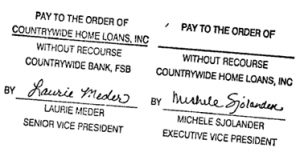
Look closely, it looks like two endorsements, two signatures, correct? Well, no, they’re not actually signatures at all….the “signatures” are just ink stamps. But that’s not what’s most interesting.

At first blush it looks like two separate stamps, but when you compare this stamp to many of the other stamps, they “both” line up perfectly and exactly. Which suggests that the figure above is really made by one singular stamp made to look like two stamps. Now did Meder stamp this? Did Sjolander stamp this? And if neither stamped it, did either stamp it?

Oh, but right, we’re not even allowed to make such inquiry correct?