
Fourteen Servicers Begin Lengthy Foreclosure Review Process
By: Krista Franks 11/01/2011
The Office of the Comptroller of the Currency (OCC) and the Federal Reserve Board both announced Tuesday that the independent foreclosure reviews of 14 large servicers issued in April are now under way.
About 4.5 million borrowers could have their loans reviewed and potentially be compensated for imposed financial hardship, according to a previous statement by the OCC.
According to the OCC, the review will take several months due to the volume of potential foreclosures to review.
The foreclosure review is part of a broader list of enforcement actions for the servicers to rectify missteps in the foreclosure process. The enforcement actions mandated by the OCC include improved borrower communications, greater oversight of third-party vendors, updated management information systems, and the elimination of “dual tracking” – which takes place when a servicer forecloses while a borrower is being considered for a modification.
The OCC issued enforcement actions to: Ally’s GMAC Mortgage, Aurora Bank, Bank of America, Citibank, EverBank, HSBC, JPMorgan Chase, MetLife, OneWest, PNC, Sovereign Bank, SunTrust, U.S. Bank, and Wells Fargo.
The Federal Reserve Board issued similar mandates in April and is also requiring the four large servicers it oversees – GMAC , HSBC, SunTrust, and JPMorgan’s EMC Mortgage – to appoint a single point of contact to certain distressed borrowers.
“The independent foreclosure review is a significant component of the mortgage servicers’ compliance with our enforcement actions,” said acting Comptroller of the Currency John Walsh. “These requirements help ensure that the servicers provide appropriate compensation to borrowers who suffered financial harm as a result of improper practices identified in our enforcement actions.”
Independent consultants will begin reviewing cases in which borrowers believe they suffered financial harm due to foreclosure actions that occurred between 2009 and 2010.
Servicers began mailing letters to borrowers Tuesday explaining the process of requesting a review, according to the OCC.
If independent reviewers determine a borrower did face financial harm due to misrepresentations or errors by the servicer, the servicer will be required to compensate the borrower.
“Borrowers are encouraged to carefully consider the information about the review program to determine if they should participate,” stated the Fed in its Tuesday announcement. “There are no costs associated with being included in the review.”
The Fed is also calling on independent reviewers to conduct a comprehensive examination of certain categories of foreclosures. For example, they will look for violations of the Servicemembers Civil Relief Act and review all cases in which a borrower filed a complaint about their foreclosure proceeding.
Borrowers’ requests for reviews will be accepted through the end of April.
Author: timothymccandless
I have spent most of my professional life helping people who were being taken advantage of by systems they did not fully understand.
As an attorney, I represented consumers against predatory lending practices and worked in elder law protecting seniors from fraud. My family lost $239,145 to identity theft, which became the foundation for my seniorgard.onlime and deepened my commitment to financial education.
Since 2008, I have maintained a blog at timothymccandless.wordpress.com providing free financial education. Not behind a paywall. Free, because financial literacy should not cost money.
I trade with real money using the exact strategy described in this book. My current positions: Pfizer at $16,480 deployed generating $77,900 per year net. Verizon at $29,260 deployed generating $51,000 per year net. Combined: 293% annualized pace. These are my only active positions. Not cherry-picked.
FHFA OIG Report
Click to access EVL-2011-004.pdf
Should be self-explanatory…
Litigation docs from Matt Weider
The cat is way out of the bag. The lenders and banks that brought our country to the verge of collapse with fraud, misrepresentation and lies have now brought these same practices into local courtrooms. Every day judges who sign foreclosure orders are confronted with legal pleadings that do not conform to the most basic requirements of professional standards, but who really cares about that…the real issue is that because the lenders cannot produce the evidence they need to proceed with their cases, they….produce the evidence they need to proceed with their cases.
I’ve previously posted about affidavit and assignment fraud…it comes in three areas:
1) False Affidavits of Service or False Affidavits That We Could Not Serve the Defendant. (See Sewer Service);
2)False Assignments of Mortgage (MERS assigns this Mortgage to Deutsche Bank who now has the right to foreclose);
3)False Affidavits of Amounts due and owing.
A Subpoena for Every Foreclosure!
Many times these documents are false on their face, but sometimes it takes a little digging to uncover the lies and misrepresentations….that’s where a subpoena comes in. The following is text of a subpoena I use. Next is a Motion to Strike Affidavit. Now there are going to be foreclosures that are proper (such as when original lenders foreclose) but in virtually every other case (especially when a pretender lender is a Plaintiff), when pressed, you’re going to find that the evidence submitted to the court is filled with mistakes lies or outright misrepresentations. Given what we’re learning about the scope of this problem…subpoenas should be dropped in every case for every fact witness, assignor, assignee and affiant. Please share results of your work with me! Together we’ll take my beloved courts back.
________________________________________
SUBPOENA DUCES TECUM FOR RECORDS WITH DEPOSITION
STATE OF FLORIDA:
TO:
YOU ARE HEREBY COMMANDED to appear before a person authorized by law to take depositions at the law offices of MATTHEW D. WEIDNER, P.A., 1229 Central Avenue, St. Petersburg, Florida 33705, on MONTH DAY, 2010, for the taking of your deposition in this action and to have with you at the above time and place the following:
1. All books, papers, records, documents and other tangible things kept by LITTON LOAN SERVICING, LP concerning the transactions alleged in the complaint against Annabel E. Montgomery.
2. Any and all other books, papers, records, documents or tangible things that relate to HSBC BANK, USA, ASSOCIATION AS TRUSTEE FOR THE ACE SECURITIES CORPORATION HOME EQUITY LOAN TRUST, SERIES 2005-AG1, ASSET BACKED PASS-THROUGH CERTIFICATES’ claim against ANNABEL E. MONTGOMERY.
3. All employment records that exist between Christopher Spradling and any employer who has employed Spradling within the last three years including current employers.
4. All records that purport to give Christopher Spradling the authority to sign or execute any documents on behalf of any person or entity.
5. All documents, records, books, evidence or instructions that you reviewed or relied upon in order to prepare the affidavit or assignment executed in this case.
These items will be inspected and may be copied at that time. You will not be required to surrender the original items. You have the right to object to the production pursuant to this subpoena at any time before production by giving written notice to the attorney whose name appears on this subpoena. You may condition the preparation of the copies upon the payment in advance of the reasonable cost of preparation.
If you fail to: (a) appear as specified, or (b) furnish the records instead of appearing as provided above; or (c) object to this subpoena you may be in contempt of Court. You are subpoenaed by the attorneys whose names appear on this subpoena, and unless excused from this subpoena by the attorney or the Court, you shall respond to this subpoena as directed.
DATED on XXXX X, 2010.
FOR THE COURT
Matthew D. Weidner, P.A.
1229 Central Avenue
St. Petersburg, FL 33705
By: ________________________________
Matthew D. Weidner
FBN: 0185957
Defendant’s Motion to Strike Affidavit of Christopher Spradling and for attorney’s fees and costs
COMES NOW, the Defendant Annabel E. Montgomery (hereinafter “Defendant”), by and through the undersigned counsel MATTHEW D. WEIDNER, and respectfully MOTIONS THIS COURT TO STRIKE AFFIDAVIT OF CHRISTOPHER SPADLING AND FOR ATTORNEY’S FEES AND COSTS, pursuant to Fla. R. Civ. Pro. 1.510, and in support thereof states as follows:
FACTS
1. This is an action for foreclosure of real property owned by the Defendant.
2. The named plaintiff in this case is HSBC BANK, USA, NATIONAL ASSOCATION, AS TRUSTEE FOR THE ACE SECURITIES CORPORATION HOME EQUITY TRUST, SERIES 2005-AG1, ASSET BACKED PASS-THROUGH CERTIFICATE (hereinafter “Plaintiff”).
3. On February 2, 2010 Plaintiff, by and through its counsel Florida Default Law Group, P.L. (hereinafter “Florida Default Law Group”), gave Notice of Filing of Affidavit as to Amounts Due and Owing and the accompanying Affidavit (hereinafter “Affidavit”).
4. The Affiant of the above-mention Affidavit was identified as Christopher Spradling (hereinafter “Spradling”). Spradling identified himself as a “Foreclosure Manager” for LITTON LOAN SERVICING, LP (hereinafter “Litton”). Litton, in turn, was identified as “the servicer of the loan…[Litton] is responsible for the collection of this loan transaction and pursuit of any delinquency in payments.”[1]
5. Spradling, based upon his personal knowledge, averred in the Affidavit that: (1) the Plaintiff or its assigns was owed a total of $408,809.30; (2) the Plaintiff was entitled to enforce the Note and Mortgage; and (3) Plaintiff was entitled to a judgment as a matter of law.[2] The Affidavit does not contain any mention as to who owes the Plaintiff the sum alleged save for one sentences line which cryptically state “[s]pecifically, I have personal knowledge of the facts regarding the sums which are due and owing to Plaintiff or its assigns pursuant to the Note and Mortgage which is the subject matter of the lawsuit” and a second which states “I am familiar with the books of account…concerning the transactions alleged in the Complaint.”[3] Emphasis added.
6. Nowhere in the Affidavit was either Litton or Spradling identified as either the Plaintiff or the Plaintiff’s authorized agent.
7. Upon information and belief, Litton is simply a “middleman” of sorts who is responsible for the transfer of funds between the various assignees of the underlying Mortgage and Note and has no knowledge of the underlying transactions between the Plaintiff and Defendant.
8. Upon information and belief, Spradling, as employee of Litton and not the Plaintiff, has no knowledge of the underlying transactions between the Plaintiff and Defendant.
LEGAL REASONING IN SUPPORT OF MOTION
1. I. Plaintiff Failed to Attach Documents Referred to in the Affidavit
1. a. Failure to Attach Documents Violates Fla. Stat. §90.901 (1989)
Florida Statue §90.901 (1989) states, in pertinent part, that “[a]uthentication or identification of evidence is required as a condition precedent to its admissibility.” The failure to authenticate documents referred to in affidavits renders the affiant incompetent to testify as to the matters referred to in the affidavit. See Fla. R. Civ. Pro. 1.510(e) (which reads, in pertinent part, that “affidavits…shall show affirmatively that the affiant is competent to testify to the matters stated therein”); Zoda v. Hedden, 596 So. 2d 1225, 1226 (Fla. 2d DCA 1992) (holding, in part, that failure to attach certified copies of public records rendered affiant, who was not a custodian of said records, incompetent to testify to the matters stated in his affidavit as affiant was unable to authenticate the documents referred to therein.)
Here, Spradling affirmatively states in the Affidavit that he is “familiar with the books of account and have examined all books, records, and documents kept by LITTON LOAN SERVICING, LP concerning the transactions alleged in the Complaint.”[4] Furthermore, Spradling averred that the “Plaintiff or its assigns, is owed…$408,809.30.”[5] Nevertheless, Spradling has failed to attach any of the books, records or documents referred to in the Affidavit. In addition, Spradling does not meet the definition of “custodian,” which is “a person or institution that has charge or custody (of…papers).” See Black’s Law Dictionary, 8th ed. 2004, custodian. By Spradling’s own admission “[t]he books, records, and documents which [Spradling] has examined are managed by employees or agents whose duty it is to keep the books accurately and completely.”[6] Emphasis added. Thus, Spradling has only examined the books, records, and documents which he refers to in the Affidavit while the true custodians of these documents are the employees or agents whose duty it is to keep the books accurately and completely. In essence, Spradling averred to records which he did not submit nor could he testify for the authenticity of just as the affiant in Zoda did.
Spradling’s failure to attach the documents referred to in the Affidavit without being custodian of same is a violation of the authentication rule promulgated in Fla. Stat. §90.901 (1989), which renders him incompetent to testify to the matters stated therein as the Second District in Zoda held. Therefore, the Affidavit should be struck in whole.
1. b. Failure to Attach Documents Violates Fla. R. Civ. Pro. 1.510(e)
Fla. R. Civ. Pro. 1.510(e) provides, in part, that “[s]worn or certified copies of all papers or parts thereof referred to in an affidavit shall be attached thereto or served therewith.” Failure to attach such papers is grounds for reversal of summary judgment decisions. See CSX Transp., Inc. v. Pasco County, 660 So. 2d 757 (Fla. 2d DCA 1995) (reversing summary judgment granted below where the affiant based statements on reports but failed to attach same to the affidavit.)
As previously demonstrated, Spradling referred to books, records, and documents kept by Litton which allegedly concerned the transaction referred to in the Complaint against the Defendant. Nevertheless, as previously demonstrated, Spradling has not attached any of these books, records or documents. This failure to do so is a violation of Fla. R. Civ. Pro. 1.510(e) and is grounds for a reversal of a summary judgment decision in favor of the Plaintiff. Therefore, the Affidavit should be struck in whole.
1. II. Affidavit Was Not Based Upon Spradling’s Personal Knowledge
As a threshold matter, the admissibility of an affidavit rests upon the affiant having personal knowledge as to the matters stated therein. See Fla. R. Civ. Pro. 1.510(e) (reading, in pertinent part, that “affidavits shall be made on personal knowledge”); Enterprise Leasing Co. v. Demartino, 15 So. 3d 711 (Fla. 2d DCA 2009); West Edge II v. Kunderas, 910 So. 2d 953 (Fla. 2d DCA 2005); In re Forefeiture of 1998 Ford Pickup, Identification No. 1FTZX1767WNA34547, 779 So. 2d 450 (Fla. 2d DCA 2000). Additionally, a corporate officer’s affidavit which merely states conclusions or opinion is not sufficient, even if it is based on personal knowledge. Nour v. All State Supply Co., So. 2d 1204, 1205 (Fla. 1st DCA 1986).
The Third District, in Alvarez v. Florida Ins. Guaranty Association, 661 So. 2d 1230 (Fla. 3d DCA 1995), noted that “the purpose of the personal knowledge requirement is to prevent the trial court from relying on hearsay when ruling on a motion for summary judgment and to ensure that there is an admissible evidentiary basis for the case rather than mere supposition or belief.” Id at 1232 (quoting Pawlik v. Barnett Bank of Columbia County, 528 So. 2d 965, 966 (Fla. 1st DCA 1988)). This opposition to hearsay evidence has deep roots in Florida common law. In Capello v. Flea Market U.S.A., Inc., 625 So. 2d 474 (Fla. 3d DCA 1993), the Third District affirmed an order of summary judgment in favor of Flea Market U.S.A as Capello’s affidavit in opposition was not based upon personal knowledge and therefore contained inadmissible hearsay evidence. See also Doss v. Steger & Steger, P.A., 613 So. 2d 136 (Fla. 4th DCA 1993); Mullan v. Bishop of Diocese of Orlando, 540 So. 2d 174 (Fla. 5th DCA 1989); Crosby v. Paxson Electric Company, 534 So. 2d 787 (Fla. 1st DCA 1988); Page v. Stanley, 226 So. 2d 129 (Fla. 4th DCA 1969). Thus, there is ample precedent for striking affidavits in full which are not based upon the affiant’s personal knowledge.
Here, the entire Affidavit is hearsay evidence as Spradling has absolutely no personal knowledge of the facts stated therein. As an employee of Litton, which purports to be the servicer of the loan, he has no knowledge of the underlying transaction between the Plaintiff and the Defendant. Neither Spradling nor Litton: (1) were engaged by the Plaintiff for the purpose of executing the underlying mortgage transaction with the Defendant; or (2) had any contact with the Defendant with respect to the underlying transaction between the Plaintiff and Defendant. In addition, the Affidavit fails to set forth with any degree of specificity what duties Litton performs for the Plaintiff, save for one line which states that Litton “is responsible for the collection of this loan transaction and pursuit of any delinquency in payments.”[7] At best, Litton acted as a middleman of sorts, whose primary function was to transfer of funds between the various assignees of the underlying Mortgage and Note. Litton is not the named Plaintiff in this case, nor does the Affidavit aver that either Spradling or Litton is the agent of the Plaintiff.
Because Spradling has no personal knowledge of the underlying transaction between the Plaintiff and Defendant, any statement he gives which references this underlying transaction (such as the fact that the Plaintiff is allegedly owed sums of monies in excess of $400,000) is, by its very nature, hearsay. The Florida Rules of Evidence define hearsay as “a statement, other than one made by the declarant while testifying at the trial or hearing, offered in evidence to prove the truth of the matter asserted.” Fla. Stat. §90.801(1)(c) (2007). Here Spradling is averring to a statement (that the Plaintiff is allegedly owed sums of money) which was made by someone other than himself (namely, the Plaintiff) and is offering this as proof of the matter asserted (that Plaintiff is entitled to enforce the Note and Mortgage and that Plaintiff is entitled to a judgment as a matter of law.) At best, the only statements which Spradling can aver to are those which regard the transfer of funds between the various assignees of the Mortgage and Note.
The Plaintiff may argue that while Spradling’s statements may be hearsay, they should nevertheless be admitted under the “Records of Regularly Conducted Business Activity” exception. Fla. Stat. §90.803(6) (2007). This rule provides that notwithstanding the provision of §90.802 (which renders hearsay statements inadmissible), hearsay statements are not inadmissible, even though the declarant is available as a witness, if the statement is
[a] memorandum, report, record, or data compilation, in any form, of acts, events, conditions, opinion, or diagnosis, made at or near the time by, or from information transmitted by, a person with knowledge, if kept in the course of a regularly conducted business activity and if it was the regular practice of that business activity to make such memorandum, report, record, or data compilation, all as shown by the testimony of the custodian or other qualified witness, or as shown by a certification or declaration that complies with paragraph (c) and s. 90.902(11), unless the sources of information or other circumstances show lack of trustworthiness. Emphasis added.
There are, however, several problems with this argument. To begin, and as previously demonstrated, no memorandums, reports, records, or data compilation have been offered by the Plaintiff. Furthermore, the books, records, and documents referred to by Spradling in the Affidavit (which, of course, were not attached) were kept by Litton, who cannot be a person with knowledge as Litton does not have any personal knowledge of underlying transaction between the Plaintiff and the Defendant. Finally, Litton, as the source of this information, shows a lack of trustworthiness because Spradling failed to attach the books, records, and documents to the Affidavit and because neither Litton nor Spradling have knowledge of the underlying transaction between the Plaintiff and the Defendant.
Because Spradling’s statements in the Affidavit are not based upon personal knowledge, they are inadmissible hearsay evidence. As no hearsay exception applies to these statements, the Affidavit should be struck in whole.
1. III. Affidavit Included Impermissible Conclusions of Law Not Supported by Facts
An affidavit in support of a motion for summary judgment may not be based upon factual conclusions or opinions of law. Jones Constr. Co. of Cent. Fla., Inc. v. Fla. Workers’ Comp. JUA, Inc., 793 So. 2d 978, 979 (Fla. 2d DCA 2001). Furthermore, an affidavit which states a legal conclusion should not be relied upon unless the affidavit also recites the facts which justify the conclusion. Acquadro v. Bergeron, 851 So. 2d 665, 672 (Fla. 2003); Rever v. Lapidus, 151 So. 2d 61, 62 (Fla. 3d DCA 1963).
Here, the Affidavit contained conclusions of law which were not supported by facts stated therein. Specifically, Spradling averred that the Plaintiff was entitled to enforce the Note and Mortgage and that the Plaintiff was entitled to a judgment as a matter of law, two legal conclusions, but did not support this conclusion with statements which referenced exactly who the Plaintiff was entitled to enforce the Note and Mortgage against. In fact there is no mention of any of the parties in question save for one cryptic line in where Spradling states that “[s]pecifically, I have personal knowledge of the facts regarding the sums which are due and owing to Plaintiff or its assigns pursuant to the Note and Mortgage which is the subject matter of the lawsuit” and another which states “I am familiar with the books of account…concerning the transactions alleged in the Complaint.”[8] Nowhere in the Affidavit does Spradling state that the Plaintiff is entitled to enforce the Note and Mortgage against the Defendant nor does Spradling state that the Plaintiff is entitled to a judgment as a matter of law because the Defendant owes the Plaintiff money. At best the Affidavit accuses someone of owing the Plaintiff $408,809.30 and that the Plaintiff should be able to enforce some Note and Mortgage against that particular someone. By not clearly identifying the parties in question, Spradling has not adequately supported his two legal conclusions.
Because the Affidavit contained impermissible conclusions of law which were not supported by facts stated therein, the Affidavit should be struck in whole.
1. IV. Sanction of Attorney’s Fees is Appropriate
Fla. R. Civ. Pro. 1.510(g) reads, in full, that
[i]f it appears to the satisfaction of the court at any time that any of the affidavits presented pursuant to this rule are presented in bad faith or solely for the purpose of delay, the court shall forthwith order the party employing them to pay to the other party the amount of the reasonable expenses which the filing of the affidavits caused the other party to incur, including reasonable attorneys’ fees, and any offending party or attorney may be adjudged guilty of contempt. Emphasis added.
The undersigned counsel has expended considerable time and resources preparing to defend against an affidavit which has, on its face, no basis in law. Both Florida Default Law Group and the Plaintiff both knew that Spradling’s affidavit lacked authenticity and reliability yet still chose to file it with the Court. In addition, this is not Florida Default Law Group’s first time filing affidavits in bad faith. Recently, the Bankruptcy Court for the Southern District of Florida sanctioned both Florida Default Law Group and its client, WELLS FARGO, $95,130.45 for false representations made in affidavits in that court as well as other bankruptcy courts in Florida. See In re: Fazul Haque, Case No. 08-14257-BKR-JKO (Order Granting Wells Fargo, N.A.’s Motion for Relief from Stay and Imposing Sanctions for Negligent Practice and False Representations, Oct. 28, 2008). This is indicia of a modus operandi on Florida Default Law Group’s part to present misrepresentations and false affidavits to the Court which make an award of attorney’s fees and costs an appropriate sanction.
WHEREFORE, Defendant asks this Court to GRANT its MOTION TO STRIKE AFFIDAVIT OF CHRISTOPHER SPRADLING and enter an ORDER granting ATTORNEY’S FEES AND COSTS and any other relief the Court deems just and proper.
________________________________________
[1] See Affidavit As to Amounts Due and Owing, pg. 1.
[2] Id, pgs. 1, 2.
[3] Id.
[4] See Affidavit As to Amounts Due and Owing, pg. 1.
[5] Id, pg. 2.
[6] See Affidavit As to Amounts Due and Owing, pg. 1.
[7] See Affidavit As to Amounts Due and Owing, pg. 1.
[8] See Affidavit As to Amounts Due and Owing, pg. 1.
The Law of Capitalism THE MASS MISS JOINDER
 I attended the Attorney General and state Bar hearing as to the intervention of the state bar into the law practice of Mitchell Stein and the K2 mass Joinder cases in Los Angeles in front of Judge Johnson. The tentative was a scathing implication of Mitchell Stein and his purported involvement with the “marketing companies” and the allegations of unfair business practices all needed for the AG and the State Bar to step in and confiscate 1.6 million in various accounts.
I was there to opine the status of the case itself and the merits of the cases and as to the victims rights as against the banks. If the Bar took over the practice would they defend the cases would they protect the victims right. No they are not; right now they the State Bar are telling the victims they are on there own.
Once again these suits I have been following and hoping could get past the Demur stage the Banks would be forced to answer. Then there would be motions for Summary Judgement and if the Victims could survive the Summary Judgement and thousands of requests for admissions and interrogatories propounded on the thousands of plaintiffs. It could be done I would have to associate about 10 other lawyers and 30 paralegals but it could be done for about $700,000.00. Then I believe the Banks would enter settlement negotiations with the victims witch I calculate to be about 6500 victims to date.
Mandelman characterized the case as follows:
The case at the core of the Kramer and Kaslow mass joinder lawsuit is: Ronald vs. Bank of America. Basically, the case accuses Countrywide (subsequent cases being filed include Citibank, One West, GMAC/Ally Bank, and perhaps others) of perpetrating a massive fraud upon homeowners by knowingly inflating appraisals, creating a bubble the bank knew would pop and leave homeowner equity devastated, violate privacy statutes, and then Civil Code sections when they refused to modify… you get the idea.
The case says that Countrywide execs knew and did it anyway in order to make zillions of dollars securitizing the loans and therefore only others would incur the future losses.
Here’s an overview of what the third amended complaint says in its Introduction section:
2. This action seeks remedies for the foregoing improper activities, including a massive fraud perpetrated upon Plaintiffs and other borrowers by the Countrywide Defendants that devastated the values of their residences, in most cases resulting in Plaintiffs’ loss of all or substantially all of their net worths.
6. Hand-in-hand with its fraudulently-obtained mortgages, Mozilo and others at Countrywide hatched a plan to “pool” the foregoing mortgages and sell the pools for inflated value. Rapidly, these two intertwined schemes grew into a brazen plan to disregard underwriting standards and fraudulently inflate property values – county-by- county, city-by-city, person-by-person – in order to take business from legitimate mortgage-providers, and moved on to massive securities fraud hand-in-hand with concealment from, and deception of, Plaintiffs and other mortgagees on an unprecedented scale.
7. From as early as 2004, Countrywide’s senior management led by Mozilo knew the scheme would cause a liquidity crisis that would devastate Plaintiffs’ home values and net worths. But, they didn’t care, because their plan was based on insider trading – pumping for as long as they could and then dumping before the truth came out and Plaintiffs’ losses were locked in.
9. It is now all too clear that this was the ultimate high-stakes fraudulent investment scheme of the last decade. Couched in banking and securities jargon, the deceptive gamble with consumers’ primary assets – their homes – was nothing more than a financial fraud perpetrated by Defendants and others on a scale never before seen. This scheme led directly to a mortgage meltdown in California that was substantially worse than any economic problems facing the rest of the United States. From 2008 to the present, Californians’ home values decreased by considerably more than most other areas in the United States as a direct and proximate result of the Defendants’ scheme set forth herein.
This massive fraudulent scheme was a disaster both foreseen by Countrywide and waiting to happen. Defendants knew it, and yet Defendants still induced the Plaintiffs into their scheme without telling them.
10. As a result, Plaintiffs lost their equity in their homes, their credit ratings and histories were damaged or destroyed, and Plaintiffs incurred material other costs and expenses, described herein. At the same time, Defendants took from Plaintiffs and other borrowers billions of dollars in interest payments and fees and generated billions of dollars in profits by selling their loans at inflated values.
14. Since the time Plaintiffs filed the initial Complaint herein, Defendants’ improper acts have continued, including, inter alia: (i) issuing Notices of Default in violation of Cal. Civil Code §2923.5; (ii) misrepresenting their intention to arrange loan modifications for Plaintiffs, while in fact creating abusive roadblocks to deprive Plaintiffs of their legal rights; and (iii) engaging in intrinsic fraud in this Court and in Kentucky by stalling in addressing Plaintiffs’ legitimate requests to cancel notices of default and for loan modifications, and by refusing to respond, in any way, to Plaintiffs’ privacy causes of action.
Now, there’s no question… this is a real lawsuit. Some attorneys believe it will be a very difficult case to win, while others think it’s quite viable and likely to settle. I can see both sides of that argument.
On one hand, it would seem difficult to prove that Countrywide caused the housing bubble; there were certainly many parties involved and numerous other contributing factors as well. On the other hand, the case has numerous aspects that are unquestionably true and certainly wrong.
Then there’s what’s known as “the banker factor.” Actually, I’m making that up, but you know what I mean. The banks aren’t going to lay down for this as it would open an enormous can of litigating worms… so they have to fight… or is there no percentage in that either? Well, now you’ve seen first hand why I chose not to go to law school.
I really haven’t the foggiest idea what’s going to happen… and neither does anyone else.
But then, Columbus couldn’t exactly stop and ask for directions either, which, it’s worth noting is why, when sailing for The New World, he landed in the Bahamas and named them San Salvador, but assumed he had found the Indies so he named the native people Indians (leading me to always wonder what he would have named them had he not gotten so hopelessly lost.)
(What if his favorite word was “Jujubees,” and he had named the natives “Jujubees?” Then I would have grown up playing Cowboys & Jujubees?)
So, since no one can know what’s going to happen in the future of this case, I thought I’d take a look at where it is today. From a review of the Los Angeles Superior Court’s online records database we find these events have transpired to-date or are set for the near future…
1. Original complaint was filed in March 2009.
2. First amended complaint was in June of 2009.
3. Second amended complaint March 2010.
4. August 2010: the banks try to remove the case to federal court, but fail.
5. Third amended complaint was filed July 7, 2010.
6. The defendant banksters have demurred again, but it doesn’t appear that the demurs filed in December have been heard.
7. Status conference set for Thursday, February 3rd, 2011.
8. There is a hearing date scheduled for March 29, 2011, but it’s not clear to me what will be happening at that hearing.
So, this is their third “amended complaint.” That means the defendants… the banks… have demurred twice. That means that the banks have come to court claiming that the mass joinder plaintiffs don’t state a cause of action… or in other words saying the plaintiffs have no case… and the court has allowed the plaintiffs to amend the complaint three times so far.
Like almost everything in the law, I guess you could read that a couple of different ways. On one hand it seems positive… the case brought by the mass joinder plaintiffs has not been tossed out by the judge yet. That’s good, right?
On the other hand… the court could “sustain the demur without leave to amend,” in which case the mass joinder suit would be over and done.
And that’s why litigating is always a gamble, and by no means a sure thing.
Here’s an oversimplified look at the mass joinder’s causes of action.
First Cause of Action… Fraudulent Concealment – This is saying that the bank was hiding things from the borrowers.
Second Cause of Action… Intentional Misrepresentation – This is lying when you knew you were lying. In other words, you knew an appraisal was wrong… it came in at $500,000, but you knew it was worth $400,000 and you passed it off anyway.
Third Cause of Action… Negligent Misrepresentation – This is like saying that you’re lying but it wasn’t intentional. Let’s say that you ordered an appraisal but never really looked at the appraisal to make sure it was done correctly. You include this cause of action in case the conduct doesn’t rise to the level of intentional misrepresentation, and perhaps because some insurance policies don’t cover intentional acts.
Fourth Cause if Action… Invasion of Constitutional Right to Privacy – This is saying that the banks disclosed personal information… perhaps when selling the loans to another investor.
Fifth Cause of Action… Violation of California Financial Information Privacy Act – See above or read the actual complaint.
Sixth Cause of Action… Civil Code 2923.5 – Defendants are prohibited by statute from recording a Notice of Default against the primary residential property of any Californian without first making contact with that person as required under § 2923.5 and then interacting with that person in the manner set forth in detail under § 2923.5. Nothing special here, but its been upheld by other courts in California.
Seventh Cause of Action… Civil Code 1798 – When they gave away your private information, they didn’t tell you they did it? Defendants failed to timely disclose to Plaintiffs the disclosure of their personal information as required under California Civil Code § 1798.82
Eighth Cause of Action… Unfair Competition Against All Defendants – Defendants’ actions in implementing and perpetrating their fraudulent scheme of inducing Plaintiffs to accept mortgages for which they were not qualified based on inflated property valuations and undisclosed disregard of their own underwriting standards and the sale of overpriced collateralized mortgage pools, all the while knowing that the plan would crash and burn, taking the Plaintiffs down and costing them the equity in their homes and other damages, violates numerous federal and state statutes and common law protections enacted for consumer protection, privacy, trade disclosure, and fair trade and commerce.
In Conclusion…
Attorney Phillip Kramer, in his own words, made it quite clear that his firm was not responsible for the mailer I received or the telemarketing about which I’ve been notified. Once again, he says…
“I know of no outbound calling. If asked, I would not approve of that. I knew that some law firms wanted to send out mailers. I have insisted that everyone comply with State Bar rules and that anything with my name must be pre-approved. As of this date, no one has submitted any proposed marketing for my review. That piece was done without my knowledge.
I am happy to pay a referral fee to other law firms. I do not split fees, pay commissions, nor do I pay referral fees to non-lawyers. I do not use cappers, and have never authorized anyone to robocall, telemarket, spam email, or undertake any mass marketing on my behalf.”
With that said I was going to apply to the Bar to take over the cases if they would relinquish the 1.6 to pay for the work to be done for the victims. Before making such a wild leap into this caos I called my State bar lawyer. He informed me that I should not even go close to these cases that all lawyers involved will be DISBARRED. I said wow but what about the merits of the cases the judge in the case had already overruled the demur as to some of the causes of action. The State Bar (by their actions in not finding a lawyer to protect the victims) is recommending that case be dismissed the Attorney General IS NOT PURSUING THE RIGHTS OF THE VICTIMS . I persisted with my lawyer. To which he exclaimed ” DON’T YOU GET IT MCCANDLESS THE AG AND THE BAR ARE WORKING FOR THE BANKS”.
Fannie Mae Foreclosure Lawyers Acted Improperly
 Homeowners in Northern California have questioned the practices of Fannie Mae and Freddie Mac in foreclosure proceedings. If you are facing a foreclosure, you may be able to keep the property by filing for bankruptcy. You should consult with an attorney regarding your legal options.
After news reports in mid-2010 began to describe the dubious practices, like the routine filing of false pleadings in bankruptcy courts, Fannie Mae’s overseer started to scrutinize the conduct of its attorneys. The inspector general of the Federal Housing Finance Agency severely criticized the FHFA’s oversight of Fannie Mae and the practices of its foreclosure attorneys in a report issued Tuesday. “American homeowners have been struggling with the effects of the housing finance crisis for several years, and they shouldn’t have to worry whether they will be victims of foreclosure abuse,” Inspector General Steve Linick told the New York Times. “Increased oversight by F.H.F.A. could help to prevent these abuses.”
According to the New York Times, the report is the second in two weeks in which the inspector general has outlined lapses at both the Federal Housing Finance Agency and the companies it oversees Federal National Mortgage Assn (Fannie Mae) and Federal Home Loan Mortgage Corp (Freddie Mac). The agency has acted as conservator for the companies since they were taken over by the government in 2008. Its duty is to ensure that their operations do not pose additional risk to the taxpayers who now own them. The companies have tapped the taxpayers to cover mortgage losses totaling about $160 billion. The new report from the inspector general tracks Fannie Mae’s dealings with the law firms handling its foreclosures from 1997, when the company created its so-called retained attorney network. At the time, Fannie Mae was a highly profitable and powerful institution, and it devised the legal network to ensure that borrower defaults would be resolved with efficiency and speed.
The law firms in the network agreed to a flat-rate fee structure and pricing model based on the volume of foreclosures they completed. The companies that serviced the loans for Fannie Mae, were supposed to monitor the law firms’ performance and practices, the report noted
After receiving information from a shareholder in 2003 about foreclosure abuses by its law firms, Fannie Mae assigned its outside counsel to investigate, according to the report. That law firm concluded in a 2006 analysis that “foreclosure attorneys in Florida are routinely filing false pleadings and affidavits,” and that the practice could be occurring elsewhere. “It is axiomatic that the practice is improper and should be stopped,” the law firm said.
The inspector general’s report said that it could not be determined whether Fannie Mae had alerted its regulator, then the Office of Federal Housing Enterprise Oversight, to the legal improprieties identified by its internal investigation.
The inspector general said that both Fannie Mae and its regulator appear to have ignored other signs of problems in their foreclosure operations. For example, the Federal Housing Finance Agency did not respond to borrower complaints about improper actions taken by law firms in foreclosures received as early as August 2009, even though foreclosure abuse poses operational and financial risks to Fannie Mae.
The report cited a media report from early 2008 detailing foreclosure abuses by law firms doing work for Fannie Mae. Nevertheless, a few months later and just before its takeover by the government, Fannie Mae began requiring the banks that serviced its loans to use only those law firms that were in its network. By then, 140 law firms in 31 jurisdictions were in the group. Fannie Mae, the mortgage finance giant, learned as early as 2003 of extensive foreclosure abuses among the law firms it had hired to remove troubled borrowers from their homes. But the company did little to correct the firms’ practices,.
Finally last fall, after an outcry over apparently forged foreclosure documents and other improprieties, the Federal Housing Finance Agency began investigating the company’s process. In a report issued early this year, it determined that Fannie Mae’s management of its network of lawyers did not meet safety and soundness standards. Among the reasons: the company’s controls to prevent or detect foreclosure abuses were inadequate, as was the company’s monitoring of the law firms. “If a law firm self-reported no issues as it processed cases,” the inspector general said, “then Fannie Mae presumed the firm was doing a good job.” The agency is still deciding how to handle the lawyer network, the inspector general said.
Officials at the housing agency have agreed with the recommendations in the inspector general’s report. Corinne Russell, a spokeswoman for F.H.F.A. said the agency was concluding its supervisory work in this area and would direct Fannie Mae to take necessary action when the work was completed.
In a response, the agency said that by Sept. 29, 2012, it would review its existing supervisory practices and act to resolve “deficiencies in the management of risks associated with default-related legal services vendors.”
If you are having problems with a loan or foreclosure, we provide free legal consultations for bankruptcy in San Francisco County, Sacramento County, Alameda County, Contra Costa County, San Mateo County, Santa Clara County, Stanislaus County, San Joaquin County, Marin County, Solano County and throughout Northern California. Contact us for a free legal consultation today.925-957-9797
Three Hundred Billion to compensate homeownners “really?” no probably 50 bucks a case!!!
Millions of current and former homeowners will have a chance to get their foreclosure cases examined to determine whether they should be compensated for banks’ mistakes, under a wide-ranging review being planned by federal regulators. Ssoo let’s see 6 Million foreclosures 50,000.00 each that’s 300 BILLION I think they are going to sweep this under the carpet just like the Countrywide deal and say they fixed it. I believe that the only way to get compensated is through litigation although this is a great admission and could be used in future litigation.
![[Mortgage]](https://i0.wp.com/si.wsj.net/public/resources/images/MI-BL544_Mortga_NS_20111003183320.jpg)
The review process, which could be unveiled in the next few weeks, will be open to borrowers who were in some stage of foreclosure in 2009 or 2010. Estimates prepared by the Office of the Comptroller of the Currency, which will oversee the review, indicate that 4.5 million borrowers could be eligible for review.
John Walsh, acting head of the OCC, unveiled some aspects of the plan in a speech last month to banking executives, when he said the agency was exploring “the best means of ensuring that injured homeowners had the opportunity to seek relief,” when they were harmed by lender improprieties.

WSJ’s Nick Timiraos has details of a plan by which 4.5 million homeowners who faced foreclosure in 2009 and 2010 could face a review of their foreclosure procedures due to errors by banks. Photo by John Moore/Getty Images
The process will include a broad public-outreach campaign, including direct mail to eligible borrowers and a single website and toll-free number. The reviews will be conducted by independent third-party companies that were hired earlier this year by 14 banks that signed consent orders in April with the OCC and the Federal Reserve. The regulators had to sign off on the selection of these companies.
“It’s a substantial undertaking at great expense to the banks,” said Tim Rood, a partner at Collingwood Group, a housing-finance consulting firm.
Borrowers who are determined to have suffered “financial injury” could be eligible for compensation that would be determined on a case-by-case basis by the third-party firms. Borrowers will have to request reviews before a cutoff date, likely to fall near the end of the first quarter of 2012. It hasn’t been determined whether borrowers that accept restitution would have to agree to surrender related legal claims.
Regulators declined to provide estimates of the amount of money that injured borrowers might receive or how much the program might cost lenders.
However, few if any borrowers are expected to have foreclosures overturned.
The review process is one of several continuing efforts to address disclosures that surfaced a year ago over banks’ use of “robo-signers,” bank employees who signed off on huge numbers of legal foreclosure filings daily and falsely claimed in the documents to have personally reviewed each case. The disclosures prompted some judges to question the veracity of other bank foreclosure practices.
The process is separate from the months-long talks between federal agencies, state attorneys general and banks to reach a multibillion-dollar settlement over foreclosure abuses. That effort took a big step backwards Friday, when California Attorney General Kamala D. Harris called the deal “inadequate” and pulled out of the settlement talks.
The loss of California could cripple any settlement because the state has among the nation’s highest volumes of foreclosures. Banks are less likely to agree to the $25 billion price tag pushed by federal and state officials without the participation of California. Banks, federal officials and state attorneys general are set to resume meetings in Washington on Tuesday.
Representatives for both sides said they still hope to reach an agreement despite Friday’s setback. The banks “remain committed to the dialogue and continue to believe that a global settlement would be an effective means of supporting the recovery of the housing market and helping to strengthen the economy,” said one person familiar with the banks’ thinking.
“We are still full-steam ahead,” said a spokesman for Iowa Attorney General Tom Miller, who is spearheading the 50-state negotiations. “With or without some states, we are still moving forward.”


Bloomberg NewsBorrowers who suffered ‘financial injury’ could be eligible for compensation. Here, a foreclosure sign hangs in front of a house in Canton, Mich., in March.
In the OCC review process, financial injury could cover a wide range of misrepresentations or errors committed by mortgage companies, according to people familiar with the process.
Banks could be liable if they miscalculated mortgage payments or applied impermissible fees or penalties. A handful of borrowers have alleged that mortgage-servicing companies, for example, improperly placed expensive insurance coverage onto their mortgage, pushing them into default and preventing them from becoming current with their payments.
Borrowers may be able to receive compensation if the review finds that the bank moved a borrower to foreclosure while the bank was receiving partial payments as part of a trial or permanent loan modification. Compensation might also be due if borrowers provide evidence that they provided the necessary documentation required to qualify for a modification but were denied the modification.
A separate report to be released on Tuesday raises new questions over Fannie Mae‘s oversight of the attorneys that conduct foreclosures on its behalf. The report, from the inspector general for the Federal Housing Finance Agency, faulted Fannie for inadequate oversight of those firms
Since 2008, Fannie has required its mortgage servicers to use designated law firms that are part of its “retained attorney network.” The network arrangement allows Fannie to negotiate discounted rates with approved firms, which in turn can lock in business from the nation’s largest mortgage investor.
The report said that in June 2010, the FHFA conducted a two-day field visit to Florida, where it found that “documentation problems were evident and law firms…were not devoting the time necessary to their cases due to Fannie Mae’s flat fee structure and volume-based processing model.”
FHFA staff subsequently informed senior Fannie officials that its attorneys were “increasingly unprepared when they enter the courtroom,” leading to a larger backlog of foreclosures.
Fannie Mae declined to comment on the report.
Are Temporary Loan And Mortgage Modifications A Scam?

As part of the Troubled Asset Relief Program financial bailout, many large national banks accepted huge sums of money from the United States government. Many of these large banks also signed agreements with the United States Treasury, in which they agreed to participate in the Home Affordable Modification Program. This program provides participating banks and mortgage servicers incentives to provide affordable mortgage loan modifications and other alternatives to foreclosure to eligible borrowers who are in danger of losing their homes.
Many banks have worked hard with homeowners to provide the homeowners with temporary trial modifications of their loans. These trial modifications, which are basically temporary modifications to the loan, are designed to lead to homeowners entering into permanent loan modifications with their banks, in order to save their homes permanently. Many homeowners have complied with temporary loan modifications on a trial basis, by providing the required documentation and making all agreed-upon payments towards the loan as it has been temporarily modified. However, many banks have not lived up to their promise to provide homeowners who have satisfied all requirements of a temporary loan modification with a permanent loan modification. This has resulted in thousands of residents across the country being deprived of the opportunity to permanently cure their delinquencies and save their homes.
The Home Affordable Modification Program has allocated to it approximately $75 billion dollars of government funds. Unfortunately, many banks have not gone far enough to make sure that their homeowners can obtain a permanent mortgage modification, even after the homeowners have satisfied all of the requirements of a temporary mortgage modification, which is supposed to lead to a permanent modification. Many of the agreements that the banks have with the homeowners state specifically that if the homeowner is in compliance with the loan modification trial period and makes all payments during the trial period, then the bank will provide the homeowner with a loan modification agreement on a permanent basis, but in practice this has not always happened.
These practices are not only contrary to the spirit of the federal legislation that created the Troubled Asset Relief Program, but may also violate the agreements between the banks and the homeowners. If you or someone you know has been effected by this practice, please contact us to discuss your legal options.
Forget Mass Joinder just use Consumer Legal Remedies Act Civil Code 1750
CALIFORNIA CIVIL CODE
SECTION 1750 et seq
Consumers Legal Remedies Act
1750. This title may be cited as the Consumers Legal Remedies Act.
1751. Any waiver by a consumer of the provisions of this title is contrary to public policy and shall be unenforceable and void.
1752. The provisions of this title are not exclusive. The remedies provided herein for violation of any section of this title or for conduct proscribed by any section of this title shall be in addition to any other procedures or remedies for any violation or conduct provided for in any other law.
Nothing in this title shall limit any other statutory or any common law rights of the Attorney General or any other person to bring class actions. Class actions by consumers brought under the specific provisions of Chapter 3 (commencing with Section 1770) of this title shall be governed exclusively by the provisions of Chapter 4 (commencing with Section 1780); however, this shall not be construed so as to deprive a consumer of any statutory or common law right to bring a class action without resort to this title. If any act or practice proscribed under this title also constitutes a cause of action in common law or a violation of another statute, the consumer may assert such common law or statutory cause of action under the procedures and with the remedies provided for in such law.
1753. If any provision of this title or the application thereof to any person or circumstance is held to be unconstitutional, the remainder of the title and the application of such provision to other persons or circumstances shall not be affected thereby.
1754. The provisions of this title shall not apply to any transaction which provides for the construction, sale, or construction and sale of an entire residence or all or part of a structure designed for commercial or industrial occupancy, with or without a parcel of real property or an interest therein, or for the sale of a lot or parcel of real property, including any site preparation incidental to such sale.
1755. Nothing in this title shall apply to the owners or employees of any advertising medium, including, but not limited to, newspapers, magazines, broadcast stations, billboards and transit ads, by whom any advertisement in violation of this title is published or disseminated, unless it is established that such owners or employees had knowledge of the deceptive methods, acts or practices declared to be unlawful by Section 1770.
1756. The substantive and procedural provisions of this title shall only apply to actions filed on or after January 1, 1971.
1760. This title shall be liberally construed and applied to promote its underlying purposes, which are to protect consumers against unfair and deceptive business practices and to provide efficient and economical procedures to secure such protection.
1761. As used in this title:
- (a) “Goods” means tangible chattels bought or leased for use primarily for personal, family, or household purposes, including certificates or coupons exchangeable for these goods, and including goods which, at the time of the sale or subsequently, are to be so affixed to real property as to become a part of real property, whether or not severable therefrom.
- (b) “Services” means work, labor, and services for other than a commercial or business use, including services furnished in connection with the sale or repair of goods.
- (c) “Person” means an individual, partnership, corporation, limited liability company, association, or other group, however organized.
- (d) “Consumer” means an individual who seeks or acquires, by purchase or lease, any goods or services for personal, family, or household purposes.
- (e) “Transaction” means an agreement between a consumer and any other person, whether or not the agreement is a contract enforceable by action, and includes the making of, and the performance pursuant to, that agreement.
- (f) “Senior citizen” means a person who is 65 years of age or older.
- (g) “Disabled person” means any person who has a physical or mental impairment which substantially limits one or more major life activities.
- (1) As used in this subdivision, “physical or mental impairment” means any of the following:
- A. Any physiological disorder or condition, cosmetic disfigurement, or anatomical loss substantially affecting one or more of the following body systems: neurological; muscoloskeletal; special sense organs; respiratory, including speech organs; cardiovascular; reproductive; digestive; genitourinary; hemic and lymphatic; skin; or endocrine.
- B. Any mental or psychological disorder, such as mental retardation, organic brain syndrome, emotional or mental illness, and specific learning disabilities. The term “physical or mental impairment” includes, but is not limited to, such diseases and conditions as orthopedic, visual, speech and hearing impairment, cerebral palsy, epilepsy, muscular dystrophy, multiple sclerosis, cancer, heart disease, diabetes, mental retardation, and emotional illness.
- (2) “Major life activities” means functions such as caring for one’ s self, performing manual tasks, walking, seeing, hearing, speaking, breathing, learning, and working.
- (h) “Home solicitation” means any transaction made at the consumer’ s primary residence, except those transactions initiated by the consumer. A consumer response to an advertisement is not a home solicitation.
1770.
- (a) The following unfair methods of competition and unfair or deceptive acts or practices undertaken by any person in a transaction intended to result or which results in the sale or lease of goods or services to any consumer are unlawful:
- (1) Passing off goods or services as those of another.
- (2) Misrepresenting the source, sponsorship, approval, or certification of goods or services.
- (3) Misrepresenting the affiliation, connection, or association with, or certification by, another. (MERS)and Securitization
- (4) Using deceptive representations or designations of geographic origin in connection with goods or services.
- (5) Representing that goods or services have sponsorship, approval, characteristics, ingredients, uses, benefits, or quantities which they do not have or that a person has a sponsorship, approval, status, affiliation, or connection which he or she does not have.
- (6) Representing that goods are original or new if they have deteriorated unreasonably or are altered, reconditioned, reclaimed, used, or secondhand.
- (7) Representing that goods or services are of a particular standard, quality, or grade, or that goods are of a particular style or model, if they are of another.
- (8) Disparaging the goods, services, or business of another by false or misleading representation of fact.
- (9) Advertising goods or services with intent not to sell them as advertised.
- (10) Advertising goods or services with intent not to supply reasonably expectable demand, unless the advertisement discloses a limitation of quantity.
- (11) Advertising furniture without clearly indicating that it is unassembled if that is the case.
- (12) Advertising the price of unassembled furniture without clearly indicating the assembled price of that furniture if the same furniture is available assembled from the seller.
- (13) Making false or misleading statements of fact concerning reasons for, existence of, or amounts of price reductions.
- (14) Representing that a transaction confers or involves rights, remedies, or obligations which it does not have or involve, or which are prohibited by law.
- (15) Representing that a part, replacement, or repair service is needed when it is not.
- (16) Representing that the subject of a transaction has been supplied in accordance with a previous representation when it has not. Sign this transaction now and when the option ARM adjusts we will refinance at no cost to you
- (17) Representing that the consumer will receive a rebate, discount, or other economic benefit, if the earning of the benefit is contingent on an event to occur subsequent to the consummation of the transaction.
- (18) Misrepresenting the authority of a salesperson, representative, or agent to negotiate the final terms of a transaction with a consumer.
- (19) Inserting an unconscionable provision in the contract.
- (20) Advertising that a product is being offered at a specific price plus a specific percentage of that price unless (1) the total price is set forth in the advertisement, which may include, but is not limited to, shelf tags, displays, and media advertising, in a size larger than any other price in that advertisement, and (2) the specific price plus a specific percentage of that price represents a markup from the seller’s costs or from the wholesale price of the product. This subdivision shall not apply to in-store advertising by businesses which are open only to members or cooperative organizations organized pursuant to Division 3 (commencing with Section 12000) of Title 1 of the Corporations Code where more than 50 percent of purchases are made at the specific price set forth in the advertisement.
- (21) Selling or leasing goods in violation of Chapter 4 (commencing with Section 1797.8) of Title 1.7.
- (22)
- (A) Disseminating an unsolicited prerecorded message by telephone without an unrecorded, natural voice first informing the person answering the telephone of the name of the caller or the organization being represented, and either the address or the telephone number of the caller, and without obtaining the consent of that person to listen to the prerecorded message.
- (B) This subdivision does not apply to a message disseminated to a business associate, customer, or other person having an established relationship with the person or organization making the call, to a call for the purpose of collecting an existing obligation, or to any call generated at the request of the recipient.
- (23) The home solicitation, as defined in subdivision (h) of Section 1761, of a consumer who is a senior citizen where a loan is made encumbering the primary residence of that consumer for the purposes of paying for home improvements and where the transaction is part of a pattern or practice in violation of either subsection (h) or (i) of Section 1639 of Title 15 of the United States Code or subsection (e) of Section 226.32 of Title 12 of the Code of Federal Regulations.
A third party shall not be liable under this subdivision unless (1) there was an agency relationship between the party who engaged in home solicitation and the third party or (2) the third party had actual knowledge of, or participated in, the unfair or deceptive transaction. A third party who is a holder in due course under a home solicitation transaction shall not be liable under this subdivision.
(b)
- (1) It is an unfair or deceptive act or practice for a mortgage broker or lender, directly or indirectly, to use a home improvement contractor to negotiate the terms of any loan that is secured, whether in whole or in part, by the residence of the borrower and which is used to finance a home improvement contract or any portion thereof. For purposes of this subdivision, “mortgage broker or lender” includes a finance lender licensed pursuant to the California Finance Lenders Law (Division 9 (commencing with Section 22000) of the Financial Code), a residential mortgage lender licensed pursuant to the California Residential Mortgage Lending Act (Division 20 (commencing with Section 50000) of the Financial Code), or a real estate broker licensed under the Real Estate Law (Division 4 (commencing with Section 10000) of the Business and Professions Code).
- (2) This section shall not be construed to either authorize or prohibit a home improvement contractor from referring a consumer to a mortgage broker or lender by this subdivision. However, a home improvement contractor may refer a consumer to a mortgage lender or broker if that referral does not violate Section 7157 of the Business and Professions Code or any other provision of law. A mortgage lender or broker may purchase an executed home improvement contract if that purchase does not violate Section 7157 of the Business and Professions Code or any other provision of law. Nothing in this paragraph shall have any effect on the application of Chapter 1 (commencing with Section 1801) of Title 2 to a home improvement transaction or the financing thereof.
1780.
- (a) Any consumer who suffers any damage as a result of the use or employment by any person of a method, act, or practice declared to be unlawful by Section 1770 may bring an action against such person to recover or obtain any of the following:
- (1) Actual damages, but in no case shall the total award of damages in a class action be less than one thousand dollars ($1,000).
- (2) An order enjoining such methods, acts, or practices.
- (3) Restitution of property.
- (4) Punitive damages.
- (5) Any other relief which the court deems proper.
- (b) Any consumer who is a senior citizen or a disabled person, as defined in subdivisions (f) and (g) of Section 1761, as part of an action under subdivision (a), may seek and be awarded, in addition to the remedies specified therein, up to five thousand dollars ($5,000) where the trier of fact (1) finds that the consumer has suffered substantial physical, emotional, or economic damage resulting from the defendant’s conduct, (2) makes an affirmative finding in regard to one or more of the factors set forth in subdivision (b) of Section 3345, and (3) finds that an additional award is appropriate. Judgment in a class action by senior citizens or disabled persons under Section 1781 may award each class member such an additional award where the trier of fact has made the foregoing findings.
- (c) An action under subdivision (a) or (b) may be commenced in the county in which the person against whom it is brought resides, has his or her principal place of business, or is doing business, or in the county where the transaction or any substantial portion thereof occurred.
If within any such county there is a municipal or justice court, having jurisdiction of the subject matter, established in the city and county or judicial district in which the person against whom the action is brought resides, has his or her principal place of business, or is doing business, or in which the transaction or any substantial portion thereof occurred, then such court is the proper court for the trial of such action. Otherwise, any municipal or justice court in such county having jurisdiction of the subject matter is the proper court for the trial thereof.
In any action subject to the provisions of this section, concurrently with the filing of the complaint, the plaintiff shall file an affidavit stating facts showing that the action has been commenced in a county or judicial district described in this section as a proper place for the trial of the action. If a plaintiff fails to file the affidavit required by this section, the court shall, upon its own motion or upon motion of any party, dismiss any such action without prejudice. - (d) The court shall award court costs and attorney’s fees to a prevailing plaintiff in litigation filed pursuant to this section. Reasonable attorney’s fees may be awarded to a prevailing defendant upon a finding by the court that the plaintiff’s prosecution of the action was not in good faith.
1781.
- (a) Any consumer entitled to bring an action under Section 1780 may, if the unlawful method, act, or practice has caused damage to other consumers similarly situated, bring an action on behalf of himself and such other consumers to recover damages or obtain other relief as provided for in Section 1780.
- (b) The court shall permit the suit to be maintained on behalf of all members of the represented class if all of the following conditions exist:
- (1) It is impracticable to bring all members of the class before the court.
- (2) The questions of law or fact common to the class are substantially similar and predominate over the questions affecting the individual members.
- (3) The claims or defenses of the representative plaintiffs are typical of the claims or defenses of the class.
- (4) The representative plaintiffs will fairly and adequately protect the interests of the class.
- (c) If notice of the time and place of the hearing is served upon the other parties at least 10 days prior thereto, the court shall hold a hearing, upon motion of any party to the action which is supported by affidavit of any person or persons having knowledge of the facts, to determine if any of the following apply to the action:
- (1) A class action pursuant to subdivision (b) is proper.
- (2) Published notice pursuant to subdivision (d) is necessary to adjudicate the claims of the class.
- (3) The action is without merit or there is no defense to the action.
A motion based upon Section 437c of the Code of Civil Procedure shall not be granted in any action commenced as a class action pursuant to subdivision (a). - (d) If the action is permitted as a class action, the court may direct either party to notify each member of the class of the action.
The party required to serve notice may, with the consent of the court, if personal notification is unreasonably expensive or it appears that all members of the class cannot be notified personally, give notice as prescribed herein by publication in accordance with Section 6064 of the Government Code in a newspaper of general circulation in the county in which the transaction occurred. - (e) The notice required by subdivision (d) shall include the following:
- (1) The court will exclude the member notified from the class if he so requests by a specified date.
- (2) The judgment, whether favorable or not, will include all members who do not request exclusion.
- (3) Any member who does not request exclusion, may, if he desires, enter an appearance through counsel.
- (f) A class action shall not be dismissed, settled, or compromised without the approval of the court, and notice of the proposed dismissal, settlement, or compromise shall be given in such manner as the court directs to each member who was given notice pursuant to subdivision (d) and did not request exclusion.
- (g) The judgment in a class action shall describe those to whom the notice was directed and who have not requested exclusion and those the court finds to be members of the class. The best possible notice of the judgment shall be given in such manner as the court directs to each member who was personally served with notice pursuant to subdivision (d) and did not request exclusion.
1782.
- (a) Thirty days or more prior to the commencement of an action for damages pursuant to the provisions of this title, the consumer shall do the following:
- (1) Notify the person alleged to have employed or committed methods, acts or practices declared unlawful by Section 1770 of the particular alleged violations of Section 1770.
- (2) Demand that such person correct, repair, replace or otherwise rectify the goods or services alleged to be in violation of Section 1770.
Such notice shall be in writing and shall be sent by certified or registered mail, return receipt requested, to the place where the transaction occurred, such person’s principal place of business within California, or, if neither will effect actual notice, the office of the Secretary of State of California. - (b) Except as provided in subdivision (c), no action for damages may be maintained under the provisions of Section 1780 if an appropriate correction, repair, replacement or other remedy is given, or agreed to be given within a reasonable time, to the consumer within 30 days after receipt of such notice.
- (c) No action for damages may be maintained under the provisions of Section 1781 upon a showing by a person alleged to have employed or committed methods, acts or practices declared unlawful by Section 1770 that all of the following exist:
- (1) All consumers similarly situated have been identified, or a reasonable effort to identify such other consumers has been made.
- (2) All consumers so identified have been notified that upon their request such person shall make the appropriate correction, repair, replacement or other remedy of the goods and services.
- (3) The correction, repair, replacement or other remedy requested by such consumers has been, or, in a reasonable time, shall be, given.
- (4) Such person has ceased from engaging, or if immediate cessation is impossible or unreasonably expensive under the circumstances, such person will, within a reasonable time, cease to engage, in such methods, act, or practices.
- (d) An action for injunctive relief brought under the specific provisions of Section 1770 may be commenced without compliance with the provisions of subdivision (a). Not less than 30 days after the commencement of an action for injunctive relief, and after compliance with the provisions of subdivision (a), the consumer may amend his complaint without leave of court to include a request for damages. The appropriate provisions of subdivision (b) or (c) shall be applicable if the complaint for injunctive relief is amended to request damages.
- (e) Attempts to comply with the provisions of this section by a person receiving a demand shall be construed to be an offer to compromise and shall be inadmissible as evidence pursuant to Section 1152 of the Evidence Code; furthermore, such attempts to comply with a demand shall not be considered an admission of engaging in an act or practice declared unlawful by Section 1770. Evidence of compliance or attempts to comply with the provisions of this section may be introduced by a defendant for the purpose of establishing good faith or to show compliance with the provisions of this section.
1783. Any action brought under the specific provisions of Section 1770 shall be commenced not more than three years from the date of the commission of such method, act, or practice.
1784. No award of damages may be given in any action based on a method, act, or practice declared to be unlawful by Section 1770 if the person alleged to have employed or committed such method, act, or practice
- (a) proves that such violation was not intentional and resulted from a bona fide error notwithstanding the use of reasonable procedures adopted to avoid any such error and
- (b) makes an appropriate correction, repair or replacement or other remedy of the goods and services according to the provisions of subdivisions (b) and (c) of Section 1782.
Small claims has equitable powers…….. this could work! ….. Could this Work????
Here is a crazy idea
In 2009 the California legislature gave equitable powers to the small claims court
We make up a little package that includes the deed of trust and the notice of default and show they are not the party in interest ie… The original Bank…… is not the pretender lender……… and ask the small claims court to rescind the Notice of Default
Banks have to defend without their lawyers and without demurs
Then there would be a court order rescinding the notice no damages just rescission
Here is the amended code pay close attention to (b)
California Code of Civil Procedure Section 116.220
Legal Research Home > California Laws > Code of Civil Procedure > California Code of Civil Procedure Section 116.220
(a) The small claims court has jurisdiction in the
following actions:
   (1) Except as provided in subdivisions (c), (e), and (f), for
recovery of money, if the amount of the demand does not exceed five
thousand dollars ($5,000).
   (2) Except as provided in subdivisions (c), (e), and (f), to
enforce payment of delinquent unsecured personal property taxes in an
amount not to exceed five thousand dollars ($5,000), if the legality
of the tax is not contested by the defendant.
   (3) To issue the writ of possession authorized by Sections 1861.5
and 1861.10 of the Civil Code if the amount of the demand does not
exceed five thousand dollars ($5,000).
   (4) To confirm, correct, or vacate a fee arbitration award not
exceeding five thousand dollars ($5,000) between an attorney and
client that is binding or has become binding, or to conduct a hearing
de novo between an attorney and client after nonbinding arbitration
of a fee dispute involving no more than five thousand dollars
($5,000) in controversy, pursuant to Article 13 (commencing with
Section 6200) of Chapter 4 of Division 3 of the Business and
Professions Code.
   (5) For an injunction or other equitable relief only when a
statute expressly authorizes a small claims court to award that
relief.
   (b) In any action seeking relief authorized by paragraphs (1) to
(4), inclusive, of subdivision (a), the court may grant equitable
relief in the form of rescission, restitution, reformation, and
specific performance, in lieu of, or in addition to, money damages.
The court may issue a conditional judgment. The court shall retain
jurisdiction until full payment and performance of any judgment or
order.
   (c) Notwithstanding subdivision (a), the small claims court has
jurisdiction over a defendant guarantor as follows:
   (1) For any action brought by a natural person against the
Registrar of the Contractors' State License Board as the defendant
guarantor, the small claims jurisdictional limit stated in Section
116.221 shall apply.
   (2) For any action against a defendant guarantor that does not
charge a fee for its guarantor or surety services, if the amount of
the demand does not exceed two thousand five hundred dollars
($2,500).
   (3) For any action brought by a natural person against a defendant
guarantor that charges a fee for its guarantor or surety services,
if the amount of the demand does not exceed six thousand five hundred
dollars ($6,500).
   (4) For any action brought by an entity other than a natural
person against a defendant guarantor that charges a fee for its
guarantor or surety services or against the Registrar of the
Contractors' State License Board as the defendant guarantor, if the
amount of the demand does not exceed four thousand dollars ($4,000).
   (d) In any case in which the lack of jurisdiction is due solely to
an excess in the amount of the demand, the excess may be waived, but
any waiver is not operative until judgment.
   (e) Notwithstanding subdivision (a), in any action filed by a
plaintiff incarcerated in a Department of Corrections and
Rehabilitation facility, the small claims court has jurisdiction over
a defendant only if the plaintiff has alleged in the complaint that
he or she has exhausted his or her administrative remedies against
that department, including compliance with Sections 905.2 and 905.4
of the Government Code. The final administrative adjudication or
determination of the plaintiff's administrative claim by the
department may be attached to the complaint at the time of filing in
lieu of that allegation.
   (f) In any action governed by subdivision (e), if the plaintiff
fails to provide proof of compliance with the requirements of
subdivision (e) at the time of trial, the judicial officer shall, at
his or her discretion, either dismiss the action or continue the
action to give the plaintiff an opportunity to provide that proof.
   (g) For purposes of this section, "department" includes an
employee of a department against whom a claim has been filed under
this chapter arising out of his or her duties as an employee of that
department.
Please let me know what you think on this one
Related articles
- Small claims has equitable powers…….. this could work! ….. Could this Work???? (timothymccandless.wordpress.com)
- Small-Claims Court Takes Lawyers Out of Equation (patspapers.com)
- Get justice for less and no attorney fees to worry (daanvottin.wordpress.com)
produce the note ?
An individual Chapter 11 bankruptcy may be better for you than Chapter 13
In my 21 years of practicing bankruptcy law, I have never been as excited by anything as the development of the individual Chapter 11 case.
Traditionally, Chapter 13 has been used for personal reorganizations while Chapter 11 has been reserved for more complex corporate reorganizations.� However, a small handful of sophisticated bankruptcy lawyers, like Brett Mearkle of Jacksonville, Florida and BLN contributors Brett Weiss and Kurt O�Keefe, are taking advantage of the debtor-friendly rules of Chapter 11, to provide more meaningful debt restructuring for individual consumers.
Before 2005, individual Chapter 11 cases were virtually non-existent. However, the Bankruptcy Abuse Prevention and Consumer Protection Act of 2005, which has generally been horrible for individual debtors, changed a critical rule in Chapter 11 that has made it the choice for bankruptcy lawyers seeking the best restructuring options for many middle-class Americans.� That rule, known as the Absolute Priority Rule, no longer applies to individuals filing under Chapter 11.� The result is that, unlike corporate debtors, an individual (or married couple) filing under Chapter 11 does not have to repay 100% of his unsecured debts.� Rather, the individual need only pay his �disposable income� over a 5 year period, just like in Chapter 13 cases.
The challenge for bankruptcy lawyers is streamlining the Chapter 11 case for consumers to bring the overall cost of filing down.� Currently, my firm has managed to bring down the cost of a typical Chapter 11, but even so, the individual Chapter 11 case costs $10,000 to $30,000, depending on the facts.� However, in as many as half of all consumer reorganizations, these increased fees and costs are far outweighed by the savings and convenience of Chapter 11.
These savings, like �cram down� of automobiles and elimination of the trustee�s administrative fee, will be discussed in more detail in my upcoming articles.
The change to the Absolute Priority Rule has gone widely unnoticed by consumer bankruptcy lawyers, largely because so few understand Chapter 11.� However, we are starting to realize the power of Chapter 11 for consumers, and a concerted effort is being made by many to understand this complicated area of bankruptcy law.� I’ll be in Tucson next week, attending a three day seminar conducted by The National Association of Consumer Bankruptcy Attorneys to learn how to identify which consumers will benefit from Chapter 11 and how to file these types of bankruptcies.� Of course a three-day seminar is really the beginning of an education in Chapter 11, and I predict there will be more advanced seminars to follow.
Be on the lookout for more articles and videos by me and other BLNers on the advantages and nuances of the individual Chapter 11.
CAL. CCP. CODE § 473 After default judgement against lender… then what… WAIT 6 months
California Code – Section 473
(a)(1)The court may, in furtherance of justice, and on any terms as may be proper, allow a party to amend any pleading or proceeding by adding or striking out the name of any party, or by correcting a mistake in the name of a party, or a mistake in any other respect; and may, upon like terms, enlarge the time for answer or demurrer. The court may likewise, in its discretion, after notice to the adverse party, allow, upon any terms as may be just, an amendment to any pleading or proceeding in other particulars; and may upon like terms allow an answer to be made after the time limited by this code.
(2)When it appears to the satisfaction of the court that the amendment renders it necessary, the court may postpone the trial, and may, when the postponement will by the amendment be rendered necessary, require, as a condition to the amendment, the payment to the adverse party of any costs as may be just.
(b)The court may, upon any terms as may be just, relieve a party or his or her legal representative from a judgment, dismissal, order, or other proceeding taken against him or her through his or her mistake, inadvertence, surprise, or excusable neglect. Application for this relief shall be accompanied by a copy of the answer or other pleading proposed to be filed therein, otherwise the application shall not be granted, and shall be made within a reasonable time, in no case exceeding six months, after the judgment, dismissal, order, or proceeding was taken. However, in the case of a judgment, dismissal, order, or other proceeding determining the ownership or right to possession of real or personal property, without extending the six-month period, when a notice in writing is personally served within the State of California both upon the party against whom the judgment, dismissal, order, or other proceeding has been taken, and upon his or her attorney of record, if any, notifying that party and his or her attorney of record, if any, that the order, judgment, dismissal, or other proceeding was taken against him or her and that any rights the party has to apply for relief under the provisions of Section 473 of the Code of Civil Procedure shall expire 90 days after service of the notice, then the application shall be made within 90 days after service of the notice upon the defaulting party or his or her attorney of record, if any, whichever service shall be later. No affidavit or declaration of merits shall be required of the moving party. Notwithstanding any other requirements of this section, the court shall, whenever an application for relief is made no more than six months after entry of judgment, is in proper form, and is accompanied by an attorney’s sworn affidavit attesting to his or her mistake, inadvertence, surprise, or neglect, vacate any (1) resulting default entered by the clerk against his or her client, and which will result in entry of a default judgment, or (2) resulting default judgment or dismissal entered against his or her client, unless the court finds that the default or dismissal was not in fact caused by the attorney’s mistake, inadvertence, surprise, or neglect. The court shall, whenever relief is granted based on an attorney’s affidavit of fault, direct the attorney to pay reasonable compensatory legal fees and costs to opposing counsel or parties. However, this section shall not lengthen the time within which an action shall be brought to trial pursuant to Section 583.310.
(c)(1)Whenever the court grants relief from a default, default judgment, or dismissal based on any of the provisions of this section, the court may do any of the following:
(A)Impose a penalty of no greater than one thousand dollars ($1,000) upon an offending attorney or party.
(B)Direct that an offending attorney pay an amount no greater than one thousand dollars ($1,000) to the State Bar Client Security Fund.
(C)Grant other relief as is appropriate.
(2)However, where the court grants relief from a default or default judgment pursuant to this section based upon the affidavit of the defaulting party’s attorney attesting to the attorney’s mistake, inadvertence, surprise, or neglect, the relief shall not be made conditional upon the attorney’s payment of compensatory legal fees or costs or monetary penalties imposed by the court or upon compliance with other sanctions ordered by the court.
(d)The court may, upon motion of the injured party, or its own motion, correct clerical mistakes in its judgment or orders as entered, so as to conform to the judgment or order directed, and may, on motion of either party after notice to the other party, set aside any void judgment or order.
Civil War Erupts On Wall Street: As Reality Finally Hits The Financial Elite, They Start Turning On Each Other
Full-Blown |
 Email This – Email This –  Print This Print This |


By David DeGraw
 Finally, after trillions in fraudulent activity, trillions in bailouts, trillions in printed money, billions in political bribing and billions in bonuses, the criminal cartel members on Wall Street are beginning to get what they deserve. As the Eurozone is coming apart at the seams and as the US economy grinds to a halt, the financial elite are starting to turn on each other. The lawsuits are piling up fast. Here’s an extensive roundup:
As I reported last week:
Collapse Roundup #5: Goliath On The Ropes, Big Banks Getting Hit Hard, It’s A “Bloodbath” As Wall Street’s Crimes Blow Up In Their Face
Time to put your Big Bank shorts on! Get ready for a run… The chickens are coming home to roost… The Global Banking Cartel’s crimes are being exposed left & right… Prepare for Shock & Awe…
Well, well… here’s your Shock & Awe:
First up, this shockingly huge $196 billion lawsuit just filed against 17 major banks on behalf of Fannie Mae and Freddie Mac. Bank of America is severely exposed in this lawsuit. As the parent company of Countrywide and Merrill Lynch they are on the hook for $57.4 billion. JP Morgan is next in the line of fire with $33 billion. And many death spiraling European banks are facing billions in losses as well.
FHA Files a $196 Billion Lawsuit Against 17 Banks
The Federal Housing Finance Agency (FHFA), as conservator for Fannie Mae and Freddie Mac (the Enterprises), today filed lawsuits against 17 financial institutions, certain of their officers and various unaffiliated lead underwriters. The suits allege violations of federal securities laws and common law in the sale of residential private-label mortgage-backed securities (PLS) to the Enterprises.
Complaints have been filed against the following lead defendants, in alphabetical order:
1. Ally Financial Inc. f/k/a GMAC, LLC – $6 billion
2. Bank of America Corporation – $6 billion
3. Barclays Bank PLC – $4.9 billion
4. Citigroup, Inc. – $3.5 billion
5. Countrywide Financial Corporation -$26.6 billion
6. Credit Suisse Holdings (USA), Inc. – $14.1 billion
7. Deutsche Bank AG – $14.2 billion
8. First Horizon National Corporation – $883 million
9. General Electric Company – $549 million
10. Goldman Sachs & Co. – $11.1 billion
11. HSBC North America Holdings, Inc. – $6.2 billion
12. JPMorgan Chase & Co. – $33 billion
13. Merrill Lynch & Co. / First Franklin Financial Corp. – $24.8 billion
14. Morgan Stanley – $10.6 billion
15. Nomura Holding America Inc. – $2 billion
16. The Royal Bank of Scotland Group PLC – $30.4 billion
17. Société Générale – $1.3 billionThese complaints were filed in federal or state court in New York or the federal court in Connecticut. The complaints seek damages and civil penalties under the Securities Act of 1933, similar in content to the complaint FHFA filed against UBS Americas, Inc. on July 27, 2011. In addition, each complaint seeks compensatory damages for negligent misrepresentation. Certain complaints also allege state securities law violations or common law fraud. [read full FHFA release]
You can read the suits filed against each individual bank here. For some more information read Bloomberg: BofA, JPMorgan Among 17 Banks Sued by U.S. for $196 Billion. Noticeably absent from the list of companies being sued is Wells Fargo.
And the suits just keep coming…
BofA sued over $1.75 billion Countrywide mortgage pool
Bank of America Corp (BAC.N) was sued by the trustee of a $1.75 billion mortgage pool, which seeks to force the bank to buy back the underlying loans because of alleged misrepresentations in how they were made. The lawsuit by the banking unit of US Bancorp (USB.N) is the latest of a number of suits seeking to recover investor losses tied to risky mortgage loans issued by Countrywide Financial Corp, which Bank of America bought in 2008. In a complaint filed in a New York state court in Manhattan, U.S. Bank said Countrywide, which issued the 4,484 loans in the HarborView Mortgage Loan Trust 2005-10, materially breached its obligations by systemically misrepresenting the quality of its underwriting and loan documentation. [read more]
Bank of America kept AIG legal threat under wraps
Top Bank of America Corp lawyers knew as early as January that American International Group Inc was prepared to sue the bank for more than $10 billion, seven months before the lawsuit was filed, according to sources familiar with the matter. Bank of America shares fell more than 20 percent on August 8, the day the lawsuit was filed, adding to worries about the stability of the largest U.S. bank…. The bank made no mention of the lawsuit threat in a quarterly regulatory filing with the U.S. Securities and Exchange Commission just four days earlier. Nor did management discuss it on conference calls about quarterly results and other pending legal claims. [read more]
Nevada Lawsuit Shows Bank of America’s Criminal Incompetence
As we’ve stated before, litigation by attorney general is significant not merely due to the damages and remedies sought, but because it paves the way for private lawsuits. And make no mistake about it, this filing is a doozy. It shows the Federal/state attorney general mortgage settlement effort to be a complete travesty. The claim describes, in considerable detail, how various Bank of America units engaged in misconduct in virtually every aspect of its residential mortgage business. [read more]
Nevada Wallops Bank of America With Sweeping Suit; Nationwide Foreclosure Settlement in Peril
The sweeping new suit could have repercussions far beyond Nevada’s borders. It further jeopardizes a possible nationwide settlement with the five largest U.S. banks over their foreclosure practices, especially given concerns voiced by other attorneys general, New York’s foremost among them…. In a statement, Bank of America spokeswoman Jumana Bauwens said reaching a settlement would bring a better outcome for homeowners than litigation. “We believe that the best way to get the housing market going again in every state is a global settlement that addresses these issues fairly, comprehensively and with finality. [read more]
FDIC Objects to Bank of America’s $8.5 Billion Mortgage-Bond Accord
The Federal Deposit Insurance Corp. is objecting to Bank of America Corp. (BAC)’s proposed $8.5 billion mortgage-bond settlement with investors, joining investors and states that are challenging the agreement. The FDIC owns securities covered by the settlement and said it doesn’t have enough information to evaluate the accord, according to a filing today in federal court in Manhattan. Bank of America has agreed to pay $8.5 billion to resolve claims from investors in Countrywide Financial mortgage bonds. The settlement was negotiated with a group of institutional investors and would apply to investors outside that group. [read more]
Fed asks Bank of America to list contingency plan: report
The Federal Reserve has asked Bank of America Corp to show what measures it could take if business conditions worsen, the Wall Street Journal said, citing people familiar with the situation. BofA executives recently responded to the unusual request from the Federal Reserve with a list of options that includes the issuance of a separate class of shares tied to the performance of its Merrill Lynch securities unit, the people told the paper. Bank of America and the Fed declined to comment to the Journal. Both could not immediately be reached for comment by Reuters outside regular U.S. business hours. [
read more]
Bombshell Admission of Failed Securitization Process in American Home Mortgage Servicing/LPS Lawsuit
Wow, Jones Day just created a huge mess for its client and banks generally if anyone is alert enough to act on it. The lawsuit in question is American Home Mortgage Servicing Inc. v Lender Processing Services. It hasn’t gotten all that much attention (unless you are on the LPS deathwatch beat) because to most, it looks like yet another beauty contest between Cinderella’s two ugly sisters. AHMSI is a servicer (the successor to Option One, and it may also still have some Ameriquest servicing).
AHMSI is mad at LPS because LPS was supposed to prepare certain types of documentation AHMSI used in foreclosures. AHMSI authorized the use of certain designated staffers signing with the authority of AHSI (what we call robosinging, since the people signing these documents didn’t have personal knowledge, which is required if any of the documents were affidavits). But it did not authorize the use of surrogate signers, which were (I kid you not) people hired to forge the signatures of robosigners. The lawsuit rather matter of factly makes a stunning admission… [read more]
Fraudclosure: MERS Case Filed With Supreme Court
Before readers get worried by virtue of the headline that the Supreme Court will use its magic legal wand to make the dubious MERS mortgage registry system viable, consider the following:
1. The Supreme Court hears only a very small portion of the cases filed with it, and is less likely to take one with these demographics (filed by a private party, and an appeal out of a state court system, as opposed to Federal court). This case, Gomes v. Countywide, was decided against the plaintiff in lower and appellate court and the California state supreme court declined to hear it
2. If MERS or the various servicers who have had foreclosures overturned based on challenges to MERS thought they’d get a sympathetic hearing at the Supreme Court, they probably would have filed some time ago. MERS have apparently been settling cases rather than pursue ones where it though the judge would issue an unfavorable precedent
3. The case in question, from what the experts I consulted with and I can tell, is not the sort the Supreme Court would intervene in based on the issue raised, which is due process (14th Amendment). But none of us have seen the underlying lower and appellate court cases, and the summaries we’ve seen are unusually unclear as to what the legal argument is. [read more]
Iowa Says State AG Accord Won’t Release Banks From Liability
The 50-state attorney general group investigating mortgage foreclosure practices won’t release banks from all civil, or any criminal, liability in a settlement, Iowa Attorney General Tom Miller said. [read more]
Fed Launches New Formal Enforcement Action Against Goldman Sachs To Review Foreclosure Practices
The Federal Reserve Board has just launched a formal enforcement action against Goldman Sachs related to Litton Loan Services. Litton Loan is the nightmare-ridden mortgage servicing unit, a subsidiary of Goldman, that Goldman has been trying to sell for months. They penned a deal to recently, but the Fed stepped in and required Goldman to end robo-signing taking place at the unit before the sale could be completed. Sounds like this enforcement action is an extension of that requirement. [read more]
Goldman Sachs, Firms Agree With Regulator To End ‘Robo-Signing’ Foreclosure Practices
Goldman Sachs and two other firms have agreed with the New York banking regulator to end the practice known as robo-signing, in which bank employees signed foreclosure documents without reviewing case files as required by law, the Wall Street Journal said. In an agreement with New York’s financial-services superintendent, Goldman, its Litton Loan Servicing unit and Ocwen Financial Corp also agreed to scrutinize loan files for evidence they mishandled borrowers’ paperwork and to cut mortgage payments for some New York homeowners, the Journal said. [read more]
Banks still robo-signing, filing doubtful foreclosure documents
Reuters has found that some of the biggest U.S. banks and other “loan servicers” continue to file questionable foreclosure documents with courts and county clerks. They are using tactics that late last year triggered an outcry, multiple investigations and temporary moratoriums on foreclosures. In recent months, servicers have filed thousands of documents that appear to have been fabricated or improperly altered, or have sworn to false facts. Reuters also identified at least six “robo-signers,” individuals who in recent months have each signed thousands of mortgage assignments — legal documents which pinpoint ownership of a property. These same individuals have been identified — in depositions, court testimony or court rulings — as previously having signed vast numbers of foreclosure documents that they never read or checked. [read more]
JPMorgan fined for contravening Iran, Cuba sanctions
JPMorgan Chase Bank has been fined $88.3 million for contravening US sanctions against regimes in Iran, Cuba and Sudan, and the former Liberian government, the US Treasury Department announced Thursday. The Treasury said that the bank had engaged in a number of “egregious” financial transfers, loans and other facilities involving those countries but, in announcing a settlement with the bank, said they were “apparent” violations of various sanctions regulations. [read more]
This Is Considered Punishment? The Federal Reserve Wells Fargo Farce
What made the news surprising, of course, was that the Federal Reserve has rarely, if ever, taken action against a bank for making predatory loans. Alan Greenspan, the former Fed chairman, didn’t believe in regulation and turned a blind eye to subprime abuses. His successor, Ben Bernanke, is not the ideologue that Greenspan is, but, as an institution, the Fed prefers to coddle banks rather than punish them.
That the Fed would crack down on Wells Fargo would seem to suggest a long-overdue awakening. Yet, for anyone still hoping for justice in the wake of the financial crisis, the news was hardly encouraging. First, the Fed did not force Wells Fargo to admit guilt — and even let the company issue a press release blaming its wrongdoing on a “relatively small group.”
The $85 million fine was a joke; in just the last quarter, Wells Fargo’s revenues exceeded $20 billion. And compensating borrowers isn’t going to hurt much either. By my calculation, it won’t top $20 million. [read more]
Exclusive: Regulators seek high-frequency trading secrets
U.S. securities regulators have taken the unprecedented step of asking high-frequency trading firms to hand over the details of their trading strategies, and in some cases, their secret computer codes. The requests for proprietary code and algorithm parameters by the Financial Industry Regulatory Authority (FINRA), a Wall Street brokerage regulator, are part of investigations into suspicious market activity, said Tom Gira, executive vice president of FINRA’s market regulation unit. [read more]
And here’s part of the Collapse Roundup I wrote on August 25th, referenced in the beginning of this report – as you will see, I would probably make a lot more money as an investment adviser:
Collapse Roundup #5: Goliath On The Ropes, Big Banks Getting Hit Hard, It’s A “Bloodbath” As Wall Street’s Crimes Blow Up In Their Face
 Time to put your Big Bank shorts on! Get ready for a run…
The chickens are coming home to roost. Reality is catching up with the market riggers (Fed, ECB, PPT, CIA) and the “too big to fail” banks are getting whacked. Trillions of dollars in bailouts and legalized (FASB) accounting fraud cannot save these insolvent zombie banks any longer. The Grim Reaper is on the horizon and his sickle will do what paid off politicians won’t, cut ‘em down to size. So get your silver stake ready, time to plunge it into their vampire squid hearts….
What about Warren Buffet? He saved Goldman Sachs with a bailout in 2008. Can he save Bank of America?…
Warren’s bailout will help BofA over the short run, but $5 billion is just a drop in the bucket when it comes to their problems. The only thing his $5 billion will accomplish is a temporary run up in stock value so everyone who has been killed on the plummeting stock price can then jump out without complete loss….
Trouble a-comin’…
Goldman Sachs TANKS After CEO Lloyd Blankfein Hires Famous Defense Lawyer
Is the Goldman Sachs CEO facing a new lawsuit?
The market seems to think so. Goldman Sachs just tanked in minutes before the close after news that Lloyd Blankfein hired a lawyer famous for defending vilified execs. It’s back up a bit since dropping over 5%, but the news is still concerning.
It’s unclear whether the lawyer is for him, Goldman Sachs, or both, but Goldman Sachs’s CEO Lloyd Blankfein hired Reid Weingarten, a high profile defense attorney who says “I’m used to these monstrously difficult cases where everybody hates my clients,” according to Reuters.
Reuters says the hire might have something to do with accusations of Blankfein’s committing perjury. Or something else:
One former federal prosecutor, who was not authorized to speak publicly, said Blankfein may have hired outside counsel after receiving a request from investigators for documents or other information. [read full report]
Speaking of hiring lawyers…
The Global Banking Cartel’s Crimes Are Being Exposed Left & Right…
Blowing Up In Their Face… Prepare for Shock & Awe…
BOOM! Moody’s exposed:
MOODY’S ANALYST BREAKS SILENCE: Says Ratings Agency Rotten To Core With Conflicts
A former senior analyst at Moody’s has gone public with his story of how one of the country’s most important rating agencies is corrupted to the core.
The analyst, William J. Harrington, worked for Moody’s for 11 years, from 1999 until his resignation last year.
From 2006 to 2010, Harrington was a Senior Vice President in the derivative products group, which was responsible for producing many of the disastrous ratings Moody’s issued during the housing bubble.
Harrington has made his story public in the form of a 78-page “comment” to the SEC’s proposed rules about rating agency reform….
Here are some key points:
* Moody’s ratings often do not reflect its analysts’ private conclusions. Instead, rating committees privately conclude that certain securities deserve certain ratings–but then vote with management to give the securities the higher ratings that issuer clients want.
* Moody’s management and “compliance” officers do everything possible to make issuer clients happy–and they view analysts who do not do the same as “troublesome.” Management employs a variety of tactics to transform these troublesome analysts into “pliant corporate citizens” who have Moody’s best interests at heart.
* Moody’s product managers participate in–and vote on–ratings decisions. These product managers are the same people who are directly responsible for keeping clients happy and growing Moody’s business.
* At least one senior executive lied under oath at the hearings into rating agency conduct. Another executive, who Harrington says exemplified management’s emphasis on giving issuers what they wanted, skipped the hearings altogether. [read full report]
BOOM! The SEC Caught Covering Up Wall Street Crimes:
Matt Taibbi Exposes How SEC Shredded Thousands of Investigations
An explosive new report in Rolling Stone magazine exposes how the U.S. Securities and Exchange Commission destroyed records of thousands of investigations, whitewashing the files of some of the nation’s largest banks and hedge funds, including AIG, Wells Fargo, Lehman Brothers, Goldman Sachs, Bank of America and top Wall Street broker Bernard Madoff. Last week, Republican Sen. Chuck Grassley of Iowa said an agency whistleblower had sent him a letter detailing the unlawful destruction of records detailing more than 9,000 information investigations. We speak with Matt Taibbi, the political reporter for Rolling Stone magazine who broke this story in his latest article….
KA-BOOM! The Fed And All Their Crony-Capitalist Cartel Members Exposed, Yet Again:
Wall Street Pentagon Papers Part III – Are The Federal Reserve’s Crimes Still Too Big To Comprehend?
Another day, another trillion plus in secret Federal Reserve “bailouts” revealed. Bloomberg News exposes this latest Fed “deal” after winning a long Freedom of Information Act (FOIA) legal battle to get the details on what was done with the American people’s money. Their report runs with an AmpedStatus style headline: “Wall Street Aristocracy Got $1.2 Trillion From Fed.”
The aristocracy is alive and well… thanks to the Fed, of course.
Keep in mind, this $1.2 trillion is in addition to the $16 trillion the Government Accountability Office (GAO) audit revealed and the over $2 trillion in Quantitative Easing the Fed dished out, not to mention the now continued promise of the Zero Interest Rate Policy (ZIRP). This is also separate from the $700 billion TARP program that Congress approved. This is yet another unknown secret program, throwing another mere $1.2 trillion in public money at the Wall Street elite (global banking cartel), just being revealed now.
Those of us paying attention over the past three years have had Fed crony-capitalism on steroids fatigue for awhile now. Nonetheless, this is deja vu all over again as another mindbogglingly huge story that must be covered comes to light.
Here are the details of this latest revelation:
Speaking of the $16 trillion GAO audit…
BOOM! GAO audit exposed, missing some vital details:
More on how the GAO’s Fed audit failed to disclose some dirty secrets about BlackRock and JP Morgan
In its review of the Fed’s outsourcing practices, it failed to mention the most damaging and suspicious sole-source (no bid) contract awarded to BlackRock, which was for handling the New York Fed’s toxic Bear Stearns portfolio, otherwise known as Maiden Lane. This contract would generate $108,000,000 in fees and was one of the largest awarded during the bailout period, but it might also have saved JP Morgan $1.1 billion in losses from its Bear Stearns acquisition….
Also, BlackRock was also one of the managers of the NY Fed’s separate $1.25 trillion MBS purchase program as part of QE1. Contrary to the lie on the NY Fed’s webpage (that the MBS auctions were conducted via competitive bidding), the NY Fed’s own purchasing manager, Brian Sack, admitted in a paper that, “the MBS purchases were arranged with primary dealer counterparties directly, [and] there was no auction mechanism to provide a measure of market supply.”
Putting it all together, it looks like Jamie Dimon signed off on hiring BlackRock for no justifiable reason to trade the very Maiden Lane portfolio that could have caused his bank, JP Morgan, to lose up to $1.1 billion. And, it was entirely possible that BlackRock saved the portfolio by trading the MBS portion of ML with the New York Fed directly as QE1 was underway. [read full report]
BOOM! Bear Stearns exposed:
Report Says Bear Stearns Executives Sold Illegal RMBS and Covered It Up
Former back office employees from Bear Stearns are coming out of the woodwork to explain how Tom Marano’s mortgage group cheated their own clients out of billions. This week I reported at The Distressed Debt Report, EMC insiders say they were told to make up the classification for whole loans, packaged into mortgage securities, to get them switched out of the trust. By classifying the loans as ‘prepaid’ or having ‘subsequent recoveries’ Bear employees were able to fool the trustee into giving them back loans they were not able to legally service. A move New York Attorney General Eric Schneiderman is actively investigating now.
In my latest DealFlow story we hear from EMC staffers who describe how subprime loans, that would have been sold by Bear Stearns trader Jeff Verschleiser’s team, never had a proper servicing license in West Virginia when they were packaged into the residential mortgage backed security. In 2003 Bear/EMC put $100 million of subprime loans from West Virginia into a few RMBS transactions. EMC, the banks wholly owned mortgage servicing shop, would service all of Bear’s RMBS after they were sold.
A year latter, when senior executies realized the mishap instead of Bear going out and informing their regulator and applying for a license, they orchestrated a cover up and even threaten EMC employees not to talk about it. [read full report]
The big banks are getting lit up!
You shall reap what you sow.
Karma is a … bit@h. [read full report]
Let’s end with this video. We need to keep in mind that the Federal Reserve has known about all of this criminal activity from the start. Yet, they have done everything they could, and are still trying, to keep this criminal operation up and running. As all these criminal banks begin to blow up, let’s not forget who their central bank is and what they have done to the American people.
Cenk, take it away and drive the point home:
– David DeGraw is the founder and editor of AmpedStatus.com. His long-awaited book, The Road Through 2012: Revolution or World War III, will finally be released on September 28th. He can be emailed at David[@]AmpedStatus.com. You can follow David’s reporting daily on his new personal website: DavidDeGraw.org
~ We are fighting to remain 100% independent, completely free from partisan influence. If you respect our work, please donate to support our efforts here.
Eighth Circuit BAP Allows Strip Off of Wholly Unsecured Lien in Chapter 20 (7+13)
The Eighth Circuit BAP found that a chapter 13 debtor may strip off a wholly unsecured lien on his principal residence even where the debtor is otherwise not entitled to discharge. In re Fisette, 11-6012 (B.A.P. 8th Cir., August 29, 2011). In so holding the court joined the majority of Circuit and BAP courts that have held that the reasoning in Nobelman v. Am. Savings Bank, 508 U.S. 324 (1993) establishes the right to strip off wholly unsecured residential liens. Turning to the issue of whether ineligibility for discharge under section 1328(f)(1) precludes the otherwise permissible lien stripping, the court stated: “We hold that the strip off of a wholly unsecured lien on a debtor’s principal residence is effective upon completion of the debtor’s obligations under his plan, and it is not contingent on his receipt of a Chapter 13 discharge.” Unlike the courts that have found that section 1325(a)(5) precludes lien-stripping in a chapter 20, the Fisette court found that, pursuant to the statutory language, the requirements of section 1325(a)(5) were not applicable to a lien which was unsecured. The court concluded its analysis with a finding that the creditors whose liens were stripped would be entitled to distribution of the estate along with the other unsecured creditors.
$196 Billion LawsuitAgainst 17 Banks
FHA Files a $196 Billion LawsuitAgainst 17 Banks
The Federal Housing Finance Agency (FHFA), as conservator forFannie Mae and Freddie Mac (the Enterprises), today filed lawsuitsagainst 17 financial institutions, certain of their officers and variousunaffiliated lead underwriters. The suits allege violations of federalsecurities laws and common law in the sale of residential private-label mortgage-backed securities (PLS) to the Enterprises.Complaints have been filed against the following lead defendants, inalphabetical order:1. Ally Financial Inc. f/k/a GMAC, LLC – $6 billion2. Bank of America Corporation – $6 billion3. Barclays Bank PLC – $4.9 billion4. Citigroup, Inc. – $3.5 billion5. Countrywide Financial Corporation -$26.6 billion6. Credit Suisse Holdings (USA), Inc. – $14.1 billion7. Deutsche Bank AG – $14.2 billion8. First Horizon National Corporation – $883 million9. General Electric Company – $549 million10. Goldman Sachs & Co. – $11.1 billion11. HSBC North America Holdings, Inc. – $6.2 billion12. JPMorgan Chase & Co. – $33 billion13. Merrill Lynch & Co. / First Franklin Financial Corp. – $24.8 billion14. Morgan Stanley – $10.6 billion15. Nomura Holding America Inc. – $2 billion16. The Royal Bank of Scotland Group PLC – $30.4 billion17. Société Générale – $1.3 billion
Some links to actual lawsuits:

Here is the press release from FHFA:
Issues in Foreclosure, Securitization, Litigation, Bankruptcy, The Courts created with Yahoo Pipes
-
SEE 42-in RE Cruz vs Aurora AURORA LOAN SERVICES LLC, SCME MORTGAGE BANKERS INC, ING BANK FSB, MORTGAGE ELECTRONIC REGISTRATION SYSTEMS ALL BITE THE DUST, SUBJECT TO LIABILITY AND NO ABILITY TO FORECLOSE WITHOUT COMPLYING WITH LAW. Salient points of Judge Mann’s Decision: TRUTH IN LENDING was dismissed because they were time-barred. LESSON: Don’t ignore […]
-
timothymccandless.wordpress.com recallcitycouncil.wordpress.com chapter11bankruptcy.wordpress.com fairdebtcollectionpracticesact.wordpress.com marionmccandless.wordpress.com trustdeedinvestment.wordpress.com rocketrecoverysystem.wordpress.com mortgagereductionlaw.wordpress.com mortgageregistationsystems.wordpress.com massjoinderlitigation.wordpress.com financialelderabuse.wordpress.com landlordfraud.wordpress.com http://mybk7.com http://mortgagereductionlaw.com http://evictiondefender.com…
-
Posted on August 7, 2011 by Neil Garfield EDITOR’S NOTE: We know the foreclosures were gross misrepresentations of fact to the Courts, to the Borrowers and to the Investors. This article shows the crossover between the MegaBanks — sharing and diluting the responsibility for these fabrications as they went along. If you are talking about […]
-
I looked into the records for that entity in the SEC EDGAR online database and discovered that the last annual report was filed in 2007, contemporaneously with a FORM 15 filing.That Form 15 filing claimed a standing under 15d-6 of the 1934 SEC regulations which exempts the entity of filing an annual report, whereby the […]
-
MOST POPULAR ARTICLES GET COMBO TITLE AND SECURITIZATION ANALYSIS – CLICK HERE Submitted on 2011/08/24 at 9:08 pm Norwest and Alt-A Land Title & Fidelity National Insurance morpted into Microsoft open platform on CLOUD and portals now through which new GMAC Mortgage & State of Maryland in the pass-thru-agency state portal funded to access FIS, […]
-
MOST POPULAR ARTICLES GET COMBO TITLE AND SECURITIZATION ANALYSIS – CLICK HERE EDITOR’S NOTE: It is comforting to know that at least some people are paying attention. From one of the largest servicers in the country comes an admission that securitization of mortgage loans was an illusion. The facts alleged by AHMSI in its lawsuit […]
-
Finality versus good and evil. In the battlefield it isn’t about good and evil. It is about winner and losers. In military battles around the world many battles have been one by the worst tyrants imaginable. Just because you are right, just because the banks did bad things, just because they have no right to […]
-
“If you’re allowed to foreclose and kick someone out of his or her home without being the party that either owns the loan or represents the person who owns the loan… if you can ignore those laws, why can’t you ignore other laws too? Which laws apply, when one of the parties didn’t make his […]
-
MOST POPULAR ARTICLES GET COMBO TITLE AND SECURITIZATION ANALYSIS – CLICK HERE see VIDEO $1.2 Trillion in EXTRA BAILOUT MONEY FROM FED SECRETLY GIVEN TO DOMESTIC AND FOREIGN BANKS Of course the figure is much higher, but the secrecy surrounding the money given by the Fed to the banks is something to enrage any tea […]
-
MOST POPULAR ARTICLES GET COMBO TITLE AND SECURITIZATION ANALYSIS – CLICK HERE EDITOR’S NOTE: Here is a good place to start — the devil is in the details. You will find that the more you probe the more people and bad documents emerge. Persistence pays. Here is a letter that one homeowner just sent to […]
-
MOST POPULAR ARTICLES GET COMBO TITLE AND SECURITIZATION ANALYSIS – CLICK HERE The boys are playing rough now, but US Bank, failing to take its queues from Deutsch is plunging ahead with CalWestern by its side, using forged, fabircated, faked documents that wouldn’t be valid even if they were properly executed. The securitizers tricked and […]
-
SAN FRANCISCO — Attorney General Kamala D. Harris today announced that the California Department of Justice, in conjunction with the State Bar of California, has sued multiple entities accused of fraudulently taking millions of dollars from thousands of homeowners who were led to believe they would receive relief on their mortgages. Attorney General Harris sued […]
-
MOST POPULAR ARTICLES GET COMBO TITLE AND SECURITIZATION ANALYSIS – CLICK HERE IF THE BANKS DON’T OWN THE PROPERTY OR THE MORTGAGE, WHO DOES? EDITOR’S NOTE: My figures tracking thousands of foreclosures indicate the same thing that the New York Post found. There are a scattered few foreclosures that are good old-fashioned foreclosures of valid […]
-
MOST POPULAR ARTICLES GET COMBO TITLE AND SECURITIZATION ANALYSIS – CLICK HERE EDITOR’S COMMENT: I was talking with an expert in landlord tenant law and I received an interesting suggestion. The case involved someone who has just been served with a writ of restitution where the owner had to peaceably leave her home — or […]
-
Wednesday, August 17th, 2011, 2:49 pm A controversial case challenging the ability of Mortgage Electronic Registration Systems to foreclose on a California man was filed with the Supreme Court Monday, making it the first major MERS case to reach the nation’s highest court. If the Supreme Court agrees to hear Gomes v. Countrywide, Gomes’ attorney, […]
-
by KERRI PANCHUK Proposed Illinois Legislation Would Freeze Evictions for Four Months California AG Wants Pay Option ARM Answers Does the Senate’s housing bill encourage foreclosures? California Law Freezes Foreclosures, Burns Servicers Short Sales Cost Lenders $310m More Than Necessary, CoreLogic Study Finds Thursday, August 4th, 2011, 7:31 am A California man is on a […]
-
So you have denied the claims of the pretenders and put that in issue. You have even alleged fraud, forgery and fabrication and the catch-word “robosigning”. But the Judge, alleging that he did not want to “make new law” (which wasn’t true) or allegedly because he didn’t want to start an avalanche of litigation interfering […]
-
Contact Us: MortgageReductionLaw.com Dear Homeowner, It’s been widely reported around the country, via internet, blogs and newspapers, how the lenders used the foreclosure mills and other legal ways, to fabricate fraudulent documents to record in the county recorder offices and pretend they have legal standing to initiate the foreclosure procedure. Neil Garfield in his blog […]
-
TIMOTHY L. MCCANDLESS, ESQ. SBN 147715 LAW OFFICES OF TIMOTHY L. MCCANDLESS 820 Main Street, Ste. 1 Martinez, CA (925) 957-9797 Telephone (909) 382-9956 Facsimile Attorney for Defendant Zenkarla S. Salazar SUPERIOR COURT OF THE STATE OF CALIFORNIA IN AND FOR THE COUNTY OF SANTA CLARA GMAC MORTGAGE, LLC FKA GMAC MORTGAGE CORPORATION, Plaintiff, vs. […]
-
MOST POPULAR ARTICLES GET COMBO TITLE AND SECURITIZATION ANALYSIS – CLICK HERE EDITOR’S NOTE: We know the foreclosures were gross misrepresentations of fact to the Courts, to the Borrowers and to the Investors. This article shows the crossover between the MegaBanks — sharing and diluting the responsibility for these fabrications as they went along. If […]
-
posted by Katie Porter As challenges to whether a “bank” (usually actually a securitized trust) has the right to foreclose because it owns the note and mortgage become more common, rumors swirl about the ability to use such tactics to get a “free house.” There are a few instances of consumer getting a free house, […]
-
From LivingLies: I think that everyone is missing the #1 problem MERS has in CA. MERS is a Non-Authorized Agent and cannot legally assign the Promissory Note, making any foreclosure by other than the original lender wrongful, for the following reasons. 1) Under established and binding Ca law, a Nominee can’t assign the Note. Born […]
-
Posted on August 1, 2011 by Neil Garfield I WRITE THIS BECAUSE WITH SO MANY PRO SE LITIGANTS AND UNINFORMED LAWYERS WEIGHING IN IT IS SOMETIMES NECESSARY TO CLARIFY THE ISSUES. Quiet Title is not a defense. If used defensively you will most likely lose your case and also unintentionally waive rights that you might […]
-
Pro Per Debtor Stops Attorneys for US Bank – in RE Deamicis Posted: 31 Jul 2011 10:21 PM PDT Pro Per Debtor Stops Attorneys for US Bank – in RE Deamicis By Daniel Edstrom DTC Systems, Inc. She has been fighting tooth and nail. Nobody was listening. The current bankruptcy judge was skeptical when she […]
-
Recent Consent Orders Consent Order, Sovereign Bank, Wyomissing, Pennsylvania, 04410, NE-11-17, April… Order shall be directed to the Comptroller of the Currency, or to the individual, … or office designated by the Comptroller of the Currency. Sovereign Bank Consent Order Page http://www.mortgagedaily.com/forms/OccConsentOrderSovereign041311.pdf Consent Order, OneWest Bank, FSB, Pasadena, California, 18129, WN-11-011,

 <=”” a=””>
 <=”” a=””>
-
A Bakersfield homeowner is taking on a bank, in a battle that could have sweeping implications for people facing foreclosure. Mark Demucha wants Wells Fargo to prove it owns his home loan. And, if his lawsuit is successful, it could set a legal precedent that slows or even stops foreclosures across the state. “Filled out the […]
-
17 News Investigation: Homeowner challenges bank. Filed under: Foreclosure, I Have a Plan, lis pendence, mers, Mortgage modification
-
Mark DeMucha v Wells Fargo Bank; Kutak Rock LLP; Homeowner Wins a California Appeal; Reversed and R http://www.scribd.com/doc/60748498/Mark-DeMucha-v-Wells-Fargo-Bank-Kutak-Rock-LLP-Loses-a-California-Appeal-Reversed-and-Remanded Added by PENDING LAWSUIT on July 24, 2011 at 9:30am — No Comments Barry Fagan v Wells Fargo re: KOSAR PETITION WHY ACTION SHOULD NOT BE DISMISSED, WITH PREJUDICE, FO…
-
One West Bank click to see full order from comptroller of the currency Filed under: I Have a Plan Tagged: one west
-
A. Standing The party seeking to invoke federal jurisdiction has the burden of establishing standing.28 Constitutional standing analysis includes three elements: (1) the plaintiff must have suffered an injury in fact—an invasion of a legally protected interest which is (a) concrete and particularized, and (b) actual or imminent, not conjectural or hypothetical; (2) there must […]
-
(1) Notaries Public § 1–Disciplinary Proceedings–Time for Instituting. Disciplinary action taken by the Secretary of State against a notary public was not barred by the fact that the proceeding was instituted more than three years after the notary’s alleged improper act and more than one year after its discovery. Statutes of limitation barring civil actions […]
-
SEPARATION OF DEED OF TRUST FROM NOTE: Bellistri Opinion Posted on April 28, 2010 by Neil Garfield There is a lot of conflicting opinions about this. My opinion is that the confusion arises not from the law, not from application of the law and not from what is written on the note or deed of Trust. […]
-
Brand New, Hot Off The Presses MERS Policy Bulletin July 24th, 2011 | Author: Matthew D. Weidner, Esq. After years of claiming that assignments don’t matter and the date of assignment certainly doesn’t matter, the MERS Monster has finally changed its tune, effective July 21, 2011: The Certifying Officer must execute the assignment of the […]
-
Stay of Execution and Appeal The defendant may request a stay of execution of the judgment whether or not an appeal is taken. [CCP §918(a), (c).] You may stay execution of the judgment for up to 40 days without the landlord’s consent in a limited civil case (or up to 70 days in an unlimited […]
-
MOST POPULAR ARTICLES GET COMBO TITLE AND SECURITIZATION ANALYSIS – CLICK HERE factual issues for Unlawful Detainer case NFG 7-15-11 Various states have two levels of jurisdiction that make it difficult to raise the proper issues in eviction even if there has been no preceding judicial action or if the preceding judicial action has been […]
-
MOST POPULAR ARTICLES GET COMBO TITLE AND SECURITIZATION ANALYSIS – CLICK HERE The Free House Myth posted by Katie Porter As challenges to whether a “bank” (usually actually a securitized trust) has the right to foreclose because it owns the note and mortgage become more common, rumors swirl about the ability to use such tactics […]
-
MOST POPULAR ARTICLES GET COMBO TITLE AND SECURITIZATION ANALYSIS – CLICK HERE EDITOR’S NOTE: The battle is heating up. BOA, for example, is stepping up efforts to cause as much trouble as possible for those foreclosure defense lawyers who are getting traction in the courts. This started some time ago as some people were actually […]
-
MOST POPULAR ARTICLES GET COMBO TITLE AND SECURITIZATION ANALYSIS – CLICK HERE No Punishment = Continued Misconduct Posted on July 19, 2011 by Mark Stopa Esq. http://www.stayinmyhome.com/blog/?p=1565 In Maine, a group of drug dealers was caught distributing drugs to local middle schoolers. They confessed, yet the District Attorney declined to press charges, so the drug […]
-
Recently Discovered Flaw in Recording System Clouds Titles on Previously Foreclosed Properties The modern system of mortgage refinancing and assignments created during the housing boom has left behind a wave of title defects on properties that have ever had a foreclosure in their history, due to a loophole in the property records recording system. […]
-
The brief below as circulated by the California Bar’s: Insolvency Law Committee: Herrera vs. Deutsche Bank National Trust Co., 2011 Westlaw 2547979 (Cal.App.) Facts: A married couple (“the homeowners”) purchased a home at a foreclosure sale. Supposedly, unbeknownst to them, their interest in the home was subject to a prior (and perhaps unrecorded) deed […]
-
If the court follows the rules of evidence (and they do) if proper objections are filed. No eviction of a secuitized loan should ever prevail on an eviction; they cannot produce the foundation to authenticate the Trustees Deed it is based upon preliminary facts that they are unable and unwilling to bring to court. The […]
-
MOST POPULAR ARTICLES GET COMBO TITLE AND SECURITIZATION ANALYSIS – CLICK HERE EDITOR’S NOTE: Anyone who has entered into mortgage modification process with BOA or any other bank acting as servicer or otherwise knows the story. The Bank does everything it can to delay the process until the borrower gets into serious trouble and then […]
-
MOST POPULAR ARTICLES GET COMBO TITLE AND SECURITIZATION ANALYSIS – CLICK HERE JUDGES ARE STARTING TO EXAMINE DOCUMENTS AND THEY DON’T LIKE WHAT THEY ARE SEEING “Thus, while A.R.S. §33-807(E) may operate to dismiss a trustee in certain instances, if one of the allegations of a complaint is that the entity purporting to act as […]
-
MOST POPULAR ARTICLES GET COMBO TITLE AND SECURITIZATION ANALYSIS – CLICK HERE The Allonge- Billions of Dollars in Commerce Hangs on A Single Scrap of Paper EDITOR’S NOTE: If you wrote a check to your next door neighbor, you would expect that he would either cash it or deposit it. But what if your neighbor […]
-
All banks love to use judicial notice to establish their position but with all the robo signing the evidence is being excluded. ROBERT HERRERA et al., Plaintiffs and Appellants, v. DEUTSCHE 1 BANK NATIONAL TRUST COMPANY et al., Defendants and Respondents. No. C065630. Court of Appeals of California, Third District, El Dorado.Filed May 31, 2011. […]
-
False Statements 06/28/2011 California Bankruptcy Judge Laura Stuart Taylor has joined the ranks of judges who will not tolerate fraudulent documents produced by banks to foreclose. Judge Taylor entered an Order To Show Cause why OneWest Bank, FSB, should not incur “a significant coercive sanction intended to deter any future tender of misleading evidence to […]
-
From ChaseChase.org: Federal District Court Javaheri v. JPMorgan Chase, Case No. CV10-8185 ODW Otis D. Wright II, Judge, U.S. District Court, Central District of California, Los Angeles Douglas Gillies, attorney for Daryoush Javaheri Plaintiff sued to halt a foreclosure initiated by JPMorgan Chase and California Reconveyance Co. Chase responded with a Motion to Dismiss. Two […]
-
By Niel Garfield EDITOR’S NOTE AND COMMENT: LAWYERS BEWARE! Starting up an anti-foreclosure venture and making comments criticizing the system has reportedly caused some investigations to begin and may result in bar discipline for technical infractions. From what I can see, the Bar is focused on UPL — unauthorized practice of law. The use of […]
-
 Each day I get calls from desperate people hoping against hope the there is a magic document that can be filed or recorded the will magically give them their home free and clear without recourse. I tell them if it sounds to good to be true it probably is. That’s not to say that I […]
 -
Ohio Judge Steven Terry Found Guilty of Rigging Foreclosure and Mail Fraud Corruption Case AKRON, Ohio – The Cuyahoga County judge charged in the county corruption investigation for allegedly fixing a foreclosure case has been found guilty on three of the five charges he was facing. The federal jury returned the verdict
 <=”” a=””>
 <=”” a=””>
 <=”” a=””>
 <=”” a=””>
Abigail C. Field- The $8.5 billion settlement that Bank of New York and Bank of America hope will resolve all (or almost all) mortgage backed securities claims between them has faced a lot of opposition. The attorneys general of New York and Delaware oppose the deal, as do various investors not involved […]
-
Lets not get to excited just yet as this comes as a complete surprise. What does this mean for the AG’s who are pursuing their own investigations and how will this help homeowners? Or is this another bailout waiting to happen? NYT- The federal agency that oversees the mortgage giants Fannie Mae and Freddie Mac is set […]
-
In case you missed it.. I put together Special Events that Happened in 1999 …Welcome to the 99 Club. It’s incomplete but it was a start to the mess we have today. AP- By PALLAVI GOGOI, AP Business Writer Counties across the United States are discovering that illegal or questionable mortgage paperwork is far more […]
-
They can start here: Deposition Transcript of Litton Loan Servicing Litigation Manager Christopher Spradling CNN- NEW YORK (CNNMoney) — The Federal Reserve issued an enforcement action Thursday against Goldman Sachs, saying the investment bank must investigate questionable lending and foreclosure practices in its mortgage unit. The action orders Goldman to hire an independent consultant to investigate […]
-
American Banker did an outstanding, superb job with this article. Please read. American Banker- Some of the largest mortgage servicers are still fabricating documents that should have been signed years ago and submitting them as evidence to foreclose on homeowners. The practice continues nearly a year after the companies were caught cutting corners in […]
-
Commonwealth of Massachusetts Southern Essex District Registry of Deeds Shetland Park 45 Congress Street Suite 4100 Salem, Massachusetts 01970 NEWS FOR IMMEDIATE RELEASE Salem, MA August 30, 2011 Contact: John O’Brien, Register of Deeds 978-542-1722 jl.obrien@sec.state.ma.us . John O’Brien, Southern Essex District Register of Deeds in Salem, […]
-
WSJ– The mortgage industry will take a step toward cleaning up some of its most controversial practices under a deal between a New York regulator and three financial firms, including Goldman Sachs Group Inc. Under the agreement with the state’s financial-services superintendent, Benjamin M. Lawsky, the three firms—Goldman, its Litton Loan Servicing […]
-
WSJ- From: Home Loan News Sent: Wednesday, August 31, 2011 4:19am Subject: Important Message From Barbara DeSoer To All IMS Associates I wanted to provide this team with information about a strategic announcement our Home Loans business will make today that is consistent with our ongoing efforts to align the business to […]
-
Aug 31 (Reuters) – Bank of New York Mellon Corp said Robert Kelly, who has held the company’s top job since 2008, has stepped down as chairman and chief executive officer, following differences in approach to managing the company. The company, one of the world’s largest custody banks, said it named board member Gerald Hassell as chairman […]
-
Bloomberg- New York Attorney General Eric Schneiderman’s office has taken testimony from 53 witnesses in its investigation into Bank of America Corp. (BAC)’s 2008 acquisition of Merrill Lynch & Co., a federal judge said. U.S. District Judge Kevin Castel in Manhattan said in an order today that “there have been 53 examinations under oath by the […]
-
UPDATE: It was announced that he’s left to spend more time with his family. According to the Yahoo Message boards: Greg Whitworth FIRED If you do a google search under cached it brings you to his info, but when clicked on the message board link it brings you or redirects one to a 404 NOT FOUND. Mysteriously his info […]
-
False Statements Limited Purpose Corporate Officers Action Date: August 31, 2011 Location: TALLAHASSEE, FL A STATEMENT ON MORTGAGE FRAUD THAT EVERY ATTORNEY GENERAL COULD ISSUE TODAY There has been widespread, well-documented abuse of corporate officer titles by banks, mortgage companies and mortgage servicing companies on mortgage-related documents. Individuals who are not corporate officers have been directed to […]
-
Hagens Berman Sobol Shapiro LLP today announced that it is investigating concerns by hedge funds and institutional investors who believe Bank of America Corp. (NYSE: BAC) may have failed to disclose to investors the risk associated with a $10 billion lawsuit threat from American International Group (“AIG”) (NYSE: AIG). According to […]
-
It’s going to tank! WSJ- Bank of America Corp. intends to sell its correspondent mortgage business, as the troubled lender looks to narrow its focus and bolster its financial strength, said people familiar with the situation. Employees could be notified as soon as Wednesday that the lender has decided to exit the […]
-
H/T David Dayen SURE DID! . For immediate release — Monday, October 6, 2008. Contact Bob Brammer – 515-281-6699 . Miller: AGs Reach Agreement with Countrywide Financial that Will Help Almost 400,000 Borrowers Facing Foreclosure The Iowa Attorney General says the settlement will offer mortgage loan modifications to more than 1,100 Iowans that will help many avoid […]
-
NEVADA vs. BANK OF AMERICA CORP. | Second Amended Complaint “The Breach, Trusts Never Became Holders of These Mortgages”” NY TIMES- The attorney general of Nevada is accusing Bank of America of repeatedly violating a broad loan modification agreement it struck with state officials in October 2008 and is seeking to rip up the deal so […]
-
MOST POPULAR ARTICLES GET COMBO TITLE AND SECURITIZATION ANALYSIS – CLICK HERE SEE Corrective+Assignment[2] CHUTZPAH: Look it up if you are not familiar with the term. Here is a document that states on its face that Linda Green had no authority to to sign anything on behalf of MERS. So there goes thousands of documents […]
-
MOST POPULAR ARTICLES GET COMBO TITLE AND SECURITIZATION ANALYSIS – CLICK HERE WHY DID THE LOAN SERVICER CLEAR THE LOAN OBLIGATION DOWN TO ZERO? Monday, August 29, 2011 Who owns the loan? The Ohio Supreme Court is taking up the question of what a bank needs to prove to force someone from his home. Story […]
-
MOST POPULAR ARTICLES CLICK HERE TO RESERVE SEATING AT HAWAII WORKSHOP GET COMBO TITLE AND SECURITIZATION ANALYSIS – CLICK HERE SEE US BANK OCC ORDER AND COMMENTARY It will be up on the store soon and on the American Homeowners Cooperative at http://www.Americanhomeownerscoop.com. Based upon an in depth analysis of our title and securitization combo […]
-
MOST POPULAR ARTICLES CLICK HERE TO RESERVE SEATING AT HAWAII WORKSHOP GET COMBO TITLE AND SECURITIZATION ANALYSIS – CLICK HERE Homeowner Associations Wake Up to Collections and Profit!! FORECLOSING ON THE BANK!! EDITOR’S COMMENT: Becker and Poliakoff in South Florida is probably the largest law firm representing homeowner associations in the U.S. Once upon a […]
-
MOST POPULAR ARTICLES CLICK HERE AND RESERVE SEATING NOW AT HAWAII WORKSHOP OCTOBER 14 GET COMBO TITLE AND SECURITIZATION ANALYSIS – CLICK HERE THEY WANT YOUR HOUSE!!! “The banks don’t care whether you made your payments or not. They want your house. They don’t care if someone else made your payments. They want your house. […]
-
MOST POPULAR ARTICLES GET COMBO TITLE AND SECURITIZATION ANALYSIS – CLICK HERE EDITOR’S NOTE: IT ALL COMES DOWN TO THIS: DO YOU WANT TO SAVE THE BANKS OR DO YOU WANT TO SAVE THE COUNTRY? Submitted on 2011/08/27 at 9:20 am by Nancy Drewe National Mortgage News sign up for your own subscription first 2 […]
-
MOST POPULAR ARTICLES CLICK HERE TO RESERVE SEATING AT HAWAII WORKSHOP GET COMBO TITLE AND SECURITIZATION ANALYSIS – CLICK HERE KISS: KEEP IT SIMPLE STUPID Finality versus good and evil. In the battlefield it isn’t about good and evil. It is about winner and losers. In military battles around the world many battles have been […]
-
MOST POPULAR ARTICLES GET COMBO TITLE AND SECURITIZATION ANALYSIS – CLICK HERE “bank is suddenly open to unlimited downside capital risk” BofA’s $8.5 Billion Settlement Could Fall Apart After Request Made To Move Mortgage Case From State To Federal Court As most know by now, the ridiculously low $8.5 billion putback settlement, which was supposed […]

 <=”” a=””>
 <=”” a=””>
 <=”” a=””>
 <=”” a=””>
-
Bombshell Admission of Failed Securitization Process in American Home Mortgage Servicing/LPS LawsuitMOST POPULAR ARTICLES GET COMBO TITLE AND SECURITIZATION ANALYSIS – CLICK HERE EDITOR’S NOTE: It is comforting to know that at least some people are paying attention. From one of the largest servicers in the country comes an admission that securitization of mortgage loans was an illusion. The facts alleged by AHMSI in its lawsuit […]
-
MOST POPULAR ARTICLES GET COMBO TITLE AND SECURITIZATION ANALYSIS – CLICK HERE “If you’re allowed to foreclose and kick someone out of his or her home without being the party that either owns the loan or represents the person who owns the loan… if you can ignore those laws, why can’t you ignore other laws […]
-
MOST POPULAR ARTICLES GET COMBO TITLE AND SECURITIZATION ANALYSIS – CLICK HERE REFUNDABLE RESERVATION NOW TO RESERVE SEATING CLICK HERE FOR ONE DAY PASS JOIN LIVINGLIES MEMBERSHIP NOW AND GET THE AUDIO-FILE ON LAST NIGHT’S 90 MINUTE BROADCAST WITH MANDELMAN MATTERS AND LIVINGLIES WRITERS. BLOG MEMBERSHIP SUBSCRIPTION We have twice monthly teleconferences, questions and answers […]
-
MOST POPULAR ARTICLES GET COMBO TITLE AND SECURITIZATION ANALYSIS – CLICK HERE Bank Of America’s No-Good, Very Bad Enablers By Halah Touryalai | Forbes – Mon, Aug 22, 2011 What’s the worse than Bank of America acting as if it deserves immunity from all its bad foreclosure behavior? A presidential administration that agrees. President Obama’s administration is […]
-
MOST POPULAR ARTICLES GET COMBO TITLE AND SECURITIZATION ANALYSIS – CLICK HERE TRANSFER TO POOL AFTER FORECLOSURE INITIATED: VOID “ The fact that Deutsche had possession of the mortgage, however, is irrelevant to its status as mortgagee. While a promissory note endorsed in blank may be enforced by the party in possession of the note, […]
-
MOST POPULAR ARTICLES GET COMBO TITLE AND SECURITIZATION ANALYSIS – CLICK HERE TENNESSEE FEDERAL COURT DENIES BANK OF AMERICA’S MOTION TO DISMISS DECLARATORY JUDGMENT ACTION CHALLENGING ALLEGED OWNERSHIP OF LOAN Today, August 23, 2011, 6 hours ago | Jeff Barnes August 23, 2011 A Tennessee Federal court has issued an Order and Memorandum denying a […]
-
MOST POPULAR ARTICLES GET COMBO TITLE AND SECURITIZATION ANALYSIS – CLICK HERE see VIDEO $1.2 Trillion in EXTRA BAILOUT MONEY FROM FED SECRETLY GIVEN TO DOMESTIC AND FOREIGN BANKS Of course the figure is much higher, but the secrecy surrounding the money given by the Fed to the banks is something to enrage any tea […]
-
MOST POPULAR ARTICLES GET COMBO TITLE AND SECURITIZATION ANALYSIS – CLICK HERE SEE 42-in_RE_Cruz_vs_Aurora AURORA LOAN SERVICES LLC, SCME MORTGAGE BANKERS INC, ING BANK FSB, MORTGAGE ELECTRONIC REGISTRATION SYSTEMS ALL BITE THE DUST, SUBJECT TO LIABILITY AND NO ABILITY TO FORECLOSE WITHOUT COMPLYING WITH LAW. Salient points of Judge Mann’s Decision: TRUTH IN LENDING was […]
-
MOST POPULAR ARTICLES GET COMBO TITLE AND SECURITIZATION ANALYSIS – CLICK HERE ROBO-SIGNING IS NOW CALLED SURROGATE SIGNING AHMSI SUIT CONFIRMS PRACTICE IS WRONG, UNAUTHORIZED AND INVALID EDITOR’S NOTE: I find it interesting that LPS continued to fabricate and forge documents after AHMSI told them to stop. It could only mean that they were really […]
-
MOST POPULAR ARTICLES GET COMBO TITLE AND SECURITIZATION ANALYSIS – CLICK HERE EDITOR’S NOTE: THE ONLY THING MISSING IS THE LARGEST QUESTION OF ALL: WERE THE MORTGAGE LIENS EVER PERFECTED? DO THEY EXIST? I also contest the issue of whether the banks were ever intending to do things right. I know from interviews I conducted […]
-
MOST POPULAR ARTICLES GET COMBO TITLE AND SECURITIZATION ANALYSIS – CLICK HERE SETTLEMENT TARGET: LABOR DAY!! “They wanted to be released from everything, including original sin,” said a U.S. official involved in the discussions. From today’s Wall Street Journal…. FORECLOSURE TALKS SNAG ON BANK LIABILITY By RUTH SIMON, VANESSA O’CONNELL and NICK TIMIRAOS Efforts to […]
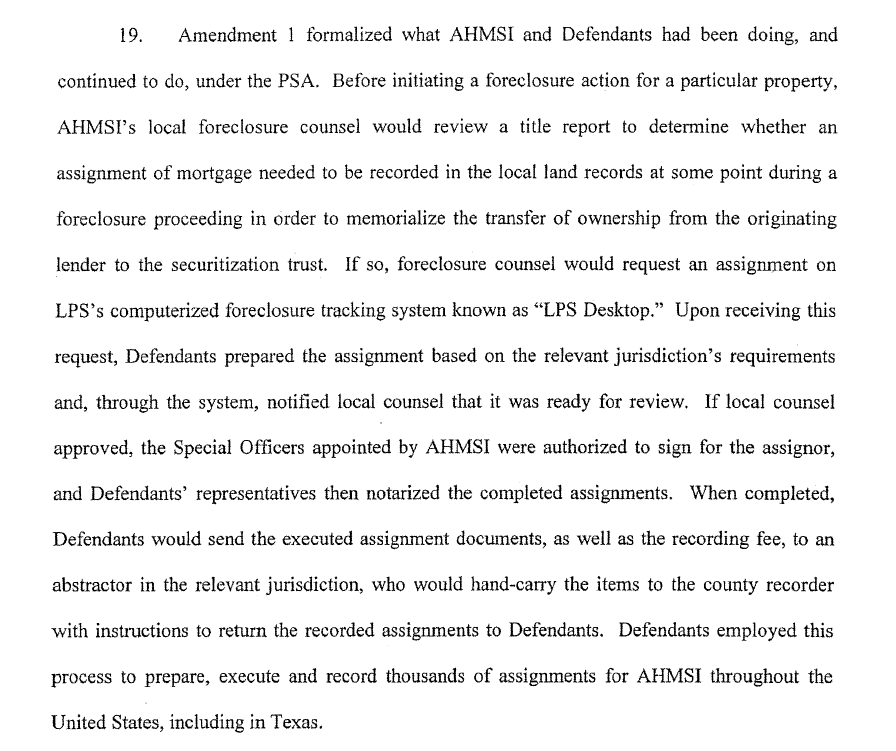 <=”” a=””>
 <=”” a=””>
 <=”” a=””>
 <=”” a=””>
 <=”” a=””>
 <=”” a=””>
 <=”” a=””>
 <=”” a=””>
 <=”” a=””>
 <=”” a=””>
 <=”” a=””>
 <=”” a=””>
 <=”” a=””>
If the loan was not perfected; then there is no lien; and if the servicer was obligated to make the payment as a co-obligor; then there was no default
SEE 42-in RE Cruz vs Aurora
AURORA LOAN SERVICES LLC, SCME MORTGAGE BANKERS INC, ING BANK FSB, MORTGAGE ELECTRONIC REGISTRATION SYSTEMS ALL BITE THE DUST, SUBJECT TO LIABILITY AND NO ABILITY TO FORECLOSE WITHOUT COMPLYING WITH LAW.
Salient points of Judge Mann’s Decision:
TRUTH IN LENDING was dismissed because they were time-barred. LESSON: Don’t ignore TILA claims or TILA audits. Get a forensic Analysis as early as possible, assert them immediately, assert rescission as soon as possible. TILA has teeth, but if you assert it late in the game.
YOU CAN’T FORECLOSE ON UNRECORDED INSTRUMENTS: Judge Mann came right out and said the California Supreme Court would not and could not decide otherwise. Any other holding would defeat the purpose of recording and create uncertainty in the marketplace. This will cause a lot of grief to pretenders. It is getting harder for them to come up with people who are willing to lie, forge or fabricate documents. Getting a notary to affix their signature and seal will soon be a thing of the past unless the signature, the person and the document is real.
THE ASSUMPTION THAT THE LOAN IS IN DEFAULT IS STILL A PROBLEM: As long as lawyers and pro se litigants are willing to concede that the obligation was in default, they are giving up their largest chip — i.e., that the loan was not in default and the loan was not subject to a perfected lien for the same reason that the court cites in its opinion. Our loan level analysis shows repeatedly that in most cases the servicer is continuing to make payments and reporting to investors that the loan is performing even as they send delinquency letter’s notices of default and notices of sales. The Court missed this point because nobody brought it up. Don’t expect the Court to do your work for you. If you have reason to believe that the servicer is still paying on your loan you should be stating that the loan is not in de fault, denying any delinquency to the creditor and objecting to any action that is based upon the premise of “default.” Note that if the servicer is paying your bills, the servicer MIGHT have a right of action against you, but it certainly isn’t under the terms of the note or mortgage.
THE ASSUMPTION THAT A VALID PERFECTED MORTGAGE LIEN EXISTS IS STILL A PROBLEM: Again, the problem is not with the Courts but with the lawyers and pro se litigants who simply assume that this is not an issue. Put yourself in the banks’ shoes. If all you had were nominees for undisclosed principals on the note and mortgage would you be OK with that? No? Then the lien was never perfected, which means for legal purposes it doesn’t exist. Just because it shows in black and white doesn’t make it true. LESSON: Deny the lien exists, deny it was perfected and make them prove how it was perfected. They can’t. In most cases neither the mortgage originator nor the nominee beneficiary (MERS) had a disclosed lender or beneficiary, nor did they incorporate the real terms of the payment to the investor/lenders. If this was a law school exam and the student wrote that the loan was perfected, the grade would be “F”.
THE ISSUE OF FEDERAL PREEMPTION AND THEREFORE JURISDICTION AND VENUE ARE STILL IN FLUX: This Judge found that federal preemption prevents the homeowner from alleging TILA as state claims. The courts are not decided on this and the issue of res judicata and Rooker -Feldman will come into play once the issue is really resolved with finality. Beware then how you assert a claim and that you don’t let the statute of limitations run out by failing to assert the right claim under TILA in the right court. better to get dismissed than to find out that you are time-barred.
WRONGFUL FORECLOSURE IS A TITLE ISSUE NOT A FAIRNESS OR TECHNICAL ISSUE: Judge Mann, correctly in my opinion, states that an assignment from MERS must be allowed in order to clear up title. But, she states that without recording an interest within the chain of title, you have no right to foreclose under the states recording laws. I think this is right, and I think it applies in all 50 states. LESSON: Plead your wrongful foreclosure, slander of title and quiet title cases as title cases and stop adding extra things that you think may them juicier. Either the title is right or it is wrong. There is no middle ground.
MERS ISSUE IS STILL OBSCURE: While the assignment from MERS, if recorded clears up one part it leaves another part undecided again because it wasn’t raised properly. There is a difference between “bare record title” and an “interest in the land.” The MERS assignment is like a quit-claim deed from someone without any interest in the land and used to clear up the chain of title on paper, but it does not convey any interest. MERS on its website and in the public domain specifically disclaims any interest in the obligation, note or mortgage. That is its selling point to members who use its “Service.” And that is why it can’t foreclose and it is subject to cease and desist orders from regulators. As with other affidavits or quit-claims to clear up apparent clouds on title, the recorded assignment or quitclaim does nothing to convey a larger interest than that possessed by the grantor. LESSON: If the pretenders want to foreclose they can’t rely on the MERS assignment. They must file a credible affidavit that states that the affiant was the undisclosed principal in the original transaction with the borrower and that it joins in or separately assigns the actual interest in the obligation, note or mortgage. In my opinion, this is the only way to perfect the original “lien.” Whether it will relate back to the original transaction is an issue the courts must decide.
NO DIFFERENCE BETWEEN A DEED OF TRUST AND A MORTGAGE: Pretenders who try to elevate a deed of trust above a mortgage are headed for a brick wall. Courts never liked non-judicial foreclosure in the first place. They are not about to to reverse centuries of law and provide higher status to a non-judicial foreclosure or the instruments that allow it. ONLY the statutes that provide for extra care on the part of the trustee are constitutional, since due process is the only way anyone in this country can be deprived of life, liberty or property. LESSON: Pound on the issue that the pretender cannot prevail in a judicial foreclosure so they are trying to get away with it in a non-judicial foreclosure. If you want to see how this will eventually unfold, look at Florida and other states that had similar issues in their “Contracts for deed.” Despite clear contractual language the courts have universally held they are mortgages and that they must be foreclosed as mortgages.
Tim McCandless Blogs its amazing what you can do if you don’t watch TV
 timothymccandless.wordpress.com
recallcitycouncil.wordpress.com
chapter11bankruptcy.wordpress.com
fairdebtcollectionpracticesact.wordpress.com
marionmccandless.wordpress.com
trustdeedinvestment.wordpress.com
rocketrecoverysystem.wordpress.com
mortgagereductionlaw.wordpress.com
mortgageregistationsystems.wordpress.com
massjoinderlitigation.wordpress.com
financialelderabuse.wordpress.com
landlordfraud.wordpress.com
http://mybk7.com
http://mortgagereductionlaw.com
http://evictiondefender.com
http://prodefenders.com
http://neilgarfield.com
http://massjoinderlitigation.info
http://fairdebtcollectionpracticesact.org
http://thestopforeclosureplan.com
Mortgage Assignments to Washington Mutual Trusts Are Fraudulent
Posted on August 7, 2011 by Neil Garfield
EDITOR’S NOTE: We know the foreclosures were gross misrepresentations of fact to the Courts, to the Borrowers and to the Investors. This article shows the crossover between the MegaBanks — sharing and diluting the responsibility for these fabrications as they went along. If you are talking about one big bank you are talking about all the megabanks.
The evidence is overwhelming. The reasons are many. But the fundamental theme here is that Banks are committing widespread fraud using the appearance of credibility just because they are banks.
Thus the strategy of pushing hard in discovery and persevering through adverse rulings appears to be getting increasing traction. Every time anyone, including judges, take a close look at this mess the conclusion is the same — the Banks’ foreclosures have been a sham. The homeowners still legally own their home and the lien is unenforceable or non-existent.
What part of the obligation of the borrower still exists? To whom is it payable? These are questions the Banks as servicers refuse to answer. It’s a simple set of questions that never had any bite to them until now.
 From Lynn Symoniak
Mortgage Fraud
Bank of America
JP Morgan Chase
Lender Processing Services
WaMu Trusts
Washington Mutual
WMABS Trusts
WMALT Trusts
Action Date: August 6, 2011
Location: Jacksonville, FL
An examination of over 5,000 Mortgage Assignments to Washington Mutual
Trusts shows that these Trusts (WaMu, WMALT and WMABS) used Mortgage
Assignments signed by employees of JP Morgan Chase to foreclose. The
most prolific of the Chase signers, all from Jacksonville, Florida,
include Elizabeth Boulton, Margaret Dalton, Barbara Hindman, Patricia
Miner, Roderick Seda and Shelley Thieven. These Chase employees sign
as MERS officers on behalf of at least 30 different mortgage companies
to convey mortgages AND NOTES to Washington Mutual trusts that closed
years earlier.
In the vast majority of these cases, Bank of America is the Trustee.
Because the original loan documents are missing, Bank of America
allows Chase to make up new documents as needed to foreclose. The vast
majority of these Assignments state that the Trusts acquired these
mortgages in 2009 and 2010.
There are two separate frauds here:
1. not having the documents despite the promises to investors that the
documents were obtained and safely held; and
2. fabricating the replacement documents to foreclose.
In almost every case, Bank of America is the Trustee.
Did the FDIC just not notice any of this? There are thousands of these
specially-made Assignments signed by Chase employees for WaMu, WMALT
and WMABS trusts used across the country.
When Bank of America did not use documents fabricated by Chase to
foreclose, it used documents fabricated by LPS in Dakota County, MN.
A TRUSTEE CANNOT MAINTAIN AN ACTION ON BEHALF OF A TRUST THAT DOESN ‘T EXIST
I looked into the records for that entity in the SEC EDGAR online database and discovered that the last annual report was filed in 2007, contemporaneously with a FORM 15 filing.That Form 15 filing claimed a standing under 15d-6 of the 1934 SEC regulations which exempts the entity of filing an annual report, whereby the number of claimed investors had fallen below the SEC registration and reporting threshold of 300 persons. ( To my understanding, the same Form 15 filing is also used when a registered, reporting, entity is dissolved.)
I then began looking at many other securitized trusts in the EDGAR database. Literally dozens and dozens of these securitized trusts have done exactly the same thing. The trust is established and appropriate SEC documents are filed for a period of time, usually 1 or 2 years. The trust then files a Form 15 claiming exemption of the obligation to file reports with the SEC under 15d-6
The paper trail for the Trust with the SEC thereby ends. Many of these trusts have not filed anything with the SEC for years. Many as far back as 2005 and 2006. Some of the SEC Form 15d-6 filings disclosed as few as 15 or less investors  . Bear in mind, these are for trusts that purportedly hold well over $1 BILLION in mortgages, and there are dozens and dozens of these trusts with a mere hand full of investors! I also noted that the agents of record of many of these trusts have changed many times, and are very infrequently named, but list only an address and phone number, (usually in New York). In several of the cases I ‘ve looked at in the EDGAR database, I actually called some of the phone number listed at 3:00am EST and got the voicemail of someone at a bank in N.Y. Note that the answering party was NEVER a bank listed as the Trustee, (as Deutsche Bank is in my case), or the trust administrator as listed in the PSA or any subsequent SEC filings. I actually got the voicemail of some fellow at HSBC Bank who was the anonymous contact in my case! My point is this — Has anyone actually verified that the securitized trusts claimed to be under the trusteeship of some of these banks still ACTUALLY EXIST? We ‘ve been so focused on the NOTE and the fraudulent paper being slung about for assignment of those notes, and whether or not the plaintiff has standing to bring the foreclosure action, has anyone thought to see if the plaintiff trust is even still active or not? Were many of these trusts actually dissolved after payouts from credit default swaps and TARP funds and the actual investors now long gone? We have no records to show whether they are alive or dead. Most of these trusts haven ‘t filed anything with anyone in years as far as I can tell. Certainly, as in my case, Deutsche Bank, (as Trustee), still exists, but can these plaintiff securitized trusts be made to prove they still exist? What happens to a foreclosure case if the plaintiff entity,(the securitized trust, not the Trustee for it), no longer exists or cannot prove it exists? IT ‘S TIME FOR ME TO GET BACK TO AN ISSUE THAT I HAVEN ‘T TALKED ABOUT FOR A WHILE AND IT IS THIS CAPACITY ISSUE BECAUSE IT STRIKES AT THE HEART OF THESE CASES. SIMPLY PUT, A TRUSTEE CANNOT MAINTAIN AN ACTION ON BEHALF OF A TRUST THAT DOESN ‘T EXIST.
OUR NANCY DREW BLASTS THROUGH THE DEVIL IN THE DETAILS ON NORWEST, GMAC ET AL (via Livinglies's Weblog)

Bombshell Admission of Failed Securitization Process in American Home Mortgage Servicing/LPS Lawsuit (via Livinglies's Weblog)
KISS: KEEP IT SIMPLE STUPID from Garfield
Finality versus good and evil. In the battlefield it isn’t about good and evil. It is about winner and losers. In military battles around the world many battles have been one by the worst tyrants imaginable.
Just because you are right, just because the banks did bad things, just because they have no right to do what they are doing, doesn’t mean you will win. You might if you do it right, but you are up against a superior army with a dubious judge looking on thinking that this deadbeat borrower wants to get out of paying.

The court system is there to mediate disputes and bring them to a conclusion. Once a matter is decided they don’t want it to be easy to reopen a bankruptcy or issues that have already been litigated. The court presumably wants justice to prevail, but it also wants to end the dispute for better or for worse.
Otherwise NOTHING would end. Everyone who lost would come in with some excuse to have another trial. So you need to show fundamental error, gross injustice or an error that causes more problems that it solves.
These are the same issues BEFORE the matter is decided in court. Foreclosures are viewed as a clerical act or ministerial act. The outcome is generally viewed as inevitable.
And where the homeowner already admits the loan exists (a mistake), that the lien is exists and was properly filed and executed (a mistake) and admits that he didn’t make payments — he is admitting something he doesn’t even know is true — that there were payments due and he didn’t make them, which by definition puts him in default.
It’s not true that the homeowner would even know if the payment is due because the banks refuse to provide any accounting on the third party payments from bailout, insurance CDS, and credit enhancement.
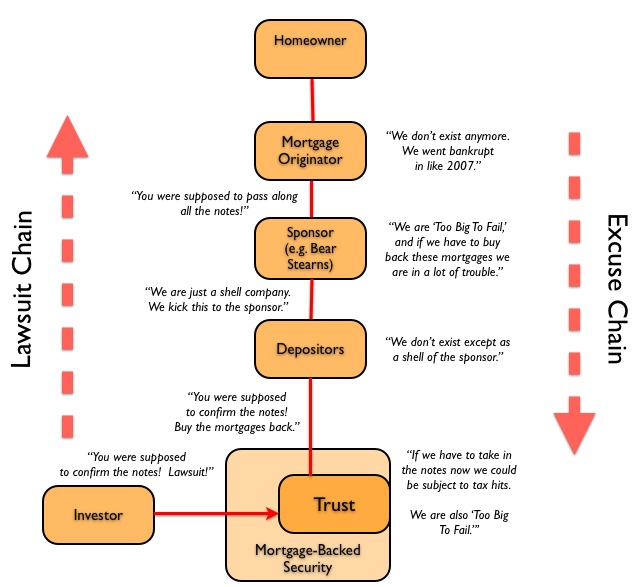
That’s why you need reports on title, securitization, forensic reviews for TILA compliance and loan level accounting. If the Judges stuck to the law, they would require the proof first from the banks, but they don’t. They put the burden on the borrowers —who are the only ones who have the least information and the least access to information — to essentially make the case for the banks and then disprove it. The borrowers are litigating against themselves.

In the battlefield it isn’t about good and evil, it is about winners and losers. Name calling and vague accusations won’t cut it.
Sure you want to use the words surrogate signing, robo-signing, forgery, fabrication and misrepresentation. You also want to show that the court’s action would or did cloud title in a way that cannot be repaired without a decision on the question of whether the lien was perfected and whether the banks should be able to say they transferred bad loans to investors who don’t want them — just so they can foreclose.
But you need some proffers of real evidence — reports, exhibits and opinions from experts that will show that there is a real problem here and that this case has not been heard on the merits because of an unfair presumption: the presumption is that just because a bank’s lawyer says it in court, it must be true.
Check with the notary licensing boards, and see if the notaries on their documents have been disciplined and if not, file a grievance if you have grounds. Once you have that, maybe you have a grievance against the lawyers. After that maybe you have a lawsuit against the banks and their lawyers.
But the primary way to control the narrative or at least trip up the narrative of the banks is to object on the basis that counsel for the bank is referring to things not in the record. That is simple and the judge can understand that.
Don’t rely on name-calling, rely on the simplest legal requirements that you can find that have been violated. Was the lien perfected?
If the record shows that others were involved in the original transaction with the borrowers at the inception of the deal, then you might be able to show that there were only nominees instead of real parties in interest named on the note and mortgage.
Without disclosure of the principal, the lien is not perfected because the world doesn’t know who to go to for a satisfaction of that lien. If you know the other parties involved were part of a securitization scheme, you should say that — these parties can only be claiming an interest by virtue of a pooling and servicing agreement. And then make the point that they are only now trying to transfer what they are calling a bad loan into the pool that the investors bought — which is expressly prohibited for multiple reasons in the PSA.
This is impersonation of the investor because the investors don’t want to come forward and get countersued for the bad and illegal lending practices that were used in getting the borrower’s signature.
Point out that the auction of the property was improperly conducted where you can show that to be the case. Nearly all of the 5 million foreclosures were allowed to be conducted with a single bid from a non-creditor.
If you are not a creditor you must bid cash, put up a portion before you bid, and then pay the balance usually within 24-72 hours.
But instead they pretended to be the creditor when their own documents show they were supposed to be representing the investors who were not part of the lawsuit nor the judgment.
SO they didn’t pay cash and they didn’t tender the note. THEY PAID NOTHING. In Florida the original note must actually be filed with the court to make sure that the matter is actually concluded.
There is a whole ripe area of inquiry of inspecting the so-called original notes and bringing to the attention the fraud upon the court in submitting a false original. It invalidates the sale, by operation of law.
MANDELMAN MATTERS: DEADBEAT BORROWERS AND THIEVES WHO CALL THEM THAT
“If you’re allowed to foreclose and kick someone out of his or her home without being the party that either owns the loan or represents the person who owns the loan… if you can ignore those laws, why can’t you ignore other laws too? Which laws apply, when one of the parties didn’t make his or her payments?”
Home » Today’s New… “But, You Didn’t Make Your Payment” Exemption to the Law
Today’s New… “But, You Didn’t Make Your Payment” Exemption to the Law
I’m not a lawyer, so let’s be very clear about that, but I’m about to tell you how the law has always worked in this country, as far as I have understood it.
If you came to repossess my car, then you were required to be the person or entity that held the pink slip to my car, or you had to be working for the person or entity that held the pink slip to my car. If you were not the person or entity holding my pink slip, then you couldn’t come repossess my car.
In fact, if you came and repossessed my car but were NOT the person or entity holding my pink slip, then we had a phrase to describe that occurrence as well … you were STEALING MY CAR.
Pretty straightforward, right? I don’t even think you need to finish law school if that’s the extent to which you want to understand the law. And don’t let any of the attorneys that may be reading this around you try to make it more complicated, because it’s not. It is that simple… you can’t repossess someone’s car unless you’re the person or entity that holds the pink slip, or title, to that car… or are working for that person or entity, of course.
That’s the same way it’s supposed to work where houses are concerned. If you don’t make your mortgage payments, that doesn’t mean that everyone in the country is allowed to throw you out of your home… only the person or entity that holds your mortgage is supposed to be able to do that, right? Of course that’s right, silly. And don’t play semantics with me, that’s the deal.
But in this country today, there appears to be a new exemption to quite a few laws… it’s called the “But you didn’t make your mortgage payments” exemption, and when it comes into play, nothing else seems to much matter… you just lose.
Like, what if you don’t make your mortgage payments and the entity that comes to evict you from your home is one that you’ve never heard of before. And they have no proof whatsoever that they own your loan or represent the entity that owns your loan. Well, in general it’s tough cheese. The judge just says, “But you didn’t make your mortgage payments,” and that’s the end of that. And most everyone seems to be in agreement with this line of thinking.
You say, “But, your Honor… they’ve broken a dozen laws here… important laws… laws governing the transfer of property rights upon which the country has been built.” And the judge just gets annoyed saying, “But you didn’t make your mortgage payments,” and that’s the end of that. It’s almost like a get out of jail free card.
So, you say, “But your Honor, they’ve forged the documents, falsified the records, committed fraud on your court.” But he says it doesn’t matter… you didn’t make your mortgage payments… you have no rights and the party that’s foreclosing is now exempt from all of the laws that might otherwise apply. In fact, those laws are now reduced to being mere “technicalities.” And no one cares about technicalities as compared to you not making your mortgage payments.
So, I’m just wondering… don’t you think this sets kind of a dangerous precedent?
Let’s say that you’re not making your mortgage payments. And one night after dinner, the doorbell rings and you answer the door and it’s a representative of your mortgage servicer… and he punches you right in the face and then proceeds to beat the crap out of you.
And you end up in court. And the judge says, “But you didn’t make your mortgage payments, “ and dismisses the case. And you say, “But, your Honor… my mortgage servicer beat the crap out of me and that’s against the law, in fact there are all sorts of laws broken by him beating the crap out of me.” But the judge just replies, “But you didn’t make your mortgage payments, “ and that’s the end of that.
Do you think I’m being ridiculous? Why? What’s the difference between ignoring one set of laws and another set of laws? If you’re allowed to foreclose and kick someone out of his or her home without being the party that either owns the loan or represents the person who owns the loan… if you can ignore those laws, why can’t you ignore other laws too? Which laws apply, when one of the parties didn’t make his or her payments?
You see, I think the reason we have laws about the transfer of property is because it was important that someone not lose their property without those laws being followed. Whether one made their payments or not, wasn’t the point… the point was simply that the transfer of property rights has always been seen as a pretty big deal under the law, as far as I can tell.
I think the reason we let things get a little loose concerning foreclosure is that we trusted the bankers who were foreclose. In California, and all of the non-judicial foreclosure states, as far as I know, you don’t need to prove to the court that you hold the title to someone’s home in order to foreclose, and I’m pretty sure that the reason that was okay to our lawmakers was that they trusted the bankers… and they never envisioned not trusting them in that regard.
The problem is that today there is an abundance of evidence that says we cannot trust our bankers… quite often they lie, commit fraud on the courts, and in general are more than willing and able to fabricate and falsify whatever is required to foreclose on someone’s home… period. They don’t care at all… and they don’t get in trouble for it either, which I find the most disturbing part of the whole thing.
So, since its become clear that bankers lie, and cannot be trusted, we’re going to need to bring back the old laws about having to prove you’re the right party to be foreclosing on someone’s home before you’re allowed to do so. Several states have already done this… Hawaii and Arkansas, most recently. Arizona tried to pass such a law, but the banking lobby got to them and killed them both.
California had a bill that would have come close, but the banking lobby killed it in committee, for heaven’s sake. It was too dangerous to even debate in the legislature.
Some have said to me, “But Mandelman… the banks need to be able to foreclose or repossess when people don’t make their house or car payments.” And I reply… “No one is debating that point. Of course they can foreclose when payments are not made. If they’re the party who holds the beneficial interest, as the lawyers says, in the loan. If they lost the pink slip, they’ll have to correct that problem before they can come take back my car.”
It’s no different than if my car gets impounded for being parked in the wrong spot. When I show up to get it out of impound, I better have the registration, right? If I don’t, what am I told by the man at the impound lot? No ticket, no laundry, right?
We have laws about the transfer of property in this country and there are reasons for these laws. None of these laws say anything about banks only being required to follow them when someone is current on his or her payments.
Let’s stop making this more complicated than it needs to be… if the trust can prove that it does hold the note, that the note was properly assigned to that trust, that the note was endorsed… or whatever was supposed to happen according to the laws and rules, did in fact happen, then fine… foreclose away. But if that’s not the case, banker people… then you have to fix it… before you’re allowed to foreclose.
Sorry, and I know how unfair you think this is, but forging the documents isn’t an okay answer to this problem. Like if you want to repossess my car and you lost the pink slip, the acceptable answer is not to fake one on your laser printer and get Linda Green to sign it, got it? That’s not how we fix things in this country, and it doesn’t matter who made payments on time and who didn’t.
If that’s inconvenient, then so be it. And I have to think it’s a damn sight less inconvenient than what’s going on today, and if it’s even more inconvenient than that, then the bankers in this country have really screwed up bad, and we should all be shown what they’ve done.
I ran all of this by a lawyer friend of mine and here is the language from the Deed of Trust (page 23):
“Reconveyance. Upon payment of all sums secured by this security instrument, lender shall request trustee to reconvey the property and shall surrender this security instrument and all notes evidencing debt secured by this security instrument to trustee. Trustee shall reconvey the property without warranty to the person or persons legally entitled to it.”
So, apparently this language appears in EVERY Deed of Trust, including yours, your Honor. So when you want your pink slip/title/note in order to have your mortgage burning party, you may be disappointed to find that no one seems to have it.
And what about title insurance in the future? Will we be able to get it as a result of this whole mess being allowed to go on unchecked? I don’t think anyone really knows the answer to that question.
Lastly, the question always seems to come around to one of damages. How did the note not being properly endorsed to the trust and the trust being permitted to foreclosing anyway damage the homeowner? Again, it’s quite simple, really…
If someone is allowed to repossess my car even though that entity doesn’t hold my pink slip or work for the entity that holds my pink slip, then whoever repossessed my car STOLE IT. And that, by itself, sounds pretty damaging.
But what if someone shows up later and says they have the pink slip? What then? Will they be understanding and say, “Oh, someone else got it. No problem, we’re sorry to have bothered you. We’ll follow up with them.”
Somehow I doubt that will happen that way. And there are several reasons I’m not at all sure that this won’t be the case in the years to come. For one thing, both Taylor Bean & Whittaker and New Century Mortgage were found to have sold mortgages to more than one person at the same time, and others have admitted that it happens all the time.
And for another, I know of several homeowners who have filed quiet title actions and are still waiting for someone to show up and say they own the loan… in one case that’s recently been brought to my attention, it’s been almost a year and still no one has shown up. Does that mean no one will? Or will someone show up years from now? (Here’s the case, click it and you’ll see.)
Harvey v Garbett, Quiet Title Case in Draper Utah
I don’t really know, but wouldn’t it just be easier for the entity foreclosing to be the entity that actually holds the beneficial interest in the loan? You know, just as the law has always intended?
There’s another reason that it makes sense to require the right entity to foreclose… because the right entity, the entity that does in fact hold the beneficial interest in the loan would be much more likely to want to modify the loan as opposed to foreclosing on it, in instances where the payments have not been made.
You see, servicers chose to foreclose because it’s in their own best interests to foreclose, but what about the investor’s best interests? After all the investor is who put up the money in the first place, so what about the investor’s best interests?
Surely the investor would rather have a modified loan, especially in instances where the home is terribly underwater and by foreclosing the investor will realize an enormous loss and then not be able to sell it… perhaps for several years… wouldn’t you think that investor would prefer to modify the loan and get payments again?
Louis Ranieri, who is often referred to as the father of mortgage-backed securities had the following to say about foreclosing:
“The cardinal principle in the mortgage crisis is a very old one. You are almost always better off restructuring a loan in a crisis with a borrower than going to a foreclosure.
In the past that was never at issue because the loan was always in the hands of someone acting as a fiduciary. The bank, or someone like a bank owned them, and they always exercised their best judgment and their interest. The problem now with the size of securitization and so many loans are not in the hands of a portfolio lender but in a security where structurally nobody is acting as the fiduciary.”
Well, what do you know about that? So, it seems there are lots of good reasons that we should make sure that the entity foreclosing is the entity who does in fact own the loan, or at least work for the entity that owns the loan.
So, why are we making this so damn difficult? And why is it such a big problem for a bank-servicer-whatever to show up and actually prove that the trust actually holds the note in question? They don’t really expect us to buy into that whole, “But we lost them, your Honor. All of them, your Honor. It was a mass misplacement, your Honor.”
I mean, come on now… are we really supposed to believe that ALL of the major banks lost ALL of the notes and ALL at the same time? Seriously? I know 14 year-old boys that could tell you that such a story is simply not believable.
It’s time to come clean banker-people. Your story stinks to high heaven and the homeowners, lawyers, investors, and even the government investigators are all getting closer to uncovering the truth every day.
And until the banks start telling the truth, or modifying loans in the best interests of the investors and homeowners like they are supposed to…
… how about we the people pass a bill that requires the entity foreclosing to prove they are the entity that owns the loan… because it’s clear… abundantly clear… that we certainly can’t trust the trustee any more.
$1.2 Trillion in Secret Additional Bailout for Banks with No Collateral and No Commitments (via Livinglies's Weblog)
GOING AFTER THE NOTARY, STEP BY STEP (via Livinglies's Weblog)
WALLS CLOSING IN ON LAW FIRMS AND SUBSTITUTE TRUSTEES AS FAKED, FORGED DOCUMENTS SURFACE IN ABUNDANCE (via Livinglies's Weblog)
Attorney General Kamala D. Harris Sues Law Firms Engaged in National “Mass Joinder” Mortgage Fraud
SAN FRANCISCO — Attorney General Kamala D. Harris today announced that the California Department of Justice, in conjunction with the State Bar of California, has sued multiple entities accused of fraudulently taking millions of dollars from thousands of homeowners who were led to believe they would receive relief on their mortgages.
Attorney General Harris sued Philip Kramer, the Law Offices of Kramer & Kaslow, two other law firms, three other lawyers, and 14 other defendants who are accused of working together to defraud homeowners across the country through the deceptive marketing of “mass joinder” lawsuits. “Mass joinder” lawsuits are lawsuits with hundreds, or more, individually named plaintiffs. This is the first consumer action by the Attorney General’s Mortgage Fraud Strike Force.
Kramer’s firm and other defendants were placed into receivership on Monday, Aug. 15. The legal actions were designed to shut down a scheme operated by attorneys and their marketing partners, in which defendants used false and misleading representations to induce thousands of homeowners into joining the mass joinder lawsuits against their mortgage lenders. Defendants also had their assets seized and were enjoined from continuing their operations. Nineteen DOJ special agents participated as the firms were taken over Wednesday, Aug. 17, along with 42 agents and other personnel from HUD’s Office of Inspector General, the California State Bar, and the Office of Receiver Thomas McNamara at 14 locations in Los Angeles and Orange Counties. Sixteen bank accounts were seized.
“The defendants in this case fraudulently promised to win prompt mortgage relief for millions of vulnerable homeowners across the country,” said Attorney General Harris. “Innocent people, already battered by the housing crisis, were targeted for fraud in their moment of distress.”
“The number of lawyers who have tried to take advantage of distressed homeowners in these tough economic times is nothing short of shocking,” said State Bar President William Hebert. “By taking over the practices of four attorneys accused of fraudulent marketing practices, the State Bar can put a stop to their deplorable conduct as part of our ongoing effort to protect the public.”
It is believed that at least two million pieces of mail were sent out by defendants to victims in at least 17 states. Defendants’ revenue from this scam is estimated to be in the millions of dollars.
As alleged in the lawsuit, defendants preyed on desperate homeowners facing foreclosure by selling them participation as plaintiffs in mass joinder lawsuits against mortgage lenders. Defendants deceptively led homeowners to believe that by joining these lawsuits, they would stop pending foreclosures, reduce their loan balances or interest rates, obtain money damages, and even receive title to their homes free and clear of their existing mortgage. Defendants charged homeowners retainer fees of up to $10,000 to join as plaintiffs to a mass joinder lawsuit against their lender or loan servicer.
Consumers who paid to join the mass joinder lawsuits were frequently unable to receive answers to simple questions, such as whether they had been added to the lawsuit, or even to establish contact with defendants. Some consumers lost their homes shortly after paying the retainer fees demanded by defendants.
This mass joinder scam began with deceptive mass mailers, the lawsuit alleges. Some mailers, designed to appear as official settlement notices or government documents, informed homeowners that they were potential plaintiffs in a “national litigation settlement” against their lender. No settlements existed and in many cases no lawsuit had even been filed. Defendants also advertised through their web sites.
When consumers contacted the defendants, they were given legal advice by sales agents, not attorneys, who made additional deceptive statements and provided (often inaccurate) legal advice about the supposedly “likely” results of joining the lawsuits. Defendants unlawfully paid commissions to their sales representatives on a per client sign-up basis, a practice known as “running and capping.”
Defendants’ alleged misconduct violates the following laws:
-False advertising, in violation of section 17500 of the Business and Professions Code
-Unfair, fraudulent and unlawful business practices, in violation of section 17200 of the Business and Professions Code
-Unlawful running and capping, in violation of section 6152, subdivision (a) of the Business and Professions Code (i.e., a lawyer unlawfully paying a non-lawyer to solicit or procure business)
-Improper fee splitting (defendants unlawfully splitting legal fees with non-attorneys)
-Failing to register with the Department of Justice as a telephonic seller.
Homeowners who have paid to be added to one of the lawsuits should contact the State Bar if they feel they may be victims of this scam. They can also contact a HUD-certified housing counselor for general mortgage related assistance.
The Department of Justice has seized the practices of the following non-attorney defendants:
Attorneys Processing Center, LLC; Data Management, LLC; Gary DiGirolamo; Bill Stephenson; Mitigation Professionals, LLC; Glen Reneau; Pate Marier & Associates, Inc.; James Pate; Ryan Marier; Home Retention Division; Michael Tapia; Lewis Marketing Corp.; Clarence Butt; and Thomas Phanco.
The State Bar has seized the practices and attorney accounts of the attorney defendants:
The Law Offices of Kramer & Kaslow; Philip Kramer, Esq; Mitchell J. Stein & Associates; Mitchell Stein, Esq.; Christopher Van Son, Esq.; Mesa Law Group Corp.; and Paul Petersen, Esq.
Attorney General Harris is challenging the defendants’ alleged misconduct in marketing their mass joinder lawsuits; her office takes no position as to the legal merits of any claims asserted in the mass joinder lawsuits filed by defendants.
Victims in the following states are known to have received these mailers, or signed on to join the case. This is a preliminary list that may be updated:
Alaska, Arizona, California, Colorado, Connecticut, Florida, Hawaii, Maryland, Massachusetts, Michigan, Missouri, Nevada, New Jersey, New York, Ohio, Texas, Washington
The complaint, temporary restraining order, examples of marketing documents and photos of the enforcement action are available with the electronic version of this release at http://oag.ca.gov/news.
NY POST: 92% —BANKS STILL FORECLOSING WITHOUT ANY RIGHT (via Livinglies's Weblog)
Should Borrower File Eviction Against Bank? (via Livinglies's Weblog)
Gomes and the U.S. Supreme court some body had better help these attorneys argue and brief the case
Wednesday, August 17th, 2011, 2:49 pm
A controversial case challenging the ability of Mortgage Electronic Registration Systems to foreclose on a California man was filed with the Supreme Court Monday, making it the first major MERS case to reach the nation’s highest court.
If the Supreme Court agrees to hear Gomes v. Countrywide, Gomes’ attorney, Ehud Gersten, says the court will have to decide whether a lower court stripped his client, Jose Gomes, of due process by allowing MERS to foreclose without ensuring the registry had the noteholder’s authority to foreclose.
“I believe this to be the first case in the country to take MERS to our Supreme Court,” Gersten told HousingWire. His claim could not be immediately verified.
“Ultimately, what this case is saying is if you are going to be taking someone’s home away from them, do you have the proof or the right to do so?” Gersten said. “If the Supreme Court starts to question MERS, and its business structure, it is going to have an effect on every MERS case in the country.”
MERS, the electronic registry at the center of the foreclosure crisis, has been under fire nationwide as foreclosure attorneys purport the firm, and its parent company Merscorp Inc., illegally foreclosed on properties.
Gersten, meanwhile, said MERS has a brief period of time to respond before the Supreme Court decides whether it will accept the case (click here for the filing).
Attorneys familiar with the Gomes case are not optimistic about its chances of being heard by the Supreme Court.
“While recent statistics show that the Supreme Court takes on average less than 3% of cases on certiorari, it takes even a smaller percentage of those advanced by private litigants, as opposed to the government,” said Patton Boggs attorney Anthony Laura. “Also it takes fewer cases out of the state court system than it does out of the federal Courts of Appeals.”
“So, the likelihood that this case will be taken is slim indeed,” Laura adds. “I believe those slim odds are even slimmer because the argument Gomes is making to the U.S. Supreme Court is one he did not previously raise.”
Laura said that, as a premise for invoking the jurisdiction of the Supreme Court, Gomes claims that the court below abridged his 14th Amendment rights.
“My recollection is that Gomes never made a Constitutional argument below, neither in the California Court of Appeals nor in the petition for review to the California Supreme Court,” he said. “In my view, the U.S. Supreme Court will look skeptically on his just raising that argument now.”
The original plaintiff, Jose Gomes, appealed to the nation’s highest court after California’s Supreme Court decided not to review the 4th Appellate District Court of California’s decision in favor of MERS.
Gomes’ petition says he’s challenging the foreclosure because MERS “did not have the current noteholder’s authority to foreclose.”
Gersten argues his client “was entitled to proof that the loan servicer, trustee or an entity such as MERS, either named in the deed of trust or acting through assignments of interest, had legal authority on behalf of the promissory note’s current holder to foreclose.”
The 4th Appellate District Court’s decision, which Gomes wants overturned, held MERS had the authority to initiate a foreclosure on Gomes because the deed of trust “explicitly provided MERS with the authority to do so,” according to court records.
The state appellate court also ruled in favor of MERS after finding the deed of trust contained no language to suggest the “lender or its successors and assigns must provide Gomes with an assurance that MERS is authorized to proceed with a foreclosure,” according to court records.
MERS chose not to comment on the case, but a spokeswoman said the company is aware of the filing with the Supreme Court.
California man wants foreclosures deemed unconstitutional in the state
by KERRI PANCHUK
Proposed Illinois Legislation Would Freeze Evictions for Four Months
California AG Wants Pay Option ARM Answers
Does the Senate’s housing bill encourage foreclosures?
California Law Freezes Foreclosures, Burns Servicers
Short Sales Cost Lenders $310m More Than Necessary, CoreLogic Study Finds
Thursday, August 4th, 2011, 7:31 am
A California man is on a mission to end foreclosures across his state, claiming an outright ban on the practice would force banks to help distressed borrowers.
In documents filed with California’s secretary of state, Sacramento resident David Benson said he’s trying to gain enough signatures – 807,615 to be exact – to get his foreclosure ban considered by voters across the state.
Benson wants to amend the California constitution, making homeownership a fundamental right.
His plan would require lenders to assist borrowers unable to pay for their homes due to financial distress and illness.
It also would force lenders to reduce a loan’s principal amount to reflect declines in property value that go beyond 10%.
Benson’s proposal says any “loan issued for and secured by a home or property by any lending institutions, loan servicers, mortgagee, trustees and beneficiaries doing business in the state of California, shall be able to be refinanced without credit review or penalty at minimum cost, within 45 days of being requested.”
That provision would automatically apply if a borrower has maintained the mortgage for at least three years.
Anthony Laura, an attorney at Patton Boggs who reviewed the proposal, said the amendment “would have the opposite effect of diminishing, not enhancing, homeownership in California.”
“While homeownership may be part of what many consider to be the American Dream, I have a hard time conceiving it as a constitutional right. Should this proposed amendment make it on the ballot and ultimately pass, it would only serve to discourage lenders from making mortgage loans in California.”
Laura said without those mortgages, few people could afford homes.
Write to Kerri Panchuk.
JUDGES: ASSUME THE BORROWER IS WRONG
So you have denied the claims of the pretenders and put that in issue. You have even alleged fraud, forgery and fabrication and the catch-word “robosigning”. But the Judge, alleging that he did not want to “make new law” (which wasn’t true) or allegedly because he didn’t want to start an avalanche of litigation interfering with judicial economy (and therefore allowing fraud and theft on the largest scale ever known to human history) has not only denied your claims and motions, but refused to even put the matter at issue, thus enabling you to at least use discovery to prove your point.

So the pretenders have their way: no evidence has been introduced into the record. You have proffered, they have proffered, but somehow their proffer means something more than your proffer even though no proffer is evidence.
Attorneys recognize this as low hanging fruit on appeal, where the trial judge is going to get the case back on remand with instructions to listen to the evidence and allow each side to produce real evidence, not proffers from counsel, and allow each side to conduct discovery. It’s not guaranteed but it is very likely. And the pretenders know that if it ever gets down to real evidence as opposed to arguments of counsel, they are dead in the water, subject to sanctions and liability for slander of title and other claims.
So they have come up with this strategy of setting supersedeas bond higher and higher so that the order appealed from goes into effect and they are able to kick the can down the road with a foreclosure sale, more transfers etc in the title chain, thus enabling them to argue the deed is done and the “former” homeowner must be relegated to only claiming damages, not the home itself. People can be kicked out by eviction proceedings that typically are conducted in courts of limited jurisdiction where in most states you are not allowed to even allege that the title is not real or that it was illegally obtained.
Initially supersedeas bond was set at levels that could be met by homeowners — sometimes as little as $500 or a monthly amount equal to a small fraction of the former monthly payment. Now, Judges who are heavily influenced by banks and large law firms, especially chief Judges who stick their noses into cases not assigned to them, are making sure that the case does NOT go to jury trial and essentially influencing the presiding Judge ex parte, to set a high supersedeas bond thus preventing the homeowner from obtaining a stay of execution on the eviction or the final judgment regarding title.
Of course it is wrong. But it is happening. You counter this by (1) making the record on appeal as to the merits of the appeal (2) adding to the record actual affidavits and testimony as to value, rental value etc. and (3) of course demanding and evidential hearing on the proper amount of the bond. Here you want to search out and produce the bond set in similar cases in the county in which your case is pending. Make sure you have a court reporter and a transcript on appeal and that the record on appeal is complete. It is not uncommon for certain documents to get “lost” or allegedly not “introduced” so when the appellate court gets it you can be met with the question of “what document?”
The other reason they are increasing supersedeas bond is because of a misconception by many pro se litigants and even some attorneys. They have the impression that the appeal is over if the bond is NOT posted with the clerk. And they have the impression that they can’t challenge the amount of bond set, or even go to the appellate court just on that issue and ask the appellate court to set bond — something they might not do but when they remand it, it is usually with instructions to the trial judge to hear evidence on the relevant issues — again something the pretenders don’t want.
Supersedeas bond ONLY applies to execution of the order or judgment that you are appealing. You can AND should continue with the appeal and if you win, the Judgment might be overturned — which means by operation of law you probably get your house back.
All these things are technical matters. Listening to other pro se litigants or even relying upon this other sites intended to help you is neither wise nor helpful. Before you act or fail to act, you should be in close contact with an attorney licensed in the jurisdiction in which your property is located. Local rules can sometimes spell the difference between the life or death of your case.
SAY NO TO LENDERS FRAUD!
Contact Us: MortgageReductionLaw.com
Dear Homeowner,
It’s been widely reported around the country, via internet, blogs and newspapers, how the lenders used the foreclosure mills and other legal ways, to fabricate fraudulent documents to record in the county recorder offices and pretend they have legal standing to initiate the foreclosure procedure.
Neil Garfield in his blog http://www.livinglies.com, The Huffington Post, The New York Times, Steve Vondran in his website http://www.foreclosuredefenseresourcecenter.com, Tim McCandless in his blog https://timothymccandless.wordpress.com and many others have been advocating for the homeowners trying to raise awareness in the courts so that justice can be served.Contact Us: MortgageReductionLaw.com
A few years ago, when the Mortgage Debacle started, these lenders went after the Mortgage Brokers after they found themselves in trouble for the many defaulted loans. They filed civil and criminal lawsuits convicting these brokers for fabricating documents and forging signatures to fund the loans. The legal system, judges and General Attorneys were prompt to convict “these so called criminals”.Contact Us: MortgageReductionLaw.com
Today the tables have turned 180 degrees and we have discovered how these entities have been widely practicing what they accused others of. Today the lenders are fabricating documents, forging signatures and filing fraudulent documents with the government agencies to weasel their way into owning the homeowners’ properties.Contact Us: MortgageReductionLaw.com
The fact that judges preceding the Unlawful Detainer hearings are not educated enough about the matter and don’t want to take the time to hear the attorneys defending the homeowners, does not help to make this wrong right. Securitization is a very complicated subject that cannot be taught in an Unlawful Detainer hearing or even in a Wrongful Foreclosure hearing. The way judges have been manipulating the information provided by the homeowners in their lawsuits to rule in favor of the lenders is despicable!Contact Us: MortgageReductionLaw.com
That’s why it’s so important to have all your property recorded documents used to foreclose on your home, been researched and analyzed by an expert that can identify all the issues that can be used in a Court of Law to fight for your home.
When you go in front of a Judge with enough evidence to prove that fraud was committed by the lender when the lender fabricated documents used to foreclose, you have a good chance to get the Judge’s attention. Fraud is a subject they know, it’s a crime and they can rule in your favor. It would be very difficult for a Judge to justify this fraudulent behavior on the part of the lender.
Later on, once you have successfully received an injunction, you can bring the securitization argument in your complaint and make the lender prove their innocence.Contact Us: MortgageReductionLaw.com
The documents used to initiate the foreclosure of your home have been fraudulently fabricated by either the Trustee or the Lender.
Some attorneys who have explored this cause of action in their civil lawsuits, have been able to get relief for the homeowners by getting the in Temporary Restraining Order and the Injunction granted.
Below please find proof of a very common practice within these entities when they fabricate documents. They use the name of one person who becomes an officer of many entities and the signature is very different in different documents. This has happened in your case too.
This is a portion of our report after thoroughly performing research and discovery for one of our clients: (testimonial letters can be provided upon request after signing a confidentiality agreement).
SIGNED BY: LINDA GREEN AS VICE PRESIDENT FOR AMERICAN HOME MORTGAGE SERVICING, INC. AS SUCCESOR IN INTEREST TO OPTION ONE MORTGAGE CORPORATION
TOO MANY JOBS
For this report, over 500 mortgage assignments were examined.
Each Assignment was filed by Docx, a mortgage servicing company in Alpharetta, GA; each was notarized in Fulton County, GA.
Many of these Assignments have been used in foreclosure actions to prove that the lender has the legal right to file the foreclosure actions.
The name of Linda Green, frequently appears on Docx documents. The following list summarizes some of the many job titles used by Green.Contact Us: MortgageReductionLaw.com
JOB TITLES HELD BY LINDA GREEN
11-11-2004 & 06-22-2006
Vice President, Loan Documentation, Wells Fargo Bank, N.A., successor by merger to Wells Fargo
Home Mortgage, Inc.
08-11-2008 & 08-14-2008
Vice President, Mortgage Electronic Registration Systems, Inc., as nominee for American Home Mortgage Acceptance, Inc
08-27-2008
Vice President, American Home Mortgage Servicing as successor-in-interest to Option One Mortgage Corporation
09-19-2008
Vice President, Mortgage Electronic Registration Systems, Inc., as nominee for American Brokers Conduit
09-30-2008
Vice President, Mortgage Electronic Registration Systems, Inc., as nominee for American Home Mortgage Acceptance, Inc
09-30-2008
Vice President, Mortgage Electronic Registration Systems, Inc., as nominee for American Brokers Conduit
10-08-2009
Vice President & Asst. Secretary, American Home Mortgage Servicing, Inc., as servicer for Ameriquest Mortgage Corporation
10-16-2008
Vice President, Mortgage Electronic Registration Systems, Inc., as nominee for American Home Mortgage Acceptance, Inc
10-17-2008, 11-20-2008
Vice President, Mortgage Electronic Registration Systems, Inc., as nominee for American Brokers Conduit
11-20-2008
Vice President, Option One Mortgage Corporation
12-08-2008
Vice President, Mortgage Electronic Registration Systems, Inc., as nominee for American Brokers Conduit
12-15-2008
Vice President, Mortgage Electronic Registration Systems, Inc., as nominee for HLB Mortgage
12-24-2008
Vice President, Mortgage Electronic Registration Systems, Inc., as nominee for American Home Mortgage Acceptance, Inc
12-26-2008
Vice President, American Home Mortgage Servicing, Inc
01-13-2009
Vice President, Mortgage Electronic Registration Systems, Inc., as nominee for Family Lending Services, Inc
01-15-2009
Vice President, Mortgage Electronic Registration Systems, Inc., acting solely as nominee for American Home Mortgage Acceptance, Inc
02-03-2009
Vice President, Mortgage Electronic Registration Systems, Inc., as nominee for American Broker Conduit
02-24-2009
Vice President, American Home Mortgage Servicing, Inc. as successor-in-interest to Option One Mortgage Corporation
02-25-2009
Vice President, Bank of America, N A
02-27-2009
Vice President, American Home Mortgage Servicing, Inc., as successor-in-interest to Option One Mortgage Corporation
03-02-2009
Vice President, Mortgage Electronic Registration Systems, Inc., acting solely as nominee for American Home Mortgage
03-04-2009
Vice President, Argent Mortgage Company, LLC by Citi Residential Lending Inc., attorney-in-fact
03-06-2009 & 03-20-2009
Vice President, Mortgage Electronic Registration Systems, Inc., as nominee for American Home Mortgage Acceptance, Inc
04-15-2009, 04-17-2009, 04-20-2009
Vice President, Bank of America, N.A.
05-11-2009, 07-06-2009
Vice President, Mortgage Electronic Registration Systems, Inc., as nominee for American Home Mortgage Acceptance, Inc
07-14-2009
Vice President, Bank of America, N.A.
07-30-2009
Vice President, Mortgage Electronic Registration Systems, Inc., as nominee for American Home Mortgage Acceptance, Inc
08-12-2009
Vice President, Sand Canyon Corporation f/k/a Option One Mortgage Corporation
08-28-2009
Vice President, Mortgage Electronic Registration Systems, Inc., as nominee for American Home Mortgage Acceptance, Inc.
09-03-2009
Asst. Vice President, Sand Canyon Corporation formerly known as Option One Mortgage Corporation
09-03-2009
Asst. Secretary, Mortgage Electronic Registration Systems, Inc., acting solely as nominee for American Home Mortgage
09-04-2009
Asst. Secretary, Mortgage Electronic Registration Systems, Inc., acting solely as nominee for American Home Mortgage
09-08-2009
Vice President, Bank of America, N.A.
09-21-2009 & 09-22-2009
Vice President, Mortgage Electronic Registration Systems, Inc., as nominee for American Home Mortgage Acceptance, Inc
ATTACHED TO THIS DOCUMENT OTHER DOCUMENTS SIGNED BY LINDA GREEN THAT SHOW THE VARIATIONS OF HER SIGNATURE
IT APPEARS AS IF THE SIGNATURE OF MS. GREEN COULD BE A FORGERY.Contact Us: MortgageReductionLaw.com
A forgery is a writing which falsely purports to be writing for another and is executed with the intent to defraud. Ordinarily a forged instrument cannot carry title.
THE SIGNATURE BELOW IS THE SIGNATURE IN THIS ASSIGNMENT OF DEED OF TRUST:Contact Us: MortgageReductionLaw.com
THE FOLLOWING SIGNATURES ARE FROM DIFFERENT DOCUMENTS RECORDEDIN DIFFERENT COUNTIES:
THIS WHOLE SYSTEM IS A FARCE. A BROKEN DOWN, FRAUDULENT, SHAKY, DISHONEST AND TERRIFYINGLY CORRUPT SYSTEM.
The press and the general public is starting to pick up on these major systemic issues that judges, attorneys and other insiders have known about for some time…when the whole system collapses we’ve all got a real mess on our hands.
As we all struggle to unravel this monstrous mess, breaking down capacity will be a key focus in the problem. We’re all going to be searching around to determine who to sue and where to sue them, but because the courts failed to enforce the most basic pleading requirement….i.e. specifically identify who the parties to the lawsuit are, this is going to be most difficult.
One of the persistent and most pervasive problems in the whole foreclosure crisis is the inability of any party to get reliable or credible information about what is owed on a mortgage, who that phantom amount is owed to and what negotiated amount a lender, servicer or other party involved in the transaction might accept to modify or short sale the underlying loan.
A very concerning issue is the publication on the MERS website of information that identifies who the servicer on a loan is and who the investor in that loan is. But, neither the servicer or investor matches up to the information in many cases.
When you combine all this information with the depositions of Robo signers that are posted on many website, you’ll understand that in a large number of cases, the only connection between the plaintiff foreclosing and the mortgage being foreclosed is a sloppy and hastily executed Assignment signed by an officer that has no corporate authority and has no personal knowledge of the information contained on those documents.
It’s simply not okay to use the “robosigning” practice in the non judicial foreclosure states because these foreclosure cases don’t have to go to court.
The following are some of the most clear legal reasons why the Robo-Signer Controversy should entitle hundreds of thousands of homeowners wrongfully foreclosed and evicted to sue in non judicial foreclosure states. Robo Signers are illegal because fraud cannot be the basis of clear title, trustee’s deeds following Robo Signed sales should be void as a matter of law, notarization is a recording requirement for many of the documents, which was often botched, and most importantly because robo signed falsifications are meant for use in court, including unlawful detainers and bankruptcy matters.Contact Us: MortgageReductionLaw.com
CALIFORNIA
1. Clear Title May Not Derive from a Fraud (including a bona fide purchaser for value).
In the case of a fraudulent transaction California law is settled. The Court in Trout v. Trout, (1934), 220 Cal. 652 at 656 stated:
“Numerous authorities have established the rule that an instrument wholly void, such as an undelivered deed, a forged instrument, or a deed in blank, cannot be made the foundation of a good title, even under the equitable doctrine of bona fide purchase. Consequently, the fact that defendant Archer acted in good faith in dealing with persons who apparently held legal title, is not in itself sufficient basis for relief.” (Emphasis added, internal citations omitted).
This sentiment was clearly echoed in 6 Angels, Inc. v. Stuart-Wright Mortgage, Inc. (2001) 85 Cal.App.4th 1279 at 1286 where the Court stated:
“It is the general rule that courts have power to vacate a foreclosure sale where there has been fraud in the procurement of the foreclosure decree or where the sale has been improperly, unfairly or unlawfully conducted, or is tainted by fraud, or where there has been such a mistake that to allow it to stand would be inequitable to purchaser and parties.” (Emphasis added).
If forged signatures are used to obtain the foreclosure it makes a difference!
2. Any apparent sale based on Robosigned documents or forged signatures should be void and without any legal effect.
In Bank of America v. LaJolla Group II, the California Court of Appeals held that if a trustee is not contractually empowered under the Deed of Trust to hold a sale, it is totally void. Voidness, as opposed to voidability, means that it is without legal effect. Title does not transfer. No right to evict arises. The property is not sold.
In turn, California Civil Code 2934a requires that the beneficiary execute, notarize and record a substitution for a valid Substitution of Trustee to take effect. Thus, if the Assignment of Deed of Trust, the Substitution of Trustee or the Notice of Default are Robo-Signed, the sale should be void.Contact Us: MortgageReductionLaw.com
3. These documents are not recordable without good notarization.
In California, the reason these documents are notarized in the first place is because otherwise they will not be accepted by the County recorder. Moreover, a notary who helps commit real estate fraud is liable for $25,000 per offense.
Once the document is recorded, however, it is entitled to a “presumption of validity”, which is what spurned the falsification trend in the first place. California Civil Code Section 2924. Therefore, the notarization of a false signature not only constitutes fraud, but is every bit intended as part of a larger conspiracy to commit fraud on the court.
4. The documents are intended for court eviction proceedings.
A necessary purpose for these documents, after the non judicial foreclosure, is the eviction of the rightful owners afterward. Even in California, eviction is a judicial process, albeit summary and often sloppily conducted by judges who don’t really believe they can say no to the pirates taking your house. However, as demonstrated below, once these documents make it into court, the bank officers and lawyers become guilty of felonies:
California Penal Code section 118 provides (a) Every person who, having taken an oath that he or she will testify, declare, depose, or certify truly before any competent tribunal, officer, or person, in any of the cases in which the oath may by law of the State of California be administered, willfully and contrary to the oath, states as true any material matter which he or she knows to be false, and every person who testifies, declares, deposes, or certifies under penalty of perjury in any of the cases in which the testimony, declarations, depositions, or certification is permitted by law of the State of California under penalty of perjury and willfully states as true any material matter which he or she knows to be false, is guilty of perjury.Contact Us: MortgageReductionLaw.com
This subdivision is applicable whether the statement, or the testimony, declaration, deposition, or certification is made or subscribed within or without the State of California.
Penal Code section 132 provides: Every person who upon any trial, proceeding, inquiry, or investigation whatever, authorized or permitted by law, offers in evidence, as genuine or true, any book, paper, document, record, or other instrument in writing, knowing the same to have been forged or fraudulently altered or ante-dated, is guilty of felony.
The Doctrine of Unclean Hands provides: plaintiff’s misconduct in the matter before the court makes his hands “unclean” and he may not hold with them the pristine remedy of injunctive relief. California Satellite Sys. v Nichols (1985) 170 CA3d 56, 216 CR 180. California’s unclean hands rule requires that the Plaintiff don’t cheat, and behave fairly. The plaintiff must come into court with clean hands, and keep them clean, or he or she will be denied relief, regardless of the merits of the claim. Kendall-Jackson Winery Ltd. v Superior Court (1999) 76 CA4th 970, 978, 90 CR2d 743. Whether the doctrine applies is a question of fact. CrossTalk Prods., Inc. v Jacobson (1998) 65 CA4th 631, 639, 76 CR2d 615.
5. Robo Signed Documents Are Intended for Use in California Bankruptcy Court Matters. One majorly overlooked facet of California is our extremely active bankrtupcy court proceedings, where, just as in judicial foreclosure states, the banks must prove “standing” to proceed with a foreclosure. If they are not signed by persons with the requisite knowledge, affidavits submitted in bankruptcy court proceedings such as objections to a plan and Relief from Stays are perjured.
The documents in support are often falsified evidence.
CONCLUSION
Verified eviction complaints, perjured motions for summary judgment, and all other eviction paperwork after robo signed non judicial foreclosures in California and other states are illegal and void. The paperwork itself is void. The sale is void. But the only way to clean up the hundreds of thousands of effected titles is through litigation, because even now the banks will simply not do the right thing. And that’s why robo signers count in non-judicial foreclosure states. Victims of robosigners in California may seek declaratory relief, damages under the Rosenthal Act; an injunction and attorneys fees for Unfair Business practices, as well as claims for slander of title; abuse of process, civil theft, and conversion.Contact Us: MortgageReductionLaw.com
Keep the trustees deed out of evidence in the unlawful detainer
TIMOTHY L. MCCANDLESS, ESQ. SBN 147715
LAW OFFICES OF TIMOTHY L. MCCANDLESS
820 Main Street, Ste. 1
Martinez, CA
(925) 957-9797 Telephone
(909) 382-9956 Facsimile
Attorney for Defendant Zenkarla S. Salazar
SUPERIOR COURT OF THE STATE OF CALIFORNIA
IN AND FOR THE COUNTY OF SANTA CLARA
GMAC MORTGAGE, LLC FKA GMAC MORTGAGE CORPORATION,
Plaintiff,
vs.
ELIZABETH L. DE VRIES; ZENKARLA S. SALAZAR
and DOES 1 through 10, Inclusive
Defendant. Case No.: 111CV198467
DEFENDANT’S MOTION IN LIMINE TO EXCLUDE ALL EVIDENCE
To the Court, to Plaintiff, GMAC MORTGAGE, LLC FKA GMAC MORTGAGE CORPORATION, [hereinafter “GMAC”] and its attorney of record:
PLEASE TAKE NOTICE that, on Friday, August 5, 2011, at 9:00 AM, or as soon thereafter as the matter may be heard, Defendant, ZENKARLA S. SALAZAR, will in limine judicii move the court, and hereby does move, for an order excluding from trial all evidence proffered by Plaintiff GMAC.
The motion will be heard in Department 19 of the Santa Clara Superior Court.
The motion will be brought pursuant to Evidence Code sections 353 and 400 et seq., Code of Civil Procedure section 430.10(b), and related decisional law.
The ground of the motion will be that the Unlawful Detainer Complaint, fails to disclose the reason why Plaintiff supposedly complied with Civil Code section 2932.5 and Civil Code section 2924; and accordingly the Complaint fails to state a claim for which relief may be granted, and thus there remain no issues of fact for which relevant evidence might be adduced at trial.
More importantly, it is acknowledged that banks, lenders and third party buyers have a secured interest in deed which was assigned and recorded as mandated by Civil Code Section 2932.5. In this case, plaintiff did not have the power of sale as mandated by Civil Code Section 2924 because there is no evidence that the secured interest of the current beneficiary has been properly acknowledged and recorded.
The motion will be based upon this notice of motion and motion, the attached Memorandum of Points and Authorities, on the pleadings and other papers on file for the above-captioned case, and upon such other and further evidence as the court may deem fit.
//
DATED: August 4, 2011 ________________________________________
LAW OFFICES OF TIMOTHY L. MCCANDLESS
By: Timothy P. McCandless, Esq.
Attorney for DEFENDANT
ZENKARLA S. SALAZAR
MEMORANDUM OF POINTS AND AUTHORITIES
I.
FACTUAL BACKGROUND
Defendant Zenkarla S. Salazar is a tenant that holds a valid lease up and until February 2013 with the subject property located at 1568 Valley Crest Drive, San Jose, CA 95131. This lease agreement was submitted with her answer and was entered before the default. Defendant Salazar demonstrated that she is a bonafide tenant and has a three-year lease at the time she was served with the Unlawful Detainer complaint.
Defendant Elizabeth L. De Vries was the original trustor of the subject property and executed the Deed of Trust recorded on February 23, 2006 at the County Recorder of Santa Clara County. Plaintiff claimed that a default occurred on the note, that the Trustee recorded a Notice of Default and initiated this unlawful non-judicial foreclosure. After the sale occurred, GMAC took over the title of the subject property.
This Unlawful Detainer action is commenced and prosecuted pursuant to California Code of Civil Procedure Section 1161a(b). Where real property is sold at a trustee sale in accordance with sections 2924 et seq., of the California Civil Code under a power of sale contained in a deed of trust, the persons who executed said deed of trust, their successor in interest, their tenants and sub-tenants, may be evicted in an action of Unlawful Detainer. California Code of Civil Procedure Section 1161a(b)(3).
The sole evidence being offered by Plaintiff is the Deed of Trust and the Trustee’s Deed Upon sale, which is inadmissible evidence, because Plaintiff GMAC cannot and has not laid the proper foundational proof that it was ever maintained a secured interest in this particular property.
Judicial notice will not suffice to establish Plaintiffs burden. „Judicial notice is the recognition and acceptance by the court, for use by the trier of fact or by the court, of the existence of a matter of law or fact that is relevant to an issue in the action without requiring formal proof of the matter.‟” (Lockley v. Law Office of Cantrell, Green, Pekich, Cruz & McCort (2001) 91 Cal.App.4th 875, 882.)
“Judicial notice may not be taken of any matter unless authorized or required by law.” (Evid. Code, § 450.) “Matters that are subject to judicial notice are listed in Evidence Code sections 451 and 452. A matter ordinarily is subject to judicial notice only if the matter is reasonably beyond dispute. [Citation.]” (Fremont Indemnity Co. v. Fremont General Corp. (2007) 148 Cal.App.4th 97, 113.)
“Taking judicial notice of a document is not the same as accepting the truth of its contents or accepting a particular interpretation of its meaning.” (Joslin v. H.A.S. Ins. Brokerage (1986) 184 Cal.App.3d 369, 374.) While courts take judicial notice of public records, they do not take notice of the truth of matters stated therein. (Love v. Wolf (1964) 226 Cal.App.2d 378, 403.) “When judicial notice is taken of a document, . . . the truthfulness and proper interpretation of the document are disputable.” (StorMedia, Inc. v. Superior Court (1999) 20 Cal.4th 449, 457, fn. 9 (StorMedia).)
This court considered the scope of judicial review of a recorded document in Poseidon Development, Inc. v. Woodland Lane Estates, LLC (2007) 152 Cal.App.4th 1106 (Poseidon). “[T]he fact a court may take judicial notice of a recorded deed, or similar document, does not mean it may take judicial notice of factual matters stated therein. [Citation.] For example, the First Substitution recites that Shanley „is the present holder of beneficial interest under said Deed of Trust.‟ By taking judicial notice of the First Substitution, the court does not take judicial notice of this fact, because it is hearsay and itcannot be considered not reasonably subject to dispute.” (Id. at p. 1117.)
The same situation is present here. The Substitution of Trustee recites that the Bank “is the present beneficiary under” the 2003 deed of trust. As in Poseidon, this fact is hearsay and disputed; the trial court could not take judicial notice of it. Nor does taking judicial notice of the Assignment of Deed of Trust establish that the Bank is the beneficiary under the 2003 deed of trust. The assignment recites that JPMorgan Chase Bank, “successor in interest to WASHINGTON MUTUAL BANK, SUCCESSOR IN INTEREST TO LONG BEACH MORTGAGE COMPANY” assigns all beneficial interest under the 2003 deed of trust to the Bank. The recitation that JPMorgan Chase Bank is the successor in interest to Long Beach Mortgage Company, through Washington Mutual, is hearsay. Defendants offered no evidence to establish that JPMorgan Chase Bank had the beneficial interest under the 2003 deed of trust to assign to the Bank. The truthfulness of the contents of the Assignment of Deed of Trust remains subject to dispute (StorMedia, supra, 20 Cal.4th at p. 457, fn. 9), and plaintiffs dispute the truthfulness of the contents of all of the recorded documents.
Judicial notice of the recorded documents did not establish that the Bank was the beneficiary or that CRC was the trustee under the 2003 deed of trust. Defendants failed to establish “facts justifying judgment in [their] favor” (Bono, supra, 103 Cal.App.4th at p. 1432), through their request for judicial notice.
Because the non-judicial foreclosure process is subject to strict scrutiny, and given the material failure of a condition precedent by Plaintiff and/or Plaintiff’s agent, the entire non-judicial foreclosure process is invalid. Therefore, the Deed of trust and the Trustee’s Deed Upon Sale cannot be admitted into evidence, as no lawful foundation can be laid. Robert Herrera et al., v. Deutsche Bank National Trust company et al, Third Appellate District case attached 6-28-2011.
Moreover, Defendant Salazar contends that Plaintiff never maintained a recorded interest in the subject real property at any time during the foreclosure proceedings in this case. In order to enforce the power of sale pursuant to California Civil Code section 2924, the secured instrument must be properly acknowledged and recorded pursuant to California Civil Code section 2932.5. The power of sale may only be exercised under California Code of Civil Procedure section 2924, if and only if, the secured interest of the current beneficiary has been properly acknowledged and recorded. In this instance, it was not.
Thus, there is a major substantive failure in the non-judicial foreclosure process and the transaction cannot stand. In order for GMAC to have proceeding the first instance under Civil Code section 2924 et seq., it was required to be record owner, which was not.
As such, Plaintiff GMAC is not entitled to obtain possession of the Subject Property as such evidence overcomes the rebuttable presumption of correctness of the sale.
Secured interests in real property are demonstrated by recordation so that the entire world will know that a party maintains a secured interest therein. That is why interests in real property are recorded and deeds are submitted as evidence to assert rights of interest and title. It is a fundamental precept of property law that in order to enforce the power of sale, the beneficiary of a deed of trust must be able to prove the existence of their secured interest in the subject property. Here, GMAC has never demonstrated that it ever had such a secured interest.
There are no valid recorded assignments recorded by GMAC as the new beneficiary of the Deed of Trust executed by Defendants thus, under California Civil Code Section 2924, plaintiff could enforce the power of sale. Thus, this non-judicial foreclosure of this particular property is invalid and plaintiff GMAC is not the lawful owner of this property and not entitled to obtain possession pursuant to California Civil Procedure Section 1161a.
II.
THE COURT HAS POWER TO EXCLUDE ALL EVIDENCE FROM TRIAL, ON GROUNDS ANALOGOUS TO A GENERAL DEMURRER.
The court has power to consider and grant an objection to all evidence under Evidence Code sections 353 and 400 et seq. If no cause of action or defense is stated by the respective pleading, then no “factual issue” any longer exists, and therefore no evidence may be admitted on grounds of “relevance” under Evidence Code sections 400 et seq.
It is well established that a party may bring an in limine objection in order to exclude all evidence, as a sort of general demurrer or “motion for judgment on the pleadings”. “Although not in form a motion, this method of attacking the pleading is identical in purpose to a general demurrer and motion for judgment on the pleadings and is governed by the same rules. [Citations.]” 5 WITKIN, Cal.Proc.3rd page 386, “Pleading” at §953. See also 6 WITKIN, Cal.Proc.3rd pages 571-573, “Proceedings Without Trial” at §§272-273.
According to 5 WITKIN, Cal.Proc.3rd page 340, “Pleading” at §899, a “general” demurrer concerns only the defense that the pleading does not state facts sufficient to constitute a cause of action or defense. That is precisely what defendant contends here: the Unlawful Detainer Complaint fails to state a claim for which relief may be granted, because it fails to plead a necessary element of compliance with Civil Code sections 2932.5 and 2924 et al.
III.
THE COURT MUST STRICTLY ENFORCE
THE TECHNICAL REQUIREMENTS FOR A FORECLOSURE.
The harshness of non-judicial foreclosure has been recognized. “The exercise of the power of sale is a harsh method of foreclosing the rights of the grantor.” Anderson v. Heart Federal Savings (1989) 208 Cal.App.3d 202, 6 215, citing to System Inv. Corporation v. Union Bank (1971) 21 Cal.App.3d 137, 153. The statutory requirements are intended to protect the trustor from a wrongful or unfair loss of his property Moeller v. Lien (1994) 25 Cal.App.4th 822, 830; accord, Hicks v. E.T. Legg & Associates (2001) 89 Cal.App.4th 496, 503; Lo Nguyen v. Calhoun (6th District 2003) 105 Cal.App.4th 428, 440, and a valid foreclosure by the private power of sale requires strict compliance with the requirements of the statute. Miller & Starr, California Real Estate (3d ed.), Deeds of Trust and Mortgages, Chapter 10 §10.179; Anderson v. Heart Federal Sav. & Loan Assn., 208 Cal. App. 3d 202, 211 (3d Dist. 1989), reh’g denied and opinion modified, (Mar. 28, 1989); Miller v. Cote (4th Dist. 1982) 127 Cal. App. 3d 888, 894; System Inv. Corp. v. Union Bank (2d Dist. 1971) 21 Cal. App. 3d 137, 152-153; Bisno v. Sax (2d Dist. 1959) 175 Cal. App. 2d 714, 720.
It has been a cornerstone of foreclosure law that the statutory requirements, intending to protect the trustor from a wrongful or unfair loss of the property, must be complied with strictly. Miller & Starr, California Real Estate (3d ed.), Deeds of Trust and Mortgages, Chapter 10 §10.182. “Close” compliance does not count. As a result, any trustee’s sale based on a statutorily deficient Notice of Default is invalid (emphasis added). Miller & Starr, California Real Estate (3d ed.), Deeds of Trust and Mortgages, Chapter 10 §10.182; Anderson v. Heart Federal Sav. & Loan Assn. (3dDist. 1989) 208 Cal. App. 3d 202, 211, reh’g denied and opinion modified, (Mar. 28, 1989); Miller v. Cote (4th Dist. 1982) 127 Cal. App. 3d 888, 894; System Inv. Corp. v. Union Bank (2d Dist. 1971) 21 Cal. App. 3d 137, 152-153; Saterstrom v. Glick Bros. Sash, Door & Mill Co.(3d Dist. 1931) 118 Cal. App. 379.
It is a fundamental precept of property law that in order to enforce the power of sale, the beneficiary of a deed of trust must be able to prove the existence of their secured interest in the subject property. Here, GMAC has never demonstrated that it ever had such a secured interest.
Additionally, any trustee’s sale based on a statutorily deficient Notice of Trustee Sale is invalid. Anderson v. Heart Federal Sav. & Loan Assn. (3d Dist. 1989) 11 208 Cal.App. 3d 202, 211, reh’g denied and opinion modified, (Mar. 28, 1989). The California Sixth District Court of Appeal observed, “Pursuing that policy [of judicial interpretation], the courts have fashioned rules to protect the debtor, one of them being that the notice of default will be strictly construed and must correctly set forth the amounts required to cure the default.” Sweatt v. The Foreclosure Co., Inc. (1985 – 6th District) 166 Cal.App.3d 273 at 278, citing to Miller v. Cote (1982) 127 Cal.App.3d 888, 894 and SystemInv. Corp. v. Union Bank (1971) 21 Cal.App.3d 137, 152-153.
The same reasoning applies even to a notice of a trustee’s sale. Courts will set aside a foreclosure sale when there has been fraud, when the sale has been improperly, unfairly, or unlawfully conducted, or when there has been such a mistake that it would be inequitable to let it stand. Bank of America Nat. Trust & Savings Ass’n v. Reidy (1940) 15 Cal. 2d 243, 248; Whitman v. Transtate Title Co.(4th Dist. 1985) 165 Cal. App. 3d 312, 322-323; In re Worcester (9th Cir. 1987) 811 F.2d 1224, 1228. See also Smith v. Williams (1961) 55 Cal. 2d 617, 621; Stirton v. Pastor (4th Dist. 1960) 177 Cal. App. 2d 232, 234; Brown v. Busch (3d Dist. 1957) 152 Cal.App. 2d 200, 203-204.
In this case, there is no evidence whether GMAC maintained a properly acknowledged and recorded security instrument in the subject property, anytime during the non-judicial foreclosure process. The Trustee’s Deed Upon Sale was recorded on December 9, 2010 when defendant De Vries’ property was sold at a trustee sale on November 15, 20102011when they have not complied with the requirements of California non-judicial foreclosure law. The foreclosers made no reasonable efforts to insure that it is acting under the authority of a lawsuit beneficiary.
A primary concern in this matter is the fact that GMAC had no legal right to foreclose upon the home of Defendant De Vries, even if she had not paid as required, if the same GMAC has not fully complied with Civil Code section 2932.5 and 2924. The basis for its noncompliance, and why this precludes a finding that Plaintiff’s title was “duly perfected”, is set forth below.
IV.
SINCE 2008, THE ABILITY TO ENFORCE THE POWER OF SALE OF A SECURED INSTRUMENT IN REAL PROPERTY IS MANDATED BY CALIFORNIA CIVIL CODE SECTION 2932.5 WHICH ALLOWS AN ASSIGNEE TO PROCEED WITH A NON-JUDICIAL FORECLOSURE PROVIDING THAT THE ASSIGNMENT IS PROPERLY ACKNOWLEDGED AND RECORDED.
In 2008, the California Legislature added Civil Code section 2932.5. The previous section is of particular relevance here:
Where a power to sell real property is given to a mortgagee, or other encumbrancer, in an instrument intended to secure the payment of money, the power is part of the security and vests in any person who by assignment becomes entitled to payment of the money secured by the instrument. The power of sale may be exercised by the assignee if the assignment is duly acknowledged and recorded.
There is no assignment ever recorded by GMAC. See also Code of Civil Procedure section 459: “it is not necessary to state the facts showing such performance, but it may be stated generally that the party duly performed all the conditions on his part required thereby; if such allegations be controverted, the party pleading must establish on the trial the facts showing such performance.”
Nonetheless, this pleading of compliance that “[o]ne of the below necessary requirements was met by the Beneficiary:” violates another rule of pleading, namely, that allegations be made positively. “Pleading in the alternative is not permitted. The opposing party is entitled to a distinct statement of the facts claimed by the pleader to exist, and a statement in the alternative is uncertain and ambiguous. It is no answer to an objection to averments made alternatively to say that, if either of the averments is true, a cause of action is alleged. Such a pleading is vulnerable to special demurrer, and there is authority that the defect cannot be cured by verdict or by judgment by default. But where the point is raised for the first time on appeal, it is not ground for reversal if the appellant was not prejudiced by the uncertainty.” 49 Cal.Jur.3d (1979 ed.), pages 412-413, “Pleading” at §51.
The noncompliance with California’s law of pleading here is prejudicial. The issue of whether or not the lender recorded a receiver’s deed is expected to be a major factual issue at the trial. It is true that defendant SALAZAR might use contention interrogatories and other specially worded interrogatories to find out what factual theory, exactly, underlies the cryptic alternative statement that “[o]ne of the below necessary requirements was met by the Beneficiary:”. And defendant SALAZAR must still then, at that point, discover the evidence upon which Plaintiff (or, more precisely, Plaintiff’s predecessor-in-interest) relies in contending that there was compliance with California Civil Code subsection 2932.5.
CONCLUSION
The public record shows, as a matter of law, that PLAINTIFF GMAC and Plaintiff’s predecessor-in-interest did not comply with the requirement to disclose according to Code of Civil Procedure subsection 2932.5 Although the Plaintiff could supply this information and cure the pleading error here, yet such an reparative measure will not cure the invalidity of that there they complied with Civil Code 2924 and that no document was recorded with the Office of the County Recorder. Until that defect is repaired, there cannot be any “duly perfected title” that serves as the basis for Plaintiff’s Unlawful Detainer case. The case must be stopped, and that may be done by an exclusion of all evidence, as prayed for above.
Respectfully submitted,
Dated: August 4, 2011 LAW OFFICES OF
TIMOTHY MCCANDLESS ESQ.
_____________________________________
Timothy L. McCandless, Esq.,
Attorney for Defendant
ZENKARLA S. SALAZAR
California Eviction Defense Manual
Chapter Outlines
1 2 3 4 5 6 7 8 9 10 11 12 13 14 15 16 17 18 19 20 21 22 23 24 25 26 27 28 29 30 31 1 2 3 4 5 6 7 8 9 10 11 12 13 14 15 16 17 18 19 20 21 22 23 24 25 26 27 28 29 30 31
1
Overview of Unlawful Detainer Law
I. SCOPE OF THIS BOOK §1.1
II. LANDLORD’S ALTERNATIVES TO UNLAWFUL DETAINER ACTION §1.2
III. ETHICS §1.3
IV. SUMMARY OF UNLAWFUL DETAINER PROCESS §1.4
A. Description of Unlawful Detainer Action §1.5
B. Reduced Time Frame Governing Unlawful Detainer Procedure §1.6
C. Landlord Must Strictly Comply With Statutory Requirements §1.7
D. Notice Requirements §1.8
E. Bases for Terminating Tenancy; Applicable Notice §1.9
1. Termination Requiring 3-Day Notice (Longer Notice Permitted) §1.10
2. Termination Requiring 30-Day or 60-Day Notice §1.11
3. Termination Requiring Other Notice §1.12
4. Termination Requiring No Notice §1.13
F. Jurisdiction and Venue §1.14
G. Default Judgment §1.15
H. Bases for Defending Unlawful Detainer Actions §1.16
I. Trial
1. Tenant Entitled to Jury Trial if Answer Presents Admissible Defenses §1.17
2. Rent and Damages Awardable to Landlord §1.18
J. Posttrial Motions §1.19
K. Execution by Sheriff §1.20
V. SUMMARY OF POTENTIAL TENANT RESPONSES TO LANDLORD’S ACTIONS §1.20A
VI. INVALIDITY OF LEASE PROVISION WAIVING TENANT’S RIGHTS §1.21
VII. WRIT OF IMMEDIATE POSSESSION §1.22
VIII. UNAVAILABILITY OF UNLAWFUL DETAINER IF TENANT IS NO LONGER IN POSSESSION OF PREMISES §1.23
Back to Top2
Relationship of Unlawful Detainer to Other Actions
I. ISSUES NOT COGNIZABLE IN UNLAWFUL DETAINER ACTIONS §2.1
II. COORDINATION AND CONSOLIDATION OF UNLAWFUL DETAINER WITH OTHER ACTIONS §2.2
A. Coordination of Complex Actions §2.2A
B. Transfer of Noncomplex Actions §2.2B
C. Consolidation of Actions Pending in Same County §2.2C
III. CONVERSION OF UNLAWFUL DETAINER ACTION TO ACTION FOR EJECTMENT §2.3
IV. SEVERING POSSESSION ISSUE FROM RENT-DUE ISSUE §2.4
V. TENANT’S SUIT FOR DECLARATORY OR INJUNCTIVE RELIEF; STAY OF UNLAWFUL DETAINER ACTION
A. Overview: Can Unlawful Detainer Actions Be Enjoined? §2.5
B. Obtaining Injunctive Relief
1. Legal Basis; Grounds §2.5A
2. The Newby Exception: Adequate Remedy at Law §2.5B
3. Overcoming Newby Limitations §2.5C
4. Procedure; Bond Required §2.5D
VI. LANDLORD’S SUIT FOR INJUNCTIVE RELIEF §2.6
VII. ACTIONS AFTER ENTRY OF JUDGMENT §2.7
VIII. ARBITRATION PROVISION IN LEASE §2.8
IX. ADMINISTRATIVE MANDAMUS §2.9
X. BANKRUPTCY §2.10
Back to Top3
Self-Help by Landlord
I. USE OF SELF-HELP BY LANDLORD §3.1
II. FORCIBLE ENTRY AND DETAINER §3.2
A. Examples of Forcible Entry and Detainer §3.3
B. Retaking Abandoned Premises Is Not Forcible Entry or Detainer §3.4
C. Recovering Punitive Damages for Forcible Entry or Detainer Requires Showing of Malice §3.5
III. SHUTTING OFF UTILITIES OR OTHERWISE BARRING TENANT’S USE OF PROPERTY
A. Civil Code §789.3 §3.6
B. Remedies Under Public Utilities Code and CC §1942.2 §3.6A
IV. OTHER ACTIONS BY LANDLORD THAT MAKE PREMISES UNINHABITABLE §3.7
V. SELF-HELP EVICTIONS OF TENANTS IN RESIDENTIAL HOTELS §3.8
VI. SELF-HELP EVICTIONS OF LODGERS §3.9
VII. SELF-HELP EVICTIONS OF OCCUPANTS OF TRANSITIONAL HOUSING §3.10
VIII. SELF-HELP EVICTIONS OF HOTEL GUESTS §3.11
IX. ANTI-HARASSMENT STATUTE (CC §1940.2) §3.12
Back to Top4
Representing the Tenant; Office Procedures
I. OFFICE PROCEDURES §4.1
II. LAW OFFICE AUTOMATION §4.2
III. LEGAL REFERENCE MATERIALS §4.3
A. Necessary Legal Sources and Forms §4.4
B. Useful Additional Library Materials §4.5
IV. INITIAL STEPS BEFORE DECIDING WHETHER TO REPRESENT TENANT
A. Initial (Telephone) Contact With Prospective Client §4.6
B. Form: Telephone Intake Form §4.7
C. Scheduling Meeting With Prospective Client §4.8
D. Conflict of Interest in Representing Tenant
1. Performing a Conflicts Check §4.9
2. Common Conflict Situations in Unlawful Detainer Actions §4.10
E. Initial Meeting With Prospective Client §4.11
F. Use of Client Interview Questionnaire §4.12
G. Form: Client Interview Questionnaire §4.13
H. Conduct of Initial Meeting §4.14
I. Investigate Tenant’s Relationship With Former Counsel and Any Litigation History §4.15
J. Contact Landlord’s Attorney for Preliminary Look at Opposing View of Case §4.16
K. Initial Assessment of Case §4.17
L. Scope of Initial Assessment §4.18
M. Allaying Tenant’s Fears §4.19
V. REPRESENTATION OF TENANT
A. Decision to Represent Tenant §4.20
1. If Attorney Will Not Represent or Assist Tenant §4.21
2. When More Time Needed for Decision on Representation §4.22
3. Form: Substitution of Attorney—Civil (Without Court Order) (Judicial Council Form MC-050; Mandatory) §4.23
4. If Attorney and Tenant Agree That Attorney Will Represent or Assist Tenant §4.24
5. Disclosure Regarding Professional Liability Insurance §4.24A
B. Representation Agreements and Ground Rules §4.25
1. Delegating Tasks to Client §4.26
2. Contents of Representation Agreement §4.27
3. Form: Representation Agreement—Private Practitioner §4.28
4. Form: Client Retainer Agreement—Legal Services Organization §4.29
C. Limited Scope Representation (Unbundling)
1. Applicable Law §4.29A
2. Checklist: Tenant Fee Agreement §4.29B
D. Deposit of Rent Due Into Client Trust Account §4.30
E. Form: Requirement for Deposit of Rent Into Attorney-Client Trust Account §4.31
VI. PROCEDURE AFTER REPRESENTATION IS UNDERTAKEN
A. Ascertain Goal of Representation §4.32
1. Ascertain Whether Tenant Wants to Continue Living in Rental Unit §4.33
2. Goal of Representation Is Not Necessarily Successful Defense of Unlawful Detainer Action §4.34
B. Counsel Should Investigate Facts of Case §4.35
C. Determining Defense Strategy §4.36
D. Making Choices on Strategy and Tactics §4.37
E. Example of Strategic and Tactical Choices in Procedure When Defective 3-Day Notice Was Served §4.38
1. Strategy and Tactics: Filing Motion to Quash Service of Summons or Demurrer §4.39
2. Strategy and Tactics: Filing an Answer §4.40
3. Strategy and Tactics: Filing Motion for Summary Judgment §4.41
F. Counsel Should Simultaneously File Pleadings, Conduct Discovery, and Negotiate §4.42
Back to Top5
Grounds for Eviction
I. GROUNDS FOR EVICTION GENERALLY §5.1
II. GROUNDS FOR EVICTION BASED ON TENANT’S DEFAULT; 3-DAY NOTICE REQUIRED §5.2
III. REASONS FOR TERMINATION NOT BASED ON TENANT’S DEFAULT; NOTICE REQUIRED §5.3
IV. REASONS FOR TERMINATION NOT BASED ON TENANT’S DEFAULT; NOTICE NOT REQUIRED §5.4
V. TERMINATING MOBILEHOME PARK TENANCIES §5.5
VI. EVICTION BROUGHT BY CITY PROSECUTOR OR CITY ATTORNEY §5.6
Back to Top6
Three-Day Notice
I. PURPOSE AND EFFECT OF 3-DAY NOTICE §6.1
A. Purpose of 3-Day Notice §6.2
B. If 3-Day Notice Is Defective §6.3
II. IMMEDIATE TENANT RESPONSE TO SERVICE OF 3-DAY NOTICE (BEFORE COMPLAINT HAS BEEN FILED) §6.4
III. STRICT COMPLIANCE WITH STATUTE IS REQUIRED §6.5
IV. NOTICE REQUIRED EVEN IF LEASE PROVIDES THAT IT IS NOT NECESSARY §6.6
V. COMPUTATION OF NOTICE PERIOD §6.7
VI. NOTICE IS VALID EVEN THOUGH IT CONTAINS MORE THAN ONE REASON FOR EVICTION §6.8
VII. NOTICE MAY BE WITHDRAWN §6.9
VIII. FORM OF NOTICE §6.10
A. Notice Must Be in Writing §6.11
B. Description of Premises in Notice §6.12
C. Signature on Notice §6.13
D. Demand for Possession Must Be Unequivocal §6.14
E. Statement of Three Days in Notice Itself May Not Be Required §6.15
F. Notice May Declare Election of Forfeiture §6.16
G. Demand for Rent and Charges
1. Notice to Quit Must Include Demand for Rent as Alternative §6.17
2. Notice Must Specify No More Than Rent Actually Due §6.18
a. Precise Amount of Rent Need Not Be Specified if Calculation of Rent Depends on Tenant’s Accounting §6.19
b. Statement of Rent Due, and Additional Claims in Notice §6.20
c. Effect of Federal Fair Debt Collection Practices Act §6.20A
3. Notice Seeks Less Than Actual Amount Owed §6.21
4. One-Year Limitation on Amount of Rent That Can Be Demanded §6.22
5. Inclusion of Late Charges in Notice §6.23
6. Validity of Late Charges Landlord Claims Are Due
a. As Liquidated Damages §6.24
b. As Violation of Usury Law §6.24A
IX. SERVICE OF NOTICE
A. When Notice May Be Served §6.25
1. “Holidays” Defined §6.26
2. When Tenant May Perform Under Notice §6.27
B. Method of Service §6.28
C. Statutory Requirements for Service of 3-Day Notice §6.29
X. WHEN 3-DAY NOTICE IS BASED ON FAILURE TO PAY RENT §6.30
XI. TENDER OF RENT
A. Method of Tender of Rent §6.31
B. Proof That Tender Was Made §6.32
C. Depositing Money in Landlord’s Bank Account §6.33
D. Effect of Tender of Rent on Obligation to Pay Rent §6.34
E. Time of Tender of Rent
1. Tender of Rent Before Service of Notice §6.35
2. Tender of Rent After Notice Is Served and Before Notice Period Expires §6.36
3. Tender of Rent After Notice Period Has Expired §6.37
XII. WHEN 3-DAY NOTICE IS BASED ON DEFAULT UNDER LEASE OTHER THAN FAILURE TO PAY RENT
A. Violation of Covenant in Lease Generally; Statutory Basis for 3-Day Notice §6.38
1. Express and Implied Covenants §6.39
2. Trivial or Technical Breach Not Sufficient §6.40
3. Waiver and Estoppel §6.41
4. Repeated Acceptance of Late Rent §6.42
5. Effect of Tenant’s Performance §6.43
6. Whether Notice Must Be Given in Alternative §6.44
7. Stating the Breach §6.45
B. Violation of Covenant Against Subletting, Assignment, or Waste; Maintaining Nuisance; or Using Premises for Unlawful Purpose §6.46
1. Subletting, Assignment, and Waste §6.47
2. Nuisance §6.48
3. Unlawful Purpose §6.49
XIII. SALE UNDER EXECUTION, MORTGAGE, OR TRUST DEED §6.50
XIV. COMMON FLAWS IN 3-DAY NOTICE OR ITS SERVICE THAT RENDER NOTICE INEFFECTIVE §6.51
XV. EFFECT OF SERVICE OF MORE THAN ONE NOTICE §6.52
Back to Top7
Thirty-Day/Sixty-Day Notices and Termination Without Notice
I. TERMINATING PERIODIC TENANCIES
A. Using 30-Day Notice §7.1
B. Using 60-Day Notice §7.1A
II. IMMEDIATE TENANT RESPONSE TO SERVICE OF NOTICE §7.2
III. TENANT REMAINS IN POSSESSION AFTER TERMINATION
A. “Holdover” Tenant Defined §7.3
B. Tenant Serves Landlord With Notice of Termination and Remains in Possession After Termination Period §7.4
C. Term Has Expired but Tenant Holds Over §7.5
D. Termination of Employment of Resident Employee §7.6
E. Death of Tenant §7.7
F. Expiration of Fixed-Term Lease §7.8
G. Effect of Landlord’s Acceptance of Rent After Expiration of Fixed Term §7.9
H. Effect of Clause Providing for Automatic Extension or Renewal §7.9A
I. Lodger Who Holds Over in Owner-Occupied Dwelling §7.10
J. Expiration of Periodic (Generally Month-to-Month) Lease §7.11
IV. LENGTH OF PERIOD OF NOTICE
A. Shortened Notice Periods by Agreement §7.12
B. Date on Which Mailed Notice Is Effective §7.13
C. Notice Period Must Expire Before Complaint Can Be Filed §7.14
V. WITHDRAWAL OF NOTICE; ACCEPTANCE OF RENT PAYMENTS §7.15
VI. FORM OF NOTICE
A. Notice Must Be in Writing §7.16
B. Description of Premises and Signature §7.17
C. Notice Cannot Be in the Alternative §7.18
D. Statement of 30 or 60 Days §7.19
E. Cover Sheet; Evictions After Foreclosure §7.19A
VII. APPORTIONMENT OF RENT §7.20
VIII. METHOD OF SERVICE §7.21
IX. TENANCY AT WILL §7.22
X. EFFECT OF SERVICE OF 30-DAY OR 60-DAY NOTICE IN CONJUNCTION WITH SERVICE OF 3-DAY NOTICE §7.23
XI. COMMON FLAWS IN NOTICE OR ITS SERVICE, RENDERING NOTICE INEFFECTIVE §7.24
Back to Top8
Service of Notices on Tenant
I. EVALUATING SERVICE OF NOTICE §8.1
II. METHODS OF SERVICE OF NOTICE §8.2
A. Personal Service §8.3
B. Substituted Service (CCP §1162(a)(2)) §8.4
C. Service by Posting, Delivery, and Mail (CCP §1162(a)(3)) §8.5
1. Service by Posting Alone Is Insufficient §8.6
2. Service by Mail Alone Is Insufficient §8.7
D. Extension of Tenant’s Time to Act When Notice Is Mailed §8.8
1. Notice Effective on Receipt §8.8A
2. Notice Effective on Mailing §8.8B
3. Effective Date of Notice Extended by CCP §1013 §8.8C
4. Rationale Favoring Extension of Response Period Under CCP §1013 When Notice Is Mailed §8.9
III. IMPROPER SERVICE
A. Effect of Defective Service of Notice §8.10
B. Actual Receipt of Improperly Served Notice §8.11
IV. EFFECT OF SERVICE ON PERSONS OTHER THAN TENANT §8.12
A. Occupants Who Are Neither Tenants nor Subtenants §8.13
B. Cotenants §8.14
C. Subtenants §8.15
V. EXAMPLES OF COMMON MISTAKES IN SERVICE §8.16
VI. PROOF OF SERVICE OF NOTICE §8.17
Back to Top9
Negotiating Strategies
I. IMPORTANCE OF NEGOTIATION AND EARLY SETTLEMENT §9.1
A. Definitions of Terms: “Negotiation,” “Target Point,” “Resistance Level,” and “Bottom Line” §9.2
B. Determining Tenant’s Goals and Expectations §9.3
C. Determining the Bargaining Range §9.4
D. Possible Bargaining Outcomes §9.5
E. Evaluating Case §9.6
II. KEY FACTORS TOWARD SETTLEMENT IN TENANT’S FAVOR
A. Merits of Tenant’s Case §9.7
B. Whether Tenant Is Willing to Relinquish Possession §9.8
C. Whether Tenant Is Impervious to Judgment for Damages §9.9
D. Whether Rental Agreement Contains Attorney Fee Clause §9.10
III. DEVELOPING A BARGAINING STRATEGY §9.11
A. Look for Means to Strengthen Tenant’s Case and Weaken Landlord’s §9.12
B. Tenant’s Attorney Must Be Ready to Move Quickly to Take Advantage of Settlement Opportunities §9.13
C. Tenant’s Attorney Should Be Aware of Landlord’s Goals and Fears §9.14
D. Determining How Much to Demand in Initial Settlement Offer §9.15
IV. ADVANTAGES AND DISADVANTAGES OF FACING OPPOSING COUNSEL KNOWN TO TENANT’S COUNSEL §9.16
V. USING BARGAINING TACTICS §9.17
VI. COMMUNICATING WARNINGS TO OPPOSING PARTY §9.18
VII. WHEN LANDLORD’S COUNSEL APPEARS TO BE DRAWING OUT ACTION TO GENERATE FEES §9.19
VIII. DRAFTING SETTLEMENT AGREEMENT §9.20
IX. EVALUATING SUCCESS OF SETTLEMENT AGREEMENT §9.21
Back to Top10
Proceeding in Forma Pauperis
I. AUTHORITY FOR OBTAINING WAIVER OF COURT FEES AND COSTS §10.1
II. RIGHT TO PROCEED IN FORMA PAUPERIS §10.2
III. SUBSTANTIVE SHOWING OF INDIGENCE §10.3
IV. CLASSES OF CLAIMANTS AND CATEGORIES FOR WHICH FEES AND COSTS MAY BE WAIVED §10.4
V. FEES AND COSTS IN TRIAL COURT
A. Types of Fees and Costs Waived by Initial Application §10.5
B. Waiver of Other Fees and Costs §10.6
C. Applying to Proceed in Forma Pauperis
1. Procedure for Request for Waiver of Court Fees and Costs §10.7
2. Grant of Waiver of Court Fees and Costs Without Hearing §10.7A
3. Hearing on Applicant’s Entitlement to Waiver of Court Fees and Costs §10.7B
4. Court Issues and Serves Order on Request to Waive Court Fees §10.7C
5. Effect of Denial of Waiver on Pleadings Already Filed by Applicant §10.7D
6. Procedure for Subsequent Determinations of Fee Waiver Eligibility §10.8
D. Right to Waiver or Reimbursement of Discovery Costs §10.9
E. Right to Appointment of Attorney §10.10
VI. FEES AND COSTS ON APPEAL
A. Proceeding in Forma Pauperis §10.11
1. Filing Fees §10.11A
2. Fees for Transcript §10.11B
3. Fees for Interpreter §10.11C
4. Appeal Bond Fees §10.11D
B. Review of Denial of Request §10.12
Back to Top11
Service of Summons and Complaint; Motion to Quash Service of Summons
I. SERVICE OF SUMMONS AND COMPLAINT §11.1
II. IMMEDIATE ACTIONS THAT CAN BE TAKEN ON TENANT’S BEHALF AFTER SERVICE OF SUMMONS §11.2
III. ATTEMPTS TO AVOID SERVICE OF SUMMONS §11.3
IV. FORM OF SUMMONS §11.4
V. FORM: SUMMONS—UNLAWFUL DETAINER—EVICTION (JUDICIAL COUNCIL FORM SUM-130) §11.5
VI. SERVICE OF PROCESS §11.6
A. Methods of Service §11.7
B. Strict Construction of Service Statutes §11.8
C. Effect of Defective Service §11.9
D. New Summons Need Not Be Served With Service of Amended Complaint §11.10
E. Return of Service §11.11
F. Personal Service §11.12
G. Substituted Service §11.13
1. Substituted Service on Individual Defendant §11.14
2. Substituted Service on Business Entity §11.15
3. Showing Reasonable Diligence §11.16
4. Recital on Return of Service §11.17
H. Service by Mail With Acknowledgment of Receipt §11.18
I. Service by Posting and Mailing §11.19
J. Order Allowing Service by Posting §11.20
K. Completion Date of Service by Posting §11.21
L. Service by Publication §11.22
VII. SPECIAL APPEARANCE REQUIRED ON MOTION TO QUASH
A. What Constitutes a General Appearance §11.23
B. Making a Special Appearance §11.24
VIII. GROUNDS FOR MOTION TO QUASH §11.25
A. Error in Filled-Out Summons §11.26
B. Failure to Properly Serve All Required Papers §11.27
C. Motion to Quash When Cause of Action Is Not Properly Unlawful Detainer §11.28
D. Complaint Contains Another Cause of Action in Addition to Unlawful Detainer §11.29
E. Complaint Prays for Damages Not Allowed in Unlawful Detainer §11.30
F. Defendant Erroneously Designated
1. Pleading Requirements; “Doe” Defendants §11.31
2. Entering Judgment Against “Doe” Defendant §11.32
IX. CONSTITUTIONAL CHALLENGE TO FIVE-DAYS-TO-ANSWER REQUIREMENT §11.33
X. MOTION TO QUASH—PROCEDURE
A. Time to File Motion; Effect of Motion on Time to File Answer §11.34
B. Form of Notice §11.35
C. Hearing on Motion to Quash; Burden of Proof §11.36
D. Filing Fees §11.37
XI. FORM: MOTION TO QUASH SERVICE OF SUMMONS; POINTS AND AUTHORITIES; DECLARATION OF TENANT §11.38
XII. FORM: ORDER GRANTING MOTION TO QUASH SERVICE OF SUMMONS §11.39
XIII. EFFECT OF GRANTING MOTION TO QUASH §11.40
XIV. EFFECT OF DENIAL OF MOTION TO QUASH §11.41
XV. APPLICATION FOR WRIT OF MANDATE IF MOTION DENIED §11.42
XVI. POSSIBLE EFFECT OF CCP §1167.4 ON WHETHER TIME FOR FILING RESPONSIVE PLEADINGS IS TOLLED BY PETITION FOR WRIT §11.43
XVII. CHART: TIMELINE FOR TENANT ACTIONS IF SUMMONS OR SERVICE OF SUMMONS WAS DEFECTIVE §11.44
Back to Top12
Default Judgments
I. PROCEDURE FOR OBTAINING JUDGMENT BY DEFAULT §12.1
II. CHECKLIST: OBTAINING RELIEF FROM ENTRY OF DEFAULT §12.2
III. SERVICE OF APPLICATION FOR ENTRY OF DEFAULT; LANDLORD’S OBLIGATION TO INFORM TENANT §12.3
IV. EFFECT OF ENTRY OF DEFAULT; LATE FILING OF RESPONSE §12.4
V. ENTRY OF DEFAULT; WRIT OF IMMEDIATE POSSESSION §12.5
VI. PROVE-UP HEARING FOR RELIEF OTHER THAN RESTITUTION §12.6
VII. PROCEDURE FOR ENTERING DEFAULT IF SERVICE WAS BY PUBLICATION §12.7
VIII. SETTING ASIDE DEFAULT AND DEFAULT JUDGMENT §12.8
A. Stipulation to Set Aside Default and Default Judgment §12.9
B. Form: Stipulation to Set Aside Default and Default Judgment; Order §12.10
C. Procedures for Applying to Set Aside Default §12.11
D. Grounds for Setting Aside Default and Default Judgment §12.12
1. Mistake, Inadvertence, Surprise, or Excusable Neglect (CCP §473)
a. Relief May Be Granted for Client or Attorney Error §12.13
b. Relief Must Be Granted for Attorney Error §12.14
c. Time Limitations on Bringing Motion Under CCP §473 §12.15
d. Showing in Support of Motion; Declaration §12.16
e. Excuses for Default; Examples §12.17
(1) Mistake of Fact §12.18
(2) Attorney’s Mistake of Law §12.19
(3) Excusable Neglect §12.20
(4) Fraud §12.21
2. Clerical Mistakes; Vacating Void Judgments (CCP §473, ¶4) §12.22
a. Judgment Void on Its Face §12.23
b. Judgment Void in Fact, But Not Void on Its Face §12.24
3. When Service of Summons Does Not Result in Actual Notice to Party (CCP §473.5) §12.25
4. Motion or Separate Action in Equity Available to Vacate Judgment on Ground of Fraud or Mistake §12.26
5. Erroneously Entered Default or Default Judgment §12.27
6. Examples of Erroneously Entered Defaults and Default Judgments §12.28
IX. WHEN WRIT OF EXECUTION HAS BEEN ISSUED §12.29
X. FORMS: MOTION TO SET ASIDE DEFAULT AND DEFAULT JUDGMENT
A. Form: Notice of Motion to Set Aside Default and Default Judgment; Supporting Memorandum §12.30
B. Form: Declaration Supporting Motion to Set Aside Default and Default Judgment §12.30A
XI. ORDER SETTING ASIDE DEFAULT AND DEFAULT JUDGMENT §12.31
XII. FORM: ORDER SETTING ASIDE DEFAULT AND DEFAULT JUDGMENT §12.32
XIII. EFFECT OF ORDER SETTING ASIDE DEFAULT AND DEFAULT JUDGMENT §12.33
Back to Top13
Demurring and Moving to Strike
I. ATTACKING LEGAL SUFFICIENCY OF COMPLAINT §13.1
II. THE DEMURRER §13.2
A. Grounds for General Demurrer §13.3
B. Grounds for Special Demurrer §13.4
C. Sustaining Demurrer With or Without Leave to Amend §13.5
D. Demurrer Permitted on Grounds of No Jurisdiction Over Subject Matter §13.6
E. Effect of Another Pending Unlawful Detainer Action §13.7
F. Parties
1. Improper Defendant §13.8
2. Improper Plaintiff §13.9
G. Venue and Trial Court Location §13.10
H. Description of Premises With Reasonable Certainty §13.11
I. Existence of Landlord-Tenant Relationship §13.12
J. Notice of Termination
1. Alleging Service of Notice §13.13
2. Alleging Proper Notice §13.13A
3. Alleging Contents of Notice §13.14
a. Default in Rent §13.15
b. Breach of Covenant Other Than Nonpayment of Rent §13.16
c. Subletting, Waste, Nuisance, or Use for Unlawful Purpose §13.17
d. Expiration of Term
(1) Fixed Term §13.18
(2) Periodic Tenancy §13.19
K. Tenant Continues in Possession §13.20
L. Fraud, Force, or Violence §13.21
M. Compliance With Implied Warranty of Habitability §13.22
N. Statute of Limitations §13.23
O. Checklist: Demurrable Defects in Complaint §13.23A
P. Form: Demurrer to Complaint §13.24
III. MOTION TO STRIKE §13.25
A. Irrelevant, False, or Improper Allegations §13.26
B. Defects Not Subject to Demurrer §13.27
C. Improper Request for Damages §13.28
D. Necessary Allegations for Finding Statutory Damages §13.29
E. Rental Value of Premises After Suit Brought §13.30
F. Attorney Fee Provision in Lease §13.31
G. Verification §13.32
H. Failure to State “§1161a” in Caption §13.32A
I. Sample Form: Motion to Strike §13.33
IV. PROCEDURE FOR DEMURRER AND MOTION TO STRIKE
A. Answer May Be Filed With Demurrer §13.34
B. Timing of Hearing on Demurrer and Motion to Strike §13.35
C. Supporting Memorandum §13.36
D. Effect of Overruling of Demurrer §13.37
E. Frivolous Demurrers §13.38
F. Motion to Strike §13.39
V. FILING FEES §13.40
VI. EXTENSION OF TIME TO PLEAD §13.41
VII. MOTION FOR JUDGMENT ON PLEADINGS §13.42
VIII. SPECIAL (ANTI-SLAPP) MOTION TO STRIKE §13.43
Back to Top14
Answering and Alleging Affirmative Defenses
I. RIGHT TO ANSWER §14.1
II. USE OF JUDICIAL COUNCIL FORMS §14.2
III. TIME TO ANSWER §14.3
IV. GOOD CAUSE TO EXTEND TIME TO ANSWER
A. Length of Extension §14.4
B. Steps Tenant Should Take to Get Extension of Time to File Answer §14.5
V. DENIALS §14.6
VI. BASES FOR DENIALS §14.7
VII. AFFIRMATIVE DEFENSES §14.8
A. Priority of Title After Foreclosure Sale §14.9
B. Implied Warranty of Habitability and Retaliatory Eviction §14.10
C. “Equitable” Defenses §14.11
D. Laches §14.12
E. Other Affirmative Defenses §14.13
F. Illegal Discrimination §14.13A
1. Violation of Unruh Civil Rights Act as Defense §14.14
a. Application of Unruh Act to Landlords §14.15
b. Prohibition of Arbitrary Discrimination Under Unruh Act §14.16
c. Minimum Income Policy §14.17
d. Examples of Reach of Unruh Act §14.18
2. Discrimination Based on Age
a. Discrimination Against Families With Children §14.19
b. Senior Citizen Housing §14.20
3. Discrimination Under Federal Fair Housing Acts §14.21
4. Discrimination Under California Fair Employment and Housing Act §14.22
5. Family Day Care Home §14.22A
6. Immigration Status §14.22B
7. Domestic Violence §14.22C
G. Other Violations of Housing Statutes and Ordinances
1. Certificate of Occupancy Violations §14.23
2. Landlord’s Duty to Repair; “Repair and Deduct” Statutes (CC §§1941–1942.5) §14.24
3. Violation of Tenantability Statutes (CC §1942.4) §14.24A
a. Indications That Premises Are Untenantable §14.25
b. Conditions Rebuttably Presumed to Breach Habitability Requirements §14.26
c. If Tenant Causes Condition of Premises §14.27
d. Tenant’s Remedies §14.28
e. Waiver of Tenant’s Rights §14.29
4. Statutory Violations Under Rent Control §14.30
H. Fraud §14.31
I. Adhesion Contract §14.32
J. Waiver and Estoppel §14.33
K. Express Promise to Repair §14.34
1. Dependent or Independent Covenants §14.35
2. Oral Promise Made Before Written Lease §14.36
a. Consideration §14.37
b. Statute of Frauds §14.38
c. Parol Evidence Rule as Applied to Leases §14.39
d. Dependency of Covenants §14.40
3. Tenant’s Arguments for Admission of Oral Promise Made Before or at Time of Execution of Written Agreement §14.41
4. Oral Promise Made Before Entry Into Oral Lease §14.42
5. Promise Made Subsequent to Lease §14.43
6. When Tenant Makes Promise to Repair §14.43A
L. Implied Covenant of Good Faith §14.44
M. Actual Partial Eviction §14.45
N. Notice Served More Than One Year After Rent Due §14.46
O. Breach of Covenant of Quiet Enjoyment §14.47
P. Offsets §14.48
Q. When Tenant Has Vacated Premises §14.49
VII. VERIFICATION §14.50
VIII. FILING ANSWER AFTER RULING ON DEMURRER §14.51
IX. EXTENSION OF TIME TO PLEAD §14.52
X. AMENDING ANSWER §14.53
XI. CROSS-COMPLAINTS §14.54
A. When Tenant Has Vacated Premises §14.55
B. When Landlord Fails to Challenge Cross-Complaint §14.56
C. Procedure §14.57
D. Form: Answer—Unlawful Detainer (Judicial Council Form UD-105) [Deleted] §14.58
Back to Top15
Affirmative Defenses—Implied Warranty of Habitability
I. INTRODUCTION
A. Adoption of Implied Warranty of Habitability: Hinson v Delis; Green v Superior Court §15.1
B. Definition of Implied Warranty of Habitability §15.2
C. Supreme Court Rationale in Adopting Implied Warranty Doctrine §15.3
D. Landlord May Be Held in Breach Even if Another Is Responsible for Defect §15.4
E. Time Within Which Landlord Must Correct Defects §15.5
II. USES OF IMPLIED WARRANTY OF HABITABILITY DOCTRINE §15.6
A. When Warranty Used in Suit for Affirmative Damages and Other Relief §15.7
B. Procedure When Using Warranty as Defense in Unlawful Detainer Action §15.8
C. Effect of Tenant Prevailing at Trial on Warranty Defense §15.9
III. ESTABLISHING BREACH OF WARRANTY
A. Facilities Covered §15.10
1. Government-Owned Housing §15.11
2. Portions of Premises Covered by Warranty of Habitability §15.12
B. Housing and Building Code Violations
1. Sources of Housing and Building Code Standards §15.13
2. Examples of Housing and Building Code Violations §15.13A
3. Jury Instructions Relating to Code Violations §15.14
4. Defects Actionable Under Implied Warranty or Negligence But Not Covered by Housing and Building Codes §15.15
C. Failure to Protect Tenants From Criminal Acts §15.16
1. Determining Whether Landlord Has a Duty to Protect Against Criminal Acts §15.17
2. Examples of Duty Not Found or Duty Held Not Breached §15.18
3. Examples of Duty Found or Landlord Held in Breach §15.19
4. Breach of Duty Raised by Allegation of Breach of Implied Warranty §15.20
5. Level of Security at Time Tenant Moves Into Premises §15.21
6. Proving Causation §15.21A
D. Seriousness of Defects
1. Requirement That Defects Be Serious §15.22
2. Examples of Defects Held Serious Enough to Constitute Breach of Implied Warranty §15.23
3. Evidence of Breach §15.24
a. Proving That Existing Conditions Violate Code §15.25
b. Presumption of Breach of Habitability Standards §15.26
c. Viewing the Premises §15.27
E. Special Problems
1. Premises Uninhabitable at Inception of Tenancy §15.28
2. Premises Become Uninhabitable After Tenant Is Served With Notice of Termination §15.29
3. Waiver of Warranty §15.30
4. Defect Caused by Tenant’s Wrongful Action §15.31
5. Defects Caused by Acts of Nature §15.32
IV. NOTICE OF DEFECT §15.33
V. REASONABLE TIME TO REPAIR NOT REQUIRED §15.34
VI. PROTECTIVE ORDERS §15.35
A. When Protective Orders Are Appropriate §15.36
B. Advantages to Tenant of Voluntary Deposit Into Attorney’s Trust Account §15.37
VII. DAMAGES FOR BREACH OF IMPLIED WARRANTY §15.38
A. Relief Based on Affirmative Defense of Breach of Implied Warranty §15.39
1. Period During Which Damages Accrue §15.40
2. Tenant Must Pay “Reasonable Rent” Even if Warranty Breached §15.41
3. Various Approaches to Measuring Damages §15.42
a. “Difference-in-Value” Approach §15.43
b. “Discomfort-and-Annoyance” Approach §15.44
c. “Percentage-Reduction-of-Use” Approach §15.45
4. Limits on Amount by Which Rent May Be Reduced §15.46
5. Amount of Rent Reduction in Subsidized Housing §15.46A
6. Nominal Damage Awards §15.47
B. Actions Brought Under CC §1942.4 §15.48
C. Actions Based on Tort of Breach of Implied Warranty §15.49
D. Hybrid View of Warranty of Habitability—Contract and Tort §15.50
VIII. EFFECT OF RECENT PURCHASE OF PROPERTY BY LANDLORD §15.51
IX. LACK OF CERTIFICATE OF OCCUPANCY §15.52
Back to Top16
Affirmative Defenses—Retaliatory Evictions
I. LEGAL FRAMEWORK §16.1
II. SEVERAL SOURCES OF LAW MAY APPLY SIMULTANEOUSLY §16.2
A. Civil Code §1942.5
1. Tenants’ Actions on Habitability (CC §1942.5(a))
a. Protected Parties and Acts §16.3
b. Limitations on Protection
(1) Tenant Cannot Be in Default in Payment of Rent §16.4
(2) Tenant May Not Invoke CC §1942.5(a) More Than Once a Year §16.5
(3) Protective Period Under CC §1942.5 Limited to 180 Days §16.6
(4) Defense Unavailable in Ellis Act Evictions §16.6A
2. Tenant Union Activity (CC §1942.5(c)) §16.7
3. Exercise of “Rights Under Law” (CC §1942.5(c)) §16.8
a. Additional Examples of Acts Protected by CC §1942.5(c) §16.9
b. Examples of Acts Protected Before Enactment of CC §1942.5 §16.10
4. Tenant Cannot Waive Rights (CC §1942.5(d)) §16.11
5. Notice and Burden of Proof (CC §1942.5(e)) §16.12
6. Procedure for Proving Retaliation When Landlord Includes Grounds in Notice (CC §1942.5(e)) §16.13
7. Remedies (CC §1942.5(f)–(g)); Punitive Damages and Attorney Fees §16.14
8. Remedies Not Exclusive (CC §1942.5(h)) §16.15
B. Public Policy; Retaliation for Refusal to Commit Crime Improper §16.16
C. Victims of Domestic Violence §16.16A
D. Other Statutory Rights
1. Retaliation Based on Tenant’s Assertion of Statutory Rights; Implied Protection §16.17
2. Retaliation Based on Tenant’s Assertion of Statutory Rights; Express Statutory Protection §16.18
3. Common Law §16.19
4. Local Rent Control Ordinances §16.20
5. Constitution §16.21
III. LIMITATIONS ON RETALIATORY EVICTION DEFENSE §16.21A
IV. PROOF OF RETALIATORY MOTIVE
A. Sole or Dominant Motive §16.22
B. Treatment of Mixed Motives in Labor Law §16.23
C. Presumptions and Burden of Proof §16.24
D. Evidence §16.25
E. Analogies Drawn From Labor Law to Prove Retaliatory Motive §16.26
F. Form: Affirmative Defense on Ground of Retaliatory Eviction §16.27
Back to Top17
Special Considerations Governing Evictions in Rent-Controlled Cities
Myron Moskovitz
Sonya Bekoff Molho
Steven A. MacDonald
Denise McGranahan
Sallyann Molloy
I. SCOPE OF LOCAL RENT CONTROL ORDINANCES
A. Local Control Versus State Preemption §17.1
B. Statewide Vacancy Decontrol
1. Existing Housing §17.1A
a. Phase-In Periods §17.1B
b. Lease Restrictions on Subletting Allowed §17.1C
c. Exceptions to Preemptive Effect §17.1D
2. New Construction and Single-Unit Exclusions §17.1E
a. Phase-In Periods for Condominiums and Single-Family Homes §17.1F
b. Exceptions to Preemptive Effect §17.1G
II. PRACTICE CONSIDERATIONS IN RENT CONTROL JURISDICTIONS §17.2
III. CITIES SUBJECT TO RENT CONTROL §17.3
IV. EVICTIONS AND RENT CONTROL
A. Overview §17.4
B. Just Cause for Eviction §17.5
1. Failure to Pay Rent §17.6
2. Failure to Cure Violation of Rental Agreement §17.7
3. Conduct Constituting a Nuisance §17.8
4. Use of Premises for Illegal Purpose §17.9
5. Refusal to Permit Landlord Access to Premises §17.10
6. Refusal to Execute New Lease §17.11
7. Subletting §17.12
8. Violation of Lease Restricting Occupancy §17.12A
a. Exception: Relative or Domestic Partner of Tenant §17.12B
b. Exception: Surviving Relative of Deceased Tenant §17.12C
c. Exception: Landlord Knowingly Accepts Rent From Occupant §17.12D
9. Rehabilitation of Unit §17.13
10. Demolition or Conversion of Units—Ellis Act Evictions §17.14
a. Constitutional Challenges; Preemption §17.14A
b. Effect of Other State Laws §17.14B
11. Occupancy by Owner or Owner’s Relative §17.15
a. Representing Tenants in Evictions for Owner Occupancy §17.16
b. Good Faith in Owner-Occupancy Evictions §17.17
12. Grounds Not Stated in Ordinance: Termination of Manager; Foreclosure §17.18
13. Failure to Use Premises as Principal Residence §17.18A
C. Notice and Pleading Requirements §17.19
D. Burdens of Proof and Presumptions §17.20
E. Defenses to Evictions §17.21
F. Statute of Limitations §17.22
G. Damages for Unlawful Evictions §17.23
H. Attorney Fees §17.24
V. NEGOTIATING AND DEFENDING ELLIS ACT EVICTIONS
A. Preliminary Considerations
1. Scope of Ellis Act §17.25
2. Representing Organized Tenants §17.26
3. Factual Investigation
a. Review Notices and Status of All Affected Units §17.27
b. Explain Ellis Process to Client §17.28
c. Ascertain Client’s Age, Health, and Economic Status §17.29
d. Investigate Unexpired Leases §17.30
B. Relocation Benefits §17.31
1. Benefits Available for Displaced Tenants Regardless of Income §17.32
2. Landlord’s Misrepresentation of Availability of Benefits §17.33
3. Documentation Proving Eligibility §17.34
4. Other Issues Affecting Payment of Benefits
a. Timely Payment §17.35
b. Waiver of Relocation Fees §17.36
c. One Fee per Unit §17.37
d. Services in Lieu of Fees §17.38
e. Failure to Pay Fees §17.39
C. Technical Defenses Based on Notice and Filing Requirements §17.40
D. Unexpired Leases §17.41
E. Tenant’s Options Regarding Unlawful Detainer Action Under Ellis Act
1. Answering the Complaint §17.42
2. Retaliatory Eviction Defense Limited §17.43
3. Failure to Take All Units Off Market §17.44
4. Other Possible Defenses §17.45
F. Discovering Violations After Eviction
1. Use of Ellis Act to Move Out Long-Term Tenants §17.46
2. Use of Post-Ellis Property for Home Ownership §17.47
a. Effect of State and Local Subdivision Laws §17.48
b. Effect of State and Local Laws Regulating Apartment Conversions §17.49
Back to Top18
Special Considerations Governing Evictions From Federally Assisted Housing
Catherine M. Bishop
Nancy Ann Palandati
Deborah A. Collins
I. “FEDERALLY ASSISTED LOW-INCOME HOUSING” DEFINED §18.1
II. ASCERTAINING WHETHER TENANT LIVES IN FEDERALLY ASSISTED HOUSING AND, IF SO, WHAT KIND §18.2
III. TYPES OF FEDERAL HOUSING PROGRAMS §18.3
A. Public Housing §18.3A
B. Section 8 §18.3B
C. HUD-Assisted and -Subsidized Housing §18.3C
D. HUD-Assisted Units Threatened With Prepayment of Mortgage or Opt-Out of Section 8 Contract §18.3D
E. Rural Housing Service (RHS) Subsidized Rental Housing §18.3E
F. Low-Income Housing Tax Credit (LIHTC) §18.3F
G. Other State and Local Programs §18.3G
IV. SUBSTANTIVE RIGHTS IN EVICTION ACTIONS
A. Application of State Law §18.4
B. Evictions After Foreclosure
1. Preemptive Measures Governing Evictions §18.4A
2. Postponing Sale of Multifamily Residential Buildings §18.4B
C. Good Cause Requirement §18.5
1. Public Housing §18.6
2. Project-Based Section 8 and HUD-Assisted and -Subsidized Housing §18.7
3. Section 8 Housing Choice Voucher Program §18.8
4. Rural Housing Service (RHS) Rental Housing §18.9
5. State and Local Housing Programs for Low-Income Families §18.10
6. Other Housing Programs for Low-Income Families §18.11
D. Facts Constituting Good Cause §18.12
1. Failure to Pay Rent §18.13
2. Serious Tenant Wrongdoing, Including Criminal Activity
a. Violation of Lease or State or Federal Law §18.14
b. Drug or Criminal Activity
(1) Statutory Authorization and Standards for Eviction §18.15
(2) Federal Standards Upheld in Rucker §18.16
(3) When State Law Standards Apply §18.16A
(4) Aftermath of Rucker; Unresolved Issues §18.17
(5) Permission to Obtain Criminal Records, Drug Treatment Information §18.17A
c. Exception: Victims of Domestic Violence Protected §18.17B
3. Violation of Program Regulations §18.18
4. Examples of Improper Grounds for Evicting Tenant §18.19
E. Defending Evictions
1. Project Owner’s Abuse of Power §18.20
2. Defensive Strategies in PHA Evictions §18.20A
3. Bankruptcy Discharge of Delinquent Rent in Public or Subsidized Housing §18.20B
V. EVICTION PROCEDURES: NOTICE AND ADMINISTRATIVE HEARING OR MEETING §18.21
A. Notice Requirements §18.22
B. Pretermination Grievance Hearing or Meeting §18.23
C. Notice and Hearing Required Before Forfeiture Under Federal Antidrug Statute §18.24
D. Relief From Forfeiture §18.25
VI. DAMAGES MAY BE AWARDED FOR WRONGFUL EVICTION FROM FEDERALLY ASSISTED HOUSING §18.26
VII. ENJOINING EVICTIONS FROM FEDERALLY ASSISTED HOUSING §18.27
Back to Top19
Special Considerations Governing Evictions in Commercial Tenancies
Myron Moskovitz
Clifford R. Horner
I. OVERVIEW OF UNLAWFUL DETAINER IN COMMERCIAL TENANCIES §19.1
II. THREE-DAY NOTICE TO PAY RENT OR QUIT
A. Lease Provisions May Affect Eviction Procedures §19.2
B. Statutory Requirements
1. Estimated Rent (CCP §1161.1) §19.3
2. When Rent Is Not Estimated §19.4
3. Service Requirements §19.5
4. Landlord’s Acceptance of Partial Tender of Rent §19.6
III. THREE-DAY NOTICE FOR VIOLATION OF COVENANT OTHER THAN PAYMENT OF RENT §19.7
A. Covenants Restricting Assignments
1. Common Law Rules §19.8
2. Statutory Law §19.9
B. Covenants Regarding Tenant Improvements §19.9A
C. Covenants Restricting Change in Use §19.10
IV. TERMINATION NOTICES FOLLOWING FORECLOSURE §19.10A
V. TERMINATION UNDER EXPRESS LEASE PROVISIONS §19.10B
VI. DEFENDING EVICTION BY ASSERTING BREACH OF LEASE BY LANDLORD
A. Covenant to Repair; Implied Warranty of Habitability
1. Dependent Versus Independent Covenants §19.11
2. Argument Favoring Adoption of Dependent Covenant Doctrine in Commercial Leases §19.12
a. Minimize Litigation §19.13
b. Eliminate Unfair Burdens on Tenant §19.14
c. Protect Tenant’s Right to Pursue Livelihood §19.15
d. No Impact on Summary Nature of Unlawful Detainer §19.16
e. Out-of-State Decisions Favor Interdependent Covenants §19.17
3. Effect of Toxic Mold Legislation §19.17A
B. Covenant of Quiet Enjoyment §19.18
C. Other Contractual Defenses §19.18A
D. Implied Warranty of Fitness §19.19
E. Implied Covenant of Good Faith §19.20
1. Duty to Maintain Third Party Leases §19.21
2. Sublessor Required to Exercise Option to Extend Master Lease §19.22
3. “No Compete” Covenant Applied to Expansion of Shopping Center §19.23
4. Good Faith Covenant Applied in Favor of Landlord §19.24
VII. NONCONTRACTUAL DEFENSES TO COMMERCIAL EVICTION ACTIONS
A. Retaliatory Eviction §19.25
B. Good Cause to Terminate Petroleum Distributorship §19.26
C. Equitable Defenses §19.27
VIII. LANDLORD’S RIGHT OF ENTRY PENDING EVICTION §19.28
Back to Top20
Effect of Sale of Property on Unlawful Detainer Proceedings
I. EFFECT OF SALE OF PROPERTY ON UNLAWFUL DETAINER §20.1
A. Sale Before Eviction Action Is Begun §20.2
B. Sale After Eviction Action Has Begun §20.3
II. EVICTING AFTER SALE UNDER CCP §1161a §20.4
A. Use of 30-Day Notice on Residential Owner’s Tenant or 60-Day or 90-Day Notice After Foreclosure §20.5
1. When 60-Day Notice Applies §20.6
2. Additional Preforeclosure Notice of Sale §20.7
3. Postponing Sale of Multifamily Residential Buildings §20.7A
4. When 90-Day Notice Applies §20.8
B. Litigating Title in Unlawful Detainer Action §20.9
C. Effect of Local Eviction Control Ordinances §20.10
D. Effect of Section 8 Eviction Controls §20.11
E. Postforeclosure Bank Eviction Policies §20.12
F. Defending Postforeclosure Evictions: Priority of Title, Title Dispute, Improper Foreclosure, or Improper Notice Following Foreclosure §20.13
III. UTILITY CUTOFFS §20.14
Back to Top21
Effect of Filing Bankruptcy on Proceedings in Unlawful Detainer
I. EFFECT OF TENANT FILING BANKRUPTCY
A. Automatic Stay on Evictions §21.1
B. Exceptions to Stay for Residential Tenancies
1. After Entry of Judgment for Eviction §21.1A
2. When Eviction Based on Endangerment of Property or Illegal Use of Controlled Substance §21.1B
C. Significant Changes Under 2005 Act §21.1C
II. LANDLORD MAY SEEK RELIEF FROM AUTOMATIC STAY §21.2
III. PENALTY FOR IMPROPER FILING OF BANKRUPTCY §21.3
IV. LEASE CLAUSES PURPORTING TO TERMINATE LEASE ON FILING OF BANKRUPTCY §21.4
V. TERMINATION OF UTILITIES AND OTHER SERVICES §21.5
VI. ASSUMPTION OF LEASE BY TRUSTEE §21.6
VII. SECURITY DEPOSITS §21.7
VIII. DISADVANTAGES TO TENANT OF FILING FOR BANKRUPTCY §21.8
IX. FILING PETITION IN BANKRUPTCY AS TACTIC IN UNLAWFUL DETAINER ACTION §21.9
Back to Top22
Summary Judgment
I. PURPOSE OF MOTION FOR SUMMARY JUDGMENT §22.1
II. TIMING OF MOTION §22.2
III. BURDEN OF PROOF §22.2A
IV. FACTUAL BASES FOR TENANT’S MOTION FOR SUMMARY JUDGMENT §22.3
V. MOVING PARTY’S SUPPORTING PAPERS §22.4
VI. OPPOSING PARTY’S COUNTERDECLARATIONS; ORDERS §22.5
VII. SUMMARY ADJUDICATION OF ISSUES §22.6
Back to Top23
Discovery
I. PURPOSES OF DISCOVERY §23.1
II. STATUTORY METHODS OF DISCOVERY §23.2
III. AVAILABILITY OF DISCOVERY IN UNLAWFUL DETAINER §23.3
IV. DEFENSE STRATEGY SHOULD INCLUDE PLAN FOR DISCOVERY §23.4
V. FORMAL AND INFORMAL DISCOVERY METHODS §23.5
VI. FORMULATING A DISCOVERY PLAN
A. When to Make and Implement Plan §23.6
B. Coordinating Various Discovery Techniques §23.7
C. Timeline for Initiating Tenant Discovery Directed to Landlord §23.8
D. Actions to Take if Discovery Cannot Be Completed Before Trial Date §23.9
VII. PURSUING DISCOVERY BEFORE ACTION FILED §23.10
A. Methods of Discovery Available Before Action Is Filed §23.11
B. Procedure for Pursuing Discovery Before Action Is Filed §23.12
C. Usefulness of Pursuing Discovery Before Action Is Filed §23.13
VIII. DISCOVERY AFTER SUMMONS AND COMPLAINT ARE SERVED §23.14
A. Time Limits on Responding to Discovery Requests §23.15
B. Preventing Setting of Trial Date Before Discovery Is Complete §23.16
C. Petitioning for Writ of Mandate if Court Refuses to Extend Trial Date §23.17
IX. METHODS OF DISCOVERY §23.18
A. Oral Depositions §23.19
1. Usefulness of Depositions §23.20
2. Expense of Depositions §23.21
3. Procedure for Oral Depositions
a. When Deposition May Be Taken §23.22
b. Setting Depositions of Parties §23.23
c. Setting Depositions of Nonparties §23.24
d. Witness and Mileage Fees §23.25
e. Procedures at Deposition §23.26
f. Inspection of Documents at Deposition §23.27
g. Reviewing, Correcting, and Approving Deposition §23.28
B. Written Interrogatories §23.29
1. Usefulness of Written Interrogatories §23.30
2. Disadvantages of Written Interrogatories §23.31
3. Limit on Number of Interrogatories That May Be Propounded §23.32
4. Form: Declaration for Additional Discovery §23.33
5. Procedure for Propounding Written Interrogatories §23.34
C. Pretrial Demand for Production of Documents or Inspection §23.35
1. Usefulness of Demand for Production §23.36
2. Introduction Into Evidence of Documents Produced §23.37
3. Tactical Considerations in Requesting Production §23.38
4. Protective Orders Against Request for Production §23.39
D. Requests for Admissions §23.40
1. Usefulness of Requests for Admissions §23.41
2. Procedure for Requests for Admissions §23.42
3. Form: Declaration in Support of Request for Additional Admissions §23.43
4. Effect of Failure to Respond to Request for Admissions §23.44
5. Effect of Failure to Admit Fact Later Found True §23.45
6. Requests for Admissions May Not Be Combined With Other Discovery Requests §23.46
7. Effect of Admission Made in Response to Request §23.47
8. Admissions and Responses Are Not Filed But Retained by Parties §23.48
X. SANCTIONS FOR REFUSAL TO MAKE DISCOVERY §23.49
A. Categories of Sanctions That May Be Imposed §23.50
B. What Constitutes Misuse of Discovery Process §23.51
C. Specific Sanctions That Court May Impose §23.52
Back to Top24
Rights of Occupants Not Named in Lease
I. OCCUPANTS WHO ARE NOT NAMED IN LEASE §24.1
II. PREJUDGMENT CLAIM OF RIGHT TO POSSESSION §24.2
A. Service of Prejudgment Claim to Right to Possession Form
1. Service by Marshal, Sheriff, or Process Server §24.3
2. Time of Service §24.4
3. Service on Occupants Other Than Tenant or Subtenant §24.5
B. Effect of Proper Service by Landlord of Prejudgment Claim Form §24.6
C. Effect of Inadequate Service by Landlord of Prejudgment Claim Form §24.7
D. Judicial Council Form CP10.5: Prejudgment Claim of Right to Possession §24.8
III. POSTJUDGMENT CLAIM OF RIGHT TO POSSESSION §24.9
A. Removal of Occupant by Sheriff or Marshal §24.10
B. Procedure by Occupant in Making Postjudgment Claim of Right to Possession §24.11
C. Judicial Council Form CP10: Claim of Right to Possession and Notice of Hearing §24.12
IV. HEARING ON CLAIM OF RIGHT TO POSSESSION §24.13
V. PROCEDURE AT HEARING ON CLAIM OF RIGHT TO POSSESSION §24.14
VI. PROCEEDING WITH ENFORCEMENT OF WRIT OF POSSESSION §24.15
Back to Top25
Trial
I. SETTING CASE FOR TRIAL
A. Request and Counter-Request to Set Trial §25.1
B. Setting Date for Trial §25.2
C. Effects of Local Practices §25.3
1. Trial by Temporary Judge §25.4
2. Procedure After Trial Date Is Set §25.5
D. Resetting Trial Date §25.6
1. Procedure If Parties Do Not Agree on New Trial Date §25.7
2. Determining Whether Moving Party Has Shown Good Cause §25.8
3. Determining Whether There Is Reasonable Probability Plaintiff Will Prevail at Trial §25.9
4. Determining Damages Landlord Might Suffer §25.10
5. Reduction of Damages Based on Diminution of Value or Setoff §25.11
6. Order to Deposit Potential Damages §25.12
7. Advancing Trial Date on Tenant’s Failure to Make Deposit §25.13
8. Costs of Escrow Recoverable by Prevailing Party §25.14
9. Distribution of Funds Held in Escrow After Trial §25.15
II. IF TENANT VACATES PREMISES BEFORE TRIAL §25.16
III. PRETRIAL CONFERENCE §25.17
IV. RIGHT TO JURY TRIAL §25.18
A. Jury Instructions §25.19
B. Waiver of Jury Trial
1. Bases for Waiver §25.20
2. Requesting Jury Trial After Waiver §25.21
3. Tenant’s Right to Jury Trial on Equitable Issues §25.22
a. Examples of Legal Issues §25.23
b. Examples of Equitable Defenses §25.24
C. Jury Verdicts
1. General and Special Verdicts §25.24A
2. Judgment Based on Jury Verdict §25.24B
V. DISQUALIFYING JUDGE §25.25
A. Challenge for Cause (CCP §170.1) §25.26
1. Conditions That May Not Be Used as Grounds to Disqualify Judge §25.27
2. Bias or Prejudice §25.28
3. Procedure for Disqualification §25.29
B. Peremptory Challenges (CCP §170.6)
1. Grounds for Challenge §25.30
2. Procedure for Peremptory Challenges §25.31
3. Time Limits for Moving to Challenge §25.32
4. Effect of Challenge §25.33
C. Tactical Considerations §25.34
VI. SUBPOENAS
A. Subpoenas for Witnesses §25.35
B. Subpoena Not Necessary to Require Attendance of Party or Agent §25.36
C. Service of Subpoena §25.37
D. Fees for Appearing in Court in Response to Subpoena §25.38
E. Subpoena Duces Tecum (Books and Papers) §25.39
1. Service of Subpoena Duces Tecum; Affidavit of Good Cause Necessary §25.40
2. Fees for Appearing in Court in Response to Subpoena Duces Tecum §25.41
3. Subpoena Duces Tecum Not Necessary for Party §25.42
F. Penalties for Disobeying Subpoena §25.43
VII. EVIDENCE PROBLEMS
A. Prima Facie Case; Nonsuit §25.44
B. Proof of Tenant’s Possession §25.45
C. Proof of Service of Notice §25.46
D. Proof of Rent Due §25.47
E. Judicial Notice §25.48
F. Use of Books and Records §25.49
G. Laying Foundation for Admission of Business Record §25.50
H. Proof of Damages §25.51
I. Waiver of Rent During Trial §25.52
J. Proving Retaliatory Eviction §25.53
1. Strength of Retaliatory Motive §25.54
2. Evidence of “Just Cause” to Evict §25.55
3. Evidence of Retaliatory Motive
a. Evidence Inferred by Conduct §25.56
b. Indirect Evidence §25.57
K. Fees for Appointment of Interpreter §25.58
VIII. TRIAL BRIEFS §25.59
IX. CONTINUANCES §25.60
A. Grounds for Continuance §25.61
1. Unavailability of Counsel §25.62
2. Unavailability of Party §25.63
3. Unavailability of Witness §25.64
4. Other Statutory Grounds for Granting Continuance §25.65
5. Unexpected Testimony §25.66
B. Procedure for Obtaining Continuance §25.67
1. Good Cause Required §25.67A
2. Stipulation for Continuance §25.67B
3. Conditions for Obtaining Continuance §25.67C
4. Appealability of Order Denying Continuance §25.67D
X. DEFAULTS AT TRIAL §25.67E
XI. CONFORMING PLEADINGS TO PROOF
A. General Law for Ordinary Civil Actions §25.68
B. Special Law for Unlawful Detainer Complaints
1. Amendment Based on Trial Evidence §25.68A
2. Amendments Before Trial Excluded §25.68B
3. Permissible Scope of Amendments §25.68C
C. Amended Versus Supplemental Complaint §25.68D
XII. STATEMENT OF DECISION §25.69
Back to Top26
Judgment
I. JUDGMENTS IN UNLAWFUL DETAINER ACTIONS §26.1
II. CONDITIONING JUDGMENT FOR TENANT ON PAYMENT OF RENT §26.2
III. TENANT MUST BE IN POSSESSION §26.3
IV. WHAT COURT CAN AWARD
A. Judgment Can Grant Possession of Premises §26.4
B. “Rent” and “Damages” §26.5
1. Determining Whether Amount Due Is Rent or Damages; Period Covered §26.6
2. Rent §26.7
3. Apportionment of Rent §26.8
4. Damages
a. Damages Occurring Before Holdover §26.9
b. Reasonable Rental Value During Holdover §26.10
c. Damages Against Subtenant §26.11
d. Damages After Judgment §26.12
e. Statutory Damages for Malicious Holdover §26.13
C. Forfeiture §26.14
D. Notice May Specify Election to Declare Forfeiture §26.15
E. Interest May Be Awarded §26.16
F. Costs May Be Awarded §26.17
G. Attorney Fees Authorized by Lease or Statute §26.18
1. Reciprocity of Attorney Fee Provision §26.19
2. Award of Fees Under Invalid Rental Agreement §26.20
3. Prevailing Party §26.21
4. Entitlement to Attorney Fees on Tender and Deposit of Amount Owed §26.22
5. Prevailing Party When Tenant Raises Habitability as Affirmative Defense §26.23
6. Size of Fee Award; Local Fee Schedules §26.24
7. Fees Awardable After Settlement Offer Rejected §26.25
8. Fees Awardable Beyond Court’s Jurisdictional Limit §26.26
9. Fees Awardable to Public Interest Attorneys §26.27
10. Fees Awardable for All Issues Argued §26.28
11. Attorney Fees Payable to Party—Not to Attorney §26.29
12. Attorney Fees Awardable as Sanctions Regardless of Lease Provision §26.30
13. Effect of Voluntary Dismissal §26.31
14. Fees Awardable for Enforcement of Right Important to Public Interest §26.32
15. Procedures for Requesting Fees §26.33
16. Related Statutes Providing for Award of Attorney Fees §26.34
H. Limitation on Award for Judgments in Municipal Court of Less Than $10,000 §26.35
I. Witness Fees May Be Awarded §26.36
J. Costs of Execution of Judgment May Be Recovered §26.37
V. EFFECT OF JUDGMENT ON CONSUMER CREDIT REPORTING §26.38
VI. RES JUDICATA AND COLLATERAL ESTOPPEL EFFECT OF JUDGMENT §26.38A
VII. UNLAWFUL DETAINER JUDGMENT FORMS
A. Form: Order for Judgment for Defendant Conditioned on Payment of Rent After Trial (Warranty of Habitability) §26.39
B. Form: Judgment—Unlawful Detainer (Judicial Council Form UD‑110) §26.40
C. Form: Judgment—Unlawful Detainer Attachment (Judicial Council Form UD‑110S) §26.41
D. Form: Stipulation for Entry of Judgment (Unlawful Detainer) (Judicial Council Form UD‑115) §26.42
Back to Top27
Posttrial Motions
I. POSTTRIAL MOTIONS COVERED §27.1
II. FIVE-DAY STATUTORY STAY OF EXECUTION (FOR APPLICATION FOR RESTORATION OF POSSESSION) §27.2
III. DISCRETIONARY STAY OF EXECUTION
A. Pending Hearing on Posttrial Motions §27.3
B. Temporary Stay Based on Hardship §27.4
C. Form: Ex Parte Application for Stay of Execution §27.5
D. Form: Memorandum in Support of Ex Parte Application for Stay of Execution §27.6
IV. MOTION FOR JUDGMENT NOTWITHSTANDING VERDICT §27.7
A. Grounds for Judgment Notwithstanding Verdict §27.8
B. Procedure for Making Notice of Motion §27.9
C. Time of Ruling on Motion §27.10
D. Form: Notice of Motion for Judgment Notwithstanding Verdict §27.11
E. Form: Order Granting or Denying Judgment Notwithstanding Verdict §27.12
V. MOTION FOR NEW TRIAL §27.13
A. Grounds for Motion for New Trial §27.14
B. Court’s Power to Vacate or Modify Judgment §27.15
C. Notice of Motion for New Trial §27.16
D. Time for Making Motion for New Trial §27.17
E. Form: Notice of Motion for New Trial §27.18
F. Form: Declaration in Support of Notice of Motion for New Trial §27.19
G. Hearing on Motion §27.20
H. Court’s Time to Rule on Motion §27.21
VI. MOTION TO SET ASIDE AND VACATE JUDGMENT §27.22
A. Notice of Motion §27.23
B. Time for Making Motion §27.24
C. Form: Notice of Motion to Vacate Judgment and Enter Different Judgment §27.25
D. Form: Order Granting Motion to Vacate Judgment and Enter Different Judgment (CCP §663) §27.26
VI. APPLICATION FOR RELIEF FROM FORFEITURE §27.27
A. Grounds for Relief From Forfeiture §27.28
B. Rent Must Be Paid and Other Covenants Performed §27.29
C. Procedure for Seeking Relief From Forfeiture §27.30
D. Form: Application for Relief From Forfeiture §27.31
E. Effect of Grant or Denial of Relief §27.32
Back to Top28
Enforcement of Judgment—Removing Tenant and Tenant’s Belongings
I. REMOVING TENANT §28.1
A. Contents of Writ §28.2
B. Sending Scare Notice to Tenant After Judgment Is Entered §28.3
C. Procedures for Serving and Enforcing Writ of Possession §28.4
D. Sheriff Must Evict if Tenant Does Not Vacate Within 5 Days §28.5
E. Effect of Failure by Sheriff to Act by Return Date of Writ §28.6
F. Judicial Council Form EJ‑130: Writ of Possession of Real Property §28.7
II. SHERIFF’S DEPARTMENT PRACTICES AND CHARGES §28.8
III. DISPOSITION OF TENANT’S PERSONAL PROPERTY
A. Personal Property Not Removed by Tenant §28.9
B. Recovery of Personal Property After Eviction §28.10
C. Treating Tenant’s Personal Property as Lost or Abandoned §28.11
D. Claim by Tenant for Personal Property (CC §1965) §28.12
E. Advantages and Disadvantages of Requesting Surrender §28.13
F. Form: Claim for Return of Personal Property Under CC §1965 §28.14
IV. DISPOSITION OF LOST PROPERTY §28.15
V. DISPOSITION OF PROPERTY ABANDONED BY TENANT §28.16
A. Landlord Must Store Abandoned Property in Safe Place §28.17
B. Notice Requirements for Disposal of Abandoned Property §28.18
C. Release of Property to Owner on Payment of Costs §28.19
D. Storage Costs §28.20
E. Sale of Unclaimed Property; Liability of Landlord §28.21
VI. EXECUTION ON TENANT’S PERSONAL PROPERTY IN LANDLORD’S POSSESSION §28.22
VII. SETTING ASIDE IMPROPER EXECUTION SALE §28.23
VIII. SUPPLEMENTAL COST BILL §28.24
IX. MOTION TO QUASH OR RECALL WRIT OF EXECUTION §28.25
X. CLAIM OF EXEMPTION §28.26
A. Judicial Council Form EJ‑160: Claim of Exemption §28.27
B. Hearing on Objections to Claim of Exemption §28.28
C. Judgment on Claim of Exemption §28.29
XI. WAGE GARNISHMENTS §28.30
Back to Top29
Appeals
I. APPEAL PROCEDURES §29.1
A. Limited Civil Cases: Timeline for Action After Entry of Judgment §29.2
B. Unlimited Civil Cases: Timeline for Action After Entry of Judgment §29.3
II. APPEALABLE JUDGMENTS AND ORDERS §29.4
III. VACATING PREMISES DOES NOT MOOT TENANT’S APPEAL §29.5
IV. FRIVOLOUS APPEALS §29.6
V. OBTAINING IMMEDIATE TEMPORARY STAY OF ENFORCEMENT OF JUDGMENT §29.7
VI. STAY PENDING APPEAL §29.8
A. Evaluating Need for Stay Pending Appeal §29.9
B. Proper Judge §29.10
C. Grounds on Which Stay May Be Granted §29.11
VII. UNDERTAKING ON APPEAL §29.12
VIII. FORM: WAIVER OF SECURITY §29.13
IX. FORM: NOTICE OF MOTION FOR STAY §29.14
X. REVIEW OF DENIAL OF STAY §29.15
XI. CLEAR ABUSE OF DISCRETION MUST BE SHOWN §29.16
XII. SCOPE OF TRIAL COURT JURISDICTION PENDING APPEAL §29.17
XIII. EVALUATING WHETHER TO APPEAL §29.18
XIV. SUMMARY OF APPELLATE PROCEDURE
A. Applicable Rules §29.19
B. Appeals From Limited Civil Cases §29.20
C. Appeals From Other Superior Court Actions §29.21
D. Standard of Review §29.22
E. Initiating Appeal
1. Notice of Appeal §29.23
2. Form: Notice of Appeal §29.24
3. Form: Notice of Appeal/Cross-Appeal (Limited Civil Case) (Judicial Council Form APP-102) §29.25
4. Form: Notice Designating Record on Appeal (Limited Civil Case) (Judicial Council Form APP-103) §29.26
5. Filing Deadlines Applicable to Appeals From Limited Civil Cases §29.27
6. Filing Deadlines Applicable to Other Superior Court Judgments §29.28
7. Record on Appeal §29.29
a. Electronic Recording or Agreed Statement §29.30
b. Form: Proposed Statement on Appeal (Limited Civil Case) (Judicial Council Form APP-104) §29.31
c. Requesting Reporter’s Transcript §29.32
F. Filing Briefs in Appellate Division of Superior Court §29.33
G. Filing Briefs in Court of Appeal §29.34
H. Purpose of Oral Argument §29.35
I. Decision on Appeal and Rehearing §29.36
J. Relief for Tenant After Reversal §29.37
K. Costs and Attorney Fees on Appeal §29.38
L. Abandonment of Appeal §29.39
M. Transfer to District Court of Appeal
1. Transfer of Appeal of Limited Civil Case From Superior Court to Court of Appeal §29.40
2. When Transfer Is Denied by District Court §29.41
Back to Top30
Civil Writs
I. CIVIL WRITS IN GENERAL §30.1
II. NATURE AND SCOPE OF WRIT §30.2
A. Conditions Under Which Writ of Mandate Will Issue §30.3
B. Alternative and Peremptory Writs of Mandate §30.4
C. Factors in Deciding Whether to Seek Writ §30.5
III. OBTAINING A STAY OF EXECUTION PENDING APPEAL OR DECISION ON PETITION FOR WRIT OF MANDATE §30.6
IV. PERSUADING COURT THAT WRIT SHOULD BE GRANTED §30.7
A. Inadequacy of Other Remedy Must Be Shown §30.8
B. No Direct Appeal §30.9
C. Common Situations in Which Relief by Writ Is Sought §30.10
D. Direct Appeal Possible §30.11
V. PROCEDURE IN OBTAINING WRIT
A. Relief Must First Be Sought in Lower Court §30.12
B. Court in Which Writ Petition Must Be Filed §30.13
C. Applicable Statutes and Rules of Court §30.14
D. Names of Parties §30.15
E. Time Limitation §30.16
F. Procedures in Superior Court §30.17
G. Pleadings in Mandamus Proceeding §30.18
1. Contents of Petition §30.19
2. Common Errors in Petitions for Writ §30.20
3. Opposition to Issuance of Writ §30.21
H. Hearing §30.22
I. Issuance of Peremptory Writ §30.23
J. Mootness §30.24
K. Damages and Costs §30.25
VI. REVIEW OF SUPERIOR COURT ACTION ON WRIT §30.26
VII. APPEAL FROM DISTRICT COURT OF APPEAL DECISION TO SUPREME COURT §30.27
Back to Top31
Return of Security Deposit and Disposition of Last Month’s Rent
I. TENANT’S RIGHTS IN SECURITY DEPOSIT AND LAST MONTH’S RENT §31.1
II. PAYMENTS TO LANDLORD ON SIGNING OF LEASE THAT ARE NOT CONSIDERED “SECURITY” §31.2
III. SECURITY “DISGUISED” AS ADVANCE RENT §31.3
IV. EFFECT OF DESIGNATION OF DEPOSIT AS “LAST MONTH’S RENT” RATHER THAN “SECURITY DEPOSIT” §31.4
V. LIMITATIONS ON AMOUNT OF SECURITY THAT MAY BE REQUIRED §31.5
VI. TENANT’S CLAIM TO SECURITY HAS PRIORITY OVER THAT OF LANDLORD’S CREDITORS §31.6
VII. SECURITY MAY NOT BE NONREFUNDABLE §31.7
VIII. PROVING AMOUNT OF SECURITY DEPOSIT §31.8
IX. LIMITS ON LANDLORD’S USE OF SECURITY DEPOSIT §31.9
X. LANDLORD’S DUTY TO RETURN DEPOSIT §31.10
A. Tenant’s Right to Request Inspection of Premises and Cure Deficiencies; Use of Deposit §31.10A
B. Tenant’s Right to Refund of Security Deposit Balance and Accounting §31.10B
XI. LANDLORD’S SALE OR OTHER TRANSFER OF PREMISES §31.11
XII. INTEREST ON SECURITY DEPOSIT §31.12
XIII. DAMAGES FOR LANDLORD’S IMPROPER RETENTION OF DEPOSIT §31.13
XIV. EFFECT ON UNLAWFUL DETAINER §31.14
Back to Top1
Overview of Unlawful Detainer Law
I. SCOPE OF THIS BOOK §1.1
II. LANDLORD’S ALTERNATIVES TO UNLAWFUL DETAINER ACTION §1.2
III. ETHICS §1.3
IV. SUMMARY OF UNLAWFUL DETAINER PROCESS §1.4
A. Description of Unlawful Detainer Action §1.5
B. Reduced Time Frame Governing Unlawful Detainer Procedure §1.6
C. Landlord Must Strictly Comply With Statutory Requirements §1.7
D. Notice Requirements §1.8
E. Bases for Terminating Tenancy; Applicable Notice §1.9
1. Termination Requiring 3-Day Notice (Longer Notice Permitted) §1.10
2. Termination Requiring 30-Day or 60-Day Notice §1.11
3. Termination Requiring Other Notice §1.12
4. Termination Requiring No Notice §1.13
F. Jurisdiction and Venue §1.14
G. Default Judgment §1.15
H. Bases for Defending Unlawful Detainer Actions §1.16
I. Trial
1. Tenant Entitled to Jury Trial if Answer Presents Admissible Defenses §1.17
2. Rent and Damages Awardable to Landlord §1.18
J. Posttrial Motions §1.19
K. Execution by Sheriff §1.20
V. SUMMARY OF POTENTIAL TENANT RESPONSES TO LANDLORD’S ACTIONS §1.20A
VI. INVALIDITY OF LEASE PROVISION WAIVING TENANT’S RIGHTS §1.21
VII. WRIT OF IMMEDIATE POSSESSION §1.22
VIII. UNAVAILABILITY OF UNLAWFUL DETAINER IF TENANT IS NO LONGER IN POSSESSION OF PREMISES §1.23
Back to Top2
Relationship of Unlawful Detainer to Other Actions
I. ISSUES NOT COGNIZABLE IN UNLAWFUL DETAINER ACTIONS §2.1
II. COORDINATION AND CONSOLIDATION OF UNLAWFUL DETAINER WITH OTHER ACTIONS §2.2
A. Coordination of Complex Actions §2.2A
B. Transfer of Noncomplex Actions §2.2B
C. Consolidation of Actions Pending in Same County §2.2C
III. CONVERSION OF UNLAWFUL DETAINER ACTION TO ACTION FOR EJECTMENT §2.3
IV. SEVERING POSSESSION ISSUE FROM RENT-DUE ISSUE §2.4
V. TENANT’S SUIT FOR DECLARATORY OR INJUNCTIVE RELIEF; STAY OF UNLAWFUL DETAINER ACTION
A. Overview: Can Unlawful Detainer Actions Be Enjoined? §2.5
B. Obtaining Injunctive Relief
1. Legal Basis; Grounds §2.5A
2. The Newby Exception: Adequate Remedy at Law §2.5B
3. Overcoming Newby Limitations §2.5C
4. Procedure; Bond Required §2.5D
VI. LANDLORD’S SUIT FOR INJUNCTIVE RELIEF §2.6
VII. ACTIONS AFTER ENTRY OF JUDGMENT §2.7
VIII. ARBITRATION PROVISION IN LEASE §2.8
IX. ADMINISTRATIVE MANDAMUS §2.9
X. BANKRUPTCY §2.10
Back to Top3
Self-Help by Landlord
I. USE OF SELF-HELP BY LANDLORD §3.1
II. FORCIBLE ENTRY AND DETAINER §3.2
A. Examples of Forcible Entry and Detainer §3.3
B. Retaking Abandoned Premises Is Not Forcible Entry or Detainer §3.4
C. Recovering Punitive Damages for Forcible Entry or Detainer Requires Showing of Malice §3.5
III. SHUTTING OFF UTILITIES OR OTHERWISE BARRING TENANT’S USE OF PROPERTY
A. Civil Code §789.3 §3.6
B. Remedies Under Public Utilities Code and CC §1942.2 §3.6A
IV. OTHER ACTIONS BY LANDLORD THAT MAKE PREMISES UNINHABITABLE §3.7
V. SELF-HELP EVICTIONS OF TENANTS IN RESIDENTIAL HOTELS §3.8
VI. SELF-HELP EVICTIONS OF LODGERS §3.9
VII. SELF-HELP EVICTIONS OF OCCUPANTS OF TRANSITIONAL HOUSING §3.10
VIII. SELF-HELP EVICTIONS OF HOTEL GUESTS §3.11
IX. ANTI-HARASSMENT STATUTE (CC §1940.2) §3.12
Back to Top4
Representing the Tenant; Office Procedures
I. OFFICE PROCEDURES §4.1
II. LAW OFFICE AUTOMATION §4.2
III. LEGAL REFERENCE MATERIALS §4.3
A. Necessary Legal Sources and Forms §4.4
B. Useful Additional Library Materials §4.5
IV. INITIAL STEPS BEFORE DECIDING WHETHER TO REPRESENT TENANT
A. Initial (Telephone) Contact With Prospective Client §4.6
B. Form: Telephone Intake Form §4.7
C. Scheduling Meeting With Prospective Client §4.8
D. Conflict of Interest in Representing Tenant
1. Performing a Conflicts Check §4.9
2. Common Conflict Situations in Unlawful Detainer Actions §4.10
E. Initial Meeting With Prospective Client §4.11
F. Use of Client Interview Questionnaire §4.12
G. Form: Client Interview Questionnaire §4.13
H. Conduct of Initial Meeting §4.14
I. Investigate Tenant’s Relationship With Former Counsel and Any Litigation History §4.15
J. Contact Landlord’s Attorney for Preliminary Look at Opposing View of Case §4.16
K. Initial Assessment of Case §4.17
L. Scope of Initial Assessment §4.18
M. Allaying Tenant’s Fears §4.19
V. REPRESENTATION OF TENANT
A. Decision to Represent Tenant §4.20
1. If Attorney Will Not Represent or Assist Tenant §4.21
2. When More Time Needed for Decision on Representation §4.22
3. Form: Substitution of Attorney—Civil (Without Court Order) (Judicial Council Form MC-050; Mandatory) §4.23
4. If Attorney and Tenant Agree That Attorney Will Represent or Assist Tenant §4.24
5. Disclosure Regarding Professional Liability Insurance §4.24A
B. Representation Agreements and Ground Rules §4.25
1. Delegating Tasks to Client §4.26
2. Contents of Representation Agreement §4.27
3. Form: Representation Agreement—Private Practitioner §4.28
4. Form: Client Retainer Agreement—Legal Services Organization §4.29
C. Limited Scope Representation (Unbundling)
1. Applicable Law §4.29A
2. Checklist: Tenant Fee Agreement §4.29B
D. Deposit of Rent Due Into Client Trust Account §4.30
E. Form: Requirement for Deposit of Rent Into Attorney-Client Trust Account §4.31
VI. PROCEDURE AFTER REPRESENTATION IS UNDERTAKEN
A. Ascertain Goal of Representation §4.32
1. Ascertain Whether Tenant Wants to Continue Living in Rental Unit §4.33
2. Goal of Representation Is Not Necessarily Successful Defense of Unlawful Detainer Action §4.34
B. Counsel Should Investigate Facts of Case §4.35
C. Determining Defense Strategy §4.36
D. Making Choices on Strategy and Tactics §4.37
E. Example of Strategic and Tactical Choices in Procedure When Defective 3-Day Notice Was Served §4.38
1. Strategy and Tactics: Filing Motion to Quash Service of Summons or Demurrer §4.39
2. Strategy and Tactics: Filing an Answer §4.40
3. Strategy and Tactics: Filing Motion for Summary Judgment §4.41
F. Counsel Should Simultaneously File Pleadings, Conduct Discovery, and Negotiate §4.42
Back to Top5
Grounds for Eviction
I. GROUNDS FOR EVICTION GENERALLY §5.1
II. GROUNDS FOR EVICTION BASED ON TENANT’S DEFAULT; 3-DAY NOTICE REQUIRED §5.2
III. REASONS FOR TERMINATION NOT BASED ON TENANT’S DEFAULT; NOTICE REQUIRED §5.3
IV. REASONS FOR TERMINATION NOT BASED ON TENANT’S DEFAULT; NOTICE NOT REQUIRED §5.4
V. TERMINATING MOBILEHOME PARK TENANCIES §5.5
VI. EVICTION BROUGHT BY CITY PROSECUTOR OR CITY ATTORNEY §5.6
Back to Top6
Three-Day Notice
I. PURPOSE AND EFFECT OF 3-DAY NOTICE §6.1
A. Purpose of 3-Day Notice §6.2
B. If 3-Day Notice Is Defective §6.3
II. IMMEDIATE TENANT RESPONSE TO SERVICE OF 3-DAY NOTICE (BEFORE COMPLAINT HAS BEEN FILED) §6.4
III. STRICT COMPLIANCE WITH STATUTE IS REQUIRED §6.5
IV. NOTICE REQUIRED EVEN IF LEASE PROVIDES THAT IT IS NOT NECESSARY §6.6
V. COMPUTATION OF NOTICE PERIOD §6.7
VI. NOTICE IS VALID EVEN THOUGH IT CONTAINS MORE THAN ONE REASON FOR EVICTION §6.8
VII. NOTICE MAY BE WITHDRAWN §6.9
VIII. FORM OF NOTICE §6.10
A. Notice Must Be in Writing §6.11
B. Description of Premises in Notice §6.12
C. Signature on Notice §6.13
D. Demand for Possession Must Be Unequivocal §6.14
E. Statement of Three Days in Notice Itself May Not Be Required §6.15
F. Notice May Declare Election of Forfeiture §6.16
G. Demand for Rent and Charges
1. Notice to Quit Must Include Demand for Rent as Alternative §6.17
2. Notice Must Specify No More Than Rent Actually Due §6.18
a. Precise Amount of Rent Need Not Be Specified if Calculation of Rent Depends on Tenant’s Accounting §6.19
b. Statement of Rent Due, and Additional Claims in Notice §6.20
c. Effect of Federal Fair Debt Collection Practices Act §6.20A
3. Notice Seeks Less Than Actual Amount Owed §6.21
4. One-Year Limitation on Amount of Rent That Can Be Demanded §6.22
5. Inclusion of Late Charges in Notice §6.23
6. Validity of Late Charges Landlord Claims Are Due
a. As Liquidated Damages §6.24
b. As Violation of Usury Law §6.24A
IX. SERVICE OF NOTICE
A. When Notice May Be Served §6.25
1. “Holidays” Defined §6.26
2. When Tenant May Perform Under Notice §6.27
B. Method of Service §6.28
C. Statutory Requirements for Service of 3-Day Notice §6.29
X. WHEN 3-DAY NOTICE IS BASED ON FAILURE TO PAY RENT §6.30
XI. TENDER OF RENT
A. Method of Tender of Rent §6.31
B. Proof That Tender Was Made §6.32
C. Depositing Money in Landlord’s Bank Account §6.33
D. Effect of Tender of Rent on Obligation to Pay Rent §6.34
E. Time of Tender of Rent
1. Tender of Rent Before Service of Notice §6.35
2. Tender of Rent After Notice Is Served and Before Notice Period Expires §6.36
3. Tender of Rent After Notice Period Has Expired §6.37
XII. WHEN 3-DAY NOTICE IS BASED ON DEFAULT UNDER LEASE OTHER THAN FAILURE TO PAY RENT
A. Violation of Covenant in Lease Generally; Statutory Basis for 3-Day Notice §6.38
1. Express and Implied Covenants §6.39
2. Trivial or Technical Breach Not Sufficient §6.40
3. Waiver and Estoppel §6.41
4. Repeated Acceptance of Late Rent §6.42
5. Effect of Tenant’s Performance §6.43
6. Whether Notice Must Be Given in Alternative §6.44
7. Stating the Breach §6.45
B. Violation of Covenant Against Subletting, Assignment, or Waste; Maintaining Nuisance; or Using Premises for Unlawful Purpose §6.46
1. Subletting, Assignment, and Waste §6.47
2. Nuisance §6.48
3. Unlawful Purpose §6.49
XIII. SALE UNDER EXECUTION, MORTGAGE, OR TRUST DEED §6.50
XIV. COMMON FLAWS IN 3-DAY NOTICE OR ITS SERVICE THAT RENDER NOTICE INEFFECTIVE §6.51
XV. EFFECT OF SERVICE OF MORE THAN ONE NOTICE §6.52
Back to Top7
Thirty-Day/Sixty-Day Notices and Termination Without Notice
I. TERMINATING PERIODIC TENANCIES
A. Using 30-Day Notice §7.1
B. Using 60-Day Notice §7.1A
II. IMMEDIATE TENANT RESPONSE TO SERVICE OF NOTICE §7.2
III. TENANT REMAINS IN POSSESSION AFTER TERMINATION
A. “Holdover” Tenant Defined §7.3
B. Tenant Serves Landlord With Notice of Termination and Remains in Possession After Termination Period §7.4
C. Term Has Expired but Tenant Holds Over §7.5
D. Termination of Employment of Resident Employee §7.6
E. Death of Tenant §7.7
F. Expiration of Fixed-Term Lease §7.8
G. Effect of Landlord’s Acceptance of Rent After Expiration of Fixed Term §7.9
H. Effect of Clause Providing for Automatic Extension or Renewal §7.9A
I. Lodger Who Holds Over in Owner-Occupied Dwelling §7.10
J. Expiration of Periodic (Generally Month-to-Month) Lease §7.11
IV. LENGTH OF PERIOD OF NOTICE
A. Shortened Notice Periods by Agreement §7.12
B. Date on Which Mailed Notice Is Effective §7.13
C. Notice Period Must Expire Before Complaint Can Be Filed §7.14
V. WITHDRAWAL OF NOTICE; ACCEPTANCE OF RENT PAYMENTS §7.15
VI. FORM OF NOTICE
A. Notice Must Be in Writing §7.16
B. Description of Premises and Signature §7.17
C. Notice Cannot Be in the Alternative §7.18
D. Statement of 30 or 60 Days §7.19
E. Cover Sheet; Evictions After Foreclosure §7.19A
VII. APPORTIONMENT OF RENT §7.20
VIII. METHOD OF SERVICE §7.21
IX. TENANCY AT WILL §7.22
X. EFFECT OF SERVICE OF 30-DAY OR 60-DAY NOTICE IN CONJUNCTION WITH SERVICE OF 3-DAY NOTICE §7.23
XI. COMMON FLAWS IN NOTICE OR ITS SERVICE, RENDERING NOTICE INEFFECTIVE §7.24
Back to Top8
Service of Notices on Tenant
I. EVALUATING SERVICE OF NOTICE §8.1
II. METHODS OF SERVICE OF NOTICE §8.2
A. Personal Service §8.3
B. Substituted Service (CCP §1162(a)(2)) §8.4
C. Service by Posting, Delivery, and Mail (CCP §1162(a)(3)) §8.5
1. Service by Posting Alone Is Insufficient §8.6
2. Service by Mail Alone Is Insufficient §8.7
D. Extension of Tenant’s Time to Act When Notice Is Mailed §8.8
1. Notice Effective on Receipt §8.8A
2. Notice Effective on Mailing §8.8B
3. Effective Date of Notice Extended by CCP §1013 §8.8C
4. Rationale Favoring Extension of Response Period Under CCP §1013 When Notice Is Mailed §8.9
III. IMPROPER SERVICE
A. Effect of Defective Service of Notice §8.10
B. Actual Receipt of Improperly Served Notice §8.11
IV. EFFECT OF SERVICE ON PERSONS OTHER THAN TENANT §8.12
A. Occupants Who Are Neither Tenants nor Subtenants §8.13
B. Cotenants §8.14
C. Subtenants §8.15
V. EXAMPLES OF COMMON MISTAKES IN SERVICE §8.16
VI. PROOF OF SERVICE OF NOTICE §8.17
Back to Top9
Negotiating Strategies
I. IMPORTANCE OF NEGOTIATION AND EARLY SETTLEMENT §9.1
A. Definitions of Terms: “Negotiation,” “Target Point,” “Resistance Level,” and “Bottom Line” §9.2
B. Determining Tenant’s Goals and Expectations §9.3
C. Determining the Bargaining Range §9.4
D. Possible Bargaining Outcomes §9.5
E. Evaluating Case §9.6
II. KEY FACTORS TOWARD SETTLEMENT IN TENANT’S FAVOR
A. Merits of Tenant’s Case §9.7
B. Whether Tenant Is Willing to Relinquish Possession §9.8
C. Whether Tenant Is Impervious to Judgment for Damages §9.9
D. Whether Rental Agreement Contains Attorney Fee Clause §9.10
III. DEVELOPING A BARGAINING STRATEGY §9.11
A. Look for Means to Strengthen Tenant’s Case and Weaken Landlord’s §9.12
B. Tenant’s Attorney Must Be Ready to Move Quickly to Take Advantage of Settlement Opportunities §9.13
C. Tenant’s Attorney Should Be Aware of Landlord’s Goals and Fears §9.14
D. Determining How Much to Demand in Initial Settlement Offer §9.15
IV. ADVANTAGES AND DISADVANTAGES OF FACING OPPOSING COUNSEL KNOWN TO TENANT’S COUNSEL §9.16
V. USING BARGAINING TACTICS §9.17
VI. COMMUNICATING WARNINGS TO OPPOSING PARTY §9.18
VII. WHEN LANDLORD’S COUNSEL APPEARS TO BE DRAWING OUT ACTION TO GENERATE FEES §9.19
VIII. DRAFTING SETTLEMENT AGREEMENT §9.20
IX. EVALUATING SUCCESS OF SETTLEMENT AGREEMENT §9.21
Back to Top10
Proceeding in Forma Pauperis
I. AUTHORITY FOR OBTAINING WAIVER OF COURT FEES AND COSTS §10.1
II. RIGHT TO PROCEED IN FORMA PAUPERIS §10.2
III. SUBSTANTIVE SHOWING OF INDIGENCE §10.3
IV. CLASSES OF CLAIMANTS AND CATEGORIES FOR WHICH FEES AND COSTS MAY BE WAIVED §10.4
V. FEES AND COSTS IN TRIAL COURT
A. Types of Fees and Costs Waived by Initial Application §10.5
B. Waiver of Other Fees and Costs §10.6
C. Applying to Proceed in Forma Pauperis
1. Procedure for Request for Waiver of Court Fees and Costs §10.7
2. Grant of Waiver of Court Fees and Costs Without Hearing §10.7A
3. Hearing on Applicant’s Entitlement to Waiver of Court Fees and Costs §10.7B
4. Court Issues and Serves Order on Request to Waive Court Fees §10.7C
5. Effect of Denial of Waiver on Pleadings Already Filed by Applicant §10.7D
6. Procedure for Subsequent Determinations of Fee Waiver Eligibility §10.8
D. Right to Waiver or Reimbursement of Discovery Costs §10.9
E. Right to Appointment of Attorney §10.10
VI. FEES AND COSTS ON APPEAL
A. Proceeding in Forma Pauperis §10.11
1. Filing Fees §10.11A
2. Fees for Transcript §10.11B
3. Fees for Interpreter §10.11C
4. Appeal Bond Fees §10.11D
B. Review of Denial of Request §10.12
Back to Top11
Service of Summons and Complaint; Motion to Quash Service of Summons
I. SERVICE OF SUMMONS AND COMPLAINT §11.1
II. IMMEDIATE ACTIONS THAT CAN BE TAKEN ON TENANT’S BEHALF AFTER SERVICE OF SUMMONS §11.2
III. ATTEMPTS TO AVOID SERVICE OF SUMMONS §11.3
IV. FORM OF SUMMONS §11.4
V. FORM: SUMMONS—UNLAWFUL DETAINER—EVICTION (JUDICIAL COUNCIL FORM SUM-130) §11.5
VI. SERVICE OF PROCESS §11.6
A. Methods of Service §11.7
B. Strict Construction of Service Statutes §11.8
C. Effect of Defective Service §11.9
D. New Summons Need Not Be Served With Service of Amended Complaint §11.10
E. Return of Service §11.11
F. Personal Service §11.12
G. Substituted Service §11.13
1. Substituted Service on Individual Defendant §11.14
2. Substituted Service on Business Entity §11.15
3. Showing Reasonable Diligence §11.16
4. Recital on Return of Service §11.17
H. Service by Mail With Acknowledgment of Receipt §11.18
I. Service by Posting and Mailing §11.19
J. Order Allowing Service by Posting §11.20
K. Completion Date of Service by Posting §11.21
L. Service by Publication §11.22
VII. SPECIAL APPEARANCE REQUIRED ON MOTION TO QUASH
A. What Constitutes a General Appearance §11.23
B. Making a Special Appearance §11.24
VIII. GROUNDS FOR MOTION TO QUASH §11.25
A. Error in Filled-Out Summons §11.26
B. Failure to Properly Serve All Required Papers §11.27
C. Motion to Quash When Cause of Action Is Not Properly Unlawful Detainer §11.28
D. Complaint Contains Another Cause of Action in Addition to Unlawful Detainer §11.29
E. Complaint Prays for Damages Not Allowed in Unlawful Detainer §11.30
F. Defendant Erroneously Designated
1. Pleading Requirements; “Doe” Defendants §11.31
2. Entering Judgment Against “Doe” Defendant §11.32
IX. CONSTITUTIONAL CHALLENGE TO FIVE-DAYS-TO-ANSWER REQUIREMENT §11.33
X. MOTION TO QUASH—PROCEDURE
A. Time to File Motion; Effect of Motion on Time to File Answer §11.34
B. Form of Notice §11.35
C. Hearing on Motion to Quash; Burden of Proof §11.36
D. Filing Fees §11.37
XI. FORM: MOTION TO QUASH SERVICE OF SUMMONS; POINTS AND AUTHORITIES; DECLARATION OF TENANT §11.38
XII. FORM: ORDER GRANTING MOTION TO QUASH SERVICE OF SUMMONS §11.39
XIII. EFFECT OF GRANTING MOTION TO QUASH §11.40
XIV. EFFECT OF DENIAL OF MOTION TO QUASH §11.41
XV. APPLICATION FOR WRIT OF MANDATE IF MOTION DENIED §11.42
XVI. POSSIBLE EFFECT OF CCP §1167.4 ON WHETHER TIME FOR FILING RESPONSIVE PLEADINGS IS TOLLED BY PETITION FOR WRIT §11.43
XVII. CHART: TIMELINE FOR TENANT ACTIONS IF SUMMONS OR SERVICE OF SUMMONS WAS DEFECTIVE §11.44
Back to Top12
Default Judgments
I. PROCEDURE FOR OBTAINING JUDGMENT BY DEFAULT §12.1
II. CHECKLIST: OBTAINING RELIEF FROM ENTRY OF DEFAULT §12.2
III. SERVICE OF APPLICATION FOR ENTRY OF DEFAULT; LANDLORD’S OBLIGATION TO INFORM TENANT §12.3
IV. EFFECT OF ENTRY OF DEFAULT; LATE FILING OF RESPONSE §12.4
V. ENTRY OF DEFAULT; WRIT OF IMMEDIATE POSSESSION §12.5
VI. PROVE-UP HEARING FOR RELIEF OTHER THAN RESTITUTION §12.6
VII. PROCEDURE FOR ENTERING DEFAULT IF SERVICE WAS BY PUBLICATION §12.7
VIII. SETTING ASIDE DEFAULT AND DEFAULT JUDGMENT §12.8
A. Stipulation to Set Aside Default and Default Judgment §12.9
B. Form: Stipulation to Set Aside Default and Default Judgment; Order §12.10
C. Procedures for Applying to Set Aside Default §12.11
D. Grounds for Setting Aside Default and Default Judgment §12.12
1. Mistake, Inadvertence, Surprise, or Excusable Neglect (CCP §473)
a. Relief May Be Granted for Client or Attorney Error §12.13
b. Relief Must Be Granted for Attorney Error §12.14
c. Time Limitations on Bringing Motion Under CCP §473 §12.15
d. Showing in Support of Motion; Declaration §12.16
e. Excuses for Default; Examples §12.17
(1) Mistake of Fact §12.18
(2) Attorney’s Mistake of Law §12.19
(3) Excusable Neglect §12.20
(4) Fraud §12.21
2. Clerical Mistakes; Vacating Void Judgments (CCP §473, ¶4) §12.22
a. Judgment Void on Its Face §12.23
b. Judgment Void in Fact, But Not Void on Its Face §12.24
3. When Service of Summons Does Not Result in Actual Notice to Party (CCP §473.5) §12.25
4. Motion or Separate Action in Equity Available to Vacate Judgment on Ground of Fraud or Mistake §12.26
5. Erroneously Entered Default or Default Judgment §12.27
6. Examples of Erroneously Entered Defaults and Default Judgments §12.28
IX. WHEN WRIT OF EXECUTION HAS BEEN ISSUED §12.29
X. FORMS: MOTION TO SET ASIDE DEFAULT AND DEFAULT JUDGMENT
A. Form: Notice of Motion to Set Aside Default and Default Judgment; Supporting Memorandum §12.30
B. Form: Declaration Supporting Motion to Set Aside Default and Default Judgment §12.30A
XI. ORDER SETTING ASIDE DEFAULT AND DEFAULT JUDGMENT §12.31
XII. FORM: ORDER SETTING ASIDE DEFAULT AND DEFAULT JUDGMENT §12.32
XIII. EFFECT OF ORDER SETTING ASIDE DEFAULT AND DEFAULT JUDGMENT §12.33
Back to Top13
Demurring and Moving to Strike
I. ATTACKING LEGAL SUFFICIENCY OF COMPLAINT §13.1
II. THE DEMURRER §13.2
A. Grounds for General Demurrer §13.3
B. Grounds for Special Demurrer §13.4
C. Sustaining Demurrer With or Without Leave to Amend §13.5
D. Demurrer Permitted on Grounds of No Jurisdiction Over Subject Matter §13.6
E. Effect of Another Pending Unlawful Detainer Action §13.7
F. Parties
1. Improper Defendant §13.8
2. Improper Plaintiff §13.9
G. Venue and Trial Court Location §13.10
H. Description of Premises With Reasonable Certainty §13.11
I. Existence of Landlord-Tenant Relationship §13.12
J. Notice of Termination
1. Alleging Service of Notice §13.13
2. Alleging Proper Notice §13.13A
3. Alleging Contents of Notice §13.14
a. Default in Rent §13.15
b. Breach of Covenant Other Than Nonpayment of Rent §13.16
c. Subletting, Waste, Nuisance, or Use for Unlawful Purpose §13.17
d. Expiration of Term
(1) Fixed Term §13.18
(2) Periodic Tenancy §13.19
K. Tenant Continues in Possession §13.20
L. Fraud, Force, or Violence §13.21
M. Compliance With Implied Warranty of Habitability §13.22
N. Statute of Limitations §13.23
O. Checklist: Demurrable Defects in Complaint §13.23A
P. Form: Demurrer to Complaint §13.24
III. MOTION TO STRIKE §13.25
A. Irrelevant, False, or Improper Allegations §13.26
B. Defects Not Subject to Demurrer §13.27
C. Improper Request for Damages §13.28
D. Necessary Allegations for Finding Statutory Damages §13.29
E. Rental Value of Premises After Suit Brought §13.30
F. Attorney Fee Provision in Lease §13.31
G. Verification §13.32
H. Failure to State “§1161a” in Caption §13.32A
I. Sample Form: Motion to Strike §13.33
IV. PROCEDURE FOR DEMURRER AND MOTION TO STRIKE
A. Answer May Be Filed With Demurrer §13.34
B. Timing of Hearing on Demurrer and Motion to Strike §13.35
C. Supporting Memorandum §13.36
D. Effect of Overruling of Demurrer §13.37
E. Frivolous Demurrers §13.38
F. Motion to Strike §13.39
V. FILING FEES §13.40
VI. EXTENSION OF TIME TO PLEAD §13.41
VII. MOTION FOR JUDGMENT ON PLEADINGS §13.42
VIII. SPECIAL (ANTI-SLAPP) MOTION TO STRIKE §13.43
Back to Top14
Answering and Alleging Affirmative Defenses
I. RIGHT TO ANSWER §14.1
II. USE OF JUDICIAL COUNCIL FORMS §14.2
III. TIME TO ANSWER §14.3
IV. GOOD CAUSE TO EXTEND TIME TO ANSWER
A. Length of Extension §14.4
B. Steps Tenant Should Take to Get Extension of Time to File Answer §14.5
V. DENIALS §14.6
VI. BASES FOR DENIALS §14.7
VII. AFFIRMATIVE DEFENSES §14.8
A. Priority of Title After Foreclosure Sale §14.9
B. Implied Warranty of Habitability and Retaliatory Eviction §14.10
C. “Equitable” Defenses §14.11
D. Laches §14.12
E. Other Affirmative Defenses §14.13
F. Illegal Discrimination §14.13A
1. Violation of Unruh Civil Rights Act as Defense §14.14
a. Application of Unruh Act to Landlords §14.15
b. Prohibition of Arbitrary Discrimination Under Unruh Act §14.16
c. Minimum Income Policy §14.17
d. Examples of Reach of Unruh Act §14.18
2. Discrimination Based on Age
a. Discrimination Against Families With Children §14.19
b. Senior Citizen Housing §14.20
3. Discrimination Under Federal Fair Housing Acts §14.21
4. Discrimination Under California Fair Employment and Housing Act §14.22
5. Family Day Care Home §14.22A
6. Immigration Status §14.22B
7. Domestic Violence §14.22C
G. Other Violations of Housing Statutes and Ordinances
1. Certificate of Occupancy Violations §14.23
2. Landlord’s Duty to Repair; “Repair and Deduct” Statutes (CC §§1941–1942.5) §14.24
3. Violation of Tenantability Statutes (CC §1942.4) §14.24A
a. Indications That Premises Are Untenantable §14.25
b. Conditions Rebuttably Presumed to Breach Habitability Requirements §14.26
c. If Tenant Causes Condition of Premises §14.27
d. Tenant’s Remedies §14.28
e. Waiver of Tenant’s Rights §14.29
4. Statutory Violations Under Rent Control §14.30
H. Fraud §14.31
I. Adhesion Contract §14.32
J. Waiver and Estoppel §14.33
K. Express Promise to Repair §14.34
1. Dependent or Independent Covenants §14.35
2. Oral Promise Made Before Written Lease §14.36
a. Consideration §14.37
b. Statute of Frauds §14.38
c. Parol Evidence Rule as Applied to Leases §14.39
d. Dependency of Covenants §14.40
3. Tenant’s Arguments for Admission of Oral Promise Made Before or at Time of Execution of Written Agreement §14.41
4. Oral Promise Made Before Entry Into Oral Lease §14.42
5. Promise Made Subsequent to Lease §14.43
6. When Tenant Makes Promise to Repair §14.43A
L. Implied Covenant of Good Faith §14.44
M. Actual Partial Eviction §14.45
N. Notice Served More Than One Year After Rent Due §14.46
O. Breach of Covenant of Quiet Enjoyment §14.47
P. Offsets §14.48
Q. When Tenant Has Vacated Premises §14.49
VII. VERIFICATION §14.50
VIII. FILING ANSWER AFTER RULING ON DEMURRER §14.51
IX. EXTENSION OF TIME TO PLEAD §14.52
X. AMENDING ANSWER §14.53
XI. CROSS-COMPLAINTS §14.54
A. When Tenant Has Vacated Premises §14.55
B. When Landlord Fails to Challenge Cross-Complaint §14.56
C. Procedure §14.57
D. Form: Answer—Unlawful Detainer (Judicial Council Form UD-105) [Deleted] §14.58
Back to Top15
Affirmative Defenses—Implied Warranty of Habitability
I. INTRODUCTION
A. Adoption of Implied Warranty of Habitability: Hinson v Delis; Green v Superior Court §15.1
B. Definition of Implied Warranty of Habitability §15.2
C. Supreme Court Rationale in Adopting Implied Warranty Doctrine §15.3
D. Landlord May Be Held in Breach Even if Another Is Responsible for Defect §15.4
E. Time Within Which Landlord Must Correct Defects §15.5
II. USES OF IMPLIED WARRANTY OF HABITABILITY DOCTRINE §15.6
A. When Warranty Used in Suit for Affirmative Damages and Other Relief §15.7
B. Procedure When Using Warranty as Defense in Unlawful Detainer Action §15.8
C. Effect of Tenant Prevailing at Trial on Warranty Defense §15.9
III. ESTABLISHING BREACH OF WARRANTY
A. Facilities Covered §15.10
1. Government-Owned Housing §15.11
2. Portions of Premises Covered by Warranty of Habitability §15.12
B. Housing and Building Code Violations
1. Sources of Housing and Building Code Standards §15.13
2. Examples of Housing and Building Code Violations §15.13A
3. Jury Instructions Relating to Code Violations §15.14
4. Defects Actionable Under Implied Warranty or Negligence But Not Covered by Housing and Building Codes §15.15
C. Failure to Protect Tenants From Criminal Acts §15.16
1. Determining Whether Landlord Has a Duty to Protect Against Criminal Acts §15.17
2. Examples of Duty Not Found or Duty Held Not Breached §15.18
3. Examples of Duty Found or Landlord Held in Breach §15.19
4. Breach of Duty Raised by Allegation of Breach of Implied Warranty §15.20
5. Level of Security at Time Tenant Moves Into Premises §15.21
6. Proving Causation §15.21A
D. Seriousness of Defects
1. Requirement That Defects Be Serious §15.22
2. Examples of Defects Held Serious Enough to Constitute Breach of Implied Warranty §15.23
3. Evidence of Breach §15.24
a. Proving That Existing Conditions Violate Code §15.25
b. Presumption of Breach of Habitability Standards §15.26
c. Viewing the Premises §15.27
E. Special Problems
1. Premises Uninhabitable at Inception of Tenancy §15.28
2. Premises Become Uninhabitable After Tenant Is Served With Notice of Termination §15.29
3. Waiver of Warranty §15.30
4. Defect Caused by Tenant’s Wrongful Action §15.31
5. Defects Caused by Acts of Nature §15.32
IV. NOTICE OF DEFECT §15.33
V. REASONABLE TIME TO REPAIR NOT REQUIRED §15.34
VI. PROTECTIVE ORDERS §15.35
A. When Protective Orders Are Appropriate §15.36
B. Advantages to Tenant of Voluntary Deposit Into Attorney’s Trust Account §15.37
VII. DAMAGES FOR BREACH OF IMPLIED WARRANTY §15.38
A. Relief Based on Affirmative Defense of Breach of Implied Warranty §15.39
1. Period During Which Damages Accrue §15.40
2. Tenant Must Pay “Reasonable Rent” Even if Warranty Breached §15.41
3. Various Approaches to Measuring Damages §15.42
a. “Difference-in-Value” Approach §15.43
b. “Discomfort-and-Annoyance” Approach §15.44
c. “Percentage-Reduction-of-Use” Approach §15.45
4. Limits on Amount by Which Rent May Be Reduced §15.46
5. Amount of Rent Reduction in Subsidized Housing §15.46A
6. Nominal Damage Awards §15.47
B. Actions Brought Under CC §1942.4 §15.48
C. Actions Based on Tort of Breach of Implied Warranty §15.49
D. Hybrid View of Warranty of Habitability—Contract and Tort §15.50
VIII. EFFECT OF RECENT PURCHASE OF PROPERTY BY LANDLORD §15.51
IX. LACK OF CERTIFICATE OF OCCUPANCY §15.52
Back to Top16
Affirmative Defenses—Retaliatory Evictions
I. LEGAL FRAMEWORK §16.1
II. SEVERAL SOURCES OF LAW MAY APPLY SIMULTANEOUSLY §16.2
A. Civil Code §1942.5
1. Tenants’ Actions on Habitability (CC §1942.5(a))
a. Protected Parties and Acts §16.3
b. Limitations on Protection
(1) Tenant Cannot Be in Default in Payment of Rent §16.4
(2) Tenant May Not Invoke CC §1942.5(a) More Than Once a Year §16.5
(3) Protective Period Under CC §1942.5 Limited to 180 Days §16.6
(4) Defense Unavailable in Ellis Act Evictions §16.6A
2. Tenant Union Activity (CC §1942.5(c)) §16.7
3. Exercise of “Rights Under Law” (CC §1942.5(c)) §16.8
a. Additional Examples of Acts Protected by CC §1942.5(c) §16.9
b. Examples of Acts Protected Before Enactment of CC §1942.5 §16.10
4. Tenant Cannot Waive Rights (CC §1942.5(d)) §16.11
5. Notice and Burden of Proof (CC §1942.5(e)) §16.12
6. Procedure for Proving Retaliation When Landlord Includes Grounds in Notice (CC §1942.5(e)) §16.13
7. Remedies (CC §1942.5(f)–(g)); Punitive Damages and Attorney Fees §16.14
8. Remedies Not Exclusive (CC §1942.5(h)) §16.15
B. Public Policy; Retaliation for Refusal to Commit Crime Improper §16.16
C. Victims of Domestic Violence §16.16A
D. Other Statutory Rights
1. Retaliation Based on Tenant’s Assertion of Statutory Rights; Implied Protection §16.17
2. Retaliation Based on Tenant’s Assertion of Statutory Rights; Express Statutory Protection §16.18
3. Common Law §16.19
4. Local Rent Control Ordinances §16.20
5. Constitution §16.21
III. LIMITATIONS ON RETALIATORY EVICTION DEFENSE §16.21A
IV. PROOF OF RETALIATORY MOTIVE
A. Sole or Dominant Motive §16.22
B. Treatment of Mixed Motives in Labor Law §16.23
C. Presumptions and Burden of Proof §16.24
D. Evidence §16.25
E. Analogies Drawn From Labor Law to Prove Retaliatory Motive §16.26
F. Form: Affirmative Defense on Ground of Retaliatory Eviction §16.27
Back to Top17
Special Considerations Governing Evictions in Rent-Controlled Cities
Myron Moskovitz
Sonya Bekoff Molho
Steven A. MacDonald
Denise McGranahan
Sallyann Molloy
I. SCOPE OF LOCAL RENT CONTROL ORDINANCES
A. Local Control Versus State Preemption §17.1
B. Statewide Vacancy Decontrol
1. Existing Housing §17.1A
a. Phase-In Periods §17.1B
b. Lease Restrictions on Subletting Allowed §17.1C
c. Exceptions to Preemptive Effect §17.1D
2. New Construction and Single-Unit Exclusions §17.1E
a. Phase-In Periods for Condominiums and Single-Family Homes §17.1F
b. Exceptions to Preemptive Effect §17.1G
II. PRACTICE CONSIDERATIONS IN RENT CONTROL JURISDICTIONS §17.2
III. CITIES SUBJECT TO RENT CONTROL §17.3
IV. EVICTIONS AND RENT CONTROL
A. Overview §17.4
B. Just Cause for Eviction §17.5
1. Failure to Pay Rent §17.6
2. Failure to Cure Violation of Rental Agreement §17.7
3. Conduct Constituting a Nuisance §17.8
4. Use of Premises for Illegal Purpose §17.9
5. Refusal to Permit Landlord Access to Premises §17.10
6. Refusal to Execute New Lease §17.11
7. Subletting §17.12
8. Violation of Lease Restricting Occupancy §17.12A
a. Exception: Relative or Domestic Partner of Tenant §17.12B
b. Exception: Surviving Relative of Deceased Tenant §17.12C
c. Exception: Landlord Knowingly Accepts Rent From Occupant §17.12D
9. Rehabilitation of Unit §17.13
10. Demolition or Conversion of Units—Ellis Act Evictions §17.14
a. Constitutional Challenges; Preemption §17.14A
b. Effect of Other State Laws §17.14B
11. Occupancy by Owner or Owner’s Relative §17.15
a. Representing Tenants in Evictions for Owner Occupancy §17.16
b. Good Faith in Owner-Occupancy Evictions §17.17
12. Grounds Not Stated in Ordinance: Termination of Manager; Foreclosure §17.18
13. Failure to Use Premises as Principal Residence §17.18A
C. Notice and Pleading Requirements §17.19
D. Burdens of Proof and Presumptions §17.20
E. Defenses to Evictions §17.21
F. Statute of Limitations §17.22
G. Damages for Unlawful Evictions §17.23
H. Attorney Fees §17.24
V. NEGOTIATING AND DEFENDING ELLIS ACT EVICTIONS
A. Preliminary Considerations
1. Scope of Ellis Act §17.25
2. Representing Organized Tenants §17.26
3. Factual Investigation
a. Review Notices and Status of All Affected Units §17.27
b. Explain Ellis Process to Client §17.28
c. Ascertain Client’s Age, Health, and Economic Status §17.29
d. Investigate Unexpired Leases §17.30
B. Relocation Benefits §17.31
1. Benefits Available for Displaced Tenants Regardless of Income §17.32
2. Landlord’s Misrepresentation of Availability of Benefits §17.33
3. Documentation Proving Eligibility §17.34
4. Other Issues Affecting Payment of Benefits
a. Timely Payment §17.35
b. Waiver of Relocation Fees §17.36
c. One Fee per Unit §17.37
d. Services in Lieu of Fees §17.38
e. Failure to Pay Fees §17.39
C. Technical Defenses Based on Notice and Filing Requirements §17.40
D. Unexpired Leases §17.41
E. Tenant’s Options Regarding Unlawful Detainer Action Under Ellis Act
1. Answering the Complaint §17.42
2. Retaliatory Eviction Defense Limited §17.43
3. Failure to Take All Units Off Market §17.44
4. Other Possible Defenses §17.45
F. Discovering Violations After Eviction
1. Use of Ellis Act to Move Out Long-Term Tenants §17.46
2. Use of Post-Ellis Property for Home Ownership §17.47
a. Effect of State and Local Subdivision Laws §17.48
b. Effect of State and Local Laws Regulating Apartment Conversions §17.49
Back to Top18
Special Considerations Governing Evictions From Federally Assisted Housing
Catherine M. Bishop
Nancy Ann Palandati
Deborah A. Collins
I. “FEDERALLY ASSISTED LOW-INCOME HOUSING” DEFINED §18.1
II. ASCERTAINING WHETHER TENANT LIVES IN FEDERALLY ASSISTED HOUSING AND, IF SO, WHAT KIND §18.2
III. TYPES OF FEDERAL HOUSING PROGRAMS §18.3
A. Public Housing §18.3A
B. Section 8 §18.3B
C. HUD-Assisted and -Subsidized Housing §18.3C
D. HUD-Assisted Units Threatened With Prepayment of Mortgage or Opt-Out of Section 8 Contract §18.3D
E. Rural Housing Service (RHS) Subsidized Rental Housing §18.3E
F. Low-Income Housing Tax Credit (LIHTC) §18.3F
G. Other State and Local Programs §18.3G
IV. SUBSTANTIVE RIGHTS IN EVICTION ACTIONS
A. Application of State Law §18.4
B. Evictions After Foreclosure
1. Preemptive Measures Governing Evictions §18.4A
2. Postponing Sale of Multifamily Residential Buildings §18.4B
C. Good Cause Requirement §18.5
1. Public Housing §18.6
2. Project-Based Section 8 and HUD-Assisted and -Subsidized Housing §18.7
3. Section 8 Housing Choice Voucher Program §18.8
4. Rural Housing Service (RHS) Rental Housing §18.9
5. State and Local Housing Programs for Low-Income Families §18.10
6. Other Housing Programs for Low-Income Families §18.11
D. Facts Constituting Good Cause §18.12
1. Failure to Pay Rent §18.13
2. Serious Tenant Wrongdoing, Including Criminal Activity
a. Violation of Lease or State or Federal Law §18.14
b. Drug or Criminal Activity
(1) Statutory Authorization and Standards for Eviction §18.15
(2) Federal Standards Upheld in Rucker §18.16
(3) When State Law Standards Apply §18.16A
(4) Aftermath of Rucker; Unresolved Issues §18.17
(5) Permission to Obtain Criminal Records, Drug Treatment Information §18.17A
c. Exception: Victims of Domestic Violence Protected §18.17B
3. Violation of Program Regulations §18.18
4. Examples of Improper Grounds for Evicting Tenant §18.19
E. Defending Evictions
1. Project Owner’s Abuse of Power §18.20
2. Defensive Strategies in PHA Evictions §18.20A
3. Bankruptcy Discharge of Delinquent Rent in Public or Subsidized Housing §18.20B
V. EVICTION PROCEDURES: NOTICE AND ADMINISTRATIVE HEARING OR MEETING §18.21
A. Notice Requirements §18.22
B. Pretermination Grievance Hearing or Meeting §18.23
C. Notice and Hearing Required Before Forfeiture Under Federal Antidrug Statute §18.24
D. Relief From Forfeiture §18.25
VI. DAMAGES MAY BE AWARDED FOR WRONGFUL EVICTION FROM FEDERALLY ASSISTED HOUSING §18.26
VII. ENJOINING EVICTIONS FROM FEDERALLY ASSISTED HOUSING §18.27
Back to Top19
Special Considerations Governing Evictions in Commercial Tenancies
Myron Moskovitz
Clifford R. Horner
I. OVERVIEW OF UNLAWFUL DETAINER IN COMMERCIAL TENANCIES §19.1
II. THREE-DAY NOTICE TO PAY RENT OR QUIT
A. Lease Provisions May Affect Eviction Procedures §19.2
B. Statutory Requirements
1. Estimated Rent (CCP §1161.1) §19.3
2. When Rent Is Not Estimated §19.4
3. Service Requirements §19.5
4. Landlord’s Acceptance of Partial Tender of Rent §19.6
III. THREE-DAY NOTICE FOR VIOLATION OF COVENANT OTHER THAN PAYMENT OF RENT §19.7
A. Covenants Restricting Assignments
1. Common Law Rules §19.8
2. Statutory Law §19.9
B. Covenants Regarding Tenant Improvements §19.9A
C. Covenants Restricting Change in Use §19.10
IV. TERMINATION NOTICES FOLLOWING FORECLOSURE §19.10A
V. TERMINATION UNDER EXPRESS LEASE PROVISIONS §19.10B
VI. DEFENDING EVICTION BY ASSERTING BREACH OF LEASE BY LANDLORD
A. Covenant to Repair; Implied Warranty of Habitability
1. Dependent Versus Independent Covenants §19.11
2. Argument Favoring Adoption of Dependent Covenant Doctrine in Commercial Leases §19.12
a. Minimize Litigation §19.13
b. Eliminate Unfair Burdens on Tenant §19.14
c. Protect Tenant’s Right to Pursue Livelihood §19.15
d. No Impact on Summary Nature of Unlawful Detainer §19.16
e. Out-of-State Decisions Favor Interdependent Covenants §19.17
3. Effect of Toxic Mold Legislation §19.17A
B. Covenant of Quiet Enjoyment §19.18
C. Other Contractual Defenses §19.18A
D. Implied Warranty of Fitness §19.19
E. Implied Covenant of Good Faith §19.20
1. Duty to Maintain Third Party Leases §19.21
2. Sublessor Required to Exercise Option to Extend Master Lease §19.22
3. “No Compete” Covenant Applied to Expansion of Shopping Center §19.23
4. Good Faith Covenant Applied in Favor of Landlord §19.24
VII. NONCONTRACTUAL DEFENSES TO COMMERCIAL EVICTION ACTIONS
A. Retaliatory Eviction §19.25
B. Good Cause to Terminate Petroleum Distributorship §19.26
C. Equitable Defenses §19.27
VIII. LANDLORD’S RIGHT OF ENTRY PENDING EVICTION §19.28
Back to Top20
Effect of Sale of Property on Unlawful Detainer Proceedings
I. EFFECT OF SALE OF PROPERTY ON UNLAWFUL DETAINER §20.1
A. Sale Before Eviction Action Is Begun §20.2
B. Sale After Eviction Action Has Begun §20.3
II. EVICTING AFTER SALE UNDER CCP §1161a §20.4
A. Use of 30-Day Notice on Residential Owner’s Tenant or 60-Day or 90-Day Notice After Foreclosure §20.5
1. When 60-Day Notice Applies §20.6
2. Additional Preforeclosure Notice of Sale §20.7
3. Postponing Sale of Multifamily Residential Buildings §20.7A
4. When 90-Day Notice Applies §20.8
B. Litigating Title in Unlawful Detainer Action §20.9
C. Effect of Local Eviction Control Ordinances §20.10
D. Effect of Section 8 Eviction Controls §20.11
E. Postforeclosure Bank Eviction Policies §20.12
F. Defending Postforeclosure Evictions: Priority of Title, Title Dispute, Improper Foreclosure, or Improper Notice Following Foreclosure §20.13
III. UTILITY CUTOFFS §20.14
Back to Top21
Effect of Filing Bankruptcy on Proceedings in Unlawful Detainer
I. EFFECT OF TENANT FILING BANKRUPTCY
A. Automatic Stay on Evictions §21.1
B. Exceptions to Stay for Residential Tenancies
1. After Entry of Judgment for Eviction §21.1A
2. When Eviction Based on Endangerment of Property or Illegal Use of Controlled Substance §21.1B
C. Significant Changes Under 2005 Act §21.1C
II. LANDLORD MAY SEEK RELIEF FROM AUTOMATIC STAY §21.2
III. PENALTY FOR IMPROPER FILING OF BANKRUPTCY §21.3
IV. LEASE CLAUSES PURPORTING TO TERMINATE LEASE ON FILING OF BANKRUPTCY §21.4
V. TERMINATION OF UTILITIES AND OTHER SERVICES §21.5
VI. ASSUMPTION OF LEASE BY TRUSTEE §21.6
VII. SECURITY DEPOSITS §21.7
VIII. DISADVANTAGES TO TENANT OF FILING FOR BANKRUPTCY §21.8
IX. FILING PETITION IN BANKRUPTCY AS TACTIC IN UNLAWFUL DETAINER ACTION §21.9
Back to Top22
Summary Judgment
I. PURPOSE OF MOTION FOR SUMMARY JUDGMENT §22.1
II. TIMING OF MOTION §22.2
III. BURDEN OF PROOF §22.2A
IV. FACTUAL BASES FOR TENANT’S MOTION FOR SUMMARY JUDGMENT §22.3
V. MOVING PARTY’S SUPPORTING PAPERS §22.4
VI. OPPOSING PARTY’S COUNTERDECLARATIONS; ORDERS §22.5
VII. SUMMARY ADJUDICATION OF ISSUES §22.6
Back to Top23
Discovery
I. PURPOSES OF DISCOVERY §23.1
II. STATUTORY METHODS OF DISCOVERY §23.2
III. AVAILABILITY OF DISCOVERY IN UNLAWFUL DETAINER §23.3
IV. DEFENSE STRATEGY SHOULD INCLUDE PLAN FOR DISCOVERY §23.4
V. FORMAL AND INFORMAL DISCOVERY METHODS §23.5
VI. FORMULATING A DISCOVERY PLAN
A. When to Make and Implement Plan §23.6
B. Coordinating Various Discovery Techniques §23.7
C. Timeline for Initiating Tenant Discovery Directed to Landlord §23.8
D. Actions to Take if Discovery Cannot Be Completed Before Trial Date §23.9
VII. PURSUING DISCOVERY BEFORE ACTION FILED §23.10
A. Methods of Discovery Available Before Action Is Filed §23.11
B. Procedure for Pursuing Discovery Before Action Is Filed §23.12
C. Usefulness of Pursuing Discovery Before Action Is Filed §23.13
VIII. DISCOVERY AFTER SUMMONS AND COMPLAINT ARE SERVED §23.14
A. Time Limits on Responding to Discovery Requests §23.15
B. Preventing Setting of Trial Date Before Discovery Is Complete §23.16
C. Petitioning for Writ of Mandate if Court Refuses to Extend Trial Date §23.17
IX. METHODS OF DISCOVERY §23.18
A. Oral Depositions §23.19
1. Usefulness of Depositions §23.20
2. Expense of Depositions §23.21
3. Procedure for Oral Depositions
a. When Deposition May Be Taken §23.22
b. Setting Depositions of Parties §23.23
c. Setting Depositions of Nonparties §23.24
d. Witness and Mileage Fees §23.25
e. Procedures at Deposition §23.26
f. Inspection of Documents at Deposition §23.27
g. Reviewing, Correcting, and Approving Deposition §23.28
B. Written Interrogatories §23.29
1. Usefulness of Written Interrogatories §23.30
2. Disadvantages of Written Interrogatories §23.31
3. Limit on Number of Interrogatories That May Be Propounded §23.32
4. Form: Declaration for Additional Discovery §23.33
5. Procedure for Propounding Written Interrogatories §23.34
C. Pretrial Demand for Production of Documents or Inspection §23.35
1. Usefulness of Demand for Production §23.36
2. Introduction Into Evidence of Documents Produced §23.37
3. Tactical Considerations in Requesting Production §23.38
4. Protective Orders Against Request for Production §23.39
D. Requests for Admissions §23.40
1. Usefulness of Requests for Admissions §23.41
2. Procedure for Requests for Admissions §23.42
3. Form: Declaration in Support of Request for Additional Admissions §23.43
4. Effect of Failure to Respond to Request for Admissions §23.44
5. Effect of Failure to Admit Fact Later Found True §23.45
6. Requests for Admissions May Not Be Combined With Other Discovery Requests §23.46
7. Effect of Admission Made in Response to Request §23.47
8. Admissions and Responses Are Not Filed But Retained by Parties §23.48
X. SANCTIONS FOR REFUSAL TO MAKE DISCOVERY §23.49
A. Categories of Sanctions That May Be Imposed §23.50
B. What Constitutes Misuse of Discovery Process §23.51
C. Specific Sanctions That Court May Impose §23.52
Back to Top24
Rights of Occupants Not Named in Lease
I. OCCUPANTS WHO ARE NOT NAMED IN LEASE §24.1
II. PREJUDGMENT CLAIM OF RIGHT TO POSSESSION §24.2
A. Service of Prejudgment Claim to Right to Possession Form
1. Service by Marshal, Sheriff, or Process Server §24.3
2. Time of Service §24.4
3. Service on Occupants Other Than Tenant or Subtenant §24.5
B. Effect of Proper Service by Landlord of Prejudgment Claim Form §24.6
C. Effect of Inadequate Service by Landlord of Prejudgment Claim Form §24.7
D. Judicial Council Form CP10.5: Prejudgment Claim of Right to Possession §24.8
III. POSTJUDGMENT CLAIM OF RIGHT TO POSSESSION §24.9
A. Removal of Occupant by Sheriff or Marshal §24.10
B. Procedure by Occupant in Making Postjudgment Claim of Right to Possession §24.11
C. Judicial Council Form CP10: Claim of Right to Possession and Notice of Hearing §24.12
IV. HEARING ON CLAIM OF RIGHT TO POSSESSION §24.13
V. PROCEDURE AT HEARING ON CLAIM OF RIGHT TO POSSESSION §24.14
VI. PROCEEDING WITH ENFORCEMENT OF WRIT OF POSSESSION §24.15
Back to Top25
Trial
I. SETTING CASE FOR TRIAL
A. Request and Counter-Request to Set Trial §25.1
B. Setting Date for Trial §25.2
C. Effects of Local Practices §25.3
1. Trial by Temporary Judge §25.4
2. Procedure After Trial Date Is Set §25.5
D. Resetting Trial Date §25.6
1. Procedure If Parties Do Not Agree on New Trial Date §25.7
2. Determining Whether Moving Party Has Shown Good Cause §25.8
3. Determining Whether There Is Reasonable Probability Plaintiff Will Prevail at Trial §25.9
4. Determining Damages Landlord Might Suffer §25.10
5. Reduction of Damages Based on Diminution of Value or Setoff §25.11
6. Order to Deposit Potential Damages §25.12
7. Advancing Trial Date on Tenant’s Failure to Make Deposit §25.13
8. Costs of Escrow Recoverable by Prevailing Party §25.14
9. Distribution of Funds Held in Escrow After Trial §25.15
II. IF TENANT VACATES PREMISES BEFORE TRIAL §25.16
III. PRETRIAL CONFERENCE §25.17
IV. RIGHT TO JURY TRIAL §25.18
A. Jury Instructions §25.19
B. Waiver of Jury Trial
1. Bases for Waiver §25.20
2. Requesting Jury Trial After Waiver §25.21
3. Tenant’s Right to Jury Trial on Equitable Issues §25.22
a. Examples of Legal Issues §25.23
b. Examples of Equitable Defenses §25.24
C. Jury Verdicts
1. General and Special Verdicts §25.24A
2. Judgment Based on Jury Verdict §25.24B
V. DISQUALIFYING JUDGE §25.25
A. Challenge for Cause (CCP §170.1) §25.26
1. Conditions That May Not Be Used as Grounds to Disqualify Judge §25.27
2. Bias or Prejudice §25.28
3. Procedure for Disqualification §25.29
B. Peremptory Challenges (CCP §170.6)
1. Grounds for Challenge §25.30
2. Procedure for Peremptory Challenges §25.31
3. Time Limits for Moving to Challenge §25.32
4. Effect of Challenge §25.33
C. Tactical Considerations §25.34
VI. SUBPOENAS
A. Subpoenas for Witnesses §25.35
B. Subpoena Not Necessary to Require Attendance of Party or Agent §25.36
C. Service of Subpoena §25.37
D. Fees for Appearing in Court in Response to Subpoena §25.38
E. Subpoena Duces Tecum (Books and Papers) §25.39
1. Service of Subpoena Duces Tecum; Affidavit of Good Cause Necessary §25.40
2. Fees for Appearing in Court in Response to Subpoena Duces Tecum §25.41
3. Subpoena Duces Tecum Not Necessary for Party §25.42
F. Penalties for Disobeying Subpoena §25.43
VII. EVIDENCE PROBLEMS
A. Prima Facie Case; Nonsuit §25.44
B. Proof of Tenant’s Possession §25.45
C. Proof of Service of Notice §25.46
D. Proof of Rent Due §25.47
E. Judicial Notice §25.48
F. Use of Books and Records §25.49
G. Laying Foundation for Admission of Business Record §25.50
H. Proof of Damages §25.51
I. Waiver of Rent During Trial §25.52
J. Proving Retaliatory Eviction §25.53
1. Strength of Retaliatory Motive §25.54
2. Evidence of “Just Cause” to Evict §25.55
3. Evidence of Retaliatory Motive
a. Evidence Inferred by Conduct §25.56
b. Indirect Evidence §25.57
K. Fees for Appointment of Interpreter §25.58
VIII. TRIAL BRIEFS §25.59
IX. CONTINUANCES §25.60
A. Grounds for Continuance §25.61
1. Unavailability of Counsel §25.62
2. Unavailability of Party §25.63
3. Unavailability of Witness §25.64
4. Other Statutory Grounds for Granting Continuance §25.65
5. Unexpected Testimony §25.66
B. Procedure for Obtaining Continuance §25.67
1. Good Cause Required §25.67A
2. Stipulation for Continuance §25.67B
3. Conditions for Obtaining Continuance §25.67C
4. Appealability of Order Denying Continuance §25.67D
X. DEFAULTS AT TRIAL §25.67E
XI. CONFORMING PLEADINGS TO PROOF
A. General Law for Ordinary Civil Actions §25.68
B. Special Law for Unlawful Detainer Complaints
1. Amendment Based on Trial Evidence §25.68A
2. Amendments Before Trial Excluded §25.68B
3. Permissible Scope of Amendments §25.68C
C. Amended Versus Supplemental Complaint §25.68D
XII. STATEMENT OF DECISION §25.69
Back to Top26
Judgment
I. JUDGMENTS IN UNLAWFUL DETAINER ACTIONS §26.1
II. CONDITIONING JUDGMENT FOR TENANT ON PAYMENT OF RENT §26.2
III. TENANT MUST BE IN POSSESSION §26.3
IV. WHAT COURT CAN AWARD
A. Judgment Can Grant Possession of Premises §26.4
B. “Rent” and “Damages” §26.5
1. Determining Whether Amount Due Is Rent or Damages; Period Covered §26.6
2. Rent §26.7
3. Apportionment of Rent §26.8
4. Damages
a. Damages Occurring Before Holdover §26.9
b. Reasonable Rental Value During Holdover §26.10
c. Damages Against Subtenant §26.11
d. Damages After Judgment §26.12
e. Statutory Damages for Malicious Holdover §26.13
C. Forfeiture §26.14
D. Notice May Specify Election to Declare Forfeiture §26.15
E. Interest May Be Awarded §26.16
F. Costs May Be Awarded §26.17
G. Attorney Fees Authorized by Lease or Statute §26.18
1. Reciprocity of Attorney Fee Provision §26.19
2. Award of Fees Under Invalid Rental Agreement §26.20
3. Prevailing Party §26.21
4. Entitlement to Attorney Fees on Tender and Deposit of Amount Owed §26.22
5. Prevailing Party When Tenant Raises Habitability as Affirmative Defense §26.23
6. Size of Fee Award; Local Fee Schedules §26.24
7. Fees Awardable After Settlement Offer Rejected §26.25
8. Fees Awardable Beyond Court’s Jurisdictional Limit §26.26
9. Fees Awardable to Public Interest Attorneys §26.27
10. Fees Awardable for All Issues Argued §26.28
11. Attorney Fees Payable to Party—Not to Attorney §26.29
12. Attorney Fees Awardable as Sanctions Regardless of Lease Provision §26.30
13. Effect of Voluntary Dismissal §26.31
14. Fees Awardable for Enforcement of Right Important to Public Interest §26.32
15. Procedures for Requesting Fees §26.33
16. Related Statutes Providing for Award of Attorney Fees §26.34
H. Limitation on Award for Judgments in Municipal Court of Less Than $10,000 §26.35
I. Witness Fees May Be Awarded §26.36
J. Costs of Execution of Judgment May Be Recovered §26.37
V. EFFECT OF JUDGMENT ON CONSUMER CREDIT REPORTING §26.38
VI. RES JUDICATA AND COLLATERAL ESTOPPEL EFFECT OF JUDGMENT §26.38A
VII. UNLAWFUL DETAINER JUDGMENT FORMS
A. Form: Order for Judgment for Defendant Conditioned on Payment of Rent After Trial (Warranty of Habitability) §26.39
B. Form: Judgment—Unlawful Detainer (Judicial Council Form UD‑110) §26.40
C. Form: Judgment—Unlawful Detainer Attachment (Judicial Council Form UD‑110S) §26.41
D. Form: Stipulation for Entry of Judgment (Unlawful Detainer) (Judicial Council Form UD‑115) §26.42
Back to Top27
Posttrial Motions
I. POSTTRIAL MOTIONS COVERED §27.1
II. FIVE-DAY STATUTORY STAY OF EXECUTION (FOR APPLICATION FOR RESTORATION OF POSSESSION) §27.2
III. DISCRETIONARY STAY OF EXECUTION
A. Pending Hearing on Posttrial Motions §27.3
B. Temporary Stay Based on Hardship §27.4
C. Form: Ex Parte Application for Stay of Execution §27.5
D. Form: Memorandum in Support of Ex Parte Application for Stay of Execution §27.6
IV. MOTION FOR JUDGMENT NOTWITHSTANDING VERDICT §27.7
A. Grounds for Judgment Notwithstanding Verdict §27.8
B. Procedure for Making Notice of Motion §27.9
C. Time of Ruling on Motion §27.10
D. Form: Notice of Motion for Judgment Notwithstanding Verdict §27.11
E. Form: Order Granting or Denying Judgment Notwithstanding Verdict §27.12
V. MOTION FOR NEW TRIAL §27.13
A. Grounds for Motion for New Trial §27.14
B. Court’s Power to Vacate or Modify Judgment §27.15
C. Notice of Motion for New Trial §27.16
D. Time for Making Motion for New Trial §27.17
E. Form: Notice of Motion for New Trial §27.18
F. Form: Declaration in Support of Notice of Motion for New Trial §27.19
G. Hearing on Motion §27.20
H. Court’s Time to Rule on Motion §27.21
VI. MOTION TO SET ASIDE AND VACATE JUDGMENT §27.22
A. Notice of Motion §27.23
B. Time for Making Motion §27.24
C. Form: Notice of Motion to Vacate Judgment and Enter Different Judgment §27.25
D. Form: Order Granting Motion to Vacate Judgment and Enter Different Judgment (CCP §663) §27.26
VI. APPLICATION FOR RELIEF FROM FORFEITURE §27.27
A. Grounds for Relief From Forfeiture §27.28
B. Rent Must Be Paid and Other Covenants Performed §27.29
C. Procedure for Seeking Relief From Forfeiture §27.30
D. Form: Application for Relief From Forfeiture §27.31
E. Effect of Grant or Denial of Relief §27.32
Back to Top28
Enforcement of Judgment—Removing Tenant and Tenant’s Belongings
I. REMOVING TENANT §28.1
A. Contents of Writ §28.2
B. Sending Scare Notice to Tenant After Judgment Is Entered §28.3
C. Procedures for Serving and Enforcing Writ of Possession §28.4
D. Sheriff Must Evict if Tenant Does Not Vacate Within 5 Days §28.5
E. Effect of Failure by Sheriff to Act by Return Date of Writ §28.6
F. Judicial Council Form EJ‑130: Writ of Possession of Real Property §28.7
II. SHERIFF’S DEPARTMENT PRACTICES AND CHARGES §28.8
III. DISPOSITION OF TENANT’S PERSONAL PROPERTY
A. Personal Property Not Removed by Tenant §28.9
B. Recovery of Personal Property After Eviction §28.10
C. Treating Tenant’s Personal Property as Lost or Abandoned §28.11
D. Claim by Tenant for Personal Property (CC §1965) §28.12
E. Advantages and Disadvantages of Requesting Surrender §28.13
F. Form: Claim for Return of Personal Property Under CC §1965 §28.14
IV. DISPOSITION OF LOST PROPERTY §28.15
V. DISPOSITION OF PROPERTY ABANDONED BY TENANT §28.16
A. Landlord Must Store Abandoned Property in Safe Place §28.17
B. Notice Requirements for Disposal of Abandoned Property §28.18
C. Release of Property to Owner on Payment of Costs §28.19
D. Storage Costs §28.20
E. Sale of Unclaimed Property; Liability of Landlord §28.21
VI. EXECUTION ON TENANT’S PERSONAL PROPERTY IN LANDLORD’S POSSESSION §28.22
VII. SETTING ASIDE IMPROPER EXECUTION SALE §28.23
VIII. SUPPLEMENTAL COST BILL §28.24
IX. MOTION TO QUASH OR RECALL WRIT OF EXECUTION §28.25
X. CLAIM OF EXEMPTION §28.26
A. Judicial Council Form EJ‑160: Claim of Exemption §28.27
B. Hearing on Objections to Claim of Exemption §28.28
C. Judgment on Claim of Exemption §28.29
XI. WAGE GARNISHMENTS §28.30
Back to Top29
Appeals
I. APPEAL PROCEDURES §29.1
A. Limited Civil Cases: Timeline for Action After Entry of Judgment §29.2
B. Unlimited Civil Cases: Timeline for Action After Entry of Judgment §29.3
II. APPEALABLE JUDGMENTS AND ORDERS §29.4
III. VACATING PREMISES DOES NOT MOOT TENANT’S APPEAL §29.5
IV. FRIVOLOUS APPEALS §29.6
V. OBTAINING IMMEDIATE TEMPORARY STAY OF ENFORCEMENT OF JUDGMENT §29.7
VI. STAY PENDING APPEAL §29.8
A. Evaluating Need for Stay Pending Appeal §29.9
B. Proper Judge §29.10
C. Grounds on Which Stay May Be Granted §29.11
VII. UNDERTAKING ON APPEAL §29.12
VIII. FORM: WAIVER OF SECURITY §29.13
IX. FORM: NOTICE OF MOTION FOR STAY §29.14
X. REVIEW OF DENIAL OF STAY §29.15
XI. CLEAR ABUSE OF DISCRETION MUST BE SHOWN §29.16
XII. SCOPE OF TRIAL COURT JURISDICTION PENDING APPEAL §29.17
XIII. EVALUATING WHETHER TO APPEAL §29.18
XIV. SUMMARY OF APPELLATE PROCEDURE
A. Applicable Rules §29.19
B. Appeals From Limited Civil Cases §29.20
C. Appeals From Other Superior Court Actions §29.21
D. Standard of Review §29.22
E. Initiating Appeal
1. Notice of Appeal §29.23
2. Form: Notice of Appeal §29.24
3. Form: Notice of Appeal/Cross-Appeal (Limited Civil Case) (Judicial Council Form APP-102) §29.25
4. Form: Notice Designating Record on Appeal (Limited Civil Case) (Judicial Council Form APP-103) §29.26
5. Filing Deadlines Applicable to Appeals From Limited Civil Cases §29.27
6. Filing Deadlines Applicable to Other Superior Court Judgments §29.28
7. Record on Appeal §29.29
a. Electronic Recording or Agreed Statement §29.30
b. Form: Proposed Statement on Appeal (Limited Civil Case) (Judicial Council Form APP-104) §29.31
c. Requesting Reporter’s Transcript §29.32
F. Filing Briefs in Appellate Division of Superior Court §29.33
G. Filing Briefs in Court of Appeal §29.34
H. Purpose of Oral Argument §29.35
I. Decision on Appeal and Rehearing §29.36
J. Relief for Tenant After Reversal §29.37
K. Costs and Attorney Fees on Appeal §29.38
L. Abandonment of Appeal §29.39
M. Transfer to District Court of Appeal
1. Transfer of Appeal of Limited Civil Case From Superior Court to Court of Appeal §29.40
2. When Transfer Is Denied by District Court §29.41
Back to Top30
Civil Writs
I. CIVIL WRITS IN GENERAL §30.1
II. NATURE AND SCOPE OF WRIT §30.2
A. Conditions Under Which Writ of Mandate Will Issue §30.3
B. Alternative and Peremptory Writs of Mandate §30.4
C. Factors in Deciding Whether to Seek Writ §30.5
III. OBTAINING A STAY OF EXECUTION PENDING APPEAL OR DECISION ON PETITION FOR WRIT OF MANDATE §30.6
IV. PERSUADING COURT THAT WRIT SHOULD BE GRANTED §30.7
A. Inadequacy of Other Remedy Must Be Shown §30.8
B. No Direct Appeal §30.9
C. Common Situations in Which Relief by Writ Is Sought §30.10
D. Direct Appeal Possible §30.11
V. PROCEDURE IN OBTAINING WRIT
A. Relief Must First Be Sought in Lower Court §30.12
B. Court in Which Writ Petition Must Be Filed §30.13
C. Applicable Statutes and Rules of Court §30.14
D. Names of Parties §30.15
E. Time Limitation §30.16
F. Procedures in Superior Court §30.17
G. Pleadings in Mandamus Proceeding §30.18
1. Contents of Petition §30.19
2. Common Errors in Petitions for Writ §30.20
3. Opposition to Issuance of Writ §30.21
H. Hearing §30.22
I. Issuance of Peremptory Writ §30.23
J. Mootness §30.24
K. Damages and Costs §30.25
VI. REVIEW OF SUPERIOR COURT ACTION ON WRIT §30.26
VII. APPEAL FROM DISTRICT COURT OF APPEAL DECISION TO SUPREME COURT §30.27
Back to Top31
Return of Security Deposit and Disposition of Last Month’s Rent
I. TENANT’S RIGHTS IN SECURITY DEPOSIT AND LAST MONTH’S RENT §31.1
II. PAYMENTS TO LANDLORD ON SIGNING OF LEASE THAT ARE NOT CONSIDERED “SECURITY” §31.2
III. SECURITY “DISGUISED” AS ADVANCE RENT §31.3
IV. EFFECT OF DESIGNATION OF DEPOSIT AS “LAST MONTH’S RENT” RATHER THAN “SECURITY DEPOSIT” §31.4
V. LIMITATIONS ON AMOUNT OF SECURITY THAT MAY BE REQUIRED §31.5
VI. TENANT’S CLAIM TO SECURITY HAS PRIORITY OVER THAT OF LANDLORD’S CREDITORS §31.6
VII. SECURITY MAY NOT BE NONREFUNDABLE §31.7
VIII. PROVING AMOUNT OF SECURITY DEPOSIT §31.8
IX. LIMITS ON LANDLORD’S USE OF SECURITY DEPOSIT §31.9
X. LANDLORD’S DUTY TO RETURN DEPOSIT §31.10
A. Tenant’s Right to Request Inspection of Premises and Cure Deficiencies; Use of Deposit §31.10A
B. Tenant’s Right to Refund of Security Deposit Balance and Accounting §31.10B
XI. LANDLORD’S SALE OR OTHER TRANSFER OF PREMISES §31.11
XII. INTEREST ON SECURITY DEPOSIT §31.12
XIII. DAMAGES FOR LANDLORD’S IMPROPER RETENTION OF DEPOSIT §31.13
XIV. EFFECT ON UNLAWFUL DETAINER §31.14
STUDY: Mortgage Assignments to Washington Mutual Trusts Are Fraudulent (via Livinglies's Weblog)
The Free House Myth
posted by Katie Porter
As challenges to whether a “bank” (usually actually a securitized
trust) has the right to foreclose because it owns the note and mortgage become more common, rumors swirl about the ability to use such tactics to get a “free house.” There are a few instances of consumer getting a free house, see here and here, for examples, but these are extreme situations not premised on ownership, but on a more fundamental flaw with the mortgage. In general, the idea that even a successful ownership challenge will create a free house to the borrower is an urban myth. I’ll explain why below, but there is a policy point here. The myth of the free house drives policymakers to complain about the moral hazard risks of holding mortgage companies to the law and tries to set up homeowners who are paying their mortgages against those who are not. It serves the banks’ political agenda to be able to point to the “free house” as an obviously unacceptable alternative of consumers winning legal challenges. It’s key then to understand that the “free house” is largely a creature of consumers’
and banks’ over-active imaginations.
In sorting out why even a successful ownership challenge does not give homeowners a free house, it is helpful to parse some key concepts. The first one is standing, which is the right of a party to ask a court for the relief it seeks. This comes in different flavors, including constitutional standing, but in the foreclosure context, usually boils down to whether the moving party is the “real party in interest.” In re Veal, the recent decision from the 9th Circuit BAP authored by Judge Bruce Markell, mentioned previously on Credit Slips , contains a discussion of standing in the foreclosure context. At least in part, the concern of the real party in interest doctrine is to make sure that the plaintiff is the right person to get legal relief in order to protect the defendant from a later action by the person truly entitled to relief. Note that standing is a concept that only applies in court; here that means in judicial foreclosures. In states that allow non-judicial foreclosure, the issue is slightly different. Does the party initiating the non-judicial foreclosure have the authority to do so under the state statute authorizing the sale? For example, cases such as In re Salazar discuss whether a recorded assignment of the mortgage is needed, as opposed to an unrecorded assignment, to initiate a foreclosure. Under either standing or statutory authority, a “win” by the homeowner leads to the same result. The foreclosure cannot proceed.
But this win is not the same as a free house. Just because a party lacked standing or statutory authority does not mean that there is not some party out there that does have the authority to foreclosure. Nor does a win on standing mean that there cannot be action taken to give the initial foreclosing party the authority that they need, which might occur by transferring possession of the note or by executing a series of assignments, to foreclose at a later date. Unless other problems exist, there is still a valid note that obligates the homeowner to pay money due and there is still a mortgage encumbering the house. The homeowner does not get a free house. Rather, the homeowner just doesn’t lose her house today to foreclosure. These are pretty different outcomes!
This doesn’t mean that I think the standing/ownership issue is inconsequential. For homeowners, a successful challenge that results in the dismissal of a foreclosure can lead to a loan modification or the delay itself can give the homeowner the time to find another solution. For investors in mortgage-backed securities, the problems with paperwork likely increase their loss severities in foreclosure, both because of increased litigation costs and because of delay in correcting problems. (And there may be even more serious problems for investors relating to whether the transfers even succeeded in putting the homes in the trust.) But we shouldn’t confuse these issues with the idea that what is at stake in sorting out this mess is giving a “free house” to some Americans, despite the lamentations of this LaSalle Bank lawyer after a judge ruled that LaSalle as trustee lacked standing to foreclose. A fruitful discussion of these issues needs to begin with a clear understanding of the consequences of the problem, as well as empirical evidence on how widespread these problems are.
The free house is political handwringing, not legal reality.
July 18, 2011 at 4:22 AM in Mortgage Debt & Home Equity Comments It’s certainly not a “free” house. I think it’ll be a nightmare for homeowners who prevail in one of these actions to try and sell their homes. Just because party X can’t foreclose doesn’t mean that there isn’t a valid mortgage still on the property. No buyer is going to want to buy (and no title insurer will want to insure) unless that mortgage is paid off. And that means determining who is the mortgagee.
Adverse possession and/or quiet title actions might help solve some of this, but they are not self-executing solutions. Homeowners will have to go to court and litigate. That’s expensive and it takes time. So, at best, these homeowners are getting not “free” houses but houses with a severely depressed value.
Posted by: Adam Levitin | July 18, 2011 at 06:46 AM
The author skims the surface of the latte and finds after skimming the surface there is no more cream. Duh.
The Banks are often appearing as trustees on behalf of NY Trusts most of which died on or about 2008. If the trusts are dead than who has the right to appear in court? Nemo est hires viventis. No one is the heir of a living person and I would suggest, no one is the a trustee able to act on behalf of a dead trust. If the paper was successfully transferred to the trust, then perhaps the thousands of suckers who bought a RMBS are the owners. But if the paper was never successfully transferred, then the trusts and the trustees are certainly not the owners with standing. The original lenders might be but after phony documents have been created assigning the note and the mortgage to dead trusts, how could they possibly have the right of ownership?
The “myth” of the free houses was created not by consumers “oy!!” but by the very Banks who are picking up “free” houses every day by pretending to be trustees acting on behalf of dead trusts or trusts that never properly held the mortgages and notes. It is very much like Ronald Reagan calling a nuclear submarine the Corpus Christie or calling armed combatants “peacekeepers.” The “free house” was the Orwellian double speak created by Bankers for Bankers and their judicial minions and hand maidens have adopted their language very well.
—
Jake Naumer
Resolution Advisors
3187 Morgan Ford
St Louis Missouri 63116
314 961 7600
Fax Voice Mail 314 754 9086
MERS in California
From LivingLies:
I think that everyone is missing the #1 problem MERS has in CA.
MERS is a Non-Authorized Agent and cannot legally assign the Promissory Note, making any foreclosure by other than the original lender wrongful, for the following reasons.
1) Under established and binding Ca law, a Nominee can’t assign the Note. Born V. Koop 1962 200 C. A. 2d 519[200 CalApp2d Page 527, 528
2) On most Notes, the term Nominee is not included and MERS never takes ownership, making it unenforceable and unassignable by MERS.
Ott v. Home Savings & Loan Association, 265 F. 2d 643 [647,648
3) Ca Civil Code §2924, et seq. is exhaustive and a Nominee is never included as an acceptable form of “authorized agent” in a judicial or non-judicial foreclosure.
Finally, GOMES V. COUNTRYYWIDE HOME LOANS, INC., 192 Cal.App.4th 1149, IS FLAWED!
a) The Gomes case simply failed to address and apply the established and binding definition of a nominee.
b) The first thing the Deed of Trust does is (i) take away MERS right to payments and (ii) take away the right to enforce the Note.
c) REGARDLESS WHAT A BORROWER AGREES TO, a borrower cannot legally grant MERS the right to assign the note or any of the rights of the note owner.
________________________________________
MERS Fatal Flaws
MERS cannot legally assign a Promissory Note because, MERS is a Non-Authorized Agent under Established and Binding California Real Property Law and the borrower can’t provide that power to MERS.
First, a Nominee is someone who is nominated potentially for a future position. Much like being nominated for President, yet a Presidential Nominee doesn’t receive any powers until the person actually becomes President.
Second, in the Deed of Trust MERS is identified “Solely as a Nominee” and as the Beneficiary. Which is logically and legally impossible, because a party can only be either the nominated Beneficiary or the Beneficiary. You can’t “not be” and “be” the beneficiary at the same time.
Third, Ca Civil Code §2924, et seq. is exhaustive and a Nominee is never included as an acceptable form of “authorized agent” in a judicial or non-judicial foreclosure.
Fourth, MERS acts “Solely as a Nominee” for lenders, and under Established California Law a “Nominee” is a “Non-Authorized” form of agent, which fails to comply with California Civil Code §§ 2924 through 2924k, as a nominee inherently lacks the right to enforce or assign, the Note or real property ownership rights, per the following case.
“In Cisco v. Van Lew, 60 Cal.App.2d 575, 583-584, 141 P.2d 433, 438., Cisco could not enforce the land sale contract because he was not a party to it, the court, at pages 583-584, said: “The word ‘nominee’ in its commonly accepted meaning connotes the delegation of authority to the nominee in a representative or nominal capacity only, and does not connote the transfer or assignment to the nominee of any property in or ownership of the rights of the person nominating him.”
Born V. Koop 1962 200 C. A. 2d 519[200 CalApp2d Page 527, 528], see file below
Fifth, in addition to MERS’ inherit lack of authority, MERS is not a party to the Note and the Note fails to use the words, for example “ Lehman Brothers Bank, FSB or Lehman Brothers Bank, FSB Nominee”.
“The purpose of the document in question here was to offer an obligation to Harold L. Shaw alone and not to his nominee or any other person whomsoever.”
Ott v. Home Savings & Loan Association, 265 F. 2d 643 [647,648], see file below
Finally, GOMES V. COUNTRYYWIDE HOME LOANS, INC., 192 Cal.App.4th 1149, IS FLAWED!
a) The Gomes case simply failed to address and apply the established and binding definition of a nominee.
b) The first thing the Deed of Trust does is (i) take away MERS right to payments and (ii) take away the right to enforce the Note.
c) REGARDLESS WHAT A BORROWER AGREES TO, a “Borrower” cannot legally grant MERS the right to assign the note or any of the rights of the note owner.
“It is no defense to deceit that false statement was made pursuant to some statutory scheme such as statutory procedures for trustee’s sale (§ 2924 et seq.).” Block v. Tobin (App. 1 Dist. 1975) 119 Cal.Rptr. 288, 45 Cal.App.3d 214.
“It is true, as Defendants repeatedly assert, that California Civil Code § 2924, et seq. authorizes non-judicial foreclosure in this state. It is not the case, however, that the availability of a non-judicial foreclosure process somehow exempts lenders, trustees, beneficiaries, servicers, and the numerous other (sometimes ephemeral) entities involved in dealing with Plaintiffs from following the law.” Sacchi vs. Mortgage Electronic Registration Systems, Inc. US Central District Court of California CV 11-1658 AHM (CWx), June 24, 2011
Therefore, without an endorsement on the Note and an assignment directly from the original lender, assignments by MERS; the substitution of the Trustee; and trustee sale are unlawful and void.
“The assignment of the lien without a transfer of the debt was a nullity in law.” (Polhemus v. Trainer, 30 Cal. 685; Peters v. Jamestown Box Co., 5 Cal. 334; Hyde v. Mangan, 88 Cal. 319;
Jones on Pledges, secs. 418, 419; Van Ewan v. Stanchfield, 13 Minn. 75.)
“A lien is not assignable unless by the express language of the statute.”
(Jones on Liens, sec. 982; Wingard v. Banning, 39 Cal. 343; Ruggles v. Walker, 34 Vt. 468; Wing v. Griffin, 1 Smith, E.D. 162; Holly v. Hungerford, 8 Pick. 73; Daubigny v. Duval, 5 Tenn. 604.)
CALIFORNIA SUPREME COURT, DAVIS, BELAU & CO. V. NATIONAL SUR. CO., 139 CAL 223, 224 (1903)
“The note and mortgage are inseparable; the former as essential, the latter as an incident. An assignment of the note carries the mortgage with it, while an assignment of the latter alone is a nullity.”
CARPENTER V. LONGAN, 83 U. S. 271 (1872), U.S. Supreme Court
“California courts have repeatedly allowed parties to pursue additional remedies for misconduct arising out of a nonjudicial foreclosure sale when not inconsistent with the policies behind the statutes”
California Golf, L.L.C. v. Cooper (2008) 163 Cal.App.4th 1053,1070
“(2) Whenever a court becomes aware that a contract is illegal, it has a duty to refrain from entertaining an action to enforce the contract. (3) Furthermore the court will not permit the parties to maintain an action to settle or compromise a claim based on an illegal contract”
Bovard v. American Horse Enterprises, Inc., 201 Cal.App.3d 832 (1988)
On April 11th, 2011,
The Honorable Judge Margaret M. Mann made very clear the following,
based upon California Supreme Court and U.S. Supreme court cases:
• Assignments must be recorded before the foreclosure sale
• Recorded assignments are necessary despite MERS’ role
• MERS’s system is not an alternative to statutory foreclosure law
Bankruptcy No: 10-17456-MM13 re: Eleazar Salazar,
see attached below Mann_order_salazar.pdf
2) Nothing under California Civil Code §§ 2924 through 2924k applies, unless there is a legal chain of title for the Deed of Trust with the Note from the original lender to MERS, and then to the foreclosing party.
The First Fatal Flaw – MERS never takes ownership of the underlying Note, Voiding the “Original” Deed of Trust.
Under California Law, the named Beneficiary on the Deed of Trust must have ownership of the underlying Note. MERS consistently claims to be only “Holding the Note” as a Nominee for the original lender, never “Owning the Note”.
Why MERS doesn’t have ownership of the Note:
1. There is no assignment or indorsement of the Note from the original lender to MERS.
2. The Deed of Trust is not a substitute for an Assignment or legal transfer of the Note from the Original lender to MERS.
“It is well established law in the Ninth Circuit that the assignment of a trust deed does not assign the underlying promissory note and right to be paid, and that the security interest is incident of the debt.” Rickie Walker case, see attached
3. MERS is a mortgage exchange not unlike a stock exchange. It allows banks to buy and sell home mortgages much like stock. Stock exchanges don’t own the stock on their exchange, only the investors do.
4. A Nominee in California cannot own the Note,
“The word “nominee” in its commonly accepted meaning, connotes the delegation of authority to the nominee in a representative or nominal capacity only, and does not connote the transfer or assignment to the nominee of any property in or ownership of the rights of the person nominating him.”
Cisco v. Van Lew, 60 Cal.App.2d 575, 583-584, 141 P.2d 433, 438.
5. In California, a Note payable to the original lender is not a bearer instrument, the original lender must indorse or assign the Note to MERS.
See Cal Com. Code §§3109,3201,3203,3204. and Rickie Walker case Order, and P&A pg6 attached below
6. MERS requires that the owner of the Note never claim MERS as a “Note-Owner”
MERS Membership Rule 8 Foreclosure, Section 2(a)(i), page 25, 26, see attached below
7. MERS consistently argues in court that it does not own the promissory notes,
MERS v. NEBRASKA DEPARTMENT OF BANKING AND FINANCE No. S-04-786, see attached below
8. Finally, Moeller v. Lien and CCC § 2924 DOES NOT “EXPRESSLY” EXCLUDE
OR SUPERCEDE CA Comercial Code § 3301, OR ANY OTHER CA LAWS!
In the case of California Golf, L.L.C. v. Cooper, 163 Cal. App. 4th 1053, 78 Cal. Rptr. 3d 153, 2008 Cal. App. LEXIS 850 (Cal. App. 2d Dist. 2008), the Appellate Court held that the remedies of 2924h were not exclusive.
9. U.S. Supreme Court decision, Carpenter v. Longan (Carpenter v. Longan, 83 U.S. 271, 21 L.Ed. 313 [1873])):
“The note and mortgage are inseparable; the former as essential, the latter as an incident. An assignment of the note carries the mortgage with it, while an assignment of the latter alone is a nullity. Case law in virtually every state follows Carpenter.”
Deed of Trust is also void, without a recorded assignment of the Deed of Trust for each transfer of the Note:
1. MERS Involvement in the loan effectively stripped the deed of trust lien from the land and a foreclosure is not legally possible, Bellistri v. Ocwen Loan Servicing, LLC, 284 S.W.3d 619 (Mo.App. E.D.,2009), attached below
2. Any assignment of the Deed of Trust & Note from MERS to a successor is void and fraudulent.
RICKIE WALKER CASE, see attached below
Therefore, MERS definition of “Holding the Note” is not the legal equivalent of “Owning the Note”;
California Civil Code section 2924 for foreclosure only applies if MERS owned the note.
The Second Fatal Flaw – MERS tracking system is not a legal chain of title and the debt may be uncollectible.
When a Note is sold, it has to be indorsed the same way you basically sign a check for deposit or cashing.
Under California Law the Note is not a bearer instrument, but an instrument payable only to a specifically identified person, per California Commercial Code §3109; any transfer of the Note requires a legal Negotiation, Endorsement and a physical delivery of the note to the transferee to perfect the transfer, per California Commercial Codes §§3201, 3203, 3204.
see attached Rickie Walker Order.
“MERS Basics “Registration vs. Recording. (PPT Slide)
o MERS is not a system of legal record nor a replacement for the public land records.
o Mortgages must be recorded in the county land records.
o MERS is a tracking system. No interests are transferred on the MERS® System, only tracked.”,
MERS Southeast Legal Seminar – MERS Basics slide 7,
see attached below. or http://www.mersinc.org/files/filedownload.aspx?id=63&table=DownloadFile
“A mortgage note holder can sell a mortgage note to another in what has become a gigantic secondary market. . . . For these servicing companies to perform their duties satisfactorily, the note and mortgage were bifurcated.”
MERSCORP President and CEO, R.K. Arnold, Yes, There is Life on MERS, Prob.& Prop., Aug. 1997, at p.16, see attached below
Clear Title May Not Derive From A Fraud (including a bona fide purchaser for value).
In the case of a fraudulent transaction California law is settled. The Court in Trout v. Taylor, (1934), 220 Cal. 652 at 656 made as much plain:
“Numerous authorities have established the rule that an instrument wholly void, such as an undelivered deed, a forged instrument, or a deed in blank, cannot be made the foundation of a good title, even under the equitable doctrine of bona fide purchase. Consequently, the fact that defendant Archer acted in good faith in dealing with persons who apparently held legal title, is not in itself sufficient basis for relief.” (Emphasis added, internal citations omitted).
This sentiment was clearly echoed in 6 Angels, Inc. v. Stuart-Wright Mortgage, Inc. (2001) 85 Cal.App.4th 1279 at 1286 where the Court stated:
“It is the general rule that courts have power to vacate a foreclosure sale where there has been fraud in the procurement of the foreclosure decree or where the sale has been improperly, unfairly or unlawfully conducted, or is tainted by fraud, or where there has been such a mistake that to allow it to stand would be inequitable to purchaser and parties.” (Emphasis added).
In Alliance Mortgage Co. v. Rothwell (1995) 10 Cal. 4th 1226, 1231 [44 Cal. Rptr. 2d 352, 900 P.2d 601], the California Supreme Court concluded that:
“ ‘the antideficiency laws were not intended to immunize wrongdoers from the consequences of their fraudulent acts’ ” and that, if the court applies a proper measure of damages, “ ‘fraud suits do not frustrate the antideficiency policies because there should be no double recovery for the beneficiary.’ ” (Id. at p. 1238.)
Great Article source: http://www.exclusiveforeclosures.net/real-estate-foreclosures/doan-on-%E2%80%9Cproduce-the-note%E2%80%9D/
Therefore, any attempt to collect by other than the original lender may be impossible without a legal chain of title, because MERS tracking system is not a legal chain of title.
Source: https://sites.google.com/site/mersfatalflawsincalifornia/
________________________________________
MERS Defense Flaw
Legal Disclaimer: All information contained on this website is alleged and general in nature, and should not be construed as legal advice or a substitute for legal advice. It was not written by an attorney and should only be reviewed by an attorney.
MERS alleged status as of November 18th, 2010
PROTECTION FROM VOIDABILITY IS ONLY PROVIDED FOR THE YEARS TAXES ARE PAID.
On July 21, 2010 MERS registered with the California Secretary of State.
MERS registration was necessary, and not retroactive for the following reasons:
1. MERS needed to register with the State of California, because MERS is Not a Foreign Lending Institution nor claims to be, therefore California Corporate Code § 191(d) does not exempt MERS from California Corporate Code §2105.
“the court cannot conclude that MERS falls within any of the five enumerated examples of “foreign lending institutions,” and the court declines to address sua sponte whether MERS otherwise satisfies subsection (d).”. . . “the enforcement of any loans by trustee’s sale, judicial process or deed in lieu of foreclosure or otherwise. . .” “Accordingly, section 191(c)(7) does not exempt MERS’s activity.”
CHAMPLAIE v. BAC, No. 2:09-cv-01316-LKK-DAD (E.D.Cal. 10-22-2009) pg23,24, attached below
As a result of MERS intentional failure from obtaining a certificate of qualification from the California Secretary of State as a “Beneficiary”, including filing returns and paying taxes, MERS is not allowed the right to defend a lawsuit when named as or defending its actions in a “Beneficiary” capacity, pursuant to California Revenue & Taxation Code Section §§ 23301, 23301.6, 23304.1.
“A suspended corporation is not allowed to exercise the powers and privileges of a corporation in good standing, including the right to sue or defend a lawsuit while its taxes remain unpaid”
PERFORMANCE PLASTERING v. RICHMOND AM. HOMES, 153 Cal.App.4th 659 (2007) 63 Cal.Rptr.3d 537
2. MERS must first produce a Certificate of Relief from Voidability for the time prior to July 21, 2010, California Revenue & Tax Code 23305.1 and file with this Superior Court Clerk receipt of payment to the California Secretary of State for taxes and penalties, California Corporations Code §2203(c).
“UMML qualified to transact intrastate business, but failed to pay the necessary fees, penalties and taxes.
The trial court correctly dismissed the complaint without prejudice.”
United Medical Management Ltd. v. Gatto, 49 Cal. App. 4th 1732 – Cal: Court of Appeals, 2nd Appellate
“we will dismiss a nonqualified foreign corporation’s appeal if we determine the nonqualified foreign corporation transacted
intrastate business in California.9 (Corp. Code, §§ 2105, 2203.) We believe this approach advances the policies of preventing tax evasion through the even-handed administration of the tax laws, while encouraging qualification of foreign corporations by prohibiting a delinquent corporation from enjoying the privileges of a going concern.”
“9 Pursuant to Corporations Code § 2203, subdivision (c), and as recognized in United Medical, supra, and Mediterranean Exports, Inc. v. Superior Court, supra, a nonqualified foreign corporation is prohibited from maintaining an action in state court only until it complies with Corporations Code section 2105, pays to the Secretary of State a penalty of $250 and the fees for filing the required statement, and files with the court clerk receipts substantiating payment of such fees and franchise taxes and any other business taxes. Since the tax liability will be the issue presented to us, we will allow a nonqualified foreign corporation to maintain an action before us if it presents evidence substantiating it has qualified with the Secretary of State and paid the $250 penalty pursuant to Corporations Code section 2203, subdivision (c).”
In the Matter of the Appeal of Reitman Atlantic Corporation, 2001-SBE-002-A, See attached below
3. MERS will very likely cite one of these two cases:
United Medical Management Ltd. v. Gatto 49 Cal.App.4th 1732 (1996),
or Perlas v. Mortgage Elec. Registration Systems, Inc., 2010 WL 3079262 * 7, an unpublished case as of 10/18/2010
Both of which are based upon this case:
“A nonqualified corporation subject to a misdemeanor prosecution and on conviction to a heavy fine for doing business without complying with the law, is permitted to qualify, be restored to full legal competency and have its prior transactions given full effect.” (Tucker v. Cave Springs Min. Corp. (1934) 139 Cal. App. 213, 217 [33 P.2d 871].
So demand MERS filing of receipts and that Certificate of Relief from Voidability!
191 CHAMPLAIE_v_BAC_HOME_LOANS_SERVICING_LP_E_D_Cal_10-22-2009
atto, 49 Cal. App. 4th 1732 – Cal_ Court of Appeals, 2nd Appellate Dist., 5th Div. 1996 – Google Scholar
bellistri-v-ocwen
Joseph Born v. Koop
mann-order_salazar
MERS RULES(June2009)
MERS Southeast Legal Seminar (11.10.04) final
MORTGAGE ELECTRONIC REGISTRATION SYSTEMS INC v. NEBRASKA DEPARTMENT OF BANKING AND FINANCE – NE Supreme Court
Ott v. Home Savings & Loan Association
Perlas v. MERS
R.K. Arnold, MERS Admits Bifurcation
Reitman Atlantic Corporation BOE
Reitman Atlantic Corporation BOE
Rickie_Walker_P_and_A
RickieWalkerOrder
QUIET TITLE IS NOT A DEFENSE — IT IS OFFENSE AND IT IS A HIGHLY EFFECTIVE LAWSUIT
Posted on August 1, 2011 by Neil Garfield
I WRITE THIS BECAUSE WITH SO MANY PRO SE LITIGANTS AND UNINFORMED LAWYERS WEIGHING IN IT IS SOMETIMES NECESSARY TO CLARIFY THE ISSUES.
Quiet Title is not a defense. If used defensively you will most likely lose your case and also unintentionally waive rights that you might not even know you had. The fact that it is being used as a defense it testament to the number of bad decisions we get. They are not really bad. They are inevitable because “quiet title” was presented incorrectly.
You can say what you want about the rules being burdensome, but rules are necessary to make sure that everyone is doing the same thing in the same way. Otherwise there would be chaos.
So here is the deal: Quiet Title is a lawsuit, also known as a cause of action. There are numerous example of quiet title lawsuits in the forms on this blog and in the articles. I think there are even some forms in the comments.
You are seeking the Court to enter an order in which the Judge signs a piece of paper (Final Judgment) that declares the TITLE rights of the parties with respect to a particular piece of property.
The Judgment is entered in civil court clerk’s office but then you must also record it in the title registry.
Normally, homeowners seek to have their title determined to be unencumbered by the claims of one or more defendants who have either expressed their claim somehow or who appear in the title record but actually (factually) lack any interest in the particular piece of real property that is the subject matter of the lawsuit.
Typically, and most easily you have a Plaintiff or Petitioner, as it may be called who files the lawsuit. That is usually the Homeowner but it could be another lien-holder who believes that the title encumbrances to be either invalid or inferior to their own lien (see articles on HOA liens for assessments).
The Petitioner Homeowner is asking the Court for a declaration that says the Petitioner’s title is in fee simple absolute and that it is not encumbered by the lien that appears in the title registry by way of a mortgage deed or deed of trust.
The Petitioner must tell the court why that lien that is recorded in the title registry is not valid or has a lower priority than the title of the homeowner. Normally the reason is something like the fact that the record contains a lien in favor of Company X but that no money is owed to Company X and that therefore there is no obligation, which therefore means that there is no note that could be introduced as evidence of a non-existent obligation and in turn means that the mortgage lien is securing an obligation that does not exist, possibly never existed. There are other reasons too that you can use. See articles on this Blog.
The target should most likely be the originating lender as that would destroy the chain of title FROM the originating lender, unless there are already assignments recorded. If there are assignments recorded you may want to name those who hold those assignments as Defendants or respondents, as they be called, to clear their supposed interests, based upon robo-signing or any number of other reasons.
Quiet Title is not about the obligation and does not wipe out the obligation. It merely declares that one or more liens cannot be enforced and should be removed from the title registry. You will see some cases where pro se litigants lost — because they did not plead or prove their case correctly. If you look at quiet title actions in which both sides are institutions you will find plenty of support for what you are doing
Its about standing
Pro Per Debtor Stops Attorneys for US Bank – in RE Deamicis
Posted: 31 Jul 2011 10:21 PM PDT
Pro Per Debtor Stops Attorneys for US Bank – in RE Deamicis
By Daniel Edstrom
DTC Systems, Inc.
She has been fighting tooth and nail. Nobody was listening. The current bankruptcy judge was skeptical when she showed up in bankruptcy. But now his ruling on a motion for relief from stay blows the doors off her case. It seems that bank attorneys are confused by something that should be very simple for an attorney. The issue is who is the real party in interest? Many have failed to comprehend what is in a name. If a very large bank is included in the name, most just glaze over it and go right to the pleadings. Here it is in a nutshell: US Bank, NA as Indenture Trustee is MEANINGLESS. This is because when a trust is involved, the trust is the real party, not the bank. US Bank is a trustee of hundreds if not thousands of trusts. Naming them as Trustee does not identify an entity that is real. In the debtors case, the bank foreclosed on her home in the name of US Bank as Indenture Trustee of [some Terwin Trust]. This was a non-judicial foreclosure. In the UD (unlawful detainer), which is a judicial case to evict her, the name used was US Bank as Indenture Trustee. The lawyers did not specify a specific trust. She lost that case in state court and before she was evicted she filed bankruptcy. She had to keep objecting and protesting. Eventually the judge came to the realization that something was wrong. In fact the judge ruled as follows:
“The defect cannot be cured, either directly or implicitly, by any ruling this court can make on behalf of the Terwin Trust in the Second 362 Motion.”
I almost fell out of my chair when I read that. If they put the wrong name, they have to cure the problem. Based on my research, in a very large number of cases the wrong party is named. Including yours truly. Have a nice day, I know I will.
Download the case here: http://dtc-systems.net/wp-content/uploads/2011/08/in-RE-Deamicis-Real-Party-in-Interest-For-Publication.pdf
Comptroler of the currecy consent orders
Recent Consent Orders
Consent Order, Sovereign Bank, Wyomissing, Pennsylvania, 04410, NE-11-17, April…
Order shall be directed to the Comptroller of the Currency, or to the individual, … or office designated
by the Comptroller of the Currency. Sovereign Bank Consent Order Page
http://www.mortgagedaily.com/forms/OccConsentOrderSovereign041311.pdf
Consent Order, OneWest Bank, FSB, Pasadena, California, 18129, WN-11-011, April…
Order shall be directed to the Comptroller of the Currency, or to the individual, division, or office
designated by the Comptroller of the Currency. OneWest Bank, FSB Consent Order
http://www.mortgagedaily.com/forms/OccConsentOrderOnewest041311.pdf
Consent Order, EverBank, Jacksonville, Florida, 15115, SE-11-014, April 13, 2011
Order shall be directed to the Comptroller of the Currency, or to the individual, division, or office
designated by the Comptroller of the Currency. EverBank Consent Order Page 24
http://www.mortgagedaily.com/forms/OccConsentOrderEverbank041311.pdf
Consent Order, Aurora Bank FSB, Wilmington, Delaware, 06069, NE-11-16, April 13…
Order shall be directed to the Comptroller of the Currency, or to the individual, division, or office
designated by the Comptroller of the Currency. Aurora Bank FSB Consent Order
http://www.mortgagedaily.com/forms/OccConsentOrderAurora041311.pdf
Consent Order U.S. Bank
Office of the Comptroller of the Currency (“OCC”), as part of … Office of the Comptroller of the Currency
250 E Street … OF THE TREASURY COMPTROLLER OF THE CURRENCY ) In the Matter
http://www.mortgagedaily.com/forms/OccConsentOrderUSBank041311.pdf
Consent Order PNC
Office of the Comptroller of the Currency (“OCC”), as part of … Office of the Comptroller of the Currency
250 E Street … OF THE TREASURY COMPTROLLER OF THE CURRENCY ) In the Matter
http://www.mortgagedaily.com/forms/OccConsentOrderPNC041311.pdf
Consent Order 2011-044
Office of the Comptroller of the Currency (“OCC”), the Board of … Office of the Comptroller of the
Currency 250 E Street … Office of the Comptroller of the Currency 250 E Street
http://www.mortgagedaily.com/forms/OccConsentOrderMerscorp041311.pdf
Consent Order MetLife
Office of the Comptroller of the Currency (“OCC”), as part of … Office of the Comptroller of the Currency
250 E Street … OF THE TREASURY COMPTROLLER OF THE CURRENCY ) In the Matter
http://www.mortgagedaily.com/forms/OccConsentOrderMetlife041311.pdf
Consent Order JPMorgan Chase
Office of the Comptroller of the Currency (“OCC”), as part of … Office of the Comptroller of the Currency
250 E Street … OF THE TREASURY COMPTROLLER OF THE CURRENCY ) In the Matter
http://www.mortgagedaily.com/forms/OccConsentOrderChase041311.pdf
Consent Order HSBC
Office of the Comptroller of the Currency (“OCC”), as part of … Office of the Comptroller of the Currency
250 E Street … OF THE TREASURY COMPTROLLER OF THE CURRENCY ) In the Matter
http://www.mortgagedaily.com/forms/OccConsentOrderHSBC041311.pdf
Consent Order Citibank
Office of the Comptroller of the Currency (“OCC”), as part of … Office of the Comptroller of the Currency
250 E Street … OF THE TREASURY COMPTROLLER OF THE CURRENCY ) In the Matter
http://www.mortgagedaily.com/forms/OccConsentOrderCitibank041311.pdf
Consent Order Bank of America
Office of the Comptroller of the Currency (“OCC”), as part of … Office of the Comptroller of the Currency
250 E Street, … Office of the Comptroller of the Currency 101 South Tryon
http://www.mortgagedaily.com/forms/OccConsentOrderBoA041311.pdf
OCC Consent Order – PNC Bank, N.A. | April 13, 2011 | MortgageDaily.com
Stories about legal settlements, judgments and mortgage class actions. Consent Order Between Office of
the Comptroller of the Currency and PNC Bank, N.A., April 13, 2011 back to
http://www.mortgagedaily.com/OccConsentOrderPNC041311.asp
OCC Consent Order – Onewest Bank FSB | April 13, 2011 | MortgageDaily.com
Stories about legal settlements, judgments and mortgage class actions. Consent Order Between Office of
the Comptroller of the Currency and Onewest Bank FSB, April 13, 2011 back to
http://www.mortgagedaily.com/OccConsentOrderOnewest041311.asp
OCC Consent Order – MetLife Bank, N.A. | April 13, 2011 | MortgageDaily.com
Stories about legal settlements, judgments and mortgage class actions. Consent Order Between Office of
the Comptroller of the Currency and MetLife Bank, N.A., April 13, 2011 back
http://www.mortgagedaily.com/OccConsentOrderMetlife041311.asp
OCC Consent Order – Citibank, N.A. | April 13, 2011 | MortgageDaily.com
Reach mortgage executives, loan originators and other people tied to mortgage industry. … Free
mortgage news for prospective borrowers. … Web site or for your RSS reader. … Data
http://www.mortgagedaily.com/OccConsentOrderCitibank041311.asp
OCC Consent Order – Everbank | April 13, 2011 | MortgageDaily.com
Stories about legal settlements, judgments and mortgage class actions. Consent Order Between Office of
the Comptroller of the Currency and Everbank, April 13, 2011 back to story
http://www.mortgagedaily.com/OccConsentOrderEverbank041311.asp
OCC Consent Order – Aurora Bank FSB | April 13, 2011 | MortgageDaily.com
Stories about legal settlements, judgments and mortgage class actions. Consent Order Between Office of
the Comptroller of the Currency and Aurora Bank FSB, April 13, 2011 back to
http://www.mortgagedaily.com/OccConsentOrderAurora041311.asp
OCC Consent Order – US Bank National Association | April 13, 2011 | MortgageDaily….
Stories about legal settlements, judgments and mortgage class actions. Consent Order Between Office of
the Comptroller of the Currency and US Bank National Association, April 13,
http://www.mortgagedaily.com/OccConsentOrderUSBank041311.asp
Servicers Hit With Federal Orders – OCC announces consent orders with 8 servicers …
Office of the Comptroller of the Currency, a government … banking regulators. Acting Comptroller of the
Currency John Walsh said … 3 billion HSBC-OCC consent order JPMorgan
http://www.mortgagedaily.com/ServicerSettlement041311.asp
OCC Consent Order – Bank of America, N.A. | April 13, 2011 | MortgageDaily.com
Stories about legal settlements, judgments and mortgage class actions. Consent Order Between Office of
the Comptroller of the Currency and Bank of America, N.A., April 13, 2011
http://www.mortgagedaily.com/OccConsentOrderBoa041311.asp
OCC Consent Order – Wells Fargo Bank, N.A. | April 13, 2011 | MortgageDaily.com
Stories about legal settlements, judgments and mortgage class actions. Consent Order Between Office of
the Comptroller of the Currency and Wells Fargo Bank, N.A., April 13, 2011
http://www.mortgagedaily.com/OccConsentOrderWells041311.asp
Interagency Review of Foreclosure Policies and Practices | April 13, 2011…
Office of the Comptroller of the Currency and Office of Thrift Supervision, April 13, 2011 back to story
Your browser does not support iframes. back to story Bank news Servicing
http://www.mortgagedaily.com/InteragencyReview041311.asp
OCC Consent Order – Sovereign Bank | April 13, 2011 | MortgageDaily.com
Stories about legal settlements, judgments and mortgage class actions. Consent Order Between Office of
the Comptroller of the Currency and Sovereign Bank, April 13, 2011 back to
http://www.mortgagedaily.com/OccConsentOrderSovereign041311.asp
OCC Consent Order – JPMorgan Chase Bank, N.A. | April 13, 2011 | MortgageDaily.com
Stories about legal settlements, judgments and mortgage class actions. Consent Order Between Office of
the Comptroller of the Currency and JPMorgan Chase Bank, N.A., April 13,
http://www.mortgagedaily.com/OccConsentOrderChase041311.asp
OCC Consent Order – Lender Processing Services, Inc. | April 13, 2011…
Stories about legal settlements, judgments and mortgage class actions. Consent Order Between Office of
the Comptroller of the Currency and Lender Processing Services, Inc., April
http://www.mortgagedaily.com/OccConsentOrderLPS041311.asp
OCC Consent Order – Ally Financial Inc. | April 13, 2011 | MortgageDaily.com
Stories about legal settlements, judgments and mortgage class actions. Consent Order Between Office of
the Comptroller of the Currency and Ally Financial Inc., April 13, 2011 back
http://www.mortgagedaily.com/OccConsentOrderAlly041311.asp
CC Consent Order – HSBC Bank USA, N.A. | April 13, 2011 | MortgageDaily.com
Stories about legal settlements, judgments and mortgage class actions. Consent Order Between Office of
the Comptroller of the Currency and HSBC Bank USA, N.A., April 13, 2011 back
http://www.mortgagedaily.com/OccConsentOrderHSBC041311.asp
OCC Consent Order – Suntrust Banks, Inc. | April 13, 2011 | MortgageDaily.com
Stories about legal settlements, judgments and mortgage class actions. Consent Order Between Office of
the Comptroller of the Currency and Suntrust Banks, Inc., April 13, 2011
http://www.mortgagedaily.com/OccConsentOrderSuntrust041311.asp
OCC Consent Order – MERSCORP Inc. | April 13, 2011 | MortgageDaily.com
Stories about legal settlements, judgments and mortgage class actions. Consent Order Between Office of
the Comptroller of the Currency and MERSCORP Inc. and the Mortgage
http://www.mortgagedaily.com/OccConsentOrderMerscorp041311.asp
David and Goliath as court overturns case dissmissal
A Bakersfield homeowner is taking on a bank, in a battle that could have sweeping implications for people facing foreclosure.
Mark Demucha wants Wells Fargo to prove it owns his home loan. And, if his lawsuit is successful, it could set a legal precedent that slows or even stops foreclosures across the state.
“Filled out the same paperwork over and over again.”
Mark Demucha says all he wanted was to keep his house. “Sent it to them over and over again. I couldn’t give you the exact time frame, but it’s ridiculous,” he said.
But, after a year of trying to get a loan modification from Wells Fargo… “I had to do something to protect my family. to protect my home.”
He felt all washed up. “Not yes, not no, not anything. They didn’t respond.”
Demucha turned to family friend Michael Finley who happens to be a lawyer.
“A company that does not have a legal right to collect mortgage payments should not have the right to foreclose,” said Finley.
Now, in a case that could have far-reaching implications, Demucha and Finley say they have one simple request. “If they are going to take my house, I should be able to see they have a legal right to take it from me,” said Demucha. “They come to me and want me to have every single piece of paper I was ever supposed to have. But, when I say ‘hey where is my promissory note?’ they look at me like I’m a thief.”
That’s because Wells Fargo didn’t loan Demucha the money to buy his house. Another company called CTX Mortgage, did.
Banks, at the time, seemed like they were almost using the housing market as a roulette wheel or a craps table. They were shoving debt around like it was a card game.
Like so many millions of homeowners, Demucha’s loan was sold to another lender, a common practice because it’s profitable to the banks.
In the old days, any time ownership of a property and its loan changed hands, it would be recorded at the Hall of Records at a cost of $18. For the mortgage industry, that took too long and on a large scale cost too much money. So they privatized it by creating the mortgage electronic registration system, a company headquartered in Reston, Virginia.
The sole purpose of MERS was to cut out the county clerk, allowing one mortgage company to quickly and electronically transfer a loan to another mortgage company.
On Tuesday, a spokeswoman told 17 News, MERS holds title to about 60% of the country’s home mortgages or about 32 million loans. MERS is basically an electronic handshake between banks, saying we have a deal.
But, MERS has turned into a headache for some lenders as homeowners across the country have successfully challenged the company’s legal standing in court. Others like Demucha are demanding their lender produce loan documents which may have been lost or even destroyed in the MERS shuffle.
“Why should the bank not still be required to possess a single piece of paper that they are the right place to home the consumer should make the payments?”
Earlier this month, a state appellate court agreed, overturning a Kern County judge’s ruling that Wells Fargo could foreclose on the home.
The case is headed back to our county where the same judge will have to decide if Wells Fargo can prove it legitimately holds title to the Demucha’s home.
“I wish I were David and they were Goliath. This would have been an easier fight. They are like an army of Goliaths and I’m like David with his hands tied behind his back,” said Demucha.
Wells Fargo spokesman Tom Goyda couldn’t comment on the specifics of this case but acknowledged the appellate court had sent the case back to the Kern County trial court to rule on several issues. Goyda noted the appeals court did not actually rule on the case and that Wells Fargo would continue to try the case in court.
A spokeswoman for MERS said her company said she couldn’t comment because they are not part of this lawsuit. Demucha and his attorney are basically asking for Wells Fargo to go away and to restore the couple’s credit.
“Wells Fargo essentially ignored them until the fifth district appellate court said Wells Fargo you can’t ignore Mark and Sherry Demucha any more,” said Finley.
The appellate court ruling has arrived back here in Kern County but a hearing has not yet been scheduled.
17 News Investigation: Homeowner challenges bank
pending lawsuits and homeowners winnning
Mark DeMucha v Wells Fargo Bank; Kutak Rock LLP; Homeowner Wins a California Appeal; Reversed and R
Added by PENDING LAWSUIT on July 24, 2011 at 9:30am — No Comments
Barry Fagan v Wells Fargo re: KOSAR PETITION WHY ACTION SHOULD NOT BE DISMISSED, WITH PREJUDICE, FO
Added by PENDING LAWSUIT on July 22, 2011 at 3:00pm — No Comments
BARRY FAGAN v WELLS FARGO BANK re: REQUEST FOR JUDICIAL NOTICE OF THE FEDERAL RESERVE BOARD’S CEASE
Added by PENDING LAWSUIT on July 22, 2011 at 2:26pm — No Comments
Barry Fagan v Wells Fargo Bank re: Cease and Desist Order In the Matter of: WELLS FARGO & COMPANY a
Added by PENDING LAWSUIT on July 20, 2011 at 4:30pm — No Comments
Barry Fagan v Wells Fargo Bank; TD Service Company; Ebert Appraisal Service; COMPLAINT
http://www.scribd.com/doc/57477739/Barry-Fagan-v-Wells-Fargo-Bank-TD-Service-Company-et-al-COMPLAINT
Added by PENDING LAWSUIT on July 20, 2011 at 4:30pm — No Comments
Barry Fagan v Wells Fargo Bank and The Office of the Comptroller of the Currency (OCC) FOIA COVER-UP
Ten pages are being withheld by the authority of the Privacy Act of 1974, 5 U.S.C. 552a (k)(2) and the Freedom of Information Act, 5 U.S.C. 552 (b)(8) and 12 C.F.R. 4.12(b)(8), relating to a record contained in or related to an examination,…
one west bank and the consent order with admissions of wrongdoing
standing
A. Standing
The party seeking to invoke federal jurisdiction has the burden of establishing standing.28
Constitutional standing analysis includes three elements: (1) the plaintiff must have suffered an
injury in fact—an invasion of a legally protected interest which is (a) concrete and particularized,
and (b) actual or imminent, not conjectural or hypothetical; (2) there must be a causal connection
between the injury and the conduct complained of; and (3) it must be likely, as opposed to
merely speculative, that the injury will be redressed by a favorable decision.29
Beyond these three constitutional requirements,30 there are additional, prudential standing
limitations,31 including the requirement that a plaintiff must assert its own legal rights and
interests, and cannot rest its claim to relief on the legal rights or interests of third parties.32 One
cannot sue to protect the interests of another when the plaintiff’s only interest is a “byproduct” of
26 See Home Builders Ass’n, v. City of Madison, 143 F.3d 1006, 1010 (5th Cir. 1998) (citation and internal quotationmarks omitted).
the litigation.33 However, courts have generally held that a party in interest may assign its legal
claims to a third party, typically by a contract assigning its full and exclusive interest in a legal
claim to the assignee.34 The assignee may then bring suit in its own name on behalf of the party
in interest.35
AHMIS relies on Sprint Communications Co. v. APCC Services, Inc. to demonstrate its
standing. There, APCC Services aggregated the legal claims of approximately 1,400 payphone
operators who had claims against long-distance telephone carriers.36 When customers made a
call on a payphone using an access code or a 1-800 number, the provider of the access code or 1-
800 number paid the long-distance carrier a fee.37 The payphone operator could then seek
payment from the long-distance carrier for the use of its payphone, and, if the carrier did not pay,
the payphone operator could sue the carrier.38 Because pursuing these legal claims individually
could be prohibitively expensive, many payphone operators assigned their claims to aggregators,
like APCC Services, which collected the claims of payphone operators.39 If the suit was
successful, the aggregator turned over the award to the payphone operators and received a fee for
its services.40 The Supreme Court noted that the assignee’s contract with the payphone operators
contained clear language granting full and exclusive legal power to the assignee.41 Since the
33 Vt. Agency of Natural Res. v. United States (ex rel. Stevens), 529 U.S. 765, 772, 120 S. Ct. 1858, 1862 (2000)
(holding that a qui tam relator under the False Claims Act has Article III standing).
34 Sprint Commc’ns Co. v. APCC Servs. Inc., 554 U.S. 269, 284–85, 128 S. Ct. 2531, 2541 (2008) (holding that an
assignee of legal claims could bring suit for another even though the assignee had to forward all proceeds to that
third party and only received servicing fees).
35 Id. at 285, 128 S. Ct. at 2541–42.
36 Id. at 272, 128 S. Ct. at 2534.
37 Id. at 271, 128 S. Ct. at 2534.
38 Id.
39 Id. at 271–72, 128 S. Ct. at 2534.
40 Id. at 272, 128 S. Ct. at 2534.
41 The contract stated that each operator “assigns, transfers and sets over to [the aggregator] for purposes of
collection all rights, title and interest of the [payphone operator] in the [payphone operator’s] claims, demands or
causes of action for ‘Dial-Around Compensation’ . . . due the [payphone operator] for periods since October 1,
1997.” Id. at 272, 128 S. Ct. at 2534 (alteration in original).
Case 3:10-cv-01936-M Document 24 Filed 07/20/11 Page 6 of 11 PageID 182
Page 7 of 11
Supreme Court had long granted assignees standing to sue for third parties,42 and since APCC
Services was unmistakably an assignee, the Supreme Court held that APCC Services had
standing, despite the fact that it would forward any aggregated award to the payphone
operators.43
AHMSI also relies upon CWCapital Asset Mgmt., L.L.C. v. Chicago Props., L.L.C. In
CWCapital, the Seventh Circuit held that a contract giving a mortgage servicer “full power and
authority, acting alone” to initiate any action the servicer believed necessary may be construed as
giving the servicer “effective equitable ownership” to the legal claim.44 Although the contract at
issue lacked clear language assigning ownership of the legal claim, the Seventh Circuit construed
as an assignment the contract since it gave the servicer total and exclusive control over legal
claims, including the right to pursue any legal actions it deemed necessary, and the right to sue in
the mortgagee’s name without indicating its status as servicer. 45 The Seventh Circuit found the
servicer to be an “effective assignee.”
However, here AHMSI does not allege it is an assignee or effective assignee of the
mortgagees’ legal claims, nor does it allege or show that its contract with the mortgagees of
record made AHMSI an assignee or effective assignee.46 AHMSI asserts that it is “responsible
for the servicing of mortgage loans,” and that it “may be subject to liability if property entrusted
to its care is not returned.”47 Such an assertion merely implies that a contract exists between
42 Id. at 285, 128 S. Ct. at 2541.
43 Id. at 287, 128 S. Ct. at 2542–43.
44 610 F.3d 497, 501 (7th Cir. 2010).
45 Id. However, when a court determines that a contract was only meant to confer a power of attorney, the contract
will not suffice to give a third party standing under the assignee exception. See W.R. Huff Asset Mgmt. Co. v.
Deloitte & Touche, L.L.P., 549 F.3d 100, 108 (2d Cir. 2008).
46 See, e.g., Lear Siegler Servs. v. Ensil Int’l Corp., No. SA-05-CV-679-XR, 2009 WL 3297975, at *4 (W.D. Tex.
Oct. 13, 2009) (dismissing a case for lack of jurisdiction where plaintiff failed to provide a contract showing an
assignment had been made).
47 Pl.’s Opp’n to Defs.’ Mot. to Dismiss at 7.
Case 3:10-cv-01936-M Document 24 Filed 07/20/11 Page 7 of 11 PageID 183
Page 8 of 11
AHMSI and the mortgagee, but does not create a reasonable inference that AHMSI is an
assignee or an effective assignee of the mortgagees’ legal claims.
AHMSI argues that HUD must either process insurance claims submitted by AHMSI or
return collateral to AHMSI since AHMSI is “the party that dealt with [HUD] throughout the
administrative process.”48 However, the NHA and its accompanying regulations define HUD’s
responsibilities, and the regulations state that the FHA Commissioner “shall have no obligation
to recognize or deal with any party other than the mortgagee of record with respect to the rights,
benefits and obligations of the mortgagee under the contract of insurance.”49 While the NHA
allows for the assignment of insured mortgages, it does not require the FHA to enter into a legal
or any other type of relationship with an assignee. The FHA Commissioner retains the right to
deal with the mortgagee alone.
The regulations allow mortgagees to employ mortgage servicers. However, the
regulations make clear that the mortgagee “shall remain fully responsible to the Secretary for
proper servicing, and the actions of its servicer shall be considered to be the actions of the
mortgagee.”50 Further, such assignment of servicing does not amount to assignment of the
mortgagee’s right to pursue legal claims against HUD or its Secretary.
AHMSI does not allege or prove that it is an assignee, that its contract with the
mortgagee amounts to an effective assignment, or that the NHA and its accompanying
regulations require HUD to recognize AHMSI as such. In light of those failures, AHMSI has not
proven it has standing.
Is the notary responsible or at least negligent or at least negligent per se !!!
(1) Notaries Public § 1–Disciplinary Proceedings–Time for Instituting.
Disciplinary action taken by the Secretary of State against a notary public was not barred by the fact that the proceeding was instituted more than three years after the notary’s alleged improper act and more than one year after its discovery. Statutes of limitation barring civil actions brought by aggrieved parties are inapplicable to a disciplinary proceeding of a state administrative agency and there is no specific time limitation statute pertaining to the revocation or suspension of a notary’s commission.

(2a , 2b) Notaries Public § 1–Disciplinary Proceedings–Suspension of Commission–Failure to Faithfully Perform Duties–Gross Negligence.
The Secretary of State properly suspended the commission of a notary public under Gov. Code, § 8214.1, subd. (d), for failure to fully and faithfully perform her duties as a notary public in that she had certified the personal appearance and acknowledgment of a man who in fact did not appear before her. The notary’s attempted characterization of her error as “clerical” was unavailing since she had completely failed to read the certificate before signing it. Such failure was gross negligence and consequently a failure to faithfully perform her notarial duty as a matter of law.
[See Cal.Jur.3d, Notaries Public and Commissioners of Deeds, § 5; Am.Jur.2d, Notaries Public, § 13.]
(3) Statutes § 44–Construction–Aids–
Contemporaneous Administrative Construction.
Though the ultimate interpretation of a statute is a judicial function, a court must accord great respect to the views of the expert administrative body charged with enforcing a particular statute.
(4) Notaries Public § 1–Disciplinary Proceedings–Suspension of Commission–Failure to Maintain Records.
The Secretary of State properly imposed a one-month suspension of a notary public’s commission (to run concurrently with another suspension) for failure to maintain a record of transactions as required by former Gov. Code, § 8206. Retention by the title company that employed the notary of photographic copies of the instruments she certified in a file to which she had access was not a substitute for her obligation to personally maintain separate records. Reasonably interpreted, the former statute required a readily accessible, separate log of official transactions by date rather than the mere retention of photographic copies of all instruments certified or proved.
The securitization argument a year later
SEPARATION OF DEED OF TRUST FROM NOTE: Bellistri Opinion
Posted on April 28, 2010 by Neil Garfield
There is a lot of conflicting opinions about this. My opinion is that the confusion arises not from the law, not from application of the law and not from what is written on the note or deed of Trust. If you look at the Bellistri Missouri case the issue is well settled. And the problem is not what is written, it is what is assumed to be written. The Bellistri case, 284SW 3d 619, (Missouri Appeal, cert. reportedly denied) coupled with its quote from Restatement 3rd is simple: put one name on the note and another on the DOT as beneficiary (particularly when the beneficiary is MERS and therefore an undisclosed principal) and you have direct evidence that the intention of the parties was to separate the note from the mortgage. The burden of proof thus shifts to the alleged creditor.
Conflict comes not from the law or the wording on the instruments but from the inherent question of “why would anyone want to do that?” There are of course many answers to that question in a securitized mortgage context. But it is the existence of the question that causes people to lean toward the idea that no reasonable person would have intended that and to assume that the parties, including the borrower, would never have intended WHAT WAS WRITTEN.
I think the point of the Bellistri case is simple: factually, the note and DOT are split and according to the Restatement 3rd, they can never be put back together again. The note, while still enforceable as an instrument by itself, is no longer secured by an encumbrance on the property. The “mistake” is that of the drafter of the instruments. They want to say, much later in time, what we NOW mean is that the beneficiary is X, who is not the payee on the note,, but X has received an assignment of the note. Thus NOW the beneficiary and the payee are the same which means we can foreclose.
So the question put to the Judge is can a note and security instrument, initially made out to two different parties be LATER joined and if so, what does that mean for enforcement. My first comment is that once you have established that facially the note and DOT were split, your prima facie case is met and the burden goes to the “lender” to prove they are the creditor along with a whole bunch of other things that are not unlike the elements of proving up a lost or destroyed note. You can’t just say it happened. You must explain and prove HOW it happened.
But the simple answer to the question as per the Restatement 3rd, is “NO.” The reason why they cannot be joined later is not just because Restatement 3rd says so, it is the reason Restatement 3rd says that, to wit: if you allowed, particularly in a non-judicial setting, parties not named on the note and not named as beneficiary to later act because of a claim as being both, you are introducing uncertainty into the marketplace which is the precise reason we have the law of contracts, property records and such. The moral hazard is raised from possibility to near certainty when you KNOW from the beginning that the payee and the beneficiary are two different parties and the beneficiary is not the real party so the knowledge includes, from the beginning, that there is at least one additional undisclosed party.
Let’s take the simplest example we can given the complexity of securitized residential mortgages. ABC is named the Payee on the note. MERS is named the beneficiary. MERS obviously has some understanding with a third party DEF not to make a claim on the loan (according to their website). So we must presume that they have that understanding and that maybe it is in writing in some general type of contract which was neither disclosed nor revealed to exist at the time of the closing with the borrower. DEF defaults in its payment obligations to MERS. MERS now says we refuse to perform under our contract with DEF. Borrower knows nothing of DEF nor of DEF’s payment default to MERS. Borrower pays the note in full to ABC. ABC returns the note as paid in full. Borrower wants a release and reconveyance (satisfaction) so the title record is clear.
Now it MIGHT be that DEF=ABC. But we don’t know that. So for purposes of your case, you MUST assume that DEF is simply an undisclosed third party. Borrower asks MERS for the release and reconveyance. MERS refuses because it wasn’t paid by DEF and because it has no idea whether you paid the right person. With MERS refusing to execute a document releasing the lien, Borrower now has a defect in title that is unmarketable.
Borrower files a quiet title suit against MERS. MERS says it was named as beneficiary but that the DOT clearly states it serves only as nominee and therefore has no power to do anything. Now you have, on record, that the beneficiary is not MERS but the undisclosed third party DEF. The court MIGHT grant the final judgment, but it would then be adjudicating the rights of other parties who are not present in court, thus leaving the title clouded and possibly still unmarketable.
Another possibility is that the Court would inquire or allow discovery to allow the identification of DEF. Assuming MERS wishes to comply, there is still a problem. Data entry is NOT performed by MERS employees. Data entry is performed by “members” with passwords and user ID’s. Thus all MERS can say is that at a particular point in time MERS computer records show DEF, which was assigned to ABC or perhaps yet another party. The assignment is executed by Jane Jones as “limited signing officer” for MERS. MERS can’t say they know Jane Jones or anything about her because she doesn’t work for MERS. Therefore the only competent evidence from MERS is the data in fields populated by unknown sources of data input, and references to documents that were never seen or kept by MERS. The evidence from MERS thus has little or no probative value.
So now the Court or borrower goes to DEF and says “Who is Jane Jones?” DEF replies they don’t know because the assignment document was prepared by a foreclosure processing firm in Jacksonville, Florida named DOCX. DOCX has no contract with ABC or DEF or MERS. They were just following orders from yet a fourth party who is unidentified, and whose instructions were relayed through a fifth firm that serves as the correspondent or document manager once the loan goes into foreclosure (perhaps ordered by the servicer, BAC).
Thus the reason that a note and DOT can never be joined at any time other than the creation of those documents and executed contemporaneously with the funding of the obligation is that the contract and its performance is not based upon a condition subsequent (because such a condition would render the contract inchoate until the condition subsequent arrived or which would extinguish the obligation, note and mortgage). For there to be enforceability there must be certainty in the contract. Certainty can only be achieved if the terms and parties who are expected to perform are identified with sufficient clarity that any reasonable person would say they are known.
A borrower who signs papers without having a known party who is required by law to execute a satisfaction (release and reconveyance) has in effect executed documentation without a counterparty. The document is therefore void. Since the document (note, DOT, etc.) is only evidence of the obligation that arose because the borrower did in fact receive a benefit from the funding of the loan, the obligation survives while the note and/or DOT do not. However, in order to achieve certainty in the marketplace, the obligation is not secured unless and until some party identifies itself as the creditor and establishes a subsequent encumbrance through judgment lien, equitable or constructive trust or some other means.
Such a creditor action would be subject to rigorous requirements of pleading and proof. In the context of a securitized residential mortgage, the creditor can only be the party(ies) who advanced actual money, from which money the borrower’s loan was funded. In the context of mortgage-backed securities, a creditor who pleads that he expected a secured loan, must also plead all the documents and transactions that gave rise to advancing the money. This would mean that the creditor would be required to disclose and account for credit enhancements, insurance, credit default swaps, over-collateralization, cross-collateralization, and payments received from all sources pursuant to the terms under which the creditor advanced said funds.
Those terms are included in the prospectus and bond indenture which incorporate the pooling and service agreement, Depositor Agreement, Assignment and Assumption Agreements etc. In other words, the actual terms upon which the creditor advanced money were different from the actual terms accepted by the borrower. A court in equity would thus be required to allocate equity and liability for the various unpaid and paid obligations of multiple parties whose existence was unknown to borrower at the time of the loan closing, and whose existence even now would be at best dimly understood by the borrower or any other person who was not extremely well-versed in the securitization of credit.
MERS and invalid assignments
Brand New, Hot Off The Presses MERS Policy Bulletin
July 24th, 2011 |  Author: Matthew D. Weidner, Esq.
Author: Matthew D. Weidner, Esq.After years of claiming that assignments don’t matter and the date of assignment certainly doesn’t matter, the MERS Monster has finally changed its tune, effective July 21, 2011:
The Certifying Officer must execute the assignment of the Security Instrument from MERS before initiating foreclosure proceedings or filing Legal Proceedings and promptly send the assignment of the Security Instrument for recording in the applicable public land records
Well, harumph says I…what of all those damn post filing assignments? What about all them specious arguments made in courtrooms all across this country that said the date of assignment didn’t matter? What about the absurd argument that an “equitable assignment” had already occurred? (despite the fact that neither the pooling and servicing a agreement nor law permit such assignments) For foreclosure cases already adjudged this is problematic and for all those hundreds of thousands still pending, this change in policy is exhibit #1 in the argument that a post filing assignment cannot confer standing.
This certainly ain’t “Ding Dong The Witch Is Dead”, it’s just another stanza in “Humpty Dumpty Sat on A Wall”
And all the kings horses and all the kings men couldn’t put Humpty Dumpty back together again.
Humpty Dumpty is our real property recording system that was developed over hundreds of years in this country. A key read is Hernando Desoto’s “The Mystery of Capital” for a long explanation that our country’s success is tied largely to our real property record system that has been completely obliterated in just a few short years by all this mortgage madness. What is most astonishing (and the biggest indictment of the whole MERS madness) is the fact that no law, legislation or court decision was ever rendered to justify the MERS system prior to its widespread implementation. It was merely spread all across this country like a virulent virus that was transmitted and lay dormant in the property records impacting millions of homes all across America.
Been evicted and need more time ??Appeals from UD actions are governed by CCP §§901–923. [See CCP §1178; Anchor Marine Repair Co. v Magnan (2001) 93 CA4th 525, 528–530.]
Stay of Execution and Appeal
The defendant may request a stay of execution of the judgment whether or not an appeal is taken. [CCP §918(a), (c).] You may stay execution of the judgment for up to 40 days without the landlord’s consent in a limited civil case (or up to 70 days in an unlimited case). [See CCP §918(b); CRC 8.104(a), 8.822.] It is a common practice in some courts to require a tenant claiming hardship to pay into court the daily rental value for the length of the stay. [See CCP §1176(a).]
 Related procedures govern stays of unlawful detainer judgments pending appeal. The following conditions apply [CCP §1176(a)]:
- There is no automatic stay on appeal.
- A request for a stay must first be directed to the judge who rendered the judgment.
- A stay must be granted if the judge finds that (1) the moving party will suffer extreme hardship if no stay is granted and (2) a stay will not irreparably injure the nonmoving party.
- Denial of a stay is reviewable by writ.
- Any stay is subject to any conditions the court deems just.
- Any stay must be conditioned on payment of the reasonable monthly rental value to the court each month in advance.
Appeals from UD actions are governed by CCP §§901–923. [See CCP §1178; Anchor Marine Repair Co. v Magnan (2001) 93 CA4th 525, 528–530.]
 The Hedge