Current articles in foreclosure

AKRON, Ohio – The Cuyahoga County judge charged in the county corruption investigation for allegedly fixing a foreclosure case has been found guilty on three of the five charges he was facing. The federal jury returned the verdict against Judge Steven Terry shortly before 2 p.m. Monday in Akron. Terry, who was facing five […]
MOST POPULAR ARTICLES DISCOUNT FOR EARLY BIRD REGISTRATION RUNS OUT ON JUNE 22 CLICK HERE TO REGISTER FOR 2 DAY GARFIELD CONTINUUM CLE SEMINAR GET COMBO TITLE AND SECURITIZATION ANALYSIS – CLICK HERE FROM MARY COCHRANE: MANY THANKS FOR YOUR EXCELLENT WORK Do you know what ‘xxx’ your loan is inside of? Do you know […]
  • MOST POPULAR ARTICLES GET COMBO TITLE AND SECURITIZATION ANALYSIS – CLICK HERE LIVINGLIES VINDICATED BY THIRD APPELLATE DECISION IN AS MANY DAYS SOUTH FLORIDA SEMINAR FILLING UP — REGISTER TODAY TO GET EARLY BIRD DISCOUNT FOR EARLY BIRD REGISTRATION RUNS OUT ON JUNE 15 CLICK HERE TO REGISTER FOR 2 DAY GARFIELD CONTINUUM CLE SEMINAR […]
  • MOST POPULAR ARTICLES GET COMBO TITLE AND SECURITIZATION ANALYSIS – CLICK HERE GET NEWSLETTER: FOR PASSWORD BECOME MEMBER AND LOOK AT YOUR EMAIL Filed under: bubble, CDO, CORRUPTION, currency, Eviction, foreclosure, GTC | Honor, Investor, Mortgage, securities fraud Tagged: foreclosure, foreclosure defense, foreclosure offense, foreclosures, securitization, TILA audit
  • MOST POPULAR ARTICLES GET COMBO TITLE AND SECURITIZATION ANALYSIS – CLICK HERE — EVIDENCE COUNTS!!! click-here-to-register-for-seminar   WHY YOU NEED TO ATTEND GARFIELD CONTINUUM SEMINAR If you don’t understand why the bundling of mortgages at the level of the investment banks is important to your case(s) involving securitized mortgages, then you don’t “get it” yet. […]
  • MOST POPULAR ARTICLES GET COMBO TITLE AND SECURITIZATION ANALYSIS – CLICK HERE — EVIDENCE COUNTS!!! “the Court will not participate in a process where OneWest increases its profits by disobeying the rules of this Court and by providing the Court with erroneous information“ NEW NOTE GAMBIT ANGERS JUDGE EDITOR’S COMMENT: We’ve been watching this for […]
  • MOST POPULAR ARTICLES GET COMBO TITLE AND SECURITIZATION ANALYSIS – CLICK HERE — EVIDENCE COUNTS!!! NEIL GARFIELD, GARFIELD CONTINUUM SEMINARS, LIVINGLIES VINDICATED IN FULL NO MERIT TO FORECLOSURE ACTIONS, PAST PRESENT OR FUTURE UNLESS THE REAL CREDITOR IS PRESENT. BURDEN OF PROOF SHIFTS TO PRETENDERS 57568003-IN-RE-VEAL-w “IN THIS CASE, ONE COMPONENT OF PRUDENTIAL STANDING IS […]
  • MOST POPULAR ARTICLES GET COMBO TITLE AND SECURITIZATION ANALYSIS – CLICK HERE Dear Scott, and all ‘Consumers’ stop being bullied! Open up the windows and scream outside at the top of your lungs! Just like in the move was it in BROOKLYN? ‘I AM NOT GOING TO TAKE THIS ANYMORE”? Consumers are in danger of […]
  • MOST POPULAR ARTICLES GET COMBO TITLE AND SECURITIZATION ANALYSIS – CLICK HERE EDITOR’S NOTE: They report this like $20 billion is a big number. The Banks caused tens of trillions of dollars in damages, stole $13 trillion from investors, stole some $5 trillion worth of property from homeowners who legally still probably own the property […]
  • MOST POPULAR ARTICLES GET COMBO TITLE AND SECURITIZATION ANALYSIS – CLICK HERE — EVIDENCE COUNTS!!! The Uncertainty Tax By THOMAS L. FRIEDMAN If you want to understand why the unemployment rate has been stubbornly lodged around 9 percent, a good place to start is with the eye-popping mortgage statistics released last week by the economic […]
  • MOST POPULAR ARTICLES GET COMBO TITLE AND SECURITIZATION ANALYSIS – CLICK HERE ANOTHER LOSS FOR DEUTSCH BANK   Home sweet foreclosed home: Queens man returns to home after judge overrules bank’s foreclosure BY Robert Gearty DAILY NEWS STAFF WRITER Sunday, June 5th 2011, 4:00 AM Johnny Ferreira may be the luckiest guy in Queens. Ninety-nine […]
  • MOST POPULAR ARTICLES GET COMBO TITLE AND SECURITIZATION ANALYSIS – CLICK HERE EDITOR’S NOTE: It is this simple: Nobody wants modifications except homeowners. Everyone else profits from pretending to have a mortgage modification process and then foreclosing. It is the biggest land grab in history. Big Banks Penalized for Performance in Mortgage Modification Program By […]
  • Just Cause Eviction Ordinance Richmond City Council Passes Just Cause Eviction Ordinance Tenants protected from unfair evictions from foreclosed home “It’s unfair for a tenant in good standing to be thrown out of their home because of a foreclosure that they could not prevent.” -Richmond City Council member, Dr. Jeff Ritterman “We see tenants who […]
  • Do We Have a Fraud Problem? The Case of the Mysteriously Appearing Allonge posted by Adam Levitin I have generally been willing to give mortgage servicers, servicer support shops (like LPS), and foreclosure attorneys the benefit of the doubt when it comes to documentation irregularities (to put it mildly) in foreclosures. My working assumption up […]
  • 2924 unconstitutional Check out this pro per complaint they raise some interesting issues. PJATSI+Supplemental+Complaint+March+25+2011 Filed under: 2924, Foreclosure Tagged: 2924, civil code 2924, Foreclosure, foreclosure defense, foreclosure offense, foreclosures, lis pendence, litigation, unconstitutional
  • 20. TIME: 9:00 CASE#: MSC11-00162 CASE NAME: CHRISTINA PENNES vs. PNC MORTGAGE HEARING ON DEMURRER TO COMPLAINT of PENNES FILED BY PNC BANK, NATIONAL ASSOCIATION * TENTATIVE RULING: *   Defendant PNC Bank, N.A.’s Demurrer to each cause of action within the Complaint is sustained with leave to amend in part and without leave […]
  • Filipino Homeowners Get Principal Reduction Relief Written by admin Featured News, News Highlights, Top StoriesJun 8, 2011 By Henni Espinosa, ABS-CBN North America Bureau June 8, 2011 UNION CITY, Calif. – Amy and Peter Asi, who lost both their jobs in 2009, almost gave up on their home. For two years, they had asked their […]
  • BOMBSHELL- ANOTHER 2ND DCA SMACKDOWN- KONSULIAN! June 1st, 2011 Paragraph 22 of almost every mortgage contains a provision that requires the plaintiff to provide notice and an opportunity to cure the default prior to foreclosure. The principle behind this paragraph and the right to cure is not just a helpful little piece for the defendant, […]
  • Posted on May 26, 2011 by Neil Garfield GET COMBO TITLE AND SECURITIZATION ANALYSIS – CLICK HERE EDITOR’S COMMENT: Here is our problem writ large. The commentary written by Shedlock (see below) is basically on the side of punishing the banks for their wrongdoing, but not giving any relief to borrowers. The logic behind the […]
  • Statutes of Limitations for TILA and RESPA Claims – For TILA claims, the statute of limitations for actions for damages runs one year after the loan origination. 15 U.S.C. § 1640(e). For actions seeking rescission, the statute of limitations is three years from loan origination. 15 U.S.C. § 1635(f). For RESPA, actions brought for lack […]
  • Applicability of US Bank v. Ibanez – The Ibanez case, 458 Mass. 637 (January 7, 2011), does not appear to assist Plaintiff in this action. First, the Court notes that this case was decided by the Massachusetts Supreme Court, such that it is persuasive authority, and not binding authority. Second, the procedural posture in this […]
  • Res Judicata Effect of Prior UD Action – Issues of title are very rarely tried in an unlawful detainer action and moving party has failed to meet the burden of demonstrating that the title issue was fully and fairly adjudicated in the underlying unlawful detainer. Vella v. Hudgins, 20 Cal. 3d 251, 257 (1977). The […]
  • Promissory Estoppel – “The doctrine of promissory estoppel makes a promise binding under certain circumstances, without consideration in the usual sense of something bargained for and given in exchange. Under this doctrine a promisor is bound when he should reasonably expect a substantial change of position, either by act or forbearance, in reliance on his […]
  • Unargued Points – “Contentions are waived when a party fails to support them with reasoned argument and citations to authority.” Moulton Niguel Water Dist. v. Colombo, 111 Cal. App. 4th 1210, 1215 (2003). Filed under: I Have a Plan
  • Responding on the Merits Waives Any Service Defect – “It is well settled that the appearance of a party at the hearing of a motion and his or her opposition to the motion on its merits is a waiver of any defects or irregularities in the notice of the motion.” Tate v. Superior Court, 45 […]
  • Cause of Action for Intentional Infliction of Emotional Distress – Collection of amounts due under a loan or restructuring a loan in a way that remains difficult for the borrower to repay is not “outrageous” conduct. Price v. Wells Fargo Bank, 213 Cal. App. 3d 465, 486 (1989). Perhaps its when a Marshall is making […]
– Cause of Action for Violation of Bus. & Prof. Code § 17200 – “The UCL does not proscribe specific activities, but broadly prohibits any unlawful, unfair or fraudulent business act or practice and unfair, deceptive, untrue or misleading advertising. The UCL governs anti-competitive business practices as well as injuries to consumers, and has as […]
SEE LIVINGLIES LITIGATION SUPPORT AT LUMINAQ.COM EDITOR’S NOTE: Finding that lawyers and judges are confused about the meaning and use of terms like “real party in interest” and “standing,” it hardly comes as a surprise that pro se litigants and other homeowners are confused as well. These concepts, which have been used and abused for […]

‘enough is enough’ to banks that are throwing tenants and their families out of their homes

Just Cause Eviction Ordinance

Richmond City Council Passes Just Cause Eviction Ordinance
Tenants protected from unfair evictions from foreclosed home

“It’s unfair for a tenant in good standing to be thrown out of their home because of a foreclosure that they could not prevent.”
-Richmond City Council member, Dr. Jeff Ritterman

“We see tenants who have moved three to four times a year, from foreclosed property to foreclosed property, losing thousands in security deposits. It goes without saying that this legislation will provide tremendous relief to many of these individuals.”
-Adam Poe, Staff Attorney, Bay Area Legal Aid

“The City of Richmond took an important step yesterday, saying ‘enough is enough’ to banks that are throwing tenants and their families out of their homes and ruining neighborhoods for no good reason. Other California cities should follow Richmond’s lead and pass eviction protection laws. This is a cost effective way for cities to prevent displacement and blight after foreclosure.”
-Dean Preston, Executive Director of Tenants Together, California’s Statewide Organization for Renters’ Rights


On June 16th, before a packed chamber, the Richmond City Council became the second city in California to enact a “Just Cause” ordinance protecting tenants from unfair evictions from foreclosed homes. Passed unanimously, the ordinance spells out 12 specific circumstances where eviction is allowed, none of which is foreclosure. The ordinance provides an affirmative defense for a tenant in an unlawful detainer action, contains retaliatory eviction protection and it requires payment of a relocation fee in the amount of two times the monthly rent plus $1000.

Homeowners are not the only victim’s of the foreclosure crisis. Renters are often overlooked who, by no fault of their own, face eviction. In Richmond, 50% of residents are renters, and with 2,000 current foreclosures and a 30% increase predicted over the next year, there is a crisis. With an eviction on record, residents have difficulty finding new homes and many families have become homeless. The West Contra Costs County School District now reports 850 homeless students, a 44% increase from just 2 years ago.

Introduced by Council Member Dr. Jeff Ritterman, Labor, faith and community groups led by Richmond Vision and Richmond Equitable Development Initiative (REDI)* have long advocated for “Just Cause” tenant protection legislation. Art Hatchett, Co-chair of Richmond Vision and Executive Director of GRIP (The Greater Richmond Interfaith Project), which provides homeless housing and services in West Contra Costa County, expressed satisfaction with the passage. “We’ve seen a significant increase in our communities’ homeless population, both individuals and families. As of July 1, 2009, the new Just Cause legislation will help keep individuals and families who are renters from becoming homeless and victims of unfair evictions.”

This ordinance gained momentum this past March when The Richmond Equitable Development Initiative (REDI) held a community town hall meeting to present their comprehensive housing platform to keep families in their homes. Over 500 community members attended. Their housing platform included: a “Just Cause” eviction ordinance, policies to stabilize and revitalize Richmond neighborhoods, create more long-term affordable housing and put Richmond residents back to work rebuilding Richmond. Since the town hall, REDI community leaders have been meeting with council members and city staff to implement these policies.

The passage of the “Just Cause” ordinance is the first policy initiative to come out of these efforts and Council Member Ritterman has proclaimed, “I hope this will be one of many measures we take as a city to address this crisis. It’s bad for the city to allow neighborhoods to deteriorate and I believe elected officials have an obligation to protect the most vulnerable among us.”

What’s an Allonge anyway ??? thanks Jake

Do We Have a Fraud Problem? The Case of the Mysteriously Appearing Allonge posted by Adam Levitin I have generally been willing to give mortgage servicers, servicer support shops (like LPS), and foreclosure attorneys the benefit of the doubt when it comes to documentation irregularities (to put it mildly) in foreclosures. My working assumption up to this point has been that the documentation problems have been a function of corner cutting with securitization based on the assumptions that (1) the loans would perform better than they did and (2) those that defaulted would result in default judgments in foreclosure, so no one would ever notice the problems. I’ve also assumed that lack of capacity has played a critical role in problems in the default management chain–the system is held together by Scotch tape at this point. In other words, the problems in the system weren’t caused by malice.

I got some grief about this from people down in the trenches when I posted a comment about this a couple of weeks ago. And I was tempted to write it off as a function of litigants being too close to their cases. But a document I read today is making me rethink these assumptions. Here is an order from a Florida court that makes me start to wonder if we might have a serious fraud problem going on with blank endorsements and allonges.

To be sure, one data point isn’t an epidemic, but servicing is an industry where things tend to happen en masse. As Obi-Wan Kenobi

explains:

Obi-Wan: “A fighter that size couldn’t get this deep into space on its own.”

Luke: “Yeah, he must have gotten lost, been part of a convoy or something.”

Han: “Well, he ain’t going to be around long enough to tell anyone about us.”

Luke: “Look at him. He’s headed for that small moon.”

Han: “I think I can get him before he gets there. He’s almost in range.”

Obi-Wan: “That’s no moon. It’s a space station.”

Han: “It’s too big to be a space station.”

Luke: “I have a very bad feeling about this.”

Obi-Wan: “Turn the ship around.”

Han: “Yeah, I think your right. Full reverse! Chewie, lock in the auxiliary power.”

To start with, let me explain endorsements and allonges. And endorsement (or indorsement) is a signature on an instrument for the purpose of transferring rights in the instrument. (See UCC 3-204 for more details.) They work the same with notes as with checks and are governed by the same law. There are three types of endorsements. There are endorsements in blank–just your signature, nothing more (e.g., Adam J. Levitin), and special endorsements (Adam J. Levitin to Katherine Porter), and restrictive endorsements (Adam J. Levitin, for deposit only in Safe’n’Sound Bank).

A blank endorsement (by the instrument’s payee, of course) turns the instrument into bearer paper. That means it’s like cash. Whoever physically possesses the note, including a theif, can enforce it against the maker. And as a recent 9th Circuit BAP opinion, In re Veal (about which I hope to blog more) noted (fn 25), bearer paper has long had lots of nefarious associations (I would add Godfather III to the bearer bonds movie list in that note). In contrast, a special endorsement limits who can enforce the note; only the specially noted endorsee has rights in that note and can enforce it (they could transfer it to someone else, but that’s another matter).

Now allonges.  An allonge isn’t a delicious throat-soothing lozenge from Switzerland. It’s a piece of paper that goes a-long with the note. The allonge is basically an overflow sheet for extra endorsements. Frankly, no one should ever be using an allonge if there is room for an endorsement on the original note. Yes, it’s easier to print on the allonge, but allonges create evidentiary problems, namely that it can be difficult to tell when the endorsement on the allonge was done or if the allonge is even meant to go with that particular note. And I’m not sure what the evidentiary weight of an affidavit or testimony on this point could possibly be. Unless the affiant or witness has some basis for knowing that this particular allonge goes with this particular note (“I distinctly remember the peculiar coffee stain on both pieces of paper–it looked like Karl Malden’s nose”), then there’s little probative value from the affidavit or testimony.

The law on allonges is not particularly well-developed. The 1951 version of the UCC, in force in NY and South Carolina (I think), covers them in section 3-202, but the current version does not. The old version of the UCC required that allonges be “firmly attached.”

That requirement seems to have been fulfilled via pasting or gluing and maybe stapling. Query whether paper clip or rubber band or simply in the same folder will suffice. I’m not sure why any of them would.

None of these methods answers the question of when the allonge was created. I can paste or rubberband the day of trial. There’s a smidgen of state law on this, but it hasn’t been a major issue previously.

Which brings us to BONY v. Faulk. In this case, the foreclosure filing included a 3 page note. The note lacked endorsements connecting the originator to BONY as trustee for the foreclosing securitziation trust. This set up a motion to dismiss on the grounds that BONY didn’t have any right to do anything–it had no connection with the note.

But wait!  Suddenly BONY’s attorney tells the court that she is in possession of the fourth page of the note, which includes a blank endorsement. Puhlease…  What a ridiculous deus ex machina ending.

Are we do believe that this attorney filed 3 pages of the note, but not the 4th? If so, I sure hope she’s not billing for that screw up.

But here’s what perplexes me. Suppose that an allonge is produced. How are we going to know when that allonge was created or that it even relates to the note in question? (Just so everyone’s clear–if the endorsement were created later, then BONY as trustee for CWABS 2006-13 trust had no standing at the time the action was filed because the trust didn’t own the note at that time.) How do we know that this attorney isn’t engaged in fraud on the court (and a host of other violations of state and federal law)?

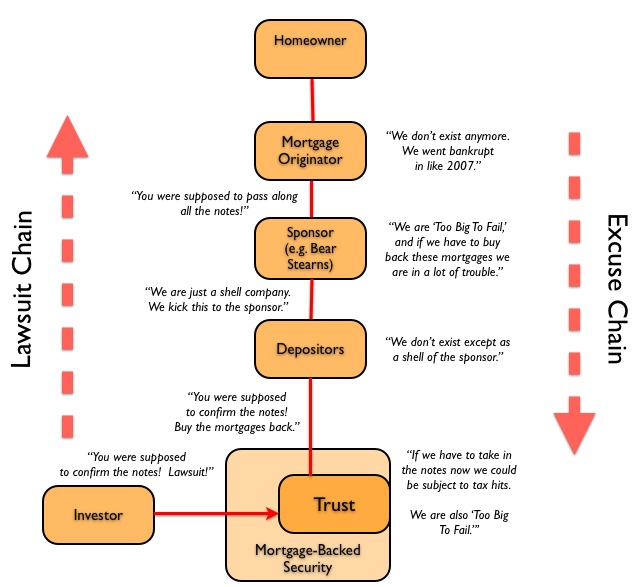
And this isn’t even getting into the question of whether the PSA at issue requires specific endorsements, not endorsements in blank. As it turns out that’s a problem in this particular case. Here’s the PSA for CWABS 2006-13 trust.  Section 2.01(g)(1) provides that the Depositor deliver to the trustee:

the original Mortgage Note, endorsed by manual of facsimile signature in blank in the following form: “Pay to the order of _______ without recourse”, with all intervening endorsements that show a complete chain of endorsement from the originator to the Person endorsing the Mortgage Note…

As an aside, let me point out that “endorsement…in blank” does not mean endorsed in blank in the UCC sense. In the UCC sense, endorsed in blank simply means the endorser’s signature, just as you might put on the back of a check before depositing it. Here, it means endorsed with a blank for the endorsee’s name.  Critically, this PSA requires a complete chain of endorsement with all intervening endorsements. A single endorsement in blank ain’t gonna do it if this PSA means anything. And there were a lot of MBS investors who assumed that it was going to be followed.

I think this PSA just puts the attorney in an even worse place. The only way there should be a separate blank endorsement page is if there was non-compliance with the PSA. Are we really to believe that happened? (Well, yes, but the attorney can’t really argue that BONY generally doesn’t comply with its duties as trustee, now can she?)

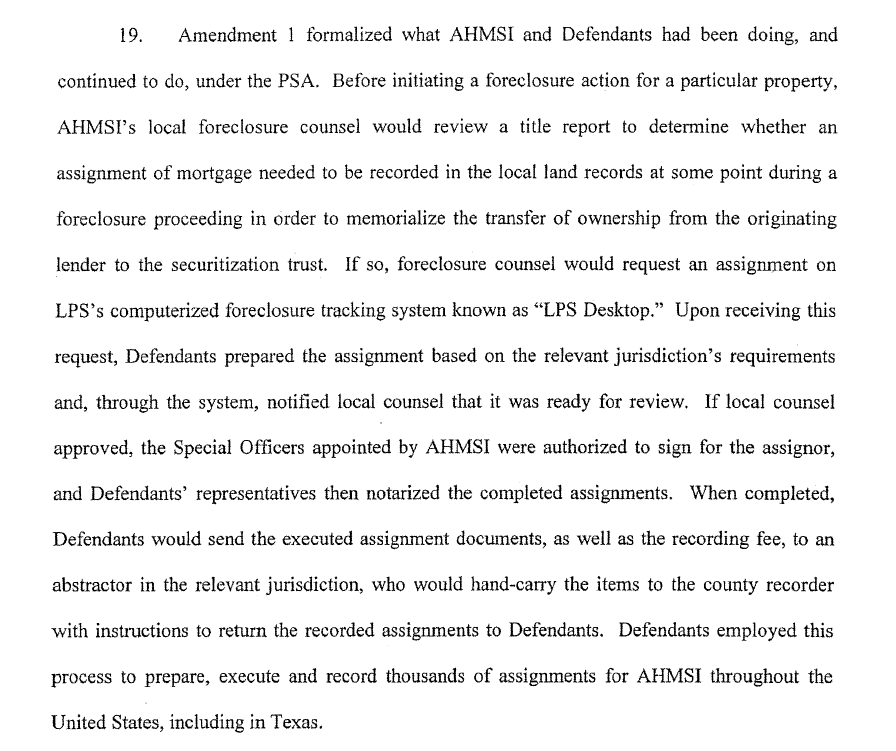
We’ve already seen pretty shocking evidence of documentation fraud in foreclosures.  Remember that the robosigning scandal was the by-product of depositions that aimed to show backdating of assignments to trusts. The shame of the robosigning press coverage was that it focused on some shmucks signing 10,000 assignments in a month–which didn’t necessarily produce any harm itself, just carpal tunnel syndrome–and overlooked the really quite serious criminal problem of the backdating of assignments. The depositions showed pretty clearly that there was backdating–the notarizations were by notaries who didn’t have their commissions until a couple of years subsequent or were done on Christmas Day, etc.

Document fraud in the mortgage industry is nothing new. It’s appeared in all flavors and sizes for centuries. The laws of negotiability are first and foremost evidentiary laws meant to protect against fraud.

Negotiable instruments are reified obligations–the instrument itself is the right to payment (UCC 3-203, cmt. 1).  That means that one can sue on either the instrument or on the underlying contract (but Statute of Frauds might require some writing for enforceability). I hope that courts will recognize that real serious potential for fraud that exists when one combines endorsements in blank with allonges and start demanding (1) that the complete note be filed with the original filing and (2) that anyone using an allonge prove that the allonge goes with the note in question. I think we’ve passed the point were there can be any assumptions of good faith and fair dealing.

I’d be curious to hear if any foreclosure defense attorneys have been pushing on the evidentiary status of allonges–namely what proof beyond a staple or the like is there that an allonge goes with a particular mortgage and wasn’t just photocopied from another one.

And yes, this sort of evidentiary scrutiny adds huge costs to the system. But it would be pretty easily avoided if PSAs had been followed in the first place–there was a reason that they required complete, unbroken chains of endorsement.

June 16, 2011 at 8:43 PM in Mortgage Debt & Home Equity

Adam J. Levitin

Associate Professor of Law

A.B. Harvard; A.M., M.Phil. Columbia; J.D. Harvard

Address:

600 New Jersey Avenue N.W.

Washington, DC 20001-2075

Office Location:  Hotung 6022

Office Phone:  202.662.9234

Office Fax:  202.662.4030

e-mail (preferred contact method): adam.levitin<at>law.georgetown.edu

(replace the <at> with the @ sign in the e-mail)

Assistant:  Terican Gross

Phone:  202.662.9485

Blog:  http://www.creditslips.org

*Please note that I do not provide personal legal advice, including on credit card and mortgage foreclosure issues.*

Biography

Professor Levitin specializes in bankruptcy, commercial law, and financial regulation.  His research focuses on consumer and housing finance, payments, and debt restructuring.

Before joining the Georgetown faculty, Professor Levitin practiced in the Business Finance & Restructuring Department of Weil, Gotshal & Manges LLP in New York and served as law clerk to the Honorable Jane Richards Roth on the United States Court of Appeals for the Third Circuit.  While at Georgetown, he has served as Special Counsel to the Congressional Oversight Panel and as the Robert Zinman Scholar in Residence at the American Bankruptcy Institute.

Professor Levitin holds a J.D. from Harvard Law School, an M.Phil and an A.M. from Columbia University, and an A.B. from Harvard College, all with honors.

Jake Naumer

Resolution Advisors

3187 Morgan Ford

St Louis Missouri 63116

314 961 7600

Fax Voice Mail 314 754 9086

2924 unconstitutional ???

2924 unconstitutional  Check out this pro per complaint they raise some interesting issues.

PJATSI+Supplemental+Complaint+March+25+2011

current rulings on wrongful foreclosure

20.  TIME:  9:00   CASE#: MSC11-00162

 CASE NAME: CHRISTINA PENNES  vs.  PNC MORTGAGE

 HEARING ON DEMURRER TO COMPLAINT of PENNES

 FILED BY PNC BANK, NATIONAL ASSOCIATION

* TENTATIVE RULING: *


Defendant PNC Bank, N.A.’s Demurrer to each cause of action within the Complaint is sustained with leave to amend in part and without leave to amend in part. (Cal. Code Civ. Proc., section 430.10, subd. (e).)


1st cause of action for Cancellation of Instruments (Assignment of Deed of Trust), 2nd cause of action for Cancellation of Instruments (Notice of Default), and  3rd cause of action for Cancellation of Instruments (Notice of Default), sustained with leave to amend. Actions to remove a cloud on title, under Civil Code section 3412, are equitable in nature, and differ from actions to quiet title in that they are aimed at a particular instrument or piece of evidence. Reiner v. Danial (1989) 211 Cal. App. 3d 682, 689.  To state a cause of action to remove a cloud, instead of pleading in general terms that the defendant claims an adverse interest, the plaintiff must allege, inter alia, facts showing actual invalidity of the apparently valid instrument or piece of evidence. (5 Witkin, Cal. Procedure (5th ed. 2008) Pleading, sections 671-674, pp. 97-99.) Plaintiffs have not met this burden. See Complaint par 20, Ex D. See also, Gomes v. Countrywide Home Loans, Inc. (2011) 192 Cal. App. 4th 1149 1154-55 [under Civ C  section 2924(a)(1), a trustee, mortgagee, or beneficiary, or any of their authorized agents, may initiate the foreclosure process. Nowhere, however, does the statute provide for a judicial action to determine whether the person initiating the foreclosure process is indeed authorized, and the court saw no ground for implying such an action, which would have been inconsistent with the policy behind nonjudicial foreclosure of providing a quick, inexpensive and efficient remedy.]


4th cause of action for wrongful foreclosure, sustained with leave to amend. The elements of a common-law cause of action for damages for wrongful foreclosure are:  (1) Trustee or mortgagee caused an illegal, fraudulent or willfully oppressive sale of real property; (2) pursuant to a power of sale contained in a mortgage or deed of trust; and (3) the Trustor or mortgagor sustained damages. (Munger v. Moore (1970) 11 Cal. App. 3d 1, 7; see 4 Witkin, Sum. Of Cal. Law (10th ed. 2005) Secured Transactions in Real Property, §168.)

The Plaintiffs  do not allege that the foreclosure sale has taken place. Thus, Plaintiffs fail to plead a necessary element of this cause of action.


5th cause of action for violation of UCL,  and 8th caused of action for violation of Rosenthal Debt Collection Practices Act [Civ C section 1788], sustained without leave to amend. California’s Unfair Competition Law (UCL) prohibits any unlawful, unfair or fraudulent business practice. (B&P Code section 17200.)  The broad scope of the statute encompasses both anti-competitive business practices and practices injurious to consumers. (Cel‑Tech Communications, Inc. v. Los Angeles Cellular Telephone Co. (1999) 20 Cal.4th 163, 180.)

This cause of action is based in part upon the 8th cause of action for violation of the Rosenthal Debt Collection Practices Act [Civ C § 1788.]

The Rosenthal Debt Collection Practices Act [RDCPA] prohibits debt collectors from engaging in abusive, deceptive and unfair practices in the collection of consumer debts.  (Civ. Code  section 1788, et. Seq.)  Consumer debt is statutorily defined as money, property or the equivalent owed by reason of a consumer credit transaction, which in turn is defined as a transaction in which property, etc. is acquired on credit for personal, family or household purposes. Cal. Civ. Code  section 1788.2(b), (e)-(f), (h).  There are no California State Court opinions to date applying this statute to the enforcement of deeds of trust or to foreclosure proceedings.


6th cause of action for quiet title, sustained with leave to amend:

To state a claim for quiet title,  the complaint shall be verified. CCP section 761.020.  The Complaint is not verified.  Additionally, in order to quiet title, plaintiff  must tender the entire outstanding principal.  See, e.g., Aguilar v. Bocci (1974) 39 Cal.App.3d 475, 477 [Plaintiff cannot quiet title without discharging his debt; the cloud upon his title persists until the debt is paid.]


7th cause of action for rescission, sustained without leave to amend. To state a claim for contract rescission, plaintiff must allege some grounds for rescission-fraud, mistake, coercion, etc. (Civ. Code, § 1689, subd. (b).) plaintiffs do not meet hits pleading burden.

Plaintiffs Opposition does not address this cause of action, therefore, they concede that it has no merit.


9th cause of action for  violation of Civ C § 2923.5, sustained with leave to amend:

Actual contact is not required. See, Civil Code section 2923.59(g). Additionally, the only remedy for a Section 2923.5 violation is a postponement of the foreclosure sale to enable the defendants to comply with the requirements of the statute — not a claim for damages. (Mabry v. Superior Court (2010) 185 Cal. App. 4th 208, 235.)

The Plaintiffs do not allege that a foreclosure sale date has been noticed.

Defendant’s Request for Judicial Notice is granted. (Evid. Code, section 452(c)[public records].


In light of the ruling on the general demurrer, the special demurrer is moot. (Cal. Code Civ. Proc., section 430.10, subd. (f).)

 
 21.  TIME:  9:00   CASE#: MSC11-00162

 CASE NAME: CHRISTINA PENNES  vs.  PNC MORTGAGE

 HEARING ON MOTION TO STRIKE PORTIONS OF PLAINTIFFS’ COMPLAINT

 FILED BY PNC BANK, NATIONAL ASSOCIATION

* TENTATIVE RULING: *


In llight of the ruling on the general demurrer, the Motion to Strike is moot.


Principal reduction success !!!

Filipino Homeowners Get Principal Reduction Relief

Written by admin Featured News, News Highlights, Top StoriesJun 8, 2011

By Henni Espinosa, ABS-CBN North America Bureau

June 8, 2011

UNION CITY, Calif. – Amy and Peter Asi, who lost both their jobs in 2009, almost gave up on their home.  For two years, they had asked their lender, Wachovia, to modify their loan and lower their home’s principal.

They hired the help of Attorney Timothy McCandless.  Eventually, the amount of the Asi’s principal loan was reduced by 29%.  Their lender cut more than $117,000 off their debt.

Peter said they can now breathe a huge sigh of relief.  He said, “We’re already struggling to pay for this house, which is underwater.  This is a big help.”

Atty. McCandless said since the Obama administration has put pressure on lenders to reduce the principals of struggling homeowners, lenders have been receptive…because they see how it will benefit them, as opposed to foreclosing on homes.

McCandless said, “If they put all these hours on the market all at once — values are going to go down faster and further.  It’s in their best interest to work with the homeowners rather than foreclosing, evicting.  It’s very destrucive to the community.”

McCandless said a third of the the homes in America are now underwater in value.  He said lenders now see principal reduction as a win-win situation.

He said, “They look at the appraised value and the cost it’s going to take to liquidate the home — versus working with the homeowner.  Values continue to drop and it’s making more and more sense for banks to work with the homeowners.”

McCandless said principal reduction is a more viable option for struggling homeowners than loan modification…because homeowners are encouraged to pay on time when they know their homes have value.

At its peak, the Asi’s home was valued at $600,000.  It is now down to $400,000.

Now that the bank reduced the amount of their loan to reflect current values, they said they’re more encouraged to pay…especially now that they have full-time jobs.

Amy said, “Without principal reduction, you feel like there’s no sense in paying.  But with it, homeowners feel motivated to pay.”

Not only was their principal reduced, the Asi’s loan was permanently modified from $4,000 a month to $2,800 a month.

The Asi’s principal reduction has a condition.  They have to pay monthly payments on time for the next three years — before the $177,000 can be fully taken out of their loan — not a problem for these homeowners who are now confident in the value of their home.

You may contact Henni Espinosa at henni_espinosa@abs-cbn.com for more information.

<object style=”height: 390px; width: 640px”><param name=”movie” value=”http://www.youtube.com/v/LFBoswtqVrk?version=3″><param name=”allowFullScreen” value=”true”><param name=”allowScriptAccess” value=”always”>

</object>


Bookmark and Share

Paragraph 22 in ALL Deeds of Trust lenders don’t follow the contract

BOMBSHELL- ANOTHER 2ND DCA SMACKDOWN- KONSULIAN! June 1st, 2011 Paragraph 22 of almost every mortgage contains a provision that requires the plaintiff to provide notice and an opportunity to cure the default prior to foreclosure. The principle behind this paragraph and the right to cure is not just a helpful little piece for the defendant, the default and cure provisions recited are an essential element of the entire legal process of foreclosure, deeply rooted in our American Jurisprudence. This is a subject that is discussed in some length in the recent Cardozo Law Review Article on Foreclosures. (attached) That’s all some deep stuff, but here’s where the rubber behind all that hits the road…in an opinion just released today….. Under Florida law, contracts are construed in accordance with their plain language, as bargained for by the parties. Auto-Owners Ins. Co. v. Anderson, 756 So. 2d 29, 34 (Fla. 2000). Further, Busey did not refute Konsulian’s defenses nor did it establish that Konsulian’s defenses were legally insufficient. Because Busey did not prove that it met the conditions precedent to filing for foreclosure, it failed to meet its burden, and it is not entitled to judgment as a matter of law. In addition to being prematurely filed, Konsulian claims that the acceleration letter failed to state the default as required by the mortgage terms. We agree and reverse. Now there are default letters floating all around in Foreclosureland, but I doubt that many of them comply with the express terms of the contract the banks created…..

Foreclosure-Gate Screw Tightens: Banks Face $17 Billion in Suits Over Foreclosures

Posted on May 26, 2011 by Neil Garfield

COMBO Title and Securitization Search, Report, Documents, Analysis & Commentary GET COMBO TITLE AND SECURITIZATION ANALYSIS – CLICK HERE

EDITOR’S COMMENT: Here is our problem writ large. The commentary written by Shedlock (see below) is basically on the side of punishing the banks for their wrongdoing, but not giving any relief to borrowers. The logic behind the position is that anyone who does not pay their mortgage should expect to lose their home. On its face, it would seem that nobody could reasonably argue to the contrary. The problem we face is the assumption behind that sentiment. The presumption is that the payments were due, that the creditor was not getting paid, and that the homeowner should lose the house for which they paid a “stupid price” — a slam at homeowners who accepted the lender’s appraisal of the property.

My premise goes deeper than the shallow waters of Shedlock’s position, who clearly represents the feeling of a majority of people who just take a quick glance at the problem. My premise is that anyone who has a debt that is due has the responsibility to pay it to the party to whom it is due, less any legally meritorious defenses for bad behavior on the part of those who induced him into the transaction.

So if you enter into a transaction where you get funded for $100,000, you have agreed to repay that $100,000. If you have a claim against the party who wants to enforce the obligation, then you should repay the net amount due after computation of damages for both sides. And if the amount due from the “enforcer” (pretender) is more than the amount claimed by the enforcer, there is no debt to pay from the borrower’s perspective. The borrower in that scenario is owed money which is an unsecured debt. I don’t think anyone could reasonably argue with that position either.

The first issue, though is whether the debt is due, and to whom. The debt might not be due at all if the creditor has received, directly or indirectly, payment or settlement from bailouts, insurance, credit default swaps, guarantees, etc. Shedlock’s mistake is the same as most people — assuming that because the homeowner stopped paying, there must be a default. In ordinary times with ordinary mortgage lending practices that would be true. In the context of the illusion of securitization and following the actual money trail, it is not true.

At the time of the declaration of default, the servicer is probably continuing to make the payments to the creditor, which means that from the creditor’s perspective, the obligation is NOT in default. Because the securitization scheme involves multiple obligors on the obligation, only one of which is the homeowner, it is not possible to determine a default unless one gets an accounting from all levels of the securitization chain. If the servicer is making the payments, then the original obligation to the creditor is NOT in default, but the servicer MIGHT have a claim for restitution against the homeowner for making his payment — but that claim is not secured and not  liquidated unless and until the servicer proves the actual money trial. So my premise is based upon making decisions based upon the actual facts rather than a set of incorrect presumptions.

The most serious defect in Shedlock’s position is that taken at face value, it would allow anyone to take the house away regardless of whether or not they are the creditor. Assuming the creditor is the investor-lender. Just because the actual lender refuses to enforce the obligation, and the obligation is “perceived” as due, does not give a license to ANYONE with some knowledge to make the claim in lieu of the real creditor. That is insane. If that were the law, then our marketplace would be filled with uncertainty inasmuch as it would virtually guarantee multiple claims on the same debt by multiple parties. In a race to the courthouse the first one to initiate proceedings to enforce the obligation would arguably be the winner — even though they never loaned any money and never purchased the obligation — and even though the obligation has potentially been paid in full or is being paid current by the servicer. Nobody can reasonably argue with this point either.

The last major point I would make is that Shedlock presumes the original transaction was properly documented and recorded in the form and content required by law. This is not the case in virtually all securitized loans. The documentation shows that homeowner-borrower (HB) was funded by originating lender (OL). In truth OL was merely acting as stand-in for undisclosed parties contrary to federal and state laws. The money trail clearly shows that the investor-lender (IL) was the source of the funds and was the intended beneficiary of the transaction.

So the documentation shows a transaction (HB-OL) that never existed since OL did not lend or otherwise even handle the money involved in the funding of the loan, most of which work was done by the closing or escrow agent. The documentation should have identified IL as the lender but didn’t. In fact, there is no documentation in which both IL and HB appear as parties, neither one actually knowing about the other nor the terms of the transaction by which IL advanced money and HB received the benefit of money.

And here is the rub: the investors don’t want any part of the predatory lending practices and faulty underwriting that was custom and practice in the industry during this mortgage mess, so they seek no remedy from the homeowner. IL does not want to limit itself and collect from HB because IL knows that the investment banker who sold the mortgage bonds didn’t use all the money for funding mortgages. Instead they used the money to claim fees and profits part of which funded bets against the very loans that they said they were selling to the IL but in fact never transferred from OL.

If  Shedlock’s premise were accepted, then the pretender lenders score a great victory for themselves at the expense of the IL whose money they used to fund the scheme and the HB whose obligation has been partially or entirely extinguished by trillions of dollars in payments received by the securitized parties on behalf of the IL but which was neither reported nor paid to IL. IL therefore has chosen to sue not the homeowner, where the damages would be reduced to near zero, but rather to sue the investment bank, where the damages are 100% of the money they advanced. If they went for the HB, they would end up with at best a home worth a small fraction of fraudulent appraisal OL used to get HB’s signature. Both the loan amount and the security for the loan would already be substantially lower than the money advanced by IL. So given that they are looking at 20 cents on the dollar if they go after the HB, less offset for predatory lending claims, they have chosen to sue the investment banker for 100 cents on the dollar.

The void created by the choice of IL not to enforce against HB has been filled with pretender lenders who see an opportunity to gain a free house. It is the banks who have created the choice of a free house (or HB relief for the borrower) or a free house for the pretender lenders. Given the equities and the fact that all of the fees and profits of the securitizers and pretenders are ill-gotten based upon fraudulent statements it hardly seems right to say that the collateral benefit from all this should flow to the banks rather than homeowners who were duped into the transaction to begin with.

from Mish Shedlock, http://globaleconomicanalysis.blogspot.com

Foreclosure-Gate Screw Tightens: Banks Face $17 Billion in Suits Over Foreclosures; Common Sense Says $5 Billion is Very Generous

State attorneys general are not happy with a $5 billion offer by major banks to settle lawsuits regarding robo-foreclosures and other alleged grievances. Some officials want as much as $20 billion. The compromise threat is on the high end.

Please consider Banks Face $17 Billion in Suits Over Foreclosures

State attorneys general told five of the nation’s largest banks on Tuesday they face a potential liability of at least $17 billion in civil lawsuits if a settlement isn’t reached to address improper foreclosure practices, according to people familiar with the matter.

The figure doesn’t cover additional billions of dollars in potential claims from federal agencies such as the Department of Housing and Urban Development and the Justice Department. State and federal officials haven’t proposed a specific comprehensive settlement figure, but Tuesday’s discussions represented the first effort to formally quantify potential liability.

Banks have proposed a $5 billion settlement that would be used to compensate any borrowers previously wronged in the foreclosure process and provide transition assistance for borrowers who are ousted from their homes. Federal and state officials have dismissed that as insufficient. Some officials have pushed for a total price tag of more than $20 billion to resolve foreclosure-handling abuses that surfaced last fall.

The U.S. Trustee Program, a part of the Justice Department that oversees bankruptcy cases, has asked for an additional $500 million to $1 billion in penalties, according to people familiar with the matter. Officials of the unit have raised questions in several cases over the authenticity of foreclosure documents.

Banks have argued that their problems are largely technical and that few if any borrowers have faced wrongful foreclosures. State and federal officials have faulted mortgage companies for not hiring enough staff to provide assistance to millions of borrowers that have fallen behind on their mortgages.

The latest development comes as state and federal officials are intensifying their scrutiny of other parts of the mortgage machine. Attorneys general in California and New York have announced wide-ranging mortgage investigations.

What are the Damages?

This is what I want to know:

  1. How many people lost their home to foreclosure out of an error? By error I mean the wrong person, a home with no mortgage, or a major procedural error.
  2. How many people think they deserve a free house and clear or a principal reduction over “show me the note” nonsense or other problems including unemployment?
  3. How many people did banks string along for many months with promises of work-outs, where the person paid their mortgage for months, then lost their home.

Throw Category #2 in the Ash Can

I am sure category #2 is the largest. Throw those cases in the ash can where they belong.

No one want to admit they were stupid. Yet people paid stupid prices for homes. Others were unlucky. Some lost their jobs. Even then, one can ask “did you have a year’s worth of living expenses saved up in the bank, in case you lost your job?” Regardless of the answer, banks should not be on the hook for people losing their jobs or having medical problems.

Here’s the cold simple truth: If you do not pay your mortgage, it is reasonable to expect to lose your home. There is no other realistic way of looking at it. Robo-signing may not be right, but it is irrelevant.

Category #1 the Real Problem

I have deep sympathy for those in cases where banks foreclosed on the wrong home, the wrong address, or on homes with no mortgage at all. Those people deserve their home paid free and clear and some huge penalty on top of it.

I suspect the number of such cases is minuscule. They receive enormous publicity but is the number 10,000? 5,000? 500? or 50? I suspect the number is far closer to the lower end than the higher end. 50 might easily be on the high side.

Whatever the number is, banks should pay mightily and punitively for it. The money should go to those wronged, not to the states. Even with massive penalties I doubt the total would come close to $200 million.

Category 3 is Where the Uncertainty Is

I do not know how big the “strung along” category is, but the only ones in this category who were genuinely harmed to any significant degree are those who continued to make mortgage payments, strung along on a promise, when instead they could have and should have walked away.

How many is that? You tell me. However, the harm is easy to quantify. The harm is extra payments people made (if any), while the banks engaged in deceptive practices or were simply understaffed.

Assume banks engaged in deceptive practices and people made extra payments instead of walking away. Would those extra payments amount to as much as $1 billion? I rather doubt it.

$5 Billion is Very Generous

What is a valid penalty? $4 billion seems like a lot of money to me. That would be a 400% penalty if the total wrong-doing amounted to $1 billion which I doubt.

The sad truth of the matter is we have a full scale witch-hunt over robo-signing and other alleged grievances even though there was little actual damage caused by banks.

If you disagree then total up the damages. However, I insist you start from two essential points.

  1. If you do not pay your mortgage, it is reasonable to expect to lose your home.
  2. Robo-signing may not be right, but it is irrelevant as per point #1.

So total up the damages, add a huge penalty, and let me know what you come up with.

No doubt, many will accuse me of siding with banks. The reality is I am siding with common sense. No one fought against bank bailouts harder than I did. Banks should have been allowed to go under.

Unfortunately they were bailed out. However, two wrongs do not make a right.

I am all for punishing banks provided the punishment is based on damages rather than the widespread belief “we need to stick it to the banks”.

tila statute of limitations

Statutes of Limitations for TILA and RESPA Claims – For TILA
claims, the statute of limitations for actions for damages runs one
year after the loan origination.  15 U.S.C. § 1640(e).  For actions
seeking rescission, the statute of limitations is three years from
loan origination.  15 U.S.C. § 1635(f).  For RESPA, actions brought
for lack of notice of change of loan servicer have a statute of
limitation of three years from the date of the occurrence, and actions
brought for payment of kickbacks for real estate settlement services,
or the conditioning of the sale on selection of certain title services
have a statute of limitations of one year from the date of the
occurrence.  12 U.S.C. § 2614.

Ibanez does it apply in california

Applicability of US Bank v. Ibanez – The Ibanez case, 458
Mass. 637 (January 7, 2011), does not appear to assist Plaintiff in
this action.  First, the Court notes that this case was decided by the
Massachusetts Supreme Court, such that it is persuasive authority, and
not binding authority.  Second, the procedural posture in this case is
different than that found in a case challenging a non-judicial
foreclosure in California.  In Ibanez, the lender brought suit in the
trial court to quiet title to the property after the foreclosure sale,
with the intent of having its title recognized (essentially validating
the trustee’s sale).  As the plaintiff, the lender was required to
show it had the power and authority to foreclose, which is
established, in part, by showing that it was the holder of the
promissory note.  In this action, where the homeowner is in the role
of the plaintiff challenging the non-judicial foreclosure, the lender
need not establish that it holds the note.

res judicata effect of prior unlawful detainer action

Res Judicata Effect of Prior UD Action – Issues of title are
very rarely tried in an unlawful detainer action and moving party has
failed to meet the burden of demonstrating that the title issue was
fully and fairly adjudicated in the underlying unlawful detainer.
Vella v. Hudgins, 20 Cal. 3d 251, 257 (1977).  The burden of proving
the elements of res judicata is on the party asserting it.  Id. The
Malkoskie case is distinguishable because, there, the unlimited
jurisdiction judge was convinced that the title issue was somehow
fully resolved by the stipulated judgment entered in the unlawful
detainer court.  Malkoskie v. Option One Mortg. Corp., 188 Cal. App.
4th 968, 972 (2010).

Promissory Estoppel

Promissory Estoppel – “The doctrine of promissory estoppel
makes a promise binding under certain circumstances, without
consideration in the usual sense of something bargained for and given
in exchange. Under this doctrine a promisor is bound when he should
reasonably expect a substantial change of position, either by act or
forbearance, in reliance on his promise, if injustice can be avoided
only by its enforcement. The vital principle is that he who by his
language or conduct leads another to do what he would not otherwise
have done shall not subject such person to loss or injury by
disappointing the expectations upon which he acted. In such a case,
although no consideration or benefit accrues to the person making the
promise, he is the author or promoter of the very condition of affairs
which stands in his way; and when this plainly appears, it is most
equitable that the court should say that they shall so stand.”  Garcia
v. World Sav., FSB, 183 Cal. App. 4th 1031, 1039-1041 (2010)
(citations quotations and footnotes omitted).

argumment only is not enough

Unargued Points – “Contentions are waived when a party fails
to support them with reasoned argument and citations to authority.”
Moulton Niguel Water Dist. v. Colombo, 111 Cal. App. 4th 1210, 1215
(2003).

If opposed service isues are waived

Responding on the Merits Waives Any Service Defect – “It is
well settled that the appearance of a party at the hearing of a motion
and his or her opposition to the motion on its merits is a waiver of
any defects or irregularities in the notice of the motion.”  Tate v.
Superior Court, 45 Cal. App. 3d 925, 930 (1975) (citations omitted).

ok what is emotional distress

Cause of Action for Intentional Infliction of Emotional
Distress –  Collection of amounts due under a loan or restructuring a
loan in a way that remains difficult for the borrower to repay is not
“outrageous” conduct.  Price v. Wells Fargo Bank, 213 Cal. App. 3d
465, 486 (1989). Perhaps its when a Marshall is making a 72 year old woman disrobe

when he is evicting the woman. She asks if she can get some cloths on and he watches as

she disrobes to put on her cloths. All this on behalf of the bank. Maybe that’s emotional distress.

I don’t mean to be salacious but this happened to a client of mine.

17200 Unfair Business Practices maybe thats what it is

– Cause of Action for Violation of Bus. & Prof. Code § 17200 –
“The UCL does not proscribe specific activities, but broadly prohibits
any unlawful, unfair or fraudulent business act or practice and
unfair, deceptive, untrue or misleading advertising. The UCL governs
anti-competitive business practices as well as injuries to consumers,
and has as a major purpose the preservation of fair business
competition. By proscribing “any unlawful business practice,” section
17200 “borrows” violations of other laws and treats them as unlawful
practices that the unfair competition law makes independently
actionable.  Because section 17200 is written in the disjunctive, it
establishes three varieties of unfair competition-acts or practices
which are unlawful, or unfair, or fraudulent. In other words, a
practice is prohibited as “unfair” or “deceptive” even if not
“unlawful” and vice versa.”  Puentes v. Wells Fargo Home Mortg., Inc.,
160 Cal. App. 4th 638, 643-644 (2008) (citations and quotations
omitted).

“Unfair” Prong

[A]ny finding of unfairness to competitors under section 17200 [must]
be tethered to some legislatively declared policy or proof of some
actual or threatened impact on competition. We thus adopt the
following test: When a plaintiff who claims to have suffered injury
from a direct competitor’s “unfair” act or practice invokes section
17200, the word “unfair” in that section means conduct that threatens
an incipient violation of an antitrust law, or violates the policy or
spirit of one of those laws because its effects are comparable to or
the same as a violation of the law, or otherwise significantly
threatens or harms competition.

Cel-Tech Communications, Inc. v. Los Angeles Cellular Telephone Co.,
20 Cal. 4th 163, 186-187 (1999).

“Fraudulent” Prong

The term “fraudulent” as used in section 17200 does not refer to the
common law tort of fraud but only requires a showing members of the
public are likely to be deceived. Unless the challenged conduct
targets a particular disadvantaged or vulnerable group, it is judged
by the effect it would have on a reasonable consumer.

Puentes, 160 Cal. App. 4th at 645 (citations and quotations
omitted).

“Unlawful” Prong

By proscribing “any unlawful” business practice, Business and
Professions Code section 17200 “borrows” violations of other laws and
treats them as unlawful practices that the UCL makes independently
actionable. An unlawful business practice under Business and
Professions Code section 17200 is an act or practice, committed
pursuant to business activity, that is at the same time forbidden by
law. Virtually any law -federal, state or local – can serve as a
predicate for an action under Business and Professions Code section
17200.

Hale v. Sharp Healthcare, 183 Cal. App. 4th 1373, 1382-1383 (2010)
(citations and quotations omitted).

“A plaintiff alleging unfair business practices under these statutes
must state with reasonable particularity the facts supporting the
statutory elements of the violation.”  Khoury v. Maly’s of California,
Inc., 14 Cal. App. 4th 612, 619 (1993) (citations and quotations
omitted).

Tender or if I could tender I wouldn’t be filing this suit

Tender – A borrower attacking a voidable sale must do equity
by tendering the amount owing under the loan.  The tender rule applies
to all causes of action implicitly integrated with the sale.  Arnolds
Management Corp. v. Eischen, 158 Cal. App. 3d 575, 579 (1984).

Statute of frauds and foreclosure

Statute of Frauds, Forebearance Agreement – An agreement to
forebear from foreclosing on real property under a deed of trust must
be in writing and signed by the party to be charged or it is barred by
the statute of frauds.  Secrest v. Security Nat. Mortg. Loan Trust
2002-2, 167 Cal. App. 4th 544, 552-553 (2008).

Statute of frauds and modification

– Statute of Frauds, Modification of Loan Documents – An
agreement to modify a note secured by a deed of trust must be in
writing signed by the party to be charged, or it is barred by the
statute of frauds.  Secrest v. Security Nat. Mortg. Loan Trust 2002-2,
167 Cal. App. 4th 544, 552-553 (2008). Oh yes but what about the exceptions.

Performance of the contract like if you will provide all you personal financial information

we (the lender)  will postpone the Trustee sale. You provide the information they foreclose anyway.

Possession of the note in California does not apply the whole UCC fpr that matter does not apply

Possession of the original promissory note – “Under Civil
Code section 2924, no party needs to physically possess the promissory
note.” Sicairos v. NDEX West, LLC, 2009 WL 385855 (S.D. Cal. 2009)
(citing CCC § 2924(a)(1); see also Lomboy v. SCME Mortgage Bankers,
2009 WL 1457738 * 12-13 (N.D. Cal. 2009) (“Under California law, a
trustee need not possess a note in order to initiate foreclosure under
a deed of trust.”).

Bet you didn’t know that the spanish contract translation does not apply to trust deeds

Cause of Action for Violation of Civil Code § 1632 - Section
1632, by its terms, does not apply to loans secured by real property.
CCC § 1632(b).


(a) The Legislature hereby finds and declares all of the

following:

(1) This section was enacted in 1976 to increase consumer

information and protections for the state’s sizeable and growing

Spanish-speaking population.

(2) Since 1976, the state’s population has become increasingly

diverse and the number of Californians who speak languages other than

English as their primary language at home has increased

dramatically.

(3) According to data from the United States Census of 2000, of

the more than 12 million Californians who speak a language other than

English in the home, approximately 4.3 million speak an Asian

dialect or another language other than Spanish. The top five

languages other than English most widely spoken by Californians in

their homes are Spanish, Chinese, Tagalog, Vietnamese, and Korean.

Together, these languages are spoken by approximately 83 percent of

all Californians who speak a language other than English in their

homes.

(b) Any person engaged in a trade or business who negotiates

primarily in Spanish, Chinese, Tagalog, Vietnamese, or Korean, orally

or in writing, in the course of entering into any of the following,

shall deliver to the other party to the contract or agreement and

prior to the execution thereof, a translation of the contract or

agreement in the language in which the contract or agreement was

negotiated, which includes a translation of every term and condition

in that contract or agreement:

(1) A contract or agreement subject to the provisions of Title 2

(commencing with Section 1801) of, and Chapter 2b (commencing with

Section 2981) and Chapter 2d (commencing with Section 2985.7) of

Title 14 of, Part 4 of Division 3.

(2) A loan or extension of credit secured other than by real

property, or unsecured, for use primarily for personal, family or

household purposes.

(3) A lease, sublease, rental contract or agreement, or other term

of tenancy contract or agreement, for a period of longer than one

month, covering a dwelling, an apartment, or mobilehome, or other

dwelling unit normally occupied as a residence.

(4) Notwithstanding paragraph (2), a loan or extension of credit

for use primarily for personal, family or household purposes where

the loan or extension of credit is subject to the provisions of

Article 7 (commencing with Section 10240) of Chapter 3 of Part 1 of

Division 4 of the Business and Professions Code, or Division 7

(commencing with Section 18000), or Division 9 (commencing with

Section 22000) of the Financial Code.

(5) Notwithstanding paragraph (2), a reverse mortgage as described

in Chapter 8 (commencing with Section 1923) of Title 4 of Part 4 of

Division 3.

(6) A contract or agreement, containing a statement of fees or

charges, entered into for the purpose of obtaining legal services,

when the person who is engaged in business is currently licensed to

practice law pursuant to Chapter 4 (commencing with Section 6000) of

Division 3 of the Business and Professions Code.

(7) A foreclosure consulting contract subject to Article 1.5

(commencing with Section 2945) of Chapter 2 of Title 14 of Part 4 of

Division 3.

(c) Notwithstanding subdivision (b), for a loan subject to this

part and to Article 7 (commencing with Section 10240) of Chapter 3 of

Part 1 of Division 4 of the Business and Professions Code, the

delivery of a translation of the statement to the borrower required

by Section 10240 of the Business and Professions Code in any of the

languages specified in subdivision (b) in which the contract or

agreement was negotiated, is in compliance with subdivision (b).

(d) At the time and place where a lease, sublease, or rental

contract or agreement described in subdivision (b) is executed,

notice in any of the languages specified in subdivision (b) in which

the contract or agreement was negotiated shall be provided to the

lessee or tenant.

(e) Provision by a supervised financial organization of a

translation of the disclosures required by Regulation M or Regulation

Z, and, if applicable, Division 7 (commencing with Section 18000) or

Division 9 (commencing with Section 22000) of the Financial Code in

any of the languages specified in subdivision (b) in which the

contract or agreement was negotiated, prior to the execution of the

contract or agreement, shall also be deemed in compliance with the

requirements of subdivision (b) with regard to the original contract

or agreement.

(1) “Regulation M” and “Regulation Z” mean any rule, regulation,

or interpretation promulgated by the Board of Governors of the

Federal Reserve System and any interpretation or approval issued by

an official or employee duly authorized by the board to issue

interpretations or approvals dealing with, respectively, consumer

leasing or consumer lending, pursuant to the Federal Truth in Lending

Act, as amended (15 U.S.C. Sec. 1601 et seq.).

(2) As used in this section, “supervised financial organization”

means a bank, savings association as defined in Section 5102 of the

Financial Code, credit union, or holding company, affiliate, or

subsidiary thereof, or any person subject to Article 7 (commencing

with Section 10240) of Chapter 3 of Part 1 of Division 4 of the

Business and Professions Code, or Division 7 (commencing with Section

18000) or Division 9 (commencing with Section 22000) of the

Financial Code.

(f) At the time and place where a contract or agreement described

in paragraph (1) or (2) of subdivision (b) is executed, a notice in

any of the languages specified in subdivision (b) in which the

contract or agreement was negotiated shall be conspicuously displayed

to the effect that the person described in subdivision (b) is

required to provide a contract or agreement in the language in which

the contract or agreement was negotiated, or a translation of the

disclosures required by law in the language in which the contract or

agreement was negotiated, as the case may be. If a person described

in subdivision (b) does business at more than one location or branch,

the requirements of this section shall apply only with respect to

the location or branch at which the language in which the contract or

agreement was negotiated is used.

(g) The term “contract” or “agreement,” as used in this section,

means the document creating the rights and obligations of the parties

and includes any subsequent document making substantial changes in

the rights and obligations of the parties. The term “contract” or

“agreement” does not include any subsequent documents authorized or

contemplated by the original document such as periodic statements,

sales slips or invoices representing purchases made pursuant to a

credit card agreement, a retail installment contract or account or

other revolving sales or loan account, memoranda of purchases in an

add-on sale, or refinancing of a purchase as provided by, or pursuant

to, the original document.

The term “contract” or “agreement” does not include a home

improvement contract as defined in Sections 7151.2 and 7159 of the

Business and Professions Code, nor does it include plans,

specifications, description of work to be done and materials to be

used, or collateral security taken or to be taken for the retail

buyer’s obligation contained in a contract for the installation of

goods by a contractor licensed pursuant to Chapter 9 (commencing with

Section 7000) of Division 3 of the Business and Professions Code, if

the home improvement contract or installation contract is otherwise

a part of a contract described in subdivision (b).

Matters ordinarily incorporated by reference in contracts or

agreements as described in paragraph (3) of subdivision (b),

including, but not limited to, rules and regulations governing a

tenancy and inventories of furnishings to be provided by the person

described in subdivision (b), are not included in the term “contract”

or “agreement.”

(h) This section does not apply to any person engaged in a trade

or business who negotiates primarily in a language other than

English, as described by subdivision (b), if the party with whom he

or she is negotiating is a buyer of goods or services, or receives a

loan or extension of credit, or enters an agreement obligating

himself or herself as a tenant, lessee, or sublessee, or similarly

obligates himself or herself by contract or lease, and the party

negotiates the terms of the contract, lease, or other obligation

through his or her own interpreter.

As used in this subdivision, “his or her own interpreter” means a

person, not a minor, able to speak fluently and read with full

understanding both the English language and any of the languages

specified in subdivision (b) in which the contract or agreement was

negotiated, and who is not employed by, or whose service is made

available through, the person engaged in the trade or business.

(i) Notwithstanding subdivision (b), a translation may retain the

following elements of the executed English-language contract or

agreement without translation: names and titles of individuals and

other persons, addresses, brand names, trade names, trademarks,

registered service marks, full or abbreviated designations of the

make and model of goods or services, alphanumeric codes, numerals,

dollar amounts expressed in numerals, dates, and individual words or

expressions having no generally accepted non-English translation. It

is permissible, but not required, that this translation be signed.

(j) The terms of the contract or agreement which is executed in

the English language shall determine the rights and obligations of

the parties. However, the translation of the contract or the

disclosures required by subdivision (e) in any of the languages

specified in subdivision (b) in which the contract or agreement was

negotiated shall be admissible in evidence only to show that no

contract was entered into because of a substantial difference in the

material terms and conditions of the contract and the translation.

(k) Upon a failure to comply with the provisions of this section,

the person aggrieved may rescind the contract or agreement in the

manner provided by this chapter. When the contract for a consumer

credit sale or consumer lease which has been sold and assigned to a

financial institution is rescinded pursuant to this subdivision, the

consumer shall make restitution to and have restitution made by the

person with whom he or she made the contract, and shall give notice

of rescission to the assignee. Notwithstanding that the contract was

assigned without recourse, the assignment shall be deemed rescinded

and the assignor shall promptly repurchase the contract from the

assignee.

Slander of title maybe thats it

Causes of Action for Slander of Title – The recordation of
the Notice of Default and Notice of Trustee’s Sale are privileged
under CCC § 47, pursuant to CCC § 2924(d)(1), and the recordation of
them cannot support a cause of action for slander of title against the
trustee.  Moreover, “[i]n performing acts required by [the article
governing non-judicial foreclosures], the trustee shall incur no
liability for any good faith error resulting from reliance on
information provided in good faith by the beneficiary regarding the
nature and the amount of the default under the secured obligation,
deed of trust, or mortgage. In performing the acts required by [the
article governing nonjudicial foreclosures], a trustee shall not be
subject to [the Rosenthal Fair Debt Collection Practices Act].”  CCC §
2924(b).

Quiet title by code and verified

Cause of Action to Quiet Title – To assert a cause of action
to quiet title, the complaint must be verified and meet the other
pleading requirements set forth in CCP § 761.020.

The complaint shall be verified and shall include all of the following:

(a)A description of the property that is the subject of the action. In the case of tangible personal property, the description shall include its usual location. In the case of real property, the description shall include both its legal description and its street address or common designation, if any.

(b)The title of the plaintiff as to which a determination under this chapter is sought and the basis of the title. If the title is based upon adverse possession, the complaint shall allege the specific facts constituting the adverse possession.

(c)The adverse claims to the title of the plaintiff against which a determination is sought.

(d)The date as of which the determination is sought. If the determination is sought as of a date other than the date the complaint is filed, the complaint shall include a statement of the reasons why a determination as of that date is sought.

(e)A prayer for the determination of the title of the plaintiff against the adverse claims.

Negligence please tell me I have a least have a case in Negligence well maybe

Cause of Action for Negligence – “Under the common law,
banks ordinarily have limited duties to borrowers. Absent special
circumstances, a loan does not establish a fiduciary relationship
between a commercial bank and its debtor. Moreover, for purposes of a
negligence claim, as a general rule, a financial institution owes no
duty of care to a borrower when the institution’s involvement in the
loan transaction does not exceed the scope of its conventional role as
a mere lender of money. As explained in Sierra-Bay Fed. Land Bank
Assn. v. Superior Court (1991) 227 Cal.App.3d 318, 334, 277 Cal.Rptr.
753, “[a] commercial lender is not to be regarded as the guarantor of
a borrower’s success and is not liable for the hardships which may
befall a borrower. It is simply not tortious for a commercial lender
to lend money, take collateral, or to foreclose on collateral when a
debt is not paid. And in this state a commercial lender is privileged
to pursue its own economic interests and may properly assert its
contractual rights.”  Das v. Bank of America, N.A., 186 Cal. App. 4th
727, 740-741 (2010) (citations and quotations omitted).

they breched but my house is worth 300,000 and I owe 600,000 ??? damages!!!

Cause of Action for Breach of Contract – “A cause of action
for damages for breach of contract is comprised of the following
elements: (1) the contract, (2) plaintiff’s performance or excuse for
nonperformance, (3) defendant’s breach, and (4) the resulting damages
to plaintiff. It is elementary that one party to a contract cannot
compel another to perform while he himself is in default. While the
performance of an allegation can be satisfied by allegations in
general terms, excuses must be pleaded specifically.”  Durell v. Sharp
Healthcare, 183 Cal. App. 4th 1350, 1367 (2010) (citations and
quotations omitted).

We don’t even have to act in “good Faith” or is that “bad Faith”

Cause of Action for Breach of the Implied Covenant of Good
Faith and Fair Dealing – “[W]ith the exception of bad faith insurance
cases, a breach of the covenant of good faith and fair dealing permits
a recovery solely in contract.  Spinks v. Equity Residential Briarwood
Apartments, 171 Cal. App. 4th 1004, 1054 (2009).  In order to state a
cause of action for Breach of the Implied Covenant of Good Faith and
Fair Dealing, a valid contract between the parties must be alleged.
The implied covenant cannot be extended to create obligations not
contemplated by the contract.  Racine & Laramie v. Department of Parks
and Recreation, 11 Cal. App. 4th 1026, 1031-32 (1992).

On account we don’t have to give you an accounting

Cause of Action for an Accounting – Generally, there is no
fiduciary duty between a lender and borrower.  Perlas v. GMAC Mortg.,
LLC, 187 Cal. App. 4th 429, 436 (2010).  Further, Plaintiff (borrower)
has not alleged any facts showing that a balance would be due from the
Defendant lender to Plaintiff.  St. James Church of Christ Holiness v.
Superior Court, 135 Cal. App. 2d 352, 359 (1955).  Any other duty to
provide an accounting only arises when a written request for one is
made prior to the NTS being recorded.  CCC § 2943(c).

Then there is “Constructive Fraud” intent need not be shown

Cause of Action for Constructive Fraud – “A relationship need
not be a fiduciary one in order to give rise to constructive fraud.
Constructive fraud also applies to nonfiduciary “confidential
relationships.” Such a confidential relationship may exist whenever a
person with justification places trust and confidence in the integrity
and fidelity of another. A confidential relation exists between two
persons when one has gained the confidence of the other and purports
to act or advise with the other’s interest in mind. A confidential
relation may exist although there is no fiduciary relation ….”
Tyler v. Children’s  Home Society, 29 Cal. App. 4th 511, 549 (1994)
(citations and quotations omitted).

Lender no fiduciary duty Broker maybe

Cause of Action for Breach of Fiduciary Duty by Lender –
“Absent special circumstances a loan transaction is at arm’s length
and there is no fiduciary relationship between the borrower and
lender. A commercial lender pursues its own economic interests in
lending money. A lender owes no duty of care to the borrowers in
approving their loan. A lender is under no duty to determine the
borrower’s ability to repay the loan. The lender’s efforts to
determine the creditworthiness and ability to repay by a borrower are
for the lender’s protection, not the borrower’s.”  Perlas v. GMAC
Mortg., LLC, 187 Cal. App. 4th 429, 436 (2010) (citations and
quotations omitted).

Ok so maybe it wasn’t Fraud they (the lender) Misrepresented the loan to me

Cause of Action for Negligent Misrepresentation – “The
elements of negligent misrepresentation are (1) the misrepresentation
of a past or existing material fact, (2) without reasonable ground for
believing it to be true, (3) with intent to induce another’s reliance
on the fact misrepresented, (4) justifiable reliance on the
misrepresentation, and (5) resulting damage.  While there is some
conflict in the case law discussing the precise degree of
particularity required in the pleading of a claim for negligent
misrepresentation, there is a consensus that the causal elements,
particularly the allegations of reliance, must be specifically
pleaded.”  National Union Fire Ins. Co. of Pittsburgh, PA v. Cambridge
Integrated Services Group, Inc., 171 Cal. App. 4th 35, 50 (2009)
(citations and quotations omitted).

What is the statue of limitations on fraud

Fraud – Statute of Limitations- The statute of limitations for
fraud is three years.  CCP § 338(d).  To the extent Plaintiff wishes
to rely on the delayed discovery rule, Plaintiff must plead the
specific facts showing (1) the time and manner of discovery and (2)
the inability to have made earlier discovery despite reasonable
diligence.”  Fox v. Ethicon Endo-Surgery, Inc., 35 Cal. 4th 797, 808
(2005).

What is fraud in factum anyway well here is what is required to plead it property

Cause of Action for Fraud, Requirement of Specificity – “To
establish a claim for fraudulent misrepresentation, the plaintiff must
prove: (1) the defendant represented to the plaintiff that an
important fact was true; (2) that representation was false; (3) the
defendant knew that the representation was false when the defendant
made it, or the defendant made the representation recklessly and
without regard for its truth; (4) the defendant intended that the
plaintiff rely on the representation; (5) the plaintiff reasonably
relied on the representation; (6) the plaintiff was harmed; and, (7)
the plaintiff’s reliance on the defendant’s representation was a
substantial factor in causing that harm to the plaintiff. Each element
in a cause of action for fraud must be factually and specifically
alleged. In a fraud claim against a corporation, a plaintiff must
allege the names of the persons who made the misrepresentations, their
authority to speak for the corporation, to whom they spoke, what they
said or wrote, and when it was said or written.”  Perlas v. GMAC
Mortg., LLC, 187 Cal. App. 4th 429, 434 (2010) (citations and
quotations omitted).

no teeth here either

Cause of Action for Violation of CCC §§ 2923.52 and / or
2923.53 – There is no private right of action.  Vuki v. Superior
Court, 189 Cal. App. 4th 791, 795 (2010).

All we have is hope

Cause of Action Under CCC § 2923.6 – There is no private
right of action under Section 2923.6, and it does not operate
substantively.  Mabry v. Superior Court, 185 Cal. App. 4th 208,
222-223 (2010).  “Section 2923.6 merely expresses the hope that
lenders will offer loan modifications on certain terms.”

pre-foreclosure only

Cause of Action Under CCC § 2923.5, Post Trustee’s Sale –
There is no private right of action under Section 2923.5 once the
trustee’s sale has occurred.  The “only remedy available under the
Section is a postponement of the sale before it happens.”  Mabry v.
Superior  Court, 185 Cal. App. 4th 208, 235 (2010).

Wrongful foreclosure and California Judge Firmat

Orange County (Cali) Superior Court Judge Firmat posted these notes on
the law and motion calendar to assist attorneys pleading various
theories in wrongful foreclosure cases etc.  Some interesting
points….

FOOTNOTES TO DEPT. C-15 LAW AND MOTION CALENDARS

Note 1 – Cause of Action Under CCC § 2923.5, Post Trustee’s Sale –
There is no private right of action under Section 2923.5 once the
trustee’s sale has occurred.  The “only remedy available under the
Section is a postponement of the sale before it happens.”  Mabry v.
Superior  Court, 185 Cal. App. 4th 208, 235 (2010).

Note 2 – Cause of Action Under CCC § 2923.6 – There is no private
right of action under Section 2923.6, and it does not operate
substantively.  Mabry v. Superior Court, 185 Cal. App. 4th 208,
222-223 (2010).  “Section 2923.6 merely expresses the hope that
lenders will offer loan modifications on certain terms.”  Id. at 222.

Note 3 – Cause of Action for Violation of CCC §§ 2923.52 and / or
2923.53 – There is no private right of action.  Vuki v. Superior
Court, 189 Cal. App. 4th 791, 795 (2010).

Note 4 –  Cause of Action for Fraud, Requirement of Specificity – “To
establish a claim for fraudulent misrepresentation, the plaintiff must
prove: (1) the defendant represented to the plaintiff that an
important fact was true; (2) that representation was false; (3) the
defendant knew that the representation was false when the defendant
made it, or the defendant made the representation recklessly and
without regard for its truth; (4) the defendant intended that the
plaintiff rely on the representation; (5) the plaintiff reasonably
relied on the representation; (6) the plaintiff was harmed; and, (7)
the plaintiff’s reliance on the defendant’s representation was a
substantial factor in causing that harm to the plaintiff. Each element
in a cause of action for fraud must be factually and specifically
alleged. In a fraud claim against a corporation, a plaintiff must
allege the names of the persons who made the misrepresentations, their
authority to speak for the corporation, to whom they spoke, what they
said or wrote, and when it was said or written.”  Perlas v. GMAC
Mortg., LLC, 187 Cal. App. 4th 429, 434 (2010) (citations and
quotations omitted).

Note 5 –Fraud – Statute of Limitations- The statute of limitations for
fraud is three years.  CCP § 338(d).  To the extent Plaintiff wishes
to rely on the delayed discovery rule, Plaintiff must plead the
specific facts showing (1) the time and manner of discovery and (2)
the inability to have made earlier discovery despite reasonable
diligence.”  Fox v. Ethicon Endo-Surgery, Inc., 35 Cal. 4th 797, 808
(2005).

Note 6 – Cause of Action for Negligent Misrepresentation – “The
elements of negligent misrepresentation are (1) the misrepresentation
of a past or existing material fact, (2) without reasonable ground for
believing it to be true, (3) with intent to induce another’s reliance
on the fact misrepresented, (4) justifiable reliance on the
misrepresentation, and (5) resulting damage.  While there is some
conflict in the case law discussing the precise degree of
particularity required in the pleading of a claim for negligent
misrepresentation, there is a consensus that the causal elements,
particularly the allegations of reliance, must be specifically
pleaded.”  National Union Fire Ins. Co. of Pittsburgh, PA v. Cambridge
Integrated Services Group, Inc., 171 Cal. App. 4th 35, 50 (2009)
(citations and quotations omitted).

Note 7 – Cause of Action for Breach of Fiduciary Duty by Lender –
“Absent special circumstances a loan transaction is at arm’s length
and there is no fiduciary relationship between the borrower and
lender. A commercial lender pursues its own economic interests in
lending money. A lender owes no duty of care to the borrowers in
approving their loan. A lender is under no duty to determine the
borrower’s ability to repay the loan. The lender’s efforts to
determine the creditworthiness and ability to repay by a borrower are
for the lender’s protection, not the borrower’s.”  Perlas v. GMAC
Mortg., LLC, 187 Cal. App. 4th 429, 436 (2010) (citations and
quotations omitted).

Note 8 – Cause of Action for Constructive Fraud – “A relationship need
not be a fiduciary one in order to give rise to constructive fraud.
Constructive fraud also applies to nonfiduciary “confidential
relationships.” Such a confidential relationship may exist whenever a
person with justification places trust and confidence in the integrity
and fidelity of another. A confidential relation exists between two
persons when one has gained the confidence of the other and purports
to act or advise with the other’s interest in mind. A confidential
relation may exist although there is no fiduciary relation ….”
Tyler v. Children’s  Home Society, 29 Cal. App. 4th 511, 549 (1994)
(citations and quotations omitted).

Note 9 – Cause of Action for an Accounting – Generally, there is no
fiduciary duty between a lender and borrower.  Perlas v. GMAC Mortg.,
LLC, 187 Cal. App. 4th 429, 436 (2010).  Further, Plaintiff (borrower)
has not alleged any facts showing that a balance would be due from the
Defendant lender to Plaintiff.  St. James Church of Christ Holiness v.
Superior Court, 135 Cal. App. 2d 352, 359 (1955).  Any other duty to
provide an accounting only arises when a written request for one is
made prior to the NTS being recorded.  CCC § 2943(c).

Note 10 – Cause of Action for Breach of the Implied Covenant of Good
Faith and Fair Dealing – “[W]ith the exception of bad faith insurance
cases, a breach of the covenant of good faith and fair dealing permits
a recovery solely in contract.  Spinks v. Equity Residential Briarwood
Apartments, 171 Cal. App. 4th 1004, 1054 (2009).  In order to state a
cause of action for Breach of the Implied Covenant of Good Faith and
Fair Dealing, a valid contract between the parties must be alleged.
The implied covenant cannot be extended to create obligations not
contemplated by the contract.  Racine & Laramie v. Department of Parks
and Recreation, 11 Cal. App. 4th 1026, 1031-32 (1992).

Note 11 – Cause of Action for Breach of Contract – “A cause of action
for damages for breach of contract is comprised of the following
elements: (1) the contract, (2) plaintiff’s performance or excuse for
nonperformance, (3) defendant’s breach, and (4) the resulting damages
to plaintiff. It is elementary that one party to a contract cannot
compel another to perform while he himself is in default. While the
performance of an allegation can be satisfied by allegations in
general terms, excuses must be pleaded specifically.”  Durell v. Sharp
Healthcare, 183 Cal. App. 4th 1350, 1367 (2010) (citations and
quotations omitted).

Note 12 – Cause of Action for Injunctive Relief – Injunctive relief is
a remedy and not a cause of action.  Guessous v. Chrome Hearts, LLC,
179 Cal. App. 4th 1177, 1187 (2009).

Note 13 – Cause of Action for Negligence – “Under the common law,
banks ordinarily have limited duties to borrowers. Absent special
circumstances, a loan does not establish a fiduciary relationship
between a commercial bank and its debtor. Moreover, for purposes of a
negligence claim, as a general rule, a financial institution owes no
duty of care to a borrower when the institution’s involvement in the
loan transaction does not exceed the scope of its conventional role as
a mere lender of money. As explained in Sierra-Bay Fed. Land Bank
Assn. v. Superior Court (1991) 227 Cal.App.3d 318, 334, 277 Cal.Rptr.
753, “[a] commercial lender is not to be regarded as the guarantor of
a borrower’s success and is not liable for the hardships which may
befall a borrower. It is simply not tortious for a commercial lender
to lend money, take collateral, or to foreclose on collateral when a
debt is not paid. And in this state a commercial lender is privileged
to pursue its own economic interests and may properly assert its
contractual rights.”  Das v. Bank of America, N.A., 186 Cal. App. 4th
727, 740-741 (2010) (citations and quotations omitted).

Note 14 – Cause of Action to Quiet Title – To assert a cause of action
to quiet title, the complaint must be verified and meet the other
pleading requirements set forth in CCP § 761.020.

Note 15 – Causes of Action for Slander of Title – The recordation of
the Notice of Default and Notice of Trustee’s Sale are privileged
under CCC § 47, pursuant to CCC § 2924(d)(1), and the recordation of
them cannot support a cause of action for slander of title against the
trustee.  Moreover, “[i]n performing acts required by [the article
governing non-judicial foreclosures], the trustee shall incur no
liability for any good faith error resulting from reliance on
information provided in good faith by the beneficiary regarding the
nature and the amount of the default under the secured obligation,
deed of trust, or mortgage. In performing the acts required by [the
article governing nonjudicial foreclosures], a trustee shall not be
subject to [the Rosenthal Fair Debt Collection Practices Act].”  CCC §
2924(b).

Note 16 – Cause of Action for Violation of Civil Code § 1632 – Section
1632, by its terms, does not apply to loans secured by real property.
CCC § 1632(b).

Note 17 – Possession of the original promissory note – “Under Civil
Code section 2924, no party needs to physically possess the promissory
note.” Sicairos v. NDEX West, LLC, 2009 WL 385855 (S.D. Cal. 2009)
(citing CCC § 2924(a)(1); see also Lomboy v. SCME Mortgage Bankers,
2009 WL 1457738 * 12-13 (N.D. Cal. 2009) (“Under California law, a
trustee need not possess a note in order to initiate foreclosure under
a deed of trust.”).

Note 18 – Statute of Frauds, Modification of Loan Documents – An
agreement to modify a note secured by a deed of trust must be in
writing signed by the party to be charged, or it is barred by the
statute of frauds.  Secrest v. Security Nat. Mortg. Loan Trust 2002-2,
167 Cal. App. 4th 544, 552-553 (2008).

Note 19 – Statute of Frauds, Forebearance Agreement – An agreement to
forebear from foreclosing on real property under a deed of trust must
be in writing and signed by the party to be charged or it is barred by
the statute of frauds.  Secrest v. Security Nat. Mortg. Loan Trust
2002-2, 167 Cal. App. 4th 544, 552-553 (2008).

Note 20 – Tender – A borrower attacking a voidable sale must do equity
by tendering the amount owing under the loan.  The tender rule applies
to all causes of action implicitly integrated with the sale.  Arnolds
Management Corp. v. Eischen, 158 Cal. App. 3d 575, 579 (1984).

Note 21 – Cause of Action for Violation of Bus. & Prof. Code § 17200 –
“The UCL does not proscribe specific activities, but broadly prohibits
any unlawful, unfair or fraudulent business act or practice and
unfair, deceptive, untrue or misleading advertising. The UCL governs
anti-competitive business practices as well as injuries to consumers,
and has as a major purpose the preservation of fair business
competition. By proscribing “any unlawful business practice,” section
17200 “borrows” violations of other laws and treats them as unlawful
practices that the unfair competition law makes independently
actionable.  Because section 17200 is written in the disjunctive, it
establishes three varieties of unfair competition-acts or practices
which are unlawful, or unfair, or fraudulent. In other words, a
practice is prohibited as “unfair” or “deceptive” even if not
“unlawful” and vice versa.”  Puentes v. Wells Fargo Home Mortg., Inc.,
160 Cal. App. 4th 638, 643-644 (2008) (citations and quotations
omitted).

“Unfair” Prong

[A]ny finding of unfairness to competitors under section 17200 [must]
be tethered to some legislatively declared policy or proof of some
actual or threatened impact on competition. We thus adopt the
following test: When a plaintiff who claims to have suffered injury
from a direct competitor’s “unfair” act or practice invokes section
17200, the word “unfair” in that section means conduct that threatens
an incipient violation of an antitrust law, or violates the policy or
spirit of one of those laws because its effects are comparable to or
the same as a violation of the law, or otherwise significantly
threatens or harms competition.

Cel-Tech Communications, Inc. v. Los Angeles Cellular Telephone Co.,
20 Cal. 4th 163, 186-187 (1999).

“Fraudulent” Prong

The term “fraudulent” as used in section 17200 does not refer to the
common law tort of fraud but only requires a showing members of the
public are likely to be deceived. Unless the challenged conduct
targets a particular disadvantaged or vulnerable group, it is judged
by the effect it would have on a reasonable consumer.

Puentes, 160 Cal. App. 4th at 645 (citations and quotations
omitted).

“Unlawful” Prong

By proscribing “any unlawful” business practice, Business and
Professions Code section 17200 “borrows” violations of other laws and
treats them as unlawful practices that the UCL makes independently
actionable. An unlawful business practice under Business and
Professions Code section 17200 is an act or practice, committed
pursuant to business activity, that is at the same time forbidden by
law. Virtually any law -federal, state or local – can serve as a
predicate for an action under Business and Professions Code section
17200.

Hale v. Sharp Healthcare, 183 Cal. App. 4th 1373, 1382-1383 (2010)
(citations and quotations omitted).

“A plaintiff alleging unfair business practices under these statutes
must state with reasonable particularity the facts supporting the
statutory elements of the violation.”  Khoury v. Maly’s of California,
Inc., 14 Cal. App. 4th 612, 619 (1993) (citations and quotations
omitted).

Note 22 – Cause of Action for Intentional Infliction of Emotional
Distress –  Collection of amounts due under a loan or restructuring a
loan in a way that remains difficult for the borrower to repay is not
“outrageous” conduct.  Price v. Wells Fargo Bank, 213 Cal. App. 3d
465, 486 (1989).

Note 23 – Cause of Action for Negligent Infliction of Emotional
Distress – Emotional distress damages are not recoverable where the
emotional distress arises solely from property damage or economic
injury to the plaintiff.  Butler-Rupp v. Lourdeaux, 134 Cal. App. 4th
1220, 1229 (2005).

Note 24 – Cause of Action for Conspiracy – There is no stand-alone
claim for conspiracy.  Applied Equipment Corp. v. Litton Saudi Arabia
Ltd., 7 Cal. 4th 503, 510-511 (1994).

Note 25 – Cause of Action for Declaratory Relief – A claim for
declaratory relief is not “proper” since the dispute has crystallized
into COA under other theories asserted in other causes of actions in
the complaint.  Cardellini v. Casey, 181 Cal. App. 3d 389, 397-398
(1986).

Note 26 – Cause of Action for Violation of the Fair Debt Collection
Practices Acts – Foreclosure activities are not considered “debt
collection” activities.  Gamboa v. Trustee Corps, 2009 WL 656285, at
*4 (N.D. Cal. March 12, 2009).

Note 27 – Duties of the Foreclosure Trustee – The foreclosure
trustee’s rights, powers and duties regarding the notice of default
and sale are strictly defined and limited by the deed of trust and
governing statutes.  The duties cannot be expanded by the Courts and
no other common law duties exist.  Diediker v. Peelle Financial Corp.,
60 Cal. App. 4th 288, 295 (1997).

Note 28 – Unopposed Demurrer – The Demurrer is sustained [w/ or w/o]
leave to amend [and the RJN granted].  Service was timely and good and
no opposition was filed.
Failure to oppose the Demurrer may be construed as having abandoned
the claims.  See, Herzberg v. County of Plumas, 133 Cal. App. 4th 1,
20 (2005) (“Plaintiffs did not oppose the County’s demurrer to this
portion of their seventh cause of action and have submitted no
argument on the issue in their briefs on appeal.  Accordingly, we deem
plaintiffs to have abandoned the issue.”).

Note 29 – Responding on the Merits Waives Any Service Defect – “It is
well settled that the appearance of a party at the hearing of a motion
and his or her opposition to the motion on its merits is a waiver of
any defects or irregularities in the notice of the motion.”  Tate v.
Superior Court, 45 Cal. App. 3d 925, 930 (1975) (citations omitted).

Note 30 – Unargued Points – “Contentions are waived when a party fails
to support them with reasoned argument and citations to authority.”
Moulton Niguel Water Dist. v. Colombo, 111 Cal. App. 4th 1210, 1215
(2003).

Note 31 – Promissory Estoppel – “The doctrine of promissory estoppel
makes a promise binding under certain circumstances, without
consideration in the usual sense of something bargained for and given
in exchange. Under this doctrine a promisor is bound when he should
reasonably expect a substantial change of position, either by act or
forbearance, in reliance on his promise, if injustice can be avoided
only by its enforcement. The vital principle is that he who by his
language or conduct leads another to do what he would not otherwise
have done shall not subject such person to loss or injury by
disappointing the expectations upon which he acted. In such a case,
although no consideration or benefit accrues to the person making the
promise, he is the author or promoter of the very condition of affairs
which stands in his way; and when this plainly appears, it is most
equitable that the court should say that they shall so stand.”  Garcia
v. World Sav., FSB, 183 Cal. App. 4th 1031, 1039-1041 (2010)
(citations quotations and footnotes omitted).

Note 32 – Res Judicata Effect of Prior UD Action – Issues of title are
very rarely tried in an unlawful detainer action and moving party has
failed to meet the burden of demonstrating that the title issue was
fully and fairly adjudicated in the underlying unlawful detainer.
Vella v. Hudgins, 20 Cal. 3d 251, 257 (1977).  The burden of proving
the elements of res judicata is on the party asserting it.  Id. The
Malkoskie case is distinguishable because, there, the unlimited
jurisdiction judge was convinced that the title issue was somehow
fully resolved by the stipulated judgment entered in the unlawful
detainer court.  Malkoskie v. Option One Mortg. Corp., 188 Cal. App.
4th 968, 972 (2010).

Note 33 – Applicability of US Bank v. Ibanez – The Ibanez case, 458
Mass. 637 (January 7, 2011), does not appear to assist Plaintiff in
this action.  First, the Court notes that this case was decided by the
Massachusetts Supreme Court, such that it is persuasive authority, and
not binding authority.  Second, the procedural posture in this case is
different than that found in a case challenging a non-judicial
foreclosure in California.  In Ibanez, the lender brought suit in the
trial court to quiet title to the property after the foreclosure sale,
with the intent of having its title recognized (essentially validating
the trustee’s sale).  As the plaintiff, the lender was required to
show it had the power and authority to foreclose, which is
established, in part, by showing that it was the holder of the
promissory note.  In this action, where the homeowner is in the role
of the plaintiff challenging the non-judicial foreclosure, the lender
need not establish that it holds the note.

Note 34 – Statutes of Limitations for TILA and RESPA Claims – For TILA
claims, the statute of limitations for actions for damages runs one
year after the loan origination.  15 U.S.C. § 1640(e).  For actions
seeking rescission, the statute of limitations is three years from
loan origination.  15 U.S.C. § 1635(f).  For RESPA, actions brought
for lack of notice of change of loan servicer have a statute of
limitation of three years from the date of the occurrence, and actions
brought for payment of kickbacks for real estate settlement services,
or the conditioning of the sale on selection of certain title services
have a statute of limitations of one year from the date of the
occurrence.  12 U.S.C. § 2614.

Yau v. Deutsche FIRST AMENDED CLASS ACTION COMPLAINT

Yau_-_complaint_First_Amended_Pleading.78103044

FIRST AMENDED CLASS ACTION COMPLAINT
Yau v. Deutsche Bank National Trust Company Americas
Request for IMMEDIATE RELIEF:

Lenore L. Albert, Esq. SBN 210876
LAW OFFICES OF LENORE ALBERT
7755 Center Avenue, Suite #1100
Huntington Beach, CA 92647
Telephone (714) 372-2264
Facsimile (419) 831-3376
Email: lenorealbert@msn.com
Attorney for Plaintiffs and the Class
EDDIE YAU, GLORIA YAU,
ROBERT H. RHOADES, NICOLE
RHOADES, STEVE BURKE, CHEN
PI AS AN INDIVIDUAL AND AS
TRUSTEE FOR THE PI TRUST
DATED MAY 17, 2004, SALIM
BENSRHIR, KIMBERLY
CHRISTENSEN, ALICE MBAABU,
CARMEN ARBALLO, ANGELA
BROWN, ANTHONY JOHNSON,
OTIS BANKS, RICHARD
APOSTOLOS, REGAN OWEN,
JENNIFER OWEN, JOANNE
ANDERSON, JEREMY JOHN DALE,
DOUGLAS L. EDMAN, and
DOUGLAS L. EDMAN and ERIC
EDMAN as trustees of the HIGH
DESERT ENTERPRISES TRUST,
on behalf of themselves and all others
similarly situated,
Plaintiffs,
vs.
DEUTSCHE BANK NATIONAL
TRUST COMPANY, DEUTSCHE
1. Breach/Unjust Enrichment
2. HAMP Breach/Unjust Enrichment
3. Breach of Contract – Third Party Ben.
4. Declaratory Relief/Default Cured
5. Declaratory Relief/Unsecured Creditor
6. Declaratory Relief/Fees and Costs
7. Fraud
8. Injunctive Relief
9. Accounting
10.Unlawful/Unfair Acts §17200
11.Fraud
12.Declaratory Relief/Injunction
[ ]
***
UNITED STATES DISTRICT COURT
CENTRAL DISTRICT OF CALIFORNIA
CASE NO. SACV11-0006-JVS (RNBx)
Assigned for all purposes to the honorable:
James V. Selna
FIRST AMENDED CLASS ACTION
COMPLAINT
Demand for Jury Trial
FIRST AMENDED CLASS ACTION COMPLAINT
Yau v. Deutsche Bank National Trust Company Americas
TEMPORARY RESTRAINING ORDER and
INJUNCTION filed Concurrently herewith

BANK TRUST COMPANY
AMERICAS and AURORA LOAN
SERVICES, LLC, Inclusive,
Defendants.
***
FIRST AMENDED CLASS ACTION COMPLAINT
Yau v. Deutsche Bank National Trust Company Americas
Plaintiffs, by and through their attorney, bring this action on behalf of themselves
and all others similarly situated against Deutsche Bank National Trust Company
(“DBNT” or “Defendant”). Deutsche Bank Trust Company Americas (“DBTCA” or
“Defendant”) and Aurora Loan Services, LLC. (“Aurora” or “Defendant”). Plaintiffs
allege the following on information and belief, except as to those allegations which
pertain to the named Plaintiffs:
1. Plaintiffs bring this action to challenge the defendants’ manipulation and use of
the federal and state programs surrounding the mortgage crisis, such as HAMP and other
foreclosure prevention services.
2. The defendants defaulted the plaintiffs and those similarly situated then offered
them federal and state home retention programs such as Home Affordability
Modification Program agreements (HAMP).
3. After the Plaintiffs made their post default payments as requested, the
defendants never-the-less denied the permanent modification, did not cure the default or
reinstate the plaintiffs’ loans on the grounds they couldn’t get the loan to work.
4. The program guidelines state that if the Net Present Value (“NPV”) of the loan
modification is greater than the NPV at foreclosure, then the lenders modify the
loan.
1. Introduction
5. Plaintiff is informed and believes and alleges thereon that the defendants were
already made whole upon the loans because these loans were securitized with credit
default swaps (“CDS”) and other security interests, and the CDS were factored into the
NPV and not merely the amount that the defendants may receive on a foreclosure sale.
6. The securitization of their loans with CDS was never revealed to the plaintiffs
and the Class prior to their default.
7. The Court has subject matter jurisdiction over this action under 28 USC § 1331
wherein the action arises under the Constitution, laws or treaties of the United States.
8. The Court has personal jurisdiction over the defendants in this action by the
fact that the Defendants are corporations conducting business in the state of California.
9. Venue is proper in this Court pursuant to 28 USC § 1392 because the action
involves real property located in both the Central and Southern District of California; and
pursuant to 28 USC § 1391(b) inasmuch as defendant DBNT and DBTCA reside in the
Central District of California, and a substantial part of the events or omissions on which
the claims are based occurred in this District.
10.Plaintiffs Eddie Yau and Gloria Yau (the “Yaus,” “plaintiff,” “plaintiffs” or
“borrowers”) are a married couple residing in Vista, California. Plaintiff is now, and at
all times mentioned herein relevant to this complaint was the owner of real property
2. Jurisdiction and Venue
3. The Parties
commonly known as 1307 Summer Court, Vista, California 92084 (“subject property”).
Douglas L. Edman was the borrower on the loan.
11.Plaintiffs Robert Rhoades and Nicole Rhoades (the “Rhoades,” “plaintiff,” or
“borrowers”) are a married couple residing in Chino, California. Plaintiff is now, and at
all times mentioned herein relevant to this complaint was the owner of real property
commonly known as 7746 Holland Park, Chino, California 92401 (“subject property”).
Robert Rhoades was the borrower on the loan.
12.Plaintiff Steve Burke is an adult residing in Paradise, California. Plaintiff is
now, and at all times mentioned herein relevant to this complaint was the owner of real
property commonly known as 5871 Pine Circle, Paradise, California 95969 (“subject
property”). Steve Burke was the borrower on the loan.
13.Plaintiff Chen Pi, acting on her own behalf and as trustee for the Pi Trust dated
May 17, 2004 resides in La Puente California. Plaintiff is now, and at all times
mentioned herein relevant to this complaint was the owner of real property commonly
known as17116 Samgerry Dr., La Puente, California (“subject property”). Chen Pi was
the borrower on the loan.
14.Plaintiff Otis Banks is an individual residing in Inglewood, California. Plaintiff
is now, and at all times mentioned herein relevant to this complaint was the owner of real
property commonly known as 5408-5408 ½ 8TH Avenue, Los Angeles, California 90045
(“subject property”). Otis Banks was the borrower on the loan.

15.Plaintiff Salim Bensrhir and Kimberly Christensen are a married couple
residing in Los Angeles, California. Plaintiff is now, and at all times mentioned herein
relevant to this complaint was the owner of real property commonly known as 842 N
Dillon Street, Los Angeles, California 90026 (“subject property”). Salim Bensrhir and
Kimberly Christensen were the borrowers on the loan.
16.Plaintiff Alice Mbaabu is an individual residing in Fontana, California.
Plaintiff is now, and at all times mentioned herein relevant to this complaint was the
owner of real property commonly known as 13536 Whipple Street, Fontana, California
92336 (“subject property”). Alice Mbaabu was the borrower on the loan.
17.Plaintiff Carmen Arballo is an individual residing in Chino, California.
Plaintiff is now, and at all times mentioned herein relevant to this complaint was the
owner of real property commonly known as 6952 Gloria Street, Chino, California 91710
(“subject property”). Carmen Arballo was the borrower on the loan.
18.Plaintiff Angela Brown is an individual residing in Stockton, California.
Plaintiff is now, and at all times mentioned herein relevant to this complaint was the
owner of real property commonly known as 4516 Abruzzi Circle, Stockton, California
95206 (“subject property”). Angela Brown was the borrower on the loan.
19.Plaintiff Anthony Johnson is an individual is an individual residing in Corona,
California. Plaintiff is now, and at all times mentioned herein relevant to this complaint
was the owner of real property commonly known as 382 Minaret Street, Corona, CA
92881 (“subject property”). Anthony R. Johnson was the borrower on the loan.
20.Plaintiff Richard Apostolos is an individual residing in Perris, California.
Plaintiff is now, and at all times mentioned herein relevant to this complaint was the
owner of real property commonly known as 21200 Mountain Ave., Perris, California
92570 (“subject property”). Richard Apostolos was the borrower on the loan.
21.Regan Owen and Jennifer Owen are a married couple residing in Chula Vista,
California. Plaintiff is now, and at all times mentioned herein relevant to this complaint
was the owner of real property commonly known as 2872 Ranch Gate Rd., Chula Vista,
California (“subject property”). Regan Owen was the borrower on the loan.
22.Plaintiff Joanne Anderson is an individual residing in Laguna Niguel,
California. Plaintiff is now, and at all times mentioned herein relevant to this complaint
was the owner of real property commonly known as 24291 Park Pl Dr, Laguna Niguel,
CA 92677 (“subject property”). Joanne Anderson was the borrower on the loan.
23. Jeremy John Dale is an individual residing in Paynes Creek, California.
Plaintiff is now, and at all times mentioned herein relevant to this complaint was the
owner of real property commonly known as 30510 HWY 36 East, Paynes Creek,
California 96075 (“subject property”). Jeremy John Dale was the borrower on the loan.
24.Douglas L. Edman is an individual residing in Malibu, California. Plaintiff is
now, and at all times mentioned herein relevant to this complaint was the owner of real
property commonly known as 612 Thrift Road, Malibu, California 90265 (“subject
property”). Douglas L. Edman was the borrower on the loan.
25.Douglas L. Edman and Eric Edman as trustees of the HIGH DESERT
ENTERPRISES TRUST reside in Malibu, California. Plaintiff is now, and at all times
mentioned herein relevant to this complaint was the owner of real property commonly
known as 612 Thrift Road, Malibu, California 90265 (“subject property”). Douglas L.
Edman was the borrower on the loan. Then after the loan was made, the property was
transferred by Douglas L. Edman to Douglas L. Edman, Trustee of the High Desert
Enterprises Trust.
26.Defendant DEUTSCHE BANK NATIONAL TRUST COMPANY (“DBNT”
or “Custodian”) has its principal place of business at 1761 Saint Andrews Place, Santa
Ana, CA 92705.
27.Defendant DEUTSCHE BANK TRUST COMPANY AMERICAS
(“DBTCA”) has its principal place of business at 1761 Saint Andrews Place, Santa Ana,
CA 92705. When DBNT and DBTCA are mentioned together in this complaint they
may be referred to as “Deutsche Bank.”
28.Defendant AURORA LOAN SERVICES, LLC (“Aurora” or “loan servicer”) is
headquartered in Littleton, Colorado and regularly conducts business in the state of
California.

29. Plaintiffs are informed and believe and allege thereon that their loans are in
securitized trusts where the defendants are either the Servicer, Custodian, or Trustee of
that trust.
30.Plaintiff is informed and believes and alleges thereon that DBNTC and
DBTCA act as board members and are referred to as the Company each with different
duties in the trusts.
31.DBNTC and DBTCA are both subsidiaries created by nonparty Deutsche Bank
Company (“DBC”) which has its principal place of business in Germany. Plaintiff is
informed and believes and alleges thereon DBNTC and DBTCA were either acting in
concert, instructing, adopting, ratifying, assisting DBC’s conduct as alleged in this
complaint through an agency or contractual relationship. As such, the actions or failure
to act are the actions or failure to act of each other.
32.Nonparty FANNIE MAE/FREDDIE MAC (“Fannie Mae”) entered into an
agreement with defendant Aurora of which the plaintiffs and the Class were intended
beneficiaries.
33.Plaintiff is informed and believes and alleges thereon that each defendant is
responsible in some manner for the occurrences alleged in this complaint, and that
plaintiff’s damages were proximately caused by the defendants and at all times
mentioned in this complaint, were the agents, servants, representatives, and/or employees
of their co-defendants, and in doing the things hereinafter alleged were acting in the
scope of their authority as agents, servants, representatives, family members and/or
employees, and with the permission and consent of their co-defendants.
34.Additionally, plaintiff is informed and believes and alleges thereon that each
defendant assisted, aided and abetted, adopted, ratified, approved, or condoned the
actions of every other defendant and that each corporate defendant, if any, was acting as
the alter ego of the other in the acts alleged herein.
35.On March 4, 2009 President Obama signed into law the Making Home
Affordable Plan as part of the Emergency Economic Stabilization Act of 2008. It is in
two parts: the Home Affordable Refinance program (“HARP”) and the Home Affordable
Modification program (“HAMP”).
36.Under these programs, the U.S. Department of the Treasury directed the large
national bank servicers to take corrective action by providing loan modifications that
produced more sustainable loan payments.
37.On March 4, 2009 the U.S. Department of the Treasury explained,
38.With the information now available, servicers can begin immediately to modify
eligible mortgages under the Modification program so that at-risk borrowers can better
afford their payments.
39.Aurora entered into a Servicer Participation Agreement for the HAMP program
with Fannie Mae; the latter acted as Financial Agent of the United States. ( ).
3. Statutory and Regulatory Scheme
Exhibit 1

40.However, Aurora failed and refused to put Mr. Yau immediately into a
modification program until they first defaulted and gave Notice of Sale of Mr. Yau’s
home. Plaintiff is informed and believes and alleges thereon that defendant Aurora first
caused Notices of Default and Notice of Foreclosure Sale to be served on the Class prior
to placing the Class into a temporary HAMP also.
41.By March 2010, the White House fortified the HAMP program because only
borrowers out of the it was aimed at were placed in a
more affordable home loan.
42.Thereafter, the contract between Aurora and Fannie Mae was amended and
restated on or about September 1, 2010. The Amended and restated contract is attached
hereto and fully incorporated herein as .
43.The United States Treasury, Office of the Comptroller of Currency (hereinafter
the “OCC”) regulates the banking industry such as defendant Deutsche Bank. The OCC
mandated that the largest banks institute HAMP programs.
44.The Office of Thrift Supervision (hereinafter the “OTS”) regulates loan
services such as defendant Aurora.
45.According to the Aurora Loan Services – Issuer Profile dated June 24, 2008 by
Analyst Kathleen Tillwitz, Aurora Loan Services was a wholly owned subsidiary of
Lehman Brothers Bank, FSB, servicing 20,000 to 110,380 (or 21.4% of their loans) in
170,000 3 to 4 million borrowers
Exhibit 2
California. As of February 29, 2008 Aurora serviced 514,831 mortgage loans totaling
$113.2 billion dollars.
46.On 11/19/10 the OCC supplied the following written testimony:
47.HAMP guidelines now preclude the servicer from initiating a foreclosure
action until the borrower has been determined to be ineligible for a HAMP modification.
48.Aurora actions in working with the borrowers on the loans at issue in this
complaint violated and continue to violate these directives.
49.Under the contract, the Servicer of the loan must perform a Net Present Value
(NPV) Test to compare the value of the money that it would receive if the loan were
modified with the value it could expect from foreclosure.
50. If the servicer and owner of the loan can expect a greater return from modifying
the loan, the loan is considered NPV positive and the servicer and owner then
modify the loan. ( )
51. In plaintiff’s case, plaintiff is informed and believes and alleges thereon that the
defendants as the servicer and owner of the loan could have expected no more than onethird
of what the plaintiff would have paid under the HAMP loan modification which
would have been anywhere from $934,560.00 to over $1 million dollars.
52.As servicer of the loan, Aurora must modify the loan unless the contractual
agreement it has with the actual holder of the loan prohibits modification. In that case,
must
Exhibit 4
the servicer is required to use reasonable efforts to obtain waivers or approval of a
modification from the owner and/or investor
53.Plaintiff is informed and believes and alleges thereon that Aurora failed to
disclose to Fannie Mae that loans like the Yau’s which appear to nicely fit under the
program’s protected class, were actually the loans that would never become permanently
modified because these loans were backed by CDS and such. Signing up as a servicer of
the HAMP program, was a carrot to lure distressed homeowners into default.
54.The defendants signed up for exemptions with the California Commissioner for
the same reason, motive or to assist in effectuating this plan.
55.Plaintiff is informed and believes and alleges thereon defendant failed to make
these material disclosures to Fannie Mae and the California Commissioner, so the
defendants could use the guise of being able to offer these “Programs” to maximize their
own profit by luring homeowners into default, dragging out the process and obtaining
more money from the defaulted homeowner than otherwise would likely occur if the
homeowner did not have hope they may qualify for one of the foreclosure alternatives,
such as HAMP.
56. In the Yau’s case, who were initially only behind by $5,000.00, if they had
known and understood the truth to this scheme, they would have had an incentive to find
a short term loan or other capital to cure the late payment prior to default instead of
relying on their lender to place them in a foreclosure alternative program; they most
$3.86 Trillion dollars.
likely would have never entered into the mortgage in the first place; and surely would
have never paid a dime to the defendants after they gave notice of default and
foreclosure.
57.The impact of Aurora’s practice of defaulting before processing a foreclosure
alternative request by a homeowner, then dragging out the process while the homeowner
is making monthly payments and denying blocks of HAMP modifications after obtaining
a temporary modification is nothing more than a financial “Death Spiral” for the
homeowner.
58.At all times herein mentioned, plaintiff and the Class believed that they were
eligible for HAMP.
59.Although the plaintiffs and the Class complied with the terms of the post
default program agreements, Defendants refused to cure the default, offer such a
permanent modification under the program or to take corrective action by providing loan
modifications that produced more sustainable loan payments to plaintiff.
60.The market size for credit default swaps by 2008 in the United States was
estimated to be Dodd- Frank Wall Street Reform and Consumer Protection Act
Critics assert that naked CDS should be banned, comparing them to
buying fire insurance on your neighbor’s house, which creates a huge
incentive for arson.1 [emphasis added]
61. In essence the defendants bet against the borrower from the beginning then
used the Federal Government through the federal HAMP program to take even more
money from the defaulting homeowner in this class knowing that they would never grant
this class of homeowners a permanent loan modification or any other type of relief. The
defendants never fully disclosed or adequately explained this to Fannie Mae/Freddie
Mac. The entire program failed to the assist the very class of homeowners it was
intended to protect.
62.On or about February 2, 2011 the Securities and Exchange Commission started
accepting comment on creating an exchange called “Swap Execution Facilities” under
the in order to create
greater transparency with Credit Default Swaps which the SEC refers to as “Security
Based Swaps.”
63.The plaintiffs and the Class in this Complaint are the class of homeowners
these federal and state programs, including the HAMP program were intended to protect.
64.The plaintiffs and the Class were led to believe that they would have the
opportunity to cure their default and be reinstated, but no matter how much they paid the
defendants each month or what they signed, it never happened and they were kept in
constant foreclosure status the entire time while doling out money and their private
financial information to the defendants.
65.Plaintiff alleges defendants intended to, did and still continue to use these
Programs to manipulate more money from the Plaintiffs and the Class.
66.After obtaining the agreements with Fannie Mae and the California
Commissioner, the defendants used the guise of offering these “Programs” to lure
homeowners into default, drag out the process and confuse the homeowners on the type
of alternative temporary program they were placing the homeowner in just to get them to
shell out more money to the defendants after a Notice of Default and Notice of Sale was
filed and served.
67.Plaintiff is informed and believes and alleges thereon that defendant Aurora
knew or had reason to know that defendant Deutsche Bank bought credit default swaps
or other types investment security/insurance that were either worth more than making the
loan modifications permanent prior to default on these blocks of homes when entering to
the contract with Fannie Mae or defendants failed to properly calculate the Net Present
Value (“NPV”) on these loan modifications. But Aurora never disclosed these facts to
Fannie Mae/Freddie Mac.
68.Plaintiff is informed and believes and alleges thereon that these CD swaps and
other financial arrangements and the NPV calculations as applied to these asset-backed
loans were material facts and as such Defendants had a duty to disclose these material
facts under the agreement with Fannie Mae/Freddie Mac or comply with the terms with
regard to NPV calculations.
69.Even if such material facts were disclosed to Fannie Mae/Freddie Mac, these
material facts were never disclosed to the intended beneficiaries of the agreements
between Fannie Mae/Freddie Mac and Aurora, the plaintiffs and the Class.
70. If it is later interpreted that the facts were disclosed to Fannie Mae/Freddie Mac
but the defendants were forbidden from using the gains they could expect to receive from
the CDS by defaulting the homeowners, then the plaintiffs allege that the defendants
breached that covenant to the injury of the plaintiffs.
71.As intended beneficiaries of the agreements between Fannie Mae/Freddie Mac
and Aurora, the Plaintiffs and the Class were injured due to the failure to disclose these
material facts and/or comply with the terms of the agreement.
72. The impact of defendants’ practice and/or scheme as more fully described
below was nothing more than a financial “Death Spiral” to the borrower resulting in
making extortion like payments after giving a complete disclosure of their remaining
financial assets, and allowing their credit to be decimated or face foreclosure sale.
73.And even if these borrowers had the ability to reinstate their loans, under this
scheme the proceeds the defendants received on default would not be applied to the loan
but become a windfall to the defendants, still leaving the homeowner’s credit and
financial health badly battered, making the entire scheme outrageous, despicable and
deserving of punitive or exemplary damages.
74.The plaintiffs each received a written agreement such as a temporary HAMP
agreement after default appearing to give the plaintiffs an opportunity to save their home
if they made the requested payments.
75.Plaintiffs and those similarly situated made all payments, however the
defendants did not cure the default, reinstate the loan or permanently modify the loan.
76.Plaintiff is informed and believes and alleges thereon that at all times
mentioned in this complaint, the defendants knew California was not a deficiency
judgment state and understood their actions of collecting payment after default without
cure or reinstatement was unlawful.
77.Yet, the defendants collected money from the plaintiffs before satisfying the
debt with the security.
78.Mr. Burke has paid the defendants approximately $20,279.00 since the Notice
of Default dated 9/16/08 originally for $6,312.74.
79.Plaintiff, Mr. Apostolos has paid $27,928.00 after his Notice of Default dated
6/7/10 in the amount of $33,014.53 and turned over approximately $7,000.00 payments
to his attorney to be held in trust for payments on his home.
4. General Factual Allegations
80.Plaintiff Ms. Brown has paid the defendants approximately $24,728.00 after
her Notice of Default dated 2/14/09 in the amount of $5,899.60 and also placed
additional payments in trust with her attorney and/or deposited with the court.
81.Plaintiff Mr. Salem Benshir and Kimberly Christensen has paid the defendants
approximately $51,991.25 after their Notice of Default dated 11/16/08 in the amount of
$10,495.23.
82.Plaintiff Regan Owens and Jennifer Owens paid the defendants approximately
$38,059.00 after their Notice of Default dated 3/10/09 in the amount of $27,371.99.
83.Plaintiff Ms. Chen Pi has paid the defendants approximately $24,728.00 after
her Notice of Default dated 2/14/09 in the amount of $5,899.60 and also placed
additional payments in trust with her attorney and/or deposited with the court.
84.Plaintiff Ms. Alice Mbaabu has paid the defendants approximately $24,728.00
after her Notice of Default dated 2/14/09 in the amount of $5,899.60 and also placed
additional payments in trust with her attorney and/or deposited with the court.
85.Plaintiff Ms. Carmen Arballo has paid the defendants approximately
$24,728.00 after her Notice of Default dated 2/14/09 in the amount of $5,899.60 and also
placed additional payments in trust with her attorney and/or deposited with the court.
86.Plaintiff Mr. Anthony Johnson has paid the defendants approximately
$24,728.00 after her Notice of Default dated 2/14/09 in the amount of $5,899.60 and also
placed additional payments in trust with her attorney and/or deposited with the court.
87.Plaintiff Mr. Otis Banks has paid the defendants approximately $24,728.00
after her Notice of Default dated 2/14/09 in the amount of $5,899.60 and also placed
additional payments in trust with her attorney and/or deposited with the court.
88. In fact, each of the named plaintiffs and those similarly situated have entered
into agreements with the defendants after default and tendered payments as requested.
89. In 2009, 632,573 California properties had some type of foreclosure filed on its
property record.2
90.According to a California Consumer Banking article dated December 13, 2010,
the outlook for 2011 is worse.
91.The number of foreclosures is expected to increase in 2011 as more mortgage
defaults work their way through the pipeline. Rick Sharga, a senior vice president for
RealtyTrac, said there were approximately 1.2 million bank repossessions in 2010,
900,000 in 2009, and “We expect we will top both of those numbers in 2011,” he said.3
92.Quality Loan Service Corporation, agent of defendant Aurora Loan Services,
LLC recorded over foreclosure type filings in in 2010
alone.
93.Recently, the Attorney General of Arizona was quoted by Business Week as
stating
What I’m most angry about is the simultaneous modifications and
foreclosures… We need to look for a stipulated judgment in all 50 states,
that if someone is in modification, they can’t be foreclosed.
(www.businessweek.com/news/2010-10-28/arizona-seeks-changes-tobanks-
home-loan-modification-process.html).
94.The plaintiffs and the Class were led to believe that they would have an
opportunity to cure their default, receive a modification and have their loan reinstated,
but no matter how much they paid the defendants each month or what they signed, it
never happened. Attached hereto and fully incorporated herein as is a true and
correct copy of the Yaus’ Temporary HAMP Agreement.
95.Some plaintiffs signed temporary modification agreements, others were
actually placed in limited modification Special Forbearance agreements, and some were
placed in both after notice of default.
96. Defendant Aurora contracted with Fannie Mae to provide foreclosure
prevention services intending to benefit homeowners with affordable loan modifications.
In return Aurora would be compensated over in taxpayer funds as
incentive to do so. Attached hereto and fully incorporated herein as is a true
and correct copy of the original Agreement between Aurora and Fannie Mae.
Exhibit 3
$2.873 Billion dollars
Exhibit 1
97.Plaintiff is informed and believes and alleges thereon that Aurora Loan
Services made and/or is making more money on defaults and/or foreclosures than on the
loan modifications and knew it would do so when entering into the contract with Fannie
Mae.
98.Plaintiff is informed and believes and alleges thereon that defendant Aurora
knew or had reason to know that defendant Deutsche Bank bought credit default swaps
or other types investment security/insurance that were either worth more than making the
loan modifications permanent prior to default on these blocks of homes when entering to
the contract with Fannie Mae or they failed to report the way they were calculating NPV
under the agreement. But Aurora never disclosed these facts to Fannie Mae.
99.Plaintiff is informed and believes and alleges thereon that these CDS and other
financial arrangements were material facts and as such Defendants had a duty to disclose
these material facts under the agreement or the NPV calculations violated the terms of
the agreement with Fannie Mae/Freddie Mac. Attached hereto and fully incorporated
herein as is a true and correct copy of the March 4, 2009 Home Affordable
Modification Program Guidelines including the NPV calculations.
100. But defendants never disclosed or adequately explained these material facts.
101. Assistant Treasury Secretary Herbert M. Allison admitted that modifying
mortgages has been more difficult than administration officials had anticipated.”
Exhibit 4
FIRST AMENDED CLASS ACTION COMPLAINT
Yau v. Deutsche Bank National Trust Company Americas

“Certainly we’ve seen a lot of frustration with this program since its
inception,” he told lawmakers. “We did not fully envision the
challenges we would encounter.” (http://rismedia.com/2010-03-
28/white-house-to-adjust-troubled-mortgage-modification-program/)
102. Section 5 of the Servicer agreement between Aurora and Fannie Mae
contains the representations, warranties and covenants which state in part:
(b) Servicer is in compliance with, and covenants that all
Services will be performed in compliance with all applicable
Federal, state and local law, regulations, regulatory guidance,
statutes, ordinances, codes and requirements, including, but not
limited to, the Truth in Lending Act, 15 USC 1601 et seq., the
home Ownership and Equity Protection Act, 15 USC 1639, the
Federal Trade Commission Act, 15 USC 41 et seq., the Equal
Credit Opportunity Act, 15 USC 701 et seq., the Fair Credit
Reporting Act, 15 USC 1681 et seq., the fair Housing Act and
other Federal and state laws designed to prevent unfair,
discriminatory or predatory lending practices and all applicable
laws governing tenant rights…Servicer is not aware of any
other legal or financial impediments to performing its
obligations under the Program in which Servicer participates or
the Agreement and shall promptly notify Fannie Mae of any
financial and/or operational impediments which may impair its
ability to perform its obligations under such Programs or the
Agreement…
(c) Servicer covenants that:…all data …that is relied upon by
Fannie Mae or Freddie Mac in calculating the Purchase Price or
in performing any compliance review will be true, complete and
accurate in all material respects, and consistent with all relevant
business records, as and when provided.
(d) Servicer covenants that it will(i) perform the Services
required under the Program Documentation and the Agreement
in accordance with the practices, high professional standards of
care, and degree of attention used in a well-managed
operation…

(f) Servicer acknowledges that the provision of false or
misleading information to Fannie Mae or Freddie mac in
connection with any of the Programs or pursuant to the
Agreement may constitute a violation of: (a) Federal criminal
law involving fraud, conflict of interest, bribery, or gratuity
violations found in Title 18 of the United States Code; or (b) the
civil False Claims Act (31 USC § 3729-3733). Servicer
covenants to disclose to Fannie Mae and Freddie Mac any
credible evidence, in connection with the Servicers, that a
management official, employee, or contractor of Servicer has
committed, or may have committed, a violation of the
referenced statutes.
(g) Servicer covenants to disclose to Fannie Mae and Freddie
Mac any other facts or information that the Treasury, Fannie
Mae or Freddie Mac should reasonably expect to know about
Servicer and its contractors to help protect the reputational
interests of the Treasury, Fannie Mae and Freddie Mac in
managing and monitoring the Programs in which Servicer
participates.” ( page A-2 to A-4 ; Exhibit 2 page B-3
to B-4)
103. Plaintiff alleges that defendants breached these covenents.
104. Defendants used the offering of the federal HAMP Program as an incentive
to get the homeowners to default on their loans which would trigger payment on the CDS
without any care about placing the homeowners at risk of a foreclosure sale and then
have the homeowners like the plaintiffs in this case continue to make monthly payments
on them while in default facing a foreclosure sale all to the defendants’ financial benefit.
105. On July 7, 2007 plaintiff Eddie Yau borrowed $608,000.00 from
Homecomings Financial, LLC on a 30 year negative adjustable rate note to purchase his
Exhibit 1
8. Factual Allegations of the Yaus Repesenting the HAMP Subclass
home where he lives with his wife. His payments were supposed to be fixed at $2,402.34
per month for the first five years of the loan.
106. Mr. Yau, a retired military veteran and mechanic, has no mortgage or home
lending financial experience beyond basic financial matters.
107. Plaintiff, as trustor, executed and delivered a deed of trust, conveying the
real property described herein to secure payment of the principal sum and interest as
provided in the note and as part of the same transaction to Homecomings Financial, LLC
which was then later assigned, sold or transferred by the lender to either DBNT or
DBTCA as beneficiary and serviced by defendant Aurora.
108. Mr. Yau missed his July 2008 payment and telephoned defendant Aurora
Loan Services and explained he was experiencing financial difficulties due to a decrease
in his income and inquired as to alternatives to foreclosure.
109. On or about September 24, 2008 defendant Aurora Loan Services sent a
letter explaining the following programs it offered and that by entering into the programs
the borrower “will avoid the loss of your home through foreclosure or further impairment
on your credit.”
“Repayment Plan: If you recently experienced a temporary reduction
in income or an increase in living expenses, a repayment plan will
allow you to repay the past due amount over a specified period of
time.
Forbearance Plan: You may be able to suspend or reduce your
mortgage payments for a short period of time. Thereafter, we would
review your current financial situation and determine what home
retention option would best assist you in bringing your loan current.
Loan Modification: A loan modification may offer you the ability to
change on or more of the terms of your mortgage. This may assist
you with providing an affordable payment and avoiding foreclosure.
Again, we would need to review your financial situation and ability to
pay. If your loan is current and you anticipate that you may have
difficulty in making the increased monthly payment, we may be able
to assist you with a loan modification that will provide you with an
affordable payment based on your current financial information.
110. Then on December 02, 2008 defendant Aurora Loan Services wrote Mr.
Yau which stated:
“Based upon the information that you provided during your telephone
conversation with Aurora, your loan may qualify for a loan
modification….You must provide documentation to support your
inability to reinstate the mortgage loan in one lump sum…under some
circumstances,
111. Then on December 19, 2008 Aurora Loan Services sent Mr. Yau a letter
noting Mr. Yau’s was in default in the amount of $4,828.68 and that
“If you do not bring your loan current within thirty (30) days of the
date of this letter, Aurora Loan Services may demand the entire
balance outstanding under the terms of your Mortgage/Deed of Trust.”
112. Aurora then followed up with the same letter of September 24, 2008 again
on December 24, 2008 and January 20, 2009.
113. Instead of sending Mr. Yau a loan modification plan, defendant Aurora
Loan Services sent him a Repayment Agreement expecting him to pay an additional
$802.78 per month ($3,207.12 per month for 6 months) which equaled a 33% increase in
you may be expected to pay a loan modification fee.”
[Emphasis added]
his monthly mortgage payment. This payment plan did not create a “more sustainable
payment plan.”
114. In 2009 the Yau’s financial situation became worse as their investments
were depleted from what was later characterized as a “Ponzi scheme.”
115. From that time up to June 2009, plaintiff would telephone defendant Aurora
seeking a modification and Aurora would take down information representing the
defendants would start the process, but the process was never started.
116. Mrs. Yau spoke to a person at Aurora Loan Services named Steve who
promised that someone from Aurora Loan Services would call them back no later than
June 1st about the Making Home Affordable Loan Program.
117. On June 16, 2009 defendant caused to be served and recorded a purported
Notice of Default and Election to Sell under Deed of Trust (NOD) alleging (a) that a
breach of the obligation secured by the deed of trust had occurred, consisting of Mr.
Yau’s failure to pay $12,655.67 as of 6/15/09, and (b) that the defendant, as beneficiary,
elected to sell, or to cause to be sold, the property to satisfy that obligation.4
4 However, that Notice of Default was outside the chain of title because Lawyers Title Company, as
the original trustee and Mortgage Electronic Registration Systems, Inc. as the nominee did not
assign this right until June 24, 2009. Attached hereto and fully incorporated herein as is a
true and correct copy of the Assignment to Quality Loan Service which was not notarized until
6/24/09.
Exhibit 8

118. A few months later defendant Aurora Loan Services faxed a “customized
Home Affordable Modification Trial Period Plan (“Trial Period Plan”)” under HAMP
wherein Mr. Yau was supposed to make payments of $1,943.70 on 10/01/09, 11/01/09,
and 12/01/09.
119. The temporary HAMP agreement which is incorporated herein stated in part
“If I comply with the requirements in Section 2 and my
representations in Section 1 continue to be true in all material
respects, the Lender will send me a Modification Agreement for my
signature which will modify my Loan Documents as necessary to
reflect this new payment amount and waive any unpaid late charges
accrued to date.”
120. Aurora promised:
“If you qualify under the federal government’s Home Affordable
Modification program and comply with the terms of the Trial Period
Plan, we will modify your mortgage loan and you can avoid
foreclosure.”
121. These terms are boilerplate in all such agreements received by the coplaintiffs
and the class.
122. Mr. Yau believed he was eligible for HAMP and made the payments as laid
out in the agreement under Section 2, provided the necessary documents and his
representations in Section 1 continued to be true in all material respects, yet defendant
Aurora Loan Services failed and refused to send the Modification Agreement for him to
sign, or to cure the default and reinstate the loan.
123. On or about March 6, 2010 defendant Aurora Loan Services sent a letter to
Mr. Yau explaining,
“Unfortunately, we are unable to offer you a Home Affordable
Modification for the following reasons: Excessive Forbearance. We
are unable to offer you a Home Affordable Modification because we
are unable to create an affordable payment equal to 31% of your
reported monthly gross income without changing the terms loan
beyond the requirements of the program.”
124. Defendant’s representation in that letter was false. According to Aurora
Loan Service’s Customer Account Activity Statement the principal balance on the loan
was at $643,178.83 when he entered the temporary payment plan.
125. The contract required Aurora to place the Yaus into a permanent
modification if the NPV was greater under modification than a foreclosure sale. Plaintiffs
allege the defendants breached by failing to place them in the permanent modification.
126. Plaintiff is informed and believes and alleges thereon that Plaintiff’s home
at foreclosure would not have resulted in a sale in excess of the NPV of the modification.
127. Plaintiff through counsel, demanded defendant’s calculations used to deny
plaintiff’s modification and NPV. To date, defendant failed to provide plaintiff with a
HAMP-compliant modification or any documentation showing its calculations to justify
why a permanent modification was not offered to Plaintiff.
128. Mr. Yau’s loan accelerated from $643,178.83 to $649,482.15 during the
interim.
129. Along with the notice that Mr. Yau did not qualify for the loan modification,
defendant Aurora stated that Mr. Yau may qualify for other foreclosure alternatives such
as “Repayment Plan: allows you to repay the past due amount over a
specified period of time.
Forbearance Plan: allows you to suspend or reduce your mortgage
payments for a short period of time until a long term solution is
available.
Loan Modification: allows us to modify one or more of your original
mortgage terms which will provide you with an affordable payment
based on your current financial information.
Pre-foreclosure Sale (short sale): allows you to sell your property,
pay off your mortgage for an amount less than total pay off to avoid
foreclosure and minimize damage to your credit rating.
Deed in lieu of foreclosure: allows you to voluntarily deed your
property to Aurora Loan Services to payoff your mortgage. Taking
this action may not save your home, but it may help your ability to
qualify for another mortgage in the future.”
130. The Yaus telephoned Aurora and were assured that the defendants would
work with the Yaus and that they could cure their default by having the lender
temporarily forebear the terms of the agreement so that the Yaus could catch up.
131. Consequently, Mr. Yau continued making monthly payments on his home
and entered into a Special Forbearance Plan with defendant Aurora when they sent him
the application to sign.
132. On or about April 7. 2010 Defendant Aurora sent Plaintiffs a letter stating it
had enclosed a “Special Forbearance Agreement which has been prepared on your
behalf.” On page 2 of the agreement it stated “WHEREAS, customer has requested and
Lender has agreed to allow Customer to repay the Arrearage pursuant to a loan work-out
arrangement on the terms set forth herein.”
133. However, there was no real consideration and the agreement was illusory
because the Lender had been given the right to proceed with a foreclosure sale during the
term of the agreement at its discretion and the terms never gave the Yaus an opportunity
to repay the arrearage.
134. The Plan was not the same as advertised in its prior letters to Mr. Yau or as
represented on the telephone. The forbearance Plan did not allow Mr. Yau to suspend or
reduce his mortgage payments for a short period of time until a long term solution was
available.
135. Mr. Yau made the required $4,804.72 initial payment and monthly
payments of $2,875.00 but he was only getting further in debt.
136. The true facts were that his payments were increased to $2,875.00 per
month and no other terms of his loan were modified or suspended during the forbearance
period. He was still in default and the foreclosure sales were still pending.
137. Furthermore, the terms of the Agreement violated California law.
138. Mr.Yau continued to make the $2,875.00 monthly payments until this action
was filed.
139. Instead of putting Mr. Yau into a temporary modification, they delayed
processing, requesting the same documents they already had over and over again.
140. As a result of defendants’ unlawful practices, unfair acts and failure to place
Mr. Yau into a permanent HAMP loan modification on December 1, 2009, his loan as of
October 10, 2010 approached the HAMP cap.
Total Unpaid principal $664,711.59
Interest from 12/1/09 to 10/10/10 47,916.49
Escrow/Impound Overdraft 12,983.09
Corporate advance 3,652.84
Unpaid Late Charges 120.12
Recording Fee 37.00
Suspense Balance -2,345.75
Total: $727,075.38
141. On November 5, 2010 defendant Aurora sent notice that it intended on
increasing Mr. Yau’s monthly loan payment to $5,466.57 on 3/01/11.
142. Defendant then notified Mr. Yau it intended to sell his home on 12/13/10.
143. From September 2008 when Mr. Yau was behind by approximately
$5,000.00 through present plaintiff has paid defendants approximately $54,293.08. This
is very close to the amount he would have paid the defendants if he had never defaulted
on the loan in the first place ($2402.34*24 months = $57,656.16).
144. Plaintiff further alleges the defendants were deceptive and unlawful in their
handling of the loans and business practices. Examples in the Yaus’ case, include but are
not limited to the fact that defendant has not rescinded the Notice of Default or Notice of
foreclosure sale although the Notice was filed before Quality Loan Services received
assignment and as such is outside the chain of title. Failing to send the plaintiffs a loan
modification application until after they filed a Notice of Default. Additionally, flood
hazard insurance was not required on the Yaus loan but the defendants charged Mr. Yau
$1592.00 for flood hazard insurance after the loan went into default in addition to other
fees and charges for allegedly driving by the home and such. Also, Defendant obtained
an exemption to allow defendant Aurora to offer modifications and other programs in
excess of 38% of the borrower’s income from the California Commissioner but
defendant never notified plaintiff of that fact as required under California law and never
took the foreclosure off of the home when it was notified of this failure to notify.
Defendants failed and refused to request partition even after being notified only Mr. Yau
was on the Note and Mrs. Yau at most was a trustee and was given no consideration for
her name to be placed on their filed recordings as a “co-borrower” for non-judicial
foreclosure purposes.
5. Factual Allegations of Mr. Edman representing the Forebearance Class
145. Mr. Edman obtained a loan to build a home on his land in Malibu,
California.
146. On or about 12/07/06, for valuable consideration, plaintiff, as borrower
made, executed and delivered to his original lender a written promissory note in the
amount of $850,000.00, a true and correct copy of which is attached as and
incorporated by reference herein.
147. According to the terms of the Note, Mr. Edman was required to pay
$3,141.77 per month for the first five (5) years.
148. Plaintiff, as trustor, executed and delivered a deed of trust, conveying the
real property described herein to secure payment of the principal sum and interest as
provided in the note and as part of the same transaction which was then transferred to
defendant, as beneficiary.
149. Said deed of trust was recorded against the subject property in the Official
Records in Los Angeles County, California, a true and correct copy of which is attached
as and incorporated by reference herein.
150. On or about 1/14/09, defendant caused to be recorded a notice of default
and election to sell in the Official Records in Los Angeles, County, California alleging
(a) that a breach of the obligation secured by the deed of trust had occurred, consisting
of plaintiff’s alleged failure to pay $14,267.35 as of 1/13/09, and (b) that the defendant,
as beneficiary, elected to sell, or to cause to be sold, the trust property to satisfy that
Exhibit 10
Exhibit B

obligation, a true and correct copy of which is attached as and incorporated
by reference herein.
151. A week later on or about 1/23/09, defendants delivered a document to Mr.
Edman which represented a “Special Forbearance Agreement [] has been prepared on
your behalf.”
“WHEREAS, customer has requested and Lender has agreed to allow Customer to
repay the Arrearage pursuant to a loan work-out arrangement on the terms set forth
herein…NOW, THEREFORE…Lender shall forbear from exercising any or all of its
rights and remedies..” [pg 2]
“The amount of each Plan payment specified above includes both (1) the regularly
scheduled monthly payment, plus (2) the portion of the Arrearage specified above…
in the event Customer cures the Arrearage by making all Plan payments on or before
the Expiration Date, and is current with the payments then due, and no default then
exists under the Loan Documents and Agreement, Lender shall consider the Note
and Security Instrument to be current and in effect according to their original terms
and conditions.” Attached hereto and fully incorporated herein as is a
true and correct copy of the Special Forbearance Agreement entered into postdefault.
152. Consequently, Mr. Edman made the monthly payments on his home and
entered into a Special Forbearance Plan with defendant Aurora.
Exhibit 11
Exhibit 12

concert therewith after default, but whose default was not cured and loan was not
reinstated by defendants after plaintiff tendered the requested payments.
California homeowners who were denied permanent HAMP loan
agreements after entering in a temporary HAMP agreement with
defendant Aurora whose loans are held by DBNT as Custodian, and
making their payments as requested under the temporary HAMP
agreement.
California homeowners who were denied permanent HAMP loan
agreements after entering in a temporary limited modification Special
Forbearance agreement with defendant Aurora whose loans are held
by DBNT as Custodian, and making their payments as requested
under the temporary HAMP agreement.
159. Excluded from the Class are governmental entities, defendants, and their
affiliates, subsidiaries, current or former employees, officers, directors, agents,
representatives, their family members, the members of this Court and its staff.
160. Defendants subjected plaintiffs and each of their respective Classes to the
same unfair, unlawful and deceptive practices and harmed them in the same manner.
Now plaintiffs and each of their respective Classes seek to enforce the same rights and
remedies under the same substantive law.
161. Plaintiffs do not know the exact size or identities of the members of the
proposed class, since such information is in the exclusive control of the Defendants.
Plaintiffs believe that the Class encompasses over 41 individuals California homeowners
HAMP Subclass:
Forbearance Subclass:

which could reach into the thousands whose identities can be readily ascertained from
Defendant’s books and records. Defendants filed over 4,000 foreclosure documents with
the Orange County Recorder’s office in 2010 alone. Therefore, the proposed Class are so
numerous that joinder of all members is impracticable.
162. Based on the market value of these homes in foreclosure and the size of the
payments made by the Class members under the temporary HAMP agreements and
thereafter, plaintiffs believe the amount in controversy could range anywhere from
$1,250,000 for the first 25 members to over $2 billion dollars for the entire anticipated
class.
163. All members of the Class have been subject to and affected by the same
conduct. The claims are based on wrongfully forcing the Class into default before
implementing a written foreclosure alternative program then wrongfully failing to cure
the default, reinstate the loan or permanently modifying the loan under HAMP and other
government programs after the Class made the payments as requested.
164. There are questions of law and fact that are common to the Class, and
predominate over any questions affecting only individual members of the Class. These
questions include, but are not limited to the following:
a. The validity of the contracts at issue in this case (
(5th Cir 1985) 759 F2d 466, 471);
See, Black Gold Marine,
Inc. v Jackson Marine Co.
b. The nature, scope and operation of defendants’ obligations to the borrowers
under the Servicer Participation Agreements entered into between Aurora
and Fannie Mae ( . (2nd Cir
1986) 799 F.2d 851, 856);
c. Whether the defendants must now be reclassified as unsecured creditors.
d. Whether the plaintiffs have cured their defaults and are entitled to
reconveyance upon payments of subsequent sums due and owing, if any.
e. Whether plaintiffs are entitled to reconveyance of their deeds.
f. The defendants’ obligations to the borrowers when the borrower holds a
CDS or some similar type of security/insurance against default on the
borrower’s loan;
g. Whether the existence of a CDS or similar type of security/insurance to a
borrower should be disclosed at the time the borrower signs the promissory
note and mortgage or as soon as the lender obtains a CDS contract that
could cover the loan.
h. Whether the failure to disclose the existence of a CDS or similar type of
security/insurance to a borrower before default is a breach of good faith and
fair dealing;
See, Topps Chewing Gum, Inc. v Fleer Corp
i. The Class’ right to terminate and rescind the contracts at issue in this action
( . (2nd
Cir. 1994) 17 F3d 38, 39-40).
j. The nature, scope and operation of defendants’ obligations to the borrowers
under the temporary HAMP agreements;
k. Whether the temporary HAMP agreements created any legally binding
obligation on the defendants;
l. Whether the agreements entered into by the borrowers after they were
denied a permanent HAMP agreement were void ab initio for failure or
partial failure of consideration;
m. Whether the agreements entered into by the borrowers after they were
denied a permanent HAMP agreement were illusory;
n. Whether the promissory note and mortgage agreements entered into by the
borrowers after the owner purchased a CDS or similar security/insurance
were void ab initio for failure to disclose this adverse interest or partial
failure of consideration;
o. Whether defendants actions failed to take corrective action by providing
loan modifications that produced more sustainable loan payments;
p. Whether the plaintiffs and the Class (“borrowers’”) payments after the
Notice of Default were the result of fraud of duress;
See, Leisure Time Productions, B.V. v Columbia Pictures Indus. Inc

q. Whether Aurora violated California law by using false, deceptive, and
misleading statements and omission in connection their collection of
Plaintiffs’ and the Class’s mortgage debt;
r. Whether defendants actions or failure to act constituted a breach of their
obligation of good faith and fair dealing;
s. Whether contracts implied in fact were created when Aurora required the
borrowers to continue to make payments after the temporary HAMP
agreement expired;
t. Whether Aurora was required to rescind or otherwise nullify the pending
foreclosure proceedings for all borrowers who were still being considered
for a HAMP modification after the OCC stated “HAMP guidelines now
preclude a servicer from initiating a foreclosure action until the borrower
has been deemed ineligible for a HAMP modification.”
u. Whether the disclosure of the credit default swaps or other types of
investment security/insurance were “material” under federal law;
v. Whether the plaintiff and the Class members are intended beneficiaries of
the agreement between defendant Aurora and Fannie Mae/Freddie Mac;
w. Whether defendant Aurora breached its agreement with Fannie Mae/Freddie
Mac;
x. Whether defendant Aurora failed to disclose a material fact to Fannie
Mae/Freddie Mac as required under its contract with them to the detriment
of its intended beneficiaries;
y. Whether defendants conduct as described in this Complaint constituted
fraud or duress;
z. Whether defendants were unjustly enriched;
aa.Whether defendants acts and practices described herein constitute unfair or
deceptive business practices under California Unfair Competition Law
(“UCL”)
bb.Whether injunctive relief is appropriate
cc.Whether specific performance is appropriate
dd.Whether punitive or exemplary damages are appropriate
165. The claims of the individual named Plaintiffs are typical of the claims of the
Class and do not conflict with the interests of any other members of the Class in that both
the Plaintiffs and the other members of the Class’ loans were all securitized in vehicles
that had default and other types of swaps placed on them, they were subjected to the
same conduct, the same terms, and tendered payments to the defendants after being
served with a Notice of Default pursuant to a post default foreclosure alternative
program.
166. The individually named Plaintiffs will fairly and adequately protect the
interests of the Class. They are committed to the vigorous prosecution of the Class’
claims and have retained attorneys who are qualified to pursue this litigation.
167. A class action is superior to other methods for the fast and efficient
adjudication of this controversy. A class action regarding the issues in this case does not
create any problems of manageability.
168. The putative class action meets the requirements of Federal Rules of Civil
Procedure 23(b)(2) and 23(b)(3).
169. The nature of notice to the proposed class required and/or contemplated is
the best practicable method possible and contemplated the defendant’s list when
disclosed would most likely be mailing to the property addresses affected by the filed
foreclosures and internet and other general notices are contemplated to ensure notice.
170. Defendants have acted or refused to act on grounds that apply generally to
the Class so that final injunctive relief or corresponding declaratory relief is appropriate
respecting the Class as a whole.
7. Claims for Relief
FIRST CAUSE OF ACTION
Breach of Contract/Unjust Enrichment
(All Plaintiffs and Classes against All Defendants)
171. Plaintiff incorporates the allegations in paragraphs 1 through 170 in this
cause of action as though fully set forth herein.
172. Plaintiffs bring this claim on their own behalf and on behalf of each
member of the Class and Subclass described above.
173. Defendant represented to plaintiff that by entering into the Special
Forbearance Agreement, the temporary HAMP agreement, or other written post-default
agreement, plaintiff would be able to save his home in that defendant would not sell
plaintiff’s home, and plaintiff would be able to either cure their default or receive a
permanent loan modification.
174. In reliance on defendants’ representations, plaintiff paid the defendants
after Notice of Default was served and recorded.
175. All of the terms in the forbearance agreements, temporary HAMP
agreements or other post-default agreements were drafted by the defendant, and not
negotiable.
176. Plaintiff had no bargaining power in negotiating the terms of these
agreements or the amounts of payments requested.
177. Defendants took the money then elected to sell the property through
foreclosure.
178. Plaintiff alleges said conduct constituted a breach of good faith and fair
dealing, was unconscionable, unjust and/or coercive.

179. As a result of defendant’s conduct, plaintiff was damaged financially.
180. Plaintiff seeks damages according to proof and reserves the right to seek
equitable remedies of unjust enrichment and disgorgement of profit made on the
Plaintiff under guise of performance of this agreement.
181. Plaintiff incorporates in this cause of action all of the allegations in
paragraphs 1 through 180 as though set forth in full herein.
182. Plaintiffs bring this claim on their own behalf and on behalf of each
member of the Class and the Subclass described above.
183. Defendant Aurora and the Plaintiffs and Class entered into a Temporary
HAMP agreement as alleged above, a true and correct copy of the Mr. Yau’s agreement
is attached hereto and fully incorporated herein as
184. Defendant Aurora agreed to permanently modify plaintiff and each
members of the Class’s loan if plaintiffs and the Class complied with the terms of the
temporary modification.
SECOND CAUSE OF ACTION
Unjust Enrichment/Breach of Temporary HAMP Agreement
(Plaintiffs, Eddie Yau, Gloria Yau, Rob Rhoades, Nicole Rhoades, Steve Burke,
Otis Banks, Richard Apostolos, Joanne Anderson and the HAMP Class against
all Defendants)
Exhibit 3.

185. Plaintiff and the Class complied with the terms of the temporary
modification, except for those terms and conditions that were excused or waived.
186. Defendant unjustifiably and inexcusably breached the contract by failing to
perform its obligations thereunder as described above.
187. As a result of defendant’s breach, plaintiff’s loan was not permanently
modified causing injury to the plaintiff and Class.
188. As a result of Defendants’ unjust enrichment, Plaintiffs and the Class have
sustained damages in an amount to be determined at trial (which include legal and other
fees in excess of the principal and interest due on their loans) and seek full
disgorgement and restitution of Defendants’ enrichments, benefits, and ill-gotten gains
acquired as a result of the wrongful conduct alleged above. Alternatively, Plaintiffs and
the Class seek specific performance or if specific performance cannot be granted,
reformation of the contract from temporary to permanent under the same monthly
payment terms for a term of 30 years or if reformation of the contract cannot be granted,
damages according to proof and reserve the right to seek equitable remedies to rescind
the payments made to defendants under guise of performance of this contract and
disgorgement of profits made on the Plaintiffs and the Class loans above reasonable
rental value of their homes from the time the loans originated.
THIRD CAUSE OF ACTION
Breach of Written Contracts – Third Party Beneficiary
(All Plaintiffs and Classes against all Defendants)
Exhibit 1
Exhibit 2
189. Plaintiffs repeat and re-allege every allegation in paragraphs 1 through 188
as though set forth in full herein.
190. Plaintiffs bring this claim on their own behalf and on behalf of each
member of the Class and Subclass described above.
191. Plaintiffs and the Class members are third party beneficiaries to the
contract attached hereto and fully incorporated herein as and to the Amended
and Restated contract attached hereto and fully incorporated herein as .
192. Plaintiff and the Class are intended beneficiaries under the contracts.
193. Defendants Aurora and DBTCA and DBNTC, jointly and severally,
unjustifiably and inexcusably breached the Contract by failing to perform their
obligations thereunder as described above.
194. Defendants’ breach of the contract resulted in harm to plaintiff.
195. Pursuant to California Civil Code §1559 and/or federal law, plaintiff may
enforce the contract’s provisions.
196. Plaintiffs and the Class seek specific performance or if specific
performance cannot be granted, reformation of the contract from temporary to
permanent under the same monthly payment terms for a term of 30 years or if
reformation of the contract cannot be granted, damages according to proof and reserve
the right to seek equitable remedies to rescind the payments made to defendants under
phs 1 through 196 as though fully set forth herein.
198. Plaintiffs bring this claim on their own behalf and on behalf of each
member of the Class and Subclass described above.
199. An actual controversy exists between plaintiff and defendant concerning
their respective rights and duties pertaining to the subject property and described
transactions because plaintiff alleges there was a cure and reinstatement by mutual
consent.
200. As a result, plaintiff desires a judicial determination and declaration that
the default was cured, plaintiff is entitled to reconveyance upon payment of subsequent
sums and the defendant has no ability to foreclose on plaintiff’s home.
201. Such a declaration is appropriate at this time so that plaintiff may
determine his or her rights and duties before the subject property is sold at a foreclosure
sale.
FOURTH CAUSE OF ACTION
Declaratory Relief – Cure and Reinstatement by Mutual Consent
(All plaintiffs and classes against all defendants)
FIFTH CAUSE OF ACTION
Declaratory Relief – One Action Rule
(All plaintiffs and classes against all defendants)
202. Plaintiff incorporated in this cause of action all of the allegations in
paragraphs 1 through 201 and the allegations in the Second cause of action as though
fully set forth herein.
203. Plaintiffs bring this claim on their own behalf and on behalf of each
member of the Class and Subclass described above.
204. An actual controversy exists between plaintiff and defendant concerning
their respective rights and duties pertaining to the subject property and described
transactions because plaintiff alleges the defendant violated the One Action Rule so
defendant is reduced to the status of unsecured creditor, entitling plaintiff to injunctive
relief, attorney fees and costs of suit.
205. As a result, plaintiff desires a judicial determination and declaration the
defendants are reduced to the status of unsecured creditor(s), the defendants have no
ability to foreclose on plaintiff’s home as unsecured creditors, and plaintiff is entitled to
reasonable attorney’s fees and costs of suit.
206. Such a declaration is appropriate at this time so that plaintiff may
determine his or her rights and duties before the subject property is sold at a foreclosure
sale.
SIXTH CAUSE OF ACTION
Declaratory Relief
Improper Application and/or Calculation of Payments, Fees and Costs
(All plaintiffs and classes against all defendants)
207. Plaintiff incorporates in this cause of action all of the allegations in
paragraphs 1 through 206 as though fully set forth herein.
208. Plaintiffs bring this claim on their own behalf and on behalf of each
member of the Class and Subclass described above.
209. An actual controversy exists between plaintiff and defendant concerning
their respective rights and duties pertaining to the subject property and described
transactions because plaintiff alleges a breach of the obligation for which the deed of
trust is security has not occurred or is excused because the beneficiary improperly
applied and/or calculated plaintiff’s payments, costs, fees, insurance, taxes and other
charges prior to, during, and/or after default.
210. As a result, plaintiff desires a judicial determination and declaration of
plaintiff’s and defendant’s respective rights and duties; specifically that plaintiff did not
breach his or her obligations and as such the Notice of default and election to sell was
null and void.
211. Such a declaration is appropriate at this time so that plaintiff may
determine his or her rights and duties before the subject property is sold at a foreclosure
sale.
212. Plaintiff incorporates by reference the allegations in paragraphs 1 through
211 as though fully set out herein.
213. Plaintiffs bring this claim on their own behalf and on behalf of each
member of the Class and Subclass described above.
214. Consent to the special forbearance was not real or free in that it was
obtained solely through fraud and misrepresentations as herein alleged.
215. Plaintiffs thus seek to rescind the agreements under California Civil Code
section 1689(b)(1). Plaintiffs have retained no consideration provided by defendants
Aurora or Deutsche Bank that can be tendered back to Aurora or Deutsche Bank prior to
rescission.
216. Aurora led plaintiff to believe that it wanted to help Plaintiff maintain
ownership of their homes.
217. Aurora represented it wanted to help Plaintiff maintain ownership of his
home through the language of the special forbearance agreement which states
SEVENTH CAUSE OF ACTION
(Fraud/Misrepresentation of Material Fact)
[By all plaintiffs and classes against all defendants)
“WHEREAS, Customer has requested and Lender has agreed to allow Customer to
repay the Arrearage pursuant to a loan work-out arrangement on the terms set forth
herein.” Aurora led Plaintiff to believe that their arrearage in payments that led to
default would be repaid if they made the payments under the special forbearance
agreement.
218. Plaintiff reasonably relied on defendant’s representations which led
Plaintiff to believe that the default on his home would be cured and his loan would
eventually be reinstated under the agreement.
219. At the time that Aurora made these representations, Aurora know or should
have known that they were not true.
220. Plaintiff is informed and believes and alleges thereon that Aurora would
ensure that the requested payments were never enough to repay the arrearage due to the
way the payments were applied.
221. Plaintiff is informed and believes and further alleges thereon that the notice
of default was on file before the special forbearance was offered so that Aurora could
execute the Trustee’s sale and foreclose after obtaining the payments knowing that the
arrearage would not be repaid.
222. Aurora made these representations with the purpose of persuading Plaintiff
to enter into the Special Forbearance agreements and to continue to make payments of
thousands of dollars.
223. Plaintiff reasonably relied on these representations.
224. Plaintiff would not have entered into the special forbearance agreement and
paid thousands of dollars to defendants Aurora and Deutsch Bank after default had he
known that he would not have had a genuine opportunity to save his home.
225. As a proximate result of defendant’s conduct plaintiff has been financially
injured in an amount to be proven at trial and his credit has been damaged.
226. Plaintiff incorporates in this cause of action all of the allegations in
paragraphs 1 through 225 as though fully set forth herein.
227. Plaintiffs bring this claim on their own behalf and on behalf of each
member of the Class and Subclass described above.
228. Defendants beneficiary and trustee intend to sell and unless restrained will
sell or cause to be sold, the subject property, all to plaintiff’s great and irreparable injury
in that defendant has given notice that the trustee sale of the property will take place on
March 11, 2011 or anytime thereafter, and if the sales take place as scheduled, plaintiff
will forfeit it.
229. The scheduled sales should be enjoined by virtue of the facts alleged that
said sale is wrongful.
EIGHTH CAUSE OF ACTION
Injunctive Relief
(All Plaintiffs and Classes against all Defendants)
230. Plaintiff has no other plain, speedy, or adequate remedy, and the injunction
relief prayed for below is necessary and appropriate at this time to prevent irreparable
loss to plaintiff’s interests.
231. Plaintiff incorporates in this cause of action all of the allegations in
paragraphs 1 through 230 as though fully set forth herein.
232. Plaintiffs bring this claim on their own behalf and on behalf of each
member of the Class and Subclass described above.
233. The amount of money defendant owes to plaintiff or vice versa is unknown
and cannot be determined without an accounting.
234. Plaintiff incorporates in this cause of action all of the allegations in
paragraphs 1 through 233 as though set forth in full herein.
235. Plaintiffs bring this claim on their own behalf and on behalf of each
member of the Class and Subclass described above.
NINTH CAUSE OF ACTION
Accounting
(All Plaintiffs and Classes against all Defendants)
TENTH CAUSE OF ACTION
Unfair and Unlawful Practices
(All plaintiffs and Classes against All Defendants)
236. California’s Unfair Competition Law (UCL) defines unfair competition to
include any “unlawful, unfair, or fraudulent” business act or practice. Cal Bus & Prof
Code 17200 et seq.
237. By its terms, the statute is broad in scope. “It governs „anti-competitive
business practices? as well as injuries to consumers, and has as a major purpose “the
preservation of fair business competition.” [Citations.]” (
(1999) 20 Cal.4th 163, 180.) “By defining
unfair competition to include any „ . . . business act or practice? [citation], the
UCL permits violations of other laws to be treated as unfair competition that is
independently actionable. [Citation.]” ( (2002) 27 Cal.4th 939, 949.)
In addition, under the UCL, “„a practice may be deemed unfair even if not specifically
proscribed by some other law.? [Citation.]” (
(2003) 29 Cal.4th 1134, 1143.) The remedies available under the UCL are
“cumulative . . . to the remedies or penalties available under all other laws of this state.”
(Bus. & Prof. Code, § 17205.) (2010)
238. Defendants have violated Cal Bus & Prof Code §17200 et seq with the
conduct as alleged above.
239. Such acts include but are not limited to:
a. Defendants have a pattern and practice of refusing to provide permanent
loan modifications to those borrowers who loans were placed in temporary
Cel-Tech Communications,
Inc. v. Los Angeles Cellular Telephone Co.
unlawful
Kasky v. Nike, Inc.
Korea Supply Co. v. Lockheed Martin
Corp.
Arce v Kaiser Foundations Health Plan, Inc.
HAMP plans but were covered by CDS or other securities/insurance, and
this refusal to provide permanent loan modifications constitutes an
unlawful, unfair or fraudulent business act or practice in violation of UCL,
and/or
b. Defendant Aurora engaged in “fraudulent” business practices under the
UCL because its temporary HAMP Agreements and post temporary HAMP
Agreements were intended and likely to mislead the public into believing
that if they made the additional payments that Aurora required they would
have an opportunity to cure their loan defaults with a permanent HAMP
modification or similar type of agreement prior to foreclosure. A true
opportunity to cure their defaults was “material” to Plaintiffs and the Class
within the meaning of , (2009) 46 Cal 4th 298, 325,
and/or
c. Aurora engaged in “unlawful” business practices under the UCL based on
its violations of the Security First Rule, Cal Code Civ Pro 726 which states
in pertinent part:
(a) There can be but one form of action for the recovery of any debt or
the enforcement of any right secured by mortgage upon real property
or an estate for years therein, which action shall be in accordance with
the provisions of this chapter. n the action the court may, by its
judgment, direct the sale of the encumbered real property or estate for
years therein (or so much of the real property or estate for years as
may be necessary), and the application of the proceeds of the sale to
In re Tobacco II Cases
the payment of the costs of court, the expenses of levy and sale, and
the amount due plaintiff, including, where the mortgage provides for
the payment of attorney’s fees, the sum for attorney’s fees as the court
shall find reasonable, not exceeding the amount named in the
mortgage.
(b) The decree for the foreclosure of a mortgage or deed of trust
secured by real property or estate for years therein shall declare the
amount of the indebtedness or right so secured and, unless judgment
for any deficiency there may be between the sale price and the amount
due with costs is waived by the judgment creditor or a deficiency
judgment is prohibited by Section 580b, shall determine the personal
liability of any defendant for the payment of the debt secured by the
mortgage or deed of trust and shall name the defendants against whom
a deficiency judgment may be ordered following the proceedings
prescribed in this section….
d. Aurora engaged in “unfair” business practices under the UCL because it
violated the laws and underlying legislative policies concerning: (1)
foreclosure prevention; (2) the unavailability of deficiency judgments after
a lender exercised its election to sell under non-judicial foreclosure; and (3)
the rights of contracting parties to enjoy the benefits of their agreements
after having paid valuable consideration for such benefits.
240. As a proximate result of defendant Aurora’s conduct, plaintiff was injured
financially and/or to his property rights. Aurora’s conduct as set forth herein resulted in
loss of money or property to Plaintiff.
241. Plaintiff seeks damages, disgorgement of profits on the CD Swaps,
injunctive relief in the form of correction of his/her, their damaged credit, cure of
default and reconveyance of the deed, and any other equitable relief that the court deems
appropriate.
242. Plaintiff incorporates by reference the allegations in paragraphs 1 through
241 as though fully set out herein.
243. Plaintiffs bring this claim on their own behalf and on behalf of each
member of the Class and Subclass described above.
244. As more fully described above defendants concealed the following material
facts that they had a duty disclose:
e. Defendants Deutsche Bank and Aurora concealed the material fact that
Deutsche Bank National Trust Company Americas as trustee was the
owner of the note and mortgage loan until after the plaintiffs and Class
were thrown into default on their loans.
f. Defendant Deutsche Bank concealed the material fact that the plaintiffs and
Class’s loans were covered with CDS or other similar security/insurance
after the defendant defaulted the plaintiffs and Class’s loans.
g. Defendant Aurora concealed a material fact that the way the contract was
written between Fannie Mae and Aurora, there was a substantial amount of
ELEVENTH CAUSE OF ACTION
(Fraud/Concealment of Material Fact)
(All Plaintiffs and Classes against All Defendants)
loans aimed at receiving a more sustainable and affordable mortgage under
HAMP that would not pass the NPV test because the lenders such as
defendant Deutsche Bank had purchased credit default swaps or other types
of investment security/insurance against these mortgages.
245. In plain language, the very types of mortgages the federal HAMP program
was designed to protect were the very types of mortgages that were not being protected
by the terms of the agreement between Aurora and Fannie Mae. The lenders like
defendant Deutsche Bank knew it. The servicers such like defendant Aurora knew or
should have known it and the plaintiffs and the Class in this action didn’t have a clue.
246. Aurora was under a duty by the terms of the contract with Fannie Mae to
disclose this material fact to Fannie Mae when it entered into this Agreement or when it
learned of this material fact from defendant Deutsche Bank. The defendants were under
a duty to disclose the owner of the loan.
247. The suppression of this fact was likely to mislead and did mislead Fannie
Mae, the plaintiffs and the Class.
248. The representations and failure to disclose information and suppression of
the information herein alleged to have been made by defendant were made with the
intent to induce plaintiffs and the Class to act in the manner herein alleged in reliance
thereon.
249. In reliance upon the representation that defendants were qualified to offer
the HAMP program to plaintiffs and the Class and without knowing that their loans
were asset-backed pass-through securities held by Deutsche Bank who bought credit
default swaps or other types of investment security/insurance or what that really meant,
the plaintiffs and the members of the Class continued to make payments on their
mortgage after they were in default and entered into the temporary HAMP agreements
as described above believing if they continued to make their payments they would be
accepted into a permanent HAMP modification.
250. Plaintiffs and the members of the Class, at the time these failures to
disclose and suppressions of facts occurred, and at the time plaintiff took the actions
herein alleged, was ignorant of the existence of the facts which defendant suppressed
and failed to disclose. If plaintiff had been aware of the existence of the facts not
disclosed by defendant, plaintiff would not have paid these additional amounts to the
defendants after default; may not have even signed the note or mortgage loan; and most
likely would not have relied on defendant Aurora’s representations which lulled them
into default without looking beyond the servicer for an alternate solution.
251. As a proximate result of Defendants’ fraudulent conduct as herein alleged,
plaintiffs and the Class were induced to disclose all of their private financial information
and pay Aurora additional monies without any real consideration by reason of which
plaintiffs and the Class have been damaged in the sum of their payments so made.
252. Plaintiffs and the Class seek specific performance or if specific
performance cannot be granted, reformation or if reformation cannot be granted, offset,
equitable remedies to rescind the payments made to defendants under guise of
performance of this contract and disgorgement of profits made on the Plaintiffs and the
Class loans above reasonable rental value of their homes from the time the loans
originated.
253. The aforementioned conduct of defendant(s) was an intentional
misrepresentation, deceit, or concealment of a material fact known to the defendant(s)
with the intention on the part of the defendant(s) of thereby depriving plaintiff of
property or legal rights or otherwise causing injury, and was despicable conduct that
subjected plaintiff to a cruel and unjust hardship in conscious disregard of plaintiff’s
rights, so as to justify an award of exemplary and punitive damages.
254. Plaintiffs and the Class seek specific performance of the temporary HAMP
agreement by converting it to a permanent modification on the same terms and if
specific performance cannot be granted; rescission of all of the agreements as a result of
these failures of consideration. Plaintiffs have no other adequate remedy at law and will
suffer irreparable harm if the agreements are not rescinded and if the fees paid (which
included legal and other fees not required to be paid under their notes) are not returned.
TWELFTH CAUSE OF ACTION
Declaratory Relief/Injunction
FIRST AMENDED CLASS ACTION COMPLAINT
Yau v. Deutsche Bank National Trust Company Americas
(As between plaintiff Gloria Yau and all those similarly situated and all
defendants)
8. PRAYER FOR RELIEF
255. Plaintiff incorporates in this cause of action all of the allegations in
paragraphs 1 through 254 as though set forth in full herein.
256. Plaintiff Gloria Yau and all those similarly situated always held title in the
home described in the complaint and in the Notice of Default and Foreclosure Sale
attached hereto as exhibits.
257. Plaintiff Gloria Yau was not a signer on the Note and was not a coborrower
on the loan, in fact.
258. Defendants contend that they have the right to non-judicially foreclose on
plaintiff Gloria Yau’s home, and conduct a trustee’s sale relative to that property and
evict her.
259. Plaintiff contends that Defendants do not have a right to foreclose on her
portion of the home.
260. An actual controversy presently exists between Plaintiff Gloria Yau and
Defendants as to the existence of the ability or right to foreclose on her home and evict
her. A judicial decision is necessary and appropriate at this time so that Plaintiff Gloria
Yau and Defendants may ascertain their respective rights relative to Plaintiffs and the
Class’s homes and the appropriate injunction issued.

WHEREFORE, Plaintiffs pray for judgment
against defendants, Aurora Loan
Services, LLC, DBNTC, DBTCA and each of them, jointly and severally, as
follows:
A judicial determination and decree that:
the plaintiffs have cured their default and plaintiff is entitled to
reconveyance upon payment of subsequent sums;
the defendants, and each of them, have no legal right or authority to
foreclose on plaintiff’s home,
that the defendant is reduced to the status of an unsecured creditor,
that defendant improperly applied and/or calculated plaintiff’s payments
requiring a full accounting;
B. An accounting;
C. A permanent or final injunction to force defendants to request immediate
removal of default or foreclosure status and all other derogatory/negative
information from the Plaintiff’s credit reports and to refrain such derogatory
reporting in the future;
A permanent or final injunction, to effect full and fair relief consistent with the
law, including but not limited to forcing defendants to reconvey the deed of the
trust to the plaintiffs and Class and refrain from holding the debt out as
“secured” to any other creditors. Such injunctive relief could include, case
dismissals, rescissions of sales, reconveyance of deeds, cures of defaults,
reinstatement of loans at the principal and rate consistent with the rest of the
relief afforded by way of this Complaint.
Restitution to the Plaintiffs and the Class in amounts to be proven at trial;
Statutory damages and civil penalties;
Disgorgement of profits;
Costs of this action, including the fees and costs of experts;
Attorneys’ fees;
Prejudgment interest at the statutory rate;
Post-judgment interest;
Exemplary and Punitive Damages; and
Grant plaintiffs and the class such other and further relief as this Court finds
necessary and proper.
Plaintiffs hereby demand a jury trial.
Dated: March 11, 2011 LAW OFFICES OF LENORE ALBERT
By _______________
LENORE ALBERT, ESQ.
Attorney for the Plaintiffs and the Class

Yau_-_complaint_First_Amended_Pleading.78103044

Wrongfull foreclosure lawsuit vallejo

http://ahref=

http://www.balitangamerica.tv/foreclosure-lawsuits/?sms_ss=facebook&at_xt=4dd2daa3410e4e26%2C0

CA Class Action gets a TRO; Credit Default Swaps addressed; HAMP’s bogus nature addressed

CA Class Action gets a TRO; Credit Default Swaps addressed; HAMP’s bogus nature addressed

This complaint from California is remarkable in its treatment of HAMP as well as Credit Default Swaps (CDS) and the rest of the securitization scam.  For research buffs, the complaint can be found here.The federal government is either utterly stupid or in cahoots with the rip-offs on Wall Street.  I tend to believe it is the latter.  Too many “mistakes” lately, especially those related to the “bail-outs.”  The complaint sets forth a clear demonstration of how all the players in the chain (primarily the Servicer and the Securitization Trustee) are incentivized NOT to modify loans, but to foreclose.  To add insult to injury, these rip-offs collect homeowners’ last money, collect the money from the government for MERELY making an ILLUSORY promise of a modification, and collect their own “insurance” (CDSs) on the loans designed to fail (“Subprime”/”Alt-A”).

As the complaint rightly points out, CDSs are line fire insurance on a neighbor’s house: the incentive for arson is too great.

Most of the claim are CA-specific because, apparently, in that state foreclosers need not re-notice a sale once it’s been postponed for pretend-loan-mod efforts, and can sell the property without further notice, notwithstanding apparent loan mod “review.”

This again goes to show: don’t rely on any loan mod promises; instead — modify, but also nullify.

90 day notice to tenants upheld in Azizona

IN THE COURT OF APPEALS
STATE OF ARIZONA
DIVISION ONE
THE BANK OF NEW YORK MELLON, as Trustee for the Structured Asset Securities Corporation Mortgage Pass-Through Certificates Series 1998-8, its assignees and/or successors-in-interest,
Plaintiff-Appellee,
v.
PATRICIA DE MEO,
Defendant-Appellant.
)))))))))))))
)
))
1 CA-CV 10-0177
DEPARTMENT B
O P I N I O N
Appeal from the Superior Court in Maricopa County
Cause No. CV 2009-035645
The Honorable Lindsay Best Ellis, Judge Pro Tempore (Retired)
REVERSED
Patricia De Meo, Appellant
In Propria Persona Phoenix
Perry & Shapiro, LLP
by Christopher R. Perry
Jason P. Sherman
Attorneys for Appellee Phoenix
Community Legal Services
by Jeffrey Kastner
Attorneys for Amici Curiae Phoenix
W E I S B E R G, Judge
2
¶1 Appellant, Patricia De Meo, appeals from a judgment finding her guilty of forcible entry and detainer and ordering her to surrender her leased premises to Appellee, The Bank of New York, as Trustee for the Structured Asset Securities Corporation Mortgage Pass-Through Certificates Series 1998-8, its assignees and/or successors-in-interest (“the Bank”). For reasons that follow, we reverse the judgment.
PROCEDURAL HISTORY
¶2 The Bank held a note secured by a deed of trust on real property (“the property”) owned by J.S. J.S. had leased the property to De Meo pursuant to a written lease agreement for one year commencing on August 31, 2005, with an option to purchase that expired on August 31, 2006. After not exercising her option to purchase, De Meo continued to lease the property on a month-to-month basis.
¶3 J.S. later defaulted on the note and the Bank acquired the property at a trustee’s sale. The trustee’s deed was recorded on August 18, 2009. On August 19, 2009, the Bank, through its attorneys, sent a letter to J.S. and/or Occupants giving notice to vacate the property within five days of the date of the letter pursuant to Arizona Revised Statutes
3
(“A.R.S.”) 12-1173 and 12-1173.01 (2003).
1
¶4 On November 24, 2009, the Bank filed a forcible entry and detainer (“FED”) complaint against J.S. and “Occupants and Parties-in-Possession.” De Meo was personally served on December 1, 2009. De Meo filed an answer on January 6, 2010 and raised several defenses, including that the Bank did not serve her with the 90-day notice required by the Protecting Tenants at Foreclosure Act of 2009 (“PTFA”) § 702, 12 U.S.C. § 5220 (2009). The letter indicated that if the property was not vacated within the time prescribed, the Bank would begin legal proceedings to recover possession of it. De Meo was still a tenant on August 19, 2009 and received the Bank’s five-day written notice to vacate.
2
¶5 Regarding the 90-day notice requirement under the PTFA, the Bank’s attorney told the court that the Bank did not file the FED action until 97 days after the August 19, 2009 letter, and that he did not “find anything here that would require us to provide any additional notice or any additional time.” The court noted that the PTFA was a new law and that
1Under A.R.S. § 12-1173, there is a forcible detainer when a month-to-month tenant refuses to surrender possession of property “for five days after written demand.” Under A.R.S. § 12-1173.01(A)(2), a person who retains possession of property after receiving “written demand of possession” may be removed through an action for forcible detainer “[i]f the property has been sold through a trustee’s sale under a deed of trust.”
2Because of our resolution of this issue, we need not address De Meo’s other arguments.
4
“all of us had a little bit of problem[] trying to figure out what it required, but the one thing that is certain that it requires is 90 days before an individual is going to be subject to a writ of restitution on a piece of property that they’re renting.” The court continued, “You had a valid lease. Once the term of the original written lease expired, it became a month-to-month tenancy. You’re entitled to at least 90 days’ notice from the date of the trustee’s sale.” However, the court reasoned that because the bank was the rightful owner, there was “no theory” that precluded the court from granting immediate possession of the property to the Bank.
¶6 The court granted judgment in the Bank’s favor. The court denied De Meo’s motion for the court to set bond and for a stay pending the outcome of the appeal. De Meo timely appealed. We have jurisdiction pursuant to A.R.S. § 12-2101(B) (2003).
DISCUSSION
¶7 De Meo claims the Bank violated the PTFA by failing to give her a 90-day written notice to vacate and that the court therefore erred in granting judgment in the Bank’s favor. The Bank responds that this appeal should be dismissed because De Meo no longer resides on the property, rendering the appeal moot. The Bank also argues that the court did not err in entering judgment in its favor because the PTFA does not require
5
a written 90-day notice, and because the Bank waited more than 90 days after giving De Meo a written five-day notice to institute the FED action.
Mootness
¶8 “A decision becomes moot for purposes of appeal where as a result of a change of circumstances before the appellate decision, action by the reviewing court would have no effect on the parties.” Vinson v. Marton & Assocs., 159 Ariz. 1, 4, 764 P.2d 736, 739 (App. 1988) (citing Ariz. State Bd. of Dirs. for Junior Colls. v. Phoenix Union High Sch. Dist., 102 Ariz. 69, 73, 424 P.2d 819, 823 (1967)). When a tenant has abandoned property after entry of judgment granting the landlord possession, the issue of mootness arises. Thompson v. Harris, 9 Ariz. App. 341, 344, 452 P.2d 122, 125 (1969). We may, however, consider an issue that has become moot “if there is either an issue of great public importance or an issue capable of repetition yet evading review.” Phoenix Newspapers, Inc. v. Molera, 200 Ariz. 457, 460, ¶ 12, 27 P.3d 814, 817 (App. 2001); Fraternal Order of Police Lodge 2 v. Phoenix Emp. Relations Bd., 133 Ariz. 126, 127, 650 P.2d 428, 429 (1982). Even accepting arguendo the Bank’s argument, the issue of notice under the PTFA and its application to the FED statutes falls within both
6
exceptions to the mootness rule, and we therefore decline to dismiss this appeal on that basis.
90-Day Notice under the PTFA
¶9 The PTFA, effective May 20, 2009, is a federal law protecting tenants who reside in certain foreclosed properties. It provides in pertinent part,
(a) In General-In the case of any foreclosure on a federally-related mortgage loan or on any dwelling or residential real property after the date of enactment of this title, any immediate successor in interest in such property pursuant to the foreclosure shall assume such interest subject to—
(1) the provision, by such successor in interest of a notice to vacate to any bona fide tenant at least 90 days before the effective date of such notice; and
(2) the rights of any bona fide tenant—
(A) under any bona fide lease entered into before the notice of foreclosure to occupy the premises until the end of the remaining term of the lease, except that a successor in interest may terminate a lease effective on the date of sale of the unit to a purchaser who will occupy the unit as a primary residence, subject to the receipt by the tenant of the 90 day notice under subsection (1); or
(B) without a lease or with a lease terminable at will under state law, subject to the receipt by the tenant of the 90 day notice under subsection (1),
except that nothing under this section shall affect the requirements for termination of any Federal-or State-subsidized tenancy or of any State or local law that provides longer time
7
periods or other additional protections for tenants.
(Emphasis added).
¶10 The Bank did not dispute below that the PTFA applies in this case.3
¶11 The interpretation and application of statutes are questions of law, which we review de novo. Kromko v. City of Tucson, 202 Ariz. 499, 501, ¶ 4, 47 P.3d 1137, 1139 (App. 2002). In statutory construction, we first look to the plain language of the statute to determine its meaning and to discern the See Harper v. JP Morgan Chase Bank Nat’l Ass’n, 699 S.E.2d 854, 856 (Ga. App. 2010) (PTFA applies where federally-related mortgage loan is being foreclosed upon and the tenant is a bona fide tenant under a bona fide lease). The Bank argues, however, that the PTFA does not require a written 90-day notice to vacate. Instead, it claims, the tenant need only receive “some notice” and that in this case, the five-day written notice was sufficient.
3Community Legal Services, on behalf of a number of organizations, has filed a brief as an amicus curiae in support of De Meo’s position. See ARCAP 16. In its responsive brief, the Bank has argued, for the first time, that the PTFA is unconstitutional as applied to De Meo and, contrary to its earlier position, that she is not protected by the PTFA because she failed to allege that the foreclosure involved a federally-related mortgage. We do not consider these arguments, however, because they are new issues that were not raised below. Parkinson v. Guadalupe Pub. Safety Ret. Board, 214 Ariz. 274, 278, ¶ 22, 151 P.3d 557, 561 (App. 2007) (court will not consider issues in amicus curiae briefs not raised below).
8
intent of Congress. BedRoc Ltd., LLC v. United States, 541 U.S. 176, 183 (2004). We consider the words or phrases in their statutory context. Id. at 186. Also, if there is an ambiguity in a statute, we may consider its legislative history. Id. at 187, n.8.
¶12 Section 702(a)(1) of PTFA provides that a successor property owner assumes an interest in the property subject to its provision of “a notice to vacate to any bona fide tenant at least 90 days before the effective date of such notice.” (Emphasis added). Section 702(a)(2)(B) specifies that a successor property owner acquires its property interest subject to the right of a bona fide tenant who is “without a lease or a lease terminable at will under state law” to receive “the 90 day notice under subsection (1).” (Emphasis added.) Accordingly, by its express terms, § 702 (a) requires that a successor property owner provide a bona fide month-to-month tenant with a 90-day notice to vacate before terminating the tenancy, and the 90-day period must be completed before the notice’s effective date.
¶13 The Bank nonetheless argues that the phrase “effective date of such notice” in § 702(a)(1) refers to the date the owner “takes action to force the tenant to vacate.” Because the FED hearing did not take place until 97 days after the notice, the
9
Bank asserts that De Meo “received the notice required by the PTFA.” However, that interpretation is not consistent with the language of § 702(a) within the context of the entire provision. See BedRoc, 541 U.S. at 185 (“statutory context . . . confirms ordinary meaning”). As explained above, § 702(a) requires that the effective date provided in the notice to vacate be not less than 90 days after service of the notice upon the tenant. Our reading of this section is supported by the opinions of courts in other jurisdictions.
¶14 In Nativi v. Deutsche Bank National Trust Co., 2010 WL 2179885 at *3 (N.D. Cal. May 26, 2010), the court opined that “[t]he PTFA protects tenants who are the victims of the foreclosure crisis. Included in the Act is a right for the tenant to occupy the premises until the end of the lease, as well as a right to receive a notice to vacate 90 days before the effective date.” (citations omitted). See also Bank of America, N.A. v. Owens, 903 N.Y.S.2d 667, 671-72 (City Ct. 2010)(the PTFA’s advance notice provisions cannot be construed to permit owners to take measures to circumvent or “short-circuit” the 90-day notice requirement). Obviously, a five-day notice, even when followed by an unannounced 90-day delay, is at best misleading. The noticed tenant could reasonably conclude that all arrangements to vacate the property and relocate must
10
be concluded within the five-day notice period. Such misleading information would not be consistent with the PTFA’s requirement.
¶15 Moreover, the Bank’s interpretation is contrary to the legislative intent expressed in support of the PTFA. As noted by Senator Christopher Dodd, one of the drafters of the PTFA, “all bona fide tenants who began renting prior to transfer of title by foreclosure . . . must be given at least 90 days’ notice before being required to vacate the property.” He added that [t]his new law protects tenants facing evictions due to foreclosure by ensuring that they . . . at the least, receive sufficient notice and time to relocate their families and lives to a new home.” 155 Cong. Rec. S8978-01 (August 6, 2009).4
¶16 Because the Bank failed to comply with the PTFA’s 90-day notice requirement, the trial court erred in finding De Meo guilty of forcible entry and detainer and in entering judgment in the Bank’s favor. The trial court further erred in failing to dismiss the FED action. See Alton v. Tower Capital Co., Inc., 123 Ariz. 602, 604, 601 P.2d 602, 604 (1979)(if landlord fails to give proper written notice, the trial court must find Our holding is consistent with this legislative intent.
4The Bank also asserts that a written 90-day notice to vacate is not required and that oral notice is sufficient to satisfy the PTFA. But the Bank has not cited any authority for this assertion and such an interpretation would be contrary to the express language of the law.
11
the tenant not guilty of forcible detainer and cannot enter judgment in the landlord’s favor); see also Rule 13(a)(2), Arizona Rules of Procedures for Eviction Actions, (if the tenant does not receive proper termination notice, “the court shall dismiss the [FED] action.”).
CONCLUSION
¶17 For the foregoing reasons, we reverse the judgment of the trial court.
_/s/_________________________
SHELDON H. WEISBERG, Judge
CONCURRING:
__/s/__________________________________
DONN KESSLER, Presiding Judge
__/s/_________________________________
DIANE M. JOHNSEN, Judge

CIVIL PROCEDURE: REAL PARTY IN INTEREST EXPLAINED (via Livinglies's Weblog)

CIVIL PROCEDURE: REAL PARTY IN INTEREST EXPLAINED SEE LIVINGLIES LITIGATION SUPPORT AT LUMINAQ.COM EDITOR'S NOTE: Finding that lawyers and judges are confused about the meaning and use of terms like "real party in interest" and "standing," it hardly comes as a surprise that pro se litigants and other homeowners are confused as well. These concepts, which have been used and abused for years now, lie at the crux of the foreclosures and the reason why they should not be allowed to proceed. In plain … Read More

via Livinglies's Weblog

robosigners unite

Review Pleadings
“Corrective” Assignment
Lender Processing
Admission by Shapiro Law Firm that Linda Green was NOT authorized to sign by MERS.


10 VERSIONS
LINDA GREEN
10 VERSIONS OF LINDA GREEN SIGNATURES ON MORTGAGE DOCUMENTS


20 TITLES
LINDA GREEN
MORTGAGE ASSIGNMENTS SHOWING 20 DIFFERENT JOB TITLES USED BY LINDA GREEN


4 VERSIONS
TYWANNA THOMAS
4 VERSIONS OF TYWANNA THOMAS SIGNATURES ON MORTGAGE DOCUMENTS


A FORGED BANK OF AMERICA SATISFACTION
Linda Green
Example of a forged “Linda Green” signature on a Mortgage Release and Satisfaction from Bank of America


A FORGED BANK OF AMERICA SATISFACTION #2
Linda Green
Example of a forged “Linda Green” signature on a Mortgage Release and Satisfaction from Bank of America


A FORGED BANK OF AMERICA SATISFACTION #3
Linda Green
Another example of “Linda Green” signing Mortgage Satisfactions


A FORGED BANK OF AMERICA SATISFACTION #4
Linda Green
Another Satisfaction, with a very different signature version of Linda Green than the other Satisfactions


A LINDA GREEN/WELLS FARGO ASSIGNMENT
WELLS FARGO
SIGNATURE VERSION #1


A LINDA GREEN/WELLS FARGO ASSIGNMENT
WELLS FARGO
SIGNATURE VERSION #2


A LINDA GREEN/WELLS FARGO ASSIGNMENT
WELLS FARGO
SIGNATURE VERSION #3


A WELLS FARGO/LINDA GREEN AFFIDAVIT
WELLS FARGO
NOTARIZED OVER 6 MONTHS AFTER THE LINDA GREEN “SIGNATURE”


A WELLS FARGO/LINDA GREEN AFFIDAVIT #2
WELLS FARGO
SIGNED IN JANUARY 2008; NOTARIZED IN JANUARY 2009


AHMSI
Coppell, TX
Response of giant mortgage servicer American Home Mortgage Servicing to the investigative report by 60 Minutes: the “real” assignments are still in the vault


Ally Financial/GMAC
Jeffrey Stephan
Nine Examples of Mortgage Assignments Signed by Jeffrey Stephan of Ally Financial Transferring MortgagesTo Unidentified Trusts


Altrui Assignment
Broward County
Example of an Assignment of a non-performing loan to a Wells Fargo trust years after the closing date of the trust.


Altrui Lis Pendens
Broward County
Lis Pendens showing the Altrui foreclosure action was filed by Wells Fargo as Trustee PRIOR to the date the trust acquired the mortgage


Anderson, Scott
Ocwen Loan Servicing
Version #1 of robo-signer Scott Anderson’s signature


Anderson, Scott
Ocwen Loan Servicing
Version #2 of robo-signer Scott Anderson’s signature


Anderson, Scott
Ocwen Loan Servicing
Version #3 of robo-signer Scott Anderson’s signature


Anderson, Scott
Ocwen Loan Servicing
Version #4 of robo-signer Scott Anderson’s signature


Anderson, Scott
Ocwen Loan Servicing
Version #5 of robo-signer Scott Anderson’s signature


Assignment of Mortgage
Miami-Dade County, FL
The Signer thinks she is Assistant Secretary of a company called “Assignment of Mortgage.” Notary thinks the same.


BACK-UP FOR EXHIBIT
LINDA GREEN
EXHIBIT WITH 1-12 VERSIONS OF LINDA GREEN SIGNATURE


Bankruptcy Opinion, In re Wilson
Eastern District of Louisiana
Opinion issued by Honorable Elizabeth W. Magner, U.S. Bankruptcy Judge, on April 6, 2011, regarding fraudulent practices of Lender Processing Services.


Barbara Hindman
JP Morgan
Barbara Hindman signing as Vice President of MERS as nominee for First National Bank of AZ (signing for GRANTOR while really working for GRANTEE)


Barbara Hindman
JP Morgan
Barbara Hindman signing as Vice President, Bank of America, N.A., as successor by merger to LaSalle Bank, N.A. as trustee for WMALT 2006-AR03 Trust by JP Morgan Chase Bank, N.A. as attorney-in-fact


Barbara Hindman
JP Morgan
Barbara Hindman signing as Vice president, MERS, as Nominee for United Financial Mortgage Corp. (signing for the GRANTOR while working for the GRANTEE)


Barbara Hindman
JP Morgan
Barbara Hindman, signing as a Vice President of MERS, as nominee for First Magnus Financial Corporation (signing for the GRANTOR while working for the GRANTEE)


Barbara Hindman
JP Morgan
Barbara Hindman, signing as Vice President, JP Morgan Chase Bank, N.A., as successor-in-interest to Washington Mutual Bank (assigning to trust years after the closing date of the trust)


Barbara Hindman
JP Morgan
Barbara Hindman, signing as Vice President, JP Morgan Chase Bank (to assign a mortgage to a trust years after the closing date of the trust)


Beth Cerni
David Stern Law Offices
Stern employee Beth Cerni’s signature looking exactly like Cheryl Samons signature (another Stern employee) notarized by yet another Stern employee


Bly, Bryan
Nationwide Title Clearing
Mortgage Assignment Signed by Bryan Bly as Attorney-In-Fact for the FDIC as receiver of IndyMac FSB on June 25, 2010.


Bly, Bryan
Nationwide Title Clearing
Mortgage Assignment Signed by Bryan Bly as Attorney-In-Fact for the FDIC as receiver of IndyMac FSB on June 25, 2010.


Brittany Snow
docx/LPS
Notary Fraud Example


Cheryl Samons
Law Offices of David Stern
Signature of Stern employee Cheryl Samons to compare with Beth Cerni signature – Samons signed over 10,000 mortgage assignments in FL in 2008 & 2009 – as a MERS officer


CHERYL SAMONS
STERN FIRM
CHERYL SAMONS SIGNING AS NOTARY ELIZABETH LEE


CHERYL SAMONS
DAVID STERN Law Offices
Unsigned Cheryl Samons Assignment – with blank line witnessed and notarized


Corrective Assignment #2
Linda Green
Another “Corrective Assignment” filed stating Green had no authority to sign on behalf of MERS


DEUTSCHE BANK
NEW York
SUMMARY OF MORTGAGE-RELATED OPINIONS OF JUDGE ARTHUR SCHACK


Doza, Sherry
SMI
Signature Versions of Sherry Doza, formerly with Stewart Mortgage Information in Houston, TX – now with First American Core Logic, Santa Ana, CA


FL Default Law Group
Jeffrey Stephans
Prominent Florida Foreclosure Firm Admits to Improper Affidavits from Jeffrey Stephans


Freddie Mac fraud
Docx/LPS
Example of Assignment Effective Date 9/9/9999


Jessica Ohde
Docx
Signature Version #3


Jessica Ohde
Docx
Signature Version #1


Jessica Ohde
Docx
Signature Version #2 – and another example of a “Bogus” Assignment


Kathy Smith
Lender Processing
Kathy Smith signing as Assistant Secretary of American Home Mortgage Servicing


Kathy Smith
Lender Processing
Kathy Smith signing as Assistant Secretary of U.S. Bank, N.A.


Kathy Smith
Lender Processing
Kathy Smith signing as Assistant Secretary of MERS as nominee for American Brokers Conduit


Kathy Smith
Lender Processing
Kathy Smith signing as Assistant Secretary of Sand Canyon Corporation as successor-in-interest to Option One Mortgage Corp.


Kathy Smith
Lender Processing
Kathy Smith signing as Asst. Secretary of MERS, as nominee for American Home Mortgage (years AFTER the bankruptcy of American Home Mortgage)


Kathy Smith
Lender Processing
Kathy Smith signing as Asst. Secretary of MERS, as nominee for Homestar Mortgage Lending Corp.


Kathy Smith
Lender Processing
Kathy Smith signing as Assistant Secretary of Argent Mortgage Company, LLC by Citi Residential Lending, Inc. as Attorney-In-Fact


Kathy Smith
Lender Processing
Kathy Smith signing as Attorney-In-Fact for Ameriquest Mortgage Company


Keri Selman
BAC/Countrywide
Mortgage-related decisions and documents regarding the many job titles claimed by Keri Selman of BAC Home Loans Servicing


Korell Harp
Docx
Harp and Thomas signing as officers of “A Bad Bene” – witnessed & notarized!


Korell Harp
Docx
Korell Harp Signature Version #1


Korell Harp
Docx
Signature Version #2


Korell Harp
Docx
Signature Version #3


Linda Green
DOCX/LPS
Linda Green Signing as Vice President of Citigroup Global Markets Realty


Linda Green
Docx
Example of signature variation


Linda Green
Docx
Example #2 of signature variations


Linda Green
Docx
Example #3 of signature variations


Linda Green
Docx
Signature variation #4


Linda Green
Docx
Most frequent Linda Green signature variation


Linda Green
Docx
Is Linda Green also Linda Thoresen? Compare These.


Linda Green
DOCX/LPS
Mortgage-related decisions and documents regarding the many job titles and signatures of Linda Green, former employee of DOCX/Lender Processing Services in Alpharetta, GA.


Linda Thoresen
Docx
Linda Thoresen Signature Version #2


Linda Thoresen
Docx/LPS
Signature Version #1 of Linda Thoresen


Linda Thoresen
Docx/LPS
Signature Version #3 Linda Thoresen


Mortgage Electronic Registration
MERS
Deposition of MERS VP William Hultman


Shelly Scheffey
Docx/LPS
Docx employee Shelly Scheffey Forgot To Sign Assignment, but the blank line was witnessed and notarized by Docx employees Christina Huang and Shawanna Crite


Steve Nagy
New Century
Steve Nagy of New Century Mortgage forgot to sign – but his signature was still witnessed


Taylor for Deutsche Bank
FL – 5th DCA
Motion for Rehearing in foreclosure case


Tywanna Thomas
Docx
Tywanna Thomas Signature Version #1


Tywanna Thomas
Docx/LPS
Signature Version #3


Tywanna Thomas
Docx
Signature Version #2


Tywanna Thomas
Docx/LPS
Assignment – Tywanna Thomas Forgot To Sign – but the blank line was still witnessed & notarized by Docx employees Christina Huang and Alicia Williams


U.S. SECURITIES & EXCHANGE COMMISSION v. ALEKSAY KAMARDIN
MIDDLE DISTRICT OF FLORIDA
Civil Action Filed By the SEC For Injunctive and Other Relief For Conducting A Fraudulent Trading Scheme


Understanding
Mortgage-Backed Securities
Talking Points for PGA Conference


USA v. ADAM SEGAN, et al.
Middle District of Florida (Orlando)
Using Phony Subcontractors & Immigrant Workers To Defraud the IRS & Workers’ Comp


USA v. ALLEN HILLY
DISTRICT OF NEW JERSEY, Newark Division
231-Count Complaint Against the Owner of Leading Edge Insurance Group and Several Illinois PEOs for Money Laundering and Wire Fraud


USA v. BERNARD MADOFF
Southern District of NY
COMPLAINT in the case that is possibly the largest securities fraud ever committed.


USA v. CENTURY EXPRESS VAN LINES, et al.
Southern District of Florida
Fraudulently Offering Low Moving Estimates, Then Inflating the Prices, and Withholding Delivery


USA v. CHARLENE CYNTHIA DEMARCO, et al.
United States District Court, District of New Jersey (Camden)
Conspiracy To Commit Mail Fraud and Wire Fraud for Allegedly Defrauding Patients Suffering from ALS, or Lou Gehrig’s Disease


USA v. DAVID BRUCE, et al.
District of South Carolina (Greenville)
Wire Fraud Case Alleging Attempt to Defraud Potential Investors By Luring Them To A Non-Existent High-Yield Trading Program


USA v. DENNIS B. EVANSON, et al.
District of Utah
Tax Evasion Using Offshore Entities


USA v. DENNIS E. LAMBKA and RONALD E. BRAY
Eastern District of Michigan
Tax Fraud, Bank Fraud and Embezzlement by the Principals of a National Employee Leasing Company, Simplified Employment Solutions


USA v. ENRIQUE GUEVARO, ERICK BRANDON and ALEXANDRA CORDERO
Southern District of Florida (Miami)
Workers’ Compensation Premium Premium Fraud Case Involving General Contractor Who Falsely Claimed That A Large Portion of Its Payroll Was Attributable to Insured Sub-Contractors


USA v. FRANK HERNANDEZ, et al.
Southern District of Florida (West Palm Beach)
Drug and Conspiracy Charges Against 14 Individuals and Seven Companies For Prescription Drug Trafficking on the Internet


USA v. GABRIEL MACENROE, et al.
District of South Carolina
Criminal Complaint Fraudulent High Yield Investment Scheme


USA v. JAMES E. TAYLOR
Eastern District of Kentucky
108 Counts of Mail Fraud and Wire Fraud in the Fraudulent Sale of Workers’ Compensation Insurance


USA v. JAMES KERNAN
NDNY
Conspiracy and fraud charges relating to the owner of Oriska Insurance and Insurance Co. of the Americas and Robert J. “Skip” Anderson.


USA v. JOHN COTONA et al.
District of New Jersey, Trenton Division
Staged Automobile Accident Allegations Against Multiple Defendants


USA v. JUSTIN BRUNER and PAUL VOYLES
WESTERN DISTRICT OF OKLAHOMA
Mail Fraud and False Declarations Charges Against the Owners of a PEO, Fairway Employment Services, for Selling Fraudulent Insurance


USA v. LAWRENCE JONES
Middle District of Florida
Conspiracy and wire fraud case alleging Lawrence Jones, an officer of several PEOs, sold fraudulent insurance, Regency of the West Indies.


USA v. LEROY BROWN
United States District Court, District of New Jersey (Newark)
Embezzlement by a Former Financial Manager at the Salvation Army


USA v. Leroy Felt
Southern District of FLorida (Miami)
Tax fraud case alleging that the owner of Woody’s Construction, a builder of single-family homes, paid his employees in cash “under-the-table” to avoid payroll taxes.


USA v. MALCOLM WEBBER
Wichita, Kansas
Complaint alleging Malcolm Webber, a/k/a Grand Chief Thunderbird IV, sold memberships in an unrecognized Indian tribe, to immigrants who thought they could get citizenship through the tribe.


USA v. MARK S. HAUKEDAHL
Northern District of Ohio
Money Laundering and Tax Evasion Charges Against An Agent Who Sold Fraudulent Errors and Omissions Insurance To 4,500 Real Estate Agents From 1993 Through 2004


USA v. NEAL BERGSTROM
District of Utah
Indictment Charging the Former CEO of A Utah Employee Leasing Company, Advantius, Inc., With Defruading the IRS of Employment Taxes


USA v. PETER J. PORCELLI, II
Southern District of Illinois
Telemarketing Fraud Allegations from “Operation No Credit” Alleging Marketing of Phony Visa and MasterCards to Individuals With Poor Credit or No Credit


USA v. RICHARD ROSENBAUM
WESTERN DISTRICT OF MICH.
Indictment charging Richard Rosenbaum, Edward Scott Cunningham and Christina Flocken with Defrauding the IRS of over $18 million by using illegal immigrant workers and failing to pay taxes


USA v. ROBERT BARNWELL CLARKSON
Greenville, SC
Civil case filed by the USA Treasury Dept. against a tax scheme promoter.


USA v. RODNEY RICHLEY
Northern District of Ohio
Tax fraud and money laundering charges against the former owner of Payroll Data Services, a PEO in Kettering, Ohio, charging that $4.3 million in federal employment taxes were diverted for Richley’s personal use.


USA v. Ronald Ferguson, et al.
Connecticut
Order Denying Defendants’ Post-Trial Motions for Judgment of Acquittal


USA v. TERRANCE D. STRADFORD, et al.
United States District Court, District of New Jersey (Camden)
Conspiracy, Wire Fraud and Money Laundering for Operating a Scheme to Fraudulently Obtain $1.36 Million in Mortgages and Spending the Proceeds on Luxury Items Including a 46-foot Yacht, a North Carolina Residence, and Vehicles.


USA v. THOMAS KING
Middle District of Florida
Mail Fraud and Selling Fraudulent Insurance by the Principal of Miralink Group, an Employee Leasing Company in Jacksonville, Florida


USA v. WM. COLTON COILE
Middle District of Florida
Criminal Information filed against Wm. Colton Coile of Fairhope, Alabama, for his role in selling fraudulent workers’ compensation insurance through employee leasing companies.


USAv. JOSEPH GIANETTI, JR.
DISTRICT OF NEW JERSEY (NEWARK)
Criminal Information Filed Against New Jersey Chiropractor for Medical Billing Fraud


Wells Fargo v. Moise
Kings County, NY
Foreclosure decision written by Justice Wayne P Saitta involving an Assignment dated several months AFTER a foreclosure action was filed


linda green robo signer notary fraud complaint

If Linda Green or any of the other docx companies signed any of your assignments or substitution of trustee this might be your complaint:

mccandlessrobosignercomplaintlindagreenrobo signer

Timothy L. McCandless, Esq. SBN 147715

LAW OFFICES OF TIMOTHY L. MCCANDLESS

1881 Business Center Drive, Ste. 9A

San Bernardino, CA 92392

Tel:  909/890-9192

Fax: 909/382-9956

Attorney for Plaintiffs


SUPERIOR COURT OF THE STATE OF CALIFORNIA


COUNTY OF ____________

___________________________________,

And ROES 1 through 5,000,

Plaintiff,

v.

SAND CANYON CORPORATION f/k/a OPTION ONE MORTGAGE CORPORATION; AMERICAN HOME MORTGAGE SERVICES, INC.; WELLS FARGO BANK, N.A., as Trustee for SOUNDVIEW HOME LOAN TRUST 2007-OPT2; DOCX, LLC; and PREMIER TRUST DEED SERVICES and all persons unknown claiming any legal or  equitable right, title, estate, lien, or interest  in the property described in the complaint adverse to Plaintiff’s title, or any cloud on Plaintiff’s  title thereto, Does 1 through 10, Inclusive,

Defendants.

CASE NO:

FIRST AMENDED COMPLAINT

FOR QUIET TITLE, DECLARATORY RELIEF, TEMPORARY RESTRAINING ORDER, PRELIMINARY INJUNTION AND PERMANENT INJUNCTION, CANCELATION OF INSTRUMENT AND FOR DAMAGES ARISING FROM:

SLANDER OF TITLE; TORTUOUS

VIOLATION OF STATUTE [Penal

Code § 470(b) – (d); NOTARY FRAUD;

///

///

///

///

Plaintiffs ___________________________ allege herein as follows:

GENERAL ALLEGATIONS

            1.         Plaintiffs ___________ (hereinafter individually and collectively referred to as “___________”), were and at all times herein mentioned are,  residents of the County of _________, State of California and the lawful owner of a parcel of real property commonly known as: _________________, California _______ and the legal description is:

Parcel No. 1:

A.P.N. No. _________ (hereinafter “Subject Property”).

2.         At all times herein mentioned, SAND CANYON CORPORATION f/k/a OPTION ONE MORTGAGE CORPORATION (hereinafter SAND CANYON”), is and was, a corporation existing by virtue of the laws of the State of California and claims an interest adverse to the right, title and interests of Plaintiff in the Subject Property.

3.         At all times herein mentioned, Defendant AMERICAN HOME MORTGAGE SERVICES, INC. (hereinafter “AMERICAN”), is and was, a corporation existing by virtue of the laws of the State of Delaware, and at all times herein mentioned was conducting ongoing business in the State of California.

4.         At all times herein mentioned, Defendant WELLS FARGO BANK, N.A., as Trustee for SOUNDVIEW HOME LOAN TRUST 2007-OPT2 (hereinafter referred to as “WELLS FARGO”), is and was, a member of the National Banking Association and makes an adverse claim to the Plaintiff MADRIDS’ right, title and interest in the Subject Property.

5.         At all times herein mentioned, Defendant DOCX, L.L.C. (hereinafter “DOCX”), is and was, a limited liability company existing by virtue of the laws of the State of Georgia, and a subsidiary of Lender Processing Services, Inc., a Delaware corporation.

6.         At all times herein mentioned, __________________, was a company existing by virtue of its relationship as a subsidiary of __________________.

7.         Plaintiffs are ignorant of the true names and capacities of Defendants sued herein as DOES I through 10, inclusive, and therefore sues these Defendants by such fictitious names and all persons unknown claiming any legal or equitable right, title, estate, lien, or interest in the property described in the complaint adverse to Plaintiffs’ title, or any cloud on Plaintiffs’ title thereto. Plaintiffs will amend this complaint as required to allege said Doe Defendants’ true names and capacities when such have been fully ascertained. Plaintiffs further allege that Plaintiffs designated as ROES 1 through 5,000, are Plaintiffs who share a commonality with the same Defendants, and as the Plaintiffs listed herein.

8.         Plaintiffs are informed and believe and thereon allege that at all times herein mentioned, Defendants, and each of them, were the agent and employee of each of the remaining Defendants.

9.         Plaintiffs allege that each and every defendants, and each of them, allege herein ratified the conduct of each and every other Defendant.

10.       Plaintiffs allege that at all times said Defendants, and each of them, were acting within the purpose and scope of such agency and employment.

11.       Plaintiffs are informed and believe and thereupon allege that circa July 2004, DOCX was formed with the specific intent of manufacturing fraudulent documents in order create the false impression that various entities obtained valid, recordable interests in real

properties, when in fact they actually maintained no lawful interest in said properties.

12.       Plaintiffs are informed and believe and thereupon allege that as a regular and ongoing part of the business of Defendant DOCX was to have persons sitting around a table signing names as quickly as possible, so that each person executing documents would sign approximately 2,500 documents per day. Although the persons signing the documents claimed to be a vice president of a particular bank of that document, in fact, the party signing the name was not the person named on the document, as such the signature was a forgery, that the name of the person claiming to be a vice president of a particular financial institution was not a “vice president”, did not have any prior training in finance, never worked for the company they allegedly purported to be a vice president of, and were alleged to be a vice president simultaneously with as many as twenty different banks and/or lending institutions.

13.       Plaintiffs are informed and believe and thereupon allege that the actual signatories of the instruments set forth in Paragraph 12 herein, were intended to and were fraudulently notarized by a variety of notaries in the offices of DOCX in Alpharetta, GA.

14.       Plaintiffs are informed and believe and thereupon allege that for all purposes the intent of Defendant DOCX was to intentionally create fraudulent documents, with forged signatures, so that said documents could be recorded in the Offices of County Recorders through the United States of America, knowing that such documents would forgeries, contained false information, and that the recordation of such documents would affect an interest in real property in violation of law.

15.       Plaintiffs allege that on or about, ____________, that they conveyed a first deed of  trust (hereinafter “DEED”) in favor of Option One Mortgage, Inc. with an interest of

approximately $_________________.

16.       Plaintiffs are informed and believe and thereupon allege that Option One Mortgage sold interest in the aforementioned DEED to unknown parties as a derivative security, who then repeatedly resold their respective interests, if any, in said DEED on at least six different occasions.

17.       Plaintiffs allege that pursuant to California Civil Code section 2932.5, an assignee may effectuate the power of sale provided the assignment is properly acknowledged and recorded. Plaintiffs further allege that due to acts and/or omissions of Defendants, and each of them, that none of the named Defendants herein are holders in due course and do not maintain an interest in the Subject Property, including but, not limited to: there are no lawful records connecting Defendants to this property other that Sand Canyon Corporation f/k/a Option One Mortgage Corporation, and the interest of Sand Canyon Corporation f/k/a Option One Mortgage Corporation was long ago sold-off to unrelated third parties for which there is no proper “paper trail” to establish the true holder in due course. Plaintiffs allege that as will be seen hereinafter that Defendants, and each of them, resorted to forged instruments in an attempt to create the appearance that Defendant Wells Fargo Bank, N.A. as Trustee of the Soundview Home Loan Trust 2007-OPT2.

18.       Plaintiffs allege that due to certain acts and/or omissions once the DEED was “assigned” to various parties the DEED was detrimentally affected in a number ways, including but, not limited to: that the power of sale inherent in the DEED was severed, because the subsequent parties were no longer holders in due course as a matter of law.

19.       On April 3, 2011, on the national program “60 Minutes”, two former employees of DOCX made admissions which entirely support the allegations set forth in Paragraphs 12 and 13, herein. During said program, former employee, Chris Pendley [sic] stated that he personally drafted the name of “Linda Green” on thousands and thousands of assignments, although he was not Linda Green, that he was signing in excess of 2,500 documents per day, and that he was paid the sum of ten ($10.00) per hour to forge the name of “Linda Green” and that he made no inspection of any documents to determine whether the execution of the assignment was lawful, had no training to make an inspection of documents to determine if the assignment was lawful, and was told by his superiors that his execution of the name Linda Green was lawful.

20.       On April 3, 2011, Linda Green, a former employee of DOCX, appeared on the aforementioned “60 Minutes” program and stated that she worked in the mailroom of DOCX and

eventually signed some documents, that although she was listed as a vice president of several

companies, that she had no connection with those companies, and that she was aware that her signature was being used by several other persons on assignments because her name was short and easy to spell.

21.       Plaintiffs are informed and believe and thereupon allege that Linda Green, acting in her capacity as an employee of DOCX allowed her name to forged upon literally thousands of purported assignments, although Linda Green never executed those assignments, never inspected those assignments, and that DOCX simply listed that Linda Green was a vice president at various

Banks and lending institutions, however, Linda Green was not lawfully a vice president, and the assertion that Linda Green was a vice president was an artifice. Plaintiffs further allege that Linda Green’s name fraudulent appeared on documents for the following institutions: 11-11-2004 & 06-22-2006 Vice President, Loan Documentation, Wells Fargo Bank, N.A., successor by merger to Wells Fargo Home Mortgage, Inc.; 08-11-2008 & 08-14-2008 Vice President, Mortgage Electronic Registration Systems, Inc., as nominee for American Home Mortgage Acceptance, Inc.; 08-27-2008 Vice President, American Home Mortgage Servicing as successor-in-interest to Option One Mortgage Corporation; 09-19-2008 Vice President, Mortgage Electronic Registration Systems, Inc., as nominee for American Brokers Conduit; 09-30-2008;

Vice President, Mortgage Electronic Registration Systems, Inc., as nominee for American Home

Mortgage Acceptance, Inc.; 09-30-2008 Vice President, Mortgage Electronic Registration Systems, Inc., as nominee for American Brokers Conduit; 10-08-2009 Vice President & Asst. Secretary, American Home Mortgage Servicing, Inc., as servicer for Ameriquest Mortgage Corporation; 10-16-2008 Vice President, Mortgage Electronic Registration Systems, Inc., as nominee for American Home Mortgage Acceptance, Inc.; 10-17-2008, 11-20-2008

Vice President, Mortgage Electronic Registration Systems, Inc., as nominee for American

Brokers Conduit; 11-20-2008 Vice President, Option One Mortgage Corporation; 12-08-2008

Vice President, Mortgage Electronic Registration Systems, Inc., as nominee for American Brokers Conduit; 12-15-2008 Vice President, Mortgage Electronic Registration Systems, Inc., as nominee for HLB Mortgage; 12-24-2008 Vice President, Mortgage Electronic Registration Systems, Inc., as nominee for American Home Mortgage Acceptance, Inc.; 12-26-2008 Vice President, American Home Mortgage Servicing, Inc.; 01-13-2009 Vice President, Mortgage Electronic Registration Systems, Inc., as nominee for Family Lending Services, Inc.; 01-15-2009

Vice President, Mortgage Electronic Registration Systems, Inc., acting solely as nominee for

American Home Mortgage Acceptance, Inc.; 02-03-2009 Vice President, Mortgage Electronic Registration Systems, Inc., as nominee for American Brokers Conduit; 02-05-2009 Vice President, Mortgage Electronic Registration Systems, Inc., acting solely as nominee for

American Home Mortgage Acceptance, Inc.; 02-24-2009 Vice President, American Home Mortgage Servicing, Inc. as successor-in-interest to Option One Mortgage Corporation;

02-25-2009 Vice President, Bank of America, N.A.; 02-27-2009 Vice President, American Home Mortgage Servicing, Inc., as successor-in-interest to Option One Mortgage Corporation;

03-02-2009 Vice President, Mortgage Electronic Registration Systems, Inc., acting solely as nominee for American Home Mortgage; 03-04-2009 Vice President, Argent Mortgage Company, LLC by Citi Residential Lending Inc., attorney-in-fact; 03-06-2009 & 03-20-2009 Vice President, Mortgage Electronic Registration Systems, Inc., as nominee for American Home

Mortgage Acceptance, Inc.; 04-15-2009, 04-17-2009, 04-20-2009 Vice President, Bank of America, N.A.; 05-11-2009, 07-06-2009 Vice President, Mortgage Electronic Registration Systems, Inc., as nominee for American Home Mortgage Acceptance, Inc.; 07-14-2009 Vice

President, Bank of America, N.A.; 07-15-2009 Vice President & Asst. Secretary, American

Home Mortgage Servicing, Inc., as servicer for Deutsche Bank National Trust Company, as trustee for, Ameriquest Mortgage Securities, Inc. asset-backed pass through certificates, series 2004-R7, under the pooling and servicing agreement dated July 1, 2004; 07-30-2009 Vice President, Mortgage Electronic Registration Systems, Inc., as nominee for American Home

Mortgage Acceptance, Inc.; 08-12-2009 Vice President, Sand Canyon Corporation f/k/a Option One Mortgage Corporation; 08-28-2009 Vice President, Mortgage Electronic Registration Systems, Inc., as nominee for American Home Mortgage Acceptance, Inc.; 09-03-2009

Asst. Vice President, Sand Canyon Corporation formerly known as Option One Mortgage

Corporation; 09-03-2009 Asst. Secretary, Mortgage Electronic Registration Systems, Inc., acting solely as nominee for American Home Mortgage; 09-04-2009 Asst. Secretary, Mortgage Electronic Registration Systems, Inc., acting solely as nominee for American Home Mortgage;

09-08-2009 Vice President, Bank of America, N.A.; 09-21-2009 & 09-22-2009 Vice President, Mortgage Electronic Registration Systems, Inc., as nominee for American Home Mortgage Acceptance, Inc. Plaintiffs further allege that Linda Green was never lawfully the vice president of any entity, more particularly the foregoing listed entities.

22.       Plaintiffs are informed and believe and thereupon allege that Defendant DOCX was a continuing criminal enterprise whose sole function was to create and forge fraudulent assignments which would purport to convey interests in real property and the entities listed in Paragraph 21 hereinabove, were complicate in Defendants’ fraud.

23.       Plaintiffs are informed and believe from beginning circa 2007 and continuing until sometime in 2010, DOCX produced thousands upon thousands of false and fraudulent assignments which were recorded in the Offices of the County Recorders of the State of

California, and several other States in the United States of America as well.

24.       Plaintiffs are informed and believe and thereupon allege that during the “60 Minutes” program on April 3, 2011, another former DOCX employee, Savonna Krite [sic] acted as a notary public and notarized that the signatures of Linda Green and others, were valid, however, she admitted that the notarizations were not that of Linda Green. Savonna Krite [sic] further admitted that she was told by officers of DOCX that it was “alright” for her to notarize signatures as being valid. Savonna Krite [sic] also admitted as of the program that she now understands that her notarizations of said assignments were “not alright.”

25.       Plaintiffs are informed and believe and thereupon allege that because the entire company structure of DOCX was to manufacture forged assignments by the thousands per day, without any consideration whatsoever that the information contained on those assignments was valid, and that the notarizations were in fact fraudulent, that no reasonable expectation can be made that any of the assignments executed by DOCX employees were or are valid.

26.       Plaintiffs are informed and believe and thereupon allege that circa _______,

Defendants, and each of them, utilized the services of DOCX in order to manufacture a fraudulent assignment from Defendant AMERICAN to WELLS FARGO, because WELLS FARGO could not find documents which would demonstrate that it owned an interest in the Plaintiffs’ subject property.

27.       Plaintiffs are informed and believe and thereupon allege that WELLS FARGO never had a lawful interest in the Plaintiffs’ subject property, either in its own capacity or as that as Trustee for the SOUNDVIEW HOME LOAN TRUST 2007-OPT2.

28.       Plaintiffs allege that they fully tendered all mortgage payments which were

lawfully due under the DEED, and that they are not in default of their payments, having lawfully

tendered all amounts due and owing.

29.       Plaintiffs allege that WELLS FARGO made demands for payment as against the DEED, however, Plaintiffs allege that WELLS FARGO was not a lawful holder in due course, that SOUNDVIEW HOME LOAN TRUST 2007-OPT2 was not a lawful holder in due course, and that neither party had any lawful right, title and interest in the DEED.

30.       Plaintiffs are informed and believe and thereupon allege that on or about, _______________, Defendant DOCX at the request of Defendants, and each of them, forged an instrument (hereinafter “FORGED ASSIGNMENT”) with the name “Linda Green” which was notarized by

“Ellis Simmons.”

31.       Plaintiffs are informed and believe and thereupon allege that on or about, _______________, an unknown employee of DOCX, in the course and scope of their employment, signed the name “Linda Green” and that such document had a notary stamp placed upon the FORGED ASSIGNMENT which purported to be lawfully notarized by “Ellis Simmons.”

32.       Plaintiffs are informed and believe and thereupon allege that the FORGED

ASSIGNMENT was then sent by DOCX through the United States Postal Service or transmitted by facsimile over the telephone and telegraph wires of the United States of America to Defendants, and each of them, in order that such FORGED ASSIGNMENT would be recorded in the Office of the County Recorder of the County of _______________.

32.       Plaintiffs are informed and believe and thereupon allege that on or about _______________, that Defendants, and each of them, their employees and/or agents, caused the FORGED ASSIGNMENT which unlawfully affected Plaintiffs’ subject property to be recorded in the Office of the Country Recorder of the County of _______________ as Instrument No. _______________. A true and correct copy of the assignment set forth in Paragraphs 30 – 31, is attached hereto as Exhibit “A”, and is incorporated by this reference.

33.       Plaintiffs are informed and believe and thereupon allege that the sole claim of Defendants, and each of them, as to their right, title and/or interest in the Plaintiffs’ Subject Property is the  FORGED ASSIGNMENT.

34.       Plaintiffs allege that the FORGED ASSIGNMENT as a matter of law is void and that it did not constitute a conveyance of an interest to Defendants, or to anyone at all, and that the FORGED ASSIGNMENT is a legal nullity.

35.       Plaintiffs allege that Defendants, and each of them, are presently relying upon the FORGED ASSIGNMENT and are knowingly and intentionally prosecuting a non-judicial foreclosure based solely upon the recordation of the FORGED ASSIGNMENT, necessitating the instant action.

FIRST CLAIM FOR RELIEF

(Slander of Title As Against All Defendants)

            36.       Plaintiffs incorporate Paragraphs 1 through 35 of the General Allegations as though such have been fully set forth herein.

37.       Plaintiffs allege that on or about, _______________, Defendants, and each of them, in some measure actively, directly, indirectly, openly and secretly contributed to the preparation of the FORGED ASSIGNMENT and the recordation of said Instrument in the Official Records of the Office of the County Recorder of _______________ County.

38.       Plaintiffs allege that the recordation of the FORGED ASSIGNMENT, by Defendants and each of them, rendered Plaintiffs’ title to the Subject Property as unmarketable.

39.       Plaintiffs allege that Defendants, and each of them, recorded the FORGED

ASSIGNMENT without privilege, knowledge and/or consent of Plaintiffs, the information contained in said FORGED ASSIGNMENT is false in that no lawful conveyance ever existed between the parties thereto, and said FORGED ASSIGNMENT when recorded published the information therein which disparaged Plaintiffs’ title as would lead a reasonable man to falsely assume that Defendants, and each of them, in some measure actually maintained some right, title and interest in Plaintiffs’ Subject Property, whereas, some of the information contained in the FORGED ASSIGNMENT is false. A true and correct copy of the FORGED ASSIGNMENT  is attached hereto as Exhibit “A”, and is incorporated by this reference.

40.       Plaintiffs allege that they actually and proximately suffered damages due to the planning, preparation and recordation of the FORGED ASSIGNMENT in an amount the totality of which has not been fully ascertained, but in no event less than the jurisdictional limitations of this court.

41.       Plaintiffs allege that the slander of the Subject Properties title was intentional,

fraudulent, malicious, oppressive and burdensome and deserving the imposition of punitive

damages in an amount sufficient that such conduct will not be repeated.

SECOND CAUSE OF ACTION

(Tortuous Violation of Statute Penal Code §§ 470(b), 470(d)

As Against Sand Canyon Corporation f/k/a Option One Mortgage Corporation;

American Home Mortgage Services, Inc.; Wells Fargo Bank, N.A., as Trustee

for Soundview Home Loan Trust 2007-OPT2; DOCX, LLC)

42.       Plaintiffs re-allege and incorporate Paragraphs 1 through 35 of the General Allegations and Paragraphs 36 through 41 of the First Cause of Action as though such have been fully set forth herein.

43.       Plaintiffs are informed and believe and thereupon allege that circa July 2004, Defendants, and each of them, contrived a scheme to replace missing documents which purported to assert interests in real properties through-out the United States of America.

44.       Plaintiffs are informed and believe and thereupon allege that by August 2008, Defendants, and each of them, had in some measure participated in the request for production of forged instruments from DOCX, as well as other document forgery mills, the purpose of which was to effect title to real properties through-out the United States of America.

45.       Plaintiffs are informed and believe and thereupon allege that on or about, August 8, 2008, the agents and/or employees of Defendants and each of them, knowingly and intentionally with the intent to defraud Plaintiffs’ interest in the Subject Property, prepared the FORGED ASSIGNMENT and caused said FORGED ASSIGNMENT to be recorded in the Official Records of the Office of the Recorder of the County of _______________ as Instrument No. _______________. A true and correct copy of the FORGED ASSIGNMENT, is attached hereto as Exhibit “A”, and is incorporated by this reference.

46.       Plaintiffs allege that Defendants, and each of them, tortuously forged the

signature of Linda Green, on the FORGED ASSIGNMENT, with the intent to defraud Plaintiffs, and such forgery directly affected Plaintiffs’ interest in the Subject Property in tortuous violation of California Penal Code sections 470(b) and 470(d).

47.       Plaintiffs allege that they actually and proximately suffered damages due to the planning, preparation and recordation of the FORGED ASSIGNMENT in an amount the totality of which has not been fully ascertained, but in no event less than the jurisdictional limitations of this court.

48.       Plaintiffs allege that the tortuous violation of Penal Code sections 470(b) and 470(d), by and through the preparation of the FORGED ASSIGNMENT, and subsequent recordation thereof was in willful disregard for Plaintiffs’ right, title and interest in the Subject Property,  intentional, fraudulent, malicious, oppressive and burdensome and deserving the imposition of punitive damages in an amount sufficient that such conduct will not be repeated.

THIRD CAUSE OF ACTION

(Notary Fraud  As Against DOCX, LLC and Defendants 1 through 10, Inclusive)

49.       Plaintiffs re-allege and incorporate Paragraphs 1 through 35 of the General Allegations, Paragraphs 35 through 41 and Paragraphs 42 through 48 of  the First and Second Causes of Action as though such have been fully set forth herein.

50.       Plaintiffs are informed and believe and thereupon allege that circa July 2004, Defendants, and each of them, contrived a scheme to replace missing documents which purported to assert interests in real properties through-out the United States of America.

51.       Plaintiffs are informed and believe and thereupon allege that by August 2008, Defendants, and each of them, had in some measure participated in the request for production of forged instruments from DOCX, as well as other document forgery mills, the purpose of which

was to effect title to real properties through-out the United States of America.

52.       Plaintiffs are informed and believe and thereupon allege that on or about, _____________, the agents and/or employees of Defendants and each of them, knowingly and

intentionally with the intent to defraud Plaintiffs’ interest in the Subject Property, prepared the FORGED ASSIGNMENT and caused said FORGED ASSIGNMENT to be recorded in the Official Records of the Office of the Recorder of the County of _______________ as Instrument No. _______________. A true and correct copy of the FORGED ASSIGNMENT, is attached hereto as Exhibit “A”, and is incorporated by this reference.

53.       Plaintiffs are informed and believe and thereupon allege that the FORGED ASSIGNMENT contained knowingly false statements including, but not limited to: that Wells Fargo Bank, N.A., as Trustee for Soundview Home Loan Trust 2007-OPT2, that Linda Green was a vice president of American Home Mortgage Services, Inc., and that Ellis Simmons lawfully notarized the FORGED ASSIGNMENT.

54.       Plaintiffs allege that they actually and proximately suffered damages due to the planning, preparation and recordation of the FORGED ASSIGNMENT in an amount the totality of which has not been fully ascertained, but in no event less than the jurisdictional limitations of this court.

55.       Plaintiffs allege that Defendants, and each of them, committed notary fraud by and through the preparation and notarization of the FORGED ASSIGNMENT, and subsequent recordation thereof was in willful disregard for Plaintiffs’ right, title and interest in the Subject Property, intentional, fraudulent, malicious, oppressive and burdensome and deserving the imposition of punitive damages in an amount sufficient that such conduct will not be repeated.

FOURTH CAUSE OF ACTION

(Cancellation of Instrument As Against Wells Fargo Bank, N.A. as Trustee for

  Soundview Home Loan Trust 2007-OPT2 and Defendants 1 through 10, Inclusive)

56.       Plaintiffs re-allege and incorporate Paragraphs 1 through 35 of the General

Allegations, Paragraphs 35 through 41 and Paragraphs 42 through 48 and Paragraphs 49 through 55 of  the First, Second and Third Causes of Action as though such have been fully set forth herein.

57.       Plaintiffs allege that a FORGED ASSIGNMENT was recorded in the Official

Records of the Office of the County Recorder for the County of _______________ as Instrument No. _______________.

58.       Plaintiffs seek an Order of the above-entitled court cancelling Instrument No. _______________, in as much as said document contains false information and affects Plaintiffs’ right, title and interest in the Subject Property.

FIFTH CAUSE OF ACTION

(Quiet Title As Against All Defendants)

59.       Plaintiffs re-allege and incorporate Paragraphs 1 through 35 of the General Allegations, Paragraphs 35 through 41 and Paragraphs 42 through 48 and Paragraphs 49 through 55 of  the First, Second and Third Causes of Action as though such have been fully set forth herein.

60.       For all the facts alleged herein, Plaintiffs seek an Order quieting title as of

_______________.

SIXTH CAUSE OF ACTION

(Declaratory Relief As Against All Defendants)

61.       An actual controversy has arisen.

62.       The parties desire a judicial determine that they may ascertain their respective

right, title and interest in the Subject Property.

63.       A judicial determination is necessary that the parties may  right, title and interest in the Subject Property.

64.       Plaintiffs allege that as a regular and ongoing part of the business of Defendant

DOCX was to have persons sitting around a table signing names as quickly as possible, so that

each person executing documents would sign approximately 2,500 documents per day. Although the persons signing the documents claimed to be a vice president of a particular bank of that document, in fact, the party signing the name was not the person named on the document, as such the signature was a forgery, that the name of the person claiming to be a vice president of a particular financial institution was not a “vice president”, did not have any prior training in finance, never worked for the company they allegedly purported to be a vice president of, and were alleged to be a vice president simultaneously with as many as twenty different banks and/or lending institutions, that the actual signatories of the instruments set forth in Paragraph 12 herein, were intended to and were fraudulently notarized by a variety of notaries in the offices of DOCX in Alpharetta, Georgia,  that for all purposes the intent of Defendant DOCX was to intentionally create fraudulent documents, with forged signatures, so that said documents could be recorded in the Offices of County Recorders through the United States of America, knowing that such documents would forgeries, contained false information, and that the recordation of such documents would affect an interest in real property in violation of law, that on or about, May 7, 2007, that they conveyed a first deed of trust (hereinafter “DEED”) in favor of Option One Mortgage, Inc. with an interest of approximately $815,000, that Option One Mortgage sold interest in the aforementioned DEED to unknown parties as a derivative security, who then repeatedly resold their respective interests, if any, in said DEED on at least six different occasions, that pursuant to California Civil Code section 2932.5, an assignee may effectuate the power of sale provided the assignment is properly acknowledged and recorded. Plaintiffs further allege that due to acts and/or omissions of Defendants, and each of them, that none of the named Defendants herein are holders in due course and do not maintain an interest in the Subject Property, including but, not limited to: there are no lawful records connecting Defendants to this property other that Sand Canyon Corporation f/k/a Option One Mortgage Corporation, and the interest of Sand Canyon Corporation f/k/a Option One Mortgage Corporation was long ago sold-off to unrelated third parties for which there is no proper “paper trail” to establish the true holder in due course. Plaintiffs allege that as will be seen hereinafter that Defendants, and each of them, resorted to forged instruments in an attempt to create the appearance that Defendant Wells Fargo Bank, N.A. as Trustee of the Soundview Home Loan Trust 2007-OPT2, that due to certain acts and/or omissions once the DEED was “assigned” to various parties the DEED was detrimentally affected in a number ways, including but, not limited to: that the power of sale inherent in the DEED was severed, because the subsequent parties were no longer holders in due course as a matter of law,  that on April 3, 2011, on the national program “60 Minutes”, two former employees of DOCX made admissions which entirely support the allegations set forth in Paragraphs 12 and 13, herein. During said program, former employee, Chris Pendley [sic] stated that he personally drafted the name of “Linda Green” on thousands and thousands of assignments, although he was not Linda Green, that he was signing in excess of 2,500 documents per day, and that he was paid the sum of ten ($10.00) per hour to forge the name of “Linda Green” and that he made no inspection of any documents to determine whether the execution of the assignment was lawful, had no training to make an inspection of documents to determine if the assignment was lawful, and was told by his superiors that his execution of the name Linda Green was lawful, on April 3, 2011, Linda Green, a former employee of DOCX, appeared on the aforementioned “60 Minutes” program and stated that she worked in the mailroom of DOCX and eventually signed some documents, that although she was listed as a vice president of several companies, that she had no connection with those companies, and that she was aware that her signature was being used by several other persons on assignments because her name was short and easy to spell, that Linda Green, acting in her capacity as an employee of DOCX allowed her name to forged upon literally thousands of purported assignments, although Linda Green never executed those assignments, never inspected those assignments, and that DOCX simply listed that Linda Green was a vice president at various Banks and lending institutions, however, Linda Green was not lawfully a vice president, and the assertion that Linda Green was a vice president was an artifice. Plaintiffs further allege that Linda Green’s name fraudulent appeared on documents for the following institutions: 11-11-2004 & 06-22-2006 Vice President, Loan Documentation, Wells Fargo Bank, N.A., successor by merger to Wells Fargo Home Mortgage, Inc.; 08-11-2008 & 08-14-2008 Vice President, Mortgage Electronic Registration Systems, Inc., as nominee for American Home Mortgage Acceptance, Inc.; 08-27-2008 Vice President, American Home Mortgage Servicing as successor-in-interest to Option One Mortgage Corporation; 09-19-2008 Vice President, Mortgage Electronic Registration Systems, Inc., as nominee for American Brokers Conduit; 09-30-2008; Vice President, Mortgage Electronic Registration Systems, Inc., as nominee for American Home Mortgage Acceptance, Inc.; 09-30-2008 Vice President, Mortgage Electronic Registration Systems, Inc., as nominee for American Brokers Conduit; 10-08-2009 Vice President & Asst. Secretary, American Home Mortgage Servicing, Inc., as servicer for Ameriquest Mortgage Corporation; 10-16-2008 Vice President, Mortgage Electronic Registration Systems, Inc., as nominee for American Home Mortgage Acceptance, Inc.; 10-17-2008, 11-20-2008 Vice President, Mortgage Electronic Registration Systems, Inc., as nominee for American Brokers Conduit; 11-20-2008 Vice President, Option One Mortgage Corporation; 12-08-2008 Vice President, Mortgage Electronic Registration Systems, Inc., as nominee for American Brokers Conduit; 12-15-2008 Vice President, Mortgage Electronic Registration Systems, Inc., as nominee for HLB Mortgage; 12-24-2008 Vice President, Mortgage Electronic Registration Systems, Inc., as nominee for American Home Mortgage Acceptance, Inc.; 12-26-2008 Vice President, American Home Mortgage Servicing, Inc.; 01-13-2009 Vice President, Mortgage Electronic Registration Systems, Inc., as nominee for Family Lending Services, Inc.; 01-15-2009 Vice President, Mortgage Electronic Registration Systems, Inc., acting solely as nominee for American Home Mortgage Acceptance, Inc.; 02-03-2009 Vice President, Mortgage Electronic Registration Systems, Inc., as nominee for American Brokers Conduit; 02-05-2009 Vice President, Mortgage Electronic Registration Systems, Inc., acting solely as nominee for

American Home Mortgage Acceptance, Inc.; 02-24-2009 Vice President, American Home Mortgage Servicing, Inc. as successor-in-interest to Option One Mortgage Corporation;

02-25-2009 Vice President, Bank of America, N.A.; 02-27-2009 Vice President, American Home Mortgage Servicing, Inc., as successor-in-interest to Option One Mortgage Corporation;

03-02-2009 Vice President, Mortgage Electronic Registration Systems, Inc., acting solely as nominee for American Home Mortgage; 03-04-2009 Vice President, Argent Mortgage Company, LLC by Citi Residential Lending Inc., attorney-in-fact; 03-06-2009 & 03-20-2009 Vice President, Mortgage Electronic Registration Systems, Inc., as nominee for American Home

Mortgage Acceptance, Inc.; 04-15-2009, 04-17-2009, 04-20-2009 Vice President, Bank of America, N.A.; 05-11-2009, 07-06-2009 Vice President, Mortgage Electronic Registration Systems, Inc., as nominee for American Home Mortgage Acceptance, Inc.; 07-14-2009 Vice

President, Bank of America, N.A.; 07-15-2009 Vice President & Asst. Secretary, American

Home Mortgage Servicing, Inc., as servicer for Deutsche Bank National Trust Company, as trustee for, Ameriquest Mortgage Securities, Inc. asset-backed pass through certificates, series 2004-R7, under the pooling and servicing agreement dated July 1, 2004; 07-30-2009 Vice President, Mortgage Electronic Registration Systems, Inc., as nominee for American Home

Mortgage Acceptance, Inc.; 08-12-2009 Vice President, Sand Canyon Corporation f/k/a Option One Mortgage Corporation; 08-28-2009 Vice President, Mortgage Electronic Registration Systems, Inc., as nominee for American Home Mortgage Acceptance, Inc.; 09-03-2009

Asst. Vice President, Sand Canyon Corporation formerly known as Option One Mortgage

Corporation; 09-03-2009 Asst. Secretary, Mortgage Electronic Registration Systems, Inc., acting solely as nominee for American Home Mortgage; 09-04-2009 Asst. Secretary, Mortgage Electronic Registration Systems, Inc., acting solely as nominee for American Home Mortgage;

09-08-2009 Vice President, Bank of America, N.A.; 09-21-2009 & 09-22-2009 Vice President, Mortgage Electronic Registration Systems, Inc., as nominee for American Home Mortgage Acceptance, Inc. Plaintiffs further allege that Linda Green was never lawfully the vice president of any entity, more particularly the foregoing listed entities, that Defendant DOCX was a continuing criminal enterprise whose sole function was to create and forge fraudulent assignments which would purport to convey interests in real property and the entities listed in Paragraph 21 hereinabove, were complicate in Defendants’ fraud, that beginning circa 2007 and continuing until sometime in 2010, DOCX produced thousands upon thousands of false and fraudulent assignments which were recorded in the Offices of the County Recorders of the State of California, and several other States in the United States of America as well, allege that during the “60 Minutes” program on April 3, 2011, another former DOCX employee, Savonna Krite [sic] acted as a notary public and notarized that the signatures of Linda Green and others, were valid, however, she admitted that the notarizations were not that of Linda Green. Savonna Krite [sic] further admitted that she was told by officers of DOCX that it was “alright” for her to notarize signatures as being valid. Savonna Krite [sic] also admitted as of the program that she now understands that her notarizations of said assignments were “not alright,” that because the entire company structure of DOCX was to manufacture forged assignments by the thousands per day, without any consideration whatsoever that the information contained on those assignments was valid, and that the notarizations were in fact fraudulent, that no reasonable expectation can be made that any of the assignments executed by DOCX employees were or are valid, that circa July 2008, Defendants, and each of them, utilized the services of DOCX in order to manufacture a fraudulent assignment from Defendant AMERICAN to WELLS FARGO, because WELLS FARGO could not find documents which would demonstrate that it owned an interest in the Plaintiffs’ subject property, that WELLS FARGO never had a lawful interest in the Plaintiffs’ subject property, either in its own capacity or as that as Trustee for the SOUNDVIEW HOME LOAN TRUST 2007-OPT2, that they fully tendered all mortgage payments which were

lawfully due under the DEED, and that they are not in default of their payments, having lawfully

tendered all amounts due and owing, that WELLS FARGO made demands for payment as against the DEED, however, Plaintiffs allege that WELLS FARGO was not a lawful holder in due course, that SOUNDVIEW HOME LOAN TRUST 2007-OPT2 was not a lawful holder in due course, and that neither party had any lawful right, title and interest in the DEED, that on or about, _______________, Defendant DOCX at the request of Defendants, and each of them, forged an instrument (hereinafter “FORGED ASSIGNMENT”) with the name “Linda Green” which was notarized by “Ellis Simmons,” that on or about, _______________, an unknown employee of DOCX, in the course and scope of their employment, signed the name “Linda Green” and that such document had a notary stamp placed upon the FORGED ASSIGNMENT which purported to be lawfully notarized by “Ellis Simmons,” that the FORGED ASSIGNMENT was then sent by DOCX through the United States Postal Service or transmitted by facsimile over the telephone and telegraph wires of the United States of America to Defendants, and each of them, in order that such FORGED ASSIGNMENT would be recorded in the Office of the County Recorder of the County of _______________, that on or about _______________, that Defendants, and each of them, their employees and/or agents, caused the FORGED ASSIGNMENT which unlawfully affected Plaintiffs’ subject property to be recorded in the Office of the Country Recorder of the County of _______________ as Instrument No. _______________. A true and correct copy of the assignment set forth in Paragraphs 30 – 31, is attached hereto as Exhibit “A”, and is incorporated by this reference, that the sole claim of Defendants, and each of them, as to their right, title and/or interest in the Plaintiffs’ Subject Property is the  FORGED ASSIGNMENT, that the FORGED ASSIGNMENT as a matter of law is void and that it did not constitute a conveyance of an interest to Defendants, or to anyone at all, and that the FORGED ASSIGNMENT is a legal nullity, that Defendants, and each of them, are presently relying upon the FORGED ASSIGNMENT and are knowingly and intentionally prosecuting a non-judicial foreclosure based solely upon the recordation of the FORGED ASSIGNMENT, necessitating the instant action, and as such, the Defendants set forth herein have no right, title and interest in the Subject Property, whereas, Defendants contend that all of their acts and/or omissions were lawful and that Wells Fargo Bank, N.A. as Trustee of the Soundview Home Loan Trust 2007-OPT2.

WHEREAS, Plaintiffs Manuel A Madrid and Virginia J. Madrid pray for Judgment as follows:

FOR THE FIRST AND THIRD CAUSES OF ACTION:

1.         For an Order, restraining Defendants, and their agents, employees, officers, attorneys, and representatives from engaging in or performing any of the following acts: (i) proceeding with the non-judicial foreclosure without an Order of this court, (ii) offering, or advertising this property for sale and (ii) attempting to transfer title to this property and or (iii) holding any auction therefore;

2.         For general damages subject to proof at time of trial;

3.         For special damages subject to proof at time of trial;

4.         For punitive damages subject to proof at time of trial;

5.         For costs of suit herein;

6.         For reasonable attorney’s fees provided by contract or statute; and

7.         For such other and further relief as the court may deem just and proper.

FOR THE SECOND CAUSE OF ACTION:

1.         For general damages according to proof at time of trial;

2.         For special damages according to proof at time of trial;

3.         For costs of suit incurred herein;

4.         For reasonable attorney’s fees provided by contract or statute; and

5.         For such other and further relief as the court may deem just and proper.

FOR THE FOURTH CAUSE OF ACTION:

1.         For an Order cancelling Instrument No. _______________, which was recorded on August in the

Office of the Country Recorder of the County of _______________;

2.         For costs of suit incurred herein;

3.         For reasonable attorney’s fees as provided by contract or statute; and

4.         For such other and further relief as the court may deem just and proper.

FOR THE FIFTH CAUSE OF ACTION:

1.         For an Order quieting title to the Subject Property from _______________;

2.         For costs of suit incurred herein;

3.         For reasonable attorney’s fees subject to proof at time of trial; and

4.         For such other and further relief as the court may deem just and proper.

FOR THE SIXTH CAUSE OF ACTION:

1.         For a declaration that Defendants do not have a right, title and interest in the Subject Property;

2.         For costs of suit incurred herein;

3.         For reasonable attorney’s fees subject to proof at time of trial; and

4.         For such other and further relief as the court may deem just and proper.

Dated:  _______, 2011                                                LAW OFFICES OF

                                                                                    TIMOTHY L. MCCANDLESS


                                                                                    __________________________________

                                                                                          Timothy L. McCandless, Esq.,

Attorney for Plaintiffs

VERIFICATION

I, Timothy L. McCandless am the attorney of record for Plaintiffs in the above-entitled action. The Plaintiffs are either absent from the County of Los Angeles where my office is located, or is otherwise unable to verify this complaint, or the facts are within the knowledge of the undersigned. For this reason, I am making this verification.

I have read the foregoing Complaint and know of its contents. I am informed and believe the matters therein to be true, and on that ground, allege that the matters stated in it are true.  I declare under penalty of perjury that the foregoing is true and correct and that this declaration was executed at San Bernardino, California

DATED: __________, 2011

         ____________________________

                         Timothy L. McCandless, Esq.

THE GREAT SECURITIZATION SCAM AND THE GREAT RECESSION

By Neil Garfield


            Both the class action lawyers and the AG offices are looking for settlements that will cure the “foreclosure” problem. This is based upon the perceived benefit of getting the foreclosures either litigated or settled, SO THE “MARKET” CAN RESUME “FORWARD” MOTION. But what if the basic transaction was so defective as to be incapable of understanding, much less enforcement?  We ignore the fact that the basic transaction was a lie, that lies are not enforceable and while they could be modified by agreement into enforceable written instruments (completely absent from the current landscape) the inescapable fact is that in order to do so, you will need the signature of borrowers on loans that are based upon fair market values, reality and set-off for the damages inflicted on the homeowners by the Great Securitization Scam.


            So we start with the myth that there was a valid legal contract at origination, an assumption that upon examination by a paralegal, much less a first-year law student, is patently untrue.  Thus we proceed with the following ten (10) lies that form the foundation of our impotent financial and economic policies in the Great Recession triggered by the housing crisis:

  1. 1.       VALID MORTGAGE TRANSACTION: There was a loan of money, but not by either the payee, the mortgagee, the trustee or anyone else that is mentioned in the closing papers or the foreclosure papers filed anywhere. That is why the pretenders would rather play with the word “holder” than “creditor.”
  1. 2.       LEGAL MORTGAGE TRANSACTION: Even if the right parties were at the table, the transaction was illegal because of appraisal fraud, underwriting fraud, Securities Fraud and Servicing Fraud.
  1. 3.       LEGAL LOAN: Even if the right parties were at two different tables, the transaction was illegal because of ratings fraud, securities fraud, common law fraud, predatory loan practices and servicing fraud.
  1. 4.       KNOWN CREDITOR: Neither the investor who was the source of funds, nor the investment banker who only committed SOME of those funds to loan transactions, nor the borrower (homeowner) even knew of the existence of each other. After the “reconstituted” bogus mortgage pools that never existed in the first place, payments by insurance, credit de fault swaps, and federal  bailouts, it is at the very least a question of fact to determine the identity of the creditor at any given point in time — i.e., to whom is an obligation owed and how many parties have liability to pay on that transaction either as borrower, guarantors, insurers, or anything else? The dart board approach currently used in foreclosures and mortgage modifications, prepayments and refinancing has generally been frowned upon by the Courts.
  1. 5.       KNOWN OBLIGATION AMOUNT: The amount advanced by the Lender (investor in bogus mortgage bonds) was far in excess of that amount used by intermediaries to fund mortgages — the rest was used to create synthetic derivative trading devices and charge fees every step of the way. Part of the difference between the funding of the residential loans and the amount advanced by the lender (investor) is easily computed by applying the same formula used to compute a yield spread premium that was paid to mortgage brokers under the table. By obscuring the real nature of the loans in the mix that offered (sold forward without ownership by the investment bank with the intent of acquiring he mortgages later) a 6% return promised to an investor could result in a yield spread premium of perhaps 12% if the loan was toxic waste and the nominal rate was 18%. Thus a $900,000 investment was converted into a $300,000 loan with no hope of repayment based upon a wildly inflated appraisal. Payments by servicers, counterparties, guarantors, insurers and bailout agencies were neither credited to the investor nor to the obligation owed to that investor. Since there was no obligor other than the homeowner according to the documents creating the securitization scam infrastructure, the borrower was part of a transaction where he “borrowed” $900,000 but only received $300,000. Third party payments made under expressly and carefully written waivers of subrogation were not applied to the amount owed to the investor and therefore not applied to the amount owed by the borrower. The absence of this information makes the servicer “accounting” a farce.
  1. VALID ACCOUNTING BY ALL PARTIES: Continuing with the facts illuminated in the preceding paragraph, both mortgage closing documents and foreclosure documents are devoid of any reference to the dozens of transactions carried out in the name of, or under agency of, or as constructive trustee of the investor who as lender is obliged to account for the balance due after third party payments.

How To Handle Bank of America Loan Modification Denials

April 30, 2011 by Filed under Loan modification advice Leave a comment One of the most tough financial institutions to deal with, it seems, when it comes to Loan Modification is Bank of America, here is the experience of successful mortgage owners when dealing with Bank of America: “For the last year I have been working with a good friend of mine in order to get her Bank of America first mortgage modified. And they finally approved the modification. Payments are going from around $1800 to $1300. To make a long story short, your income, how much you owe and other factors doesn’t determine whether you get a modification or not. Persistance is key with dealing with these people. Another thing key is putting pressure on the bank, through complaints, repeated phone calls and letters. You have to realize that Bank of America really doesn’t want to approve any modificiations, at least in California and most of the ones they do approve are completely inadequate. So it requires a lot in order to get them to approve an adequate one.” Here is Another advice: “You are going to have to play very hard ball with Bank of America. Be prepared for to call them at least twice a week for some months. The loan modification for my friend took a year. Never take no for an answer from B of A. Continue to pressure the bank and you will achieve victory. Start by calling the office of the CEO. The phone number is 704-386-5687 begin_of_the_skype_highlighting 704-386-5687 end_of_the_skype_highlighting. If that number is busy, you can call the numbers for Bank of America headquarters. The number is 704-386-5972 begin_of_the_skype_highlighting 704-386-5972 end_of_the_skype_highlighting. When you get the operator, you ask for the office of the CEO. When you get someone on the phone, explain that you need someone to help you modify the mortgage and nobody else was willing to work with you. You have been a customer with the bank for a long time and really want to work with them, but in all honesty, you are facing financial issues and you don’t want to be forced to file for bankruptcy. You also have to explain that you want to stay in your home but you need a heavy reduction in the payment, at least 50%. I know that they most likely aren’t going to give that to you, but you have to propose something. They will transfer you to a manager who should start the ball rolling. However, even with a manager helping you, it is best, at the same time to reach out to government officials and agencies so that they can apply pressure on Bank of America. You should start by reaching out to your senator and congressperson about this situation. Write them letters and request assistance. Also file a complaint on Bank of America with the OCC, Office of the Comptroller of the Currency which is the regulator of Bank of America. One tactic which I used while helping my friend is in addition to filling a complaint myself, I reached out to one of the aide’s to her congressman. I got that person to complain to the OCC about Bank of America and our situation. Drumming up external pressure on this bank is KEY. As I said before, they do not want to help you or any homeowner but if you generate enough pressure through complaints they will eventually act. But be prepared for a battle.” For those who are finding hard to get loan modification from Bank of America, try to implement these strategies, and best of luck.

20 MILLION DOLLAR JUDGEMENT wrongful foreclosure

Coldwell Banker Mortgage messes with the wrong Soldier and gets SHOT DOWN IN FLAMES WITH 20 MILLION DOLLAR JUDGEMENT.

OUCH – BANKS MESSES WITH SOLDIER AND LOSES AT TRIAL!  CAN’T A SOLDIER GET A LITTLE RESPECT HERE?

THE CASE IS 4:09-CV-00146-CDL, FILED IN UNITED STATES DISTRICT COURT IN GEORGIA.  ATTORNEY (WINNER) IS CHARLIE GOWER.  CASE FILED 12/1/09.

FINAL VERDICT: 1,000,000 IN EMOTIONAL DISTRESS DAMAGES / $350,000 IN ATTORNEY FEES / $20,000,000 IN PUNITIVE DAMAGES (WOW).

CAUSES OF ACTION ALLEGED (AND SUCCESSFULLY PROVEN): 1. RESPA 2. BREACH OF CONTRACT AND 3. NEGLIGENCE

________________________________________________________________________________________________________________________

Military.com reports a 20 million dollar SHOT TO THE HEART of PHH Mortgage for imporperly messing with Soldier’s Credit Report.

Another amazing tale of lender arrogance and failure to follow the law.  This time, the culprit is PHH Mortgage (DBA Coldwell Banker Mortgage).  The story is old, common, typical and simple to understand.  Soldier buys a house and gets hooked up on automatic payment system.  Payments are kept current.  Later, lender claims payments are late, and soldier is forced to clear up his name and to try to contact the servicer to fix the error.  Of course, there is little help offered and lots of hold time with customer servicer.  Eventually, negative credit is reported against the soldier.  Amazing?  Yeah.

So after several go-rounds to fix the problem, the guy gets tired of it, hires a lawyer, and files a lawsuit.  Lender of course is arrogant, denies all wrongdoing and takes the case to jury trial.  End result – Verdict for Plaintiff, and 20 million dollar punitive damage award against Coldwell Banker.  When will these companies get it right and start treating people like human beings?

Just another tale from the foreclosure pit.

EasyFreeAds Blog News Facebook Twitter Myspace Friendfeed Technorati del.icio.us Digg Google Yahoo Buzz StumbleUpon

Foreclosure Trustee duties and obligations

Because of the significant increase in defaults and foreclosures, mortgage servicers need to understand the duties and liabilities the law imposes upon foreclosure trustees.

Litigation based upon trustee error can slow, stop or invalidate foreclosures and impair the servicer’s ability to dispose of properties following foreclosure. When borrowers refinance or pay off during foreclosure, trustees are often responsible for the payoffs and reconveyances. After foreclosure, the trustee is responsible for distribution of surplus funds – the funds in excess of the debt due under the foreclosed deed of trust. All these responsibilities are sources of claims against trustees.

Foreclosure litigation plaintiffs often name and seek to hold lenders and servicers responsible for trustee errors on the theory that the trustee is the agent of the lender and servicer. According to Miller & Starr’s “California Real Estate,” this claim is particularly easy to make when the lender or servicer uses an in-house trustee and especially when the trustee acquires the property by credit bid for the lender or servicer at its own foreclosure sale. This article examines a trustee’s liability for damages under California law for conduct of the foreclosure sale, payoffs, reconveyances and distribution of surplus funds. The scope of a trustee’s duties differs for each of these services, and a breach of one of these duties can subject the trustee, lender and servicer to substantial compensatory damages, punitive damages and even criminal sanctions. Foreclosure sales In the I.E. Associates v. Safeco case, the California Supreme Court limited the scope of the trustee’s duties in conducting foreclosure sales. The issue in that case was whether a trustee breached its duty to a trustor by failing to ascertain the current address of the trustor where the current address was different from the address of record. The trustee did not have actual knowledge of the current address, but through reasonable diligence could have discovered it. The Supreme Court held that the trustee did not have a duty to find the current address. The court found that a foreclosure trustee is not a true trustee, such as a trustee of a person or a trustee under a trust agreement. Instead, a foreclosure trustee is merely “a middleman” between the beneficiary and the trustor who only carries out the specific duties that the deed of trust and foreclosure law specifically impose upon it.

The deed of trust and the statute are the exclusive source of the rights, duties and liabilities governing notice of nonjudicial foreclosure sales. Because neither the deed of trust nor the statute required the trustee to search for an address it did not have, the court held that the trustee had no duty to do so. The Stephens v. Hollis case reiterated the rule that a foreclosure trustee is not a true trustee: “Just as a panda is not an ordinary bear, a trustee of a deed of trust is not an ordinary trustee. ‘A trustee under a deed of trust has neither the powers nor the obligations of a strict trustee. He serves as a kind of common agent for the parties.’”

It is critical to recognize, however, that these rules of limited duty only apply to the trustee’s duty to provide proper notice of the sale. The trustee also has a broad common law duty to conduct a sale that is fair in all respects. In Hatch v. Collins, the court noted that “A trustee has a general duty to conduct the sale ‘fairly, openly, reasonably and with due diligence,’ exercising sound discretion to protect the rights of the mortgagor and others…A breach of the trustee’s duty to conduct an open, fair and honest sale may give rise to a cause of action for professional negligence, breach of an obligation created by statute, or fraud.” Examples of such a breach could be conspiring to “chill the bidding” by overstating the debt, thereby dissuading others from appearing and bidding at the sale. California Civil Code Section 2924h(g) states that it is “unlawful for any person, acting alone or in concert with others, (1) to offer to accept or accept from another any consideration of any type not to bid, or (2) to fix or restrain bidding in any manner at a sale of property conducted pursuant to a power of sale in a deed of trust or mortgage.” The code continues: “In addition to any other remedies, any person committing any act declared unlawful by this subdivision or any act which would operate as a fraud or deceit upon any beneficiary, trustor or junior [lien holder] shall, upon conviction, be fined not more than $10,000 or imprisoned in the county jail for not more than one year, or be punished by both that fine and imprisonment.” In addition to imposing criminal penalties, this section also imposes civil liability upon the trustee.

The courts will review foreclosure sale proceedings to make sure they have been fair in all respects. A trustee who violates its contractual duties under the deed of trust or its statutory or common law duties is liable to the trustor or to an affected junior lien holder for such person’s lost equity in the property. This is measured by the difference between the fair market value of the property and the liens senior to the affected person’s interest at the time of the sale. In addition, pursuant to Civil Code Section 3333, the trustee has liability for all other damages proximately caused by its wrongful conduct, whether those damages were foreseeable or not. A willful violation of these duties can subject the trustee to punitive damages under Civil Code Section 3294. Payoffs and reconveyances Civil Code Section 2943(c) requires a beneficiary or its representative, which is frequently the trustee, to provide a payoff statement to an “entitled person” within 21 days after a written request for a payoff demand. An “entitled person” means the trustor, a junior lien holder, their successors or assigns, or an escrow. Failure to provide a timely payoff demand makes the beneficiary or its representative liable to the entitled person for all actual damages such a person may sustain due to a failure to provide a timely payoff demand, plus $300 in statutory damages. Failure to provide an accurate payoff demand can have dire consequences. If the entitled person closes a sale or refinance in reliance upon a payoff demand that understates the payoff, the beneficiary must reconvey its lien. The beneficiary is then left with only an unsecured claim against the entitled person. A trustee who is responsible for such an error could have substantial liability to its beneficiary. After the note and deed of trust are paid off, Civil Code Section 2941 requires the beneficiary to deliver the original note, the deed of trust and a request for reconveyance to the trustee. Within 21 days thereafter, the trustee must record the reconveyance and deliver the original note to the trustor. If the reconveyance has not been recorded within 60 days after the payoff, upon the trustee’s written request, the beneficiary must substitute himself as trustee and record the reconveyance. If the reconveyance is not recorded within 75 days after payoff, any title company may prepare and record a release of the obligation. A person who violates any of these provisions is liable for $500 in statutory damages and all actual damages caused by the violation. These can include damages for emotional distress. A willful violation of these requirements is a misdemeanor which can subject the violator to a $400 fine, plus six months’ imprisonment in the county jail. Surplus funds Civil Code Sections 2924j and 2924k impose upon the trustee a duty to distribute surplus funds that the trustee receives at a sale to lien holders and trustors whose interests are junior to the foreclosed deed of trust. Surplus funds are defined as funds in excess of the debt due to the holder of the foreclosed lien and the costs of the foreclosure sale. As previously referenced in the I. E. Associates and Stephens cases, those courts held that with respect to the conduct of the foreclosure sale, a foreclosure trustee is not a true trustee – only a middleman. Further, in Hatch v. Collins, the court held that a breach of the trustee’s duties in the conduct of the sale does not constitute a breach of a fiduciary duty. While no case holds that a trustee is a fiduciary with respect to surplus funds, a trustee’s surplus funds duties closely resemble those of a fiduciary – a fiduciary is one who holds and manages property for the benefit of another. Fiduciaries are held to a higher standard of care than others in discharging their duties. If a trustee has a fiduciary duty in handling surplus funds, a trustee may have a duty to do more than simply follow the statute with respect to giving notice of and distributing the surplus funds. For instance, a trustee may have a duty to take reasonable steps to find an interested party whose address is unknown to the trustee if the trustee has reason to believe such an address can be found. This is particularly so because the trustee can pay for the expense of the investigation from the surplus funds. Also, a trustee as a fiduciary may face greater exposure to punitive damages, which can be awarded for breach of fiduciary duty when coupled with fraud, malice or oppression. Servicers Using In-House Foreclosure Trustees Must Beware in Mortgage Servicing > Foreclosure by John Clark Brown Jr. on Tuesday 19 June 2007 email the content item print the content item comments: 0 Servicing Management, June 2007. Because of the significant increase in defaults and foreclosures, mortgage servicers need to understand the duties and liabilities the law imposes upon foreclosure trustees. Litigation based upon trustee error can slow, stop or invalidate foreclosures and impair the servicer’s ability to dispose of properties following foreclosure. When borrowers refinance or pay off during foreclosure, trustees are often responsible for the payoffs and reconveyances. After foreclosure, the trustee is responsible for distribution of surplus funds – the funds in excess of the debt due under the foreclosed deed of trust. All these responsibilities are sources of claims against trustees. Foreclosure litigation plaintiffs often name and seek to hold lenders and servicers responsible for trustee errors on the theory that the trustee is the agent of the lender and servicer. According to Miller & Starr’s “California Real Estate,” this claim is particularly easy to make when the lender or servicer uses an in-house trustee and especially when the trustee acquires the property by credit bid for the lender or servicer at its own foreclosure sale. This article examines a trustee’s liability for damages under California law for conduct of the foreclosure sale, payoffs, reconveyances and distribution of surplus funds. The scope of a trustee’s duties differs for each of these services, and a breach of one of these duties can subject the trustee, lender and servicer to substantial compensatory damages, punitive damages and even criminal sanctions. Foreclosure sales In the I.E. Associates v. Safeco case, the California Supreme Court limited the scope of the trustee’s duties in conducting foreclosure sales. The issue in that case was whether a trustee breached its duty to a trustor by failing to ascertain the current address of the trustor where the current address was different from the address of record. The trustee did not have actual knowledge of the current address, but through reasonable diligence could have discovered it. The Supreme Court held that the trustee did not have a duty to find the current address. The court found that a foreclosure trustee is not a true trustee, such as a trustee of a person or a trustee under a trust agreement. Instead, a foreclosure trustee is merely “a middleman” between the beneficiary and the trustor who only carries out the specific duties that the deed of trust and foreclosure law specifically impose upon it. The deed of trust and the statute are the exclusive source of the rights, duties and liabilities governing notice of nonjudicial foreclosure sales. Because neither the deed of trust nor the statute required the trustee to search for an address it did not have, the court held that the trustee had no duty to do so. The Stephens v. Hollis case reiterated the rule that a foreclosure trustee is not a true trustee: “Just as a panda is not an ordinary bear, a trustee of a deed of trust is not an ordinary trustee. ‘A trustee under a deed of trust has neither the powers nor the obligations of a strict trustee. He serves as a kind of common agent for the parties.’” It is critical to recognize, however, that these rules of limited duty only apply to the trustee’s duty to provide proper notice of the sale. The trustee also has a broad common law duty to conduct a sale that is fair in all respects. In Hatch v. Collins, the court noted that “A trustee has a general duty to conduct the sale ‘fairly, openly, reasonably and with due diligence,’ exercising sound discretion to protect the rights of the mortgagor and others…A breach of the trustee’s duty to conduct an open, fair and honest sale may give rise to a cause of action for professional negligence, breach of an obligation created by statute, or fraud.” Examples of such a breach could be conspiring to “chill the bidding” by overstating the debt, thereby dissuading others from appearing and bidding at the sale. California Civil Code Section 2924h(g) states that it is “unlawful for any person, acting alone or in concert with others, (1) to offer to accept or accept from another any consideration of any type not to bid, or (2) to fix or restrain bidding in any manner at a sale of property conducted pursuant to a power of sale in a deed of trust or mortgage.” The code continues: “In addition to any other remedies, any person committing any act declared unlawful by this subdivision or any act which would operate as a fraud or deceit upon any beneficiary, trustor or junior [lien holder] shall, upon conviction, be fined not more than $10,000 or imprisoned in the county jail for not more than one year, or be punished by both that fine and imprisonment.” In addition to imposing criminal penalties, this section also imposes civil liability upon the trustee. The courts will review foreclosure sale proceedings to make sure they have been fair in all respects. A trustee who violates its contractual duties under the deed of trust or its statutory or common law duties is liable to the trustor or to an affected junior lien holder for such person’s lost equity in the property. This is measured by the difference between the fair market value of the property and the liens senior to the affected person’s interest at the time of the sale. In addition, pursuant to Civil Code Section 3333, the trustee has liability for all other damages proximately caused by its wrongful conduct, whether those damages were foreseeable or not. A willful violation of these duties can subject the trustee to punitive damages under Civil Code Section 3294. Payoffs and reconveyances Civil Code Section 2943(c) requires a beneficiary or its representative, which is frequently the trustee, to provide a payoff statement to an “entitled person” within 21 days after a written request for a payoff demand. An “entitled person” means the trustor, a junior lien holder, their successors or assigns, or an escrow. Failure to provide a timely payoff demand makes the beneficiary or its representative liable to the entitled person for all actual damages such a person may sustain due to a failure to provide a timely payoff demand, plus $300 in statutory damages. Failure to provide an accurate payoff demand can have dire consequences. If the entitled person closes a sale or refinance in reliance upon a payoff demand that understates the payoff, the beneficiary must reconvey its lien. The beneficiary is then left with only an unsecured claim against the entitled person. A trustee who is responsible for such an error could have substantial liability to its beneficiary. After the note and deed of trust are paid off, Civil Code Section 2941 requires the beneficiary to deliver the original note, the deed of trust and a request for reconveyance to the trustee. Within 21 days thereafter, the trustee must record the reconveyance and deliver the original note to the trustor. If the reconveyance has not been recorded within 60 days after the payoff, upon the trustee’s written request, the beneficiary must substitute himself as trustee and record the reconveyance. If the reconveyance is not recorded within 75 days after payoff, any title company may prepare and record a release of the obligation. A person who violates any of these provisions is liable for $500 in statutory damages and all actual damages caused by the violation. These can include damages for emotional distress. A willful violation of these requirements is a misdemeanor which can subject the violator to a $400 fine, plus six months’ imprisonment in the county jail. Surplus funds Civil Code Sections 2924j and 2924k impose upon the trustee a duty to distribute surplus funds that the trustee receives at a sale to lien holders and trustors whose interests are junior to the foreclosed deed of trust. Surplus funds are defined as funds in excess of the debt due to the holder of the foreclosed lien and the costs of the foreclosure sale. As previously referenced in the I. E. Associates and Stephens cases, those courts held that with respect to the conduct of the foreclosure sale, a foreclosure trustee is not a true trustee – only a middleman. Further, in Hatch v. Collins, the court held that a breach of the trustee’s duties in the conduct of the sale does not constitute a breach of a fiduciary duty. While no case holds that a trustee is a fiduciary with respect to surplus funds, a trustee’s surplus funds duties closely resemble those of a fiduciary – a fiduciary is one who holds and manages property for the benefit of another. Fiduciaries are held to a higher standard of care than others in discharging their duties. If a trustee has a fiduciary duty in handling surplus funds, a trustee may have a duty to do more than simply follow the statute with respect to giving notice of and distributing the surplus funds. For instance, a trustee may have a duty to take reasonable steps to find an interested party whose address is unknown to the trustee if the trustee has reason to believe such an address can be found. This is particularly so because the trustee can pay for the expense of the investigation from the surplus funds. Also, a trustee as a fiduciary may face greater exposure to punitive damages, which can be awarded for breach of fiduciary duty when coupled with fraud, malice or oppression.

California Eviction Judgment Cures a Wrongful Foreclosure

March 31, 2011 Posted In: Mortgage

By Law Office of James J. Falcone on March 31, 2011 9:50 PM | Permalink

In a recent court decision homeowners in Los Angeles were foreclosed. The foreclosing lender then filed an eviction action (unlawful detainer); the former owners stipulated the eviction judgment. The Homeowners filed suit for wrongful foreclosure.

The claim was that a Notice of Default was recorded on behalf of ‘Option One’ as beneficiary, but there was no substitution showing that Option One was the new beneficiary of record, and the foreclosure was conducted on behalf a trustee for which there was no substitution recorded.

The court dismissed the homeowners lawsuit. The court found that no substitution showing Option One as the new beneficiary of record with the statutory authority to designate a substituted trustee. The beneficiary of record remained Home Loans USA, Inc., the original beneficiary and lender to plaintiff in her refinance transaction. But even so, the eviction judgment which the homeowners stipulated to was res judicata as to plaintiffs’ claims in this action which all arise from the alleged invalidity of the foreclosure sale- they essentially agreed that it was already determined that there were no defects in the foreclosure, and that the lender had good title with which to evict them. “Res Judicata” means that the issue was already determined by a court.

The court stated “By stipulating to judgment against them, plaintiffs conceded the validity of Wells Fargo’s allegations that the sale had been duly conducted and operated to transfer “duly perfected” legal title to the property.”

Unlawful Detainer is a quick proceeding, and the trial seldom gets 30 minutes of court time. This decision will encourage sophisticated foreclosing lenders to move to eviction quickly to cut off claims of wrongful foreclosure, and sophisticated homeowners to hire a real estate attorney to represent them. It is nearly impossible to prove defects in the foreclosure at an eviction trial, and the owner must file their own suit and obtain an injunction from it going forward while they litigate the foreclosure.

Recording false documents ? and getting the house, the insurence, the tarp, the fdic guarentee, and whatever else the American taxpayer will give the pretender lender

Recently, many California Courts have been dismissing lawsuits filed to stop non-judicial foreclosures, ruling that the non-judicial foreclosure statutes occupy the field and are exclusive as long as they are complied with.  Thus, in the case where a notice of default is recorded and a lawsuit then filed in response to stop the foreclosure since the foreclosing party does not possess the underlying note, all too often the Court will simply dismiss the case and claim “2924 has no requirement to produce the note.”

Thus, these Courts view the statutes that regulate non-judicial foreclosures as all inclusive of all the requirements and remedies in foreclosure proceedings.  Indeed, California Civil Code sections 2924 through 2924k provide a comprehensive framework for the regulation of a nonjudicial foreclosure sale pursuant to a power of sale contained in a deed of trust. This comprehensive statutory scheme has three purposes: ‘“(1) to provide the creditor/beneficiary with a quick, inexpensive and efficient remedy against a defaulting debtor/trustor; (2) to protect the debtor/trustor from wrongful loss of the property; and (3) to ensure that a properly conducted sale is final between the parties and conclusive as to a bona fide purchaser.” [Citations.]’ [Citation.]” (Melendrez v. D & I Investment, Inc. (2005) 127 Cal.App.4th 1238, 1249–1250 [26 Cal. Rptr. 3d 413].)

Notwithstanding, the foreclosure statutes are not exclusive.  If someone commits murder during an auction taking place under Civil Code 2924, that does not automatically mean they are immune from criminal and civil liability.  Perhaps this is where some of these courts are “missing the boat.”

For example, in Alliance Mortgage Co. v. Rothwell (1995) 10 Cal. 4th 1226, 1231 [44 Cal. Rptr. 2d 352, 900 P.2d 601], the California Supreme Court concluded that a lender who obtained the property with a full credit bid at a foreclosure sale was not precluded from suing a third party who had fraudulently induced it to make the loan. The court concluded that “ ‘the antideficiency laws were not intended to immunize wrongdoers from the consequences of their fraudulent acts’ ” and that, if the court applies a proper measure of damages, “ ‘fraud suits do not frustrate the antideficiency policies because there should be no double recovery for the beneficiary.’ ” (Id. at p. 1238.)

Likewise, in South Bay Building Enterprises, Inc. v. Riviera Lend-Lease, Inc. [*1071]  (1999) 72 Cal.App.4th 1111, 1121 [85 Cal. Rptr. 2d 647], the court held that a junior lienor retains the right to recover damages from the trustee and the beneficiary of the foreclosing lien if there have been material irregularities in the conduct of the foreclosure sale. (See also Melendrez v. D & I Investment, Inc., supra, 127 Cal.App.4th at pp. 1257–1258; Lo v. Jensen (2001) 88 Cal.App.4th 1093, 1095 [106 Cal. Rptr. 2d 443] [a trustee’s sale tainted by fraud may be set aside].)

In looking past the comprehensive statutory framework, these other Courts also considered the policies advanced by the statutory scheme, and whether those policies would be frustrated by other laws.  Recently, in the case of California Golf, L.L.C. v. Cooper, 163 Cal. App. 4th 1053, 78 Cal. Rptr. 3d 153, 2008 Cal. App. LEXIS 850 (Cal. App. 2d Dist. 2008), the Appellate Court held that the remedies of 2924h were not exclusive.  Of greater importance is that the Appellate Court reversed the lower court and specifically held that provisions in UCC Article 3 were allowed in the foreclosure context:

Considering the policy interests advanced by the statutory scheme governing nonjudicial foreclosure sales, and the policy interests advanced by Commercial Code section 3312, it is clear that allowing a remedy under the latter does not undermine the former. Indeed, the two remedies are complementary and advance the same goals. The first two goals of the nonjudicial foreclosure statutes: (1) to provide the creditor/beneficiary with a quick, inexpensive and efficient remedy against a defaulting debtor/trustor and (2) to protect the debtor/trustor from a wrongful loss of the property, are not impacted by the decision that we reach. This case most certainly, however, involves the third policy interest: to ensure that a properly conducted sale is final between the parties and conclusive as to a bona fide purchaser.

This is very significant since it provides further support to lawsuits brought against foreclosing parties lacking the ability toenforce the underlying note, since those laws also arise under Article 3.  Under California Commercial Code 3301, a note may only be enforced if one has actual possession of the note as a holder, or has possession of the note not as a non-holder but with holder rights.

Just like in California Golf, enforcing 3301 operates to protect the debtor/trustor from a wrongful loss of the property.  To the extent that a foreclosing party might argue that such lawsuits disrupt a quick, inexpensive, and efficient remedy against a defaulting debtor/trustor, the response is that “since there is no enforceable obligation,  the foreclosing entity is not a party/creditor/beneficiary entitled to a quick, inexpensive, and efficient remedy,” but simply a declarant that recorded false documents.

This is primarily because being entitled to foreclose non-judicially under 2924 can only take place “after a breach of the obligation for which that mortgage or transfer is a security.”   Thus, 2924 by its own terms, looks outside of the statute to the actual obligation to see if there was a breach, and if the note is unenforceable under Article 3, there can simply be no breach.  End of story.

Accordingly, if there is no possession of the note or possession was not obtained until after the notice of sale was recorded, it is impossible to trigger 2924, and simple compliance with the notice requirements in 2924 does not suddenly bless the felony of grand theft of the unknown foreclosing entity.  To hold otherwise would create absurd results since it would allow any person or company the right to take another persons’ home by simply recording a false notice of default and notice of sale.

Indeed, such absurdity would allow you to foreclose on your own home again to get it back should you simply record the same false documents.  Thus it is obvious that these courts improperly assume the allegations contained in the notice of default and notice of sale are truthful.   Perhaps these courts simply cannot or choose not to believe such frauds are taking place due to the magnitude and volume of foreclosures in this Country at this time.  One can only image the chaos that would ensue in America if the truth is known that millions of foreclosures took place unlawfully and millions more are now on hold as a result of not having the ability to enforce the underlying obligation pursuant to Article 3.

So if you are in litigation to stop a foreclosure, you can probably expect the Court will want to immediately dismiss your case.  These Courts just cannot understand how the law would allow someone to stay in a home without paying.  Notwithstanding, laws cannot be broken, and Courts are not allowed to join with the foreclosing parties in breaking laws simply because “not paying doesn’t seem right.”

Accordingly, at least for appeal purposes, be sure to argue that 2924 was never triggered since there was never any “breach of the obligation” and that Appellate Courts throughout California have routinely held that other laws do in fact apply in the non-judicial foreclosure process since the policies advanced by the statutory non-judicial foreclosure scheme are not frustrated by these other laws. The recent exposure and discovery of Robosigners and notary fraud has added another dimension to the “exclusive 2924 argument as seen in the 22/20 special aired April 3, 2011.

Scott Pelley reports how problems with mortgage documents are prompting lawsuits and could slow down the weak housing market

  • Play CBS Video Video The next housing shockAs more and more Americans face mortgage foreclosure, banks’ crucial ownership documents for the properties are often unclear and are sometimes even bogus, a condition that’s causing lawsuits and hampering an already weak housing market. Scott Pelley reports.
  • Video Extra: Eviction reprieveFlorida residents AJ and Brenda Boyd spent more than a year trying to renegotiate their mortgage and save their home. At the last moment, questions about who owns their mortgage saved them from eviction.
  • Video Extra: “Save the Dream” eventsBruce Marks, founder and CEO of the nonprofit Neighborhood Assistance Corporation of America talks to Scott Pelley about his “Save the Dream” events and how foreclosures are causing a crisis in America.
(CBS News)If there was a question about whether we’re headed for a second housing shock, that was settled last week with news that home prices have fallen a sixth consecutive month. Values are nearly back to levels of the Great Recession. One thing weighing on the economy is the huge number of foreclosed houses.Many are stuck on the market for a reason you wouldn’t expect: banks can’t find the ownership documents.Who really owns your mortgage?
Scott Pelley explains a bizarre aftershock of the U.S. financial collapse: An epidemic of forged and missing mortgage documents.It’s bizarre but, it turns out, Wall Street cut corners when it created those mortgage-backed investments that triggered the financial collapse. Now that banks want to evict people, they’re unwinding these exotic investments to find, that often, the legal documents behind the mortgages aren’t there. Caught in a jam of their own making, some companies appear to be resorting to forgery and phony paperwork to throw people – down on their luck – out of their homes.In the 1930s we had breadlines; venture out before dawn in America today and you’ll find mortgage lines. This past January in Los Angeles, 37,000 homeowners facing foreclosure showed up to an event to beg their bank for lower payments on their mortgage. Some people even slept on the sidewalk to get in line.So many in the country are desperate now that they have to meet in convention centers coast to coast.In February in Miami, 12,000 people showed up to a similar event. The line went down the block and doubled back twice.

Video: The next housing shock
Extra: Eviction reprieve
Extra: “Save the Dream” events

Dale DeFreitas lost her job and now fears her home is next. “It’s very emotional because I just think about it. I don’t wanna lose my home. I really don’t,” she told “60 Minutes” correspondent Scott Pelley.

“It’s your American dream,” he remarked.

“It was. And still is,” she replied.

These convention center events are put on by the non-profit Neighborhood Assistance Corporation of America, which helps people figure what they can afford, and then walks them across the hall to bank representatives to ask for lower payments. More than half will get their mortgages adjusted, but the rest discover that they just can’t keep their home.

For many that’s when the real surprise comes in: these same banks have fouled up all of their own paperwork to a historic degree.

“In my mind this is an absolute, intentional fraud,” Lynn Szymoniak, who is fighting foreclosure, told Pelley.

While trying to save her house, she discovered something we did not know: back when Wall Street was using algorithms and computers to engineer those disastrous mortgage-backed securities, it appears they didn’t want old fashioned paperwork slowing down the profits.

“This was back when it was a white hot fevered pitch to move as many of these as possible,” Pelley remarked.

“Exactly. When you could make a whole lotta money through securitization. And every other aspect of it could be done electronically, you know, key strokes. This was the only piece where somebody was supposed to actually go get documents, transfer the documents from one entity to the other. And it looks very much like they just eliminated that stuff all together,” Szymoniak said.

Szymoniak’s mortgage had been bundled with thousands of others into one of those Wall Street securities traded from investor to investor. When the bank took her to court, it first said it had lost her documents, including the critical assignment of mortgage which transfers ownership. But then, there was a courthouse surprise.

“They found all of your paperwork more than a year after they initially said that they had lost it?” Pelley asked.

“Yes,” she replied.

Asked if that seemed suspicious to her, Szymoniak said, “Yes, absolutely. What do you imagine? It fell behind the file cabinet? Where was all of this? ‘We had it, we own it, we lost it.’ And then more recently, everyone is coming in saying, ‘Hey we found it. Isn’t that wonderful?'”

But what the bank may not have known is that Szymoniak is a lawyer and fraud investigator with a specialty in forged documents. She has trained FBI agents.

She told Pelley she asked for copies of those documents.

Asked what she found, Szymoniak told Pelley, “When I looked at the assignment of my mortgage, and this is the assignment: it looked that even the date they put in, which was 10/17/08, was several months after they sued me for foreclosure. So, what they were saying to the court was, ‘We sued her in July of 2008 and we acquired this mortgage in October of 2008.’ It made absolutely no sense.”

Produced by Robert Anderson and Daniel Ruetenik

Now for the pleading

Timothy L. McCandless, Esq. SBN 147715

LAW OFFICES OF TIMOTHY L. MCCANDLESS

1881 Business Center Drive, Ste. 9A

San Bernardino, CA 92392

Tel:  909/890-9192

Fax: 909/382-9956

Attorney for Plaintiffs


SUPERIOR COURT OF THE STATE OF CALIFORNIA


COUNTY OF ____________

___________________________________,

And ROES 1 through 5,000,

Plaintiff,

v.

SAND CANYON CORPORATION f/k/a OPTION ONE MORTGAGE CORPORATION; AMERICAN HOME MORTGAGE SERVICES, INC.; WELLS FARGO BANK, N.A., as Trustee for SOUNDVIEW HOME LOAN TRUST 2007-OPT2; DOCX, LLC; and PREMIER TRUST DEED SERVICES and all persons unknown claiming any legal or  equitable right, title, estate, lien, or interest  in the property described in the complaint adverse to Plaintiff’s title, or any cloud on Plaintiff’s  title thereto, Does 1 through 10, Inclusive,

Defendants.CASE NO:

FIRST AMENDED COMPLAINT

FOR QUIET TITLE, DECLARATORY RELIEF, TEMPORARY RESTRAINING ORDER, PRELIMINARY INJUNTION AND PERMANENT INJUNCTION, CANCELATION OF INSTRUMENT AND FOR DAMAGES ARISING FROM:

SLANDER OF TITLE; TORTUOUS

VIOLATION OF STATUTE [Penal

Code § 470(b) – (d); NOTARY FRAUD;

///

///

///

///

Plaintiffs ___________________________ allege herein as follows:

GENERAL ALLEGATIONS

            1.         Plaintiffs ___________ (hereinafter individually and collectively referred to as “___________”), were and at all times herein mentioned are,  residents of the County of _________, State of California and the lawful owner of a parcel of real property commonly known as: _________________, California _______ and the legal description is:

Parcel No. 1:

A.P.N. No. _________ (hereinafter “Subject Property”).

2.         At all times herein mentioned, SAND CANYON CORPORATION f/k/a OPTION ONE MORTGAGE CORPORATION (hereinafter SAND CANYON”), is and was, a corporation existing by virtue of the laws of the State of California and claims an interest adverse to the right, title and interests of Plaintiff in the Subject Property.

3.         At all times herein mentioned, Defendant AMERICAN HOME MORTGAGE SERVICES, INC. (hereinafter “AMERICAN”), is and was, a corporation existing by virtue of the laws of the State of Delaware, and at all times herein mentioned was conducting ongoing business in the State of California.

4.         At all times herein mentioned, Defendant WELLS FARGO BANK, N.A., as Trustee for SOUNDVIEW HOME LOAN TRUST 2007-OPT2 (hereinafter referred to as “WELLS FARGO”), is and was, a member of the National Banking Association and makes an adverse claim to the Plaintiff MADRIDS’ right, title and interest in the Subject Property.

5.         At all times herein mentioned, Defendant DOCX, L.L.C. (hereinafter “DOCX”), is and was, a limited liability company existing by virtue of the laws of the State of Georgia, and a subsidiary of Lender Processing Services, Inc., a Delaware corporation.

6.         At all times herein mentioned, __________________, was a company existing by virtue of its relationship as a subsidiary of __________________.

7.         Plaintiffs are ignorant of the true names and capacities of Defendants sued herein as DOES I through 10, inclusive, and therefore sues these Defendants by such fictitious names and all persons unknown claiming any legal or equitable right, title, estate, lien, or interest in the property described in the complaint adverse to Plaintiffs’ title, or any cloud on Plaintiffs’ title thereto. Plaintiffs will amend this complaint as required to allege said Doe Defendants’ true names and capacities when such have been fully ascertained. Plaintiffs further allege that Plaintiffs designated as ROES 1 through 5,000, are Plaintiffs who share a commonality with the same Defendants, and as the Plaintiffs listed herein.

8.         Plaintiffs are informed and believe and thereon allege that at all times herein mentioned, Defendants, and each of them, were the agent and employee of each of the remaining Defendants.

9.         Plaintiffs allege that each and every defendants, and each of them, allege herein ratified the conduct of each and every other Defendant.

10.       Plaintiffs allege that at all times said Defendants, and each of them, were acting within the purpose and scope of such agency and employment.

11.       Plaintiffs are informed and believe and thereupon allege that circa July 2004, DOCX was formed with the specific intent of manufacturing fraudulent documents in order create the false impression that various entities obtained valid, recordable interests in real

properties, when in fact they actually maintained no lawful interest in said properties.

12.       Plaintiffs are informed and believe and thereupon allege that as a regular and ongoing part of the business of Defendant DOCX was to have persons sitting around a table signing names as quickly as possible, so that each person executing documents would sign approximately 2,500 documents per day. Although the persons signing the documents claimed to be a vice president of a particular bank of that document, in fact, the party signing the name was not the person named on the document, as such the signature was a forgery, that the name of the person claiming to be a vice president of a particular financial institution was not a “vice president”, did not have any prior training in finance, never worked for the company they allegedly purported to be a vice president of, and were alleged to be a vice president simultaneously with as many as twenty different banks and/or lending institutions.

13.       Plaintiffs are informed and believe and thereupon allege that the actual signatories of the instruments set forth in Paragraph 12 herein, were intended to and were fraudulently notarized by a variety of notaries in the offices of DOCX in Alpharetta, GA.

14.       Plaintiffs are informed and believe and thereupon allege that for all purposes the intent of Defendant DOCX was to intentionally create fraudulent documents, with forged signatures, so that said documents could be recorded in the Offices of County Recorders through the United States of America, knowing that such documents would forgeries, contained false information, and that the recordation of such documents would affect an interest in real property in violation of law.

15.       Plaintiffs allege that on or about, ____________, that they conveyed a first deed of  trust (hereinafter “DEED”) in favor of Option One Mortgage, Inc. with an interest of

Interested Call our offices now!!!!

Southern California

909-890-9192

Northern California

925-957-9797

Pooling and servicing agreements PSA how it works in Judicial foreclosure states like Florida

THE ROOT OF FORECLOSURE DEFENSE The Pooling and Servicing Agreement (PSA) is the document that actually creates a residential mortgage backed securitized trust and establishes the obligations and authority of the Master Servicer and the Primary Servicer. The PSA is the heart and root of all securitized based foreclosure action defenses. The PSA establishes that mandatory rules and procedures for the sales and transfers of the mortgages and mortgage notes from the originators to the Trust. It is this unbroken chain of assignments and negotiations that creates what is called “The Alphabet Problem.” In order to understand the “Alphabet Problem,” you must keep in mind that the primary purpose of securitization is to make sure the assets (e.g., mortgage notes) are both FDIC and Bankruptcy “remote” from the originator. As a result, the common structures seek to create at least two “true sales” between the originator and the Trust. One of the defenses used by the famous Foreclosure Defender, April Charney is the following: PLAINTIFF FAILED TO COMPLY WITH APPLICABLE POOLING AND SERVICING AGREEMENT LOAN SERVICING REQUIREMENTS: Plaintiff failed to provide separate Defendants with legitimate and non predatory access to the debt management and relief that must be made available to borrowers, including this Defendant pursuant to and in accordance with the Pooling and Servicing Agreement filed by the plaintiff with the Securities and Exchange Commission that controls and applies to the subject mortgage loan. Plaintiff’s non-compliance with the conditions precedent to foreclosure imposed on the plaintiff pursuant to the applicable pooling and servicing agreement is an actionable event that makes the filing of this foreclosure premature based on a failure of a contractual and/or equitable condition precedent to foreclosure which denies Plaintiff’s ability to carry out this foreclosure. You therefore have in the most basic securitized structure the originator, the sponsor, the depositor and the Trust. I refer to these parties as the A (originator), B (sponsor), C (depositor) and D (Trust) alphabet players. The other primary but non-designated player in my alphabet game is the Master Document Custodian for the Trust. The MDC is entrusted with the physical custody of all of the “original” notes and mortgages and the assignment, sales and purchase agreements. The MDC must also execute representations and attestations that all of the transfers really and truly occurred “on time” and in the required “order” and that “true sales” occurred at each link in the chain. Section 2.01 of most PSAs includes the mandatory conveyancing rules for the Trust and the representations and warranties. The basic terms of this Section of the standard PSA is set-forth below: 2.01 Conveyance of Mortgage Loans. (a) The Depositor, concurrently with the execution and delivery hereof, hereby sells, transfers, assigns, sets over and otherwise conveys to the Trustee for the benefit of the Certificateholders, without recourse, all the right, title and interest of the Depositor in and to the Trust Fund, and the Trustee, on behalf of the Trust, hereby accepts the Trust Fund. (b) In connection with the transfer and assignment of each Mortgage Loan, the Depositor has delivered or caused to be delivered to the Trustee for the benefit of the Certificateholders the following documents or instruments with respect to each Mortgage Loan so assigned: (i) the original Mortgage Note (except for no more than up to 0.02% of the mortgage Notes for which there is a lost note affidavit and the copy of the Mortgage Note) bearing all intervening endorsements showing a complete chain of endorsement from the originator to the last endorsee, endorsed “Pay to the order of _____________, without recourse” and signed in the name of the last endorsee. To the extent that there is no room on the face of any Mortgage Note for an endorsement, the endorsement may be contained on an allonge, unless state law does not so allow and the Trustee is advised by the Responsible Party that state law does not so allow. If the Mortgage Loan was acquired by the Responsible Party in a merger, the endorsement must be by “[last endorsee], successor by merger to [name of predecessor]“. If the Mortgage Loan was acquired or originated by the last endorsee while doing business under another name, the endorsement must be by “[last endorsee], formerly known as [previous name]“; A review of all of the recent “standing” and “real party in interest” cases decided by the bankruptcy courts and the state courts in judicial foreclosure states all arise out of the inability of the mortgage servicer or the Trust to “prove up” an unbroken chain of “assignments and transfers” of the mortgage notes and the mortgages from the originators to the sponsors to the depositors to the trust and to the master document custodian for the trust. As stated in the referenced PSA, the parties have represented and warranted that there is “a complete chain of endorsements from the originator to the last endorsee” for the note. And, the Master Document Custodian must file verified reports that it in fact holds such documents with all “intervening” documents that confirm true sales at each link in the chain. The complete inability of the mortgage servicers and the Trusts to produce such unbroken chains of proof along with the original documents is the genesis for all of the recent court rulings. One would think that a simple request to the Master Document Custodian would solve these problems. However, a review of the cases reveals a massive volume of transfers and assignments executed long after the “closing date” for the Trust from the “originator” directly to the “trust.” I refer to these documents as “A to D” transfers and assignments. There are some serious problems with the A to D documents. First, at the time these documents are executed the A party has nothing to sell or transfer since the PSA provides such a sale and transfer occurred years ago. Second, the documents completely circumvent the primary objective of securitization by ignoring the “true sales” to the Sponsor (the B party) and the Depositor (the C party). In a true securitization, you would never have any direct transfers (A to D) from the originator to the trust. Third, these A to D transfers are totally inconsistent with the representations and warranties made in the PSA to the Securities and Exchange Commission and to the holders of the bonds (the “Certificateholders”) issued by the Trust. Fourth, in many cases the A to D documents are executed by parties who are not employed by the originator but who claim to have “signing authority” or some type of “agency authority” from the originator. Finally, in many of these A to D document cases the originator is legally defunct at the time the document is in fact signed or the document is signed with a current date but then states that it has an “effective date” that was one or two years earlier. Hence, we have what I call the Alphabet Problem.

AFFIRMATIVE DEFENSES AND COUNTRCLAIMS RELATED TO POOLING & SERVICING AGREEMENTS 1. Plaintiff failed to comply with the foreclosure prevention loan servicing requirement imposed on Plaintiff pursuant to the National Housing Act, 12 U.S.C. 1701x(c)(5) which requires all private lenders servicing non-federally insured home loans, including the Plaintiff, to advise borrowers, including this separate Defendant, of any home ownership counseling Plaintiff offers together with information about counseling offered by the U.S. Department of Housing and Urban Development. 2. Plaintiff cannot legally pursue foreclosure unless and until Plaintiff demonstrates compliance with 12 U.S.C. 1701x(c)(5). 3. Plaintiff failed to provide separate Defendants with legitimate and non predatory access to the debt management and relief that must be made available to borrowers, including this Defendant pursuant to and in accordance with the Pooling and Servicing Agreement filed by the plaintiff with the Securities and Exchange Commission that controls and applies to the subject mortgage loan. 4. Plaintiff’s non-compliance with the conditions precedent to foreclosure imposed on the plaintiff pursuant to the applicable pooling and servicing agreement is an actionable event that makes the filing of this foreclosure premature based on a failure of a contractual and/or equitable condition precedent to foreclosure which denies Plaintiff’s ability to carry out this foreclosure. 5. The special default loan servicing requirements contained in the subject pooling and servicing agreement are incorporated into the terms of the mortgage contract between the parties as if written therein word for word and the defendants are entitled to rely upon the servicing terms set out in that agreement. 6. Defendants are third party beneficiaries of the Plaintiff’s pooling and servicing agreement and entitled to enforce the special default servicing obligations of the plaintiff specified therein. 7. Plaintiff cannot legally pursue foreclosure unless and until Plaintiff demonstrates compliance with the foreclosure prevention servicing imposed by the subject pooling and servicing agreement under which the plaintiff owns the subject mortgage loan. 8. The section of the Pooling and Servicing Agreement (PSA) is a public document on file and online at http://www.secinfo.com and the entire pooling and servicing agreement is incorporated herein. 9. The Plaintiff failed, refused or neglected to comply, prior to the commencement of this action, with the servicing obligations specifically imposed on the plaintiff by the PSA in many particulars, including, but not limited to: a. Plaintiff failed to service and administer the subject mortgage loan in compliance with all applicable federal state and local laws. b. Plaintiff failed to service and administer the subject loan in accordance with the customary an usual standards of practice of mortgage lenders and servicers. c. Plaintiff failed to extend to defendants the opportunity and failed to permit a modification, waiver, forbearance or amendment of the terms of the subject loan or to in any way exercise the requisite judgment as is reasonably required pursuant to the PSA. 10. The Plaintiff has no right to pursue this foreclosure because the Plaintiff has failed to provide servicing of this residential mortgage loan in accordance with the controlling servicing requirements prior to filing this foreclosure action. 11. Defendants have a right to receive foreclosure prevention loan servicing from the Plaintiff before the commencement or initiation of this foreclosure action. 12. Defendants are in doubt regarding their rights and status as borrowers under the National Housing Act and also under the Pooling and Servicing Agreement filed by the plaintiff with the Securities and Exchange Commission. Defendants are now subject to this foreclosure action by reason of the above described illegal acts and omissions of the Plaintiff. 13. Defendants are being denied and deprived by Plaintiff of their right to access the required troubled mortgage loan servicing imposed on the plaintiff and applicable to the subject mortgage loan by the National Housing Act and also under the Pooling and Servicing Agreement filed by the plaintiff with the Securities and Exchange Commission. 14. Defendants are being illegally subjected by the Plaintiff to this foreclosure action, being forced to defend the same and they are being charged illegal predatory court costs and related fees, and attorney fees. Defendants are having their credit slandered and negatively affected, all of which constitutes irreparable harm to Defendants for the purpose of injunctive relief. 15. As a proximate result of the Plaintiff’s unlawful actions set forth herein, Defendants continue to suffer the irreparable harm described above for which monetary compensation is inadequate. 18. Defendants have a right to access the foreclosure prevention servicing prescribed by the National Housing Act and under the Pooling and Servicing Agreement filed by the plaintiff with the Securities and Exchange Commission which right is being denied to them by the Plaintiff. 16. These acts were wrongful and predatory acts by the plaintiff, through its predecessor in interest, and were intentional and deceptive. 17. There is a substantial likelihood that Defendants will prevail on the merits of the case.