WHAT WE STAND FOR Brutal Honesty Over Hype: Institutional Flow Analysis for Systematic Income Trading Every morning at 6:40 AM PST, we analyze real-time institutional flow through a systematic FinViz scan methodology. This isn't about guru alerts or inflated premium yields—this is about identifying when institutions are accumulating or distributing, and making disciplined trading decisions based on evidence, not hope. Real-Time Institutional Flow Signals for Protected Options Income – No YouTube Guru BS We call out the lies: No "50% monthly returns on premium." No "90% win rates." We calculate returns on TOTAL CAPITAL DEPLOYED, not misleading premium percentages. We trade the Protected Wheel strategy because capital preservation matters more than home runs. And most importantly, we tell you when NOT to trade—because sitting out is often the best trade. Tracking The Great Rotation of 2026: Morning Institutional Flow + Protected Wheel Strategy The market is shifting: Magnificent 7 tech dominance → Value/Small Caps/Industrials/Russell 2000 leadership. We're tracking this rotation in real-time through daily sector concentration analysis, Treasury yields, VIX patterns, and institutional 13F filings. Your morning scan will see the rotation before the pundits talk about it. 6:40 AM FinViz Scan Methodology: Catch Institutional Moves Before Market Open Our edge is simple: A systematic pre-market scan that identifies sector concentration and accumulation/distribution patterns. Four requirements for entry: (1) 40%+ sector concentration, (2) <20% RED distribution, (3) Clean momentum, (4) Low volatility. If these aren't met, NO TRADES. Discipline beats gambling every time
Category: I Have a Plan
Legal solutions are different for everybody, but the legal options to protect oneself are not. This category is to evaluate options available and a plan of action for each of these
From: Charles Cox [mailto:charles@bayliving.com] Sent: Saturday, February 18, 2012 6:55 AM To: Charles Cox Subject: The Banking Crisis Represents Systematic Destruction of "Our" Legal System
The Banking Crisis Represents The Destruction of “Our” Legal System
From New Deal 2.0, an essay by Bruce Johnson (see below):
Banks are demonstrating that if you have enough money and influence, you’re not expected to follow the same laws as everyone else.
For several years, I have been writing that extreme economic inequality is among the most destructive forces in a society. As inequality grows, it undermines the effective functioning of the economy, the basic tenets of capitalism, and the foundations of democracy.
Unfortunately, the housing crisis and now the housing settlement increasingly look like an example of how these mechanisms work.
One of the central characteristics of highly unequal societies is that two sets of laws develop: One set for the rich and powerful and one set for everyone else. The more unequal societies become, the more easily they accept the unacceptable, and with each unrebuked violation, the powerful actors at the top of the society gain an ever greater sense of entitlement and an ever greater sense that the laws that govern everyone else don’t apply to them. As a result, their behavior becomes increasingly egregious.
I would suggest that the robo-mortgage scandal is a strong indicator that this type of unequal justice is now becoming ever more commonplace in America. Past bank abuses are typically discussed without a sense of outrage. They have, in effect, become a recognized practice of deception with no consequences. Here are three prominent examples from the past few years:
First, the robo-mortgage scandal was discovered. As powerful members of society, the banks effectively decided what laws they wanted to follow and disregarded others. The banks claimed that their violations were technical and harmed no one. Nonetheless, the activities of the banks constituted massive fraud, perjury, and conspiracy. Bank officials have testified in court that they filed as many as 10,000 false affidavits a month. These are effectively undeniable admissions of law-breaking on a massive scale.
It’s a federal crime, punishable by up of five years of imprisonment, to knowingly file a false affidavit with the court. From the perspective of the law, you are guilty of the same perjury when you falsely testify in court or when you submit a false affidavit. In most states, filing false affidavits with the court similarly constitutes a felony offense of perjury.
From: Charles Cox [mailto:charles@bayliving.com] Sent: Thursday, February 16, 2012 5:59 AM To: Charles Cox Subject: Audit Uncovers Extensive Flaws in Foreclosures (copy attached)
An audit by San Francisco county officials of about 400 recent foreclosures there determined that almost all involved either legal violations or suspicious documentation, according to a report released Wednesday.
Phil Ting, the San Francisco assessor-recorder, found widespread violations or irregularities in files of properties subject to foreclosure sales.
Anecdotal evidence indicating foreclosure abuse has been plentiful since the mortgage boom turned to bust in 2008. But the detailed and comprehensive nature of the San Francisco findings suggest how pervasive foreclosure irregularities may be across the nation.
The improprieties range from the basic — a failure to warn borrowers that they were in default on their loans as required by law — to the arcane. For example, transfers of many loans in the foreclosure files were made by entities that had no right to assign them and institutions took back properties in auctions even though they had not proved ownership.
Commissioned by Phil Ting, the San Francisco assessor-recorder, the report examined files of properties subject to foreclosure sales in the county from January 2009 to November 2011. About 84 percent of the files contained what appear to be clear violations of law, it said, and fully two-thirds had at least four violations or irregularities.
Kathleen Engel, a professor at Suffolk University Law School in Boston said: “If there were any lingering doubts about whether the problems with loan documents in foreclosures were isolated, this study puts the question to rest.”
The report comes just days after the $26 billion settlement over foreclosure improprieties between five major banks and 49 state attorneys general, including California’s. Among other things, that settlement requires participating banks to reduce mortgage amounts outstanding on a wide array of loans and provide $1.5 billion in reparations for borrowers who were improperly removed from their homes.
But the precise terms of the states’ deal have not yet been disclosed. As the San Francisco analysis points out, “the settlement does not resolve most of the issues this report identifies nor immunizes lenders and servicers from a host of potential liabilities.” For example, it is a felony to knowingly file false documents with any public office in California.
In an interview late Tuesday, Mr. Ting said he would forward his findings and foreclosure files to the attorney general’s office and to local law enforcement officials. Kamala D. Harris, the California attorney general, announced a joint investigation into foreclosure abuses last December with the Nevada attorney general, Catherine Cortez Masto. The joint investigation spans both civil and criminal matters.
The depth of the problem raises questions about whether at least some foreclosures should be considered void, Mr. Ting said. “We’re not saying that every consumer should not have been foreclosed on or every lender is a bad actor, but there are significant and troubling issues,” he said.
California has been among the states hurt the most by the mortgage crisis. Because its laws, like those of 29 other states, do not require a judge to oversee foreclosures, the conduct of banks in the process is rarely scrutinized. Mr. Ting said his report was the first rigorous analysis of foreclosure improprieties in California and that it cast doubt on the validity of almost every foreclosure it examined.
“Clearly, we need to set up a process where lenders are following every part of the law,” Mr. Ting said in the interview. “It is very apparent that the system is broken from many different vantage points.”
The report, which was compiled by Aequitas Compliance Solutions, a mortgage regulatory compliance firm, did not identify specific banks involved in the irregularities. But among the legal violations uncovered in the analysis were cases where the loan servicer did not provide borrowers with a notice of default before beginning the eviction process; 8 percent of the audited foreclosures had that basic defect.
In a significant number of cases — 85 percent — documents recording the transfer of a defaulted property to a new trustee were not filed properly or on time, the report found. And in 45 percent of the foreclosures, properties were sold at auction to entities improperly claiming to be the beneficiary of the deeds of trust. In other words, the report said, “a ‘stranger’ to the deed of trust,” gained ownership of the property; as a result, the sale may be invalid, it said.
In 6 percent of cases, the same deed of trust to a property was assigned to two or more different entities, raising questions about which of them actually had the right to foreclose. Many of the foreclosures that were scrutinized showed gaps in the chain of title, the report said, indicating that written transfers from the original owner to the entity currently claiming to own the deed of trust have disappeared.
Banks involved in buying and selling foreclosed properties appear to be aware of potential problems if gaps in the chain of title cloud a subsequent buyer’s ownership of the home. Lou Pizante, a partner at Aequitas who worked on the audit, pointed to documents that banks now require buyers to sign holding the institution harmless if questions arise about the validity of the foreclosure sale.
The audit also raises serious questions about the accuracy of information recorded in the Mortgage Electronic Registry System, or MERS, which was set up in 1995 by Fannie Mae and Freddie Mac and major lenders. The report found that 58 percent of loans listed in the MERS database showed different owners than were reflected in other public documents like those filed with the county recorder’s office.
The report contradicted the contentions of many banks that foreclosure improprieties did little harm because the borrowers were behind on their mortgages and should have been evicted anyway. “We can deduce from the public evidence,” the report noted, “that there are indeed legitimate victims in the mortgage crisis. Whether these homeowners are systematically being deprived of legal safeguards and due process rights is an important question.”
From: Charles Cox [mailto:charles@bayliving.com] Sent: Thursday, February 16, 2012 5:59 AM To: Charles Cox Subject: Foreclosure Fraud by Robo-Signing Lawyers – Our Leaders Wish You’d Just Forget About It
Foreclosure Fraud by Robo-Signing Lawyers – Our Leaders Wish You’d Just Forget About It
What is robo-signing? After all, it doesn’t sound as bad as “fraud and corruption.”
Robo-signing and it’s sibling, “surrogate signing,” is the systematic, intentional misrepresentation or fabrication of evidence in every court of every county in every state of the United States. It is the filing of forged documents critical to a bank’s case in nearly every foreclosure in our country. It’s bad enough that the banks are perpetrating fraud, but what’s worse is that their lawyers are knowing accomplices to the fraud.
Lawyers are commonly referred to as “Officers of the Court.” That’s because lawyers take an oath upon admission to the profession to uphold the law and the integrity of the judicial process. We are the gatekeepers of justice. When we lie to judges, the integrity of our judicial system suffers irreparable harm.
Here is but one example of the criminal conduct that is being forgiven by the AG settlement:
In Florida, only the owner of the mortgage note and mortgage can file a foreclosure against a homeowner. Usually, the plaintiff in a foreclosure case is someone other than the originator of the loan because the original note holder usually sells the loan. The document evidencing that transfer of ownership is known as the Assignment of Mortgage, which is recorded in the official records of the county where the home is located. The Assignment of Mortgage is a critical piece of evidence in a foreclosure because it establishes the plaintiff’s “standing” to foreclose.
Example of a robo-signing lawyer
Here is a screenshot of four signatures of one “Assistant Secretary” of Mortgage Electronic Registration Systems as “nominee” for various mortgage originators. Clearly, all four signatures do not look alike, even though this is allegedly the signature of the same person. But this person isn’t just a person – she’s a lawyer. And she’s not just any lawyer. She’s the litigation managing attorney at The Law Offices of Marshall C. Watson, P.A., one of the largest foreclosure law firms in the State of Florida, and I spoke with her just two days ago!
The fraud being perpetrated goes like this: The plaintiff needs the Assignment of Mortgage from the originator of the loan to the plaintiff to create “standing.” So, the plaintiff’s own lawyer creates the assignment, allegedly transferring an interest in land, and signs it herself. The lawyer then actually records this fabricated document in the county official records and also files it in the actual foreclosure case.
As the litigation managing attorney for Marshall Watson, this lawyer appears regularly before judges throughout the state, and these judges rely upon her honesty in all her dealings with the court. When a lawyer lies in court, it is worse than when a non-lawyer lies because we are not just sworn to tell the truth but to uphold the integrity of the court.
Someone really should tell Florida Attorney General Pam Bondi about this lawyer. Oh wait. She already knows. Florida’s Attorney General has had an ongoing investigation of Marshall Watson for years. The investigation was started by Bondi’s predecessor, Bill McCollum, but the moment she took office, she was more focused on shutting down such investigations, starting with her firing of the bulldog attorneys assigned to foreclosure fraud. In Marshall Watson’s case, they settled for $2M, but nobody was prosecuted for any crimes.
Well, even if Attorney General Pam Bondi ignores fraud on the court, surely The Florida Bar is investigating this lawyer because The Florida Bar HAS TO take robo-signing by lawyers seriously. But the Florida Bar doesn’t investigate robo-signers. To the contrary, The Florida Bar HIRES THEM to oversee attorney ethics investigations (The Florida Bar has in the past and will probably again investigate ME for speaking the truth). I AM NOT MAKING THIS UP!
If you are a homeowner, who is on your side? The President of the United States? The United States Congress? Your Attorney General? Your State Legislator? Your local Bar?
It’s getting harder to tell, but the signs aren’t good.
From: Charles Cox [mailto:charles@bayliving.com] Sent: Monday, February 13, 2012 10:20 AM To: Charles Cox Subject: What Goes to the Banks Stays With the Banks
Even if the Payment was on the Debt owned by Another
There have been dozens of deals with law enforcement and regulatory agencies. There have been thousands of settlements with individual homeowners sealed under confidentiality. Why do they not work for everyone?
The answer is obvious — borrowers don’t count. And the reason they don’t count is the uninformed view that borrowers took the loans and should repay them — even if the loans are NOT in default, are paid off in full to creditors, and the claimants who keep getting money from all sides and from all directions without any demand for accounting.
It is the policy of this country that the full brunt of the cost of the mortgage crisis should be borne by borrowers. We are imposing an ideology over the facts, ignoring the absurdity of the consequences, and compounding both past evil and greasing the tracks for the banks to serve as the collection point for payments covering losses that never occurred (to the banks).
These payments include taxpayer direct bailouts (Bush’s TARP), indirect bailouts (Bush-Obama public-private Maiden Lane deals), direct private payments from servicers (while declaring non-payment from the borrower), direct private payments from insurers who were bailed out using taxpayer dollars, direct private payments from credit default swap counter parties who were funded by Taxpayer bailouts from the U.S. treasury and foreign treasuries, and indirect credits from other exotic credit enhancements.
THAT MAKES 6 distinct sources of payment received by the banks IN ADDITION TO THE DIRECT PAYMENTS FROM BORROWERS AND INDIRECT PAYMENTS FROM BORROWERS WHO GAVE UP TITLE AND POSSESSION TO HOMES ON WHICH THE CREDITOR WAS PAID IN FULL AND THERE WAS NO DEFAULT.
Even Borrowers can’t get their brains around the possibility that they accepted a loan that was paid off using their tax dollars and financial relationships enabled by the ignorance of both the creditor investor who actually loaned the money and the ignorance of the Buyer.
In all cases the investors are sitting with the alleged loss due to so-called defaulted mortgages. In no case have the banks loaned money in any securitized loan. In no case have the banks paid any money to buy the loans. In all cases the risk of loss was left with the creditor investor. In all cases, the Banks collected the payments, the bailouts, the insurance proceeds, the CDS proceeds etc. In no case have the banks even admitted the receipt of more than $17 trillion on defaults that at most were valued under $3 trillion. In no case have the banks been required to provide a full and fair accounting.
Instead, the banks and servicers have completely controlled the narrative portraying borrowers as deadbeats wanting to get out of a valid debt when what these brewers want is a modification based upon realistic numbers in a fair Market on a fair playing field — one which recognizes that the inflated appraisals of yesteryear were the responsibility of the banks that ordered those appraisals with express instructions as to what value must be attached to the property if the apprised ever wanted to work again as an appraiser.
What goes to the banks, stays with the banks.
There are rarely payments of more than a pittance paid to the creditors from their agent bankers.
The banks withhold money received because (a) they mean to keep it and (b) they mean to declare a non-existent default in order to create the appearance on an economic reality in which foreclosure is proper.
Add to that the "credit bid" the banks submit in lieu of cash payment at the bogus foreclosure sales, and you end up with the banks taking all of the money from investors and homeowners and all of the property from the homeowners whose debt has long since been paid.
This validation of economic crimes worthy of life sentences on Wall Street. Instead, we continue the attack on the middle class and poor thus defiling our own reputation and undermining the nation’s ability to recover from what could have been a temporary debasement of our currency and prospects.
It is axiomatically true that no nation has survived severe income inequality — because for wealth inequality to get that extreme the freedoms in the marketplace must be replaced by bullies. The nation of laws that keep a society intact is replaced by the law of men. Thus is born both the new Aristocracy and the new seeds of social revolution.
You wonder about the attitude in California in particular, with regard to the problems we’re facing…this should give you an idea.
To: Charles Cox Subject: Judicial council meeting.
>> Mr. Stewart: Thank you. Good morning, lady chairperson and California Judicial Council members. It’s an honor to address you. And I thank you for allowing me to speak. As you may know, in 2009, there were over 500,000 foreclosures in California. My talk coincides with a power point slide presentation that I submitted for this talk, that all of you I understand have a copy of.
It’s regarding Judicial Council Ud-100 form, intent versus use. And for all these talks, usually you give an outline of what you’re going to say, then you say it and then you give a conclusion and recap what you said. So, I would open with a joke but the one that I had is kind of corny, so I’ll proceed to the outline.
The — I’m going to contrast the unlimited jurisdiction complaint versus the unlawful detainer complaint, then go to the legislative report concerning the code passed by the legislature regarding unlawful detainer actions, the Judicial Council intent as inferred by the comments on the Jd-100 form. The current use by attorneys for banks of the Ud-100 form. And then overview how judges implement the U D complaint versus the intent of the complaint and the civil rights and due process issues for homeowners who are confronted with UD complaint.
First of all the ordinary unlawful or unlimited jurisdiction complaint is to be used only after administrative remedies have been exhausted. For a party whose rights have been violated. The unlimited jurisdiction complaints have three realms of discovery prior to trial setting another full round of discovery after trial setting, but before trial. The unlimited jurisdiction complaint allows for cross complaint that must be heard prior to the hearing of the complaint and cannot be dismissed unlike the complaint. pursuant to maxums of law. The unlawful detainer does not allow for cross complaint. It does not allow for full discovery, it operates under the presumption that the plaintiff, who is filing the unlawful detainer, has standing to file the unlawful detainer, does not allow a challenge to the ownership claim of the plaintiff or the standing of the plaintiff to file and make the claim for unlawful detainer.
The legislative report for the unlawful detainer legislation makes it clear that it is intended for non-payment of rent. That indicates that it’s to be applied to renters, not homeowners, who have been foreclosed upon. The Judicial Council on the UD-100 Judicial Council form states clearly on page 1, note, do not use this form for evictions after sale, and then it cites code of civil procedure section 1161-A.
Now the current use of the unlawful detainer complaint by the banks involves their deliberate misrepresentation of the owner who of this foreclosed upon as renters. And of course there is no opportunity in the unlawful detainer complaint to challenge this. 99% of foreclosures are currently done in California in fraud. So we’ve got a situation where you’ve got a fraudulent complaint filed, home owners are confronted with this on a fast track, and generally they are confused and baffled and when they ask to change the jurisdiction from the limbed jurisdiction unlawful detainer to an unlimited complaint with cross complaint as is provided generally by local rules, the judges generally refuse and further the judges do not do a SuA Sponte dismissal of the unlawful detainer for lack of standing –
>> Mr. Stewart you’re up to your five minutes.
>> I can conclude.
>> Within 30 seconds, please, sir.
>> Mr. Stewart: The banks have no standing to foreclose because all the notes for the mortgages are securitized, sealed in a 30 years real estate management conduit that the banks do not open because then they will have to pay the taxes and penalties on 3.6 billion dollars of Remic notes, not just the note they are trying to get. They never become an assign on the note, they never are recorded in the public record as an assign on the note, they’ve separated the note from the deed of trust, so they have violated UCC 3-305-B and made the note unenforceable but the standing is never allowed to be challenged and further more the trustee fraudulently certifies under penalty of perjury that civil code 2934 and all its requirements have been satisfied when in fact the California civil code 2932.5 has been violated because the banks never have the note.
>>Mr. Stewart, I’ll stop you here because I want you to know we have an idea of the substance of your complaint about the use of this form. And we appreciate you are bringing this to the attention of the judicial counsel. Thank you, Mr. Stewart.
From: Charles Cox [mailto:charles@bayliving.com] Sent: Friday, February 10, 2012 1:39 PM To: Charles Cox Subject: American Banker | Other sources who spoke with American Banker raised doubts that everything is yet in place. A person familiar with the mortgage servicing pact says that a settlement term sheet does not yet exist.
More than a day after the announcement of a mammoth national mortgage servicing settlement, the actual terms of the deal still aren’t public. The website created for the national settlement lists the document as "coming soon."
That’s because a fully authorized, legally binding deal has not been inked yet.
The implication of this is hard to say. Spokespersons for both the Iowa attorney general’s office and the Department of Justice both told American Banker that the actual settlement will not be made public until it is submitted to a court. A representative for the North Carolina attorney general downplayed the significance of the document’s non-final status, saying that the terms were already fixed.
"Once the documents are finalized, they’ll be posted to nationalmortgagesettlement.com," the representative said in an email to American Banker.
Other sources who spoke with American Banker raised doubts that everything is yet in place. A person familiar with the mortgage servicing pact says that a settlement term sheet does not yet exist. Instead, there are a series of nearly-complete documents that will be attached to a consent judgment eventually filed with the court. That truly final version will include things such as servicing standards, consumer relief options, legal releases, and enforcement terms. There will likely be separate state and a federal versions of the release.
Some who talked to American Banker said that the political pressure to announce the settlement drove the timing, in effect putting the press release cart in front of the settlement horse.
Whatever the reason for the document’s continued non-appearance, the lack of a public final settlement is already the cause for disgruntlement among those who closely follow the banking industry. Quite simply, the actual terms of a settlement matter.
"The devil’s in the details," says Ron Glancz, chairman of law firm Venable LLP’s Financial Services Group. "Until you see the document you’re never quite sure what your rights are."
"It’s frustrating," agrees Stern Agee analyst John Nadel. "But it’s not unlike anything else that’s been going on in financial reform generally, is it?"
Should the settlement still have loose strings, yesterday’s frenzy over the completion of the settlement may have been premature. The announced deal launched a countless press releases and wall to wall news coverage. But few news outlets asked for the document, and those that did (including American Banker) have been unsuccessful.
"It is hard for me to believe that they would have gone public in the way that they did if they didn’t have it all worked out. But it is unusual that we don’t have a copy of the settlement yet," says Diane Thompson, an attorney for the National Consumer Law Center.
American Banker asked The Department of Justice, the Department of Housing and Urban Development, and the offices of Attorneys General in Iowa, North Carolina and Colorado for a copy of the settlement last night. Only Iowa, North Carolina and the Department of Justice have responded, saying that the document would not be available until it is filed with the court on a yet-undetermined date.
And there is plenty more still to be worked out under all circumstances.
"Even once we get to the final terms, the servicers we’re told are going to be allowed to develop their own plans," says NCLC’s Thompson. "They’re going to have three months to develop those from when the settlement is approved by the court. We are a long way in lots of ways from being able to kick the tires."
Mrs Harris our Attorney General says we foreclosure victims will get real relief but if you divide 26 Billion into the 2 million victims that’s 13,000 how is that going to help anybody but the Banks. Short sale relief is no relief at all. California is an Anti- deficiency state. The victim only gets to move.
From: Charles Cox [mailto:charles@bayliving.com] Sent: Thursday, February 09, 2012 6:44 AM To: Charles Cox Subject: Attorney General Kamala D. Harris Secures $18 Billion California Commitment for Struggling Homeowners – Another sell out!
Sold out again!!! I knew it. She’s right in there with Governor Moonbeam and his $8.4 billion settlement with Countrywide that helped him get elected that no one collected on…disgusting but typical and not unexpected. She’s obviously been to the “talk out of both sides of your mouth” school of politics.
From: Charles Cox [mailto:charles@bayliving.com] Sent: Thursday, February 09, 2012 6:48 AM To: Charles Cox Subject: The 50 State AG Sellout- The American People Sold Out To The Banks – I agree with Matt!
The 50 State AG Sellout- The American People Sold Out To The Banks
Is Canada accepting applications? How Bout Mexico? China? This place is toast. A white collar criminal corprotacracy that makes us all slaves to a corporate machine that will not be slowed down and certainly will not stop.
I find the news that attorneys general from 49 states will sign a settlement with the banks most offensive. I’m sorry, I thought this was a government Of The People. I thought we had a say in things….I’m certain I read that somewhere. But that’s an old dream. Today, the criminals negotiate directly with the prosecutors…such as they are and we just sit back and wait for their pronouncement, like some oracles on high.
It’s a sick and despicable state of affairs, our national descent into hell is only hastened. Not much you can do now…the fix is in. They all own us. There are no leaders, only minions of the evil machine….
Keep in mind, it’s not just everyday Americans that are hosed by this deal, it’s investors who are being hosed to pay for this garbage. It sets up a good old fashioned taking of private property….scary huh?
Well, hopefully the big, well-funded investors will stand up and fight this insanity…because the little guy has no seat at the table and won’t stand a chance of fighting back…..
From: Charles Cox [mailto:charles@bayliving.com] Sent: Thursday, February 09, 2012 9:11 AM To: Charles Cox Subject: Robo-Deal: The Price of Crime – Neil Garfield Weighs in…
Robo-Deal: The Price of Crime
Posted on February 9, 2012 by Neil Garfield
” The biggest mistake being made in the settlement is that investors are being insulted. They won’t return to the same marketplace and invest in similar offerings in the future. This puts a permanent damper on credit markets and liquidity. Investors have no reason to trust a society that ratifies criminal fraud. Investors have a high tolerance for risk, but zero tolerance for corruption. The net effect will be investments going anywhere but the credit markets based on Wall Street, which means that fund managers are going to perceive that their only safe move is to go to a more stable environment in which crime is punished and fraud isn’t tolerated.” — Neil F Garfield, livinglies.me
EDITOR’S COMMENT AND ANALYSIS: If you steal a little money you go to jail. If you steal a lot you get to keep it. That seems to be the net impact of the multi-state settlement. Yves Smith (see below) and Adam Levitin are among many who decry this settlement and I agree with their reasons, but I don’t agree that this is the end of this “theater.”
It is probable that world class criminals will escape prosecution and it is certainly a bad precedent to put a price — $2,000 — on committing forgery, where the loss is in the hundreds of thousands of dollars. The driving theme behind the settlement is to get this episode behind us and so, like the tobacco settlement, this new deal is intended to start us on the path of clearing out the foreclosure problem — but unlike the tobacco settlement in which people were successfully encouraged to stop smoking, this settlement is based solidly on continuing false and fraudulent foreclosures on debts that have been paid if you apply the third party payments.
Those foreclosures cannot continue without continuing the fraud. This isn’t a paperwork problem — it is an economic one in which the real parties in interest have been left out.
Yet the theater is far from over because the title issues and the individual causes of action — for those homeowners who want to pursue them — still exist, and criminal prosecutions — for those prosecutors who won’t be stopped will also continue. There is no avoiding the realization that the very banks who are parties to this settlement are not and never were parties to the loans. They never owned them and they never bought them.
Thus any document signed by these strangers to the transaction is no more than a wild deed that cannot support a chain of title. If this issue is not addressed head-on, who is going to buy anything or lend anything in a market where a growing number of supposedly ex-homeowners successfully overturn foreclosures and regain title and possession of their properties? It isn’t the number of people who succeed in this endeavor that matters — it is that the risk exists that it could happen on any property.
WHY ROBO? Take a step back and look at this picture. The Banks are settling claims for wrongful foreclosure but the wrongful foreclosure is being left intact. The obvious title problems are left intact like a disease on a rotting corpse. The question of why false declarations in false documents were used is being glossed over as though it doesn’t really matter why they did it. Isn’t anyone curious why banks would resort to widespread use of forged documents with false declarations contained in them?
This issue won’t go away. If there was a cover-up, what were they attempting to cover up? For me the answer is clear — (a) the loans contain numerous fatal defects that eviscerate the debt mortgage securing the debt and (b) that there was no right or reason to foreclose except that the banks and servicers saw an opportunity to make even more money by taking the homes after they had already taken the investors and the homeowners to the cleaners.
The bottom line is (a) that there were fatal defects in both the documentation for the origination of the loan and the documentation for the origination of the sale of mortgage bonds to investors. This was intentional, so that the banks could do exactly what they are now doing, pretending on a grand scale to be the creditors when in fact the real creditors are being left out in the cold. And (b) there remain fatal defects in both the so-called mortgages and the foreclosure process as it has progressed thus far. The only settlement that counts, therefore, is one that stops the false foreclosures by strangers to the deal on loans that are not in default and that are not secured by a perfected mortgage lien.
In the end run, how much more the banks will be required to fork over will depend upon you and others who read this blog. If you call it quits, then the most you will see if in fact anyone sees it, is $2,000 for losing a home you should not have lost and being tricked into a loan that should have been far different in both amount and terms. Those who have not yet been foreclosed are not directly affected by the settlement. So assuming that the banks and servicers persist in pursuing foreclosures in which they have no interest other than greed, nothing we have so far will change anything.
Those who press on will see a benefit from their efforts although I concede that the turmoil of litigation is daunting at the very least. The prospect of overturning foreclosures and evictions that were based upon false declarations in false documents by banks and servicers who had no privity with the homeowner remains a viable and even an enhanced option. How Judges will react to the news of indictment for criminal activity and settlement with law enforcement officials is anyone’s guess. The added factor that has not been addressed is that most of the foreclosed loans were not in actual default.
In the final analysis, the crisis in title chains is not being addressed at all and there is a lot of work to do to clear it up one way or another. But one thing is certain: continued false foreclosures is not the path of recovery.
From: Charles Cox [mailto:charles@bayliving.com] Sent: Thursday, February 09, 2012 2:09 PM To: Charles Cox Subject: Attacking Standing in Federal / Bankruptcy Court – Max Gardner Newsletter Posting
Attacking Standing in Federal / Bankruptcy Court
By Tiffany Sanders on February 9, 2012
It is apodictic there can be no cause of action to foreclose a mortgage unless we know where the paper is and that it actually represents something. There is much “sand in the gears” of our property transfer system in these times. However, we cannot bend the rules. A person seeking to enforce an instrument conveying an interest in real property must demonstrate he has directly or indirectly acquired ownership of the instrument. – Max Gardner
Robin Miller has compiled an extensive bibliography on standing issues for us, and we’ll be sharing the case citations she has aggregated in a series of articles over the next several newsletters. Today, we’ll start with the basics: standing in federal court generally and bankruptcy court specifically. Later in the series, we’ll look at state court standing decisions, cases relating to MERS, right to enforce the note and more.
Standing in Federal Court – the Basics
Standing is a threshold issue in every federal case and cannot be waived; if the litigant does not have standing, the court has no power to hear the case, even if no objection has been raised. Unfortunately, not all courts exercise that affirmative duty, so it’s up to us as attorneys for the debtor/defendant to ensure that claimants without standing don’t slip through. The cases below establish those basic principles.
Sprint Communications Co. v. APCC Services, Inc., 554 U.S. 269 (2008): Assignee to claim must hold legal title at the time that it is asserted in action.
Elk Grove Unified School District v. Newdow, 542 U.S. 1 (2004): Federal court can only exercise jurisdiction when litigant meets both constitutional and prudential standing requirements.
Warth v. Seldin, 422 U.S. 490 (1975): Standing is a threshold question in every federal case determining the power of the court to entertain the suit.
St. Paul Fire and Marine Insurance Co. v. PepsiCo, Inc., 884 F. 2d 688 (2nd Cir. 1989): Court has independent duty to examine standing.
Barhold v. Rodriguez, 863 F.2d 233 (2nd Cir. 1988): Parties cannot consent to waive standing.
Constitutional and Prudential Standing in Bankruptcy Courts
Numerous U.S. Bankruptcy Court rulings have reaffirmed the general rule that federal court jurisdiction requires that the litigant have both Constitutional and prudential standing. That requirement and what exactly is required to satisfy the standard is elaborated upon in:
In re Jackson, 451 B.R. 24 (Bankr. E.D. Cal., June 6, 2011): For a federal court to have jurisdiction, the proponent of a matter must have both constitutional standing, which requires an injury fairly traceable to the defendant’s allegedly unlawful conduct and likely to be redressed by the requested relief, and prudential standing.
In re Veal, 450 B.R. 897 (9th Cir. B.A.P., June 10, 2011): A federal court may exercise jurisdiction over a litigant only when that litigant meets constitutional and prudential standing requirements; constitutional standing requires an injury in fact, which is caused by or fairly traceable to some conduct or some statutory prohibition, and which the requested relief will likely redress; prudential standing embodies judicially self-imposed limits on the exercise of federal jurisdiction; here, Wells Fargo did not establish standing to seek relief from stay, as it did not show that it or its agent had actual possession of the note, so that it could not establish that it was a “person entitled to enforce” the note under UCC § 3-301.
In re Burnett, 450 B.R. 589 (Bankr. W.D. Va., April 28, 2011): In order to establish a colorable claim, a movant for relief from stay must satisfy the constitutional limitations on federal court jurisdiction and prudential limitations on its exercise.
In re Hill, 2009 WL 1956174 (Bankr. D.Ariz., July 6, 2009): In addition to the procedural “real party in interest” requirements of Rule 17, a litigant must also have standing to bring a motion; a litigant must have both constitutional standing and prudential standing for a federal court to have jurisdiction to hear the case.
Party in Interest Issues in Bankruptcy Courts
In re Wilhelm, 407 B.R. 392 (Bankr. D. Idaho, July 7, 2009): To obtain stay relief, a movant must have standing and be the real party in interest under Federal Rule of Civil Procedure 17.
Standing of a Servicer
In re Alcide, 450 B.R. 526 (Bankr. E.D. Pa., May 27, 2011): To establish its status as a party in interest entitled to seek relief from the automatic stay, a mortgage servicer must demonstrate that (1) the initiation of a stay relief motion is within the scope of authority delegated to the servicer by its principal and; and (2) the principal itself is a party in interest (i.e., the principal is a party with the right to enforce the mortgage).
In re Gulley, 436 B.R. 878 (Bankr. N.D.Tex., August 23, 2010): A mortgage loan servicer is considered a creditor with standing to file a proof of claim by virtue of its pecuniary interest in collecting payments under the terms of the note.
In re Jacobson, 402 B.R. 359 (Bankr. W.D. Wash., March 6, 2009): Even if a servicer or agent has authority to bring a motion for relief from stay on behalf of the holder, it is the holder, rather than the servicer, that must be the moving party, and so identified in the papers and in the electronic docketing done by the moving party’s counsel.
Possession of the Note
In re Escobar, 457 B.R. 229 (Bankr. E.D. N.Y., August 22, 2011): Where the stay relief movant claims rights as a secured creditor by virtue of an assignment of rights to a promissory note secured by a lien against real property, it must provide satisfactory proof of its status as the owner or holder of the note; here, the movants had met this burden of proof through their uncontroverted affidavit testimony that they were holders of the notes by virtue of possession of the original notes executed with endorsements in blank.
In re Veal, 450 B.R. 897 (9th Cir. B.A.P., June 10, 2011): (See Constitutional and Prudential Standing in Bankruptcy Courts)
In re Banks, 457 B.R. 9 (8th Cir. B.A.P., Oct. 11, 2011): The bankruptcy court erred in holding that a creditor possessed the right to enforce a note endorsed in blank where the creditor did not establish that it was in possession of the note.
Date of Possession
In re Ruest, Case No. 08-10512, Adv. Proc. No. 09-1035 (Bankr. D. Vt., August 23, 2011): Even though it was undisputed that loan servicer was in possession of the note and the note was endorsed in blank, the date that the bank came into possession of the note was a genuine issue of material fact sufficient to deny motion for summary judgment.
In re Parker, 445 B.R. 301 (Bankr. D.Vt., March 18, 2011): The creditor needed to show that it was the holder of the note on the date of the debtor’s bankruptcy petition, and, since the endorsement was not dated, the court would hold a hearing to receive evidence on the issue.
From: Charles Cox [mailto:charles@bayliving.com] Sent: Tuesday, February 07, 2012 8:56 AM To: Charles Cox Subject: Your AG Needs Your Opinion on the No-Investigation-Slap-on-the-Wrist “Settlement” – Posted by Beth Findsen
Your AG Needs Your Opinion on the No-Investigation-Slap-on-the-Wrist “Settlement”
February 6, 2012
So the persistent buzz is that the AGs are close to a deal, despite the resistance of various AGs of the braver ilk, California and Nevada come to mind. I vote that we all write to Arizona AG Tom Horne and urge him to show the courage of Nevada and hold out until investigations are complete (or even begun) and to insist that there be no waivers of criminal liability or other blatant pandering.
In the jumpy, suggestible universe of Gabe Sherman, Wall Street sleuth, things really are that simple: The beleaguered financial overclass creates value, in a rationally ordered system of maximally awarded talent. And the clueless public sector, intoxicated on post-meltdown regulatory prerogative, meddles with the primal forces of nature, skews executive compensation downward, panders to the blurry “populist” agenda of the Occupy Wall Street Crowd, generally foments market uncertainty and other forms of intolerable chaos so that presto, before you know it, we have “The End of Wall Street As They Knew It.”
In other words: To your crying towels, bankers! Correspondent Sherman is on the scene, and no howling distortion of recent financial history you care to offer is too outlandish for him to faithfully record! After duly huddling with a couple of dozen financial titans, our reporter has arrived at a chilling verdict: “what emerged is a picture of an industry afflicted by a crisis it would not be flip to call existential.”
Perhaps not—but what is exceedingly flip is brother Sherman’s account of the origins of the crisis.
Sure, there was that awkward business that sent the global finance sector to the brink of ruin, plus a devastating tsunami in Japan and whatnot—but the true culprit sending Wall Street titans back into their bedrooms to listen to Interpol on auto-repeat and cut themselves is of course the specter of government regulation. The Dodd-Frank financial reform act, a largely toothless measure lousy with loopholes and lobbying dosh, becomes in the alternate universe of Adam Moss’s New York magazine a rash bid to expropriate the expropriators. Even though the full provisions of the already anemic bill don’t go into effect until 2016, the very thought of a somewhat straitened financial playing field so terrifies Wall Street’s stout corridor of wealth creators that, well, they’re bidding farewell to the most valuable commodity of all—their big swinging dicks. “The government has strangled the financial system,” Dick Bove, an especially excitable and frequently mistaken bank analyst, tells Sherman. “We’ve basically castrated these companies. They can’t borrow as much as they used to borrow.”
You see, by force of the Volcker rule—a watered-down version of the central Glass-Steagall protections separating out commercial and investment banking that were disastrously repealed in 1999—Wall Street is re-thinking everything, from the scale of its year-end bonuses to its “core value to the economy.” And Bove, for one, preaches that all this doom-and-gloom thinking can’t help but be self-fulfilling: “These are sweeping secular changes taking place that won’t just impact the guys who won’t get their bonuses this year. We’ve made a decision as a nation to shrink the growth of the financial system under the theory that it won’t impact the growth of the nation’s economy.” Another unnamed informant tells Sherman that the financial industry is gearing up for a state of near permanent pay-austerity at the mere thought of the Volcker rule, which doesn’t kick in officially until July: “If you landed on Earth from Mars and looked at the banks, you’d see that these are institutions that need to build up capital and they’re becoming lower-margin businesses. So that means it will be hard, nearly impossible, to sustain their size and compensation structure.”
Never mind that this diagnosis is diametrically opposed to the Bove-ian school of market alarmism, which holds that banks are being starved of desperately needed leverage and credit; this unnamed fearmonger sees them in a frenzy to raise capital, and one thing the Volcker rule undeniably seeks to achieve is minimal capital requirements to prevent speculative lending from veering once more into toxic chaos.
No, for Sherman, all that’s needed to stoke the proper mood of Misean panic is to rouse the specter of frightened bankers, and a few quick-and-dirty quarterly profit reports.
From the moment Dodd-Frank passed, the banks’ financial results have tended to slide downward, in significant part because of measures taken in anticipation of its future effect. Since July 2010, Bank of America nosed down 42 percent, Morgan Stanley fell 25 percent, Goldman fell 21 percent, and Citigroup fell 16—in a period when the Dow rose 25 percent.
Other economic journalists might conclude that this downturn was a set of long-overdue market corrections, and given the broader turn around in the actual manufacturing economy, by no means an indication of worsening conditions—for investors and workers alike. Some radical others might even suggest that the shredded headcounts at the financial firms played a part in their own downturn in revenue. But while from his evidently privileged vantage in the driver’s seat of the Doc’s Time Machine, Sherman can divine all sorts of mischief arising from the yet-to-be-implemented provisions of Dodd-Frank, it does bear reminding that since 2010, BofA has been forced to eat a sizable portion of the toxic mortgage debt it acquired amid its spectacularly ill-advised purchase of Countrywide; Morgan has suffered tremendous losses in its Japanese operations and has, like most banks, been spooked by its exposure to the Euro-debt crisis (funnily enough, the firm’s US-based investment-banking operations—ie, the shop most directly affected by the dread Volcker rule, has booked profits amid all the tumult abroad); much the same general picture holds at Goldman, which as you may recall, has had more than its share of legal contretemps thrown into the bargain . As for Citigroup—the company whose very grotesque merged existence was the deregulatory excuse for repealing Glass Steagall—it’s been a basket case for so very long that a 16 percent loss in profits over the past two years seems cause for celebration, Volcker Rule or no Volcker Rule.
From: Charles Cox [mailto:charles@bayliving.com] Sent: Tuesday, February 07, 2012 10:43 AM To: Charles Cox Subject: Price of Signature of Homeowners Rises to Avoid "Title Crash"
Price of Signature of Homeowners Rises to Avoid “Title Crash”
Posted on February 7, 2012 by Neil Garfield
EDITOR’S ANALYSIS: The race is on. Homeowners are sitting on an asset — their signature — that has gone up in value 35X thus far from $1,000 to $35,000. The REAL STORY is that the Banks and servicers need to find a way to get the signatures of homeowners through any means possible, including payment. The amount of the payment is rising and will continue to rise like the last holdout of a property owner on a parcel where some big developer wants to build a giant stadium. People are starting to realize that the longer you hold out the higher will be the payment.
The reason is simple. With the current Missouri indictment clarifying that this was no accidental paperwork problem, the realization is dawning on almost everyone that plain old property law is going to be the basis of the solution to the title crisis enveloping this nation. Without solving it, title insurers, banks, servicers, and other parties could be liable or indicted for stealing millions of homes.
The logic is both simple and compelling. The Banks and services employed “outside servicers” to fabricate documents containing false declarations about the chain of title, their authority to execute documents. Those documents “established” that the forecloser “pretender” was the creditor and that the original loan documents were perfectly fine — and now transferred to a stranger to the transaction — something we call a break in the chain of title if it shows up in the title records.
If the documents consisted of false declarations (and forged too), and that point is accepted as a fact proven in court, there remains no discretion for the Judge but to invalidate the title chain from the time that the break occurred forward. This means title reverts back to the way title appeared in the title chain before the fabrication of documents. That means the homeowner is still the record title owner, entitled to both the title and possession of the property.
The fact is that all the foreclosed homeowners who were the victims of wrongful foreclosures are most probably still the legal owner of the property that was “foreclosed” and “sold” to “creditors” at a false “auction” claiming false credentials. There is only one way to be sure that the title chain can be fixed — get the signature of the homeowner(s) who were involved in the title chain. But the banks and Servicers know that if they simply come right out and ask for the signature they will be met with a negative answer and a barrage of lawsuits which now bear substantial likelihood of success.
So they are concocting various excuses for why homeowners should sign documents that contain releases and ratifications of title. THAT is why they are getting more lenient on modifications short-sales, and now bonuses that raise the standard amount of “cash for keys” from what was $1,000 to over $35,000 so far. See an attorney who is knowledgeable in real estate transactions before you agree to sign anything and bargain hard for your rights and compensation.
They made a fortune deceiving you into signing onto loans that were unworkable based upon prices that were just plain false. You might as well get your piece of the pie — or up the ante and file a quiet title lawsuit. Lawyers should be careful when advising their clients or prospective clients. Many lawyers are still saying the old “you owe the money, you have no rights” mantra. This could be the basis for a malpractice suit later when the client realizes that he did have rights and he lost them as a result of the attorney’s bad advice.
Banks, accelerating efforts to move troubled mortgages off their books, are offering as much as $35,000 or more in cash to delinquent homeowners to sell their properties for less than they owe.
Lenders have routinely delayed or blocked such transactions, known as short sales, in which they accept less from a buyer than the seller’s outstanding loan. Now banks have decided the deals are faster and less costly than foreclosures, which have slowed in response to regulatory probes of abusive practices. Banks are nudging potential sellers by pre-approving deals, streamlining the closing process, forgoing their right to pursue unpaid debt and in some cases providing large cash incentives, said Bill Fricke, senior credit officer for Moody’s Investors Service in New York.
Losses for lenders are about 15 percent lower on the sales than on foreclosures, which can take years to complete while taxes and legal, maintenance and other costs accumulate, according to Moody’s. The deals accounted for 33 percent of financially distressed transactions in November, up from 24 percent a year earlier, said CoreLogic Inc., a Santa Ana, California-based real estate information company.
Karen Farley hadn’t made a mortgage payment in a year when she got what looked like a form letter from her lender.
“You could sell your home, owe nothing more on your mortgage and get $30,000,” JPMorgan Chase & Co. (JPM) said in the Aug. 17 letter obtained by Bloomberg News.
$200,000 Short
Farley, whose home construction lending business dried up after the housing crash, said the New York-based bank agreed to let her sell her San Marcos, California, home for $592,000 — about $200,000 less than what she owes. The $30,000 will cover moving costs and the rental deposit for her next home. Farley, who is also approved for an additional $3,000 through a federal incentive program, is scheduled to close the deal Feb. 10.
“I wondered, why would they offer me something, and why wouldn’t they just give me the boot?” Farley, 65, said in a telephone interview. “Instead, I’m getting money.”
Tom Kelly, a JPMorgan spokesman, declined to comment on the company’s incentives.
“When a modification is not possible, a short sale produces a better and faster result for the homeowner, the investor and the community than a foreclosure,” he said in an e-mail.
A mountain of pending repossessions is holding back a recovery in the housing market, where prices have fallen for six straight years, and damping economic growth. Owners of more than 14 million homes are in foreclosure, behind on their mortgages or owe more than their properties are worth, said RealtyTrac Inc., a property-data company in Irvine, California.
Foreclosure Holdouts
Short sales represented 9 percent of all U.S. residential transactions in November, the most recent month for which data is available, up from 2 percent in January 2008, according to Corelogic. Bank-owned foreclosures and short sales sold at a discount of 34 percent to non-distressed properties in the third quarter, according to RealtyTrac.
As lenders shift their focus to sales, they are finding that some borrowers would rather risk repossession while they wait for a loan modification, according to Guy Cecala, publisher of Inside Mortgage Finance, a trade journal. In a loan modification, the monthly payment, and sometimes principal, is reduced to help prevent seizure. Homeowners facing foreclosure may live rent-free for years before they are forced out.
“That’s why the banks have got to pay the big bucks,” Cecala said. “The real question is why is the bribe so big? Is that what it takes to get somebody out of their home?”
Multiple Banks
Banks also pay a few thousand dollars to the owners of second liens, whose loans can be wiped out by a short sale, to encourage them not to block the deals.
While JPMorgan is giving the largest incentive payments, other banks and mortgage investors are also offering them, according to interviews with 12 real estate agents in Arizona, California, Florida, New York and Washington. Lenders also provide incentives on loans they service and don’t own when the mortgage investor, such as a hedge fund, requests it.
JPMorgan, the biggest U.S. bank, approves about 5,000 short sales a month. It generally offers $10,000 to $35,000 in cash payments at settlement, real estate agents said. Not all of the sales include incentives.
Borrowers also can receive payments from the federal government’s Home Affordable Foreclosure Alternatives program, which in 2010 began offering as much as $1,500 to servicers, $2,000 to investors and $3,000 to homeowners who complete short sales.
Quicker Resolution
For banks, approving a sale for less than is owed on the home can cut a year or more off the time it takes to unload a property. From listing to sale, the transactions took about 123 days on average at the end of last year, according to the Campbell/Inside Mortgage Finance HousingPulse Tracking Survey.
Lenders spend an average of 348 days to foreclose in the U.S. and an additional 175 days to sell the property, according to RealtyTrac. In New York, a state that requires court approval for repossessions, it takes about four years to foreclose on a home and then resell it, the company said.
Lenders can often afford to forgive debt, offer the incentive and still make a profit because they purchased the loan from another bank at a discount, said Trent Chapman, a Realtor who trains brokers and attorneys to negotiate with banks for short sales.
“My guess is they want to get rid of bad loans,” Chapman said. “If they short sale these types of loans, they have less of a headache and have some goodwill with the homeowner.”
Wells Fargo, based in San Francisco, offers relocation assistance of as much as $20,000 for borrowers who complete short sales or agree to transfer title through a deed in lieu of foreclosure “in certain states with extended foreclosure timelines, including Florida,” Veronica Clemons, a spokeswoman, said in an e-mail.
Bank of America Corp. sent letters to 20,000 Florida homeowners as part of a pilot program, offering incentives of as much as $20,000, or 5 percent of the unpaid loan balance, Jumana Bauwens, a spokeswoman, said in an e-mail. The program expired in December and the Charlotte, North Carolina-based bank hasn’t decided whether to introduce it in other states, she said. About 15 percent of the homeowners agreed to participate in the program, she said.
Citigroup Offers
“The bank is pleased with the response,” Bauwens wrote. “The state is experiencing higher foreclosure rates than other parts of the country and is therefore seen as a viable market to gauge incremental short-sale response and completion rates when presenting homeowners with relocation assistance at closing.”
Citigroup offers $3,000 to most borrowers who qualify for its program, but the “amount may increase based on the circumstances of each individual case,” Mark Rodgers, a spokesman for the New York-based bank, said in an e-mail. “Investor programs have different guidelines for relocation incentives, which we honor.”
Susan Fitzpatrick, a spokeswoman for Detroit-based Ally, didn’t comment specifically on incentives when asked about them.
Borrowers typically can’t negotiate the incentives, which arrive by mail, Chapman, the Realtor, said.
Tap on Shoulder
“It’s not really easy to identify the guidelines because Chase doesn’t tell you, they kind of tap you on the shoulder,” he said. “When I first saw it in January 2011, I thought it was a joke or a typo. I was convinced it must say $3,000, not $30,000.”
Offering enough for the homeowner to put down a deposit on a rental apartment is reasonable, said Sean O’Toole, chief executive officer of ForeclosureRadar.com, which tracks sales of foreclosed properties. Giving tens of thousands of dollars to delinquent homeowners sends the wrong message, particularly if they got into trouble by running up home-equity loans during the housing boom, he said.
“It may make sense for people to walk away, it doesn’t make sense for them to get rewarded for doing it,” O’Toole said. “It’s not the homeowner’s fault that house prices dropped so dramatically, but they have already received months of free rent, if not cash out.”
Cecala of Inside Mortgage Finance said he wonders whether lenders are making big payments on properties with underlying title problems. Evan Berlin, managing partner of Berlin Patten, a real estate law firm in Sarasota, Florida, said representatives of a large bank told him the incentives are primarily given to borrowers when it doesn’t have the proper paperwork needed to win its foreclosure case. He declined to name the bank for publication.
Incentive Disconnect
State attorneys general across the U.S. began investigating foreclosure practices in October 2010 following allegations that the nation’s top mortgage servicers were using faulty documents to repossess homes.
Berlin said his office negotiated about 400 short sales in the past year and about a quarter included an incentive, ranging from $3,000 to $48,000. In some cases, the payments aren’t incentives at all because they’re offered after the borrower has almost completed the short sale, he said.
“The idea is that this is relocation assistance,” Berlin said. “But when you’re offering $48,000, obviously it doesn’t cost $48,000 to relocate.”
Cooperation Sought
The size of the payment may have little to do with sales price. JPMorgan gave one Phoenix homeowner $20,000 after she sold her property in June for $32,000, according to Royce Hauger, the real estate agent who represented the seller and shared a copy of the settlement sheet with Bloomberg News. The bank also agreed to forgive more than $70,000 in debt, she said.
Kelly, the JPMorgan spokesman, declined to comment on the payment.
The homeowners are getting the money in exchange for their cooperation, said Kris Pilles, a Riverhead, New York-based real estate broker who represents banks, servicers and hedge funds that own distressed housing debt.
Pilles is frequently dispatched to the homes of delinquent borrowers to explain the benefits of avoiding foreclosure, he said. His clients have paid as much as $92,500. In return, the lenders expect the seller to clean the house before showings, and trim the grass.
“Money talks,” Pilles said. “From the bank side, it’s anything to initiate a conversation with someone who may not be listening to them.”
To contact the reporter on this story: Prashant Gopal in New York at pgopal2
To contact the editors responsible for this story: Daniel Taub at dtaub; Rob Urban at robprag.
California not among states that OK bank settlement
——————–
More than 40 states signed onto a proposed $25-billion deal with major mortgage servicers over faulty foreclosure practices. New York, Nevada and Delaware joined California in holding out for better terms.
By Alejandro Lazo and Jim Puzzanghera, Los Angeles Times
February 7 2012
Reporting from Los Angeles and Washington — More than 40 states signed onto a proposed $25-billion settlement with major mortgage servicers over faulty foreclosure procedures, but California, New York and other key states were still not among them.
We have uncovered a number of the Newspapers that “publish” for 21 days the notice of Trustee sale are not legally qualified to do so.
A “newspaper of general circulation” is a newspaper published for the dissemination of local or telegraphic news and intelligence of a general character, which has a bona fide subscription list of paying subscribers, and has been established, printed and published at regular intervals in the State, county, or city where publication, notice by publication, or official advertising is to be given or made for at least one year preceding the date of the publication, notice or advertisement.
The Paso Robles Press in Paso Robles California are not Judicially adjudicated and they are printed outside the county, We are currently litigating cases and having the Trustee Sales set aside. This paper is printed hundreds of miles ouside the San Luis Obispo county in Watsonville, California and they have published hundreds of Legal notices.
Generally speaking, the statutory, nonjudicial foreclosure procedure begins with the recording of a notice of default by the trustee. (§ 2924, subd. (a)(1).) 8 After the expiration of not less than three months, the trustee must publish, post, and mail a notice of sale at least 20 days before the sale, and must also record the notice of sale at least 14 days before the sale (§§ 2924, subds. (a)(1), (a)(2) & (a)(3), 2924f, subd. (b)(1); see Moeller v. Lien (1994) 25 Cal.App.4th 822, 830, 30 Cal.Rptr.2d 777 (Moeller ); see also 4 Miller & Starr, supra, § 10:199, p. 623.) The sale and any postponement are governed by section 2924g. (Moeller, supra, 25 Cal.App.4th at p. 830, 30 Cal.Rptr.2d 777; Miller & Starr, supra, § 10:201, p. 637.)
From: Charles Cox [mailto:charles@bayliving.com] Sent: Friday, January 20, 2012 8:25 AM To: Charles Cox Subject: My Dear Fellow Attorneys from Matt Weidner
I have spent this week, the week we celebrate Martin Luther King Jr and his accomplishments during the civil rights movement, thinking about the very real parallels between that tumultuous time and where we are today in this country. Especially today, when I am in a jail of sorts, I have been considering how King and his followers were constantly attacked. The attacks King and his followers suffered are not unlike the attacks that are visited upon those few who are standing up to defend consumers, fight for basic rights and the Rule of Law. It is rumored that the banks will announce a deal soon with the attorney generals from all across the country that have been investigating them. If any deal is indeed inked it will be a most dark day in this nation’s history. A deal between the banks and the attorney generals will indeed be the last nail in the coffin of the fiction that we are still a nation ruled by laws. So as you think about that, close your eyes for a moment and picture Martin Luther King sitting in a Birmingham jail and responding to a letter of complaint that he had recently received:
My Dear Fellow Attorneys:
While confined here in a foreclosure courtroom, I came across your recent statement calling my present activities “unwise and untimely.” Seldom do I pause to answer criticism of myself and the other foreclosure and consumer defense attorneys by those who do not understand that the work of defending the helpless is the highest calling of the legal profession. If I sought to answer all the criticisms that cross my desk, my secretaries would have little time for anything other than such correspondence in the course of the day, and I would have no time for constructive work. But since I feel that you are men of genuine good will and that your criticisms are sincerely set forth, I want to try to answer your statement in what I hope will be patient and reasonable terms.
I think I should indicate why I am here in foreclosure courtrooms, since you have been influenced by the view which argues against defending consumers in court, fearful that all these defendants want is a “Free House”. I have the honor of serving and defending families and good people who find themselves down on their luck and facing foreclosure. Despite some of the unfair, unfortunate and misinformed characterizations of my clients perpetuated by some small segment of the population, my clients are not in foreclosure because they want to be in foreclosure. They are not unemployed because they do not want to work. They are not down on their luck because they sought out a tortured existence in this world. They are in foreclosure because they have no money. They have no money because there are no jobs. There are no jobs because their government has failed them. The industries and institutions that should be providing jobs and providing the money that would permit them to pay their bills and fulfill their obligations have closed down here at home and sent all the jobs offshore. For many of my clients, foreclosure courtroom is their last stop before they disappear into oblivion. They stand in courtrooms gripping onto their homes with white, bleeding knuckles, hoping against all hope that what they have heard about justice and fairness and equity and our nation’s court system really is true.
But more basically, I defend homeowners in court because injustice is here. Just as the prophets of the eighth century B.C. left their villages and carried their “thus saith the Lord” far beyond the boundaries of their home towns, and just as the Apostle Paul left his village of Tarsus and carried the gospel of Jesus Christ to the far corners of the Greco Roman world, so am I compelled to carry the fight for the Rule of Law beyond my own cases and clients. Like Paul, I must constantly respond to the Macedonian call for aid. Moreover, I am cognizant of the interrelatedness of all communities and states. I cannot sit idly by in Saint Petersburg and not be concerned about what happens in Birmingham. Injustice anywhere is a threat to justice everywhere. We are caught in an inescapable network of mutuality, tied in a single garment of destiny. Whatever affects one directly, affects all indirectly. Never again can we afford to live with the narrow, provincial “outside agitator” idea. Anyone who lives inside the United States can never be considered an outsider anywhere within its bounds.
You deplore the defense of foreclosure cases and the Occupy protests that are taking place all across this country. But your statements, I am sorry to say, fail to express a similar concern for the conditions that brought about the demonstrations and the defense. I am sure that none of you would want to rest content with the superficial kind of social and legal analysis that deals merely with effects and does not grapple with underlying causes. It is unfortunate that demonstrations are taking place all across this country, but it is even more unfortunate that this nation’s power structure left the 99% with no alternative. It is terribly unfortunate that attorneys general from states all across this nation are meeting in secret with the banks and their henchmen and that they appear to close to finalizing some sort of deal. If the attorneys general that are supposed to be representing the interests of The People do indeed finalize a deal, it will truly be a deal with the devil. Such a deal will hasten our nation’s descent into a dark pit of white collar criminal lawlessness from which we will never recover.
In any nonviolent campaign there are four basic steps: collection of the facts to determine whether injustices exist; negotiation; self purification; and direct action. We have gone through all these steps in foreclosure courtrooms. There can be no gainsaying the fact that injustice engulfs our entire nation. Foreclosure courtrooms are probably the most clear expression of this injustice in the United States. The ugly record of injustice in foreclosure is widely known. Defendants in foreclosure have experienced grossly unjust treatment in the courts. There have been more violations of the fundamental principles of justice and equity in foreclosures than in any other aspect of our national existence. These are the hard, brutal facts of the case. On the basis of these conditions, homeowners and activists have sought to negotiate with the banks and institutions.
But the latter consistently refused to engage in good faith negotiation. Then, last September, came the opportunity to talk with leaders of banking community. In the course of the negotiations, certain promises were made by them–for example, they would review homeowners for loan modifications. On the basis of these promises, homeowners, attorneys and courts agreed to suspend most pending foreclosure cases. As the weeks and months went by however, we realized that we were the victims of a broken promise. A few temporary modifications were offered then just as quickly removed. As in so many past experiences, our hopes had been blasted, and the shadow of deep disappointment settled upon us. We had no alternative except to prepare for direct action like foreclosure trials, whereby we would continue the defense of homeowners and speaking out against the banks and the corporate elite as a means of laying our case before the conscience of the local and the national community.
You may well ask: “Why direct action? Why motions and discovery, foreclosure trials and so forth? Isn’t mediation a better path? You are quite right in calling for mediation. Indeed, this is the very purpose of direct action. Nonviolent direct action seeks to create such a crisis and foster such a tension that an industry which has constantly refused to negotiate is forced to confront the issues. It seeks so to dramatize the issue that it can no longer be ignored. My citing the creation of tension as part of the work of the nonviolent resister may sound rather shocking. But I must confess that I am not afraid of the word “tension.” I have earnestly opposed violent tension, but there is a type of constructive, nonviolent tension which is necessary for growth. Just as Socrates felt that it was necessary to create a tension in the mind so that individuals could rise from the bondage of myths and half truths to the unfettered realm of creative analysis and objective appraisal, so must we see the need for nonviolent gadflies to create the kind of tension in society that will help men rise from the dark depths of prejudice and racism to the majestic heights of understanding and brotherhood.
The purpose of our direct action program is to create a situation so crisis packed that it will inevitably open the door to successful mediations. I therefore concur with you in your call for mediations. Too long has our beloved court system been bogged down in a tragic effort to live in monologue rather than dialogue. One of the basic points in your statement is that the action that I and my associates have taken in foreclosure courtrooms is untimely. Some have asked: “Why didn’t you give the new mediation programs time to act?” The only answer that I can give to this query is that the programs and the plaintiffs must be prodded about as much as before. We are all sadly mistaken if we feel that these new mediation programs will bring any real changes without pressure on the banks to deal fairly and in good faith. While the new banks and servicers may be different, they are both corporate creatures, dedicated to maintenance of the status quo. I have hope that the banks will be reasonable enough to see the futility of massive resistance to mortgage modifications and solutions. But they will not see this without pressure from devotees of consumer rights.
My friends, I must say to you that we have not made a single gain in consumer rights without determined legal and nonviolent pressure. Lamentably, it is an historical fact that privileged groups seldom give up their privileges voluntarily. Individuals may see the moral light and voluntarily give up their unjust posture; but, as Reinhold Niebuhr has reminded us, groups tend to be more immoral than individuals. We know through painful experience that fair dealings are never voluntarily given by the banks; it must be demanded by the consumers that bailed them out. Some say, “Be patient, pushing these issues is not well-timed.”
Frankly, I have yet to engage in a direct action campaign that was “well timed” in the view of those who have suffered unduly from the tortures of this obscene and unfair economy and its parasitic legal and political system. For years now I have heard the words, “Wait, a solution is coming!” It rings in the ear of every American citizen with piercing familiarity. This “Wait” has almost always meant “Never.” We must come to see, with one of our distinguished jurists, that “justice too long delayed is justice denied.” We have waited for since 2008 for the banks and Wall Street to start treating Americans fairly. The banks and Wall Street are moving with jetlike speed toward gaining extraordinary profitablity, but we still creep at horse and buggy pace toward gaining principle reductions or short sale approvals.
Perhaps it is easy for those who have never felt the stinging darts foreclosure to say, “Wait.” But when you have seen good families thrown into the street, when you have seen the banks kick down doors and change the locks with no court order, when you have seen law enforcement standing idly by and saying, “it is a civil matter”, when you have seen court rulings that are repugnant to fundamental laws, when you have seen the bank and corporate executives reap unconscionable profits, when you have seen clients become sick and die due to the stress and pain of foreclosure and their economic situation, when you have seen single women who live in mortal fear that her front door may be kicked down for the third time, when you see children who have only known their parents suffering–then you will understand why we find it difficult to wait.There comes a time when the cup of endurance runs over, and men are no longer willing to be plunged into the abyss of despair. I hope, sirs, you can understand our legitimate and unavoidable impatience.
You express a great deal of anxiety over our willingness to aggressively pursue foreclosure cases, to stand up for basic laws and argue that certain foreclosure case law should not be followed. You express concern that we some of the recent case law should not be followed. This is certainly a legitimate concern. Since we so diligently urge people to obey the laws. One may well ask: “How can you advocate breaking some laws and obeying others?” The answer lies in the fact that there are two types of laws: just and unjust. I would be the first to advocate obeying just laws. One has not only a legal but a moral responsibility to obey just laws. Conversely, one has a moral responsibility to disobey unjust laws. I would agree with St. Augustine that “an unjust law is no law at all.” Now, what is the difference between the two? How does one determine whether a law is just or unjust? A just law is a man made code that squares with the moral law or the law of God. An unjust law or appellate case is a code that is out of harmony with the moral law and economic reality. A just law and a just outcome in foreclosure recognizes that the homeowners that the banks are using the court process to throw into the street have already paid the banks and institutions through trillions of dollars in tax benefits and direct profits. To put it in the terms of St. Thomas Aquinas: An unjust law is a human law that is not rooted in eternal law and natural law. Any law that uplifts human personality is just. Any law that degrades human personality is unjust.
All homestead foreclosures, when the case is defended because the homeowner has already paid the bank his fair share through bailouts, handouts and direct political corruption. Let us consider a more concrete example of just and unjust laws. An unjust law is a code that a numerical or power majority group compels a minority group to obey but does not make binding on itself. This is difference made legal. By the same token, a just law is a code that a majority compels a minority to follow and that it is willing to follow itself. This is sameness made legal. Let me give another explanation. A law is unjust if it is inflicted on a minority that, as a result of being denied the right to vote, had no part in enacting or devising the law. Who can say that the banks, which have obscenely unequal bargaining power have passed laws that benefit themselves while forcing trauma and the expenses of their ill-conceived laws on the unrepresented taxpayer and consumer who is victimized by their laws?
Throughout this nation all sorts of devious methods are used to prevent the voice of The People from being heard and to silencing advocates and critics. Can any law enacted under such circumstances be considered democratically structured? Sometimes a law is just on its face and unjust in its application. For instance, I have been charged with abusing my First Amendment rights. Now, there is nothing wrong in having an ordinance which restricts speech. But such an ordinance becomes unjust when it is used to punish well-intentioned criticism of our court system and to deny citizens the First-Amendment privilege of peaceful assembly and protest. I hope you are able to see the distinction I am trying to point out. In no sense do I advocate “free homes” as some do. That would lead to anarchy. One who seeks to defend a homeowner must be willing to counsel that homeowner to begin making what payments he can. I submit that an individual who correctly and aggressively defends the correct foreclosure case is in reality expressing the highest respect for law. Of course, there is nothing new about this kind of civil disobedience.
It was evidenced sublimely in the refusal of Shadrach, Meshach and Abednego to obey the laws of Nebuchadnezzar, on the ground that a higher moral law was at stake. It was practiced superbly by the early Christians, who were willing to face hungry lions and the excruciating pain of chopping blocks rather than submit to certain unjust laws of the Roman Empire. To a degree, academic freedom is a reality today because Socrates practiced civil disobedience. In our own nation, the Boston Tea Party represented a massive act of civil disobedience.
We should never forget that everything Adolf Hitler did in Germany was “legal” and everything the Hungarian freedom fighters did in Hungary was “illegal.” It was “illegal” to aid and comfort a Jew in Hitler’s Germany. Even so, I am sure that, had I lived in Germany at the time, I would have aided and comforted my Jewish brothers. If today I lived in a Communist country where certain principles dear to the Christian faith are suppressed, I would openly advocate disobeying that country’s antireligious laws. I must make two honest confessions to you, my fellow attorneys.
First, I must confess that over the past few years I have been gravely disappointed with other attorneys. I have almost reached the regrettable conclusion that the consumer’s great stumbling block in his stride toward fairness is not the banks or the servicers, but the attorneys who are more devoted to “order” than to justice; who prefer a negative peace which is the absence of tension to a positive peace which is the presence of justice; who constantly says: “I agree with you in the goal you seek, but I cannot agree with your methods of direct action”; who paternalistically believes he can set the timetable for demanding economic justice and the return to the Rule of Law in courtrooms; who live by a mythical concept of time and who constantly advises those who are suffering to wait for a “more convenient season.”
Shallow understanding from people of good will is more frustrating than absolute misunderstanding from people of ill will. Lukewarm acceptance is much more bewildering than outright rejection. I had hoped that the other attorneys would understand that law and order exist for the purpose of establishing justice and that when they fail in this purpose they become the dangerously structured dams that block the flow of social and economic progress. I had hoped that the other attorneys would understand that the present tension in the our courts is a necessary phase of the transition from an obnoxious negative peace, in which the consumer accepted his unjust plight, to a substantive and positive peace, in which all consumers wake up and start fighting back.
Actually, we who engage in the defense of consumers are not the creators of tension. We merely bring to the surface the hidden tension that is already alive. We bring it out in the open, where it can be seen and dealt with. Like a boil that can never be cured so long as it is covered up but must be opened with all its ugliness to the natural medicines of air and light, injustice must be exposed, with all the tension its exposure creates, to the light of human conscience and the air of national opinion before it can be cured. In your attacks on consumer attorneys and activists you assert that our actions, even though professionally and ethically appropriate, must be condemned because they slow down the court process.
I have even heard many good judges cry aloud, “The Supreme Court and Legislature demand we conclude foreclosure trials in 18 months!” But is this a logical assertion? What if the legislature demanded that all criminal cases be concluded in some arbitrary period, but the prosecutors did not want to proceed with false evidence? What if family courts were underfunded yet the legislature demanded swift closure…and yet the couple that stands before you did not yet want their divorce….would you still demand they conclude their divorce…or else? You speak of foreclosure defense as extreme. At first I was rather disappointed that fellow attorneys would see my efforts as those of an extremist.
I began thinking about the fact that I stand in the middle of two opposing forces in the economically depressed community. One is a force of complacency, made up in part of those who, as a result of long years of oppression, are so drained of self respect and a sense of “somebodiness” that they have adjusted to their condition; and in part of a few middle-class Americans who, because of a degree of academic and economic security and because in some ways they profit by segregation, have become insensitive to the problems of the masses. The other force is one of bitterness and hatred, and it comes perilously close to advocating violence.
It is expressed in the various Occupy groups that are springing up across the nation, the largest and best known being Occupy Wall Street. Nourished by the frustration over the continued existence of economic and social discrimination, this movement is made up of people who have lost faith in America, who have absolutely repudiated our corrupt form of government, and who have concluded that corporations are an incorrigible “devil.” Oppressed people cannot remain oppressed forever. The yearning for freedom and fairness eventually manifests itself, and that is what has happened to the American people. Something within has reminded him of his birthright of freedom and economic equality and something without has reminded him that it can be gained. I had hoped that the banks and institutions would see this need. Perhaps I was too optimistic; perhaps I expected too much. I suppose I should have realized that few members of the oppressor class can understand the deep groans and passionate yearnings of the oppressed people, and still fewer have the vision to see that injustice must be rooted out by strong, persistent and determined action.
But despite notable exceptions, I must honestly reiterate that I have been disappointed with the church. I do not say this as one of those negative critics who can always find something wrong with the church. I say this as a minister of the gospel, who loves the church; who was nurtured in its bosom; who has been sustained by its spiritual blessings and who will remain true to it as long as the cord of life shall lengthen. When myself and others started defending homeowners in foreclosure a few years ago, I felt we would be supported by other attorneys. Instead, some have been outright opponents, refusing to understand the foreclosure defense movement and misrepresenting its leaders; all too many others have been more cautious than courageous and have remained silent behind the anesthetizing security of their own offices.
In spite of my shattered dreams, I come to court everyday with the hope that other attorneys would see the justice of our cause and, with deep moral concern, would serve as the channel through which our just grievances could reach the power structure. I had hoped that each of you would understand. But again I have been disappointed. Yes, these questions are still in my mind. In deep disappointment I have wept over the laxity of the attorney class. But be assured that my tears have been tears of love. There can be no deep disappointment where there is not deep love. Yes, I love the attorney class. How could I do otherwise? There was a time when the attorney class was very powerful. In those days the attorney class was not merely a thermometer that recorded the ideas and principles of popular opinion; it was a thermostat that transformed the mores of society.
Whenever the good attorneys entered a town, the people in power became disturbed and immediately sought to convict them for being “disturbers of the peace” and “outside agitators.”‘ But the attorneys pressed on, in the conviction that they were “a colony of heaven,” called to obey the Rule of Law rather than man. Small in number, they were big in commitment. Things are different now. So often the attorney class is a weak, ineffectual voice with an uncertain sound. So often it is an archdefender of the status quo. Far from being disturbed by the presence of attorneys, the power structure of the average community is consoled by the attorney class’s silent–and often even vocal–sanction of things as they are.
But the judgment of The People is upon our court system as never before. If today’s court system does not recapture the spirit and integrity of the early courts, it will lose its authenticity, forfeit the loyalty of millions, and be dismissed as an institution with no meaning for the twentieth century. Every day I meet young people whose disappointment with the church has turned into outright disgust. Perhaps I have once again been too optimistic. Are attorneys too inextricably bound to the status quo to save our nation and the world? Perhaps I must turn my faith to the highest called among the ranks, the attorneys above the other attorneys, as the true ekklesia and the hope of the world. But again I am thankful to God that some noble souls from the ranks of attorneys have broken loose from the paralyzing chains of conformity and joined us as active partners in the struggle for foreclosure justice and basic rights.
It is true that the courts have exercised a degree of discipline in handling the foreclosure crisis. In this sense they have conducted themselves rather mechanically. But for what purpose? To preserve the system of foreclosure. Over the past few years I have consistently asserted that the vast magnitude of problems in the pending foreclosure files currently filed demands that most be dismissed in order not to soil the entire court system’s integrity. Never before have I written so long a letter. I’m afraid it is much too long to take your precious time. I can assure you that it would have been much shorter if I had been writing from a comfortable desk, but what else can one do when he is sitting here in a foreclosure courtroom, other than write long letters, think long thoughts and pray long prayers?
If I have said anything in this letter that overstates the truth and indicates an unreasonable impatience, I beg you to forgive me. If I have said anything that understates the truth and indicates my having a patience that allows me to settle for anything less than brotherhood, I beg God to forgive me. I hope this letter finds you strong in the faith. I also hope that circumstances will soon make it possible for me to meet each of you, not as an antagonist on one side of this profound economic and social rights battle but as a fellow attorney all on the side of justice and the Rule of Law.
Let us all hope that the dark clouds of injustice will soon pass away and the deep fog of misunderstanding will be lifted from our fear drenched communities, and in some not too distant tomorrow the radiant stars of love and brotherhood will shine over our great nation with all their scintillating beauty.
Yours for the cause of Peace and Brotherhood, Matthew Weidner
(Reuters) – U.S. Attorney General Eric Holder and Lanny Breuer, head of the Justice Department’s criminal division, were partners for years at a Washington law firm that represented a Who’s Who of big banks and other companies at the center of alleged foreclosure fraud, a Reuters inquiry shows.
The firm, Covington & Burling, is one of Washington’s biggest white shoe law firms. Law professors and other federal ethics experts said that federal conflict of interest rules required Holder and Breuer to recuse themselves from any Justice Department decisions relating to law firm clients they personally had done work for.
Image via Wikipedia
Both the Justice Department and Covington declined to say if either official had personally worked on matters for the big mortgage industry clients. Justice Department spokeswoman Tracy Schmaler said Holder and Breuer had complied fully with conflict of interest regulations, but she declined to say if they had recused themselves from any matters related to the former clients.
Reuters reported in December that under Holder and Breuer, the Justice Department hasn’t brought any criminal cases against big banks or other companies involved in mortgage servicing, even though copious evidence has surfaced of apparent criminal violations in foreclosure cases.
The evidence, including records from federal and state courts and local clerks’ offices around the country, shows widespread forgery, perjury, obstruction of justice, and illegal foreclosures on the homes of thousands of active-duty military personnel.
In recent weeks the Justice Department has come under renewed pressure from members of Congress, state and local officials and homeowners’ lawyers to open a wide-ranging criminal investigation of mortgage servicers, the biggest of which have been Covington clients. So far Justice officials haven’t responded publicly to any of the requests.
While Holder and Breuer were partners at Covington, the firm’s clients included the four largest U.S. banks – Bank of America, Citigroup, JP Morgan Chase and Wells Fargo & Co – as well as at least one other bank that is among the 10 largest mortgage servicers.
DEFENDER OF FREDDIE
Servicers perform routine mortgage maintenance tasks, including filing foreclosures, on behalf of mortgage owners, usually groups of investors who bought mortgage-backed securities.
Covington represented Freddie Mac, one of the nation’s biggest issuers of mortgage backed securities, in enforcement investigations by federal financial regulators.
A particular concern by those pressing for an investigation is Covington’s involvement with Virginia-based MERS Corp, which runs a vast computerized registry of mortgages. Little known before the mortgage crisis hit, MERS, which stands for Mortgage Electronic Registration Systems, has been at the center of complaints about false or erroneous mortgage documents.
Court records show that Covington, in the late 1990s, provided legal opinion letters needed to create MERS on behalf of Fannie Mae, Freddie Mac, Bank of America, JP Morgan Chase and several other large banks. It was meant to speed up registration and transfers of mortgages. By 2010, MERS claimed to own about half of all mortgages in the U.S. — roughly 60 million loans.
But evidence in numerous state and federal court cases around the country has shown that MERS authorized thousands of bank employees to sign their names as MERS officials. The banks allegedly drew up fake mortgage assignments, making it appear falsely that they had standing to file foreclosures, and then had their own employees sign the documents as MERS “vice presidents” or “assistant secretaries.”
Covington in 2004 also wrote a crucial opinion letter commissioned by MERS, providing legal justification for its electronic registry. MERS spokeswoman Karmela Lejarde declined to comment on Covington legal work done for MERS.
It isn’t known to what extent if any Covington has continued to represent the banks and other mortgage firms since Holder and Breuer left. Covington declined to respond to questions from Reuters. A Covington spokeswoman said the firm had no comment.
Several lawyers for homeowners have said that even if Holder and Breuer haven’t violated any ethics rules, their ties to Covington create an impression of bias toward the firms’ clients, especially in the absence of any prosecutions by the Justice Department.
O. Max Gardner III, a lawyer who trains other attorneys to represent homeowners in bankruptcy court foreclosure actions, said he attributes the Justice Department’s reluctance to prosecute the banks or their executives to the Obama White House’s view that it might harm the economy.
But he said that the background of Holder and Breuer at Covington — and their failure to act on foreclosure fraud or publicly recuse themselves — “doesn’t pass the smell test.”
Federal ethics regulations generally require new government officials to recuse themselves for one year from involvement in matters involving clients they personally had represented at their former law firms.
President Obama imposed additional restrictions on appointees that essentially extended the ban to two years. For Holder, that ban would have expired in February 2011, and in April for Breuer. Rules also require officials to avoid creating the appearance of a conflict.
Schmaler, the Justice Department spokeswoman, said in an e-mail that “The Attorney General and Assistant Attorney General Breuer have conformed with all financial, legal and ethical obligations under law as well as additional ethical standards set by the Obama Administration.”
She said they “routinely consult” the department’s ethics officials for guidance. Without offering specifics, Schmaler said they “have recused themselves from matters as required by the law.”
Senior government officials often move to big Washington law firms, and lawyers from those firms often move into government posts. But records show that in recent years the traffic between the Justice Department and Covington & Burling has been particularly heavy. In 2010, Holder’s deputy chief of staff, John Garland, returned to Covington, as did Steven Fagell, who was Breuer’s deputy chief of staff in the criminal division.
The firm has on its web site a page listing its attorneys who are former federal government officials. Covington lists 22 from the Justice Department, and 12 from U.S. Attorneys offices, the Justice Department’s local federal prosecutors’ offices around the country.
As Reuters reported in 2011, public records show large numbers of mortgage promissory notes with apparently forged endorsements that were submitted as evidence to courts.
There also is evidence of almost routine manufacturing of false mortgage assignments, documents that transfer ownership of mortgages between banks or to groups of investors. In foreclosure actions in courts mortgage assignments are required to show that a bank has the legal right to foreclose.
In an interview in late 2011, Raymond Brescia, a visiting professor at Yale Law School who has written about foreclosure practices said, “I think it’s difficult to find a fraud of this size on the U.S. court system in U.S. history.”
Holder has resisted calls for a criminal investigation since October 2010, when evidence of widespread “robo-signing” first surfaced. That involved mortgage servicer employees falsely signing and swearing to massive numbers of affidavits and other foreclosure documents that they had never read or checked for accuracy.
Recent calls for a wide-ranging criminal investigation of the mortgage servicing industry have come from members of Congress, including Senator Maria Cantwell, D-Wash., state officials, and county clerks. In recent months clerks from around the country have examined mortgage and foreclosure records filed with them and reported finding high percentages of apparently fraudulent documents.
On Wednesday, John O’Brien Jr., register of deeds in Salem, Mass., announced that he had sent 31,897 allegedly fraudulent foreclosure-related documents to Holder. O’Brien said he asked for a criminal investigation of servicers and their law firms that had filed the documents because they “show a pattern of fraud,” forgery and false notarizations.
(Reporting By Scot J. Paltrow, editing by Blake Morrison)
They take our payments they take the investors money they take AIG credit default Swap money they take the Private Mortgage Insurance they take the TARP they take our homes in Foreclosure THEN THEY ASK FOR AMNESTY.
There is a slow moving but nevertheless troubling effort underway to change foreclosure laws across the US. The Uniform Law Commission, the same body that created the Uniform Commercial Code, a model set of laws that sought to harmonize commercial laws in all 50 states, has had two full day public but not well publicized meeting of a “study group” on mortgage foreclosure. Note that it took over a decade to draft the first version of the UCC and a protracted period for it to be implemented by states (most states have adopted the updated version of the UCC, although certain articles of the new version have not been implemented in any states).
Given its august history, one would think the ULC would be above political influences. That would appear to be a naive assumption these days. The study committee’s public meetings meetings to solicit opinion from “stakeholders” on “problems” with foreclosures. Curiously enough, these “stakeholder” meetings had no representation of investors (Tom Deutsch of the American Securitization Forum would claim he played that role, but everyone in mortgage land knows the ASF is a sell side organization) and effectively no input from homeowners or consumer advocates (none at the first meeting, and only, at the second, in Washington last week).
I got reports from three people who attended the latest session, in Washington, last week, na all were disheartening. Tom Cox, the Maine attorney who broke the robosigning scandal, provided a memorandum that argues that the commission has effectively assumed that the “problems” require a legislative solution:
Before there can be a determination made as to whether there is a need for a new uniform act dealing with foreclosure issues, there must be an clear accounting of (1) what the problems are that cause legislation to be considered, (2) what has caused those problems to occur, and (3) only then, whether the problems lend themselves to a legislative solution that would be offered by a new uniform act. Unfortunately, it appears that the JEBURPA letter of May 30, 2011 and all of the subsequent steps leading to this stakeholders’ meeting have failed to conduct the step 2 analysis. Further, it appears that the assumption has been made that new legislation is the solution to the perceived problems without there having been analysis of whether other non-‐legislative solutions might be more appropriate.
It’s time for me to have an adult conversation with the experienced practicing attorneys in this country. Other grown-ups are welcome to sit in as well, but it’s time for children to be in bed or occupied elsewhere, okay?
If there’s no money to be made solving something… no profit incentive… then for the most part, we don’t quite have a handle on to solving it. For example, we’re not very good at cleaning up our oceans in general, and if there weren’t money to be made cleaning up oceans after oil spills, my guess would be that we wouldn’t be very good at doing that either.
To-date, however, BP has reportedly spent $21 billion cleaning up the Gulf of Mexico since its last mega-disaster, and guess what? The Gulf of Mexico is pretty clean again… just two years later! I remember hearing environmentalists predict that it could take 100 years to clean up the Gulf after the Deepwater Horizon catastrophe. I guess they were underestimating just how much solution $21 billion can often buy.
Well, today we have a mammoth size foreclosure problem in this country, and it’s being talked about like it’s damn near an unsolvable problem… as if solving it would require determining the chemical origins of life, or figuring out whether black holes really do exist in space.
The foreclosure crisis, thank goodness, is not a black hole-type problem as many would have us believe. It is a problem that, political constraints notwithstanding, exists at the juncture of economics and the rule of law. In other words… it’s an oil spill… perhaps the worst oil spill of which the world has ever conceived… the Exxon Valdez meets Deepwater Horizon x 100, if you will… but it’s still just an oil spill.
It’s also important to note that as an economics problem alone, the foreclosure crisis is not a particularly challenging one to solve. Some would rush to remind me that any proposed solution would be rife with “moral hazard,” and while that may be true, it doesn’t make the problem insoluble, by any means.
The elephant in the room is that what we’re facing in this country today is not just a foreclosure crisis, what we’re dealing with with is much better described as a FRAUDclosure crisis.
A couple of years ago, many would have said that my use of the word “fraud” before “closure,” is just hyperbole. Today, however, anyone voicing that sort of opinion is selling something. Even a cursory review of last year’s scathing “consent orders,” that federal regulators issued after months spent investigating mortgage servicers… or a quick perusal of the complaints filed against the servicers by attorneys general in Massachusetts, Nevada, Maryland, or Arizona… or by reading any number of published court decisions favoring homeowners… and one can only conclude that use of the word “fraud” is, if anything, understatement.
Additionally, this past year has been a turning point for the general public as far as FRAUDclosures are concerned. Television’s most venerable news magazine, “60 Minutes,” along with newspaper-of-record, “The New York Times,” joined a long list of others documenting the many ways that banks and mortgage servicers are routinely breaking numerous laws in order to take advantage of homeowners in foreclosure. It’s now widely understood to be something that’s occurring all over the country, and even though the banking industry continues to try to dismiss publicized instances as insignificant dalliances or “isolated incidents,” their sheer number has made such attempts laughable. And the levels of wholesale anger and dissatisfaction with government felt among the populace are both palpable and rising fast.
Today, even forecasts from the likes of Goldman Sachs and Amherst Securities peg the number of foreclosures between 10.4 and 14 million by year-end 2014, and those numbers could easily go higher should home prices continue to fall… which they invariably will. Add those numbers to the millions of foreclosures already water under the bridge, and were talking about a crisis that results in ONE IN FOUR Americans with mortgages losing their homes to foreclosure in the next handful of years.
What I’m describing will unquestionably devastate any hope for recovery in our broader economy for any number of reasons. For one thing, as banks are forced to recognize their losses incurred on the mortgage-backed securities and CDOs that capitalize their balance sheets, they will become insolvent… and this time many will be forced to fail. For another, home prices will continue falling pushing more and more homeowners underwater and consumer spending will continue to decline and that will lead to rising unemployment, which will in turn fuel further foreclosures. And those hopelessly underwater will begin walking away en masse, which will further exacerbate the decline in prices and become impossible to combat.
All of these factors and more will combine to reduce future demand for residential real estate dramatically… perhaps by half, but in addition, with no secondary mortgage market… no ability to securitize debt… even those wanting to buy homes going forward will find credit to be tight and tighter, destroying any potential for recovery in the housing market.
And I’m no longer in a small group of people writing about this deteriorating situation as was the case three plus years ago. Every day others are waking up to the fact that what we’ve been told about foreclosures to-date by our government and the financial services and related industries, has proven itself to be at best mistaken… at worst misdirection… or, not to put too fine a point on it, outright folderol.
As conservative columnist, Peggy Noonan, has pointed out recently, it’s simply impossible to imagine this sort of future without also seeing social unrest on a scale not seen in this country since at least the 1930s. Writing recently about the Occupy Wall Street (“OWS”) movement, Noonan echoes my sentiments on the situation to a tee…
“OWS is an expression of American discontent, and others will follow. Protests and social unrest are particularly likely if people feel they are unfairly losing their homes to support irresponsible, law-breaking institutions that have successfully disregarded the fundamental rules of capitalism and good citizenship.”
The harsh truth is that whatever is done in the future at state or federal levels to mitigate the damage caused by foreclosures, it’s simply too late to prevent our FRAUDclosure crisis from pretty much wiping out our nation’s middle class economy for more than a generation. As a practical matter, the only real question we face today is how many are wounded and how many are killed… none of us is getting out unscathed.
There should be no question in anyone’s mind… there are only two paths ahead from which to choose. Both involve fighting a war… but on one path the battle is fought by lawyers in our courts… on the other, by citizens in our streets.
Make no mistake about it… if we are to mitigate any of the damage being caused, uphold the rule of law, and protect the rights of millions of homeowners… it should be obvious to anyone that WE NEED TENS OF THOUSANDS OF LAWYERS trained in foreclosure defense, loss mitigation and bankruptcy. And yet, more than four years into the FRAUDclosure crisis, we don’t have anywhere near the number of trained, ethical attorneys required to meet the demand.
We’re all adults here, so let’s not kid ourselves about why that’s the case.
We all know why we don’t have the lawyers we need to marshall a more effective defense of homeowners engulfed by the FRAUDclosure crisis… it’s because THERE’S NO MONEY IN IT. Or, at least that’s what lawyers have been told they are supposed to believe. Not only that, but the message has been that there shouldn’t be any money in representing homeowners at risk of FRAUDclosure. It’s as if attorneys profiting from representing homeowners at risk of FRAUDclosure is somehow a bad thing.
AND THAT’S JUST 100% BANKER-INSPIRED B.S.
Don’t you see what’s happened here? We’ve allowed the banks, and the government that’s been bailing them out, to essentially criminalize the profit potential in representing homeowners at risk of foreclosure… and wonder of wonders, miracles of miracles… here we sit with what appears to be an unsolvable problem.
Consider this… bankers say that they’ve been overwhelmed by the millions of homeowners unexpectedly seeking loan modifications and that’s why applying for a loan modification has been such a nightmare. But, what about the number of foreclosures occurring in the same time frame? Haven’t there been an unprecedented and unexpected number of foreclosures too? So,why is it that the banks have no problems accommodating the millions of unexpected foreclosures, but the millions of unexpected loan modifications represent an unsolvable problem?
It’s simple… because on the foreclosure side of the equation, banks allow lawyers to be profitably compensated for handling foreclosures, and sure enough those law firms have figured out how to handle any number of foreclosures that come down the pike… in fact, the more the merrier, as they say. On the loan modification side of the house, however, profits are a dirty word… and wouldn’t you know it, the problem is unsolvable. Why am I not surprised?
Over the TWO YEARS following the Deepwater Horizon disaster, BP spent $21 billion to clean up the Gulf of Mexico. In the FOUR YEARS since the tsunami of foreclosures began, we’ve spent roughly ten percent of what BP spent cleaning up the Gulf… $2.4 billion… and the vast majority of that amount paid to mortgage servicers… and we’re wondering why the problem can’t be solved?
A MESSAGE TO OUR NATION’S LAWYERS…
It’s the biggest financial opportunity for the legal profession
SINCE THE REAR END COLLISION.
The fact is… there is a HUGE OPPORTUNITY today to build a very profitable legal practice based on the ethical and effective representation of homeowners caught in the FRAUDclosure crisis.
From the very beginning of the mortgage meltdown, banks have tried to make sure that homeowners were not represented by attorneys when trying to save their homes from FRAUDclosure. The reason is now apparent: Banks knew it was a FRAUDclosure crisis before the rest of us did because they’re the ones who put the FRAUD into FRAUDclosure. From the earliest days of the crisis, the banks and the Obama Administration have been reinforcing TWO LIES:
Homeowners at risk of foreclosure don’t need lawyers… they can just call their bank directly. That’s like the police telling someone under arrest that he or she doesn’t need a lawyer because any questions can be answered by the District Attorney. It’s a damn lie… homeowners DO NEED LAWYERS to help them save their homes because it’s not just a foreclosure crisis, it’s a FRAUDclosure crisis.
A lawyer who charges a homeowner at risk of foreclosure up front… is a “SCAMMER.” That is not only a LIE, but it’s a lie to achieve two key bank objectives. One – It stopped many homeowners from seeking legal representation, thus allowing the banks to do whatever they wanted as related to foreclosing on their homes. Two – It stopped countless attorneys from building a profitable practice based on representing homeowners at risk of foreclosure.
The California Example…
In California, the efforts to stop lawyers from representing homeowners have been more extreme than in any other state. Here the campaign to malign the legal profession has been driven by legislative committees and supported by the California State Bar Association. In October 2009, California’s SB 94 created a law that has effectively prevented lawyers from offering to represent homeowners who are seeking to avoid foreclosure through modification of their loans. Under the guise of “charging up front makes you a scammer,” SB 94 has made it illegal for a lawyer to charge a homeowner an upfront retainer for legal fees.
Quite predictably, the law has made it difficult or even impossible for California homeowners to find quality legal representation related to seeking loan modifications, forcing those at risk of foreclosure who want to be represented by an attorney into either litigation or bankruptcy. Writing for The New York Times in December 2010, David Streitfeld’s article titled, “Homes at Risk, and No Help from Lawyers,” described the situation in California related to SB 94.
In California, where foreclosures are more abundant than in any other state, homeowners trying to win a loan modification have always had a tough time.
Now they face yet another obstacle: hiring a lawyer.
Sharon Bell, a retiree who lives in Laguna Niguel, southeast of Los Angeles, needs a modification to keep her home. She says she is scared of her bank and its plentiful resources, so much so that she cannot even open its certified letters inquiring where her mortgage payments may be. Yet the half-dozen lawyers she has called have refused to represent her.
“They said they couldn’t help,” said Ms. Bell, 63. “But I’ve got to find help, because I’m dying every day.”
Lawyers throughout California say they have no choice but to reject clients like Ms. Bell because of a new state law that sharply restricts how they can be paid. Under the measure, passed overwhelmingly by the State Legislature and backed by the state bar association, lawyers who work on loan modifications cannot receive any money until the work is complete. The bar association says that under the law, clients cannot put retainers in trust accounts.
To make matters worse, SB 94 has recently become controversial. In late September 2011, Suzan Anderson, who is the supervising trial council of the state bar’s special team on loan modifications, made an unscheduled appearance at the bar’s annual conference, presenting what she purported to be the bar’s new interpretation of SB 94. Literally hundreds of attorneys and legal scholars disagree, however, and litigation has recently been filed against the bar seeking declaratory relief, so we’ll soon see the courts decide the issue.
The core issue is about when a lawyer who represents a homeowner trying to get their loan modified can be compensated. The bar claims the law requires an attorney to wait until the very end of the case, however, the actual language contained in SB 94 doesn’t say that… it says lawyers cannot be paid until completing “any and all services (the lawyer) has contracted to perform…” Up until Ms. Anderson’s presentation at the annual meeting, lawyers were dividing services into separate contractual arrangements and accepting payments from homeowners as discreet sets of services were completed.
Regardless of which side of the debate you’re on, the issue highlights how far the banking lobby will push a state legislature and state bar association in an attempt to prevent homeowners from being represented by legal council when trying to to avoid foreclosure, and it should come as absolutely no surprise that SB 94 was born in the state’s Senate Banking Committee, sponsored by Sen. Ron Calderon, who chairs that committee.
Advocates of SB 94 claim that it was needed to stop “scammers” who were preying on homeowners in distress from accepting up-front fees. As quoted from Streitfeld’s article in The New York Times…
A spokesman for the Mortgage Bankers Association said it simply wanted to protect homeowners from fraud. “Be very careful about anyone who wants you to pay them to help you get a loan modification,” said the spokesman, John Mechem.
The evidence of any sort of army of lawyers-turned-scammers ripping off homeowners has always been thin, and by “thin” I mean nonexistant. In the two years since the bill became law, the bar has taken some type of disciplinary action related to the representation of homeowners in foreclosure against two dozen lawyers, give or take a few. In a state with more than 200,000 lawyers and 2 million homeowners in foreclosure, two dozen lawyers disciplined would hardly seem justification for a law that effectively prevents lawyers from helping homeowners get their loans modified.
Last December, Suzan Anderson, who heads up the bar’s task force on loan modifications, told The New York Times…
“I wish the law had worked,” Ms. Anderson said.
It’s also telling that no other state in the country has a law anything like SB 94, in fact, the rest of the states follow the FTC’s Mortgage Assistance Relief Services rule, MARS, which was adopted on January 30, 2011, and it does allow attorneys representing homeowners seeking loan modifications to accept funds in advance into their trust accounts.
The New York Times article also offered the perspective of several California homeowners seeking legal assistance in a post SB 94 world…
Mark Stone, a 56-year-old general contractor in Sierra Madre, feels differently. A few years ago, he got sick with hepatitis C. Unable to work full time, he began to miss mortgage payments. The drugs he was taking left him “a little confused,” he said.
Mr. Stone knew that his condition put him at a disadvantage in negotiations with his bank. So he hired Gregory Royston, a real estate lawyer in Redondo Beach. It took Mr. Royston nearly a year, but he restructured the loan.
Without the lawyer, Mr. Stone said, “I’d be living under a bridge.
”The legal bill, paid in advance, was $3,500. “Worth every penny,” said Mr. Stone, who is now back at work.
“This law,” Mr. Royston said, “took the wrong people out of the game.”
A Bleak Picture in California…
California’s approach to discouraging lawyers from representing homeowners at risk of foreclosure has not served the state or its residents well at all. California is the “hardest hit” of all 50 states, accounting for one of every five foreclosures in the U.S. Almost half of California’s homeowners are either underwater or effectively underwater today. Since 2008, there have been 1.2 million foreclosures statewide, and that number is expected to exceed 2 million by the end of 2012. And, according to the report published by the California Reinvestment Coalition…
The 2 million foreclosures expected by the end of this year are forecasted to cost the state and its residents $650 billion statewide.
Today, in California alone there are roughly TWO MILLION homeowners in foreclosure. I don’t know exactly how many we have nationwide, estimates vary, but are in the 5 million range. I do know that if two million people needed just 10 hours of legal assistance, it would take 20 million man hours. Assuming a six hour work day and a 260 day work year… that’s just under 13,000 years assuming only one lawyer were involved. To help two million people, assuming 10 hours each, at best would require more than 10,000 lawyers trained and working efficiently.
How many attorneys do we have trained and ready to help loans get modified, represent homeowners in foreclosure defense matters and/or in bankruptcy. Nowhere near 13,000 that’s for sure… in fact, we might not find 1300 either… and many would say the number could be closer to 130, and with the proliferating fraudulent documents… the abuses by servicers… the number of people who are foreclosed on illegally… its become easy to see the disease, and trained ethical lawyers would seem the only cure.
Mandelman out.
~~~
We need a literal army of experienced litigators, and Max Gardner’s Bankruptcy Boot Camp has trained close to 900 attorneys to protect the rights of homeowners in foreclosure. I’ve attended Max’s Boot Camp… I could never recommend it strongly enough… and often do. But, there’s more than legal training that’s required here… and if we’re going to attract the number of lawyers we need to fight this war…
The Answer is Money…
What Was Your Question?
Ohio’s former Attorney General Marc Dann is a highly experienced foreclosure defense attorney and a graduate of Max Gardner’s Boot Camp. He’s proven in his own successful practice that lawyers have the opportunity to DO GOOD… and DO WELL at the same time by learning the ins and outs of this, unfortunately, very fast growing and specialized field. And he’s developed a comprehensive training and ongoing support program that allows experienced foreclosure defense attorneys to immediately access new clients and the right clients, improve operations within their firms, and yes… increase their profitability dramatically.
Marc understands our need for an experienced army of foreclosure defense lawyers, but he also understands the reality that lawyers have to make money in order to operate effectively. In a phrase, a lawyer that can provide effective representation for homeowners at risk of foreclosure today, should not be worried about losing his or her own home to foreclosure because that benefits no one.
So, Marc has developed and employed best practices in building his own successful foreclosure defense practice, and now he’s teaching other attorneys how to make money in foreclosure defense so that ultimately he will have provided countless thousands of homeowners all over the country with access to highly capable, ethical and experienced attorneys.
Marc Dann’s LAW PROFITS program will take experienced and effective attorneys committed to foreclosure defense and protecting the rights of homeowners, and help transform them into vibrant, profitable firms or individual legal practices. Some of the innovative solutions Marc will be delivering include:
How to cut through the noise created by scammers, reaching out to homeowners in a very honest and compelling way.
When and how to sue the bad modification company or bad lawyer.
Suing the foreclosure mills for fun and profits.
Using Fair Debt Collection Practices and State Consumer Protection.
Learn about the new practices available under Dodd Frank.
Harnessing TILA and RESPA inside and outside bankruptcy court.
Unconventional approaches stay one step ahead of servicer practices.
Billing structures, methodologies, and practice accounting.
Designing compensation programs that balance the needs of homeowners with the needs of your firm.
Never lose clients – Ongoing communications program that’s turn-key and educates clients so they become fans.
Fee agreements – for contingency and hourly clients.
Become part of a highly visible network of top foreclosure defense attorneys, and strategic partners.
Communications strategies and tactics proven effective and unavailable anywhere else.
Making little or no money in foreclosure defense isn’t doing your clients any favors because you cannot be your best without it. Marc Dann’s LAW PROFITS is not a pot of gold, or a winning lottery ticket, but it is a proven process and suite of best practices that makes a law practice profitable… essentially immediately. It’s work, no question about it, but it’s important and gratifying work.
I wholeheartedly support Mar’c Dann’s LAW PROFITS initiative. And I strongly urge all of the lawyers reading this to take action now by clicking the link below, so you can find out more about what his LAW PROFITS program for foreclosure defense and bankruptcy lawyers can do for you and your firm. The FRAUDclosure crisis and its ancillary topics, I’m sorry to say, are going to be with us for a long time… a decade plus, if we’re lucky. Longer if we’re not. It’s time to settle in and start capitalizing on being one of the best at solving on of the worst case scenarios.
For purposes of this division:
   (a) "Annual percentage rate" means the annual percentage rate for
the loan calculated according to the provisions of the federal Truth in Lending Act and the regulations adopted thereunder by the Federal
Reserve Board.
   (b) "Covered loan" means a consumer loan in which the original
principal balance of the loan does not exceed the most current
conforming loan limit for a single-family first mortgage loan
established by the Federal National Mortgage Association in the case
of a mortgage or deed of trust, and where one of the following
conditions are met:
   (1) For a mortgage or deed of trust, the annual percentage rate at
consummation of the transaction will exceed by more than eight
percentage points the yield on Treasury securities having comparable
periods of maturity on the 15th day of the month immediately
preceding the month in which the application for the extension of
credit is received by the creditor.
   (2) The total points and fees payable by the consumer at or before
closing for a mortgage or deed of trust will exceed 6 percent of the
total loan amount.
   (c) "Points and fees" shall include the following:
   (1) All items required to be disclosed as finance charges under
Sections 226.4(a) and 226.4(b) of Title 12 of the Code of Federal Regulations, including the Official Staff Commentary, as amended from
time to time, except interest.
   (2) All compensation and fees paid to mortgage brokers in
connection with the loan transaction.
   (3) All items listed in Section 226.4(c)(7) of Title 12 of the
Code of Federal Regulations, only if the person originating the
covered loan receives direct compensation in connection with the
charge.
   (d) "Consumer loan" means a consumer credit transaction that is
secured by real property located in this state used, or intended to
be used or occupied, as the principal dwelling of the consumer that
is improved by a one-to-four residential unit. "Consumer loan" does
not include a reverse mortgage, an open line of credit as defined in
Part 226 of Title 12 of the Code of Federal Regulations (Regulation
Z), or a consumer credit transaction that is secured by rental
property or second homes. "Consumer loan" does not include a bridge
loan. For purposes of this division, a bridge loan is any temporary
loan, having a maturity of one year or less, for the purpose of
acquisition or construction of a dwelling intended to become the
consumer's principal dwelling.
   (e) "Original principal balance" means the total initial amount
the consumer is obligated to repay on the loan.
   (f) "Licensing agency" shall mean the Department of Real Estate
for licensed real estate brokers, the Department of Corporations for
licensed residential mortgage lenders and licensed finance lenders
and brokers, and the Department of Financial Institutions for
commercial and industrial banks and savings associations and credit
unions organized in this state.
   (g) "Licensed person" means a real estate broker licensed under
the Real Estate Law (Part 1 (commencing with Section 10000) of
Division 4 of the Business and Professions Code), a finance lender or
broker licensed under the California Finance Lenders Law (Division 9
(commencing with Section 22000)), a residential mortgage lender
licensed under the California Residential Mortgage Lending Act
(Division 20 (commencing with Section 50000)), a commercial or
industrial bank organized under the Banking Law (Division 1
(commencing with Section 99)), a savings association organized under
the Savings Association Law (Division 2 (commencing with Section
5000)), and a credit union organized under the California Credit
Union Law (Division 5 (commencing with Section 14000)). Nothing in
this division shall be construed to prevent any enforcement by a
governmental entity against any person who originates a loan and who
is exempt or excluded from licensure by all of the licensing
agencies, based on a violation of any provision of this division.
Nothing in this division shall be construed to prevent the Department
of Real Estate from enforcing this division against a licensed
salesperson employed by a licensed real estate broker as if that
salesperson were a licensed person under this division. A licensed
person includes any person engaged in the practice of consumer
lending, as defined in this division, for which a license is required
under any other provision of law, but whose license is invalid,
suspended or revoked, or where no license has been obtained.
   (h) "Originate" means to arrange, negotiate, or make a consumer
loan.
   (i) "Servicer" has the same meaning provided in Section 6 (i)(2)
of the Real Estate Settlement Procedures Act of 1974.
In addition to discussing remedial measures for predatory lending, it is important to also discuss ways in which individuals can avoid receiving a predatory loan.
The first way to avoid predatory lending is to comparison shop different lenders to find the best deal. As predatory lenders would have them believe, borrowers with credit problems think that only by paying exorbitant interest rates can they qualify for a loan. However, the truth is that up to 50% of those people who receive predatory loans would actually qualify for a prime loan. The most practical way to remedy this problem is for a borrower to obtain a credit history report and have it analyzed by a disinterested third party. By doing this, the borrower will know when a predatory lender is being untruthful about the type of loan for which he or she will qualify due to credit problems.
Second, when applying for a loan, keep an eye out for common misrepresentations that are indicative of predatory loans. For example, the lender states that the loan has the flexibility of an open line of credit, or the lender requires credit insurance, claiming it is the only way the borrower will qualify for the loan. Next, the consumer should ask to see the lender’s published rates on fees and points.
Finally, the consumer should look for terms and conditions that will trap him or her into the loan. As discussed above, prepayment clauses are indicative of a predatory loan. The reasoning behind prepayment clauses is to keep borrowers from refinancing into a prime loan once they learn the financial reality of their current loan. Furthermore, when a borrower is offered a loan that is “asset based”(10), he or she should demand to be told what affect such a loan could have on the asset’s equity.
CONCLUSION
It is important for attorneys to utilize all available tools at their discretion to curb harm resulting from predatory lending. California Finance Code § 4970 is a powerful new tool for litigators. Equipped with this new tool and California Business & Professions Code 17200, California attorneys should be eager to assist the victims of predatory lending.
In addition, it is important for the consumer to learn ways to spot predatory lending terms and conditions. By seeking the advice of counsel when applying for a loan, one may be able to avoid financial pitfalls down the road.
California Financial Code § 4970 et seq. became effective on July 1, 2002. This law recognizes the need for more stringent regulations on consumer loans secured by specified real property, defined as “covered loans.” The effect of the bill was best summed up by the Legislative Counsel’s digest, which states:
The law prohibits various acts in making covered loans, including the following:
Failing to consider the financial ability of a borrower to repay the loan
Financing specified types of credit insurance into a consumer loan transaction
Recommending or encouraging a consumer to default on an existing consumer loan in order to solicit or make a covered loan that refinances the consumer loan
Making a covered loan without providing the consumer specified disclosure
Moreover, this law expressly defines the relationship between the broker and the borrower as a fiduciary relationship, thereby placing a legal duty on the broker to act in the borrower’s best interest.Furthermore, the newly enacted provisions clearly lay out strong incentives for attorneys to vigorously prosecute predatory lending. Under California Financial Code § 4978, these incentives include mandatory attorney fees, the award of punitive damages, and the greater of either actual damages or statutorily prescribed damages when the violation is “willful and knowing.”
(a) A person who fails to comply with the provisions of this division is civilly liable to the consumer in an amount equal to actual damages suffered by the consumer, plus attorney’s fees and costs. For a willful and knowing violation of this division, the person shall be liable to the consumer in the amount of $15,000.00 or the consumer’s actual damages, whichever is greater, plus attorneys’ fees and costs…..
(b)(2). A court may, in addition to any other remedy, award punitive damages to the consumer upon a finding that such damages are warranted pursuant to Section 3294 of the Civil Code.
Accordingly, if either an express violation of this section or abuse of the fiduciary relationship between broker and borrower is established, private attorneys and their clients are now equipped with statutory power to obtain redress.
Although California Financial Code § 4970 paints with a broad stroke, with its specificity, predatory lenders will undoubtedly find loopholes in the regulations. Fortunately for California consumers, actions for predatory lending can also be brought under the very expansive state consumer protection statutes, such as Business and Professions Code §17200.
The California Reinvestment Committee (CRC) is currently conducting a study weighing the effect predatory lending has had on Californians. The preliminary findings suggest predatory lending is a very common practice in California:
73% of all borrowers saw key loan terms (e.g. interest rate, fixed versus adjustable mortgage, prepayment penalty) change for the worse at the closing of the loan as compared to what was represented to them;
61% of all borrowers had loans containing prepayment penalty provisions which lock borrowers into bad loans by assessing a fee of several thousand dollars if borrowers pay off their subprime loans early;
64% of borrowers reported refinancing their home loans from two to six times, suggesting widespread “loan flipping” and “equity stripping” by lenders;
39% of borrowers reported that the idea to take out a loan secured by their home came from the marketing of subprime lenders. Aggressive marketing through telephone calls, mailers and broker solicitations, was experienced by most study participants.
Although the study is still in its infancy, the preliminary numbers leave no room for doubt that predatory lending has become a tremendous problem in California and is robbing Californians of millions of dollars. The discrepancies in prime loan interest rates and those offered by the subprime lenders has steadily increased.
Subprime lenders state that they serve a very important function, mainly providing credit to borrowers with imperfect credit histories. However, it is this exact premise, the supposed benevolence of subprime lending, on which predatory lenders rely to justify their practices, thereby blending financially feasible subprime lending into predatory lending. Financial Code § 4970 is California’s remedy to this problem.
Predatory lending has become an insidious financial problem in recent years for thousands of Californians. In any real estate loan, the loan terms and consequences must be adequately disclosed and, more importantly, financially feasible for the borrower. Through “flipping” and “packing,” predatory lenders avoid these two requirements, reaping massive benefits while causing financial ruination for the consumer.
Fortunately for consumers, the California Legislature has recognized the growing problem of predatory lending by adding Division 1.6 to the Financial Code, effective July 1, 2002. This law specifies what constitutes predatory lending and expressly prohibits certain acts. In discussing predatory lending practices in California, this article will demonstrate the potential impact of the new law, and what remedies are now available to those affected by these practices. .
Wests-bankrupcty-reporter In reading bankruptcy court opinions concerning violations of the automatic stay, and from my practice in prosecuting these violations, it would appear the greatest misunderstanding of 11 U.S.C. § 362(k) (and the pre-BAPCPA provision of § 362(h)), is the distinction between damages and injury.
As I have often said, “damages” do not constitute a element that must be established to establish liability under § 362(k). Damages are simply a consequence of the bankruptcy court otherwise finding a willful violation of the stay.
Injury, on the other hand does not have to be individually proved up by a Plaintiff in a stay violation for the simple reason that the proving up of a violation (any violation, willful or otherwise) establishes the violation of a core right, which constitutes an injury. If you prove what you otherwise need to prove under § 362(k), you have established injury.
Yet, well meaning bankruptcy judges, as well as less than well meaning defense counsel, continue to spend much time and effort attempting to (1) confuse actual, out-of-pocket damages with injury, and (2) attempting to refute injury is separately established, contesting whether a defendant is liable under § 362(k). It is an analysis that is simply unnecessary.
As to the issue of damages v. injury the tendency is to treat these a synonomous terms. Defendants, and some judges, continue to believe that if actual, out-of-pocket damages cannot be established at the outset of the case prosecuting a violation, then the plaintiff simply cannot prevail. This would seem, however, to ignore proper legal construction. Words in a statute are not to be read so as to render them superfluous. Hence, the elementary rule of statutory construction is that, wherever possible, effect must be given to every word of a statute. United States v. Nordic Village, Inc., 503 U.S. 30, 112 S.Ct. 1011, 1015 (1992). The terms injury and damages are included in the same sentence and cannot be interchangable terms.
Further, the 5th Circuit (as with all circuit courts) does not establish either injury or damages as any one of the elements necessary for a determination of liability in its reading of § 362(k). In re Chesnut, 422 F.3d 298, 302 (5th Cir. 2005), In re Repine, 536 F.3d 512 (5th Cir. 2008), and Campbell v. Countrywide Home Loans, Inc., Case No. 07-20499, Pg. 9 (5th Cir. October 13, 2008).
The finding of a willful violation of the injunctions of a court, injury is already established. “Injury” is broadly defined as being “a violation of another’s legal right, for which the law provides a remedy.” Black’s Law Dictionary 801 (8th ed. 2004). Since the automatic stay of 11 U.S.C. § 362(a) is a legal right afforded to Mr. and Mrs. Henderson that protects them from continued collection efforts by their Creditors. (H.R. Rep. No. 595, 95th Cong., 1st Sess. 174-75 (1977)) “the mere violation of the automatic stay constitutes an injury to the debtor inasmuch as the creditor’s violation restricts the debtor’s breathing spell and subjects the debtor to continued collection efforts, possibly including harassment and intimidation.” Jackson v. Dan Holiday Furniture, LLC (In re Jackson), 309 B.R. 33, 38 (Bankr. W.D. Mo. 2004). Also see, In re Reed, 102 B.R. 243, 245 (Bankr. E.D. Okl. 1989); Bukowski v. Patel, 266 B.R. 838 (Bankr. E.D. Wis. 2001); and, In re Preston, 333 B.R. 346, 350 (Bankr. M.D. NC 2005). The United States Supreme Court recently confirmed that “injury” constitutes a standing issue, ruling that one of the elements to Article III standing a plaintiff must establish “a ―concrete and particularized‖ invasion of a ―legally protected interest”, as is the case with 11 U.S.C. § 362(a) and other bankruptcy provisions. Sprint Communications Co. v. APCC Services, Inc., 07-552, pg. 4 (U.S. 6-23-2008). The willful violation of 11 U.S.C. § 362(a)(1) and other bankruptcy provisions and rules does constitute the invasion of such a legally protected interest and the undisputed material facts above demonstrate such an invasion.
From: Charles Cox [mailto:charles@bayliving.com] Sent: Tuesday, January 10, 2012 8:12 AM To: Charles Cox Subject: Max Gardner’s Top 65 Tips for Spotting Fake Documents
I think I sent this out about a month ago but doesn’t hurt to review:
Max Gardner’s Top 65 Tips for Spotting Fake Documents
From: Charles Cox [mailto:charles@bayliving.com] Sent: Wednesday, January 04, 2012 12:10 PM To: Charles Cox Subject: WHY DO WE CALL THEM BANKS? | Setback for Bank of America in a Lawsuit Filed by MBIA.
EDITOR’S NOTE: Wiley makes a very good point and one which ought to be considered strategically when referring to these entities in court, in articles, pleadings, memos etc. By conceding that they acted as banks, we grant them credibility they don’t deserve. Many of the entities are not even financial institutions in the true sense of the words. Many of them never did any lending and take no deposits. They were brokers, which is the most favorable way of describing the loan originator that pretender to be the lender at closing. The Banks didn’t lend any money in these securitized deals — they brokered it through conduits and in many cases never even handled the money much less funded the loan.
It would be wise to take Wiley’s advice. He is getting a lot of traction in St Louis.
They’re Not Banks – Introducing the Money Changers
As we think about how to attack the never-ending fraud brought by the financial sector, I realized something that had been brewing in my brain for some time. We sometimes overlook the power of words and their utility in a battle.
The thought came to me when I *had* to get something with one of my kids and we were forced to go to Wal-Mart. As I walked into that fluorescent behemoth blur, here was my thought.
Wal-Mart sells groceries, but it’s not a grocery store. It sells hardware, but it’s not a hardware store. It sells clothes, but it’s not a clothes store. What is it?
It’s a Wal-Mart. It is sui generis. Wal-Mart has traits from other businesses, but it has morphed into its own creation. We grew up knowing and identifying the places we went by what they sold and we still tend to want to think of things in this way. But they’re not that way anymore.
This sounds simple, but think of its applications in our context.
We have allowed Bank of America and Citi and Chase and all the other grotesque Molochs to call themselves banks. THEY’RE NOT.
They are no more banks than Wal-Mart is a grocery store. It may sell groceries, but what we have come to know and love from a grocery store has been surgically removed from Wal-Mart.
Same thing here. Bank of America is not a bank; it is a global financial monster who may happen to provide some banking services.
"Bank" is still a word in the American lexicon that connotes safety and security. It’s money in the bank, we say. Take it to the bank, we say, meaning that something is sure.
And there are still banks, ones who know their customers, hold their own notes and act in "bank-like" ways. Those are entities we generally don’t have much problem with. They may not always act like we want them to, but they are not involved in the whole-sale fraud that our adversaries are.
They didn’t act as banks in these transactions. They bundled the money and sold it, and now they act as bill collectors. That doesn’t make them a bank any more than selling a cup of coffee would make McDonald’s a coffee house.
They’re not banks. We should quit giving them the benefit of this positive connotation. I am fully convinced that part of our problem in explaining this to the American public is that they are used to not questioning bankers and doctors. They need to know that these aren’t bankers.
We need a new term. Financial machine? Financial monster? Money changers? We need something to use to distinguish them from traditional banking, and something that emphasizes their role in this situation.
I’m going to suggest "Money Changers." I’m not calling them banks anymore. They don’t deserve it.
From: Charles Cox [mailto:charles@bayliving.com] Sent: Monday, January 09, 2012 6:43 PM To: Charles Cox Subject: Roger Bernhardt on Calvo -D/T assignments need not be recorded pre foreclosure
Midcourse Corrections
The Uncertain Requirement for Recording Assignments of Deeds of Trust
Roger Bernhardt
Calvo v HSBC Bank
The decision in Calvo v HSBC Bank (2011) 199 CA4th 118, 130 CR3d 815, will certainly affect foreclosure practice—that is, ifit survives review by the supreme court and if it is followed by other courts,prospects that I find doubtful. (Calvo’s holding that an assignment of a deed of trust is not subject to the preforeclosure recordation requirement of CC §2932.5, on the ground that a deed of trust is not a mortgage, is reported in this issue at p 196.)
The lesson everyone thought they learned in 1933, when the California Supreme Court decided Bank of Italy Nat’l Trust & Sav. Ass’n v Bentley (1933) 217 C 644, 20 P2d 940, was that in mortgage law, form does not control, so that when an instrument functioned like a mortgage it should be treated like a mortgage, regardless of whether it looked like a mortgage (as a deed of trust or sale and leaseback, for example, does not). The court’s later language in Monterey S.P. Partnership v W.L. Bangham, Inc. (1989) 49 C3d 454, 460, 261 CR 587, reported at 12 CEB RPLR 250 (Nov. 1989), dealing with deeds of trust in particular (“In practical effect, if not in legal parlance, a deed of trust is a lien on the property…. [M]ortgagees and trust deed beneficiaries alike hold security interests in property encumbered by mortgages and deeds of trust”), seemed to clinch that matter, and makes it extremely unlikely that that conclusion will change, despite what the Calvo court has said to the contrary.
As far as lower court holdings are concerned, Calvo cited In re Salazar (Bankr SD Cal 2011) 448 BR 814 with disapproval but did not mention two other 2011 federal decisions that reached the same conclusion that CC §2932.5 applies to deeds of trust as well as mortgages—namely, In re Cruz (Bankr SD Cal, Aug. 11, 2011, No. 11–01133-MM13) 2011 Bankr Lexis 3080 and Tamburri v Suntrust Mortgage (ND Cal, July 6, 2011, No. C-11–2899 EMC) 2011 US Dist Lexis 72202—or three state court of appeal decisions doing the same: Diamond Heights Village Ass’n, Inc. v Financial Freedom Sr. Funding Corp. (2011) 196 CA4th 290, 126 CR3d 673, Aviel v Ng (2008) 161 CA4th 809, 74 CR3d 200, and Ung v Koelhler (2005) 135 CA4th 186, 37 CR3d 311. (I commented on some of these cases in prior issues of this Reporter. See Editor’s Take, 34 CEB RPLR 144 (July 2011) (Diamond Heights); Midcourse Corrections: When First Might Be Worst, 31 CEB RPLR 75 (May 2008) (Aviel); Editor’s Take, 29 CEB RPLR 251 (Mar. 2008) (Ung).) Calvo is rather clearly going against the grain of these holdings.
Technically, CC §2932.5 is ambiguous enough to allow a court to go either way on the question of whether deeds of trust fit under it. There are three sections in the Civil Code that deal with assignments, and the other two of them explicitly include deeds of trust as covered instruments. Civil Code §2934 says “Any assignment of a mortgage and any assignment of the beneficial interest under a deed of trust may be recorded, and from the time the same is filed for record operates as constructive notice of the contents thereof to all persons.” (Emphasis added.) Civil Code §2935asserts that
the record of the assignment of the mortgage or of the assignment of the beneficial interest under the deed of trust, is not of itself notice to the debtor, his heirs, or personal representatives, so as to invalidate any payment made by them, or any of them, to the person holding such note, bond, or other instrument. [Emphasis added.]
These sections both stand in contrast to §2932.5, which does not mention deeds of trust but instead provides as follows:
Where a power to sell real property is given to a mortgagee, or other encumbrancer, in an instrument intended to secure the payment of money, the power is part of the security and vests in any person who by assignment becomes entitled to payment of the money secured by the instrument. The power of sale may be exercised by the assignee if the assignment is duly acknowledged and recorded. [Emphasis added.]
It is certainly true that the beneficiary of a deed of trust looks like an “encumbrancer” who could easily fit under §2932.5, but why did the terminology get switched if all three sections were designed to have the same scope? (I have always wondered why the legislature wanted to make recordation appear mandatory, as §2932.5 does in foreclosure situations, if its effect is at the same time made so minimal, as it is in §2935 for payment situations.)
The obviously best way to resolve legislative uncertainties is for the legislature itself to step in, and the real resolution of the question of whether §2932.5 should apply only to mortgages, or to deeds of trust as well, ought to come from a clarifying amendment out of Sacramento. That, however, is unlikely to happen, meaning that the question will have to be settled by courts in lieu, and part of their conclusion might be based on a consideration of what purpose is supposed to be accomplished through such a recording requirement as §2932.5 now contains.
It is evident enough that deeds of trust themselves ought to be recorded, to ensure that subsequent potential purchasers and encumbrancers of the property have notice of them and thereby take their proper place in line when claims against the land need to be ranked: Grantees want to be assured their titles are marketable and lenders to be assured that their liens have priority. A mandatory recording requirement like that contained in CC §1214 had to be imposed for real estate markets to operate sensibly.
But the considerations are not the same when we are considering subsequent transfers of a deed of trust that was itself recorded when it was first executed, by virtue of which the world did receive constructive notice of the fact of its existence. That original recordation does not tell the world much else. It does not give any information, for instance, as to how much is owing on the loan secured by the deed of trust, because that depends on (1) the face amount of the promissory note—which is not recorded—as well as (2) the payments that were thereafter made on that note—facts even less likely to appear anywhere in the records. That essential information is obtained by talking to the right persons, rather than by more diligent record searching.
Nor, more relevantly to the transfer issues being considered here, will the records inform anyone about the identity of the person who is entitled to receive the payments that remain owing on that note. Civil Code §2935, quoted above, says that it protects payments not made to the recorded assignee of a deed of trust only when they were made “to the person holding such note”—which is nowhere in the records. Even when a mortgage or deed of trust is involved, the debtor’s obligation is to pay the holder of the note, not the holder of the security instrument; the rules of commercial paper trump the rules on mortgage instruments and the effect or noneffect of their recordation.
The facts that (1) recorded mortgage instruments do not inform anyone of the amounts due under the promissory notes they secure and (2) in mortgage transfer situations, payment and priority issues are decided according to possession of the secured notes, rather than on the record identity of the secured parties, inevitably makes the recording of assignments of deeds of trust irrelevant to most outcomes. It certainly may be important for a borrower/trustor to know, or at least be able to find out, who holds her loan, for her to pay it off or to dispute it, but that problem would be better resolved through sensible rules about the giving (and contents) of notices of default and notices of sale or notices of servicing changes, rather than through rules mandating the recording of assignments. What bona fide dispute between a trustor and beneficiary or between rival beneficiaries actually turns on whether the assignment of a deed of trust was recorded, rather than on whether the underlying note was actually paid or transferred? Especially in today’s secondary market, where only MERS’s name may appear in the records—despite countless loan transfers—until a final assignment out of the system is made to a lender about to foreclose (see “Challenges to California Foreclosures Based on MERS Transfers” and “More on Mortgage Transfer Mysteries” at RogerBernhardt.com), the value of a requirement that the final transfer be recorded is even more obscure.
The Calvo judges may have had similar misgivings about the impact that the nonrecordation of the deed of trust had on the underlying merits of that case (or instead suspected that that event was being employed opportunistically to trip up an unwary lender more than to provide any meaningful protection to that borrower). If such was the motivation behind the decision, it may constitute more of a better policy than an authoritative precedent, in light of the many contrary decisions holding the other way on the mortgage/deed of trust distinction. For the time being, lawyers for transferees of loans that have gone into default should make sure that their clients have a good chain of recorded assignments before they let the foreclosure sale go forward.
Calvo v HSBC Bank (2011) 199 CA4th 118, 130 CR3d 815
Borrower defaulted on her loan, secured by a deed of trust against her home. The deed of trust granted title to the property and the power to sell on default to the trustee. A new trustee recorded a notice of default and began foreclosure proceedings. There was no notice of an assignment of the deed of trust; only the notice of the substitution of trustee reflected the change, which was recorded on the same day as was the notice of trustee’s sale. Borrower sued the successor lender and the Mortgage Electronic Registration Systems, Inc. (MERS) (the lender’s agent and nominal beneficiary), seeking to set aside the trustee’s sale, alleging a violation of CC §2932.5 (defining mortgagee’s power to sell real property). The trial court dismissed the complaint on demurrer and the court of appeal affirmed.
Under CCP §2924(a), a “trustee, mortgagee, or beneficiary, or any of their authorized agents, may initiate the foreclosure process.” MERS, as both the nominal beneficiary and agent of the original lender and its successor, had the statutory authority to begin foreclosure proceedings. See Gomes v Countrywide Home Loans, Inc. (2011) 192 CA4th 1149, 121 CR3d 819 (reported at 34 CEB RPLR 66 (Mar. 2011)). Here, CC §2932.5 did not apply because foreclosure proceedings were begun under the authority granted in the deed of trust, not under a mortgage (which merely creates a lien, but does not transfer title, as does a deed of trust). Borrower simply “alleged no legal basis for setting aside the sale in this case.”
Lona v. Citibank Docket
Cal.App. 6th Dist (H036140) 12/21/11TRUSTEE‘S SALES: The court reversed a summary judgment in favor of defendants in an action seeking to set aside a trustee’s sale on the basis that the loan was unconscionable. The court held that summary judgment was improper for two reasons:
1. The homeowner presented sufficient evidence of triable issues of material fact regarding unconscionability. Plaintiff asserted that the loan broker ignored his inability to repay the loan (monthly loan payments were four times his monthly income) and, as a person with limited English fluency, little education, and modest income, he did not understand many of the details of the transaction which was conducted entirely in English.
2. Plaintiff did not tender payment of the debt, which is normally a condition precedent to an action by the borrower to set aside the trustee’s sale, but defendants’ motion for summary judgment did not address the exceptions to this rule that defendant relied upon.
The case contains a good discussion of four exceptions to the tender requirement: 1. If the borrower’s action attacks the validity of the underlying debt, a tender is not required since it would constitute an affirmation of the debt. 2. A tender will not be required when the person who seeks to set aside the trustee’s sale has a counter-claim or set-off against the beneficiary. 3. A tender may not be required where it would be inequitable to impose such a condition on the party challenging the sale. 4. No tender will be required when the trustor is not required to rely on equity to attack the deed because the trustee’s deed is void on its face.Pioneer Construction v. Global Investment Corp. Docket
Cal.App. 2nd Dist. (B225685) 12/21/11MECHANICS LIENS: The court held that:
1. A mechanics lien claimant who provided labor and materials prepetition to a debtor in bankruptcy can record a mechanics lien after the property owner files for bankruptcy without violating the automatic stay. (11 U.S.C. §362(b)(3).)
2. A mechanics lienor must, and defendant did, file a notice of lien in the debtor’s bankruptcy proceedings to inform the debtor and creditors of its intention to enforce the lien. (11 U.S.C. §546(b)(2).)
3. The 90-day period to file an action after recording a mechanics lien is tolled during the pendency of the property owner’s bankruptcy. Accordingly, an action to enforce the lien was timely when filed 79 days after a trustee’s sale by a lender who obtained relief from the automatic stay. (The property ceased to be property of the estate upon completion of the trustee’s sale.)Harbour Vista v. HSBC Mortgage Services Docket
Cal.App. 4th Dist., Div. 3 (G044357) 12/19/11QUIET TITLE: Code of Civil Procedure Section 764.010 states that “[t]he court shall not enter judgment by default. . .” The court held that, while default may be entered, Section 764.010 requires that before issuing a default judgment the trial court must hold an evidentiary hearing in open court, and that a defendant is entitled to participate in the hearing even when it has not yet answered the complaint and is in default. Normally, a defendant has no right to participate in the case after its default has been entered.Park v. First American Title Insurance Company Docket
Cal.App. 4th Dist., Div. 3 (G044118) 11/23/11 (Pub. Order 12/16/11)TRUSTEE’S SALES: A trustee’s sale was delayed due to defendant’s error in preparing the deed of trust. However, the court held that plaintiff could not establish damages because she could not prove that a potential buyer was ready, willing and able to purchase the property when the trustee’s sale was originally scheduled. Such proof would require showing that a prospective buyer made an offer, entered into a contract of sale, obtained a cashier’s check, or took any equivalent step that would have demonstrated she was ready, willing, and able to purchase plaintiff’s property. Also, plaintiff would need to show that the prospective buyer was financially able to purchase the property, such as by showing that the prospective buyer had obtained financing for the sale, preapproval for a loan or had sufficient funds to purchase the property with cash.Bardasian v. Superior Court Docket
Cal.App. 3rd Dist. (C068488) 12/15/11TRUSTEE’S SALES: Civil Code Section 2923.5 requires that before a notice of default can be filed, a lender must attempt to contact the borrower and explore options to prevent foreclosure. Where the trial court ruled on the merits that a lender failed to comply with Section 2923.5, it was proper to enjoin the sale pending compliance with that section, but it was not proper to require plaintiff to post a bond and make rent payments. Also, discussions in connection with a loan modification three years previously did not constitute compliance with the code section.Lang v. Roche Docket
Cal.App. 2nd Dist. (B222885) 11/29/11SHERIFF’S SALES: Plaintiff sought to set aside a Sheriff’s sale arising from the execution on a judgment rendered in another action. Defendant had obtained that judgment by default after service by publication even though plaintiff was defendant’s next door neighbor and could easily be found. The court set the sale aside, holding that even though C.C.P. 701.780 provides that an execution sale is absolute and cannot be set aside, that statute does not eliminate plaintiff’s right of equitable redemption where the judgment is void due to lack of personal jurisdiction.Promenade at Playa Vista HOA v. Western Pacific Housing Docket
Cal.App. 2nd Dist. (B225086) 11/8/11CC&R’S: In a construction defect action brought by a condominium homeowners association, the court held that a developer cannot compel binding arbitration of the litigation pursuant to an arbitration provision in the Declaration of Covenants, Conditions, and Restrictions. CC&R’s are not a contract between the developer and the homeowners association. Instead, the provisions in the CC&R’s are equitable servitudes and can be enforced only by the homeowners association or the owner of a condominium, not by a developer who has sold all the units.Alpha and Omega Development v. Whillock Contracting Docket
Cal.App. 4th Dist., Div. 1 (D058445) 11/2/11LIS PENDENS: This is a slander of title and malicious prosecution action brought after defendant’s unsuccessful action to foreclose a mechanics lien. Plaintiff’s slander of title allegation is based on defendant’s recordation of a lis pendens in the prior mechanics lien action. The appellate court upheld the trial court’s granting of defendant’s anti-SLAPP motion and striking the slander of title cause of action, because recording a lis pendens is privileged under Civil Code Section 47(b)(4).Biancalana v. T.D. Service Company Docket Sup.Ct. Docket
Cal.App. 6th Dist. (H035400) 10/31/11 Petition for review by Cal Supreme Ct. filed 12/9/11TRUSTEE’S SALES: Inadequacy of the sale price is not a sufficient ground for setting aside a trustee’s sale of real property in the absence of any procedural errors. The unpaid balance of the loan secured by the subject deed of trust was $219,105. The trustee erroneously told the auctioneer to credit bid the delinquency amount ($21,894.17). Plaintiff was the successful bidder with a bid of $21,896. The court refused to set aside the sale because there were no procedural errors and the mistake was within the discretion and control of the trustee, who was acting as agent for the lender. The court distinguished Millennium Rock Mortgage, Inc. v. T.D. Service Co. because here the mistake was made by defendant in the course and scope of its duty as the beneficiary’s agent, not by the auctioneer as in Millennium Rock.
The case also contains a discussion of the rule that once the trustee’s deed has been delivered, a rebuttable presumption arises that the foreclosure sale has been conducted regularly and properly. But where the deed has not been transferred, the sale may be challenged on the grounds of procedural irregularity.First Bank v. East West Bank Docket
Cal.App. 2nd Dist. (B226061) 10/17/11 Case complete 12/19/11RECORDING: Where two deeds of trust secured by the same real property were simultaneously time-stamped for recording by the County Recorder’s Office but were indexed at different times, the lenders have equal priority. The recording laws protect subsequent purchasers and neither bank was a subsequent purchaser. The court acknowledged that a subsequent purchaser (or lender) who records his interest before the prior interest is indexed has priority, but this rule does not apply when both deeds of trust were recorded simultaneously.Dollinger DeAnza Assoc. v. Chicago Title Insurance CompanyDocket Sup.Ct. Docket
Cal.App. 6th Dist. (H035576) 9/9/11 (Pub. Order 10/6/11 Request for depublication filed 11/4/11TITLE INSURANCE: Plaintiff’s title insurance policy, which was issued in 2004, insured property that originally consisted of seven parcels, but which had been merged into a single parcel pursuant to a Notice of Merger recorded by the City of Cupertino in 1984. The policy did not except the Notice of Merger from coverage. Plaintiff filed this action after Chicago Title denied its claim for damages alleged to result from the inability to sell one of the parcels separately. The court ruled in favor of Chicago, holding:
1. While the notice of merger may impact Plaintiff’s ability to market the separate parcel, it has no affect on Plaintiff’s title to that parcel, so it does not constitute a defect in title. It does not represent a third person’s claim to an interest in the property.
2. Chicago is not barred by principals of waiver or estoppel from denying plaintiff’s claim, after initially accepting the claim, because 1) waiver only applies to insurers that do not reserve rights when accepting a tender of defense and 2) plaintiff failed to show detrimental reliance, which is one of the elements of estoppel.
3. Plaintiff’s claim for breach of the implied covenant of good faith and fair dealing cannot be maintained where benefits are not due under plaintiff’s insurance policy.
4. Since the court held that the Notice of Merger was not a defect in title, it did not need to consider Chicago’s contention that the Notice of Merger was void because the County Recorder indexed it under the name of the City, rather than the name of the property owner. [Ed. note: This case must have dealt with an ALTA 1992 policy. The ALTA 2006 policy made changes to the Covered Risks.]Sukut Construction v. Rimrock CA Docket Sup.Ct. Docket
Cal.App. 4th Dist., Div. 1 (D057774) 9/30/11 Petition for review by Cal Supreme Ct. DENIED 12/14/11MECHANICS LIENS: Plaintiff could not establish a mining lien under Civil Code Section 3060 for removing rocks from a quarry because a quarry is not a mine and the rocks were not minerals. The court did not address whether plaintiff could establish a regular mechanics lien because it held that plaintiff was judicially estopped from asserting that position after leading defendant to believe that it was asserting only a mining claim.UNPUBLISHED: First American Title Insurance Company v. Ordin Docket
Cal.App. 2nd Dist. (B226671) 9/14/11 Case complete 11/17/11TITLE INSURANCE: An arbitrator found that defendants did not lose coverage under their title policy when they conveyed title to their wholly owned corporation, then to themselves as trustees of their family trust and finally to a wholly owned limited liability company. This conflicts with the holding in Kwok v. Transnation Title Insurance Company and this could have been an interesting case, except that whether the ruling was right or wrong was not before the court. The court held only that the arbitrator’s award could not be overturned, even if the the law was applied incorrectly, because there was no misconduct by the arbitrator.Calvo v. HSBC Bank Docket Sup.Ct. Docket
199 Cal.App.4th 118 – 2nd Dist. (B226494) 9/13/11 Petition for review by Cal Supreme Ct. filed 10/25/11TRUSTEE’S SALES: Notice of the assignment of a deed of trust appeared only in the substitution of trustee, which was recorded on the same date as the notice of trustee’s sale, and which stated that MERS, as nominee for the assignee lender, was the present beneficiary. Plaintiff sought to set aside the trustee’s sale for an alleged violation of Civil Code section 2932.5, which requires the assignee of a mortgagee to record an assignment before exercising a power to sell real property. The court held that the lender did not violate section 2932.5 because that statute does not apply when the power of sale is conferred in a deed of trust rather than a mortgage.Robinson v. Countrywide Home Loans Docket
199 Cal.App.4th 42 – 4th Dist., Div. 2 (E052011) 9/12/11 Case complete 11/15/11TRUSTEE’S SALES: The trial court properly sustained defendant lender’s demurrer without leave to amend because 1) the statutory scheme does not provide for a preemptive suit challenging MERS authority to initiate a foreclosure and 2) even if such a statutory claim were cognizable, the complaint did not allege facts sufficient to challenge the trustee’s authority to initiate a foreclosure.Hacienda Ranch Homes v. Superior Court (Elissagaray) Docket
198 Cal.App.4th 1122 – 3rd Dist. (C065978) 8/30/11 Case complete 11/1/11ADVERSE POSSESSION: Plaintiffs (real parties in interest) acquired a 24.5% interest in the subject property at a tax sale. The court rejected plaintiffs’ claim of adverse possession under both 1) “color of title” because the tax deed by which they acquired their interest clearly conveyed only a 24.5% interest instead of a 100% interest, and 2) “claim of right” because plaintiffs’ claims of posting for-sale signs and clearing weeds 2 or 3 times a year did not satisfy the requirement of protecting the property with a substantial enclosure or cultivating or improving the property, as required by Code of Civil Procedure Section 325. The court also pointed out that obtaining adverse possession against cotenants requires evidence much stronger than that which would be required against a stranger, and plaintiffs failed to establish such evidence in this case.Gramercy Investment Trust v. Lakemont Homes Nevada, Inc. Docket
198 Cal.App.4th 903 – 4th Dist., Div. 2 (E051384) 8/24/11 Case complete 10/27/11ANTIDEFICIENCY: After a judicial foreclosure, the lender obtained a deficiency judgment against a guarantor. The court held that the choice of law provision designating the law of New York was unenforceable because there were insufficient contacts with New York. California is where the contract was executed, the debt was created and guaranteed, the default occurred and the real property is located. Also, Nevada law does not apply, even though the guarantor was a Nevada corporation, because Nevada had no connection with the transaction. The court also held that the guarantor was not entitled to the protection of California’s antideficiency statutes because the guaranty specifically waived rights under those statutes in accordance with Civil Code Section 2856.Hill v. San Jose Family Housing PartnersDocket
198 Cal.App.4th 764 – 6th Dist. (H034931) 8/23/11 Case complete 10/25/11EASEMENTS: Plaintiff, who had entered into an easement agreement with defendant’s predecessor to maintain a billboard on a portion of defendant’s property, filed an action to prevent defendant from constructing a multi-unit building that would allegedly block the view of the billboard. Defendant asserted that the easement was unenforceable because it violated city and county building codes. The court held:
1. The easement was enforceable because the property’s use for advertising purposes is not illegal in and of itself. Although the instrumentality of that use, i.e., the billboard, may be illegal, that is not a bar to the enforcement of the agreement.
2. The easement agreement did not specifically state that it included the right to view the billboard from the street, but the parties necessarily intended the easement to include that right since viewing the billboard by passing traffic is the purpose of the easement.
3. Nevertheless, the trial court improperly denied a motion for a retrial to re-determine damages based on new evidence that the city had instituted administrative proceedings to have the billboard removed. The award of damages was based on plaintiff’s expected revenue from the billboard until 2037, and such damages will be overstated if the city forces plaintiff to remove the billboard.Fontenot v. Wells Fargo Bank Docket Sup.Ct. Docket
198 Cal.App.4th 256 – 1st Dist. (A130478) 8/11/11 Depublication request DENIED 11/30/11FORECLOSURE / MERS: Plaintiff alleged a foreclosure was unlawful because MERS made an invalid assignment of an interest in the promissory note and because the lender had breached an agreement to forbear from foreclosure. The appellate court held that the trial court properly sustained a demurrer to the fourth amended complaint without leave to amend. The court held that MERS had a right to assign the note even though it was not the beneficiary of the deed of trust because in assigning the note it was acting on behalf of the beneficiary and not on its own behalf. Additionally, Plaintiff failed to allege that the note was not otherwise assigned by an unrecorded document. The court also held that plaintiff failed to properly allege that the lender breached a forbearance agreement because plaintiff did not attach to the complaint a copy of a letter (which the court held was part of the forbearance agreement) that purportedly modified the agreement. Normally, a copy of an agreement does not have to be attached to a complaint, but here the trial court granted a previous demurrer with leave to amend specifically on condition plaintiff attach a copy of the entire forbearance agreement to the amended pleading.Boschma v. Home Loan Center Docket
198 Cal.App.4th 230 – 4th Dist., Div. 3 (G043716) 8/10/11 Case complete 10/11/11LOAN DISCLOSURE: Borrowers stated a cause of action that survived a demurrer where they alleged fraud and a violation of California’s Unfair Competition Law (B&PC 17200, et seq.) based on disclosures indicating that borrowers’ Option ARM loan may result in negative amortization when, in fact, making the scheduled payments would definitely result in negative amortization. However, the court also pointed out that at trial in order to prove damages plaintiffs will have to present evidence that, because of the structure of the loans, they suffered actual damages beyond their loss of equity. For every dollar by which the loan balances increased, plaintiffs kept a dollar to save or spend as they pleased, so they will not be able to prove damages if their “only injury is the psychological revelation . . . that they were not receiving a free lunch from defendant”.Thorstrom v. Thorstrom Docket
196 Cal.App.4th 1406 – 1st Dist. (A127888) 6/29/11 Case complete 8/30/11EASEMENTS: Plaintiffs were not able to preclude defendants’ use of a well on plaintiffs’ property. The historic use of the well by the common owner (the mother of the current owners) indicated an intent for the well to serve both properties, and an implied easement was created in favor of defendants when the mother died and left one parcel to each of her two sons. However, the evidence did not establish that defendants were entitled to exclusive use of the well, so both properties are entitled to reasonable use of the well consistent with the volume of water available at any given time.Herrera v. Deutsche Bank Docket
196 Cal.App.4th 1366 – 3rd Dist. (C065630) 5/31/11 (Cert. for pub. 6/28/11) Case complete 8/30/11TRUSTEE’S SALES: Plaintiffs sought to set aside a trustee’s sale, claiming that the Bank had not established that it was the assignee of the note, and that the trustee (“CRC”) had not established that it was properly substituted as trustee. To establish that the Bank was the beneficiary and CRC was the trustee, defendants requested that the trial court take judicial notice of the recorded Assignment of Deed of Trust and Substitution of Trustee, and filed a declaration by an employee of CRC referring to the recordation of the assignment and substitution, and stating that they “indicated” that the Bank was the assignee and CRC was the trustee. The trial court granted defendants’ motion for summary judgment and the appellate court reversed. The Court acknowledged that California law does not require the original promissory note in order to foreclose. But while a court may take judicial notice of a recorded document, that does not mean it may take judicial notice of factual matters stated therein, so the recorded documents do not prove the truth of their contents. Accordingly, the Bank did not present direct evidence that it held the note.
Ed. notes: 1. It seems that the Bank could have avoided this result if it had its own employee make a declaration directly stating that the Bank is the holder of the note and deed of trust, 2. In the unpublished portion of the opinion, the Court held that if the Bank is successful in asserting its claim to the Property, there is no recognizable legal theory that would require the Bank to pay plaintiffs monies they expended on the property for back taxes, insurance and deferred maintenance.Tashakori v. Lakis Docket Sup.Ct. Docket
196 Cal.App.4th 1003 – 2nd Dist. (B220875) 6/21/11 Petition for review by Cal Supreme Ct. DENIED 9/21/11EASEMENTS: The court granted plaintiffs an “equitable easement” for driveway purposes. Apparently, plaintiffs did not have grounds to establish a prescriptive easement. But a court can award an equitable easement where the court applies the “relative hardship” test and determines, as the court did here, that 1) the use is innocent, which means it was not willful or negligent, 2) the user will suffer irreparable harm if relief is not granted and 3) there is little harm to the underlying property owner.Conservatorship of Buchenau (Tornel v. Office of the Public Guardian) Docket
196 Cal.App.4th 1031 – 2nd Dist. (B222941) 5/31/11 (Pub. order 6/21/11) Case complete 8/24/11CONTRACTS: A purchaser of real property was held liable for damages for refusing to complete the purchase contract, even though the seller deposited the deed into escrow 19 days after the date set for close of escrow. The escrow instructions did not include a “time is of the essence” clause, so a reasonable time is allowed for performance. The purchaser presented no evidence that seller’s delay of 19 days was unreasonable following a two-month escrow. Diamond Heights Village Assn. v. Financial Freedom Senior Funding Corp. Docket Sup.Ct. Docket
196 Cal.App.4th 290 – 1st Dist. (A126145) 6/7/11 Petition for review by Cal Supreme Ct. DENIED 9/21/11HOMEOWNERS ASSOCIATION LIENS:
1. A homeowner’s association recorded a notice of assessment lien, judicially foreclosed and obtained a judgment against the homeowners. However, it did not record an abstract of judgment, which would have created a judgment lien, nor did it record a writ of execution, which would have created an execution lien. The court held that a subsequently recorded deed of trust had priority because when an assessment lien is enforced through judicial action, the debt secured by the lien is merged into the judgment. The association’s previous rights were merged into the judgment, substituting in their place only such rights as attach to the judgment.
2. After defendant lender prevailed on summary judgment as to the single cause of action naming the lender, trial proceeded as to the owners of the property, including a cause of action for fraudulent conveyance of a 1/2 interest in the property pertaining to a transfer from the original owner to himself and his mother. The trial court ruled in favor of the Association on the fraudulent conveyance cause of action AND held that defendant lender’s deed of trust was set aside as to that 1/2 interest. The appellate court held that trial of those remaining claims was proper, including trial of the Association’s cause of action against the homeowners for fraudulent conveyance of their condominium unit. It was not proper, however, to void the lender’s security interest in the property (in whole or part) when the lender had not been joined as a party to the fraudulent conveyance cause of action, and final judgment had already been entered in its favor.Hamilton v. Greenwich Investors XXVIModification Docket
195 Cal.App.4th 1602 – 2nd Dist. (B224896) 6/1/11 Case complete 8/17/11TRUSTEE’S SALES:
1. Plaintiff/borrower’s failure to disclose, in earlier bankruptcy proceedings, the existence of his breach of contract and fraud claims against the lender bars the borrower from litigating those claims now. The court distinguished several cases that permitted a debtor in bankruptcy from subsequently pursuing a cause of action that was not disclosed in the bankruptcy pleadings on the basis that in those cases the defendant was not a creditor in the bankruptcy and because the schedules specifically asked the debtor to disclose any offsets against the debts that were listed. This action against the lender amounts to an offset against the loan, so by listing the loan and failing to list this claim, the borrower’s bankruptcy schedules were inaccurate.
2. The borrower’s causes of action for breach of contract and fraud fail in any event because the borrower did not allege the essential fact of payment of sums due from the borrower (i.e. performance by the borrower) or set forth an excuse for performance.
3. The borrower cannot state a cause of action for violations of Civil Code Section 2923.5, which requires lenders to contact borrowers to explore options to avoid foreclosure, because the only remedy for such violations is postponement of the foreclosure sale, and borrower’s house has been sold.***DECERTIFIED*** Ferguson v. Avelo MortgageModification Docket Sup.Ct. Docket
Cal.App. 2nd Dist. (B223447) 6/1/11 Petition for review by Cal Supreme Ct. DENIED & DECERTIFIED 9/14/11FORECLOSURE / MERS:
1. A Notice of Default was defective because it was signed by a trustee before recordation of the substitution of trustee substituting it in place of the original trustee. But the Notice of Sale was properly given because it recorded at the same time as the substitution and included the statutorily required affidavit attesting to the mailing of a copy of the substitution to all persons to whom an NOD must be mailed. Since the NOS was valid, the court held that the sale was merely voidable and not void. Therefore, unlike a void sale (such as where a substitution of trustee is not recorded until after the trustee’s sale is completed), where the sale is merely voidable the plaintiff must tender full payment of the debt in order to bring an action setting aside the sale. The plaintiff did not make such a tender, so the trial court properly refused to set aside the sale.
2. Mortgage Electronic Registration Systems (MERS), as nominee of the original lender had the authority to assign the note and deed of trust to defendant, even if MERS does not possess the original note.Creative Ventures, LLC v. Jim Ward & Associates Docket Sup.Ct. Docket
195 Cal.App.4th 1430 – 6th Dist. (H034883) 5/31/11 Petition for review by Cal Supreme Ct. DENIED 8/10/11USURY:
1. The real estate broker arranged loan exception to the Usury Law does not apply were a corporation was not licensed as a broker, even though the officer who negotiated the loan was licensed, where the officer was acting on behalf of the corporation and not on his own behalf.
2. The payee of the note assigned the note to multiple investors. In order to take free of the borrower’s defenses against the original payee, the assignees would have had to be holders in due course. They were not holders in due course because a) the original payee did not endorse the note and transfer possession of the note to the assignees, both of which are requirements for holder in due course status, and b) each investor was assigned a partial interest and partial assignees cannot be holders in due course.
3. The individual investors did not receive usurious interest because the interest rate itself was not usurious. But since the overall interest was usurious when the payee’s brokerage fee was included, the investors must refund the illegal interest each received.
4. The fact that the investors did not intend to violate the Usury Law is irrelevant because the only intent required is the intent to receive payment of interest.
5. An award of treble damages is within the discretion of the trial court, and the trial court properly exercised its discretion not to award treble damages because the conduct of defendants was not intentional.Ribeiro v. County of El Dorado Docket Sup.Ct. Docket
195 Cal.App.4th 354 – 3rd Dist. (C065505) 5/10/111 Petition for review by Cal Supreme Ct. DENIED 8/24/11TAX SALES: “Caveat emptor” applies to tax sales. Accordingly, plaintiff/tax sale purchaser could not rescind the tax sale and obtain his deposit back where he was unaware of the amount of 1915 Act bond arrearages and where the County did not mislead him.The Main Street Plaza v. Cartwright & Main, LLC Docket
194 Cal.App.4th 1044 – 4th Dist., Div. 3 (G043569) 4/27/11 Case complete 6/27/11EASEMENTS: Plaintiff sought to establish a prescriptive easement for parking and access. The trial court granted a motion for summary judgment against plaintiff because it had not paid taxes on the easement. The appellate court reversed because, while payment of property taxes is an element of a cause of action for adverse possession, payment of taxes is not necessary for an easement by prescription, unless the easement has been separately assessed. A railway easement over the same area was separately assessed, but that is irrelevant because the railway easement and the prescriptive easement were not coextensive in use.Liberty National Enterprises v. Chicago Title Insurance Company Docket
194 Cal.App.4th 839 – 2nd Dist. (B222455) 4/6/11 (pub. order 4/26/11) Case complete 6/28/11NOTE: This case is not summarized because it deals with disqualification of a party’s attorney, and not with issues related to title insurance. It is included here only to point out that fact.Barry v. OC Residential Properties Docket Sup.Ct. Docket
194 Cal.App.4th 861 – 4th Dist., Div. 3 (G043073) 4/26/11 Petition for review by Cal Supreme Ct. DENIED 7/13/11TRUSTEE’S SALES: Under C.C.P. 729.035 a trustee’s sale to enforce a homeowners association lien is subject to a right of redemption for 90 days after the sale, and under C.C.P. 729.060 the redemption price includes reasonable amounts paid for maintenance, upkeep and repair. Defendant purchased plaintiff’s interest in a common interest development at a foreclosure sale of a homeowners association lien. Plaintiff sought to redeem the property and defendant included certain repair costs in the redemption amount. Plaintiff asserted that the costs were not for reasonable maintenance, upkeep and repair. The court held that the costs were properly included because the person seeking to redeem has the burden of proof, and plaintiff failed to carry that burden in this case. Plaintiff also asserted that she should not have to pay the repair costs because the work was performed by an unlicensed contractor. The court held that the cost of the repair work was properly included because plaintiff would receive a windfall if she did not have to reimburse those costs and because this is not an action in which a contractor is seeking compensation.McMackin v. Ehrheart Docket
194 Cal.App.4th 128 – 2nd Dist. (B224723) 4/8/11 Case complete 6/9/11CONTRACTS / PROBATE: This case involves a “Marvin” agreement, which is an express or implied contract between nonmarital partners. Plaintiff sought to enforce an alleged oral agreement with a decedent to leave plaintiff a life estate in real property. The court held that since the agreement was for distribution from an estate, it is governed by C.C.P. Section 366.3, which requires the action to be commenced within one year after the date of death. But the court further concluded that, depending on the circumstances of each case, the doctrine of equitable estoppel may be applied to preclude a party from asserting the statute of limitations set forth in section 366.3 as a defense to an untimely action where the party’s wrongdoing has induced another to forbear filing suit.Ferwerda v. Bordon Docket
193 Cal. App. 4th 1178 – 3rd Dist. (C062389) 3/25/11 Petition for review by Cal Supreme Ct. DENIED 6/8/11CC&R’s
In the published portion of the opinion, the court held:
1. The following language in the CC&R’s gave the Homeowners Association the authority to adopt new design standards pertaining to development of lots in the subdivision: “in the event of a conflict between the standards required by [the Planning] Committee and those contained herein, the standards of said Committee shall govern”; and
2. The Planning Committee could not adopt a rule that allowed for attorney’s fees to be awarded to the prevailing party in a lawsuit because such a provision was not contained in the CC&R’s. Adopting the rule was an attempt by the committee to insert a new provision that binds homeowners without their approval.
In the unpublished portion of the opinion, the court held that the Planning Committee acted properly in denying the plaintiff’s building plans. (The details are not summarized here because that part of the opinion is not certified for publication.)Capon v. Monopoly Game LLC Docket
193 Cal. App. 4th 344 – 1st Dist. (A124964) 3/4/11 Case complete 5/5/11HOME EQUITY SALES CONTRACT ACT: In the published portion of the opinion, the court held that plaintiff was entitled to damages under the Home Equity Sales Contract Act because the purchaser was subject to the Act and the purchase contract did not comply with it. There is an exception in the Act for a purchaser who intends to live in the property. The principal member of the LLC purchase asserted that he intended to live in the property, but the court held the exception does not apply because the purchaser was the LLC rather than the member, so his intent was irrelevant.Gomes v. Countrywide Home Loans Docket Cal. Sup.Ct. Docket U.S. Supreme Ct. Docket
192 Cal. App. 4th 1149 – 4th Dist., Div. 1 (D057005) 2/18/11 Petition for review by Cal Supreme Ct. DENIED 5/18/11, Petition for a writ of certiorari DENIED 10/11/11FORECLOSURE / MERS: A borrower brought an action to restrain a foreclosure of a deed of trust held by MERS as nominee for the original lender. A Notice of Default had been recorded by the trustee, which identified itself as an agent for MERS. The court held that 1) There is no legal basis to bring an action in order to determine whether the person electing to sell the property is duly authorized to do so by the lender, unless the plaintiff can specify a specific factual basis for alleging that the foreclosure was not initiated by the correct party; and 2) MERS has a right to foreclose because the deed of trust specifically provided that MERS as nominee has the right to foreclose.Schuman v. Ignatin Docket
191 Cal. App. 4th 255 – 2nd Dist. (B215059) 12/23/10 Case complete 2/23/11CC&R’s: The applicable CC&R’s would have expired, but an amendment was recorded extending them. Plaintiff filed this action alleging that defendant’s proposed house violated the CC&R’s. The trial court held that the amendment was invalid because it was not signed by all of the lot owners in the subdivision. Since the CC&R’s had expired, it did not determine whether the proposed construction would have violated them. The appellate court reversed and remanded, holding that the defect in the amendment rendered it voidable, not void, and it could no longer be challenged because the four-year statute of limitations contained in C.C.P. 343 had run.Schelb v. Stein Docket
190 Cal. App. 4th 1440 – 2nd Dist. (B213929) 12/17/10 Case complete 2/16/11MARKETABLE RECORD TITLE ACT: In a previous divorce action, in order to equalize a division of community property, the husband was ordered to give the wife a note secured by a deed of trust on property awarded to the husband. In this case (many years later), the court held that under the Marketable Record Title Act, the deed of trust had expired. (Civil Code Section 882.020.) However, under Family Code Section 291, the underlying family law judgment does not expire until paid, so it is enforceable as an unsecured judgment.Vuki v. Superior Court Docket
189 Cal. App. 4th 791 – 4th Dist., Div. 3 (G043544) 10/29/10 Case complete 1/3/11TRUSTEE’S SALES: Unlike section 2923.5 as construed by this court in Mabry v. Superior Court (2010) 185 Cal.App.4th 208, neither Section 2923.52 or Section 2923.53 provides any private right of action, even a very limited one as this court found in Mabry. Civil Code section 2923.52 imposes a 90-day delay in the normal foreclosure process. But Civil Code section 2923.53 allows for an exemption to that delay if lenders have loan modification programs that meet certain criteria. The only enforcement mechanism is that a violation is deemed to be a violation of lenders license laws. Section 2923.54 provides that a violation of Sections 2923.52 or 2923.53 does not invalidate a trustee’s sale, and plaintiff also argued that a lender is not entitled to a bona fide purchaser protection. The court rejected that argument because any noncompliance is entirely a regulatory matter, and cannot be remedied in a private action.Abers v. RounsavellMod Opinion Docket
189 Cal. App. 4th 348 – 4th Dist., Div. 3 (G040486) 10/18/10 Case complete 12/20/10LEASES: Leases of residential condominium units required a re-calculation of rent after 30 years based on a percentage of the appraised value of the “leased land”. The term “leased land” was defined to consist of the condominium unit and an undivided interest in the common area of Parcel 1, and did not include the recreational area (Parcel 2), which was leased to the Homeowners Association. The Court held that the language of the leases was clear. The appraisals were to be based only on the value of the lessees’ interest in Parcel 1 and not on the value of the recreational parcel.UNPUBLISHED: Residential Mortgage Capital v. Chicago Title Ins. Company Docket
Cal.App. 1st Dist. (A125695) 9/20/10 Case complete 11/23/10ESCROW: An escrow holder released loan documents to a mortgage broker at the broker’s request in order to have the borrowers sign the documents at home. They were improperly backdated and the broker failed to provide duplicate copies of the notice of right to rescind. Due these discrepancies, the lender complied with the borrower’s demand for a rescission of the loan, and filed this action against the escrow holder for amounts reimbursed to the borrower for finance charges and attorney’s fees. The Court held that the escrow holder did not breach a duty to the lender because it properly followed the escrow instructions, and it is common for escrow to release documents to persons associated with the transaction in order for them to be signed elsewhere.Starr v. Starr Docket
189 Cal. App. 4th 277 – 2nd Dist. (B219539) 9/30/10 Case complete 12/16/10COMMUNITY PROPERTY: In a divorce action the Court ordered the husband to convey title to himself and his former wife. Title had been taken in the husband’s name and the wife executed a quitclaim deed. But Family Code Section 721 creates a presumption that a transaction that benefits one spouse was the result of undue influence. The husband failed to overcome this presumption where the evidence showed that the wife executed the deed in reliance on the husband’s representation that he would subsequently add her to title. The husband was, nevertheless, entitled to reimbursement for his separate property contribution in purchasing the property.Malkoskie v. Option One Mortgage Corp. Docket
188 Cal. App. 4th 968 – 2nd Dist. (B221470) 9/23/10 Case complete 11/23/10TRUSTEE’S SALES: After plaintiff stipulated to a judgment in an unlawful detainer action, she could not challenge the validity of the trustee’s sale in a subsequent action because the subsequent action is barred by collateral estoppel. Because the action was barred, the court did not reach the question of the validity of the trustee’s sale based on the substitution of trustee being recorded after trustee’s sale proceedings had commenced and based on assignments of the deed of trust into the foreclosing beneficiary being recorded after the trustee’s deed.Lee v. Fidelity National Title Ins. Co. Docket Sup.Ct. Docket
188 Cal. App. 4th 583 – 1st Dist. (A124730) 9/16/10 Petition for review and depublication by Cal Supreme Ct. DENIED 12/1/10TITLE INSURANCE:
1. The insureds could have reasonably expected that they were buying a title insurance policy on APN 22, and not just APN 9, where both the preliminary report and policy included a reference to APN 22, listed exclusions from coverage that were specific to APN 22, and attached an assessor’s parcel map with an arrow pointing to both APN 9 and 22.
2. A preliminary report is merely an offer to issue a title policy, but an insured has the right to expect that the policy will be consistent with the terms of the offer.
3. There was a triable issue of fact as to whether a neighbor’s construction of improvements on APN 22 was sufficient to commence the running of the statute of limitations, where the insureds testified that they did not know the precise location of APN 22 and assumed that the neighbors constructed the improvements on their own property.
4. There was a triable issue of fact as to whether Fidelity National Title Insurance Company acted as escrow holder or whether the escrow was conducted by its affiliate, Fidelity National Title Company (only the insurance company was named as a defendant).Chicago Title Insurance Company v. AMZ Insurance Services Docket Sup.Ct. Docket
188 Cal. App. 4th 401 – 4th Dist., Div. 3 (G041188) 9/9/10 Petition for review and depublication by Cal Supreme Ct. DENIED 12/15/10ESCROW: A document entitled “Evidence of Property Insurance” (“EOI”) constitutes a binder under Insurance Code Section 382.5(a). In this case an EOI was effective to obligate the insurer to issue a homeowner’s policy even though the escrow failed to send the premium check. In order to cancel the EOI the insured has to be given notice pursuant to Insurance Code Section 481.1, which the insurer did not do. The escrow holder paid the insured’s loss and obtained an assignment of rights. The court held that the escrow holder did not act as a volunteer in paying the amount of the loss, and is entitled to be reimbursed by the insurance company under the doctrine of equitable subrogation.Vanderkous v. Conley Docket
188 Cal. App. 4th 111 – 1st Dist (A125352) 9/2/10 Case complete 11/3/10QUIET TITLE: 1) In a quiet title action the court has equitable powers to award compensation as necessary to do complete justice, even though neither party’s pleadings specifically requested compensation. 2) Realizing that the court was going to require plaintiff to compensate defendant in exchange for quieting title in plaintiff’s favor, plaintiff dismissed the lawsuit. However, the dismissal was invalid because it was filed following trial after the case had been submitted to the court.Purdum v. Holmes Docket
187 Cal. App. 4th 916 – 2nd Dist. (B216493) 7/29/10 Case complete 10/22/10NOTARIES: A notary was sued for notarizing a forged deed. He admitted that he knew the grantor had not signed the deed, but the lawsuit was filed more than six years after the deed was signed and notarized. The court held that the action was barred by the six-year limitation period in C.C.P. 338(f)(3) even though plaintiff did not discover the wrongful conduct until well within the six year period.Perlas v. GMAC Mortgage Docket
187 Cal. App. 4th 429 – 1st Dist. (A125212) 8/11/10 Case complete 10/10/10DEEDS OF TRUST: Borrowers filed an action against a lender to set aside a deed of trust, setting forth numerous causes of action. Borrowers’ loan application (apparently prepared by a loan broker) falsely inflated the borrowers’ income. In the published portion of the opinion. The court held in favor of the lender, explaining that a lender is not in a fiduciary relationship with borrowers and owes them no duty of care in approving their loan. A lender’s determination that the borrowers qualified for the loan is not a representation that they could afford the loan. One interesting issue in the unpublished portion of the opinion was the court’s rejection of the borrowers’ argument that naming MERS as nominee invalidated the deed of trust because, as borrower argued, the deed of trust was a contract with MERS and the note was a separate contract with the lender.Soifer v. Chicago Title CompanyModification Docket Sup.Ct. Docket
187 Cal. App. 4th 365 – 2nd Dist. (B217956) 8/10/10 Petition for review by Cal Supreme Ct. DENIED 10/27/10TITLE INSURANCE: A person cannot recover for errors in a title company’s informal communications regarding the condition of title to property in the absence of a policy of title insurance or the purchase of an abstract of title. There are two ways in which an interested party can obtain title information upon which reliance may be placed: an abstract of title or a policy of title insurance. Having purchased neither, plaintiff cannot recover for title company’s incorrect statement that a deed of trust in foreclosure was a first lien.In re: Hastie (Weinkauf v. Florez) Docket Sup.Ct. Docket
186 Cal. App. 4th 1285 – 1st Dist. (A127069) 7/22/10 Petition for review by Cal Supreme Ct. filed late and DENIED 9/21/10DEEDS: An administrator of decedent’s estate sought to set aside two deeds on the basis that the grantees were the grandson and granddaughter of decedent’s caregiver. Defendant did not dispute that the transfers violated Probate Code Section 21350, which prohibits conveyances to a fiduciary, including a caregiver, or the fiduciary’s relatives, unless specified conditions are met. Instead, defendant asserted only that the 3-year statute of limitations had expired. The court held that the action was timely because there was no evidence indicating that the heirs had or should have had knowledge of the transfer, which would have commenced the running of the statute of limitations.Bank of America v. Stonehaven Manor, LLC Docket Sup.Ct. Docket
186 Cal. App. 4th 719 – 3rd Dist. (C060089) 7/12/10 Petition for review by Cal Supreme Ct. DENIED 10/20/10ATTACHMENT: The property of a guarantor of a debt–a debt which is secured by the real property of the principal debtor and also that of a joint and several co-guarantor–is subject to attachment where the guarantor has contractually waived the benefit of that security (i.e. waived the benefit of Civil Code Section 2849).Jackson v. County of Amador Docket
186 Cal. App. 4th 514 – 3rd Dist. (C060845) 7/7/10 Depublication request DENIED 9/15/10RECORDING LAW: An owner of two rental houses sued the county recorder for recording a durable power of attorney and two quitclaim deeds that were fraudulently executed by the owner’s brother. The superior court sustained the recorder’s demurrer without leave to amend. The court of appeal affirmed, holding that the legal insufficiency of the power of attorney did not provide a basis for the recorder to refuse to record the power of attorney under Government Code Section 27201(a) and the recorder did not owe the owner a duty to determine whether the instruments were fraudulently executed because the instruments were notarized.Luna v. Brownell Docket
185 Cal. App. 4th 668 – 2nd Dist. (B212757) 6/11/10 Case complete 8/17/10DEEDS: A deed transferring property to the trustee of a trust is not void as between the grantor and grantee merely because the trust had not been created at the time the deed was executed, if (1) the deed was executed in anticipation of the creation of the trust and (2) the trust is in fact created thereafter. The deed was deemed legally delivered when the Trust was established.Mabry v. Superior Court Docket Sup.Ct. Docket
185 Cal. App. 4th 208 – 4th Dist., Div. 3 (G042911) 6/2/10 Petition for review by Cal Supreme Ct. DENIED 8/18/10TRUSTEE’S SALES: The court answered, and provided thorough explanations for, a laundry list of questions regarding Civil Code Section 2923.5, which requires a lender to explore options for modifying a loan with a borrower prior to commencing foreclosure proceedings.
1. May section 2923.5 be enforced by a private right of action? Yes.
2. Must a borrower tender the full amount of the mortgage indebtedness due as a prerequisite to bringing an action under section 2923.5? No.
3. Is section 2923.5 preempted by federal law? No.
4. What is the extent of a private right of action under section 2923.5? It is limited to obtaining a postponement of a foreclosure to permit the lender to comply with section 2923.5.
5. Must the declaration required of the lender by section 2923.5, subdivision (b) be under penalty of perjury? No.
6. Does a declaration in a notice of default that tracks the language of section 2923.5(b) comply with the statute, even though such language does not on its face delineate precisely which one of three categories applies to the particular case at hand? Yes.
7. If a lender forecloses without complying with section 2923.5, does that noncompliance affect the title acquired by a third party purchaser at the foreclosure sale? No.
8. Did the lender comply with section 2923.5? Remanded to the trial court to determine which of the two sides is telling the truth.
9. Can section 2923.5 be enforced in a class action in this case? Not under these facts, which are highly fact-specific.
10. Does section 2923.5 require a lender to rewrite or modify the loan? No.612 South LLC v. Laconic Limited Partnership Docket
184 Cal. App. 4th 1270 – Cal.App. 4th Dist., Div. 1 (D056646) 5/25/10 Case complete 7/26/10ASSESSMENT BOND FORECLOSURE:
1. Recordation of a Notice of Assessment under the Improvement Act of 1911 imparted constructive notice even though the notice did not name the owner of the subject property and was not indexed under the owner’s name. There is no statutory requirement that the notice of assessment be indexed under the name of the property owner.
2. A Preliminary Report also gave constructive notice where it stated: “The lien of special tax for the following municipal improvement bond, which tax is collected with the county taxes. . .”
3. A property owner is not liable for a deficiency judgment after a bond foreclosure because a property owner does not have personal liability for either delinquent amounts due on the bond or for attorney fees incurred in prosecuting the action.Tarlesson v. Broadway Foreclosure InvestmentsDocket
184 Cal. App. 4th 931 – 1st Dist. (A125445) 5/17/10 Case complete 7/20/10HOMESTEADS: A judgment debtor is entitled to a homestead exemption where she continuously resided in property, even though at one point she conveyed title to her cousin in order to obtain financing and the cousin subsequently conveyed title back to the debtor. The amount of the exemption was $150,000 (later statutorily changed to $175,000) based on debtor’s declaration that she was over 55 years old and earned less than $15,000 per year, because there was no conflicting evidence in the record.UNPUBLISHED: MBK Celamonte v. Lawyers Title Insurance Corporation Docket Sup.Ct. Docket
Cal.App. 4th Dist., Div. 3 (G041605) 4/28/10 Petition for review by Cal Supreme Ct. DENIED 7/21/10TITLE INSURANCE / ENCUMBRANCES: A recorded authorization for a Mello Roos Assessment constitutes an “encumbrance” covered by a title policy, even where actual assessments are conditioned on the future development of the property.Plaza Home Mortgage v. North American Title Company Docket Sup.Ct. Docket
184 Cal. App. 4th 130 – 4th Dist., Div. 1 (D054685) 4/27/10 Depublication request DENIED 8/11/10ESCROW / LOAN FRAUD: The buyer obtained 100% financing and managed to walk away with cash ($54,000) at close of escrow. (Actually, the buyer’s attorney-in-fact received the money.) The lender sued the title company that acted as escrow holder, asserting that it should have notified the lender when it received the instruction to send the payment to the buyer’s attorney-in-fact after escrow had closed. The court reversed a grant of a motion for summary judgment in favor of the escrow, pointing out that its decision is narrow, and holding only that the trial court erred when it determined the escrow did not breach the closing instructions contract merely because escrow had closed. The case was remanded in order to determine whether the escrow breached the closing instructions contract and if so, whether that breach proximately caused the lender’s damages.Garcia v. World Savings Docket Sup.Ct. Docket
183 Cal. App. 4th 1031 – 2nd (B214822) 4/9/10 Petition for review and depublication by Cal Supreme Ct. DENIED 6/23/10TRUSTEE’S SALES: A lender told plaintiffs/owners that it would postpone a trustee’s sale by a week to give plaintiffs time to obtain another loan secured by other property in order to bring the subject loan current. Plaintiffs obtained a loan the following week, but the lender had conducted the trustee’s sale on the scheduled date and the property was sold to a third party bidder. Plaintiffs dismissed causes of action pertaining to setting aside the sale and pursued causes of action for breach of contract, wrongful foreclosure and promissory estoppel. The court held that there was no consideration that would support the breach of contract claim because plaintiffs promised nothing more than was due under the original agreement. Plaintiffs also could not prove a cause of action for wrongful foreclosure because that cause of action requires that the borrower tender funds to pay off the loan prior to the trustee’s sale. However, plaintiffs could recover based on promissory estoppel because procuring a high cost, high interest loan by using other property as security is sufficient to constitute detrimental reliance.LEG Investments v. Boxler Docket
183 Cal. App. 4th 484 – 3rd Dist. (C058743) 4/1/10 Certified for Partial Publication Case complete 6/2/10PARTITION: A right of first refusal in a tenancy in common agreement does not absolutely waive the right of partition. Instead, the right of first refusal merely modifies the right of partition to require the selling cotenant to first offer to sell to the nonselling cotenant before seeking partition. [Ed. note: I expect that the result would have been different if the right of partition had been specifically waived in the tenancy in common agreement.]Steiner v. Thexton Docket
48 Cal. 4th 411 – Cal. Supreme Court (S164928) 3/18/10OPTIONS: A contract to sell real property where the buyer’s performance was entirely conditioned on the buyer obtaining regulatory approval to subdivide the property is an option. Although plaintiffs’ promise was initially illusory because no consideration was given at the outset, plaintiffs’ part performance of their bargained-for promise to seek a parcel split cured the initially illusory nature of the promise and thereby constituted sufficient consideration to render the option irrevocable.Grotenhuis v. County of Santa Barbara Docket
182 Cal. App. 4th 1158 – 2nd Dist. (B212264) 3/15/10 Case complete 5/18/10PROPERTY TAXES: Subject to certain conditions, a homeowner over the age of 55 may sell a principle residence, purchase a replacement dwelling of equal or lesser value in the same county, and transfer the property tax basis of the principal residence to the replacement dwelling. The court held that this favorable tax treatment is not available where title to both properties was held by an individual’s wholly owned corporation. The court rejected plaintiffs’ argument that the corporation was their alter ego because that concept is used to pierce the corporate veil of an opponent, and not to enable a person “to weave in and out of corporate status when it suits the business objective of the day.”Clear Lake Riviera Community Assn. v. Cramer Docket
182 Cal.App. 4th 459 – 1st Dist. (A122205) 2/26/10 Case complete 4/29/10HOMEOWNER’S ASSOCIATIONS: Defendant homeowners were ordered to bring their newly built house into compliance with the homeowners association’s guidelines where the house exceed the guidelines’ height restriction by nine feet. Even though the cost to the defendants will be great, they built the house with knowledge of the restriction and their hardship will not be grossly disproportionate to the loss the neighbors would suffer if the violation were not abated, caused by loss in property values and loss of enjoyment of their properties caused by blocked views. The height restriction was contained in the associations guidelines and not in the CC&R’s, and the association did not have records proving the official adoption of the guidelines. Nevertheless, the court held that proper adoption was inferred from the circumstantial evidence of long enforcement of the guidelines by the association.Forsgren Associates v. Pacific Golf Community Development Docket Sup. Ct. Docket
182 Cal.App. 4th 135 – 4th Dist., Div. 2 (E045940) 2/23/10 Petition for review by Cal Supreme Ct. DENIED 6/17/10MECHANIC’S LIENS: 1. Owners of land are subject to mechanic’s liens where they were aware of the work being done by the lien claimant and where they failed to record a notice of non-responsibility.
2. Civil Code Section 3128 provides that a mechanic’s lien attaches to land on which the improvement is situated “together with a convenient space about the same or so much as may be required for the convenient use and occupation thereof”. Accordingly, defendant’s land adjacent to a golf course on which the lien claimant performed work is subject to a mechanic’s lien, but only as to the limited portions where a tee box was located and where an irrigation system was installed.
3. The fact that adjacent property incidentally benefits from being adjacent to a golf course does not support extending a mechanic’s lien to that property.
4. The owners of the adjacent property were liable for interest, but only as to their proportionate share of the amount of the entire mechanic’s lien.Steinhart v. County of Los Angeles Docket
47 Cal.4th 1298 – Cal. Supreme Court (S158007) 2/4/10PROPERTY TAXES: A “change in ownership”, requiring a property tax reassessment, occurs upon the death of a trust settlor who transferred property to a revocable trust, and which became irrevocable upon the settlor’s death. The fact that one trust beneficiary was entitled to live in the property for her life, and the remaining beneficiaries received the property upon her death, did not alter the fact that a change in ownership of the entire title had occurred.Kuish v. Smith Docket
181 Cal.App.4th 1419 – 4th Dist., Div. 3 (G040743) 2/3/10 Case complete 4/12/10CONTRACTS: 1. Defendants’ retention of a $600,000 deposit designated as “non-refundable” constituted an invalid forfeiture because a) the contract did not contain a valid liquidated damages clause, and b) plaintiff re-sold the property for a higher price, so there were no out-of-pocket damages. 2. The deposit did not constitute additional consideration for extending the escrow because it was labeled “non-refundable” in the original contract.Kendall v. Walker (Modification attached)Docket
181 Cal.App.4th 584 – 1st Dist. (A105981) 12/30/09 Case complete 3/29/10WATER RIGHTS: An owner of land adjoining a navigable waterway has rights in the foreshore adjacent to his property separate from that of the general public. The court held that the boundary in the waterway between adjacent parcels of land is not fixed by extending the boundary lines into the water in the direction of the last course ending at the shore line. Instead, it is fixed by a line drawn into the water perpendicular to the shore line. Accordingly, the court enjoined defendants from allowing their houseboat from being moored in a manner that crossed onto plaintiffs’ side of that perpendicular boundary line.Junkin v. Golden West Foreclosure Service Docket
180 Cal.App.4th 1150 – 1st Dist. (A124374) 1/5/10 Case complete 3/12/10USURY: The joint venture exception to the Usury Law, which has been developed by case law, provides that where the relationship between the parties is a bona fide joint venture or partnership, an advance by a joint venturer is an investment and not a loan, making the Usury Law inapplicable. The court applied the exception to a loan by one partner to the other because instead of looking at the loan in isolation, it looked at the entire transaction which it determined to be a joint venture. The case contains a good discussion of the various factors that should be weighed in determining whether the transaction is a bona fide joint venture. The presence or absence of any one factor is not, alone, determinative. The factors include whether or not: 1) there is an absolute obligation of repayment, 2) the investor may suffer a loss, 3) the investor has a right to participate in management, 4) the subject property was purchased from a third party and 5) the parties considered themselves to be partners.Banc of America Leasing & Capital v. 3 Arch Trustee Services Docket
180 Cal.App.4th 1090 – 4th Dist., Div. 3 (G041480) 12/11/09 Case complete 3/8/10TRUSTEE’S SALES: A judgment lien creditor is not entitled to receive a notice of default, notice of trustee’s sale or notice of surplus sale proceeds unless the creditor records a statutory request for notice. The trustee is required to disburse surplus proceeds only to persons who have provided the trustee with a proof of claim. The burden rests with the judgment creditor to keep a careful watch over the debtor, make requests for notice of default and sales, and to submit claims in the event of surplus sale proceeds.Park 100 Investment Group v. Ryan Docket
180 Cal.App.4th 795 – 2nd Dist. (B208189) 12/23/09 Case complete 2/26/10LIS PENDENS: 1. A lis pendens may be filed against a dominant tenement when the litigation involves an easement dispute. Although title to the dominant tenement would not be directly affected if an easement right was shown to exist, the owner’s right to possession clearly is affected
2.A recorded lis pendens is a privileged publication only if it identifies an action previously filed with a court of competent jurisdiction which affects the title or right of possession of real property. If the complaint does not allege a real property claim, or the alleged claim lacks evidentiary merit, the lis pendens, in addition to being subject to expungement, is not privileged.Millennium Rock Mortgage v. T.D. Service CompanyModification Docket
179 Cal.App.4th 804 – 3rd Dist. (C059875) 11/24/09 Case complete 1/26/10TRUSTEE’S SALES: A trustee’s sale auctioneer erroneously read from a script for a different foreclosure, although the correct street address was used. The auctioneer opened the bidding with the credit bid from the other foreclosure that was substantially less than the correct credit bid. The errors were discovered after the close of bidding but prior to the issuance of a trustee’s deed. The court held that the errors constituted an “irregularity” sufficient to give the trustee the right to rescind the sale.
The court distinguished 6 Angels v. Stuart-Wright Mortgage, in which the court held that a beneficiary’s negligent miscalculation of the amount of its credit bid was not sufficient to rescind the sale. In 6 Angelsthe error was totally extrinsic to the proper conduct of the sale itself. Here there was inherent inconsistency in the auctioneer’s description of the property being offered for sale, creating a fatal ambiguity in determining which property was being auctioned.Fidelity National Title Insurance Company v. Schroeder Docket
179 Cal.App.4th 834 – 5th Dist. (F056339) 11/24/09 Case complete 1/25/10JUDGMENTS: A judgment debtor transferred his 1/2 interest in real property to the other cotenant prior to the judgment creditor recording an abstract of judgment. The court held that if the trial court on remand finds that the transfer was intended to shield the debtor’s property from creditors, then the transferee holds the debtor’s 1/2 interest as a resulting trust for the benefit of the debtor, and the creditor’s judgment lien will attach to that interest. The court also held that the transfer cannot be set aside under the Uniform Fraudulent Transfer Act because no recoverable value remained in the real property after deducting existing encumbrances and Gordon’s homestead exemption.
The case contains a good explanation of the difference between a resulting (“intention enforcing”) and constructive (“fraud-rectifying”) trust. A resulting trust carries out the inferred intent of the parties; a constructive trust defeats or prevents the wrongful act of one of them.Zhang v. Superior Court Docket Sup.Ct. Docket
Cal.App. 4th Dist., Div. 2 (E047207) 10/29/09 Petition for review by Cal Supreme Ct. GRANTED 2/10/10INSURANCE / BAD FAITH: Fraudulent conduct by an insurer does not give rise to a private right of action under the Unfair Insurance Practices Act (Insurance Code section 790.03 et seq.), but it can give rise to a private cause of action under the Unfair Competition Law (Business and Professions Code section 17200 et seq.).Presta v. Tepper Docket
179 Cal.App.4th 909 – 4th Dist., Div. 3 (G040427) 10/28/09 Case complete 1/25/10TRUSTS: An ordinary express trust is not an entity separate from its trustee, like a corporation is. Instead, a trust is merely a relationship by which one person or entity holds property for the benefit of some other person or entity. Consequently, where two men entered into partnership agreements as trustees of their trusts, the provision of the partnership agreement, which required that upon the death of a partner the partnership shall purchase his interest in the partnership, was triggered by the death of one of the two men.Wells Fargo Bank v. NeilsenModificationDocket Sup.Ct. Docket
178 Cal.App.4th 602 – 1st Dist. (A122626) 10/22/09 (Mod. filed 11/10/09) Petition for review by Cal Supreme Ct. DENIED 2/10/10CIRCUITY OF PRIORITY: The Court follows the rule in Bratcher v. Buckner, even though Bratcher involved a judgment lien and two deeds of trust and this case involves three deeds of trust. The situation is that A, B & C have liens on the subject property, and A then subordinates his lien to C’s lien. The problem with this is that C appears to be senior to A, which is senior to B, which is senior to C, so that each lien is senior and junior to one of the other liens.
The Court held that the lien holders have the following priority: (1) C is paid up to the amount of A’s lien, (2) if the amount of A’s lien exceeds C’s lien, A is paid the amount of his lien, less the amount paid so far to C, (3) B is then paid in full, (4) C is then paid any balance still owing to C, (5) A is then paid any balance still owing to A.
This is entirely fair because A loses priority as to the amount of C’s lien, which conforms to the intent of the subordination agreement. B remains in the same position he would be in without the subordination agreement since his lien remains junior only to the amount of A’s lien. C steps into A’s shoes only up to the amount of A’s lien.
NOTE: The odd thing about circuity of priority cases is that they result in surplus proceeds after a foreclosure sale being paid to senior lienholders. Normally, only junior lienholders and the foreclosed out owner are entitled to share in surplus proceeds, and the purchaser takes title subject to the senior liens.Schmidli v. Pearce Docket
178 Cal.App.4th 305 – 3rd Dist. (C058270) 10/13/09 Case complete 12/15/09MARKETABLE RECORD TITLE ACT: This case was decided under the pre-2007 version of Civil Code Section 882.020, which provided that a deed of trust expires after 10 years if the maturity date is “ascertainable from the record”. The court held that this provision was not triggered by a Notice of Default, which set forth the maturity date and which was recorded prior to expiration of the 10-year period. NOTE: In 2007, C.C. Section 882.020 was amended to make it clear that the 10-year period applies only where the maturity date is shown in the deed of trust itself.Nielsen v. Gibson Docket
178 Cal.App.4th 318 – 3rd Dist. (C059291) 10/13/09 Case complete 12/15/09ADVERSE POSSESSION: 1. The “open and notorious” element of adverse possession was satisfied where plaintiff possessed the subject property by actual possession under such circumstances as to constitute reasonable notice to the owner. Defendant was charged with constructive knowledge of plaintiff’s possession, even though defendant was out of the country the entire time and did not have actual knowledge.
2. The 5-year adverse possession period is tolled under C.C.P. Section 328 for up to 20 years if the defendant is “under the age of majority or insane”. In the unpublishedportion of the opinion the court held that although the defendant had been ruled incompetent by a court in Ireland, there was insufficient evidence that defendant’s condition met the legal definition of “insane”.Ricketts v. McCormackDocket Sup.Ct. Docket
177 Cal.App.4th 1324 – 2nd Dist. (B210123) 9/27/09 Petition for review by Cal Supreme Ct. DENIED 12/17/09RECORDING LAW: Civil Code Section 2941(c) provides in part, “Within two business days from the day of receipt, if received in recordable form together with all required fees, the county recorder shall stamp and record the full reconveyance or certificate of discharge.” In this class action lawsuit against the County recorder, the court held that indexing is a distinct function, separate from recording a document, and is not part of section 2941(c)’s stamp-and-record requirement.
The court distinguished indexing, stamping and recording: Stamping: The “stamping” requirement of Section 2941(c) is satisfied when the Recorder endorses on a reconveyance the order of receipt, the day and time of receipt and the amount of fees paid. Recording: The reconveyance is “recorded” once the Recorder has confirmed the document meets all recording requirements, created an entry for the document in the “Enterprise Recording Archive” system, calculated the required fees and confirmed payment of the correct amount and, finally, generated a lead sheet containing, among other things, a bar code, a permanent recording number and the words “Recorded/Filed in Official Records.” Indexing: Government Code Section 27324 requires all instruments “presented for recordation” to “have a title or titles indicating the kind or kinds of documents contained therein,” and the recorder is “required to index only that title or titles captioned on the first page of a document.Starlight Ridge South Homeowner’s Assn. v. Hunter-BloorDocket
177 Cal.App.4th 440 – 4th Dist., Div. 2 (E046457) 8/14/09 (Pub. Order 9/3/09) Case complete 10/19/09CC&R’s: Under Code Civ. Proc. Section 1859, where two provisions appear to cover the same matter, and are inconsistent, the more specific provision controls over the general provision. Here the provision of CC&R’s requiring each homeowner to maintain a drainage ditch where it crossed the homeowners’ properties was a specific provision that controlled over a general provision requiring the homeowner’s association to maintain landscape maintenance areas.First American Title Insurance Co. v. XWarehouse Lending Corp.Docket
177 Cal.App.4th 106 – 1st Dist. (A119931) 8/28/09 Case complete 10/30/09TITLE INSURANCE: A loan policy provides that “the owner of the indebtedness secured by the insured mortgage” becomes an insured under the loan policy. Normally, this means that an assignee becomes an insured. However, where the insured lender failed to disburse loan proceeds for the benefit of the named borrower, an indebtedness never existed, and the warehouse lender/assignee who disbursed money to the lender did not become an insured. The court pointed out that the policy insures against defects in the mortgage itself, but not against problems related to the underlying debt.
NOTE: In Footnote 8 the court distinguishes cases upholding the right of a named insured or its assignee to recover from a title insurer for a loss due to a forged note or forged mortgage because in those cases, and unlike this case, moneys had been actually disbursed or credited to the named borrower by either the lender or its assignee.Wells Fargo v. D & M CabinetsDocket
177 Cal.App.4th 59 – 3rd Dist. (C058486) 8/28/09 Case complete 10/28/09JUDGMENTS: A judgment creditor, seeking to sell an occupied dwelling to collect on a money judgment, may not bypass the stringent requirements of C.C.P. Section 704.740 et seq. when the sale is conducted by a receiver appointed under C.C.P Section 708.620. The judgment creditor must comply with Section 704.740, regardless of whether the property is to be sold by a sheriff or a receiver.Sequoia Park Associates v. County of SonomaDocketSup.Ct. Docket
176 Cal.App.4th 1270 – 1st Dist. (A120049) 8/21/09 Petition for review by Cal Supreme Ct. DENIED 12/2/09PREEMPTION: A County ordinance professing to implement the state mobilehome conversion statutes was preempted for the following reasons: (1) Gov. Code Section 66427.5 expressly preempts the power of local authorities to inject other factors when considering an application to convert an existing mobilehome park from a rental to a resident-owner basis, (2) the ordinance is impliedly preempted because the Legislature has established a dominant role for the state in regulating mobilehomes, and has indicated its intent to forestall local intrusion into the particular terrain of mobilehome conversions and (3) the County’s ordinance duplicates several features of state law, a redundancy that is an established litmus test for preemption.Citizens for Planning Responsibly v. County of San Luis ObispoDocketSup.Ct. Docket
176 Cal.App.4th 357 – 2nd Dist (B206957) 8/4/09 Petition for review by Cal Supreme Ct. DENIED 10/14/09PREEMPTION: The court held that the State Aeronautics Act, which regulates the development and expansion of airports, did not preempt an initiative measure adopted by the voters because none of the following three factors necessary to establish preemption was present: (1) The Legislature may so completely occupy the field in a matter of statewide concern that all, or conflicting, local legislation is precluded, (2) the Legislature may delegate exclusive authority to a city council or board of supervisors to exercise a particular power over matters of statewide concern, or (3) the exercise of the initiative power would impermissibly interfere with an essential governmental function.Delgado v. Interinsurance Exchange of the Auto Club of So. Cal.Docket
47 Cal.4th 302 – Cal. Supreme Court (S155129) 8/3/09INSURANCE / BAD FAITH: The case is not as relevant to title insurance as the lower court case, which held that an insurance company acted in bad faith as a matter of law where a potential for coverage was apparent from the face of the complaint. The Supreme Court reversed, basing its decision on the meaning of “accident” in a homeowner’s policy, and holding that an insured’s unreasonable belief in the need for self-defense does not turn the resulting intentional act of assault and battery into “an accident” within the policy’s coverage clause. Therefore, the insurance company had no duty to defend its insured in the lawsuit brought against him by the injured party.1538 Cahuenga Partners v. Turmeko PropertiesDocket
176 Cal.App.4th 139 – 2nd Dist. (B209548) 7/31/09 Case complete 10/7/09RECONVEYANCE: [This is actually a civil procedure case that it not of much interest to title insurance business, but it is included here because the underlying action sought to cancel a reconveyance.] The court ordered that a reconveyance of a deed of trust be cancelled pursuant to a settlement agreement. The main holding was that a trial court may enforce a settlement agreement against a party to the settlement that has interest in the subject matter of the action even if the party is not named in the action, where the non-party appears in court and consents to the settlement.Lee v. LeeDocket
175 Cal.App.4th 1553 – 5th Dist. (F056107) 7/29/09 Case complete 9/28/09DEEDS / STATUTE OF FRAUDS:
1. The Statute of Frauds does not apply to an executed contract, and a deed that is executed by the grantor and delivered to the grantee is an executed contract. The court rejected defendants’ argument that the deed did not reflect the terms of sale under a verbal agreement.
2. While the alteration of an undelivered deed renders the conveyance void, the alteration of a deed after it has been delivered to the grantee does not invalidate the instrument as to the grantee. The deed is void only as to the individuals who were added as grantees after delivery.White v. CridlebaughDocket
178 Cal.App.4th 506 – 5th Dist. (F053843) 7/29/09 (Mod. 10/20/09) Case complete 12/21/09MECHANIC’S LIENS: Under Business and Professions Code Section 7031, a property owner may recover all compensation paid to an unlicensed contractor, in addition to not being liable for unpaid amounts. Furthermore, this recovery may not be offset or reduced by the unlicensed contractor’s claim for materials or other services.Linthicum v. ButterfieldDocketSup.Ct. Docket
175 Cal.App.4th 259 – 2nd Dist. (B199645) 6/24/09 Petition for review by Cal Supreme Ct. DENIED 9/9/09NOTE: This is a new opinion following a rehearing. The only significant changes from the original opinion filed 4/2/09 (modified 4/8/09) involve the issue of a C.C.P. 998 offer, which is not a significant title insurance or escrow issue.
EASEMENTS: The court quieted title to an easement for access based on the doctrine of “balancing conveniences ” or “relative hardship”. Prohibiting the continued use of the roadway would cause catastrophic loss to the defendants and insignificant loss to the plaintiffs. However, the court remanded the case for the trial court to determine the width of the easement, which should be the minimal width necessary. The court reversed the judgment insofar as it awarded a utility easement to the defendants because they did not seek to quiet title to an easement for utilities, even though they denied the material allegations of that cause of action.United Rentals Northwest v. United Lumber ProductsDocket
174 Cal.App.4th 1479 – 5th Dist. (F055855) 6/18/09 Case complete 8/18/09MECHANIC’S LIENS: Under Civil Code Section 3106, a “work of improvement” includes the demolition and/or removal of buildings. The court held that lumber drying kilns are “buildings” so the contractor who dismantled and removed them was entitled to a mechanic’s lien.People v. ShettyDocketSup.Ct. Docket
174 Cal.App.4th 1488 – 2nd Dist. (B205061) 6/18/09 Petition for review by Cal Supreme Ct. DENIED 9/30/09HOME EQUITY SALES CONTRACT ACT: This case is not significant from a title insurance standpoint, but it is interesting because it is an example of a successful prosecution under the Home Equity Sales Contract Act (Civil Code Section 1695 et seq.).Strauss v. HortonModification Docket
46 Cal.4th 364 – Cal. Supreme Court (S168047) 5/26/09SAME SEX MARRIAGE: The California Supreme Court upheld Proposition 8, which amended the California State Constitution to provide that: “Only marriage between a man and a woman is valid or recognized in California.” Proposition 8 thereby overrode portions of the ruling of In re Marriage Cases, which allowed same-sex marriages. But the Court upheld the marriages that were performed in the brief time same-sex marriage was legal between June 17, 2008 (In re Marriage Cases) through November 5, 2008 (Proposition 8).In re Marriage of LundDocket
174 Cal.App.4th 40 – 4th Dist., Div. 3 (G040863) 5/21/09 Case complete 7/27/09COMMUNITY PROPERTY: An agreement accomplished a transmutation of separate property to community property even though it stated that the transfer was “for estate planning purposes”. A transmutation either occurs for all purposes or it doesn’t occur at all.St. Marie v. Riverside County Regional Park, etc.Docket
46 Cal.4th 282 – Cal. Supreme Court (S159319) 5/14/09OPEN SPACE DEDICATION: Property granted to a Regional Park District is not “actually dedicated” under Public Resources Code Section 5540 for open space purposes until the district’s Board of Directors adopts a resolution dedicating the property for park or open space purposes. Therefore, until the Board of Directors adopts such a resolution, the property may be sold by the District without voter or legislative approval.Manhattan Loft v. Mercury LiquorsDocketSup.Ct. Docket
173 Cal.App.4th 1040 – 2nd Dist. (B211070) 5/6/09 Petition for review by Cal Supreme Ct. DENIED 8/12/09LIS PENDENS: An arbitration proceeding is not an “action” that supports the recordation of a notice of pendency of action. The proper procedure is for a party to an arbitration agreement to file an action in court to support the recording of a lis pendens, and simultaneously file an application to stay the litigation pending arbitration.Murphy v. BurchDocket
46 Cal.4th 157 – Cal. Supreme Court (S159489) 4/27/09EASEMENT BY NECESSITY: This case contains a good discussion of the law of easements by necessity, which the court held did not apply in this case to provide access to plaintiff’s property. This means plaintiff’s property is completely landlocked because the parties had already stipulated that a prescriptive easement could not be established.
An easement by necessity arises by operation of law when 1) there is a strict necessity as when a property is landlocked and 2) the dominant and servient tenements were under the same ownership at the time of the conveyance giving rise to the necessity. The second requirement, while not categorically barred when the federal government is the common grantor, requires a high burden of proof to show 1) the intent of Congress to establish the easement under federal statutes authorizing the patent and 2) the government’s lack of power to condemn the easement. Normally, a reservation of an easement in favor of the government would not be necessary because the government can obtain the easement by condemnation.
The court pointed out that there is a distinction between an implied grant and implied reservation, and favorably quotes a treatise that observes: “an easement of necessity may be created against the government, but the government agency cannot establish an easement by necessity over land it has conveyed because its power of eminent domain removes the strict necessity required for the creation of an easement by necessity.”Abernathy Valley, Inc. v. County of SolanoDocket
173 Cal.App.4th 42 – 1st Dist. (A121817) 4/17/09 Case complete 6/22/09SUBDIVISION MAP ACT: This case contains a very good history of California’s Subdivision Map Act statutes. The court held that parcels shown on a 1909 map recorded pursuant to the 1907 subdivision map law are not entitled to recognition under the Subdivision Map Act’s grandfather clause (Government Code Section 66499.30) because the 1907 act did not regulate the “design and improvement of subdivisions”. The court also held that a local agency may deny an application for a certificate of compliance that seeks a determination that a particular subdivision lot complies with the Act, where the effect of issuing a certificate would be to effectively subdivide the property without complying with the Act.Linthicum v. ButterfieldModificationDocketSup.Ct. Docket
172 Cal.App.4th 1112 – 2nd Dist. (B199645) 4/2/09 SEE NEW OPINION FILED 6/24/09
EASEMENTS: The court quieted title to an easement for access based on the doctrine of “balancing conveniences ” or “relative hardship”. Prohibiting the continued use of the roadway would cause catastrophic loss to the defendants and insignificant loss to the plaintiffs. However, the court remanded the case for the trial court to determine the width of the easement, which should be the minimal width necessary. The court reversed the judgment insofar as it awarded a utility easement to the defendants because they did not seek to quiet title to an easement for utilities, even though they denied the material allegations of that cause of action.McAvoy v. HilbertDocket
172 Cal.App.4th 707 – 4th Dist., Div 1 (D052802) 3/24/09 Case complete 5/27/09ARBITRATION: C.C.P. Section 1298 requires that an arbitration provision in a real estate contract be accompanied by a statutory notice and that the parties indicate their assent by placing their initials on an adjacent space or line. The court held that a listing agreement that is part of a larger transaction for the sale of both a business and real estate is still subject to Section 1298, and refused to enforce an arbitration clause that did not comply with that statute.Peak-Las Positas Partners v. BollagModificationDocket
172 Cal.App.4th 101 – 2nd Dist. (B205091) 3/16/09 Case complete 5/27/09ESCROW: Amended escrow instructions provided for extending the escrow upon mutual consent which “shall not be unreasonably withheld or delayed”. The court held that substantial evidence supported the trial court’s determination that the seller’s refusal to extend escrow was unreasonable. The court pointed out the rule that equity abhors a forfeiture and that plaintiff had paid a non-refundable deposit of $465,000 and spent $5 million in project costs to obtain a lot line adjustment that was necessary in order for the property to be sold.Alfaro v. Community Housing Improvement System & Planning AssnModificationDocketSup.Ct. Docket
171 Cal.App.4th 1356 6th Dist. (H031127) 2/19/09 Petition for review by Cal Supreme Ct. DENIED 5/13/09CC&R’s: The court upheld the validity of recorded CC&R’s containing an affordable housing restriction that required property to remain affordable to buyers with low to moderate income. The court reached several conclusions:
1. Constructive notice of recorded CC&R’s is imparted even if they are not referenced in a subsequent deed,
2. CC&R’s may describe an entire tract, and do not need to describe individual lots in the tract,
3. An affordable housing restriction is a reasonable restraint on alienation even if it is of indefinite duration,
4. Defendants had a duty as sellers to disclose the existence of the CC&R’s. Such disclosure was made if plaintiffs were given, prior to close of escrow, preliminary reports that disclosed the CC&R’s.
5. The fact that a victim had constructive notice of a matter from public records is no defense to fraud. The existence of such public records may be relevant to whether the victim’s reliance was justifiable, but it is not, by itself, conclusive.
6. In the absence of a claim that defendants somehow prevented plaintiffs from reading the preliminary reports or deeds, or misled them about their contents, plaintiffs cannot blame defendants for their own neglect in reading the reports or deeds. Therefore, the date of discovery of alleged fraud for failing to disclose the affordable housing restriction would be the date plaintiffs received their preliminary reports or if they did not receive a preliminary report, the date they received their deeds.Kwok v. Transnation Title Insurance Company DocketSup.Ct. Docket
170 Cal.App.4th 1562 – 2nd Dist. (B207421) 2/10/09 Petition for review by Cal Supreme Ct. DENIED 4/29/09TITLE INSURANCE: Plaintiffs did not succeed as insureds “by operation of law” under the terms of the title insurance policy after transfer of the property from a wholly owned limited liability company, of which appellants were the only members, to appellants as trustees of a revocable family trust. This case highlights the importance of obtaining a 107.9 endorsement, which adds the grantee as an additional insured under the policy.Pro Value Properties v. Quality Loan Service Corp.Docket
170 Cal.App.4th 579 – 2nd Dist. (B204853) 1/23/09 Case complete 3/27/09TRUSTEE’S SALES: A Trustee’s Deed was void because the trustee failed to record a substitution of trustee. The purchaser at the sale was entitled to a return of the money paid plus interest. The interest rate is the prejudgment interest rate of seven percent set forth in Cal. Const., Art. XV, Section 1. A trustee’s obligations to a purchaser are based on statute and not on a contract. Therefore, Civil Code Section 3289 does not apply, since it only applies to a breach of a contract that does not stipulate an interest rate.Sixells v. Cannery Business ParkDocketSup.Ct. Docket
170 Cal.App.4th 648 – 3rd Dist. (C056267) 12/29/08 Petition for review by Cal Supreme Ct. DENIED 3/25/09CONTRACTS: The Subdivision Map Act (Gov. Code, Section 66410 et seq.) prohibits the sale of a parcel of real property until a final subdivision map or parcel map has been filed unless the contract to sell the property is “expressly conditioned” upon the approval and filing of a final map (66499.30(e)). Here, the contract satisfied neither requirement because it allowed the purchaser to complete the purchase if, at its election, the subject property was made into a legal parcel by recording a final map or if the purchaser “waived” the recording of a final map. Therefore the contract was void.Patel v. LiebermenschDocket 45 Cal.4th 344 – Cal. Supreme Court (S156797) 12/22/08SPECIFIC PERFORMANCE: The material factors required for a written contract are the seller, the buyer, the price to be paid, the time and manner of payment, and the property to be transferred, describing it so it may be identified. Here, specific performance of an option was granted even though it was not precise as to the time and manner of payment because where a contract for the sale of real property specifies no time of payment, a reasonable time is allowed. The manner of payment is also a term that may be supplied by implication.In re Marriage of Brooks and RobinsonDocketSup.Ct. Docket
169 Cal.App.4th 176 – 4th Dist., Div. 2 (E043770) 12/16/08 Request for review and depublication by Cal Supreme Ct. DENIED 3/25/09COMMUNITY PROPERTY: The act of taking title to property in the name of one spouse during marriage with the consent of the other spouse effectively removes that property from the general presumption that the property is community property. Instead, there is a presumption that the parties intended title to be held as stated in the deed. This presumption can only be overcome by clear and convincing evidence of a contrary agreement, and not solely by tracing the funds used to purchase the property or by testimony of an intention not disclosed at the time of the execution of the conveyance. Because the court found that there was no agreement to hold title other than as the separate property of the spouse who acquired title in her own name, it did not reach the issue of whether a purchaser from that spouse was a BFP or would be charged with knowledge of that the seller’s spouse had a community property interest in the property.The Formula, Inc. v. Superior CourtDocket
168 Cal.App.4th 1455 – 3rd Dist. (C058894) 12/10/09 Case complete 2/10/09LIS PENDENS: A notice of litigation filed in another state is not authorized for recording under California’s lis pendens statutes. An improperly filed notice of an action in another state is subject to expungement by a California court, but not under the authority of C.C.P. Section 405.30, and an order of expungement is given effect by being recorded in the chain of title to overcome the effect of the earlier filing.Ekstrom v. Marquesa at Monarch Beach HOADocketSup.Ct. Docket
168 Cal.App.4th 1111 – 4th Dist., Div. 3 (G038537) 12/1/08 Depublication request DENIED 3/11/09CC&R’s: A provision in CC&R’s requiring all trees on a lot to be trimmed so as to not exceed the roof of the house on the lot, unless the tree does not obstruct views from other lots, applies to palm trees even though topping a palm tree will kill it. All trees means “all trees”, so palm trees are not exempt from the requirement that offending trees be trimmed, topped, or removed.Spencer v. MarshallDocket
168 Cal.App.4th 783 – 1st Dist. (A119437) 11/24/08 Case complete 1/26/09HOME EQUITY SALES: The Home Equity Sales Contract Act applies even where the seller is in bankruptcy and even where the seller’s Chapter 13 Bankruptcy Plan allows the seller to sell or refinance the subject property without further order of the court.Kachlon v. MarkowitzDocket
168 Cal.App.4th 316 – 2nd Dist. (B182816) 11/17/08 Case complete 1/27/09TRUSTEE’S SALES:
1. The statutorily required mailing, publication, and delivery of notices in nonjudicial foreclosure, and the performance of statutory nonjudicial foreclosure procedures, are privileged communications under the qualified, common-interest privilege, which means that the privilege applies as long as there is no malice. The absolute privilege for communications made in a judicial proceeding (the “litigation privilege”) does not apply.
2. Actions seeking to enjoin nonjudicial foreclosure and clear title based on the provisions of a deed of trust are actions on a contract, so an award of attorney fees under Civil Code Section 1717 and provisions in the deed of trust is proper.
3. An owner is entitled to attorney fees against the trustee who conducted trustee’s sale proceedings where the trustee did not merely act as a neutral stakeholder but rather aligned itself with the lender by denying that the trustor was entitled to relief.Hines v. LukesDocket
167 Cal.App.4th 1174 – 2nd Dist. (B199971) 10/27/08 Case complete 12/31/08EASEMENTS: [Not significant from a title insurance standpoint]. The underlying dispute concerns an easement but the case involves only civil procedure issues pertaining to the enforcement of a settlement agreement.Satchmed Plaza Owners Association v. UWMC Hospital Corp.Docket
167 Cal.App.4th 1034 – 4th Dist., Div. 3 (G038119) 10/23/08 Case complete 12/23/08RIGHT OF FIRST REFUSAL: [Not significant from a title insurance standpoint]. The underlying dispute concerns a right of first refusal but the case involves only civil procedure issues pertaining to a party’s waiver of its right to appeal where it has accepted the benefits of the favorable portion of judgment.Gray v. McCormickDocketSup.Ct. Docket
167 Cal.App.4th 1019 – 4th Dist., Div. 3 (G039738) 10/23/08 Petition for review by Cal Supreme Ct. DENIED 1/14/09EASEMENTS: Exclusive easements are permitted under California law, but the use by the owner of the dominant tenement is limited to the purposes specified in the grant of easement, not all conceivable uses of the property.In re Estate of FelderDocket
167 Cal.App.4th 518 – 2nd Dist. (B205027) 10/9/08 Case complete 12/11/08CONTRACTS: [Not significant from a title insurance standpoint]. The case held that an estate had the right to retain the entire deposit upon a purchaser’s breach of a sales contract even though the estate had only a 1/2 interest in the subject property.Secrest v. Security National Mortgage Loan TrustOrder Modifying Opinion DocketSup.Ct. Docket
167 Cal.App.4th 544 – 4th Dist., Div. 3 (G039065) 10/9/08, Modified 11/3/08 Petition for review by Cal Supreme Ct. DENIED 12/17/08LOAN MODIFICATION: Because a note and deed of trust come within the statute of frauds, a Forbearance Agreement also comes within the statute of frauds pursuant to Civil Code section 1698. Making the downpayment required by the Forbearance Agreement was not sufficient part performance to estop Defendants from asserting the statute of frauds because payment of money alone is not enough as a matter of law to take an agreement out of the statute, and the Plaintiffs have legal means to recover the downpayment if they are entitled to its return. In addition to part performance, the party seeking to enforce the contract must have changed position in reliance on the oral contract to such an extent that application of the statute of frauds would result in an unjust or unconscionable loss, amounting in effect to a fraud.FDIC v. DintinoDocket
167 Cal.App.4th 333 – 4th Dist., Div. 1 (D051447) 9/9/08 (Pub. Order 10/2/08) Case complete 12/2/08TRUST DEEDS: A lender who mistakenly reconveyed a deed of trust could not sue under the note because it would violate the one action rule. However, the lender prevailed on its unjust enrichment cause of action. The applicable statute of limitations was the 3-year statute for actions based on fraud or mistake, and not the 4-year statute for actions based on contract. Nevertheless, the action was timely because the statute did not begin to run until the lender reasonably discovered its mistake, and not from the date of recordation of the reconveyance. Finally, the court awarded defendant attorney’s fees attributable to defending the contract cause of action because defendant prevailed on that particular cause of action even though he lost the lawsuit.California Coastal Commission v. AllenDocketSup.Ct. Docket
167 Cal.App.4th 322 – 2nd Dist. (B197974) 10/1/08 Petition for review by Cal Supreme Ct. DENIED 1/14/09HOMESTEADS:
1. The assignees of a judgment properly established their rights as assignees by filing with the clerk of the court an acknowledgement of assignment of judgment.
2. The subject property was not subject to a homestead exemption because the debtor transferred the property to a corporation of which he was the sole shareholder. The homestead exemption only applies to the interest of a natural person in a dwelling.
3. The debtor could not claim that he was only temporarily absent from a dwelling in order to establish it as his homestead where he leased it for two years. This is true even though the debtor retained the right to occupy a single car section of the garage and the attic.In re Marriage of HoltemannDocketSup.Ct. Docket
162 Cal.App.4th 1175 – 2nd Dist. (B203089) 9/15/08 Petition for review by Cal Supreme Ct. DENIED 12/10/08COMMUNITY PROPERTY: Transmutation of separate property to community property requires language which expressly states that the characterization or ownership of the property is being changed. Here, an effective transmutation occurred because the transmutation agreement clearly specified that a transmutation was occurring and was not negated by arguably confusing language in a trust regarding the parties’ rights to terminate the trust. The court also stated that it was not aware of any authority for the proposition that a transmutation can be conditional or temporary. However, while questioning whether a transmutation can be conditional or temporary, the court did not specifically make that holding because the language used by the parties was not conditional.Mission Shores Association v. PheilDocket
166 Cal.App.4th 789 – 4th Dist., Div. 2 (E043932) 9/5/08 Case complete 11/7/08CC&R’s: Civil Code Section 1356 allows a court to reduce a super-majority voting requirement to amend CC&R’s where the court finds that the amendment is reasonable. Here the court reduced the 2/3 majority requirement to a simple majority for an amendment to limit rentals of homes to 30 days or more.Zanelli v. McGrath Docket
166 Cal.App.4th 615 – 1st Dist. (A117111) 9/2/08 Case complete 11/4/08EASEMENTS:
1. The doctrine of merger codified in Civil Code Sections 805 and 811 applies when “the right to the servitude,” and “the right to the servient tenement” are not vested in a single individual, but in the same persons;
2. The doctrine of merger applies regardless of whether the owners held title as joint tenants or tenants in common. Also, the fact that one owner held his interest in one of the properties as trustee for his inter vivos revocable trust does not preclude merger because California law recognizes that when property is held in this type of trust the settlor has the equivalent of full ownership of the property. (If he had held title only in a representative capacity as a trustee for other beneficiaries under the terms of an irrevocable trust, then his ownership might not result in extinguishment by merger because he would only hold the legal title for the benefit of others.) The court cites Galdjie v. Darwish (2003) 113 Cal.App.4th 1331, stating that a revocable inter vivos trust is recognized as simply a probate avoidance device, but does not prevent creditors of the settlers from reaching trust property.
(3) After being extinguished by merger, an easement is not revived upon severance of the formerly dominant and servient parcels unless it is validly created once again.Ritter & Ritter v. The Churchill Condominium Assn. Docket
166 Cal.App.4th 103 – 2nd Dist. (B187840) 7/22/08 (pub. order 8/21/08) Case complete 10/21/08HOMEOWNERS’ ASSOCIATIONS: A member of a condominium homeowners’ association can recover damages from the association which result from a dangerous condition negligently maintained by the association in the common area. However, the court found in favor of the individual directors because a greater degree of fault is necessary to hold unpaid individual board members liable, and such greater degree of fault was not present here.Kempton v. City of Los AngelesDocketSup.Ct. Docket
165 Cal.App.4th 1344 – 2nd Dist. (B201128) 8/13/08 Request for Depublication by Cal Supreme Ct. DENIED 11/12/08NUISANCE: A private individual may bring an action against a municipality to abate a public nuisance when the individual suffers harm that is specially injurious to himself, or where the nuisance is a public nuisance per se, such as blocking a public sidewalk or road. The court held that plaintiff’s assertions that neighbors’ fences were erected upon city property, prevent access to plaintiff’s sidewalk area, and block the sightlines upon entering and exiting their garage were sufficient to support both a public nuisance per se and specific injury.Claudino v. PereiraDocketSup.Ct. Docket
165 Cal.App.4th 1282 – 3rd Dist. (C054808) 8/12/08 Petition for review by Cal Supreme Ct. DENIED 11/12//08SURVEYS: Determining the location of a boundary line shown on a plat recorded pursuant to the 1867 Townsite Acts requires an examination of both the plat and the surveyor’s field notes. Here, the plat showed the boundary as a straight line, but the court held that the boundary followed the center line of a gulch because the field notes stated that the boundary was “down said gulch”.Zack’s, Inc. v. City of SausalitoDocket
165 Cal.App.4th 1163 – 1st Dist. (A118244) 8/11/08 Case complete 10/14/08TIDELANDS / PUBLIC STREETS: A statute authorizing the City’s lease of tidelands does not supersede other state laws establishing procedures for the abandonment of public streets. Because the City failed to follow the normal procedure for abandonment of the portion of the street upon which it granted a lease, the leasehold was not authorized and can therefore be deemed a nuisance.Gehr v. Baker Hughes Oil Field OperationsDocketSup.Ct. Docket
165 Cal.App.4th 660 – 2nd Dist. (B201195) 7/30/08 Petition for review by Cal Supreme Ct. DENIED 10/16/08NUISANCE: Plaintiff purchased from Defendant real property that was contaminated, and Defendant had begun the remediation process. The 3-year statute of limitations for suing under a permanent nuisance theory had expired. So Plaintiff sued for nuisance damages under a continuing nuisance theory, seeking interest rate differential damages based on the difference in the interest rate between an existing loan and a loan that plaintiff could have obtained if not for the contamination.
The court held that plaintiff’s claim for interest rate differential damages is actually a claim for diminution in value, which may not be recovered under a continuing nuisance theory. Damages for diminution in value may only be recovered for permanent, not continuing, nuisances. When suing for a continuing nuisance, future or prospective damages are not allowed, such as damages for diminution in the value of the subject property. A nuisance can only be considered “continuing” if it can be abated, and therefore a plaintiff suing under this theory may only recover the costs of abating the nuisance.
If the nuisance has inflicted a permanent injury on the land, the plaintiff generally must bring a single lawsuit for all past, present, and future damages within three years of the creation of the nuisance. But if the nuisance is one which may be discontinued at any time, it is considered continuing in character and persons harmed by it may bring successive actions for damages until the nuisance is abated. Recovery is limited, however, to actual injury suffered prior to commencement of each action.Witt Home Ranch v. County of SonomaDocketSup.Ct. Docket
165 Cal.App.4th 543 – 1st Dist. (A118911) 7/29/08 Petition for review by Cal Supreme Ct. DENIED 5/28/08SUBDIVISION MAP ACT: This case contains a good history of California’s Subdivision Map Act statutes. The court held that the laws governing subdivision maps in 1915 did not regulate the “design and improvement of subdivisions,” as required by the grandfather clause of Government Code Section 66499.30. The subdivision map in this case was recorded in 1915 and no lots were subsequently conveyed, so the map does not create a valid subdivision.T.O. IX v. Superior CourtDocketSup.Ct. Docket
165 Cal.App.4th 140 – 2nd Dist. (B203794) 7/24/08 Petition for review by Cal Supreme Ct. DENIED 9/10/08MECHANIC’S LIENS: A mechanic’s lien claimant recorded a mechanic’s lien against each of the nine parcels in a project, each lien for the full amount due under the contract. The court held that defendant could record a single release bond under Civil Code Section 3143 to release all of the liens.Kassir v. Zahabi Docket
164 Cal.App.4th 1352 – 4th Dist., Div. 3 (G038449) 3/5/08 (Pub. Order 4/3/08, Received 7/16/08) Case complete 5/9/08SPECIFIC PERFORMANCE: The trial court ordered Defendant to specifically perform his contract to sell real property to Plaintiff, and further issued a judgment ordering Defendant to pay Plaintiff for rents accruing during the time Defendant was able to perform the agreement but refused to do so. The court held that because the property was overencumbered, Defendant would have received nothing under the agreement and no offset was required.
The court explained that because execution of the judgment in a specific performance action will occur later than the date of performance provided by the contract, financial adjustments must be made to relate their performance back to the contract date, namely: 1) when a buyer is deprived of possession of the property pending resolution of the dispute and the seller receives rents and profits, the buyer is entitled to a credit against the purchase price for the rents and profits from the time the property should have been conveyed to him, 2) a seller also must be treated as if he had performed in a timely fashion and is entitled to receive the value of his lost use of the purchase money during the period performance was delayed, 3) if any part of the purchase price has been set aside by the buyer with notice to the seller, the seller may not receive credit for his lost use of those funds and 4) any award to the seller representing the value of his lost use of the purchase money cannot exceed the rents and profits awarded to the buyer, for otherwise the breaching seller would profit from his wrong.Grant v. RatliffDocketSup.Ct. Docket
164 Cal.App.4th 1304 – 2nd Dist. (B194368) 7/16/08 Request for depublication by Cal Supreme Ct. DENIED 10/1/08PRESCRIPTIVE EASEMENTS: The plaintiff/owner of Parcel A sought to establish a prescriptive easement to a road over Parcel B. In order to establish the requisite 5-year period of open and notorious possession, the plaintiff needed to include the time that the son of the owner of Parcel B spent living in a mobile home on Parcel A. The court held that the son’s use of Parcel A was not adverse but was instead a matter of “family accommodation” and, therefore, a prescriptive easement was not established. The court also discussed: 1) a party seeking to establish a prescriptive easement has the burden of proof by clear and convincing evidence and 2) once the owner of the dominant tenement shows that use of an easement has been continuous over a long period of time, the burden shifts to the owner of the servient tenement to show that the use was permissive, but the servient tenement owner’s burden is a burden of producing evidence, and not a burden of proof.SBAM Partners v. WangDocket
164 Cal.App.4th 903 – 2nd Dist. (B204191) 7/9/08 Case complete 9/10/08HOMESTEADS: Under C.C.P. Section 704.710, a homestead exemption is not allowed on property acquired by the debtor after the judgment has been recorded unless it was purchased with exempt proceeds from the sale, damage or destruction of a homestead within the six-month safe harbor period.Christian v. FloraDocket
164 Cal.App.4th 539 – 3rd Dist. (C054523) 6/30/08 Case complete 9/2/08EASEMENTS: Where parcels in a subdivision are resubdivided by a subsequent parcel map, the new parcel map amends the provisions of any previously recorded parcel map made in compliance with the Map Act. Here, although the deeds to plaintiffs referred to the original parcel map, since the intent of the parties was that the easement shown on the amended parcel map would be conveyed, the grantees acquired title to the easement shown on the amended map.Lange v. SchillingDocket
163 Cal.App.4th 1412 – 3rd Dist. (C055471) 5/28/08; pub. order 6/16/08 Case Complete 8/18/08REAL ESTATE AGENTS: The clear language of the standard California real estate purchase agreement precludes an award of attorney’s fees if a party does not attempt mediation before commencing litigation. Because plaintiff filed his lawsuit before offering mediation, there was no basis to award attorney’s fees.Talbott v. HustwitDocketSup.Ct. Docket
164 Cal.App.4th 148 – 4th Dist., Div. 3 (G037424) 6/20/08 Petition for review and depublication DENIED by Cal Supreme Ct. 9/24/08GUARANTEES:
1. C.C.P. 580a, which requires an appraisal of the real property security before the court may issue a deficiency judgment, does not apply to an action against a guarantor.
2. A lender cannot recover under a guaranty where there the debtor and guarantor already have identical liability, such as with general partners or trustees of a revocable trust in which the debtor is the settlor, trustee and primary beneficiary. Here, however, a guarantee signed by the trustees of the debtors’ trust is enforceable as a “true guarantee” because, although the debtors were the settlors, they were a) secondary, not primary, beneficiaries and b) were not the trustees.Mayer v. L & B Real EstateSup.Ct. Docket
43 Cal.4th 1231 – Cal. Supreme Court (S142211) 6/16/08TAX SALES: The one-year statute of limitations for attacking a tax sale does not begin to run against a property owner who is in “undisturbed possession” of the subject property until that owner has actual notice of the tax sale. Ordinarily, a property owner who has failed to pay property taxes has sufficient knowledge to put him on notice that a tax sale might result. However, in this case the property owners did not have notice because they purchased a single piece of commercial property and received a single yearly tax bill. They had no reason to suspect that due to errors committed by the tax assessor, a small portion of their property was being assessed separately and the tax bills were being sent to a previous owner.
NOTE: This creates a hazard for title companies insuring after a tax sale in reliance on the one-year statute of limitations in Revenue and Taxation Code Section 3725.California Golf v. CooperDocketSup.Ct. Docket
163 Cal.App.4th 1053 – 2nd Dist. (B195211) 6/9/08 Petition for review by Cal Supreme Ct. DENIED 9/17/08TRUSTEE’S SALES:
1. A bidder at a trustee’s sale may not challenge the sale on the basis that the lender previously obtained a decree of judicial foreclosure because the doctrine of election of remedies benefits only the trustor or debtor.
2. A lender’s remedies against a bidder who causes a bank to stop payment on cashier’s checks based on a false affidavit asserting that the checks were lost is not limited to the remedies set forth in CC Section 2924h, and may pursue a cause of action for fraud against the bidder.
(The case contains a good discussion (at pp. 25 – 26) of the procedure for stopping payment on a cashier’s check by submitting an affidavit to the issuing bank.)Biagini v. BeckhamDocket
163 Cal.App.4th 1000 – 3rd Dist. (C054915) 6/9/08 Case complete 8/11/08DEDICATION:
1. Acceptance of a dedication may be actual or implied. It is actual when formal acceptance is made by the proper authorities, and implied when a use has been made of the property by the public 1) of an intensity that is reasonable for the nature of the road and 2) for such a length of time as will evidence an intention to accept the dedication. BUT the use in this case was not sufficient because the use was by neighbors whose use did not exceed what was permitted pursuant to a private easement over the same area.
2. A statutory offer of dedication can be revoked as to the public at large by use of the area that is inconsistent with the dedication, but the offer remains open for formal acceptance by the public entity to which the offer was made. Steiner v. ThextonDocketSup.Ct. Docket
Cal.App. 3rd Dist. (C054605) 5/28/08 REVERSED by Cal. Supreme Ct.OPTIONS: A contract to sell real property where the buyer’s performance was entirely conditioned on the buyer obtaining regulatory approval to subdivide the property is an option. An option must be supported by consideration, but was not here, where the buyer could back out at any time. Buyer’s promise to deliver to seller copies “of all information, reports, tests, studies and other documentation” was not sufficient consideration to support the option.In re Marriage CasesDocket
43 Cal.4th 757 – Cal. Supreme Court (S147999) 5/15/08MARRIAGE: The language of Family Code Section 300 limiting the designation of marriage to a union “between a man and a woman” is unconstitutional and must be stricken from the statute, and the remaining statutory language must be understood as making the designation of marriage available both to opposite-sex and same-sex couples.Harvey v. The Landing Homeowners AssociationDocket
162 Cal.App.4th 809 – 4th Dist., Div. 1 (D050263) 4/4/08 (Cert. for Pub. 4/30/08) Case complete 6/30/08HOMEOWNERS ASSOCIATIONS: The Board of Directors of an HOA has the authority to allow owners to exclusively use common area accessible only to those owners where the following provision of the CC&R’s applied: “The Board shall have the right to allow an Owner to exclusively use portions of the otherwise nonexclusive Common Area, provided that such portions . . . are nominal in area and adjacent to the Owner’s Exclusive Use Area(s) or Living Unit, and, provided further, that such use does not unreasonably interfere with any other Owner’s use . . .” Also, this is allowed under Civil Code Section 1363.07(a)(3)(E).Salma v. CaponDocket
161 Cal.App.4th 1275 – 1st Dist. (A115057) 4/9/08 Case complete 6/11/08HOME EQUITY SALES: A seller claimed he sold his house for far less than it was worth “due to the duress of an impending trustee’s sale and the deceit of the purchasers”. The case involves procedural issues that are not relevant to this web site. However, it is included here because it demonstrates the kind of mess that can occur when you are dealing with property that is in foreclosure. Be careful, folks.Aviel v. NgDocket
161 Cal.App.4th 809 – 1st Dist. (A114930) 2/28/08; pub. order 4/1/08 Case complete 5/6/08LEASES / SUBORDINATION: A lease provision subordinating the lease to “mortgages” also applied to deeds of trust because the two instruments are functionally and legally the same. Therefore a foreclosure of a deed of trust wiped out the lease.People v. MartinezDocket
161 Cal.App.4th 754 – 4th Dist., Div. 2 (E042427) 4/1/08 Case complete 6/2/08FORGERY: This criminal case involves a conviction for forgery of a deed of trust. [NOTE: The crime of forgery can occur even if the owner actually signed the deed of trust. The court pointed out that “forgery is committed when a defendant, by fraud or trickery, causes another to execute a document where the signer is unaware, by reason of such trickery, that he is executing a document of that nature.”Pacific Hills Homeowners Association v. PrunDocket
160 Cal.App.4th 1557 – 4th Dist., Div. 3 (G038244) 3/20/08 Case complete 5/27/08CC&R’s: Defendants built a gate and fence within the setback required by the CC&R’s. 1) The court held that the 5-year statute of limitations of C.C.P. 336(b) applies to unrecorded as well as recorded restrictions, so that the shorter 4-year statute of limitations of C.C.P. 337 is inapplicable. 2) The court upheld the trial court’s equitable remedy of requiring the HOA to pay 2/3 of the cost of relocation defendant’s gate based upon the HOA’s sloppiness in not pursuing its case more promptly.Nicoll v. RudnickDocket
160 Cal.App.4th 550 – 5th Dist. (F052948) 2/27/08 Case complete 4/28/08WATER RIGHTS: An appropriative water right established in a 1902 judgment applied to the entire 300 acre parcel so that when part of the parcel was foreclosed and subsequently re-sold, the water rights must be apportioned according to the acreage of each parcel, not according to the prior actual water usage attributable to each parcel. NOTE: This case contains a good explanation of California water rights law.Real Estate Analytics v. VallasDocket
160 Cal.App.4th 463 – 4th Dist., Div. 1 (D049161) 2/26/08 Case complete 5/29/08SPECIFIC PERFORMANCE: Specific performance is appropriate even where the buyer’s sole purpose and entire intent in buying the property was to earn money for its investors and turn a profit as quickly as possible. The fact that plaintiff was motivated solely to make a profit from the purchase of the property does not overcome the strong statutory presumption that all land is unique and therefore damages were inadequate to make plaintiff whole for the defendant’s breach.Fourth La Costa Condominium Owners Assn. v. SeithDocket
159 Cal.App.4th 563 – 4th Dist., Div. 1 (D049276) 1/30/08 Case complete 4/1/08CC&R’s/HOMEOWNER’S ASSOCIATIONS: The court applied CC 1356(c)(2) and Corp. Code 7515, which allow a court to reduce the supermajority vote requirement for amending CC&R’s and bylaw because the amendments were reasonable and the balloting requirements of the statutes were met.02 Development, LLC v. 607 South Park, LLCDocket
159 Cal.App.4th 609 – 2nd Dist. (B200226) 1/30/08 Case complete 4/3/08SPECIFIC PERFORMANCE: 1) An assignment of a purchaser’s rights under a purchase agreement prior to creation of the assignee as an LLC is valid because an organization can enforce pre-organization contracts if the organization adopts or ratifies them. 2) A purchaser does not need to prove that it already had the necessary funds, or already had binding commitments from third parties to provide the funds, when the other party anticipatorily repudiates the contract. All that plaintiff needed to prove was that it would have been able to obtain the necessary funding (or funding commitments) in order to close the transaction on time.Richeson v. HelalDocketSup.Ct. Docket
158 Cal.App.4th 268 – 2nd Dist. (B187273) 11/29/07; Pub. & mod. order 12/21/07 (see end of opinion)Petition for review by Cal Supreme Ct. DENIED 2/20/08CC&R’s / MUNICIPALITIES: An Agreement Imposing Restrictions (“AIR”) and CC&R’s did not properly lend themselves to an interpretation that would prohibit the City from changing the permitted use or zoning and, were they so construed, the AIR and CC&R’s would be invalid as an attempt by the City to surrender its future right to exercise its police power respecting the property. Here, the AIR and CC&R’s did not prohibit the City from issuing a new conditional use permit allowing the continued use of the subject property as a neighborhood market.Bill Signs Trucking v. Signs Family Ltd. PartnershipDocketSup.Ct. Docket
157 Cal.App.4th 1515 – 4th Dist., Div. 1 (D047861) 12/18/07 Petition for review by Cal Supreme Ct. DENIED 4/9/08LEASES / RIGHT OF FIRST REFUSAL: A tenant’s right of first refusal under a commercial lease is not triggered by the conveyance of an interest in the property between co-partners in a family limited partnership that owns the property and is the landlord.Schweitzer v. Westminster InvestmentsDocketSup.Ct. Docket
157 Cal.App.4th 1195 – 4th Dist., Div. 1 (D049589) 12/13/07 Petition for review by Cal Supreme Ct. DENIED 3/26/08EQUITY PURCHASERS:
1) The bonding requirement of the Home Equity Sales Contracts Act (Civil Code Section 1695.17) is void for vagueness under the due process clause and may not be enforced. Section 1695.17 is vague because it provides no guidance on the amount, the obligee, the beneficiaries, the terms or conditions of the bond, the delivery and acceptance requirements, or the enforcement mechanisms of the required bond.
2) Although the bond requirement may not be enforced, the remainder of the statutory scheme remains valid because the bond provisions are severable from the balance of the enactment.
3) The court refused to set aside the deed in favor of the equity purchaser because, first, the notice requirements of Civil Code Section 1695.5 appear to have been met and, second, the seller’s right to rescind applies before the deed is recorded but the statute “does not specify that a violation of section 1695.5 provides grounds for rescinding a transaction after recordation of the deed”.Crestmar Owners Association v. StapakisDocket
157 Cal.App.4th 1223 – 2nd Dist. (B191049) 12/13/07 Case complete 2/15/07CC&R’s: Where a developer failed to convey title to two parking spaces as required by the CC&R’s, the homeowner’s association was able to quiet title even though more than 20 years had passed since the parking spaces should have been conveyed. The statute of limitations does not run against someone, such as the homeowner’s association here, who is in exclusive and undisputed possession of the property.Washington Mutual Bank v. BlechmanDocketSup.Ct. Docket
157 Cal.App.4th 662 – 2nd Dist. (B191125) 12/4/07 Petition for review by Cal Supreme Ct. DENIED 3/19/08TRUSTEE’S SALES: The foreclosing lender and trustee are indispensable parties to a lawsuit which seeks to set aside a trustee’s sale. Therefore, a default judgment against only the purchaser at the trustee’s sale is subject to collateral attack.Garretson v. PostDocketSup.Ct. Docket
156 Cal.App.4th 1508 – 4th Dist., Div.2 (E041858) 11/20/07 Petition for review by Cal Supreme Ct. DENIED 2/27/08TRUSTEE’S SALES: A cause of action for wrongful foreclosure does not fall within the protection of Code of Civil Procedure section 425.16, commonly referred to as the anti-SLAPP statute (strategic lawsuit against public participation).Murphy v. BurchDocketSup.Ct. Docket
Cal.App. 1st Dist. (A117051) 11/19/07 AFFIRMED by Cal Supreme Ct. 4/27/09EASEMENT BY NECESSITY: An easement by necessity arises by operation of law when 1) there is a strict necessity as when a property is landlocked and 2) the dominant and servient tenements were under the same ownership at the time of the conveyance giving rise to the necessity. However, the second requirement is not met when the properties were owned by the federal government because the Government has the power of eminent domain, rendering it unnecessary to resort to the easement by necessity doctrine in order to acquire easements.
The court attempts to distinguish Kellogg v. Garcia, 102 Cal.App.4th 796, by pointing out that in that case the issue of eminent domain did not arise because the dominant tenement was owned by a private party and the servient tenements by the federal government. [Ed. Note: the court does not adequately address the fact that the government does not always have the power of eminent domain. It only has that power if a public purpose is involved. Also, I do not think the court adequately distinguishes Kellogg, which seems to hold that common ownership by the federal government satisfies the requirement of common ownership.]Elias Real Estate v. TsengDocketSup.Ct. Docket
156 Cal.App.4th 425 – 2nd Dist. (B192857) 10/25/07 Petition for review by Cal Supreme Ct. DENIED 2/13/08SPECIFIC PERFORMANCE: Acts of a partner falling within Corp. Code 16301(1) (acts in ordinary course of business) are not subject to the statute of frauds. Acts of a partner falling within Corp. Code 16301(2) (acts not in the ordinary course of business) are subject to the statute of frauds. In this case, a sale of the partnership’s real property was not in the ordinary course of business, so it fell within Corp. Code 16301(2) and plaintiff could not enforce a contract of sale signed by only one partner.Strong v. State Board of EqualizationDocketSup.Ct. Docket
155 Cal.App.4th 1182 – 3rd Dist. (C052818) 10/2/07 Petition for review by Cal Supreme Ct. DENIED 1/3/08CHANGE OF OWNERSHIP: The statute that excludes transfers between domestic partners from property tax reassessment is constitutional.County of Solano v. HandleryDocketSup.Ct. Docket
155 Cal.App.4th 566 – 1st Dist. (A114120) 9/21/07 Petition for review by Cal Supreme Ct. DENIED 12/12/07DEEDS: The County brought an action against grantors’ heirs to invalidate restrictions in a deed limiting the subject property to use as a county fair or similar public purposes. The court refused to apply the Marketable Record Title Act to eliminate the power of termination in favor of the grantors because the restrictions are enforceable under the public trust doctrine.Baccouche v. BlankenshipDocket
154 Cal.App.4th 1551 – 2nd Dist (B192291) 9/11/07 Case complete 11/16/07EASEMENTS: An easement that permits a use that is prohibited by a zoning ordinance is not void. It is a valid easement, but cannot be enforced unless the dominant owner obtains a variance. As is true with virtually all land use, whether a grantee can actually use the property for the purposes stated in the easement is subject to compliance with any applicable laws and ordinances, including zoning restrictions.WRI Opportunity Loans II LLC v. CooperDocket
154 Cal.App.4th 525 – 2nd Dist. (B191590) 8/23/07 Case complete 10/26/07USURY: The trial court improperly granted a motion for summary judgment on the basis that the loan was exempt from the usury law.
1. The common law exception to the usury law known as the “interest contingency rule” provides that interest that exceeds the legal maximum is not usurious when its payment is subject to a contingency so that the lender’s profit is wholly or partially put in hazard. The hazard in question must be something over and above the risk which exists with all loans – that the borrower will be unable to pay.
2. The court held that the interest contingency rule did not apply to additional interest based on a percentage of the sale price of completed condominium units because the lender was guaranteed additional interest regardless of whether the project generated rents or profits.
3. The loan did not qualify as a shared appreciation loan, permitted under Civil Code Sections 1917-1917.006, because the note guaranteed the additional interest regardless of whether the property appreciated in value or whether the project generated profits.
4. The usury defense may not be waived by guarantor of a loan. (No other published case has addressed this issue.)Archdale v. American International Specialty Lines Ins. Co.Docket
154 Cal.App.4th 449 – 2nd Dist. (B188432) 8/22/07 Case complete 10/26/07INSURANCE: The case contains good discussions of 1) an insurer’s liability for a judgment in excess of policy limits where it fails to accept a reasonable settlement offer within policy limits and 2) the applicable statutes of limitation.REVERSED by Cal. Supreme Court 12/22/08
Patel v. LiebermenschDocketSup.Ct. Docket
154 Cal.App.4th 373 – 4th, Div. 1 (D048582) 8/21/07REVERSED: SPECIFIC PERFORMANCE: Specific performance of an option was denied where the parties never reached agreement on the amount of the deposit, the length of time of the escrow or payment of escrow expenses if there were a delay. One judge dissented on the basis that the option contract was sufficiently clear to be specifically enforced and the court should insert reasonable terms in place of the uncertain terms.In Re Marriage of RuelasDocket
154 Cal.App.4th 339 – 2nd Dist. (B191655) 8/20/07 Case complete 10/26/07RESULTING TRUST: A resulting trust was created where a daughter acquired property in her own name and the evidence showed that she was acquiring the property for her parents who had poor credit.Stoneridge Parkway Partners v. MW Housing PartnersDocketSup.Ct. Docket
153 Cal.App.4th 1373 – 3rd Dist. (C052082) 8/3/07 Petition for review by Cal Supreme Ct. DENIED 11/14/07USURY: The exemption to the usury law for loans made or arranged by real estate brokers applies to a loan in which the broker who negotiated the loan was an employee of an affiliate of the lender, but nevertheless acted as a third party intermediary in negotiating the loan. Kinney v. OvertonDocketSup.Ct. Docket
153 Cal.App.4th 482 – 4th Dist., Div. 3 (G037146) 7/18/07 Petition for review by Cal Supreme Ct. DENIED 10/10/07EASEMENTS: Former Civil Code Section 812 provided that
“[t]he vacation . . . of streets and highways shall extinguish all private easements therein claimed by reason of the purchase of any lot by reference to a map or plat upon which such streets or highways are shown, other than a private easement necessary for the purpose of ingress and egress to any such lot from or to a public street or highway, except as to any person claiming such easement who, within two years from the effective date of such vacation or abandonment . . . shall have recorded in the office of the recorder of the county in which such vacated or abandoned streets or highways are located a verified notice of his claim to such easement . . .” [Emphasis added.]
The court held that cross-complainant could not maintain an action against the person occupying the disputed abandoned parcel because it was not necessary for access and he did not record the notice required by C.C. Section 812. The court specifically did not address the state of title to the disputed parcel or what interest, if any, cross-defendant may have in the parcel.Hartzheim v. Valley Land & Cattle CompanyDocketSup.Ct. Docket
153 Cal.App.4th 383 – 6th Dist. (H030053) 7/17/07 Petition for review by Cal Supreme Ct. DENIED 10/10/07LEASES / RIGHT OF FIRST REFUSAL: A right of first refusal in a lease was not triggered by a partnership’s conveyance of property to the children and grandchildren of its partners for tax and estate planning purposes because it did not constitute a bona fide offer from any third party. The court considered three factors: 1) the contract terms must be reviewed closely to determine the conditions necessary to invoke the right, 2) where a right of first refusal is conditioned upon receipt of a bona fide third party offer to purchase the property, the right is not triggered by the mere conveyance of that property to a third party and 3) the formalities of the transaction must be reviewed to determine its true nature.Berryman v. Merit Property Mgmt.DocketSup.Ct. Docket
152 Cal.App.4th 1544 – 4th Dist., Div. 3 (G037156) 5/31/07 Petition for review by Cal Supreme DENIED 10/10/07HOMEOWNER’S ASSOCIATIONS: Fees charged by a homeowner’s association upon a transfer of title by a homeowner are limited by Civil Code Section 1368 to the association’s actual costs. The court held that this limitation does not apply to fees charged by a management company hired by the association.Cal-Western Reconveyance Corp. v. ReedDocket
152 Cal.App.4th 1308 – 2nd Dist. (B193014) 6/29/07 Case complete 8/29/07TRUSTEE’S SALES: After a trustee’s sale, the trustee deposited the surplus proceeds into court under CC 2924j in order to determine who was entitled to the excess proceeds. The court held that:
(1) The distribution of surplus proceeds to satisfy child and spousal support arrearages was proper because the County had properly recorded an abstract of support judgment,
(2) The trial court erred in distributing proceeds to the debtor’s former wife to satisfy her claims for a community property equalization payment and for attorney fees ordered in the dissolution proceeding, because no recorded lien or encumbrance secured those claims, which in any event were discharged in the debtor’s bankruptcy proceeding (because child and spousal support obligations are not dischargeable, but property settlement payments are dischargeable), and
(3) The trial court erred in distributing proceeds to the debtor’s former lawyer, who was retained to assist the debtor in the collection of proceeds from the trustee’s sale, because an attorney’s lien on the prospective recovery of a client must be enforced in a separate action.
(4) The debtor failed to produce sufficient evidence to support his claim that he was entitled to the $150,000 homestead exemption applicable when a debtor is physically disabled and unable to engage in substantial gainful employment (so he was entitled to only the standard $50,000 homestead exemption).Poseidon Development v. Woodland Lane EstatesOrder Modifying OpinionDocket
152 Cal.App.4th 1106 – 3rd Dist. (C052573) 6/28/07 Case complete 8/31/07PROMISSORY NOTES: A penalty that applied to late payments of installments did not apply to a late payment of the final balloon payment of principal. The penalty was 10% of the amount due, which made sense for regular installments, but bore no reasonable relationship to actual damages if applied to the balloon payment.Carr v. KaminsDocket
151 Cal.App.4th 929 – 2nd Dist. (B191247) 5/31/07 Case complete 8/1/07QUIET TITLE: A quiet title judgment was set aside by defendant’s heir four years after being entered because the heir was not named and served. The plaintiff believed the defendant to be deceased, but made no effort to locate and serve the defendant’s heirs. [Even though this case contains some unique facts, the fact that a default judgment can be set aside four years after being entered demonstrates the danger of relying on default judgments and the need to closely examine the court file and surrounding circumstances before doing so.]Estate of YoolDocket
151 Cal.App.4th 867 – 1st Dist. (A114787) 5/31/07 Case complete 7/31/07RESULTING TRUST: A decedent held title with her daughter for the purpose of facilitating financing and did not intend to acquire beneficial title. A probate court properly ordered the Special Administrator to convey title to the daughter based on the Resulting Trust Doctrine. It held that the four-year statute of limitations under C.C.P. 343 applied and not C.C.P. 366.2, which limits actions to collect on debts of the decedent to one year after the date of death.Kalway v. City of BerkeleyDocket
151 Cal.App.4th 827 – 1st Dist. (A112569) 5/31/07 Case complete 8/1/07SUBDIVISION MAP ACT: Plaintiff husband transferred title of a parcel to his wife in order to avoid merger under the Subdivision Map Act of a substandard parcel into their adjoining lot. The court held that plaintiffs could not evade the Map Act in this manner. It also held that the City had no authority to obtain an order canceling the deed, but that the wife also had no right to further transfer title to the substandard lot except back to her husband.Delgado v. Interinsurance Exchange of the Auto Club of So. Cal.DocketSup.Ct. Docket
Cal.App. 2nd Dist. (B191272) 6/25/07 REVERSED BY CALIFORNIA SUPREME COURTBAD FAITH: An insurance company acted in bad faith as a matter of law where a potential for coverage was apparent from the face of the complaint. The insured allegedly assaulted plaintiff and there was a potential for coverage because the insured may have acted in self defense. The case contains a thorough analysis of the duties of defense and indemnity.Blackmore v. PowellDocketSup.Ct. Docket
150 Cal.App.4th 1593 – 2nd Dist. (B185326) 5/22/07 Request for depublication DENIED 8/29/07EASEMENTS: An easement “for parking and garage purposes” includes the exclusive right to build and use a garage. Granting an exclusive easement may constitute a violation under the Subdivision Map act, but here there is no violation because the exclusive use of the garage covers only a small portion of the easement and is restricted to the uses described in the easement deed. Amalgamated Bank v. Superior CourtDocketSup.Ct. Docket
149 Cal.App.4th 1003 – 3rd Dist. (C052156, C052395) 4/16/07 Petition for review by Cal Supreme Ct. DENIED 8/8/07LIS PENDENS:
1. In deciding a writ petition from an order granting or denying a motion to expunge a lis pendens after judgment and pending appeal, an appellate court must assess whether the underlying real property claim has “probable validity”. This is the same test that is used before judgment. “Probable validity” post-judgment means that it is more likely than not the real property claim will prevail at the end of the appellate process.
2. A judicial foreclosure sale to a third party is absolute, subject only to the right of redemption, and may not be set aside, except that under C.C.P. Section 701.680(c)(1) the judgment debtor may commence an action to set aside the sale within 90 days only if the purchaser at the sale was the judgment creditor. Here, a potential bidder who was stuck in traffic and arrived too late to the sale could not set it aside because only the judgment debtor can do that and because a third party purchased at the sale. L&B Real Estate v. Housing Authority of Los AngelesDocket
149 Cal.App.4th 950 – 2nd Dist. (B189740) 4/13/07 Case complete 6/13/07TAX DEEDS: Because public property is exempt from taxation, tax deeds purporting to convey such property for nonpayment of taxes are void. Two parcels were inadvertently not included in a deed to the State (subsequently conveyed to the Housing Authority of Los Angeles). Accordingly, the tax collector thought that those parcels were still owned by the seller and sold them at a tax sale after real estate taxes were not paid on them. The court also points out that plaintiff was not a good faith purchaser because it had constructive and actual knowledge of the fact that the Housing Authority’s low income housing was partially located on the two parcels sold at the tax sale.Ulloa v. McMillin Real EstateDocket
149 Cal.App.4th 333 – 4th Dist., Div. 1 (D048066) 3/7/07 (Cert. for pub. 4/4/07) Case complete 6/4/07STATUTE OF FRAUDS: The Statute of Frauds requires the authority of an agent who signs a sales agreement to be in writing if the agent signs on behalf of the party to be charged. However, a plaintiff purchaser whose agent signed her name with only verbal authorization is not precluded by the Statute of Frauds from bringing the action because the defendant is the party to be charged.Jordan v. Allstate Insurance CompanyDocketSup.Ct. Docket
148 Cal.App.4th 1062 – 2nd Dist. (B187706) 3/22/07 Petition for review and depublication DENIED 6/27/07BAD FAITH: Where there is a genuine issue as to the insurer’s liability under the policy, there can be no bad faith liability imposed on the insurer for advancing its side of that dispute. However, there can be bad faith liability where an insurer denies coverage but a reasonable investigation would have disclosed facts showing the claim was covered under other provisions of the policy. The court clarified that an insurer’s failure to investigate can result in bad faith liability only if there is coverage. If there is no coverage, then any failure to properly investigate cannot cause the insured any damage.Shah v. McMcMahonDocket
148 Cal.App.4th 526 – 2nd Dist. (B188972) 3/12/07 Case complete 5/16/07LIS PENDENS: Plaintiffs could not appeal an order for attorney’s fees awarded in a hearing of a motion to expunge a lis pendens. The only remedy is to challenge the award by way of a petition for writ of mandate.Sterling v. TaylorDocket
40 Cal.4th 757 – Cal. Supreme Court (S121676) 3/1/07STATUTE OF FRAUDS: If a memorandum signed by the seller includes the essential terms of the parties’ agreement (i.e. the buyer, seller, price, property and the time and manner of payment), but the meaning of those terms is unclear, the memorandum is sufficient under the statute of frauds if extrinsic evidence clarifies the terms with reasonable certainty. Because the memorandum itself must include the essential contractual terms, extrinsic evidence cannot supply those required terms, however, it can be used to explain essential terms that were understood by the parties but would otherwise be unintelligible to others. In this case, the memorandum did not set forth the price with sufficient clarity because it was uncertain whether it was to be determined by a multiplier applied to the actual rent role or whether the price specified was the agreed price even though it was based on the parties’ incorrect estimate of the rent role.Jet Source Charter v. DohertyDocket
148 Cal.App.4th 1 – 4th Dist., Div. 1 (D044779) 1/30/07 (Pub. order and modification filed 2/28/07 – see end of opinion) Case complete 5/1/07PUNITIVE DAMAGES: Parts I, II, III and IV NOT certified for publication: Where the defendant’s conduct only involves economic damage to a single plaintiff who is not particularly vulnerable, an award which exceeds the compensatory damages awarded is not consistent with due process.Dyer v. MartinezDocketSup.Ct. Docket
147 Cal.App.4th 1240 – 4th Dist., Div. 3 (G037423) 2/23/07 Petition for review by Cal Supreme Ct. DENIED 6/13/07RECORDING: A lis pendens that was recorded but not indexed does not impart constructive notice, so a bona fide purchaser for value takes free of the lis pendens. The party seeking recordation must ensure that all the statutory requirements are met and the recorder is deemed to be an agent of the recording party for this purpose.Behniwal v. MixDocket
147 Cal.App.4th 621 – 4th Dist., Div. 3 (G037200) 2/7/07 Case complete 4/13/07SPECIFIC PERFORMANCE: In a specific performance action, a judgment for plaintiff’s attorneys’ fees cannot be offset against the purchase price that the successful plaintiff must pay defendant for the property. A judgment for attorneys’ fees is not an incidental cost that can be included as part of the specific performance judgment, and it is not a lien that relates back to the filing of the lis pendens. Instead, it is an ordinary money judgment that does not relate back to the lis pendens. So, while plaintiff’s title will be superior to defendant’s liens that recorded subsequent to the lis pendens, those liens are nevertheless entitled to be paid to the extent of available proceeds from the full purchase price.Castillo v. Express EscrowDocket
146 Cal.App.4th 1301 – 2nd Dist. (B186306) 1/18/07 Case complete 3/20/07MOBILEHOME ESCROWS:
1) Health and Safety Code Section 18035(f) requires the escrow agent for a mobile home sale to hold funds in escrow upon receiving written notice of a dispute between the parties, even though the statute specifically states “unless otherwise specified in the escrow instructions” and even though the escrow instructions provided that escrow was to close unless “a written demand shall have been made upon you not to complete it”.
2) Section 18035(f) does not require the written notice of dispute to cite the code section, or to be in any particular form, or that the notice be addressed directly to the escrow holder, or that the notice contain an express request not to close escrow. The subdivision requires nothing more than that the escrow agent receive notice in writing of a dispute between the parties. So receiving a copy of the buyer’s attorney’s letter to the seller was sufficient to notify the escrow agent that a dispute existed.Rappaport-Scott v. Interinsurance ExchangeDocket
146 Cal.App.4th 831 – 2nd Dist (B184917) 1/11/07 Case complete 3/14/07INSURANCE: An insurer’s duty to accept reasonable settlement offers within policy limits applies only to third party actions and not to settlement offers from an insured. An insurer has a duty not to unreasonable withhold payments due under a policy. But withholding benefits under a policy is not unreasonable if there is a genuine dispute between the insurer and the insured as to coverage or the amount of payment due, which is what occurred in this case.In re: Rabin
BAP 9th Circuit 12/8/06BANKRUPTCY/HOMESTEADS: Under California law, the homestead exemption rights of registered domestic partners are identical to those of people who are married. Therefore, domestic partners are limited to a single combined exemption, in the same manner as people who are married. In the absence of a domestic partnership or marriage, each cotenant is entitled to the full homestead exemption.Wachovia Bank v. Lifetime IndustriesDocket
145 Cal.App.4th 1039 – 4th Dist., Div. 2 (E037560) 12/15/06 Case complete 2/16/07OPTIONS:
1. When the holder of an option to purchase real property exercises the option and thereby obtains title to the property, the optionee’s title relates back to the date the option was given, as long as the optionee has the right to compel specific performance of the option. But where the optionee acquires title in a transaction unconnected with the option, such as where there has been a breach of the option agreement so that the optionee did not have the right to specific performance, the optionee takes subject to intervening interests just like any other purchaser.
2. Civil Code Section 2906 provides a safe harbor for a lender to avoid the rule against “clogging” the equity of redemption as long as the option is not dependent on the borrower’s default. But even if the lender falls outside the safe harbor because the exercise of the option is dependent upon borrower’s default, it does not automatically follow that the option is void. Instead, the court will analyze the circumstances surrounding the transaction and the intent of the parties to determine whether the option is either void or a disguised mortgage. Also, even if the transaction is a disguised mortgage the optionee (now mortgagee) has a right to judicially foreclose, which will wipe out intervening interests.Wright v. City of Morro BayDocketSup.Ct. Docket
144 Cal.App.4th 767, 145 Cal.App.4th 309a – 2nd Dist (B176929) 11/7/06 Modification of Opinion 12/6/06Petition for review by Cal Supreme Ct. DENIED 2/21/07DEDICATION/ABANDONMENT: C.C.P. 771.010, which provides for termination of an offer of dedication if not accepted within 25 years, did not apply because 1) the statute cannot be applied retroactively to the City’s acceptance occurring more than 25 years after the offer of dedication and 2) the area covered by the dedicated road has never been used by anyone, so the requirement that the property be “used as if free of the dedication” was not met.State Farm General Insurance Co. v. Wells Fargo BankDocket
143 Cal.App.4th 1098 – 1st Dist. (A111643) 10/10/06 Case complete 12/11/06The “superior equities rule” prevents an insurer, who is subrogated to the rights of the insured after paying a claim, from recovering against a party whose equities are equal or superior to those of the insurer. Thus, an insurer may not recover from an alleged tortfeasor where the tortfeasor’s alleged negligence did not directly cause the insured’s loss. The court questioned the continued vitality of the superior equities rule in California, but felt compelled to follow a 1938 Supreme Court case that applied the rule. The court suggests that the Supreme Court should re-address the issue in light of modern day fault principles.Corona Fruits & Veggies v. Frozsun FoodsDocketSup.Ct. Docket
143 Cal.App.4th 319 – 2nd Dist. (B184507) 9/25/06 Petition for review by Cal Supreme Ct. DENIED 12/20/06UCC: A UCC-1 financing statement filed in the name of Armando Munoz is not effective where the debtor’s true name was Armando Munoz Juarez.Warren v. MerrillDocket
143 Cal.App.4th 96 – 2nd Dist. (B186698) 9/21/06 Case complete 11/21/06QUIET TITLE: The Court quieted title in plaintiff where title was taken in the real estate agent’s daughter’s name as part of a fraudulent scheme perpetrated by the agent. This is not a significant title insurance case, but I posted it for reference since it involves quiet title.McKell v. Washington MutualDocketSup.Ct. Docket
142 Cal.App.4th 1457 – 2nd Dist. (B176377) 9/18/06 Request for depublication DENIED 1/17/07RESPA: Washington Mutual (i) charged hundreds of dollars in “underwriting fees” when the underwriting fee charged by Fannie Mae and Freddie Mac to WAMU was only $20 and (ii) marked up the charges for real estate tax verifications and wire transfer fees. The court followed Kruse v. Wells Fargo Home Mortgage (2d Cir. 2004) 383 F.3d 49, holding that marking up costs, for which no additional services are performed, is a violation of RESPA. Such a violation of federal law constitutes an unlawful business practice under California’s Unfair Competition Law (“UCL”) and a breach of contract. Plaintiffs also stated a cause of action for an unfair business practice under the UCL based on the allegation that WAMU led them to believe they were being charged the actual cost of third-party services.Reilly v. City and County of San FranciscoDocketSup.Ct. Docket
142 Cal.App.4th 480 – 1st Dist. (A109062) 8/29/06 Request for depublication DENIED 12/13/06PROPERTY TAX: A change in ownership of real property held by a testamentary trust occurs when an income beneficiary of the trust dies and is succeeded by another income beneficiary. Also, for purposes of determining change in ownership, a life estate either in income from the property or in the property itself is an interest equivalent in value to the fee interest.Markowitz v. FidelityDocketSup.Ct. Docket
142 Cal.App.4th 508 – 2nd Dist. (B179923) 5/31/06 Publication ordered by Cal. Supreme Court 8/30/06ESCROW: Civil Code Section 2941, which permits a title insurance company to record a release of a deed of trust if the lender fails to do so, does not impose an obligation on an escrow holder/title company to record the reconveyance on behalf of the trustee. Citing other authority, the Court states that an escrow holder has no general duty to police the affairs of its depositors; rather, an escrow holder’s obligations are limited to faithful compliance with the parties’ instructions, and absent clear evidence of fraud, an escrow holder’s obligations are limited to compliance with the parties’ instructions. The fact that the borrower had an interest in the loan escrow does not mean that he was a party to the escrow, or to the escrow instructions.Cebular v. Cooper Arms Homeowners AssociationDocketSup.Ct. Docket
142 Cal.App.4th 106 – 2nd Dist. (B182555) 8/21/06 Request for review by Cal Supreme Ct. DENIED 11/15/06; Request to publish Part III, Sec. B filed 10/24/06COVENANTS, CONDITIONS AND RESTRICTIONS: It is not unreasonable for CC&R’s to allocate dues obligations differently for each unit, along with the same allocation of voting rights, even though each unit uses the common areas equally. Although the allocation does not make much sense, courts are disinclined to question the wisdom of agreed-to restrictions.Bernard v. FoleyDocket
39 Cal.4th 794 – Cal. Supreme Court (S136070) (8/21/06)TESTAMENTARY TRANSFERS: Under Probate Code Section 21350, “care custodians” are presumptively disqualified from receiving testamentary transfers from dependent adults to whom they provide personal care, including health services. The Court held that the term “care custodian” includes unrelated persons, even where the service relationship arises out of a preexisting personal friendship rather than a professional or occupational connection. Accordingly, the Court set aside amendments to decedent’s will that were made shortly before decedent’s death, which would have given most of the estate to the care providers.Regency Outdoor Advertising v. City of Los AngelesDocket
39 Cal.4th 507 – Cal. Supreme Court (S132619) 8/7/06 Modification of Opinion 10/11/06ABUTTER’S RIGHTS: There is no right to be seen from a public way, so the city is not liable for damages resulting from the view of plaintiff’s billboard caused by planting trees along a city street. The court pointed out that a private party who blocks the view of someone’s property by obstructing a public way would be liable to someone in plaintiff’s position.Kleveland v. Chicago Title Insurance CompanyDocketSup.Ct. Docket
141 Cal.App.4th 761 – 2nd Dist. (B187427) 7/24/06 Case complete 10/5/06 Request for depublication DENIED 10/25/06TITLE INSURANCE: An arbitration clause in a title policy is not enforceable where the preliminary report did not contain an arbitration clause and did not incorporate by reference the arbitration clause in the CLTA policy actually issued. (The preliminary report incorporated by reference the provisions of a Homeowner’s Policy of Title Insurance with a somewhat different arbitration clause, but a CLTA policy was actually issued.)Essex Insurance Company v. Five Star Dye HouseDocket
38 Cal.4th 1252 – Cal. Supreme Court (S131992) 7/6/06INSURANCE: When an insured assigns a claim for bad faith against the insurer, the assignee may recover Brandt (attorney) fees. Although purely personal causes of action are not assignable, such as claims for emotional distress or punitive damages, Brandt fees constitute an economic loss and are not personal in nature.Peak Investments v. South Peak Homeowners AssociationDocket
140 Cal.App.4th 1363 – 4th Dist., Div. 3 (G035851) 6/28/06 Case complete 8/31/06HOMEOWNER’S ASSOCIATIONS: Where CC&R’s require approval by more than 50 percent of owners in order to amend the Declaration, Civil Code Section 1356(a) allows a court, if certain conditions are met, to reduce the percentage of votes required, if it was approved by “owners having more than 50 percent of the votes in the association”. The Court held that the quoted phrase means a majority of the total votes in the HOA, not merely a majority of those votes that are cast.CTC Real Estate Services v. LepeDocket
140 Cal.App.4th 856 – 2nd Dist. (B185320) 6/21/06 Case complete 8/23/06TRUSTEE’S SALES: The victim of an identity theft, whose name was used to obtain a loan secured by a purchase money deed of trust to acquire real property, may, as the only claimant, recover undistributed surplus proceeds that remained after a trustee sale of the property and the satisfaction of creditors. The Court pointed out that a victim of theft is entitled to recover the assets stolen or anything acquired with the stolen assets, even if the value of those assets exceeds the value of that which was stolen.Slintak v. Buckeye Retirement Co.DocketSup.Ct. Docket
139 Cal.App.4th 575 – 2nd Dist. (B182875) 5/16/06 Request for review by Cal Supreme Ct. DENIED 9/13/06MARKETABLE RECORD TITLE ACT
1) Under Civil Code Section 882.020(a)(1), a deed of trust expires after 10 years where “the final maturity date or the last date fixed for payment of the debt or performance of the obligation is ascertainable from the record”. Here, the October 1992 Notice of Default was recorded and contained the due date of the subject note; thus, the due date is “ascertainable from the record” and the 10-year limitations period of section 882.020(a)(1) applies.
2) Under C.C. Section 880.260, if an action is commenced and a lis pendens filed by the owner to quiet or clear title, the running of the 10-year limitations period is reset and a new 10-year limitations period commences on the date of the recording of the lis pendens. After the expiration of the recommenced 10-year period, the power of sale in the trust deed expires. Preciado v. WildeDocketSup.Ct. Docket
139 Cal.App.4th 321 – 2nd Dist. (B182257) 5/9/06 Request for review by Cal Supreme Ct. DENIED 8/16/06ADVERSE POSSESSION: Plaintiffs failed to establish adverse possession against defendant, with whom they held title as tenants in common. Before title may be acquired by adverse possession as between cotenants, the occupying tenant must impart notice to the tenant out of possession, by acts of ownership of the most open, notorious and unequivocal character, that he intends to oust the latter of his interest in the common property. Such evidence must be stronger than that which would be required to establish title by adverse possession in a stranger.UNPUBLISHEDHarbor Pipe v. Stevens
Cal.App. 4th Dist., Div. 3 (G035530) 4/4/06 Case complete 6/6/06JUDGMENTS: A judgment lien against the settlor of a revocable trust attached to trust property where the identity of the settlor is reflected in the chain of title, so a purchaser takes subject to the judgment lien. NOTE: In other words, title companies need to check the names of the settlors in the General Index when title is held in trust.Aaron v. DunhamDocketSup.Ct. Docket
137 Cal.App.4th 1244 – 1st Dist. (A109488) 3/15/06 Request for review by Cal Supreme Ct. DENIED 6/21/06PRESCRIPTIVE EASEMENTS: 1) Permission granted to an owner does not constitute permission to a successor. 2) Under Civil Code Section 1008, signs preventing prescriptive rights must be posted by an owner or his agent, so signs posted by a lessee without the knowledge of the owner, do not qualify.***DECERTIFIED*** Newmyer v. Parklands RanchDocketSup.Ct. Docket
Cal.App. 2nd Dist. (B180461) 3/23/06 Request for review by Cal Supreme Ct. DENIED; CA opinion DECERTIFIED 6/14/06EASEMENTS: The owner of the dominant tenement possessing over the servient tenement an access easement that includes the right to grant other easements for “like purposes” may convey to an owner of property adjoining the dominant tenement an enforceable easement for access over the servient tenement.Marion Drive LLC v. SaladinoDocketSup.Ct. Docket
136 Cal.App.4th 1432 – 2nd Dist. (B182727) 2/27/06 Request for review by Cal Supreme Ct. DENIED 5/24/06ASSESSMENT LIEN: After a tax sale, the holder of a bond secured by a 1911 Act assessment lien has priority as to surplus tax sale proceeds over a subsequently recorded deed of trust. This is true even though the bond holder purchased the property from the tax sale purchaser. The Court rejected defendant’s argument that fee title had merged with the assessment lien.Barnes v. HussaDocket
136 Cal.App.4th 1358 – 3rd Dist. (C049163) 2/24/06 Case complete 4/26/06LICENSES / WATER RIGHTS: The Plaintiff did not overburden a license to run water in a pipeline across defendant’s property where he extended the pipeline to other property he owned because there was no increase in the burden on the servient tenement and no harm to defendants. A couple of interesting things pointed out by the Court are: 1) A person entitled to use water may use it elsewhere as long as others are not injured by the change, and 2) “An irrevocable license . . . is for all intents and purposes the equivalent of an easement.”***REVERSED***
Mayer v. L & B Real EstateDocketSup.Ct. Docket
Cal.App. 2nd Dist. (B180540) 2/14/06 REVERSED by Cal Supreme Ct. 6/16/08TAX SALES: The one-year statute of limitations for attacking a tax sale applies to preclude an action by a property owner who had actual notice of the tax sale, even where the tax collector’s conduct was egregious. The Court did not reach the question of whether the tax collector satisfied its due process obligations, but refers to a Supreme Court case which held that the limitations period is enforceable even if the defect is constitutional in nature. That case recognized a limited exception where an owner is in “undisturbed possession” such that the owner lacked any reasonable means of alerting himself to the tax sale proceedings.Wright Construction Co. v. BBIC InvestorsDocketSup.Ct. Docket
136 Cal.App.4th 228 – 1st Dist. (A109876) 1/31/06 Request for review by Cal Supreme Ct. DENIED 4/26/06MECHANICS’ LIENS: A mechanic’s lien is premature and invalid under Civil Code Section 3115 if it is recorded before the contractor “completes his contract”. A contract is complete for purposes of commencing the recordation period under section 3115 when all work under the contract has been performed, excused, or otherwise discharged. Here, because of the tenant’s anticipatory breach of the contract, plaintiff had “complete[d] [its] contract” within the meaning of section 3115 the day before the claim of lien was recorded, so the claim of lien was not premature. In a previous writ proceeding, the Court held that the landlord’s notice of nonresponsibility was invalid under the “participating owner doctrine” because the landlord caused the work of improvement to be performed by requiring the lessee to make improvements.Torres v. TorresDocketSup.Ct. Docket
135 Cal.App.4th 870 – 2nd Dist. (B179146) 1/17/06 Request for review by Cal Supreme Ct. DENIED 4/12/06POWER OF ATTORNEY: 1) A statutory form power of attorney is not properly completed where the principal marks the lines specifying the powers with an “X” instead of initials, as required by the form. However, the form is not the exclusive means of creating a power of attorney, so even though it is not valid as a statutory form, it is valid as regular power of attorney. 2) Under Probate Code Section 4264, an attorney in fact may not make a gift of the principal’s property unless specifically authorized to do so in the power of attorney. Here, the principal quitclaimed the property to himself, the other attorney in fact and the principal as joint tenants. However, the court refused to invalidate the conveyance because the plaintiff failed to produce any evidence that the conveyance was not supported by consideration.Ung v. KoehlerOrder Modifying OpinionDocketSup.Ct. Docket
135 Cal.App.4th 186 – 1st Dist. (A109532) 12/28/05 Request for review by Cal Supreme Ct. DENIED 4/12/06TRUSTEE’S SALES:
1. Expiration of the underlying obligation does not preclude enforcement of the power of sale under a deed of trust.
2. A power of sale expires after 60 years or, if the last date fixed for payment of the debt is ascertainable from the record, 10 years after that date.
3. In order to avoid a statutory absurdity, a notice of default that is recorded more than 10 years after “the last date fixed for payment of the debt” does not constitute a part of the “record” for purposes of Civil Code Section 882.020(a).Trust One Mortgage v. Invest America MortgageDocket
134 Cal.App.4th 1302 – 4th Dist., Div. 3 (G035111) 12/15/05 Case complete 2/21/06TRUSTEE’S SALES/ANTI-DEFICIENCY: An indemnification agreement is enforceable after a non-judicial foreclosure where the indemnitor is not the same person as the obligor. If the indemnitor and obligor were the same, the indemnity would be void as an attempt to circumvent antideficiency protections.UNPUBLISHED OPINION Citifinancial Mortgage Company v. Missionary FoundationDocket
Cal.App. 2nd (B178664) 12/14/05 Case complete 2/16/06MARKETABLE RECORD TITLE ACT: (UNPUBLISHED OPINION) Under Civil Code Section 882.020(a)(1), a deed of trust becomes unenforceable 10 years after the final maturity date, or the last date fixed for payment of the debt or performance of the obligation, if that date is ascertainable from the record. Here, the record showed via an Order Confirming Sale of Real Property that the obligation was due five years after close of escrow. The Court held that since “close of escrow” is an event, and not a date certain, Section 882.020(a)(1) did not apply in spite of the fact that escrow must have closed in order for the deed of trust to have been recorded.McElroy v. Chase Manhattan Mortgage Corp.Docket
134 Cal.App. 4th 388 – 4th Dist., Div. 3 (G034588) 11/1/05 Case complete 2/1/06TRUSTEE’S SALES: The Court refused to set aside a trustee’s sale where the lender foreclosed after the trustors tendered payment in the form of a “Bonded Bill of Exchange Order”. The Court determined that “the Bill is a worthless piece of paper, consisting of nothing more than a string of words that sound as though they belong in a legal document, but which, in reality, are incomprehensible, signifying nothing.”***DECERTIFIED*** The Santa Anita Companies v. Westfield CorporationDocketSup.Ct. Docket
134 Cal.App.4th 77 – 2nd Dist. (B175820) 11/17/05 Request for review by Cal Supreme Ct. DENIED and DECERTIFIED 01/25/06DEEDS: The 3-year statute of limitations under C.C.P. 338(d) to seek relief on the ground of mistake does not begin to run until discovery of the mistake or receiving facts that would put a reasonable person on notice of the mistake. The fact that carefully reading the deed would have revealed the mistake is not sufficient to charge the plaintiff with notice, so the statute of limitations did not begin to run until plaintiff actually became aware of the error, and this action was therefore timely.Big Valley Band of Pomo Indians v. Superior CourtDocket
133 Cal.App.4th 1185 – 1st Dist. (A108615) 11/1/05 Case complete 1/4/06INDIANS: An employment agreement with an Indian tribe contained the following clause: “Any claim or controversy arising out of or relating to any provisions of this Agreement, or breach thereof, shall . . . be resolved by arbitration under the rules of the American Arbitration Association in San Francisco, California, and judgment on any award by the arbitrators may be entered in any court having such jurisdiction”. The court held that the effect of the arbitration clause as limited to a consent to arbitrate and enforce any award in state court. But this clause was insufficient to waive the tribe’s immunity from a breach of contract action brought in state court. So plaintiffs are apparently free to bring the same breach of contract claims in an arbitration proceeding.Behniwal v. MixDocket
133 Cal.App.4th 1027 – 4th Dist., Div. 3 (G034074) 9/30/05 Case complete 1/3/06STATUTE OF FRAUDS: A sales contract signed on the sellers’ behalf by their real estate agent did not satisfy the Statute of Frauds because the agent did not have written authority to sign for the sellers. However, a contract which must be in writing can be ratified if the ratification is also in writing. Here the sellers ratified the contract by a sufficient written ratification where they subsequently signed disclosure documents that specifically referred to the contract signed by the real estate agent.Behniwal v. Superior Court Docket
133 Cal.App.4th 1048 – 4th Dist., Div. 3 (G035299) 9/30/05 Case complete 1/3/06LIS PENDENS: (Related to Mix v. Superior Court, several cases below.) Having determined that the plaintiffs have at least a “probably valid” real property claim, the Court issued a peremptory writ of mandate directing the Superior Court to vacate its order expunging the lis pendens. The lis pendens will therefore protect plaintiff’s claim until the time for appeal to the Supreme Court expires or unless the Supreme Court issues its own writ directing that the lis pendens be expunged.Zipperer v. County of Santa ClaraDocket
133 Cal.App.4th 1013 – 6th Dist. (H028455) 9/30/05 (Mod. 10/28/05) Case complete 12/28/05EASEMENTS:
PUBLISHED PORTION: The Solar Shade Control Act provides that “. . . no person owning, or in control of a property shall allow a tree or shrub to be placed, or, if placed, to grow on such property, subsequent to the installation of a solar collector on the property of another so as to cast a shadow greater than 10 percent of the collector absorption area”. The County is exempt from the Act because it adopted an ordinance pursuant to a statute allowing cities and counties to exempt themselves from the Act. The Court did not address the issue of whether the act applies where a tree is not “placed” by a property owner.
UNPUBLISHED PORTION: A common law easement for light and air generally may be created only by express written instrument. A statutory “solar easement” under Civil Code Section 801.5 may be created only by an instrument containing specified terms. The Court held that the County did not have an obligation to trim trees to avoid shading plaintiff’s solar panels, rejecting several theories asserted by plaintiff.Fishback v. County of VenturaDocket
133 Cal.App.4th 896 – 2nd Dist. (B177462) 10/26/05 Case complete 1/9/06SUBDIVISION MAP ACT: Under the 1937 and 1943 Subdivision Map Acts, “subdivision” was defined as “any land or portion thereof shown on the last preceding tax roll as a unit or as contiguous units which is divided for the purpose of sale . . . into five or more parcels within any one year period.” The Court makes numerous points interpreting those statutes, some of the most significant being: 1) Once the fifth parcel is created within a one-year period, all the parcels created within that year constitute a subdivision; 2) Even though a unit of land is defined as a unit as shown on the last tax roll preceding the division, that does not mean the unit shown on the last preceding tax roll is a legal parcel, and legal parcels cannot be created by dividing that illegal parcel; and 3) If land is divided for the purpose of sale, it is irrelevant that the retained parcel is not held for the purpose of sale. Thus, for example, if the owner of a unit of land divides it in half, the unit is divided for the purpose of sale even if the owner intends to sell only one half and keep the other.Attorney General Opinion No. 04-1105
10/3/05ASSESSOR’S RECORDS: County Assessors maintain parcel boundary map data, which is detailed geographic information used to describe and define the precise geographic boundaries of assessor’s parcels. When maintained in electronic format, Assessors must make copies in electronic format available to the public. The fee charged for producing the copy is limited to the direct cost of producing the copy in electronic format, and may not include expenses associated with the county’s initial gathering of the information, with initial conversion of the information into electronic format, or with maintaining the information.Villacreses v. MolinariDocketSup.Ct. Docket
132 Cal.App.4th 1223 – 4th Dist., Div. 3 (G034719) 9/26/05 Request for review by Cal Supreme Ct. DENIED 12/14/05ARBITRATION: Section 1298 requires that an arbitration provision in a real estate contract be accompanied by a statutory notice and that the parties indicate their assent by placing their initials on an adjacent space or line. The arbitration notice, standing alone, does not constitute an arbitration provision. So the Defendants could not compel arbitration where the contract contained only the notice, but did not contain a separate arbitration provision.
The Court has a good sense of humor. The opinion contains the following memorable quotes:
1. “If the first rule of medicine is ‘Do no harm,’ the first rule of contracting should be ‘Read the documents’.”
2. “. . . to paraphrase the immortal words of a former President of the United States, the applicability of this purported arbitration agreement to the instant dispute ‘depends upon what the meaning of the word “it” is.'”Campbell v. Superior Court (La Barrie)DocketSup.Ct. Docket
132 Cal.App.4th 904 – 4th Dist., Div. 1 (D046064) 9/14/05 Request for review by Cal Supreme Ct. DENIED 12/14/05LIS PENDENS: A cause of action for a constructive trust or an equitable lien does not support a lis pendens where it is merely for the purpose of securing a judgment for money damages. [Ed. Note: The Court in this and similar cases make the absolute statement that “an equitable lien does not support a lis pendens”, and explain that the lien is sought merely to secure a money judgment. But it is unclear whether the Court would reach the same conclusion in a pure equitable lien case. For example, where a loan is paid off with the proceeds of a new loan, but the new mortgage accidentally fails to be recorded, an action to impose an equitable lien seeks more than a mere money judgment. It seeks to allow the new lender to step into the shoes of the old lender and, in my opinion, a lis pendens should be allowed.]Fripp v. Walters DocketDocketSup.Ct. Docket
132 Cal.App.4th 656 – 3rd Dist. (C046733) 9/7/05 (ONLY PART I CERTIFIED FOR PUBLICATION)Request for review by Cal Supreme Ct. DENIED 11/16/05BOUNDARIES / SURVEYS: A conveyance referring to a parcel map cannot convey more property than the creator of the parcel map owned. The Court rejected Defendant’s claim that the recorded parcel map was a “government sanctioned survey” which precludes a showing that the boundaries established by the parcel map are erroneous. The court explained that the rule cited by Defendants applies only to official survey maps that create boundaries. Boundary lines cannot be questioned after the conveyance of public land to a private party, even if they are inaccurate.Title Trust Deed Service Co. v. PearsonDocket
132 Cal.App.4th 168 – 2nd Dist (B175067) 8/25/05 Case complete 10/28/05HOMESTEADS: A declared homestead exemption applies to surplus proceeds from a trustee’s sale. [Comment: Applying the declared homestead exemption to trustee’s sales is fine. But the Court also seems to want to pay surplus proceeds to the debtor up to the amount of the exemption before paying the holder of a junior trust deed. This should be wrong since the homestead exemption does not apply to voluntary liens. I think the Court does not adequately address what appears to me to be a circuity of priority problem: The homestead exemption is senior to the judgment lien, which in this case happens to be senior to a junior TD, which is senior to the homestead exemption.]In re Marriage of BensonDocket
36 Cal.4th 1096 – Cal. Supreme Court (S122254) 8/11/05COMMUNITY PROPERTY: The doctrine of partial performance, which is an exception to the Statute of Frauds, is not an exception to the requirement of Family Code Section 852 that an agreement to transmute property be in writing. The concurring opinion points out that the Court does not decide what statutory or equitable remedy would be available to make whole a spouse who has been disadvantaged by an illusory oral promise to transmute property, or what sanction may be employed against a spouse who has used section 852(a) as a means of breaching his or her fiduciary duty and gaining unjust enrichment.First Federal Bank v. FegenDocket
131 Cal.App.4th 798 – 2nd Dist. (B174252) 7/29/05 Case complete 9/29/05JUDGMENTS: The Court dismissed an appeal as being moot where the debtor did not post a bond after a sheriff’s sale of real property. C.C.P. Section 917.4 provides that an appeal of an order directing the sale of real property does not stay enforcement of the order. A sheriff’s sale is final, except that the debtor can commence an action within 90 days to set aside the sale if the judgment creditor is the successful bidder. Here, the debtor failed to file an action within 90 days so the sale is final.Bear Creek Master Association v. EdwardsDocketSup.Ct. Docket
130 Cal.App.4th 1470 – 4th Dist. Div. 2 (E034859) 7/13/05 Request for review by Cal Supreme Ct. DENIED 10/19/05CONDOMINIUMS: The definition of “condominium” in Civil Code Section 1351(f) does not require that an actual structure has been built; rather it only requires that it be described in a recorded condominium plan. (Note, however, that under CC 1352 the condominium does not come into existence until a condominium unit has been conveyed.) The case also contains an extensive discussion of the procedural requirements for foreclosing on an assessment lien recorded by the homeowner’s association.Woodridge Escondido Property Owners Assn. v. NielsenDocketSup.Ct. Docket
130 Cal.App.4th 559 – 4th Dist. Div. 1 (D044294) 5/25/05 (pub. order 6/16/05) Request for review by Cal Supreme Ct. DENIED 8/31/05CC&R’s: A provision in CC&R’s that prohibited construction of a permanent structure in an easement area applied to a deck because it was attached to the house and had supporting posts that were buried in the ground, such that it was designed to continue indefinitely without change and was constructed to last or endure.Beyer v. Tahoe Sands ResortDocket
129 Cal.App.4th 1458 – 3rd Dist. (C045691) 6/8/05 Case complete 8/8/05EASEMENTS: California Civil Code Section 805 provides that a servitude cannot be held by the owner of the servient tenement. The Court held that the term “owner” under Section 805 means the owner of the full fee title, both legal and equitable, such that a property owner who owns less than full title may validly create easements in his own favor on his land. Here, the Court held that the grantor could reserve an easement over property conveyed to a time-share trustee where the grantor held all beneficial interest in the trust and the grantee held just bare legal title.Bank of America v. La Jolla GroupDocketSup.Ct. Docket
129 Cal.App.4th 706 – 5th Dist. (F045318) 5/19/05 Request for review by Cal Supreme Ct. DENIED 9/7/05TRUSTEE’S SALES: A trustee’s sale, which was accidentally held after the owner and lender agreed to reinstate the loan, is invalid. The conclusive presumptions in Civil Code Section 2924 pertain only to notice requirements, not to every defect or inadequacy. The Court points out that the advantages of being a bona fide purchaser are not limited to the presumptions set forth in Section 2924, but does not discuss it further because the defendant did not argue that its bona fide purchaser status supports its position in any way other than the statutory presumptions.Zabrucky v. McAdamsDocket
129 Cal.App.4th 618 – 2nd Dist. (B167590) 5/18/05 Case complete 7/20/05COVENANTS, CONDITIONS & RESTRICTIONS: The Court interpreted a provision in CC&R’s to prohibit an addition to a house which would unreasonably obstruct a neighbor’s view. The Court painstakingly nit-picked through the provisions of the CC&R’s and compared the provisions and the facts to other cases where courts have done the same. The main conclusion I draw is that these cases are each unique and it is very difficult to determine in advance what a court will do. In fact, one judge dissented in this case. This means it can be very dangerous to issue endorsements such as CLTA Endorsement No. 100.6 or 100.28, insuring against this kind of provision in CC&R’s.Anolik v. EMC Mortgage Corp.DocketSup.Ct. Docket
Cal.App. 3rd Dist. (C044201) 4/29/05 (Mod. 5/26/05) Request for review by Cal Supreme Ct. DENIED and DECERTIFIED 8/10/05***DECERTIFIED*** TRUSTEE’S SALES:
1. To be valid, a notice of default must contain at least one correct statement of a breach, and it must be substantial enough to authorize use of the drastic remedy of nonjudicial foreclosure.
2. An assertion in a notice of default of one or more breaches qualified with the words “if any” does not satisfy the requirements of section 2924 because it indicates that the lender has no clue as to the truth or falsity of the assertion.
3. It is not proper to declare a payment in default when the time for imposing a late fee on that payment has not expired because the default is not sufficiently substantial at that point.
4. Under Civil Code Section 2954, a lender cannot force impound payments for property taxes until the borrower has failed to pay two consecutive tax installments.Kangarlou v. Progressive Title CompanyDocket
128 Cal.App.4th 1174 – 2nd Dist. (B177400) 4/28/05 Case complete 6/29/05ESCROW: 1. Under Civil Code Section 1717, plaintiff can recover attorney’s fees after prevailing in an action against the escrow holder, even though the escrow instructions limited attorney’s fees to actions to collect escrow fees.
2. Under Business and Professions Code Section 10138, an escrow holder has a duty to obtain evidence that a real estate broker was regularly licensed before delivering compensation.Paul v. SchoellkopfDocketSup.Ct. Docket
128 Cal.App.4th 147 – 2nd Dist. (B170379) 4/5/05 Request for review by Cal Supreme Ct. DENIED 6/15/05ESCROW: A provision for attorneys’ fees in escrow instructions limited to fees incurred by the escrow company in collecting for escrow services does not apply to other disputes between the buyer and seller.Knight v. Superior CourtDocketSup.Ct. Docket
128 Cal.App.4th 14 – 3rd Dist. (C048378) 4/4/05 Request for review by Cal Supreme Ct. DENIED 6/29/05DOMESTIC PARTNERSHIPS: Family Code Section 308.5, enacted by Proposition 22, 3/7/00, states: “Only marriage between a man and a woman is valid or recognized in California.” This statute did not prohibit the legislature from enacting California’s Domestic Partnership Law, Family Code Section 297, et seq., because Section 308.5 pertains only to marriages, not to other relationships.Estate of SeifertDocketSup.Ct. Docket
128 Cal.App.4th 64 – 3rd Dist. (C046456) 4/4/05 Request for review by Cal Supreme Ct. DENIED 6/22/05ADVERSE POSSESSION: A fiduciary, including an executor, may not acquire title by adverse possession against the heirs. Once the executor was appointed, the statutory period for his adverse possession of the subject property ceased to run.Melendrez v. D & I InvestmentDocketSup.Ct. Docket
127 Cal.App.4th 1238 – 6th Dist. (H027098) 3/29/05 Request for review by Cal Supreme Ct. DENIED 6/22/05 TRUSTEE’S SALES: A trustee’s sale cannot be set aside where the purchaser at the sale is a bona fide purchaser (“BFP”). The elements of being a BFP are that the buyer 1) purchase the property in good faith for value, and 2) have no knowledge or notice of the asserted rights of another. The value paid may be substantially below fair market value. Also, the buyer’s sophistication and experience in purchasing at trustee’s sales does not disqualify him from being a BFP, although in evaluating whether the buyer is a BFP, the buyer’s foreclosure sale experience may be considered in making the factual determination of whether he had knowledge or notice of the conflicting claim.Radian Guaranty v. GaramendiDocketSup.Ct. Docket
127 Cal.App.4th 1280 – 1st Dist. (A105789) 3/29/05 Request for review by Cal Supreme Ct. DENIED 7/20/05TITLE INSURANCE: Radian’s Lien Protection Policy constitutes title insurance pursuant to Insurance Code Section 12340.1. Because Radian does not possess a certificate of authority to transact title insurance, it is not authorized to sell the policy in California or anywhere else in the United States, pursuant to California’s monoline statutes: Ins. Code Section 12360 (title insurance) and Ins. Code Section 12640.10 (mortgage guaranty insurance).Gardenhire v. Superior CourtDocketSup.Ct. Docket
128 Cal.App.4th 426a – 6th Dist. (H026601) 3/22/05 Request for review by Cal Supreme Ct. DENIED 6/8/05TRUSTS: A trust can be revoked by a will where the trust provided for revocation by “any writing” and the will expressed a present intent to revoke the trust. The Court pointed out that a will, which is inoperative during the testator’s life, can nevertheless have a present and immediate effect upon delivery, such as notice of intent to revoke.Jones v. Union Bank of CaliforniaDocketSup.Ct. Docket
127 Cal.App.4th 542 – 2nd Dist. (B173302) 3/11/05 Request for review by Cal Supreme Ct. DENIED 6/8/05When a lender successfully defends an action to set aside or enjoin a foreclosure sale, the antideficiency provisions of C.C.P. Section 580d do not prohibit an award of attorney fees. In addition, Civil Code sections 2924c and 2924d do not limit the amount of fees the court may award.O’Toole Company v. Kingsbury Court HOADocket
126 Cal.App.4th 549 – 2nd Dist. (B172607) 2/3/05 Case complete 4/8/05HOMEOWNER’S ASSOCIATIONS: In a suit to enforce a judgment, the trial court properly appointed a receiver and levied a special emergency assessment when defendant-homeowners association failed to pay. The Court pointed out that regular assessments are exempt from execution, but not special assessments.State of California ex rel. Bowen v. Bank of AmericaDocketSup.Ct. Docket
126 Cal.App.4th 225 – 2nd Dist. (B172190) 1/31/05 Request for review by Cal Supreme Ct. DENIED 5/18/05ESCHEAT: This is a qui tam action filed on behalf of the State Controller. The court held that unused reconveyance fees do not need to be escheated because the obligation to return a specific sum of money is neither certain nor liquidated under Civil Code Section 2941 or under the provisions of the deeds of trust. This case was against lenders and I believe it would not apply in the context of escrow and title insurance.Van Klompenburg v. BergholdDocketSup.Ct. Docket
126 Cal.App.4th 345 – 3rd Dist. (C045417) 1/31/05 Request for review by Cal Supreme Ct. DENIED 5/11/05EASEMENTS: Where the grant of easement states that the right of way shall be “kept open” and “wholly unobstructed”, the normal rule does not apply, which would otherwise allow the owner of the servient estate to erect a locked gate as long as the owner of the dominant estate is given a key and the gate does not unreasonably interfere with the use of the easement.State of California v. Old Republic Title CompanyDocketSup.Ct. Docket
125 Cal.App.4th 1219 – 1st Dist. (A095918) 1/20/05 NOTE: request for order directing republication of court of appeal opinion DENIED 8/16/06.
Overruled in part on issue not significant to title insurance – SEE BELOW.TITLE INSURANCE: Old Republic was found liable for 1) failing to escheat unclaimed funds in escrow accounts, 2) failing to return fees collected for reconveyances which were not used and 3) failing to pay interest collected on escrow funds to the depositing party.
Of particular interest, the Court stated:
“Insurance Code Section 12413.5 provides that interest on escrow funds must be paid to the depositing party ‘unless the escrow is otherwise instructed by the depositing party . . . .’ Any title company is free to draft escrow instructions that, with full disclosure to and agreement from the depositing party, direct that the arbitrage interest differential be paid to the company. It is a matter of disclosing the pertinent costs and benefits to the customer.”
FALSE CLAIMS ACT: A political subdivision may not bring an action under Government Code section 12652, subdivision (c), to recover funds on behalf of the state or another political subdivision.Frei v. DaveyDocket
124 Cal.App.4th 1506 – 4th Dist., Div. 3 (G033682) 12/17/04 Case complete 2/22/05CONTRACTS: Under the most recent version of the CAR purchase contract, the prevailing party is barred from recovering attorney fees if he refused a request to mediate.Mix v. Superior Court DocketSup.Ct. Docket
124 Cal.App.4th 987 – 4th Dist., Div. 3 12/7/04 (G033875) Request for review by Cal Supreme Ct. DENIED 2/16/05LIS PENDENS: (Related to Behniwal v. Superior Court, several cases above.) After the claimant loses at trial, the trial court must expunge a lis pendens pending appeal unless claimant can establish by a preponderance of the evidence the probable validity of the real property claim. Claimants will rarely be able to do this because it requires a trial court to determine that its own decision will probably be reversed on appeal. The court points out that this strict result is tempered by claimant’s ability to petition the appellate court for a writ of mandate, so that the appellate court can make its own determination of the probability of the trial court’s decision being reversed on appeal.D’Orsay International Partners v. Superior CourtDocketSup.Ct. Docket
123 Cal.App.4th 836 – 2nd Dist. 10/29/04 (B174411) Request for review by Cal Supreme Ct. DENIED 1/26/05MECHANIC’S LIENS: The court ordered the release of a mechanic’s lien because there was no actual visible work on the land or the delivery of construction materials. The criteria applicable to a design professional’s lien do not apply where the claimant filed a mechanic’s lien. The court specifically did not address the question of whether a contractor performing design services or employing design professionals may assert a design professionals’ lien.Gibbo v. BergerDocketSup.Ct. Docket
123 Cal.App.4th 396 – 4th Dist., Div. 2 10/22/04 (E035201) Case complete 12/27/04 Req. for Depublication by Cal. Supreme Ct. DENIED 2/16/05USURY: The usury exemption for loans arranged by real estate brokers does not apply where the broker functioned as an escrow whose involvement was limited to preparing loan documents on the terms provided by the parties, ordering title insurance, and dispersing funds, all in accordance with the parties’ instructions. In order to “arrange a loan” the broker must act as a third party intermediary who causes a loan to be obtained or procured. Such conduct includes structuring the loan as the agent for the lender, setting the interest rate and points to be paid, drafting the terms of the loan, reviewing the loan documents, or conducting a title search.Knapp v. DohertyDocket
123 Cal.App.4th 76 – 6th Dist. 9/20/04 (H026670) Case complete 12/21/04TRUSTEE’S SALES:
1. Civil Code Section 2924 requires the trustee to give notice of sale only “after the lapse of the three months” following recordation of the notice of default. The Notice of Sale technically violated this requirement because it was served by mail on the property owner several days prior to the end of three months. However, this did not invalidate the sale because the owner did not suffer prejudice from the early notice.
2. Incorrectly stating the date of the default in the Notice of Default did not invalidate the sale because the discrepancy was not material.Royal Thrift and Loan v. County EscrowDocket
123 Cal.App.4th 24 – 2nd Dist. 10/15/04 (B165006) Case complete 12/16/04TRUSTEE’S SALES:
1. Postponements of a trustee’s sale during an appeal were reasonable, so they do not count toward the 3-postponement limit of Civil Code Section 2924g(c)(1). The postponements fall under the “stayed by operation of law” exception. However, the Court recognized that the better course would have been to re-notice the trustee’s sale after the appeal.
2. The court indicated that an appeal from an action to quiet title against a deed of trust should stay the trustee’s sale proceedings under Code of Civil Procedure Section 916 pending the appeal. However, the court did not formally make that holding because the owner did not appeal and the issues involving the appellants (escrow holder and bonding company) did not require a holding on that issue.Tesco Controls v. Monterey Mechanical Co.Docket
124 Cal.App.4th 780 – 3rd Dist. 12/6/04 (C042184) (Opinion on rehearing) Case complete 2/7/05MECHANIC’S LIENS: A mechanic’s lien release that waives lien rights up to the date stated in the release is effective to waive lien rights up to that date, even if the progress payments did not fully compensate the lien claimant.Gale v. Superior CourtDocket
122 Cal.App.4th 1388 – 4th Dist., Div. 3 10/6/04 (G033968) (Mod. 10/22/04) Rehearing Denied 10/22/04; Case Complete 12/10/04LIS PENDENS / DIVORCE
1. The automatic stay contained in a divorce summons does not apply to the sale by the husband, as managing member of a family-owned management company, of real property vested in the management company.
2. A petition for dissolution of marriage which does not allege a community interest in specific real property does not support the filing of a lis pendens.Nwosu v. UbaDocket
122 Cal.App.4th 1229 – 6th Dist. 10/1/04 (H026182) Case complete 12/01/04The court held that a transaction was a bona fide sale and not an equitable mortgage. The complicated facts provide little of interest to the title insurance business, other than to note the fact that a deed can be held to be a mortgage if the deed was given to secure a debt. The case contains a good discussion of the distinction between legal claims, for which there is a right to a jury trial, and equitable claims, for which there is no right to a jury trial.Moores v. County of MendocinoDocket
122 Cal.App.4th 883 – 1st Dist. 9/24/04 (A105446) Case complete 11/24/04SUBDIVISION MAP ACT: The enactment of an ordinance requiring the County to record notices of merger did not result in the unmerger of parcels that had previously merged under the County’s previous automatic merger ordinance. The County properly sent a subsequent notice under Gov. Code Section 66451.302 notifying property owners of the possibility of a merger. Accordingly, plaintiff’s parcels remain merged.Larsson v. GrabachDocketSup.Ct. Docket
121 Cal.App.4th 1147 – 5th Dist. 8/25/04 (F042675) Request for review by Cal Supreme Ct. DENIED 12/15/04EASEMENTS: An easement by implication can be created when an owner of real property dies intestate and the property is then divided and distributed to the intestate’s heirs by court decree.Felgenhauer v. SoniDocket
121 Cal.App.4th 445 – 2nd Dist. 8/5/04 (B157490) Case complete 10/8/04PRESCRIPTIVE EASEMENTS: To establish a claim of right, which is one of the elements necessary to establish a prescriptive easement, the claimant does not need to believe he is entitled to use of the easement. The phrase “claim of right” has caused confusion because it suggests the need for an intent or state of mind. But it does not require a belief that the use is legally justified; it simply means that the property was used without permission of the owner of the land.Jonathan Neil & Assoc. v. JonesDocket
33 Cal.4th 917 – Cal. Supreme Court (S107855) 8/5/04 (Mod. 10/20/04)INSURANCE: A tort action for breach of the duty of good faith and fair dealing exists only in regard to the issues of bad faith payment of claims and unreasonable failure to settle. It does not pertain to the general administration of an insurance policy or to other contract settings. In this case, a tort cause of action does not lie for the insurer’s bad faith conduct in setting an unfairly high insurance premium.Bello v. ABA Energy CorporationDocket
121 Cal.App.4th 301 – 1st Dist. 8/2/04 (A102287) Case complete 10/6/04RIGHTS OF WAY: A grant of a public right of way includes uses made possible by future development or technology, which are not in existence at the time of the grant. Here, the Court held that a right of way included the right to install a pipeline to transport natural gas.California National Bank v. HavisDocket
120 Cal.App.4th 1122 – 2nd Dist. 7/23/04 (B167152) Case complete 9/22/04DEEDS OF TRUST: A bank holding a deed of trust holder was paid outside of escrow with a check. The bank sent a letter to escrow stating that it had “received payoff funds . . . it is our policy to issue the Full Reconveyance 10 days after receipt of the payoff check. Therefore, a Full Reconveyance will be sent to the County Recorder on or about August 5, 2002”. The escrow relied on the letter and closed escrow without paying off the lender. The check bounced and the lender began foreclosure.
The Court reversed a summary judgment in favor of defendants, holding that the letter did not constitute a payoff demand statement binding on the bank under CC 2943. The Court determined that there was a triable issue of fact as to whether the parties could reasonably have relied on the letter. [Ed. note: The Court exhibited a scary lack of understanding of real estate transactions, and could not come to grips with the fact that reconveyances from institutional lenders never record at close of escrow.]Kirkeby v. Sup. Ct. (Fascenelli)Docket
33 Cal.4th 642 – Cal. Supreme Court 7/22/04 (S117640)LIS PENDENS: An action to set aside a fraudulent conveyance supports the recording of a lis pendens. The court stated that “[b]y definition, the voiding of a transfer of real property will affect title to or possession of real property”. (Ed. note: Several appellate court decisions have held that actions to impose equitable liens and constructive trusts do not support a lis pendens. The Supreme Court did not deal with those issues but it seems that, using the court’s language, it could similarly be said that “by definition imposing an equitable lien or constructive trust will affect title to or possession of real property.”)Tom v. City and County of San FranciscoDocketSup.Ct. Docket
120 Cal.App.4th 674 – 1st Dist. 6/22/04 (A101950) Request for review by Cal Supreme Ct. DENIED 10/13/04TENANCY IN COMMON AGREEMENTS: In order to evade burdensome regulations for converting apartments to condominiums, it has become a common practice in San Francisco for a group of people to acquire a multi-unit residential building and enter into a tenancy in common agreement establishing an exclusive right of occupancy for each dwelling unit. Seeking to end this practice, the People’s Republic of San Francisco enacted an ordinance prohibiting exclusive right of occupancy agreements. The Court held that the ordinance is unconstitutional because it violates the right of privacy set forth in Article I, section I of the California Constitution.California Attorney General Opinion No. 03-1108
6/9/04RECORDING: A memorandum of lease is a recordable instrument.Yeung v. SoosDocket
119 Cal.App.4th 576 – 2nd Dist. 6/16/04 (B165939) (Mod. 7/2/04) Case complete 9/10/04QUIET TITLE: A default judgment after service by publication is permissible in a quiet title action. However, the judgment may not be entered by the normal default prove-up methods; the court must require evidence of the plaintiff’s title, including live witnesses and complete authentication of the underlying real property records. Nevertheless, the judgment is not rendered void because the default prove-up method was used rather than an evidentiary hearing.Villa de Las Palmas HOA v. TerifajDocket
33 Cal.4th 73 – Cal. Supreme Court 6/14/04 (S109123)RESTRICTIONS: Use restrictions in amended declarations are binding on owners who purchased prior to recordation of the amendment. They are also subject to the same presumption of validity as the original declaration.In re Marriage of GioiaDocket
119 Cal.App.4th 272 – 2nd Dist. 6/9/04 (B166803) Case complete 8/11/04BANKRUPTCY: A bankruptcy trustee’s notice of abandonment of property was effective even though it was ambiguous because it did not specifically state that the trustee will be deemed to have abandoned the property 15 days from the date of mailing of the notice. The court also states that an abandonment is irrevocable even if the property later becomes more valuable.Dieckmeyer v. Redevelopment Agency of Huntington BeachDocketSup.Ct. Docket
127 Cal.App.4th 248 – 4th Dist., Div. 3 2/28/05 (G031869) (2nd Opinion) Case complete 5/5/05DEEDS OF TRUST: Where a deed of trust secures both payment of a promissory note and performance of contractual obligations (CC&R’s in this case), the trustor is not entitled to reconveyance of the deed of trust after the note is paid off, but before the contractual obligations are satisfied.Textron Financial v. National Union Fire Insurance Co.DocketSup.Ct. Docket
118 Cal.App.4th 1061 – 4th Dist., Div. 3 5/20/04 (G020323) (Mod. 6/18/04) Req. for rev. and depub. by Cal Supreme Ct. DENIED 9/15/04INSURANCE / PUNITIVE DAMAGES:
1. The amount of attorney’s fees incurred by an insured in obtaining policy benefits and recoverable under Brandt v. Sup. Ct. are limited to the fees under the contingency fee agreement between the insured and its counsel, and not a higher figure based on the reasonable value of the attorney’s services.
2. Punitive damages must be based on compensatory damages awarded for tortious conduct, including breach of the implied covenant of good faith and fair dealing, excluding the sum recovered on the breach of contract claim.
3. When compensatory damages are neither exceptionally high nor low, and the defendant’s conduct is neither exceptionally extreme nor trivial, the outer constitutional limit on the amount of punitive damages is approximately four times the amount of compensatory damages.
4. The wealth of a defendant cannot justify an otherwise unconstitutional punitive damages award.Blackburn v. CharnleyDocketSup.Ct. Docket
117 Cal.App.4th 758 – 2nd Dist. 4/8/04 (B166080) Request for review by Cal Supreme Ct. DENIED 7/21/04SPECIFIC PERFORMANCE: Specific performance is available even though the contract referred to lots which had not yet been subdivided. This violation of the Subdivision Map Act made the contract voidable at the option of the buyer, who chose to enforce the contract instead. The requirement in the standard CAR contract to mediate in order to collect attorney’s fees does not apply where an action is filed in order to record a lis pendens and where mediation was conducted pursuant to the court’s own practices.Hedges v. CarriganDocket
117 Cal.App.4th 578 – 2nd Dist. 4/6/04 (B166248) Case complete 6/11/04ARBITRATION: The Federal Arbitration Act preempts C.C.P. Section 1298, which requires that an arbitration clause in a real estate contract contain a specified notice and be in a specified type size. Preemption requires that the transaction affect interstate commerce, which the court found existed because the anticipated financing involved an FHA loan, and the purchase agreement was on a copyrighted form that stated it could only be used by members of the National Association of Realtors. [Ed. note: the form does not say that!] However, in the unpublished portion of the opinion, the court held that the arbitration clause could not be enforced because it required that the parties initial it in order to acknowledge their agreement to arbitration, and they did not all do so. [Ed. note: the concurring opinion makes much more sense than the majority opinion!]Kapner v. Meadowlark Ranch Assn.Docket
116 Cal.App.4th 1182 – 2nd Dist. 3/17/04 (B163525) Case complete 5/25/04ADVERSE POSSESSION / PRESCRIPTIVE EASEMENTS: A prescriptive easement cannot be established where the encroacher’s use is exclusive. The Court affirmed the trial court’s order requiring the property owner to sign an encroachment agreement or remove the encroachment.Harrison v. WelchDocketSup.Ct. Docket
116 Cal.App.4th 1084 – 3rd Dist. 3/12/04 (C044320) Request for depublication DENIED 6/23/04ADVERSE POSSESSION / PRESCRIPTIVE EASEMENTS:
1) In the uncertified Part I of the opinion, the court rejected Defendant’s claim of adverse possession because real property taxes were not paid on any area outside of Defendant’s lot. The court rejected defendant’s creative argument that real property taxes were paid on all land within the setback area where defendant’s house was 3-1/2 feet from the property line, and a zoning ordinance required a 5-foot setback.
2) A prescriptive easement cannot be established where the encroacher’s use is exclusive. The opinion contains an excellent discussion of the case law on this issue.
3) The 5-year statute of limitations in C.C.P. Sections 318 and 321, within which a plaintiff must bring an action to recover real property, does not commence until the encroacher’s use of the property has ripened into adverse possession.Brizuela v. CalFarm Insurance CompanyDocketSup.Ct. Docket
116 Cal.App.4th 578 – 2nd Dist. 3/3/04 (B160875) Review by Cal Supreme Ct. DENIED 6/9/04INSURANCE: Where an insurance policy requires an insured who has filed a claim to submit to an examination under oath, that obligation is a condition precedent to obtaining benefits under the policy. The insurer is entitled to deny the claim without showing it was prejudiced by the insured’s refusal.Hanshaw v. Long Valley Road Assn.DocketSup.Ct. Docket
116 Cal.App.4th 471 – 3rd Dist. 3/2/04 (C041796) Review by Cal Supreme Ct. DENIED 5/19/04PUBLIC STREETS: An offer of dedication of a public street that is not formally accepted may, nevertheless, be accepted by subsequent public use. This is known as common law dedication. However, counties have a duty to maintain only those roads that are “county roads”, and a public road does not become a county road unless specifically accepted as such by the appropriate resolution of the Board of Supervisors.Miner v. Tustin Avenue InvestorsDocket
116 Cal.App.4th 264 – 4th Dist., Div.3 2/27/04 (G031703) Case complete 5/4/04LEASES / ESTOPPEL CERTIFICATES: A lease contained an option to renew for 5 years, but the tenant signed an estoppel certificate stating that the lease was in full force and effect, and that the tenant had no options except the following: (blank lines that followed were left blank). The Court held that the tenant was not bound by the estoppel certificate because it was ambiguous as to whether it referred only to options outside of the lease or whether the tenant had somehow given up his option rights.Tremper v. QuinonesDocket
115 Cal.App.4th 944 – 2nd Dist. 2/17/04 (B165218) Case complete 5/3/04GOOD FAITH IMPROVER: Attorney’s fees and costs may be included in the calculation of damages awarded against a person bringing an action as a good faith improver under C.C.P. Section 871.3, regardless of whether the costs and fees were incurred in prosecuting a complaint or defending against a cross complaint, and even where the good faith improver issues are part of a quiet title action which would not ordinarily support an award of attorney’s fees and costs.Kertesz v. OstrovskyDocket
115 Cal.App.4th 369 – 4th Dist., Div.3 1/28/04 (G030640) Case complete 4/2/04JUDGMENTS / BANKRUPTCY: The time for renewing a judgment was 10 years from entry of the judgment, plus the amount of time between the debtor’s filing of a bankruptcy petition and the date of the Bankruptcy Court’s order of nondischargeability, plus an additional 30 days under Bankruptcy Code Section 108(c). The court reached this conclusion even though the judgment was entered before the bankruptcy petition was filed, and the 10-year period for renewing the judgment expired long after the bankruptcy was closed.
NOTE: I believe the judge misunderstood the automatic stay and Bankruptcy Code Section 108(c). I do not believe the automatic stay applies when a period of time for taking an action commences prior to bankruptcy, and expires after the bankruptcy case is closed.Rancho Santa Fe Association v. Dolan-KingDocketSup.Ct. Docket
115 Cal.App.4th 28 – 4th Dist., Div.1 1/7/04 (D040637/D041486) Pet. for Review by Cal Supreme Ct. DENIED 4/28/04HOMEOWNER’S ASSOCIATIONS: Regulations adopted and interpreted by a Homeowner’s Association must be reasonable from the perspective of the entire development, not by determining on a case-by-case basis the effect on individual homeowners.Gray Cary Ware & Freidenrich v. Vigilant Insurance Co.Docket
114 Cal.App.4th 1185 – 4th Dist., Div.1 1/12/04 (D041811) Case complete 3/15/04INSURANCE: Civil Code Section 2860(c) provides for the arbitration of disputes over the amount of legal fees or the hourly billing rate of Cumis counsel, but does not apply to other defense expenses.
From: Charles Koppa [mailto:poppakoppa@hotmail.com] Sent: Friday, December 23, 2011 11:56 AM To: InfoSam Subject: 45 Season’s Reasons!
Print out this sheet to make notes. Then open the attached Slide Show and contemplate God’s Winter Glory. 45 LESSONS IN LIFE – (Click 25 Fantastic Scenes – A Gift for YOU)
1.Life isn’t fair, but it’s still good.
2.When in doubt, just take next small step.
3.Life is too short to waste time hating anyone.
4.Your job won’ take care of you when you are sick. Your friends and family will. Stay in Touch.
5.Pay off credit cards every month.
6.You don’t have to win every argument. Agree to disagree..
7.Cry with someone. It’s more healing than crying alone.
8.It’s ok to get angry with God. He can take it.
9.Save for retirement. Starting with your first paycheck.
10.When it comes to chocolate, Resistance is futile.
11.Make peace with your past, so it won’t screw up your present.
12.It’s ok to let your children see you cry.
13.Don’t compare yourself to others; you have no idea what their journey is all about.
14.If a relationship has to be a secret, you shouldn’t be in it.
15.Everything changes in a blink of an eye. But don’t worry God never blinks.
16.Take a deep breath, it calms the mind.
17.Get rid of anything that isn’t useful, beautiful or joyful.
18.Whatever doesn’t kill you, makes you stronger.
19.It’s never too late to have a happy childhood; But the second is up to you.
20.When it comes to going after what you love in life, don’t take no for an answer.
21.Burn the candles, use the nice sheets, wear the fancy lingerie. Don’t wait for a special occasion. Today is special.
22.Over prepare then go with the flow.
23.Be eccentric now. Don’t wait for old age to wear purple.
24.The most important sex organ is the brain.
25.No one is charge of your happiness but you.
26.Frame every so-called disaster with these words "In five years will this matter?"
27.Always choose life.
28.Forgive everyone everything.
29.What others think of you is none of your business.
30.Time heals almost everything. Give time, time.
31.However good or bad a situation is, it will change.
32.Don’t take yourself so seriously no one else does.
33.Believe in Miracles.
34.God Love you because of who God is, not because of anything you did or didn’t do..
35.Don’t audit life. Show up and make the most of it now.
36.Growing old beats the alternative-dying young.
37.Your children get only one childhood.
38.All that truly matters in the end is that you’re loved.
39.Get outside every day. Miracles are waiting everywhere.
40.If we all throw our problems in a pile, and saw everyone else’s, we’d grab ours back.
41.Envy is a waste of time. You already have all you need..
42.The best is yet to come.
43.No matter how you feel, get up, dress up, and show up
44.Yield. Start each day by saying, "I AM Alive!
45.Life isn’t tied with a bow, but it’s still a gift.
46. Please Pass this on to Your 7% family and friends…
Of late I have had three clients who have contracted with companies who claim they can settle the second trust deed on the clients home for pennies on the dollar. They clients must pay the agreed amount up front and to the scamming company. As an example this client paid 40,000.00 to settle a 112,000.00. Eagerly my client paid from a loan from relatives. Eight months later; still no settlement and when he asks for a refund the company says they are going through an audit,and right after the audit he will get a refund. Double talk if you ask me. The company will be using some other “clients’ money if they ever pay back. We sued them, and took their default, they promised a full refund by Dec. 15, 2011; no refund yet, I believe this is a Ponzi
scheme cooked up by some Broker. Advise: when parting with your hard earned Dollars for a pay off a second trust deed; be sure your money is going in an escrow account or attorney trust account and if it sounds to good to be true it probablyis. Take your time and slow down a discount today can be a bigger discount tomorrow!
Bank of America, N.A. v. La Jolla Group II, 129 Cal. App. 4th 706, 15 710,717 (5th Dist. 2005) (void foreclosure sale required rescission of trustee’s deed returning title to the status quo prior to the foreclosure sale); Dimock v. Emerald Properties, 81 Cal. App. 4th 868, 874 (4th Dist. 2000) (sale under deed of trust by former trustee void, and tender of the amount due is unnecessary).
THE COURT MUST STRICTLY ENFORCE
THE TECHNICAL REQUIREMENTS FOR A FORECLOSURE.
The harshness of non-judicial foreclosure has been recognized. “The exercise of the power of sale is a harsh method of foreclosing the rights of the grantor.” Anderson v. Heart Federal Savings (1989) 208 Cal.App.3d 202, 6 215, citing to System Inv. Corporation v. Union Bank (1971) 21 Cal.App.3d 137, 153. The statutory requirements are intended to protect the trustor from a wrongful or unfair loss of his property Moeller v. Lien (1994) 25 Cal.App.4th 822, 830; accord, Hicks v. E.T. Legg & Associates (2001) 89 Cal.App.4th 496, 503; Lo Nguyen v. Calhoun (6th District 2003) 105 Cal.App.4th 428, 440, and a valid foreclosure by the private power of sale requires strict compliance with the requirements of the statute. Miller & Starr, California Real Estate (3d ed.), Deeds of Trust and Mortgages, Chapter 10 §10.179; Anderson v. Heart Federal Sav. & Loan Assn., 208 Cal. App. 3d 202, 211 (3d Dist. 1989), reh’g denied and opinion modified, (Mar. 28, 1989); Miller v. Cote (4th Dist. 1982) 127 Cal. App. 3d 888, 894; System Inv. Corp. v. Union Bank (2d Dist. 1971) 21 Cal. App. 3d 137, 152-153; Bisno v. Sax (2d Dist. 1959) 175 Cal. App. 2d 714, 720.
It has been a cornerstone of foreclosure law that the statutory requirements, intending to protect the Trustor and or Grantor from a wrongful or unfair loss of the property, must be complied with strictly. Miller & Starr, California Real Estate (3d ed.), Deeds of Trust and Mortgages, Chapter 10 §10.182. “Close” compliance does not count. As a result, any trustee’s sale based on a statutorily deficient Notice of Default is invalid (emphasis added). Miller & Starr, California Real Estate (3d ed.), Deeds of Trust and Mortgages, Chapter 10 §10.182; Anderson v. Heart Federal Sav. & Loan Assn. (3dDist. 1989) 208 Cal. App. 3d 202, 211, reh’g denied and opinion modified, (Mar. 28, 1989); Miller v. Cote (4th Dist. 1982) 127 Cal. App. 3d 888, 894; System Inv. Corp. v. Union Bank (2d Dist. 1971) 21 Cal. App. 3d 137, 152-153; Saterstrom v. Glick Bros. Sash, Door & Mill Co.(3d Dist. 1931) 118 Cal. App. 379.
Additionally, any Trustee’s Sale based on a statutorily deficient Notice of Trustee Sale is invalid. Anderson v. Heart Federal Sav. & Loan Assn. (3d Dist. 1989) 11 208 Cal.App. 3d 202, 211, reh’g denied and opinion modified, (Mar. 28, 1989). The California Sixth District Court of Appeal observed, “Pursuing that policy [of judicial interpretation], the courts have fashioned rules to protect the debtor, one of them being that the notice of default will be strictly construed and must correctly set forth the amounts required to cure the default.” Sweatt v. The Foreclosure Co., Inc. (1985 – 6th District) 166 Cal.App.3d 273 at 278, citing to Miller v. Cote (1982) 127 Cal.App.3d 888, 894 and SystemInv. Corp. v. Union Bank (1971) 21 Cal.App.3d 137, 152-153.
The same reasoning applies even to a Notice of Trustee’s Sale. Courts will set aside a foreclosure sale when there has been fraud, when the sale has been improperly, unfairly, or unlawfully conducted, or when there has been such a mistake that it would be inequitable to let it stand. Bank of America Nat. Trust & Savings Ass’n v. Reidy (1940) 15 Cal. 2d 243, 248; Whitman v. Transtate Title Co.(4th Dist. 1985) 165 Cal. App. 3d 312, 322-323; In re Worcester (9th Cir. 1987) 811 F.2d 1224, 1228. See also Smith v. Williams (1961) 55 Cal. 2d 617, 621; Stirton v. Pastor (4th Dist. 1960) 177 Cal. App. 2d 232, 234; Brown v. Busch (3d Dist. 1957) 152 Cal.App. 2d 200, 203-204.
From: Charles Cox [mailto:charles@bayliving.com] Sent: Friday, December 16, 2011 9:41 AM To: Charles Cox Subject: Homeowner’s challenge of foreclosure fails |
On December 1st, the Eighth Circuit addressed a "show-me-the-note" challenge to a home foreclosure. Plaintiff challenged the validity of the foreclosure of his home because Chase initiated foreclosure based on the assignment of the mortgage. Affirming the entry of summary judgment dismissing the claim, the Court held that Minnesota law does not require Chase to possess the promissory note at the time it commences foreclosure by advertisement, and even if Minnesota law imposed such a requirement, the undisputed facts establish Chase possessed the note. (Ruling Attached)
From: Charles Cox [mailto:charles@bayliving.com] Sent: Friday, December 16, 2011 9:34 AM To: Charles Cox Subject: More on the "Independent Foreclosure Review" process – Independent Consultants Cannot Contact Borrowers
The independent consultants hired by bank servicers to review and assess the claims of millions of borrowers who may have been harmed in the foreclosure process will not be able to contact these borrowers directly or even talk with housing counselors, according to testimony at a Senate Banking subcommittee on Tuesday.
The consultants will be operating in a “vacuum,” and without access to the actual borrowers, said Alys Cohen of the National Consumer Law Review.
Promontory Financial Group managing director Konrad Alt told subcommittee chairman Robert Menendez, D-N.J., that his foreclosure review teams must ask the servicer to contact the borrower if they need additional information about a claim.
Sen. Menendez noted that the claim forms are in narrative form and consumers are unlikely to provide all the necessary information to back up their claims. It would be “very difficult to judge their claims without additional information,” he said.
From: Charles Cox [mailto:charles@bayliving.com] Sent: Friday, December 16, 2011 8:38 AM To: Charles Cox Subject: Treat foreclosure as a crime scene
Treat foreclosure as a crime scene
By MATT STOLLER | 12/15/11 1:48 PM EST
Bubbling under the surface of politics is the foreclosure crisis — where the power of big finance is brushing up against the rule of law. The party leaders seem to have decided it is essentially a giant — but unavoidable — tragedy. GOP presidential candidate Mitt Romney said foreclosures have to clear for the housing market to reset. The Obama administration, meanwhile, has spent only about $2 billion of the $75 billion authorized for the Home Affordable Modification Program.
But the foreclosure crisis is not only a few million personal tragedies. It is a few million crime scenes.
Massachusetts Attorney General Martha Coakley recently filed the first broad civil suit against five major banks and the Mortgage Electronic Registration Systems for foreclosure fraud. Her suit alleges that mortgage servicers routinely backdated and falsified documents to expedite foreclosures. In many cases, they foreclosed on loans they did not even own.
This is one of a series of suits that state officials are bringing against leading financial institutions. Nevada Attorney General Catherine Cortez Masto last month indicted two employees of the foreclosure specialist Lender Processing Services, which works with the big banks, on 606 felony and misdemeanor counts of fraud.
Delaware Attorney General Beau Biden is also suing MERS — as I recently wrote in POLITICO — for unfair and deceptive practices. New York Attorney General Eric Schneiderman successfully intervened to stop a whitewash settlement of Countrywide’s ostensible fraud in packaging and selling mortgage-backed securities it knew to be poisoned.
These attorneys general have changed the legal environment around the mortgage and foreclosure mess — refocusing the core issue on justice. They are reframing the problem as a crime scene.
What is behind these suits? Simple: Crime by mortgage servicers and their contractors. And this is more than just the crime of these foreclosures themselves — it’s the residual tail end of a housing bubble based on fraud. The reason these bank servicers must now routinely employ notaries using false documentation is because they never established a clear chain of the property title upfront.
The attitude during the go-go days of the housing bubble was “here today, gone tomorrow,” as Joe Nocera and Bethany McLean make clear in their book “All the Devils Are Here.” This was a refinement of the financial deal makers’ code, “IBG-YBG,” meaning “I’ll be gone, you’ll be gone,” described by Jonathan Knee in “The Accidental Investment Banker.”
In this environment, why bother getting your paperwork in order when the goal is to put someone into a predatory loan, reap fees and disappear tomorrow?
Now that these homes are in foreclosure, however, the lack of paperwork is a serious problem. And, since no one has yet been held accountable for the fraud perpetrated during the housing bubble, the business model of financial institutions is often still predatory.
This fraud is now coming back to haunt our courts — for example, in the falsified foreclosure paperwork required to cover up the corner-cutting of the subprime lenders and the banks that funded them.
The banks themselves have confessed to breaking the law. The Veterans Affairs Committee held a hearing early this year when JPMorgan was found to be illegally foreclosing on 18 U.S. military families — a violation of the Servicemember Civil Relief Act.
This law bans foreclosing on active duty troops. Knowingly violating the ban carries up to one year in prison for each count. JPMorgan apologized for its violations, because for banks, being sorry when caught is what really counts. The families were compensated by JPMorgan financially, but no one at the bank got jail time or had to plead guilty.
Bank regulators have now found that up to 5,000 military families may have been foreclosed on illegally, as The Financial Times reported last month. Yet the Justice Department settled with Bank of America for alleged violations of the service member act. BofA, like JPMorgan, doesn’t have to admit to wrongdoing — but it says it is very sorry anyway.
“The SCRA is not some obscure legal technicality,” said Rep. Brad Miller (D-N.C.), who wrote the law, “that might just have escaped the attention of mortgage servicers. Those servicers are all affiliates of the biggest banks. … Servicing mortgages is all they do, and they really don’t have that many laws to keep up with. They have got to have known what the law required and consciously decided that they could just ignore it, the same way they apparently decided it was OK to file false affidavits in legal proceedings.”
President Barack Obama has argued, as recently as last Sunday on “60 Minutes,” that what happened on Wall Street wasn’t criminal. “Some of the most damaging behavior on Wall Street,” the president told Steve Kroft, “in some cases, some of the least ethical behavior on Wall Street, wasn’t illegal. That’s exactly why we had to change the laws.”
Obama is wrong. Fraud was illegal before the crisis; it’s illegal now. The Servicemember Civil Relief Act was signed in 2003. So it was already on the books. During the savings and loan crisis, the George H.W. Bush administration sent about 3,000 white-collar criminals to jail. This administration has yet to send one.
And it is for lack of trying. Attorney General Eric Holder and his network of U.S. attorneys haven’t brought one criminal suit on illegal military foreclosures or foreclosure fraud. There have been enough books and investigations revealing rampant criminality in the housing bubble and now in foreclosure crisis. Yet Holder’s DOJ is still settling with banks to let them off the hook for illegal foreclosures on active duty troops.
The administration is now attempting to quash state-level officials by fiercely lobbying for a 50-state settlement to paper over the foreclosure fraud scandal. Obama may talk about his fealty to the “99 percent,” but his administration is engaged in an aggressive coverup of bank crimes.
The administration’s response to Coakley’s suit is perhaps the most revealing, for the Massachusetts case against the banks was particularly sweeping.
The banks’ press release response has largely been “we’re disappointed” boilerplate, and only the taxpayer-owned lender Ally Financial (formerly GMAC) pushed back hard. The company declared that it plans to cease all mortgage lending in Massachusetts.
Coakley’s response was simply that this is proof that Ally is not interested in following the laws regarding rules of evidence. In other words: good riddance.
After this dispute, Rep. Barney Frank (D-Mass.) and Coakley called for congressional hearings into Ally’s behavior.
Ally’s action is an attempt at what is known as a capital strike — a threat by financial interests that they will cease financing critical social activities unless their legal demands are met.
Gretchen Morgensen and Josh Rosner detail a similar case in “Reckless Endangerment,” their history of the housing bubble. In 2003, before the bubble, Georgia lawmakers noticed that mortgage lending was riddled with fraud and predation. So the Legislature passed a law clamping down on fraud with a state consumer protection law.
The response was devastating — Standard & Poor’s declared it would no longer rate mortgage-backed securities with loans originated in Georgia. The agency made enormous profits by rating subprime mortgages, so a predatory lending law may well have proved a threat to this profit stream. The state quickly reversed the law for fear that there would be no more housing finance in the state.
Other states and localities took notice — and we saw what happened next.
The housing bubble, in other words, was not just due to tragic herding behavior. It also involved the financial sector’s aggressive responses to democratic attempts to rein in creditor abuses. Now Ally, a bank 74 percent owned by taxpayers and controlled by the administration, is continuing this abusive trend.
Turning our markets into playpens for predatory behavior didn’t happen overnight, and it will not be fixed overnight. But until we have public servants strongly focused on justice for all, we can expect the crime spree to go on. After all, what we’re all learning is that, at least for large banks, crime pays.
Matt Stoller worked on the Dodd-Frank financial reform law and Federal Reserve transparency issues as a staffer for Rep. Alan Grayson (D-Fla.). He is now a fellow at the Roosevelt Institute.
EDITOR’S NOTE: Calculated Risk has the right idea but the wrong calculation. It is relying on published reports of underwater houses and the amount they are underwater. The true figure is at least $1.4 trillion, which would make the settlement around 1.75 cents on the dollar. And it does not include all the foreclosures that went forward even though the homeowner was seeking modification that would present affordable payments and a better return to investors than foreclosure.
This so-called settlement is nothing more than a public relations stunt. It insures that money and politics will continue to be mixed together. It is virtual amnesty. An attorney general is charged with protecting citizens of the state.
Iowa Attorney General Tom Miller said Thursday a settlement between almost all state attorneys general and the five largest mortgage servicers should be finalized before Christmas, with or without California.
The deal, which Miller has been trying to negotiate since March, would release the five servicers – Ally Financial, Bank of America, Citigroup, J.P. Morgan Chase, and Wells Fargo – from legal claims on past home loan servicing and foreclosures. The deal would not prohibit individuals from suing the banks, or government prosecutors from suing banks over issues related to the packaging of home loans into mortgage-backed securities.
In return the banks will agree to pay for what Miller calls “substantial principal reductions” for homeowners who are underwater, and agree to a set of mortgage servicing standards, interest rate reductions, and cash payments to some homeowners who’ve alrady gone through foreclosure.
Steven M. Cohen, who was the governor’s secretary, is one potential foreclosure monitor, according to the person, who declined to be identified because the negotiations are secret. That person said North Carolina Commissioner of Banks Joseph A. Smith Jr. is also a candidate, as did a second person who asked not to be identified.
Selection of a monitor is one of the final issues to be worked out between the banks and state and federal officials, said the people. Selection of the monitor is a key issue for the regulators because success of the agreement will largely depend on his or her work, one of the people said.
Other candidates are Nicolas P. Retsinas, a former assistant secretary of the U.S. Department of Housing and Urban Development, and ex-Federal Deposit Insurance Corp. Chairman Sheila Bair, one of the people said.
The discussion of possible principal reductions is too optimistic. They are discussing something like a $25 billion settlement (including California) and only a portion would be for principal reductions. Currently, according to CoreLogic, homeowners with negative equity (including 2nd liens) are an aggregate $699 billion underwater. Even if the entire settlement went to principal reductions, the average underwater homeowner would only see a few percent of their negative equity eliminated.
The major impact from this settlement on the housing market would be to reduce the number of seriously delinquent loans – either by modifications (including principal reductions) or through foreclosures. Currently, according the LPS
From: Charles Cox [mailto:charles@bayliving.com] Sent: Thursday, December 15, 2011 8:33 AM To: Charles Cox Subject: Congress Questions Impartiality of Independent Foreclosure Reviews (duh!!!) | STEAL HUNDREDS OF MILLIONS, PAY FINES WITH THE MONEY YOU STOLE. |
Congress Questions Impartiality of Independent Foreclosure Reviews
By: Krista Franks 12/14/2011
At a Senate subcommittee hearing held this week to examine the progress of the foreclosure review process ordered earlier this year by the Office of the Comptroller of the Currency (OCC) and the Federal Reserve, lawmakers questioned the impartiality of the “independent reviews.”
The consent orders designed in April call for the independent review of about 4.5 million foreclosure actions by 10 servicers to determine instances in which borrowers were financially harmed and compensate those borrowers.
Julie Williams, first senior deputy comptroller and chief counsel for the OCC, attempted to assure the senators posing questions that the reviews would be unbiased.
Williams explained that the banks proposed the independent consultants, and the OCC and Federal Reserve reviewed the proposals and rejected those in which they found a conflict of interest.
When asked if many of the approved consultants have worked with the servicers previously, Williams admitted that some had. “There are a number of situations where they have done previous work for the servicers in different areas, generally, but they have had previous business engagements with those servicers.”
“This raises questions about the true independence of these organizations,” Sen. Jack Reed (D-Rhode Island) stated.
In her testimony, Williams stated that the OCC is requiring the independent reviewers to “ensure its work under the foreclosure review would not be subject to direction, control, supervision, oversight, or influence by the servicer, its contractors, or agents.”
In its written testimony, the Federal Reserve corroborated Williams’s claim. “In determining the acceptability of consultants, the Federal Reserve closely scrutinized their independence,” stated Scott G. Alvarez, general counsel for the Federal Reserve.
“Everyone involved in this process – the residential mortgage loan servicers, consultants and the regulators – has the desire to get it right,” stated Paul Leonard, vice president of the Housing Policy Council/The Financial Services Roundtable.
Another witness at the hearing expressed an entirely different set of concerns. “My concern is not with the selection of independent consultants, but with the time and costs involved in such a laborious review process relative to the expected economic assessment of harm,” stated Anthony B. Sanders, professor of real estate finance at George Mason University.
Sanders suggests out of the 4.5 million loans, there may be 100 instances of “egregious errors.”
“Once the review is completed and the remediation for financial harm is concluded, I urge everyone to put the foreclosure issue aside and allow the market to heal itself,” Sanders stated.
Meanwhile, servicers will have sent more than 4 million letters by the end of this year and will begin an advertising campaign beginning early 2012 to inform borrowers that they can request an independent review of their foreclosure action.
In addition to a sample set of foreclosure actions, independent reviewers will examine all foreclosure actions on military members covered by the Servicemembers Civil Relief Act, borrowers who previously filed a complaint regarding their foreclosure, and “high risk” cases involving bankruptcy.
From: Charles Cox [mailto:charles@bayliving.com] Sent: Thursday, December 15, 2011 2:19 PM To: Charles Cox Subject: MERS as a "sham" rebuffed by the Ninth Circuit
The Ninth Circuit rejected a putative class action alleging lenders conspired to defraud borrowers through the Mortgage Electronic Registration System (“MERS”)—a private electronic database tracking the transfer of interests in loans. Cervantes v. Countrywide Home Loans, Inc., 656 F.3d 1034 (9th Cir. 2011). In affirming dismissal, the Ninth Circuit held plaintiffs failed to state a claim for any underlying fraud. Their allegations missed key elements: that plaintiffs were misinformed about MERS, reliance, and injury. The Ninth Circuit also held that because the standard deeds of trust disclosed MERS’s role and right to foreclose, plaintiffs had agreed to those terms and were on notice. The Ninth Circuit rejected plaintiffs’ core theory that no entity could foreclose because MERS splits the deed from the note. It held that “the notes and deeds are not irreparably split: the split only renders the mortgage unenforceable if MERS or the trustee, as nominal holders of the deeds, are not agents of the lenders.”
IN THE COURT OF APPEAL FOR THE STATE OF CALIFORNIA
FIFTH APPELLATE DISTRICT
Image via Wikipedia
Appellants and Plaintiffs
v.
WELLS FARGO HOME MORTGAGE, INC.; WELLS FARGO BANK, NATIONAL ASSOCIATION a.k.a. WELLS FARGO BANK, N.A.; FIRST AMERICAN LOANSTAR TRUSTEE SERVICES; FIRST AMERICAN CORPORATION; AND DOES 1 TO 45
Respondents and Defendants
Appeal from the Superior Court of the State of California, County of Kern
Case No. S-1500-CV-267074
Honorable SIDNEY P. CHAPIN, Judge
Department 4
Tele: 661.868.7205
REPLY BRIEF OF APPELLANTS MARK J. DEMUCHA AND CHERYL M. DEMUCHA
Michael D. Finley, Esq.
Law Offices of Michael D. Finley
25375 Orchard Village Road, Suite 106
Valencia, CA 91355-3000
661.964.0444
Attorneys for Plaintiffs-Appellants,
MARK J. DEMUCHA and CHERYL M. DEMUCHA
TABLE OF CONTENTS
TABLE OF AUTHORITIES ii
INTRODUCTION 1
STATEMENT OF THE FACTS 2
PROCEDURAL HISTORY 4
STANDARD OF REVIEW 4
ARGUMENT 5
A. THE DEMURRER WAS NOT PROPERLY SUSTAINED 5
B. THE COMPLAINT VERY PLAINLY CONTAINS A
TENDER, EVEN THOUGH IT IS NOT REQUIRED FOR
A QUIET TITLE ACTION 5
C. SUSTAINING OF THE DEMURRER WAS REVERSIBLE
ERROR BECAUSE CALIFORNIA LAW REQUIRES
WELLS FARGO TO POSSESS THE NOTE IN ORDER TO
ENFORCE THE LOAN 7
D. THE DEFENDANTS’/RESPONDENTS’ ARGUMENTS
REGARDING THE PROPRIETY OF SUSTAINING THE
DEMURRER ON THE CLAIMS TO QUIET TITLE AND
REMOVE CLOUD ARE BASED UPON THE DELIBERATE MISREPRESENTATION OF THE NATURE OF THE
DEMUCHAS’ COMPLAINT 8
E. THE DEFENDANTS’/RESPONDENTS’ ARGUMENTS
REGARDING THE PROPRIETY OF SUSTAINING THE
DEMURRER ON THE CLAIM FOR FRAUD AND MISREPRESENTATION ARE BASED UPON THE
DELIBERATE MISREPRESENTATION OF THE CONTENT
OF THE DEMUCHAS’ COMPLAINT 9
F. THE DEFENDANTS’/RESPONDENTS’ ARGUMENTS
REGARDING THE PROPRIETY OF SUSTAINING THE
DEMURRER ON THE CLAIM FOR INFLICTION OF
EMOTIONAL DISTRESS ARE BASED UPON THE
DELIBERATE MISREPRESENTATION OF THE CONTENT
OF THE DEMUCHAS’ COMPLAINT 9
G. THE DEFENDANTS’/RESPONDENTS’ ARGUMENTS
REGARDING THE PROPRIETY OF SUSTAINING THE
DEMURRER ON THE CLAIM FOR SLANDER OF
CREDIT ARE BASED UPON THE DELIBERATE MISREPRESENTATION OF THE CONTENT OF THE
DEMUCHAS’ COMPLAINT 10
H. THE DEFENDANTS’/RESPONDENTS’ ARGUMENTS
REGARDING THE PROPRIETY OF SUSTAINING THE
DEMURRER ON THE CLAIM FOR INFLICTION OF
EMOTIONAL DISTRESS ARE BASED UPON THE
DELIBERATE MISREPRESENTATION OF THE
CONTENT OF THE DEMUCHAS’ COMPLAINT 10
CONCLUSION 10
TABLE OF AUTHORITIES
CASES
Page
Caporale v. Saxon Mortgage, Bankr. North Dist. Cal., San Jose Case No. 07-54109. 8
In re Foreclosure Cases, 2007 WL 3232430 (Bankr. N.D. Ohio 2007). 8
Staff Mortgage v. Wilke (1980) 625 F.2d 281 8
Starr v. Bruce Farley Corp. (9th Cir. 1980), 612 F.2d 1197. 8
Whitman v. Transtate Title Co. (1985) 165 Cal.App.3d 312, 322-323. 6
STATUTES
Commercial Code § 3301. 7, 8, 9,
INTRODUCTION
Defendants/Respondents continue to mischaracterize the Plaintiffs’/Appellants’ complaint very deliberately, apparently because they realize that the Plaintiff’s complaint as actually plead is beyond their ability to oppose it. Calling the Plaintiffs’ Complaint “inartfully drafted” because it does not state that it is a challenge to a non-judicial foreclosure is wishful thinking. The complaint is very artfully drafted as a Quiet Title action. The plaintiffs are not seeking to “stave off foreclosure of a mortgage,” but seeking to remove a false claim against their title to the property. No non-judicial foreclosure has taken place. No foreclosure sale has occurred, so there is no foreclosure sale to challenge or undo, but the Defendants/Respondents insist on arguing the case at the demurrer level and on this appeal as a complaint to challenge or set aside a non-judicial foreclosure and keep trying to apply those inapplicable pleading requirements to the complaint. The plaintiffs did seek a preliminary injunction against the foreclosure and obtained it because the Defendants/Respondents did not comply with the laws regarding non-judicial foreclosure. However, that does not make their complaint a “central defense” to non-judicial foreclosure as Defendants/Respondents argue throughout their brief. The mischaracterization of the case was a key element of the lower court’s error and continues to be a key element of the Defendants’/Respondents’ false arguments.
Further, Plaintiffs/Appellants never argued that producing the note was a preliminary requirement to non-judicial foreclosure, but Plaintiffs/Appellants have plead very specifically throughout the complaint that possessing the note is a requirement for the Defendants/Respondents to have any right to enforce the note whatsoever, which has been established California law (and in every state that has adopted the Uniform Commercial Code) for a very long time. The references to producing the note were merely offered as evidence demonstrating that the Defendants/Respondents do no possess the note because they repeatedly fail and refuse to produce it. In fact, it is important to note that the Defendants/Respondents have never yet argued that the note is in their possession as required by law.
STATEMENT OF THE FACTS
A. THE SUBJECT TRANSACTION.
The Defendants’/Respondents’ Statement of Facts has a very subtle attempt at subterfuge and misdirection in that it places a statement made about their finances during litigation after Plaintiffs/Appellants incurred legal fees in a different context as though the statement were made prior to litigation during the time that the prior (and possibly current) note holder CTX Mortgage had the loan and prior to the recording of the notice of default. Defendants/Respondents have gone to great lengths to take this statement out of context and have argued extensively that this constitutes proof that the Plaintiffs/Appellants were unable to tender payment. However, this requires the assumption that only one conclusion may be drawn from the statement rather than a range of possibilities, including the fact that the Plaintiffs/Appellants had incurred attorney’s fees by that time.
B. THE DEMUCHAS’ CONTENTIONS.
As in the underlying Demurrer, the Defendants/Respondents continue to falsely argue that there was no allegation of Tender in the Complaint. However, as demonstrated in the Appellants’ Opening Brief, there is no requirement of tender to plead Quiet Title. Even so, the Defendants/Respondents quote the allegation of tender that is in the Complaint even while arguing that there is no allegation of tender. This demonstrates the Defendants’/Respondents’ motive in deliberately mischaracterizing the complaint: they wish to apply a non-applicable standard to the complaint. Then when the non-applicable standard has been complied with anyway, they attempt to mislead the court by arguing that a plain allegation of tender is not an allegation of tender. However, as will be shown, the Defendants/Respondents have cited a case that states that tender can be offered in the complaint, and need not have been offered prior to filing the complaint.
C. DEFENDANTS’/RESPONDENTS’ ASSERTION OF NO ALLEGATION OF TENDER OF ALL AMOUNTS DUE IS BLATANTLY FALSE.
As stated above, Plaintiffs/Appellants have already demonstrated that tendering payment is not a required element of a Quiet Title action, but that they have pleaded tender anyway. The Defendants’/Respondents’ arguments that payments must be tendered “when due” misstates the law, even for cases challenging non-judicial foreclosures, which this case is not. As will be shown below, the Defendants/Respondents cited a case that indicates very clearly that even in non-judicial foreclosure cases, a tender may be made in the complaint and need not have been made prior to filing the complaint.
D. THE FORECLOSURE PROCEEDINGS AND THE DEMUCHAS’ ATTEMPTS TO DELAY OR HALT THEM.
The Defendants/Respondents’ focus on these extra proceedings within the case is a red herring to distract the court’s focus from the demurrer. The appeal is not about the ex-parte application for a preliminary injunction that was granted due to the fact that the Defendants/Respondents did not comply with California law requiring a specific declaration to be signed under penalty of perjury that was not. The Defendants/Respondents are going well outside the Complaint’s four corners to abuse the details of the ex-parte application that was not about the Complaint nor the Demurrer that are the subjects of this appeal. And once again, they are trying to argue the issue of the Plaintiffs’/Appellants’ financial situation as stated during the ex-parte proceedings after they had already incurred attorney’s fees for the false proposition that the Plaintiffs/Appellants were allegedly incapable of tendering payment prior to incurring the additional attorney’s fees of litigation when that is not the only conclusion that can be drawn from the separate ex-parte pleadings. Finally, they continue to shout endlessly about the issue of tender when it is not a required part of pleading the elements of Quiet Title and when pleading tender is required, an offer made in the complaint itself is deemed sufficient, as will be shown below.
E. THE ARGUMENTS ABOUT FAILURE TO “PRODUCE THE NOTE” ARE A RED HERRING TO DISTRACT THE COURT FROM THE LEGAL REQUIREMENT THAT THE DEFENDANTS “POSSESS THE NOTE.”
The Defendants/Respondents continue to make a big deal about the fact that in a few places, the Complaint mentions that the defendants have failed to produce the original note. However, their own arguments on this point mention that the complaint further alleges their failure to hold or possess the original note, which is the more key portion of the pleadings.
PROCEDURAL HISTORY
The parties’ explanations of the case’s procedural history are close enough that no further discussion is necessary.
STANDARD OF REVIEW
Some of the arguments contained in the Defendants’/Respondents’ Standard of Review section of their brief are specious, especially in the final paragraph arguing the subjects of tender and producing the note. The Defendants/Respondents have never demonstrated that California law requires an allegation of tender for a Quiet Title action, but have only cited as authority for this position cases that are focused on undoing a foreclosure sale after it has been completed. However, even those cases state that tender does not have to be made before filing the complaint, but the tender itself can be made within the complaint, and there cannot be any question that an offer of tender is made within the complaint. The Plaintiffs’/Appellants’ current attorney helped prepare pleadings for them in the trial court case and even made special, limited scope appearances for them, even though they were officially in pro per, so they incurred considerable legal fees during the litigation, which certainly had an effect on their financial situation at the time that they filed their ex parte application for a preliminary injunction, so the Defendants’/Respondents’ argument that the ex parte papers demonstrate that the Plaintiffs/Appellants could not tender payment is false. Further, the Defendants’/Respondents’ argument that “the central premise of each cause of action of the DeMuchas’ First Amendent Complaint [is] that a lender must ‘produce the note’ while conducting a non-judicial foreclosure” is a blatant misstatement of the Complaint’s content. The Complaint is not about non-judicial foreclosure, it is about quieting title. And the central premise is that a lender must possess the note in order to have a right to enforce the note, which is the law in California and every other state that has adopted the Uniform Commercial Code. No non-judicial foreclosure has yet taken place regarding the subject property.
ARGUMENT
A. THE DEMURRER WAS NOT PROPERLY SUSTAINED.
Defendants/Respondents are demonstrating to this court the same misdirection and deliberate mischaracterization of the pleadings that misled the trial court into committing reversible error by improperly sustaining a demurrer to a valid complaint. The Defendants/Respondents have never demonstrated that tender is a requirement for a Quiet Title action. They have mischaracterized the case as a case to undo a non-judicial foreclosure when no non-judicial foreclosure has ever been completed regarding the subject property. The cases that they cited to the trial court and to this court regarding the requirements of a tender allegation were cases in which the subject property had been sold at a non-judicial foreclosure sale, which was being challenged after the fact. They have mischaracterized the Complaint’s allegations as though they state that “producing the note” is a requirement for non-judicial foreclosure, which is a blatant misstatement. The complaint states the true fact that the defendants have failed and refused to produce the note only as evidence of the fact that they do not possess the note and therefore have no right to enforce the note under California law. It is worth noting that the Defendants’/Respondents’ 34-page Appellate Brief never claims that they are the holders of the note as required by law.
B. THE COMPLAINT VERY PLAINLY CONTAINS A TENDER, EVEN THOUGH IT IS NOT REQUIRED FOR A QUIET TITLE ACTION.
Defendants/Respondents continue their same improper tactic used with the trial court of citing irrelevant cases seeking to undo a foreclosure sale after the fact. Since no foreclosure sale has yet taken place regarding the subject property and this is a Quiet Title action, those cases are all irrelevant and inapplicable to the First Amended Complaint that is the subject of the Demurrer and this appeal. However, even under the Defendants’/Respondents’ inapplicable cases, the Defendants/Respondents have swerved into something that destroys their arguments completely: Citing Whitman v. Transtate Title Co. (1985) 165 Cal.App.3d 312, 322-323, the Defendants/Respondents correctly stated on page 11 of their brief, “therefore as a condition precedent to any action challenging a foreclosure, a plaintiff must pay or offer to pay the secured debt before an action is commenced or in the complaint.” (Emphasis added). This is not an action challenging a foreclosure, but even if those standards were inappropriately applied to this action, the tender or offer to pay can be made “in the complaint.” The Verified First Amended Complaint (“VFAC”) states, “Plaintiff offers to pay and mortgage payments on the property to the individual or entity that is the valid holder of the original note as required by California Commercial Code § 3301, et seq. and all property taxes to the appropriate government agency.” (VFAC page 3, line 28 through page 4, line 7). This is a very clear tender, made “in the complaint,” even though it is not required in a Quiet Title Action.
Since tender is not a statutory element of a Quiet Title action, the Defendants’/Respondents’ arguments regarding the difficult financial times mentioned in the Plaintiffs’/Appellants’ ex-parte application for a preliminary injunction are moot. However, it should be noted that by the time the Plaintiffs/Appellants filed their ex-parte application, they had the additional financial burden of paying for attorney’s fees to have the same attorney who now represents them on appeal prepare pleadings for them and make special, limited scope appearances for them on the trial court level, so the conclusion that the Defendants/Respondents are asking the court to make are inaccurate.
Even the Defendants’/Respondents’ arguments regarding “implicit integration” of foreclosure issues are irrelevant, because the cases that they cited specifically involved a non-judicial foreclosure in which the sale had been completed, but no non-judicial foreclosure sale has taken place regarding the subject property. The defendants’ argument that Plaintiffs’/Appellants’ have failed to cite any authority for the fact that no allegation of tender is required is another false statement. Plaintiffs have directly quoted Code of Civil Procedure § 761.020, which fully sets forth the elements of a Quiet Title Action, and there is no requirement of tender. However, even if the court somehow found that a tender allegation was required, the tender allegation has been made in the Complaint in accordance with the Defedants’/Appellants’ own citations as set forth above. Further, the Defendants’/Respondents’ arguments that “a court of equity will not order a useless act performed” (FPCI Re-Hab 01, etc. v. E&G Investments, Ltd. (1989) 207 Cal.App.3d 1018, 1022, and “equity will not interpose its remedial power in the accomplishment of what seemingly would be nothing but an idly and expensively futile act” (Leonard v. Bank of America Ass’n (1936) 16 Cal. App. 2d 341, 344) could and should just as easily be applied to the futile and useless acts that Defendants’/Respondents’ are requesting to be required and plead when they do not possess the original note and therefore have no right to expect payments, seek payments, nor threaten foreclosure because they did not receive payments that they had no right to receive in the first place, pursuant to Commercial Code § 3301. It can and should also be used to destroy their argument that plaintiff must be subjected to the requirements of case law regarding actions seeking to undo foreclosure irregularities before the foreclosure has even been completed, as though plaintiff should be able to foresee every foreclosure irregularity with a crystal ball before the process is even completed!
C. SUSTAINING OF THE DEMURRER WAS REVERSIBLE ERROR BECAUSE CALIFORNIA LAW REQUIRES WELLS FARGO TO POSSESS THE NOTE IN ORDER TO ENFORCE THE LOAN.
Plaintiffs/Appellants have cited a fully binding California Statute, Commercial Code § 3301, which specifically states that in order to be a “person entitled to enforce an instrument,” the Defendants/Respondents must have been the holder of the instrument, with very limited exceptions. In opposition, the Defendants/Respondents continue their same bad habit engaged in during the trial court proceedings of citing and relying upon federal trial court cases, which are not binding authority in any way, without disclosing to the court that they are citing non-binding authority. In addition, many of their citations do not even contain the full reference, so that it is difficult or impossible to locate and read the case. As for the federal trial court cases, all that they have demonstrated is that there is a need for a California appellate court to clear up the confusion that clearly exists regarding California’s law, and especially Commercial Code § 3301. Further, their statement that every court that has considered the issue has ruled that possessing the note is not necessary for a foreclosure is false. For example, in the U.S. Bankruptcy Court for the Northern District of California in San Jose, a federal trial court judge stopped a foreclosure because the bank could not produce the note in the case of Caporale v. Saxon Mortgage, Case No. 07-54109. Like the Defendants’/Respondents’ authorities, this case is only persuasive authority, not binding, but it was reported on by ABC News, and a copy of the news video is available to be viewed online at http://abclocal.go.com/kgo/story?section=news/7_on_your_side&id=6839404. If the court is going to consider the non-binding federal trial court decisions offered by the Defendants/Respondents, the court should also consider the non-binding persuasive authority of In re Foreclosure Cases, 2007 WL 3232430 (Bankr. N.D. Ohio 2007), wherein U.S. Bankruptcy Court Judge Christopher Boyko dismissed without prejudice fourteen judicial foreclosure actions filed by the trustees of securitized trusts against borrowers who had defaulted on their residential mortgages that had been sold into securitized trusts, based upon the application of Uniform Commercial Code § 3-301 to the mortgages in question.
As for their claim that the commercial code does not apply to a mortgage or a note secured by deed of trust, the Defendants/Respondents are willfully ignoring Staff Mortgage v. Wilke (1980) 625 F.2d 281, 6 Bankr.Ct.Dec. 1385, 29 UCC Rep.Serv. 639, cited in Plaintiffs’/Appellants’ Opening Brief, which clearly states that “notes secured by deeds of trust…were ‘instruments’ under the California Commercial Code.” This holding is repeated in Starr v. Bruce Farley Corp. (9th Cir. 1980), 612 F.2d 1197. The Defendants/Respondents have offered nothing other than their own opinion for the proposition that the note secured by deed of trust in question is not a “negotiable instrument” within the meaning of Commercial Code § 3301, even though they claim to have purchased the note, which by definition makes it negotiable.
D. THE DEFENDANTS’/RESPONDENTS’ ARGUMENTS REGARDING THE PROPRIETY OF SUSTAINING THE DEMURRER ON THE CLAIMS TO QUIET TITLE AND REMOVE CLOUD ARE BASED UPON THE DELIBERATE MISREPRESENTATION OF THE NATURE OF THE DEMUCHAS’ COMPLAINT.
As always, the Defendants/Respondents insist upon misrepresenting the nature of the First Amended Complaint. Every element of each of these causes of action was specifically plead, as has been demonstrated. Pursuant to Commercial Code § 3301, the Defendants/Respondents have no right to enforce the note unless they possess the note. Plaintiffs/Appellants rely upon the appellate court to read the First Amended Complaint and comprehend it independently of the Defendants’/Respondents’ misrepresentations.
E. THE DEFENDANTS’/RESPONDENTS’ ARGUMENTS REGARDING THE PROPRIETY OF SUSTAINING THE DEMURRER ON THE CLAIM FOR FRAUD AND MISREPRESENTATION ARE BASED UPON THE DELIBERATE MISREPRESENTATION OF THE CONTENT OF THE DEMUCHAS’ COMPLAINT.
The content of the First Amended Complaint speaks for itself. The Defendants/Respondents continue to look right at the paragraphs of the document that contain the elements required by law for each cause of action and to falsely state that the required allegations are not there. Plaintiffs/Appellants rely upon the appellate court to read the First Amended Complaint and comprehend it independently of the Defendants’/Respondents’ misrepresentations.
F. THE DEFENDANTS’/RESPONDENTS’ ARGUMENTS REGARDING THE PROPRIETY OF SUSTAINING THE DEMURRER ON THE CLAIM FOR INFLICTION OF EMOTIONAL DISTRESS ARE BASED UPON THE DELIBERATE MISREPRESENTATION OF THE CONTENT OF THE DEMUCHAS’ COMPLAINT.
The content of the First Amended Complaint speaks for itself. The Defendants/Respondents continue to look right at the paragraphs of the document that contain the elements required by law for each cause of action and to falsely state that the required allegations are not there. Plaintiffs/Appellants rely upon the appellate court to read the First Amended Complaint and comprehend it independently of the Defendants’/Respondents’ misrepresentations.
G. THE DEFENDANTS’/RESPONDENTS’ ARGUMENTS REGARDING THE PROPRIETY OF SUSTAINING THE DEMURRER ON THE CLAIM FOR SLANDER OF CREDIT ARE BASED UPON THE DELIBERATE MISREPRESENTATION OF THE CONTENT OF THE DEMUCHAS’ COMPLAINT.
The content of the First Amended Complaint speaks for itself. The Defendants/Respondents continue to look right at the paragraphs of the document that contain the elements required by law for each cause of action and to falsely state that the required allegations are not there. Plaintiffs/Appellants rely upon the appellate court to read the First Amended Complaint and comprehend it independently of the Defendants’/Respondents’ misrepresentations.
H. THE DEFENDANTS’/RESPONDENTS’ ARGUMENTS REGARDING THE PROPRIETY OF SUSTAINING THE DEMURRER ON THE CLAIM FOR INFLICTION OF EMOTIONAL DISTRESS ARE BASED UPON THE DELIBERATE MISREPRESENTATION OF THE CONTENT OF THE DEMUCHAS’ COMPLAINT.
The content of the First Amended Complaint speaks for itself. The Defendants/Respondents continue to look right at the paragraphs of the document that contain the elements required by law for each cause of action and to falsely state that the required allegations are not there. Plaintiffs/Appellants rely upon the appellate court to read the First Amended Complaint and comprehend it independently of the Defendants’/Respondents’ misrepresentations.
CONCLUSION
The trial court erred in sustaining the demurrer without leave to amend and entering a judgment of dismissal. The rules of a non-judicial foreclosure proceeding and litigation to set aside a non-judicial foreclosure do not apply to a quiet title action that is filed prior to a foreclosure sale. The Commercial Code’s requirements that the entity enforcing a note must possess the original note (with limited exceptions) applies to a Note Secured by Deed of Trust. Even in the context of a non-judicial foreclosure, there is no “breach” unless the entity that did not receive the mortgage payments had a right to receive the mortgage payments through possession of the original note or compliance with another recognized exception under the Commercial Code. Any other result would cause an unnecessary conflict of laws and allow fraudulent “lenders” to engage in non-judicial foreclosures and sales of property so long as they complied with the technical requirements of a non-judicial foreclosure. All of the causes of action of the Verified First Amended Complaint are properly plead, with the exception that “punitive damages” is not technically a cause of action, but that can be resolved by striking the label “Sixth Cause of Action” and just allowing the heading “Punitive Damages” to stand.
RESPECTFULLY SUBMITTED,
Dated: 23 December 2010
Michael D. Finley, Esq.
Counsel for Plaintiffs/Appellants
Mark J. DeMucha & Cheryl M. DeMucha
CERTIFICATE OF COMPLIANCE
Pursuant to rule 8.204(c) of the California Rules of Court, I hereby certify that this brief contains 3,914 words, including footnotes. In making this certification, I have relied on the word count of the computer program used to prepare the brief.
Dated: 23 December 2010
Michael D. Finley, Esq.
Counsel for Plaintiffs/Appellants
Mark J. DeMucha & Cheryl M. DeMucha
PROOF OF SERVICE
STATE OF CALIFORNIA, COUNTY OF LOS ANGELES
I am employed in the County of Los Angeles, State of California. I am over the age of 18 and not a party to the within action; my business address is: 25375 Orchard Village Road, Suite 106, Valencia, CA 91355-3000.
On 23 December 2010 I served the foregoing document described as: Appellant’s Opening Brief on the interested parties in this action by placing a true copy thereof in sealed envelopes addressed as follows:
(Attorneys for Wells Fargo Home Mortgage, Inc. & Wells Fargo Bank, N.A.): Kutak Rock LLP, 18201 Von Karman, Suite 1100, Irvine, CA 92612
(Attorneys for First American Loanstar Trustee Services & First American Corporation): Wright, Finlay & Zak, LLP, 4665 MacArthur Court, Suite 280, Newport Beach, CA 92660
Judge Sidney P. Chapin, Kern County Superior Court, Metropolitan Division, 1415 Truxtun Ave., Bakersfield, CA 93301
BY MAIL: I deposited such envelopes in the mail at Valencia, California. The envelopes were mailed with first class postage thereon fully prepaid.
ALSO, BY ELECTRONIC FILING WITH THE SUPREME COURT: In addition, I filed an electronic copy of the Appellant’s Opening Brief with the Supreme Court of California on 23 December 2010, through the Supreme Court’s website.
WELLS FARGO HOME MORTGAGE, INC.; WELLS FARGO BANK, NATIONAL ASSOCIATION a.k.a. WELLS FARGO BANK, N.A.; FIRST AMERICAN LOANSTAR TRUSTEE SERVICES; FIRST AMERICAN CORPORATION; AND DOES 1 TO 45,
Defendants
Court of Appeal
No. F059476
(Superior Court No.: S-1500-CV-267074)
Appeal From a Judgment of Dismissal following the Sustaining of Demurrer Without Leave to Amend
The Superior Court of California, County of Kern
The Honorable SIDNEY P. CHAPIN, Judge
APPELLANTS’ OPENING BRIEF
Mark J. DeMucha & Cheryl M. DeMucha
Represented by Michael D. Finley, Esq.
25375 Orchard Village Road, Suite 106
Valencia, CA 91355-3000
661.964.0444
TABLE OF CONTENTS
TABLE OF AUTHORITIES ii
STATEMENT OF THE CASE 1
STATEMENT OF APPEALABILITY 1
STATEMENT OF THE FACTS 1
ARGUMENT 5
I. THE COURT ABUSED ITS DISCRETION
IN DISMISSING THE VERIFIED FIRST AMENDED
COMPLAINT WITHOUT LEAVE TO AMEND 5
A. The Standard of Review 5
B. Causes of Action to Be Discussed Independently 5
II. A PARTY SEEKING TO ENFORCE A NOTE SECURED
BY DEED OF TRUST IN CALIFORNIA MUST POSSESS
THE ORIGINAL NOTE OR OTHERWISE COMPLY WITH
THE CALIFORNIA COMMERCIAL CODE 6
A. Commercial Code § 3301, et seq., applies to Notes
Secured by Deed of Trust 6
B. California Law requires security interests in real property
to be perfected by obtaining possession of the original note 7
C. The foreclosure statute cannot be read in a vacuum and must
be read in a manner that complies with other applicable statutes 7
III. THE ELEMENTS OF A QUIET TITLE ACTION HAVE BEEN
PROPERLY PLEAD 8
A. Elements of the Action 8
B. The elements of quiet title were fully plead 9
IV. TENDER IS NOT AN ELEMENT OF QUIET TITLE,
BUT WAS PLEAD ANYWAY 9
A. Defendant’s arguments that tender must be alleged are false 9
B. Tender was properly alleged 10
C. The court erred by considering extrinsic evidence regarding tender 10
V. THE ELEMENTS OF AN ACTION TO REMOVE CLOUD
WERE PROPERLY PLEAD 11
A. Elements of the Action 11
B. The elements of an Action to Remove Cloud were properly plead 11
VI. THE ELEMENTS OF FRAUD WERE PROPERLY PLEAD 11
A. Elements of the Action 11
B. The elements of Fraud were fully plead 12
C. The defendant again improperly offered irrelevant extrinsic
evidence to support its arguments on this issue 12
VII. THE ELEMENTS OF INTENTIONAL INFLICTION OF
EMOTIONAL DISTRESS WERE PROPERLY PLEAD 12
A. Elements of the Action 12
B. The elements of intentional infliction of emotional distress
were properly plead 13
C. Defendant’s assertion of a privilege constitutes a defense, not
an element, and does not overcome the allegation of intentionally fraudulent statements and conduct based thereon 13
D. The defendant again asserted and the trial court may have
considered improper and irrelevant extrinsic evidence 13
VIII. THE ELEMENTS OF SLANDER OF CREDIT WERE
PROPERLY PLEAD 14
A. Elements of the Action 14
B. The elements of slander of credit were properly plead 14
C. The defendant again asserted and the trial court may have
considered improper and irrelevant extrinsic evidence 14
IX. THE PARAGRAPHS REGARDING PUNITIVE
DAMAGES, THOUGH MISLABLED AS A “CAUSE
OF ACTION,” WERE PROPERLY PLEAD 15
A. Elements of Punitive Damages 15
B. The elements of punitive damages, though properly plead,
were mislabeled as a “cause of action,” which should be
disregarded as a trifle, with substance being honored over form 15
X. IF THE DEMURRER IS OVERTURNED, THE MOTION
TO STRIKE WILL NO LONGER BE MOOT, SO THAT
THE TRIAL COURT SHOULD RECEIVE INSTRUCTIONS
REGARDING THE LAW ON THOSE ISSUES 15
A. The Trial Court ruled that the Motion to Strike was Moot
due to the sustaining of the Demurrer 16
B. If the sustaining of the Demurrer and the order of dismissal
are overturned, the Motion to Strike will no longer be moot
and the court may need to instruct the trial court: 16
CONCLUSION 16
TABLE OF AUTHORITIES
CASES
Page
Abdallah v. United Sav. Bank (1995) 43 Cal.App.4th 1001. 9
Blank v. Kirwan (1985) 39 Cal.3d 311, 318. 5
Cervantez v. J. C. Penney Co. (1979) 24 Cal. 3d 579, 593). 12, 13
Ephraim v. Metropolitan Trust Co. of Ca. (1946) 28 Cal.2nd 824, 835. 11
Gonsalves v. Hodgson (1951) 38 Cal.2d 91, 100-101. 11
I.E. Assocs. v. Safeco Title Ins. Co. (1985) 39 Cal.3d 281 7
Knickerbocker v. City of Stockton (1988) 199 Cal.App.3d 235, 239, fn. 2. 5, 10
Nguyen v. Calhoun (2003) 105 Cal.App.4th 428 9
Quelimane Co. v. Stewart Title Guaranty Co. (1998) 19 Cal.4th 26, 38, 39. 5
Roberts v. Ball, Hunt, Hart, Brown & Baerwitz (1976) 57 Cal.App.3d 104, 109. 11
Santa Teresa Citizen Action Group v. State Energy Resources
Conservation & Development Com. (2003) 105 Cal.App.4th 1441, 1445. 5
Staff Mortgage v. Wilke (1980) 625 F.2d 281 7
Wilner v. Sunset Life Ins. Co. (2000) 78 Cal.App.4th 952, 958. 5
Zelig v. County of Los Angeles (2002) 27 Cal.4th 1112, 1126. 5
STATUTES
Business & Professions Code § 10233.2 7
Civil Code § 2923.5 2
Civil Code § 2924(a) 8
Civil Code § 3294 15
Civil Code § 3528 15
Civil Code § 3535 15
Code of Civil Procedure § 425.12 15
Code of Civil Procedure § 761.020 8
Code of Civil Procedure § 2015.5 2
Commercial Code § 3301, et seq. 2, 6, 8, 10
Commercial Code § 3309 6
Commercial Code § 3418(d) 6
Commercial Code § 9304(l) 7
STATEMENT OF THE CASE
Plaintiffs and appellants MARK J. DEMUCHA and CHERYL M. DEMUCHA filed a Verified First Amended Complaint on 15 June 2009 seeking Quiet Title, Removal of Cloud on Title, Damages for Fraud and Misrepresentation, Damages for Intentional Infliction of Emotional Distress, Damages for Slander of Credit, and Punitive Damages (Verified First Amended Complaint in Augmented Record, hereafter “VFAC”). Plaintiffs obtained a preliminary injunction against foreclosure on 7/7/2009 (Court Register of Actions or Docket in Augmented Record, hereafter “CRAD”). However, plaintiffs did not post the required bond of $10,807.40, so the order was dissolved on 7/29/2009 (CRAD). On 15 July 2009, Defendants filed a Demurrer (CT 1) and Motion to Strike Portions of the First Amended Complaint (CT 17). Plaintiff filed his oppositions to the Demurrer and Motion to Strike on 28 August 2009 (CT 26 & Plaintiff’s Brief in Opposition to Defendant’s Motion to Strike Portions of First Amended Complaint; Memorandum of Points of Authorities in Support Thereof in Augmented Record- hereafter “OMS”). Defendants filed their reply briefs on the Demurrer and Motion to Strike on 17 September 2009 (CT 35 and 41). Hearings were held on the Demurrer and Motion to Strike on 14 and 28 September 2009 (RT 2-5). The Court sustained the Demurrer without leave to amend and ruled the Motion to Strike as moot on 28 September 2009 (RT 4, line 22 through 5, line 19). The Court’s Judgment and Order of Dismissal was entered on 7 October 2009 (CT 57).
STATEMENT OF APPEALABILITY
This appeal is from the judgment of the Kern County Superior Court and is authorized by the Code of Civil Procedure, section 904.1, subsection (a)(1).
STATEMENT OF THE FACTS
Plaintiffs and appellants MARK J. DEMUCHA and CHERYL M. DEMUCHA filed a Verified First Amended Complaint on 15 June 2009 seeking Quiet Title, Removal of Cloud on Title, Damages for Fraud and Misrepresentation, Damages for Intentional Infliction of Emotional Distress, Damages for Slander of Credit, and Punitive Damages (Verified First Amended Complaint in Augmented Record, hereafter “VFAC”). A key allegation throughout the VFAC was that the defendants “have all failed and refused to produce the original note or otherwise provide proof that any of the defendants is or at any time was the holder of the original note that the defendants, and each of them, are trying to enforce, as required by California Commercial Code § 3301, et seq.” (VFAC 2, line 26 through 3, line 4). It is important to note that this was not an action to stop a foreclosure, but primarily a quiet title action. Plaintiffs did seek a preliminary injunction against foreclosure and obtained the injunction on 7/7/2009 (the court ruled that the defendants failed to comply with Civil Code § 2923.5 and Code of Civil Procedure § 2015.5, requiring that the Notice of Default Declaration be a declaration signed under penalty of perjury, so that the defendants’ entire foreclosure proceedings were invalid) (Court Register of Actions or Docket in Augmented Record, hereafter “CRAD”). However, plaintiffs did not post the required bond of $10,807.40, so the order was dissolved on 7/29/2009. On 15 July 2009, Defendants filed a Demurrer (CT 1) and Motion to Strike Portions of the First Amended Complaint (CT 17). Plaintiff filed his oppositions to the Demurrer and Motion to Strike on 28 August 2009 (CT 26 & Plaintiff’s Brief in Opposition to Defendant’s Motion to Strike Portions of First Amended Complaint; Memorandum of Points of Authorities in Support Thereof hereafter “OMS”). Defendants filed their reply briefs on the Demurrer and Motion to Strike on 17 September 2009 (CT 35 and 41). Throughout their pleadings, the defendants repeatedly mischaracterized the proceedings as being anti-foreclosure proceedings and argued that a lender need not “possess the note” prior to conducting a non-judicial foreclosure (CT 2, lines 9-12), and claimed falsely that there was no allegation of tender in the First Amended Complaint (CT 2, lines 4-8) over the plaintiffs’ objections (CT 26, line 25 through 27, line 4). The defendants further falsely claimed that the first cause of action for quiet title must fail because “plaintiffs cannot state a basis for superior title,” failed to allege all adverse claims, and failed to allege a legal description (CT 2, lines 13-17). In fact, all of the allegedly non-existent allegations are found in paragraphs 9 through 14 of the VFAC (CT 27, lines 5 through 8; VFAC 2, line 17 through 4, line 3). With respect to the second cause of action for “Action to Remove Cloud,” the defendants falsely claimed that it should fail because plaintiffs failed to state a cause of action, failed to plead facts indicating that an instrument was invalid, failed to satisfy the legal requirements for a quiet title action, and cannot demonstrate equity (CT 2, lines 18-22). Again, all of the allegedly missing allegations are contained in paragraphs 9 through 13 of the VFAC (CT 27, lines 9-15; VFAC 2, line 17 through 3, line 24). Regarding the third cause of action for fraud and misrepresentation, defendants falsely claimed that plaintiffs failed to state a cause of action because plaintiffs failed to allege specific facts indicating that any representation was false, cannot allege specific facts indicating that any representation was made with knowledge of its falsity, and plaintiffs could not have actually relied on any alleged representation (CT 2, lines 23-28). In fact, all of the allegedly missing allegations are found in paragraphs 10, 13, 16, and 18 of the VFAC (CT 27, lines 16-25; VFAC page 2 line 26 though page 3 line 10, page 3 lines 20 through 26, page 4 lines 12 through 16, and page 4 line 23 through page 6 line 6). With respect to the fourth cause of action for intentional infliction of emotional distress, defendants falsely claimed that the cause of action must fail because plaintiffs do not contend that they tendered all of their payments under the loan, alleged no facts indicating outrageous conduct, and alleged no facts indicating that defendant intentionally caused any plaintiff emotional distress (CRT 11, line 8 through 12, line 26). In fact, all of the supposedly missing allegations were contained in paragraph 21 (and through incorporation by reference, paragraphs 10, 12, 13, 14, 16, and 18) of the Verified First Amended Complaint (CT 27, line 26 through 28, line 3; VFAC 6 lines 19 through 23; VFAC 2, line 26 through 3, line 10; VFAC 3, line 15 through 4, line 3; VFAC 4, lines 8-14 and 19-24). The demurrer falsely asserted that the fifth cause of action for Slander of Credit must fail because plaintiffs failed to identify the allegedly defamatory statement, cannot allege that any statement about plaintiffs’ credit was false, and cannot allege actual malice (CT 13, line 1 through 14, line 22). In fact, all of the purportedly missing allegations were contained in paragraph 23 (and through incorporation by reference, paragraphs 10, 12, 13, 14, 16, and 18) of the Verified First Amended Complaint (CT 28, lines 4-15; VFAC 7 lines 1 through 3; VFAC 2, line 26 through 3, line 10; VFAC 3, line 15 through 4, line 3; VFAC 4, lines 8-14 and 19-24). The demurrer asserted that the sixth cause of action for Punitive Damages must fail because punitive damages are not a cause of action and a false assertion that plaintiffs failed to plead facts supporting any entitlement to punitive damages (CT 14, line 23 through 15, line 12). Plaintiffs argued that the use of the label “cause of action” did not remove the requirement that the punitive damages allegations be plead, that if it were labeled differently the defendants would have no argument, that the court is to honor substance over form and trifles are to be disregarded, that all of the necessary elements for punitive damages are contained in the sixth cause of action of the Verified First Amended Complaint, and that plaintiff should be given leave to amend (CT 28, line 16 through 29, line 2; VFAC 5, line 19 through 6, line 5). The defendants’ Motion to Strike sought to eliminate the allegations regarding attorney’s fees without any authorities based upon a false claim that the plaintiffs failed to allege a contractual or statutory provision entitling them to such recovery, and the allegations regarding punitive damages based on essentially the same reasoning stated in the Demurrer to the sixth cause of action. CT 18, line 5 through 19, line 4). The plaintiffs fully opposed the Motion to Strike in their “Plaintiff’s Brief in Opposition to Defendant’s Motion to Strike Portions of First Amended Complaint; Memorandum of Points of Authorities in Support Thereof.” Hearings were held on the Demurrer and Motion to Strike on 14 and 28 September 2009 (RT 2-5). The Court sustained the Demurrer without leave to amend and ruled the Motion to Strike as moot, specifically finding that “there’s no tender on the amounts of the loan, and failure to produce the note is not in the foreclosure proceeding as to the deed of trust, a basis upon which to attack the foreclosure” (RT 4, line 22 through 5, line 19). There were numerous other arguments made about the other allegations of the complaint, including a ridiculous assertion by the defendants that the Commercial Code applies only to consumer goods and not to mortgages of real property (CT 6, lines 22-23), but the court apparently hung its hat on these findings alone: the blatantly false claim that no tender was alleged and that failure to produce the note is (according to the defendant and the honorable superior court) not a basis on which to attack a foreclosure (RT 4, line 22 through 5, line 19). The Court’s Judgment and Order of Dismissal was entered on 7 October 2009 (CT 57).
ARGUMENT
Issue 1
THE COURT ABUSED ITS DISCRETION IN DISMISSING THE VERIFIED FIRST AMENDED COMPLAINT WITHOUT LEAVE TO AMEND
A. The Standard of Review: “On review of an order sustaining a demurrer without leave to amend, our standard of review is de novo, ‘i.e., we exercise our independent judgment about whether the complaint states a cause of action as a matter of law.’ [Citation.]” (Santa Teresa Citizen Action Group v. State Energy Resources Conservation & Development Com. (2003) 105 Cal.App.4th 1441, 1445.) “We treat the demurrer as admitting all material facts properly pleaded, but not contentions, deductions or conclusions of fact or law. [Citation.] We also consider matters which may be judicially noticed.” [Citation.] Further, we give the complaint a reasonable interpretation, reading it as a whole and its parts in their context.’” (Zelig v. County of Los Angeles (2002) 27 Cal.4th 1112, 1126). When analyzing a demurrer, the court is to look “only to the face of the pleadings and to matters judicially noticeable and not to the evidence or other extrinsic matter.” (Knickerbocker v. City of Stockton (1988) 199 Cal.App.3d 235, 239, fn. 2.). The appellate court is “not bound by the trial court’s construction of the complaint . . . .” (Wilner v. Sunset Life Ins. Co. (2000) 78 Cal.App.4th 952, 958.) Rather, the appellate court is to independently evaluate the complaint, construing it liberally, giving it a reasonable interpretation, reading it as a whole, and viewing its parts in context. (Blank v. Kirwan (1985) 39 Cal.3d 311, 318.) The appellate court must determine de novo whether the factual allegations of the complaint are adequate to state a cause of action under any legal theory. (Quelimane Co. v. Stewart Title Guaranty Co. (1998) 19 Cal.4th 26, 38.) In the event that the complaint is found to not state a cause of action, but there is a reasonable possibility that amendment can cure the defect, leave to amend must be granted. (Id. at p. 39.)
B. Causes of action to be discussed independently: Plaintiffs/appellants will discuss each cause of action independently below, demonstrating that each element of each cause of action has been fully plead. Further, plaintiffs/appellants contend that if the court determines that any element was lacking, an amendment could provide the necessary allegation(s), so that leave to amend should be granted.
Issue 2
A PARTY SEEKING TO ENFORCE A NOTE SECURED BY DEED OF TRUST IN CALIFORNIA MUST POSSESS THE ORIGINAL NOTE OR OTHERWISE COMPLY WITH THE CALIFORNIA COMMERCIAL CODE
A. Commercial Code § 3301, et seq., applies to Notes Secured by Deed of Trust: With respect to “negotiable instruments,” California’s Commercial Code § 3301 specifies as follows:
“Person entitled to enforce” an instrument means (a) the holder of the instrument, (b) a nonholder in possession of the instrument who has the rights of a holder, or (c) a person not in possession of the instrument who is entitled to enforce the instrument pursuant to Section 3309 or subdivision (d) of Section 3418. A person may be a person entitled to enforce the instrument even though the person is not the owner of the instrument or is in wrongful possession of the instrument.
According to this code section, which applies to “negotiable instruments,” the instrument may only be enforced by someone who possesses the original instrument, unless they meet the exceptions that are set forth in Commercial Code § 3309 or 3418(d). In the case before this court, the defendants do not possess the original Note Secured by Deed of Trust, although they claim to “own” the note, which they allegedly purchased from the original lender. The fact that they claim to have purchased the “Note Secured by Deed of Trust” demonstrates that it was a “negotiable instrument. However, the defendants falsely argued to the trial court that “the Uniform Commercial Code applies to the sale of goods and not transactions involving real property” (CT 6, lines 22-23).
B. California Law requires security interests in real property to be perfected by obtaining possession of the original note: The United States Court of Appeals for the 9th Circuit, specifically ruling on a California federal case, in Staff Mortgage v. Wilke (1980) 625 F.2d 281, 6 Bankr.Ct.Dec. 1385, 29 UCC Rep.Serv. 639, citing an earlier case, specifically held that “notes secured by deeds of trust…were ‘instruments’ under the California Commercial Code,” that recording was not adequate to perfect the security interest under the Commercial Code because “such notice was not the type of notice intended or provided by the California Commercial Code,” and that “Perfection of a security interest in an instrument can only occur with the actual possession of the instrument by the secured party.” This case specifically cited Commercial Code § 9304(l). In defendant’s reply brief, they falsely claimed that this case “is no longer good authority because it was superseded by statute” (CT 43, line 28 to CT 44, line 6). However, the defendant blatantly misrepresented the law, because the statute that supposedly superseded this case, California Business & Professions Code § 10233.2, merely created an exception to this rule that permits perfection without possession of the security instrument only in the case of real estate brokers who sell a note and then service the note, in which case the security interest has been perfected even if the broker continues to possess the note. This is not the situation in the case before this court. Here, defendant Wells Fargo, a bank, not a real estate broker, purchased the Note Secured by Deed of Trust from a different lender. The exception that they falsely claim has “superseded” Staff Mortgage does not apply by any stretch of the imagination.
C. The foreclosure statutes cannot be read in a vacuum and must be read in a manner that complies with other applicable statutes: The defendants cited I.E. Assocs. v. Safeco Title Ins. Co. (1985) 39 Cal.3d 281 in their demurrer (CT 6, line 28 through CT 7 line 4) for the proposition that the non-judicial foreclosure statutes are intended to be exhaustive, so no other laws apply. However, this is a complete misstatement of that case. The actual ruling in I.E. Assocs. was that the principles of common law do not apply because the non-judicial foreclosure statutes are intended to be exhaustive. There is no ruling in I.E. Assocs., nor any other binding authority, that would cause the non-judicial foreclosure statutes to supersede other applicable statutes. There is further nothing in the non-judicial foreclosure statutes that negates the requirements of the Commercial Code that a negotiable instrument must be possessed by the person or entity that seeks to enforce it. The non-judicial foreclosure statutes do require that there must be a “breach” prior to the commencement of foreclosure proceedings (Civil Code § 2924(a)). When read together, Commercial Code § 3301 helps to determine whether or not there has been a “breach” of the Note Secured by Deed of Trust that would trigger the lender’s right to pursue a non-judicial foreclosure. If the lender has perfected its security interest by possessing the original Note or falling within one of the two statutory exceptions, then they have the right to receive the mortgage payments, and if the borrower then fails to make the payments to the entity that has the right to enforce the note, there has been a “breach.” On the other hand, if the entity seeking to enforce the note is not authorized to enforce the note due to lack of compliance with Commercial Code § 3301, that entity cannot properly claim that there has been a “breach” that triggers the right to engage in the non-judicial foreclosure process. If the court were to reach any other result, it would create a conflict of laws and would put borrowers in danger of foreclosure by fraudulent entities who claim to have the right to engage in non-judicial foreclosure proceedings even though they do not have the right to enforce the note, and who subsequently hide behind technical compliance with the non-judicial foreclosure procedures. The borrower could be making or tendering the payment to the entity who holds the statutory right to enforce the note and still be subjected to a non-judicial foreclosure proceeding by a fraudulent “lender” who falsely claims to have the right to enforce the note while not complying with Commercial Code § 3301.
Issue 3
THE ELEMENTS OF A QUIET TITLE ACTION HAVE BEEN PROPERLY PLEAD
A. Elements of the Action: Pursuant to Code of Civil Procedure § 761.020, the elements of a Quiet Title Action are as follows:
   (a) A description of the property that is the subject of the action. In the case of tangible personal property, the description shall include its usual location. In the case of real property, the description shall include both its legal description and its street address or common designation, if any.
   (b) The title of the plaintiff as to which a determination under this chapter is sought and the basis of the title. If the title is based upon adverse possession, the complaint shall allege the specific facts constituting the adverse possession.
   (c) The adverse claims to the title of the plaintiff against which a determination is sought.
   (d) The date as of which the determination is sought. If the determination is sought as of a date other than the date the complaint is filed, the complaint shall include a statement of the reasons why a determination as of that date is sought.
   (e) A prayer for the determination of the title of the plaintiff against the adverse claims.
B. The Elements of Quiet Title were fully plead: Plaintiff’s superior title is alleged in Paragraph 9 (page 2 lines 17 through 25) and 14 (page 3 line 27 through page 4 line 1), all adverse claims against the property are specified in Paragraphs 9 through 14 (page 2 line 17 through page 3 line 28), the legal description and property address are specified in Paragraph 9 (page 2 lines 18 through 23), the date as of which the determination is sought is specified in Paragraph 14 (page 3 lines 27-28), and the prayer for title in plaintiff’s favor is found on page 6 line 8 of the VFAC.
Issue 4
TENDER IS NOT AN ELEMENT OF QUIET TITLE, BUT WAS PLEAD ANYWAY
A. Defendant’s arguments that tender must be alleged are false: In the defendant’s Demurrer, it was argued that actions attacking trustee sales by foreclosure require tender of the amount due for a secured debt. Defendants cited several cases, including, but not limited to, Nguyen v. Calhoun (2003) 105 Cal.App.4th 428 and Abdallah v. United Sav. Bank (1995) 43 Cal.App.4th 1001. However, all of those cases were attacks on a trustee sale after the sale was completed. In the case before this court, no foreclosure has been completed and no trustee sale has been held. Therefore, no allegation of tender is necessary.
B. Tender was properly alleged: Even though plaintiffs/appellants contend that tender was not required to be alleged, the VFAC contains the allegations of tender in Paragraph 14 (page 4 lines 2 through 7- VFAC). Because plaintiffs/appellants further contend that the defendants do not possess the original note and are therefore not entitled to enforce the note secured by deed of trust pursuant to Commercial Code § 3301, et seq. (discussed more fully below), the plaintiffs/appellants made their tender “to the individual or entity that is the valid holder of the original note,” as well as to pay all taxes to the appropriate government agency.” (VFAC page 4, lines 2 through 7). Plaintiffs/appellants contend that this allegation of tender is appropriate where it is unclear as to who has proper authority under the law to receive the mortgage payments.
C. The Court erred by considering extrinsic evidence regarding tender: The defendant argued that statements in a separate ex parte application for preliminary injunction indicated that the plaintiffs/appellants could not tender the amounts due for the mortgage because they were “experiencing ‘difficult financial times’ and do not earn enough to ‘make ends meet” (CT 5, lines 10-14). The trial court was apparently heavily influenced by this argument, because it decided that there was no tender (RT 4, line 22 through 5, line 19) despite the obvious allegations of tender contained in the complaint (VFAC page 4, lines 2 through 7). Pursuant to Knickerbocker v. City of Stockton (1988) 199 Cal.App.3d 235, 239, fn. 2, cited above under Issue I, the court should not have considered any extrinsic evidence, but should have only looked at the four corners of the pleadings, plus matters that are properly judicially noticed. Here, the argument is further very weak because there are no details about the exact nature of the plaintiffs/appellants’ financial predicament. The CRAD (in the augmented record) shows that plaintiffs/appellants had an attorney appear for them at one hearing, which is the same attorney acting for the plaintiffs/appellants on this appeal. Further, that same attorney prepared other documents for the defendants that were filed in propria persona, so that they had additional expenses besides just living expenses due to the defendants’ actionable conduct. The point is that it is not safe to assume that the plaintiffs/appellants could not have afforded to tender the amounts due on the mortgage to the proper possessor of the Note just because they were having financial difficulties during the litigation.
Issue 5
THE ELEMENTS OF AN ACTION TO REMOVE CLOUD WERE PROPERLY PLED
A. Elements of the Action: The elements of an Action to Remove Cloud are the same as those for an action to Quiet Title, with the distinction that the cloud on title is allegedly “created by a designated instrument. In a suit to remove a cloud the complaint must state facts, not mere conclusions, showing the apparent validity of the instrument designated, and point out the reason for asserting that it is actually invalid.” (Ephraim v. Metropolitan Trust Co. of Ca. (1946) 28 Cal.2nd 824, 835.)
B. The elements of an Action to Remove Cloud were properly plead: The elements of a quiet title action were fully plead, as shown under Issue 3 above. The defendant further argued that there was no pleading of a specific invalid instrument. However, The allegations that the defendants’ claims through the mortgage (specific instrument) that was granted to CTX MORTGAGE COMPANY, LLC, are invalid may be found in Paragraphs 9 through 13 (page 2 line 17 through page 3 line 26) of the VFAC.
Issue 6
THE ELEMENTS OF FRAUD WERE PROPERLY PLEAD
A. Elements of the Action: The elements of an action for fraud are (1) a false representation about a material fact, (2) knowledge of the falsity, (3) intent to defraud, (4) justifiable reliance, and (4) damages. (Roberts v. Ball, Hunt, Hart, Brown & Baerwitz (1976) 57 Cal.App.3d 104, 109; Gonsalves v. Hodgson (1951) 38 Cal.2d 91, 100-101.)
B. The Elements of Fraud were fully plead: The allegations of specific facts that representations were false are found in Paragraph 18 (page 4 line 23 through page 6 line 6), as well as in Paragraph 10 (page 2 line 26 though page 3 line 10), Paragraph 13 (page 3 lines 20 through 26), and Paragraph 16 (page 4 lines 12 through 16), of the VFAC. The allegations that the defendants knew of the falsity of the representations are found in Paragraph 18 (page 5 lines 1 through 3, page 5 lines 13 through 16, page 6 lines 2 through 6), as well as portions of Paragraphs 10, 13, and 16, of the VFAC. The allegations of ratification are found in Paragraph 18 (page 5 lines 12 through 13, and page 6 lines 1 and 2) of the VFAC. The allegations of reliance on the misrepresentations/ fraud and damages are contained in Paragraph 18 (page 5 lines 3 and 4, page 6 lines 6 through 9) of the VFAC.
C. The defendant again improperly offered irrelevant extrinsic evidence to support its arguments on this issue: Defendant again argued in its Demurrer that the court should consider plaintiffs/appellants’ statement in their Ex Parte Application for a Preliminary Injunction that they are having “difficult financial times” to be proof that they were in default on their mortgage (CT 10, lines 10-12). This should not have been argued by the defendant nor considered by the court.
Issue 7
THE ELEMENTS OF INTENTIONAL INFLICTION OF EMOTIONAL DISTRESS WERE PROPERLY PLEAD
A. Elements of the action: The elements of a cause of action for intentional infliction of emotional distress are: (1) the defendant engaged in extreme and outrageous conduct with the intention of causing, or reckless disregard of the probability of causing, severe emotional distress to the plaintiff; (2) the plaintiff actually suffered severe or extreme emotional distress; and (3) the outrageous conduct was the actual and proximate cause of the emotional distress. (Cervantez v. J. C. Penney Co. (1979) 24 Cal. 3d 579, 593).
B. The elements of intentional infliction of emotional distress were properly plead: All of the necessary elements are plead in paragraphs 19 through 21 (pages 4 line 27 through 5 line 8) of the VFAC, with incorporation by reference of paragraphs 1 through 18. The defendant specifically argued that there was no pleading of outrageous conduct, but the outrageous conduct was plead using the phrase “intentional, unreasonable, and so outrageous that they exceed all bounds usually tolerated by a decent society” in Paragraph 21 (page 6 lines 19 through 23) and more fully described in the numerous prior paragraphs that are “incorporated by reference” into the Intentional Infliction of Emotional Distress cause of action (including, but not limited to, paragraphs 10, 12, 13, 14, 16, and 18) of the First Amended Complaint.
C. Defendant’s assertion of a privilege constitutes a defense, not an element, and does not overcome the allegation of intentionally fraudulent statements and conduct based thereon: The defendant argued that it had a “qualified privilege” as a creditor (CT 11, line 19 through CT 12, line 9). However, this is merely a defense to the cause of action and therefore should not affect the complaint on demurrer (Cervantez v. J. C. Penney Co. (1979) 24 Cal. 3d 579, 593). Further, none of the authorities cited by the defendant allowed fraudulent statements and other misconduct based thereon to fall within the qualified privilege.
D. The defendant again asserted and the trial court may have considered improper and irrelevant extrinsic evidence: Defendant yet again argued in its Demurrer that the court should consider plaintiffs/appellants’ statement in their Ex Parte Application for a Preliminary Injunction that they are having “difficult financial times” and were having trouble making ends meet to be proof that they were in default on their mortgage (CT 12, lines 12-15). Again, this should not have been argued by the defendant nor considered by the court.
//
//
Issue 8
THE ELEMENTS OF SLANDER OF CREDIT WERE PROPERLY PLEAD
A. Elements of the Action: The elements that were contested by the defendant include purported failure to identify the allegedly defamatory statement, a claim that plaintiff cannot (not that they did not) allege that any statement about plaintiff’s credit was false, and that plaintiffs cannot (again, not that they did not) allege actual malice (CT 13, line 1 through CT 14, line 22).
B. The elements of slander of credit were properly plead: The alleged defamatory statements are referenced in Paragraph 23 (page 7 lines 1 through 3), and more fully described in the paragraphs that are “incorporated by reference” into the Slander of Credit Cause of Action (including, but not limited to, paragraphs 10, 12, 13, 14, 16, and 18-including thorough verbatim quotes in paragraph 18) of the VFAC. The allegation that the statements about plaintiffs’ credit were false is found in Paragraph 23 (page 7 lines 2 and 3), and more fully demonstrated in the paragraphs that are “incorporated by reference” into the Slander of Credit Cause of Action (including, but not limited to, paragraphs 10, 12, 13, 14, 16, and 18) of the VFAC. The allegation of malice is contained in Paragraph 23 (page 6 line 28 through page 7 line 3), and more fully described in the paragraphs that are “incorporated by reference” into the Slander of Credit Cause of Action (including, but not limited to, paragraphs 10, 12, 13, 14, 16, and 18) of the VFAC.
C. The defendant again asserted and the trial court may have considered improper and irrelevant extrinsic evidence: Defendant once again argued in its Demurrer that the court should consider plaintiffs/appellants’ statement in their Ex Parte Application for a Preliminary Injunction that they are having “difficult financial times” and were having trouble making ends meet to be proof that they failed to remain current on their mortgage (CT 13, lines 22-25). Again, this should not have been argued by the defendant nor considered by the court.
Issue 9
THE PARAGRAPHS REGARDING PUNITIVE DAMAGES, THOUGH MISLABLED AS A “CAUSE OF ACTION,” WERE PROPERLY PLEAD
A. Elements of Punitive Damages: Punitive damages require a pleading that the defendant has been guilty of oppression, fraud, or malice with respect to an obligation that did not arise from contract (Civil Code § 3294).
B. The elements of punitive damages, though properly plead, were mislabeled as a “cause of action,” which should be disregarded as a trifle, with substance being honored over form: The defendant properly argued that punitive damages are not a separate cause of action. However, they still must be plead. Whether it is labeled as a “cause of action” or just a paragraph pleading exemplary damages, the so-called Sixth Cause of Action contains necessary elements to request punitive or exemplary damages as required by Code of Civil Procedure § 425.12 and Civil Code § 3294, and is very similar to Judicial Council Form PLD-PI-001(6). Therefore, if paragraphs 24 and 25 of the VFAC were merely labeled differently, defendant would have no argument whatsoever. Further, pursuant to Civil Code § 3528, the court is to honor substance over form, so defendants’ argument that form should be given a higher priority than substance is contrary to California law. Also, Civil Code § 3535 provides that the Law disregards trifles, so the most that should have happened is that the label “Sixth Cause of Action” should have been stricken and the remaining label and paragraphs should have remained intact.
Issue 10
IF THE DEMURRER IS OVERTURNED, THE MOTION TO STRIKE WILL NO LONGER BE MOOT, SO THAT THE TRIAL COURT SHOULD RECEIVE INSTRUCTIONS REGARDING THE LAW ON THOSE ISSUES
A. The Trial Court ruled that the Motion to Strike was Moot due to the sustaining of the Demurrer: The trial court first sustained the demurrer (RT 4, line 22 through 5, line 4). Then the court ruled that the Motion to Strike was moot (RT 5, lines 9 through 11).
B. If the sustaining of the Demurrer and the order of dismissal are overturned, the Motion to Strike will no longer be moot and the court may need to instruct the trial court: Plaintiffs/appellants are seeking the overturning of the sustaining of the Demurrer and the resulting order of dismissal. If that happens, the Motion to Strike will no longer be moot. Since the Motion to Strike was not granted, plaintiffs/appellants are not briefing those issues. However, plaintiffs/appellants request that this court consider reviewing the portions of the record and augmented record that include the Motion to Strike and the plaintiffs’/appellants’ opposition thereto and further consider making appropriate instructions to the trial court on those issues.
CONCLUSION
The trial court erred in sustaining the demurrer without leave to amend and entering a judgment of dismissal. The rules of a non-judicial foreclosure proceeding and litigation to set aside a non-judicial foreclosure do not apply to a quiet title action that is filed prior to a foreclosure sale. The Commercial Code’s requirements that the entity enforcing a note must possess the original note (with limited exceptions) applies to a Note Secured by Deed of Trust. The Commercial Code’s requirements that the perfection of a security interest in real property requires possession of the original note applies to a Note Secured by Deed of Trust. Even in the context of a non-judicial foreclosure, there is no “breach” unless the entity that did not receive the mortgage payments had a right to receive the mortgage payments through possession of the original note or compliance with another recognized exception under the Commercial Code. Any other result would cause an unnecessary conflict of laws and allow fraudulent “lenders” to engage in non-judicial foreclosures and sales of property so long as they complied with the technical requirements of a non-judicial foreclosure. All of the causes of action of the Verified First Amended Complaint are properly plead, with the exception that “punitive damages” is not technically a cause of action, but that can be resolved by striking the label “Sixth Cause of Action” and just allowing the heading “Punitive Damages” to stand.
RESPECTFULLY SUBMITTED,
Dated: 10 June 2010
Michael D. Finley, Esq.
Counsel for Plaintiffs/Appellants
Mark J. DeMucha & Cheryl M. DeMucha
CERTIFICATE OF COMPLIANCE
Pursuant to rule 8.204(c) of the California Rules of Court, I hereby certify that this brief contains 5,800 words, including footnotes. In making this certification, I have relied on the word count of the computer program used to prepare the brief.
Dated: 10 June 2010
Michael D. Finley, Esq.
Counsel for Plaintiffs/Appellants
Mark J. DeMucha & Cheryl M. DeMucha
AMENDED PROOF OF SERVICE
STATE OF CALIFORNIA, COUNTY OF LOS ANGELES
I am employed in the County of Los Angeles, State of California. I am over the age of 18 and not a party to the within action; my business address is: 25375 Orchard Village Road, Suite 106, Valencia, CA 91355-3000.
On 10 June 2010 (and on 14 June 2010 as indicated below) I served the foregoing document described as: Appellant’s Opening Brief on the interested parties in this action by placing a true copy thereof in sealed envelopes addressed as follows:
(Attorneys for Wells Fargo Home Mortgage, Inc. & Wells Fargo Bank, N.A.): Kutak Rock LLP, 18201 Von Karman, Suite 1100, Irvine, CA 92612
(Attorneys for First American Loanstar Trustee Services & First American Corporation): Wright, Finlay & Zak, LLP, 4665 MacArthur Court, Suite 280, Newport Beach, CA 92660
(6/14/2010): Judge Sidney P. Chapin, Kern County Superior Court, Metropolitan Division, 1415 Truxtun Ave., Bakersfield, CA 93301
BY MAIL: I deposited such envelopes in the mail at Valencia, California. The envelopes were mailed with first class postage thereon fully prepaid.
ALSO, BY ELECTRONIC FILING WITH THE SUPREME COURT: In addition, I filed an electronic copy of the Appellant’s Opening Brief with the Supreme Court of California on 14 June 2010, through the Supreme Court’s website.
Don’t delay – Opt in to the follow Blog and gain access to over 680 ideas and posts to hold your Lender accountable new post every day!
Do you want to hold your lender responsible for their illegal actions?
Challenge Your Lender… Now!
image003
My name is Timothy McCandless, and I’m here to tell you what most banks and mortgage loan servicers don’t want you to know: More than 65 million homes in the US may not be subject to foreclosure after all, and your home is very likely one of the “safe” homes. The reason these homes are not technically subject to foreclosure is because the lenders, mortgage companies, mortgage servicers, and title companies broke the law throughout the process of managing your loan, both at the inception of your loan and throughout the life of the loan. Because of their fraudulent actions, they are unable to produce a title for, or show ownership of, your property. This causes what we call a “defect of title”, and legally prohibits your lender or servicer from foreclosing, regardless of whether or not your loan is current.
This situation is all over the news, and now, starting today, you can learn how to protect yourself from unlawful foreclosure.
WE CAN TRAIN YOU HOW TO CHALLENGE YOUR LENDER
Most Mortgage Assignments are Illegal
In a major ruling in the Massachusetts Supreme Court today, US Bank National Association and Wells Fargo lost the “Ibanez case”, meaning that they don’t have standing to foreclose due to improper mortgage assignment. The ruling is likely to send shock waves through the entire judicial system, and seriously raise the stakes on foreclosure fraud. Bank stocks plummeted after this ruling. These assignments are what people need to challenge in their own mortgages.
I am prepared to show you the most amazing information on how you can actually Challenge Your Lender. Once you opt in for our free ebook (just enter your email address above and to the right), you’ll get immediate access to our first, very informative webinar, as well as to our free ebook. You’ll learn more about the Challenge Your Lender program, and more importantly, how the US mortgage system is rigged to take advantage of you and how to can fight back. My program will show you exactly how to get a copy of your loan documents that your lender or loan servicer currently has in their possession, and then how to begin examining these documents to learn more about how your lender, as well as other parties involved, has used your name and credit to make millions of dollars. Analyzing your loan documents is a crucial first step in beginning the Challenge Your Lender process.
Save your home from foreclosure
The information that you will be receiving in my free material and webinar will further your knowledge on what most lenders are doing to homeowners, and how you can save yourself from foreclosure. You will have the opportunity to acquire a free copy of my Challenge Your Lender workbook and learn how to begin building the paper trail that you will need to defend yourself and to prove the wrongdoings of your lender and loan servicer. Once you go through the workbook and listen in on the free webinar, you will be on top of your Challenge and ready to begin the program.
The Challenge Your Lender program will help put you in a position of power and control over your loan, and will allow you to decide what you would like to do with your property. This leverage will be advantageous when you begin negotiating your foreclosure. Most importantly, your lender or loan servicer should not be able to foreclose on you once you notify them that you have identified fraudulent activity. My program is your first step in saving your property from foreclosure.
Don’t wait – opt in today. Every day counts in the battle against your lender.
From: Charles Cox [mailto:charles@bayliving.com] Sent: Sunday, December 11, 2011 4:23 PM To: Charles Cox Subject: Class of Homebuyers Claims BofA Found a New Dirty Trick
I’m suggesting you be VERY careful if you pay to reinstate or past payments or they could pull the same trick on you and you pay tens of thousands of dollars more and they still show you in “default” and foreclose on you. These guys have no scruples and will do ANYTHING they can to pull more money out of you and still take your house away from you.
and How Newt Gingrich Abetted the Theft of Average Joe’s Home – by Bill ButlerThe untold story in the foreclosure crisis unfolding across America is that, following a foreclosure perpetrated by one of the October 2008 Bailout Banks (e.g. Bank of America, Citibank, JPMorgan, Wells Fargo) Fannie Mae or Freddie Mac suddenly appear as the record owner of Average Joe’s home. These federal government sponsored entities then go into local housing court and get a court order authorizing them to evict Joe. If Joe resists, these supposedly charitable institutions obtain a writ ordering the local sheriff to forcibly remove Joe from his home.
Newt Gingrich recently admitted to accepting $1.8 million from Freddie Mac ($25,0000 to $30,000 a month during one span of time) for advising this proto-fascist entity. Gingrich claims that he supports Fannie and Freddie because he believes the federal government “should have programs to help low income people acquire the ability to buy homes.” But Fannie and Freddie don’t do this and never have. When government “helps” someone by subsidizing the purchase of something (through easy credit or lower-than-market rates), it makes that something more expensive. Helping someone buy something that is overpriced because of your help is not help. Fannie/Freddie subsidies not only hurt the low income people they intend to help, they hurt everyone by subsidizing, and therefore distorting, the entire housing market. Fannie/Freddie’s charity has now taken a dark turn. Like their Depression-era New Deal predecessor the Regional Agricultural Credit Corp., Fannie/Freddie are now repossessing homes at an increasing and alarming rate.
Mr. Gingrich either does not understand economics – government subsidies make things more expensive, not less expensive, and therefore hurt their intended beneficiaries – or he is a vain, selfish, and cynical man with no interest in actually helping his neighbor.
You decide.
THE OCTOBER 2008 BAILOUT PAID OFF THE HOLDERS OF MORTGAGE BACKED SECURITES AND DERIVATIVE INSUREDS
The facts indicate that the Federal Reserve “printed” at least 16 trillion dollars as part of the 2008 bailouts. The bigger questions, however, who got it, why and what did the Fed get in return? The Fed doesn’t just print money. It prints money to buy stuff. Most often this is U.S. Treasuries. That changed in October of 2008. In and after October 2008 the Fed printed new money to buy mortgage-backed securities (MBS) that were defaulting at a rapid rate. Want proof? Here is a link to the Federal Reserve balance sheet which shows that the Fed is holding over a trillion dollars in mortgage backed securities that it began acquiring in 2008.
Why is the Federal Reserve holding all these MBS? Because when “the market” collapsed in September of 2008, what really collapsed is the Fannie/Freddie/Wall Street mortgage “daisy chain” securitization scheme. As increasing numbers of MBS went into default, the purchasers of derivatives (naked insurance contracts betting on MBS default) began filing claims against the insurance writers (e.g. AIG) demanding payment. This started in February 2007 when HSBC Bank announced billions in MBS losses, gained momentum in June of 2007 when Bear Stearns announced $3.8 billion in MBS exposure in just one Bear Stearns fund, and further momentum with the actual collapse of Bear Stears in July and August of 2007. By September of 2008, the Bear Stearns collapse proved to be the canary in the coal mine as the claims on off-balance sheet derivatives became the cascading cross defaults that Alan Greenspan warned could collapse the entire Western financial system.
Part of what happened in October 2008 is that the Federal Reserve paid AIG’s and others’ derivative obligations to the insureds (pension funds, hedge funds, major banks, foreign banks) who held the naked insurance contracts guaranteeing Average Joe’s payments. To understand this, imagine that a cataclysmic event occurred in the U.S. that destroyed nearly every car in the U.S. and further that Allstate insured all of these cars. That is what happened to AIG. When the housing market collapsed and borrowers began defaulting on their securitized loans, AIG’s derivative obligations exceeded its ability (or willingness) to pay. So the Fed stepped in as the insurer of last resort and bailed out AIG (and probably others). When an insurer pays on a personal property claim, it has “subrogation” rights. This means when it pays it has the right to demand possession of the personal property it insured or seek recovery from those responsible for the loss. In Allstate’s case this is wrecked cars. In the case of AIG and the Fed, it is MBS. That is what the trillions of MBS on the Fed’s balance sheet represent: wrecked cars that Fannie and Freddie are now liquidating for scrap value.
Thank you Mr. Gingrich. Great advice.
BUT FANNIE/FREDDIE WASN’T MY LENDER AND WASN’T MY MORTGAGEE, SO HOW CAN THEY TAKE MY HOUSE?
To understand how it came to be that the Fed has paid Average Joe’s original actual lender (the MBS purchaser) and now Fannie and Freddie are trying to take Joe’s home, you first have to understand some mortgage law and securitization basics.
The Difference Between Notes and Mortgages
When you close on the purchase of your home, you sign two important documents. You sign a promissory note that represents your legal obligation to pay. You sign ONE promissory note. You sign ONE promissory note because it is a negotiable instrument, payable “to the order of” the “lender” identified in the promissory note. If you signed two promissory notes on a $300,000 loan from Countrywide, you could end up paying Countrywide (or one of its successors) $600,000.
At closing you also sign a Mortgage (or a Deed of Trust in Deed of Trust States). You may sign more than one Mortgage. You may sign more than one Mortgage because it does not represent a legal obligation to pay anything. You could sign 50 Mortgages relating to your $300,000 Countrywide loan and it would not change your obligation. A Mortgage is a security instrument. It is security and security only. Without a promissory note, a mortgage is nothing. Nothing.
You “give” or “grant” a mortgage to your original lender as security for the promise to pay as represented by the promissory note. In real estate law parlance, you “give/grant” the “mortgage” to the “holder” of your “promissory note.”
If you question my bona fides in commenting on the important distinction between notes and mortgages, I know what I am talking about. I tried and won perhaps the first securitized mortgage lawsuit ever in the country in First National Bank of Elk River v. Independent Mortgage Services, 1996 WL 229236 (Minn. Ct. App. No. DX-95-1919).
In FNBER v. IMS a mortgage assignee (IMS) claimed the ownership of two mortgages relating to loans (promissory notes) held by my client, the First National Bank of Elk River (FNBER). After a three-day trial where IMS was capably represented by a former partner of the international law firm Dorsey & Whitney, my client prevailed and the Court voided the recorded mortgage assignments to IMS. My client prevailed not because of my great skill but because it had actual, physical custody of the original promissory notes (payable to the order of my client) and had been “servicing” (receiving payments on) the loans for years notwithstanding the recorded assignment of mortgage. The facts at trial showed that IMS rejected the loans because they did not conform to their securitization parameters. In short, IMS, as the “record owner” of the mortgages without any provable connection to the underlying notes, had nothing. FNBER, on the other hand, had promissory notes payable to the order of FNBER but did not have “record title” to the mortgages. FNBER was the winner because its possession of and entitlement to enforce the notes made it the “legal owner” of the mortgages.
The lesson: if you have record title to a mortgage but cannot show that you have possession of and/or entitlement to enforce the promissory notes that the mortgage secures, you lose.
This is true for 62 million securitized loans.
Securitization – The Car That Doesn’t Go In Reverse
There is nothing per se illegitimate about securitization. The law has for a long time recognized the rights of a noteholder to sell off pro-rata interests in the note. So long as the noteholder remains the noteholder he has the right to exercise rights in a mortgage (take the house) when there is a default on the note. Securitization does not run afoul of traditional real estate and foreclosure law when the mortgage holder can prove his connection to the noteholder.
But modern securitization doesn’t work this way.
The “securitization” of a “mortgage loan” today involves multiple parties but the most important parties and documents necessary for evaluating whether a bank has a right to foreclose on a mortgage are:
(1) the Borrower (Average Joe);
(2) the Original Lender (Mike’s Baitshop and Mortgages or Bailey Savings & Loan – whoever is across the closing table from Joe);
(3) the Original Mortgagee (could be Mike’s B&M, but could be anyone, including Fannie’s Creature From the Black Lagoon, the mortgagee “nominee” MERS);
(4) the “Servicer” of the loan as identified in the PSA (usually a Bank or anyone with “servicer” in its name, the entity to whom Joe makes his payments);
(5) the mortgage loan “pooling and servicing agreement” (PSA) and the PSA Trust created by the PSA;
(6) the “PSA Trust” is the “special purpose entity” created by the PSA. The PSA Trust is the heart of the PSA. It holds all securitized notes and mortgages and also sells MBS securities to investors; and
(7) the “Trustee” of the PSA Trust is the entity responsible for safekeeping of Joe’s promissory note and mortgage and the issuer of MBS.
The PSA Servicer is essentially the Chief Operating Officer and driver of the PSA. Without the Servicer, the securitization car does not go. The Servicer is the entity to which Joe pays his “mortgage” (really his note, but you get it) every month. When Joe’s loan gets “sold” multiple times, the loan is not actually being sold, the servicing rights are. The Servicer has no right, title or interest in either the promissory note or the mortgage. Any right that the Servicer has to receive money is derived from the PSA. The PSA, not Joe’s Note or Joe’s Mortgage, gives the Servicer the right to take droplets of cash out of Joe’s monthly payments before distributing the remainder to MBS purchasers.
The PSA Trustee and the sanctity of the PSA Trust are vitally important to the validity of the PSA. The PSA promoters (the usual suspects, Goldman Sachs, Lehman Bros., Merrill, Deutchebank, Barclays, etc.) persuaded MBS purchasers to part with trillions of dollars based on the idea that they would ensure that Joe’s Note would be properly endorsed by every person or entity that touched it after Joe signed it, that they would place Joe’s Note and Joe’s Mortgage in the vault-like PSA Trust and the note and mortgage would remain in the PSA Trust with a green-eyeshade, PSA Trustee diligently safekeeping them for 30 years. Further, the PSA promoters hired law firms to persuade the MBS purchasers that the PSA Trust, which is more than100 percent funded (that is, oversold) by the MBS purchasers, was the real owner of Joe’s Note and Joe’s Mortgage and that the PSA Trust, using other people’s money, had purchased or soon would purchase thousands of similar notes and mortgages in a “true sale” in accordance with FASB 140.
The PSA does not distribute pool proceeds that can be tracked pro rata to identifiable loans. In this respect, in the wrong hands (e.g. Countrywide’s Angelo Mozilo) PSAs have the potential to operate like a modern “daisy chain” fraud whereby the PSA oversells the loans in the PSA Trust, thus defrauding the MBS investors. The PSA organizers also do not inform Joe at the other end of the chain that they have sold his $300,000 loan for $600,000 and that the payout to the MBS purchasers (and other derivative side-bettors) when Joe defaults is potentially multiples of $300,000.
The PSA organizers can cover the PSA’s obligations to MBS purchasers through derivatives. Derivatives are like homeowners’ fire insurance that anyone can buy. If everyone in the world can bet that Joe’s home is going to burn down and has no interest in preventing it, odds are that Joe’s home will burn down. This is part of the reason Warren Buffet called derivatives a “financial weapon of mass destruction.” They are an off-balance sheet fiat money multiplier (the Fed stopped reporting the explosive expansion of M3 in 2006 most likely because of derivatives and mortgage loan securitization fraud), and create incentive for fraud. On the other end of the chain, Joe has no idea that the “Lender” across the table from him has no skin in the game and is more than likely receiving a commission for dragging Joe to the table.
A serious problem with modern securitization is that it destroys “privity.” Privity of contract is the traditional notion that there are two parties to a contract and that only a party to the contract can enforce or renegotiate that contract. Put simply, if A and B have a contract, C cannot enforce B’s rights against A (unless A expressly agrees or C otherwise shows a lawful agency relationship with B). The frustration for Joe is that he cannot find the other party to his transaction. When Joe talks to his “bank” (really his Servicer) and tries to renegotiate his loan, his bank tells him that a mysterious “investor” will not approve. He can’t do this because they don’t exist, have been paid or don’t have the authority to negotiate Joe’s loan.
Joe’s ultimate “investor” is the Fed, as evidenced by the trillion of MBSs on its balance sheet. Although Fannie/Freddie purportedly now “own” 80 percent of all U.S. “mortgage loans,” Fannie/Freddie are really just the Fed’s repo agents. Joe has no privity relationship with Fannie/Freddie. Fannie, Freddie and the Fed know this. So they are using the Bailout Banks to frontrun the process – the Bailout Bank (who also have no cognizable connection to the note and therefore no privity relationship with Joe) conducts a fraudulent foreclosure by creating a “record title” right to foreclose and, when the fraudulent process is over, hands the bag of stolen loot (Joe’s home) to Fannie and Freddie.
Record Title and Legal Title
Virtually all 62 million securitized notes define the “Noteholder” as “anyone who takes this Note by transfer and who is entitled to receive payment under this Note…” Very few of the holders of securitized mortgages can establish that they both hold (have physical possession of) the note AND are entitled to receive payments on the notes. For whatever reason, if a Bailout Bank has possession of an original note, it is usually endorsed payable to the order of some other (often bankrupt) entity.
If you are a Bailout Bank and you have physical possession of an original securitized note, proving that you are “entitled to receive payment” on the note is nearly impossible. First, you have to explain how you obtained the note when it should be in the hands of a PSA Trustee and it is not endorsed by the PSA Trustee. Second, even if you can show how you obtained the note, explaining why you are entitled to receive payments when you paid nothing for it and when the Fed may have satisfied your original creditors is a very difficult proposition. Third, because a mortgage is security for payments due to the noteholder and only the noteholder, if you cannot establish legal right to receive payments on the note but have a recorded mortgage all you have is “record” title to the mortgage. You have the “power” to foreclose (because courts trust recorded documents) but not necessarily the legal “right” to foreclose. Think FNBER v. IMS.
The “robosigner” controversy, reported by 60 Minutes months ago, is a symptom of the banks’ problem with “legal title” versus “record title.” The 60 Minutes reports shows that Bailout Banks are hiring 16 year old, independent contractors from Backwater, Georgia to pose as vice presidents and sign mortgage assignments which they “record” with local county recorders. This is effective in establishing the Bailout Banks’ “record title” to the “mortgage.” Unlike real bank vice presidents subject to Sarbanes-Oxley, Backwater 16-year olds have no reason to ask: “Where is the note?”; “Is my bank the noteholder?”; or “Is my Bank entitled to receive payments on the note?”
The Federal Office of the Comptroller of the Currency and the Office of Thrift Supervision agree with this analysis. In April of 2011 the OCC and OTS reprimanded the Bailout Banks for fraudulently foreclosing on millions of Average Joe’s:
…without always ensuring that the either the promissory note or the mortgage document were properly endorsed or assigned and, if necessary, in the possession of the appropriate party at the appropriate time…
The OCC and OTS further found that the Bailout Banks “failed to sufficiently oversee outside counsel and other third-party providers handling foreclosure-related services.”
Finally, Bailout Banks consented to the OCC and OTS spanking by admitting that they have engaged in “unsafe and unsound banking practices.”
In these “Order and Consent Decrees,” the OCC and the OTS reprimanded all of the usual suspects: Bank of America, Citibank, HSBC, JPMorgan Chase, MetLife, MERSCorp, PNC Bank, US Bank, Wells Fargo, Aurora Bank, Everbank, OneWest Bank, IMB HoldCo LLC, and Sovereign Bank.
Although the OCC and OTS Orders are essentially wrist slaps for what is a massive fraud, these orders at least expose some truth. In response to the OCC Order, the Fannie/Freddie-created Mortgage Electronic Registration Systems (MERS), changed its rules (see Rule 8) to demand that foreclosing lawyers identify the “noteowner” prior to initiating foreclosure proceedings.
NEWT’S FANNIE/FREDDIE ENDGAME: PLANTATION USA
Those of us fighting the banks began to see a disturbing trend starting about a year ago. Fannie and Freddie began showing up claiming title and seeking to evict homeowners from their homes.
The process works like this, using Bank of America as an example. Average Joe had a securitized loan with Countrywide. Countrywide, which might as well have been run by the Gambino family with expertise in “daisy chain” fraud, never followed the PSA, did not care for the original notes and almost never deposited the original notes in the PSA Trust. Countrywide goes belly up. Bank of America (BOA) takes over Countrywide in perhaps the worst deal in the history of corporate America, acquiring more liabilities than assets. Bank of America realizes that it has acquired a big bag of dung (no notes = no mortgages = big problem) and so sets up an entity called “BAC Home Loans LLP” whose general partner is another BOA entity.
The purpose of these BOA entities is to execute the liquidation the Countrywide portfolio as quickly as possible and, at the same time, isolate the liability to two small BOA subsidiaries. BOA uses BAC Home Loans LLP to conduct the foreclosure on Joe’s home. BAC Home Loans LLP feeds local foreclosure lawyers phony, robosigned documents that establish an “of record” transfer of the Countrywide mortgage to BAC Home Loans LLP. BAC Home Loans LLP, “purchases” Joe’s home at a Sheriff’s sale by bidding Joe’s debt owed to Countrywide. BAC Home Loans LLP does not have and cannot prove any connection to Joe’s note so BAC Home Loans LLP quickly deeds Joe’s property to Fannie and Freddie.
When it is time to kick Joe out of his home, Fannie Mae shows up in the eviction action. When compelled to show its cards, Fannie will claim title to Joe’s house via a “quit claim deed” or an assignment of the Sheriff’s Certificate of sale. Adding insult to injury, while Joe may have spent years trying to get BOA to “modify” his loan, and may have begged BOA for the right to pay BOA $1000 a month if only BOA will stop the foreclosure, Fannie now claims that BOA deeded Joe’s property to Fannie for nothing. That right, nothing. All county recorders require that a real estate purchaser claim how much they paid for the property to determine the tax value. Fannie claims on these recorded documents that it paid nothing for Joe’s home and, further, falsely claims that it is exempt because it is a US government agency. It isn’t. It is a government sponsored entity that is currently in conservatorship and run by the US government.
Great advice Newt.
CONCLUSION
It is apparent that the US government is so broke that it will do anything to pay its bills, including stealing Average Joe’s home.
That’s change that both Barack Obama and Newt Gingrich can believe in.
APPENDIX
More and more courts are agreeing that the banks “inside” the PSA do not have legal standing (they have no skin in the game and so cannot show the necessary “injury in fact”), are not “real parties in interest” (they cannot show that they followed the terms of the PSA or are otherwise “entitled to enforce” the note) and that there are real questions of whether any securitized mortgage can ever be properly perfected.
The banks’ weakness is exposed most often in bankruptcy courts because it is there that they have to show their cards and explain how they claim a legal right, rather than the “of record” right, to foreclose the mortgage. More and more courts are recognizing that, without proof of ownership of the underlying note, holding a mortgage means nothing.
The most recent crack in the Banks’s position is evidenced by the federal Eight Circuit Court of Appeals’ decision in In Re Banks, No. 11-6025 (8th Cir., Sept. 13, 2011). In Banks, a bank attempted to execute a foreclosure within a bankruptcy case. The bank had a note payable to the order of another entity; that is, the foreclosing bank was “Bank C” but had a note payable to the order of “Bank B” and endorsed in blank by Bank B. The bank, Bank C, alleged that, because the note was endorsed in blank and “without recourse,” that it had the right to foreclose. The Court held that this was insufficient to show a sufficient chain of title to the note, reversed the lower court’s decision and remanded for findings regarding when and how Bank C acquired the note.
See also, In Re Aagard, No. 810-77338-reg (Bankr. E.D.N.Y., Feb. 10, 2011) (Judge Grossman slams MERS as lacking standing, working as both principal and agent in same transaction, and exposes MERS’ alleged principal US Bank as unable to produce or provide evidence that it is in fact the holder of the note); In Re Vargas, No. 08-17036SB (Bankr. C.D. Cal., Sept. 30, 2008) (Judge Bufford correctly applied rules of evidence and held that MERS could not establish right to possession of the 83-year old Mr. Vargas’ home through the testimony of a low-level employee who had no foundation to testify about the legal title to the original note); In Re Walker, Bankr. E.D. Cal. No. 10-21656-E-11 (May 20, 2010) (holding that neither MERS nor its alleged principal could show that they were “real parties in interest” because neither could provide any evidence of the whereabouts of, much less legal title to, the original note); Landmark v.Kesler, 216 P.2d 158 (Kan. 2009) (in this case the Kansas Supreme Court provides the most cogent state court analysis of the problem created by securitization – the “splitting” of the note and the mortgage and the real party in interest and standing problems that the holder of the mortgage has when it cannot also show that it has clean and clear legal title to the note); U.S. Bank Nat’l Ass’n v. Ibanez, 941 NE 40 (Mass. 2011), (the Massachusetts Supreme Court denied two banks’ attempts to “quiet title” following foreclosure because the banks’ proffered evidence did not show ownership of the mortgages – or for that matter, the notes – prior to the Sheriff’s sale); and Jackson v. MERS, 770 N.W.2d 489 (Minn. 2009) (this federal-gun-to-the-head – certified question from federal court asking for state court blessing of its already decided ruling – to the Minnesota Supreme Court is most notable for the courageous dissent of NFL Hall of Fame player and only popularly elected Justice Alan Page who opined that MERS should pound sand and obey state recording standards).
November 28, 2011
Bill Butler [send him mail] is a Minneapolis attorney and the owner of Butler Liberty Law.
From: Charles Cox [mailto:charles@bayliving.com] Sent: Tuesday, December 06, 2011 7:15 AM To: Charles Cox Subject: Why Hasn’t the Government Gone After Mortgage Fraud?
I watched it Sunday night…wanted to reach through the TV and choke the sweating, lying, incompetent and arrogant scumbag!!!! Adverts to wade through…but about 14 minutes of this piece…
Offensive, offensive, offensive…HOW ABOUT ILLEGAL YOU JERK, DOING A GREAT JOB MY ASS!!!!!
From: Charles Cox [mailto:charles@bayliving.com] Sent: Tuesday, December 06, 2011 7:15 AM To: Charles Cox Subject: Foreclosure Crisis Isn’t Even Halfway Over: Study
Foreclosure Crisis Isn’t Even Halfway Over: Study
By: Carrie Bay 12/05/2011
The foreclosure crisis has had a long and destructive run – five years and counting, with millions put out of their homes. According to the Center for Responsible Lending (CRL), we’re not even halfway through the devastation.
The organization’s analysis of 27 million mortgage loans originated over a five-year period found that 6.4 percent of mortgages made between 2004 and 2008 have ended in foreclosure, and an additional 8.3 percent are at immediate, serious risk.
The study also offers up evidence that foreclosure patterns are strongly linked with patterns of risky lending. According to CRL, foreclosure rates are consistently worse for borrowers who received high-risk loan products that were aggressively marketed before the housing crash, such as loans with prepayment penalties, hybrid adjustable-rate mortgages (ARMs), and option ARMs.
Looking at the demographics of foreclosure casualties, CRL found that the majority of people affected by foreclosures
have been white families. However, borrowers of color are more than twice as likely to lose their home, the organization says.
According to CRL, these higher rates reflect the fact that African Americans and Latinos were consistently more likely to receive high-risk loan products, even after accounting for income and credit status.
African Americans and Latinos were much more likely to receive subprime loans with high interest rates and loans with features that are associated with higher foreclosures, CRL explained. The nonprofit group found that these disparities were evident even when comparing borrowers within the same credit score ranges, with the gap especially pronounced for borrowers with higher credit scores.
“Our study provides further support for the key role played by loan products in driving foreclosures,” CRL said. “Specific populations that received higher-risk products-regardless of income and credit status-were more likely to lose their homes.”
While some blame the subprime disaster on policies designed to expand access to mortgage credit, CRL says the facts undercut these claims.
Instead, the group argues that dangerous products, aggressive marketing, and poor loan underwriting were major drivers of foreclosures in the subprime market. CRL credits the Dodd-Frank Act as the first vital step taken to strengthen mortgage protections by restricting the use of risky products and requiring lenders to consider each borrower’s ability to repay a loan.
“These new rules will certainly have a positive effect on the success of future mortgages,” CRL said.
From: Charles Cox [mailto:charles@bayliving.com] Sent: Thursday, November 17, 2011 6:48 AM To: Charles Cox Subject: NEVADA ATTORNEY GENERAL RELEASES MASSIVE INDICTMENT
This really is extraordinary. An Attorney General brings a HUGE indictment against two individuals…but here’s why it is so earth-shattering…..read carefully the crimes that are alleged….then understand that these same acts were probably performed all across this country hundreds of thousands of times.
The conundrum created by an announcement such as this is once it’s done once by one Attorney General, what are all the other Attorney’s General and enforcement agencies to do? Shall they just ignore what their counterpart is alleging? Are they able to just sit on the sidelines and ignore the serious allegations of systemic violations knowing full well that it was/is happening in their states as well?
And what about states like North Carolina and Massachusetts where elected public officials like Jeff Thigpen and John O’Brien have been screaming bloody hell for years, demanding that something be done?
The implications here are mind-blowing…read the indictment carefully and just extrapolate out, all across the country……






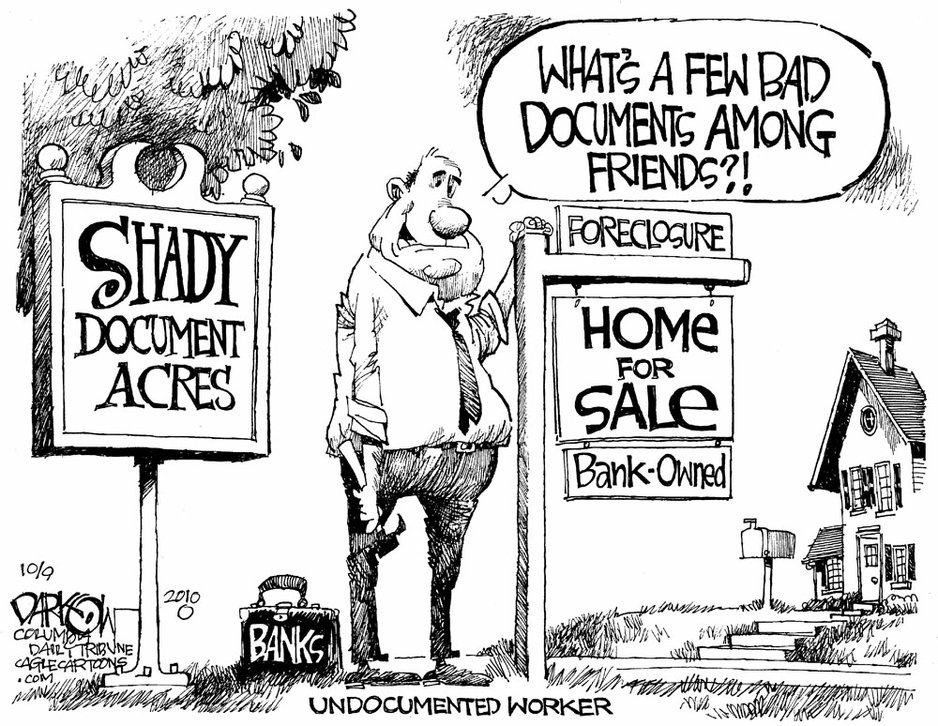






 5:027 Ways to Stop a Foreclosureby InvestmentPros40,072 views
  13:19Foreclosure Defense Arguments Part1/2by Silverwolf702,811 views
  4:2132 Ways To Quickly Stop Foreclosureby HomeownersUnited19,497 views
  14:43Foreclosure Defense Educationby 1ajstephens1,369 views
  10:00Defending Homeowners / Foreclosure Defense Talk…by raj21showtime345 views
  5:37Foreclosure Defense Attorney Roy Oppenheim Disc…by OppenheimRoy1,760 views
  2:14Defending a FL Foreclosure: Strategic Defaultby OppenheimRoy8,730 views
  2:01Operation Restoration: How to Avoid Foreclosureby OperationRestoration5,377 views
  1:1415 Mortgage Help Tips That Stop Foreclosureby ppcfore12332 views
  7:54Stop Foreclosure- Halt Foreclosue- The Timelineby nubianronin13,490 views
  9:38Foreclosure Defense – What You Need To Know 2/2by CameronBaxterFilms0918,746 views
  2:08Advantages of a Short Sale Vs. Foreclosure 1-8…by upsidedownflorida4,511 views
  9:53Foreclosure Defense – What You Need To Know 1/2by CameronBaxterFilms0924,392 views
  2:55Foreclosure Rescue Foundationby ForeclosureDS451 views
  6:13Trying to STOP FORECLOSURE? Our COPYRIGHTED SYS…by koning192,279 views
  4:36Matthew Weidner, PA- Foreclosure Defenseby weidnerlaw927 views
  2:55Attorney Foreclosure Defense Lawby LoanModLaw797 views
  9:36How to Stop Foreclosure with Loan Modificationby helpsavemyhome2,471 views
  9:55Fancy Pants Foreclosure Investor Loses $82,000by FlippingHomes16,584 views
  1:08Temporary Restraining Orders and Injunctions by…by LoanModLaw948 views
  13:25The Foreclosure Process in Washington Stateby EdMcFerranshortsale730 views
  1:19How To Stop Foreclosure & Avoid Foreclosure- Lo…by StopForeclosureFast6,481 views
  4:43Stop Foreclosure California, Ugent news regardi…by jamesbrighton3413,735 views
  1:09Sonu – Favorite Girl – Justin Bieber (Cover)by xSonu707x39,644 views
  0:42Central Florida Foreclosure Defense Attorney Ch…by ep2k302 views
  3:33Real People, Real Stories: Avoid Foreclosure Re…by FTCvideos9,679 views
  0:32Your Florida Foreclosure Defense Team :Wesolosk…by wesoloskicarlson270 views
  1:55Florida Foreclosure Defenseby kelattorney182 views
  1:31Strategic Default – Florida Foreclosure Defense…by ScorpionDesignVideo293 views
  3:21Foreclosure Defense, Florida Foreclosure Adviceby OppenheimRoy768 views
  2:24Foreclosure Defense What Happens After A Client…by foreclosuredefensela421 views
  2:23Foreclosure Defense: Shuster & Saben Opens Seco…by foreclosuredefensela290 views
  5:27Moratorium On Foreclosures-Stop All Evictions Now!by PeoplesVideo470 views
  3:12Mike DiCosola Seminars – Real Testimoniesby TheSovereignPatriot292 views
  9:21Facing Foreclosure? Roy Oppenheim on The Balanc…by OppenheimRoy446 views
  2:02Protect Yourself From Mortgage Fraudby AvoidFraud88,926 views
  4:51Bank Foreclosure Fraud “WHAT DOES A MORTGAGE NO…by DinSFLA11,340 views
  2:08Short Sale or Foreclosure: Will You Save Money?by ExpertRealEstateTips14,475 views





 Author:
