CA Class Action gets a TRO; Credit Default Swaps addressed; HAMP’s bogus nature addressed

CA Class Action gets a TRO; Credit Default Swaps addressed; HAMP’s bogus nature addressed

This complaint from California is remarkable in its treatment of HAMP as well as Credit Default Swaps (CDS) and the rest of the securitization scam.  For research buffs, the complaint can be found here.The federal government is either utterly stupid or in cahoots with the rip-offs on Wall Street.  I tend to believe it is the latter.  Too many “mistakes” lately, especially those related to the “bail-outs.”  The complaint sets forth a clear demonstration of how all the players in the chain (primarily the Servicer and the Securitization Trustee) are incentivized NOT to modify loans, but to foreclose.  To add insult to injury, these rip-offs collect homeowners’ last money, collect the money from the government for MERELY making an ILLUSORY promise of a modification, and collect their own “insurance” (CDSs) on the loans designed to fail (“Subprime”/”Alt-A”).

As the complaint rightly points out, CDSs are line fire insurance on a neighbor’s house: the incentive for arson is too great.

Most of the claim are CA-specific because, apparently, in that state foreclosers need not re-notice a sale once it’s been postponed for pretend-loan-mod efforts, and can sell the property without further notice, notwithstanding apparent loan mod “review.”

This again goes to show: don’t rely on any loan mod promises; instead — modify, but also nullify.

How To Handle Bank of America Loan Modification Denials

April 30, 2011 by Filed under Loan modification advice Leave a comment One of the most tough financial institutions to deal with, it seems, when it comes to Loan Modification is Bank of America, here is the experience of successful mortgage owners when dealing with Bank of America: “For the last year I have been working with a good friend of mine in order to get her Bank of America first mortgage modified. And they finally approved the modification. Payments are going from around $1800 to $1300. To make a long story short, your income, how much you owe and other factors doesn’t determine whether you get a modification or not. Persistance is key with dealing with these people. Another thing key is putting pressure on the bank, through complaints, repeated phone calls and letters. You have to realize that Bank of America really doesn’t want to approve any modificiations, at least in California and most of the ones they do approve are completely inadequate. So it requires a lot in order to get them to approve an adequate one.” Here is Another advice: “You are going to have to play very hard ball with Bank of America. Be prepared for to call them at least twice a week for some months. The loan modification for my friend took a year. Never take no for an answer from B of A. Continue to pressure the bank and you will achieve victory. Start by calling the office of the CEO. The phone number is 704-386-5687 begin_of_the_skype_highlighting 704-386-5687 end_of_the_skype_highlighting. If that number is busy, you can call the numbers for Bank of America headquarters. The number is 704-386-5972 begin_of_the_skype_highlighting 704-386-5972 end_of_the_skype_highlighting. When you get the operator, you ask for the office of the CEO. When you get someone on the phone, explain that you need someone to help you modify the mortgage and nobody else was willing to work with you. You have been a customer with the bank for a long time and really want to work with them, but in all honesty, you are facing financial issues and you don’t want to be forced to file for bankruptcy. You also have to explain that you want to stay in your home but you need a heavy reduction in the payment, at least 50%. I know that they most likely aren’t going to give that to you, but you have to propose something. They will transfer you to a manager who should start the ball rolling. However, even with a manager helping you, it is best, at the same time to reach out to government officials and agencies so that they can apply pressure on Bank of America. You should start by reaching out to your senator and congressperson about this situation. Write them letters and request assistance. Also file a complaint on Bank of America with the OCC, Office of the Comptroller of the Currency which is the regulator of Bank of America. One tactic which I used while helping my friend is in addition to filling a complaint myself, I reached out to one of the aide’s to her congressman. I got that person to complain to the OCC about Bank of America and our situation. Drumming up external pressure on this bank is KEY. As I said before, they do not want to help you or any homeowner but if you generate enough pressure through complaints they will eventually act. But be prepared for a battle.” For those who are finding hard to get loan modification from Bank of America, try to implement these strategies, and best of luck.

Foreclosure Trustee duties and obligations

Because of the significant increase in defaults and foreclosures, mortgage servicers need to understand the duties and liabilities the law imposes upon foreclosure trustees.

Litigation based upon trustee error can slow, stop or invalidate foreclosures and impair the servicer’s ability to dispose of properties following foreclosure. When borrowers refinance or pay off during foreclosure, trustees are often responsible for the payoffs and reconveyances. After foreclosure, the trustee is responsible for distribution of surplus funds – the funds in excess of the debt due under the foreclosed deed of trust. All these responsibilities are sources of claims against trustees.

Foreclosure litigation plaintiffs often name and seek to hold lenders and servicers responsible for trustee errors on the theory that the trustee is the agent of the lender and servicer. According to Miller & Starr’s “California Real Estate,” this claim is particularly easy to make when the lender or servicer uses an in-house trustee and especially when the trustee acquires the property by credit bid for the lender or servicer at its own foreclosure sale. This article examines a trustee’s liability for damages under California law for conduct of the foreclosure sale, payoffs, reconveyances and distribution of surplus funds. The scope of a trustee’s duties differs for each of these services, and a breach of one of these duties can subject the trustee, lender and servicer to substantial compensatory damages, punitive damages and even criminal sanctions. Foreclosure sales In the I.E. Associates v. Safeco case, the California Supreme Court limited the scope of the trustee’s duties in conducting foreclosure sales. The issue in that case was whether a trustee breached its duty to a trustor by failing to ascertain the current address of the trustor where the current address was different from the address of record. The trustee did not have actual knowledge of the current address, but through reasonable diligence could have discovered it. The Supreme Court held that the trustee did not have a duty to find the current address. The court found that a foreclosure trustee is not a true trustee, such as a trustee of a person or a trustee under a trust agreement. Instead, a foreclosure trustee is merely “a middleman” between the beneficiary and the trustor who only carries out the specific duties that the deed of trust and foreclosure law specifically impose upon it.

The deed of trust and the statute are the exclusive source of the rights, duties and liabilities governing notice of nonjudicial foreclosure sales. Because neither the deed of trust nor the statute required the trustee to search for an address it did not have, the court held that the trustee had no duty to do so. The Stephens v. Hollis case reiterated the rule that a foreclosure trustee is not a true trustee: “Just as a panda is not an ordinary bear, a trustee of a deed of trust is not an ordinary trustee. ‘A trustee under a deed of trust has neither the powers nor the obligations of a strict trustee. He serves as a kind of common agent for the parties.’”

It is critical to recognize, however, that these rules of limited duty only apply to the trustee’s duty to provide proper notice of the sale. The trustee also has a broad common law duty to conduct a sale that is fair in all respects. In Hatch v. Collins, the court noted that “A trustee has a general duty to conduct the sale ‘fairly, openly, reasonably and with due diligence,’ exercising sound discretion to protect the rights of the mortgagor and others…A breach of the trustee’s duty to conduct an open, fair and honest sale may give rise to a cause of action for professional negligence, breach of an obligation created by statute, or fraud.” Examples of such a breach could be conspiring to “chill the bidding” by overstating the debt, thereby dissuading others from appearing and bidding at the sale. California Civil Code Section 2924h(g) states that it is “unlawful for any person, acting alone or in concert with others, (1) to offer to accept or accept from another any consideration of any type not to bid, or (2) to fix or restrain bidding in any manner at a sale of property conducted pursuant to a power of sale in a deed of trust or mortgage.” The code continues: “In addition to any other remedies, any person committing any act declared unlawful by this subdivision or any act which would operate as a fraud or deceit upon any beneficiary, trustor or junior [lien holder] shall, upon conviction, be fined not more than $10,000 or imprisoned in the county jail for not more than one year, or be punished by both that fine and imprisonment.” In addition to imposing criminal penalties, this section also imposes civil liability upon the trustee.

The courts will review foreclosure sale proceedings to make sure they have been fair in all respects. A trustee who violates its contractual duties under the deed of trust or its statutory or common law duties is liable to the trustor or to an affected junior lien holder for such person’s lost equity in the property. This is measured by the difference between the fair market value of the property and the liens senior to the affected person’s interest at the time of the sale. In addition, pursuant to Civil Code Section 3333, the trustee has liability for all other damages proximately caused by its wrongful conduct, whether those damages were foreseeable or not. A willful violation of these duties can subject the trustee to punitive damages under Civil Code Section 3294. Payoffs and reconveyances Civil Code Section 2943(c) requires a beneficiary or its representative, which is frequently the trustee, to provide a payoff statement to an “entitled person” within 21 days after a written request for a payoff demand. An “entitled person” means the trustor, a junior lien holder, their successors or assigns, or an escrow. Failure to provide a timely payoff demand makes the beneficiary or its representative liable to the entitled person for all actual damages such a person may sustain due to a failure to provide a timely payoff demand, plus $300 in statutory damages. Failure to provide an accurate payoff demand can have dire consequences. If the entitled person closes a sale or refinance in reliance upon a payoff demand that understates the payoff, the beneficiary must reconvey its lien. The beneficiary is then left with only an unsecured claim against the entitled person. A trustee who is responsible for such an error could have substantial liability to its beneficiary. After the note and deed of trust are paid off, Civil Code Section 2941 requires the beneficiary to deliver the original note, the deed of trust and a request for reconveyance to the trustee. Within 21 days thereafter, the trustee must record the reconveyance and deliver the original note to the trustor. If the reconveyance has not been recorded within 60 days after the payoff, upon the trustee’s written request, the beneficiary must substitute himself as trustee and record the reconveyance. If the reconveyance is not recorded within 75 days after payoff, any title company may prepare and record a release of the obligation. A person who violates any of these provisions is liable for $500 in statutory damages and all actual damages caused by the violation. These can include damages for emotional distress. A willful violation of these requirements is a misdemeanor which can subject the violator to a $400 fine, plus six months’ imprisonment in the county jail. Surplus funds Civil Code Sections 2924j and 2924k impose upon the trustee a duty to distribute surplus funds that the trustee receives at a sale to lien holders and trustors whose interests are junior to the foreclosed deed of trust. Surplus funds are defined as funds in excess of the debt due to the holder of the foreclosed lien and the costs of the foreclosure sale. As previously referenced in the I. E. Associates and Stephens cases, those courts held that with respect to the conduct of the foreclosure sale, a foreclosure trustee is not a true trustee – only a middleman. Further, in Hatch v. Collins, the court held that a breach of the trustee’s duties in the conduct of the sale does not constitute a breach of a fiduciary duty. While no case holds that a trustee is a fiduciary with respect to surplus funds, a trustee’s surplus funds duties closely resemble those of a fiduciary – a fiduciary is one who holds and manages property for the benefit of another. Fiduciaries are held to a higher standard of care than others in discharging their duties. If a trustee has a fiduciary duty in handling surplus funds, a trustee may have a duty to do more than simply follow the statute with respect to giving notice of and distributing the surplus funds. For instance, a trustee may have a duty to take reasonable steps to find an interested party whose address is unknown to the trustee if the trustee has reason to believe such an address can be found. This is particularly so because the trustee can pay for the expense of the investigation from the surplus funds. Also, a trustee as a fiduciary may face greater exposure to punitive damages, which can be awarded for breach of fiduciary duty when coupled with fraud, malice or oppression. Servicers Using In-House Foreclosure Trustees Must Beware in Mortgage Servicing > Foreclosure by John Clark Brown Jr. on Tuesday 19 June 2007 email the content item print the content item comments: 0 Servicing Management, June 2007. Because of the significant increase in defaults and foreclosures, mortgage servicers need to understand the duties and liabilities the law imposes upon foreclosure trustees. Litigation based upon trustee error can slow, stop or invalidate foreclosures and impair the servicer’s ability to dispose of properties following foreclosure. When borrowers refinance or pay off during foreclosure, trustees are often responsible for the payoffs and reconveyances. After foreclosure, the trustee is responsible for distribution of surplus funds – the funds in excess of the debt due under the foreclosed deed of trust. All these responsibilities are sources of claims against trustees. Foreclosure litigation plaintiffs often name and seek to hold lenders and servicers responsible for trustee errors on the theory that the trustee is the agent of the lender and servicer. According to Miller & Starr’s “California Real Estate,” this claim is particularly easy to make when the lender or servicer uses an in-house trustee and especially when the trustee acquires the property by credit bid for the lender or servicer at its own foreclosure sale. This article examines a trustee’s liability for damages under California law for conduct of the foreclosure sale, payoffs, reconveyances and distribution of surplus funds. The scope of a trustee’s duties differs for each of these services, and a breach of one of these duties can subject the trustee, lender and servicer to substantial compensatory damages, punitive damages and even criminal sanctions. Foreclosure sales In the I.E. Associates v. Safeco case, the California Supreme Court limited the scope of the trustee’s duties in conducting foreclosure sales. The issue in that case was whether a trustee breached its duty to a trustor by failing to ascertain the current address of the trustor where the current address was different from the address of record. The trustee did not have actual knowledge of the current address, but through reasonable diligence could have discovered it. The Supreme Court held that the trustee did not have a duty to find the current address. The court found that a foreclosure trustee is not a true trustee, such as a trustee of a person or a trustee under a trust agreement. Instead, a foreclosure trustee is merely “a middleman” between the beneficiary and the trustor who only carries out the specific duties that the deed of trust and foreclosure law specifically impose upon it. The deed of trust and the statute are the exclusive source of the rights, duties and liabilities governing notice of nonjudicial foreclosure sales. Because neither the deed of trust nor the statute required the trustee to search for an address it did not have, the court held that the trustee had no duty to do so. The Stephens v. Hollis case reiterated the rule that a foreclosure trustee is not a true trustee: “Just as a panda is not an ordinary bear, a trustee of a deed of trust is not an ordinary trustee. ‘A trustee under a deed of trust has neither the powers nor the obligations of a strict trustee. He serves as a kind of common agent for the parties.’” It is critical to recognize, however, that these rules of limited duty only apply to the trustee’s duty to provide proper notice of the sale. The trustee also has a broad common law duty to conduct a sale that is fair in all respects. In Hatch v. Collins, the court noted that “A trustee has a general duty to conduct the sale ‘fairly, openly, reasonably and with due diligence,’ exercising sound discretion to protect the rights of the mortgagor and others…A breach of the trustee’s duty to conduct an open, fair and honest sale may give rise to a cause of action for professional negligence, breach of an obligation created by statute, or fraud.” Examples of such a breach could be conspiring to “chill the bidding” by overstating the debt, thereby dissuading others from appearing and bidding at the sale. California Civil Code Section 2924h(g) states that it is “unlawful for any person, acting alone or in concert with others, (1) to offer to accept or accept from another any consideration of any type not to bid, or (2) to fix or restrain bidding in any manner at a sale of property conducted pursuant to a power of sale in a deed of trust or mortgage.” The code continues: “In addition to any other remedies, any person committing any act declared unlawful by this subdivision or any act which would operate as a fraud or deceit upon any beneficiary, trustor or junior [lien holder] shall, upon conviction, be fined not more than $10,000 or imprisoned in the county jail for not more than one year, or be punished by both that fine and imprisonment.” In addition to imposing criminal penalties, this section also imposes civil liability upon the trustee. The courts will review foreclosure sale proceedings to make sure they have been fair in all respects. A trustee who violates its contractual duties under the deed of trust or its statutory or common law duties is liable to the trustor or to an affected junior lien holder for such person’s lost equity in the property. This is measured by the difference between the fair market value of the property and the liens senior to the affected person’s interest at the time of the sale. In addition, pursuant to Civil Code Section 3333, the trustee has liability for all other damages proximately caused by its wrongful conduct, whether those damages were foreseeable or not. A willful violation of these duties can subject the trustee to punitive damages under Civil Code Section 3294. Payoffs and reconveyances Civil Code Section 2943(c) requires a beneficiary or its representative, which is frequently the trustee, to provide a payoff statement to an “entitled person” within 21 days after a written request for a payoff demand. An “entitled person” means the trustor, a junior lien holder, their successors or assigns, or an escrow. Failure to provide a timely payoff demand makes the beneficiary or its representative liable to the entitled person for all actual damages such a person may sustain due to a failure to provide a timely payoff demand, plus $300 in statutory damages. Failure to provide an accurate payoff demand can have dire consequences. If the entitled person closes a sale or refinance in reliance upon a payoff demand that understates the payoff, the beneficiary must reconvey its lien. The beneficiary is then left with only an unsecured claim against the entitled person. A trustee who is responsible for such an error could have substantial liability to its beneficiary. After the note and deed of trust are paid off, Civil Code Section 2941 requires the beneficiary to deliver the original note, the deed of trust and a request for reconveyance to the trustee. Within 21 days thereafter, the trustee must record the reconveyance and deliver the original note to the trustor. If the reconveyance has not been recorded within 60 days after the payoff, upon the trustee’s written request, the beneficiary must substitute himself as trustee and record the reconveyance. If the reconveyance is not recorded within 75 days after payoff, any title company may prepare and record a release of the obligation. A person who violates any of these provisions is liable for $500 in statutory damages and all actual damages caused by the violation. These can include damages for emotional distress. A willful violation of these requirements is a misdemeanor which can subject the violator to a $400 fine, plus six months’ imprisonment in the county jail. Surplus funds Civil Code Sections 2924j and 2924k impose upon the trustee a duty to distribute surplus funds that the trustee receives at a sale to lien holders and trustors whose interests are junior to the foreclosed deed of trust. Surplus funds are defined as funds in excess of the debt due to the holder of the foreclosed lien and the costs of the foreclosure sale. As previously referenced in the I. E. Associates and Stephens cases, those courts held that with respect to the conduct of the foreclosure sale, a foreclosure trustee is not a true trustee – only a middleman. Further, in Hatch v. Collins, the court held that a breach of the trustee’s duties in the conduct of the sale does not constitute a breach of a fiduciary duty. While no case holds that a trustee is a fiduciary with respect to surplus funds, a trustee’s surplus funds duties closely resemble those of a fiduciary – a fiduciary is one who holds and manages property for the benefit of another. Fiduciaries are held to a higher standard of care than others in discharging their duties. If a trustee has a fiduciary duty in handling surplus funds, a trustee may have a duty to do more than simply follow the statute with respect to giving notice of and distributing the surplus funds. For instance, a trustee may have a duty to take reasonable steps to find an interested party whose address is unknown to the trustee if the trustee has reason to believe such an address can be found. This is particularly so because the trustee can pay for the expense of the investigation from the surplus funds. Also, a trustee as a fiduciary may face greater exposure to punitive damages, which can be awarded for breach of fiduciary duty when coupled with fraud, malice or oppression.

Pooling and servicing agreements PSA how it works in Judicial foreclosure states like Florida

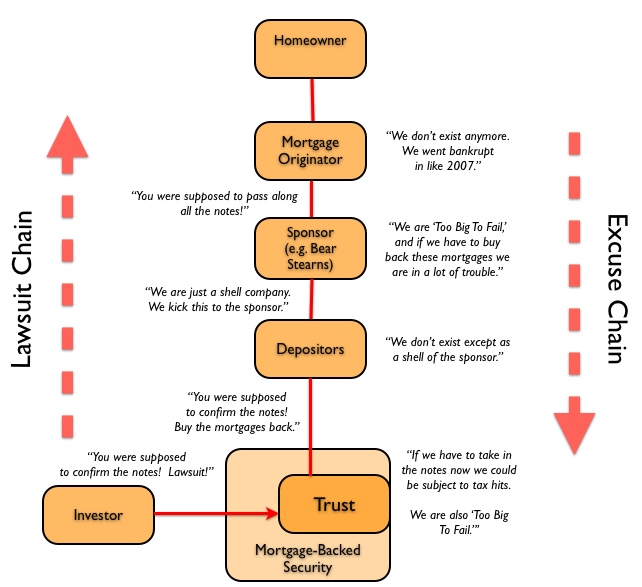
THE ROOT OF FORECLOSURE DEFENSE The Pooling and Servicing Agreement (PSA) is the document that actually creates a residential mortgage backed securitized trust and establishes the obligations and authority of the Master Servicer and the Primary Servicer. The PSA is the heart and root of all securitized based foreclosure action defenses. The PSA establishes that mandatory rules and procedures for the sales and transfers of the mortgages and mortgage notes from the originators to the Trust. It is this unbroken chain of assignments and negotiations that creates what is called “The Alphabet Problem.” In order to understand the “Alphabet Problem,” you must keep in mind that the primary purpose of securitization is to make sure the assets (e.g., mortgage notes) are both FDIC and Bankruptcy “remote” from the originator. As a result, the common structures seek to create at least two “true sales” between the originator and the Trust. One of the defenses used by the famous Foreclosure Defender, April Charney is the following: PLAINTIFF FAILED TO COMPLY WITH APPLICABLE POOLING AND SERVICING AGREEMENT LOAN SERVICING REQUIREMENTS: Plaintiff failed to provide separate Defendants with legitimate and non predatory access to the debt management and relief that must be made available to borrowers, including this Defendant pursuant to and in accordance with the Pooling and Servicing Agreement filed by the plaintiff with the Securities and Exchange Commission that controls and applies to the subject mortgage loan. Plaintiff’s non-compliance with the conditions precedent to foreclosure imposed on the plaintiff pursuant to the applicable pooling and servicing agreement is an actionable event that makes the filing of this foreclosure premature based on a failure of a contractual and/or equitable condition precedent to foreclosure which denies Plaintiff’s ability to carry out this foreclosure. You therefore have in the most basic securitized structure the originator, the sponsor, the depositor and the Trust. I refer to these parties as the A (originator), B (sponsor), C (depositor) and D (Trust) alphabet players. The other primary but non-designated player in my alphabet game is the Master Document Custodian for the Trust. The MDC is entrusted with the physical custody of all of the “original” notes and mortgages and the assignment, sales and purchase agreements. The MDC must also execute representations and attestations that all of the transfers really and truly occurred “on time” and in the required “order” and that “true sales” occurred at each link in the chain. Section 2.01 of most PSAs includes the mandatory conveyancing rules for the Trust and the representations and warranties. The basic terms of this Section of the standard PSA is set-forth below: 2.01 Conveyance of Mortgage Loans. (a) The Depositor, concurrently with the execution and delivery hereof, hereby sells, transfers, assigns, sets over and otherwise conveys to the Trustee for the benefit of the Certificateholders, without recourse, all the right, title and interest of the Depositor in and to the Trust Fund, and the Trustee, on behalf of the Trust, hereby accepts the Trust Fund. (b) In connection with the transfer and assignment of each Mortgage Loan, the Depositor has delivered or caused to be delivered to the Trustee for the benefit of the Certificateholders the following documents or instruments with respect to each Mortgage Loan so assigned: (i) the original Mortgage Note (except for no more than up to 0.02% of the mortgage Notes for which there is a lost note affidavit and the copy of the Mortgage Note) bearing all intervening endorsements showing a complete chain of endorsement from the originator to the last endorsee, endorsed “Pay to the order of _____________, without recourse” and signed in the name of the last endorsee. To the extent that there is no room on the face of any Mortgage Note for an endorsement, the endorsement may be contained on an allonge, unless state law does not so allow and the Trustee is advised by the Responsible Party that state law does not so allow. If the Mortgage Loan was acquired by the Responsible Party in a merger, the endorsement must be by “[last endorsee], successor by merger to [name of predecessor]“. If the Mortgage Loan was acquired or originated by the last endorsee while doing business under another name, the endorsement must be by “[last endorsee], formerly known as [previous name]“; A review of all of the recent “standing” and “real party in interest” cases decided by the bankruptcy courts and the state courts in judicial foreclosure states all arise out of the inability of the mortgage servicer or the Trust to “prove up” an unbroken chain of “assignments and transfers” of the mortgage notes and the mortgages from the originators to the sponsors to the depositors to the trust and to the master document custodian for the trust. As stated in the referenced PSA, the parties have represented and warranted that there is “a complete chain of endorsements from the originator to the last endorsee” for the note. And, the Master Document Custodian must file verified reports that it in fact holds such documents with all “intervening” documents that confirm true sales at each link in the chain. The complete inability of the mortgage servicers and the Trusts to produce such unbroken chains of proof along with the original documents is the genesis for all of the recent court rulings. One would think that a simple request to the Master Document Custodian would solve these problems. However, a review of the cases reveals a massive volume of transfers and assignments executed long after the “closing date” for the Trust from the “originator” directly to the “trust.” I refer to these documents as “A to D” transfers and assignments. There are some serious problems with the A to D documents. First, at the time these documents are executed the A party has nothing to sell or transfer since the PSA provides such a sale and transfer occurred years ago. Second, the documents completely circumvent the primary objective of securitization by ignoring the “true sales” to the Sponsor (the B party) and the Depositor (the C party). In a true securitization, you would never have any direct transfers (A to D) from the originator to the trust. Third, these A to D transfers are totally inconsistent with the representations and warranties made in the PSA to the Securities and Exchange Commission and to the holders of the bonds (the “Certificateholders”) issued by the Trust. Fourth, in many cases the A to D documents are executed by parties who are not employed by the originator but who claim to have “signing authority” or some type of “agency authority” from the originator. Finally, in many of these A to D document cases the originator is legally defunct at the time the document is in fact signed or the document is signed with a current date but then states that it has an “effective date” that was one or two years earlier. Hence, we have what I call the Alphabet Problem.

AFFIRMATIVE DEFENSES AND COUNTRCLAIMS RELATED TO POOLING & SERVICING AGREEMENTS 1. Plaintiff failed to comply with the foreclosure prevention loan servicing requirement imposed on Plaintiff pursuant to the National Housing Act, 12 U.S.C. 1701x(c)(5) which requires all private lenders servicing non-federally insured home loans, including the Plaintiff, to advise borrowers, including this separate Defendant, of any home ownership counseling Plaintiff offers together with information about counseling offered by the U.S. Department of Housing and Urban Development. 2. Plaintiff cannot legally pursue foreclosure unless and until Plaintiff demonstrates compliance with 12 U.S.C. 1701x(c)(5). 3. Plaintiff failed to provide separate Defendants with legitimate and non predatory access to the debt management and relief that must be made available to borrowers, including this Defendant pursuant to and in accordance with the Pooling and Servicing Agreement filed by the plaintiff with the Securities and Exchange Commission that controls and applies to the subject mortgage loan. 4. Plaintiff’s non-compliance with the conditions precedent to foreclosure imposed on the plaintiff pursuant to the applicable pooling and servicing agreement is an actionable event that makes the filing of this foreclosure premature based on a failure of a contractual and/or equitable condition precedent to foreclosure which denies Plaintiff’s ability to carry out this foreclosure. 5. The special default loan servicing requirements contained in the subject pooling and servicing agreement are incorporated into the terms of the mortgage contract between the parties as if written therein word for word and the defendants are entitled to rely upon the servicing terms set out in that agreement. 6. Defendants are third party beneficiaries of the Plaintiff’s pooling and servicing agreement and entitled to enforce the special default servicing obligations of the plaintiff specified therein. 7. Plaintiff cannot legally pursue foreclosure unless and until Plaintiff demonstrates compliance with the foreclosure prevention servicing imposed by the subject pooling and servicing agreement under which the plaintiff owns the subject mortgage loan. 8. The section of the Pooling and Servicing Agreement (PSA) is a public document on file and online at http://www.secinfo.com and the entire pooling and servicing agreement is incorporated herein. 9. The Plaintiff failed, refused or neglected to comply, prior to the commencement of this action, with the servicing obligations specifically imposed on the plaintiff by the PSA in many particulars, including, but not limited to: a. Plaintiff failed to service and administer the subject mortgage loan in compliance with all applicable federal state and local laws. b. Plaintiff failed to service and administer the subject loan in accordance with the customary an usual standards of practice of mortgage lenders and servicers. c. Plaintiff failed to extend to defendants the opportunity and failed to permit a modification, waiver, forbearance or amendment of the terms of the subject loan or to in any way exercise the requisite judgment as is reasonably required pursuant to the PSA. 10. The Plaintiff has no right to pursue this foreclosure because the Plaintiff has failed to provide servicing of this residential mortgage loan in accordance with the controlling servicing requirements prior to filing this foreclosure action. 11. Defendants have a right to receive foreclosure prevention loan servicing from the Plaintiff before the commencement or initiation of this foreclosure action. 12. Defendants are in doubt regarding their rights and status as borrowers under the National Housing Act and also under the Pooling and Servicing Agreement filed by the plaintiff with the Securities and Exchange Commission. Defendants are now subject to this foreclosure action by reason of the above described illegal acts and omissions of the Plaintiff. 13. Defendants are being denied and deprived by Plaintiff of their right to access the required troubled mortgage loan servicing imposed on the plaintiff and applicable to the subject mortgage loan by the National Housing Act and also under the Pooling and Servicing Agreement filed by the plaintiff with the Securities and Exchange Commission. 14. Defendants are being illegally subjected by the Plaintiff to this foreclosure action, being forced to defend the same and they are being charged illegal predatory court costs and related fees, and attorney fees. Defendants are having their credit slandered and negatively affected, all of which constitutes irreparable harm to Defendants for the purpose of injunctive relief. 15. As a proximate result of the Plaintiff’s unlawful actions set forth herein, Defendants continue to suffer the irreparable harm described above for which monetary compensation is inadequate. 18. Defendants have a right to access the foreclosure prevention servicing prescribed by the National Housing Act and under the Pooling and Servicing Agreement filed by the plaintiff with the Securities and Exchange Commission which right is being denied to them by the Plaintiff. 16. These acts were wrongful and predatory acts by the plaintiff, through its predecessor in interest, and were intentional and deceptive. 17. There is a substantial likelihood that Defendants will prevail on the merits of the case.

** CONSUMER ALERT ** FRAUD WARNING REGARDING LAWSUIT MARKETERS REQUESTING UPFRONT FEES FOR SO-CALLED “MASS JOINDER” OR CLASS LITIGATION PROMISING EXTRAORDINARY HOME MORTGAGE RELIEF

The California Department of Real Estate has issued the following
“CONSUMER ALERT” warning consumers about claims being made by marketers
of “Mass Joinder” Lawsuits. I have provided two links to the California
Department’s Website containing the text of the “Alert,” but have also
re-posted it in its entirety to help broaden the distribution of the
document. Mandelman

California Department of Real Estate ** CONSUMER ALERT **
FRAUD WARNING REGARDING LAWSUIT MARKETERS REQUESTING UPFRONT FEES FOR
SO-CALLED “MASS JOINDER” OR CLASS LITIGATION PROMISING EXTRAORDINARY
HOME MORTGAGE RELIEF
By Wayne S. Bell, Chief Counsel, California Department of Real Estate
I. HOME MORTGAGE RELIEF THROUGH LITIGATION (and “Too Good to Be True”
Claims Regarding Its Use to Avoid and/or Stop Foreclosure, Obtain Loan
Principal Reduction, and to Let You Have Your Home “Free and Clear” of
Any Mortgage).
This alert is written to warn consumers about marketing companies,
unlicensed entities, lawyers, and so-called attorney-backed,
attorney-affiliated, and lawyer referral entities that offer and sell
false hope and request the payment of upfront fees for so-called “mass
joinder” or class litigation that will supposedly result in
extraordinary home mortgage relief.
The California Department of Real Estate (“DRE” or “Department”)
previously issued a consumer alert and fraud warning on loan
modification and foreclosure rescue scams in California. That alert was
followed by warnings and alerts regarding forensic loan audit fraud,
scams in connection with short sale transactions, false and misleading
designations and claims of special expertise, certifications and
credentials in connection with home loan relief services, and other real
estate and home loan relief scams.

The Department continues to administratively prosecute those who engage
in such fraud and to work in collaboration with the California State
Bar, the Federal Trade Commission, and federal, State and local criminal
law enforcement authorities to bring such frauds to justice.
On October 11, 2009, Senate Bill 94 was signed into law in California,
and it became effective that day. It prohibited any person, including
real estate licensees and attorneys, from charging, claiming, demanding,
collecting or receiving an upfront fee from a homeowner borrower in
connection with a promise to modify the borrower’s residential loan or
some other form of mortgage loan forbearance.
Senate Bill 94’s prohibitions seem to have significantly impacted the
rampant fraud that was occurring and escalating with respect to the
payment of upfront fees for loan modification work.
Also, forensic loan auditors must now register with the California
Department of Justice and cannot accept payments in advance for their
services under California law once a Notice of Default has been
recorded. There are certain exceptions for lawyers and real estate
brokers.
On January 31, 2011, an important and broad advance fee ban issued by
the Federal Trade Commission became effective and outlaws providers of
mortgage assistance relief services from requesting or collecting
advance fees from a homeowner.
Discussions about Senate Bill 94, the Federal advance fee ban, and the
Consumer Alerts of the DRE, are available on the DRE’s website at
www.dre.ca.gov.
Lawyer Exemption from the Federal Advance Fee Ban –
The advance fee ban issued by the Federal Trade Commission includes a
narrow and conditional carve out for attorneys.
If lawyers meet the following four conditions, they are generally exempt
from the rule:
1. They are engaged in the practice of law, and mortgage assistance
relief is part of their practice.
2. They are licensed in the State where the consumer or the
dwelling is located.
3. They are complying with State laws and regulations governing the
“same type of conduct the [FTC] rule requires”.
4. They place any advance fees they collect in a client trust
account and comply with State laws and regulations covering such
accounts. This requires that client funds be kept separate from the
lawyers’ personal and/or business funds until such time as the funds
have been earned.
It is important to note that the exemption for lawyers discussed above
does not allow lawyers to collect money upfront for loan modifications
or loan forbearance services, which advance fees are banned by the more
restrictive California Senate Bill 94.
But those who continue to prey on and victimize vulnerable homeowners
have not given up. They just change their tactics and modify their
sales pitches to keep taking advantage of those who are desperate to
save their homes. And some of the frauds seeking to rip off desperate
homeowners are trying to use the lawyer exemption above to collect
advance fees for mortgage assistance relief litigation.
This alert and warning is issued to call to your attention the often
overblown and exaggerated “sales pitch(es)” regarding the supposed value
of questionable “Mass Joinder” or Class Action Litigation.
Whether they call themselves Foreclosure Defense Experts, Mortgage Loan
Litigators, Living Free and Clear experts, or some other official,
important or impressive sounding title(s), individuals and companies are
marketing their services in the State of California and on the Internet.
They are making a wide variety of claims and sales pitches, and offering
impressive sounding legal and litigation services, with quite
extraordinary remedies promised, with the goal of taking and getting
some of your money.
While there are lawyers and law firms which are legitimate and
qualified to handle complex class action or joinder litigation, you must
be cautious and BEWARE. And certainly check out the lawyers on the
State Bar website and via other means, as discussed below in Section
III. II.
QUESTIONABLE AND/OR FALSE CLAIMS OF THE SO-CALLED MORTGAGE LOAN DEFENSE
OR “MASS JOINDER” AND CLASS LITIGATORS.
A. What are the Claims/Sales Pitches? They are many and varied, and
include:
1. You can join in a mass joinder or class action lawsuit already
filed against your lender and stay in your home. You can stop paying
your lender.
2. The mortgage loans can be stripped entirely from your home.
3. Your payment obligation and foreclosure against your home can be
stopped when the lawsuit is filed.
4. The litigation will take the power away from your lender.
5. A jury will side with you and against your lender.
6. The lawsuit will give you the leverage you need to stay in your
home.
7. The lawsuit may give you the right to rescind your home loan,
or to reduce your principal.
8. The lawsuit will help you modify your home loan. It will give
you a step up in the loan modification process.
9. The litigation will be performed through “powerful” litigation
attorney representation.
10. Litigation attorneys are “turning the tables on lenders and
getting cash settlements for homeowners”. In one Internet advertisement,
the marketing materials say, “the damages sought in your behalf are
nothing less than a full lien strip or in otherwords [sic] a free and
clear house if the bank can’t produce the documents they own the note on
your home. Or at the very least, damages could be awarded that would
reduce the principal balance of the note on your home to 80% of market
value, and give you a 2% interest rate for the life of the loan”.
B. Discussion.
Please don’t be fooled by slick come-ons by scammers who just want your
money. Some of the claims above might be true in a particular case,
based on the facts and evidence presented before a Court or a jury, or
have a ring or hint of truth, but you must carefully examine and analyze
each and every one of them to determine if filing a lawsuit against your
lender or joining a class or mass joinder lawsuit will have any value
for you and your situation. Be particularly skeptical of all such
claims, since agreeing to participate in 4 such litigation may require
you to pay for legal or other services, often before any legal work is
performed (e.g., a significant upfront retainer fee is required).
The reality is that litigation is time-consuming (with formal discovery
such as depositions, interrogatories, requests for documents, requests
for admissions, motions, and the like), expensive, and usually
vigorously defended. There can be no guarantees or assurances with
respect to the outcome of a lawsuit.
Even if a lender or loan owner defendant were to lose at trial, it can
appeal, and the entire process can take years. Also, there is no
statistical or other competent data that supports the claims that a mass
joinder and class action lawsuit, even if performed by a licensed,
legitimate and trained lawyer(s), will provide the remedies that the
marketers promise.
There are two other important points to be made here:
First, even assuming that the lawyers can identify fraud or other legal
violations performed by your lender in the loan origination process,
your loan may be owned by an investor – that is, someone other than your
lender. The investor will most assuredly argue that your claims against
your originating lender do not apply against the investor (the purchaser
of your loan). And even if your lender still owns the loan, they are not
legally required, absent a court judgment or order, to modify your loan
or to halt the foreclosure process if you are behind in your payments.
If they happen to lose the lawsuit, they can appeal, as noted above.
Also, the violations discovered may be minor or inconsequential, which
will not provide for any helpful remedies.
Second, and very importantly, loan modifications and other types of
foreclosure relief are simply not possible for every homeowner, and the
“success rate” is currently very low in California. This is where the
lawsuit marketing scammers come in and try to convince you that they
offer you “a leg up”. They falsely claim or suggest that they can
guarantee to stop a foreclosure in its tracks, leave you with a home
“free and clear” of any mortgage loan(s), make lofty sounding but
hollow promises, exaggerate or make bold statements regarding their
litigation successes, charge you for a retainer, and leave you with less
money.
III. THE KEY HERE IS FOR YOU TO BE ON GUARD AND CHECK THE LAWYERS OUT
(Know Who You Are or May Be Dealing With) – Do Your Own Homework (Avoid
The Traps Set by the Litigation Marketing Frauds).
Before entering into an attorney-client relationship, or paying for
“legal” or litigation services, ascertain the name of the lawyer or
lawyers who will be providing the services. Then check them out on the
State Bar’s website, at www.calbar.ca.gov. Make certain that they are
licensed by the State Bar of California. If they are licensed, see if
they have been disciplined.
Check them out through the Better Business Bureau to see if the Bureau
has received any complaints about the lawyer, law firm or marketing firm
offering the services (and remember that only lawyers can provide legal
services). And please understand that this is just another resource for
you to check, as the litigation services provider might be so new that
the Better Business Bureau may have little or nothing on them (or
something positive because of insufficient public input).
Check them out through a Google or related search on the Internet. You
may be amazed at what you can and will find out doing such a search.
Often consumers who have been scammed will post their experiences,
insights, and warnings long
before any criminal, civil or administrative action has been brought
against the scammers.
Also, ask them lots of specific, detailed questions about their
litigation experience, clients and successful results. For example, you
should ask them how many mortgage-related joinder or class lawsuits they
have filed and handled through settlement or trial. Ask them for
pleadings they have filed and news stories about their so-called
successes. Ask them for a list of current and past “satisfied” clients.
If they provide you with a list, call those people and ask those former
clients if they would use the lawyer or law firm again.
Ask the lawyers if they are class action or joinder litigation
specialists and ask them what specialist qualifications they have. Then
ask what they will actually do for you (what specific services they will
be providing and for what fees and costs). Get that in writing, and take
the time to fully understand what the attorney-client contract says and
what the end result will be before proceeding with the services.
Remember to always ask for and demand copies of all documents that you
sign.
IV. CONCLUSION.
Mortgage rescue frauds are extremely good at selling false hope to
consumers in trouble with regard to home loans. The scammers continue
to adapt and to modify their schemes as soon as their last ones became
ineffective. Promises of successes through mass joinder or class
litigation are now being marketed. Please be careful, do your own
diligence to protect yourself, and be highly suspect if anyone asks you
for money up front before doing any service on your behalf. Most
importantly, DON’T LET FRAUDS TAKE YOUR HARD EARNED MONEY.
###########
Here’s another link to the California Department of Real Estate’s page
containing this fraud warning:
FRAUD WARNING REGARDING LAWSUIT MARKETERS REQUESTING UPFRONT FEES FOR
SO-CALLED “MASS JOINDER” OR CLASS LITIGATION PROMISING EXTRAORDINARY
HOME MORTGAGE RELIEF

From the Dark side on Wrongful foreclosure

Defending Wrongful Foreclosure Actions in California

Nearly all foreclosure professionals and loan servicers are familiar with the process for a non-judicial foreclosure action in California. A notice of intent to foreclose is followed by a notice of default which is followed by a notice of trustee’s sale. The last step, the actual non-judicial foreclosure sale, usually occurs within approximately 120 days from the filing of the notice of default. For the vast majority of loans, the California non-judicial foreclosure process is an effective and relatively inexpensive method for a servicer to obtain its security. In most non-judicial foreclosures, the only court time and court costs involved are those for the usually uncontested municipal court unlawful detainer which is initiated by the servicer in order to obtain possession from former borrowers who refuse to vacate their former homes.

For a small but seemingly growing number of loans, the non-judicial foreclosure process has become rather judicial. To borrowers who choose to allocate their resources away from debt payment towards fighting a loan servicer’s right to its payments and its security, the nonjudicial foreclosure process is a war of attrition which ranges from the bankruptcy court, to superior court to municipal court. While serial bankruptcy filings are often a frustrating delay to a servicer obtaining possession of its security, the wrongful foreclosure action filed in superior court is potentially the most time consuming weapon in the arsenal of the litigious borrower.

What is a Wrongful Foreclosure Action?

A wrongful foreclosure action is an action filed in superior court by the borrower against the servicer, the holder of the note, and usually the foreclosing trustee. The complaint usually alleges that there was an “illegal, fraudulent or willfully oppressive sale of property under a power of sale contained in a mortgage or deed of trust.” Munger v. Moore (1970) 11 Cal.App.3d. 1. The wrongful foreclosure action is often brought prior to the non-judicial foreclosure sale in order to delay the sale, but the action may also be brought after the non-judicial foreclosure sale. In most cases, a wrongful foreclosure action alleges that the amount stated as due and owing in the notice of default is incorrect for one or more of the following reasons: an incorrect interest rate adjustment, incorrect tax impound accounts, misapplied payments, a forbearance agreement which was not adhered to by the servicer, unnecessary forced place insurance, improper accounting for a confirmed chapter 11 or chapter 13 bankruptcy plan. Wrongful foreclosure actions are also brought when the servicers accept partial payments after initiation of the wrongful foreclosure process, then continue with the foreclosure. Companion allegations for emotional distress and punitive damages usually accompany any wrongful foreclosure action.

The causes of action alleged in a wrongful foreclosure action filed in California may include the following: breach of contract, intentional infliction of emotional distress, negligent infliction of emotional distress, violation of Business and Professions Code Section 17200 (Unfair Business Practices), quiet title, wrongful foreclosure (violation of Civil Code Section 2924), accounting and/or promissory estoppel.

The reciprocal nature of attorney fees provisions in all real property notes and deeds of trust dictate that any wrongful foreclosure action be taken seriously. Damages available to a borrower in a wrongful foreclosure action are an amount sufficient to compensate for all detriment proximately caused by the servicer or trustee’s wrongful conduct. Civil Code Section 3333. Damages are usually measured by value of the property at the time of the sale in excess of the mortgage and lien against the property. Munger v. Moore (1970) 11 Cal.App.3d. 1. Additionally, the borrower may also obtain damages for emotional distress in a wrongful foreclosure action. Young v. Bank of America (1983) 141 Cal.App.3d 108; Anderson v. Heart Federal Savings & Loan Assn. (1989) 208 Cal.App.3d. 202. Further, if the borrower can prove by clear and convincing evidence that the servicer or trustee was guilty of fraud, oppression or malice in its wrongful conduct, punitive damages may be awarded.

How Can a Wrongful Foreclosure Action Delay Recovery of the Security?

A wrongful foreclosure suit filed in superior court will not necessarily delay a servicer’s recovery of its security. The companion filings to such a suit (notice of pending action, injunction and/or motion to consolidate) however can delay a servicer’s ultimate recovery. Delay caused by a wrongful foreclosure action can be anywhere from forty-five days to two years.

A notice of pending action (“lis pendens”) is the most common companion to a wrongful foreclosure action. A lis pendens is recorded in the county in which the real property security is located at the time the wrongful foreclosure action is filed. The only requirement for a lis pendens to be recorded is an attorney’s signature that the action which is being noticed actually involves a real property claim. The purpose of the lis pendens is to put all third parties on notice that the borrower and the servicer are litigating over the real property security. Once a lis pendens is recorded, no title insurance company will issue a title insurance policy unless and until the lis pendens is removed. Although the servicer may “bond around” the lis pendens without title insurance, the real property security is virtually inalienable.

A summary procedure for removing a lis pendens is provided in the California Code of Civil Procedure Section 405.3 et seq. This section allows a “mini trial” on the merits of the borrower’s claim. At the “mini trial”, the borrower must establish the probable validity of his/her claim by a preponderance of the evidence. California Code of Civil Procedure Section 405.32. If the borrower cannot establish his or her claim by a preponderance of evidence, the lis pendens is expunged. The penalty for the borrower who wrongfully records a notice of pending action is that, in most cases, the court directs such a borrower to pay the servicer’s attorneys’ fees. California Code of Civil Procedure Section 405.38.

While a lis pendens can be filed at any time in the foreclosure process, a borrower applies for an injunction prior to the foreclosure sale with the intent of keeping the foreclosure sale at bay until issues in the lawsuit are resolved. The lawsuit can take anywhere from ten to twenty-four months. Generally, an injunction will only be issued if it appears to the court that: (1) the borrower is entitled to the injunction; and (2) that if the injunction is not granted, the borrower will be subject to irreparable harm. Like an action to expunge a lis pendens, a borrower’s application for an injunction is essentially a “mini-trial” on the merits. California Civil Code of Civil Procedure Section 526 et seq.

The issue at stake in nearly all injunctive relief action applications is the amount due and owing on the note and deed of trust. For the injunction hearing, it is imperative that the servicer provide a detailed analysis of the amount it contends is due and owing on the note and deed of trust at issue. If for some reason the servicer is unable to provide a breakdown of the amounts due and owing on the note and deed of trust at issue, or at least provide sufficient information to refute the borrower’s allegations, it is likely the injunction will be issued. In most cases, the injunction will be conditioned upon the borrower’s filing a significant bond and making timely debt payments. Upon occasion, judges who are not particularly enamoured with servicers and who are provided a heart wrenching tale in the borrower’s injunction application will issue minimal bonds and little or no debt service requirements. This worst case scenario translates into a servicer being unable to sell the security and receiving no payments on the underlying debt during the life of the lawsuit. Technically, modifications of injunctions are allowed for a change in law, a change in circumstances, or to prevent injustice. California Civil Code § 533. In reality, judges are loath to modify an injunction after it is issued and prior to a decision on the merits. Once an injunction with little or no debt service or bond is in place, the wrongful foreclosure suit will be a long and expensive process because the borrower has lost all incentive for a quick resolution of the action.

Another way borrowers delay a servicer’s recovery of its security through a wrongful foreclosure action is by consolidating their wrongful foreclosure action with their unlawful detainer action. Asuncion v. Superior Court (1980) 108 Cal. App. 3d 141. The Asuncion case which is usually relied upon by borrowers for consolidation contains an egregious fact scenario including clear fraud in the inducement of the loan. Judges however, do not limit the application of Asuncion to cases where fraud is alleged by the borrower. In applying Asuncion, a court can allow the unlawful detainer suit to be consolidated with the wrongful foreclosure action if there is a mere similarity of issues in the cases.

If the superior court allows consolidation, a servicer’s right to possession of the real property security will be stayed until a verdict for the servicer is obtained in the wrongful foreclosure action. Courts generally will condition such consolidation on borrower debt service payments. Again, though, the real property security will not be recovered until a final decision on the merits in the wrongful foreclosure action is reached. As discussed above, this can be anywhere from ten months to two years.

SELF-EXAMINATION: What to do when sued for a wrongful foreclosure?

The most important words in defending a wrongful foreclosure action are “critical self-examination”. Before determining strategy for the upcoming (possibly lengthy) lawsuit, it is critical to know if any of the borrower’s allegations of the servicers breach of duty are correct. If the borrower’s allegations are correct and the borrower wins the lawsuit, the servicer will have to unwind (or be precluded from conducting) the foreclosure sale, and pay the borrowers legal bill. Accordingly, the self-examination must be critical and comprehensive.

The necessary self-examination is much more than: Did we apply the payments correctly?… Yes… next question. In addition to reviewing proper payment application, the servicer should review all facets of servicing the loan in question. If we imposed force place insurance, did we have a right to do so? Did we inadvertently charge the escrow account (for excessive amount of taxes, for example)? Did we improperly account for a debtor with a confirmed bankruptcy plan? Did we adjust the interest rate correctly? Did we enter into a forbearance agreement to which we did not adhere? These are the types of questions a servicer needs to ask itself in preparing for a defense of a wrongful foreclosure action.

If, after a careful analysis of the borrower’s complaint, the servicer determines that an error was made, and given that the servicer may be required to pay for the borrower’s attorney, the question then becomes, what is the quickest way out of this lawsuit? For example, can the servicer rescind the sale, clarify negative credit information and get the borrower to dismiss the action? If the borrower appears intransigent and trial is likely, the servicer’s first concern should be to counter the “shifting” of attorney’s fees under the note.

“Offers in compromise” can counteract the shifting of the claims provided for in the note and deed of trust. Cal Code Civ. Proc. Section 998. An offer in compromise is a procedure which allows a servicer to determine the borrower’s likely damages and offer that sum to a borrower to settle the action. If the borrower refuses to settle and ultimately is awarded less than the servicer’s offer in compromise, the borrower will not recover his/her post-offer attorney fees and will be required to pay the servicer’s post-offer attorney fees. California Code Civil Procedure Section 998.

An offer in compromise is only appropriate if the borrower is “in it for the long haul,” is represented by an attorney and is likely to obtain a judgment in its favor. If the borrower is self-represented, an aggressive defense of significant discovery and early dispositive motions may be appropriate. Other areas of weakness in a borrower’s case may be lack of damages and lack of standing. As Munson v. Moore, supra indicates if there is no equity at the time of the alleged wrongful foreclosure sale, the borrower may not have suffered recoverable damages. The borrower’s standing to bring the action may be successfully attacked if the borrower has filed for chapter 7 bankruptcy protection to delay eviction or if the borrower can be declared a vexatious litigant. If a review of the borrower’s origination file uncovers material misrepresentations of fact, a counter-suit for mortgage fraud may be appropriate. The best strategy for defending a wrongful foreclosure action is never delay for delay’s sake.

If the servicer, after an exhaustive self-examination, determines that the borrower’s lawsuit is not justified, the goal shifts from control of damages to obtaining possession and clean title as soon as possible. Usually, the best method for this is the motion to expunge lis pendens. This procedure, as discussed above, is usually a mini-trial on the merits. Oftentimes, after the lis pendens is expunged and the real property security is sold, the borrower’s motivation to litigate is lost. The strategies previously discussed are also available when the borrower’s suit is likely non-meritorious, but they are usually not necessary. If no lis pendens was recorded by the borrower, early aggressive discovery followed by an early summary judgment motion is often the best route available to the servicer for the early resolution of the action.

Conclusion: Can wrongful foreclosure actions be avoided?

All of the preventive actions that an army of lawyers could recommend will not dissuade the borrower who feels wronged by his bank and wants the bank “to pay” from filing a wrongful foreclosure action. Many marginal wrongful foreclosure actions can be avoided, however, if the servicer reviews every communication sent to a borrower, (note adjustment letter, bankruptcy coupon letter, partial payment acceptance letter, etc.); with the following critical question: can this communication be misunderstood by the borrower or can its meaning be twisted by a clever debtor’s lawyer? If the answer to this question is yes, can this letter be written in a manner which more completely protects the servicer’s interest? Additionally, the servicer must truly understand the numbers which comprise the amount due stated on the notice of default and be certain of their accuracy.

California law provides many unique procedural remedies which may be employed in battling a wrongful foreclosure action. Judicious use of these procedures by counsel and close coordination between counsel and client can lessen the pain of defending a wrongful foreclosure action

Find Your Home’s Pooling And Servicing Agreement

Critical Information: How to Find Your Home’s Pooling And Servicing Agreement

February 28th, 2011 • Foreclosure

The pooling and servicing agreement (PSA) is a contract that should govern the terms under which trillions of dollars-worth of equity in the land of the United States of America was flung around the world. These contracts should govern how disputes over ownership and interest in the land that was the United States of America should be resolved. Pretty simple stuff, right? I mean if I’m a millionaire big shot New York Lawyer working for big shot billionaire Wall Street Investors and banks, then I’d do my job as a lawyer to make sure the contract was right and that all the i’s were dotted and the t’s were crossed right?

But that’s not at all what’s happened. In our scraggly street level offices, far below the big fancy marble encased towers of American law and finance, simple dirt lawyers defending homeowners started actually reading these contracts. We ask lots of questions about just what all those fancy words in their big shot contracts mean. Invariably, the big shot lawyers and the foreclosure mills tell us, “Don’t you worry about all them words you scraggly, simple dirt lawyer. Those words aren’t important to you.”

But increasingly judges recognize that the words really do mean something. Take note of the following statements from the recent Ibanez Ruling:

I concur fully in the opinion of the court, and write separately only to underscore that what is surprising about these cases is not the statement of principles articulated by the court regarding title law and the law of foreclosure in Massachusetts, but rather the utter carelessness with which the plaintiff banks documented the titles to their assets.

The type of sophisticated transactions leading up to the accumulation of the notes and mortgages in question in these cases and their securitization, and, ultimately the sale of mortgaged-backed securities, are not barred nor even burdened by the requirements of Massachusetts law. The plaintiff banks, who brought these cases to clear the titles that they acquired at their own foreclosure sales, have simply failed to prove that the under-lying assignments of the mortgages that they allege (and would have) entitled them to foreclose ever existed in any legally cognizable form before they exercised the power of sale that accompanies those assignments.

The Ibanez decision underscores the fact that it is important for all of us to know and understand how the pooling and servicing agreements directly impact what is occurring in the courtroom. And for assistance with understanding the PSA and how to find it, more commentary from Michael Olenick at Legalprise:

Overview of PSA’s

Securitized loans are built into securities, which happen to look and function virtually identically to bonds but are categorized and called securities because of some legal restrictions on bonds that nobody seems to know about.

The securities start with one or more investment banks, called the Underwriter (should be called the Undertaker), that seems to disappear right after cashing in lots of fees. They create a prospectus that has different parts of the security that they are proposing. Each of these parts is called a tranche. There are anywhere from a half-dozen to a couple dozen tranches. Each one is considered riskier.

Each tranche is actually a separate sub-security, that can and is traded differently, but governed by the same PSA, listed in the Prospectus. Similar tranches from multiple loans were often bundled together into something called a Collateralized Debt Obligation, or CDO. So besides the MBS there might also be one or more CDO’s made up of, say, one middle tranche of each MBS. Each tranche is considered riskier, usually based a combination of the credit-scores of the people in the tranche and the type of loans (ex: full/partial/no doc, traditional/interest-only/neg am, first or secondary lien, etc…).

CDO’s were eligible for a type of “insurance” in case their price went down called a Credit Default Swap, or CDS (also known as “synthetic CDO’s”). There was actually no need to own the CDO to buy the
insurance and many companies purchased the insurance, that paid out handsomely. [That’s what the AIG bailout was for, because they didn’t keep adequate reserves to pay out the insurance policies.]

Later, investors could also purchase securities made up of multiple CDO’s, much the same way that CDO’s were made up of tranches of multiple MBS’s. These were called “CDO’s squared.” Not surprisingly,
there were also a few “CDO’s cubed,” CDO’s of CDO’s squared. CDO’s were virtually all written offshore so little is known about who owns them, except that they were premised on the idea that since there was
collateralized mortgage debt at their base they could not collapse. Their purpose was to spread the various of risks of mortgages which, back then, meant prepayment of high interest debt and default.

Investors were actually way more obsessed with prepayment because they thought the whole country could not default; to make sure of that MBS’s and all their gobbly gook were spread around the country; you
can see where in the prospectus. They were almost more concerned with geographic dispersion than credit dispersion.

After that it’s the servicers/trustee/document custodian scheme we’re all familiar with. OK .. with that too-strange-to-make-up explanation means let’s dive into how to find one’s loan:

1. Find the security name: it will be a year (usually the year of origination), a dash, two letters, then a number. It will be somewhere in one of your filings. For this we’ll use a random First Franklin loan, 2005-FF1. [Note; they would just sequentially number them, so the first security First Franklin floated in 2005 would be FF1, then FF2, etc…]
2. Go to the SEC’s new search engine: http://www.sec.gov/edgar/searchedgar/companysearch.html
3. Click the first link, Company or fund name…
4. Choose the radio button marked “contains” and type in the ticker; that is 2005-FF1
5. There will be multiple filings but one of them will be marked 424B5. Click that, it’s the prospectus.

If you really want to have fun, and want to know what happened after 2008 when these all disappeared, type the ticker (again, 2005-FF1) into the full text link from the first search page. There you’ll see lots and lots of filings as pieces and parts of the security are blasted everywhere. To track yours you have to find which tranche you ended up in. Sometimes it’s in the filing but, if not, you can usually figure it out from the prospectus if you know basic origination info (credit-score, type of loan, where the house is, etc…); some even list loan amounts.

One warning on those secondary filings, servicers and trusts both break them out as assets. How one loan can be reported as an asset in two places is a mystery, but considering this doesn’t even cover the CDO’s and CDS’s dual reporting doesn’t seem to strange. You’ll see your loan keep wandering through the financial system, with one exception (next paragraph), right up to the present day. You can even see how much the investment banks thinks that its worth over time since they report out both original amount and fair market value.

The exception — when your loan really does disappear — is when it was eaten up by the Federal Reserve’s Toxic Loan Asset Facility, TALF. But you can look that up to and see how the government purchased your
loan for full-price, when investors on the open market were only willing to pay a few cents on the dollar. If your loan went to TALF you can find it in the spreadsheet here: http://www.federalreserve.gov/newsevents/reform_talf.htm Your loan will be in the top spreadsheet and the genuine lender in the bottom.

Now they have to admit it they violated the law and will be liable for Billions

BofA, Wells, Citi see foreclosure probe fines

By Joe Rauch and Clare Baldwin
CHARLOTTE, N.C./NEW YORK | Fri Feb 25, 2011 9:20pm EST
CHARLOTTE, N.C./NEW YORK (Reuters) – Bank of America, Citigroup and Wells Fargo — three of the biggest banks in the United States — said they could face fines from a regulatory probe into the industry’s foreclosure practices.
The statements, made in regulatory filings on Friday, are the most direct admission yet from major banks that they could have to pay significant amounts of money to settle probes and lawsuits alleging that they improperly foreclosed on homes.
Bank of America Corp (BAC.N), the largest U.S. bank by assets, said the probe could lead to “material fines” and “significant” legal expenses in 2011.
Wells Fargo & Co (WFC.N), the largest U.S. mortgage lender, said it is likely to face fines or sanctions, such as a foreclosure moratorium or suspension, imposed by federal or state regulators. It said some government agency enforcement action was likely and could include civil money penalties.
Citigroup Inc (C.N) said it could pay fines or set up principal reduction programs.
The biggest U.S. mortgage lenders are being investigated by 50 state attorneys general and U.S. regulators for foreclosing on homes without having proper paperwork in place or without having properly reviewed paperwork before signing it.
The bad documentation threatens to slow down the foreclosure process and invalidate some repossessions.
Sources familiar with discussions among federal authorities have said they could seek as much as $20 billion in total from lenders to settle the foreclosure probe, which began last fall.
Analysts said the acknowledgment of potential foreclosure liabilities highlights the continuing struggles of the largest U.S. banks after the world financial crisis.
“Are they trying? Sure, but this is not an easy fix and these kinds of problems are going to hang around the banks for years,” said Matt McCormick, a portfolio manager with Cincinnati-based Bahl & Gaynor Investment Counsel.
McCormick said he has sold nearly all of his U.S. bank holdings because of concerns over foreclosures and other losses.
Beyond direct fines due to regulators, banks may also end up paying government-controlled mortgage giants Freddie Mac and Fannie Mae for the foreclosure delays.
Bank of America said it recorded $230 million in compensatory fees in the fourth quarter that it expects to owe the government mortgage companies.
The bank said its projected costs for settlements for all legal matters it is facing, including mortgage issues, could be $145 million to $1.5 billion beyond what it has already reserved.
Wells Fargo said that in the worst-case scenario, as of the end of 2010, it could have to pay $1.2 billion more than it has set aside to cover legal matters.
Citigroup said it could face up to about $4 billion more in losses from all sorts of lawsuits, including but not limited to those relating to mortgages and foreclosures.
Wells Fargo said in October that it plans to amend 55,000 foreclosure filings nationwide, amid signs that documentation for some foreclosures was incomplete or incorrect. Other banks made similar moves.
Other banks echoed the concern over foreclosures in a wave of annual report filings with the Securities and Exchange Commission on Friday.
Atlanta-based SunTrust said it expects regulators may issue a consent order, which will require the largest mortgage lenders to fix problems with their foreclosure processes, and potentially levy fines.
Wells Fargo shares closed 3.1 percent higher at $32.40 on the New York Stock Exchange. Bank of America shares closed 1.6 percent higher at $14.20 and Citi shares closed 0.2 percent higher at $4.70, also on the New York Stock Exchange.
(Reporting by Joe Rauch, Clare Baldwin and Maria Aspan; Editing by Gary Hill)

Litigation with HUD and FHA Insured Mortgage Loans and Foreclosure


When a mortgage is insured or guaranteed by the Federal Housing Administration (FHA), an agency overseen by the Department of Housing and Urban Development (HUD), servicing companies must follow HUD servicing guidelines. Some of these regulations involve the foreclosure process on a such a property, and failure to follow the guidelines may be used by homeowners to defend their foreclosure in court.

The following is a list and brief description of some of the court cases that have involved HUD and FHA loans that were improperly serviced, ones that were decided in favor of homeowners, and ones in which borrowers facing foreclosure were denied claims. Knowing some of the background of these cases may help homeowners decide if their loan is being properly serviced, or if it is worth their time to apply for an FHA loan.

One of the requirements to foreclose on a HUD loan is that the servicer must attempt to hold a face-to-face meeting with the homeowners before three payments have been missed. In Banker’s Life v. Denton, homeowners raised the failure to hold the meeting as a defense against foreclosure. Also, the servicer did not send the request for the meeting via certified mail or attempt to visit the borrowers at the property. The court found for the owners in this case.

Notices of default must also be sent to delinquent borrowers in accordance with the HUD regulations. In Federal National Mortgage Ass’n v. Moore, homeowners raised the argument that the lender had not sent out a notice of default that was in compliance with HUD’s regulations. The notice sent, according to the borrowers, was not valid because it was on a form that was not “approved by the Secretary” of HUD and was not sent in a timely manner as the regulations require.

Since these two cases had been decided, HUD’s regulations have changed, but the language of the preforeclosure servicing, including notice requirements and review guidelines, have remained the same. In fact, another court case, Mellon Mortgage Co. v. Larios, decided that the requirements are the same now as they were before the statue was revised. Lenders failing to comply with these guidelines can still be used as a defense against foreclosure.

The face-to-face meeting with homeowners is also an important aspect of foreclosing on a mortgage backed by HUD. The minimum requirement to comply with this regulation is visiting the borrowers at home and sending at least one letter via certified mail. The issue came up in Washington Mutual Bank v. Mahaffey, and the lender was denied summary judgment because it had not sent the letter, even though someone had been sent to the property to visit the homeowners.

Of course, this is not to imply that every homeowner will win a case and successfully defend against foreclosure. Courts have also ruled against borrowers who raised issues regarding servicing. In Miller v. G.E. Capital Mortgage Servs., Inc., the court ruled that private citizens have no right to sue for violations of HUD’s loss mitigation provisions. The law, according to the court, is meant to focus on regulation of lenders — not creating rights for borrowers facing foreclosure.

Also, courts have found that the language included in deeds of trust insured by the FHA are not negotiated contractual terms. Instead, they are imposed by the FHA on both the borrowers and lenders, and the borrowers may not raise defenses in relation to breach of contract if lenders fail to follow the FHA guidelines. This case was decided in Wells Fargo Home Mortgage, Inc. v. Neal. If the homeowners and mortgage company can not bargain for that aspect of the contract, there can be no breach of the contract.

Homeowners, their loss mitigation professionals, and their foreclosure attorneys should become aware of some of the issues involved with HUD loans if they have a mortgage insured by the FHA or are considering taking advantage of the new government programs. While some protections may be offered to borrowers, others seem to be taken away by the courts if there is a question about a foreclosure. Knowing the issues through previously-decided court cases can help educate borrowers.

Agard MERS a nominee is not an agent

UNITED STATES BANKRUPTCY COURT
EASTERN DISTRICT OF NEW YORK
—————————————————————–x
In re:
Case No. 810-77338-reg
FERREL L. AGARD,
Chapter 7
Debtor.
—————————————————————–x
MEMORANDUM DECISION
Before the Court is a motion (the “Motion”) seeking relief from the automatic stay
pursuant to 11 U.S.C. § 362(d)(1) and (2), to foreclose on a secured interest in the Debtor’s real
property located in Westbury, New York (the “Property”). The movant is Select Portfolio
Servicing, Inc. (“Select Portfolio” or “Movant”), as servicer for U.S. Bank National Association,
as Trustee for First Franklin Mortgage Loan Trust 2006-FF12, Mortgage Pass-Through
Certificates, Series 2006-FF12 (“U.S. Bank”). The Debtor filed limited opposition to the Motion
contesting the Movant’s standing to seek relief from stay. The Debtor argues that the only
interest U.S. Bank holds in the underlying mortgage was received by way of an assignment from
the Mortgage Electronic Registration System a/k/a MERS, as a “nominee” for the original
lender. The Debtor’s argument raises a fundamental question as to whether MERS had the legal
authority to assign a valid and enforceable interest in the subject mortgage. Because U.S. Bank’s
rights can be no greater than the rights as transferred by its assignor – MERS – the Debtor argues
that the Movant, acting on behalf of U.S. Bank, has failed to establish that it holds an
enforceable
Case 8-10-77338-reg Doc 41 Filed 02/10/11 Entered 02/10/11 14:13:10
right against the Property.1 The Movant’s initial response to the Debtor’s opposition was that
MERS’s authority to assign the mortgage to U.S. Bank is derived from the mortgage itself which
allegedly grants to MERS its status as both “nominee” of the mortgagee and “mortgagee of
record.” The Movant later supplemented its papers taking the position that U.S. Bank is a
creditor with standing to seek relief from stay by virtue of a judgment of foreclosure and sale
entered in its favor by the state court prior to the filing of the bankruptcy. The Movant argues
that the judgment of foreclosure is a final adjudication as to U.S. Bank’s status as a secured
creditor and therefore the Rooker-Feldman doctrine prohibits this Court from looking behind the
judgment and questioning whether U.S. Bank has proper standing before this Court by virtue of a
valid assignment of the mortgage from MERS.
The Court received extensive briefing and oral argument from MERS, as an intervenor in
these proceedings which go beyond the arguments presented by the Movant. In addition to the
rights created by the mortgage documents themselves, MERS argues that the terms of its
membership agreement with the original lender and its successors in interest, as well as New
York state agency laws, give MERS the authority to assign the mortgage. MERS argues that it
holds legal title to mortgages for its member/lenders as both “nominee” and “mortgagee of
1 The Debtor also questions whether Select Portfolio has the authority and the standing to
seek relief from the automatic stay. The Movant argues that Select Portfolio has standing
to bring the Motion based upon its status as “servicer” of the Mortgage, and attaches an
affidavit of a vice president of Select Portfolio attesting to that servicing relationship.
Caselaw has established that a mortgage servicer has standing to seek relief from the
automatic stay as a party in interest. See, e.g., Greer v. O’Dell, 305 F.3d 1297
(11th Cir. 2002); In re Woodberry, 383 B.R. 373 (Bankr. D.S.C. 2008). This presumes,
however, that the lender for whom the servicer acts validly holds the subject note and
mortgage. Thus, this Decision will focus on whether U.S. Bank validly holds the subject
note and mortgage.
Page 2 of 37
Case 8-10-77338-reg Doc 41 Filed 02/10/11 Entered 02/10/11 14:13:10
record.” As such, it argues that any member/lender which holds a note secured by real property,
that assigns that note to another member by way of entry into the MERS database, need not also
assign the mortgage because legal title to the mortgage remains in the name of MERS, as agent
for any member/lender which holds the corresponding note. MERS’s position is that if a MERS
member directs it to provide a written assignment of the mortgage, MERS has the legal
authority, as an agent for each of its members, to assign mortgages to the member/lender
currently holding the note as reflected in the MERS database.
For the reasons that follow, the Debtor’s objection to the Motion is overruled and the
Motion is granted. The Debtor’s objection is overruled by application of either the Rooker-
Feldman doctrine, or res judicata. Under those doctrines, this Court must accept the state court
judgment of foreclosure as evidence of U.S. Bank’s status as a creditor secured by the Property.
Such status is sufficient to establish the Movant’s standing to seek relief from the automatic stay.
The Motion is granted on the merits because the Movant has shown, and the Debtor has not
disputed, sufficient basis to lift the stay under Section 362(d).
Although the Court is constrained in this case to give full force and effect to the state
court judgment of foreclosure, there are numerous other cases before this Court which present
identical issues with respect to MERS and in which there have been no prior dispositive state
court decisions. This Court has deferred rulings on dozens of other motions for relief from stay
pending the resolution of the issue of whether an entity which acquires its interests in a mortgage
by way of assignment from MERS, as nominee, is a valid secured creditor with standing to seek
relief from the automatic stay. It is for this reason that the Court’s decision in this matter will
address the issue of whether the Movant has established standing in this case notwithstanding the
Page 3 of 37
Case 8-10-77338-reg Doc 41 Filed 02/10/11 Entered 02/10/11 14:13:10
existence of the foreclosure judgment. The Court believes this analysis is necessary for the
precedential effect it will have on other cases pending before this Court.
The Court recognizes that an adverse ruling regarding MERS’s authority to assign
mortgages or act on behalf of its member/lenders could have a significant impact on MERS and
upon the lenders which do business with MERS throughout the United States. However, the
Court must resolve the instant matter by applying the laws as they exist today. It is up to the
legislative branch, if it chooses, to amend the current statutes to confer upon MERS the requisite
authority to assign mortgages under its current business practices. MERS and its partners made
the decision to create and operate under a business model that was designed in large part to avoid
the requirements of the traditional mortgage recording process. This Court does not accept the
argument that because MERS may be involved with 50% of all residential mortgages in the
country, that is reason enough for this Court to turn a blind eye to the fact that this process does
not comply with the law.
Facts
Procedural Background
On September 20, 2010, the Debtor filed for relief under Chapter 7 of the Bankruptcy
Code. In Schedule A to the petition, the Debtor lists a joint ownership interest in the Property
described as follows:
A “[s]ingle family home owned with son, deed in son’s name since 2007; used as
primary residence . . .. Debtor was on original deed and is liable on the mortgage,
therefore has equitable title. Debtor is in default of the mortgage with a principal
balance of over $450,000.00. The house is worth approximately $350,000. A
Page 4 of 37
Case 8-10-77338-reg Doc 41 Filed 02/10/11 Entered 02/10/11 14:13:10
foreclosure sale was scheduled 9/21/10.”
According to Schedule D, the Property is valued at $350,000 and is encumbered by a mortgage
in the amount of $536,920.67 held by “SPS Select Portfolio Servicing.”
On October 14, 2010, the Movant filed the Motion seeking relief from the automatic stay
pursuant to 11 U.S.C. §362(d) to foreclose on the Property. The Motion does not state that a
foreclosure proceeding had been commenced or that a judgment of foreclosure was granted prior
to the filing of the bankruptcy petition. Nor does it mention that the Debtor holds only equitable
title and does not hold legal title to the Property. Instead, Movant alleges that U.S. Bank is the
“holder” of the Mortgage; that the last mortgage payment it received from the Debtor was
applied to the July, 2008 payment; and that the Debtor has failed to make any post-petition
payments to the Movant. Movant also asserts that as of September 24, 2010, the total
indebtedness on the Note and Mortgage was $542,902.33 and the Debtor lists the value of the
Property at $350,000 in its schedules. On that basis, Movant seeks entry of an order vacating the
stay pursuant to 11 U.S.C. § 362(d)(1) and (d)(2).
Annexed to the Motion are copies of the following documents:
• Adjustable Rate Note, dated June 9, 2006, executed by the Debtor as borrower and listing
First Franklin a Division of Na. City Bank of In. (“First Franklin”) as the lender
(“Note”);
• Balloon Note Addendum to the Note, dated June 9, 2006;
• Mortgage, dated June 9, 2006 executed by the Debtor and listing First Franklin as lender,
and MERS as nominee for First Franklin and First Franklin’s successors and assigns
(“Mortgage”);
• Adjustable Rate and Balloon Rider, dated June 9, 2006;
• Addendum to Promissory Note and Security Agreement executed by the Debtor; and
Page 5 of 37
Case 8-10-77338-reg Doc 41 Filed 02/10/11 Entered 02/10/11 14:13:10
• Assignment of Mortgage, dated February 1, 2008, listing MERS as nominee for First
Franklin as assignor, and the Movant, U.S. Bank National Association, as Trustee for
First Franklin Mortgage Loan Trust 2006- FF12, Mortgage Pass-through Certificates,
Series 2006-FF12, as assignee (“Assignment of Mortgage”).
The Arguments of the Parties
On October 27, 2010, the Debtor filed “limited opposition” to the Motion, alleging that
the Movant lacks standing to seek the relief requested because MERS, the purported assignor to
the Movant, did not have authority to assign the Mortgage and therefore the Movant cannot
establish that it is a bona fide holder of a valid secured interest in the Property.
The Movant responded to the Debtor’s limited opposition regarding MERS’s authority to
assign by referring to the provisions of the Mortgage which purport to create a “nominee”
relationship between MERS and First Franklin. In conclusory fashion, the Movant states that it
therefore follows that MERS’s standing to assign is based upon its nominee status.
On November 15, 2010, a hearing was held and the Court gave both the Debtor and
Movant the opportunity to file supplemental briefs on the issues raised by the Debtor’s limited
opposition.
On December 8, 2010, the Movant filed a memorandum of law in support of the Motion
arguing that this Court lacks jurisdiction to adjudicate the issue of whether MERS had authority
to assign the Mortgage, and even assuming the Court did have jurisdiction to decide this issue,
under New York law the MERS assignment was valid. In support of its jurisdictional argument,
the Movant advises the Court (for the first time) that a Judgement of Foreclosure and Sale
(“Judgment of Foreclosure”) was entered by the state court in favor of the Movant on November
24, 2008, and any judicial review of the Judgment of Foreclosure is barred by the doctrines of
Page 6 of 37
Case 8-10-77338-reg Doc 41 Filed 02/10/11 Entered 02/10/11 14:13:10
res judicata, Rooker-Feldman, and judicial estoppel.2 The Movant argues that the Debtor had a
full and fair opportunity to litigate these issues in state court, but chose to default, and cannot
now challenge the state court’s adjudication as to the Movant’s status as a secured creditor or
holder of the Note and Mortgage, or its standing to seek relief from the automatic stay in this
Court. The Movant also notes that the Debtor admits in her petition and schedules that she is
liable on the Mortgage, that it was in default and the subject of a foreclosure sale, and thus
judicial estoppel bars her arguments to the contrary.
In addition to its preclusion arguments, on the underlying merits of its position the
Movant cites to caselaw holding that MERS assignments similar to the assignment in this case,
are valid and enforceable. See U.S. Bank, N.A. v. Flynn, 897 N.Y.S. 2d 855, 858 (N.Y. Sup. Ct.
2010); Kiah v. Aurora Loan Services, LLC, 2010 U.S. Dist. LEXIS 121252, at *1 (D. Mass. Nov.
16, 2010); Perry v. Nat’l Default Servicing Corp., 2010 U.S. Dist. LEXIS 92907, at *1 (Dist.
N.D. Cal. Aug. 20, 2010). It is the Movant’s position that the provisions of the Mortgage grant
to MERS the right to assign the Mortgage as “nominee,” or agent, on behalf of the lender, First
Franklin. Specifically, Movant relies on the recitations of the Mortgage pursuant to which the
“Borrower” acknowledges that MERS holds bare legal title to the Mortgage, but has the right
“(A) to exercise any or all those rights, including, but not limited to, the right to foreclose and
2
The Judgment of Foreclosure names the Debtor and an individual, Shelly English, as
defendants. Shelly English is the Debtor’s daughter-in-law. At a hearing held on
December 13, 2010, the Debtor’s counsel stated that he “believed” the Debtor transferred
title to the Property to her son, Leroy English, in 2007. This is consistent with
information provided by the Debtor in her petition and schedules. Leroy English,
however, was not named in the foreclosure action. No one in this case has addressed the
issue of whether the proper parties were named in the foreclosure action. However,
absent an argument to the contrary, this Court can only presume that the Judgment of
Foreclosure is a binding final judgment by a court of competent jurisdiction.
Page 7 of 37
Case 8-10-77338-reg Doc 41 Filed 02/10/11 Entered 02/10/11 14:13:10
sell the Property; and (B) to take any action required of Lender including, but not limited to,
releasing and canceling [the Mortgage].” In addition, the Movant argues that MERS’s status as a
“mortgagee” and thus its authority to assign the Mortgage is supported by the New York Real
Property Actions and Proceedings Law (“RPAPL”) and New York Real Property Law (“RPL”).
Movant cites to RPAPL § 1921-a which allows a “mortgagee” to execute and deliver partial
releases of lien, and argues that MERS falls within the definition of “mortgagee” which includes
the “current holder of the mortgage of record . . . or . . . their . . . agents, successors or assigns.”
N.Y. Real Prop. Acts. Law § 1921(9)(a) (McKinney 2011). Although the definition of
“mortgagee” cited to by the Movant only applies to RPAPL § 1921, Movant argues that it is a
“mortgagee” vested with the authority to execute and deliver a loan payoff statement; execute
and deliver a discharge of mortgage and assign a mortgage pursuant to RPL §§ 274 and 275.
In addition to its status as “mortgagee,” Movant also argues that the assignment is valid
because MERS is an “agent” of each of its member banks under the general laws of agency in
New York, see N.Y. Gen. Oblig. Law § 5-1501(1) (McKinney 2011),3 and public policy requires
the liberal interpretation and judicial recognition of the principal-agent relationship. See Arens v.
Shainswitt, 37 A.D.2d 274 (N.Y. App. Div. 1971), aff’d 29 N.Y.2d 663 (1971). In the instant
case, Movant argues, the Mortgage appoints MERS as “nominee,” read “agent,” for the original
3 Movant cites to New York General Obligations Law for the proposition that “an agency
agreement may take any form ‘desired by the parties concerned.’” The direct quote
“desired by the parties concerned” seems to be attributed to the General Obligations Law
citation, however, the Court could find no such language in the current version of § 5-
1501(1). That provision, rather, defines an agent as “a person granted authority to act as
attorney-in-fact for the principal under a power of attorney, and includes the original
agent and any co-agent or successor agent. Unless the context indicates otherwise, an
‘agent’ designated in a power of attorney shall mean ‘attorney-in-fact’ for the purposes of
this title. An agent acting under a power of attorney has a fiduciary relationship with the
principal.” N.Y. Gen. Oblig. Law § 5-1501(1) (McKinney 2011) (emphasis added).
Page 8 of 37
Case 8-10-77338-reg Doc 41 Filed 02/10/11 Entered 02/10/11 14:13:10
lender and the original lender’s successors and assigns. As nominee/agent for the lender, and as
mortgagee of record, Movant argues MERS had the authority to assign the Mortgage to the
Movant, U.S. Bank, “in accordance with the principal’s instruction to its nominee MERS, to
assign the mortgage lien to U.S. Bank . . . .”
Finally, Movant argues that even absent a legally enforceable assignment of the
Mortgage, it is entitled to enforce the lien because U.S. Bank holds the Note. The Movant
argues that if it can establish that U.S. Bank is the legal holder the Note, the Mortgage by
operation of law passes to the Movant because the Note and the Mortgage are deemed to be
inseparable. See In re Conde-Dedonato, 391 B.R. 247 (Bankr. E.D.N.Y. 2008). The Movant
represents, but has not proven, that U.S. Bank is the rightful holder of the Note, and further
argues that the assignment of the Note has to this point not been contested in this proceeding.
MERS moved to intervene in this matter pursuant to Fed. R. Bankr. P. 7024 because:
12. The Court’s determination of the MERS Issue directly affects the
business model of MERS. Additionally, approximately 50% of all consumer
mortgages in the United States are held in the name of MERS, as the mortgagee
of record.
13. The Court’s determination of the MERS Issue will have a
significant impact on MERS as well as the mortgage industry in New York and
the United States.
14. MERS has a direct financial stake in the outcome of this contested
matter, and any determination of the MERS Issue has a direct impact on MERS.
(Motion to Intervene, ¶¶12-14).
Permission to intervene was granted at a hearing held on December 13, 2010.
In addition to adopting the arguments asserted by the Movant, MERS strenuously
defends its authority to act as mortgagee pursuant to the procedures for processing this and other
mortgages under the MERS “system.” First, MERS points out that the Mortgage itself
Page 9 of 37
Case 8-10-77338-reg Doc 41 Filed 02/10/11 Entered 02/10/11 14:13:10
designates MERS as the “nominee” for the original lender, First Franklin, and its successors and
assigns. In addition, the lender designates, and the Debtor agrees to recognize, MERS “as the
mortgagee of record and as nominee for ‘Lender and Lender’s successors and assigns’” and as
such the Debtor “expressly agreed without qualification that MERS had the right to foreclose
upon the premises as well as exercise any and all rights as nominee for the Lender.” (MERS
Memorandum of Law at 7). These designations as “nominee,” and “mortgagee of record,” and
the Debtor’s recognition thereof, it argues, leads to the conclusion that MERS was authorized as
a matter of law to assign the Mortgage to U.S. Bank.
Although MERS believes that the mortgage documents alone provide it with authority to
effectuate the assignment at issue, they also urge the Court to broaden its analysis and read the
documents in the context of the overall “MERS System.” According to MERS, each
participating bank/lender agrees to be bound by the terms of a membership agreement pursuant
to which the member appoints MERS to act as its authorized agent with authority to, among
other things, hold legal title to mortgages and as a result, MERS is empowered to execute
assignments of mortgage on behalf of all its member banks. In this particular case, MERS
maintains that as a member of MERS and pursuant to the MERS membership agreement, the
loan originator in this case, First Franklin, appointed MERS “to act as its agent to hold the
Mortgage as nominee on First Franklin’s behalf, and on behalf of First Franklin’s successors and
assigns.” MERS explains that subsequent to the mortgage’s inception, First Franklin assigned
the Note to Aurora Bank FSB f/k/a Lehman Brothers Bank (“Aurora”), another MERS member.
According to MERS, note assignments among MERS members are tracked via self-effectuated
and self-monitored computer entries into the MERS database. As a MERS member, by
Page 10 of 37
Case 8-10-77338-reg Doc 41 Filed 02/10/11 Entered 02/10/11 14:13:10
operation of the MERS membership rules, Aurora is deemed to have appointed MERS to act as
its agent to hold the Mortgage as nominee. Aurora subsequently assigned the Note to U.S. Bank,
also a MERS member. By operation of the MERS membership agreement, U.S. Bank is deemed
to have appointed MERS to act as its agent to hold the Mortgage as nominee. Then, according to
MERS, “U.S. Bank, as the holder of the note, under the MERS Membership Rules, chose to
instruct MERS to assign the Mortgage to U.S. Bank prior to commencing the foreclosure
proceedings by U.S. Bank.” (Affirmation of William C. Hultman, ¶12).
MERS argues that the express terms of the mortgage coupled with the provisions of the
MERS membership agreement, is “more than sufficient to create an agency relationship between
MERS and lender and the lender’s successors in interest” under New York law and as a result
establish MERS’s authority to assign the Mortgage. (MERS Memorandum of Law at 7).
On December 20, 2010, the Debtor filed supplemental opposition to the Motion. The
Debtor argues that the Rooker-Feldman doctrine should not preclude judicial review in this case
because the Debtor’s objection to the Motion raises issues that could not have been raised in the
state court foreclosure action, namely the validity of the assignment and standing to lift the stay.
The Debtor also argues that the Rooker-Feldman doctrine does not apply because the Judgment
of Foreclosure was entered by default. Finally, she also argues that the bankruptcy court can
review matters “which are void or fraudulent on its face.” See In re Ward, 423 B.R. 22 (Bankr.
E.D.N.Y. 2010). The Debtor says that she is “alleging questionable, even possibly fraudulent
conduct by MERS in regards to transferring notes and lifting the stay.” (Debtor’s Supplemental
Opposition at 3).
The Movant filed supplemental papers on December 23, 2010 arguing that the Motion is
Page 11 of 37
Case 8-10-77338-reg Doc 41 Filed 02/10/11 Entered 02/10/11 14:13:10
moot because the Property is no longer an asset of the estate as a result of the Chapter 7
Trustee’s “report of no distribution,” and as such, the Section 362(a) automatic stay was
dissolved upon the entry of a discharge on December 14, 2010. See Brooks v. Bank of New York
Mellon, No. DKC 09-1408, 2009 WL 3379928, at *2 (D. Md. Oct. 16, 2009); Riggs Nat’l Bank
of Washington, D.C. v. Perry, 729 F.2d 982, 986 (4th Cir. 1984).
The Movant also maintains that Rooker-Feldman does apply to default judgments
because that doctrine does not require that the prior judgment be a judgment “on the merits.”
Charchenko v. City of Stillwater, 47 F.3d 981, 983 n.1 (8th Cir. 1995); see also Kafele v. Lerner,
Sampson & Rothfuss, L.P.A., No. 04-3659, 2005 WL 3528921, at *2-3 (6th Cir. Dec. 22, 2005);
In re Dahlgren, No. 09-18982, 2010 WL 5287400, at *1 (D.N.J. Dec. 17, 2010). The Movant
points out that the Debtor seems to be confusing the Rooker-Feldman doctrine with issue and
claim preclusion and that the Debtor has misapplied Chief Judge Craig’s ruling in In re Ward.
Discussion
As a threshold matter, this Court will address the Movant’s argument that this Motion has
been mooted by the entry of the discharge order.
Effect of the Chapter 7 discharge on the automatic stay
Section 362(c) provides that:
Except as provided in subsections (d), (e), (f), and (h) of this section–
(1) the stay of an act against property of the estate under subsection (a) of this
section continues until such property is no longer property of the estate;
Page 12 of 37
Case 8-10-77338-reg Doc 41 Filed 02/10/11 Entered 02/10/11 14:13:10
(2) the stay of any other act under subsection (a) of this section continues until the
earliest of–
(A) the time the case is closed;
(B) the time the case is dismissed; or
(C) if the case is a case under chapter 7 of this title concerning an individual or a case
under chapter 9, 11, 12, or 13 of this title, the time a discharge is granted or denied;
11 U.S.C. § 362(c) (emphasis added).
Pursuant to Section 362(c)(1), the automatic stay which protects “property of the estate,”
as opposed to property of the debtor, continues until the property is no longer property of the
estate regardless of the entry of the discharge. The provision of the statute relied upon by the
Movant for the proposition that the automatic stay terminates upon the entry of a discharge,
relates only to the stay of “any other act under subsection(a),”, i.e., an act against property that is
not property of the estate, i.e., is property “of the debtor.” The relationship between property of
the estate and property of the debtor is succinctly stated as follows:
Property of the estate consists of all property of the debtor as of the date of the
filing of the petition. 11 U.S.C. § 541. It remains property of the estate until it has
been exempted by the debtor under § 522, abandoned by the trustee under §
554(a), or sold by the trustee under § 363. If property of the estate is not claimed
exempt, sold, or abandoned by the trustee, it is abandoned to the debtor at the
time the case is closed if the property was scheduled under § 521(1). If the
property is not scheduled by the debtor and is not otherwise administered, it
remains property of the estate even after the case has been closed.
If the property in question is property of the estate, it remains subject to the
automatic stay until it becomes property of the debtor and until the earlier of the
time the case was closed, the case is dismissed, or a discharge is granted or denied
in a chapter 7 case.
In re Pullman, 319 B.R. 443, 445 (Bankr. E.D. Va. 2004).
Page 13 of 37
Case 8-10-77338-reg Doc 41 Filed 02/10/11 Entered 02/10/11 14:13:10
Movant’s position seems to be that the Chapter 7 Trustee’s filing of a “report of no
distribution,” otherwise known as a “no asset report,” effectuated an abandonment of the real
property at issue in this case, and therefore the Property has reverted back to the Debtor.
However, Movant fails to cite the relevant statute. Section 554(c) provides that “[u]nless the
court orders otherwise, any property scheduled under section 521(1) of this title not otherwise
administered at the time of the closing of a case is abandoned to the debtor and administered for
purposes of section 350 of this title.” 11 U.S.C. § 554(c) (emphasis added); Fed. R. Bankr. P.
6007. Cases interpreting Section 554(c) hold that the filing of a report of no distribution does
not effectuate an abandonment of estate property. See, e.g., In re Israel, 112 B.R. 481, 482 n.3
(Bankr. D. Conn. 1990) (“The filing of a no-asset report does not close a case and therefore does
not constitute an abandonment of property of the estate.”) (citing e.g., Zlogar v. Internal Revenue
Serv. (In re Zlogar), 101 B.R. 1, 3 n.3 (Bankr. N.D. Ill. 1989); Schwaber v. Reed (In re Reed), 89
B.R. 100, 104 (Bankr. C.D. Cal. 1988); 11 U.S.C. § 554(c)).
Because the real property at issue in this case has not been abandoned it remains property
of the estate subject to Section 362(a) unless and until relief is granted under Section 362(d).
Rooker-Feldman and res judicata4
The Movant argues that U.S. Bank’s status as a secured creditor, which is the basis for its
standing in this case, already has been determined by the state court and that determination
cannot be revisited here. The Movant relies on both the Rooker-Feldman doctrine and res
4 Because the Debtor’s objection is overruled under Rooker-Feldman and res judicata, the
Court will not address the merits of the Movant’s judicial estoppel arguments.
Page 14 of 37
Case 8-10-77338-reg Doc 41 Filed 02/10/11 Entered 02/10/11 14:13:10
judicata principles to support this position.
The Rooker-Feldman doctrine is derived from two Supreme Court cases, Rooker v.
Fidelity Trust Co., 263 U.S. 413 (1923), and D.C. Court of Appeals v. Feldman, 460 U.S. 462
(1983), which together stand for the proposition that lower federal courts lack subject matter
jurisdiction to sit in direct appellate review of state court judgments. The Rooker-Feldman
doctrine is a narrow jurisdictional doctrine which is distinct from federal preclusion doctrines.
See McKithen v. Brown, 481 F.3d 89, 96-97 (2d Cir. 2007) (citing Exxon Mobil Corp. v. Saudi
Basic Indus. Corp., 544 U.S. 280, 284 (2005), and Hoblock v. Albany County Board of Elections,
422 F.3d 77, 85 (2d Cir. 2005)). In essence, the doctrine bars “cases brought by state-court
losers complaining of injuries caused by state-court judgments rendered before the district court
proceedings commenced and inviting district court review and rejection of those judgments.
Rooker-Feldman does not otherwise override or supplant preclusion doctrine or augment the
circumscribed doctrines that allow federal courts to stay or dismiss proceedings in deference to
state-court actions.” Exxon Mobil, 544 U.S. at 283.
The Second Circuit has delineated four elements that must be satisfied in order for
Rooker-Feldman to apply:
First, the federal-court plaintiff must have lost in state court. Second, the plaintiff
must “complain [ ] of injuries caused by [a] state-court judgment[.]” Third, the
plaintiff must “invit[e] district court review and rejection of [that] judgment [ ].”
Fourth, the state-court judgment must have been “rendered before the district
court proceedings commenced”-i.e., Rooker-Feldman has no application to
federal-court suits proceeding in parallel with ongoing state-court litigation. The
first and fourth of these requirements may be loosely termed procedural; the
second and third may be termed substantive.
McKithen, 481 F.3d at 97 (internal citation omitted and alteration in original) (quoting Hoblock,
Page 15 of 37
Case 8-10-77338-reg Doc 41 Filed 02/10/11 Entered 02/10/11 14:13:10
422 F.3d at 85).
In a case with facts similar to the instant case, Chief Judge Craig applied the Rooker-
Feldman doctrine to overrule a debtor’s objection to a motion for relief from the automatic stay.
See In re Ward, 423 B.R. 22 (Bankr. E.D.N.Y. 2010). In In re Ward, a foreclosure sale was
conducted prior to the filing of the bankruptcy petition. When the successful purchaser sought
relief from stay in the bankruptcy case to proceed to evict the debtor, the debtor opposed the
motion. The debtor argued that the foreclosure judgment was flawed because “no original note
was produced”, “the mortgage was rescinded”, “the plaintiff in the action doesn’t exist” or “was
not a proper party to the foreclosure action”, and that “everything was done irregularly and
underneath [the] table.” In re Ward, 423 B.R. at 27. Chief Judge Craig overruled the debtor’s
opposition and found that each of the elements of the Rooker-Feldman doctrine were satisfied:
The Rooker-Feldman doctrine applies in this case because the Debtor lost in the
state court foreclosure action, the Foreclosure Judgment was rendered before the
Debtor commenced this case, and the Debtor seeks this Court’s review of the
Foreclosure Judgment in the context of her opposition to the Purchaser’s motion
for relief from the automatic stay. The injury complained of, i.e., the foreclosure
sale to the Purchaser, was “caused by” the Foreclosure Judgment because “the
foreclosure [sale] would not have occurred but-for” the Foreclosure Judgment.
Accordingly, the Rooker-Feldman doctrine does not permit this Court to
disregard the Foreclosure Judgment.
In re Ward, 423 B.R. at 28 (citations omitted and alteration in original).
In the instant case, the Debtor argues that the Rooker-Feldman doctrine does not apply
because the Judgment of Foreclosure was entered on default, not on the merits. She also argues
that Rooker-Feldman should not apply because she is alleging that the Judgment of Foreclosure
was procured by fraud in that the MERS system of mortgage assignments was fraudulent in
nature or void. However, this Court is not aware of any exception to the Rooker-Feldman
Page 16 of 37
Case 8-10-77338-reg Doc 41 Filed 02/10/11 Entered 02/10/11 14:13:10
doctrine for default judgments, or judgments procured by fraud and the Court will not read those
exceptions into the rule. See Salem v. Paroli, 260 B.R. 246, 254 (S.D.N.Y. 2001) (applying
Rooker-Feldman to preclude review of state court default judgment); see also Lombard v.
Lombard, No. 00-CIV-6703 (SAS), 2001 WL 548725, at *3-4 (S.D.N.Y. May 23, 2001)
(applying Rooker-Feldman to preclude review of stipulation of settlement executed in
connection with state court proceeding even though applicant argued that the stipulation should
be declared null and void because he was under duress at the time it was executed).
The Debtor also argues that Rooker-Feldman does not apply in this case because she is
not asking this Court to set aside the Judgment of Foreclosure, but rather is asking this Court to
make a determination as to the Movant’s standing to seek relief from stay. The Debtor argues
that notwithstanding the Rooker-Feldman doctrine, the bankruptcy court must have the ability to
determine the standing of the parties before it.
Although the Debtor says she is not seeking affirmative relief from this Court, the net
effect of upholding the Debtor’s jurisdictional objection in this case would be to deny U.S. Bank
rights that were lawfully granted to U.S. Bank by the state court. This would be tantamount to a
reversal which is prohibited by Rooker-Feldman.
Even if Rooker-Feldman were found not to apply to this determination, the Court still
would find that the Debtor is precluded from questioning U.S. Bank’s standing as a secured
creditor under the doctrine of res judicata. The state court already has determined that U.S.
Bank is a secured creditor with standing to foreclose and this Court cannot alter that
determination in order to deny U.S. Bank standing to seek relief from the automatic stay.
The doctrine of res judicata is grounded in the Full Faith and Credit Clause of the United
Page 17 of 37
Case 8-10-77338-reg Doc 41 Filed 02/10/11 Entered 02/10/11 14:13:10
States Constitution. U.S. Const. art. IV, § 1. It prevents a party from re-litigating any issue or
defense that was decided by a court of competent jurisdiction and which could have been raised
or decided in the prior action. See Burgos v. Hopkins, 14 F.3d 787, 789 (2d Cir. 1994) (applying
New York preclusion rules); Swiatkowski v. Citibank, No. 10-CV-114, 2010 WL 3951212, at
*14 (E.D.N.Y. Oct. 7, 2010) (citing Waldman v. Vill. of Kiryas Joel, 39 F.Supp.2d 370, 377
(S.D.N.Y. 1999)). Res judicata applies to judgments that were obtained by default, see Kelleran
v. Andrijevic, 825 F.2d 692, 694-95 (2d Cir. 1987), but it may not apply if the judgment was
obtained by extrinsic fraud or collusion. “Extrinsic fraud involves the parties’ ‘opportunity to
have a full and fair hearing,’ while intrinsic fraud, on the other hand, involves the ‘underlying
issue in the original lawsuit.’” In re Ward, 423 B.R. at 29. The Debtor’s assertions that the
MERS system of assignments may have been fraudulent is more appropriately deemed an
intrinsic fraud argument. The Debtor has not alleged any extrinsic fraud in the procurement of
the Judgment of Foreclosure which prevented a full and fair hearing before the state court.
As a result, the Court finds that the Judgment of Foreclosure alone is sufficient evidence
of the Movant’s status as a secured creditor and therefore its standing to seek relief from the
automatic stay. On that basis, and because the Movant has established grounds for relief from
stay under Section 362(d), the Motion will be granted.
MERS
Because of the broad applicability of the issues raised in this case the Court believes that
it is appropriate to set forth its analysis on the issue of whether the Movant, absent the Judgment
of Foreclosure, would have standing to bring the instant motion. Specifically MERS’s role in
Page 18 of 37
Case 8-10-77338-reg Doc 41 Filed 02/10/11 Entered 02/10/11 14:13:10
the ownership and transfer of real property notes and mortgages is at issue in dozens of cases
before this Court. As a result, the Court has deferred ruling on motions for relief from stay
where the movants’ standing may be affected by MERS’s participation in the transfer of the real
property notes and mortgages. In the instant case, the issues were resolved under the Rooker-
Feldman doctrine and the application of res judicata. Most, if not all, of the remainder of the
“MERS cases” before the Court cannot be resolved on the same basis. For that reason, and
because MERS has intervened in this proceeding arguing that the validity of MERS assignments
directly affects its business model and will have a significant impact on the national mortgage
industry, this Court will give a reasoned opinion as to the Movant’s standing to seek relief from
the stay and how that standing is affected by the fact that U.S. Bank acquired its rights in the
Mortgage by way of assignment from MERS.
Standing to seek relief from the automatic stay
The Debtor has challenged the Movant’s standing to seek relief from the automatic stay.
Standing is a threshold issue for a court to resolve. Section 362(d) states that relief from stay
may be granted “[o]n request of a party in interest and after notice and a hearing.” 11 U.S.C. §
362(d). The term “party in interest” is not defined in the Bankruptcy Code, however the Court
of Appeals for the Second Circuit has stated that “[g]enerally the ‘real party in interest’ is the
one who, under the applicable substantive law, has the legal right which is sought to be enforced
or is the party entitled to bring suit.” See Roslyn Savings Bank v. Comcoach (In re Comcoach),
698 F.2d 571, 573 (2d Cir. 1983). The legislative history of Section 362 “suggests that,
notwithstanding the use of the term ‘party in interest’, it is only creditors who may obtain relief
Page 19 of 37
Case 8-10-77338-reg Doc 41 Filed 02/10/11 Entered 02/10/11 14:13:10
from the automatic stay.” Id. at 573-74. (citing H.R. Rep. No. 95-595, 95th Cong., 1st Sess. 175,
reprinted in 1978 U.S.Code Cong. & Ad. News 5787, 6136); see also Greg Restaurant Equip.
And Supplies v. Toar Train P’ship (In re Toar Train P’ship), 15 B.R. 401, 402 (Bankr. D.
Vt.1981) (finding that a judgment creditor of the debtor was not a “party in interest” because the
judgment creditor was not itself a direct creditor of the bankrupt).
Using the standard established by the Second Circuit, this Court must determine whether
the Movant is the “one who, under applicable substantive law, has the legal right” to enforce the
subject Note and Mortgage, and is therefore a “creditor” of this Debtor. See In re Toar, 15 B.R.
at 402; see also In re Mims, 438 B.R. 52, 55 (Bankr. S.D.N.Y. 2010). The Bankruptcy Code
defines a “creditor” as an “entity that has a claim against the debtor that arose at the time of or
before the order for relief . . . .” 11 U.S.C. § 101(10). “Claim” is defined as the “right to
payment, whether or not such right is reduced to judgment, liquidated, unliquidated, fixed,
contingent, matured, unmatured, disputed, undisputed, legal, equitable, secured or unsecured . . .
.” 11 U.S.C. § 101(5)(A). In the context of a lift stay motion where the movant is seeking to
commence or continue with an action to foreclose a mortgage against real property, the movant
must show that it is a “party in interest” by showing that it is a creditor with a security interest in
the subject real property. See Mims, 438 B.R. at 57 (finding that as movant “failed to prove it
owns the Note, it has failed to establish that it has standing to pursue its state law remedies with
regard to the Mortgage and Property”). Cf. Brown Bark I L.P. v. Ebersole (In re Ebersole), 440
B.R. 690, 694 (Bankr. W.D. Va. 2010) (finding that movant seeking relief from stay must prove
that it is the holder of the subject note in order to establish a ‘colorable claim’ which would
establish standing to seek relief from stay).
Page 20 of 37
Case 8-10-77338-reg Doc 41 Filed 02/10/11 Entered 02/10/11 14:13:10
Noteholder status
In the Motion, the Movant asserts U.S. Bank’s status as the “holder” of the Mortgage.
However, in order to have standing to seek relief from stay, Movant, which acts as the
representative of U.S. Bank, must show that U.S. Bank holds both the Mortgage and the Note.
Mims, 438 B.R. at 56. Although the Motion does not explicitly state that U.S. Bank is the holder
of the Note, it is implicit in the Motion and the arguments presented by the Movant at the
hearing. However, the record demonstrates that the Movant has produced no evidence,
documentary or otherwise, that U.S. Bank is the rightful holder of the Note. Movant’s reliance
on the fact that U.S. Bank’s noteholder status has not been challenged thus far does not alter or
diminish the Movant’s burden to show that it is the holder of the Note as well as the Mortgage.
Under New York law, Movant can prove that U.S. Bank is the holder of the Note by
providing the Court with proof of a written assignment of the Note, or by demonstrating that
U.S. Bank has physical possession of the Note endorsed over to it. See, eg., LaSalle Bank N.A. v.
Lamy, 824 N.Y.S.2d 769, 2006 WL 2251721, at *1 (N.Y. Sup. Ct. Aug. 7, 2006). The only
written assignment presented to the Court is not an assignment of the Note but rather an
“Assignment of Mortgage” which contains a vague reference to the Note. Tagged to the end of
the provisions which purport to assign the Mortgage, there is language in the Assignment stating
“To Have and to Hold the said Mortgage and Note, and also the said property until the said
Assignee forever, subject to the terms contained in said Mortgage and Note.” (Assignment of
Mortgage (emphasis added)). Not only is the language vague and insufficient to prove an intent
to assign the Note, but MERS is not a party to the Note and the record is barren of any
representation that MERS, the purported assignee, had any authority to take any action with
Page 21 of 37
Case 8-10-77338-reg Doc 41 Filed 02/10/11 Entered 02/10/11 14:13:10
respect to the Note. Therefore, the Court finds that the Assignment of Mortgage is not sufficient
to establish an effective assignment of the Note.
By MERS’s own account, it took no part in the assignment of the Note in this case, but
merely provided a database which allowed its members to electronically self-report transfers of
the Note. MERS does not confirm that the Note was properly transferred or in fact whether
anyone including agents of MERS had or have physical possession of the Note. What remains
undisputed is that MERS did not have any rights with respect to the Note and other than as
described above, MERS played no role in the transfer of the Note.
Absent a showing of a valid assignment of the Note, Movant can demonstrate that U.S.
Bank is the holder of the Note if it can show that U.S. Bank has physical possession of the Note
endorsed to its name. See In re Mims, 423 B.R. at 56-57. According to the evidence presented
in this matter the manner in which the MERS system is structured provides that, “[w]hen the
beneficial interest in a loan is sold, the promissory note is [] transferred by an endorsement and
delivery from the buyer to the seller [sic], but MERS Members are obligated to update the
MERS® System to reflect the change in ownership of the promissory note. . . .” (MERS
Supplemental Memorandum of Law at 6). However, there is nothing in the record to prove that
the Note in this case was transferred according to the processes described above other than
MERS’s representation that its computer database reflects that the Note was transferred to U.S.
Bank. The Court has no evidentiary basis to find that the Note was endorsed to U.S. Bank or
that U.S. Bank has physical possession of the Note. Therefore, the Court finds that Movant has
not satisfied its burden of showing that U.S. Bank, the party on whose behalf Movant seeks relief
from stay, is the holder of the Note.
Page 22 of 37
Case 8-10-77338-reg Doc 41 Filed 02/10/11 Entered 02/10/11 14:13:10
Mortgagee status
The Movant’s failure to show that U.S. Bank holds the Note should be fatal to the
Movant’s standing. However, even if the Movant could show that U.S. Bank is the holder of the
Note, it still would have to establish that it holds the Mortgage in order to prove that it is a
secured creditor with standing to bring this Motion before this Court. The Movant urges the
Court to adhere to the adage that a mortgage necessarily follows the same path as the note for
which it stands as collateral. See Wells Fargo Bank, N.A. v. Perry, 875 N.Y.S.2d 853, 856 (N.Y.
Sup. Ct. 2009). In simple terms the Movant relies on the argument that a note and mortgage are
inseparable. See Carpenter v. Longan, 83 U.S. 271, 274 (1872). While it is generally true that a
mortgage travels a parallel path with its corresponding debt obligation, the parties in this case
have adopted a process which by its very terms alters this practice where mortgages are held by
MERS as “mortgagee of record.” By MERS’s own account, the Note in this case was
transferred among its members, while the Mortgage remained in MERS’s name. MERS admits
that the very foundation of its business model as described herein requires that the Note and
Mortgage travel on divergent paths. Because the Note and Mortgage did not travel together,
Movant must prove not only that it is acting on behalf of a valid assignee of the Note, but also
that it is acting on behalf of the valid assignee of the Mortgage.5
5 MERS argues that notes and mortgages processed through the MERS System are never
“separated” because beneficial ownership of the notes and mortgages are always held by
the same entity. The Court will not address that issue in this Decision, but leaves open
the issue as to whether mortgages processed through the MERS system are properly
perfected and valid liens. See Carpenter v. Longan, 83 U.S. at 274 (finding that an
assignment of the mortgage without the note is a nullity); Landmark Nat’l Bank v. Kesler,
216 P.3d 158, 166-67 (Kan. 2009) (“[I]n the event that a mortgage loan somehow
separates interests of the note and the deed of trust, with the deed of trust lying with some
independent entity, the mortgage may become unenforceable”).
Page 23 of 37
Case 8-10-77338-reg Doc 41 Filed 02/10/11 Entered 02/10/11 14:13:10
MERS asserts that its right to assign the Mortgage to U.S. Bank in this case, and in what
it estimates to be literally millions of other cases, stems from three sources: the Mortgage
documents; the MERS membership agreement; and state law. In order to provide some context
to this discussion, the Court will begin its analysis with an overview of mortgage and loan
processing within the MERS network of lenders as set forth in the record of this case.
In the most common residential lending scenario, there are two parties to a real property
mortgage – a mortgagee, i.e., a lender, and a mortgagor, i.e., a borrower. With some nuances
and allowances for the needs of modern finance this model has been followed for hundreds of
years. The MERS business plan, as envisioned and implemented by lenders and others involved
in what has become known as the mortgage finance industry, is based in large part on amending
this traditional model and introducing a third party into the equation. MERS is, in fact, neither a
borrower nor a lender, but rather purports to be both “mortgagee of record” and a “nominee” for
the mortgagee. MERS was created to alleviate problems created by, what was determined by the
financial community to be, slow and burdensome recording processes adopted by virtually every
state and locality. In effect the MERS system was designed to circumvent these procedures.
MERS, as envisioned by its originators, operates as a replacement for our traditional system of
public recordation of mortgages.
Caselaw and commentary addressing MERS’s role in the mortgage recording and
foreclosure process abound. See Christopher L. Peterson, Foreclosure, Subprime Mortgage
Lending, and the Mortgage Electronic Registration System, 78 U. Cin. L. Rev. 1359 (2010). In a
2006 published opinion, the New York Court of Appeals described MERS system as follows:
In 1993, the MERS system was created by several large participants in the real
estate mortgage industry to track ownership interests in residential mortgages.
Page 24 of 37
Case 8-10-77338-reg Doc 41 Filed 02/10/11 Entered 02/10/11 14:13:10
Mortgage lenders and other entities, known as MERS members, subscribe to the
MERS system and pay annual fees for the electronic processing and tracking of
ownership and transfers of mortgages. Members contractually agree to appoint
MERS to act as their common agent on all mortgages they register in the MERS
system.
The initial MERS mortgage is recorded in the County Clerk’s office with
‘Mortgage Electronic Registration Systems, Inc.’ named as the lender’s nominee
or mortgagee of record on the instrument. During the lifetime of the mortgage,
the beneficial ownership interest or servicing rights may be transferred among
MERS members (MERS assignments), but these assignments are not publicly
recorded; instead they are tracked electronically in MERS’s private system. In the
MERS system, the mortgagor is notified of transfers of servicing rights pursuant
to the Truth in Lending Act, but not necessarily of assignments of the beneficial
interest in the mortgage.
Merscorp, Inc., v. Romaine, 8 N.Y.3d 90 (N.Y. 2006) (footnotes omitted).
In the words of MERS’s legal counsel, “[t]he essence of MERS’ business is to hold legal
title to beneficial interests under mortgages and deeds of trust in the land records. The MERS®
System is designed to allow its members, which include originators, lenders, servicers, and
investors, to accurately and efficiently track transfers of servicing rights and beneficial
ownership.” (MERS Memorandum of Law at 5). The MERS® System “. . . eliminate[s] the
need for frequent, recorded assignments of subsequent transfers.” (MERS Supplemental
Memorandum of Law at 4). “Prior to MERS, every time a loan secured by a mortgage was sold,
the assignee would need to record the assignment to protect the security interest. If a servicing
company serviced the loan and the servicing rights were sold, – an event that could occur
multiple times during the life of a single mortgage loan – multiple assignments were recorded to
ensure that the proper servicer appeared in the land records in the County Clerk’s office.”
(MERS Supplemental Memorandum of Law at 4-5).
“When the beneficial interest in a loan is sold, the promissory note is still transferred by
Page 25 of 37
Case 8-10-77338-reg Doc 41 Filed 02/10/11 Entered 02/10/11 14:13:10
an endorsement and delivery from the buyer to the seller, but MERS Members are obligated to
update the MERS® System to reflect the change in ownership of the promissory note. . . . So
long as the sale of the note involves a MERS Member, MERS remains the named mortgagee of
record, and continues to act as the mortgagee, as the nominee for the new beneficial owner of the
note (and MERS’ Member). The seller of the note does not and need not assign the mortgage
because under the terms of that security instrument, MERS remains the holder of title to the
mortgage, that is, the mortgagee, as the nominee for the purchaser of the note, who is then the
lender’s successor and/or assign.” (MERS Supplemental Memorandum of Law at 6). “At all
times during this process, the original mortgage or an assignment of the mortgage to MERS
remains of record in the public land records where the security real estate is located, providing
notice of MERS’s disclosed role as the agent for the MERS Member lender and the lender’s
successors and assigns.” (Declaration of William C. Hultman, ¶9).
MERS asserts that it has authority to act as agent for each and every MERS member
which claims ownership of a note and mortgage registered in its system. This authority is based
not in the statutes or caselaw, but rather derives from the terms and conditions of a MERS
membership agreement. Those terms and conditions provide that “MERS shall serve as
mortgagee of record with respect to all such mortgage loans solely as a nominee, in an
administrative capacity, for the beneficial owner or owners thereof from time to time.”
(Declaration of William C. Hultman, ¶5). MERS “holds the legal title to the mortgage and acts
as the agent or nominee for the MERS Member lender, or owner of the mortgage loan.”
(Declaration of William C. Hultman, ¶6). According to MERS, it is the “intent of the parties . . .
for MERS to serve as the common nominee or agent for MERS Member lenders and their
Page 26 of 37
Case 8-10-77338-reg Doc 41 Filed 02/10/11 Entered 02/10/11 14:13:10
successors and assigns.” (MERS Supplemental Memorandum of Law at 19) (emphasis added by
the Court). “Because MERS holds the mortgage lien for the lender who may freely transfer its
interest in the note, without the need for a recorded assignment document in the land records,
MERS holds the mortgage lien for any intended transferee of the note.” (MERS Supplemental
Memorandum of Law at 15) (emphasis added by the Court). If a MERS member subsequently
assigns the note to a non-MERS member, or if the MERS member which holds the note decides
to foreclose, only then is an assignment of the mortgage from MERS to the noteholder
documented and recorded in the public land records where the property is located. (Declaration
of William C. Hultman, ¶12).
Before commenting on the legal effect of the MERS membership rules or the alleged
“common agency” agreement created among MERS members, the Court will review the relevant
portions of the documents presented in this case to evaluate whether the documentation, on its
face, is sufficient to prove a valid assignment of the Mortgage to U.S. Bank.
The Mortgage
First Franklin is the “Lender” named in the Mortgage. With reference to MERS’s role in
the transaction, the Mortgage states:
MERS is a separate corporation that is acting solely as a nominee for Lender and
Lender’s successors and assigns. MERS is organized and existing under the laws
of Delaware, and has an address and telephone number of P.O. Box 2026, Flint,
MI 48501-2026, tel. (888) 679 MERS. FOR PURPOSES OF RECORDING
THIS MORTGAGE, MERS IS THE MORTGAGEE OF RECORD.
(Mortgage at 1 (emphasis added by the Court)).
The Mortgage also purports to contain a transfer to MERS of the Borrower’s (i.e., the
Page 27 of 37
Case 8-10-77338-reg Doc 41 Filed 02/10/11 Entered 02/10/11 14:13:10
Debtor’s) rights in the subject Property as follows:
BORROWER’S TRANSFER TO LENDER OF RIGHTS IN THE PROPERTY
[The Borrower] mortgage[s], grant[s] and convey[s] the Property to MERS
(solely as nominee for Lender and Lender’s successors in interest) and its
successors in interest subject to the terms of this Security Instrument. This means
that, by signing this Security Instrument, [the Borrower is] giving Lender those
rights that are stated in this Security Instrument and also those rights that
Applicable Law gives to lenders who hold mortgage on real property. [The
Borrower is] giving Lender these rights to protect Lender from possible losses
that might result if [the Borrower] fail[s] to [comply with certain obligations
under the Security Instrument and accompanying Note.]
[The Borrower] understand[s] and agree[s] that MERS holds only legal title to the
rights granted by [the Borrower] in this Security Instrument, but, if necessary to
comply with law or custom, MERS (as nominee for Lender and Lenders’s
successors and assigns) has the right: (A) to exercise any or all those rights,
including, but not limited to, the right to foreclose and sell the Property; and (B)
to take any action required of Lender including, but not limited to, releasing and
canceling this Security Instrument.
[The Borrower gives] MERS (solely as nominee for Lender and Lender’s
successors in interest), rights in the Property . . .
(Mortgage at 3) (emphasis added).
The Assignment of Mortgage references the Mortgage and defines the “Assignor” as
“‘Mers’ Mortgage Electronic Registration Systems, Inc., 2150 North First Street, San Jose,
California 95131, as nominee for First Franklin, a division of National City Bank of IN, 2150
North First Street San Jose, California 95153.” (Emphasis added by the Court). The “Assignee”
is U.S. Bank.
Premised on the foregoing documentation, MERS argues that it had full authority to
validly execute the Assignment of Mortgage to U.S. Bank on February 1, 2008, and that as of the
date the foreclosure proceeding was commenced U.S. Bank held both the Note and the
Mortgage. However, without more, this Court finds that MERS’s “nominee” status and the
Page 28 of 37
Case 8-10-77338-reg Doc 41 Filed 02/10/11 Entered 02/10/11 14:13:10
rights bestowed upon MERS within the Mortgage itself, are insufficient to empower MERS to
effectuate a valid assignment of mortgage.
There are several published New York state trial level decisions holding that the status of
“nominee” or “mortgagee of record” bestowed upon MERS in the mortgage documents, by
itself, does not empower MERS to effectuate an assignment of the mortgage. These cases hold
that MERS may not validly assign a mortgage based on its nominee status, absent some evidence
of specific authority to assign the mortgage. See Bank of New York v. Mulligan, No. 29399/07,
2010 WL 3339452, at *7 (N.Y. Sup. Ct. Aug. 25, 2010); One West Bank, F.S.B. v. Drayton, 910
N.Y.S.2d 857, 871 (N.Y. Sup. Ct. 2010); Bank of New York v. Alderazi, 900 N.Y.S.2d 821, 824
(N.Y. Sup. Ct. 2010) (the “party who claims to be the agent of another bears the burden of
proving the agency relationship by a preponderance of the evidence”); HSBC Bank USA v.
Yeasmin, No. 34142/07, 2010 WL 2089273, at *3 (N.Y. Sup. Ct. May 24, 2010); HSBC Bank
USA v. Vasquez, No. 37410/07, 2009 WL 2581672, at *3 (N.Y. Sup. Ct. Aug. 21, 2010); LaSalle
Bank N.A. v. Lamy, 824 N.Y.S.2d 769, 2006 WL 2251721, at *2 (N.Y. Sup. Ct. Aug. 7, 2006)
(“A nominee of the owner of a note and mortgage may not effectively assign the note and
mortgage to another for want of an ownership interest in said note and mortgage by the
nominee.”). See also MERS v. Saunders, 2 A.3d 289, 295 (Me. 2010) (“MERS’s only right is to
record the mortgage. Its designation as the ‘mortgagee of record’ in the document does not
change or expand that right…”). But see US Bank, N.A. v. Flynn, 897 N.Y.S.2d 855 (N.Y. Sup.
Ct. 2010) (finding that MERS’s “nominee” status and the mortgage documents give MERS
authority to assign); Crum v. LaSalle Bank, N.A., No. 2080110, 2009 WL 2986655, at *3 (Ala.
Civ. App., Sept. 18, 2009) (finding MERS validly assigned its and the lender’s rights to
Page 29 of 37
Case 8-10-77338-reg Doc 41 Filed 02/10/11 Entered 02/10/11 14:13:10
assignee); Blau v. America’s Servicing Company, et al., No. CV-08-773-PHX-MHM, 2009 WL
3174823, at *8 (D. Ariz. Sept. 29, 2009) (finding that assignee of MERS had standing to
foreclose).
In LaSalle Bank, N.A. v. Bouloute, No. 41583/07, 2010 WL 3359552, at *2 (N.Y. Sup.
Aug. 26, 2010), the court analyzed the relationship between MERS and the original lender and
concluded that a nominee possesses few or no legally enforceable rights beyond those of a
principal whom the nominee serves. The court stated:
MERS . . . recorded the subject mortgage as “nominee” for FFFC. The word
“nominee” is defined as “[a] person designated to act in place of another, usu. in a
very limited way” or “[a] party who holds bare legal title for the benefit of
others.” (Black’s Law Dictionary 1076 [8th ed 2004] ). “This definition suggests
that a nominee possesses few or no legally enforceable rights beyond those of a
principal whom the nominee serves.” (Landmark National Bank v. Kesler, 289
Kan 528, 538 [2009] ). The Supreme Court of Kansas, in Landmark National
Bank, 289 Kan at 539, observed that:
The legal status of a nominee, then, depends on the context of the
relationship of the nominee to its principal. Various courts have
interpreted the relationship of MERS and the lender as an agency
relationship. See In re Sheridan, 2009 WL631355, at *4 (Bankr. D. Idaho,
March 12, 2009) (MERS “acts not on its own account. Its capacity is
representative.”); Mortgage Elec. Registrations Systems, Inc. v. Southwest,
2009 Ark. 152 —-, 301 SW3d 1, 2009 WL 723182 (March 19, 2009)
(“MERS, by the terms of the deed of trust, and its own stated purposes,
was the lender’s agent”); La Salle Nat. Bank v. Lamy, 12 Misc.3d 1191[A],
at *2 [Sup Ct, Suffolk County 2006] ) … (“A nominee of the owner of a
note and mortgage may not effectively assign the note and mortgage to
another for want of an ownership interest in said note and mortgage by the
nominee.”).
LaSalle Bank, N.A. v. Bouloute, No. 41583/07, 2010 WL 3359552, at *2; see also Bank of New
York v. Alderazi, 900 N.Y.S.2d 821, 823 (N.Y. Sup. Ct. 2010) (nominee is “‘[a] person
designated to act in place of another, usually in a very limited way.’”) (quoting Black’s Law
Page 30 of 37
Case 8-10-77338-reg Doc 41 Filed 02/10/11 Entered 02/10/11 14:13:10
Dictionary)).
In LaSalle Bank, N.A. v. Bouloute the court concluded that MERS must have some
evidence of authority to assign the mortgage in order for an assignment of a mortgage by MERS
to be effective. Evidence of MERS’s authority to assign could be by way of a power of attorney
or some other document executed by the original lender. See Bouloute, 2010 WL 3359552, at
*1; Alderazi, 900 N.Y.S.2d at 823 (“‘To have a proper assignment of a mortgage by an
authorized agent, a power of attorney is necessary to demonstrate how the agent is vested with
the authority to assign the mortgage.’”) (quoting HSBC Bank USA, NA v. Yeasmin, 866 N.Y.S.2d
92 (N.Y. Sup. Ct. 2008)).
Other than naming MERS as “nominee”, the Mortgage also provides that the Borrower
transfers legal title to the subject property to MERS, as the Lender’s nominee, and acknowledges
MERS’s rights to exercise certain of the Lender’s rights under state law. This too, is insufficient
to bestow any authority upon MERS to assign the mortgage. In Bank of New York v. Alderazi,
the court found “[t]he fact that the borrower acknowledged and consented to MERS acting as
nominee of the lender has no bearing on what specific powers and authority the lender granted
MERS.” Alderazi, 900 N.Y.S.2d at 824. Even if it did bestow some authority upon MERS, the
court in Alderazi found that the mortgage did not convey the specific right to assign the
mortgage.
The Court agrees with the reasoning and the analysis in Bouloute and Alderazi, and the
other cases cited herein and finds that the Mortgage, by naming MERS a “nominee,” and/or
“mortgagee of record” did not bestow authority upon MERS to assign the Mortgage.
Page 31 of 37
Case 8-10-77338-reg Doc 41 Filed 02/10/11 Entered 02/10/11 14:13:10
The MERS membership rules
According to MERS, in addition to the alleged authority granted to it in the Mortgage
itself, the documentation of the Assignment of Mortgage comports with all the legal
requirements of agency when read in conjunction with the overall MERS System. MERS’s
argument requires that this Court disregard the specific words of the Assignment of Mortgage or,
at the very least, interpret the Assignment in light of the overall MERS System of tracking the
beneficial interests in mortgage securities. MERS urges the Court to look beyond the four
corners of the Mortgage and take into consideration the agency relationship created by the
agreements entered into by the lenders participating in the MERS System, including their
agreement to be bound by the terms and conditions of membership.
MERS has asserted that each of its member/lenders agrees to appoint MERS to act as its
agent. In this particular case, the Treasurer of MERS, William C. Hultman, declared under
penalty of perjury that “pursuant to the MERS’s Rules of Membership, Rule 2, Section 5. . . First
Franklin appointed MERS to act as its agent to hold the Mortgage as nominee on First Franklin’s
behalf, and on behalf of First Franklin’s successors and assigns.” (Affirmation of William C.
Hultman, ¶7). However, Section 5 of Rule 2, which was attached to the Hultman Affirmation as
an exhibit, contains no explicit reference to the creation of an agency or nominee relationship.
Consistent with this failure to explicitly refer to the creation of an agency agreement, the rules of
membership do not grant any clear authority to MERS to take any action with respect to the
mortgages held by MERS members, including but not limited to executing assignments. The
rules of membership do require that MERS members name MERS as “mortgagee of record” and
that MERS appears in the public land records as such. Section 6 of Rule 2 states that “MERS
Page 32 of 37
Case 8-10-77338-reg Doc 41 Filed 02/10/11 Entered 02/10/11 14:13:10
shall at all times comply with the instructions of the holder of mortgage loan promissory notes,”
but this does not confer any specific power or authority to MERS.
State law
Under New York agency laws, an agency relationship can be created by a “manifestation
of consent by one person to another that the other shall act on his behalf and subject to his
control, and the consent by the other to act.” Meisel v. Grunberg, 651 F.Supp.2d 98, 110
(S.D.N.Y. 2009) (citing N.Y. Marine & Gen. Ins. Co. v. Tradeline, L.L.C., 266 F.3d 112, 122 (2d
Cir.2001)).
‘Such authority to act for a principal may be actual or apparent.’ . . . Actual
authority arises from a direct manifestation of consent from the principal to the
agent. . . . . The existence of actual authority ‘depends upon the actual interaction
between the putative principal and agent, not on any perception a third party may
have of the relationship.’
Meisel v. Grunberg, 651 F.Supp.2d at 110 (citations omitted).
Because MERS’s members, the beneficial noteholders, purported to bestow upon MERS
interests in real property sufficient to authorize the assignments of mortgage, the alleged agency
relationship must be committed to writing by application of the statute of frauds. Section 5-
703(2) of the New York General Obligations Law states that:
An estate or interest in real property, other than a lease for a term not exceeding
one year, or any trust or power, over or concerning real property, or in any
manner relating thereto, cannot be created, granted, assigned, surrendered or
declared, unless by act or operation of law, or by a deed or conveyance in writing,
subscribed by the person creating, granting, assigning, surrendering or declaring
the same, or by his lawful agent, thereunto authorized by writing.
See N.Y. Gen. Oblig. Law § 5-703(1) (McKinney 2011); Republic of Benin v. Mezei, No. 06 Civ.
870 (JGK), 2010 WL 3564270, at *3 (S.D.N.Y. Sept. 9, 2010); Urgo v. Patel, 746 N.Y.S.2d 733
Page 33 of 37
Case 8-10-77338-reg Doc 41 Filed 02/10/11 Entered 02/10/11 14:13:10
(N.Y. App. Div. 2002) (finding that unwritten apparent authority is insufficient to satisfy the
statute of frauds) (citing Diocese of Buffalo v. McCarthy, 91 A.D.2d 1210 (4th Dept. 1983)); see
also N.Y. Gen. Oblig. Law § 5-1501 (McKinney 2011) (“‘agent’ means a person granted
authority to act as attorney-in-fact for the principal under a power of attorney. . .”). MERS asks
this Court to liberally interpret the laws of agency and find that an agency agreement may take
any form “desired by the parties concerned.” However, this does not free MERS from the
constraints of applicable agency laws.
The Court finds that the record of this case is insufficient to prove that an agency
relationship exists under the laws of the state of New York between MERS and its members.
According to MERS, the principal/agent relationship among itself and its members is created by
the MERS rules of membership and terms and conditions, as well as the Mortgage itself.
However, none of the documents expressly creates an agency relationship or even mentions the
word “agency.” MERS would have this Court cobble together the documents and draw
inferences from the words contained in those documents. For example, MERS argues that its
agent status can be found in the Mortgage which states that MERS is a “nominee” and a
“mortgagee of record.” However, the fact that MERS is named “nominee” in the Mortgage is
not dispositive of the existence of an agency relationship and does not, in and of itself, give
MERS any “authority to act.” See Steinbeck v. Steinbeck Heritage Foundation, No. 09-18360cv,
2010 WL 3995982, at *2 (2d Cir. Oct. 13, 2010) (finding that use of the words “attorney in fact”
in documents can constitute evidence of agency but finding that such labels are not dispositive);
MERS v. Saunders, 2 A.3d 289, 295 (Me. 2010) (designation as the ‘mortgagee of record’ does
not qualify MERS as a “mortgagee”). MERS also relies on its rules of membership as evidence
Page 34 of 37
Case 8-10-77338-reg Doc 41 Filed 02/10/11 Entered 02/10/11 14:13:10
of the agency relationship. However, the rules lack any specific mention of an agency
relationship, and do not bestow upon MERS any authority to act. Rather, the rules are
ambiguous as to MERS’s authority to take affirmative actions with respect to mortgages
registered on its system.
In addition to casting itself as nominee/agent, MERS seems to argue that its role as
“mortgagee of record” gives it the rights of a mortgagee in its own right. MERS relies on the
definition of “mortgagee” in the New York Real Property Actions and Proceedings Law Section
1921 which states that a “mortgagee” when used in the context of Section 1921, means the
“current holder of the mortgage of record . . . or their agents, successors or assigns.” N.Y. Real
Prop. Acts. L. § 1921 (McKinney 2011). The provisions of Section 1921 relate solely to the
discharge of mortgages and the Court will not apply that definition beyond the provisions of that
section in order to find that MERS is a “mortgagee” with full authority to perform the duties of
mortgagee in its own right. Aside from the inappropriate reliance upon the statutory definition
of “mortgagee,” MERS’s position that it can be both the mortgagee and an agent of the
mortgagee is absurd, at best.
Adding to this absurdity, it is notable in this case that the Assignment of Mortgage was
by MERS, as nominee for First Franklin, the original lender. By the Movant’s and MERS’s
own admission, at the time the assignment was effectuated, First Franklin no longer held any
interest in the Note. Both the Movant and MERS have represented to the Court that subsequent
to the origination of the loan, the Note was assigned, through the MERS tracking system, from
First Franklin to Aurora, and then from Aurora to U.S. Bank. Accordingly, at the time that
MERS, as nominee of First Franklin, assigned the interest in the Mortgage to U.S. Bank, U.S.
Page 35 of 37
Case 8-10-77338-reg Doc 41 Filed 02/10/11 Entered 02/10/11 14:13:10
Bank allegedly already held the Note and it was at U.S. Bank’s direction, not First Franklin’s,
that the Mortgage was assigned to U.S. Bank. Said another way, when MERS assigned the
Mortgage to U.S. Bank on First Franklin’s behalf, it took its direction from U.S. Bank, not First
Franklin, to provide documentation of an assignment from an entity that no longer had any rights
to the Note or the Mortgage. The documentation provided to the Court in this case (and the
Court has no reason to believe that any further documentation exists), is stunningly inconsistent
with what the parties define as the facts of this case.
However, even if MERS had assigned the Mortgage acting on behalf of the entity which
held the Note at the time of the assignment, this Court finds that MERS did not have authority,
as “nominee” or agent, to assign the Mortgage absent a showing that it was given specific
written directions by its principal.
This Court finds that MERS’s theory that it can act as a “common agent” for undisclosed
principals is not support by the law. The relationship between MERS and its lenders and its
distortion of its alleged “nominee” status was appropriately described by the Supreme Court of
Kansas as follows: “The parties appear to have defined the word [nominee] in much the same
way that the blind men of Indian legend described an elephant – their description depended on
which part they were touching at any given time.” Landmark Nat’l Bank v. Kesler, 216 P.3d
158, 166-67 (Kan. 2010).
Conclusion
For all of the foregoing reasons, the Court finds that the Motion in this case should be
granted. However, in all future cases which involve MERS, the moving party must show that it
Page 36 of 37
Case 8-10-77338-reg Doc 41 Filed 02/10/11 Entered 02/10/11 14:13:10
validly holds both the mortgage and the underlying note in order to prove standing before this
Court.
Dated: Central Islip, New York
February 10, 2011 /s/ Robert E. Grossman
Hon. Robert E. Grossman
United States Bankruptcy Judge
Page 37 of 37
Case 8-10-77338-reg Doc 41 Filed 02/10/11 Entered 02/10/11 14:13:10

bad day for the MERS argument in California

COURT OF APPEAL, FOURTH APPELLATE DISTRICT
DIVISION ONE
STATE OF CALIFORNIA
NANCY G. JIMENEZ,
Plaintiff and Appellant,
v.
MORTGAGE ELECTRONIC REGISTRATION SYSTEMS, INC., et al.,
Defendants and Respondents.
D056325
(Super. Ct. No. 37-2009-00088881-CU-OR-CTL)
APPEAL from judgments of the Superior Court of San Diego County, William R. Nevitt, Jr., Judge. Affirmed.
Plaintiff Nancy Jimenez appeals from judgments of dismissal in favor of defendants Mortgage Electronic Registration Systems, Inc. (MERS) and California Reconveyance Company (CRC) on her complaint in which she alleged, inter alia, MERS, CRC and JPMorgan Chase Bank, N.A., (Chase) lacked authority to conduct a nonjudicial foreclosure on a deed of trust for her property, which identified MERS as the “nominee” for the lender and its successors and assigns as well as the beneficiary of the deed.
2
Taking judicial notice of the “legal effect of” certain recorded documents, the trial court sustained the defendants’ demurrers to all but one cause of action and thereafter entered judgments of dismissal as to MERS and CRC. On appeal, Jimenez contends CRC lacked authority to foreclose on her property due to the void nature of the purported assignment of the deed by MERS; that as a result, CRC was not acting in the interest of the true holder of Jimenez’s note. She further contends the court erred by judicially noticing the legal effect of the documents submitted by defendants with their papers. Though we agree with Jimenez’s latter contention, we nevertheless affirm the judgments.
FACTUAL AND PROCEDURAL BACKGROUND
In November 2006, Jimenez executed a promissory note in The Mortgage Store’s favor for a $232,000 loan secured by real property on Florida Street in San Diego, California. The deed of trust securing the note defines the lender as The Mortgage Store and the trustee as First American Title Company. The deed of trust identifies MERS as a “separate corporation that is acting solely as a nominee for Lender and Lender’s successors and assigns” and provides that MERS “is the beneficiary under this Security Instrument.”
After CRC recorded a notice of trustee’s sale notifying Jimenez of her default under the deed of trust and the possible sale of her property, Jimenez sued MERS, CRC and Chase for “wrongful initiation of foreclosure,” declaratory relief and quiet title. In
3
her complaint, she also alleged a cause of action against Chase and CRC for violation of the Rosenthal Fair Debt Collection Practices Act (Rosenthal Act or Act, Civ. Code,1
§ 1788 et seq.), and causes of action against Chase alone for violations of section 2943 and the Unfair Competition Law (UCL; Bus. & Prof. Code, § 17200 et seq.).
Jimenez alleges on information and belief that at all times relevant, “MERS has existed only to maintain a database of mortgages registered by its member lenders and to serve as nominee beneficiary under their deeds of trust, sparing the true beneficiaries the trouble and expense of recording assignments of mortgages from the original lender to assigns as the notes are sold in the secondary mortgage market.” She alleges, “MERS does not own the promissory notes secured by the mortgages and has no right to payments made on the notes, nor does MERS service mortgage loans or make any decisions regarding them. MERS merely attempts to immobilize the mortgage lien while transfers of the promissory notes and servicing rights continue to occur.” According to Jimenez, The Mortgage Store acquired the note for resale and resold it into the secondary mortgage market, where it was sold and resold until it landed in a pool of mortgages that constituted the assets of a “special purpose entity” administered by a trustee, who held legal title to the assets. Jimenez alleges that at all times relevant, the “secondary mortgage market was marked by endemic failures to validly assign and properly document the assignments of mortgages, including mortgages in which MERS was the
1 All statutory references are to the Civil Code unless otherwise indicated.
4
nominal beneficiary, so that the actual ownership of beneficial interests in many mortgages became, and remains, difficult or impossible to determine.”
Jimenez further alleges that in January 2009, she sought documents concerning her loan from Chase via Washington Mutual,2 including a copy of the note; documents reflecting the note’s sale, transfer or assignment; and a beneficiary statement and payoff demand statement under section 2943. Two days later, CRC recorded a notice of default and election to sell under Jimenez’s trust deed, stating she was in default and it could exercise the power of sale in the trust deed without further notice. Thereafter Jimenez sent several additional requests for the same documents to Chase but did not obtain all of them. Jimenez alleges she “does not know the identity of the Note’s beneficial owner, that is, the ‘beneficiary’ as that term is used in . . . the California Civil Code relating to mortgages and deeds of trust . . . .” but she is “informed and believes that a person purporting to be the rightful current beneficiary by virtue of a purported assignment from MERS authorized an agent to cause the above-mentioned Notices to be recorded.” Jimenez alleges that The Mortgage Store did not assign the note to MERS and did not authorize MERS or any other person to assign the note to anyone on its behalf; that “the person or entity who directed the initiation of the foreclosure process was not the rightful
2 Jimenez alleged that defendant JPMorgan Chase Bank, N.A. “does business in California as Chase and as of September 28, 2008, also as Washington Mutual . . . .”
5
owner of the Note and was acting without the rightful owner’s authority.”3 Jimenez sought a judicial declaration concerning the interpretation of section 2924 as well as a determination that her interest in the property was free of the lien of the deed of trust.
As to Chase and CRC, Jimenez alleges Chase identified itself to her as a debt collector in a March 2009 letter and that letter, together with CRC’s notice of default, constituted attempts to collect a debt in violation of the Rosenthal Act. As to Chase, Jimenez alleges it violated section 2943 by intentionally failing to respond to her requests for documents.
MERS generally demurred on grounds Jimenez’s complaint failed to state a cause of action. In part, MERS argued it was a duly appointed beneficiary under the trust deed and as a result had authority to assign the deed of trust in January 2007 to another entity,
3 Defendants criticize Jimenez’s allegations made on information and belief as “conclusory suppositions” and an “unarticulated guise” for pleading facts. But it is permissible for a pleader to allege on information and belief facts not within his or
her actual or presumed personal knowledge. (See Dey v. Continental Cent. Credit
(2008) 170 Cal.App.4th 721, 725, fn. 1; North v. Cecil B. DeMille Productions, Inc. (1934) 2 Cal.2d 55, 58; 4 Witkin, Cal. Procedure (5th ed. 2008) Pleading, §§ 398, 399, pp. 537-539.) We will, however, disregard as argument, contention or legal conclusions Jimenez’s allegations that MERS “spar[es] the true beneficiaries the trouble and expense of recording assignments of mortgages from the original lender to assigns . . . “; MERS “has no right to payments made on the notes”; the “secondary mortgage market was marked by endemic failures to validly assign and properly document the assignments of mortgages . . . so that the actual ownership of beneficial interests in many mortgages became, and remains, difficult or impossible to determine”; and MERS “was not the rightful owner of the Note and was acting without the rightful owner’s authority.” (E.g., Foerst v. Hobro (1932) 125 Cal.App. 476, 478; Spaulding v. Wesson (1890) 84 Cal. 141, 142; Metzenbaum v. Metzenbaum (1948) 86 Cal.App.2d 750, 754; 4 Witkin, Cal. Procedure, supra, § 384, pp. 521-522.)
6
La Salle Bank,4 which in turn recorded a substitution of trustee naming CRC as the new trustee. It asked the court to take judicial notice of the grant deed, deed of trust, notice of default, and a January 27, 2009 assignment providing that MERS “grants, assigns and transfers . . . all beneficial interest under” the deed of trust to La Salle Bank “together with the note or notes therein described and secured thereby . . . .” It also asked the court to judicially notice a substitution of trustee recorded on January 27, 2009, in which La Salle Bank, identified as the trust deed’s beneficiary, purported to substitute CRC as the trustee. It argued foreclosure was lawfully initiated under sections 2924 to 2924i, permitting the “trustee, mortgagee or beneficiary or any of their authorized agents” to conduct the foreclosure process and allowing a substituted trustee or its agent to record the notice of default and notice of sale. MERS argued Jimenez’s quiet title cause of action failed for the absence of a verified complaint and the fact its allegations were contradicted by the judicially noticeable documents.
CRC and Chase generally demurred on the same grounds as MERS and requested that the court take judicial notice of the same documents. They additionally argued Jimenez’s Rosenthal Act cause of action failed because Chase, as the trust deed’s beneficiary, had the authority to instruct the foreclosure trustee to commence foreclosure and when the beneficial interest was assigned to CRC, CRC possessed the same authority.
4 The entity is alleged to be La Salle Bank, N.A., as trustee for Washington Mutual Mortgage Pass Through Certificates WMALT Series 2007-OC1Trust. We shall refer to that entity as La Salle Bank.
7
In opposition to the demurrers, Jimenez argued her case centered on the validity and effect of the assignment and substitution of trustee that were the subject of defendants’ requests for judicial notice. She maintained a key factual dispute was whether CRC in fact held a beneficial interest in the promissory note secured by the deed of trust, and the documents were not judicially noticeable official records or findings, but merely documents created by the defendants. She argued the court could not take judicial notice of the documents’ contents and absent anything to contradict her pleadings it was required to overrule the demurrers to all but the quiet title and section 2943 causes of action. Jimenez sought leave to amend to cure the lack of verification and to “add any such allegations as may be appropriate, if the court sustains the demurrer.”
Granting judicial notice “as to the legal effect of the recorded documents,” the court tentatively sustained the defendants’ demurrers to all but the UCL cause of action without leave to amend. As to those causes of action, it ruled the documents contradicted essential allegations of Jimenez’s complaint and Jimenez did not show she could cure the defects by further amendment. It granted Jimenez leave to amend her UCL cause of action. The court thereafter entered judgments of dismissal in favor of MERS and CRC. This appeal followed.
DISCUSSION
I. Standard of Review
The applicable appellate review standards are settled: ” ‘A demurrer tests the sufficiency of a complaint as a matter of law.’ [Citation.] In reviewing the propriety of the sustaining of a demurrer, the ‘court gives the complaint a reasonable interpretation,
8
and treats the demurrer as admitting all material facts properly pleaded. [Citations.] The court does not, however, assume the truth of contentions, deductions or conclusions of law. [Citation.] The judgment must be affirmed “if any one of the several grounds of demurrer is well taken. [Citations.]” [Citation.] However, it is error for a trial court to sustain a demurrer when the plaintiff has stated a cause of action under any possible legal theory. [Citation.] And it is an abuse of discretion to sustain a demurrer without leave to amend if the plaintiff shows there is a reasonable possibility any defect identified by the defendant can be cured by amendment.’ ” (Dey v. Continental Cent. Credit, supra, 170 Cal.App.4th at pp. 725-726.) Plaintiffs bear the burden of proving a reasonable possibility any defects can be cured by amendment. (Zelig v. County of Los Angeles (2002) 27 Cal.4th 1112, 1126.) The reviewing court independently examines the complaint under this standard. (McCall v. PacificCare of California, Inc. (2001) 25 Cal.4th 412, 415; Dey, at p. 726.)
If judicially noticeable facts render an otherwise facially valid complaint defective, the complaint is subject to demurrer. (See Evans v. City of Berkeley (2006) 38 Cal.4th 1, 6.) This rule discourages plaintiffs from filing sham pleadings: “Under the doctrine of truthful pleading, the courts ‘will not close their eyes to situations where a complaint contains allegations of fact inconsistent with attached documents, or allegations contrary to facts that are judicially noticed.’ [Citation.] ‘False allegations of fact, inconsistent with annexed documentary exhibits [citation] or contrary to facts judicially noticed [citation], may be disregarded . . . .’ ” (Hoffman v. Smithwoods RV Park, LLC (2009) 179 Cal.App.4th 390, 400; accord, C.R. v. Tenet Healthcare Corp.
9
(2009) 169 Cal.App.4th 1094, 1102 [allegations contrary to the law or to a fact of which judicial notice may be taken will be treated as a nullity].) However, our review should reflect no concern for whether Jimenez can prove the facts alleged in her complaint. (California Golf, LLC v. Cooper (2008) 163 Cal.App.4th 1053, 1064.) ” ‘The hearing on demurrer may not be turned into a contested evidentiary hearing through the guise of having the court take judicial notice of documents whose truthfulness or proper interpretation are disputable.’ ” (See Silguero v. Creteguard, Inc. (2010) 187 Cal.App.4th 60, 64.)
Jimenez makes lengthy arguments as to MERS’s role in non-judicial foreclosures without citation to the record. These arguments are unhelpful on our review of the sufficiency of her complaint, given our focus on Jimenez’s properly pleaded material facts and exhibits attached to her complaint. (Zelig v. County of Los Angeles, supra, 27 Cal.4th at p. 1126; Barnett v. Fireman’s Fund Ins. Co. (2001) 90 Cal.App.4th 500, 505.).
II. Propriety of Taking Judicial Notice of the “Effect” of the Recorded Documents
We begin with Jimenez’s challenge to the propriety of taking judicial notice of the “effect” of MERS’s recorded assignment to La Salle Bank and La Salle Bank’s substitution of CRC as trustee. Defendants sought judicial notice under Evidence Code section 451, subdivision (f), mandating notice of “[f]acts and propositions of generalized knowledge that are so universally known that they cannot reasonably be the subject of dispute,” and subdivisions of Evidence Code section 452 permitting judicial notice of court records (Evid. Code, § 452, subd. (d)), facts and propositions of such common knowledge that they cannot reasonably be the subject of dispute (Evid. Code, § 452,
10
subd. (g)), and facts and propositions that are not reasonably subject to dispute and are capable of immediate and accurate determination “by resort to sources of reasonably indisputable accuracy.” (Evid. Code, § 452, subd. (h).)
” ‘ “Judicial notice is the recognition and acceptance by the court, for use by the trier of fact or by the court, of the existence of a matter of law or fact that is relevant to an issue in the action without requiring formal proof of the matter.” [Citation.]’ [Citation.]
‘ “Judicial notice may not be taken of any matter unless authorized or required by law.” (Evid. Code, § 450.) . . . A matter ordinarily is subject to judicial notice only if the matter is reasonably beyond dispute. [Citation.] Although the existence of a document may be judicially noticeable, the truth of statements contained in the document and its proper interpretation are not subject to judicial notice if those matters are reasonably disputable.’ ” (Unruh-Hazton v. Regents of University of California (2008) 162 Cal.App.4th 343, 364-365; accord, StorMedia Inc. v. Superior Court (1999) 20 Cal.4th 449, 457, fn. 9 [“When judicial notice is taken of a document . . . the truthfulness and proper interpretation of the document are disputable”]; C.R. v. Tenet Healthcare Corp., supra, 169 Cal.App.4th at pp. 1103-1104.)
Jimenez argues the statutes cited by defendants do not permit judicial notice of the assignment and trust deed; that none of the statutory grounds were present. We agree. The recorded documents are not court records (Evid. Code, § 452, subd. (d)), and the contents of the documents, purporting to evidence particular transactions, neither constitute nor include “facts and propositions” that would be the subject of Evidence Code sections 451, subdivision (f), and 452, subdivisions (g) or (h). (Compare with In re
11
Marriage of Tammen (1976) 63 Cal.App.3d 927, 931 [taking judicial notice, as a matter of common knowledge, of the proposition that deeds of trust are bought and sold in the course of ordinary business].)
Accordingly, we reject defendants’ assertion that judicial notice lies under section 452, subdivision (h), which involves facts that are “widely accepted as established by experts and specialists in the natural, physical, and social sciences which can be verified by reference to treatises, encyclopedias, almanacs and the like. . . . .” (Gould v. Maryland Sound Industries, Inc. (1995) 31 Cal.App.4th 1137, 1145.) Defendants argue the assignment from MERS to La Salle Bank and La Salle Bank’s substitution of trustee demonstrate facts that are not reasonably subject to dispute and capable of immediate and accurate determination by resort to sources of reasonably indisputable accuracy, so as to contradict allegations of Jimenez’s complaint, including her allegation that “as of April 30, 2009, no assignment of the Note and no Substitution of Trustee had been recorded and . . . none has been recorded since that time.” Defendants point also to Jimenez’s allegation that “CRC has not been duly appointed or duly substituted as trustee by the true beneficiary of the Deed of Trust and therefore has no authority to conduct a sale of the property.” They argue the recording of the documents accomplished that substitution, and the “facts may be considered as business records and an exception to the hearsay rule” that fall within the scope of the sort of facts and propositions included in Evidence Code section 452, subdivision h. Defendants cite no authority for the latter proposition.
12
Jimenez concedes the propriety of taking judicial notice of the fact of recording. She maintains the court cannot, however, take judicial notice of the key issue here: whether the documents reflect a valid assignment of the promissory note from the original lender (The Mortgage Store) to any of the defendants, a claim that involves the truth of the documents’ contents. She argues recordation is not a substitute for evidentiary proof of the truth of the facts asserted in a recorded document. Specifically, she points to her allegation that there is no assignment of the promissory note from the original lender (The Mortgage Store) to any of the defendants, and to the fact that none of the recorded documents show any such assignment. Jimenez further argues the trial court’s taking of judicial notice was not harmless error, as these documents were the sole support for its ruling dismissing her causes of action. She emphasizes that our review in any event is de novo, and we are not bound by the trial court’s reasoning.
There is authority for the proposition that a court may take judicial notice of “recorded deeds.” (Evans v. California Trailer Court, Inc. (1994) 28 Cal.App.4th 540, 549, citing Maryland Casualty Co. v. Reeder (1990) 221 Cal.App.3d 961, 977 (Maryland Casualty) & Cal-American Income Property Fund II v. County of Los Angeles (1989) 208 Cal.App.3d 109, 112, fn. 2; Poseidon Development, Inc. v. Woodland Lane Estates, LLC (2007) 152 Cal.App.4th 1106 (Poseidon).) In Evans, the plaintiffs did not object to the request and further conceded the truth of the matters evidenced by the deed, and under those circumstances the appellate court upheld the trial court’s evidentiary ruling taking judicial notice of a trustee’s deed. (Evans, at p. 549.) In Maryland Casualty, this court, reviewing a summary judgment on an insurance company’s declaratory relief complaint,
13
asked the parties to identify evidence of ownership and took judicial notice of recorded deeds purporting to establish a chain of title so as to decide whether certain entities held interests in property and were subject to an exclusion against insurance coverage. (Maryland Casualty, 221 Cal.App.3d at pp. 976-977.) There is no indication in that case that any party objected to the request or disputed the validity of the deeds. Maryland Casualty in turn relied on B & P Development Corp. v. City of Saratoga (1986) 185 Cal.App.3d 949, in which the appellate court took judicial notice under Evidence Code sections 459 and 452, subdivisions (g) and (h) only of the fact that the plaintiff had filed and recorded its final subdivision map. (Id. at p. 960.) The Court of Appeal in Cal-American Income Property Fund II granted the request to judicially notice the Los Angeles County Recorder’s recordation of trust deeds as official acts of the executive department under Evidence Code section 452, subdivision (c), a provision not relied upon by defendants here. (Cal-American Income Property Fund II, at p. 112, fn. 2.) The appellate court in Cal-American did so in view of the fact that the plaintiff, who opposed the request on grounds the documents were not introduced in the lower court, did not question the authenticity of the documents and the parties made reference to the trust deeds and foreclosure proceedings in the proceedings below. (Ibid.)
In Poseidon, the appellate court observed that under Maryland Casualty, judicial notice may be taken of recorded deeds, but cautioned that “the fact a court may take judicial notice of a recorded deed, or similar document, does not mean it may take judicial notice of factual matters stated therein. [Citation.] For example, the First Substitution [a substitution of trustee document recorded on July 16, 2004] recites that
14
Shanley ‘is the present holder of beneficial interest under said Deed of Trust.’ By taking judicial notice of the First Substitution, the court does not take judicial notice of this fact, because it is hearsay and it cannot be considered not reasonably subject to dispute.” (Poseidon, supra, 152 Cal.App.4th at p. 1117.) Poseidon involved plaintiff Poseidon Development, Inc.’s complaint for breach of a promissory note in which Poseidon sought to recover, inter alia, expenses associated with its initiation of a nonjudicial foreclosure proceeding. (Id. at p. 1109.) The trial court sustained the defendant’s demurrers without leave to amend, finding that certain documents, including assignments of the trust deed and note from Poseidon to another mortgage company, showed Poseidon was not entitled to recover fees incurred for the foreclosure because it had assigned the deed of trust and had no right to initiate foreclosure proceedings. (Id. at p. 1116.) On appeal, Poseidon challenged the trial court’s taking of judicial notice of the fact that the document transferred beneficial interest in the note and trust deed and argued that matter remained subject to dispute. (Id. at p. 1117.) The Court of Appeal rejected that argument, noting that the assignment contradicted Poseidon’s allegations that it ” ‘remained the true and rightful owner of the note with the power to foreclose on the deed of trust . . . .’ ” (Id. at p. 1118.) It held the “legal effect [of the assignment] could not be clearer” in that it was “not reasonably subject to dispute that, whatever else occurred, Poseidon gave up and no longer held the beneficial interest under the deed of trust” and thus no longer had the power to substitute the trustee of the deed of trust. (Ibid.) Importantly, the Court of Appeal observed that on appeal, Poseidon did not dispute the validity of the assignment, only its effect. (Ibid.) We take from Poseidon that had the plaintiff disputed the validity
15
of the assignment, judicial notice as to whether Poseidon retained the beneficial interest would be a contested factual matter not subject to judicial notice.
Here, we may judicially notice the fact that on January 27, 2009, MERS recorded an assignment of the deed of trust and note to La Salle, which in turn recorded a substitution of trustee document stating it was substituting CRC as the trustee. This would contradict Jimenez’s allegation that no assignment of the deed of trust or substitution of trustee had been recorded as of April 30, 2009. However, unlike the plaintiff in Poseidon, the gravamen of Jimenez’s complaint — reasonably and liberally construing its allegations — challenges the validity of the assignments and substitutions. In opposition to the demurrer, she questioned whether CRC in fact held a beneficial interest in the deed of trust and pointed out her complaint challenged the validity of MERS’s purported assignment of the note based on factual allegations — which we must accept as true — that The Mortgage Store did not assign the note to MERS or authorize MERS to assign the note to anyone on its behalf, and that MERS is not the note’s holder. Because Jimenez disputes MERS’s status and its ability to assign the note and also CRC’s status as the legitimate trustee, we conclude it is not proper to judicially notice the validity or legal effect of the assignment to La Salle Bank and substitution of trustee to CRC. (Poseidon, 152 Cal.App.4th at p. 1117.)
III. The Complaint Fails to State a Cause of Action Even Assuming the Truth of Jimenez’s Allegation That MERS Does Not Hold the Promissory Note
Though we disregard the truth of the contents of the assignment and substitution of trustee submitted by defendants in support of their demurrer, we nevertheless conclude
16
Jimenez cannot state causes of action for “wrongful initiation” of foreclosure, declaratory relief, and violations of the Rosenthal Act. Our conclusion mainly turns on the recitals in the deed of trust executed by Jimenez and attached to her complaint, which give precedence to any contrary factual allegations. (Qualcomm, Inc. v. Certain Underwriters At Lloyd’s, London (2008) 161 Cal.App.4th 184, 191; Performance Plastering v. Richmond American Homes of California (2007) 153 Cal.App.4th 659, 665; Dodd v. Citizen’s Bank of Costa Mesa (1990) 222 Cal.App.3d 1624, 1627.)
A. Wrongful Initiation of Foreclosure
We have found no California state authority, and Jimenez cites none, identifying or describing the elements of a purported cause of action for “wrongful initiation” of foreclosure.5 Her allegations charge in a conclusory fashion that she does not know the note’s “beneficial owner”; that the person who directed initiation of the foreclosure is not the “rightful” owner of the note, that CRC is without authority to foreclose, and she has suffered damage “[a]s a result of defendant’s wrongful actions . . . .” Jimenez admits that the essence of her complaint is that under California law, “only the holder of a beneficial interest in a note can foreclose on the security for that note.”
We could reject Jimenez’s attempted cause of action merely by disregarding her conclusory pleading. But Jimenez’s assertions about the note are unavailing in any event.
5 Jimenez does not allege that her property was in fact sold at a foreclosure sale, and her cause of action does not seek to set aside such a sale. In Hulse v. Ocwen Federal Bank, FSB (D.Or. 2002) 195 F.Supp.2d 1188, the court suggested that without an actual foreclosure sale, the plaintiff in that case might have no remedy for an alleged initiation of the foreclosure process by the wrong entity. (Id. at p. 1204, fn. 5.)
17
In California, the regulation of nonjudicial foreclosures pursuant to a power of sale is governed by the ” ‘comprehensive framework’ ” of sections 2924 through 2924k. (Melendrez v. D&I Investment, Inc. (2005) 127 Cal.App.4th 1238, quoting Moeller v. Lien (1994) 25 Cal.App.4th 822, 830; see also Ung v. Koehler (2005) 135 Cal.App.4th 186, 202 [exercise of power of sale in a deed of trust ” ‘is carefully circumscribed by statute’ “]; Knapp v. Doherty (2004) 123 Cal.App.4th 76, 86.) The statutory scheme is intended to be “exhaustive” and courts will not incorporate unrelated provisions into statutory nonjudicial foreclosure proceedings. (See Moeller, at p. 834.) Under the scheme, a “trustee, mortgagee or beneficiary or any of their authorized agents” may record the notice of default — the document that initiates the non-judicial foreclosure process. (§§ 2924, subd. (a)(1); see also 2924b(b)(4) [“A ‘person authorized to record the notice of default or notice of sale’ shall include an agent for the mortgagee or beneficiary, an agent of the named trustee, any person designated in an executed substitution of trustee, or an agent of that substituted trustee”].) There is abundant federal authority in accord. (Morgera v. Countrywide Home Loans (E.D.Cal. 2010) 2010 WL 160348, *7 [citing cases]; Linkhart v. US. Bank Nat. Assn. (S.D.Cal. 2010) 2010 WL 1996895; Perlas v. Mortgage Elec. Registration Systems, Inc. (N.D.Cal. 2010) 2010 WL 3079262 [“There is no requirement in California that the foreclosure be initiated by the lender itself”].) Jimenez points to nothing in the framework requiring that the person initiating non-judicial foreclosure proceedings possess a beneficial interest in the note, or be the lender or original note holder.
18
Jimenez attacks MERS’s ability to validly assign the note on grounds it is a nominal beneficiary only of the deed of trust, and is not the holder of the note.6 But that allegation is contradicted by the recorded deed of trust attached to her complaint, executed by Jimenez, in which Jimenez agreed that MERS, the designated beneficiary, was also broadly granted the right as the lender’s nominee to “exercise any or all of [the lender’s] interests, including, but not limited to, the right to foreclose and sell the Property; and to take any action required of Lender . . . .”7 (Italics added.) This language empowers MERS to take any actions within the lender’s authority, including making assignments of the note (as well as the trust deed), contrary to Jimenez’s allegations. Because Jimenez’s cause of action is premised on MERS’s asserted lack of power or authority to assign the promissory note, it fails on grounds her assertion is
6 It is true, as Jimenez emphasizes, that a valid assignment requires more than just assignment of the deed; the note must also be assigned. (See Carpenter v. Longan (1872) 83 U.S. 271, 274 [“[t]he note and mortgage are inseparable; the former as essential, the latter as an incident”; “[a]n assignment of the note carries the mortgage with it, while an assignment of the latter alone is a nullity”]; Kelley v. Upshaw (1952) 39 Cal.2d 179, 192 [assignment of only the deed without a transfer of the promissory note is completely ineffective]; see also Restatement (3d) of Property (Mortgages) § 5.4 [“[a] mortgage may be enforced only by, or in behalf of, a person who is entitled to enforce the obligation that the mortgage secures,” italics added].) Here, the face of MERS’s assignment to La Salle Bank shows MERS identified not just the deed of trust, but also the promissory note.
7 More fully, the deed of trust provides: “Borrower understands and agrees that MERS holds only legal title to the interests granted by Borrower in this Security Instrument but, if necessary to comply with law or custom, MERS (as nominee for Lender and Lender’s successors and assigns) has the right: to exercise any or all of those interests, including, but not limited to, the right to foreclose and sell the Property; and to take any action required of Lender including, but not limited to, releasing and canceling this Security Instrument.”
19
belied by the recitals in the deed of trust, which take precedence over the contrary factual allegations.
B. Declaratory Relief
Jimenez seeks a judicial declaration as to whether, “by necessary implication, [section] 2924[, subdivision] (a) allows a borrower, before his or her property is sold, to bring a civil action in order to test whether the person electing to sell the property is, or is duly authorized to do so by, the owner of a beneficial interest in it.” She specifically points to section 2924, subdivision (a)(1)(C), which requires, as part of a notice of default, “[a] statement setting forth the nature of each breach actually known to the beneficiary and of his or her election to sell or cause to be sold the property to satisfy that obligation and any other obligation secured by the deed of trust or mortgage that is in default.”
But this statute merely governs the contents of the notice of default for purposes of allowing a default to be cured and obtain reinstatement. (See Ung v. Koehler, supra, 135 Cal.App.4th 186, 202.) There are no ” ‘ “clear, understandable, unmistakable terms” ‘ ” within the statute that evidences legislative intent to create a private cause of action as Jimenez suggests. (See Lu v. Hawaiian Gardens Casino, Inc. (2010) 50 Cal.4th 592, 597.) We conclude Jimenez has not alleged an actual controversy to maintain a cause of action for her requested declaratory relief.
C. Violation of Rosenthal Act Cause of Action (as to CRC)
The Rosenthal Act protects consumers from unfair or deceptive debt collection acts and practices for “consumer debts,” created through transactions in which “property,
20
services or money is acquired on credit . . . primarily for personal, family, or household purposes.” (§§ 1788.1, 1788.2 subds. (e)-(f).) Under the Act, a “debt collector” is defined as “any person who, in the ordinary course of business, regularly, on behalf of himself or herself or others, engages in debt collection.” (§ 1788.2, subd. (c).)
In support of her Rosenthal Act cause of action, Jimenez alleges CRC and Chase are “debt collectors within the meaning of the [Act]” and that Chase’s March 31, 2009 letter and CRC’s Notice of Default were attempts to collect a debt in violation of section 1788.10, subdivision (e)8 “in that they constitute an implied threat to sell the property, which is not permitted by law because, on information and belief, defendants were not authorized by the Note’s rightful owner to foreclose on the property.” Jimenez alleges the violations were willful and knowing. In its demurrer, CRC argued Jimenez failed to allege any harassing or threatening conduct, obscenity, misleading or false communications or any communications to third parties such as employers. It argued Jimenez’s allegations as to the absence of CRC’s authority to foreclose were contrary to the documents it sought to judicially notice.
On appeal, Jimenez apparently rests her argument on the impropriety of taking judicial notice of CRC’s status as the beneficial holder of the promissory note. She does not otherwise describe the Rosenthal Act’s elements or explain how her allegations state a
8 Section 1788.10, subdivision (e) prohibits any debt collector from collecting or attempting to collect a consumer debt by means of the following conduct: “The threat to any person that nonpayment of the consumer debt may result in the arrest of the debtor or the seizure, garnishment, attachment or sale of any property or the garnishment or attachment of wages of the debtor, unless such action is in fact contemplated by the debt collector and permitted by law . . . .” (§ 1788.10, subd. (e).)
21
cause of action under the Act. For its part, CRC responds for the first time on appeal that foreclosure of a loan is not “debt collection” under the Act. It cites federal cases involving the federal Fair Debt Collection Practices Act (FFDCPA, 15 U.S.C. §§ 1692-1692).
Jimenez’s Rosenthal Act claim falls on the premise alleged in her complaint that MERS had no authority to assign the promissory note, which assertedly invalidated CRC’s beneficial interest and ability to initiate foreclosure proceedings. As we have held, that premise is contradicted by the deed of trust granting MERS broad powers. Because the absence of MERS’s authority is the underlying basis for her cause of action under the Act, we conclude she cannot state a cause of action under the Act as a matter of law.
DISPOSITION
The judgments are affirmed.
O’ROURKE, J.
WE CONCUR:
BENKE, Acting P. J.
AARON, J.

The law of capitalism

The Impact of Citizens United on Judicial Elections. Further why can’t I find a judge willing to follow the law. It is clear that the concerned citizen or dispossessed homeowner has no dog in the fight. The result is clear judges will support the banks the FDIC because there support and bias is now tied to the law of Capitalism. As can be seen in the sweetheart deal that One West Bank gets when they agree to buy Inymac Bank they get 90% buyback guarantee for paper they only pay a fraction of face value. Then we look to see who the major stockholders are and it becomes clear who benefits at the expense of the taxpayer. Oh whops i went to find the major stock holders where on yahoo only to find they are not publicly held that explains a lot.It’s privately held by a “consortium of private investors.” That means there’s no public stock, and presumably no stock symbol. This privacy is presumably why it gets away with being one of only four major mortgage companies who have not signed on to the “Making Home Affordable” Plan, as of 6/30/09.Read more: http://wiki.answers.com Q/OneWest_Bank_Group_LLC_stock_symbol#ixzz1E8b8GmYj
In enforcing its rights under the loans purchased from IndyMac, OneWest Bank has taken a much more aggressive approach to foreclosing on properties.

In Citizens United v. FEC,[1] the United States Supreme Court struck down the long-standing federal ban on corporate independent expenditures in elections.[ii] The transformational effect that unrestricted corporate and union spending will have on elections for legislative and executive offices has been widely denounced.[iii] But the most severe impact of Citizens United may be felt in state judicial elections.

Just last year, the Supreme Court ordered a West Virginia judge disqualified from hearing the case of a campaign supporter who had spent extravagantly to elect the judge. It did so after concluding that, by refusing to step aside from hearing his benefactor’s case, the judge had violated the opposing party’s constitutional right to a fair hearing before an impartial court.[iv] Yet, by opening the door to expanded corporate spending in judicial races, Citizens United is likely to make this type of conflict of interest more common, and to increase pressures on judges who seek to remain independent and impartial.

Equally important, heightened spending in judicial races will almost certainly exacerbate existing public concerns that justice is for sale to the highest bidder. As Justice John Paul Stevens noted in dissent, the Citizens United decision came at a time “when concerns about the conduct of judicial elections have reached a fever pitch.”[v] And after Citizens United, if retired Justice Sandra Day O’Connor’s predictions are correct, “the problem of campaign contributions in judicial elections might get considerably worse and quite soon.”[vi]

This paper examines the damage that runaway spending in judicial elections is having on our state judiciaries, and offers several policy recommendations that states should consider in responding to the threat that outsized campaign spending poses to fair and independent courts. It first summarizes recent trends in judicial election spending and documents the impact that escalating spending is having on public confidence in the courts. Next, the paper highlights seven states in which Citizens United’s impact on judicial campaigns is likely to be significant, and explains why the decision is likely to spur increased special interest spending in judicial elections. The paper concludes with proposals for responding to our increasingly expensive judicial elections: public financing for judicial campaigns; enhanced disclosure and disqualification rules; and replacing judicial elections with merit selection systems in which bipartisan committees nominate the most qualified applicants, governors appoint judges from the nominees, and voters choose whether to retain the judges at the ballot box.
Introduction

Retired Justice Sandra Day O’Connor recently explained the risks that unlimited campaign spending poses to fair and independent courts — and the likelihood that Citizens United will intensify these risks:

If you’re a litigant appearing before a judge, it makes sense to invest in that judge’s campaign. No states can possibly benefit from having that much money injected into a political judicial campaign. The appearance of bias is high, and it destroys any credibility in the courts.

[After Citizens United], we can anticipate labor unions’ trial lawyers might have the means to win one kind of an election, and that a tobacco company or other corporation might win in another election. If both sides open up their spending, mutually assured destruction is probably the most likely outcome. It would end both judicial impartiality and public perception of impartiality.[vii]

The threat to our state courts is real — and serious. Thirty-nine states use elections to select some or all of their judges.[viii] According to the National Center on State Courts, nearly 9 in 10 — fully 87% — of all state judges run in elections, either to gain a seat on the bench in the first place, or to keep the seat once there.[ix] In a 2001 poll of state and local judges, more than 90% of all elected judges nationwide said they are under pressure to raise money in election years, and almost every elected judge on a state high court — 97% — said they were under a “great deal” or at least some pressure to raise money in the years they faced election.[x]

Corporations and special interests are already major spenders in judicial campaigns. As repeat players in high-stakes litigation, these groups have strong incentives to support judges they believe are likely to favor their interests. This is particularly true on state high courts, where electing a majority or a crucial swing vote can make the difference in litigation involving multi-million dollar claims. As a result, business interests and lawyers account for nearly two-thirds of all contributions to state supreme court candidates. Pro-business groups have a distinct advantage: in 2005-2006, for example, they were responsible for 44% of all contributions to supreme court candidates, compared with 21% for lawyers.[xi] In 2006, pro-business groups were responsible for more than 90% of all spending by interest groups on television advertising in supreme court campaigns.[xii]

This special interest spending has occurred in judicial elections despite the fact that approximately half the states previously banned or sharply restricted corporations from using treasury funds for campaign advocacy. None of these restrictions is permissible after Citizens United. The inevitable result will be increased corporate spending in judicial elections — and increased threats to independent and impartial courts.

Why Robo-Signatures Are Illegal in California and Other Non-Judicial Foreclosure States

With all of the press robo-signing has gotten, it is a bit surprising that everyone is having such a hard time concluding whether these practices effect California foreclosures. My assistant even said to me today, “but the banks say that it doesn’t matter because California is non judicial.”

Because the topic has not gotten the treatment it deserves, I will gladly do the job. The following are by no means a complete list, but are the most clear LEGAL reasons (setting aside pure moral questions and the U.S. Constitution) that the Robo-Signer Controversy will lead to massive litigation in California.

In short, Robo Signers are illegal in California because good title cannot be based on fraud, robo signed non judicial foreclosure sales are void as a matter of law, the documents are not able to be recorded in California if they are not notarized, which we know was often not done properly, and finally, because they robo signed forgeries ARE intended for judicial proceedings, including evictions and bankruptcy relief from stay motions.

1. Good Title Cannot Be Based on Fraud (Even as to a 3d Party).

In the case of a fraudulent transaction California law is settled. The Court in Trout v. Trout, (1934), 220 Cal. 652 at 656 made as much plain:

“Numerous authorities have established the rule that an instrument wholly void, such as an undelivered deed, a forged instrument, or a deed in blank, cannot be made the foundation of a good title, even under the equitable doctrine of bona fide purchase. Consequently, the fact that defendant Archer acted in good faith in dealing with persons who apparently held legal title, is not in itself sufficient basis for relief.” (Emphasis added, internal citations omitted).

This sentiment was clearly echoed in 6 Angels, Inc. v. Stuart-Wright Mortgage, Inc. (2001) 85 Cal.App.4th 1279 at 1286 where the Court stated:

“It is the general rule that courts have power to vacate a foreclosure sale where there has been fraud in the procurement of the foreclosure decree or where the sale has been improperly, unfairly or unlawfully conducted, or is tainted by fraud, or where there has been such a mistake that to allow it to stand would be inequitable to purchaser and parties.” (Emphasis added).

Hence, if forged Robo Signed signatures are used to obtain the foreclosure, it CERTAINLY makes a difference in California and other non-judicial foreclosure states.

2. Any apparent sale based on Robosigned documents is void – without any legal effect – like Monopoly Money.

In Bank of America v. LaJolla Group II, the California Court of Appeals held that if a trustee is not contractually empowered under the Deed of Trust to hold a sale, it is totally void. It has no legal effect whatsoever. Title does not transfer. No right to evict arises. The property is not sold.

In turn, California Civil COde 2934a requires that the beneficiary execute and notarize and record a substitution for a valid substitution of trustee to take effect. Thus, if the Assignment of Deed of Trust is robo-signed, the sale is void. If the substitution of trustee is robo-signed, the sale is void. If the Notice of Default is Robo-Signed, the sale is void.

3. These documents are not recordable without good notarization.

In California, the reason these documents are notarized in the first place is because otherwise they will not be accepted by the County recorder. Moreover, a notary who helps commit real estate fraud is liable for $25,000 per offense.

Once the document is recorded, however, it is entitled to a “presumption of validity”, which is what spurned the falsification trend in the first place. Civil Code section 2924.

Therefore, the notarization of a false signature not only constitutes fraud, but is every bit intended as part of a larger conspiracy to commit fraud on the court.

4. The documents are intended for court eviction proceedings.

A necessary purpose for these documents, AFTER the non judicial foreclosure, is the eviction of the rightful owners afterward. Even in California, eviction is a judicial process, albeit summary and often sloppily conducted by judges who don’t really believe they can say no to the pirates taking your house. However, as demonstrated below, once these documents make it into court, the bank officers and lawyers become guilty of FELONIES:

California Penal Code section 118 provides (a) Every person who, having taken an oath that he or she will testify, declare, depose, or certify truly before any competent tribunal, officer, or person, in any of the cases in which the oath may by law of the State of California be administered, willfully and contrary to the oath, states as true any material matter which he or she knows to be false, and every person who testifies, declares, deposes, or certifies under penalty of perjury in any of the cases in which the testimony, declarations, depositions, or certification is permitted by law of the State of California under penalty of perjury and willfully states as true any material matter which he or she knows to be false, is guilty of perjury. This subdivision is applicable whether the statement, or the testimony, declaration, deposition, or certification is made or subscribed within or without the State of California.

Penal Code section 132 provides: Every person who upon any trial, proceeding, inquiry, or investigation whatever, authorized or permitted by law, offers in evidence, as genuine or true, any book, paper, document, record, or other instrument in writing, knowing the same to have been forged or fraudulently altered or ante-dated, is guilty of felony.

The Doctrine of Unclean Hands provides: plaintiff’s “unclean hands” bar injunctive relief when the plaintiff’s misconduct arose from the transaction pleaded in the complaint. California Satellite Sys. v Nichols (1985) 170 CA3d 56, 216 CR 180. The unclean hands doctrine demands that a plaintiff act fairly in the matter for which he or she seeks a remedy. The plaintiff must come into
court with clean hands, and keep them clean, or he or she will be denied relief, regardless of the merits of the claim. Kendall-Jackson Winery Ltd. v Superior Court (1999) 76 CA4th 970, 978, 90 CR2d 743. Whether the doctrine applies is a question of fact. CrossTalk Prods., Inc. v Jacobson (1998) 65 CA4th 631, 639, 76 CR2d 615.

5. Robo Signed Documents Are Intended for Use in California Bankruptcy Court Matters.

One majorly overlooked facet of California is our extremely active bankrtupcy court proceedings, where, just as in judicial foreclosure states, the banks must prove “standing” to proceed with a foreclosure. All declarations submitted in support of standing to file a proof of claim, objections to a plan and most importantly perhaps Relief from Stays are fraud upon bankruptcy court if signed by robo-signers.

Conclusion

Verified eviction complaints, perjured motions for summary judgment, and all other eviction paperwork after robo signed non judicial foreclosures in California and other states are illegal and void. The paperwork itself is void. The sale is void. But the only way to clean up the hundreds of thousands of effected titles is through litigation, because even now the banks will simply not do the right thing. And that’s why robo signers count in non-judicial foreclosure states. Victims of robosigners in California may seek declaratory relief, damages under the Rosenthal Act; an injunction and attorneys fees for Unfair Business practices, as well as claims for slander of title; abuse of process, civil theft, and conversion.Timothy McCandless Esq. and Associates
Offices Statewide

(909)890-9192 begin_of_the_skype_highlighting (909)890-9192 end_of_the_skype_highlighting

(925)957-9797 begin_of_the_skype_highlighting (925)957-9797 end_of_the_skype_highlighting

FAX (909) 382-9956
tim@Prodefenders.com

http://www.timothymccandless.com

Commercial Mortgage Modification: What They Are and How to Get One


Image Source:  © Copyright 2009  Roy Tennant
Introduction
This article will discuss, in basic terms, the process for obtaining a commercial mortgage modification.  For more detailed information, contact an attorney in your area competent in this specialized field of law. This article is not meant to be construed as legal advice, and is for educational and informative purposes only.
Definition of Commercial Mortgage Modification
First off, the term “Commercial Mortgage Modification” refers to a renegotiation in payment terms of a mortgage secured by real property that is not 1-4 unit residential real estate.  Commercial mortgages can be secured by hotels, golf courses, shopping malls, apartment complexes, office buildings, shipping warehouses, or any other type of commercial property (that is, not 1-4 unit residential).
The Best Circumstances for a Commercial Mortgage Modification
The circumstances under which commercial mortgage modification negotiations occur include any foreseeably pending default by the commercial mortgage borrower.  These circumstances will fall into one of two categories: debt service default, or balloon payment default.
“Debt service default” arises where a borrower does not have the monthly cash flow to continue to pay the monthly mortgage payment during the life of the loan (usually, 3, 5, or 7 years).  “Balloon Payment default,” on the other hand, occurs at the end of the life of the commercial mortgage, when the borrower must pay back the majority of the loan principal to the lender in a single lump sum (or, “balloon payment”).  Either debt service default or balloon payment default can lead to a borrower request for commercial mortgage modification.
The Process of Obtaining a Commercial Mortgage Modification
Obtaining a commercial mortgage modification from your lender is essentially a 3-step process that involves first a pre-negotiation agreement or letter your bank will send you upon your request to negotiate, a process of supplying information for your bank to review in consideration of your commercial mortgage modification request, and finally, negotiation of the terms of your commercial mortgage modification.
Pre-negotiation letter. The pre-negotiation agreement or letter which accompanies most negotiations for commercial mortgage modifications is usually an agreement about the negotiation process itself.  A pre-negotiation agreement will set the ground rules regarding whether each party reserves or waives certain legal rights during negotiation, such as the common law duty of good faith and fair dealing. It is very important to read, understand, and if necessary, negotiate the terms of the pre-negotiation agreement itself, so that you do not unwittingly waive potential rights or claims.
Informing your bank. The process of informing your bank will be similar to your original loan application.  You will provide your bank with tax and income information for consideration of whether you qualify for new terms.  Tax returns, profit and loss schedules, and proof of accounts receivable are common items the bank will want to see.  If you are a landlord, the bank may require you to provide information as to the nature of your leases and their respective payment histories.
Negotiating Terms. The final stage of the process, negotiating the terms of your commercial mortgage modification, involves the give-and-take process during which you set, for example, a new loan duration, interest rate, balloon amount, or other concessions for you to avoid defaulting on your mortgage and going into foreclosure.
Who to Call
You should always rely on a skilled professional whenever you are going to sign any legal documents, and so it is highly recommended that you contact an attorney in your area familiar with lending laws, banking regulations, and best practices in the field of commercial mortgage modification.  Conclusion
Commercial Mortgage Modification should be a consideration for anyone who owns a business and who is likely to default on a commercial mortgage obligation in the foreseeable future.  The process can be relatively simple, but involves highly complex legal documents for which a skilled professional should be sought.

Southern California (909)890-9192 begin_of_the_skype_highlighting              (909)890-9192      end_of_the_skype_highlighting      end_of_the_skype_highlighting in Northern California(925)957-9797

Mortgage Lawsuits

DUNN v. WELLS FARGO: Eight causes of action
LAWYERS’ FUND FOR CLIENT PROTECTION OF STATE v. JP MORGAN CHASE BANK
ACEVES v. U.S. BANK: Bank’s promise to work with her in reinstating and modifying the loan was enforceable
KESLING v. COUNTRYWIDE HOME LOANS: Countrywide has refused to exercise its rights to obtain repayment on the loan
BROWN v. BANK OF NEW YORK MELLON: Homeowners do not have a a private right of action under HAMP for denial of a loan modification
CALDERON v. AURORA LOAN SERVICES: Plaintiffs alleged that “at no time” was MERS a holder of the “Note” or “Deed of Trust”
MARSH v. WELLS FARGO BANK: Approved Plaintiffs’ application for a loan modification
DELEBREAU v. BAYVIEW LOAN SERVICING: The Court is Alarmed by the Factual and Procedural Morass
TORRES v. LITTON LOAN SERVICING: Another solicitation from Defendant for a loan modification plan
WELLS FARGO BANK, N.A. v. YOUNG: Question of whether foreclosures are legal proceedings or equitable proceedings
BANK OF NEW YORK v. PARNELL: A notice of mortgage cancellation
BANK v HARP: JPMorgan improperly filed the foreclosure complaint
CATALAN v. GMAC MORTGAGE: Details of plaintiffs’ maddening troubles with their mortgage
Keller Rohrback L.L.P. Files Class Action Against EMC Mortgage Corp. and Bear Stearns
International Investors Join Forces in Lawsuit Against Fortis Over Massive Misrepresentation Ahead of 2008 Bank Collapse
Wells Fargo Comments on Massachusetts Supreme Court Ruling
U.S. Bank’s Statement on Massachusetts Court Ruling
Massachusetts Foreclosure Case Reveals Bad Practices Behind the Mortgage Scene
Prisco v. U.S. Bank: Defendant violated the automatic stay under 11 U.S.C. § 362.1
Brookstone Law Fights For Orange County Law Enforcement Professionals Loan Modification
KARL v. QUALITY LOAN SERVICE: Plaintiff alleges several defects in the NOD
SIFRE v. WELLS FARGO BANK: Defendant does not have standing to foreclose and fraudulently induced him into entering into the mortgage contract
U.S. v. RAMENTOL: Appeal that the government failed to introduce evidence sufficient for a jury to convict them of wire fraud
MORTENSEN v. MERS: Defendants treated Mortensen shabbily in connection with his efforts to negotiate a mortgage loan modification
U.S. v. NOVRIT: Appeal from a criminal conviction for multiple counts relating to a mortgage fraud conspiracy
Ally Financial Reaches Agreement with Fannie Mae on Mortgage Repurchase Exposure
HAMP: Public citizens are not intended third-party beneficiaries to government contracts
VIDA v. ONEWEST BANK: HAMP does not provide for a private right of action
Loan Officers File Overtime Case Against Republic Mortgage Home Loans
Mortgage Lawsuits Up 41%
Timothy McCandless Esq. and Associates
Offices Statewide

(909)890-9192
(925)957-9797
FAX (909) 382-9956
tim@Prodefenders.com

http://www.timothymccandless.com

Temporary injunction granted !

Attorney Lenore L. Albert in Huntington beach, CA, attorney for Plaintiffs and the Class Action has secured an order that is worth reading both from the standpoint of what you should be looking for as well as what should be in your pleadings. The Court has obviously been convinced that Deutsch, Aurora, Quality Loan Service et al are involved in an enterprise that if not criminal, does not meet the standards of due process or even just plain common sense and fairness.


J Selna is paving the way for a permanent injunction against them for much the same reasons as we have seen in the high Court decisions around the country including the recent Ibanez decision in Massachusetts, and the very recent New jersey decision. The Order is important not only for its content but because of its form which is why I want you to read it.

The Order 1st prohibits the Defendants from taking ANY action with respect to the properties, and second sets the stage for making that prohibition permanent. What is interesting to me about this order is the specificity of the order and the timing in which it takes effect. See if you don’t agree.

selna-ca-tro-deutsch-aurora-quality

The Scandal of Foreclosure Mill Law Firms Continues

It has been well known for some time that many of the foreclosure mill law firms are not truly law firms.  Rather, they are just paperwork processors for the massive banks masquerading as lawyers.  One aspect of this, while well known but unpunished, is the fact that these firms flaunt the rules prohibiting law firms from splitting legal fees with non-lawyers or having non-lawyer shareholders.  Why the state ethics boards that govern lawyers are not cracking down is beyond me.  One thing that might crack down on them is the marketplace.  In today’s New York Times, it is reported that a scheme to spin off the “backoffice” operations of one of the most notorious of these law firms, that of David J. Stern in Florida is a disaster for investors. It does not help these investors that Mr. Stern’s “law firm” has essentially been fired by all of its major clients since the robosigning scandal first came out.

Attacking the Sale or Defending Possession in Unlawful Detainer Proceedings

Generally, the purchaser at a trustee’s sale may institute an unlawful detainer action to obtain possession if the “property has been duly sold in accordance with Section 2924 of the Civil Code” and if “title under the sale has been duly perfected.” [Code of Civ. Proc. § 1161a(b) (3). ] A transferee of the purchaser also has standing to use the unlawful detainer process. [See Evans v. Superior Court (1977) 67 Cal.App.3d 162, 169-70; 136 Cal.Rptr. 596.] The action may be brought after the failure to vacate following the service of a three-day notice to quit. [Code of Civ. Proc. § 116la(b).] However, unlawful detainer proceedings may be used against a tenant or subtenant only after the service of notice to quit at least as long as the periodic tenancy but not exceeding 30 days. [Code Civ. Pro. § 1161a(c).] The remedy is cumulative to common law actions such as ejectment which may be brought to obtain possession. [See Duckett v. Adolph Wexler Bldg. & Fin. Corp. (1935) 2 Cal.2d 263, 265-66; 40 P.2d 506; Mutual Bldo. & Loan Assn. v. Corum (1934) 3 Cal.App.2d 56, 58; 38 P.2d 793.] With very rare exceptions, the purchaser will invoke summary unlawful detainer proceedings rather than other proceedings to gain possession.
However, the purchaser is precluded from invoking unlawful detainer if a local ordinance, such as a rent control law, does not permit eviction after foreclosure. [See Gross v. Superior Court (1985) 171 Cal.App.3d 265; 217 Cal.Rptr. 284.] The purchaser may also be bound to rent ceilings. [See People v. Little (1983) 141 Cal.App.3d Supp. 14; 192 Cal.Rptr. 619.]
The courts have charted inconsistent paths in determining what defenses may be raised in unlawful detainer proceedings and to what extent the trustor may be able to attack the purchaser’s title. In the early cases, the courts concluded that the purchaser had the burden of proving that the purchaser acquired the property in the manner expressed in the unlawful detainer statute; i.e., the property was duly sold and the purchaser duly perfected title. No other questions of title could be litigated. [See e.g., Nineteenth Realty Co. v. Diacrs (1933) 134 Cal.App. 278, 288-89; 25 P.2d 522; Hewitt v. Justice’s Court (1933) 131 Cal.App. 439, 443; 21 P.2d 641.]

This rule was adopted by the Supreme Court in Cheney v. Trauzettel (1937) 9 Cal.2d 158; 69 P.2d 832. The Supreme Court held that:
… in the summary proceeding in unlawful detainer the right to possession alone was involved, and the broad question of title could not be raised and litigated by cross-complaint or affirmative defense. [Citations omitted.] It is true that where the purchaser at a trustee’s sale proceeds under section 1161a of the Code of Civil Procedure he must prove his acquisition of title by purchase at the sale; but it is only to this limited extent, as provided by statute, that the title may be litigated in such a proceeding. [Citations omitted.] . . . the plaintiff need only prove a sale in compliance with the statute and deed of trust, followed by purchase at such sale, and the defendant may raise objections only on that phase of the issue of title. Matters affecting the validity of the trust deed or primary obligation itself, or other basic defects in the plaintiff’s title, are neither properly raised in this summary proceeding for possession, nor are they concluded by the judgment. (Id. at 159-60.)
Accordingly, in numerous cases trustors have been forbidden from defending against the unlawful detainer on grounds other than showing that the sale was not conducted pursuant to Civil Code § 2924. [See e.g., California Livestock Production Credit Assn. v. Sutfin, supra, 165 Cal.App.3d 136, 140 n.2; Evans v. Superior Court, supra, 67 Cal.App.3d 162, 170-71; MCA. Inc. v. Universal Diversified Enterprises Corp. (1972) 27 Cal.App.3d 170, 176-77; 103 Cal.Rptr. 522; Cruce v. Stein, supra, 146 Cal.App.2d 688, 692; Abrahamer v. Parks, supra, 141 Cal.App.2d 82, 84; Hiaoins v. Covne (1946) 75 Cal.App.2d 69, 72-73, 75; 170 P.2d 25; Delov v. Ono (1937) 22 Cal.App.2d 301, 303; 70 P.2d 960.]
Other courts, on the other hand, have considered defenses extrinsic to compliance with statutory foreclosure procedure in determining unlawful detainer matters. In Seidell v. Anglo-California Trust Co. (1942) 55 Cal.App.2d 913, 921; 132 P.2d 12, the Court of Appeal construed Cheney to prohibit only equitable but not legal defenses. Therefore, the Court thought that lack of consideration and other issues going to the validity of the note and the trust deed were proper defenses. (Id. at 922.) Other cases have permitted the unlawful detainer defenses whether or not the grounds were technically legal or equitable. [See e.g., Kartheiser v. Superior Court (1959) 174 Cal.App.2d 617, 621; 345 P.2d 135 (beneficiary’s waiver of default); Freeze v. Salot, supra, 122 Cal.App.2d 561; (no default); Kessler v. Bridge (1958) 161 Cal.App.2d Supp. 837; 327 P.2d 241 (rescission, lack of delivery); Altman v. McCollum. supra, 107 Cal.App.2d Supp. 847; (estoppel to assert default).]
The issue of what defenses can or should be raised also significantly affects the application of the res judicata doctrine to any action by the trustor after the unlawful detainer to challenge the trustee’s sale. Cases, proceeding from Seidell, which hold that potential defenses are far ranging, have also held that issues which were, or might have been, determined in the unlawful detainer proceeding are barred by res judicata in subsequent proceedings. [See Freeze v. Salot. supra, 122 Cal.App.2d 561, 565-66; Bliss v. Security-First Nat. Bank (1947) 81 Cal.App.2d 50, 58; Seidell v. Analo-California Trust Co., supra, 55 Cal.App.2d 913.]
The Court of Appeal, however, ruled differently in Gonzales v. Gem Properties, Inc., supra, 37 Cal.App.3d 1029, 1036. The court recognized the extreme difficulty of conducting complicated defenses in the context of a summary proceeding; investigation and discovery procedures are limited, and the proceeding is too swift to afford sufficient time for preparation. Therefore, the court denied a res judicata effect to issues such as fraud.
The resolution of the problems raised by these cases appears in Vella v. Hudoins (1977) 20 Cal.3d 251; 142 Cal.Rptr. 414 and Asuncion v. Superior Court (1980) 108 Cal.App.3d 141; 166 Cal.Rptr.
306. In Vella, the Supreme Court held generally that only claims “bearing directly upon the right of immediate possession are permitted; consequently, a judgment in unlawful detainer usually has very limited res judicata effect and will not prevent one who is dispossessed from bringing a subsequent action to resolve questions of title [citations omitted], or to adjudicate other legal and equitable claims between the parties [citations omitted].” (20 Cal.3d at 255.) The purchaser, however, must show that the sale was regularly conducted and that the purchaser’s title was duly perfected. (Id.)
The court reaffirmed the holding in Cheney that claims dealing with the validity of the trust deed or the obligation or with other basic defects in the purchaser’s title should not be litigated in unlawful detainer proceedings, and that determination made regarding such claims should not be given res judicata effect. (Id. at 257.) Defenses which need not be raised may nonetheless be considered if there is no objection. [See Stephens, Partain & Cunningham v. Hollis, supra, 196 Cal.App.3d 948, 953.] Res judicata will apply only to defenses, including those ordinarily not cognizable but raised without objection, if there is a fair opportunity to litigate, rvella v. Hudgins, supra, 20 Cal.3d 251, 256-57.] Since complex claims, such as for fraud, can very rarely be fairly litigated in summary unlawful detainer proceedings, the trustor is not required to raise those issues as a defense. (Id.at 258.)
Although not required and ordinarily not allowed to litigate critical issues involving the obligation, the trust deed, and title, the homeowner-trustor is practically impelled to litigate these issues or be dispossessed since an unlawful detainer hearing will certainly precede a trial on a quiet title action. [See Code of Civ. Proc. § 1179a; Kartheiser v. Superior Court, supra, 174 Cal.App.2d 617, 621-23.] The California Supreme Court, citing Justice Douglas, aptly observed:
. . . the home, even though it be in the slums, is where man’s roots are. To put him into the street . . . deprives the tenant of a fundamental right without any real opportunity to defend. Then he loses the essence of the controversy, being given only empty promises that somehow, somewhere, someone may allow him to litigate the basic question in the case. S. P. Growers Assn. v. Rodriguez (1976) 17 Cal.3d 719, 730; 131 Cal.Rptr. 761.
Accordingly, the Court of Appeal held in Asuncion, supra, that “homeowners cannot be evicted, consistent with due process guaranties, without being permitted to raise the affirmative defenses which if proved would maintain their possession and ownership.” (108 Cal.App.3d at 146.) Nonetheless, the Court was mindful that an unlawful detainer action was “not a suitable vehicle to try complicated ownership issues. …” [Id. at 144; see Mehr v. Superior Court (1983) 139 Cal.App.3d 1044, 1049; 189 Cal.Rptr. 138; Gonzales v. Gem Properties, Inc., supra, 37 Cal.App.3d 1029, 1036.] The Court thus prescribed the following procedure when the trustor had on file a superior court action contesting title: (a) the municipal court should transfer the unlawful detainer proceeding to the superior court because that action ultimately involves the issue of title which is beyond the municipal court’s jurisdiction; and (b) the superior court should stay the eviction action, subject to a bond if appropriate, until trial of the action dealing with title, or (c) the superior court should consolidate the actions. (Id. at 146-47.)
If the challenge to title is based on fraud in the acquisition of title, improper sales methods, or other improprieties that directly impeach the unlawful detainer plaintiff’s title or the procedures followed in the foreclosure sale, Asuncion and Mehr dictate that the unlawful detainer should be stayed. On the other hand, if the challenge to title is based on a claim unrelated to the specific property in question, such as a fraud not directly related to the obtaining of title to the property that is the subject of the unlawful detainer, the rule in Asuncion does not apply. [See Old National Financial Services, Inc. v. Seibert (1987) 194 Cal.App.3d 460, 464-67.]

Asuncion should also be distinguished from Mobil Oil Corp. v. Superior Court (1978) 79 Cal.App.3d 486; 145 Cal.Rptr. 17, which is frequently cited in opposition to the procedure authorized in Asuncion♦ In Mobil, the court ruled that statutory procedure accorded unlawful detainer proceedings precluded staying the unlawful detainer action until the tenant gas station operator could try his action alleging unfair practices in the termination of his franchise. (Id. at 494.) The Asuncion court noted some procedural distinctions: the commercial lessee did not seek a preliminary injunction and obtained a stay on apparently inadequate factual grounds, while the Asuncions had not yet had the opportunity to present facts on which a preliminary injunction might issue. (See 108 Cal.App.3d at 146 n. 1.)
In addition, the differences between the interests presented in commercial and residential transactions suggest that different considerations may apply to each. The courts have recognized a distinction between commercial and residential cases and have been more willing to allow affirmative defenses in residential cases. [See S. P. Growers Assn., supra, 17 Cal.3d 719, 730; 131 Cal.Rptr. 761; Custom Parking, Inc. v. Superior Court (1982) 138 Cal.App.3d 90, 96-100; 187 Cal.Rptr. 674; Schulman v. Vera (1980) 108 Cal.App.3d 552, 560-63; 166 Cal.Rptr. 620; Asuncion v. Superior Court, supra, 108 Cal.App.3d 141, 145, 146 n. 1; Mobil Oil Corp.v, Handlev (1976) 76 Cal.App.3d 956, 966;- 143 Cal.Rptr. 321; see generally, Union Oil Co. v. Chandler (1970) 4 Cal.App.3d 716, 725; 84 Cal.Rptr. 756.]
The commercial lessee may be able to establish its rights in an action apart from the unlawful detainer. The trustor, however, will lose possession of the trustor’s home. While the lessee’s loss is likely compensable in money, the loss of the home and the attendant adverse impact on the psychological well being of the residents and the family structure will not as easily be amenable to compensation. Moreover, the family cast out onto the streets may be unable to maintain an action which may come to trial years later. [See S. P. Growers Assn. v. Rodriguez, supra, 17 Cal.3d 719, 730.] In addition, the affirmative defenses alleged in the recent commercial lease cases have presented substantial and complex issues [see e.g., Mobil Oil Corp. v. Superior Court, supra, 79 Cal.App.3d 486, 495 (unfair business practice charge involving all Mobil service station operators); Onion Oil Co. v. Chandler, supra, 4 Cal.App.3d 716, 725-26 (antitrust violations)] and would likely consume more trial time than most trustee’ s sale cases.
Moreover, the court’s decision on whether to recognize various affirmative defenses in unlawful detainer proceedings results from a balancing of the public policies furthered by protecting the tenant or property owner from eviction against the state’s interest in the expediency of a summary proceeding. [See e.g., Barela v. Superior Court (1981) 30 Cal.3d 244, 250; 178 Cal.Rptr. 618; S. P. Growers Assn. v. Rodriguez, supra, 17 Cal.3d 719, 729-30; Custom Parking, Inc. v. Superior Court, supra, 138 Cal.App.3d 90.] There is a strong public policy supporting homeownership and the conservation of neighborhoods from destabilizing influences. [See discussion in Chapter III B 1 “Propriety of Injunctive Relief”.] These interests when coupled with the due process concerns mentioned in Asuncion militate for the hearing of affirmative defenses in accord with the procedure set forth in Asuncion.
As an alternative to an Asuncion motion prior to the hearing of the unlawful detainer action, the homeowner’s counsel could file a superior court action to challenge title and to restrain the purchasers from initiating or prosecuting an unlawful detainer. If the homeowner has lost the unlawful detainer, the injunction could be aimed at restraining the purchasers from enforcing the writ of possession or from taking possession of the premises.
Counsel should not direct the injunction against the municipal court or the sheriff or marshall since the superior court has no jurisdiction to enjoin a judicial proceeding or a public officer’s discharge of regular duties. [See e.g., Code of Civ. Proc. § 526.]
The courts have not ruled on whether traditional landlord-tenant defenses could ever be invoked in unlawful detainer,proceedings between the purchaser at the foreclosure sale and the person in possession. However, these defenses do not apply if the person in possession has no independent right to possession after the foreclosure. [See California Livestock Production Credit Assn. v. Sutfin. supra, 165 Cal.App.3d 136, 143.] In Sutfin, for example, the court held that a trustor could not invoke a retaliatory eviction defense because the trustor had no lease agreement giving the trustor a right to possession and the trustor’s only claim to possession derived from his title to the property which was lost at a valid foreclosure sale. (Id.)

HIGH COURTS KNOCKING DOWN PRETENDER SHELL GAME

Posted on February 1, 2011 by Neil Garfield
ONE ON ONE WITH NEIL GARFIELD
COMBO ANALYSIS TITLE AND SECURITIZATION

SEE nj-game-over-standing-required-no-pretender-lenders-allowed-personal-knowledge-required-to-authenticate
SEE ibanez-huge-win-for-borrowers-in-massachusetts-non-judicial-state-high-court
Maybe the Game IS Over
Show me the law! That was the answer I was getting from skeptical lawyers and Judges three years, 2 years ago and even six months ago. Now there are high Courts and trial courts from Coast to Coast that are answering. It isn’t “new law” as the lawyers for the banks are suggesting, and it isn’t about a free house for borrowers.
In plain language this is about the application of law that has governed business conduct for centuries with the consequential effect of (a) preventing intervening parties from avoiding the requirements of due process and getting title issued to a house in which they never had any interest (a free house for pretender lenders) and (b) opening the door to the inner sanctum where the real parties in interest can interact in ways that will settle the mortgage mess (corruption of title and fraud) in a direct manner as best as possible under the circumstances.
Wall Street and those who protect Wall Street in government having nothing left but scare tactics — as if overturning millions of fraudulent transactions and foreclosures would somehow result in in the end of the world or weaken our nation. President Sarkozy answered that ridiculous assertion in sharp words to Jamie Dimon at the Davos conference when he pointed to the wild irresponsible schemes that others have less gently refereed to as criminal fraud. Sarkozy was speaking for the head of every government in the world and every central banker except perhaps a select few who were providing lubricant to Wall Street’s contrivances during the period of 2001-2009.

If our position in the world depends upon protecting those who commit fraud, if our credibility is seen as depending upon maintaining a status quo in which millions go starving and homeless, if the light we shine blinds the eyes of people who wish to see, then we have forsaken our heritage, and forever changed and corrupted the ideal that the United States of America is a nation of laws, in which here, better than anywhere else on Earth, here is where the people are free to pursue truth, justice and prosperity under the watchful eye of a protective government

WELLS FARGO BANK, N.A., v. SANDRA A. FORD | NJ APPELLATE DIVISION Reverses Foreclosure Due to Lack of Standing

WELLS FARGO BANK, N.A., v. SANDRA A. FORD | NJ APPELLATE DIVISION Reverses Foreclosure Due to Lack of Standing
Today, January 30, 2011, 9 hours ago | Foreclosure FraudGo to full article

Below is a well thought out decision by the SUPERIOR COURT OF NEW JERSEY APPELLATE DIVISION.

The court decided that Wells Fargo lacked standing to foreclose.

Some excerpts from the opinion…
(Emphasis added by 4F)
WELLS FARGO BANK, N.A.,
as Trustee,
Plaintiff-Respondent,
v.
SANDRA A. FORD,
Defendant-Appellant.

This appeal presents significant issues regarding the evidence required to establish the standing of an alleged assignee of a mortgage and negotiable note to maintain a foreclosure action.

On March 6, 2005, defendant Sandra A. Ford executed a negotiable note to secure repayment of $403,750 she borrowed from Argent Mortgage Company (Argent) and a mortgage on her residence in Westwood. Defendant alleges that Argent engaged in various predatory and fraudulent acts in connection with this transaction.

Five days later, on March 11, 2005, Argent purportedly assigned the mortgage and note to plaintiff Wells Fargo Bank, N.A. (Wells Fargo). Wells Fargo claims that it acquired the status of a holder in due course as a result of this assignment and therefore is not subject to any of the defenses defendant may have been able to assert against Argent.

Defendant allegedly stopped making payments on the note in the spring of 2006, and on July 14, 2006, Wells Fargo filed this mortgage foreclosure action. In an amended complaint, Wells Fargo asserted that Argent had assigned the mortgage and note to Wells Fargo but that the assignment had not yet been recorded.

Wells Fargo subsequently filed a motion for summary judgment. This motion was supported by a certification of Josh Baxley, who identified himself as “Supervisor of Fidelity National as an attorney in fact for HomEq Servicing Corporation as attorney in fact for [Wells Fargo].” Baxley’s certification stated: “I have knowledge of the amount due Plaintiff for principal, interest and/or other charges pursuant to the mortgage due upon the mortgage made by Sandra A. Ford dated March 6, 2005, given to Argent Mortgage Company, LLC, to secure the sum of $403,750.00.” . Baxley’s certification also alleged that Wells Fargo is “the holder and owner of the said Note/Bond and Mortgage” executed by defendant and that the exhibits.

Attached to his certification, which appear to be a mortgage and note signed by defendant, were “true copies.” Again, the source of this purported knowledge was not indicated. The exhibits attached to the Baxley certification did not include the purported assignment of the mortgage.

The trial court issued a brief oral opinion granting Wells Fargo’s motion for summary judgment. The court observed that defendant “has raised numerous serious disturbing allegations relating to the originator of this loan [Argent], which if true would be a substantial violation of law and substantial violation of her rights.” Nevertheless, the court concluded that those allegations did not provide a defense to Wells Fargo’s foreclosure action because Wells Fargo was a “holder in due course” of the mortgage and note. The court apparently based this conclusion in part on a document attached to Wells Fargo’s reply brief, entitled “Assignment of Mortgage,” which was not referred to in Baxley’s certification or authenticated in any other manner.

Defendant filed a notice of appeal from the judgment.

On appeal, defendant argues that (1) Wells Fargo failed to establish that it is the holder of the negotiable note she gave to Argent and therefore lacks standing to pursue this foreclosure action; (2) even if Wells Fargo is the holder of the note, it failed to establish that it is a holder in due course and therefore, the trial court erred in concluding that Wells Fargo is not subject to the defenses asserted by defendant based on Argent’s alleged predatory and fraudulent acts in connection with execution of the mortgage and note; and (3) even if Wells Fargo is a holder in due course, it still would be subject to certain defenses and statutory claims defendant asserted in her answer and counterclaim.

We conclude that Wells Fargo failed to establish its standing to pursue this foreclosure action. Therefore, the summary judgment in Wells Fargo’s favor must be reversed and the case remanded to the trial court.

The Baxley certification Wells Fargo submitted in support of its motion for summary judgment alleged that “[p]laintiff is still the holder and owner of the said Note/Bond and mortgage,” and a copy of the mortgage and note was attached to the certification. In addition, Wells Fargo submitted a document that purported to be an assignment of the mortgage, which stated that it was an assignment of “the described Mortgage, together with the certain note(s) described
therein with all interest, all liens, and any rights due or to become due thereon.”

If properly authenticated, these documents could be found sufficient to establish that Wells Fargo was a “nonholder in possession of the [note] who has the rights of a holder.”

Baxley’s certification does not allege that he has personal knowledge that Wells Fargo is the holder and owner of the note. In fact, the certification does not give any indication how Baxley obtained this alleged knowledge. The certification also does not indicate the source of Baxley’s alleged knowledge that the attached mortgage and note are “true copies.”

Furthermore, the purported assignment of the mortgage, which an assignee must produce to maintain a foreclosure action, see N.J.S.A. 46:9-9, was not authenticated in any manner; it was simply attached to a reply brief. The trial court should not have considered this document unless it was authenticated by an affidavit or certification based on personal knowledge.

For these reasons, the summary judgment granted to Wells Fargo must be reversed and the case remanded to the trial court because Wells Fargo did not establish its standing to pursue this foreclosure action by competent evidence. On the remand, defendant may conduct appropriate discovery, including taking the deposition of Baxley and the person who purported to assign the mortgage and note to Wells Fargo on behalf of Argent. Our conclusion that the summary judgment must be reversed because Wells Fargo failed to establish its standing to maintain this action makes it unnecessary to address defendant’s other arguments. However, for the guidance of the trial court in the event Wells Fargo is able to establish its standing on remand, we note that even though Wells Fargo could become a “holder” of the note under N.J.S.A. 12A:3-201(b) if Argent indorsed the note to Wells Fargo even at this late date, see UCC Comment 3 to N.J.S.A. 12A:3-203, Wells Fargo would not thereby become a “holder in due course” that could avoid whatever defenses defendant would have to a claim by Argent because Wells Fargo is now aware of those defenses.

Consequently, if Wells Fargo produces an indorsed copy of the note on the remand, the date of that indorsement would be a critical factual issue in determining whether Wells Fargo is a holder in due course. Accordingly, the summary judgment in favor of Wells Fargo is reversed and the case is remanded to the trial court for further proceedings in conformity with this opinion.

mass joinder litigation complaint

And the first “meaty” part of the complaint….

5. The fraud perpetrated by the Countrywide Defendants from 2003 through 2007, including by BofA starting no later than 2007, was willful and pervasive. It begin with simple greed and then accelerated when Countrywide founder and CEO Angelo Mozilo (“Mozilo”) discovered that Countrywide could not sustain its business, unless it used its size and large market share in California to systematically create false and inflated property appraisals throughout California. Countrywide then used these false property valuations to induce Plaintiffs and other borrowers into ever-larger loans on increasingly risky terms. As Mozilo knew from no later than 2004, these loans were unsustainable for Countrywide and the borrowers and to a certainty would result in a crash that would destroy the equity invested by Plaintiffs and other Countrywide borrowers.

In other words, Countrywide is alleged to not only have made bad loans, but also to have intentionally inflated appraisals.

6. Hand-in-hand with its fraudulently-obtained mortgages, Mozilo and others at Countrywide hatched a plan to “pool” the foregoing mortgages and sell the pools for inflated value. Rapidly, these two intertwined schemes grew into a brazen plan to disregard underwriting standards and fraudulently inflate property values – county-by-county, city-by-city, person-by-person – in order to take business from legitimate mortgage-providers, and moved on to massive securities fraud hand-in-hand with concealment from, and deception of, Plaintiffs and other mortgagees on an unprecedented scale.

Oh, that’s rich. So not only (it is alleged) did Countrywide bamboozle borrowers, they also bamboozled investors.

9. It is now all too clear that this was the ultimate high-stakes fraudulent investment scheme of the last decade. Couched in banking and securities jargon, the deceptive gamble with consumers’ primary assets – their homes – was nothing more than a financial fraud perpetrated by Defendants and others on a scale never before seen. This scheme led directly to a mortgage meltdown in California that was substantially worse than any economic problems facing the rest of the United States. From 2008 to the present, Californians’ home values decreased by considerably more than most other areas in the United States as a direct and proximate result of the Defendants’ scheme set forth herein. The Countrywide Defendants’ business premise was to leave the borrowers, including Plaintiffs, holding the bag once Countrywide and its executives had cashed in reaping huge salaries and bonuses and selling Countrywide’s shares based on their inside information, while investors were still buying the increasingly overpriced mortgage pools and before the inevitable dénouement. This massive fraudulent scheme was a disaster both foreseen by Countrywide and waiting to happen. Defendants knew it, and yet Defendants still induced the Plaintiffs into their scheme without telling them.

There’s the base of it all….

24. Defendants have gone to great lengths to avoid producing documents in this litigation because they know that such documents will establish all details of the massive fraud they perpetrated on Plaintiffs and other Californians. PennyMac, the Granada Network and Defendants’ overseas operations are used by Defendants to systematically hide documents. By delaying production of documents, the Defendants are buying time as they (a) accept the benefits of the scheme described herein, (b) cover up their fraud, and (c) make it materially more expensive and difficult for Plaintiffs and their counsel to obtain a just result.

Of course there’s the famous “let’s hide Waldo” game once the gig is pretty much up. After all, if we have to produce the documents, well, our goose might be cooked – and that would be bad.

So what else is presented in here? Oh, all sorts of good stuff. Here’s a sampling:

275. Defendant CT REAL ESTATE SERVICES, INC. is a California corporation – corporation number C0570795 – and is a resident of Ventura County, California. Defendant CT REAL ESTATE SERVICES has acted alongside and in concertwith BofA in carrying out the concealment described herein and in continuing to conceal from Plaintiffs, from the California general public, and from regulators the details of the securitization and sale of deeds of trust and mortgages (including those of Plaintiffs herein) that would expose all Defendants herein to liability for sale of mortgages of California citizens – including all Plaintiffs herein – for more than the actual value of the mortgage loans. The sale and particularly the undisclosed sale of mortgage loans in excess of actual value violates California Civil Code, §§ 1709 and 1710, and California Business and Professions Code § 17200 et seq., 15 U.S.C. §§ 1641 et seq. and other applicable laws.

That sounds like a problem to me……

290. At the time of entering into the notes and deeds of trust referenced herein with respect to each Plaintiff, the Countrywide Defendants were bound and obligated to fully and accurately disclose:

a. Who the true lender and mortgagee were.

b. That to induce a Plaintiff to enter into the mortgage, the Countrywide Defendants caused the appraised value of Plaintiff’s home to be overstated.

c. That to disguise the inflated value of Plaintiff’s home, Countrywide was orchestrating the over-valuation of homes throughout Plaintiff’s community.

d. That to induce a Plaintiff to enter into a mortgage, the Countrywide Defendants disregarded their underwriting requirements, thereby causing Plaintiff to falsely believe that Plaintiff was financially capable of performing Plaintiff’s obligations under the mortgage, when the Countrywide Defendants knew that was untrue. One way they systematically disregarded the underwriting requirements was through the use of the Granada Network, another fact which Defendants systematically failed to disclose to any California borrower.

Ding ding ding ding ding ding!

One of the keys to this mess is that the lenders knew full well that the borrowers could not pay “as agreed”, yet made the loans anyway.

i. The sales would include sales to nominees who were not authorized under law at the time to own a mortgage, including, among others, Mortgage Electronic Registration Systems Inc., a/k/a MERSCORP, Inc. (“MERS”), which according to its website was created by mortgage banking industry participants to be only a front or nominee to “streamline” the mortgage re-sale and securitization process;

ii. Plaintiff’s true financial condition and the true value of Plaintiff’s home and mortgage would not be disclosed to investors to whom the mortgage would be sold;

iii. Countrywide intended to sell the mortgage together with other mortgages as to which it also intended not to disclose the true financial condition of the borrowers or the true value of their homes or mortgages;

iv. The consideration to be sought from investors would be greater than the actual value of the said notes and deeds of trust;

and

v.The consideration to be sought from investors would be greater than the income stream that could be generated from the instruments even assuming a 0% default rate thereon;

You mean basically everything important about the loans, their quality, who they were going to be sold to, why and how was all bogus? And in addition, the price to be sought from investors exceeded the income stream that could be achieved even if nobody defaulted at all?

Heh, that’s a good gig if you can get it – and if you can find a way to do it legally.

Are there some facts behind this? Oh it appears there are…

The credit losses experienced by Countrywide in 2007 not only were foreseeable by the proposed defendants, they were in fact foreseen at least as early as September 2004. [¶ 33 (Emphasis in original)]

. . .

The credit risk described in the September 2004 warning worsened from September 2004 to August 2007. [¶ 35 (Emphasis in original)]

. . .

By no later than 2006, Mozilo and Sambol were on notice that Countrywide’s exotic loan products might not continue to be saleable into the secondary market, yet this material risk was not disclosed in Countrywide’s periodic filings. [¶ 45]

. . .

Mozilo and Sambol made affirmative misleading public statements in addition to those in the periodic filings that were designed to falsely reassure investors about the nature and quality of Countrywide’s underwriting. [¶ 91]

Oh my. 2004 eh? I seem to remember tAngelo on CNBS making multiple appearances talking about how his company was going to take market share from all these subprime lenders that collapsed, and this was going to be great for his company. Indeed, I remember chortling at the time that I believed he was a lying SOB, and of course the so-called “Fantastic Mainstream Media” lapped it up – and helped support his stock price.

It appears that the intrepid attorneys who filed this action remember that too…. and the pages surrounding 100 in the complaint document a whole bunch of them, including statements in 10Ks and 10Qs that, it is alleged, were flatly false.

And, of course, there’s this one, which I have referred to many times over the last three and a half years:

363. In the January 30, 2007 earnings conference call, Mozilo attempted to distinguish Countrywide from other lenders by stating “we backed away from the subprime area because of our concern over credit quality.” On March 13, 2007, in an interview with Maria Bartiromo on CNBC, Mozilo said that it would be a “mistake” to compare monoline subprime lenders to Countrywide. He then went on to state that the subprime market disruption in the first quarter of 2007 would “be great for Countrywide at the end of the day because all of the irrational competitors will be gone.”

I distinctly remember the cheesy suits and ties, not to mention the sprayed-on-looking tan.

370. In fact, the appraisals were inflated. Countrywide did not utilize quality underwriting processes. Countrywide’s financial condition was not sound, but was a house of cards ready to collapse, as Countrywide well knew, but Plaintiffs did not. Further, Plaintiffs’ mortgages were not refinanced with fixed rate mortgages and neither Agate nor Countrywide ever intended that they would be.

As I have repeatedly pointed out, the entire intent of these loans was not to be a mortgage at all. It was, I allege, more akin to an asset-stripping scheme where the borrower would be effectively forced to come back to the lender after a couple of years when the teaser expired or the inevitable reset or recast occurred and effectively hand over his accumulated “appreciation” in price through yet more fees to be paid to the “lender.”

I believe that for all intents and purposes, from the lender’s point of view, this was nothing more than renting the house, as passing of a clear title to the buyer was never part of what was contemplated by the lender – but of course the borrower wasn’t told this in advance – or at all.

There’s much more in the complaint, but this will do for a start.

Incidentally, the banks tried to get this removed to Federal Court and kill it, and were rebuffed, so it appears that it’s headed to trial. Plaintiff’s Bar 1, Banksters 0 thus far – I will be providing updates on this case as I become aware of them. Southern California (909)890-9192 begin_of_the_skype_highlighting (909)890-9192 end_of_the_skype_highlighting in Northern California(925)957-9797

joinder cases now forming

Group Seeking Plaintiffs In Massive Lawsuit Against Bank of America (Countrywide) / Chase / Wells Fargo / Citi / Onewest / GMAC

We are currently seeking homeowners in the State of California, to join our legal action against PREDATOR BANKS, for their complicity in the massive mortgage fraud schemes, known as ‘Mortgage Gate’:

The time has finally come! Law suits are exploding all over the country, because … We The People … are now going to fight back. We are going after the following banks:

Bank of America (Countrywide) / Chase / Wells Fargo / Citi / Onewest / GMAC.

Below is the link to the case Stien firm filed last summer. It’s the 117 page Complaint against Bank of America: Ronald, et al vs. Bank of America (Countrywide), Case No. BC409444.

Click to access Complaint_Ronald_TAC_7-7-10_Conformed.pdf

This case is a ‘joinder’ with currently 1,100 homeowners already onboard. Joinders are different than class actions in that, clients receive only a small share of the winnings in a class action. Eg: $100 out of a $5 Million settlement. In a joinder, however, each Complaint is settled SEPARATELY, according to the damages they directly sustained. And yet, the entire group is represented under one Complaint.

Recently our clients racked up some really great, CONSECUTIVE WINS against B of A. Take a look:

1. Five injunctions.

2. The order of Judge Chaney RESCINDING 9 notices of default (never before done in California legal history).

3. An order “Ordering Bank of America” to submit to discovery. (Heretofore, they had the audacity to refuse furnishing proof that they actually “owned” the property they stole from homeowners.)

4. An order throwing Bank of America’s motion out of Federal Court, because Ronald et al v. Bank of America is not “Preempted by Federal Law.”

5. And COUNTLESS additional orders to stop homes from being sold.

In addition, our attorneys are demanding various damages, deepening upon each unique situation of the homeowner. Those being:

1. Monetary compensation for those already foreclosed upon.
2. Principle reduction to 80% or less than current market value
3. FULL Lien striping

Folks, I’m a legal assistant and former loan modification processor. Like you, I’ve seen it all.

Let me tell you what happened to one of my clients, Mr. Flores, of Orange County, CA. Mr. Flores is a small business owner (“Beach Transmission” … cross street Lampson). He owns a little transmission shop on Beach Boulevard. He has been renting out two units at his shop for well over ten years. Mr. Flores collects $3,600 in rent each month from his two shop tenants. During the entire ten years, the IRS recognized this as certifiable INCOME on his tax returns.

But when Mr. Flores applied for a home-loan modification with Bank of America, they refused to recognize his shop rentals as income (even though the IRS has for years!). As a result, B of A tabulated his income as NEGATIVE $1,500 because they refused to factor in his $3,600 of rental income. Mr. Flores didn’t qualify for the modification, couldn’t keep up the payments, and they sold his house.

To add insult to injury, the B of A rep told me, bold-faced, over the phone that …”Mr. Flores is a high risk mortgagor according to our charts.”

I asked the rep what he meant by ‘charts’ and he said…”Well, we check the SPENDING HABITS of each borrower by age, marital status, number of children, line of work, and income, in that particular neighborhood to see who is most likely to default on a loan, or not.”

We had this person on speaker-phone and our whole office was SPEECHLESS! Were these charts part of the Lehman Brothers’ BETS that they placed against your neighborhood? (You saw the documentary on MSNBC, right?)

In other words, banks have also been foreclosing on you, not based on your income and ability to pay, but on PROBABILITY CHARTS that suggest you’re a dead-beat … based on what your neighbor down the street did.

And that was a day in the life of a loan modification processor, like me. Well, all that is about to change, folks. Just today, my colleagues told me, there is talk on several business blogs that some of the bank CEO’s are about to be indicted and will have to go to prison.

getting a mod with a 998

Some folks have told me that they got their modification approved using a California Civil Code 998.

Now a 998 traditionally was used in personal injury cases to put pressure on the insurance companies to settle rather than incur both sides of the litigation cost. But it applies to all civil actions. I see the advantage of a 998 in that you don’t have to file litigation to use it. This could be a useful way to start negotiation without incurring the expense of a lawsuit. Once again it costs nothing to try. The other benefit is it may get your case transferred to legal rather than some loss mitigator hence a better result in a faster time frame.

1. What is a California Code of Civil Procedure Section 998 offer to compromise?
CCP Section 998 is a statute that gives litigants leverage to settle cases. The mechanism of Section 998 is for a party to make an offer to compromise and settle a case. The offer must be in writing and must offer something in consideration for settlement. This does not necessarily need to be a dollar amount but must be something of value, such as an offer to waive costs.

There can be significant consequences to failing to accept an offer to compromise and then not securing a judgment or award better than the offer. For plaintiffs who refuse a defendant’s offer and then either suffer a defense verdict or a judgment or award less than that offer, they do not recover their post-offer statutory costs normally allowed by CCP Sections 1032 and 1033.5, and they must pay the defendant’s same costs. Further, they may be required to pay the defendant’s “actually incurred and reasonably necessary” expert witness costs, including costs incurred pre-offer.1 For defendants who reject a plaintiff’s offer and then suffer a verdict or judgment in excess of the value of the offer, they may be required to pay the plaintiff’s statutory costs, as well as post-offer expert witness costs. In personal injury actions, defendants also will be liable for prejudgment interest.2

A statutory offer also can be a strategic tool to force a settlement. Applied with care and foresight, counsel can structure the value of an offer as a reasonable settlement amount, which then puts pressure on the other party to either accept the offer or risk having to reimburse the other side’s regular and expert witness costs.

mers in court cases

MERS v. Nebraska Dept of Banking and Finance – State Appellate, MERS demands to be recognized as having no actionable interest in title. 2005, Cite as 270 Neb 529
Merscorp, Inc., et al., Respondents, v Edward P. Romaine, & c., et al., Appellants, et al., Defendant the fact that the Mortgage and Deed of Trust are separated is recognized (concurring opinion). While affirming MERS could enter in the records as “nominee”, the court recognized many inherent problems. Rather than resolve them, they sloughed them off to the legislature. 2006
The Boyko Decision -Federal District Judge Christopher Boyko of the Eastern Division of the Northern District of Ohio Federal Court overturns 14 foreclosure actions with a well reasoned opinion outlining the failure of the foreclosing party to prove standing. This decision started the movement of challenging the standing of the foreclosing party. Oct 2007
Landmark National Bank v Kesler – KS State Supreme Court – MERS has no standing to foreclose and is, in fact, a straw man. Oct 2009.
The importance of the findings of the Supreme Court of Kansas cannot be overemphasized. It is generally the law in all states that if the law of one state has not specifically addressed a specific legal issue that the court may look to the law of states which have. The Kansas Court acknowledged that the case was one of “first impression in Kansas”, which is why the Kansas Court looked to legal decisions from California, Idaho, New York, Missouri, and other states for guidance and to support its decision. As we have previously reported, the Ohio Courts have looked to the legal decisions of New York to resolve issues in foreclosure defense, most notably issues of standing to institute a foreclosure.
It is practically certain that this decision will be the subject of review by various courts. MERS has already threatened a “second appeal” (by requesting “reconsideration” by the Supreme Court of Kansas of its decision by the entire panel of Judges in that Court). However, for now, the decision stands, which decision is of monumental importance for borrowers. It thus appears that the tide is finally starting to turn, and that the courts are beginning to recognize the extent of the wrongful practices and fraud perpetrated by “lenders” and MERS upon borrowers, which conduct was engaged in for the sole purpose of greed and profit for the “lenders” and their ilk at the expense of borrowers.
MERS, Inc., Appellant v Southwest Homes of Arkansas, Appellee The second State Supreme Court ruling – AR 2009
BAC v US Bank – FL Appellate court upholds the concept of determining the standing of the foreclosing party before allowing summary judgement. All cases in FL must now go through this process. If you want to have fun, read the plaintiff’s brief. 2007
Wells Fargo NAS v Farmer Motion to vacate in Supreme Court, Kings County, NY 2009
In Re: Joshua & Stephanie Mitchell – US Federal Bankruptcy Court, NV 2009
In Re: Wilhelm et al., Case No. 08-20577-TLM (opinion of Hon. Terry L. Myers, Chief U.S. Bankruptcy Judge, July 9, 2009) – Chief US Bankruptcy Judge, ID – MERS, by its construction, separates the Deed from the Mortgage
MERS v Johnston – Vermont Superior Court Decision
Wells Fargo v Jordon – OH Appellate Court
Weingartner et al v Chase Home Finance et al – US District Court (Nev): Two pro se plaintiffs sue for relief re: MERS assignments. Very technical decision but two things are apparent. First, the court has little patience for pro se plaintiffs who throw everything out there wasting the court’s time and second, even though the court threw out most of what the plaintiffs were arguing for, they did side with the plaintiff. Provides a good insight to the court’s reasoning vis a vis MERS assignments. Also makes clear you shouldn’t try this from home. Please seek legal counsel.
Schneider et al v Deutsche Bank et al (FL): Class action suit (the filing) seeking to recover actual and statutory damages for violations of the foreclosure process. Provides an excellent description of the securitization process and the problems with assignments. Any person named as a defendant in a suit by Deutsche Bank should contact the firms involved for inclusion in this suit.
JP Morgan Chase v New Millenial et. al. – FL Appellate which clearly demonstrates the chaos which can ensue when there is a failure to register changes of ownership at the county recorder’s office. Everyone operates in good faith, then out of nowhere, someone shows up waving a piece of paper. The MERS system, while not explicitly named, is clearly the culprit of the chaos. 2009
In Re: Walker, Case No. 10-21656-E-11 – Eastern District of CA Bankruptcy court rules MERS has NO actionable interest in title. “Any attempt to transfer the beneficial interest of a trust deed without ownership of the underlying note is void under California law.” “MERS could not, as a matter of law, have transferred the note to Citibank from the original lender, Bayrock Mortgage Corp.” The Court’s opinion is headlined stating that MERS and Citibank are not the real parties in interest.
In re Vargas, 396 B.R. at 517-19. Judge Bufford made a finding that the witness called to testify as to debt and default was incompetent. All the witness could testify was that he had looked at the MERS computerized records. The witness was unable to satisfy the requirements of the Federal Rules of Evidence, particularly Rule 803, as applied to computerized records in the Ninth Circuit. See id. at 517-20. The low level employee could really only testify that the MERS screen shot he reviewed reflected a default. That really is not much in the way of evidence, and not nearly enough to get around the hearsay rule.
In Re: Joshua and Stephanie Mitchell, Case No. BK-S-07-16226-LBR [U.S. Bankruptcy Court, District of Nevada, Memorandum Opinion of August 19, 2008]. Federal Court in Nevada attacked MERS’ purported “authority”, finding that there was no evidence that MERS was the agent of the note’s holder
Mortgage Electronic Registration Systems, Inc. v. Girdvainis, Sumter County, South Carolina Court of Common Pleas Case No. 2005-CP-43-0278 (Order dated January 19, 2006, citing to the representations of MERS and court findings in Mortgage Electronic Registration Systems, Inc. v. Nebraska Dept. of Banking and Finance, 270 Neb. 529, 704 NW 2d. 784). As such, ALL MERS assignments are suspect at best, and may in fact be fraudulent. The Court of Common Pleas of Sumter County, South Carolina also found that MERS’ rights were not as they were represented to be; that MERS had no rights to collect on any debt because it did not extend any credit; none of the borrowers owe MERS any money; that MERS does not own the promissory notes secured by the mortgages; and that MERS does not acquire any loan or extension of credit secured by a lien on real property.
MORTGAGE ELECTRONIC REGISTRATION SYSTEMS, INC. v. SAUNDERS 2010 ME 79 Docket: Cum-09-640.Supreme Judicial Court of Maine. | Ordered dated August 12, 2010. We conclude that although MERS is not in fact a “mortgagee” within the meaning of our foreclosure statute, 14 M.R.S. §§ 6321-6325, and therefore had no standing to institute foreclosure proceedings, the real party in interest was the Bank and the court did not abuse its discretion by substituting the Bank for MERS. Because, however, the Bank was not entitled to summary judgment as a matter of law, we vacate the judgment and remand for further proceedings.
MERS ‘AGENT’ PREVIOUS MTG FRAUD SCHEME| Mortgage Electronic Registration Systems, Inc. v. Folkes, 2010 NY Slip Op 32007 – NY: Supreme Court The settlement agent on all of the MERS documents was listed as Peter Port, Esq., undeniably plaintiffs agent. According to an affidavit, with documents attached from Ms. Nichole M. Orr, identified as an Assistant Vice President and Senior Operational Risk Specialist for Bank of America Home Loans, the successor-in-interest to plaintiff America’s Wholesale Lender (April 1, 2010)[1] certain wire transfers were made on November 23, 2004 to Mr. Port. The money appears to have come from an account with JP Morgan, but one of the documents also shows, inexplicably, that Mr. Port then sent $435,067.73 of this money to Cheron A. Ramphal at 14917 Motley Road, Silver Springs, MD. It should also be noted, as it was in the decision of February 5, 2008 by Judge Payne, that Mr. Port pled guilty in March 2006 in Federal District Court in New Jersey to providing false documents in a scheme to commit mortgage fraud.
‘NO PROOF’ MERS assigned BOTH Mortgage and NOTE to HSBC|HSBC Bank, etc. v. Miller, et al. The “Assignment of Mortgage,” which is attached as exhibit E to the opposition papers, makes no reference to the note, and only makes reference to the mortgage being assigned. The Assignment has a vague reference to note wherein it states that “the said assignor hereby grants and conveys unto the said assignee, the assignor’s beneficial interest under the mortgage, “but this is the only language in the Assignment which could possibly be found to refer to the note.
Contrary to the affirmation of Ms. Szeliga in which she represented, in paragraph 17, that there was language in the assignment which specifically referred to the note, the assignment in this case does not contain °a specific reference to the Note.
In light of the foregoing, the Court is satisfied that there is insufficient proof to establish that both the note and the mortgage have been assigned to the Plaintiff, and therefore, it is hereby ORDERED that the Plaintiff has no standing to maintain the foreclosure action; and it is further ORDERED that the application of Defendant, Jeffrey F. Miller, to dismiss is granted, without prejudice, to renew upon proof of a valid assignment of the note.
Judge ARTHUR SCHACK’s COLASSAL Steven J. BAUM “MiLL” SMACK DOWN!! MERS TWILIGHT ZONE! | HSBC BANK v. Yeasmin The MERS mortgage twilight zone was created in 1993 by several large “participants in the real estate mortgage industry to track ownership interests in residential mortgages. Mortgage lenders and other entities, known as MERS members, subscribe to the MERS system and pay annual fees for the electronic processing and tracking of ownership and transfers of mortgages. Members contractually agree to appoint MERS to act as their common agent on all mortgages they register in the MERS system.
UNION BANK CO. v. NORTH CAROLINA FURNITURE EXPRESS, LLC.: MERS ‘GETS FORECLOSED’| ASSIGNS NADA TO BAC fka COUNTRYWIDE OHIO COURT OF APPEAL: While an assignment typically transfers the lien of the mortgage on the property described in the mortgage, as BAC acknowledged in its reply brief, an assignee can only take, and the assignor can only give, the interest currently held by the assignor. R.C. 5301.31. With that stated, it is clear under the facts of this case that BAC never obtained an interest in the property; thus, it could not have been substituted as a party-defendant in the 2008 foreclosure action. Here, with respect to the 2008 foreclosure action, the date the last party was served with notice was on January 28, 2009, which was almost six months before the purported assignment from MERS to BAC. Next, on March 11, 2009, the trial court issued a judgment entry of default against MERS foreclosing on its interest in the property. Once again, this default judgment was entered against MERS almost three months before the purported assignment from MERS to BAC occurred. The effect of this default judgment against MERS resulted in MERS having “no interest in and to said premises and the equity of redemption of said Defendants in the real estate described in Plaintiff’s Complaint shall be forever cut off, barred, and foreclosed.” (2008 CV 0267, Mar. 10, 2009 JE). Nevertheless, according to the documents filed by BAC to evidence its assignment from MERS, MERS assigned its interest to BAC on June 1, 2009. (2009 CV 312, Oct. 7, 2009 JE, Ex. A). Consequently, as a result of the already entered default judgment against MERS, when BAC was assigned MERS’ interest in the property on June 1, 2009, BAC did not receive a viable interest in the property. See Quill v. Maddox (May 31, 2002), 2nd Dist. No. 19052, at *2 (mortgagee’s assignee failed to establish that it had an interest in the property, as mortgagee’s interest was foreclosed by the court before mortgagee assigned its interest to assignee, which could acquire no more interest than mortgagee held). Thus, we find that it was reasonable for the trial court to have denied the motion to substitute BAC as a party-defendant for MERS given its lack of interest in the property.
HSBC v. Thompson: HSBC’s Irregularities: Mortgage Documentation and Corporate Relationships with Ocwen, MERS, and Delta Even if HSBC had provided support for the proposition that ownership of the note is not required, the evidence about the assignment is not properly before us. The alleged mortgage assignment is attached to the rejected affidavits of Neil. Furthermore, even if we were to consider this “evidence,” the mortgage assignment from MERS to HSBC indicates that the assignment was prepared by Ocwen for MERS, and that Ocwen is located at the same Palm Beach, Florida address mentioned in Charlevagne and Antrobus. See Exhibit 3 attached to the affidavit of Chomie Neil. In addition, Scott Anderson, who signed the assignment, as Vice-President of MERS, appears to be the same individual who claimed to be both Vice-President of MERS and Vice-President of Ocwen. See Antrobus, 2008 WL 2928553, * 4, and Charlevagne, 2008 WL 2954767, * 1.
MERS v. TORR NY JUDGE SPINNER DENIES Deutsche & MERS for NOT Recording Mortgage, Make up Affidavit and Assignment! MERS ‘QUIET TITLE’ FAIL: To establish a claim of lien by a lost mortgage there must be certain evidence (e.s.) demonstrating that the mortgage was properly executed with all the formalities required by law and proof of the contents (e.s.) of such instrument. … Here Burnett’s affidavit simply states that the original mortgage is not in Deutsch Bank’s files, and that he is advised(e.s.) that the title company is out of business. Burnett gives no specifics as to what efforts were made to locate the lost mortgage…. More importantly, there is no affidavit from MLN by an individual with personal knowledge of the facts that the complete file concerning this mortgage was transferred to Deutsch Bank and that the copy of the mortgage submitted to the court is an authentic copy of Torr’s Mortgage.” (e.s.)
LPP MORTGAGE v. SABINE PROPERTIES: FINAL DISPOSITION| NO Evidence ‘MERS’ Owned The NOTE, Could NOT ASSIGN IT NY SUPREME COURT: FINAL DISPOSITION
Here, there are no allegations or evidence that MERS was the owner of the note such that it could assign it to LPP. Thus, the assignment from MERS was insufficient to confer ownership of the note to LPP and it has no standing to bring this action. Kluge v. F umz ~1, 45 AD2d at 538 (holding that the assignment of a mortgage without transfer of the debt is a nullity); Johnson v. Melnikoff, 20 Misc3d 1142(A), “2 (Sup Ct Kings Co. 2008), n. 2, afr, 65 AD3d 519 (2d Dept 20 1 Oj(noting that assignments by MERS which did not include the underlying debt were a legal nullity); m e Elect ro pic Registration Svstem v, Coakley, 41 AD3d 674 (2d Dept 2007)(holding that MERS had standing to bring foreclosure proceeding based on evidence that MERS was the lawful holder of the promissory note and the mortgage).
Thus, even assuming arguendo that the language of the assignment from MERS to LPP could be interpreted as purporting to assign not only the mortgage but also the note, such assignment is invalid since based on the record, MERS lacked an ownership interest in the note. $ee LaSalle Bank Nat. Ass’n v. Lamv, 12 Misc3d 1191(A), “3 (Sup Ct Suffolk Co. 2006) (noting that “the mortgage is merely an incident of and collateral security for the debt and an assignment of the mortgage does not pass ownership of the debt itself ’);
WACHOVIA BANK, NATIONAL ASSOCIATION, against –STUART BRENNER, et aI. : Defendant’ s answer contains a defense of “lack of standing.” Plaintiff has failed to establish it was the holder of the note and the mortgage securing it when the action was commenced. In that regard, plaintiff relies on an undated assignment of the mortgage by MERS as nominee acknowledged by a Texas notary on July 18, 2009. The note sued on does not contain an indication it has been negotiated. The undated assignment by MERS contains a provision at the assignment of the mortgage is “TOGETHER with the notes described in said mortgage.” The record before me is devoid of proof that MERS as nominee for purposes of recording had authority to assign the mortgage. However, assuming it had such authority since it is a party to the mortgage and such authority might be implied , there has been a complete failure to establish MERS, as a non-party to the note, to negotiate its transfer. A transfer of the note effects a transfer of the mortgage MERS vs. Coakley, 41 AD3 674), the assignment of a mortgage without a valid transfer of the mortgage note is a nullity(Kluge vs. Fugazv, 145 AD2 537).

MERS CEO R.K. Arnold Leaving Company go figure!

Who knows, maybe his resignation has something to do with this article where he admits that they have bifuricated the note from the mortgage and have been doing so for many years with the servicers,

As investors bought more and more loans in the secondary market, many of them began to contract with servicing
companies to handle loan servicing obligations. A servicer is a company that a mortgage loan investor hires to handle
payment processing, tax and insurance escrows, foreclosure and other matters related to the loan or the property. Often, the servicer is the same lender that originated the loan, sold the beneficial ownership in the secondary market and agreed to continue servicing the loan for the new beneficial owner.

For these servicing companies to perform their duties satisfactorily, the note and mortgage were bifurcated. The
investor or its designee held the note and named the servicing company as mortgagee, a structure that became standard. Some servicing companies have grown quite large, and a very active secondary market in servicing contracts has developed as well. Now more than $ 400 billion in servicing contracts trade annually.

A servicing contract is not an interest in real estate. Unlike a mortgage, it has nothing to do with legal title to the
property and is personal property under UCC § 9-106. Even before MERS, servicers had no reason to appear in the
public land records, except to receive the legal process they need to service loans properly.

The bifurcated structure worked fine for a long time, but the sheer volume of transfers between servicing
companies and the resulting need to record assignments caused a heavy drag on the secondary market. The burden
affected lenders, title companies, consumers and even local recorders. Assignment processing for the sale of a relatively modest loan portfolio can take up to six months to complete. Error rates as high as 33% are common. With the active secondary market in servicing contracts, more than four million loans are affected annually. Loan servicing can trade several times before even the first assignment in a chain is recorded, leaving the public land records clogged with unnecessary assignments. Sometimes these assignments are recorded in the wrong sequence, clouding title to the property.

see full article “There is Life on MERS”
MERS CEO R.K. Arnold Leaving Company

Submitted by Tyler Durden on 01/21/2011 14:23 -0500
Is the biggest fraud in the history of the US housing market about to come unglued? If so, take our prediction of a $100 billion total in future BofA rep and warranty reserves and triple it.
From the WSJ:
The chief executive of the privately-held Mortgage Electronic Registration Systems, or MERS, is planning to leave the company and an announcement could come within days, according to people familiar with the matter.

The company has been under fire by Congress and state officials for its role in the mortgage-document crisis. The firm’s board of directors has met in recent days to address the fate of the company and its chief executive, R.K. Arnold, the people said.

Arnold and other MERS executives didn’t respond to requests for comment. A MERS spokeswoman Friday declined comment. Arnold, a former U.S. Army Ranger, has served as the CEO and president of Merscorp Inc., the parent company of MERS, since 1998 and has been with the company since its inception 15 years ago, according to a corporate biography.

MERS was built by Fannie Mae (FNMA), Freddie Mac (FMCC), and several large U.S. banks in 1996 as an electronic registry of land records. That created a parallel database to facilitate the packaging of loans into securities that could be sold and re-sold without being recorded in local county courthouses, reducing costs for banks. The company’s name is listed as the agent for mortgage lenders on more than 65 million home loans.

But the company’s practices have begun to receive heavy scrutiny from state prosecutors and federal regulators, particularly in light of foreclosure-document problems that surfaced last fall. State and federal lawmakers have begun to consider bills that would make it harder for banks to use or foreclose on properties through MERS.

MERS’s legal standing also has been challenged by legal experts because it doesn’t own the underlying debt. Previously, the mortgage and the promissory note weren’t split between different parties.

Critics of the company have raised concerns over whether notes were properly assigned or tracked within the electronic system. Judges have also begun to question the company’s practices of “deputizing” hundreds of bank executives to handle foreclosures by naming them “vice presidents” of MERS.

Some judges chastise banks over foreclosure paperwork

Gallery
During the housing boom, millions of homeowners got easy access to mortgages. Now, some mortgage lenders and government officials are taking action after discovering that many mortgage documents were mishandled.

ST PATCHOGUE, N.Y. – A year ago, Long Island Judge Jeffrey Spinner concluded that a mortgage company’s paperwork in a foreclosure case was so flawed and its behavior in negotiations with the borrower so “repugnant” that he erased the family’s $292,500 debt and gave the house back for free.

The judgment in favor of the homeowner, Diane Yano-Horoski, which is being appealed, has alarmed the nation’s biggest lenders, who say it could establish a dramatic new legal precedent and roil the nation’s foreclosure system.

It is not the only case that has big banks worried. Spinner and some of colleagues in the New York City area estimate they are dismissing 20 to 50 percent of foreclosure cases on the basis of sloppy or fraudulent paperwork filed by lenders.

Their decisions illustrate the central role lower court judges will have in resolving the country’s foreclosure debacle. The mess came to light after lawsuits and media reports showed lenders were routinely filing shoddy or fraudulent papers to seize the homes of borrowers who had missed payments.

In millions of cases across the United States, local judges have wide latitude to impose sanctions on banks, free homeowners from their mortgage debts or allow the companies to proceed with flawed foreclosures. Ultimately, the industry is likely to face a messy scenario – different resolutions by courts in all 50 states.

The foreclosure dismissals in this area of New York have not delivered free homes for borrowers. With so much at stake, lenders in this part of New York are aggressively appealing foreclosure dismissals, which is likely to keep the legal system bogged down, foreclosed homes off the market, and homeowners like the Yano-Horoski family in legal limbo for years.

“We believe the Yano-Horoski ruling, if allowed to stand, has sweeping and dangerous implications for the entire mortgage lending industry,” said OneWest Bank, the family’s mortgage servicer.

The situation in Suffolk and Nassau counties on Long Island and Kings County in Brooklyn- which have among the highest rates of foreclosure in the state and where the 81 judges handling foreclosures have become infamous over the past few years for scrutinizing paperwork for errors – provides a window into how the crisis could unfold across in the country.

While the level of tolerance for document mistakes varies from judge to judge, the group as a whole has a reputation for ruling against mortgage companies when paperwork issues or other problems arise. At least one bank, J.P. Morgan Chase, requires document processors to separate foreclosures cases from these three counties from those in the rest of the country. A high-ranking executive of the company is specially assigned to sign off on the area’s foreclosure filings.

Judge Dana Winslow of Nassau County says he’s thought a lot about why judges in his area are more apt to question filings. He said it comes down to one thing: Lack of trust for Wall Street. In this region, judges have seen a lot of inaccurate filings from the financial sector.

Trust “of the lending institutions and Wall Street has eroded in some areas of the country more than others,” Winslow said.

Craig D. Robins, a foreclosure defense attorney who authors the Long Island Bankruptcy blog, said of the Yano-Horoski case: “I think we’re going to see more decisions like this across the country. Many judges are finding their court calendars clogged with cases that have all these flaws in them that never should have been brought in the first place or should never have been brought without more due diligence.”

Going forward, mortgage companies trying to foreclosure in the state of New York will face stiffer requirements. On Oct. 20, the state’s chief judge said attorneys for lenders will have to vouch personally for the accuracy of documents.

“We can’t have the process being a fraud,” New York State Chief Judge Jonathan Lippman said in announcing the new procedure. “It has to be real and based on credible information.”

Even before Lippman’s order, however, lower court judges were already raising questions about faulty paperwork in foreclosures.

On June 17, for example, Judge Karen Murphy of Nassau County ruled that Wachovia Bank lacked standing to foreclose on a home because the document used to prove ownership of the mortgage was incomplete.

On Sept. 21, Judge Peter Mayer of Suffolk County delayed a foreclosure by Ally Financial’s GMAC mortgage unit after noticing that the paperwork transferring the mortgage to the bank was dated two days after the foreclosure was initiated.

And on Oct. 21, Judge Arthur Schack of Kings County dismissed a OneWest foreclosure motion because the bank had not adequately documented how the mortgage had been sold and resold to investors. He also questioned why the employee who signed many of the documents claimed to be a vice president of several different mortgage companies at the same time.

In a different case in May, Schack ruled that HSBC Bank could not foreclose on a home because the paperwork that assigned the mortgage to HSBC from the original lender, Cambridge, was “defective.”

That didn’t mean the borrower, Lovely Yeasmin, a 28-year-old cashier who immigrated from Bangladesh, got her three-story townhouse in Brooklyn’s Bushwick neighborhood for free. Wells Fargo, the mortgage servicer for HSBC, has not appealed the case. Instead, it has offered to temporarily lower her monthly payment from $4,700 to $3,000.

Yeasmin’s eldest brother, Mohammed Parpez, 35, said that before the judge’s order, Wells Fargo was resistent to a loan modification. “The banks are crooks. They tell everyone they are trying to help people like us, but they are really doing the opposite,” Parpez said.

Tom Goyda, a Wells Fargo spokesman, said that although the company “disagrees with the court’s findings,” it is continuing to try to work out a longer-term solution with the family.Members of the Yano-Horoski family said they struggled similarly to get their lender to modify their loan after Greg Horoski fell ill in 2005 and his online business selling specialty dolls suffered. After he underwent a triple bypass surgery, two stents and two hip replacements, he and his wife, Diane – who teaches an online English composition course – found themselves unable to pay the bills.

Despite his pleas, Horoski said, he failed to get OneWest to come to an agreement, even though he became able to pay the debt after his company’s sales picked up.

In his November 2009 ruling, Judge Spinner of Suffolk County blasted OneWest for negotiating with an “opprobrious demeanor and condescending attitude.” He also cited the bank’s “duplicity” in offering a forbearance agreement with a deadline that had already passed and for presenting contradictory paperwork claiming different amounts for what the family owed.

With their case under appeal, the Yano-Horoskis now find themselves in a tricky position, wary of putting more money into a house that an appeals court could take away from them. While the other houses on their quiet suburban street are meticulously maintained, their front-porch light remains shattered and the paint on their house is peeling.

They’ve shelled out $3,000 for a new hot-water system. They paid $2,000 for tree trimming after a neighbor complained. But they’ve let the $10,000 property tax bill become delinquent, and they worry an appeals court could not only reverse the earlier ruling but demand that the family pay back the mortgage for every month that has passed since.

Nonetheless, Horoski remains optimistic.

“People thought people who didn’t pay their mortgages were automatically deadbeats,” he said. “People are educated now. They are realizing all of a sudden how many hundreds of thousands of these homes that were foreclosed may have been done so with fraudulent documents.”

Staff researchers Julie Tate, Alice Crites and Magda Jean-Louis contributed to this report. Faye Crosley forwarded this article to me and I have posted it for my readers. It would appear that some judges are beginning to thaw to the idea that this “bailout” is for the banks and the victims are being pushed aside by the foreclosure machine

The Robo-Signing Mess Is Just the Tip of the Iceberg, Mortgage Putbacks Will Be the Harbinger of the Collapse of Big Banks that Will Dwarf 2008!

The Robo-Signing Mess Is Just the Tip of the Iceberg, Mortgage Putbacks Will Be the Harbinger of the Collapse of Big Banks that Will Dwarf 2008!

Today, October 12, 2010, 1 hour ago | Reggie MiddletonGo to full article


Now that the Robo-Signing scandals have achieved full notoriety through the media, it is time to address the real issues facing investors in bank stocks. I also believe that the media is staring at the wrong target. Each major media outlet is copying what is popular or what the next outlet broke as a story versus where the true economic risks actually lie – which is essentially the real story and where the meat actually is. Here’s what’s truly at stake – the United States is now at risk of losing its hegemony as the financial capital of the world! Why? Because when we had the chance to put the injured banks to sleep and redirect resources to into new productivity, we instead allowed politics to shovel 100′s of billions in tax payer capital into zombie institutions as they turned around and paid much of it right back out as bonuses. As a result, significant capital has been destroyed, the original problem has metastized, and the banks are still in zombie status, but with share prices that are multiples of the actual values of the entities that they allegedly represent – a perfect storm for a market crash that will make 2008 look like a bull rally! For those who feel I am being sensationalist, I refer you first my track record in making such claims.

The Japanese tried to hide massive NPAs in its banking system after a credit fueled bubble burst by sweeping them under a rug for political reasons. Here’s a newsflash – it didn’t work, it hasn’t worked for 20 years, and despite that Japan is embarking on QE v3.3 because it simply doesn’t believe that it is not working. Here are the steps the US is consciously taking it its bid to enter a 20 year deflationary spiral like Japan, and may I add that these steps were clearly delineated on BoomBustBlog ONE YEAR ago (Bad CRE, Rotten Home Loans, and the End of US Banking Prominence? Thursday, November 12th, 2009), so no one can say this is a surprise.

Step one: Hide the Truth!

fasb_mark_to_market_chart.png

Step two: Formulate intricate lies to placate the masses

In this case, the US bank stress tests: You’ve Been Bamboozled, Hoodwinked and Lied To! Here’s the Proof. What Are You Going to Do About It?. We have government complicity in the purposeful opacity of the values of the mortgage assets (see the FDIC “Prudent Commercial Real Estate Loan Workouts” guidance issued Oct 30th, as reported by the WSJ: Banks Hasten to Adopt New Loan Rules and the new FDIC guidance that states performing loans “made to creditworthy borrowers” will not require write downs “solely because the value of the underlying collateral declined”).

Step three: Being forced to face the music

This is where we are now, and I will go through this in more detail below

Step four: The eradication of US banks from global prominence

Not the floundering of the banks that I predicted in 2007 and 2008, but the outright collapse of many (and probably most) of the big ones, or at the very least significant shrinkage. Does this sound outrageous to you? For those of you who believe that the government’s “pretend and extend” policy has any chance in hell of working, or better yet, that we are not following in the footsteps of Japan, let’s take a pictorial trip through recent history. There are practically no Japanese banks in the top 20 bank category on  global basis by 2003 – NONE (save potentially Nomura, which arguably survived in name, alone). As you can see, they literally dominated 90% of the space in 1990!

Click to enlarge…

top_20_banks.jpg

Source: Cap Gemini Banking M&A

The European banks are not faring much better than the US banks,either – reference the Pan-European Sovergein Debt Crisis, as I see it. This is so much more serious than robo-signing scandals, and I have been shouting about this non-sense of 3 years straight. Well, are we following the Japanese “Lost Path”? Notwithstanding the damning evidence of hide the truth and hide amongst lies linked to above, ponder the following rather dated, but still quite poignant data…


housing_price_futures.jpg

Source: Nomura on Balance Sheet Recessions

Keep in mind that the US housing futures data above is based on the unrealistically optimistic Case Shiller index – reference Those Who Blindly Follow Housing Prices Without Taking Other Metrics Into Consideration Are Missing the Housing Depression of the New Millennium.

Robo-Signing: What is the  real issue at hand?

The Robo-Signing issues have arisen because some mortgage servicers have been signing off foreclosure documents without actually reading them, or doing so without the presence of a notary. Thus, the Office of the Comptroller of the Currency (OCC) has directed seven of the US’ biggest lenders — BAC, JPM, WFC, Citi, HSBC, PNC and UBS  — to review their foreclosure processes. Consequently, Bank of America, JP Morgan Chase and GMAC Mortgage have suspended foreclosure cases in 23 states after noting their employees may have mishandled foreclosure documents. Goldman Sachs is following suit via their Litton Loans arm. It should also be noted that the document forgery issues penetrate much farther than just distressed properties and foreclosures. Evidence has surfaced that all types of forgeries and misrepresentations are abound in all types of mortgage paperwork. 4closureFraud (a sight where I sourced a lot of the recent robo-signing scandal info from) has a post that actually shows  President Obama’s mortgage paperwork as a “Victim to Chase Robo-Signer” This mess, in and of itself, will be difficult to untangle.

For those who didn’t notices, this is a regulatory “hold it” to the MERS system and an alert to its constituency, many of whom are subjects of extensive BoomBustBlog forensic analysis. Major MERS shareholders include:

These companies will start infighting as their myriad interest start to conflict with each other. Title insurers will balk at insuring what could be defective title, banks will fight insurers who will try to renege on insurance and/or put back loans through the warranties and representations clause as losses to investors mount though either increased expenses to work out the paperwork mess or outright losses due to fraud.

Make no mistake, the amount of litigation that is being thrown at these banks and service companies is significant, and they are shining lights on aspects of the banking world that were most conveniently kept secret, as in this class action suit that outlines the contradictory wording in the MERS paperwork (reference pages 10, 11 and 15). Pages 15 on makes issue of fraudulent assignments, of Robo-Signing fame – see for yourself;

Here is a deposition of one of the “said” secretaries from another suit in New Jersey…

#000000;”>Does MERS have any salaried employees?
A No.
Q Does MERS have any employees?
A Did they ever have any? I couldn’t hear you.
Q Does MERS have any employees currently?
A No.
Q In the last five years has MERS had any
employees
?
A No.
Q To whom do the officers of MERS report?
A The Board of Directors.
Q To your knowledge has Mr. Hallinan ever
reported to the Board?
A He would have reported through me if there was
something to report.
Q So if I understand your answer, at least the
MERS officers reflected on Hultman Exhibit 4, if they
had something to report would report to you even though
you’re not an employee of MERS, is that correct?
MR. BROCHIN: Object to the form of the
question.
A That’s correct.
Q And in what capacity would they report to you?
A As a corporate officer. I’m the secretary.
Q As a corporate officer of what?
Of MERS.
Q So you are the secretary of MERS, but are not
an employee of MERS?
A That’s correct.

#000000;”>etc…
How many assistant secretaries have you
appointed pursuant to the April 9, 1998 resolution; how
many assistant secretaries of MERS have you appointed?
A I don’t know that number.
Q Approximately?
A I wouldn’t even begin to be able to tell you
right now.
Q Is it in the thousands?
A Yes.
Q Have you been doing this all around the
country in every state in the country?
A Yes.
Q And all these officers I understand are unpaid
officers of MERS
?
A Yes.
Q And there’s no live person who is an employee
of MERS that they report to, is that correct, who is an
employee?
MR. BROCHIN: Object to the form of the
question.
A There are no employees of MERS.

And even more damning, this particular suit gets right to the heart of the matter from an economic AND legal perspective (something that the previous suits have not) and that is that the banks were complicit in overvaluing both the lender and the collateral at the point of underwriting, and doing so on a broad basis. This is the notion behind my premise that a wave of losses and litigation will be coming any minute now as investors and the insurers facing claims from those investors attempt to put back loans on a wide scale and near universal basis as the rampant fraud of the real estate bubble of the new millenium is exposed and litigated throughout the court system.Those entities that swallowed loan mills such as Wachovia, Countrywide, Nationwide, Lehman, Bear Sterns, Merrill Lynch and WaMu will be feeling their indigestion.

I read through portions of a couple of filings and there appears to be some technical errors and maybe even a slight misunderstanding of the banking business, but if these guys (the plaintiff’s attorneys) get their act together in terms of coordinating with each other and getting some real expertise on the subject matter to bolster their filings, I really don’t see how this will not – at the very least – materially drive the expense ratios of both the banks and the investment pools, and at worst hasten the inevitable demise of those entities that underwrote or bought the bad paper then paid the gift of US taxpayer capital (TARP,ZIRP, PPIP, etc. ) out as bonuses versus alleviating the matter at hand.

Impact on RMBS and CDOs

Most analysts believe that a break in foreclosures will not be an optimistic sign for Residential Mortgage Backed Securities (RMBS).  This is because RMBS portfolios that contain the foreclosure loans will likely experience higher loss severities due to longer liquidation timelines.  Additionally, the RMBS market is expected to witness a large number of repurchases as well as higher monetary losses and ratings downgrades if it is proved that loans were not serviced in accordance with regulatory guidelines. Of course, I believe that servicing is the minor issue. It is the faulty underwriting that is the canary in the goldmine here, and the servicing issues is simply the impetus that will shine the light on the premise that at least half of the high LTV loans written were done so on a fraudulent basis.

GMAC Mortgage Class Action Lawsuit Complaint Filed Over Alleged … Oct 4, 2010 GMAC Homeowners In Maine File Class Action Lawsuit Complaint Against GMAC Mortgage Over Alleged False Foreclosure Documents, Affidavits and.
classactionlawsuitsinthenews.com/classactionlawsuits/gmac-mortgage-classactionlawsuit-complaint-filed-over-alleged-false-foreclosure-docu…Cached

Wrongful Foreclosure Class Action « Timothymccandless’s Weblog

Jan 15, 2010 13 Responses to “Wrongful Foreclosure Class Action” I would like to be included in your class action lawsuit. I am a victim of predatory
timothymccandless.wordpress.com/…/wrongful-foreclosureclassaction/

o    According to Canadian rating agency DBRS “The recent findings could have far reaching implications throughout the industry with hundreds of thousands of homeowners contesting foreclosures that are in process or have been completed; ultimately causing servicers to face losses due to expensive litigation and class action lawsuits. The biggest uncertainty remains on how the courts will view the “legality” of foreclosures that have already taken place and what actions, if any, will be taken to remedy the situation.

DBRS believes that servicers will be able to quickly correct and refile any deficient affidavits in addition to implementing the appropriate controls to ensure there is not another breakdown in process. However, RMBS that contain these loans will likely experience higher loss severities due to longer liquidation timelines, negative rating actions and the potential for loans to be repurchased out of the transaction due to breaches of representation and warranties if it is proven that they were not serviced in accordance with applicable guidelines. DBRS will continue to monitor the impact of this situation on its rated transactions and take any rating actions as necessary” (Source: http://ftalphaville.ft.com/blog/2010/10/05/360811/from-robo-signing-to-rmbs/)

o    Researchers at DBRS also highlighted that the robo-signing debacle will likely lead to a large number of residential mortgage-backed securities repurchases as well as higher monetary losses and continual ratings downgrades if it is proven that loans were not serviced in accordance with federal guidelines. (Source: http://foreclosureblues.wordpress.com/2010/10/04/rmbs-buybacks-expected-to-increase-due-to-robo-signing-dbrs/)

Every material development is impetus for the potential for putbacks due to breaches of representation and warranties Uncertainty in the RMBS market in terms of actual valuation is a result of rampant and provable inflation of appraisal prices during the underwriting of said mortgages and not so much falsification of documents since in many cases those documents can be cured, but misrepresentation cannot! You do not hear this in the media circuits, but it is a fact. Thus, the underwriting banks face the chance of systemic losses. I have warned of this about a year ago – Banks Swallow Another $30 billion or So in More Losses as Their Share Prices Surge (Again). You see, banks often allowed for the inflation of appraisal values and/or income/assets, but the broker channel did it as par for the course.

This is the part that everybody seems to be overlooking…

All you really need to do is find the banks that accepted a lot of broker business, factor in the expense of the class action suit litigation that is popping up in nearly every state (try Googling it, you will be amazed as big firms and store front lawyers alike are throwing their hats in the ring), and you will see the easiest way out of a potentially tough bind for investors is the put back. Where does this land? Squarely on the balance sheet of the banks – who, BTW have the money to attract even more predatory lawyers. A forensic review of high LTV loans between 2003 and 2007 should find that at the very least 30% were aggressively valued, with a more realistic number coming in at about 60%. Ask anyone who was in in the business at that time, I doubt they will disagree.

When I warned of this LAST YEAR, it was not taken very seriously. I suggest all should think again – Reggie Middleton on JP Morgan’s “Blowout” Q4-09 Results. Let’s reminisce…

I pointed out an anomaly in JP Morgan’s “blowout” quarterly earnings release – #1f1f1f;”>Reggie Middleton on JP Morgan’s “Blowout” Q4-09 Results#000000;”>. Let’s reminisce…

#1f1f1f;”>

#333333;”>Warranties of representation, and forced repurchase of loans

#333333;”>JP Morgan has increased its reserves with regards to repurchase of sold securities but the information surround these actions are very limited as the company does not separately report the repurchase reserves created to meet contingencies. However, the Company’s income from mortgage servicing was severely impacted by increase in repurchase reserves. Mortgage production revenue was negative $192 million against negative $70 million in 3Q09 and positive $62 million in 4Q08.

Counterparties who are accruing losses from bad loans, (ex. monoline insurers such as Ambac and MBIA, see A Super Scary Halloween Tale of 104 Basis Points Pt I & II, by Reggie Middleton circa November 2007,) are stepping up their aggression in pushing loans that appear to breach certain warranties or smack of fraud. I expect this activity to pick up significantly, and those banks that made significant use of brokers and third parties to place mortgages will be at material risk – much more so than the primarily direct writers. I’ll give you two guesses at which two banks are suspect. If you need a hint, take a look at who is increasing reserves for repurchases! JP Morgan and their not so profitable acquisition, WaMu!

https://i0.wp.com/boombustblog.com/images/stories/regional_banks/32bustedbanks/thumbnails/thumb_image020.png

As I said, losses should be ramping up on the mortgage sector. Notice the trend of housing prices after the onset of government bubble blowing: If Anybody Bothered to Take a Close Look at the Latest Housing Numbers…

PNC Bank and Wells Fargo are in very similar situations regarding acquiring stinky loan portfolios. I suggest subscribers review the latest forensic reports on each company to refresh as the companies report Q4 2009 earnings. Unlike JPM, these banks do not have the investment banking and trading fees of significance (albeit decreasing significance) to fall back on as a cushion to consumer and mortgage credit losses.

#1f1f1f;”>

Well, it looks as if I was onto something. From Bloomberg:


March 5 (Bloomberg) – Fannie Mae andFreddie Mac may force lenders includingBank of America Corp.JPMorgan Chase & Co.Wells Fargo & Co. and Citigroup Inc. to buy back $21 billion of home loans this year as part of a crackdown on faulty mortgages.

That’s the estimate of Oppenheimer & Co. analyst Chris Kotowski, who says U.S. banks could suffer losses of $7 billion this year when those loans are returned and get marked down to their true value. Fannie Mae and Freddie Mac, both controlled by the U.S. government, stuck the four biggest U.S. banks with losses of about $5 billion on buybacks in 2009, according to company filings made in the past two weeks.


The surge shows lenders are still paying the price for lax standards three years after mortgage markets collapsed under record defaults. Fannie Mae and Freddie Mac are looking for more faulty loans to return after suffering $202 billion of losses since 2007, and banks may have to go along, since the two U.S.- owned firms now buy at least 70 percent of new mortgages.


Freddie Mac forced lenders to buy back $4.1 billion of mortgages last year, almost triple the amount in 2008, according to a Feb. 26 filing. As of Dec. 31, Freddie Mac had another $4 billion outstanding loan-purchase demands that lenders hadn’t met, according to the filing. Fannie Mae didn’t disclose the amount of its loan-repurchase demands. Both firms were seized by the government in 2008 to stave off their collapse.


….


The government’s efforts might be counterproductive, since the Treasury and Federal Reserve are trying to help banks heal, FBR’s Miller said. The banks have to buy back the loans at par, and then take an impairment, because borrowers usually have stopped paying and the price of the underlying homehas plunged. JPMorgan said in a presentation last month that it loses about 50 cents on the dollar for every loan it has to buy back.


Striking a Balance


“It’s a fine line you’re walking, because the government’s trying to recapitalize the banks, not put them in bankruptcy, and then here’s Fannie and Freddie putting more pressure on the banks through these buybacks,” FBR’s Miller said. “If it becomes too big of an issue, the banks are going to complain to Congress, and they’re going to stop it.” [Of, course! Let the taxpayer eat the losses borne from our purposefully sloppy underwriting]


Bank of America recorded a $1.9 billion “warranties expense” for past and future buybacks of loans that weren’t properly written, seven times the 2008 amount, the bank said in a Feb. 26 filing. A spokesman for Charlotte, North Carolina- based Bank of America, Scott Silvestri, declined to comment.


JPMorgan, based in New York, recorded $1.6 billion of costs in 2009 from repurchases, including $500 million of losses on repurchased loans and $1 billion to increase reserves for future losses, according to a Feb. 24 filing.


“It’s become a very meaningful issue, and it will continue to be a meaningful issue for the next couple of years,” Charlie Scharf, JPMorgan’s head of retail banking, said at a Feb. 26 investor conference. He declined to say when the repurchase demands might peak.


“I can’t forecast the rates at which they’re going to continue,” she said. Her division lost $3.84 billion last year, as the bank overall posted a $6.28 billion profit. “The volume is increasing.”


Wells Fargo, ranked No. 1 among U.S. home lenders last year, bought back $1.3 billion of loans in 2009, triple the year-earlier amount, according to a Feb. 26 filing. The San Francisco-based bank recorded $927 million of costs last year associated with repurchases and estimated future losses.


Citigroup increased its repurchase reserve sixfold to $482 million, because of increased “trends in requests by investors for loan-documentation packages to be reviewed,” according to a Feb. 26 filing.


“The request for loan documentation packages is an early indicator of a potential claim,” New York-based Citigroup said.


According to a WSJ analysis, the RMBS market may have a balanced impact with the junior bondholders typically at the bottom of the credit structure could actually end up better off than expected. Senior bondholders, typically at the top, could end up worse off.  This is because when houses that have been packaged into a mortgage bond are liquidated at a foreclosure sale—the very end of the foreclosure processes—the holders of the junior, or riskiest debt, would be the first investors to take losses. But if a foreclosure is delayed, the servicer must typically keep advancing payments that will go to all bondholders, including the junior debt holders, even though the home loan itself is producing no revenue stream. In addition, how the allocation of cost of re-processing the foreclosed loans, which could be significant also, remains a key concern. (Source: http://ftalphaville.ft.com/blog/2010/10/07/363876/updating-the-us-foreclosure-scandal/)

However, some analysts and bond traders have a contrarian view that the “Robo-signing” issues will not have a significant effect on the RMBS valuations, as most RMBS investments have been made after stringent performance modeling (Yeeeahhh, right! Just like the HPA (perpetual housing price appreciation assumptions utilized by Fitch during the boom to dole out AAA ratings on subprime trash! This is total and absolute BULLSHIT, but I am including it so as to be as balanced as possible). More so, they believe that the actual impact on RMBS valuations will depend on how long it takes for banks to tackle the problem.

  • According to a RMBS manager at one capital market group, “the majority of investors currently involved in trading RMBS performed stringent performance modeling. Anyone who bought RMBS from 2006 and 2007, vintages from when presumably these robo-signed foreclosures were inked, would have run the collateral through extended resolution scenarios”. He also expects that bond rally will continue, and that problem would not emerge unless the robo-signing issue is not resolved in less than six months. As per the RMBS manager, “RMBS right now is trading like stocks. Besides, in the year-end, the book always goes up, it’s window dressing the portfolio.
  • Another bond trader, who is also has a bullish view for the market, believes that every single major servicer will face problems similar to Ally and JPMorgan, but still expects RMBS to remain well-valued considering overall loss severities are level and constant repayment rates remain healthy (source: http://www.housingwire.com/2010/10/01/robo-signers-dont-scare-the-mortgage-bond-market).
  • According to Brett Schaffer, the president of Phoenix Capital Inc. and Phoenix Analytics Services Inc, “it’s premature to determine how big of a hit the “robo-signing” scandal will have on servicing valuations. Much depends on how long it takes for servicers to address the problem. If this gets resolved in fairly short order within a month or six weeks and … there isn’t any critical flaw in the mortgage servicers’ practices in general, then I don’t think it has really any impact,” On the other hand, if it is determined that there is a material flaw and there is going to be long-term foreclosure halts, then it probably would have a material impact on those particular firms. It’s not just a blanket statement for the market.”
  • According to Robert Lee, senior vice president at Mortgage Industry Advisory Corp. in New York, “Servicing costs are going to rise regardless of how long it takes for the issue to be resolved, as companies hire employees to work through the documents and the foreclosure process is delayed. But the impact of those higher costs on mortgage servicing asset values may be minimal because many servicers have been conservative in their estimates. Servicing rights themselves right now are weaker than where the cash flow values are.” He also estimated the hit to most portfolios’ value from the fallout of the documentation scandal will be less than 10 basis points. (Servicing values are expressed as a percentage of the unpaid principal balance of the loans in a portfolio).

Overall, we at the BoomBust believe that the uncertainty on the impact of robo-signing on RMBS valuation will remain until the banks give clarity on how long the foreclosures are expected to remain suspended. We also believe that the media is staring at the wrong target. Each major media outlet is copying what is popular or what the next outlet broke as a story versus where the true economic risks actually lie – which is essentially the real story and where the meat actually is. Watch the W&R number over the next two quarters for those banks that purchased cesspool portfolios such as Countrywide, National City, Wachovia and WaMu, and let me know if they start to skyrocket.


In the meantime, I will be updating my forensic valuations of the big banks that I have covered right about the time they report in the upcoming weeks. These updates will include Morgan Stanley, Goldman Sachs, PNC, Wells Fargo, and JP Morgan. I will put them through the realistic stress test scenarios that our government failed to and have the results available to paying subscribers. Of course, I will factor in the very real probability of a surge in W&R activity, just as I warned last year. This is something that is just not found in banking analysis that I see on the Street. Below is an example of what was done last year for PNC…….

#ffffff;”>For those of you want to know what the stress tests results of the big banks were if they used the NY Fed/FDIC official loss data, I have run the numbers for you. It doesn’t look very pretty in some cases. This content is paid subscriber-only, except for the two links that have public-lite and public excerpt included! Let’s walk through the PNC free data, in light of how misleading their latest quarterly report was (see For those that didn’t notice – Reggie Middleton on PNCl Q3-09 Results and then be sure to read At What Point Does Accounting Gimmickery Become an Outright Lie? Let’s Ask PNC).

#ffffff;”>Click any of these graphics to enlarge…

pnc_stress1.png

#ffffff;”>Notice the amount of leverage that PNC is using if one were to use the NY Fed and FDIC data in lieu of what PNC has proffered through their take home test.

#ffffff;”>pnc_stress2.png

#ffffff;”>As you can see from above, there is a significant difference between what the government’s SCAP tests reveal PNC will lose and what the government’s NY Fed and FDIC call sheet data says PNC will lose – a very significant difference. Solely as a result of looking at this chart, one should be willing to demand a second round of considerably more stringent stress testing.

#ffffff;”>pnc_stress3.png

#ffffff;”>If one were to granularly break down the foreseen losses to PNC’s portfolio using the government data…

#ffffff;”>pnc_stress4.png

#ffffff;”>As you can see, going through each major loan category in PNC’s books reveals a much LESS optimistic scenario than ANY portrayed in their SCAP take home test results…

#ffffff;”>In an act of near unprecedented generosity, I have included the PNC valuation along with the Blackrock contribution in the free PNC lite public download below (in alphabetical order).

#ffffff;”>


Subscriber content that reveals what the banks REALLY needed in terms of capital and cushions to whether the true rate of losses and unemployment to come. You may subscribe here to access this content.#ffffff;”>Goldman Sachs Stress Test Professional Goldman Sachs Stress Test Professional 2009-04-20 10:06:45 4.04 Mb

Goldman Sachs Stress Test Retail Goldman Sachs Stress Test Retail 2009-04-20 10:08:06 720.25 Kb

MS Simulated Government Stress Test MS Simulated Government Stress Test 2009-05-05 11:36:25 2.49 Mb

MS Stess Test Model Assumptions and Stress Test Valuation MS Stess Test Model Assumptions and Stress Test Valuation 2009-04-22 07:55:17 339.99 Kb

PNC SCAP Results recast using FDIC and NY Fed data - Pro PNC SCAP Results recast using FDIC and NY Fed data – Pro 2009-05-15 07:31:21 455.37 Kb

PNC SCAP Results recast using FDIC and NY Fed data - Retail PNC SCAP Results recast using FDIC and NY Fed data – Retail 2009-05-15 07:30:25 395.18 Kb

PNC Stress Test Pro PNC Stress Test Pro 2009-04-13 02:10:17 3.11 Mb

PNC Stress Test update - Professional PNC Stress Test update – Professional 2009-04-21 15:55:56 3.00 Mb

PNC Stress Test Retail PNC Stress Test Retail 2009-04-13 02:11:08 323.51 Kb

PNC Stress Test update - Retail PNC Stress Test update – Retail 2009-04-21 15:53:52 777.50 Kb

PNC stress test write up - public lite PNC stress test write up – public lite 2009-07-27 02:37:11 995.30 Kb

Sun Trust Banks Simulated Government Stress Test Sun Trust Banks Simulated Government Stress Test 2009-05-05 11:37:13 1016.17 Kb

JPM Public Excerpt of Forensic Analysis Subscription JPM Public Excerpt of Forensic Analysis Subscription 2009-09-22 14:33:53 1.51 Mb


BofA Finds Foreclosure Document Errors

BofA Finds Foreclosure Document Errors


By DAN FITZPATRICK

Bank of America Corp. for the first time acknowledged finding some mistakes in foreclosure files as it begins to resubmit documents in 102,000 cases.

The Charlotte, N.C., lender discovered errors in 10 to 25 out of the first several hundred foreclosure cases it examined starting last Monday. The problems included improper paperwork, lack of signatures and missing files, said people familiar with the results. In certain cases, information about the property and payment history didn’t match.

Some of the defects seem relatively minor, according to the bank, and bank officials said they haven’t uncovered any evidence of wrongful foreclosures. There was an address missing one of five digits, misspellings of borrowers’ names, a transposition of a first and last name and a missing signature on one document “underlying” an affidavit, a bank spokesman said.

Editors’ Deep Dive: Rebuilding the Mortgage Market

Access thousands of business sources not available on the free web. Learn More

But the bank uncovered these mistakes while preparing less than 1% of the first foreclosure files that it intends to resubmit to the courts in 23 states. As the nation’s largest mortgage lender, the bank is under pressure to show that its mortgage process isn’t flawed amid revelations that many banks used “robo-signers” to approve large numbers of foreclosure documents without reading them closely.

State and federal agencies launched investigations into the allegations, and some officials, including Iowa’s attorney general, said they wouldn’t necessarily trust the banks’ self-assessments.

Several statements from bank officers about foreclosure practices have come under scrutiny. Wells Fargo & Co. Chief Executive John Stumpf on Oct. 20 said: “I don’t know how other companies do it, but in our company the affidavit signer and the reviewer are the same team member.” Days later a deposition emerged from a bankruptcy case indicating that Wells Fargo had in fact used a robo-signer who didn’t verify documents she approved.

A Wells Fargo spokeswoman said “we don’t believe any of those cases or depositions should be taken out of context. If we find some errors and need for improvements we will take that action.”

Bank of America in several recent public comments about the foreclosure issue hadn’t previously acknowledged even minor errors. Yet last week it uncovered a group of mistakes as it prepared to resubmit the first batch of documents and shared the information internally, according to people familiar with the matter. Executives are briefed twice daily about what was found.

When the bank announced Oct. 18 that it would lift a freeze on foreclosure sales in 23 states, it emphasized the accuracy of its internal review. “Our initial assessment findings show the basis for our foreclosure decisions is accurate,” the company said in a statement.

That conclusion, it turns out, was based on an earlier sample of fewer than 1,000 files. The bank found no mistakes in the sample, a spokesman said, but it decided to make changes to its affidavit approval procedures before going through all 102,000 cases. Now, for example, a notary will sit next to the signer of the affidavit as the documents are being reviewed.

The day after the bank began its comprehensive review of all documents, CEO Brian Moynihan told analysts on an Oct. 19 conference call that “the teams reviewing the data have not found information which was inaccurate, which would affect the plain facts of the foreclosure” such as whether the customer was actually delinquent on the loan. The errors uncovered so far support Mr. Moynihan’s statement, bank officials said, and all mistakes are being corrected before the bank resubmits documents to the courts.

Barbara Desoer, president of home loans for Bank of America, said Sunday that Mr. Moynihan’s Oct. 19 comments were “consistent” with the review findings. “The basis for the foreclosure decisions have been accurate and correct,” she said.

What is Causing All of These Bankruptcy Filings?

There are several common causes which lead to filing for bankruptcy.  These included, but are not limited to the following:

1. Lawsuits/Garnishments

Nobody wants to be sued and brought to judgment.  Nobody wants to have 10%-25% of their hard earned wages deducted from their pay.  In many cases, the taking of 10%-25% of one’s wages leads to the inability of that person to pay his rent, utilities or auto payment.  Just the thought of the employer potentially having to garnish wages leads many to panic.  Debtors do not want their employers or co-workers knowing of their financial troubles.

2. Auto Repossessions

Imagine waking one morning, heading out the door to work, only to find that your car is not where you parked it.  Sure you were a little late on the auto payment, but you thought the finance company would wait for you to get current on your own.  Auto lenders will do whatever it takes to get you financed, regardless of whether you are actually capable of affording the car.  They realize that if you can’t pay the installment, they can take back their vehicle and re-sell it before it fully depreciates.  They do this through the use of auto auctions where the vehicle sells for substantially less than what is owed.  This leads to a deficiency amount which the lender seeks to recover from the debtor, you.  Talk about insult to injury, the debtor first loses possession of the vehicle and then gets sued for the outstanding deficiency balance.  Who wants to pay for something that they no longer have?

3. Unpaid Medicals

With more and more Americans going without medical insurance (45.8 million, per the U.S. Census Bureau press release dated 8/30/05), they risk losing whatever they have earned throughout their lifetime should a major medical problem occur.  Most claim that they can’t afford to carry medical insurance.  In reality, they can’t afford not to.  The rising cost of health care could significantly deplete one’s savings should a serious illness or injury occur.  Even those with co-payment coverages are having a difficult time meeting their burden of the bill.

4. High Interest Loans

There have always been high interest personal loans from many sources.  In recent times, the advent of the payday loan has surfaced.  These loans have exorbitant interest, which is often carried over to extend the loan.  People who cannot survive until their next payday are giving up a huge portion of their paycheck to get the money in advance.  This dangerous cycle leads to further borrowing with less and less money actually going into the worker’s pocket.

6. Foreclosures

The pride and joy of being a homeowner can be easily tempered by the hard work and cost of maintaining the home.  Calling the landlord to make repairs is not an option; you are your own landlord.  When the water is not flowing to the main sewer, you have no option, but to make the repairs.  Additionally, the mortgage needs to be timely paid no matter what your special circumstance may be.  Real estate taxes and homeowner’s insurance are also required to be paid regularly or you face a foreclosure suit.  Changes in employment, health, income and marital status can lead to one’s failure to make timely payments.  Many take second mortgages or lines of credit which simply create an additional, financial burden on the homeowner.  When faced with the reality that they cannot afford the home, debtors can vacate the home and extinguish any mortgage liability through  bankruptcy.

7. Overzealous Lending

How many credit card applications have you received in the mail this year?  If you are like many Americans, the applications continue to appear regularly.  Have you received convenience checks or offers for additional lines of credit?  If so, you may have taken advantage of the use of the credit without any feasible way of repaying the debt.  Many people are receiving pre-approved credit applications when they are in fact, not credit worthy.  The credit card lenders point fault at the debtors for accepting the credit without the means to repay it.  It seems more logical to fault lenders who do not undertake to check the credit worthiness of particular debtors.

8. Consumer Overspending

Many people see what they want, acquire it, and decide later how they will pay for it.  People want to possess the latest clothing, jewelry, electronics, etc.  Most stores now offer the ability to take the product home through the use of store credit cards or outside financing.  You may even get a modest percentage discount off the purchase price if you open or use the store charge card.  Many people charge their groceries, restaurant and transportation expenses believing that if they just make the minimum payments everything will be alright.

Is wall street stealing your home

“Just when you thought Wall Street couldn’t defraud the economy any further, it went ahead and did it. After pushing millions of borrowers into foreclosure with fraudulent loans, big banks are now being implicated in a massive new fraud scandal involving the foreclosure process itself. All over the country, banks and their lawyers are resorting to outright fraud in order to kick people out of their homes and slap them with huge, illegal fees. It may be the biggest scandal of the entire financial crisis, one that could result in epic losses for the nation’s largest banks.

We’ve been hearing for years about the horrific mortgages bankers pushed borrowers into, the outrageous scams they deployed in dumping these mortgages on investors, and the lies they told to their own shareholders about those mortgages in order to boost bonuses. Fraud was a major part of this machine at every stage of production, but the foreclosure fraud being uncovered by lawyers today appears to be the broadest scandal to emerge from the mortgage mess thus far.

Yves Smith has done an outstanding job covering this scandal, so be sure to check out her posts for all the details, but here’s the basic story: Banks intentionally skimped on their mortgage paperwork during the housing bubble—it cut their costs and made the sale of mortgage-backed securities more profitable. A basic, standardized part of the mortgage process at many banks included forging or destroying key documents, or never bothering to write them up in the first place. Those reckless procedures have been applied to millions of mortgages issued over the past decade, and allowed inflated bonus checks to be written for years. But things are about to get very ugly for the banks.

Mortgage documentation has been so shoddy that banks can’t actually prove that they own the mortgages they want to foreclose on. This isn’t a small scandal, it isn’t a minor clerical issue, and it isn’t a problem that banks deserve help from taxpayers to solve. Wall Street has simply not performed the basic tasks necessary to track ownership of its assets. Imagine a car manufacturer being unable to document the sale of automobiles. The basic business has broken.

If banks can’t prove that they have the right to foreclose, they’re not allowed to foreclose. The borrower gets to keep the house—even if he or she has stopped making payments on the mortgage. So banks—and the scummy law firms they hire—are resorting to all kinds of new tricks in order to foreclose (see Andy Kroll’s excellent article detailing the sharks who operate these law firms). They’re creating new documents, forging signatures and lying to judges. This is all fraud.

And this fraud doesn’t only help banks cut costs—it also enables lawyers to slap troubled borrowers with huge, illegal fees, squeezing them for money even after they’ve been tapped out on mortgage payments. If you can’t pay the foreclosure fees in court, debt collectors will chase you down and garnish your wages for years to come. These are massive fees—tens of thousands of dollars assessed on individual families for the luxury of being booted out of their home, all made possible by fraudulent documents, forged paperwork, and straightforward lies.

The ownership chain for mortgages is so complex—one bank issues a loan, which is sliced and diced into multiple mortgage-backed securities and sold to multiple investors—that the right to foreclose is not clear without precise and meticulous paperwork. If banks don’t keep these records, there is no way for them to prove the losses or profits they make from a given loan.

Banks can’t even keep track of what houses they actually have the right to foreclose on. In addition to slipping illegal fees into the mix, the financial establishment is slamming incorrect foreclosures through the legal pipeline. Banks are actually kicking people out of homes who have been paying their mortgages on time. In some cases, they’re even evicting borrowers who have already paid off their loan.

When banks can’t get the documents they want, they resort to still more drastic measures. Banks are violating the law by physically breaking into peoples’ homes, stealing their belongings and changing the locks. Add breaking and entering and larceny to the list of crimes committed by banks in the foreclosure process.

This scandal ought to put people behind bars. When somebody breaks into your home and steals your stuff, he goes to jail. But it also creates very serious problems for the entire financial system—if banks can’t prove they own mortgages, how can we trust their quarterly earnings statements? How can the bonuses based on those earnings be justified?

In other words, the inhumane and illegal way banks have treated their borrowers is only part of the fraud scandal Wall Street now faces. There is also the makings of a massive corporate accounting scandal—one that easily rivals Enron and WorldComm in its scope.

GMAC, Bank of America and JPMorgan Chase—three of the largest mortgage servicers in the nation—have already frozen foreclosures in 23 states. These are the states in which banks must obtain a court order to proceed with a foreclosure, but there is every reason to suspect that the same illegal practices are occurring in other states. Shoddy documentation has been a standardized element of the mortgage process for years—it has just been easier to prove this malfeasance in states that require courts to sign-off on foreclosures.

When housing prices are in decline, banks lose money on foreclosures. Today, the average loss on a foreclosed subprime or Alt-A mortgage is about 63 percent, according to data analyzed by Valparaiso University Law Professor Alan White. But if banks can’t actually take over the home, a foreclosure is far worse for the bank—it can’t cut its losses on an unpaid loan by seizing the house and selling it. If borrowers assert their rights, and courts uphold the law, some of the nation’s largest banks are about to take massive, unexpected losses.

That fact—combined with the prospect of shareholder lawsuits over improper accounting—should radically change the landscape for foreclosure relief and broader financial reform. Most banks cannot afford to go to zero on every mortgage they own from the housing bubble. If troubled borrowers stand up to their banks, the resulting losses could easily jeopardize the solvency of some major firms. This gives reformers and policymakers a critical tool to demand stronger medicine for Wall Street: Give us real reform, or we’ll let you go under.

The Devil’s in the Details – Foreclosure


By Numerian Posted by Michael Collins

It seems, therefore, that millions of foreclosures that have occurred in the past two years may be invalid. Investors who were part of the $8,000 tax credit program may not have valid mortgages and may not legally have the right to live in their home. Title insurance companies have stopped accepting mortgage titles from GMAC and other financial firms implicated in this situation. Numerian

What appeared at first to be an isolated problem with home mortgage foreclosures at GMAC has morphed into a serious conundrum for just about everyone involved in the residential home market: homeowners, banks, mortgage servicers, investors, and even the US government. The problem goes beyond finding which lender has legal title to a home, and therefore the right to foreclose on a defaulted mortgage. The problem has become how to prepare for a possible behavioral change among homeowners, if more than a small percentage of them decide to stop paying on their mortgage. (Image)

Strategic Defaults are Already On the Rise

What would motivate a homeowner to stop paying their mortgage principal and interest? So far, severe financial problems, combined with a drastic fall in house prices, have been the main causes of most mortgage defaults by homeowners. When the value of the house falls below the mortgage balance due, homeowners are even more liable to default on their loan, and the greater this difference (referred to as the homeowner being “underwater”), the more likely it is that a strategic default will take place. This is an industry term for defaults that occur even though the borrower has the financial means to continue paying down the mortgage.

Strategic defaults are a rational decision by the homeowner, who believes the value of the home is so far below the mortgage balance that it would take years for market values to catch up. Why pay off a loan on a depreciating asset, especially if the homeowner can rent the same size home for much less than their mortgage payment? Depending on the location, strategic defaults represent from 10% – 20% of all defaults. There is also more of a tendency for owners of expensive homes to strategically default than owners of average size homes, so strategic defaults are of serious concern to the banking industry.

The initial reaction of banks to the rising level of mortgage defaults was to foreclose and dispose of the property as soon as possible. When home values were in a free-fall up to the summer of 2009, the banking industry frenetically processed tens of thousands of foreclosures each month, evicting homeowners in every metropolitan area across the US. This process slowed down last year for two reasons. First, the federal government imposed a moratorium on foreclosures, and second, the banks were achieving less and less on foreclosed homes. In previous recessions, banks could recover around 40% of the value of the outstanding mortgage from a foreclosure and bank sale of the property. Today the recovery rate has fallen to an unprecedented low of 5% of the loan value, which is hardly worth the expense, time, and trouble of foreclosing on the property.

You would think, therefore, that banks would be eager to work out a deal with the homeowner, lowering their mortgage balance to some level that meets the financial capabilities of the borrower. This isn’t happening either. To do this, the bank would still have to declare a loss on its books, and even the biggest banks don’t have enough capital to do this on a wholesale scale. Another factor is that the banks may only own a small portion of the mortgage, the rest being sold off to investors in a mortgage-backed security deal. These investors would have to consent to taking a loss as well, and this is almost impossible to arrange.

Where is the Title to the Home?

Now comes a third problem. The GMAC revelations showed that this mortgage company has been foreclosing on thousands of properties each month, filing incomplete or possibly fraudulent documents with the court approving the foreclosures. The process of foreclosing on a home mortgage is complex and governed by both federal and state laws, but in any event the process requires that someone working for the foreclosing bank assert in writing that they are personally familiar with all the documents submitted, and that these documents are accurate. GMAC has not been meeting this standard. A middle level executive has been signing over 10,000 foreclosure documents for GMAC each month and could not possibly have “personal knowledge” of the details of each foreclosure.

It gets worse. GMAC has been asserting that it is in possession of the lien representing the mortgage, and much more importantly – it is also in possession of the title to the home. It is the title which is of far more importance here, because without clear title a bank has no foreclosure rights. GMAC has been going in front of courts all over the US claiming it holds title to the property in question, when in fact the person making this claim has no personal knowledge of the documents, and GMAC cannot in many cases produce the title.

Who has the title? GMAC may have lost it within its own files, or may have passed the title on to a mortgage servicer when the mortgage was sold off to investors. The mortgage servicer may have sold the title to another servicer, or to a clearing house that supposedly was protecting the legal rights of the lenders and investors in mortgage securities. As the mortgage market became frenzied at the height of the bubble, the financial industry became very sloppy about documentation and is now having serious trouble producing the necessary documents to proceed with a foreclosure.

Quite a few real estate lawyers believe that what GMAC did, whether through sloppiness or deliberately, constitutes a fraud upon the court, which is subject to criminal penalties. GMAC has halted all foreclosures until it straightens out the document mess, but there is increasing suspicion in the mortgage market that these problems are not going to be solved in just a month or two, if at all. JP Morgan Chase has admitted that it too has a middle level executive who was submitting personal attestations to the foreclosure courts, when she could not possibly have known the facts behind each mortgage. Chase is probably in very good company with Citigroup, Bank of America, and Wells Fargo, all of which are likely to have similar processing problems.

It seems, therefore, that millions of foreclosures that have occurred in the past two years may be invalid. Investors who were part of the $8,000 tax credit program may not have valid mortgages and may not legally have the right to live in their home. Title insurance companies have stopped accepting mortgage titles from GMAC and other financial firms implicated in this situation.

Foreclosure Market is Coming to a Halt

The foreclosure market in the US is slowly grinding to a halt, with all this uncertainty about past and future mortgage rights, and with banks now recovering only 5% of the mortgage value in a forced sale. Professionals in the market are now speculating that the federal government may be forced to outlaw all home foreclosures, since there is so much doubt on whether banks have any legal right to foreclose on residential property. If this were to happen, the market mechanism essential to clearing defaulted properties from the market would cease to exist. Lost too would be the process known as price discovery, wherein neighboring properties can be appraised, making it much harder for any homeowner wishing to sell to do so. Not only is the foreclosure market subject to a freeze, but the entire home resale market could be crippled as well.

In fact, there may be yet another incentive for homeowners to strategically default, if theoretically the defaulter could live in the home free of charge should the party holding the mortgage be unable to produce the title. Already there are thousands of homeowners in the US who are living “rent free”, so to speak, while they wait for the bank to foreclose or for the courts to honor a bank’s foreclosure claim. These people are socking away tens of thousands of dollars in savings, or spending it for that matter, while the disposition of their property is in limbo. Even when the bank is finally able to proceed with the foreclosure, they are not suing the homeowner for back principal and interest due, in part because the delay may have been caused by the bank itself, and in part because some states do not allow banks to go after other homeowner assets once a default occurs.

As the months go by, the difference between a homeowner living rent free in their home, and de facto owning the home free and clear through a form of squatters rights, is becoming very gray. This is not going to sit well with the people who continue to pay down their mortgage even if they are underwater, nor will it sit well with those who paid off their mortgage. Good financial stewardship, a virtue in the past, is looking more and more like foolhardiness. There is both a legal and social breakdown that is occurring here, upending over a century of contract law and prudent behavior that underlay the housing market.

If strategic defaults spread in part because of this new uncertainty over foreclosure and who has the title to the home, the banks and the mortgage backed securities market would be put in a dreadful position. The day in and day out cash flow expected from millions of mortgage principal and interest payments would be impacted far more than it is already, with the banks unable to access their collateral to stanch the bleeding. Insolvencies among the banks and the investors holding mortgage securities would certainly rise.

The Federal Government is Ultimately Going to Own this Problem

How bad this could get is anyone’s guess, but continued deterioration will inevitably drag in the US government, which owns both Fannie Mae and Freddie Mac, by far the biggest issuers and guarantors of mortgage backed securities. The federal government also has an ownership stake in Citigroup and is sitting on billions of dollars of mortgage securities bought from all the big banks and from failing institutions like Bear Stearns. If the largest US banks are pushed into technical insolvency because of this problem, the federal government would inevitably own them too.

What is currently a legal problem could turn into a behavioral problem affecting the entire mortgage market, which in turn creates a massive political problem for the federal government. It is the behavioral problem which has to be of most concern for the government, because if people who could pay their mortgage decide it is uneconomic or unfair for them to do so, the relationship between borrower and lender is broken. Currently it is slightly fractured, and the government as well as industry leaders will do everything possible to downplay this situation, characterizing it as a technical matter that will be easily and quickly cleared up.

So far, though, the courts aren’t buying the quick fixes being proposed by the industry. The foreclosure laws that have arisen over the past 100 years are designed to protect the homeowner from hasty and incomplete processes, and as well from fraudulent foreclosures. The courts are saying that the banking industry not only was hasty and reckless in its mortgage securitization process, but that homeowner rights are being trampled upon, and the courts themselves are being defrauded along with the homeowners. More and more judges across the country are coming to this conclusion, and if they believe the rule of law has been seriously undermined in the mortgage market, why should any homeowner feel a moral or legal compulsion to continue to pay down their mortgage?

TREBEL THE DAMAGES AND OFFSET THE DEBT

These pretender lenders are not banks and are thereby subject to usury law when you add all the undisclosed profits and appraisal fraud is easy to see that the interest exceeds 10% and this could be offset as against the loan.The trustor also may offset against the amount claimed by the beneficiary any amount due the trustor from the beneficiary. [See Hauger v. Gates (1954) 42 Cal.2d 752, 755; 249 P.2d 609; Richmond v. Lattin (1883) 64 Cal. 273; 30 P. 818; Goodwin v. Alston (1955) 130 Cal.App.2d 664, 669; 280 P.2d 34; Cohen v. Bonnell (1936) 14 Cal.App.2d 38; 57 P.2d 1326; Zarillo v. Le Mesnacer (1921) 51 Cal.App. 442; 1196 P.902 (damages for conversion offset against debt secured by chattel mortgage); Williams v. Pratt (1909) 10 Cal.App. 625, 632; 103 P. 151.]  In Goodwin, supra, the mortgagor established that the mortgagee charged usurious interest, and the penalty of the trebled interest payments along with other amounts were setoff against the mortgage debt. As a result, the debt was effectively satisfied, the mortgage was thereby extinguished and no foreclosure was permitted, and the mortgagee was held liable to the mortgagor for damages.  (See 130 Cal.App.2d at 668-69.)

The Supreme Court made clear in Hauaer, supra, that the trustor, in the context of the nonjudicial foreclosure of a deed of trust, could use the right of setoff. [See 42 Cal.2d at 755.] Normally, setoff is employed defensively through an affirmative defense or cross-complaint (or formerly counterclaim) in response to an action for money. The court in Hauaer, however, saw no distinction between the right of setoff held by a trustor defending a foreclosure action or by a trustor affirmatively attacking a nonjudicial foreclosure proceeding. (Id. at 755-56.) Accordingly, the Supreme Court held that the trustor, as plaintiff, could establish the impropriety of a foreclosure by showing that the trustor was not in default on his obligation since the obligation was offset by an obligation which the beneficiary owed to him. (Id. at 753, 755.) The court further held that the trustor did not have to bring an independent action to establish the setoff. (Id. at 755.) Moreover, the court declared that unliquidated as well as liquidated amounts could be setoff; thus, the court allowed the trustor to setoff an unliquidated claim for damages for breach of contract.

Hauaer and the other cases cited above are based on former Code of Civ. Proc. § 440 which has been superseded by Code of Civ. Proc. § 431.70. The rule of these cases should not be altered because the new section appears broader than the old. Furthermore, the Legislative Committee Comment to section 431.70 not only states that the new section continues the substantive effect of section 440 but also approvingly cites Hauaer.

The right of setoff has substantial significance in contesting the validity of any foreclosure since the trustor may establish that no default occurred or, indeed, no indebtedness exists because of an offsetting amount owed by the beneficiary to the trustor. As discussed above, this offset may be a liquidated or an unliquidated claim. In addition, the claim which the trustor may wish to offset may be barred by the statute of limitations at the time of the foreclosure, but as long as the trustor’s claim and the beneficiary’s claim coexisted at any time when neither claim was barred, the claims are deemed to have been offset. [See Code of Civ. Proc. § 431.70.] The theory is that the competing claims which coexisted when both were enforceable were offset to the extent they equaled each other without the need to bring an action on the claims. Therefore, since the offsetting claim is deemed satisfied to the extent it equaled the other claim, there was no

existing claim against which the statute of limitation operates. See Jones v. Mortimer (1946) 28 Cal.2d 627, 632-33; 170 P.2d 893; Singer Co. v. County of Kings (1975) 46 Cal.App.3d 852, 869; 121 Cal.Rptr. 398; see also Hauger v. Gates, supra, 42 Cal.2d 752, 755.]

The right of setoff not only gives the trustor the ability to setoff liquidated and unliquidated claims for money paid or for damages, but also permits setoffs for statutory penalties to which the trustor may be entitled because of the beneficiary’s violation of the law. In Goodwin v. Alston, supra, 130 Cal.App.2d 664 the debtor in a foreclosure action offset his obligation against the treble damages awarded to him for the creditor’s usury violations. Similarly, the penalty for violating the federal Truth in Lending Act — twice the amount of the finance charge but not less than $100 or more than $1,000 [15 U.S.C. § 1640(a)(2)(A)(i)] — may be offset against the obligation owed the creditor.-‘ [See 15 U.S.C. § 1640(h); Reliable Credit Service, Inc. v. Bernard (La.App. 1976) 339 So.2d 952, 954, cert, den. 341 So.2d 1129, cert, den. 342 So.2d 215; Martin v. Body (Tex.Civ.App. 1976) 533 S.W.2d 461, 467-68].

Although Truth in Lending penalties may be offset against the creditor’s claim, the debtor may not unilaterally deduct the penalty; rather, the offset must be raised in a judicial proceeding, and the offset’s validity must be adjudicated.  [15 U.S.C. § 1640(h); see e.g., Pacific Concrete Fed. Credit Union v. Kauanoe (Haw. 1980) 614 P.2d 936, 942-43; Lincoln First Bank of Rochester v. Rupert (App.Div. 1977) 400 N.Y.S. 618, 621.]

Although no cases have authorized the trustor’s offset of punitive damages against the obligation owed, no reason appears to prevent the offset of punitive damages. Normally, if punitive damages were appropriate, sufficient fraud, oppression, or other misconduct would be established to vitiate the entire transaction. But even if the transaction were rescinded, the injured trustor likely would be required to return any consideration given by the offending beneficiary. The trustor almost always will have spent the money, usually to satisfy another creditor or to purchase goods or services which cannot be returned for near full value. A punitive damage offset may reduce or eliminate the trustor’s obligation to restore consideration paid in a fraudulent, oppressive, or similarly infirm transaction.

Trial Mods or forbearance agreements may be a waiver of Foreclosure

Trial Mods or forbearance agreements may be a waiver of Foreclosure

Waiver or Estoppel to Claim Payment or Default

May a client call me to say they where making there trial loan mod  payments but the lender foreclosed anyway. The trustor may deny that any amount is owed at that particular time, or may deny that the prescribed amount demanded is owed, if the beneficiary has waived the time requirements contained in the obligation by accepting late payments or if the beneficiary has accepted payments smaller than that permitted in the contract.

A waiver is unlikely to be construed as permanent in the absence of a writing or new consideration. A permanent waiver is, in effect, a change in the agreement equivalent to a novation requiring new consideration. [E.g., Hunt v. Smyth, supra, 25 Cal.App.3d 807, 819; Bledsoe v. Pacific Ready Cut Homes, Inc. (1928) 92 Cal.App. 641, 644-45; 268 P. 697.] The beneficiary and trustor may modify their payment schedule in writing without new consideration. [See Civ. Code §§1698(a), 2924c (b)(1).] The beneficiary’s conduct, however, may constitute a temporary waiver.

The beneficiary cannot declare the trustor in default of the terms of the obligation where the beneficiary has temporarily waived such terms — until the beneficiary has given definite notice demanding payment in accord with the obligation and has provided the trustor a reasonable length of time to comply. In addition, the beneficiary must give the trustor definite notice that future payments must comply with the terms of the obligation. [E.g., Hunt v. Smyth. supra, 25 Cal.App.3d 807, 822-23; Lopez v. Bell (1962) 207 Cal.App.2d 394, 398-99; 24 Cal.Rptr. 626; Bledsoe v. Pacific Ready Cut Homes, Inc., supra, 92 Cal.App. 641, 645.] Even if the beneficiary’s conduct does not constitute a knowing relinquishment of rights, it may create an equitable estoppel. [See e.g., Altman v. McCollum (1951) 107 Cal.App.2d Supp. 847; 236 P.2d 914.]

Nearly 50 percent leave Obama mortgage-aid program

Nearly 50 percent leave Obama mortgage-aid program
Obama mortgage-aid effort is struggling to stem the rising number of foreclosures in US
ap

FILE – In this file photo taken July 21, 2010, a “bank owned” sign is seen on a home that is listed as a foreclosure on a HUD website, in Hawthorne, Calif. Nearly half of the homeowners who enrolled in the Obama administration’s flagship mortgage-relief program have fallen out. (AP Photo/Reed Saxon, file)
Martin Crutsinger, AP Economics Writer, On Friday August 20, 2010, 10:18 pm EDT

WASHINGTON (AP) — Nearly half of the 1.3 million homeowners who enrolled in the Obama administration’s flagship mortgage-relief program have fallen out.

The program is intended to help those at risk of foreclosure by lowering their monthly mortgage payments. Friday’s report from the Treasury Department suggests the $75 billion government effort is failing to slow the tide of foreclosures in the United States, economists say.

More than 2.3 million homes have been repossessed by lenders since the recession began in December 2007, according to foreclosure listing service RealtyTrac Inc. Economists expect the number of foreclosures to grow well into next year.

“The government program as currently structured is petering out. It is taking in fewer homeowners, more are dropping out and fewer people are ending up in permanent modifications,” said Mark Zandi, chief economist at Moody’s Analytics.

Besides forcing people from their homes, foreclosures and distressed home sales have pushed down on home values and crippled the broader housing industry. They have made it difficult for homebuilders to compete with the depressed prices and discouraged potential sellers from putting their homes on the market.

Approximately 630,000 people who had tried to get their monthly mortgage payments lowered through the government program have been cut loose through July, according to the Treasury report. That’s about 48 percent of the those who had enrolled since March 2009. And it is up from more than 40 percent through June.

Another 421,804, or roughly 32 percent of those who started the program, have received permanent loan modifications and are making their payments on time.

RealtyTrac reported that the number of U.S. homes lost to foreclosure surged in July to 92,858 properties, up 9 percent from June. The pace of repossessions has been increasing and the nation is now on track to having more than 1 million homes lost to foreclosure by the end of the year. That would eclipse the more than 900,000 homes repossessed in 2009, the firm says.

Lenders have historically taken over about 100,000 homes a year, according to RealtyTrac.

Zandi said the government effort will likely end up helping only about 500,000 homeowners lower their monthly payments on a permanent basis. That’s a small percentage of the number of people who have already lost their homes to foreclosure or distressed sales like short sales — when lenders let homeowners sell for less than they owe on their mortgages.

Zandi predicts another 1.5 million foreclosures or short sales in 2011.

“We still have a lot more foreclosures to come and further home price declines,” Zandi said. He said home prices, which have already fallen 30 percent since the peak of the housing boom, would drop by another 5 percent by next spring.

Many borrowers have complained that the government program is a bureaucratic nightmare. They say banks often lose their documents and then claim borrowers did not send back the necessary paperwork.

The banking industry said borrowers weren’t sending back their paperwork. They also have accused the Obama administration of initially pressuring them to sign up borrowers without insisting first on proof of their income. When banks later moved to collect the information, many troubled homeowners were disqualified or dropped out.

Obama officials dispute that they pressured banks. They have defended the program, saying lenders are making more significant cuts to borrowers’ monthly payments than before the program was launched. And some of the largest mortgage companies in the program have offered alternative programs to those who fell out.

Homeowners who qualify can receive an interest rate as low as 2 percent for five years and a longer repayment period. Those who have successfully navigated the program to reach permanent modifications have seen their monthly payments cut on average by about $500.

Homeowners first receive temporary modifications and those are supposed to become permanent after borrowers make three payments on time and complete all the required paperwork. That includes proof of income and a letter explaining the reason for their troubles. But in practice, the process has taken far longer.

The more than 100 participating mortgage companies get taxpayer incentives to reduce payments. As of mid-June only $490 million had been spent out of a potential $75 billion the government has made available to help stem the wave of foreclosures.

AP Real Estate Writer Alan Zibel in Washington and Alex Veiga in Los Angeles contributed to this report.

A Homeowners’ Rebellion: Could 62 Million Homes be Foreclosure-Proof?

62 MILLION HOMES ARE LEGALLY FORECLOSURE -PROOF

Posted 7 hours ago by Neil Garfield on Livinglies’s Weblog

EDITOR’S NOTE: YES IT MEANS WHAT IT SAYS — WHICH IS WHAT I HAVE BEEN SAYING FOR THREE YEARS. BUT JUST BECAUSE SOME JUDGES REALIZE THAT THIS IS THE ONLY CORRECT LEGAL INTERPRETATION DOESN’T MEAN ALL OF THEM WILL ABIDE BY THAT. QUITE THE REVERSE. MOST JUDGES REFUSE TO ACCEPT AND CAN’T WRAP THEIR BRAINS AROUND THE FACT THAT THE FINANCIAL INDUSTRY THAT SET THE LEGAL STANDARDS FOR PERFECTING A SECURITY INTEREST IN RESIDENTIAL HOME MORTGAGES COULD HAVE SCREWED UP LIKE THIS.

THE ANSWER OF COURSE IS THAT THEY DIDN’T — WALL STREET DID IT. I KNOW FOR A FACT AND HAVE SEEN THE INTERNAL MEMORANDUM WRITTEN IN 2003-2006 THAT LAWYERS WHO WERE PREPARING THE SECURITIZATION DOCUMENTS KNEW AND INFORMED THEIR CLIENTS THAT THIS COULD NOT WORK.

THIS DOES NOT MEAN YOU GET A FREE HOUSE. BUT IT DOES MEAN THAT AT THE MOMENT ANY HOUSE IN WHICH MERS WAS INVOLVED DOES NOT HAVE A PERFECTED SECURITY INTEREST AS AN ENCUMBRANCE. AND THAT MEANS THAT ANY FORECLOSURE BASED UPON DOCUMENTS OR PRESUMPTIONS REGARDING MERS ARE VOID. AND THAT MEANS THAT IF YOU FALL INTO THIS CLASS OF PEOPLE — AND MOST PEOPLE DO — IT IS POSSIBLE AND EVEN PROBABLE THAT YOU COULD BE AWARDED QUIET TITLE ON A HOME THAT WAS FORECLOSED AND SOLD EVEN YEARS AGO.

BUT BEWARE: JUST BECAUSE THEY SCREWED UP THE PAPERWORK AND THEY DON’T HAVE THE REMEDY OF FORECLOSURE IMMEDIATELY AVAILABLE DOESN’T MEAN THAT NOBODY LENT YOU MONEY NOR DOES IT MEAN THAT YOU DON’T OWE ANY MONEY NOR DOES IT MEAN THAT THEY COULD NOT CREATE AN EQUITABLE LIEN ON YOUR PROPERTY THAT COULD AMOUNT TO A MORTGAGE THAT COULD BE FORECLOSED. BUT THAT IS STRICTLY A JUDICIAL PROCESS EVEN IN SO-CALLED NON-JUDICIAL STATES.

WE ARE NOW CLOSING IN ON THE REALITY. THE INEVITABLE OUTCOME IS PRINCIPAL REDUCTION WHETHER THE BANKS LIKE IT OR NOT. EVEN IF THEIR LIEN WAS PERFECTED AND ENFORCEABLE THEY STILL CANNOT GET ANY MORE MONEY THAN THE HOUSE IS WORTH. WITHOUT THE ENCUMBRANCE, THEY ARE FORCED TO NEGOTIATE A WHOLE NEW PATH WITH ONLY THE PARTIES THAT ARE NOW LEFT HOLDING THE BAG ON THE LOSS ASSOCIATED WITH THE ORIGINAL LOAN ON YOUR PROPERTY, AFTER ADJUSTMENTS FOR PAYMENTS RECEIVED BUT NOT RECORDED OR ALLOCATED.

IN ORDER TO HOLD THEIR FEET TO THE FIRE, YOU HAVE TO KNOW THE ORIGINAL SECURITIZATION SCHEME AND INSIST ON PROOF OF WHAT HAPPENED AFTER THE INITIAL SECURITIZATION PLAN WAS PUT IN PLACE. REMEMBER THAT THIS IS NOT A FIXED EVENT. THIS IS SINGLE TRANSACTION BETWEEN THE BORROWER AND AN ONGOING PROCESSION OF SUCCESSORS EACH OF WHOM HAS QUESTIONABLE RIGHTS TO THE NOTE, MORTGAGE OR EVEN THE OBLIGATION SINCE THEY WERE ONLY ASSIGNED A RECEIVABLE FROM A PARTY WHO WAS NEITHER THE BORROWER NOR THE ORIGINATING LENDER.

A Homeowners’ Rebellion: Could 62 Million Homes be Foreclosure-Proof?

*
The Alex Jones Channel Alex Jones Show podcast Prison Planet TV Infowars.com Twitter Alex Jones’ Facebook Infowars store

Ellen Brown
Web of Debt
August 20, 2010

Over 62 million mortgages are now held in the name of MERS, an electronic recording system devised by and for the convenience of the mortgage industry. A California bankruptcy court, following landmark cases in other jurisdictions, recently held that this electronic shortcut makes it impossible for banks to establish their ownership of property titles—and therefore to foreclose on mortgaged properties. The logical result could be 62 million homes that are foreclosure-proof.

Victims of predatory lending could end up owning their homes free and clear—while the financial industry could end up skewered on its own sword.

Mortgages bundled into securities were a favorite investment of speculators at the height of the financial bubble leading up to the crash of 2008. The securities changed hands frequently, and the companies profiting from mortgage payments were often not the same parties that negotiated the loans. At the heart of this disconnect was the Mortgage Electronic Registration System, or MERS, a company that serves as the mortgagee of record for lenders, allowing properties to change hands without the necessity of recording each transfer.

MERS was convenient for the mortgage industry, but courts are now questioning the impact of all of this financial juggling when it comes to mortgage ownership. To foreclose on real property, the plaintiff must be able to establish the chain of title entitling it to relief. But MERS has acknowledged, and recent cases have held, that MERS is a mere “nominee”—an entity appointed by the true owner simply for the purpose of holding property in order to facilitate transactions. Recent court opinions stress that this defect is not just a procedural but is a substantive failure, one that is fatal to the plaintiff’s legal ability to foreclose.

That means hordes of victims of predatory lending could end up owning their homes free and clear—while the financial industry could end up skewered on its own sword.

California Precedent

The latest of these court decisions came down in California on May 20, 2010, in a bankruptcy case called In re Walker, Case no. 10-21656-E–11. The court held that MERS could not foreclose because it was a mere nominee; and that as a result, plaintiff Citibank could not collect on its claim. The judge opined:

Since no evidence of MERS’ ownership of the underlying note has been offered, and other courts have concluded that MERS does not own the underlying notes, this court is convinced that MERS had no interest it could transfer to Citibank. Since MERS did not own the underlying note, it could not transfer the beneficial interest of the Deed of Trust to another. Any attempt to transfer the beneficial interest of a trust deed without ownership of the underlying note is void under California law.

In support, the judge cited In Re Vargas (California Bankruptcy Court); Landmark v. Kesler (Kansas Supreme Court); LaSalle Bank v. Lamy (a New York case); and In Re Foreclosure Cases (the “Boyko” decision from Ohio Federal Court). (For more on these earlier cases, see here, here and here.) The court concluded:

Since the claimant, Citibank, has not established that it is the owner of the promissory note secured by the trust deed, Citibank is unable to assert a claim for payment in this case.

The broad impact the case could have on California foreclosures is suggested by attorney Jeff Barnes, who writes:

This opinion . . . serves as a legal basis to challenge any foreclosure in California based on a MERS assignment; to seek to void any MERS assignment of the Deed of Trust or the note to a third party for purposes of foreclosure; and should be sufficient for a borrower to not only obtain a TRO [temporary restraining order] against a Trustee’s Sale, but also a Preliminary Injunction barring any sale pending any litigation filed by the borrower challenging a foreclosure based on a MERS assignment.

While not binding on courts in other jurisdictions, the ruling could serve as persuasive precedent there as well, because the court cited non-bankruptcy cases related to the lack of authority of MERS, and because the opinion is consistent with prior rulings in Idaho and Nevada Bankruptcy courts on the same issue.

What Could This Mean for Homeowners?

Earlier cases focused on the inability of MERS to produce a promissory note or assignment establishing that it was entitled to relief, but most courts have considered this a mere procedural defect and continue to look the other way on MERS’ technical lack of standing to sue. The more recent cases, however, are looking at something more serious. If MERS is not the title holder of properties held in its name, the chain of title has been broken, and no one may have standing to sue. In MERS v. Nebraska Department of Banking and Finance, MERS insisted that it had no actionable interest in title, and the court agreed.

An August 2010 article in Mother Jones titled “Fannie and Freddie’s Foreclosure Barons” exposes a widespread practice of “foreclosure mills” in backdating assignments after foreclosures have been filed. Not only is this perjury, a prosecutable offense, but if MERS was never the title holder, there is nothing to assign. The defaulting homeowners could wind up with free and clear title.

In Jacksonville, Florida, legal aid attorney April Charney has been using the missing-note argument ever since she first identified that weakness in the lenders’ case in 2004. Five years later, she says, some of the homeowners she’s helped are still in their homes. According to a Huffington Post article titled “‘Produce the Note’ Movement Helps Stall Foreclosures”:

Because of the missing ownership documentation, Charney is now starting to file quiet title actions, hoping to get her homeowner clients full title to their homes (a quiet title action ‘quiets’ all other claims). Charney says she’s helped thousands of homeowners delay or prevent foreclosure, and trained thousands of lawyers across the country on how to protect homeowners and battle in court.

Criminal Charges?


Other suits go beyond merely challenging title to alleging criminal activity. On July 26, 2010, a class action was filed in Florida seeking relief against MERS and an associated legal firm for racketeering and mail fraud. It alleges that the defendants used “the artifice of MERS to sabotage the judicial process to the detriment of borrowers;” that “to perpetuate the scheme, MERS was and is used in a way so that the average consumer, or even legal professional, can never determine who or what was or is ultimately receiving the benefits of any mortgage payments;” that the scheme depended on “the MERS artifice and the ability to generate any necessary ‘assignment’ which flowed from it;” and that “by engaging in a pattern of racketeering activity, specifically ‘mail or wire fraud,’ the Defendants . . . participated in a criminal enterprise affecting interstate commerce.”

Local governments deprived of filing fees may also be getting into the act, at least through representatives suing on their behalf. Qui tam actions allow for a private party or “whistle blower” to bring suit on behalf of the government for a past or present fraud on it. In State of California ex rel. Barrett R. Bates, filed May 10, 2010, the plaintiff qui tam sued on behalf of a long list of local governments in California against MERS and a number of lenders, including Bank of America, JPMorgan Chase and Wells Fargo, for “wrongfully bypass[ing] the counties’ recording requirements; divest[ing] the borrowers of the right to know who owned the promissory note . . .; and record[ing] false documents to initiate and pursue non-judicial foreclosures, and to otherwise decrease or avoid payment of fees to the Counties and the Cities where the real estate is located.” The complaint notes that “MERS claims to have ‘saved’ at least $2.4 billion dollars in recording costs,” meaning it has helped avoid billions of dollars in fees otherwise accruing to local governments. The plaintiff sues for treble damages for all recording fees not paid during the past ten years, and for civil penalties of between $5,000 and $10,000 for each unpaid or underpaid recording fee and each false document recorded during that period, potentially a hefty sum. Similar suits have been filed by the same plaintiff qui tam in Nevada and Tennessee.

By Their Own Sword: MERS’ Role in the Financial Crisis

MERS is, according to its website, “an innovative process that simplifies the way mortgage ownership and servicing rights are originated, sold and tracked. Created by the real estate finance industry, MERS eliminates the need to prepare and record assignments when trading residential and commercial mortgage loans.” Or as Karl Denninger puts it, “MERS’ own website claims that it exists for the purpose of circumventing assignments and documenting ownership!”

Fresh food that lasts from eFoods Direct (Ad)

MERS was developed in the early 1990s by a number of financial entities, including Bank of America, Countrywide, Fannie Mae, and Freddie Mac, allegedly to allow consumers to pay less for mortgage loans. That did not actually happen, but what MERS did allow was the securitization and shuffling around of mortgages behind a veil of anonymity. The result was not only to cheat local governments out of their recording fees but to defeat the purpose of the recording laws, which was to guarantee purchasers clean title. Worse, MERS facilitated an explosion of predatory lending in which lenders could not be held to account because they could not be identified, either by the preyed-upon borrowers or by the investors seduced into buying bundles of worthless mortgages. As alleged in a Nevada class action called Lopez vs. Executive Trustee Services, et al.:

Before MERS, it would not have been possible for mortgages with no market value . . . to be sold at a profit or collateralized and sold as mortgage-backed securities. Before MERS, it would not have been possible for the Defendant banks and AIG to conceal from government regulators the extent of risk of financial losses those entities faced from the predatory origination of residential loans and the fraudulent re-sale and securitization of those otherwise non-marketable loans. Before MERS, the actual beneficiary of every Deed of Trust on every parcel in the United States and the State of Nevada could be readily ascertained by merely reviewing the public records at the local recorder’s office where documents reflecting any ownership interest in real property are kept….

After MERS, . . . the servicing rights were transferred after the origination of the loan to an entity so large that communication with the servicer became difficult if not impossible …. The servicer was interested in only one thing – making a profit from the foreclosure of the borrower’s residence – so that the entire predatory cycle of fraudulent origination, resale, and securitization of yet another predatory loan could occur again. This is the legacy of MERS, and the entire scheme was predicated upon the fraudulent designation of MERS as the ‘beneficiary’ under millions of deeds of trust in Nevada and other states.

Axing the Bankers’ Money Tree

If courts overwhelmed with foreclosures decide to take up the cause, the result could be millions of struggling homeowners with the banks off their backs, and millions of homes no longer on the books of some too-big-to-fail banks. Without those assets, the banks could again be looking at bankruptcy. As was pointed out in a San Francisco Chronicle article by attorney Sean Olender following the October 2007 Boyko [pdf] decision:

The ticking time bomb in the U.S. banking system is not resetting subprime mortgage rates. The real problem is the contractual ability of investors in mortgage bonds to require banks to buy back the loans at face value if there was fraud in the origination process.

. . . The loans at issue dwarf the capital available at the largest U.S. banks combined, and investor lawsuits would raise stunning liability sufficient to cause even the largest U.S. banks to fail . . . .

Nationalization of these giant banks might be the next logical step—a step that some commentators said should have been taken in the first place. When the banking system of Sweden collapsed following a housing bubble in the 1990s, nationalization of the banks worked out very well for that country.

The Swedish banks were largely privatized again when they got back on their feet, but it might be a good idea to keep some banks as publicly-owned entities, on the model of the Commonwealth Bank of Australia. For most of the 20th century it served as a “people’s bank,” making low interest loans to consumers and businesses through branches all over the country.

With the strengthened position of Wall Street following the 2008 bailout and the tepid 2010 banking reform bill, the U.S. is far from nationalizing its mega-banks now. But a committed homeowner movement to tear off the predatory mask called MERS could yet turn the tide. While courts are not likely to let 62 million homeowners off scot free, the defect in title created by MERS could give them significant new leverage at the bargaining table.

Gator Bradshaw and the BASICS

CASE INTERPRETATION BY ATTORNEY NEIL GARFIELD of livinglies:
“The real party in interest in relief from stay is whoever is entitled to enforce the obligation
sought to be enforced. Even if a servicer or agent has authority to bring the motion on
behalf of the holder, it is the holder, rather than the servicer, who must be the moving
party, and so identified in the papers and in the electronic docketing done by the moving
party’s counsel.”
For 2 years I have been saying “stick with the basics.” Black Letter Law will set you free. But
time and again attorneys, pro se litigants and judges go astray and find themselves in never-never
land. Most attorneys and Judges take preliminary motions with a grain of salt. Virtually all
foreclosures would be eliminated if lawyers and judges paid attention to the very beginning of
the case. Gator Bradshaw in Florida delivers a nice piece at our seminar on motion practice.
Your job is to immediately focus the Judge’s attention on the fatal defects presented by the
actions of the intermediaries in the securitization process and more specifically, whoever is
attempting to foreclose. By failing to challenge this at the outset you have effectively waived the
issue and now face an uphill battle. This case reported below shows that a mere objection from
the Trustee in BK Court caused the entire claim of the forecloser to completely collapse.
Seven (7) months ago, before any of the landmark decisions reported on these pages, Federal
Bankruptcy Judge Myers in Idaho was presented with an objection from the Trustee to Motion
for Relief From Stay.
The fact that the Trustee took up the cause is reason enough to note this case. What the Court did
with it, in an articulate, well-reasoned memorandum of decision, is nothing short of startling in
its clarity.
One by one, this Judge takes down the arguments and tactics of the intermediaries in the
securitization chain and basically says that none of them has a right to make a claim.
In short, just as in these pages, the Judge doesn’t say who CAN assert and enforce the claim; he
just says that none of these nominees, intermediaries, conduits, bookkeepers, servicers, MERS,
or pretender lenders has any pecuniary interest in the outcome and therefore they lack standing to
be in court. On jurisdictional grounds, therefore, the case is closed and these interlopers are
thrown out of court. Will the REAL Lender please stand up? Maybe, maybe not.
The Judge points out that “The Motion further alleges that Debtors were indebted at filing “to
Movant” and that the debt arose out of a promissory note and a deed of trust dated September 20,
2006 “naming Movant as beneficiary.”
Judge Myers calmly and correctly points out that this was a total lie. When pressed, the
attorney acknowledged that the movant was not owed any money and that MERS was
merely an agent for an undisclosed principal for an undisclosed purpose acting
purportedly for the real party in interest. But the Judge says quite clearly and correctly
that the rules require the real party in interest to be the movant.
This Judge also addresses the issue of burden of proof, a sticking point for many readers of this
blog. He states that the burden is on the movant to prove standing, not on the homeowner or
petitioner to prove lack of standing. In fact, pointing to the rules again, he says that the pleading
must “[p]rovide the details of the underlying obligation or liability upon which the motion
is based;”
In a stroke of his pen, this Judge ends the issue over who has the burden of proof and even
provides grounds BEFORE DISCOVERY for dumping fraudsters out of court. They must plead
the allegations, and they must attach documentation that shows their pleadings are true and
correct.
This Judge is telling fraudsters to stop coming to court with attorney affidavits that are not
evidence (see his memorandum) and to stop submitting affidavits, notes, revisions to notes, late
indorsements, assignments that don’t match up with the pleadings or the requirements of
pleading.
Edited by MSFraud.org
1 All chapter and section references are to the Bankruptcy Code, 11 U.S.C. §§ 101-1532,
unless otherwise indicated.
2 In 2008, this Court saw over 2,300 stay relief motions in the 5,224 cases filed.
3 See Local Bankruptcy Rule 4001.2 (addressing substantive and procedural
requirements for stay relief motions, and providing for entry of orders upon absence of objection
after notice).
MEMORANDUM OF DECISION – 1
UNITED STATES BANKRUPTCY COURT
DISTRICT OF IDAHO
IN RE )
) Case No. 08-20381-TLM
DARRELL ROYCE SHERIDAN, )
SHERRY ANN SHERIDAN, )
) Chapter 7
Debtors. )
________________________________ )
MEMORANDUM OF DECISION
________________________________________
INTRODUCTION
In this Chapter 7 case, the trustee, Ford Elsaesser (“Trustee”), objects to a
motion under § 362(d) for relief from the § 362(a) automatic stay.1 Motions under
§ 362(d) are common in bankruptcy cases.2 Most stay relief requests proceed
promptly to entry of an order, after proper notice, without any objection.3
However, changes in mortgage practices over the past several years have
created a number of new issues. The one highlighted in this case is the standing of
4 There was no objection, and the exemption was therefore allowed. Taylor v. Freeland
& Kronz, 503 U.S. 638, 643-44 (1992); Rainsdon v. Farson (In re Farson), 387 B.R. 784, 797
(Bankr. D. Idaho 2008). Debtors indicated in their § 521 statement of intention that they would
(continued…)
MEMORANDUM OF DECISION – 2
the moving creditor. Serial assignments of the mortgagee’s interest(s) and the
securitization of mortgages have complicated what was previously a generally
straight-forward standing analysis. Though many creditors provide in their
motions adequate explanation and documentation of their standing to seek relief
on real estate secured debts, Trustee challenges the adequacy of the subject motion
in this case.
Following hearing and consideration of the arguments of the parties, the
Court determines that Trustee’s objection is well taken and the same will be
sustained. The motion for stay relief will be denied.
BACKGROUND AND FACTS
On June 24, 2008, Darrell and Sherry Ann Sheridan (“Debtors”) filed their
joint chapter 7 bankruptcy petition, schedules and statements. They scheduled a
fee ownership interest in a residence located in Post Falls, Idaho. See Doc. No. 1
at sched. A (the “Property”). Debtors asserted the Property’s value was
$225,000.00. Id. They indicated secured claims existed in favor of “Litton Loan
Servicing” ($197,000.00) and “Citimortgage” ($34,000.00). Id. at sched. D.
While this left no apparent equity in the Property, Debtors nevertheless claimed
the benefit of an Idaho homestead exemption. Id. at sched. C.4
4 (…continued)
reaffirm the secured debts on the Property.
5 Closing of the case as a no asset chapter 7 would constitute an abandonment of the
Property as a scheduled but not administered asset, see § 554(c), and the automatic stay would
terminate, see § 362(c)(1).
6 Mortgage Electronic Registration Systems, Inc. refers to itself, and is generally referred
to by others and in the case law, as “MERS.”
MEMORANDUM OF DECISION – 3
The § 341(a) meeting of creditors occurred on July 31, 2008. Debtors
received a discharge on October 3, 2008. While the case was noticed to creditors
as a “no asset” chapter 7, and though Trustee concedes there will be no anticipated
distribution to creditors, Trustee has not yet filed his final report of no distribution
which would allow the case to close.5
On October 16, 2008, the subject motion for relief from stay was filed. See
Doc. No. 21 (the “Motion”). It was filed by “Mortgage Electronic Registration
Systems, Inc. as nominee HSBC Bank USA, National Association, as Indenture
Trustee of the Fieldstone Mortgage Investment Trust Series 2006-3.” Id. at 1 (the
“Movant”).6 The Movant characterized itself as a “secured creditor and
Claimant.” Id. The Motion further alleges that Debtors were indebted at filing “to
Movant” and that the debt arose out of a promissory note and a deed of trust dated
September 20, 2006 “naming Movant as beneficiary.” Id.
Attached to the Motion is a promissory note (the “Note”) executed by
Debtors. It is payable to “Fieldstone Mortgage Company” as the “Lender.” See
7 The documents attached to the Motion were admitted into evidence at the final hearing,
by stipulation of the parties, as “Exhibit 1.”
8 A “final hearing” is contemplated under § 362(d) and (e). That it would be an
evidentiary hearing is a result of the presence of material, disputed facts, which under Fed. R.
Bankr. P. 9014(d) requires testimony in the same manner as in an adversary proceeding.
MEMORANDUM OF DECISION – 4
Ex. 1.7 A portion of the Note states: “I understand Lender may transfer this Note.
Lender or anyone who takes this Note by transfer and who is entitled to receive
payments . . . is called the Note Holder.”
The Note is secured by a deed of trust dated September 20, 2006 and
recorded in the real property records of Kootenai County, Idaho, on September 22,
2006 (the “Deed of Trust”). The Deed of Trust at paragraph (C) identifies and
defines the “Lender” as “Fieldstone Mortgage Company, a Maryland corporation.”
Paragraph (E) of the Deed of Trust recites:
MERS is a separate corporation that is acting solely as nominee for
Lender and Lender’s successors and assigns. MERS is the beneficiary
under this Security Instrument.
Ex. 1.
Trustee objected to the Motion, contending that the Movant failed to
establish its interest in the Property or its standing to seek stay relief. Doc. No. 23.
At a preliminary hearing on November 4, 2008, the parties requested a final
hearing because the question of standing remained unresolved.8 A final hearing
was held on December 16, 2008, at which Trustee and counsel for Movant made
argument, but no evidence was presented other than the documents that, as noted
9 The Code establishes time frames for preliminary hearing, final hearing and ruling.
See § 362(e)(1), (2). In this case, the Motion was originally filed October 16, 2008. Under
§ 362(e)(2), the stay generally “shall terminate on the date that is 60 days after a request is made
by a party in interest” if the case is one under chapters 7, 11 or 13 and the debtor is an individual.
However, that period may be extended by either agreement of the parties or by the Court for good
cause. See § 362(e)(2)(B). Here, the scheduling of the hearings resulted in a final hearing on
December 16, 2008, about the 60th day after the request. This delay was by or with concurrence
of the parties. The Court concludes that additional delay to the date of this Decision was required
to address the contentions of the parties.
10 Another ground for stay relief with respect to acts against property is an absence of
equity in such property coupled with a lack of necessity of such property for an effective
reorganization. See § 362(d)(2). The Motion indicated a lack of equity in the Property and, in
light of the fact that this is a chapter 7 liquidation, the Property is not required for reorganization.
MEMORANDUM OF DECISION – 5
above, were admitted by agreement.9
DISCUSSION AND DISPOSITION
A. Stay relief requires a motion by a party in interest with standing
The Bankruptcy Code, Bankruptcy Rules and this District’s local rules
govern stay relief requests.
Under the Code, relief from the § 362(a) stay is authorized “[o]n request of
a party in interest and after notice and a hearing, . . . .” See § 362(d) (emphasis
added). See also § 362(e)(1) and (2), § 362(f), § 362(j) (all referring to requests
made by a “party in interest.”) One ground for stay relief is “cause, including the
lack of adequate protection of an interest in propertyof such party in interest[.]”
§ 362(d)(1) (emphasis added). The Motion here alleged “cause” based on
delinquent payments, see Doc. No. 21 at 2, thus implicating § 362(d)(1) even
though no specific citations to § 362(d)(1) are made.10
MEMORANDUM OF DECISION – 6
The Rules require that a stay relief request be made by a motion. See Fed.
R. Bankr. P. 9013 (“A request for an order, except when an application is
authorized by these rules, shall be by written motion, unless made during a
hearing.”) (emphasis added); Fed. R. Bankr. P. 4001(a)(1) (“A motion for relief
from an automatic stay provided by the Code . . . shall be made in accordance with
Rule 9014[.]”) (emphasis added).
In addition to the Bankruptcy Rules, this District’s local rules require, inter
alia, that:
– the request shall be made by a “party in interest” and by “motion;”
– the motion shall “[p]rovide the details of the underlying obligation or
liability upon which the motion is based;” and
– the motion shall have attached “accurate and legible copies of all
documents evidencing the obligation and the basis of perfection of
any lien or security interest[.]”
LBR 4001.2(a), (b)(2), and (b)(5).
1. Party in interest, and standing
While the term “party in interest” is not defined by the Code, this Court has
held that such a party must have a “pecuniary interest” in the outcome of the
dispute before the Court. See In re Simplot, 2007 WL 2479664 at *9 n.45 (Bankr.
D. Idaho Aug. 28, 2007) (citing In re Elias, 05.2 I.B.C.R. 41, 42, 2005 WL
4705220 (Bankr. D. Idaho 2005), and In re Stone, 03.2 I.B.C.R. 134, 135 (Bankr.
MEMORANDUM OF DECISION – 7
D. Idaho 2003)). See also Brown v. Sobczak (In re Sobczak), 369 B.R. 512, 517-
18 (9th Cir. BAP 2007) (noting that a “party in interest” may be one who has an
actual pecuniary interest in the case, one who has a practical stake in the outcome
of the case, or one who will be impacted in any significant way in the case).
Simplot not only defined party in interest, it addressed “standing” issues.
The question there was whether the J. R. Simplot Company, which was not a
creditor with a claim against the debtor or estate, “had sufficient party in interest
standing to be heard[.]” 2007 WL 2479664 at *9. This Court stated:
Hasso v. Mozsgai (In re La Sierra Fin. Servs.), 290 B.R. 718 (9th Cir.
BAP 2002), explained that the doctrine of standing encompasses both
constitutional limitations on federal court jurisdiction (i.e., the case or
controversy requirements of Article III), and prudential limitations on
the court’s exercise of that jurisdiction. Constitutional standing
requires an injury in fact, viz. an invasion of a judicially cognizable
interest. 290 B.R. at 726-27. Prudential standing requires that the
party’s assertions fall within the zone of interests protected by the
statute and, further, requires that the litigant assert only its own rights
and not those of another party. Id. at 727 (citing Bennett v. Spear, 520
U.S. 154, 162, 167-68 (1997). The party asserting standing exists has
the burden of proving it. Id. at 726. Though sometimes articulated in
the cases as principles applicable to standing on appeal, the same
propositions apply to a party at the bankruptcy court level.
Id. (footnote citations omitted). In Simplot, the Court concluded that “parties may
not assert . . . objections that relate solely to others, or that go to issues that do not
directly and adversely affect them pecuniarily.” Id. at *10 (footnote citations
omitted). These same standing requirements were recently highlighted in a stay
relief context by the court in In re Jacobson, ___ B.R. ___, 2009 WL 567188 at
MEMORANDUM OF DECISION – 8
*5-6 (Bankr. W.D. Wash. Mar. 6, 2009).
2. Real party in interest
Under Rule 9014, which by virtue of Rule 4001(a)(1) governs stay relief
requests, certain “Part VII” rules are applicable. See Rule 9014(c). Among those
incorporated rules is Rule 7017, which in turn incorporates Fed. R. Civ. P. 17, and
Rule 17(a)(1) provides that “An action must be prosecuted in the name of the real
party in interest.”
Jacobson notes that its moving party, who claimed to be a servicer for the
holder of the note, “neither asserts beneficial interest in the note, nor that it could
enforce the note in its own right.” 2009 WL 567188 at *4. It concluded that Fed.
R. Civ. P. 17 applied, requiring the stay relief motion to be brought in the name of
the real party in interest. Id. (citing In re Hwang, 396 B.R. 757, 767 (Bankr. C.D.
Cal. 2008)); see also In re Vargas, 396 B.R. 511, 521 (Bankr. C.D. Cal. 2008). As
Jacobson summarized:
The real party in interest in relief from stay is whoever is entitled to
enforce the obligation sought to be enforced. Even if a servicer or
agent has authority to bring the motion on behalf of the holder, it is the
holder, rather than the servicer, which must be the moving party, and
so identified in the papers and in the electronic docketing done by the
moving party’s counsel.
Id.
The upshot of these several provisions of the Code, Rules, local rules and
case law is this: to obtain stay relief, a motion must be brought by a party in
interest, with standing. This means the motion must be brought by one who has a
11 The Ninth Circuit’s recent decision in Reusser v. Wachovia Bank, 525 F.3d 855 (9th
Cir. 2008) does not require a different conclusion. Reusser held that a lender, Wachovia Bank,
did not violate the automatic stay by seeking to foreclose on the debtors’ property after the
bankruptcy court granted the loan servicer’s (Washington Mutual) § 362(d) motion. Id. at 861-
62. Although Wachovia did not join in the motion or separately seek stay relief, the court held
that the order entered “as to Washington Mutual” was effective as to Wachovia. Id. at 857, 861.
Notably, however, the Reussers never challenged Washington Mutual’s standing in bankruptcy
court; instead, they launched that attack in a subsequently filed district court action. Id. at 861-
62. The Ninth Circuit held that “a final order lifting an automatic stay is binding as to the
property or interest in question—the res—and its scope is not limited to the particular parties
before the court.” Id. at 861. The difference here is that Trustee has timely objected to Movant’s
standing and, of course, no final order has been entered.
MEMORANDUM OF DECISION – 9
pecuniary interest in the case and, in connection with secured debts, by the entity
that is entitled to payment from the debtor and to enforce security for such
payment. That entity is the real party in interest. It must bring the motion or, if
the motion is filed by a servicer or nominee or other agent with claimed authority
to bring the motion, the motion must identify and be prosecuted in the name of the
real party in interest.11
B. The present Motion
Under the documents attached to the Motion and later admitted at hearing
as Ex. 1, Fieldstone Mortgage Company, a Maryland corporation, would certainly
appear to be a party in interest and have standing. It has an economic interest
according to the Note attached to the Motion and an interest in Debtors’ Property
according to the Deed of Trust that is also attached.
However, the Motion was not brought by Fieldstone Mortgage Company.
12 Idaho Code § 45-1502(1) defines beneficiary for purposes of the trust deed statute as
“the person named or otherwise designated in a trust deed as the person for whose benefit a trust
deed is given, or his successor in interest, and who shall not be the trustee.” Idaho Code § 45-
1502(3) defines trust deed as “a deed executed in conformity with this act and conveying real
property to a trustee in trust to secure the performance of an obligation of the grantor or other
person named in the deed to a beneficiary.” Id. (emphasis added).
MEMORANDUM OF DECISION – 10
1. MERS as “nominee” or “beneficiary”
Counsel for Movant argues that MERS, given its titular designation of
“beneficiary” under the Deed of Trust, is or should be able to prosecute the
Motion under the Code, Rules and Local Rules. Counsel conceded, however, that
MERS is not an economic “beneficiary” under the Deed of Trust. It is owed and
will collect no money from Debtors under the Note, nor will it realize the value of
the Property through foreclosure of the Deed of Trust in the event the Note is not
paid.12
Further, the Deed of Trust’s designation of MERS as “beneficiary” is
coupled with an explanation that “MERS is . . . acting solely as nominee for
Lender and Lender’s successors and assigns.” Ex. 1 (emphasis added). Movant’s
briefing suggests that a “nominee” is synonymous with an “agent.” See Doc. No.
26 at 2.
The Motion was filed by MERS “as nominee [for] HSBC Bank USA,
National Association, as Indenture Trustee of the Fieldstone Mortgage Investment
Trust Series 2006-3.” Even assuming that MERS as a “nominee” had sufficient
rights and ability as an agent to advance its principal’s stay relief request, there
13 The Motion uses several terms (Movant, Claimant, Petitioner) without definition or
evident consistency. The Motion commenced as follows:
“COMES NOW Mortgage Electronic Registration Systems, Inc. as nominee
HSBC Bank USA, National Association, as Indenture Trustee of the Fieldstone
Mortgage Investment Trust Series 2006-3, a secured creditor and Claimant
herein, and moves the Court for its Order granting relief from the automatic
stay[.]”
Thus, the “Claimant” and evidently the “Movant” (i.e., the party who “COMES NOW . . . and
moves”) are one and the same, and this entity also purports to be a “secured creditor.” Since
MERS is acting as nominee, the Claimant/Movant and secured creditor appears by these
allegations to be HSBC Bank USA (in its role as indenture trustee for others). The Motion
continues by asserting that “Debtor was on the date of filing the petition herein, indebted to
Claimant arising out of [the Note] and a Deed of Trust dated September 20, 2006, naming
Movant as beneficiary.” Contrary to these assertions, the Deed of Trust does not name HSBC
Bank USA or the Fieldstone Mortgage Investment Trust as its beneficiary. Nor is there
explanation of how Debtors came to owe HSBC Bank USA.
14 This language appears in the Deed of Trust only. There is no mention of MERS in the
Note.
MEMORANDUM OF DECISION – 11
remains an insuperable problem. The Motion provides no explanation, much less
documentation or other evidence, to show that the Fieldstone Mortgage
Investment Trust Series 2006-3 (as an entity) or HSBC Bank USA (as that entity’s
“indenture trustee”) has any interest in the subject Note or the subject Deed of
Trust.13
In light of Trustee’s objection on this score, Movant argues that MERS’
role as “nominee for Lender [i.e., Fieldstone Mortgage Company] and Lender’s
successors and assigns” gives it ample authority to assert the stay relief request
under the Deed of Trust for whatever successor in interest or assignee might have
the beneficial interest.14 Even if the proposition is accepted that the Deed of Trust
15 Some courts have indicated that the stay relief request should explain the serial
assignments resulting in the movant becoming the holder of the note. See, e.g., In re Hayes, 393
B.R. 259, 269 (Bankr. D. Mass. 2008) (“The Court and the Debtor are entitled to insist that the
moving party establish its standing in a motion for relief from stay through the submission of an
accurate history of the chain of ownership of the mortgage.”); In re Maisel, 378 B.R. 19, 22
(Bankr. D. Mass. 2007) (“‘If the claimant acquired the note and mortgage from the original lender
or from another party who acquired it from the original lender, the claimant can meet its burden
through evidence that traces the loan from the original lender to the claimant.’”) (quoting In re
(continued…)
MEMORANDUM OF DECISION – 12
provisions give MERS the ability to act as an agent (“nominee”) for another, it
acts not on its own account. Its capacity is representative.
2. Documentation
This District’s Local Bankruptcy Rule 4001.2 requires copies of “all
documents evidencing the obligation and the basis of perfection of any lien or
security interest.” The sole documentation provided with the Motion here
evidences the interests in the Note and Deed of Trust held by Fieldstone Mortgage
Company, a Maryland corporation. This submission does not answer the key
question — Who was the holder of the Note at the time of the Motion?
Several movants for stay relief have argued that the holder of a note secured
by a deed of trust obtains the benefit of the deed of trust even in the absence of an
assignment of the deed of trust, on the theory that the security for the debt follows
the debt. Under this theory, it would appear that when bankruptcy intervenes, and
somewhat like a game of Musical Chairs, the then-current holder of the note is the
only creditor with a pecuniary interest and standing sufficient to pursue payment
and relief from stay.15
15 (…continued)
Parrish, 326 B.R. 708, 720 (Bankr. N.D. Ohio 2005)). The court in Jacobson decided that it
“need not here go so far” as to require such tracing, because of the paucity of proof presented in
that case. 2009 WL 567188 at *6. The same is true here. Movant’s proof does not even show
who presently holds the Note. That alone provides sufficient basis to deny the Motion.
MEMORANDUM OF DECISION – 13
The Motion here certainly suggests that the Fieldstone Mortgage
Investment Trust Series 2006-3 (or perhaps HSBC Bank USA in its capacity as
indenture trustee for that trust) was the holder of the note on the June 24, 2008,
petition date. But at the time of the final § 362(e) evidentiary hearing herein, the
parties discussed and Movant ultimately conceded that (I) the Note contained
nothing indicating its transfer by Fieldstone Mortgage Company, (ii) the Motion
was devoid of allegations regarding the details of any such transfer, and (iii) the
record lacked any other documents related to the issue.
3. The supplemental affidavit
Subsequent to the closing of the hearing and after the Court took the
dispute under advisement, Movant filed a “supplemental affidavit” of its counsel.
See Doc. No. 28 (filed January 2, 2009). This affidavit alleges that Movant’s
counsel obtained on such date the “original” Note and that the same contains an
indorsement. Counsel states that his “affidavit is presented to supplement the
record herein and for the Court’s consideration in the pending motion[.]” Id. at 2.
The filing and consideration of this supplemental affidavit are improper for
several reasons.
16 Accord Jacobson, 2009 WL 567188 at *6-8 (discussing inadequacies of evidentiary
submissions).
MEMORANDUM OF DECISION – 14
First, the record was closed, and the Court did not authorize the reopening
of that record, nor did it indicate any post-hearing submissions would be accepted.
Second, Trustee did not have the opportunity to address this “newly
obtained” document at hearing, and nothing shows his consent to the post hoc
supplementation of the evidentiary record.
Third, disputed factual issues in contested matters may not be resolved
through testimony in “affidavits” but rather require testimony in open court. See
Fed. R. Bankr. P. 9014(d). Under the circumstances, the identity of the holder of
the Note certainly appears to be a fact in dispute falling within the ambit of this
rule.
Fourth, the affidavit is insufficient to establish that counsel, as affiant, has
the ability to testify regarding or lay the foundation required to admit the
document. See Esposito v. Noyes (In re Lake Country Invs., LLC), 255 B.R. 588,
594-95 (Bankr. D. Idaho 2000).16 The assertion that the newly possessed note is
the “original” appears to be based not on the affiant’s (counsel’s) personal
knowledge but on the assertions of someone else.
Fifth, the proffer of this “new” note as the “original” note directly
contradicts Movant’s prior representations that the Note attached to the Motion
17 See generally Idaho Code § 28-3-205(2) (“When indorsed in blank, an instrument is
payable to the bearer and may be negotiated by transfer of possession alone until specially
indorsed.”); § 28-3-301 (providing that the holder of the instrument may enforce it). These
provisions make identification of the current holder significant.
MEMORANDUM OF DECISION – 15
was “true and correct” and the operative document in this matter. See Doc. No. 21
at 1.
Sixth, even were it considered, the “new” Note’s asserted indorsement
states: “Pay To The Order Of [blank] Without Recourse” and then purports to be
signed by Fieldstone Mortgage Company through a named assistant vice
president. There is no date nor indication of who was or is the transferee.
Fieldstone Mortgage Company may have indorsed the Note in blank, but this
document does not alone establish that either HSBC Bank USA or Fieldstone
Mortgage Investment Trust is the Note’s holder.17
Thus, even if a “nominee” such as MERS could properly bring a motion for
stay relief in the name of and on behalf of the real party in interest – the entity that
has rights in and pecuniary interest under the Note secured by the Deed of Trust –
nothing of record adequately establishes who that entity actually is. Under the
evidence submitted at the § 362(e) final hearing, which consists solely of Exhibit
1, the only entity that MERS could conceivably represent as an agent/nominee
would be Fieldstone Mortgage Company. But MERS does not represent that party
according to the Motion and, in fact, its contentions are to the effect that
18 For this reason, Movant’s reliance on In re Huggins, 357 B.R. 180 (Bankr. D. Mass.
2006) is misplaced. Huggins held that MERS, which was named in a mortgage as the lender’s
nominee, had standing to seek stay relief. Id. at 184-85. But in Huggins, the original lender
continued to hold the note, and the mortgage had not been transferred. Id. at 182, 184.
19 See Fed. R. Bankr. P. 9011(b) (providing inter alia that a motion’s filing or other
presentation constitutes a certification that there has been an “inquiry reasonable under the
circumstances” and that factual allegations made “have evidentiary support or, if specifically so
identified, are likely to have evidentiary support after a reasonable opportunity for further
investigation or discovery”). Trustee here was clear, though, that he asserted no Rule 9011
claims against Movant or its counsel.
MEMORANDUM OF DECISION – 16
Fieldstone Mortgage Company is no longer a party in interest.18
At the time of that final hearing, counsel for Movant conceded that he had
no documentation provided to him by his “client” which indicated the interests
under the Note or Deed of Trust were held by either HSBC Bank USA or the
Fieldstone Mortgage Investment Trust. Counsel filed the Motion and
characterized the Movant’s identity therein based solely on undocumented
representations made to him. This would appear to be a problematic approach
generally.19 And, in this particular case, Trustee’s objection to the Motion put the
matter at issue and Movant to its proof.
CONCLUSION
When Trustee challenged the Motion’s bare assertions, Movant failed to
provide an adequate record showing it was a party in interest with standing
entitled to seek such relief. On the record presented, the Court finds and
concludes Trustee’s objection is well taken. That objection will be sustained. The
Motion will be denied. The Trustee will provide a form of order for the Court’s
MEMORANDUM OF DECISION – 17
review and entry.
DATED: March 12, 2009
TERRY L. MYERS
CHIEF U. S. BANKRUPTCY JUDGE

MERS to big to punish

The issue before the court boils down to whether MERS qualifies for certain exemptions from corporate tax registration required under section 23305 of the California Revenue and Tax Code. If it does not qualify for exemption, then MERS’ contracts are voidable under White Dragon Productions, Inc. vs. Performance Guarantees, Inc. (1987)
196 Cal.App.3d 163, and MERS may not appear to defend itself in this matter. (While Defendant presents a contrary 9th circuit decision on the issue of voidability of contract, the doctrine of stare decisis prevents the court from choosing to elect to follow that advisory opinion over California’s own precedent. Auto Equity Sales, Inc. v. Superior Court, 57 Cal. 2d 450 (1962). In Auto Equity Sales, the Court explained:
Under the doctrine of stare decisis, all tribunals exercising inferior jurisdiction are required to follow decisions of courts exercising superior jurisdiction. Otherwise, the doctrine of stare decisis makes no sense. The decisions of this court are binding upon and must be followed by all the state courts of California. Decisions of every division of the District Courts of Appeal are binding upon all the justice and municipal courts and upon all the superior courts of this state, and this is so whether or not the superior court is acting as a trial or appellate court. Courts exercising inferior jurisdiction must accept the law declared by courts of superior jurisdiction. It is not their function to attempt to overrule decisions of a higher court.” Therefore, White Dragon controls.)

With regard to the matter instantly before the court, MERS’ claimed exemptions are laid out at Corporations Code sections 191(c)(7) and 191(d)(3). Each of these statutory provisions provides narrow grounds for a foreign corporation to gain exemption from registration with our Secretary of State and payment of taxes so long as that corporation meets certain requirements and only conducts certain limited activities.
To rule on the question of MERS’ exemption under Corp. Code section 191(c)(7), the court must make three determinations: first, the court must make a legal determination as to the meaning of the language “creating evidences” in the statute; second and third, the court must make factual determinations to what activities MERS has been alleged in the FAC to have been conducting, and whether those activities are “creating evidences” and thereby exempted.
To answer the question of MERS’ exemption under Corp. Code section 191(d)(3), the court need make only two factual determinations, which are: is MERS a foreign lending institution, and if so, does it own the instant note, or any note in any of the thousands of MERS foreclosures in this state?
Finally, the court must decide whether, under either section, the operation of a database, selling memberships, and providing access to a database constitute exempted activities, and whether the acting as an agent of an exempt institution extends the exemption to MERS?

II. ARGUMENT
A. MERS DOES NOT QUALIFY FOR EXEMPTION UNDER CORPORATIONS
CODE SECTION 191(c)(7) BECAUSE 1) THE RULES OF STATUTORY
INTERPRETATION FORBID RENDERING SUBSECTION (d)(3) TO BE DEAD
LETTER; 2) ALL OF MERS’ ACTIVITIES GO BEYOND THE PLAIN MEANING
OF THE TERM, AND 3) NONE OF MERS’ ACTIVITIES COMPRISE THE PLAIN
MEANING OF THE TERM.
1. A Finding That MERS’ Foreclosure Activities Constitute Merely “Creating Evidences” Of Mortgages Would Render Subsection (d)(3) Dead Letter.

California Corporations Code section 191 (c)(7) provides an exemption to tax registration for foreign corporations engaged in “[c]reating evidences of debt or mortgages, liens or security interests on real or personal property.” Id. The statute does not expressly define “creating evidences,” and so the court is called upon to apply the rules of statutory construction to interpret the code prior to applying it. This is a matter of first impression, as there is no California precedent on this issue. (However, both parties have submitted federal court opinions on both sides of the issue).

California courts do not favor constructions of statutes that render them advisory only, or a dead letter. Petropoulos v. Department of Real Estate (2006) 142 Cal.App.4th 554, 567; People v. Stringham (1988) 206 Cal.App.3d 184, 197. Because Corp Code section 191(d)(7) expressly reserves the activities of assigning mortgages, conducting foreclosures, and substituting trustees for foreign lending institutions, these activities must, by definition, go beyond what is intended by “creating evidences” of transactions, or else, the gateway consideration of being a foreign lending institution required at section 191(d) would be dead letter, because such activities would already apply to ALL foreign corporations, who are exempted at (c)(7) for “creating evidences.” If the legislature included these foreclosurerelated activities in a new subsection expressly reserved for a certain type of foreign entity, then it clearly did not intend for them to be included by the term “creating evidences” which is provided to all foreign corporations.

2. All of MERS’ Activities Go Beyond The Plain Meaning Of The Term “Creating Evidences.”
Because there is no express definition of “creating evidences” provided in the Corporations Code, this phrase should be given its common meaning. “Creation” is defined by Mirriam Webster’s Dictionary as “the act of making, inventing or producing.”
“Evidence” is defined by the California Code of Evidence as “testimony, writings, material objects, or other things presented to the senses that are offered to prove the existence or nonexistence of a fact.” Evidence Code 140.
The evidences referred to in Corp. Code section 191(c)(7) are “of debt or mortgages, liens or security interest on real or personal property.”

Hence, when the words are taken together, the statute exempts: “making, inventing, or producing testimony, writings, material objects, or other things presented to the senses that are offered to prove the existence or nonexistence of debt or mortgages, liens or security interest on real or personal property.”

MERS’s California activities go far beyond these activities. In contrast to MERS, a foreign corporation who might qualify for exemption for “making, inventing, or producing testimony, writings, material objects, or other things presented to the senses that are offered to prove the existence or nonexistence of debt, mortgages, liens or security interest on real or personal property” is Socrates Legal Media, LLC, 227 West Monroe Suite 500 Chicago, IL 60606.

The business of Socrates Legal Media includes selling pre-packaged contract forms at Office Depot for people who conduct routine real estate transactions, such as taking liens on real property to secure debts. If a dispute arose between two parties to such an agreement within our state, and Socrates was brought in by the Plaintiff and alleged as being an unregistered foreign corporation who does not to have capacity to defend, Socrates could point out that it merely CREATES EVIDENCES of transactions, and seek exemption from the registration requirement to defend itself in the case. MERS, on the other hand, does not merely provide forms for agreements, or “create evidences” of them; MERS participates in California transactions.

Therefore, MERS’ activities go beyond what “creating evidences” could possibly mean. However, the trouble with MERS’s argument does not end with that.

3. None of MERS’ Activities Meet The Definition of “Creating Evidences.”

The real trouble with MERS’ argument is that it clearly did not even create these evidences to begin with, nor does it claim to. To wit, the evidences of debt, liens on property, or mortgages at issue in this case – the Note and the Deed of Trust – are “made, invented, and produced” respectively by the Lender and by federal government bodies known as “Fannie Mae” (short for the Federal National Mortgage Agency) and “Freddie Mac” (short for the Federal Home Loan Mortgage Corporation).

The court may take judicial notice of the fact that these uniform instruments, used more commonly than any other to evidence the fact of a real estate mortgage transaction in our state, may be downloaded at http://www.freddiemac.com/uniform/. The mortgages at issue in this and every other MERS related case are not MERS’ forms. MERS did not “create” these “evidences.”

Rather, MERS’ involvement in the transaction was wholly participatory. MERS was named beneficiary on the deeds of trust. MERS participated in the foreclosure activities, though it was never entitled to collect a single penny under the notes. Characteristically, MERS only participated in the transaction for the sole purpose of avoiding paying California taxes. See: MERS’ admission in MERS v. Nebraska, that its purpose for being a phantom beneficiary on these deeds of trust is to avoid state real property transfer taxes at Plaintiff’s RJN in Support of Supplemental Briefing Exh. A (For the Nebraska Supreme Court’s finding that ” Mortgage lenders hire MERS to act as their nominee for mortgages, which allows the lenders to trade the mortgage note and servicing rights on the market without recording subsequent trades with the various register of deeds throughout Nebraska.”). See also: the admission of Bill Hultman at Plaintiffs RJN in Support of Supplemental Briefing Exh. B at Paragraph 8 (for MERS’ admission that “MERS is not a party to or obligee under the terms of the Promissory Note, and MERS does not appear on the Promissory Note.”).

Nor was the execution of the documents at closing MERS’ doing; that was conducted at a title company or by mobile notary. MERS does not claim that any person from MERS was present at a single mortgage closing in this state. Nor does MERS claim that any agent or representative of MERS even so much as signed the Fannie/Freddie uniform instruments.

The record in this case clearly establishes that only the Plaintiffs signed the Deed of Trust. Therefore, MERS’ activities do not render it exempt from tax registration under Corp Code 191(c)(7) because its activities go beyond “creating evidences” and do not include “creating evidences” in the first instance.

B. MERS DOES NOT QUALIFY UNDER SECTION 191(d)(3) BECAUSE IT IS NOT
A FOREIGN LENDING INSTITUTION AND BECAUSE IT DOES NOT OWN THE
NOTE.

1. As a Gateway Consideration, The Court Must Find That MERS Is A Foreign Lending Institution (Or Wholly Owned By One) to Qualify for ANY of the Exemptions at Corp. Code Section 191(d).

Under Corporations Code Section 191(d)(3), MERS must both 1) be the right type of entity (the gateway consideration to the exemptions), and 2) own the note to qualify for exemption.

Corporations Code Section 191(d) provides exemption solely for any:
“…foreign lending institution, including, but not limited to: any foreign banking corporation, any foreign corporation all of the capital stock of which is owned by one or more foreign banking corporations, any foreign savings and loan association, any foreign insurance company or any foreign corporation or association authorized by its charter to invest in loans secured by real and personal property, whether organized under the laws of the United States or of any other state, district or territory of the United States, shall not be considered to be doing, transacting or engaging in business in this state solely by reason of engaging in any or all of the following activities either on its own behalf or as a trustee of a pension plan, employee profit sharing or retirement plan, testamentary or inter vivos trust, or in any other fiduciary capacity…”

Firstly, MERS does not argue that it is a foreign lending institution in this case. In its Demurrer, Reply, oral argument, or anywhere on this record, there is NO factual averment that MERS is a foreign lending institution or wholly owned by one, or is an investor in mortgage notes.

Secondly, MERS has not submitted any evidence which would support such a finding.

Thirdly, in MERS v. Nebraska, MERS judicially admitted to the Supreme Court of Nebraska that it has never lent a dollar in any state, and is also not the holder of the note on any of its Deeds of Trust. Plaintiff’s Supplemental RJN Exh. A. In that case, MERS appealed a finding of the trial court that MERS was a foreign banking institution and therefore had to register as one in Nebraska. While the legal issue in the instant case is distinguishable, the factual problem before the court is identical to that case: is MERS a bank?.
Whereas there, MERS did everything it could to prove it was NOT a foreign lending institution, here MERS attempts the opposite. Where in Nebraska, MERS sought to avoid registration as a financial institution by swearing to God that it does not ever own the note, here MERS seeks to avail itself of an exemption reserved for foreign lending institutions, asserting the bald-faced conclusion that it should not have to register as a foreign corporation and pay California state taxes under a statute which clearly requires both status as a financial institution, AND ownership of the note, which it also disclaims.

B. MERS DOES NOT OWN THE NOTES AS REQUIRED BY 191(d)(3).

At Corporations Code Section 191(d)(3) the legislature expressly states MERS’claimed exemption:

“The ownership of any loans and the enforcement of any loans by trustee’s sale, judicial process or deed in lieu of foreclosure or otherwise.” Id. [Emphasis Added].

Corp. Code section 191(d)(3) is written in the conjunctive: “own and enforce.” MERS’ averments to its ability to participate in trustee sales without registration by way of this statute is therefore patently unfounded.

There is no averment in this case that MERS owns the note. In fact, by judicial admission, there is the opposite: MERS submits in its own joint Request for Judicial Notice in Support of Demurrer, an Assignment of the Deed of Trust to Wells Fargo. Consistent with MERS’ practice of hiding the true noteholder from the borrower to facilitate foreclosure fraud, the transfer to Wells Fargo suggests that it was Wells Fargo who had been the holder of the note entitled to enforce the Deed of Trust all along, never MERS.

C. MERS ACTIVITIES GO BEYOND THE SCOPE OF BOTH STATUTES; EVEN
IF MERS WERE EXEMPT UNDER EITHER STATUTE, ITS ACTIVITIES
INCLUDING OPERATING A MEMBERSHIP DATABASE GO BEYOND THE
SCOPE OF ANY OF THE ACTIVITIES INCLUDED IN EITHER EXEMPTION.

1. MERS’ Foreclosure Agent Activities Are Not Exempt Under Either Statute at Issue.

In reality, MERS operates as more of an agent than as a beneficiary on any given Deed of Trust (using the dubious title “nominee”). In support, MERS claims that Civil Code section 2924 allows “agents” to begin the non-judicial foreclosure process in California, and therefore, its agency activities should enjoy exemption from taxation. This is a non-sequitur.

The statutory exemption provided at Corp. Code section 191(d)(3) does not extend to companies in the business of “acting as foreclosure agents,” nor is any such interpretation of the statute even possible. While the Civil Code does allow agents to perform certain foreclosure functions, such allowance has no impact on the operation of the Tax Code.

MERS’ exemption argument leaps from one unfounded conclusion to the next. Nowhere in either statute does it aver that agents of the true noteholders are subject to the same exemptions simply by reason of agents being allowed to act on behalf of the noteholder.

Finally, and perhaps most telling, if you “follow the money” the distinction is clear: MERS profits by posing as the beneficiary to the deed of trust and generating foreclosure paperwork; a foreign lending institution profits by lending, and, when that doesn’t work out, by selling its security to collect on an unpaid debt. The business activities, or “profit generating activities”, of MERS are quite distinct from those of its principals, and there is no indication in any of the statutes that the legislature intended for the two to be interchangeable.

2. MERS’ Database Maintenance and Subscription Activities Are Not Exempt.

In their FAC, the Plaintiffs allege a set of activities which is neither included nor discussed above or by MERS at all in any of its arguments in favor of exemption: MERS operates a subscription-based information database for profit within the state of California.
MERS sells memberships to the database, provides access to records, and charges its customers accordingly. Similar to Westlaw, LexisNexis, or any other database provider, this activity is no more “creation of” the information contained therein, than is Westlaw the Creator of judicial opinion in any jurisdiction in this state or country.

Thus, regardless of the applicability to either claimed exemption to MERS’ other activities, MERS’ subscription-based activities exceed what the legislature intended a foreign corporation to do in this state without paying taxes to support the courts, schools, infrastructure, and other benefits of which it avails itself.

Therefore, MERS does not qualify for exemption from Revenue and Tax Code 23305 by way of either Corporations Code section 191(c)(7) or section 191(d)(3).

D. PUBLIC POLICY WEIGHS IN FAVOR OF MAKING MERS PAY ITS TAXES.

There is an argument that because MERS has embroiled itself in so many California mortgages, that it would be detrimental to industry to enforce our laws against it. However, because of the fact that the potential detriment to MERS pales in comparison to the impact MERS has had on this state, and will continue to have if allowed to be above our law, it would not be sound judicial policy to disregard the laws of California solely because of the sheer volume in which the defendant has violated them. It should be the opposite.

To enforce compliance with California’s tax code against MERS would not be any detriment to the mortgage industry, because the mortgage industry has already profited far beyond what was legal or fair in the first place due to these unlawful activities, as has MERS. To now disregard that those monies were ill-gotten based on the idea that it was just so much money that we’ll hurt the industry, truly, is to incentivize wholesale violation of California laws, as long as the issue stays under the radar long enough for the wrongful
conduct to become “too big to punish.”

Indeed, the mortgage industry has already received $700 billion in TARP funds, which came from taxpayer dollars, MERS itself as saved hundreds of millions of tax dollars by refusing to register in this state, and MERS’ customers have saved hundreds of millions by abusing the recording system and the unsupervised nonjudicial foreclosure statute.

It should be noted that secondary market mortgage holders have a remedy to all this: judicial foreclosure. The California codes are not set up without some recourse for those who are RIGHTFULLY owed a debt and RIGHTFULLY entitled to collect on it. Indeed, judicial foreclosure is the due process right of every California citizen whose mortgagee is not entitled to foreclose under Civil Code section 2924. (While Civil Code 2924 was not found to be a violation of due process by the California Supreme Court, a judicial seal of approval on abuse of that statute by those without any right title or interest most certainly is.)

On the flip side of this coin is the already felt crushing impact of these activities on the state of California. The courts are closed the third Wednesday of every month, and clerk staff has been cut to the bones. Public schools and universities are cutting both staff and course options as well as increasing tuition. The roads and bridges are in disrepair. Record foreclosures have caused record joblessness and record inflation. And meanwhile, MERS’ participation in the subprime securitized mortgage scheme was essential to the volume of bad loans being made, to the alacrity with which Wall Street was jamming these pools down our throats, and to the vigor with which mortgage brokers working for yield spread premiums were cold calling and loan flipping.

Clearly MERS was and is conducting business in this state, without paying a dollar on its own tax-free profits, and while aiding its customers in the avoidance of essential property transfer taxes. Its activities not only cost the state in the sheer loss of income, but also in the expense that will go into correcting thousands of real property records which have been deranged by MERS’ wholesale disregard for California law.

CLASS ACTION FILED AGAINST STERN, MERS


Posted on July 28, 2010 by Neil Garfield

Entered on the Court docket of the Southern District of Florida, a class action for damages has been filed against MERS, the Stern Law Firm and David Stern individually.The lawsuit alleges racketeering under the RICO (Racketeer Influenced and Corrupt Organization Act, 18 U.S.C. Sec. 1962 and 1964) statute, alleging that MERS was created “in order to undermine and eventually eviscerate long-standing principles of real property law…”. It also cites the “lost note” syndrome we are all so familiar with by now.

The lawsuit filed by Kenneth Eric Trent, Esq. in Fort Lauderdale, Florida reads like a mystery novel. He probably has an incorrect chronology of a few details of the actual way securitization played out, but on the whole, the complaint is worth a read and he should get all the help you can give him. He includes actual testimony in the complaint taken from other cases in addition to a very well-written narrative. Here is one quote I liked —

“Unbeknownst to the borrowers and the public, the billions of dollars spent to fund these loans were expended to “prime the pump.” The big institutions and the conspirators were making an investment, but the expected return was NOT the interest they pretended to anticipate receiving as borrowers paid the mortgages. The lenders knew that the new loans were “bad paper;” this was of little concern to them because they intended to realize profits so great as to render such interest, even if it had been received, negligible by comparison. Part of the reason this fraudulent scheme has gone largely unnoticed for such an extended period of time is that its sophistication is beyond the imagination of average persons. Similarly beyond the imagination of most persons is and was the scope of the DISHONESTY of the lenders and those acting in furtherance of the scheme, including the present Defendants.”

Securitized Mortgage: A Basic Roadmap

The Parties and Their Roles

The first issue in reviewing a structured residential mortgage transaction is to differentiate between a private-label deal and an “Agency” (or “GSE”) deal. An Agency (or GSE) deal is one involving Fannie Mae, Freddie Mac, or Ginnie Mae, the three Government Sponsored Enterprises (also known as the GSEs). This paper will review the parties, documents, and laws involved in a typical private-label securitization. We also address frequently-occurring practical considerations for counsel dealing with securitized mortgage loans that are applicable across-the-board to mortgages into both private-label and Agency securitizations.

The parties, in the order of their appearance are:

Originator. The “originator” is the lender that provided the funds to the borrower at the loan closing or close of escrow. Usually the originator is the lender named as “Lender” in the mortgage Note. Many originators securitize loans; many do not. The decision not to securitize loans may be due to lack of access to Wall Street capital markets, or this may simply reflect a business decision not to run the risks associated with future performance that necessarily go with sponsoring a securitization, or the originator obtains better return through another loan disposition strategy such as whole loan sales for cash.

Warehouse Lender. The Originator probably borrowed the funds on a line of credit from a short-term revolving warehouse credit facility (commonly referred to as a “warehouse lender”); nevertheless the money used to close the loan were technically and legally the Originator’s funds. Warehouse lenders are either “wet” funders or “dry” funders. A wet funder will advance the funds to close the loan upon the receipt of an electronic request from the originator. A dry funder, on the other hand, will not advance funds until it actually receives the original loan documents duly executed by the borrower.

Responsible Party. Sometimes you may see another intermediate entity called a “Responsible Party,” often a sister company to the lender. Loans appear to be transferred to this entity, typically named XXX Asset Corporation.

Sponsor. The Sponsor is the lender that securitizes the pool of mortgage loans. This means that it was the final aggregator of the loan pool and then sold the loans directly to the Depositor, which it turn sold them to the securitization Trust. In order to obtain the desired ratings from the ratings agencies such as Moody’s, Fitch and S&P, the Sponsor normally is required to retain some exposure to the future value and performance of the loans in the form of purchase of the most deeply subordinated classes of the securities issued by the Trust, i.e. the classes last in line for distributions and first in line to absorb losses (commonly referred to as the “first loss pieces” of the deal).

Depositor. The Depositor exists for the sole purpose of enabling the transaction to have the key elements that make it a securitization in the first place: a “true sale” of the mortgage loans to a “bankruptcy-remote” and “FDIC-remote” purchaser. The Depositor purchases the loans from the Sponsor, sells the loans to the Trustee of the securitization Trust, and uses the proceeds received from the Trust to pay the Sponsor for the Depositor’s own purchase of the loans. It all happens simultaneously, or as nearly so as theoretically possible. The length of time that the Depositor owns the loans has been described as “one nanosecond.”

The Depositor has no other functions, so it needs no more than a handful of employees and officers. Nevertheless, it is essential for the “true sale” and “bankruptcy-remote”/“FDIC-remote” analysis that the Depositor maintains its own corporate existence separate from the Sponsor and the Trust and observes the formalities of this corporate separateness at all times. The “Elephant in the Room” in all structured financial transactions is the mandatory requirement to create at least two “true sales” of the notes and mortgages between the Originator and the Trustee for the Trust so as to make the assets of the Trust both “bankruptcy” and “FDIC” remote from the originator. And, these “true sales” will be documented by representations and attestations signed by the parties; by attorney opinion letters; by asset purchase and sale agreements; by proof of adequate and reasonably equivalent consideration for each purchase; by “true sale” reports from the three major “ratings agencies” (Standard & Poors, Moody’s, and Fitch) and by transfer and delivery receipts for mortgage notes endorsed in blank.

Trustee. The Trustee is the owner of the loans on behalf of the certificate holders at the end of the securitization transaction. Like any trust, the Trustee’s powers, rights, and duties are defined by the terms of the transactional documents that create the trust, and are subject to the terms of the trust laws of some particular state, as specified by the “Governing Law” provisions of the transaction document that created the trust. The vast majority of the residential mortgage backed securitized trusts are subject to the applicable trust laws of Delaware or New York. The “Pooling and Servicing Agreement” (or, in “Owner Trust” transactions as described below, the “Trust Indenture”) is the legal document that creates these common law trusts and the rights and legal authority granted to the Trustee is no greater than the rights and duties specified in this Agreement. The Trustee is paid based on the terms of each structure. For example, the Trustee may be paid out of interest collections at a specified rate based on the outstanding balance of mortgage loans in the securitized pool; the Master Servicer may pay the Trustee out of funds designated for the Master Servicer; the Trustee may receive some on the interest earned on collections invested each month before the investor remittance date; or the Securities Administrator may pay the Trustee out of their fee with no charges assessed against the Trust earnings. Fee amounts ranger for as low as .0025% to as high as .009%.

Indenture Trustee and Owner Trustee. Most private-label securitizations are structured to meet the Internal Revenue Code requirements for tax treatment as a “Real Estate Mortgage Investment Conduit (“REMIC”). However some securitizations (both private-label and GSE) have a different, non-REMIC structure usually called an “Owner Trust.” In an Owner Trust structure the Trustee roles are divided between an Owner Trustee and an Indenture Trustee. As the names suggest, the Owner Trustee owns the loans; the Indenture Trustee has the responsibility of making sure that all of the funds received by the Trust are properly disbursed to the investors (bond holders) and all other parties who have a financial interest in the securitized structure. These are usually Delaware statutory trusts, in which case the Owner Trustee must be domiciled in Delaware.

Primary Servicer. The Primary Servicer services the loans on behalf of the Trust. Its rights and obligations are defined by a loan servicing contract, usually located in the Pooling and Servicing Agreement in a private-label (non-GSE) deal. The trust may have more than one servicer servicing portions of the total pool, or there may be “Secondary Servicers,” “Default Servicers,” and/or “Sub-Servicers” that service loans in particular categories (e.g., loans in default). Any or all of the Primary, Secondary, or Sub-Servicers may be a division or affiliate of the Sponsor; however under the servicing contract the Servicer is solely responsible to the Trust and the Master Servicer (see next paragraph). The Servicers are the legal entities that do all the day-to-day “heavy lifting” for the Trustee such as sending monthly bills to borrowers, collecting payments, keeping records of payments, liquidating assets for the Trustee, and remitting net payments to the Trustee.

The Servicers are normally paid based on the type of loans in the Trust. For example, a typical annual servicing fee structure may be: .25% annually for a prime mortgage; .375% for an Alt-A or Option ARM; and .5% for a subprime loan. In this example, a subprime loan with an average balance over a given year of $120,000 would generate a servicing fee of $600.00 for that year. The Servicers are normally permitted to retain all “ancillary fees” such as late charges, check by phone fees, and the interest earned from investing all funds on hand in overnight US Treasury certificates (sometimes called “interest earned on the float”).

Master Servicer. The Master Servicer is the Trustee’s representative for assuring that the Servicer(s) abide by the terms of the servicing contracts. For trusts with more than one servicer, the Master Servicer has an important administrative role in consolidating the monthly reports and remittances of funds from the individual servicers into a single data package for the Trustee. If a Servicer fails to perform or goes out of business or suffers a major downgrade in its servicer rating, then the Master Servicer must step in, find a replacement and assure that no interruption of essential servicing functions occurs. Like all servicers, the Master Servicer may be a division or affiliate of the Sponsor but is solely responsible to the Trustee. The Master Servicer receives a fee, small compared to the Primary Servicer’s fee, based on the average balance of all loans in the Trust.

Custodian. The Master Document Custodian takes and maintains physical possession of the original hard-copy Mortgage Notes, Mortgages, Deeds of Trust and certain other “key loan documents” that the parties deem essential for the enforcement of the mortgage loan in the event of default.

• This is done for safekeeping and also to accomplish the transfer and due negotiation of possession of the Notes that is essential under the Uniform Commercial Code for a valid transfer to the Trustee to occur.
• Like the Master Servicer, the Master Document Custodian is responsible by contract solely to the Trustee (e.g., the Master Document Custodial Agreement). However unlike the Master Servicer, the Master Document Custodian is an institution wholly independent from the Servicer and the Sponsor.
• There are exceptions to this rule in the world of Fannie Mae/Freddie Mac (“GSE”) securitizations. The GSE’s may allow selected large originators with great secure storage capabilities (in other words, large banks) to act as their own Master Document Custodians. But even in those cases, contracts make clear that the GSE Trustee, not the originator, is the owner of the Note and the mortgage loan.
• The Master Document Custodian must review all original documents submitted into its custody for strict compliance with the specifications set forth in the Custodial Agreement, and deliver exception reports to the Trustee and/or Master Servicer as to any required documents that are missing or fail to comply with those specifications.
• In so doing the Custodian must in effect confirm that for each loan in the Trust there is a “complete and unbroken chain of transfers and assignments of the Notes and Mortgages.”
• This does not necessarily require the Custodian to find assignments or endorsements naming the Depositor or the Trustee. The wording in the Master Document Custodial Agreement must be read closely. Defined terms such as “Last Endorsee” may technically allow the Custodian to approve files in which the last endorsement is from the Sponsor in blank, and no assignment to either the Depositor or the Trustee has been recorded in the local land records.
• In many private-label securitizations a single institution fulfills all of the functions related to document custody for the entire pool of loans. In these cases, the institution might be referred to simply as the “Custodian” and the governing document as the “Custodial Agreement.”

Typical transaction steps and documents (in private-label, non-GSE securitizations)

1. The Originator sells loans (one-by-one or in bundles) to the Securitizer (a/k/a the Sponsor) pursuant to a Mortgage Loan Purchase and Sale Agreement (MLPSA) or similarly-named document. The purpose of the MLPSA is to sell all right, title, claims, legal, equitable and any and all other interest in the loans to the Securitizer-Sponsor. For Notes endorsed in “blank” which are bearer instruments under the UCC, the MLPSA normally requires acceptance and delivery receipts for all such Notes in order to fully document the “true sale.” Frequently a form is prescribed for the acceptance and delivery receipt and attached as an exhibit to the MLPSA.

The MLPSA will contain representations, attestations and warranties as to the enforceability and marketability of each loan, and specify the purchaser’s remedies for a breach of any “rep” or “warrant.” The primary remedy is the purchaser’s right to require the seller to repurchase any loan materially and adversely affected by a breach. Among the defects and events covered by “reps” and “warrants” are “Early Payment Defaults,” commonly referred to as “EPD’s.” An EDP occurs if a loan becomes seriously (usually, 60 or more days) delinquent within a specified period of time after it has been sold to the Trust. The EDP covenants are always limited in time and normally only cover EDPs that occur within 12 to 18 months of the original sale. If an EDP occurs, then the Trust can force the originator to repurchase the EPD note and replace it with a note of similar static qualities (amount, term, type, etc.)

2. The Securitizer-Sponsor sells the loans to the Depositor. This takes place in another MLPSA very similar to the first one and the same documents are created and exchange with the same or similar terms. These are typically included as exhibits to the PSA.

3. Depositor, Trustee, Master Servicer and Servicer enter into a Pooling and Servicing Agreement (“PSA”) in which:

— the Depositor sells all right, title, legal, equitable and any other interest in the mortgage loans to the Trustee, with requirements for acceptance and delivery receipts, often including the prescribed form as an exhibit, in similar fashion to the MLPSA’s;

— the PSA creates the trust, appoints the Trustee, and defines the classes of securities (often called “Certificates”) that the trust will issue to investors and establishes the order of priority between classes of Certificates as to distributions of cash collected and losses realized with respect to the underlying loans (the highest rated Certificates are paid first and the lowest rated Certificates suffer the first losses-thus the basis for the term “structured finance”); and

— the Servicer, Master Servicer and Trustee establish the Servicer’s rights and duties, including limits and extent of a Servicer’s right to deal with default, foreclosure, and Note modifications. Some PSA’s include detailed loss mitigation or modification rules, and others limit any substantive modifications (such as changing the interest rate, reducing the principal debt, waiving default debt, extending the repayment term, etc.)

4. All parties including the Custodian enter into the Custodial Agreement in which:

• the Depositor agrees to cause the Notes and other specified key loan documents (usually including an unrecorded, recordable Assignment “in blank”)(NB that several recent courts have raised serious legal questions about the assignment of a real estate instrument in blank under such theories as the statute of frauds and whether or not an assignment in blank is in fact a “recordable” legal real estate document) to be delivered to the Custodian (with the Securitizer to do the actual physical shipment);
• the Custodian agrees to inspect the Notes and other documents and to certify in designated written documents to the Trustee that the documents meet the required specifications and are in the Custodian’s possession; and
• establishes a (supposedly exclusive) procedure and specified forms whereby the Servicer can obtain possession of any Note, Mortgage, Deed of Trust or other custodial document for foreclosure or payoff purposes.

Finding Documents on the S.E.C.’s website (the EDGAR filing system):

• If you know the name of the Depositor and the name of the Trust (e.g. “Time Bomb Mortgage Trust 2006-2”) that contains the loan in question, then the PSA and Custodial Agreement probably can be found on the SEC’s website (www.sec.gov):
• On the SEC home page look for a link to “Search for Company Filings” and then choose to search by “Company Name,” using the name of the Depositor. (Alternatively, click on the “Contains” button on the search page and then search by the series, i.e. 2006-2 in the above example.)
• Hopefully, this will enable you to find the Trust in question. If so, the PSA and the Custodial Agreement should be available as attachments to one or more of the earliest-filed forms (normally the 8-K) shown on the list of available documents. Sometimes the PSA is listed as a named document but other times you just look for the largest document in terms of megabytes filed with the 8-K form.
• The available documents also should include the Prospectus and/or Prospectus Supplement (Form 424B5) and the Free Writing Prospectus (“FWP”). The latter documents (at least the sections written in English, as opposed to the many tables of financial data) can be very helpful in providing a concise and straightforward description of the parties, documents, and transaction steps and detailed transactional graphs and charts in the particular deal. And because these are SEC documents, the information serves as highly credible evidence on these points, and the Court can take judicial notice of any document filed with the SEC.
• For securitizations created after January 1, 2006, SEC “Regulation AB” requires the parties to file a considerable amount of detailed information about the individual loans included in the Trust. This information may be filed as an Exhibit to the PSA or to a Form 8-K. This loan-level data typically includes loan numbers, interest rates, principal amount of loan, origination date and (sometimes) property addresses and thus can be very useful in proving that a particular loan is in a particular Trust.

Dealing with Notes and Assignments:

There are two basic documents involved in a residential mortgage loan: the promissory note and the mortgage (or deed of trust). For brevity’s sake these are referred to simply as the Note and the Mortgage.

A Note is: a contract to repay borrowed money. It is a negotiable instrument governed by Article 3 of the Uniform Commercial Code (UCC). The Note, by itself, is an unsecured debt. Notes are personal property. Notes are negotiated by endorsement or by transfer and delivery as provided for by the UCC. Notes are separate legal documents from the real estate instruments that secure the loans evidenced by the Notes by liens on real property.

A Mortgage is: a lien on, and an interest in, real estate. It is a security agreement. It creates a lien on the real estate as collateral for a debt, but it does not create the debt itself. The rights created by a Mortgage are classified as real property and these instruments are governed by local real estate law in each jurisdiction. The UCC has nothing to do with the creation, drafting, recording or assignment of these real estate instruments.

A Note can only be transferred by: an “Endorsement” if the Note is payable to a particular party; or by transfer of possession of the Note, if the Note is endorsed “in blank.” Endorsements must be written or stamped on the face of the Note or on a piece of paper physically attached to the Note (the Allonge). See UCC §3-210 through §3-205. The UCC does not recognize an Assignment as a valid means of transferring a Note such that the transferee becomes a “holder”, which is what the owners of securitized mortgage notes universally claim to be.

In most states, an Allonge cannot be used to endorse a note if there is sufficient room at the “foot of the note” for such endorsements. The “foot of the note” refers to the space immediately below the signatures of the borrowers. Also, if an Allonge is properly used, then it must describe the terms of the note and most importantly must be “permanently affixed” to the Note. Most jurisdictions hold that “staples” and “tape” do not constitute a “permanent” attachment. And, the Master Document Custodial Agreement may specify when an Allonge can be used and how it must be attached to the original Note.

Mortgage rights can only be transferred by: an Assignment recorded in the local land records. Mortgage rights are “estates in land” and therefore governed by the state’s real property laws. These vary from state to state but in general Mortgage rights can only be transferred by a recorded instrument (the Assignment) in order to be effective against third parties without notice.

In discussions of exactly what documents are required to transfer a “mortgage loan” confusion often arises between Notes versus Mortgages and the respective documents necessary to accomplish transfers of each. The issue often arises from the standpoint of proof: Has Party A proven that a transfer has occurred to it from Party B? Does Party A need to have an Assignment? The answer often depends on exactly what Party A is trying to prove.

Scenario 1: Party A is trying to prove that the Trustee “owns the loan.” Here the likely questions are, did the transaction steps actually occur as required by the PSA and as represented in the Prospectus Supplement, and are the Trustee’s ownership rights subject to challenge in a bankruptcy case?

The answers lie in the UCC and in documents such as:

• the MLPSA’s;
• conveyancing rules of the PSA (normally Section 2.01);
• transfer and delivery receipts (look for these to be described in the “Conditions to Closing” or similarly named section of MLPSA’s and the PSA);
• funds transfer records (canceled checks, wire transfers, etc);
• compliance and exception reports provided by the Custodian pursuant to the Master Document Custodial Agreement; and
• the “true sale” legal opinions.

Some of these documents may or may not be available on the SEC’s EDGAR system; some may be obtainable only through discovery in litigation. The primary inquiry is whether or not the documents, money and records that were required to have been produced and change hands actually do so as required, and at the times required, by the terms of the transaction documents.

Another question sometimes asked when examining the “validity” of a securitization (or in other words, the rights of a securitization Trustee versus a bankruptcy trustee) is, must the Note be endorsed to the Trustee at the time of the securitization? Here are some points to consider:

• Frequently the only endorsement on the Note is from the Securitizer-Sponsor “in blank” and the only Assignment that exists, pre-foreclosure, is from the Securitizer-Sponsor “in blank” (in other words, the name of the transferee is not inserted in the instrument and this space is blank).
• The concept widely accepted in the securitization world (the issuers and ratings agencies, and the law firms advising them) is that this form of documentation was sufficient for a valid and unbroken chain of transfers of the Notes and assignments of the Mortgages as long as everything was done consistently with the terms of the securitization documents. This article is not intended to validate or defend either this concept or this practice, nor is it intended to represent in any way that the terms of the securitization documents were actually followed to the letter in every real-world case. In fact, and unfortunately for the certificate holders and the securitized mortgage markets, there are many instances in many reported cases where these mandatory rules of the securitization documents have not been followed but in fact, completely ignored.
• Often shortly before foreclosure (or in some cases afterwards) a mortgage assignment is produced from the Originator to the Trustee years after the Trust has closed out for the receipt of all mortgage loans. Such assignments are inconsistent with the mandatory conveyancing rules of the Trust Documents and are also inconsistent with the special tax rules that apply to these special trust structures. Most state law requires the chain of title not to include any mortgage assignments in blank, but assignments from A to B to C to D. Under most state statutes, an assignment in blank would be deemed an “incomplete real estate instrument.” Even more frequent than A to D assignments are MERS to D assignments, which suffer from the same transfer problems noted herein plus what is commonly referred to as the “MERS problem.”

Scenario 2: Party B seeks to prove standing to foreclose or to appear in court with the rights of a secured creditor under the Bankruptcy Code. OK, granted the UCC (§3-301) does provide that a negotiable instrument can be enforced either by “(i) the holder of the instrument, or (ii) a non-holder in possession of the instrument who has the rights of a holder.”

• Servicers and foreclosure counsel have been known to contend that this is the end of the story and that the servicer can therefore do anything that the holder of the Note could do, anywhere, anytime.

• The Fannie Mae and Freddie Mac Guides contain many sections that appear to lend superficial support to this contention and frequently will be cited by Servicers and foreclosure counsel as though the Guides have the force of law, which of course they do not.

• There are many serious problems with this legal position, as recognized by an increasing number of reported court decisions.

Authors’ General Conclusions and Observations:

• Servicers and foreclosure firms are either wrong, or at least not being cautious, if they attempt to foreclose, or appear in court, without having a valid pre-complaint or pre-motion Assignment of the Mortgage. Yet at the same time, Servicers and note holders place themselves at risk of preference and avoidable transfer issues in bankruptcy cases if, for example, endorsements and Assignments that they rely upon to support claims to secured status occur or are recorded after or soon before bankruptcy filing.

• In addition any Servicer, Lender, or Securitization Trustee is either wrong, or at least not being cautious, if it ever: (1) claims in any communications to a consumer or to the Court in a judicial proceeding that it is the Note holder unless they are, at the relevant point in time, actually the holder and owner of the Note as determined under UCC law; or (2) undertakes to enforce rights under a Mortgage without having and recording a valid Assignment.
• The UCC deals only with enforcing the Note. Enforcing the Mortgage on the other hand is governed by the state’s real property and foreclosure laws, which generally contain crucial provisions regarding actions required to be taken by the “note holder” or “beneficiary.” State law may or may not authorize particular actions to be taken by servicers or agents of the holder of the Note.

• For the Servicer to have “the rights of the holder” under the UCC it must be acting in accordance with its contract. For example, if the Servicer claims to have possession of the Note, did it follow the procedures contained in the “Release of Documents” section of the Custodial Agreement in obtaining possession? Does the Servicer really have “constitutional” standing under either Federal or State law to enforce the Note even if it is a “holder” if it does not have any “pecuniary” or economic interest in the Note? In short, the concept of constitutional standing involves some injury in fact and it is hard to see how a mere “place-holder” or “Nominee” could ever over-come such a hurdle unless it actually owned the Note or some real interest in the same.

• The Servicer should have the burden of explaining the legal reasons supporting its standing and authority to act. Sometimes Servicers have difficulty maintaining a consistent story in this regard. Is the Servicer claiming to be the actual holder, or the holder and the owner, or merely an authorized agent of the true holder? If it is claiming some agency, what proof does it have to support such a claim? What proof is required? Sometimes this is just academic legal hair-splitting but many times it involves serious issues of fact. For example, what if the attorney for the Servicer asserts to the court that his or her client actually owns the Note, but the Fannie Mae website reports that Fannie is the owner? What if the MERS website reports that the Plaintiff is just the “Servicer?” What if the pre-complaint correspondence to the borrower names some entirely different party as the holder and indicated that the current plaintiff is only the Servicer?

• Finally, the Servicer always has an obligation to be factually accurate in borrower communications and legal proceedings, and to supervise employees and vendors and attorneys to assure that Note endorsements, Assignments of Mortgage, and affidavits are executed by persons with valid corporate authority, and not falsified nor offered for any improper purpose.

The focus of the default servicing industry must move from “how fast we can get things done” to “how honestly and accurately can we be in presenting the proper documentation to the courts and to the borrowers”. Judicial proceedings are not like NASCAR races where the fastest lawyer always wins. Judicial proceedings are all about finding the truth no matter how long it takes and regardless of the time and difficulties involved.

eviction defense court documents

briefsamended ud answer

CABESAS-MOTION LIMINE

Cabesas-Notice and demrrure to complaint

Cabesas-Notice and Demurrer to cmplaint

CAPARAS, Herm UD Plaintiff’s MSC Brief

Dancy+Opening+Brief

Dancy+Opening+Brief-1

defendant michelle cabesas special interrogaroties to plaintiff fannie mae national association

Exerpts+from+1161a+UD+appellate+brief

Motion to Consolidate P & A

notice of demurrer to complaint

Notice of Motion to Consolidate

our points and authorities re mot to consol

plaintiff’s responses to request for admission- genuineness documents

CAPARAS, Herm UD Plaintiff’s MSC Brief

EXHIBITS COMPILATION
declaration of timothy mccandless in opp to mtn for summ judg
SEPARATE STATEMENT OF DISPUTED FACTS
EVIDENTIARY OBJECTION TO DECLARATION OF MAC JOHNSON

Cabesas-Notice and demrrure to complaint

MERS’s Authority to Operate in California CARTER v. DEUTSCHE BANK NATIONAL TRUST COMPANY (N.D.Cal. 1-27-2010)

2. MERS’s Authority to Operate in California
The FAC fleetingly alleges that “MERS [is] not registered to do
business in California.” FAC ¶ 9. While MERS’s registration
status receives no other mention in the complaint, plaintiff’s
opposition memorandum purports to support several of plaintiff’s
claims with this allegation, and defendant’s reply discusses it
on the merits. The court therefore discusses this issue here.
The California Corporations Code requires entities that
“transact[] intrastate business” in California to acquire a
“certificate of qualification” from the California Secretary of
State. Cal. Corp. Code § 2105(a). MERS argues that its activities
fall within exceptions to the statutory definition of transacting
intrastate business, such that these requirement does not apply.
See Cal. Corp. Code § 191. It is not clear to the court that
MERS’s activity is exempt.
Page 23
MERS primarily relies on Cal. Corp. Code § 191(d)(3). Cal.
Corp. Code § 191(d) enumerates various actions that do not
trigger the registration requirement when performed by “any
foreign lending institution.” Because neither the FAC nor the
exhibits indicate that MERS is such an institution, MERS cannot
protect itself under this exemption at this stage. The statute
defines “foreign lending institution” as “including, but not
limited to: [i] any foreign banking corporation, [ii] any foreign
corporation all of the capital stock of which is owned by one or
more foreign banking corporations, [iii] any foreign savings and
loan association, [iv] any foreign insurance company or [v] any
foreign corporation or association authorized by its charter to
invest in loans secured by real and personal property[.]” Cal.
Corp. Code § 191(d). Neither any published California decision
nor any federal decision has interpreted these terms. Because
plaintiff alleges that MERS does not itself invest in loans or
lend money, it appears that [i], [iii], and [v] do not apply.
MERS does not claim to be an insurance company under [ii].
Finally, it is certainly plausible that not all of MERS’s owners
are foreign corporations. At this stage of litigation, the court
cannot conclude that MERS falls within any of the five enumerated
examples of “foreign lending institutions,” and the court
declines to address sua sponte whether MERS otherwise satisfies
subsection (d).
Corp. Code § 191(d). Neither any published California decision
nor any federal decision has interpreted these terms. Because
plaintiff alleges that MERS does not itself invest in loans or
lend money, it appears that [i], [iii], and [v] do not apply.
MERS does not claim to be an insurance company under [ii].
Finally, it is certainly plausible that not all of MERS’s owners
are foreign corporations. At this stage of litigation, the court
cannot conclude that MERS falls within any of the five enumerated
examples of “foreign lending institutions,” and the court
declines to address sua sponte whether MERS otherwise satisfies
subsection (d).
Defendants also invoke a second exemption, Cal. Corp. Code
§ 191(c)(7). While section 191(c) is not restricted to “lending
institutions,” MERS’s acts do not fall into the categories
Page 24
enumerated under the section, including subsection (c)(7).
Plaintiff alleges that MERS directed the trustee to initiate
nonjudicial
foreclosure on the property. Section 191(c)(7)
provides that “[c]reating evidences of debt or mortgages, liens
or security interests on real or personal property” is not
intrastate business activity. Although this language is
unexplained, directing the trustee to initiate foreclosure
proceedings appears to be more than merely creating evidence of a
mortgage. This is supported by the fact that a separate statutory
section, § 191(d)(3) (which MERS cannot invoke at this time, see
supra), exempts “the enforcement of any loans by trustee’s sale,
judicial process or deed in lieu of foreclosure or otherwise.”
Interpreting section (c)(7) to include these activities would
render (d)(3) surplusage, and such interpretations of California
statutes are disfavored under California law. People v. Arias,
45 Cal. 4th 169, 180 (2008), Hughes v. Bd. of Architectural
Examiners, 17 Cal. 4th 763, 775 (1998). Accordingly,
section 191(c)(7) does not exempt MERS’s activity.[fn12]
For these reasons, plaintiff’s argument that MERS has acted
Page 25
in violation of Cal. Corp. Code § 2105(a) is plausible, and
cannot be rejected at this stage in the litigation.
3. Whether MERS Has Acted UltraVires
Plaintiff separately argues that MERS has acted in violation of
its own “terms and conditions.” These “terms” allegedly provide
that
MERS shall serve as mortgagee of record with respect to
all such mortgage loans solely as a nominee, in an
administrative capacity, for the beneficial owner or
owners thereof from time to time. MERS shall have no
rights whatsoever to any payments made on account of
such mortgage loans, to any servicing rights related to
such mortgage loans, or to any mortgaged properties
securing such mortgage loans. MERS agrees not to assert
any rights (other than rights specified in the
Governing Documents) with respect to such mortgage
loans or mortgaged properties. References herein to
“mortgage(s)” and “mortgagee of record” shall include
deed(s) of trust and beneficiary under a deed of trust
and any other form of security instrument under
applicable state law.”
FAC ¶ 10. The FAC does not specify the source of these “terms and
conditions.” Plaintiff’s opposition memorandum states that they
are taken from MERS’s corporate charter, implying that an action
in violation thereof would be ultra vires. Opp’n at 4. Plaintiff
then alleges that these terms do not permit MERS to “act as a
nominee or beneficiary of any of the Defendants.” FAC ¶ 32.
However, the terms explicitly permit MERS to act as nominee.
Plaintiff has not alleged a violation of these terms.
4. Defendants’ Authority to Foreclose
Another theme underlying many of plaintiff’s claims is that
defendants have attempted to foreclose or are foreclosing on the
Page 26
property without satisfying the requirements for doing so.
Plaintiff argues that foreclosure is barred because no defendant
is a person entitled to enforce the deed of trust under the
California Commercial Code and because defendants failed to issue
a renewed notice of default after the initial trustee’s sale was
4. Defendants’ Authority to Foreclose
Another theme underlying many of plaintiff’s claims is that
defendants have attempted to foreclose or are foreclosing on the
Page 26
property without satisfying the requirements for doing so.
Plaintiff argues that foreclosure is barred because no defendant
is a person entitled to enforce the deed of trust under the
California Commercial Code and because defendants failed to issue
a renewed notice of default after the initial trustee’s sale was
rescinded.

Another win against Downey Savings

645068 – US BANK VS. MARTIN, A – Plaintiff’s Motion for Summary Judgment – DENIED. The Plaintiff as moving party has established a prima facie showing that it is entitled to judgment for possession against Defendant as a matter of law. However, Defendant’s objections Nos. 1, 3-6, 8, 9, and 11 to the Johnson Declaration are overruled; and objections Nos. 2, 7 and 10 are sustained, based on a lack personal knowledge and/or hearsay, regarding the alleged transfer of the beneficial interest to Plaintiff and as to the reasonable rental value.

Further, the Court finds the Defendant has met his burden of establishing triable issues of fact to rebut the presumption of validity of the sale and the issue of whether Plaintiff had the right to proceed with foreclosure. Namely the evidence of a gap in title and security interest from Downey Savings & Loan through the FDIC to Plaintiff during the time of the foreclosure proceeding, as well as missing evidence to show whether the Trustee, DSL Service Company, was authorized to act as Plaintiff’s agent in continuing to pursue the sale once Downey Savings & Loan had lost its security interest. (See Plaintiff’s undisputed fact # 7 and Defendant’s objection thereto; and Declaration of Defense counsel, McCandless, paragraphs 2, 8, 9, 10, 12 and 13). As such, triable issues of material fact remain and the motion for summary judgment is denied.

Latest ruling on Civil Code 2923.5

B. Perata Mortgage Relief Act, Cal. Civ. Code § 2923.5

Plaintiffs’ second cause of action arises under the Perata Mortgage Relief Act, Cal. Civ. Code § 2923.5. Plaintiffs argue U.S. Bank is liable for monetary damages under this provision because it “failed and refused to explore” “alternatives to the drastic remedy of foreclosure, such as loan modifications” before initiating foreclosure proceedings. (FAC PP 17-18.) Furthermore, Plaintiffs allege U.S. Bank violated Cal. Civ. Code § 2923.5(c) by failing to include with the notice of sale a declaration that it contacted the borrower to explore such options. (Opp’n at 6.)

Section 2923.5(a)(2) requires a “mortgagee, beneficiary or authorized agent” to “contact the borrower in person or by telephone in order to assess the borrower’s [*1166] financial situation and explore options for the borrower to avoid foreclosure.” For a lender which had recorded a notice of default prior to the effective date of the statute, as is the case here, § 2923.5(c) imposes a duty to attempt to negotiate with a borrower before recording a notice of sale. These provisions cover loans initiated between January 1, 2003 and December 31, 2007. Cal. Civ. Code § 2923.5(h)(3), (i).

U.S. Bank’s primary argument is that Plaintiffs’ claim should be dismissed because neither § 2923.5 nor its legislative history clearly indicate an intent to create a private right of action. (Mot. at 8.) Plaintiffs counter that such a conclusion is unsupported by the legislative history; the California legislature would not have enacted this “urgency” legislation, intended to curb high foreclosure rates in the state, without any accompanying enforcement mechanism. (Opp’n at 5.) The court agrees with Plaintiffs. While the Ninth Circuit has yet to address this issue, the court found no decision from this circuit [**15] where a § 2923.5 claim had been dismissed on the basis advanced by U.S. Bank. See, e.g. Gentsch v. Ownit Mortgage Solutions Inc., 2009 U.S. Dist. LEXIS 45163, 2009 WL 1390843, at *6 (E.D. Cal., May 14, 2009)(addressing merits of claim); Lee v. First Franklin Fin. Corp., 2009 U.S. Dist. LEXIS 44461, 2009 WL 1371740, at *1 (E.D. Cal., May 15, 2009) (addressing evidentiary support for claim).

On the other hand, the statute does not require a lender to actually modify a defaulting borrower’s loan but rather requires only contacts or attempted contacts in a good faith effort to prevent foreclosure. Cal. Civ. Code § 2923.5(a)(2). Plaintiffs allege only that U.S. Bank “failed and refused to explore such alternatives” but do not allege whether they were contacted or not. (FAC P 18.) Plaintiffs’ use of the phrase “refused to explore,” combined with the “Declaration of Compliance” accompanying the Notice of Trustee’s Sale, imply Plaintiffs were contacted as required by the statute. (Doc. No. 7-2, Exh. 4 at 3.) Because Plaintiffs have failed to state a claim under Cal. Civ. Code § 2923.5, U.S. Bank’s motion to dismiss is granted. Plaintiffs’ claim is dismissed without prejudice.

2009-2010 livinglies recap

1. No governmental relief is in sight for homeowners except in isolated instances of community action together with publicity from the media.
2. State and federal governments continue to sink deeper into debt, cutting social and necessary services while avoiding the elephant in the living room: the trillions of dollars owed and collectible in taxes, recording fees, filing fees, late fees, penalties, financial damages, punitive damages and interest due from the intermediary players on Wall Street who created trading “instruments” based upon conveyance of interests in real property located within state borders. The death grip of the lobby for the financial service industry is likely to continue thus making it impossible to resolve the housing crisis, the state budget crisis or the federal budget deficit.
3. Using taxpayer funds borrowed from foreign governments or created through quantitative easing, trillions of dollars have been paid, or provided in “credit lines” to intermediaries on the false premise that they own or control the mortgage backed securities that have defaulted. Foreclosures continue to hit new highs. Total money injected into the system exceeds 8 trillion dollars. Record profits announced by the financial services industry in which power is now more concentrated than before, making them the strongest influence in Federal and State capitals around the world.
4. Toxic Titles reveal unmarketable properties in and out of foreclosures with no relief in sight because nearly everyone is ignoring this basic problem that is a deal-breaker on every transfer of an interest in real property.
5. Evictions continue to hit new highs as Judges continue to be bombarded with ill-conceived motions that do not address the jurisdiction or authority of the court. The illegal evictions are based upon fraudulent conveyances procured through abuse of the foreclosure process and direct misrepresentations and fraud upon the court and recording system in each county as to the documents fabricated for purposes of foreclosure — creating the illusion of a proper paper trail.
6. 1.7 million new foreclosed properties are due to hit the market according to published statistics. Livinglies estimate the number to be at least 4 million.
7. Downward pressure on both price and marketability continues with no end in sight.
8. Unemployment continues to rise, albeit far more slowly than at the beginning of 2009. Unemployment, underemployment, employment drop-outs, absence of entry-level jobs, low statistics on new business starts, and former members of workforce (particularly men) are harbingers for continued decline in median income combined with higher expenses for key components, particularly health care. The ability to pay anything other than rent is continuing its decline.
9. Concurrent with the increase in foreclosures and the decrease in housing prices, official figures put the number of homes underwater at 25%. Livinglies estimates that when you look at three components not included in official statistics, the figure rises to more than 45%. The components are selling discounts, selling expenses, and continued delusional asking prices that will soon crash when sellers realize that past high prices were an illusion, not a market fluctuation.
10. The number of people walking from their homes is increasing daily, including people who are not behind in their mortgages. This is increasing the inventory of homes that are not officially included in the pipeline because they are not sufficiently advanced in the delinquency or foreclosure process. This is a hidden second wave of pressure on housing prices and marketability.
11. With the entire economy on government life-support that is not completely effective in preventing rises in homelessness and people requiring public assistance, the likelihood of severe social unrest and political upheaval increases month by month. Increasing risks of unrest prompted at least one Wall Street Bank to order enough firearms and ammunition to start an armory.
12. Modification of mortgages has been largely a sham.
13. Short-sales have been largely a sham.
14. Quiet titles in favor of homeowners are increasing at a slow pace as the sophistication of defenses improves on the side of financial services companies seeking free homes through foreclosures.
15. Legislative Intervention has been ineffective and indeed, misleading
16. Executive intervention has been virtually non-existent. The people who perpetrated this fraud not only have evaded prosecution, they maintain close relationships with the Obama administration.
17. Judicial intervention has been spotty and could be much better once people accept the complexity of securitization and the simplicity of STRATEGIES THAT WORK.
18. Legal profession , slow to start went from zero to 15 mph during 2009. Let’s hope they get to 60 mph during 2010.
19. Accounting profession, which has thus far stayed out of the process is expected to jump in on several fronts, including closer scrutiny of the published financial statements of public companies and financial institutions and the cottage industry of examining loan documents for compliance issues and violations of Federal and State lending laws.
20. Prospects for actual economic recovery affecting the average citizen are dim. While there has been considerable improvement from the point of risk we had reached at the end of 2008, the new President and Congress have yet to address essential reforms on joblessness, regulation of financial services (including insurance businesses permitted to write commitments without sufficient assets in reserve to assure the payment of the risk. The economic indicators have been undermined by the intentional fraud perpetrated upon the world economic and financial system. Thus the official figures are further than ever from revealing the truth about about our current status. Without key acceptance of these anomalies it is inconceivable that the economy will, in reality, improve during 2010.
21. Real inflation affecting everyday Americans has already started to rise as credit markets become increasingly remote from the prospective borrowers. Hyperinflation remains a risk although most of us were off on the timing because we underestimated the tenacious grip the dollar had on world commerce. While this assisted us in moving toward a softer landing, the probability that the dollar will continue to fall is still very high, thus making certain non-dollar denominated commodities more valuable. This phenomenon could affect housing prices in an upward direction if the trend continues. However the higher dollar prices will be offset by the fact that the cheaper dollars are required in greater quantities to buy anything. Thus the home prices might rise from $125,000 to $150,000 but the price of a loaf of bread will also be higher by 20%.
22. GDP has been skewed away from including econometrics for actual work performed in the home unless money changes hands. Societal values have thus depreciated the value of child-rearing and stable homes. The results have been catastrophic in education, crime, technological innovation and policy making. While GDP figures are officially announced as moving higher, the country continues to move further into a depression. No actual increase in GDP has occurred for many years, unless the declining areas of the society are excluded from what is counted.
23. The stock market is vastly overvalued again based upon vaporous forward earnings estimates and completely arbitrary price earnings ratios used by analysts. The vapor created by a 1000% increase in money supply caused by deregulation of the private financial institutions together with the illusion of profits created by these institutions trading between themselves has resulted in an increase from 16% to 45% of GDP activity. This figure is impossible to be real. As long as it is accepted as real or even possible, public figures, appointed and elected will base policy decisions on the desires of what is currently seen as the main driver of the U.S. economy. The balance of wealth will continue to move toward the levels of revolutionary France or the American colonies.
24. Perceptible increases in savings and consumer resistance to retail impulse buying bodes well for the long-term prospects of the country. As the savings class becomes more savvy and more wealthy, they will, like their counterparts in the upper echelons of government commence exercising their power in the marketplace and in the voting booth.

discovery to mers

PROPOUND TO MORTGAGE ELECTRONIC (2)

How to Use MERS on Deed of Trust or Mortgage

It is time to use the presence of MERS on the originating loan paperwork as an OFFENSIVE TACTIC. Most states have some version of the statute below. It is simply common sense. A creditor is not a creditor unless they are owed something. A beneficiary is not a beneficiary unless they are a creditor. In the case of a mortgage note, a beneficiary is not a creditor unless it is the obligee on the note (i.e., the one to whom the note directs payment). There is no escaping this logic.

The point is that designating MERS as beneficiary or mortgagee is the same as designating nobody at all. The range of options for the Judge include several possibilities. But the one I think we should concentrate on is that an ambiguity has been raised on the face of every Deed of Trust or Mortgage Deed naming MERS as the beneficiary or mortgagee. That being the case, it MUST BE JUDICIALLY DETERMINED by a trier of fact (Judge or Jury)in judicial foreclosure states.

In California there is legislation being proposed that would require mandatory mediation before a foreclosure can be initiated. The provisions the California Foreclosure prevention act of 2008 are just not working. Judges don’t uphold what the law says civil code 2023.6 and 2923.6 when the attorneys for the publicly funded Banks (our tax dollars 17.1 Trillion before it all over) oppose individual debtors and claim federal preemption. Our legal system is a rigged game favoring the capital of a capitalist system. In California a nonjudicial state a foreclosure can occur on the mere word of a lender without the original note or assignment of the original deed of trust. A then former homeowner can then be evicted by giving notice to vacate constructively (without notice) have a summons “Posted and Mailed” (again no actual notice) a default judgment taken (no trial) and a writ issued and the Sheriff’s instruction to evict issued and enforced.

In Non Judicial an action should be filed for declaratory relief that the foreclosure is invalid and void this is the problem in the non Judicial states. See state bar president article No Lawyer No Law Without having a beneficiary or mortgagee identified, there obviously can be no enforcement. The power off sale is contained in Civil 2932 and in California there must be a valid assignment civil code 2932.5 to have the power to foreclose.

So the strategy here would be to force the would-be forecloser (pretender lender) to file a lawsuit establishing the note and mortgage (or deed of trust) by identifying the beneficiary or mortgagee. It would also enable you, in the face of a reluctant judge, to press for expedited discovery for information that the would-be foreclosing trustee or attorney should have had before they started. And this leads to a request for an evidentiary hearing — the kiss of death for pretender lenders unless you don’t know your rules of evidence

California Mortgage and Deed of Trust Practice § 1.39 (3d ed Cal CEB 2008)

§ 1.39 (1) Must Be Obligee

The beneficiary must be an obligee of the secured obligation (usually the payee of a note), because otherwise the deed of trust in its favor is meaningless. Watkins v Bryant (1891) 91 C 492, 27 P 775; Nagle v Macy (1858) 9 C 426. See §§ 1.8-1.19 on the need for an obligation. The deed of trust is merely an incident of the obligation and has no existence apart from it. Goodfellow v Goodfellow (1933) 219 C 548, 27 P2d 898; Adler v Sargent (1895) 109 C 42, 41
P 799; Turner v Gosden (1932) 121 CA 20, 8 P2d 505. The holder of the note, however, can enforce the deed of trust
whether or not named as beneficiary or mortgagee. CC § 2936;

No lawyer, no law

Pro bono publico
Redeeming the touch of justice that brought each of us to the Bar

By Howard B. Miller
President, State Bar of California

Miller
Unfortunately the colloquial meaning of pro bono has become legal services for free, at no cost. But the proper meaning and importance of the words is in the full Latin quote: for the public good.

Several almost simultaneous developments have brought us to a tipping point in the commitment of the legal profession to pro bono work, and in our understanding that it is for the public good.

No lawyer, no law

We were all caught unawares in the past year not only by the scope of the loan foreclosure crisis, but by the cracks and failures that it showed in our legal system. We know of too many cases where homeowners would have had legal defenses to foreclosure, but without lawyers in our California system of non-judicial foreclosure the result was a loss of homes. For over a century our legislature and courts have constructed an elaborate series of technicalities and protections for homeowners faced with foreclosure. But the existence of those protections made no difference to those who had no legal representation. It is as though all those laws did not exist, as though because there was no representation all the work and thought that went into those laws and protections had never been done.

And so we learned again, with a vengeance: No lawyer, no law.

Litigating against your lender

“The Fed’s study found that only 3 percent of seriously delinquent borrowers – those more than 60 days behind – had their loans modified to lower monthly payments . . . The servicers are making assumptions that are much too anti-modification, The servicers have the authority’’ to help borrowers, “they just don’t want to use it.’’ www.thestopforeclosureplan.com
The Boston Globe “Lenders Avoid Redoing Loans, Fed Concludes” July 7, 2009.
LITIGATING AGAINST YOUR LENDER
The state and federal government may structure a mortgage modification program as voluntary on the part of the lender, but may provide incentives for the lender to participate. A mandatory mortgage modification program requires the lender to modify mortgages meeting the criteria with respect to the borrower, the property, and the loan payment history.
www.thestopforeclosureplan.com

1.If you feel you were taken advantage of or not told the whole truth when you received your loan and want to consider legal action against your lender, call us.
1.Did you know that in some cases the lender is forced to eliminate your debt completely and give you back the title to your home?
2.If you received your loan based on any of the following you may have possible claims against your lender:
1.Stated Income
2.Inflated Appraisal
3.If you were sold on taking cash out of your home
4.If you were sold on using your home’s equity to pay off your credit cards or auto loans
5.If you refinanced more than one time in the course of a 3 year period
6.If you were charged high fees
7.If you were sold on getting a negative amortization loan, or adjustable rate loan
8.If your loan had a prepayment penalty
9.If you feel your interest rate is higher than it should be
10.If your initial closing costs looked different at signing than you were lead to believe
11.If you know more than one person in your same position that closed a loan with the same lender or mortgage broker
12.If you feel you were given an inferior loan because of your race
13.If you feel that your lender is over aggressive in their collections actions
14.If there is more than 3 people in your neighborhood that are facing foreclosure
15.If you only speak Spanish and all your disclosures were given to you in English

Predatory lending is a term used to describe unfair, deceptive, or fraudulent practices of some lenders during the loan origination process. There are no legal definitions in the United States for predatory lending, though there are laws against many of the specific practices commonly identified as predatory, and various federal agencies use the term as a catch-all term for many specific illegal activities in the loan industry. Predatory lending is not to be confused with predatory mortgage servicing (predatory servicing) which is used to describe the unfair, deceptive, or fraudulent practices of lenders and servicing agents during the loan or mortgage servicing process, post origination.

One less contentious definition of the term is the practice of a lender deceptively convincing borrowers to agree to unfair and abusive loan terms, or systematically violating those terms in ways that make it difficult for the borrower to defend against. Other types of lending sometimes also referred to as predatory include payday loans, credit cards or other forms of consumer debt, and overdraft loans, when the interest rates are considered unreasonably high. Although predatory lenders are most likely to target the less educated, racial minorities and the elderly, victims of predatory lending are represented across all demographics.

Predatory lending typically occurs on loans backed by some kind of collateral, such as a car or house, so that if the borrower defaults on the loan, the lender can repossess or foreclose and profit by selling the repossessed or foreclosed property. Lenders may be accused of tricking a borrower into believing that an interest rate is lower than it actually is, or that the borrower’s ability to pay is greater than it actually is. The lender, or others as agents of the lender, may well profit from repossession or foreclosure upon the collateral.

Abusive or unfair lending practices www.thestopforeclosureplan.com
There are many lending practices which have been called abusive and labeled with the term “predatory lending.” There is a great deal of dispute between lenders and consumer groups as to what exactly constitutes “unfair” or “predatory” practices, but the following are sometimes cited.

•Unjustified risk-based pricing. This is the practice of charging more (in the form of higher interest rates and fees) for extending credit to borrowers identified by the lender as posing a greater credit risk. The lending industry argues that risk-based pricing is a legitimate practice; since a greater percentage of loans made to less creditworthy borrowers can be expected to go into default, higher prices are necessary to obtain the same yield on the portfolio as a whole. Some consumer groups argue that higher prices paid by more vulnerable consumers cannot always be justified by increased credit risk.
•Single-premium credit insurance. This is the purchase of insurance which will pay off the loan in case the homebuyer dies. It is more expensive than other forms of insurance because it does not involve any medical checkups, but customers almost always are not shown their choices, because usually the lender is not licensed to sell other forms of insurance. In addition, this insurance is usually financed into the loan which causes the loan to be more expensive, but at the same time encourages people to buy the insurance because they do not have to pay up front.
•Failure to present the loan price as negotiable. Many lenders will negotiate the price structure of the loan with borrowers. In some situations, borrowers can even negotiate an outright reduction in the interest rate or other charges on the loan. Consumer advocates argue that borrowers, especially unsophisticated borrowers, are not aware of their ability to negotiate and might even be under the mistaken impression that the lender is placing the borrower’s interests above its own. Thus, many borrowers do not take advantage of their ability to negotiate.
•Failure to clearly and accurately disclose terms and conditions, particularly in cases where an unsophisticated borrower is involved. Mortgage loans are complex transactions involving multiple parties and dozens of pages of legal documents. In the most egregious of predatory cases, lenders or brokers have been known to not only mislead borrowers, but actually alter documents after they have been signed.
•Short-term loans with disproportionally high fees, such as payday loans, credit card late fees, checking account overdraft fees, and Tax Refund Anticipation Loans, where the fee paid for advancing the money for a short period of time works out to an annual interest rate significantly in excess of the market rate for high-risk loans. The originators of such loans dispute that the fees are interest.
•Servicing agent and securitization abuses. The mortgage servicing agent is the entity that receives the mortgage payment, maintains the payment records, provides borrowers with account statements, imposes late charges when the payment is late, and pursues delinquent borrowers. A securitization is a financial transaction in which assets, especially debt instruments, are pooled and securities representing interests in the pool are issued. Most loans are subject to being bundled and sold, and the rights to act as servicing agent sold, without the consent of the borrower. A federal statute requires notice to the borrower of a change in servicing agent, but does not protect the borrower from being held delinquent on the note for payments made to the servicing agent who fails to forward the payments to the owner of the note, especially if that servicing agent goes bankrupt, and borrowers who have made all payments on time can find themselves being foreclosed on and becoming unsecured creditors of the servicing agent. Foreclosures can sometimes be conducted without proper notice to the borrower. In some states (see Texas Rule of Civil Procedure 746), there is no defense against eviction, forcing the borrower to move and incur the expense of hiring a lawyer and finding another place to live while litigating the claim of the “new owner” to own the house, especially after it is resold one or more times. When the debtor demands that the current claimed note owner produce the original note with his signature on it, the note owner typically is unable or unwilling to do so, and tries to establish his claim with an affidavit that it is the owner, without proving it is the “holder in due course”, the traditional standard for a debt claim, and the courts often allow them to do that. In the meantime, the note continues to be traded, its physical whereabouts difficult to discover.
Consumers believe that they are protected by consumer protection laws, when their lender is really operating wholly outside the laws. Refer to 16 U.S.C. 1601 and 12 C.F.R. 226.

Underlying issues
There are many underlying issues in the predatory lending debate:

•Judicial practices: Some argue that much of the problem arises from a tendency of the courts to favor lenders, and to shift the burden of proof of compliance with the terms of the debt instrument to the debtor. According to this argument, it should not be the duty of the borrower to make sure his payments are getting to the current note-owner, but to make evidence that all payments were made to the last known agent for collection sufficient to block or reverse repossession or foreclosure, and eviction, and to cancel the debt if the current note owner cannot prove he is the “holder in due course” by producing the actual original debt instrument in court.
http://www.thestopforeclosureplan.com•Risk-based pricing: The basic idea is that borrowers who are thought of as more likely to default on their loans should pay higher interest rates and finance charges to compensate lenders for the increased risk. In essence, high returns motivate lenders to lend to a group they might not otherwise lend to — “subprime” or risky borrowers. Advocates of this system believe that it would be unfair — or a poor business strategy — to raise interest rates globally to accommodate risky borrowers, thus penalizing low-risk borrowers who are unlikely to default. Opponents argue that the practice tends to disproportionately create capital gains for the affluent while oppressing working-class borrowers with modest financial resources. Some people consider risk-based pricing to be unfair in principle. Lenders contend that interest rates are generally set fairly considering the risk that the lender assumes, and that competition between lenders will ensure availability of appropriately-priced loans to high-risk customers. Still others feel that while the rates themselves may be justifiable with respect to the risks, it is irresponsible for lenders to encourage or allow borrowers with credit problems to take out high-priced loans. For all of its pros and cons, risk-based pricing remains a universal practice in bond markets and the insurance industry, and it is implied in the stock market and in many other open-market venues; it is only controversial in the case of consumer loans.
•Competition: Some believe that risk-based pricing is fair but feel that many loans charge prices far above the risk, using the risk as an excuse to overcharge. These criticisms are not levied on all products, but only on those specifically deemed predatory. Proponents counter that competition among lenders should prevent or reduce overcharging.
•Financial education: Many observers feel that competition in the markets served by what critics describe as “predatory lenders” is not affected by price because the targeted consumers are completely uneducated about the time value of money and the concept of Annual percentage rate, a different measure of price than what many are used to.
•Caveat emptor: There is an underlying debate about whether a lender should be allowed to charge whatever it wants for a service, even if it seems to make no attempts at deceiving the consumer about the price. At issue here is the belief that lending is a commodity and that the lending community has an almost fiduciary duty to advise the borrower that funds can be obtained more cheaply. Also at issue are certain financial products which appear to be profitable only due to adverse selection or a lack of knowledge on the part of the customers relative to the lenders. For example, some people allege that credit insurance would not be profitable to lending companies if only those customers who had the right “fit” for the product actually bought it (i.e., only those customers who were not able to get the generally cheaper term life insurance).
•Discrimination: Some organizations feel that many financial institutions continue to engage in racial discrimination. Most do not allege that the loan underwriters themselves discriminate, but rather that there is systemic discrimination. Situations in which a loan broker or other salesman may negotiate the interest rate are likely more ripe for discrimination. Discrimination may occur if, when dealing with racial minorities, loan brokers tend to claim that a person’s credit score is lower than it is, justifying a higher interest rate charged, on the hope that the customer assumes the lender to be correct. This may be based on an internalized bias that a minority group has a lower economic profile. It is also possible that a broker or loan salesman with some control over the interest rate might attempt to charge a higher rate to persons of race which he personally dislikes. For this reason some call for laws requiring interest rates to be set entirely by objective measures.
OCC Advisory Letter AL 2003-2 describes predatory lending as including the following:

•Loan “flipping” – frequent refinancings that result in little or no economic benefit to the borrower and are undertaken with the primary or sole objective of generating additional loan fees, prepayment penalties, and fees from the financing of credit-related products;
•Refinancings of special subsidized mortgages that result in the loss of beneficial loan terms;
•”Packing” of excessive and sometimes “hidden” fees in the amount financed;
•Using loan terms or structures – such as negative amortization – to make it more difficult or impossible for borrowers to reduce or repay their indebtedness;
•Using balloon payments to conceal the true burden of the financing and to force borrowers into costly refinancing transactions or foreclosures;
•Targeting inappropriate or excessively expensive credit products to older borrowers, to persons who are not financially sophisticated or who may be otherwise vulnerable to abusive practices, and to persons who could qualify for mainstream credit products and terms;
•Inadequate disclosure of the true costs, risks and, where necessary, appropriateness to the borrower of loan transactions;
•The offering of single premium credit life insurance; and
•The use of mandatory arbitration clauses.
It should be noted that mortgage applications are usually completed by mortgage brokers, rather than by borrowers themselves, making it difficult to pin down the source of any misrepresentations.

A stated income loan application is where no proof of income is needed. When the broker files the loan, they have to go by whatever income is stated. This opened the doors for borrowers to be approved for loans that they otherwise would not qualify for, or afford.

Although the target for most scammers, lending institutions were often complicit in what amounted to multiparty mortgage fraud. The Oregonian obtained a JP Morgan Chase memo, titled “Zippy Cheats & Tricks.” Zippy was Chase’s in-house automated loan underwriting system, and the memo was a primer on how to get risky mortgage loans approved.

United States legislation combating predatory lending
Many laws at both the Federal and state government level are aimed at preventing predatory lending. Although not specifically anti-predatory in nature, the Federal Truth in Lending Act requires certain disclosures of APR and loan terms. Also, in 1994 section 32 of the Truth in Lending Act, entitled the Home Ownership and Equity Protection Act of 1994, was created. This law is devoted to identifying certain high-cost, potentially predatory mortgage loans and reining in their terms.www.thestopforeclosureplan.com

Twenty-five states have passed anti-predatory lending laws. Arkansas, Georgia, Illinois, Maine, Massachusetts, North Carolina, New York, New Jersey, New Mexico and South Carolina are among those states considered to have the strongest laws. Other states with predatory lending laws include: California, Colorado, Connecticut, Florida, Kentucky, Maine, Maryland, Nevada, Ohio, Oklahoma, Oregon, Pennsylvania, Texas, Utah, Wisconsin, and West Virginia. These laws usually describe one or more classes of “high-cost” or “covered” loans, which are defined by the fees charged to the borrower at origination or the APR. While lenders are not prohibited from making “high-cost” or “covered” loans, a number of additional restrictions are placed on these loans, and the penalties for noncompliance can be substantial.
http://www.thestopforeclosureplan.com

The lawyer is not competend to testify

If the lawyer is not a competent witness with personal knowledge, then he should shut up and sit down.

So you sent a QWR and you know the loan is securitized. The orignating lender says talk to the servicer and the servicer declines to answer all the questions because they didn’t originate the loan. Or you are in court and the lawyer is trying to finesse his way past basic rules of evidence and due process by making representations to the Judge as an officer of the court.

He’s lying of course and if you let it go unchallenged, you will lose the case. Basically opposing counsel is saying “trust me Judge I wouldn’t say it if it wasn’t so.” And your answer is that the lawyer is not a witness, that you don’t trust the lawyer or what he has to say, that if he is a witness he should be sworn in and subject to cross examaintion and if he is not a witness you are entitled to be confronted with a real witness with real testimony based upon real knowledge.

First Questions: When did you first learn of this case? What personal knowledge do you have concerning the payments received from the homeowner or third parties? What personal knowledge do you have as to who providing the actual cash from which the subject loan was funded?

Only when pressed relentlessly by the homeowner, the servicer comes up with a more and more restrictive answer as to what role they play. But they always start with don’t worry about a thing we control everything. Not true. Then later after you thought you worked out a modification they tell the deal is off because the investor declined. The investor is and always was the lender. That is the bottom line and any representation to the contrary is a lie and a fraud upon the court.

So whoever you sent the QWR to, always disclaims your right to ask, or tells you the name of the investor (i.e., your lender) is confidential, or that they have authority (but they won’t show it to you). That doesn’t seem to be a lender, does it? In fact they disclaim even knowing enough to answer your questions.

So AFTER THEY SERVE YOU with something file a motion to compel an immediate full answer to your QWR since under TILA service on the servicer is the same as service on the lender. You argue that everyone seems to be claiming rights to be paid under the original obligation, everyone seems to be claiming the right to enforce the note and mortgage, but nobody is willing to state unequivocally that they are the lender.

You are stuck in the position of being unable to seek modification under federal and State rules, unable to sell the property because you don’t know who can sign a satisfaction of mortgage or a release and reconveyance, unable to do a short-sale, and unable to refinance — all because they won’t give a simple answer to a simple question: who is the lender and what is the balance claimed by the real lender on the obligation? At this point you don’t even know that any of the real lenders wish to make a claim.

This is probably because they received TARP funds and insurance proceeds on defaults of pools that they had purchased multiple insurance policies (credit default swaps). But whether they are paid by someone who acquired rights of subrogation or they were not paid, you have a right to a FULL accounting and to know who they are and whether they received any third party money. If they were paid in part or otherwise sold their interest, then you have multiple additional unknown parties.

The reason is simple. They are not the lender and they know it. The lender is a group of investors who funded the transaction with Petitioner/Homeowner and others who purchased similar financial products from the same group of participants in the securitization chain relating to the subject loan.

The people currently in court do not include all the real parties in interest for you to make claims against the lender. Cite to the Massachusetts case where Wells Fargo and its lawyer were subject to an $850,000 sanction for misrepresenting its status to the court.

It is not enough for them to bluff their way by saying that they have already answered the interrogatories. When they lost and it came time to allocate damages and attorneys fees, Wells suddenly said they were NOT the lender, beneficiary or current holder and that therefore the damages and attorneys fees should be assessed against the real lender — who was not a party to the pending litigation and whom they refused to disclose along with their misrepresentation that they were the true lender.

It is not enough that the lawyer makes a representation to the court as an officer of the court. That is not how evidence works. If the lawyer wants to represent facts, then he/she should be sworn in and be subject to (1) voir dire to establish that he/she is opposing counsel that it came from some company.

The witness must be a competent witness who takes an oath, has personal knowledge regarding the content of the document, states that personal knowledge and whose testimony conforms to what is on the document.

There is no such thing as foundation without a witness. There is no such thing as foundation without a competent witness. So if the lawyer tries to finesse the subject by making blanket representations to the court(e.g. the property is “underwater” by $xxx,xxx and we need a lift of stay…yet, there is no certified appraisal entered into evidence with a certified appraiser that can be cross examined…just a statement from opposing counsel) point to Wells, or even point to other inconsistencies between what counsel has represented and what now appears to be the truth, and demand an evidentiary hearing. If the lawyer is not a competent witness with personal knowledge, then he should shut up and sit down.

File a motion to extend time to file adversary proceeding(in BK situation), answer, affirmative defenses and counterclaim UNTIL YOU GET A FULL AND COMPLETE ANSWER TO YOUR QWR so you can determine the real parties in interest and serve them with process. Otherwise, we will have a partial result wherein the real owner of the loan can and will claim damages and injunctive relief probably against all the current parties to this action including the Homeowner.

In short, the opposing counsel cannot just make statements of “fact” and have them accepted by the court as “fact” if they don’t pass the sniff test of real evidence corroborated by a competent witness. …and with every pleading ask for an evidentiary hearing and attorneys fees. Follow rule 11 procedure in Federal Court or the state law counterpart so you can get them later.

Countrywide San Diego district attorney v. Countrywide

san deigovscountrywide