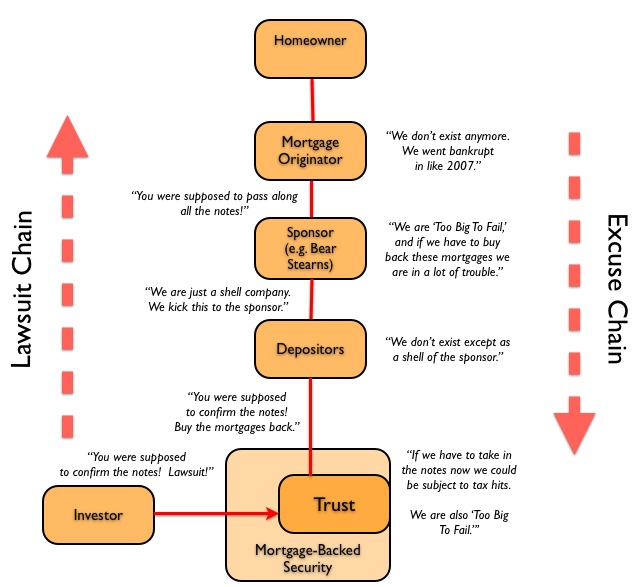
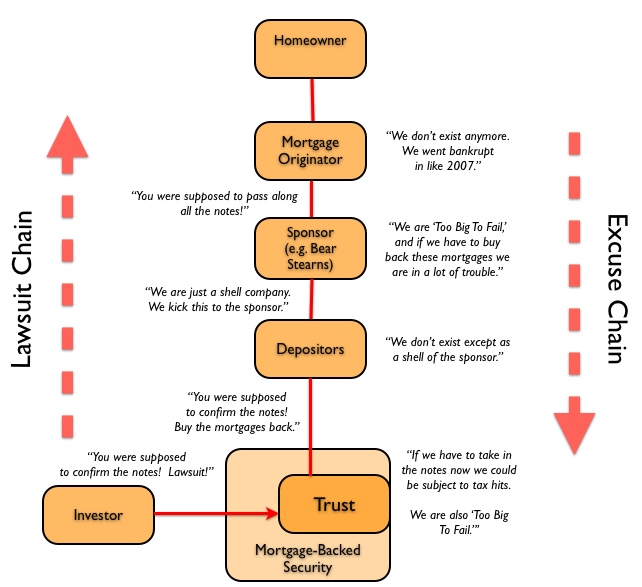
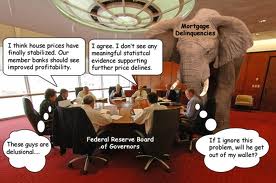
produce the note ?

Civil War Erupts On Wall Street: As Reality Finally Hits The Financial Elite, They Start Turning On Each Other

Full-Blown

September 3rd, 2011 | Filed under Economy, Feature, Hot List, News . Follow comments through RSS 2.0 feed. Click here to comment, or trackback.
Email This Email ThisPrint This Print This

Post to Twitter Post to Facebook Post to Reddit Post to Digg Post to StumbleUpon

By David DeGraw

Full-Blown Civil War Erupts On Wall Street: As Reality Finally Hits The Financial Elite, They Turn On Each OtherFinally, after trillions in fraudulent activity, trillions in bailouts, trillions in printed money, billions in political bribing and billions in bonuses, the criminal cartel members on Wall Street are beginning to get what they deserve. As the Eurozone is coming apart at the seams and as the US economy grinds to a halt, the financial elite are starting to turn on each other. The lawsuits are piling up fast. Here’s an extensive roundup:

As I reported last week:

Collapse Roundup #5: Goliath On The Ropes, Big Banks Getting Hit Hard, It’s A “Bloodbath” As Wall Street’s Crimes Blow Up In Their Face

Time to put your Big Bank shorts on! Get ready for a run… The chickens are coming home to roost… The Global Banking Cartel’s crimes are being exposed left & right… Prepare for Shock & Awe…

Well, well… here’s your Shock & Awe:

First up, this shockingly huge $196 billion lawsuit just filed against 17 major banks on behalf of Fannie Mae and Freddie Mac. Bank of America is severely exposed in this lawsuit. As the parent company of Countrywide and Merrill Lynch they are on the hook for $57.4 billion. JP Morgan is next in the line of fire with $33 billion. And many death spiraling European banks are facing billions in losses as well.

FHA Files a $196 Billion Lawsuit Against 17 Banks

The Federal Housing Finance Agency (FHFA), as conservator for Fannie Mae and Freddie Mac (the Enterprises), today filed lawsuits against 17 financial institutions, certain of their officers and various unaffiliated lead underwriters. The suits allege violations of federal securities laws and common law in the sale of residential private-label mortgage-backed securities (PLS) to the Enterprises.

Complaints have been filed against the following lead defendants, in alphabetical order:

1. Ally Financial Inc. f/k/a GMAC, LLC – $6 billion
2. Bank of America Corporation – $6 billion
3. Barclays Bank PLC – $4.9 billion
4. Citigroup, Inc. – $3.5 billion
5. Countrywide Financial Corporation -$26.6 billion
6. Credit Suisse Holdings (USA), Inc. – $14.1 billion
7. Deutsche Bank AG – $14.2 billion
8. First Horizon National Corporation – $883 million
9. General Electric Company – $549 million
10. Goldman Sachs & Co. – $11.1 billion
11. HSBC North America Holdings, Inc. – $6.2 billion
12. JPMorgan Chase & Co. – $33 billion
13. Merrill Lynch & Co. / First Franklin Financial Corp. – $24.8 billion
14. Morgan Stanley – $10.6 billion
15. Nomura Holding America Inc. – $2 billion
16. The Royal Bank of Scotland Group PLC – $30.4 billion
17. Société Générale – $1.3 billion

These complaints were filed in federal or state court in New York or the federal court in Connecticut. The complaints seek damages and civil penalties under the Securities Act of 1933, similar in content to the complaint FHFA filed against UBS Americas, Inc. on July 27, 2011. In addition, each complaint seeks compensatory damages for negligent misrepresentation. Certain complaints also allege state securities law violations or common law fraud. [read full FHFA release]

You can read the suits filed against each individual bank here. For some more information read Bloomberg: BofA, JPMorgan Among 17 Banks Sued by U.S. for $196 Billion. Noticeably absent from the list of companies being sued is Wells Fargo.

And the suits just keep coming…

BofA sued over $1.75 billion Countrywide mortgage pool

Bank of America Corp (BAC.N) was sued by the trustee of a $1.75 billion mortgage pool, which seeks to force the bank to buy back the underlying loans because of alleged misrepresentations in how they were made. The lawsuit by the banking unit of US Bancorp (USB.N) is the latest of a number of suits seeking to recover investor losses tied to risky mortgage loans issued by Countrywide Financial Corp, which Bank of America bought in 2008. In a complaint filed in a New York state court in Manhattan, U.S. Bank said Countrywide, which issued the 4,484 loans in the HarborView Mortgage Loan Trust 2005-10, materially breached its obligations by systemically misrepresenting the quality of its underwriting and loan documentation. [read more]

Bank of America kept AIG legal threat under wraps

Top Bank of America Corp lawyers knew as early as January that American International Group Inc was prepared to sue the bank for more than $10 billion, seven months before the lawsuit was filed, according to sources familiar with the matter. Bank of America shares fell more than 20 percent on August 8, the day the lawsuit was filed, adding to worries about the stability of the largest U.S. bank…. The bank made no mention of the lawsuit threat in a quarterly regulatory filing with the U.S. Securities and Exchange Commission just four days earlier. Nor did management discuss it on conference calls about quarterly results and other pending legal claims. [read more]

Nevada Lawsuit Shows Bank of America’s Criminal Incompetence

As we’ve stated before, litigation by attorney general is significant not merely due to the damages and remedies sought, but because it paves the way for private lawsuits. And make no mistake about it, this filing is a doozy. It shows the Federal/state attorney general mortgage settlement effort to be a complete travesty. The claim describes, in considerable detail, how various Bank of America units engaged in misconduct in virtually every aspect of its residential mortgage business. [read more]

Nevada Wallops Bank of America With Sweeping Suit; Nationwide Foreclosure Settlement in Peril

The sweeping new suit could have repercussions far beyond Nevada’s borders. It further jeopardizes a possible nationwide settlement with the five largest U.S. banks over their foreclosure practices, especially given concerns voiced by other attorneys general, New York’s foremost among them…. In a statement, Bank of America spokeswoman Jumana Bauwens said reaching a settlement would bring a better outcome for homeowners than litigation. “We believe that the best way to get the housing market going again in every state is a global settlement that addresses these issues fairly, comprehensively and with finality. [read more]

FDIC Objects to Bank of America’s $8.5 Billion Mortgage-Bond Accord

The Federal Deposit Insurance Corp. is objecting to Bank of America Corp. (BAC)’s proposed $8.5 billion mortgage-bond settlement with investors, joining investors and states that are challenging the agreement. The FDIC owns securities covered by the settlement and said it doesn’t have enough information to evaluate the accord, according to a filing today in federal court in Manhattan. Bank of America has agreed to pay $8.5 billion to resolve claims from investors in Countrywide Financial mortgage bonds. The settlement was negotiated with a group of institutional investors and would apply to investors outside that group. [read more]

Fed asks Bank of America to list contingency plan: report

The Federal Reserve has asked Bank of America Corp to show what measures it could take if business conditions worsen, the Wall Street Journal said, citing people familiar with the situation. BofA executives recently responded to the unusual request from the Federal Reserve with a list of options that includes the issuance of a separate class of shares tied to the performance of its Merrill Lynch securities unit, the people told the paper. Bank of America and the Fed declined to comment to the Journal. Both could not immediately be reached for comment by Reuters outside regular U.S. business hours. [
read more]

Bombshell Admission of Failed Securitization Process in American Home Mortgage Servicing/LPS Lawsuit

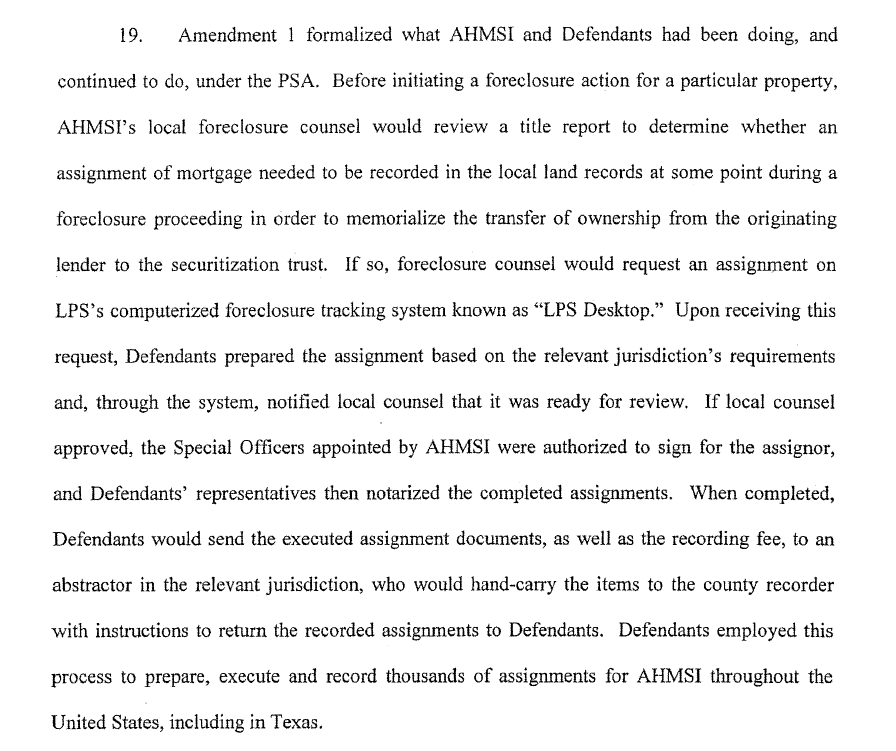
Wow, Jones Day just created a huge mess for its client and banks generally if anyone is alert enough to act on it. The lawsuit in question is American Home Mortgage Servicing Inc. v Lender Processing Services. It hasn’t gotten all that much attention (unless you are on the LPS deathwatch beat) because to most, it looks like yet another beauty contest between Cinderella’s two ugly sisters. AHMSI is a servicer (the successor to Option One, and it may also still have some Ameriquest servicing).

AHMSI is mad at LPS because LPS was supposed to prepare certain types of documentation AHMSI used in foreclosures. AHMSI authorized the use of certain designated staffers signing with the authority of AHSI (what we call robosinging, since the people signing these documents didn’t have personal knowledge, which is required if any of the documents were affidavits). But it did not authorize the use of surrogate signers, which were (I kid you not) people hired to forge the signatures of robosigners. The lawsuit rather matter of factly makes a stunning admission… [read more]

Fraudclosure: MERS Case Filed With Supreme Court

Before readers get worried by virtue of the headline that the Supreme Court will use its magic legal wand to make the dubious MERS mortgage registry system viable, consider the following:

1. The Supreme Court hears only a very small portion of the cases filed with it, and is less likely to take one with these demographics (filed by a private party, and an appeal out of a state court system, as opposed to Federal court). This case, Gomes v. Countywide, was decided against the plaintiff in lower and appellate court and the California state supreme court declined to hear it

2. If MERS or the various servicers who have had foreclosures overturned based on challenges to MERS thought they’d get a sympathetic hearing at the Supreme Court, they probably would have filed some time ago. MERS have apparently been settling cases rather than pursue ones where it though the judge would issue an unfavorable precedent

3. The case in question, from what the experts I consulted with and I can tell, is not the sort the Supreme Court would intervene in based on the issue raised, which is due process (14th Amendment). But none of us have seen the underlying lower and appellate court cases, and the summaries we’ve seen are unusually unclear as to what the legal argument is. [read more]

Iowa Says State AG Accord Won’t Release Banks From Liability

The 50-state attorney general group investigating mortgage foreclosure practices won’t release banks from all civil, or any criminal, liability in a settlement, Iowa Attorney General Tom Miller said. [read more]

Fed Launches New Formal Enforcement Action Against Goldman Sachs To Review Foreclosure Practices

The Federal Reserve Board has just launched a formal enforcement action against Goldman Sachs related to Litton Loan Services. Litton Loan is the nightmare-ridden mortgage servicing unit, a subsidiary of Goldman, that Goldman has been trying to sell for months. They penned a deal to recently, but the Fed stepped in and required Goldman to end robo-signing taking place at the unit before the sale could be completed. Sounds like this enforcement action is an extension of that requirement. [read more]

Goldman Sachs, Firms Agree With Regulator To End ‘Robo-Signing’ Foreclosure Practices

Goldman Sachs and two other firms have agreed with the New York banking regulator to end the practice known as robo-signing, in which bank employees signed foreclosure documents without reviewing case files as required by law, the Wall Street Journal said. In an agreement with New York’s financial-services superintendent, Goldman, its Litton Loan Servicing unit and Ocwen Financial Corp also agreed to scrutinize loan files for evidence they mishandled borrowers’ paperwork and to cut mortgage payments for some New York homeowners, the Journal said. [read more]

Banks still robo-signing, filing doubtful foreclosure documents

Reuters has found that some of the biggest U.S. banks and other “loan servicers” continue to file questionable foreclosure documents with courts and county clerks. They are using tactics that late last year triggered an outcry, multiple investigations and temporary moratoriums on foreclosures. In recent months, servicers have filed thousands of documents that appear to have been fabricated or improperly altered, or have sworn to false facts. Reuters also identified at least six “robo-signers,” individuals who in recent months have each signed thousands of mortgage assignments — legal documents which pinpoint ownership of a property. These same individuals have been identified — in depositions, court testimony or court rulings — as previously having signed vast numbers of foreclosure documents that they never read or checked. [read more]

JPMorgan fined for contravening Iran, Cuba sanctions

JPMorgan Chase Bank has been fined $88.3 million for contravening US sanctions against regimes in Iran, Cuba and Sudan, and the former Liberian government, the US Treasury Department announced Thursday. The Treasury said that the bank had engaged in a number of “egregious” financial transfers, loans and other facilities involving those countries but, in announcing a settlement with the bank, said they were “apparent” violations of various sanctions regulations. [read more]

This Is Considered Punishment? The Federal Reserve Wells Fargo Farce

What made the news surprising, of course, was that the Federal Reserve has rarely, if ever, taken action against a bank for making predatory loans. Alan Greenspan, the former Fed chairman, didn’t believe in regulation and turned a blind eye to subprime abuses. His successor, Ben Bernanke, is not the ideologue that Greenspan is, but, as an institution, the Fed prefers to coddle banks rather than punish them.

That the Fed would crack down on Wells Fargo would seem to suggest a long-overdue awakening. Yet, for anyone still hoping for justice in the wake of the financial crisis, the news was hardly encouraging. First, the Fed did not force Wells Fargo to admit guilt — and even let the company issue a press release blaming its wrongdoing on a “relatively small group.”

The $85 million fine was a joke; in just the last quarter, Wells Fargo’s revenues exceeded $20 billion. And compensating borrowers isn’t going to hurt much either. By my calculation, it won’t top $20 million. [read more]

Exclusive: Regulators seek high-frequency trading secrets

U.S. securities regulators have taken the unprecedented step of asking high-frequency trading firms to hand over the details of their trading strategies, and in some cases, their secret computer codes. The requests for proprietary code and algorithm parameters by the Financial Industry Regulatory Authority (FINRA), a Wall Street brokerage regulator, are part of investigations into suspicious market activity, said Tom Gira, executive vice president of FINRA’s market regulation unit. [read more]

And here’s part of the Collapse Roundup I wrote on August 25th, referenced in the beginning of this report – as you will see, I would probably make a lot more money as an investment adviser:

Collapse Roundup #5: Goliath On The Ropes, Big Banks Getting Hit Hard, It’s A “Bloodbath” As Wall Street’s Crimes Blow Up In Their Face

Collapse Roundup #5: Goliath On The Ropes, Big Banks Getting Hit Hard, Banking Cartel's Crimes Blowing Up In Their FaceTime to put your Big Bank shorts on! Get ready for a run

The chickens are coming home to roost. Reality is catching up with the market riggers (Fed, ECB, PPT, CIA) and the “too big to fail” banks are getting whacked. Trillions of dollars in bailouts and legalized (FASB) accounting fraud cannot save these insolvent zombie banks any longer. The Grim Reaper is on the horizon and his sickle will do what paid off politicians won’t, cut ‘em down to size. So get your silver stake ready, time to plunge it into their vampire squid hearts….

What about Warren Buffet? He saved Goldman Sachs with a bailout in 2008. Can he save Bank of America?…

Warren’s bailout will help BofA over the short run, but $5 billion is just a drop in the bucket when it comes to their problems. The only thing his $5 billion will accomplish is a temporary run up in stock value so everyone who has been killed on the plummeting stock price can then jump out without complete loss….

Trouble a-comin’…

Goldman Sachs TANKS After CEO Lloyd Blankfein Hires Famous Defense Lawyer

Collapse Roundup #5: Goliath On The Ropes, Big Banks Getting Hit Hard, Banking Cartel's Crimes Blowing Up In Their FaceIs the Goldman Sachs CEO facing a new lawsuit?

The market seems to think so. Goldman Sachs just tanked in minutes before the close after news that Lloyd Blankfein hired a lawyer famous for defending vilified execs. It’s back up a bit since dropping over 5%, but the news is still concerning.

It’s unclear whether the lawyer is for him, Goldman Sachs, or both, but Goldman Sachs’s CEO Lloyd Blankfein hired Reid Weingarten, a high profile defense attorney who says “I’m used to these monstrously difficult cases where everybody hates my clients,” according to Reuters.

Reuters says the hire might have something to do with accusations of Blankfein’s committing perjury. Or something else:

One former federal prosecutor, who was not authorized to speak publicly, said Blankfein may have hired outside counsel after receiving a request from investigators for documents or other information. [read full report]

Speaking of hiring lawyers…

The Global Banking Cartel’s Crimes Are Being Exposed Left & Right…

Blowing Up In Their Face… Prepare for Shock & Awe…

BOOM! Moody’s exposed:

MOODY’S ANALYST BREAKS SILENCE: Says Ratings Agency Rotten To Core With Conflicts

A former senior analyst at Moody’s has gone public with his story of how one of the country’s most important rating agencies is corrupted to the core.

The analyst, William J. Harrington, worked for Moody’s for 11 years, from 1999 until his resignation last year.

From 2006 to 2010, Harrington was a Senior Vice President in the derivative products group, which was responsible for producing many of the disastrous ratings Moody’s issued during the housing bubble.

Harrington has made his story public in the form of a 78-page “comment” to the SEC’s proposed rules about rating agency reform….

Here are some key points:

* Moody’s ratings often do not reflect its analysts’ private conclusions. Instead, rating committees privately conclude that certain securities deserve certain ratings–but then vote with management to give the securities the higher ratings that issuer clients want.

* Moody’s management and “compliance” officers do everything possible to make issuer clients happy–and they view analysts who do not do the same as “troublesome.” Management employs a variety of tactics to transform these troublesome analysts into “pliant corporate citizens” who have Moody’s best interests at heart.

* Moody’s product managers participate in–and vote on–ratings decisions. These product managers are the same people who are directly responsible for keeping clients happy and growing Moody’s business.

* At least one senior executive lied under oath at the hearings into rating agency conduct. Another executive, who Harrington says exemplified management’s emphasis on giving issuers what they wanted, skipped the hearings altogether. [read full report]

BOOM! The SEC Caught Covering Up Wall Street Crimes:

Matt Taibbi Exposes How SEC Shredded Thousands of Investigations

An explosive new report in Rolling Stone magazine exposes how the U.S. Securities and Exchange Commission destroyed records of thousands of investigations, whitewashing the files of some of the nation’s largest banks and hedge funds, including AIG, Wells Fargo, Lehman Brothers, Goldman Sachs, Bank of America and top Wall Street broker Bernard Madoff. Last week, Republican Sen. Chuck Grassley of Iowa said an agency whistleblower had sent him a letter detailing the unlawful destruction of records detailing more than 9,000 information investigations. We speak with Matt Taibbi, the political reporter for Rolling Stone magazine who broke this story in his latest article….

KA-BOOM! The Fed And All Their Crony-Capitalist Cartel Members Exposed, Yet Again:

Wall Street Pentagon Papers Part III – Are The Federal Reserve’s Crimes Still Too Big To Comprehend?

Collapse Roundup #5: Goliath On The Ropes, Big Banks Getting Hit Hard, Banking Cartel's Crimes Blowing Up In Their FaceAnother day, another trillion plus in secret Federal Reserve “bailouts” revealed. Bloomberg News exposes this latest Fed “deal” after winning a long Freedom of Information Act (FOIA) legal battle to get the details on what was done with the American people’s money. Their report runs with an AmpedStatus style headline: “Wall Street Aristocracy Got $1.2 Trillion From Fed.”

The aristocracy is alive and well… thanks to the Fed, of course.

Keep in mind, this $1.2 trillion is in addition to the $16 trillion the Government Accountability Office (GAO) audit revealed and the over $2 trillion in Quantitative Easing the Fed dished out, not to mention the now continued promise of the Zero Interest Rate Policy (ZIRP). This is also separate from the $700 billion TARP program that Congress approved. This is yet another unknown secret program, throwing another mere $1.2 trillion in public money at the Wall Street elite (global banking cartel), just being revealed now.

Those of us paying attention over the past three years have had Fed crony-capitalism on steroids fatigue for awhile now. Nonetheless, this is deja vu all over again as another mindbogglingly huge story that must be covered comes to light.

Here are the details of this latest revelation:

[read full report]

Speaking of the $16 trillion GAO audit…

BOOM! GAO audit exposed, missing some vital details:

More on how the GAO’s Fed audit failed to disclose some dirty secrets about BlackRock and JP Morgan

In its review of the Fed’s outsourcing practices, it failed to mention the most damaging and suspicious sole-source (no bid) contract awarded to BlackRock, which was for handling the New York Fed’s toxic Bear Stearns portfolio, otherwise known as Maiden Lane. This contract would generate $108,000,000 in fees and was one of the largest awarded during the bailout period, but it might also have saved JP Morgan $1.1 billion in losses from its Bear Stearns acquisition….

Also, BlackRock was also one of the managers of the NY Fed’s separate $1.25 trillion MBS purchase program as part of QE1. Contrary to the lie on the NY Fed’s webpage (that the MBS auctions were conducted via competitive bidding), the NY Fed’s own purchasing manager, Brian Sack, admitted in a paper that, “the MBS purchases were arranged with primary dealer counterparties directly, [and] there was no auction mechanism to provide a measure of market supply.”

Putting it all together, it looks like Jamie Dimon signed off on hiring BlackRock for no justifiable reason to trade the very Maiden Lane portfolio that could have caused his bank, JP Morgan, to lose up to $1.1 billion. And, it was entirely possible that BlackRock saved the portfolio by trading the MBS portion of ML with the New York Fed directly as QE1 was underway. [read full report]

BOOM! Bear Stearns exposed:

Report Says Bear Stearns Executives Sold Illegal RMBS and Covered It Up

Former back office employees from Bear Stearns are coming out of the woodwork to explain how Tom Marano’s mortgage group cheated their own clients out of billions. This week I reported at The Distressed Debt Report, EMC insiders say they were told to make up the classification for whole loans, packaged into mortgage securities, to get them switched out of the trust. By classifying the loans as ‘prepaid’ or having ‘subsequent recoveries’ Bear employees were able to fool the trustee into giving them back loans they were not able to legally service. A move New York Attorney General Eric Schneiderman is actively investigating now.

In my latest DealFlow story we hear from EMC staffers who describe how subprime loans, that would have been sold by Bear Stearns trader Jeff Verschleiser’s team, never had a proper servicing license in West Virginia when they were packaged into the residential mortgage backed security. In 2003 Bear/EMC put $100 million of subprime loans from West Virginia into a few RMBS transactions. EMC, the banks wholly owned mortgage servicing shop, would service all of Bear’s RMBS after they were sold.

A year latter, when senior executies realized the mishap instead of Bear going out and informing their regulator and applying for a license, they orchestrated a cover up and even threaten EMC employees not to talk about it. [read full report]

The big banks are getting lit up!

You shall reap what you sow.

Karma is a … bit@h. [read full report]

Let’s end with this video. We need to keep in mind that the Federal Reserve has known about all of this criminal activity from the start. Yet, they have done everything they could, and are still trying, to keep this criminal operation up and running. As all these criminal banks begin to blow up, let’s not forget who their central bank is and what they have done to the American people.

Cenk, take it away and drive the point home:


– David DeGraw is the founder and editor of AmpedStatus.com. His long-awaited book, The Road Through 2012: Revolution or World War III, will finally be released on September 28th. He can be emailed at David[@]AmpedStatus.com. You can follow David’s reporting daily on his new personal website: DavidDeGraw.org


~ We are fighting to remain 100% independent, completely free from partisan influence. If you respect our work, please donate to support our efforts here.

Post to Twitter Post to Facebook Post to Reddit Post to Digg Post to StumbleUpon

If the loan was not perfected; then there is no lien; and if the servicer was obligated to make the payment as a co-obligor; then there was no default

SEE 42-in RE Cruz vs Aurora
AURORA LOAN SERVICES LLC, SCME MORTGAGE BANKERS INC, ING BANK FSB, MORTGAGE ELECTRONIC REGISTRATION SYSTEMS ALL BITE THE DUST, SUBJECT TO LIABILITY AND NO ABILITY TO FORECLOSE WITHOUT COMPLYING WITH LAW.
Salient points of Judge Mann’s Decision:

TRUTH IN LENDING was dismissed because they were time-barred. LESSON: Don’t ignore TILA claims or TILA audits. Get a forensic Analysis as early as possible, assert them immediately, assert rescission as soon as possible. TILA has teeth, but if you assert it late in the game.
YOU CAN’T FORECLOSE ON UNRECORDED INSTRUMENTS: Judge Mann came right out and said the California Supreme Court would not and could not decide otherwise. Any other holding would defeat the purpose of recording and create uncertainty in the marketplace. This will cause a lot of grief to pretenders. It is getting harder for them to come up with people who are willing to lie, forge or fabricate documents. Getting a notary to affix their signature and seal will soon be a thing of the past unless the signature, the person and the document is real.
THE ASSUMPTION THAT THE LOAN IS IN DEFAULT IS STILL A PROBLEM: As long as lawyers and pro se litigants are willing to concede that the obligation was in default, they are giving up their largest chip — i.e., that the loan was not in default and the loan was not subject to a perfected lien for the same reason that the court cites in its opinion. Our loan level analysis shows repeatedly that in most cases the servicer is continuing to make payments and reporting to investors that the loan is performing even as they send delinquency letter’s notices of default and notices of sales. The Court missed this point because nobody brought it up. Don’t expect the Court to do your work for you. If you have reason to believe that the servicer is still paying on your loan you should be stating that the loan is not in de fault, denying any delinquency to the creditor and objecting to any action that is based upon the premise of “default.” Note that if the servicer is paying your bills, the servicer MIGHT have a right of action against you, but it certainly isn’t under the terms of the note or mortgage.
THE ASSUMPTION THAT A VALID PERFECTED MORTGAGE LIEN EXISTS IS STILL A PROBLEM: Again, the problem is not with the Courts but with the lawyers and pro se litigants who simply assume that this is not an issue. Put yourself in the banks’ shoes. If all you had were nominees for undisclosed principals on the note and mortgage would you be OK with that? No? Then the lien was never perfected, which means for legal purposes it doesn’t exist. Just because it shows in black and white doesn’t make it true. LESSON: Deny the lien exists, deny it was perfected and make them prove how it was perfected. They can’t. In most cases neither the mortgage originator nor the nominee beneficiary (MERS) had a disclosed lender or beneficiary, nor did they incorporate the real terms of the payment to the investor/lenders. If this was a law school exam and the student wrote that the loan was perfected, the grade would be “F”.
THE ISSUE OF FEDERAL PREEMPTION AND THEREFORE JURISDICTION AND VENUE ARE STILL IN FLUX: This Judge found that federal preemption prevents the homeowner from alleging TILA as state claims. The courts are not decided on this and the issue of res judicata and Rooker -Feldman will come into play once the issue is really resolved with finality. Beware then how you assert a claim and that you don’t let the statute of limitations run out by failing to assert the right claim under TILA in the right court. better to get dismissed than to find out that you are time-barred.
WRONGFUL FORECLOSURE IS A TITLE ISSUE NOT A FAIRNESS OR TECHNICAL ISSUE: Judge Mann, correctly in my opinion, states that an assignment from MERS must be allowed in order to clear up title. But, she states that without recording an interest within the chain of title, you have no right to foreclose under the states recording laws. I think this is right, and I think it applies in all 50 states. LESSON: Plead your wrongful foreclosure, slander of title and quiet title cases as title cases and stop adding extra things that you think may them juicier. Either the title is right or it is wrong. There is no middle ground.
MERS ISSUE IS STILL OBSCURE: While the assignment from MERS, if recorded clears up one part it leaves another part undecided again because it wasn’t raised properly. There is a difference between “bare record title” and an “interest in the land.” The MERS assignment is like a quit-claim deed from someone without any interest in the land and used to clear up the chain of title on paper, but it does not convey any interest. MERS on its website and in the public domain specifically disclaims any interest in the obligation, note or mortgage. That is its selling point to members who use its “Service.” And that is why it can’t foreclose and it is subject to cease and desist orders from regulators. As with other affidavits or quit-claims to clear up apparent clouds on title, the recorded assignment or quitclaim does nothing to convey a larger interest than that possessed by the grantor. LESSON: If the pretenders want to foreclose they can’t rely on the MERS assignment. They must file a credible affidavit that states that the affiant was the undisclosed principal in the original transaction with the borrower and that it joins in or separately assigns the actual interest in the obligation, note or mortgage. In my opinion, this is the only way to perfect the original “lien.” Whether it will relate back to the original transaction is an issue the courts must decide.
NO DIFFERENCE BETWEEN A DEED OF TRUST AND A MORTGAGE: Pretenders who try to elevate a deed of trust above a mortgage are headed for a brick wall. Courts never liked non-judicial foreclosure in the first place. They are not about to to reverse centuries of law and provide higher status to a non-judicial foreclosure or the instruments that allow it. ONLY the statutes that provide for extra care on the part of the trustee are constitutional, since due process is the only way anyone in this country can be deprived of life, liberty or property. LESSON: Pound on the issue that the pretender cannot prevail in a judicial foreclosure so they are trying to get away with it in a non-judicial foreclosure. If you want to see how this will eventually unfold, look at Florida and other states that had similar issues in their “Contracts for deed.” Despite clear contractual language the courts have universally held they are mortgages and that they must be foreclosed as mortgages.

Tim McCandless Blogs its amazing what you can do if you don’t watch TV

timothymccandless.wordpress.com
recallcitycouncil.wordpress.com
chapter11bankruptcy.wordpress.com
fairdebtcollectionpracticesact.wordpress.com
marionmccandless.wordpress.com
trustdeedinvestment.wordpress.com
rocketrecoverysystem.wordpress.com
mortgagereductionlaw.wordpress.com
mortgageregistationsystems.wordpress.com
massjoinderlitigation.wordpress.com
financialelderabuse.wordpress.com
landlordfraud.wordpress.com
http://mybk7.com
http://mortgagereductionlaw.com
http://evictiondefender.com
http://prodefenders.com
http://neilgarfield.com
http://massjoinderlitigation.info
http://fairdebtcollectionpracticesact.org
http://thestopforeclosureplan.com

KISS: KEEP IT SIMPLE STUPID from Garfield

Finality versus good and evil. In the battlefield it isn’t about good and evil. It is about winner and losers. In military battles around the world many battles have been one by the worst tyrants imaginable.

Just because you are right, just because the banks did bad things, just because they have no right to do what they are doing, doesn’t mean you will win. You might if you do it right, but you are up against a superior army with a dubious judge looking on thinking that this deadbeat borrower wants to get out of paying.

The court system is there to mediate disputes and bring them to a conclusion. Once a matter is decided they don’t want it to be easy to reopen a bankruptcy or issues that have already been litigated. The court presumably wants justice to prevail, but it also wants to end the dispute for better or for worse.

Otherwise NOTHING would end. Everyone who lost would come in with some excuse to have another trial. So you need to show fundamental error, gross injustice or an error that causes more problems that it solves.

These are the same issues BEFORE the matter is decided in court. Foreclosures are viewed as a clerical act or ministerial act. The outcome is generally viewed as inevitable.

And where the homeowner already admits the loan exists (a mistake), that the lien is exists and was properly filed and executed (a mistake) and admits that he didn’t make payments — he is admitting something he doesn’t even know is true — that there were payments due and he didn’t make them, which by definition puts him in default.

It’s not true that the homeowner would even know if the payment is due because the banks refuse to provide any accounting on the third party payments from bailout, insurance CDS, and credit enhancement.

That’s why you need reports on title, securitization, forensic reviews for TILA compliance and loan level accounting. If the Judges stuck to the law, they would require the proof first from the banks, but they don’t. They put the burden on the borrowers —who are the only ones who have the least information and the least access to information — to essentially make the case for the banks and then disprove it. The borrowers are litigating against themselves.

In the battlefield it isn’t about good and evil, it is about winners and losers. Name calling and vague accusations won’t cut it.

Sure you want to use the words surrogate signing, robo-signing, forgery, fabrication and misrepresentation. You also want to show that the court’s action would or did cloud title in a way that cannot be repaired without a decision on the question of whether the lien was perfected and whether the banks should be able to say they transferred bad loans to investors who don’t want them — just so they can foreclose.

But you need some proffers of real evidence — reports, exhibits and opinions from experts that will show that there is a real problem here and that this case has not been heard on the merits because of an unfair presumption: the presumption is that just because a bank’s lawyer says it in court, it must be true.

Check with the notary licensing boards, and see if the notaries on their documents have been disciplined and if not, file a grievance if you have grounds. Once you have that, maybe you have a grievance against the lawyers. After that maybe you have a lawsuit against the banks and their lawyers.

But the primary way to control the narrative or at least trip up the narrative of the banks is to object on the basis that counsel for the bank is referring to things not in the record. That is simple and the judge can understand that.

Don’t rely on name-calling, rely on the simplest legal requirements that you can find that have been violated. Was the lien perfected?

If the record shows that others were involved in the original transaction with the borrowers at the inception of the deal, then you might be able to show that there were only nominees instead of real parties in interest named on the note and mortgage.

Without disclosure of the principal, the lien is not perfected because the world doesn’t know who to go to for a satisfaction of that lien. If you know the other parties involved were part of a securitization scheme, you should say that — these parties can only be claiming an interest by virtue of a pooling and servicing agreement. And then make the point that they are only now trying to transfer what they are calling a bad loan into the pool that the investors bought — which is expressly prohibited for multiple reasons in the PSA.

This is impersonation of the investor because the investors don’t want to come forward and get countersued for the bad and illegal lending practices that were used in getting the borrower’s signature.

Point out that the auction of the property was improperly conducted where you can show that to be the case. Nearly all of the 5 million foreclosures were allowed to be conducted with a single bid from a non-creditor.

If you are not a creditor you must bid cash, put up a portion before you bid, and then pay the balance usually within 24-72 hours.

But instead they pretended to be the creditor when their own documents show they were supposed to be representing the investors who were not part of the lawsuit nor the judgment.

SO they didn’t pay cash and they didn’t tender the note. THEY PAID NOTHING. In Florida the original note must actually be filed with the court to make sure that the matter is actually concluded.

There is a whole ripe area of inquiry of inspecting the so-called original notes and bringing to the attention the fraud upon the court in submitting a false original. It invalidates the sale, by operation of law.

Attorney General Kamala D. Harris Sues Law Firms Engaged in National “Mass Joinder” Mortgage Fraud

SAN FRANCISCO — Attorney General Kamala D. Harris today announced that the California Department of Justice, in conjunction with the State Bar of California, has sued multiple entities accused of fraudulently taking millions of dollars from thousands of homeowners who were led to believe they would receive relief on their mortgages.

Attorney General Harris sued Philip Kramer, the Law Offices of Kramer & Kaslow, two other law firms, three other lawyers, and 14 other defendants who are accused of working together to defraud homeowners across the country through the deceptive marketing of “mass joinder” lawsuits. “Mass joinder” lawsuits are lawsuits with hundreds, or more, individually named plaintiffs. This is the first consumer action by the Attorney General’s Mortgage Fraud Strike Force.

Kramer’s firm and other defendants were placed into receivership on Monday, Aug. 15. The legal actions were designed to shut down a scheme operated by attorneys and their marketing partners, in which defendants used false and misleading representations to induce thousands of homeowners into joining the mass joinder lawsuits against their mortgage lenders. Defendants also had their assets seized and were enjoined from continuing their operations. Nineteen DOJ special agents participated as the firms were taken over Wednesday, Aug. 17, along with 42 agents and other personnel from HUD’s Office of Inspector General, the California State Bar, and the Office of Receiver Thomas McNamara at 14 locations in Los Angeles and Orange Counties. Sixteen bank accounts were seized.

“The defendants in this case fraudulently promised to win prompt mortgage relief for millions of vulnerable homeowners across the country,” said Attorney General Harris. “Innocent people, already battered by the housing crisis, were targeted for fraud in their moment of distress.”

“The number of lawyers who have tried to take advantage of distressed homeowners in these tough economic times is nothing short of shocking,” said State Bar President William Hebert. “By taking over the practices of four attorneys accused of fraudulent marketing practices, the State Bar can put a stop to their deplorable conduct as part of our ongoing effort to protect the public.”

It is believed that at least two million pieces of mail were sent out by defendants to victims in at least 17 states. Defendants’ revenue from this scam is estimated to be in the millions of dollars.

As alleged in the lawsuit, defendants preyed on desperate homeowners facing foreclosure by selling them participation as plaintiffs in mass joinder lawsuits against mortgage lenders. Defendants deceptively led homeowners to believe that by joining these lawsuits, they would stop pending foreclosures, reduce their loan balances or interest rates, obtain money damages, and even receive title to their homes free and clear of their existing mortgage. Defendants charged homeowners retainer fees of up to $10,000 to join as plaintiffs to a mass joinder lawsuit against their lender or loan servicer.

Consumers who paid to join the mass joinder lawsuits were frequently unable to receive answers to simple questions, such as whether they had been added to the lawsuit, or even to establish contact with defendants. Some consumers lost their homes shortly after paying the retainer fees demanded by defendants.

This mass joinder scam began with deceptive mass mailers, the lawsuit alleges. Some mailers, designed to appear as official settlement notices or government documents, informed homeowners that they were potential plaintiffs in a “national litigation settlement” against their lender. No settlements existed and in many cases no lawsuit had even been filed. Defendants also advertised through their web sites.

When consumers contacted the defendants, they were given legal advice by sales agents, not attorneys, who made additional deceptive statements and provided (often inaccurate) legal advice about the supposedly “likely” results of joining the lawsuits. Defendants unlawfully paid commissions to their sales representatives on a per client sign-up basis, a practice known as “running and capping.”

Defendants’ alleged misconduct violates the following laws:
-False advertising, in violation of section 17500 of the Business and Professions Code
-Unfair, fraudulent and unlawful business practices, in violation of section 17200 of the Business and Professions Code
-Unlawful running and capping, in violation of section 6152, subdivision (a) of the Business and Professions Code (i.e., a lawyer unlawfully paying a non-lawyer to solicit or procure business)
-Improper fee splitting (defendants unlawfully splitting legal fees with non-attorneys)
-Failing to register with the Department of Justice as a telephonic seller.

Homeowners who have paid to be added to one of the lawsuits should contact the State Bar if they feel they may be victims of this scam. They can also contact a HUD-certified housing counselor for general mortgage related assistance.

The Department of Justice has seized the practices of the following non-attorney defendants:
Attorneys Processing Center, LLC; Data Management, LLC; Gary DiGirolamo; Bill Stephenson; Mitigation Professionals, LLC; Glen Reneau; Pate Marier & Associates, Inc.; James Pate; Ryan Marier; Home Retention Division; Michael Tapia; Lewis Marketing Corp.; Clarence Butt; and Thomas Phanco.

The State Bar has seized the practices and attorney accounts of the attorney defendants:
The Law Offices of Kramer & Kaslow; Philip Kramer, Esq; Mitchell J. Stein & Associates; Mitchell Stein, Esq.; Christopher Van Son, Esq.; Mesa Law Group Corp.; and Paul Petersen, Esq.

Attorney General Harris is challenging the defendants’ alleged misconduct in marketing their mass joinder lawsuits; her office takes no position as to the legal merits of any claims asserted in the mass joinder lawsuits filed by defendants.

Victims in the following states are known to have received these mailers, or signed on to join the case. This is a preliminary list that may be updated:

Alaska, Arizona, California, Colorado, Connecticut, Florida, Hawaii, Maryland, Massachusetts, Michigan, Missouri, Nevada, New Jersey, New York, Ohio, Texas, Washington

The complaint, temporary restraining order, examples of marketing documents and photos of the enforcement action are available with the electronic version of this release at http://oag.ca.gov/news.

Gomes and the U.S. Supreme court some body had better help these attorneys argue and brief the case

Wednesday, August 17th, 2011, 2:49 pm

A controversial case challenging the ability of Mortgage Electronic Registration Systems to foreclose on a California man was filed with the Supreme Court Monday, making it the first major MERS case to reach the nation’s highest court.

If the Supreme Court agrees to hear Gomes v. Countrywide, Gomes’ attorney, Ehud Gersten, says the court will have to decide whether a lower court stripped his client, Jose Gomes, of due process by allowing MERS to foreclose without ensuring the registry had the noteholder’s authority to foreclose.

“I believe this to be the first case in the country to take MERS to our Supreme Court,” Gersten told HousingWire. His claim could not be immediately verified.

“Ultimately, what this case is saying is if you are going to be taking someone’s home away from them, do you have the proof or the right to do so?” Gersten said. “If the Supreme Court starts to question MERS, and its business structure, it is going to have an effect on every MERS case in the country.”

MERS, the electronic registry at the center of the foreclosure crisis, has been under fire nationwide as foreclosure attorneys purport the firm, and its parent company Merscorp Inc., illegally foreclosed on properties.

Gersten, meanwhile, said MERS has a brief period of time to respond before the Supreme Court decides whether it will accept the case (click here for the filing).

Attorneys familiar with the Gomes case are not optimistic about its chances of being heard by the Supreme Court.

“While recent statistics show that the Supreme Court takes on average less than 3% of cases on certiorari, it takes even a smaller percentage of those advanced by private litigants, as opposed to the government,” said Patton Boggs attorney Anthony Laura. “Also it takes fewer cases out of the state court system than it does out of the federal Courts of Appeals.”

“So, the likelihood that this case will be taken is slim indeed,” Laura adds. “I believe those slim odds are even slimmer because the argument Gomes is making to the U.S. Supreme Court is one he did not previously raise.”

Laura said that, as a premise for invoking the jurisdiction of the Supreme Court, Gomes claims that the court below abridged his 14th Amendment rights.

“My recollection is that Gomes never made a Constitutional argument below, neither in the California Court of Appeals nor in the petition for review to the California Supreme Court,” he said. “In my view, the U.S. Supreme Court will look skeptically on his just raising that argument now.”

The original plaintiff, Jose Gomes, appealed to the nation’s highest court after California’s Supreme Court decided not to review the 4th Appellate District Court of California’s decision in favor of MERS.

Gomes’ petition says he’s challenging the foreclosure because MERS “did not have the current noteholder’s authority to foreclose.”

Gersten argues his client “was entitled to proof that the loan servicer, trustee or an entity such as MERS, either named in the deed of trust or acting through assignments of interest, had legal authority on behalf of the promissory note’s current holder to foreclose.”

The 4th Appellate District Court’s decision, which Gomes wants overturned, held MERS had the authority to initiate a foreclosure on Gomes because the deed of trust “explicitly provided MERS with the authority to do so,” according to court records.

The state appellate court also ruled in favor of MERS after finding the deed of trust contained no language to suggest the “lender or its successors and assigns must provide Gomes with an assurance that MERS is authorized to proceed with a foreclosure,” according to court records.

MERS chose not to comment on the case, but a spokeswoman said the company is aware of the filing with the Supreme Court.

California man wants foreclosures deemed unconstitutional in the state

by KERRI PANCHUK

Proposed Illinois Legislation Would Freeze Evictions for Four Months
California AG Wants Pay Option ARM Answers
Does the Senate’s housing bill encourage foreclosures?
California Law Freezes Foreclosures, Burns Servicers
Short Sales Cost Lenders $310m More Than Necessary, CoreLogic Study Finds

Thursday, August 4th, 2011, 7:31 am

A California man is on a mission to end foreclosures across his state, claiming an outright ban on the practice would force banks to help distressed borrowers.

In documents filed with California’s secretary of state, Sacramento resident David Benson said he’s trying to gain enough signatures – 807,615 to be exact – to get his foreclosure ban considered by voters across the state.

Benson wants to amend the California constitution, making homeownership a fundamental right.

His plan would require lenders to assist borrowers unable to pay for their homes due to financial distress and illness.

It also would force lenders to reduce a loan’s principal amount to reflect declines in property value that go beyond 10%.

Benson’s proposal says any “loan issued for and secured by a home or property by any lending institutions, loan servicers, mortgagee, trustees and beneficiaries doing business in the state of California, shall be able to be refinanced without credit review or penalty at minimum cost, within 45 days of being requested.”

That provision would automatically apply if a borrower has maintained the mortgage for at least three years.

Anthony Laura, an attorney at Patton Boggs who reviewed the proposal, said the amendment “would have the opposite effect of diminishing, not enhancing, homeownership in California.”

“While homeownership may be part of what many consider to be the American Dream, I have a hard time conceiving it as a constitutional right. Should this proposed amendment make it on the ballot and ultimately pass, it would only serve to discourage lenders from making mortgage loans in California.”

Laura said without those mortgages, few people could afford homes.

Write to Kerri Panchuk.

SAY NO TO LENDERS FRAUD!

Contact Us: MortgageReductionLaw.com

Dear Homeowner,

It’s been widely reported around the country, via internet, blogs and newspapers, how the lenders used the foreclosure mills and other legal ways, to fabricate fraudulent documents to record in the county recorder offices and pretend they have legal standing to initiate the foreclosure procedure.

Neil Garfield in his blog http://www.livinglies.com, The Huffington Post, The New York Times, Steve Vondran in his website http://www.foreclosuredefenseresourcecenter.com, Tim McCandless in his blog https://timothymccandless.wordpress.com and many others have been advocating for the homeowners trying to raise awareness in the courts so that justice can be served.Contact Us: MortgageReductionLaw.com

A few years ago, when the Mortgage Debacle started, these lenders went after the Mortgage Brokers after they found themselves in trouble for the many defaulted loans. They filed civil and criminal lawsuits convicting these brokers for fabricating documents and forging signatures to fund the loans. The legal system, judges and General Attorneys were prompt to convict “these so called criminals”.Contact Us: MortgageReductionLaw.com

Today the tables have turned 180 degrees and we have discovered how these entities have been widely practicing what they accused others of. Today the lenders are fabricating documents, forging signatures and filing fraudulent documents with the government agencies to weasel their way into owning the homeowners’ properties.Contact Us: MortgageReductionLaw.com

The fact that judges preceding the Unlawful Detainer hearings are not educated enough about the matter and don’t want to take the time to hear the attorneys defending the homeowners, does not help to make this wrong right. Securitization is a very complicated subject that cannot be taught in an Unlawful Detainer hearing or even in a Wrongful Foreclosure hearing. The way judges have been manipulating the information provided by the homeowners in their lawsuits to rule in favor of the lenders is despicable!Contact Us: MortgageReductionLaw.com

That’s why it’s so important to have all your property recorded documents used to foreclose on your home, been researched and analyzed by an expert that can identify all the issues that can be used in a Court of Law to fight for your home.

When you go in front of a Judge with enough evidence to prove that fraud was committed by the lender when the lender fabricated documents used to foreclose, you have a good chance to get the Judge’s attention. Fraud is a subject they know, it’s a crime and they can rule in your favor. It would be very difficult for a Judge to justify this fraudulent behavior on the part of the lender.

Later on, once you have successfully received an injunction, you can bring the securitization argument in your complaint and make the lender prove their innocence.Contact Us: MortgageReductionLaw.com

The documents used to initiate the foreclosure of your home have been fraudulently fabricated by either the Trustee or the Lender.

Some attorneys who have explored this cause of action in their civil lawsuits, have been able to get relief for the homeowners by getting the in Temporary Restraining Order and the Injunction granted.

Below please find proof of a very common practice within these entities when they fabricate documents. They use the name of one person who becomes an officer of many entities and the signature is very different in different documents. This has happened in your case too.

This is a portion of our report after thoroughly performing research and discovery for one of our clients: (testimonial letters can be provided upon request after signing a confidentiality agreement).

SIGNED BY: LINDA GREEN AS VICE PRESIDENT FOR AMERICAN HOME MORTGAGE SERVICING, INC. AS SUCCESOR IN INTEREST TO OPTION ONE MORTGAGE CORPORATION

TOO MANY JOBS

For this report, over 500 mortgage assignments were examined.

Each Assignment was filed by Docx, a mortgage servicing company in Alpharetta, GA; each was notarized in Fulton County, GA.

Many of these Assignments have been used in foreclosure actions to prove that the lender has the legal right to file the foreclosure actions.

The name of Linda Green, frequently appears on Docx documents. The following list summarizes some of the many job titles used by Green.Contact Us: MortgageReductionLaw.com

JOB TITLES HELD BY LINDA GREEN

11-11-2004 & 06-22-2006

Vice President, Loan Documentation, Wells Fargo Bank, N.A., successor by merger to Wells Fargo

Home Mortgage, Inc.

08-11-2008 & 08-14-2008

Vice President, Mortgage Electronic Registration Systems, Inc., as nominee for American Home Mortgage Acceptance, Inc

08-27-2008

Vice President, American Home Mortgage Servicing as successor-in-interest to Option One Mortgage Corporation

09-19-2008

Vice President, Mortgage Electronic Registration Systems, Inc., as nominee for American Brokers Conduit

09-30-2008

Vice President, Mortgage Electronic Registration Systems, Inc., as nominee for American Home Mortgage Acceptance, Inc

09-30-2008

Vice President, Mortgage Electronic Registration Systems, Inc., as nominee for American Brokers Conduit

10-08-2009

Vice President & Asst. Secretary, American Home Mortgage Servicing, Inc., as servicer for Ameriquest Mortgage Corporation

10-16-2008

Vice President, Mortgage Electronic Registration Systems, Inc., as nominee for American Home Mortgage Acceptance, Inc

10-17-2008, 11-20-2008

Vice President, Mortgage Electronic Registration Systems, Inc., as nominee for American Brokers Conduit

11-20-2008

Vice President, Option One Mortgage Corporation

12-08-2008

Vice President, Mortgage Electronic Registration Systems, Inc., as nominee for American Brokers Conduit

12-15-2008

Vice President, Mortgage Electronic Registration Systems, Inc., as nominee for HLB Mortgage

12-24-2008

Vice President, Mortgage Electronic Registration Systems, Inc., as nominee for American Home Mortgage Acceptance, Inc

12-26-2008

Vice President, American Home Mortgage Servicing, Inc

01-13-2009

Vice President, Mortgage Electronic Registration Systems, Inc., as nominee for Family Lending Services, Inc

01-15-2009

Vice President, Mortgage Electronic Registration Systems, Inc., acting solely as nominee for American Home Mortgage Acceptance, Inc

02-03-2009

Vice President, Mortgage Electronic Registration Systems, Inc., as nominee for American Broker Conduit

02-24-2009

Vice President, American Home Mortgage Servicing, Inc. as successor-in-interest to Option One Mortgage Corporation

02-25-2009

Vice President, Bank of America, N A

02-27-2009

Vice President, American Home Mortgage Servicing, Inc., as successor-in-interest to Option One Mortgage Corporation

03-02-2009

Vice President, Mortgage Electronic Registration Systems, Inc., acting solely as nominee for American Home Mortgage

03-04-2009

Vice President, Argent Mortgage Company, LLC by Citi Residential Lending Inc., attorney-in-fact

03-06-2009 & 03-20-2009

Vice President, Mortgage Electronic Registration Systems, Inc., as nominee for American Home Mortgage Acceptance, Inc

04-15-2009, 04-17-2009, 04-20-2009

Vice President, Bank of America, N.A.

05-11-2009, 07-06-2009

Vice President, Mortgage Electronic Registration Systems, Inc., as nominee for American Home Mortgage Acceptance, Inc

07-14-2009

Vice President, Bank of America, N.A.

07-30-2009

Vice President, Mortgage Electronic Registration Systems, Inc., as nominee for American Home Mortgage Acceptance, Inc

08-12-2009

Vice President, Sand Canyon Corporation f/k/a Option One Mortgage Corporation

08-28-2009

Vice President, Mortgage Electronic Registration Systems, Inc., as nominee for American Home Mortgage Acceptance, Inc.

09-03-2009

Asst. Vice President, Sand Canyon Corporation formerly known as Option One Mortgage Corporation

09-03-2009

Asst. Secretary, Mortgage Electronic Registration Systems, Inc., acting solely as nominee for American Home Mortgage

09-04-2009

Asst. Secretary, Mortgage Electronic Registration Systems, Inc., acting solely as nominee for American Home Mortgage

09-08-2009

Vice President, Bank of America, N.A.

09-21-2009 & 09-22-2009

Vice President, Mortgage Electronic Registration Systems, Inc., as nominee for American Home Mortgage Acceptance, Inc

ATTACHED TO THIS DOCUMENT OTHER DOCUMENTS SIGNED BY LINDA GREEN THAT SHOW THE VARIATIONS OF HER SIGNATURE

IT APPEARS AS IF THE SIGNATURE OF MS. GREEN COULD BE A FORGERY.Contact Us: MortgageReductionLaw.com

A forgery is a writing which falsely purports to be writing for another and is executed with the intent to defraud. Ordinarily a forged instrument cannot carry title.

THE SIGNATURE BELOW IS THE SIGNATURE IN THIS ASSIGNMENT OF DEED OF TRUST:Contact Us: MortgageReductionLaw.com

THE FOLLOWING SIGNATURES ARE FROM DIFFERENT DOCUMENTS RECORDEDIN DIFFERENT COUNTIES:

THIS WHOLE SYSTEM IS A FARCE. A BROKEN DOWN, FRAUDULENT, SHAKY, DISHONEST AND TERRIFYINGLY CORRUPT SYSTEM.

The press and the general public is starting to pick up on these major systemic issues that judges, attorneys and other insiders have known about for some time…when the whole system collapses we’ve all got a real mess on our hands.

As we all struggle to unravel this monstrous mess, breaking down capacity will be a key focus in the problem. We’re all going to be searching around to determine who to sue and where to sue them, but because the courts failed to enforce the most basic pleading requirement….i.e. specifically identify who the parties to the lawsuit are, this is going to be most difficult.

One of the persistent and most pervasive problems in the whole foreclosure crisis is the inability of any party to get reliable or credible information about what is owed on a mortgage, who that phantom amount is owed to and what negotiated amount a lender, servicer or other party involved in the transaction might accept to modify or short sale the underlying loan.

A very concerning issue is the publication on the MERS website of information that identifies who the servicer on a loan is and who the investor in that loan is. But, neither the servicer or investor matches up to the information in many cases.

When you combine all this information with the depositions of Robo signers that are posted on many website, you’ll understand that in a large number of cases, the only connection between the plaintiff foreclosing and the mortgage being foreclosed is a sloppy and hastily executed Assignment signed by an officer that has no corporate authority and has no personal knowledge of the information contained on those documents.

It’s simply not okay to use the “robosigning” practice in the non judicial foreclosure states because these foreclosure cases don’t have to go to court.

The following are some of the most clear legal reasons why the Robo-Signer Controversy should entitle hundreds of thousands of homeowners wrongfully foreclosed and evicted to sue in non judicial foreclosure states. Robo Signers are illegal because fraud cannot be the basis of clear title, trustee’s deeds following Robo Signed sales should be void as a matter of law, notarization is a recording requirement for many of the documents, which was often botched, and most importantly because robo signed falsifications are meant for use in court, including unlawful detainers and bankruptcy matters.Contact Us: MortgageReductionLaw.com

CALIFORNIA

1. Clear Title May Not Derive from a Fraud (including a bona fide purchaser for value).

In the case of a fraudulent transaction California law is settled. The Court in Trout v. Trout, (1934), 220 Cal. 652 at 656 stated:

“Numerous authorities have established the rule that an instrument wholly void, such as an undelivered deed, a forged instrument, or a deed in blank, cannot be made the foundation of a good title, even under the equitable doctrine of bona fide purchase. Consequently, the fact that defendant Archer acted in good faith in dealing with persons who apparently held legal title, is not in itself sufficient basis for relief.” (Emphasis added, internal citations omitted).

This sentiment was clearly echoed in 6 Angels, Inc. v. Stuart-Wright Mortgage, Inc. (2001) 85 Cal.App.4th 1279 at 1286 where the Court stated:

“It is the general rule that courts have power to vacate a foreclosure sale where there has been fraud in the procurement of the foreclosure decree or where the sale has been improperly, unfairly or unlawfully conducted, or is tainted by fraud, or where there has been such a mistake that to allow it to stand would be inequitable to purchaser and parties.” (Emphasis added).

If forged signatures are used to obtain the foreclosure it makes a difference!

2. Any apparent sale based on Robosigned documents or forged signatures should be void and without any legal effect.

In Bank of America v. LaJolla Group II, the California Court of Appeals held that if a trustee is not contractually empowered under the Deed of Trust to hold a sale, it is totally void. Voidness, as opposed to voidability, means that it is without legal effect. Title does not transfer. No right to evict arises. The property is not sold.

In turn, California Civil Code 2934a requires that the beneficiary execute, notarize and record a substitution for a valid Substitution of Trustee to take effect. Thus, if the Assignment of Deed of Trust, the Substitution of Trustee or the Notice of Default are Robo-Signed, the sale should be void.Contact Us: MortgageReductionLaw.com

3. These documents are not recordable without good notarization.

In California, the reason these documents are notarized in the first place is because otherwise they will not be accepted by the County recorder. Moreover, a notary who helps commit real estate fraud is liable for $25,000 per offense.

Once the document is recorded, however, it is entitled to a “presumption of validity”, which is what spurned the falsification trend in the first place. California Civil Code Section 2924. Therefore, the notarization of a false signature not only constitutes fraud, but is every bit intended as part of a larger conspiracy to commit fraud on the court.

4. The documents are intended for court eviction proceedings.

A necessary purpose for these documents, after the non judicial foreclosure, is the eviction of the rightful owners afterward. Even in California, eviction is a judicial process, albeit summary and often sloppily conducted by judges who don’t really believe they can say no to the pirates taking your house. However, as demonstrated below, once these documents make it into court, the bank officers and lawyers become guilty of felonies:

California Penal Code section 118 provides (a) Every person who, having taken an oath that he or she will testify, declare, depose, or certify truly before any competent tribunal, officer, or person, in any of the cases in which the oath may by law of the State of California be administered, willfully and contrary to the oath, states as true any material matter which he or she knows to be false, and every person who testifies, declares, deposes, or certifies under penalty of perjury in any of the cases in which the testimony, declarations, depositions, or certification is permitted by law of the State of California under penalty of perjury and willfully states as true any material matter which he or she knows to be false, is guilty of perjury.Contact Us: MortgageReductionLaw.com

This subdivision is applicable whether the statement, or the testimony, declaration, deposition, or certification is made or subscribed within or without the State of California.

Penal Code section 132 provides: Every person who upon any trial, proceeding, inquiry, or investigation whatever, authorized or permitted by law, offers in evidence, as genuine or true, any book, paper, document, record, or other instrument in writing, knowing the same to have been forged or fraudulently altered or ante-dated, is guilty of felony.

The Doctrine of Unclean Hands provides: plaintiff’s misconduct in the matter before the court makes his hands “unclean” and he may not hold with them the pristine remedy of injunctive relief. California Satellite Sys. v Nichols (1985) 170 CA3d 56, 216 CR 180. California’s unclean hands rule requires that the Plaintiff don’t cheat, and behave fairly. The plaintiff must come into court with clean hands, and keep them clean, or he or she will be denied relief, regardless of the merits of the claim. Kendall-Jackson Winery Ltd. v Superior Court (1999) 76 CA4th 970, 978, 90 CR2d 743. Whether the doctrine applies is a question of fact. CrossTalk Prods., Inc. v Jacobson (1998) 65 CA4th 631, 639, 76 CR2d 615.

5. Robo Signed Documents Are Intended for Use in California Bankruptcy Court Matters. One majorly overlooked facet of California is our extremely active bankrtupcy court proceedings, where, just as in judicial foreclosure states, the banks must prove “standing” to proceed with a foreclosure. If they are not signed by persons with the requisite knowledge, affidavits submitted in bankruptcy court proceedings such as objections to a plan and Relief from Stays are perjured.

The documents in support are often falsified evidence.

CONCLUSION

Verified eviction complaints, perjured motions for summary judgment, and all other eviction paperwork after robo signed non judicial foreclosures in California and other states are illegal and void. The paperwork itself is void. The sale is void. But the only way to clean up the hundreds of thousands of effected titles is through litigation, because even now the banks will simply not do the right thing. And that’s why robo signers count in non-judicial foreclosure states. Victims of robosigners in California may seek declaratory relief, damages under the Rosenthal Act; an injunction and attorneys fees for Unfair Business practices, as well as claims for slander of title; abuse of process, civil theft, and conversion.Contact Us: MortgageReductionLaw.com

The Free House Myth

posted by Katie Porter
As challenges to whether a “bank” (usually actually a securitized
trust) has the right to foreclose because it owns the note and mortgage become more common, rumors swirl about the ability to use such tactics to get a “free house.” There are a few instances of consumer getting a free house, see here and here, for examples, but these are extreme situations not premised on ownership, but on a more fundamental flaw with the mortgage. In general, the idea that even a successful ownership challenge will create a free house to the borrower is an urban myth. I’ll explain why below, but there is a policy point here. The myth of the free house drives policymakers to complain about the moral hazard risks of holding mortgage companies to the law and tries to set up homeowners who are paying their mortgages against those who are not. It serves the banks’ political agenda to be able to point to the “free house” as an obviously unacceptable alternative of consumers winning legal challenges. It’s key then to understand that the “free house” is largely a creature of consumers’
and banks’ over-active imaginations.

In sorting out why even a successful ownership challenge does not give homeowners a free house, it is helpful to parse some key concepts. The first one is standing, which is the right of a party to ask a court for the relief it seeks. This comes in different flavors, including constitutional standing, but in the foreclosure context, usually boils down to whether the moving party is the “real party in interest.” In re Veal, the recent decision from the 9th Circuit BAP authored by Judge Bruce Markell, mentioned previously on Credit Slips , contains a discussion of standing in the foreclosure context. At least in part, the concern of the real party in interest doctrine is to make sure that the plaintiff is the right person to get legal relief in order to protect the defendant from a later action by the person truly entitled to relief. Note that standing is a concept that only applies in court; here that means in judicial foreclosures. In states that allow non-judicial foreclosure, the issue is slightly different. Does the party initiating the non-judicial foreclosure have the authority to do so under the state statute authorizing the sale? For example, cases such as In re Salazar discuss whether a recorded assignment of the mortgage is needed, as opposed to an unrecorded assignment, to initiate a foreclosure. Under either standing or statutory authority, a “win” by the homeowner leads to the same result. The foreclosure cannot proceed.

But this win is not the same as a free house. Just because a party lacked standing or statutory authority does not mean that there is not some party out there that does have the authority to foreclosure. Nor does a win on standing mean that there cannot be action taken to give the initial foreclosing party the authority that they need, which might occur by transferring possession of the note or by executing a series of assignments, to foreclose at a later date. Unless other problems exist, there is still a valid note that obligates the homeowner to pay money due and there is still a mortgage encumbering the house. The homeowner does not get a free house. Rather, the homeowner just doesn’t lose her house today to foreclosure. These are pretty different outcomes!

This doesn’t mean that I think the standing/ownership issue is inconsequential. For homeowners, a successful challenge that results in the dismissal of a foreclosure can lead to a loan modification or the delay itself can give the homeowner the time to find another solution. For investors in mortgage-backed securities, the problems with paperwork likely increase their loss severities in foreclosure, both because of increased litigation costs and because of delay in correcting problems. (And there may be even more serious problems for investors relating to whether the transfers even succeeded in putting the homes in the trust.) But we shouldn’t confuse these issues with the idea that what is at stake in sorting out this mess is giving a “free house” to some Americans, despite the lamentations of this LaSalle Bank lawyer after a judge ruled that LaSalle as trustee lacked standing to foreclose. A fruitful discussion of these issues needs to begin with a clear understanding of the consequences of the problem, as well as empirical evidence on how widespread these problems are.
The free house is political handwringing, not legal reality.

July 18, 2011 at 4:22 AM in Mortgage Debt & Home Equity Comments It’s certainly not a “free” house. I think it’ll be a nightmare for homeowners who prevail in one of these actions to try and sell their homes. Just because party X can’t foreclose doesn’t mean that there isn’t a valid mortgage still on the property. No buyer is going to want to buy (and no title insurer will want to insure) unless that mortgage is paid off. And that means determining who is the mortgagee.
Adverse possession and/or quiet title actions might help solve some of this, but they are not self-executing solutions. Homeowners will have to go to court and litigate. That’s expensive and it takes time. So, at best, these homeowners are getting not “free” houses but houses with a severely depressed value.

Posted by: Adam Levitin | July 18, 2011 at 06:46 AM

The author skims the surface of the latte and finds after skimming the surface there is no more cream. Duh.
The Banks are often appearing as trustees on behalf of NY Trusts most of which died on or about 2008. If the trusts are dead than who has the right to appear in court? Nemo est hires viventis. No one is the heir of a living person and I would suggest, no one is the a trustee able to act on behalf of a dead trust. If the paper was successfully transferred to the trust, then perhaps the thousands of suckers who bought a RMBS are the owners. But if the paper was never successfully transferred, then the trusts and the trustees are certainly not the owners with standing. The original lenders might be but after phony documents have been created assigning the note and the mortgage to dead trusts, how could they possibly have the right of ownership?
The “myth” of the free houses was created not by consumers “oy!!” but by the very Banks who are picking up “free” houses every day by pretending to be trustees acting on behalf of dead trusts or trusts that never properly held the mortgages and notes. It is very much like Ronald Reagan calling a nuclear submarine the Corpus Christie or calling armed combatants “peacekeepers.” The “free house” was the Orwellian double speak created by Bankers for Bankers and their judicial minions and hand maidens have adopted their language very well.


Jake Naumer
Resolution Advisors
3187 Morgan Ford
St Louis Missouri 63116
314 961 7600
Fax Voice Mail 314 754 9086

MERS in California

From LivingLies:
I think that everyone is missing the #1 problem MERS has in CA.
MERS is a Non-Authorized Agent and cannot legally assign the Promissory Note, making any foreclosure by other than the original lender wrongful, for the following reasons.
1) Under established and binding Ca law, a Nominee can’t assign the Note. Born V. Koop 1962 200 C. A. 2d 519[200 CalApp2d Page 527, 528
2) On most Notes, the term Nominee is not included and MERS never takes ownership, making it unenforceable and unassignable by MERS.
Ott v. Home Savings & Loan Association, 265 F. 2d 643 [647,648
3) Ca Civil Code §2924, et seq. is exhaustive and a Nominee is never included as an acceptable form of “authorized agent” in a judicial or non-judicial foreclosure.
Finally, GOMES V. COUNTRYYWIDE HOME LOANS, INC., 192 Cal.App.4th 1149, IS FLAWED!
a) The Gomes case simply failed to address and apply the established and binding definition of a nominee.
b) The first thing the Deed of Trust does is (i) take away MERS right to payments and (ii) take away the right to enforce the Note.
c) REGARDLESS WHAT A BORROWER AGREES TO, a borrower cannot legally grant MERS the right to assign the note or any of the rights of the note owner.
________________________________________
MERS Fatal Flaws
MERS cannot legally assign a Promissory Note because, MERS is a Non-Authorized Agent under Established and Binding California Real Property Law and the borrower can’t provide that power to MERS.
First, a Nominee is someone who is nominated potentially for a future position. Much like being nominated for President, yet a Presidential Nominee doesn’t receive any powers until the person actually becomes President.
Second, in the Deed of Trust MERS is identified “Solely as a Nominee” and as the Beneficiary. Which is logically and legally impossible, because a party can only be either the nominated Beneficiary or the Beneficiary. You can’t “not be” and “be” the beneficiary at the same time.
Third, Ca Civil Code §2924, et seq. is exhaustive and a Nominee is never included as an acceptable form of “authorized agent” in a judicial or non-judicial foreclosure.
Fourth, MERS acts “Solely as a Nominee” for lenders, and under Established California Law a “Nominee” is a “Non-Authorized” form of agent, which fails to comply with California Civil Code §§ 2924 through 2924k, as a nominee inherently lacks the right to enforce or assign, the Note or real property ownership rights, per the following case.
“In Cisco v. Van Lew, 60 Cal.App.2d 575, 583-584, 141 P.2d 433, 438., Cisco could not enforce the land sale contract because he was not a party to it, the court, at pages 583-584, said: “The word ‘nominee’ in its commonly accepted meaning connotes the delegation of authority to the nominee in a representative or nominal capacity only, and does not connote the transfer or assignment to the nominee of any property in or ownership of the rights of the person nominating him.”
Born V. Koop 1962 200 C. A. 2d 519[200 CalApp2d Page 527, 528], see file below
Fifth, in addition to MERS’ inherit lack of authority, MERS is not a party to the Note and the Note fails to use the words, for example “ Lehman Brothers Bank, FSB or Lehman Brothers Bank, FSB Nominee”.
“The purpose of the document in question here was to offer an obligation to Harold L. Shaw alone and not to his nominee or any other person whomsoever.”
Ott v. Home Savings & Loan Association, 265 F. 2d 643 [647,648], see file below
Finally, GOMES V. COUNTRYYWIDE HOME LOANS, INC., 192 Cal.App.4th 1149, IS FLAWED!
a) The Gomes case simply failed to address and apply the established and binding definition of a nominee.
b) The first thing the Deed of Trust does is (i) take away MERS right to payments and (ii) take away the right to enforce the Note.
c) REGARDLESS WHAT A BORROWER AGREES TO, a “Borrower” cannot legally grant MERS the right to assign the note or any of the rights of the note owner.
“It is no defense to deceit that false statement was made pursuant to some statutory scheme such as statutory procedures for trustee’s sale (§ 2924 et seq.).” Block v. Tobin (App. 1 Dist. 1975) 119 Cal.Rptr. 288, 45 Cal.App.3d 214.

“It is true, as Defendants repeatedly assert, that California Civil Code § 2924, et seq. authorizes non-judicial foreclosure in this state. It is not the case, however, that the availability of a non-judicial foreclosure process somehow exempts lenders, trustees, beneficiaries, servicers, and the numerous other (sometimes ephemeral) entities involved in dealing with Plaintiffs from following the law.” Sacchi vs. Mortgage Electronic Registration Systems, Inc. US Central District Court of California CV 11-1658 AHM (CWx), June 24, 2011
Therefore, without an endorsement on the Note and an assignment directly from the original lender, assignments by MERS; the substitution of the Trustee; and trustee sale are unlawful and void.

“The assignment of the lien without a transfer of the debt was a nullity in law.” (Polhemus v. Trainer, 30 Cal. 685; Peters v. Jamestown Box Co., 5 Cal. 334; Hyde v. Mangan, 88 Cal. 319;
Jones on Pledges, secs. 418, 419; Van Ewan v. Stanchfield, 13 Minn. 75.)
“A lien is not assignable unless by the express language of the statute.”
(Jones on Liens, sec. 982; Wingard v. Banning, 39 Cal. 343; Ruggles v. Walker, 34 Vt. 468; Wing v. Griffin, 1 Smith, E.D. 162; Holly v. Hungerford, 8 Pick. 73; Daubigny v. Duval, 5 Tenn. 604.)
CALIFORNIA SUPREME COURT, DAVIS, BELAU & CO. V. NATIONAL SUR. CO., 139 CAL 223, 224 (1903)

“The note and mortgage are inseparable; the former as essential, the latter as an incident. An assignment of the note carries the mortgage with it, while an assignment of the latter alone is a nullity.”
CARPENTER V. LONGAN, 83 U. S. 271 (1872), U.S. Supreme Court
“California courts have repeatedly allowed parties to pursue additional remedies for misconduct arising out of a nonjudicial foreclosure sale when not inconsistent with the policies behind the statutes”
California Golf, L.L.C. v. Cooper (2008) 163 Cal.App.4th 1053,1070
“(2) Whenever a court becomes aware that a contract is illegal, it has a duty to refrain from entertaining an action to enforce the contract. (3) Furthermore the court will not permit the parties to maintain an action to settle or compromise a claim based on an illegal contract”
Bovard v. American Horse Enterprises, Inc., 201 Cal.App.3d 832 (1988)

On April 11th, 2011,
The Honorable Judge Margaret M. Mann made very clear the following,
based upon California Supreme Court and U.S. Supreme court cases:
• Assignments must be recorded before the foreclosure sale
• Recorded assignments are necessary despite MERS’ role
• MERS’s system is not an alternative to statutory foreclosure law
Bankruptcy No: 10-17456-MM13 re: Eleazar Salazar,

see attached below Mann_order_salazar.pdf

2) Nothing under California Civil Code §§ 2924 through 2924k applies, unless there is a legal chain of title for the Deed of Trust with the Note from the original lender to MERS, and then to the foreclosing party.

The First Fatal Flaw – MERS never takes ownership of the underlying Note, Voiding the “Original” Deed of Trust.
Under California Law, the named Beneficiary on the Deed of Trust must have ownership of the underlying Note. MERS consistently claims to be only “Holding the Note” as a Nominee for the original lender, never “Owning the Note”.

Why MERS doesn’t have ownership of the Note:
1. There is no assignment or indorsement of the Note from the original lender to MERS.
2. The Deed of Trust is not a substitute for an Assignment or legal transfer of the Note from the Original lender to MERS.
“It is well established law in the Ninth Circuit that the assignment of a trust deed does not assign the underlying promissory note and right to be paid, and that the security interest is incident of the debt.” Rickie Walker case, see attached
3. MERS is a mortgage exchange not unlike a stock exchange. It allows banks to buy and sell home mortgages much like stock. Stock exchanges don’t own the stock on their exchange, only the investors do.
4. A Nominee in California cannot own the Note,
“The word “nominee” in its commonly accepted meaning, connotes the delegation of authority to the nominee in a representative or nominal capacity only, and does not connote the transfer or assignment to the nominee of any property in or ownership of the rights of the person nominating him.”
Cisco v. Van Lew, 60 Cal.App.2d 575, 583-584, 141 P.2d 433, 438.
5. In California, a Note payable to the original lender is not a bearer instrument, the original lender must indorse or assign the Note to MERS.
See Cal Com. Code §§3109,3201,3203,3204. and Rickie Walker case Order, and P&A pg6 attached below
6. MERS requires that the owner of the Note never claim MERS as a “Note-Owner”
MERS Membership Rule 8 Foreclosure, Section 2(a)(i), page 25, 26, see attached below
7. MERS consistently argues in court that it does not own the promissory notes,
MERS v. NEBRASKA DEPARTMENT OF BANKING AND FINANCE No. S-04-786, see attached below
8. Finally, Moeller v. Lien and CCC § 2924 DOES NOT “EXPRESSLY” EXCLUDE
OR SUPERCEDE CA Comercial Code § 3301, OR ANY OTHER CA LAWS!
In the case of California Golf, L.L.C. v. Cooper, 163 Cal. App. 4th 1053, 78 Cal. Rptr. 3d 153, 2008 Cal. App. LEXIS 850 (Cal. App. 2d Dist. 2008), the Appellate Court held that the remedies of 2924h were not exclusive.
9. U.S. Supreme Court decision, Carpenter v. Longan (Carpenter v. Longan, 83 U.S. 271, 21 L.Ed. 313 [1873])):
“The note and mortgage are inseparable; the former as essential, the latter as an incident. An assignment of the note carries the mortgage with it, while an assignment of the latter alone is a nullity. Case law in virtually every state follows Carpenter.”

Deed of Trust is also void, without a recorded assignment of the Deed of Trust for each transfer of the Note:
1. MERS Involvement in the loan effectively stripped the deed of trust lien from the land and a foreclosure is not legally possible, Bellistri v. Ocwen Loan Servicing, LLC, 284 S.W.3d 619 (Mo.App. E.D.,2009), attached below
2. Any assignment of the Deed of Trust & Note from MERS to a successor is void and fraudulent.
RICKIE WALKER CASE, see attached below
Therefore, MERS definition of “Holding the Note” is not the legal equivalent of “Owning the Note”;
California Civil Code section 2924 for foreclosure only applies if MERS owned the note.

The Second Fatal Flaw – MERS tracking system is not a legal chain of title and the debt may be uncollectible.
When a Note is sold, it has to be indorsed the same way you basically sign a check for deposit or cashing.

Under California Law the Note is not a bearer instrument, but an instrument payable only to a specifically identified person, per California Commercial Code §3109; any transfer of the Note requires a legal Negotiation, Endorsement and a physical delivery of the note to the transferee to perfect the transfer, per California Commercial Codes §§3201, 3203, 3204.
see attached Rickie Walker Order.

“MERS Basics “Registration vs. Recording. (PPT Slide)
o MERS is not a system of legal record nor a replacement for the public land records.
o Mortgages must be recorded in the county land records.
o MERS is a tracking system. No interests are transferred on the MERS® System, only tracked.”,
MERS Southeast Legal Seminar – MERS Basics slide 7,
see attached below. or http://www.mersinc.org/files/filedownload.aspx?id=63&table=DownloadFile

“A mortgage note holder can sell a mortgage note to another in what has become a gigantic secondary market. . . . For these servicing companies to perform their duties satisfactorily, the note and mortgage were bifurcated.”
MERSCORP President and CEO, R.K. Arnold, Yes, There is Life on MERS, Prob.& Prop., Aug. 1997, at p.16, see attached below

Clear Title May Not Derive From A Fraud (including a bona fide purchaser for value).
In the case of a fraudulent transaction California law is settled. The Court in Trout v. Taylor, (1934), 220 Cal. 652 at 656 made as much plain:
“Numerous authorities have established the rule that an instrument wholly void, such as an undelivered deed, a forged instrument, or a deed in blank, cannot be made the foundation of a good title, even under the equitable doctrine of bona fide purchase. Consequently, the fact that defendant Archer acted in good faith in dealing with persons who apparently held legal title, is not in itself sufficient basis for relief.” (Emphasis added, internal citations omitted).

This sentiment was clearly echoed in 6 Angels, Inc. v. Stuart-Wright Mortgage, Inc. (2001) 85 Cal.App.4th 1279 at 1286 where the Court stated:
“It is the general rule that courts have power to vacate a foreclosure sale where there has been fraud in the procurement of the foreclosure decree or where the sale has been improperly, unfairly or unlawfully conducted, or is tainted by fraud, or where there has been such a mistake that to allow it to stand would be inequitable to purchaser and parties.” (Emphasis added).

In Alliance Mortgage Co. v. Rothwell (1995) 10 Cal. 4th 1226, 1231 [44 Cal. Rptr. 2d 352, 900 P.2d 601], the California Supreme Court concluded that:
“ ‘the antideficiency laws were not intended to immunize wrongdoers from the consequences of their fraudulent acts’ ” and that, if the court applies a proper measure of damages, “ ‘fraud suits do not frustrate the antideficiency policies because there should be no double recovery for the beneficiary.’ ” (Id. at p. 1238.)
Great Article source: http://www.exclusiveforeclosures.net/real-estate-foreclosures/doan-on-%E2%80%9Cproduce-the-note%E2%80%9D/

Therefore, any attempt to collect by other than the original lender may be impossible without a legal chain of title, because MERS tracking system is not a legal chain of title.

Source: https://sites.google.com/site/mersfatalflawsincalifornia/

________________________________________
MERS Defense Flaw
Legal Disclaimer: All information contained on this website is alleged and general in nature, and should not be construed as legal advice or a substitute for legal advice. It was not written by an attorney and should only be reviewed by an attorney.

MERS alleged status as of November 18th, 2010

PROTECTION FROM VOIDABILITY IS ONLY PROVIDED FOR THE YEARS TAXES ARE PAID.

On July 21, 2010 MERS registered with the California Secretary of State.
MERS registration was necessary, and not retroactive for the following reasons:
1. MERS needed to register with the State of California, because MERS is Not a Foreign Lending Institution nor claims to be, therefore California Corporate Code § 191(d) does not exempt MERS from California Corporate Code §2105.
“the court cannot conclude that MERS falls within any of the five enumerated examples of “foreign lending institutions,” and the court declines to address sua sponte whether MERS otherwise satisfies subsection (d).”. . . “the enforcement of any loans by trustee’s sale, judicial process or deed in lieu of foreclosure or otherwise. . .” “Accordingly, section 191(c)(7) does not exempt MERS’s activity.”
CHAMPLAIE v. BAC, No. 2:09-cv-01316-LKK-DAD (E.D.Cal. 10-22-2009) pg23,24, attached below
As a result of MERS intentional failure from obtaining a certificate of qualification from the California Secretary of State as a “Beneficiary”, including filing returns and paying taxes, MERS is not allowed the right to defend a lawsuit when named as or defending its actions in a “Beneficiary” capacity, pursuant to California Revenue & Taxation Code Section §§ 23301, 23301.6, 23304.1.
“A suspended corporation is not allowed to exercise the powers and privileges of a corporation in good standing, including the right to sue or defend a lawsuit while its taxes remain unpaid”
PERFORMANCE PLASTERING v. RICHMOND AM. HOMES, 153 Cal.App.4th 659 (2007) 63 Cal.Rptr.3d 537
2. MERS must first produce a Certificate of Relief from Voidability for the time prior to July 21, 2010, California Revenue & Tax Code 23305.1 and file with this Superior Court Clerk receipt of payment to the California Secretary of State for taxes and penalties, California Corporations Code §2203(c).
“UMML qualified to transact intrastate business, but failed to pay the necessary fees, penalties and taxes.
The trial court correctly dismissed the complaint without prejudice.”
United Medical Management Ltd. v. Gatto, 49 Cal. App. 4th 1732 – Cal: Court of Appeals, 2nd Appellate
“we will dismiss a nonqualified foreign corporation’s appeal if we determine the nonqualified foreign corporation transacted
intrastate business in California.9 (Corp. Code, §§ 2105, 2203.) We believe this approach advances the policies of preventing tax evasion through the even-handed administration of the tax laws, while encouraging qualification of foreign corporations by prohibiting a delinquent corporation from enjoying the privileges of a going concern.”

“9 Pursuant to Corporations Code § 2203, subdivision (c), and as recognized in United Medical, supra, and Mediterranean Exports, Inc. v. Superior Court, supra, a nonqualified foreign corporation is prohibited from maintaining an action in state court only until it complies with Corporations Code section 2105, pays to the Secretary of State a penalty of $250 and the fees for filing the required statement, and files with the court clerk receipts substantiating payment of such fees and franchise taxes and any other business taxes. Since the tax liability will be the issue presented to us, we will allow a nonqualified foreign corporation to maintain an action before us if it presents evidence substantiating it has qualified with the Secretary of State and paid the $250 penalty pursuant to Corporations Code section 2203, subdivision (c).”
In the Matter of the Appeal of Reitman Atlantic Corporation, 2001-SBE-002-A, See attached below

3. MERS will very likely cite one of these two cases:
United Medical Management Ltd. v. Gatto 49 Cal.App.4th 1732 (1996),
or Perlas v. Mortgage Elec. Registration Systems, Inc., 2010 WL 3079262 * 7, an unpublished case as of 10/18/2010
Both of which are based upon this case:
“A nonqualified corporation subject to a misdemeanor prosecution and on conviction to a heavy fine for doing business without complying with the law, is permitted to qualify, be restored to full legal competency and have its prior transactions given full effect.” (Tucker v. Cave Springs Min. Corp. (1934) 139 Cal. App. 213, 217 [33 P.2d 871].
So demand MERS filing of receipts and that Certificate of Relief from Voidability!
191 CHAMPLAIE_v_BAC_HOME_LOANS_SERVICING_LP_E_D_Cal_10-22-2009
atto, 49 Cal. App. 4th 1732 – Cal_ Court of Appeals, 2nd Appellate Dist., 5th Div. 1996 – Google Scholar
bellistri-v-ocwen

Joseph Born v. Koop
mann-order_salazar
MERS RULES(June2009)
MERS Southeast Legal Seminar (11.10.04) final

MORTGAGE ELECTRONIC REGISTRATION SYSTEMS INC v. NEBRASKA DEPARTMENT OF BANKING AND FINANCE – NE Supreme Court

Ott v. Home Savings & Loan Association
Perlas v. MERS
R.K. Arnold, MERS Admits Bifurcation
Reitman Atlantic Corporation BOE
Rickie_Walker_P_and_A
RickieWalkerOrder

David and Goliath as court overturns case dissmissal

A Bakersfield homeowner is taking on a bank, in a battle that could have sweeping implications for people facing foreclosure.

Mark Demucha wants Wells Fargo to prove it owns his home loan. And, if his lawsuit is successful, it could set a legal precedent that slows or even stops foreclosures across the state.

“Filled out the same paperwork over and over again.”

Mark Demucha says all he wanted was to keep his house. “Sent it to them over and over again. I couldn’t give you the exact time frame, but it’s ridiculous,” he said.

But, after a year of trying to get a loan modification from Wells Fargo… “I had to do something to protect my family. to protect my home.”

He felt all washed up. “Not yes, not no, not anything. They didn’t respond.”

Demucha turned to family friend Michael Finley who happens to be a lawyer.

“A company that does not have a legal right to collect mortgage payments should not have the right to foreclose,” said Finley.

Now, in a case that could have far-reaching implications, Demucha and Finley say they have one simple request. “If they are going to take my house, I should be able to see they have a legal right to take it from me,” said Demucha. “They come to me and want me to have every single piece of paper I was ever supposed to have. But, when I say ‘hey where is my promissory note?’ they look at me like I’m a thief.”

That’s because Wells Fargo didn’t loan Demucha the money to buy his house. Another company called CTX Mortgage, did.

Banks, at the time, seemed like they were almost using the housing market as a roulette wheel or a craps table. They were shoving debt around like it was a card game.

Like so many millions of homeowners, Demucha’s loan was sold to another lender, a common practice because it’s profitable to the banks.

In the old days, any time ownership of a property and its loan changed hands, it would be recorded at the Hall of Records at a cost of $18. For the mortgage industry, that took too long and on a large scale cost too much money. So they privatized it by creating the mortgage electronic registration system, a company headquartered in Reston, Virginia.

The sole purpose of MERS was to cut out the county clerk, allowing one mortgage company to quickly and electronically transfer a loan to another mortgage company.

On Tuesday, a spokeswoman told 17 News, MERS holds title to about 60% of the country’s home mortgages or about 32 million loans. MERS is basically an electronic handshake between banks, saying we have a deal.

But, MERS has turned into a headache for some lenders as homeowners across the country have successfully challenged the company’s legal standing in court. Others like Demucha are demanding their lender produce loan documents which may have been lost or even destroyed in the MERS shuffle.

“Why should the bank not still be required to possess a single piece of paper that they are the right place to home the consumer should make the payments?”

Earlier this month, a state appellate court agreed, overturning a Kern County judge’s ruling that Wells Fargo could foreclose on the home.

The case is headed back to our county where the same judge will have to decide if Wells Fargo can prove it legitimately holds title to the Demucha’s home.

“I wish I were David and they were Goliath. This would have been an easier fight. They are like an army of Goliaths and I’m like David with his hands tied behind his back,” said Demucha.

Wells Fargo spokesman Tom Goyda couldn’t comment on the specifics of this case but acknowledged the appellate court had sent the case back to the Kern County trial court to rule on several issues. Goyda noted the appeals court did not actually rule on the case and that Wells Fargo would continue to try the case in court.

A spokeswoman for MERS said her company said she couldn’t comment because they are not part of this lawsuit. Demucha and his attorney are basically asking for Wells Fargo to go away and to restore the couple’s credit.

“Wells Fargo essentially ignored them until the fifth district appellate court said Wells Fargo you can’t ignore Mark and Sherry Demucha any more,” said Finley.

The appellate court ruling has arrived back here in Kern County but a hearing has not yet been scheduled.

MERS and invalid assignments

Brand New, Hot Off The Presses MERS Policy Bulletin

July 24th, 2011 | Author:

After years of claiming that assignments don’t matter and the date of assignment certainly doesn’t matter, the MERS Monster has finally changed its tune, effective July 21, 2011:

The Certifying Officer must execute the assignment of the Security Instrument from MERS before initiating foreclosure proceedings or filing Legal Proceedings and promptly send the assignment of the Security Instrument for recording in the applicable public land records

Well, harumph says I…what of all those damn post filing assignments?  What about all them specious arguments made in courtrooms all across this country that said the date of assignment didn’t matter?  What about the absurd argument that an “equitable assignment” had already occurred? (despite the fact that neither the pooling and servicing a agreement nor law permit such assignments)  For foreclosure cases already adjudged this is problematic and for all those hundreds of thousands still pending, this change in policy is exhibit #1 in the argument that a post filing assignment cannot confer standing.

This certainly ain’t “Ding Dong The Witch Is Dead”, it’s just another stanza in “Humpty Dumpty Sat on A Wall”

And all the kings horses and all the kings men couldn’t put Humpty Dumpty back together again.

Humpty Dumpty is our real property recording system that was developed over hundreds of years in this country.  A key read is Hernando Desoto’s “The Mystery of Capital” for a long explanation that our country’s success is tied largely to our real property record system that has been completely obliterated in just a few short years by all this mortgage madness.  What is most astonishing (and the biggest indictment of the whole MERS madness) is the fact that no law, legislation or court decision was ever rendered to justify the MERS system prior to its widespread implementation.  It was merely spread all across this country like a virulent virus that was transmitted and lay dormant in the property records impacting millions of homes all across America.

MERS Policy Bulletin

Cloud on title forever post foreclosure {but wait the Banks own the title companies}

Recently Discovered Flaw in Recording System Clouds Titles on Previously

Foreclosed Properties


The modern system of mortgage refinancing and assignments created during the housing boom has left behind a wave of title defects on properties that have ever had a foreclosure in their history, due to a loophole in the property records recording system. This has been detected on a number of properties currently in foreclosure, and found to have been uncorrected on properties previously foreclosed.


(PRWEB) February 10, 2010 — A previously undetected title flaw has been discovered on many previously foreclosed properties. As the number of real estate foreclosures skyrockets, the odds are higher that a home you live in today, or at some point in the future may have had a foreclosure in its history. Even if the foreclosure has long since passed, a loophole in the way mortgages are recorded can create a serious title defect for future owners. Title analysis performed this month by AFX Title has detected this error to be common in random samples of properties it reviewed. “This could affect the property ownership of millions of homes nationwide” said David Pelligrinelli, of AFX Title. “The mortgage recording method which created this title flaw did not exist until

recently. As title abstractors are just seeing this problem emerge now but a wave of title claims is coming over the next year or so.”


The problem is created through a break in the chain of mortgage ownership. Until the 1980’s, most mortgages were loans between the homeowner and a bank, who lent the money directly. More recently, the mortgage financing system transformed into an international system of securitization, with mortgage lenders packaging their loans into securities, bought and sold by investors like stocks. These transactions even split individual mortgages into sections, where each loan could have parts owned by different investment banks.


The transfer of ownership in these mortgage backed securities (MBS) was done with contracts on the balance sheets of Wall Street investment banks, such as Morgan Stanley and Goldman Sachs. The company who originally appeared to make the loan was normally a retail lending company such as Countrywide or Lending Tree, who typically acted as a sales company, and sometimes remained contracted to service the loan. In the event that the loan goes into foreclosure at a later date, the then-current owner of the loan files the foreclosure and sells the property to a new owner, often at auction. The land records would show a deed of transfer from the investment bank to the new owner. This creates a break in the chain of ownership of the mortgage rights. In many cases, the transfer of ownership of the mortgage loan has gone from the original lender, through several owners, and then to the foreclosing bank, none of which is recorded on the property title history.


Technically, the foreclosing bank has no recorded title rights to foreclose in the first place. Owners of the loan normally do not publicly record each of the transfers out of expediency, and cost. Filing a document of transfer (called an assignment) in the land records incurs a substantial fee paid to the county clerk.


Some delinquent homeowners have used this error to delay the foreclosure, forcing lenders to “produce the note.” In these cases, the bank has to go through the process of getting assignments to the foreclosing bank after the fact. However, the title repair process is not required however in the majority of cases when the homeowner does not

contest the foreclosure.


PRWeb eBooks – Another online visibility tool from PRWeb


This leaves the break in chain of title dormant in the property records, vulnerable to be contested in the future. A few largely overlooked cases have already been decided by courts on this issue. In Lowell MA, a judge invalidated the foreclosure of homes based on missing and out-of-order assignments (US Bank v Ibanez).


Unraveling the chain of title and clarifying ownership of loans will create challenges for the courts and legislative bodies in all states. In the meantime, homeowners and buyers should be aware of how this could affect their property title. There are reports that some title insurers are indicating that they will not insure for this title defect.


As a national provider of property title searches, AFX Title is seeing an increasing number of files where the chain of title has obvious gaps in the recorded mortgage assignments. According to Pelligrinelli, the issue is serious. “When running searches for clients, we are noticing that a significant number of previously foreclosed properties have unconnected chain of assignments in the mortgage history. This could represent a title defect which could technically affect ownership rights for future owner.”


Pelligrinelli adds that some lenders and government institutions are rushing to repair the titles on lender-owned properties as they discover them in their portfolio. This does not help individual owners who own properties previously foreclosed.


Ask for a 402 hearing and then dissmiss the eviction !!!

If the court follows the rules of evidence (and they do) if proper objections are filed. No eviction of a secuitized loan should ever prevail on an eviction; they cannot produce the foundation to authenticate the Trustees Deed it is based upon preliminary facts that they are unable and unwilling to bring to court. The Assignments Civil code 2932.5 , The Servicer, The Accounting, The Trustee, MERS, The Robo signer, The person that purportedly contacted the Borrower Trustor, The compliance documents with Civil Code 2924, all these are preliminary facts upon which the admission of the Trustees Deed depend Evidence code 400,401,402,403. Check out this motion !!

Timothy L. McCandless, Esq.  (SBN 147715)

LAW OFFICES OF TIMOTHY L. MCCANDLESS

Attorney for Defendant,

SUPERIOR COURT OF CALIFORNIA

IN AND FOR THE COUNTY OF SOLANO

SOLANO COURT/ LIMITED JURISDICTION

FANNIE MAE et al,

Plaintiff,

v.

Defendant.

)

)

)

)

)

)

)

)

)

)

)

)

)

)

)Case No.:


DEFENDANT’S IN LIMINE MOTION TO EXCLUDE ALL EVIDENCE (RE:FACIALLY INVALID DEED OF TRUST)

TRIAL DATE:  Tues., June 15, 2010 ) 

To the Court, to Plaintiff FANNIE MAE, and its attorney of record:

            PLEASE TAKE NOTICE that, on Tuesday, June 15, 2010, at 8:30 AM, or as soon thereafter as the matter may be heard, Defendant, MICHELLE CABESAS, will in limine judicii move the court, and hereby does move, for an order excluding from trial all evidence proffered by Plaintiff FANNIE MAE.

          The motion will be heard in Department  26, at 1:30 p.m. in front of the Honorable Judge Davis  of the Solano Court of the above-captioned court.

The motion will be brought pursuant to Evidence Code sections 353 and 400 et seq., Code of Civil Procedure section 430.10(b), and related decisional law.

The ground of the motion will be that the Unlawful Detainer Complaint, together with the publicly-filed “Deed of Trust” that is necessarily incorporated into it, is facially invalid because the  Beneficiary did not have the power of sale. Such irregularities should constitute sufficient grounds to set aside the entire non-judicial foreclosure process. Therefore, the Trustee’s Deed After Sale should not be admitted as no lawful basis exists for its execution. Additionally, the Notice of Default, and Notice of Default Declaration should be excluded.

The failure of Plaintiff and/or Plaintiff’s agent to perform a condition precedent pursuant to Civil Code Section 2923.5 is fatal. The Notice of Default Declaration fails is several regards, (1) the language of the Notice does not comply with the statute because it does not set forth facts of how the statute was performed; (2) the Declaration is not sworn under penalty of perjury; (3) the only date of the Declaration is the date of execution which is one day prior to the Notice of Default which was recorded only five days later, thus, thirty days did not pass from the date of execution of the Declaration and the date of recordation. As such, under Section 2923.5, the Notice of Default Declaration is void and could not support the recordation of the Notice of Default.  Because the non-judicial foreclosure process is subject to strict scrutiny, and given the material failure of a condition precedent by Plaintiff and/or Plaintiff’s agent, the entire non-judicial foreclosure process is invalid.  Therefore, the Trustee’s Deed After Sale cannot be admitted into evidence, as no lawful foundation can be laid.

//

DATED:  June 14, 2010.                  ________________________________________

LAW OFFICES OF TIMOTHY L. MCCANDLESS

By: Timothy P. McCandless, Esq.

Attorney for Defendant,

MEMORANDUM OF POINTS AND AUTHORITIES

I.

FACTUAL BACKGROUND

The court’s records for this case will show that Plaintiff FANNIE MAE filed its Complaint on or about  August 4, 2009.   The apparent foreclosing beneficiary was plaintiff, FANNIE MAE.  [See attachment to Unlawful Detainer Complaint entitled “Trustee’s Deed Upon Sale.”]

This motion ensued in its present form, because sufficient time did not remain before trial, in order to permit Defendant CABESAS to bring a regularly-noticed general demurrer or “motion for judgment on the pleadings”.

II.

THE COURT HAS POWER TO EXCLUDE ALL EVIDENCE FROM TRIAL, ON GROUNDS ANALOGOUS TO A GENERAL DEMURRER.

            The court has power to consider and grant an objection to all evidence under Evidence Code sections 353 and 400 et seq.  If no cause of action or defense is stated by the respective pleading, then no “factual issue” any longer exists, and therefore no evidence may be admitted on grounds of “relevance” under Evidence Code sections 400 et seq.

It is well established that a party may bring an in limine objection in order to exclude all evidence, as a sort of general demurrer or “motion for judgment on the pleadings”.  “Although not in form a motion, this method of attacking the pleading is identical in purpose to a general demurrer and motion for judgment on the pleadings and is governed by the same rules.  [Citations.]”  5 WITKIN, Cal.Proc.3rd page 386, “Pleading” at §953.  See also 6 WITKIN, Cal.Proc.3rd pages 571-573, “Proceedings Without Trial” at §§272-273.

According to 5 WITKIN, Cal.Proc.3rd page 340, “Pleading” at §899, a “general” demurrer concerns only the defense that the pleading does not state facts sufficient to constitute a cause of action or defense.  That is precisely what defendant contends here: the Unlawful Detainer Complaint fails to state a claim for which relief may be granted.

III.

THE COURT MUST STRICTLY ENFORCE

THE TECHNICAL REQUIREMENTS FOR A FORECLOSURE.

            The harshness of non-judicial foreclosure has been recognized. “The exercise of the power of sale is a harsh method of foreclosing the rights of the grantor.” Anderson v. Heart Federal Savings (1989) 208 Cal.App.3d 202, 6 215, citing to System Inv. Corporation v. Union Bank (1971) 21 Cal.App.3d 137, 153.  The statutory requirements are intended to protect the trustor from a wrongful or unfair loss of his property Moeller v. Lien (1994) 25 Cal.App.4th 822, 830; accord, Hicks v. E.T. Legg & Associates (2001) 89 Cal.App.4th 496, 503; Lo Nguyen v. Calhoun (6th District 2003) 105 Cal.App.4th 428, 440, and a valid foreclosure by the private power of sale requires strict compliance with the requirements of the statute. Miller & Starr, California Real Estate (3d ed.), Deeds of Trust and Mortgages, Chapter 10 §10.179; Anderson v. Heart Federal Sav. & Loan Assn., 208 Cal. App. 3d 202, 211 (3d Dist. 1989), reh’g denied and opinion modified, (Mar. 28, 1989); Miller v. Cote (4th Dist. 1982) 127 Cal. App. 3d 888, 894; System Inv. Corp. v. Union Bank (2d Dist. 1971) 21 Cal. App. 3d 137, 152-153; Bisno v. Sax (2d Dist. 1959) 175 Cal. App. 2d 714, 720.

It has been a cornerstone of foreclosure law that the statutory requirements, intending to protect the trustor from a wrongful or unfair loss of the property, must be complied with strictly. Miller & Starr, California Real Estate (3d ed.), Deeds of Trust and Mortgages, Chapter 10 §10.182.   “Close” compliance does not count. As a result, any trustee’s sale based on a statutorily deficient Notice of Default is invalid (emphasis added). Miller & Starr, California Real Estate (3d ed.), Deeds of Trust and Mortgages, Chapter 10 §10.182; Anderson v. Heart Federal Sav. & Loan Assn. (3dDist. 1989) 208 Cal. App. 3d 202, 211, reh’g denied and opinion modified, (Mar. 28, 1989); Miller v. Cote (4th Dist. 1982) 127 Cal. App. 3d 888, 894; System Inv. Corp. v. Union Bank (2d Dist. 1971) 21 Cal. App. 3d 137, 152-153; Saterstrom v. Glick Bros. Sash, Door & Mill Co.(3d Dist. 1931) 118 Cal. App. 379.

Additionally, any trustee’s sale based on a statutorily deficient Notice of Trustee Sale is invalid.  Anderson v. Heart Federal Sav. & Loan Assn. (3d Dist. 1989) 11 208 Cal.App. 3d 202, 211, reh’g denied and opinion modified, (Mar. 28, 1989). The California Sixth District Court of Appeal observed, “Pursuing that policy [of judicial interpretation], the courts have fashioned rules to protect the debtor, one of them being that the notice of default will be strictly construed and must correctly set forth the amounts required to cure the default.” Sweatt v. The Foreclosure Co., Inc. (1985 – 6th District) 166 Cal.App.3d 273 at 278, citing to Miller v. Cote (1982) 127 Cal.App.3d 888, 894 and SystemInv. Corp. v. Union Bank (1971) 21 Cal.App.3d 137, 152-153.

The same reasoning applies even to a notice of a trustee’s sale.  Courts will set aside a foreclosure sale when there has been fraud, when the  sale has been improperly, unfairly, or unlawfully conducted, or when there has  been such a mistake that it would be inequitable to let it stand. Bank of America Nat. Trust & Savings Ass’n v. Reidy (1940) 15 Cal. 2d 243, 248; Whitman v. Transtate Title Co.(4th Dist. 1985) 165 Cal. App. 3d 312, 322-323; In re Worcester (9th Cir. 1987) 811 F.2d 1224, 1228.  See also Smith v. Williams (1961) 55 Cal. 2d 617, 621; Stirton v. Pastor (4th Dist. 1960) 177 Cal. App. 2d 232, 234; Brown v. Busch (3d Dist. 1957) 152 Cal.App. 2d 200, 203-204.

If somehow these foreclosing predecessor-in-interest can establish this standing, or right, to extrajudicially foreclose, still it should be prevented from pursuing this eviction action, because such an action, if successful, would result in a wrongful foreclosure, due to the predecessor-in-interest’s exercise of a non-existent extrajudicial power.

IV.

PLAINTIFF, OR PLAINTIFF’S PREDECESSOR-IN-INTEREST,

DID NOT HAVE THE RIGHT TO EXTRAJUDICIALLY FORECLOSE

The foreclosing predecessor-in-interest simply did not have the right to foreclose under the subject trust deed, because the notice of default  facially invalid.

The reason why the security instrument is not valid, is because it is facially void        !  A copy of the subject trust deed – a public record!! — is attached hereto.  Further, the trueness of the copy is readily verifiable, since it is a publicly-recorded document.  Clear as daylight, contact with the trustor 30 days prior to the notice was imjpossible. The was no lender MERS is not a lender Plaintiff  did not get the assignment  till 7/8/2009  . The notice of default was recorded 7/31/2009 only 23 days after the assignment.

A trust deed adds a third party, of sorts, namely the beneficiary.  It has been observed that a trust deed naming a purely fictitious person as beneficiary may be void.  Woodward v. McAdam (1894), 101 Cal. 438.  It has been held that a trust deed might be void for uncertainty, where the deed of trust does not name or describe any of the beneficiaries, but only classified them by reference to a common attribute.  Watkins v. Bryant (1891), 91 Cal. 492.  There seems to be no common-sense reason why the same principle should not apply to the designation of the grantee/ trustee, even were the law of deeds not generally applicable to trust deeds.

Beneficiary did not have the power of sale. Such irregularities should constitute sufficient grounds to set aside the entire non-judicial foreclosure process. Therefore, the Trustee’s Deed After Sale should not be admitted as no lawful basis exists for its execution. Additionally, the Notice of Default, and Notice of Default Declaration should be excluded.

The failure of Plaintiff and/or Plaintiff’s agent to perform a condition precedent pursuant to Civil Code Section 2923.5 is fatal. The Notice of Default Declaration fails is several regards, (1) the language of the Notice does not comply with the statute because it does not set forth facts of how the statute was performed; (2) the Declaration is not sworn under penalty of perjury; (3) the only date of the Declaration is the date of execution which is one day prior to the Notice of Default which was recorded only five days later, thus, thirty days did not pass from the date of execution of the Declaration and the date of recordation. As such, under Section 2923.5, the Notice of Default Declaration is void and could not support the recordation of the Notice of Default.  Because the non-judicial foreclosure process is subject to strict scrutiny, and given the material failure of a condition precedent by Plaintiff and/or Plaintiff’s agent, the entire non-judicial foreclosure process is invalid.  Therefore, the Trustee’s Deed After Sale cannot be admitted into evidence, as no lawful foundation can be laid.

CONCLUSION

          The Plaintiff’s entire case rests upon the “facial” or “on the public record” legitimacy of the extrajudicial foreclosure by its predecessor-in-interest.  The foreclosure was facially void.  The case should be dismissed, upon the court’s determination that no factual “issue” remains.

Respectfully submitted,

DATED:  June 14, 2010             _______________________________________

LAW OFFICES OF TIMOTHY L. MCCANDLESS

By: Timothy P. McCandless

ATTORNEY FOR DEFENDANT

One West False statements

False Statements

06/28/2011

California Bankruptcy Judge Laura Stuart Taylor has joined the ranks of judges who will not tolerate fraudulent documents produced by banks to foreclose. Judge Taylor entered an Order To Show Cause why OneWest Bank, FSB, should not incur “a significant coercive sanction intended to deter any future tender of misleading evidence to any court of this district.” Judge Taylor ordered OneWest to appear before her on July 29, 2011, to show cause as to why it should not be subject to compensatory and/or coercive sanctions, in the case In re Jessie M. Arizmendi, Bk. No. 09-19263-PB13, U.S. Bankruptcy Court, Southern District of California. The case involves a motion for relief from stay filed by OneWest supported with a declaration of Brian Burnett, who declared under penalty of perjury that OneWest was the real party in interest in connection with the Motion because OneWest was the current beneficiary under the terms of a promissory note and Deed of Trust.

According to the Burnett declaration, OneWest received its interest in the Trust Deed pursuant to an Assignment from MERS. The assignment of the Trust Deed and the Note showed the transfer from MERS as nominee for the original lender directly to OneWest in 2010.

At trial, however, OneWest’s witness, Charles Boyle, testified that the beneficiary of the loan was actually Freddie Mac. Based on this conflict, the Court required post-trial briefings.

According to the Court, “OneWest, in its post-trial brief, provided a standing argument based on a new version of the Note, which attached an allonge dated July 24, 2007 evidencing a transfer from Original Lender to IndyMac Bank, FSB and bore an endorsement in blank from IndyMac Bank, FSB. This was new information not presented in the OneWest Declaration and this note was not identical to the note authenticated by the OneWest Declaration and attached to the OneWest Proof of Claim.

This Court is concerned, thus, that OneWest provided false or misleading evidence to the Court and that OneWest did so willfully, maliciously, in bad faith, and/or for an inappropriate purpose.”

According to research by Fraud Digest, Brian Burnett has used many different job titles when signing mortgage-related documents for OneWest, often using different titles on the same day, including:

– Assistant Vice President, Mortgage Electronic Registration Systems, Inc., as Nominee for Acoustic Home Loans;

– Assistant Vice President, Mortgage Electronic Registration Systems, Inc., as Nominee for Aegis Wholesale Corporation;

– Assistant Vice President, Mortgage Electronic Registration Systems, Inc., as Nominee for American Brokers Conduit;

– Assistant Vice President, Mortgage Electronic Registration Systems, Inc., as Nominee for Beach First National Bank;

– Assistant Vice President, Mortgage Electronic Registration Systems, Inc., as Nominee for Credit Suisse Financial Corp.;

– Assistant Vice President, Mortgage Electronic Registration Systems, Inc., as Nominee for CTX Mortgage Company, LLC;

– Assistant Vice President, Mortgage Electronic Registration Systems, Inc., as Nominee for DHI Mortgage Company, Ltd.;

– Assistant Vice President, Mortgage Electronic Registration Systems, Inc., as Nominee for Express Capital Lending;

– Assistant Vice President, Mortgage Electronic Registration Systems, Inc., as Nominee for Finasure Home Loans, LLC;

– Assistant Vice President, Mortgage Electronic Registration Systems, Inc., as Nominee for First Magnus Financial Corporation;

– Assistant Vice President, Mortgage Electronic Registration Systems, Inc., as Nominee for First Meridian Mortgage;

– Assistant Vice President, Mortgage Electronic Registration Systems, Inc., as Nominee for Flick Mortgage Investors, Inc.;

– Assistant Vice President, Mortgage Electronic Registration Systems, Inc., as Nominee for Home Loan Center, Inc. d/b/a LendingTree Loans;

– Assistant Vice President, Mortgage Electronic Registration Systems, Inc., as Nominee for Impac Funding Corp., d/b/a Impac Lending Group;

– Assistant Vice President, Mortgage Electronic Registration Systems, Inc., as Nominee for IndyMac Bank, FSB;

– Assistant Vice President, Mortgage Electronic Registration Systems, Inc., as Nominee for LoanCity;

– Assistant Vice President, Mortgage Electronic Registration Systems, Inc., as Nominee for MortgageIt, Inc.;

– Assistant Vice President, Mortgage Electronic Registration Systems, Inc., as Nominee for NetBank, a Federal Savings Bank;

– Assistant Vice President, Mortgage Electronic Registration Systems, Inc., as Nominee for New American Funding, a California Corporation;

– Assistant Vice President, Mortgage Electronic Registration Systems, Inc., as Nominee for Opteum Financial Services, LLC;

– Assistant Vice President, Mortgage Electronic Registration Systems, Inc., as Nominee for OneWest Bank, FSB;

– Assistant Vice President, Mortgage Electronic Registration Systems, Inc., as Nominee for Quicken Loans, Inc.;

– Assistant Vice President, Mortgage Electronic Registration Systems, Inc., as Nominee for Sloan Mortgage Group, Inc.;

– Assistant Vice President, Mortgage Electronic Registration Systems, Inc., as Nominee for Taylor, Bean & Whitaker;

– Assistant Vice President, Mortgage Electronic Registration Systems, Inc., as Nominee for TM Capital, Inc.

– Assistant Vice President, Mortgage Electronic Registration Systems, Inc., as Nominee for d/b/a Fedfirst Mortgage Corporation; and

– Assistant Vice President, Mortgage Electronic Registration Systems, Inc., as Nominee for UBS AG.

July 29, 2011, may be the day that Brian Burnett and OneWest are held accountable for the thousands of mortgage assignments – with false statements regarding the history and ownership of mortgages – presented to courts to foreclose.

Javaheri v. JPMorgan Chase finally !!

From ChaseChase.org:

Federal District Court

Javaheri v. JPMorgan Chase, Case No. CV10-8185 ODW

Otis D. Wright II, Judge, U.S. District Court, Central District of California, Los Angeles
Douglas Gillies, attorney for Daryoush Javaheri

Plaintiff sued to halt a foreclosure initiated by JPMorgan Chase and California Reconveyance Co. Chase responded with a Motion to Dismiss. Two times the court granted Chase’s motion with leave to amend. Plaintiff filed a Second Amended Complaint and Chase again moved to dismiss.

In opposing the motion, Plaintiff requested that the court take judicial notice of:

(1) the Congressional Oversight Panel November Oversight Report (COP Report) released on November 16, 2010 – http://cop.senate.gov/documents/cop-111610-report.pdf

(2) Federal Reserve System Consent Order in the Matter of JPMORGAN CHASE & CO., Docket No. 11-023-B-HC and 11- 023-B-DEO, dated April 13, 2011 – www.federalreserve.gov/newsevents/press/enforcement/enf20110413a5.pdf

Judge Wright denied Chase’s motion to dismiss five causes of action – wrongful foreclosure, quiet title, violation of Cal Civ. Code Sec. 2923.5, quasi contract, and declaratory relief.

The Banksters will get you any way they can

By Niel Garfield

EDITOR’S NOTE AND COMMENT: LAWYERS BEWARE! Starting up an anti-foreclosure venture and making comments criticizing the system has reportedly caused some investigations to begin and may result in bar discipline for technical infractions. From what I can see, the Bar is focused on UPL — unauthorized practice of law. The use of non-licensed people to do either intakes or provide services COULD subject the lawyer to discipline, which the Banks would just love to see. Be careful how you structure and supervise your organization. If grievances pile up (which they will, because you can’t save everyone), the Bar will be at your door-step. Document everything you do and stay in constant contact in writing with each client.

Daily Business Review.com: Lawyers investigated for criticizing system

No attorneys are facing disciplinary charges for their work in foreclosure cases despite a firestorm of complaints about purported fraudulent court filings on behalf of lenders.

But two foreclosure defense attorneys have been actively investigated for publicly criticizing the gridlocked foreclosure process.

The Bar investigated Jacksonville attorney Chip Parker for telling CNN, “Foreclosure courts throughout the state of Florida have adopted a system of ramming foreclosure cases through the final judgments and sale — with very little regard to the rule of law.” He also said, “What I am seeing now is an attack upon the citizens of the state of Florida by retired judges.”

The Bar also is investigating Tampa lawyer Matthew Weidner for “exercising free speech in the courtroom” in violation of a Pinellas County ordinance. Weidner, a prominent foreclosure defense lawyer, runs a blog critical of the state’s foreclosure process and is frequently quoted in national publications.

The article then goes on to say this…

Parker learned he was under scrutiny in a letter from Bar counsel Shanell Schuyler last Dec. 3. The letter, obtained by the Review, includes a link to Parker’s CNN interview and advises him to explain his on-camera statements in writing by Dec. 20 in light of The Bar’s Rule of Professional Conduct 4-8.2 prohibiting lawyers from making false or reckless comments about court personnel.

“I was shocked,” Parker said. “I said, ‘This is a joke, right?’ I have a First Amendment right to free speech. I’ve said a lot worse and been more pointed in my speech in the past. CNN actually toned down my comments.”

Parker responded to The Bar by quoting Oliver Wendell Holmes Jr., the late associate justice of the U.S. Supreme Court, saying his criticism was “consistent with the great traditions of American lawyers.”

Parker said he hasn’t been told who filed the complaint due to confidentiality rules, but he heard it was an offended judge. He reached out to constitutional lawyer Talbot “Sandy” D’Alemberte, a former president of the American Bar Association and Florida State University, whom he had met at a recent dinner honoring Parker. D’Alemberte intervened at The Bar, and the case was dropped Jan. 13, 2011.

D’Alemberte also is helping Weidner at the request of the Florida Press Association and the First Amendment Foundation, which were contacted by Weidner. He declined comment on his pending investigation. But D’Alemberte said he believes the case also will be dropped.

You can check out the article in full here…
(Free registration required)

Unfortunately, these two “good guys” are not the only defense attorneys being investigated. I personally know of a few others that are being “probed” as well…

So there you have it folks. You stand up against the banksters and they come at you any way they can…

But, don’t forget, it’s okay to join a Foreclosure Mill if you are a chief judge….

‘enough is enough’ to banks that are throwing tenants and their families out of their homes

Just Cause Eviction Ordinance

Richmond City Council Passes Just Cause Eviction Ordinance
Tenants protected from unfair evictions from foreclosed home

“It’s unfair for a tenant in good standing to be thrown out of their home because of a foreclosure that they could not prevent.”
-Richmond City Council member, Dr. Jeff Ritterman

“We see tenants who have moved three to four times a year, from foreclosed property to foreclosed property, losing thousands in security deposits. It goes without saying that this legislation will provide tremendous relief to many of these individuals.”
-Adam Poe, Staff Attorney, Bay Area Legal Aid

“The City of Richmond took an important step yesterday, saying ‘enough is enough’ to banks that are throwing tenants and their families out of their homes and ruining neighborhoods for no good reason. Other California cities should follow Richmond’s lead and pass eviction protection laws. This is a cost effective way for cities to prevent displacement and blight after foreclosure.”
-Dean Preston, Executive Director of Tenants Together, California’s Statewide Organization for Renters’ Rights


On June 16th, before a packed chamber, the Richmond City Council became the second city in California to enact a “Just Cause” ordinance protecting tenants from unfair evictions from foreclosed homes. Passed unanimously, the ordinance spells out 12 specific circumstances where eviction is allowed, none of which is foreclosure. The ordinance provides an affirmative defense for a tenant in an unlawful detainer action, contains retaliatory eviction protection and it requires payment of a relocation fee in the amount of two times the monthly rent plus $1000.

Homeowners are not the only victim’s of the foreclosure crisis. Renters are often overlooked who, by no fault of their own, face eviction. In Richmond, 50% of residents are renters, and with 2,000 current foreclosures and a 30% increase predicted over the next year, there is a crisis. With an eviction on record, residents have difficulty finding new homes and many families have become homeless. The West Contra Costs County School District now reports 850 homeless students, a 44% increase from just 2 years ago.

Introduced by Council Member Dr. Jeff Ritterman, Labor, faith and community groups led by Richmond Vision and Richmond Equitable Development Initiative (REDI)* have long advocated for “Just Cause” tenant protection legislation. Art Hatchett, Co-chair of Richmond Vision and Executive Director of GRIP (The Greater Richmond Interfaith Project), which provides homeless housing and services in West Contra Costa County, expressed satisfaction with the passage. “We’ve seen a significant increase in our communities’ homeless population, both individuals and families. As of July 1, 2009, the new Just Cause legislation will help keep individuals and families who are renters from becoming homeless and victims of unfair evictions.”

This ordinance gained momentum this past March when The Richmond Equitable Development Initiative (REDI) held a community town hall meeting to present their comprehensive housing platform to keep families in their homes. Over 500 community members attended. Their housing platform included: a “Just Cause” eviction ordinance, policies to stabilize and revitalize Richmond neighborhoods, create more long-term affordable housing and put Richmond residents back to work rebuilding Richmond. Since the town hall, REDI community leaders have been meeting with council members and city staff to implement these policies.

The passage of the “Just Cause” ordinance is the first policy initiative to come out of these efforts and Council Member Ritterman has proclaimed, “I hope this will be one of many measures we take as a city to address this crisis. It’s bad for the city to allow neighborhoods to deteriorate and I believe elected officials have an obligation to protect the most vulnerable among us.”

current rulings on wrongful foreclosure

20.  TIME:  9:00   CASE#: MSC11-00162

 CASE NAME: CHRISTINA PENNES  vs.  PNC MORTGAGE

 HEARING ON DEMURRER TO COMPLAINT of PENNES

 FILED BY PNC BANK, NATIONAL ASSOCIATION

* TENTATIVE RULING: *


Defendant PNC Bank, N.A.’s Demurrer to each cause of action within the Complaint is sustained with leave to amend in part and without leave to amend in part. (Cal. Code Civ. Proc., section 430.10, subd. (e).)


1st cause of action for Cancellation of Instruments (Assignment of Deed of Trust), 2nd cause of action for Cancellation of Instruments (Notice of Default), and  3rd cause of action for Cancellation of Instruments (Notice of Default), sustained with leave to amend. Actions to remove a cloud on title, under Civil Code section 3412, are equitable in nature, and differ from actions to quiet title in that they are aimed at a particular instrument or piece of evidence. Reiner v. Danial (1989) 211 Cal. App. 3d 682, 689.  To state a cause of action to remove a cloud, instead of pleading in general terms that the defendant claims an adverse interest, the plaintiff must allege, inter alia, facts showing actual invalidity of the apparently valid instrument or piece of evidence. (5 Witkin, Cal. Procedure (5th ed. 2008) Pleading, sections 671-674, pp. 97-99.) Plaintiffs have not met this burden. See Complaint par 20, Ex D. See also, Gomes v. Countrywide Home Loans, Inc. (2011) 192 Cal. App. 4th 1149 1154-55 [under Civ C  section 2924(a)(1), a trustee, mortgagee, or beneficiary, or any of their authorized agents, may initiate the foreclosure process. Nowhere, however, does the statute provide for a judicial action to determine whether the person initiating the foreclosure process is indeed authorized, and the court saw no ground for implying such an action, which would have been inconsistent with the policy behind nonjudicial foreclosure of providing a quick, inexpensive and efficient remedy.]


4th cause of action for wrongful foreclosure, sustained with leave to amend. The elements of a common-law cause of action for damages for wrongful foreclosure are:  (1) Trustee or mortgagee caused an illegal, fraudulent or willfully oppressive sale of real property; (2) pursuant to a power of sale contained in a mortgage or deed of trust; and (3) the Trustor or mortgagor sustained damages. (Munger v. Moore (1970) 11 Cal. App. 3d 1, 7; see 4 Witkin, Sum. Of Cal. Law (10th ed. 2005) Secured Transactions in Real Property, §168.)

The Plaintiffs  do not allege that the foreclosure sale has taken place. Thus, Plaintiffs fail to plead a necessary element of this cause of action.


5th cause of action for violation of UCL,  and 8th caused of action for violation of Rosenthal Debt Collection Practices Act [Civ C section 1788], sustained without leave to amend. California’s Unfair Competition Law (UCL) prohibits any unlawful, unfair or fraudulent business practice. (B&P Code section 17200.)  The broad scope of the statute encompasses both anti-competitive business practices and practices injurious to consumers. (Cel‑Tech Communications, Inc. v. Los Angeles Cellular Telephone Co. (1999) 20 Cal.4th 163, 180.)

This cause of action is based in part upon the 8th cause of action for violation of the Rosenthal Debt Collection Practices Act [Civ C § 1788.]

The Rosenthal Debt Collection Practices Act [RDCPA] prohibits debt collectors from engaging in abusive, deceptive and unfair practices in the collection of consumer debts.  (Civ. Code  section 1788, et. Seq.)  Consumer debt is statutorily defined as money, property or the equivalent owed by reason of a consumer credit transaction, which in turn is defined as a transaction in which property, etc. is acquired on credit for personal, family or household purposes. Cal. Civ. Code  section 1788.2(b), (e)-(f), (h).  There are no California State Court opinions to date applying this statute to the enforcement of deeds of trust or to foreclosure proceedings.


6th cause of action for quiet title, sustained with leave to amend:

To state a claim for quiet title,  the complaint shall be verified. CCP section 761.020.  The Complaint is not verified.  Additionally, in order to quiet title, plaintiff  must tender the entire outstanding principal.  See, e.g., Aguilar v. Bocci (1974) 39 Cal.App.3d 475, 477 [Plaintiff cannot quiet title without discharging his debt; the cloud upon his title persists until the debt is paid.]


7th cause of action for rescission, sustained without leave to amend. To state a claim for contract rescission, plaintiff must allege some grounds for rescission-fraud, mistake, coercion, etc. (Civ. Code, § 1689, subd. (b).) plaintiffs do not meet hits pleading burden.

Plaintiffs Opposition does not address this cause of action, therefore, they concede that it has no merit.


9th cause of action for  violation of Civ C § 2923.5, sustained with leave to amend:

Actual contact is not required. See, Civil Code section 2923.59(g). Additionally, the only remedy for a Section 2923.5 violation is a postponement of the foreclosure sale to enable the defendants to comply with the requirements of the statute — not a claim for damages. (Mabry v. Superior Court (2010) 185 Cal. App. 4th 208, 235.)

The Plaintiffs do not allege that a foreclosure sale date has been noticed.

Defendant’s Request for Judicial Notice is granted. (Evid. Code, section 452(c)[public records].


In light of the ruling on the general demurrer, the special demurrer is moot. (Cal. Code Civ. Proc., section 430.10, subd. (f).)

 
 21.  TIME:  9:00   CASE#: MSC11-00162

 CASE NAME: CHRISTINA PENNES  vs.  PNC MORTGAGE

 HEARING ON MOTION TO STRIKE PORTIONS OF PLAINTIFFS’ COMPLAINT

 FILED BY PNC BANK, NATIONAL ASSOCIATION

* TENTATIVE RULING: *


In llight of the ruling on the general demurrer, the Motion to Strike is moot.


Principal reduction success !!!

Filipino Homeowners Get Principal Reduction Relief

Written by admin Featured News, News Highlights, Top StoriesJun 8, 2011

By Henni Espinosa, ABS-CBN North America Bureau

June 8, 2011

UNION CITY, Calif. – Amy and Peter Asi, who lost both their jobs in 2009, almost gave up on their home.  For two years, they had asked their lender, Wachovia, to modify their loan and lower their home’s principal.

They hired the help of Attorney Timothy McCandless.  Eventually, the amount of the Asi’s principal loan was reduced by 29%.  Their lender cut more than $117,000 off their debt.

Peter said they can now breathe a huge sigh of relief.  He said, “We’re already struggling to pay for this house, which is underwater.  This is a big help.”

Atty. McCandless said since the Obama administration has put pressure on lenders to reduce the principals of struggling homeowners, lenders have been receptive…because they see how it will benefit them, as opposed to foreclosing on homes.

McCandless said, “If they put all these hours on the market all at once — values are going to go down faster and further.  It’s in their best interest to work with the homeowners rather than foreclosing, evicting.  It’s very destrucive to the community.”

McCandless said a third of the the homes in America are now underwater in value.  He said lenders now see principal reduction as a win-win situation.

He said, “They look at the appraised value and the cost it’s going to take to liquidate the home — versus working with the homeowner.  Values continue to drop and it’s making more and more sense for banks to work with the homeowners.”

McCandless said principal reduction is a more viable option for struggling homeowners than loan modification…because homeowners are encouraged to pay on time when they know their homes have value.

At its peak, the Asi’s home was valued at $600,000.  It is now down to $400,000.

Now that the bank reduced the amount of their loan to reflect current values, they said they’re more encouraged to pay…especially now that they have full-time jobs.

Amy said, “Without principal reduction, you feel like there’s no sense in paying.  But with it, homeowners feel motivated to pay.”

Not only was their principal reduced, the Asi’s loan was permanently modified from $4,000 a month to $2,800 a month.

The Asi’s principal reduction has a condition.  They have to pay monthly payments on time for the next three years — before the $177,000 can be fully taken out of their loan — not a problem for these homeowners who are now confident in the value of their home.

You may contact Henni Espinosa at henni_espinosa@abs-cbn.com for more information.

<object style=”height: 390px; width: 640px”><param name=”movie” value=”http://www.youtube.com/v/LFBoswtqVrk?version=3″><param name=”allowFullScreen” value=”true”><param name=”allowScriptAccess” value=”always”>

</object>


Bookmark and Share

Quiet title by code and verified

Cause of Action to Quiet Title – To assert a cause of action
to quiet title, the complaint must be verified and meet the other
pleading requirements set forth in CCP § 761.020.

The complaint shall be verified and shall include all of the following:

(a)A description of the property that is the subject of the action. In the case of tangible personal property, the description shall include its usual location. In the case of real property, the description shall include both its legal description and its street address or common designation, if any.

(b)The title of the plaintiff as to which a determination under this chapter is sought and the basis of the title. If the title is based upon adverse possession, the complaint shall allege the specific facts constituting the adverse possession.

(c)The adverse claims to the title of the plaintiff against which a determination is sought.

(d)The date as of which the determination is sought. If the determination is sought as of a date other than the date the complaint is filed, the complaint shall include a statement of the reasons why a determination as of that date is sought.

(e)A prayer for the determination of the title of the plaintiff against the adverse claims.

Wrongful foreclosure and California Judge Firmat

Orange County (Cali) Superior Court Judge Firmat posted these notes on
the law and motion calendar to assist attorneys pleading various
theories in wrongful foreclosure cases etc.  Some interesting
points….

FOOTNOTES TO DEPT. C-15 LAW AND MOTION CALENDARS

Note 1 – Cause of Action Under CCC § 2923.5, Post Trustee’s Sale –
There is no private right of action under Section 2923.5 once the
trustee’s sale has occurred.  The “only remedy available under the
Section is a postponement of the sale before it happens.”  Mabry v.
Superior  Court, 185 Cal. App. 4th 208, 235 (2010).

Note 2 – Cause of Action Under CCC § 2923.6 – There is no private
right of action under Section 2923.6, and it does not operate
substantively.  Mabry v. Superior Court, 185 Cal. App. 4th 208,
222-223 (2010).  “Section 2923.6 merely expresses the hope that
lenders will offer loan modifications on certain terms.”  Id. at 222.

Note 3 – Cause of Action for Violation of CCC §§ 2923.52 and / or
2923.53 – There is no private right of action.  Vuki v. Superior
Court, 189 Cal. App. 4th 791, 795 (2010).

Note 4 –  Cause of Action for Fraud, Requirement of Specificity – “To
establish a claim for fraudulent misrepresentation, the plaintiff must
prove: (1) the defendant represented to the plaintiff that an
important fact was true; (2) that representation was false; (3) the
defendant knew that the representation was false when the defendant
made it, or the defendant made the representation recklessly and
without regard for its truth; (4) the defendant intended that the
plaintiff rely on the representation; (5) the plaintiff reasonably
relied on the representation; (6) the plaintiff was harmed; and, (7)
the plaintiff’s reliance on the defendant’s representation was a
substantial factor in causing that harm to the plaintiff. Each element
in a cause of action for fraud must be factually and specifically
alleged. In a fraud claim against a corporation, a plaintiff must
allege the names of the persons who made the misrepresentations, their
authority to speak for the corporation, to whom they spoke, what they
said or wrote, and when it was said or written.”  Perlas v. GMAC
Mortg., LLC, 187 Cal. App. 4th 429, 434 (2010) (citations and
quotations omitted).

Note 5 –Fraud – Statute of Limitations- The statute of limitations for
fraud is three years.  CCP § 338(d).  To the extent Plaintiff wishes
to rely on the delayed discovery rule, Plaintiff must plead the
specific facts showing (1) the time and manner of discovery and (2)
the inability to have made earlier discovery despite reasonable
diligence.”  Fox v. Ethicon Endo-Surgery, Inc., 35 Cal. 4th 797, 808
(2005).

Note 6 – Cause of Action for Negligent Misrepresentation – “The
elements of negligent misrepresentation are (1) the misrepresentation
of a past or existing material fact, (2) without reasonable ground for
believing it to be true, (3) with intent to induce another’s reliance
on the fact misrepresented, (4) justifiable reliance on the
misrepresentation, and (5) resulting damage.  While there is some
conflict in the case law discussing the precise degree of
particularity required in the pleading of a claim for negligent
misrepresentation, there is a consensus that the causal elements,
particularly the allegations of reliance, must be specifically
pleaded.”  National Union Fire Ins. Co. of Pittsburgh, PA v. Cambridge
Integrated Services Group, Inc., 171 Cal. App. 4th 35, 50 (2009)
(citations and quotations omitted).

Note 7 – Cause of Action for Breach of Fiduciary Duty by Lender –
“Absent special circumstances a loan transaction is at arm’s length
and there is no fiduciary relationship between the borrower and
lender. A commercial lender pursues its own economic interests in
lending money. A lender owes no duty of care to the borrowers in
approving their loan. A lender is under no duty to determine the
borrower’s ability to repay the loan. The lender’s efforts to
determine the creditworthiness and ability to repay by a borrower are
for the lender’s protection, not the borrower’s.”  Perlas v. GMAC
Mortg., LLC, 187 Cal. App. 4th 429, 436 (2010) (citations and
quotations omitted).

Note 8 – Cause of Action for Constructive Fraud – “A relationship need
not be a fiduciary one in order to give rise to constructive fraud.
Constructive fraud also applies to nonfiduciary “confidential
relationships.” Such a confidential relationship may exist whenever a
person with justification places trust and confidence in the integrity
and fidelity of another. A confidential relation exists between two
persons when one has gained the confidence of the other and purports
to act or advise with the other’s interest in mind. A confidential
relation may exist although there is no fiduciary relation ….”
Tyler v. Children’s  Home Society, 29 Cal. App. 4th 511, 549 (1994)
(citations and quotations omitted).

Note 9 – Cause of Action for an Accounting – Generally, there is no
fiduciary duty between a lender and borrower.  Perlas v. GMAC Mortg.,
LLC, 187 Cal. App. 4th 429, 436 (2010).  Further, Plaintiff (borrower)
has not alleged any facts showing that a balance would be due from the
Defendant lender to Plaintiff.  St. James Church of Christ Holiness v.
Superior Court, 135 Cal. App. 2d 352, 359 (1955).  Any other duty to
provide an accounting only arises when a written request for one is
made prior to the NTS being recorded.  CCC § 2943(c).

Note 10 – Cause of Action for Breach of the Implied Covenant of Good
Faith and Fair Dealing – “[W]ith the exception of bad faith insurance
cases, a breach of the covenant of good faith and fair dealing permits
a recovery solely in contract.  Spinks v. Equity Residential Briarwood
Apartments, 171 Cal. App. 4th 1004, 1054 (2009).  In order to state a
cause of action for Breach of the Implied Covenant of Good Faith and
Fair Dealing, a valid contract between the parties must be alleged.
The implied covenant cannot be extended to create obligations not
contemplated by the contract.  Racine & Laramie v. Department of Parks
and Recreation, 11 Cal. App. 4th 1026, 1031-32 (1992).

Note 11 – Cause of Action for Breach of Contract – “A cause of action
for damages for breach of contract is comprised of the following
elements: (1) the contract, (2) plaintiff’s performance or excuse for
nonperformance, (3) defendant’s breach, and (4) the resulting damages
to plaintiff. It is elementary that one party to a contract cannot
compel another to perform while he himself is in default. While the
performance of an allegation can be satisfied by allegations in
general terms, excuses must be pleaded specifically.”  Durell v. Sharp
Healthcare, 183 Cal. App. 4th 1350, 1367 (2010) (citations and
quotations omitted).

Note 12 – Cause of Action for Injunctive Relief – Injunctive relief is
a remedy and not a cause of action.  Guessous v. Chrome Hearts, LLC,
179 Cal. App. 4th 1177, 1187 (2009).

Note 13 – Cause of Action for Negligence – “Under the common law,
banks ordinarily have limited duties to borrowers. Absent special
circumstances, a loan does not establish a fiduciary relationship
between a commercial bank and its debtor. Moreover, for purposes of a
negligence claim, as a general rule, a financial institution owes no
duty of care to a borrower when the institution’s involvement in the
loan transaction does not exceed the scope of its conventional role as
a mere lender of money. As explained in Sierra-Bay Fed. Land Bank
Assn. v. Superior Court (1991) 227 Cal.App.3d 318, 334, 277 Cal.Rptr.
753, “[a] commercial lender is not to be regarded as the guarantor of
a borrower’s success and is not liable for the hardships which may
befall a borrower. It is simply not tortious for a commercial lender
to lend money, take collateral, or to foreclose on collateral when a
debt is not paid. And in this state a commercial lender is privileged
to pursue its own economic interests and may properly assert its
contractual rights.”  Das v. Bank of America, N.A., 186 Cal. App. 4th
727, 740-741 (2010) (citations and quotations omitted).

Note 14 – Cause of Action to Quiet Title – To assert a cause of action
to quiet title, the complaint must be verified and meet the other
pleading requirements set forth in CCP § 761.020.

Note 15 – Causes of Action for Slander of Title – The recordation of
the Notice of Default and Notice of Trustee’s Sale are privileged
under CCC § 47, pursuant to CCC § 2924(d)(1), and the recordation of
them cannot support a cause of action for slander of title against the
trustee.  Moreover, “[i]n performing acts required by [the article
governing non-judicial foreclosures], the trustee shall incur no
liability for any good faith error resulting from reliance on
information provided in good faith by the beneficiary regarding the
nature and the amount of the default under the secured obligation,
deed of trust, or mortgage. In performing the acts required by [the
article governing nonjudicial foreclosures], a trustee shall not be
subject to [the Rosenthal Fair Debt Collection Practices Act].”  CCC §
2924(b).

Note 16 – Cause of Action for Violation of Civil Code § 1632 – Section
1632, by its terms, does not apply to loans secured by real property.
CCC § 1632(b).

Note 17 – Possession of the original promissory note – “Under Civil
Code section 2924, no party needs to physically possess the promissory
note.” Sicairos v. NDEX West, LLC, 2009 WL 385855 (S.D. Cal. 2009)
(citing CCC § 2924(a)(1); see also Lomboy v. SCME Mortgage Bankers,
2009 WL 1457738 * 12-13 (N.D. Cal. 2009) (“Under California law, a
trustee need not possess a note in order to initiate foreclosure under
a deed of trust.”).

Note 18 – Statute of Frauds, Modification of Loan Documents – An
agreement to modify a note secured by a deed of trust must be in
writing signed by the party to be charged, or it is barred by the
statute of frauds.  Secrest v. Security Nat. Mortg. Loan Trust 2002-2,
167 Cal. App. 4th 544, 552-553 (2008).

Note 19 – Statute of Frauds, Forebearance Agreement – An agreement to
forebear from foreclosing on real property under a deed of trust must
be in writing and signed by the party to be charged or it is barred by
the statute of frauds.  Secrest v. Security Nat. Mortg. Loan Trust
2002-2, 167 Cal. App. 4th 544, 552-553 (2008).

Note 20 – Tender – A borrower attacking a voidable sale must do equity
by tendering the amount owing under the loan.  The tender rule applies
to all causes of action implicitly integrated with the sale.  Arnolds
Management Corp. v. Eischen, 158 Cal. App. 3d 575, 579 (1984).

Note 21 – Cause of Action for Violation of Bus. & Prof. Code § 17200 –
“The UCL does not proscribe specific activities, but broadly prohibits
any unlawful, unfair or fraudulent business act or practice and
unfair, deceptive, untrue or misleading advertising. The UCL governs
anti-competitive business practices as well as injuries to consumers,
and has as a major purpose the preservation of fair business
competition. By proscribing “any unlawful business practice,” section
17200 “borrows” violations of other laws and treats them as unlawful
practices that the unfair competition law makes independently
actionable.  Because section 17200 is written in the disjunctive, it
establishes three varieties of unfair competition-acts or practices
which are unlawful, or unfair, or fraudulent. In other words, a
practice is prohibited as “unfair” or “deceptive” even if not
“unlawful” and vice versa.”  Puentes v. Wells Fargo Home Mortg., Inc.,
160 Cal. App. 4th 638, 643-644 (2008) (citations and quotations
omitted).

“Unfair” Prong

[A]ny finding of unfairness to competitors under section 17200 [must]
be tethered to some legislatively declared policy or proof of some
actual or threatened impact on competition. We thus adopt the
following test: When a plaintiff who claims to have suffered injury
from a direct competitor’s “unfair” act or practice invokes section
17200, the word “unfair” in that section means conduct that threatens
an incipient violation of an antitrust law, or violates the policy or
spirit of one of those laws because its effects are comparable to or
the same as a violation of the law, or otherwise significantly
threatens or harms competition.

Cel-Tech Communications, Inc. v. Los Angeles Cellular Telephone Co.,
20 Cal. 4th 163, 186-187 (1999).

“Fraudulent” Prong

The term “fraudulent” as used in section 17200 does not refer to the
common law tort of fraud but only requires a showing members of the
public are likely to be deceived. Unless the challenged conduct
targets a particular disadvantaged or vulnerable group, it is judged
by the effect it would have on a reasonable consumer.

Puentes, 160 Cal. App. 4th at 645 (citations and quotations
omitted).

“Unlawful” Prong

By proscribing “any unlawful” business practice, Business and
Professions Code section 17200 “borrows” violations of other laws and
treats them as unlawful practices that the UCL makes independently
actionable. An unlawful business practice under Business and
Professions Code section 17200 is an act or practice, committed
pursuant to business activity, that is at the same time forbidden by
law. Virtually any law -federal, state or local – can serve as a
predicate for an action under Business and Professions Code section
17200.

Hale v. Sharp Healthcare, 183 Cal. App. 4th 1373, 1382-1383 (2010)
(citations and quotations omitted).

“A plaintiff alleging unfair business practices under these statutes
must state with reasonable particularity the facts supporting the
statutory elements of the violation.”  Khoury v. Maly’s of California,
Inc., 14 Cal. App. 4th 612, 619 (1993) (citations and quotations
omitted).

Note 22 – Cause of Action for Intentional Infliction of Emotional
Distress –  Collection of amounts due under a loan or restructuring a
loan in a way that remains difficult for the borrower to repay is not
“outrageous” conduct.  Price v. Wells Fargo Bank, 213 Cal. App. 3d
465, 486 (1989).

Note 23 – Cause of Action for Negligent Infliction of Emotional
Distress – Emotional distress damages are not recoverable where the
emotional distress arises solely from property damage or economic
injury to the plaintiff.  Butler-Rupp v. Lourdeaux, 134 Cal. App. 4th
1220, 1229 (2005).

Note 24 – Cause of Action for Conspiracy – There is no stand-alone
claim for conspiracy.  Applied Equipment Corp. v. Litton Saudi Arabia
Ltd., 7 Cal. 4th 503, 510-511 (1994).

Note 25 – Cause of Action for Declaratory Relief – A claim for
declaratory relief is not “proper” since the dispute has crystallized
into COA under other theories asserted in other causes of actions in
the complaint.  Cardellini v. Casey, 181 Cal. App. 3d 389, 397-398
(1986).

Note 26 – Cause of Action for Violation of the Fair Debt Collection
Practices Acts – Foreclosure activities are not considered “debt
collection” activities.  Gamboa v. Trustee Corps, 2009 WL 656285, at
*4 (N.D. Cal. March 12, 2009).

Note 27 – Duties of the Foreclosure Trustee – The foreclosure
trustee’s rights, powers and duties regarding the notice of default
and sale are strictly defined and limited by the deed of trust and
governing statutes.  The duties cannot be expanded by the Courts and
no other common law duties exist.  Diediker v. Peelle Financial Corp.,
60 Cal. App. 4th 288, 295 (1997).

Note 28 – Unopposed Demurrer – The Demurrer is sustained [w/ or w/o]
leave to amend [and the RJN granted].  Service was timely and good and
no opposition was filed.
Failure to oppose the Demurrer may be construed as having abandoned
the claims.  See, Herzberg v. County of Plumas, 133 Cal. App. 4th 1,
20 (2005) (“Plaintiffs did not oppose the County’s demurrer to this
portion of their seventh cause of action and have submitted no
argument on the issue in their briefs on appeal.  Accordingly, we deem
plaintiffs to have abandoned the issue.”).

Note 29 – Responding on the Merits Waives Any Service Defect – “It is
well settled that the appearance of a party at the hearing of a motion
and his or her opposition to the motion on its merits is a waiver of
any defects or irregularities in the notice of the motion.”  Tate v.
Superior Court, 45 Cal. App. 3d 925, 930 (1975) (citations omitted).

Note 30 – Unargued Points – “Contentions are waived when a party fails
to support them with reasoned argument and citations to authority.”
Moulton Niguel Water Dist. v. Colombo, 111 Cal. App. 4th 1210, 1215
(2003).

Note 31 – Promissory Estoppel – “The doctrine of promissory estoppel
makes a promise binding under certain circumstances, without
consideration in the usual sense of something bargained for and given
in exchange. Under this doctrine a promisor is bound when he should
reasonably expect a substantial change of position, either by act or
forbearance, in reliance on his promise, if injustice can be avoided
only by its enforcement. The vital principle is that he who by his
language or conduct leads another to do what he would not otherwise
have done shall not subject such person to loss or injury by
disappointing the expectations upon which he acted. In such a case,
although no consideration or benefit accrues to the person making the
promise, he is the author or promoter of the very condition of affairs
which stands in his way; and when this plainly appears, it is most
equitable that the court should say that they shall so stand.”  Garcia
v. World Sav., FSB, 183 Cal. App. 4th 1031, 1039-1041 (2010)
(citations quotations and footnotes omitted).

Note 32 – Res Judicata Effect of Prior UD Action – Issues of title are
very rarely tried in an unlawful detainer action and moving party has
failed to meet the burden of demonstrating that the title issue was
fully and fairly adjudicated in the underlying unlawful detainer.
Vella v. Hudgins, 20 Cal. 3d 251, 257 (1977).  The burden of proving
the elements of res judicata is on the party asserting it.  Id. The
Malkoskie case is distinguishable because, there, the unlimited
jurisdiction judge was convinced that the title issue was somehow
fully resolved by the stipulated judgment entered in the unlawful
detainer court.  Malkoskie v. Option One Mortg. Corp., 188 Cal. App.
4th 968, 972 (2010).

Note 33 – Applicability of US Bank v. Ibanez – The Ibanez case, 458
Mass. 637 (January 7, 2011), does not appear to assist Plaintiff in
this action.  First, the Court notes that this case was decided by the
Massachusetts Supreme Court, such that it is persuasive authority, and
not binding authority.  Second, the procedural posture in this case is
different than that found in a case challenging a non-judicial
foreclosure in California.  In Ibanez, the lender brought suit in the
trial court to quiet title to the property after the foreclosure sale,
with the intent of having its title recognized (essentially validating
the trustee’s sale).  As the plaintiff, the lender was required to
show it had the power and authority to foreclose, which is
established, in part, by showing that it was the holder of the
promissory note.  In this action, where the homeowner is in the role
of the plaintiff challenging the non-judicial foreclosure, the lender
need not establish that it holds the note.

Note 34 – Statutes of Limitations for TILA and RESPA Claims – For TILA
claims, the statute of limitations for actions for damages runs one
year after the loan origination.  15 U.S.C. § 1640(e).  For actions
seeking rescission, the statute of limitations is three years from
loan origination.  15 U.S.C. § 1635(f).  For RESPA, actions brought
for lack of notice of change of loan servicer have a statute of
limitation of three years from the date of the occurrence, and actions
brought for payment of kickbacks for real estate settlement services,
or the conditioning of the sale on selection of certain title services
have a statute of limitations of one year from the date of the
occurrence.  12 U.S.C. § 2614.

Yau v. Deutsche FIRST AMENDED CLASS ACTION COMPLAINT

Yau_-_complaint_First_Amended_Pleading.78103044

FIRST AMENDED CLASS ACTION COMPLAINT
Yau v. Deutsche Bank National Trust Company Americas
Request for IMMEDIATE RELIEF:

Lenore L. Albert, Esq. SBN 210876
LAW OFFICES OF LENORE ALBERT
7755 Center Avenue, Suite #1100
Huntington Beach, CA 92647
Telephone (714) 372-2264
Facsimile (419) 831-3376
Email: lenorealbert@msn.com
Attorney for Plaintiffs and the Class
EDDIE YAU, GLORIA YAU,
ROBERT H. RHOADES, NICOLE
RHOADES, STEVE BURKE, CHEN
PI AS AN INDIVIDUAL AND AS
TRUSTEE FOR THE PI TRUST
DATED MAY 17, 2004, SALIM
BENSRHIR, KIMBERLY
CHRISTENSEN, ALICE MBAABU,
CARMEN ARBALLO, ANGELA
BROWN, ANTHONY JOHNSON,
OTIS BANKS, RICHARD
APOSTOLOS, REGAN OWEN,
JENNIFER OWEN, JOANNE
ANDERSON, JEREMY JOHN DALE,
DOUGLAS L. EDMAN, and
DOUGLAS L. EDMAN and ERIC
EDMAN as trustees of the HIGH
DESERT ENTERPRISES TRUST,
on behalf of themselves and all others
similarly situated,
Plaintiffs,
vs.
DEUTSCHE BANK NATIONAL
TRUST COMPANY, DEUTSCHE
1. Breach/Unjust Enrichment
2. HAMP Breach/Unjust Enrichment
3. Breach of Contract – Third Party Ben.
4. Declaratory Relief/Default Cured
5. Declaratory Relief/Unsecured Creditor
6. Declaratory Relief/Fees and Costs
7. Fraud
8. Injunctive Relief
9. Accounting
10.Unlawful/Unfair Acts §17200
11.Fraud
12.Declaratory Relief/Injunction
[ ]
***
UNITED STATES DISTRICT COURT
CENTRAL DISTRICT OF CALIFORNIA
CASE NO. SACV11-0006-JVS (RNBx)
Assigned for all purposes to the honorable:
James V. Selna
FIRST AMENDED CLASS ACTION
COMPLAINT
Demand for Jury Trial
FIRST AMENDED CLASS ACTION COMPLAINT
Yau v. Deutsche Bank National Trust Company Americas
TEMPORARY RESTRAINING ORDER and
INJUNCTION filed Concurrently herewith

BANK TRUST COMPANY
AMERICAS and AURORA LOAN
SERVICES, LLC, Inclusive,
Defendants.
***
FIRST AMENDED CLASS ACTION COMPLAINT
Yau v. Deutsche Bank National Trust Company Americas
Plaintiffs, by and through their attorney, bring this action on behalf of themselves
and all others similarly situated against Deutsche Bank National Trust Company
(“DBNT” or “Defendant”). Deutsche Bank Trust Company Americas (“DBTCA” or
“Defendant”) and Aurora Loan Services, LLC. (“Aurora” or “Defendant”). Plaintiffs
allege the following on information and belief, except as to those allegations which
pertain to the named Plaintiffs:
1. Plaintiffs bring this action to challenge the defendants’ manipulation and use of
the federal and state programs surrounding the mortgage crisis, such as HAMP and other
foreclosure prevention services.
2. The defendants defaulted the plaintiffs and those similarly situated then offered
them federal and state home retention programs such as Home Affordability
Modification Program agreements (HAMP).
3. After the Plaintiffs made their post default payments as requested, the
defendants never-the-less denied the permanent modification, did not cure the default or
reinstate the plaintiffs’ loans on the grounds they couldn’t get the loan to work.
4. The program guidelines state that if the Net Present Value (“NPV”) of the loan
modification is greater than the NPV at foreclosure, then the lenders modify the
loan.
1. Introduction
5. Plaintiff is informed and believes and alleges thereon that the defendants were
already made whole upon the loans because these loans were securitized with credit
default swaps (“CDS”) and other security interests, and the CDS were factored into the
NPV and not merely the amount that the defendants may receive on a foreclosure sale.
6. The securitization of their loans with CDS was never revealed to the plaintiffs
and the Class prior to their default.
7. The Court has subject matter jurisdiction over this action under 28 USC § 1331
wherein the action arises under the Constitution, laws or treaties of the United States.
8. The Court has personal jurisdiction over the defendants in this action by the
fact that the Defendants are corporations conducting business in the state of California.
9. Venue is proper in this Court pursuant to 28 USC § 1392 because the action
involves real property located in both the Central and Southern District of California; and
pursuant to 28 USC § 1391(b) inasmuch as defendant DBNT and DBTCA reside in the
Central District of California, and a substantial part of the events or omissions on which
the claims are based occurred in this District.
10.Plaintiffs Eddie Yau and Gloria Yau (the “Yaus,” “plaintiff,” “plaintiffs” or
“borrowers”) are a married couple residing in Vista, California. Plaintiff is now, and at
all times mentioned herein relevant to this complaint was the owner of real property
2. Jurisdiction and Venue
3. The Parties
commonly known as 1307 Summer Court, Vista, California 92084 (“subject property”).
Douglas L. Edman was the borrower on the loan.
11.Plaintiffs Robert Rhoades and Nicole Rhoades (the “Rhoades,” “plaintiff,” or
“borrowers”) are a married couple residing in Chino, California. Plaintiff is now, and at
all times mentioned herein relevant to this complaint was the owner of real property
commonly known as 7746 Holland Park, Chino, California 92401 (“subject property”).
Robert Rhoades was the borrower on the loan.
12.Plaintiff Steve Burke is an adult residing in Paradise, California. Plaintiff is
now, and at all times mentioned herein relevant to this complaint was the owner of real
property commonly known as 5871 Pine Circle, Paradise, California 95969 (“subject
property”). Steve Burke was the borrower on the loan.
13.Plaintiff Chen Pi, acting on her own behalf and as trustee for the Pi Trust dated
May 17, 2004 resides in La Puente California. Plaintiff is now, and at all times
mentioned herein relevant to this complaint was the owner of real property commonly
known as17116 Samgerry Dr., La Puente, California (“subject property”). Chen Pi was
the borrower on the loan.
14.Plaintiff Otis Banks is an individual residing in Inglewood, California. Plaintiff
is now, and at all times mentioned herein relevant to this complaint was the owner of real
property commonly known as 5408-5408 ½ 8TH Avenue, Los Angeles, California 90045
(“subject property”). Otis Banks was the borrower on the loan.

15.Plaintiff Salim Bensrhir and Kimberly Christensen are a married couple
residing in Los Angeles, California. Plaintiff is now, and at all times mentioned herein
relevant to this complaint was the owner of real property commonly known as 842 N
Dillon Street, Los Angeles, California 90026 (“subject property”). Salim Bensrhir and
Kimberly Christensen were the borrowers on the loan.
16.Plaintiff Alice Mbaabu is an individual residing in Fontana, California.
Plaintiff is now, and at all times mentioned herein relevant to this complaint was the
owner of real property commonly known as 13536 Whipple Street, Fontana, California
92336 (“subject property”). Alice Mbaabu was the borrower on the loan.
17.Plaintiff Carmen Arballo is an individual residing in Chino, California.
Plaintiff is now, and at all times mentioned herein relevant to this complaint was the
owner of real property commonly known as 6952 Gloria Street, Chino, California 91710
(“subject property”). Carmen Arballo was the borrower on the loan.
18.Plaintiff Angela Brown is an individual residing in Stockton, California.
Plaintiff is now, and at all times mentioned herein relevant to this complaint was the
owner of real property commonly known as 4516 Abruzzi Circle, Stockton, California
95206 (“subject property”). Angela Brown was the borrower on the loan.
19.Plaintiff Anthony Johnson is an individual is an individual residing in Corona,
California. Plaintiff is now, and at all times mentioned herein relevant to this complaint
was the owner of real property commonly known as 382 Minaret Street, Corona, CA
92881 (“subject property”). Anthony R. Johnson was the borrower on the loan.
20.Plaintiff Richard Apostolos is an individual residing in Perris, California.
Plaintiff is now, and at all times mentioned herein relevant to this complaint was the
owner of real property commonly known as 21200 Mountain Ave., Perris, California
92570 (“subject property”). Richard Apostolos was the borrower on the loan.
21.Regan Owen and Jennifer Owen are a married couple residing in Chula Vista,
California. Plaintiff is now, and at all times mentioned herein relevant to this complaint
was the owner of real property commonly known as 2872 Ranch Gate Rd., Chula Vista,
California (“subject property”). Regan Owen was the borrower on the loan.
22.Plaintiff Joanne Anderson is an individual residing in Laguna Niguel,
California. Plaintiff is now, and at all times mentioned herein relevant to this complaint
was the owner of real property commonly known as 24291 Park Pl Dr, Laguna Niguel,
CA 92677 (“subject property”). Joanne Anderson was the borrower on the loan.
23. Jeremy John Dale is an individual residing in Paynes Creek, California.
Plaintiff is now, and at all times mentioned herein relevant to this complaint was the
owner of real property commonly known as 30510 HWY 36 East, Paynes Creek,
California 96075 (“subject property”). Jeremy John Dale was the borrower on the loan.
24.Douglas L. Edman is an individual residing in Malibu, California. Plaintiff is
now, and at all times mentioned herein relevant to this complaint was the owner of real
property commonly known as 612 Thrift Road, Malibu, California 90265 (“subject
property”). Douglas L. Edman was the borrower on the loan.
25.Douglas L. Edman and Eric Edman as trustees of the HIGH DESERT
ENTERPRISES TRUST reside in Malibu, California. Plaintiff is now, and at all times
mentioned herein relevant to this complaint was the owner of real property commonly
known as 612 Thrift Road, Malibu, California 90265 (“subject property”). Douglas L.
Edman was the borrower on the loan. Then after the loan was made, the property was
transferred by Douglas L. Edman to Douglas L. Edman, Trustee of the High Desert
Enterprises Trust.
26.Defendant DEUTSCHE BANK NATIONAL TRUST COMPANY (“DBNT”
or “Custodian”) has its principal place of business at 1761 Saint Andrews Place, Santa
Ana, CA 92705.
27.Defendant DEUTSCHE BANK TRUST COMPANY AMERICAS
(“DBTCA”) has its principal place of business at 1761 Saint Andrews Place, Santa Ana,
CA 92705. When DBNT and DBTCA are mentioned together in this complaint they
may be referred to as “Deutsche Bank.”
28.Defendant AURORA LOAN SERVICES, LLC (“Aurora” or “loan servicer”) is
headquartered in Littleton, Colorado and regularly conducts business in the state of
California.

29. Plaintiffs are informed and believe and allege thereon that their loans are in
securitized trusts where the defendants are either the Servicer, Custodian, or Trustee of
that trust.
30.Plaintiff is informed and believes and alleges thereon that DBNTC and
DBTCA act as board members and are referred to as the Company each with different
duties in the trusts.
31.DBNTC and DBTCA are both subsidiaries created by nonparty Deutsche Bank
Company (“DBC”) which has its principal place of business in Germany. Plaintiff is
informed and believes and alleges thereon DBNTC and DBTCA were either acting in
concert, instructing, adopting, ratifying, assisting DBC’s conduct as alleged in this
complaint through an agency or contractual relationship. As such, the actions or failure
to act are the actions or failure to act of each other.
32.Nonparty FANNIE MAE/FREDDIE MAC (“Fannie Mae”) entered into an
agreement with defendant Aurora of which the plaintiffs and the Class were intended
beneficiaries.
33.Plaintiff is informed and believes and alleges thereon that each defendant is
responsible in some manner for the occurrences alleged in this complaint, and that
plaintiff’s damages were proximately caused by the defendants and at all times
mentioned in this complaint, were the agents, servants, representatives, and/or employees
of their co-defendants, and in doing the things hereinafter alleged were acting in the
scope of their authority as agents, servants, representatives, family members and/or
employees, and with the permission and consent of their co-defendants.
34.Additionally, plaintiff is informed and believes and alleges thereon that each
defendant assisted, aided and abetted, adopted, ratified, approved, or condoned the
actions of every other defendant and that each corporate defendant, if any, was acting as
the alter ego of the other in the acts alleged herein.
35.On March 4, 2009 President Obama signed into law the Making Home
Affordable Plan as part of the Emergency Economic Stabilization Act of 2008. It is in
two parts: the Home Affordable Refinance program (“HARP”) and the Home Affordable
Modification program (“HAMP”).
36.Under these programs, the U.S. Department of the Treasury directed the large
national bank servicers to take corrective action by providing loan modifications that
produced more sustainable loan payments.
37.On March 4, 2009 the U.S. Department of the Treasury explained,
38.With the information now available, servicers can begin immediately to modify
eligible mortgages under the Modification program so that at-risk borrowers can better
afford their payments.
39.Aurora entered into a Servicer Participation Agreement for the HAMP program
with Fannie Mae; the latter acted as Financial Agent of the United States. ( ).
3. Statutory and Regulatory Scheme
Exhibit 1

40.However, Aurora failed and refused to put Mr. Yau immediately into a
modification program until they first defaulted and gave Notice of Sale of Mr. Yau’s
home. Plaintiff is informed and believes and alleges thereon that defendant Aurora first
caused Notices of Default and Notice of Foreclosure Sale to be served on the Class prior
to placing the Class into a temporary HAMP also.
41.By March 2010, the White House fortified the HAMP program because only
borrowers out of the it was aimed at were placed in a
more affordable home loan.
42.Thereafter, the contract between Aurora and Fannie Mae was amended and
restated on or about September 1, 2010. The Amended and restated contract is attached
hereto and fully incorporated herein as .
43.The United States Treasury, Office of the Comptroller of Currency (hereinafter
the “OCC”) regulates the banking industry such as defendant Deutsche Bank. The OCC
mandated that the largest banks institute HAMP programs.
44.The Office of Thrift Supervision (hereinafter the “OTS”) regulates loan
services such as defendant Aurora.
45.According to the Aurora Loan Services – Issuer Profile dated June 24, 2008 by
Analyst Kathleen Tillwitz, Aurora Loan Services was a wholly owned subsidiary of
Lehman Brothers Bank, FSB, servicing 20,000 to 110,380 (or 21.4% of their loans) in
170,000 3 to 4 million borrowers
Exhibit 2
California. As of February 29, 2008 Aurora serviced 514,831 mortgage loans totaling
$113.2 billion dollars.
46.On 11/19/10 the OCC supplied the following written testimony:
47.HAMP guidelines now preclude the servicer from initiating a foreclosure
action until the borrower has been determined to be ineligible for a HAMP modification.
48.Aurora actions in working with the borrowers on the loans at issue in this
complaint violated and continue to violate these directives.
49.Under the contract, the Servicer of the loan must perform a Net Present Value
(NPV) Test to compare the value of the money that it would receive if the loan were
modified with the value it could expect from foreclosure.
50. If the servicer and owner of the loan can expect a greater return from modifying
the loan, the loan is considered NPV positive and the servicer and owner then
modify the loan. ( )
51. In plaintiff’s case, plaintiff is informed and believes and alleges thereon that the
defendants as the servicer and owner of the loan could have expected no more than onethird
of what the plaintiff would have paid under the HAMP loan modification which
would have been anywhere from $934,560.00 to over $1 million dollars.
52.As servicer of the loan, Aurora must modify the loan unless the contractual
agreement it has with the actual holder of the loan prohibits modification. In that case,
must
Exhibit 4
the servicer is required to use reasonable efforts to obtain waivers or approval of a
modification from the owner and/or investor
53.Plaintiff is informed and believes and alleges thereon that Aurora failed to
disclose to Fannie Mae that loans like the Yau’s which appear to nicely fit under the
program’s protected class, were actually the loans that would never become permanently
modified because these loans were backed by CDS and such. Signing up as a servicer of
the HAMP program, was a carrot to lure distressed homeowners into default.
54.The defendants signed up for exemptions with the California Commissioner for
the same reason, motive or to assist in effectuating this plan.
55.Plaintiff is informed and believes and alleges thereon defendant failed to make
these material disclosures to Fannie Mae and the California Commissioner, so the
defendants could use the guise of being able to offer these “Programs” to maximize their
own profit by luring homeowners into default, dragging out the process and obtaining
more money from the defaulted homeowner than otherwise would likely occur if the
homeowner did not have hope they may qualify for one of the foreclosure alternatives,
such as HAMP.
56. In the Yau’s case, who were initially only behind by $5,000.00, if they had
known and understood the truth to this scheme, they would have had an incentive to find
a short term loan or other capital to cure the late payment prior to default instead of
relying on their lender to place them in a foreclosure alternative program; they most
$3.86 Trillion dollars.
likely would have never entered into the mortgage in the first place; and surely would
have never paid a dime to the defendants after they gave notice of default and
foreclosure.
57.The impact of Aurora’s practice of defaulting before processing a foreclosure
alternative request by a homeowner, then dragging out the process while the homeowner
is making monthly payments and denying blocks of HAMP modifications after obtaining
a temporary modification is nothing more than a financial “Death Spiral” for the
homeowner.
58.At all times herein mentioned, plaintiff and the Class believed that they were
eligible for HAMP.
59.Although the plaintiffs and the Class complied with the terms of the post
default program agreements, Defendants refused to cure the default, offer such a
permanent modification under the program or to take corrective action by providing loan
modifications that produced more sustainable loan payments to plaintiff.
60.The market size for credit default swaps by 2008 in the United States was
estimated to be Dodd- Frank Wall Street Reform and Consumer Protection Act
Critics assert that naked CDS should be banned, comparing them to
buying fire insurance on your neighbor’s house, which creates a huge
incentive for arson.1 [emphasis added]
61. In essence the defendants bet against the borrower from the beginning then
used the Federal Government through the federal HAMP program to take even more
money from the defaulting homeowner in this class knowing that they would never grant
this class of homeowners a permanent loan modification or any other type of relief. The
defendants never fully disclosed or adequately explained this to Fannie Mae/Freddie
Mac. The entire program failed to the assist the very class of homeowners it was
intended to protect.
62.On or about February 2, 2011 the Securities and Exchange Commission started
accepting comment on creating an exchange called “Swap Execution Facilities” under
the in order to create
greater transparency with Credit Default Swaps which the SEC refers to as “Security
Based Swaps.”
63.The plaintiffs and the Class in this Complaint are the class of homeowners
these federal and state programs, including the HAMP program were intended to protect.
64.The plaintiffs and the Class were led to believe that they would have the
opportunity to cure their default and be reinstated, but no matter how much they paid the
defendants each month or what they signed, it never happened and they were kept in
constant foreclosure status the entire time while doling out money and their private
financial information to the defendants.
65.Plaintiff alleges defendants intended to, did and still continue to use these
Programs to manipulate more money from the Plaintiffs and the Class.
66.After obtaining the agreements with Fannie Mae and the California
Commissioner, the defendants used the guise of offering these “Programs” to lure
homeowners into default, drag out the process and confuse the homeowners on the type
of alternative temporary program they were placing the homeowner in just to get them to
shell out more money to the defendants after a Notice of Default and Notice of Sale was
filed and served.
67.Plaintiff is informed and believes and alleges thereon that defendant Aurora
knew or had reason to know that defendant Deutsche Bank bought credit default swaps
or other types investment security/insurance that were either worth more than making the
loan modifications permanent prior to default on these blocks of homes when entering to
the contract with Fannie Mae or defendants failed to properly calculate the Net Present
Value (“NPV”) on these loan modifications. But Aurora never disclosed these facts to
Fannie Mae/Freddie Mac.
68.Plaintiff is informed and believes and alleges thereon that these CD swaps and
other financial arrangements and the NPV calculations as applied to these asset-backed
loans were material facts and as such Defendants had a duty to disclose these material
facts under the agreement with Fannie Mae/Freddie Mac or comply with the terms with
regard to NPV calculations.
69.Even if such material facts were disclosed to Fannie Mae/Freddie Mac, these
material facts were never disclosed to the intended beneficiaries of the agreements
between Fannie Mae/Freddie Mac and Aurora, the plaintiffs and the Class.
70. If it is later interpreted that the facts were disclosed to Fannie Mae/Freddie Mac
but the defendants were forbidden from using the gains they could expect to receive from
the CDS by defaulting the homeowners, then the plaintiffs allege that the defendants
breached that covenant to the injury of the plaintiffs.
71.As intended beneficiaries of the agreements between Fannie Mae/Freddie Mac
and Aurora, the Plaintiffs and the Class were injured due to the failure to disclose these
material facts and/or comply with the terms of the agreement.
72. The impact of defendants’ practice and/or scheme as more fully described
below was nothing more than a financial “Death Spiral” to the borrower resulting in
making extortion like payments after giving a complete disclosure of their remaining
financial assets, and allowing their credit to be decimated or face foreclosure sale.
73.And even if these borrowers had the ability to reinstate their loans, under this
scheme the proceeds the defendants received on default would not be applied to the loan
but become a windfall to the defendants, still leaving the homeowner’s credit and
financial health badly battered, making the entire scheme outrageous, despicable and
deserving of punitive or exemplary damages.
74.The plaintiffs each received a written agreement such as a temporary HAMP
agreement after default appearing to give the plaintiffs an opportunity to save their home
if they made the requested payments.
75.Plaintiffs and those similarly situated made all payments, however the
defendants did not cure the default, reinstate the loan or permanently modify the loan.
76.Plaintiff is informed and believes and alleges thereon that at all times
mentioned in this complaint, the defendants knew California was not a deficiency
judgment state and understood their actions of collecting payment after default without
cure or reinstatement was unlawful.
77.Yet, the defendants collected money from the plaintiffs before satisfying the
debt with the security.
78.Mr. Burke has paid the defendants approximately $20,279.00 since the Notice
of Default dated 9/16/08 originally for $6,312.74.
79.Plaintiff, Mr. Apostolos has paid $27,928.00 after his Notice of Default dated
6/7/10 in the amount of $33,014.53 and turned over approximately $7,000.00 payments
to his attorney to be held in trust for payments on his home.
4. General Factual Allegations
80.Plaintiff Ms. Brown has paid the defendants approximately $24,728.00 after
her Notice of Default dated 2/14/09 in the amount of $5,899.60 and also placed
additional payments in trust with her attorney and/or deposited with the court.
81.Plaintiff Mr. Salem Benshir and Kimberly Christensen has paid the defendants
approximately $51,991.25 after their Notice of Default dated 11/16/08 in the amount of
$10,495.23.
82.Plaintiff Regan Owens and Jennifer Owens paid the defendants approximately
$38,059.00 after their Notice of Default dated 3/10/09 in the amount of $27,371.99.
83.Plaintiff Ms. Chen Pi has paid the defendants approximately $24,728.00 after
her Notice of Default dated 2/14/09 in the amount of $5,899.60 and also placed
additional payments in trust with her attorney and/or deposited with the court.
84.Plaintiff Ms. Alice Mbaabu has paid the defendants approximately $24,728.00
after her Notice of Default dated 2/14/09 in the amount of $5,899.60 and also placed
additional payments in trust with her attorney and/or deposited with the court.
85.Plaintiff Ms. Carmen Arballo has paid the defendants approximately
$24,728.00 after her Notice of Default dated 2/14/09 in the amount of $5,899.60 and also
placed additional payments in trust with her attorney and/or deposited with the court.
86.Plaintiff Mr. Anthony Johnson has paid the defendants approximately
$24,728.00 after her Notice of Default dated 2/14/09 in the amount of $5,899.60 and also
placed additional payments in trust with her attorney and/or deposited with the court.
87.Plaintiff Mr. Otis Banks has paid the defendants approximately $24,728.00
after her Notice of Default dated 2/14/09 in the amount of $5,899.60 and also placed
additional payments in trust with her attorney and/or deposited with the court.
88. In fact, each of the named plaintiffs and those similarly situated have entered
into agreements with the defendants after default and tendered payments as requested.
89. In 2009, 632,573 California properties had some type of foreclosure filed on its
property record.2
90.According to a California Consumer Banking article dated December 13, 2010,
the outlook for 2011 is worse.
91.The number of foreclosures is expected to increase in 2011 as more mortgage
defaults work their way through the pipeline. Rick Sharga, a senior vice president for
RealtyTrac, said there were approximately 1.2 million bank repossessions in 2010,
900,000 in 2009, and “We expect we will top both of those numbers in 2011,” he said.3
92.Quality Loan Service Corporation, agent of defendant Aurora Loan Services,
LLC recorded over foreclosure type filings in in 2010
alone.
93.Recently, the Attorney General of Arizona was quoted by Business Week as
stating
What I’m most angry about is the simultaneous modifications and
foreclosures… We need to look for a stipulated judgment in all 50 states,
that if someone is in modification, they can’t be foreclosed.
(www.businessweek.com/news/2010-10-28/arizona-seeks-changes-tobanks-
home-loan-modification-process.html).
94.The plaintiffs and the Class were led to believe that they would have an
opportunity to cure their default, receive a modification and have their loan reinstated,
but no matter how much they paid the defendants each month or what they signed, it
never happened. Attached hereto and fully incorporated herein as is a true and
correct copy of the Yaus’ Temporary HAMP Agreement.
95.Some plaintiffs signed temporary modification agreements, others were
actually placed in limited modification Special Forbearance agreements, and some were
placed in both after notice of default.
96. Defendant Aurora contracted with Fannie Mae to provide foreclosure
prevention services intending to benefit homeowners with affordable loan modifications.
In return Aurora would be compensated over in taxpayer funds as
incentive to do so. Attached hereto and fully incorporated herein as is a true
and correct copy of the original Agreement between Aurora and Fannie Mae.
Exhibit 3
$2.873 Billion dollars
Exhibit 1
97.Plaintiff is informed and believes and alleges thereon that Aurora Loan
Services made and/or is making more money on defaults and/or foreclosures than on the
loan modifications and knew it would do so when entering into the contract with Fannie
Mae.
98.Plaintiff is informed and believes and alleges thereon that defendant Aurora
knew or had reason to know that defendant Deutsche Bank bought credit default swaps
or other types investment security/insurance that were either worth more than making the
loan modifications permanent prior to default on these blocks of homes when entering to
the contract with Fannie Mae or they failed to report the way they were calculating NPV
under the agreement. But Aurora never disclosed these facts to Fannie Mae.
99.Plaintiff is informed and believes and alleges thereon that these CDS and other
financial arrangements were material facts and as such Defendants had a duty to disclose
these material facts under the agreement or the NPV calculations violated the terms of
the agreement with Fannie Mae/Freddie Mac. Attached hereto and fully incorporated
herein as is a true and correct copy of the March 4, 2009 Home Affordable
Modification Program Guidelines including the NPV calculations.
100. But defendants never disclosed or adequately explained these material facts.
101. Assistant Treasury Secretary Herbert M. Allison admitted that modifying
mortgages has been more difficult than administration officials had anticipated.”
Exhibit 4
FIRST AMENDED CLASS ACTION COMPLAINT
Yau v. Deutsche Bank National Trust Company Americas

“Certainly we’ve seen a lot of frustration with this program since its
inception,” he told lawmakers. “We did not fully envision the
challenges we would encounter.” (http://rismedia.com/2010-03-
28/white-house-to-adjust-troubled-mortgage-modification-program/)
102. Section 5 of the Servicer agreement between Aurora and Fannie Mae
contains the representations, warranties and covenants which state in part:
(b) Servicer is in compliance with, and covenants that all
Services will be performed in compliance with all applicable
Federal, state and local law, regulations, regulatory guidance,
statutes, ordinances, codes and requirements, including, but not
limited to, the Truth in Lending Act, 15 USC 1601 et seq., the
home Ownership and Equity Protection Act, 15 USC 1639, the
Federal Trade Commission Act, 15 USC 41 et seq., the Equal
Credit Opportunity Act, 15 USC 701 et seq., the Fair Credit
Reporting Act, 15 USC 1681 et seq., the fair Housing Act and
other Federal and state laws designed to prevent unfair,
discriminatory or predatory lending practices and all applicable
laws governing tenant rights…Servicer is not aware of any
other legal or financial impediments to performing its
obligations under the Program in which Servicer participates or
the Agreement and shall promptly notify Fannie Mae of any
financial and/or operational impediments which may impair its
ability to perform its obligations under such Programs or the
Agreement…
(c) Servicer covenants that:…all data …that is relied upon by
Fannie Mae or Freddie Mac in calculating the Purchase Price or
in performing any compliance review will be true, complete and
accurate in all material respects, and consistent with all relevant
business records, as and when provided.
(d) Servicer covenants that it will(i) perform the Services
required under the Program Documentation and the Agreement
in accordance with the practices, high professional standards of
care, and degree of attention used in a well-managed
operation…

(f) Servicer acknowledges that the provision of false or
misleading information to Fannie Mae or Freddie mac in
connection with any of the Programs or pursuant to the
Agreement may constitute a violation of: (a) Federal criminal
law involving fraud, conflict of interest, bribery, or gratuity
violations found in Title 18 of the United States Code; or (b) the
civil False Claims Act (31 USC § 3729-3733). Servicer
covenants to disclose to Fannie Mae and Freddie Mac any
credible evidence, in connection with the Servicers, that a
management official, employee, or contractor of Servicer has
committed, or may have committed, a violation of the
referenced statutes.
(g) Servicer covenants to disclose to Fannie Mae and Freddie
Mac any other facts or information that the Treasury, Fannie
Mae or Freddie Mac should reasonably expect to know about
Servicer and its contractors to help protect the reputational
interests of the Treasury, Fannie Mae and Freddie Mac in
managing and monitoring the Programs in which Servicer
participates.” ( page A-2 to A-4 ; Exhibit 2 page B-3
to B-4)
103. Plaintiff alleges that defendants breached these covenents.
104. Defendants used the offering of the federal HAMP Program as an incentive
to get the homeowners to default on their loans which would trigger payment on the CDS
without any care about placing the homeowners at risk of a foreclosure sale and then
have the homeowners like the plaintiffs in this case continue to make monthly payments
on them while in default facing a foreclosure sale all to the defendants’ financial benefit.
105. On July 7, 2007 plaintiff Eddie Yau borrowed $608,000.00 from
Homecomings Financial, LLC on a 30 year negative adjustable rate note to purchase his
Exhibit 1
8. Factual Allegations of the Yaus Repesenting the HAMP Subclass
home where he lives with his wife. His payments were supposed to be fixed at $2,402.34
per month for the first five years of the loan.
106. Mr. Yau, a retired military veteran and mechanic, has no mortgage or home
lending financial experience beyond basic financial matters.
107. Plaintiff, as trustor, executed and delivered a deed of trust, conveying the
real property described herein to secure payment of the principal sum and interest as
provided in the note and as part of the same transaction to Homecomings Financial, LLC
which was then later assigned, sold or transferred by the lender to either DBNT or
DBTCA as beneficiary and serviced by defendant Aurora.
108. Mr. Yau missed his July 2008 payment and telephoned defendant Aurora
Loan Services and explained he was experiencing financial difficulties due to a decrease
in his income and inquired as to alternatives to foreclosure.
109. On or about September 24, 2008 defendant Aurora Loan Services sent a
letter explaining the following programs it offered and that by entering into the programs
the borrower “will avoid the loss of your home through foreclosure or further impairment
on your credit.”
“Repayment Plan: If you recently experienced a temporary reduction
in income or an increase in living expenses, a repayment plan will
allow you to repay the past due amount over a specified period of
time.
Forbearance Plan: You may be able to suspend or reduce your
mortgage payments for a short period of time. Thereafter, we would
review your current financial situation and determine what home
retention option would best assist you in bringing your loan current.
Loan Modification: A loan modification may offer you the ability to
change on or more of the terms of your mortgage. This may assist
you with providing an affordable payment and avoiding foreclosure.
Again, we would need to review your financial situation and ability to
pay. If your loan is current and you anticipate that you may have
difficulty in making the increased monthly payment, we may be able
to assist you with a loan modification that will provide you with an
affordable payment based on your current financial information.
110. Then on December 02, 2008 defendant Aurora Loan Services wrote Mr.
Yau which stated:
“Based upon the information that you provided during your telephone
conversation with Aurora, your loan may qualify for a loan
modification….You must provide documentation to support your
inability to reinstate the mortgage loan in one lump sum…under some
circumstances,
111. Then on December 19, 2008 Aurora Loan Services sent Mr. Yau a letter
noting Mr. Yau’s was in default in the amount of $4,828.68 and that
“If you do not bring your loan current within thirty (30) days of the
date of this letter, Aurora Loan Services may demand the entire
balance outstanding under the terms of your Mortgage/Deed of Trust.”
112. Aurora then followed up with the same letter of September 24, 2008 again
on December 24, 2008 and January 20, 2009.
113. Instead of sending Mr. Yau a loan modification plan, defendant Aurora
Loan Services sent him a Repayment Agreement expecting him to pay an additional
$802.78 per month ($3,207.12 per month for 6 months) which equaled a 33% increase in
you may be expected to pay a loan modification fee.”
[Emphasis added]
his monthly mortgage payment. This payment plan did not create a “more sustainable
payment plan.”
114. In 2009 the Yau’s financial situation became worse as their investments
were depleted from what was later characterized as a “Ponzi scheme.”
115. From that time up to June 2009, plaintiff would telephone defendant Aurora
seeking a modification and Aurora would take down information representing the
defendants would start the process, but the process was never started.
116. Mrs. Yau spoke to a person at Aurora Loan Services named Steve who
promised that someone from Aurora Loan Services would call them back no later than
June 1st about the Making Home Affordable Loan Program.
117. On June 16, 2009 defendant caused to be served and recorded a purported
Notice of Default and Election to Sell under Deed of Trust (NOD) alleging (a) that a
breach of the obligation secured by the deed of trust had occurred, consisting of Mr.
Yau’s failure to pay $12,655.67 as of 6/15/09, and (b) that the defendant, as beneficiary,
elected to sell, or to cause to be sold, the property to satisfy that obligation.4
4 However, that Notice of Default was outside the chain of title because Lawyers Title Company, as
the original trustee and Mortgage Electronic Registration Systems, Inc. as the nominee did not
assign this right until June 24, 2009. Attached hereto and fully incorporated herein as is a
true and correct copy of the Assignment to Quality Loan Service which was not notarized until
6/24/09.
Exhibit 8

118. A few months later defendant Aurora Loan Services faxed a “customized
Home Affordable Modification Trial Period Plan (“Trial Period Plan”)” under HAMP
wherein Mr. Yau was supposed to make payments of $1,943.70 on 10/01/09, 11/01/09,
and 12/01/09.
119. The temporary HAMP agreement which is incorporated herein stated in part
“If I comply with the requirements in Section 2 and my
representations in Section 1 continue to be true in all material
respects, the Lender will send me a Modification Agreement for my
signature which will modify my Loan Documents as necessary to
reflect this new payment amount and waive any unpaid late charges
accrued to date.”
120. Aurora promised:
“If you qualify under the federal government’s Home Affordable
Modification program and comply with the terms of the Trial Period
Plan, we will modify your mortgage loan and you can avoid
foreclosure.”
121. These terms are boilerplate in all such agreements received by the coplaintiffs
and the class.
122. Mr. Yau believed he was eligible for HAMP and made the payments as laid
out in the agreement under Section 2, provided the necessary documents and his
representations in Section 1 continued to be true in all material respects, yet defendant
Aurora Loan Services failed and refused to send the Modification Agreement for him to
sign, or to cure the default and reinstate the loan.
123. On or about March 6, 2010 defendant Aurora Loan Services sent a letter to
Mr. Yau explaining,
“Unfortunately, we are unable to offer you a Home Affordable
Modification for the following reasons: Excessive Forbearance. We
are unable to offer you a Home Affordable Modification because we
are unable to create an affordable payment equal to 31% of your
reported monthly gross income without changing the terms loan
beyond the requirements of the program.”
124. Defendant’s representation in that letter was false. According to Aurora
Loan Service’s Customer Account Activity Statement the principal balance on the loan
was at $643,178.83 when he entered the temporary payment plan.
125. The contract required Aurora to place the Yaus into a permanent
modification if the NPV was greater under modification than a foreclosure sale. Plaintiffs
allege the defendants breached by failing to place them in the permanent modification.
126. Plaintiff is informed and believes and alleges thereon that Plaintiff’s home
at foreclosure would not have resulted in a sale in excess of the NPV of the modification.
127. Plaintiff through counsel, demanded defendant’s calculations used to deny
plaintiff’s modification and NPV. To date, defendant failed to provide plaintiff with a
HAMP-compliant modification or any documentation showing its calculations to justify
why a permanent modification was not offered to Plaintiff.
128. Mr. Yau’s loan accelerated from $643,178.83 to $649,482.15 during the
interim.
129. Along with the notice that Mr. Yau did not qualify for the loan modification,
defendant Aurora stated that Mr. Yau may qualify for other foreclosure alternatives such
as “Repayment Plan: allows you to repay the past due amount over a
specified period of time.
Forbearance Plan: allows you to suspend or reduce your mortgage
payments for a short period of time until a long term solution is
available.
Loan Modification: allows us to modify one or more of your original
mortgage terms which will provide you with an affordable payment
based on your current financial information.
Pre-foreclosure Sale (short sale): allows you to sell your property,
pay off your mortgage for an amount less than total pay off to avoid
foreclosure and minimize damage to your credit rating.
Deed in lieu of foreclosure: allows you to voluntarily deed your
property to Aurora Loan Services to payoff your mortgage. Taking
this action may not save your home, but it may help your ability to
qualify for another mortgage in the future.”
130. The Yaus telephoned Aurora and were assured that the defendants would
work with the Yaus and that they could cure their default by having the lender
temporarily forebear the terms of the agreement so that the Yaus could catch up.
131. Consequently, Mr. Yau continued making monthly payments on his home
and entered into a Special Forbearance Plan with defendant Aurora when they sent him
the application to sign.
132. On or about April 7. 2010 Defendant Aurora sent Plaintiffs a letter stating it
had enclosed a “Special Forbearance Agreement which has been prepared on your
behalf.” On page 2 of the agreement it stated “WHEREAS, customer has requested and
Lender has agreed to allow Customer to repay the Arrearage pursuant to a loan work-out
arrangement on the terms set forth herein.”
133. However, there was no real consideration and the agreement was illusory
because the Lender had been given the right to proceed with a foreclosure sale during the
term of the agreement at its discretion and the terms never gave the Yaus an opportunity
to repay the arrearage.
134. The Plan was not the same as advertised in its prior letters to Mr. Yau or as
represented on the telephone. The forbearance Plan did not allow Mr. Yau to suspend or
reduce his mortgage payments for a short period of time until a long term solution was
available.
135. Mr. Yau made the required $4,804.72 initial payment and monthly
payments of $2,875.00 but he was only getting further in debt.
136. The true facts were that his payments were increased to $2,875.00 per
month and no other terms of his loan were modified or suspended during the forbearance
period. He was still in default and the foreclosure sales were still pending.
137. Furthermore, the terms of the Agreement violated California law.
138. Mr.Yau continued to make the $2,875.00 monthly payments until this action
was filed.
139. Instead of putting Mr. Yau into a temporary modification, they delayed
processing, requesting the same documents they already had over and over again.
140. As a result of defendants’ unlawful practices, unfair acts and failure to place
Mr. Yau into a permanent HAMP loan modification on December 1, 2009, his loan as of
October 10, 2010 approached the HAMP cap.
Total Unpaid principal $664,711.59
Interest from 12/1/09 to 10/10/10 47,916.49
Escrow/Impound Overdraft 12,983.09
Corporate advance 3,652.84
Unpaid Late Charges 120.12
Recording Fee 37.00
Suspense Balance -2,345.75
Total: $727,075.38
141. On November 5, 2010 defendant Aurora sent notice that it intended on
increasing Mr. Yau’s monthly loan payment to $5,466.57 on 3/01/11.
142. Defendant then notified Mr. Yau it intended to sell his home on 12/13/10.
143. From September 2008 when Mr. Yau was behind by approximately
$5,000.00 through present plaintiff has paid defendants approximately $54,293.08. This
is very close to the amount he would have paid the defendants if he had never defaulted
on the loan in the first place ($2402.34*24 months = $57,656.16).
144. Plaintiff further alleges the defendants were deceptive and unlawful in their
handling of the loans and business practices. Examples in the Yaus’ case, include but are
not limited to the fact that defendant has not rescinded the Notice of Default or Notice of
foreclosure sale although the Notice was filed before Quality Loan Services received
assignment and as such is outside the chain of title. Failing to send the plaintiffs a loan
modification application until after they filed a Notice of Default. Additionally, flood
hazard insurance was not required on the Yaus loan but the defendants charged Mr. Yau
$1592.00 for flood hazard insurance after the loan went into default in addition to other
fees and charges for allegedly driving by the home and such. Also, Defendant obtained
an exemption to allow defendant Aurora to offer modifications and other programs in
excess of 38% of the borrower’s income from the California Commissioner but
defendant never notified plaintiff of that fact as required under California law and never
took the foreclosure off of the home when it was notified of this failure to notify.
Defendants failed and refused to request partition even after being notified only Mr. Yau
was on the Note and Mrs. Yau at most was a trustee and was given no consideration for
her name to be placed on their filed recordings as a “co-borrower” for non-judicial
foreclosure purposes.
5. Factual Allegations of Mr. Edman representing the Forebearance Class
145. Mr. Edman obtained a loan to build a home on his land in Malibu,
California.
146. On or about 12/07/06, for valuable consideration, plaintiff, as borrower
made, executed and delivered to his original lender a written promissory note in the
amount of $850,000.00, a true and correct copy of which is attached as and
incorporated by reference herein.
147. According to the terms of the Note, Mr. Edman was required to pay
$3,141.77 per month for the first five (5) years.
148. Plaintiff, as trustor, executed and delivered a deed of trust, conveying the
real property described herein to secure payment of the principal sum and interest as
provided in the note and as part of the same transaction which was then transferred to
defendant, as beneficiary.
149. Said deed of trust was recorded against the subject property in the Official
Records in Los Angeles County, California, a true and correct copy of which is attached
as and incorporated by reference herein.
150. On or about 1/14/09, defendant caused to be recorded a notice of default
and election to sell in the Official Records in Los Angeles, County, California alleging
(a) that a breach of the obligation secured by the deed of trust had occurred, consisting
of plaintiff’s alleged failure to pay $14,267.35 as of 1/13/09, and (b) that the defendant,
as beneficiary, elected to sell, or to cause to be sold, the trust property to satisfy that
Exhibit 10
Exhibit B

obligation, a true and correct copy of which is attached as and incorporated
by reference herein.
151. A week later on or about 1/23/09, defendants delivered a document to Mr.
Edman which represented a “Special Forbearance Agreement [] has been prepared on
your behalf.”
“WHEREAS, customer has requested and Lender has agreed to allow Customer to
repay the Arrearage pursuant to a loan work-out arrangement on the terms set forth
herein…NOW, THEREFORE…Lender shall forbear from exercising any or all of its
rights and remedies..” [pg 2]
“The amount of each Plan payment specified above includes both (1) the regularly
scheduled monthly payment, plus (2) the portion of the Arrearage specified above…
in the event Customer cures the Arrearage by making all Plan payments on or before
the Expiration Date, and is current with the payments then due, and no default then
exists under the Loan Documents and Agreement, Lender shall consider the Note
and Security Instrument to be current and in effect according to their original terms
and conditions.” Attached hereto and fully incorporated herein as is a
true and correct copy of the Special Forbearance Agreement entered into postdefault.
152. Consequently, Mr. Edman made the monthly payments on his home and
entered into a Special Forbearance Plan with defendant Aurora.
Exhibit 11
Exhibit 12

concert therewith after default, but whose default was not cured and loan was not
reinstated by defendants after plaintiff tendered the requested payments.
California homeowners who were denied permanent HAMP loan
agreements after entering in a temporary HAMP agreement with
defendant Aurora whose loans are held by DBNT as Custodian, and
making their payments as requested under the temporary HAMP
agreement.
California homeowners who were denied permanent HAMP loan
agreements after entering in a temporary limited modification Special
Forbearance agreement with defendant Aurora whose loans are held
by DBNT as Custodian, and making their payments as requested
under the temporary HAMP agreement.
159. Excluded from the Class are governmental entities, defendants, and their
affiliates, subsidiaries, current or former employees, officers, directors, agents,
representatives, their family members, the members of this Court and its staff.
160. Defendants subjected plaintiffs and each of their respective Classes to the
same unfair, unlawful and deceptive practices and harmed them in the same manner.
Now plaintiffs and each of their respective Classes seek to enforce the same rights and
remedies under the same substantive law.
161. Plaintiffs do not know the exact size or identities of the members of the
proposed class, since such information is in the exclusive control of the Defendants.
Plaintiffs believe that the Class encompasses over 41 individuals California homeowners
HAMP Subclass:
Forbearance Subclass:

which could reach into the thousands whose identities can be readily ascertained from
Defendant’s books and records. Defendants filed over 4,000 foreclosure documents with
the Orange County Recorder’s office in 2010 alone. Therefore, the proposed Class are so
numerous that joinder of all members is impracticable.
162. Based on the market value of these homes in foreclosure and the size of the
payments made by the Class members under the temporary HAMP agreements and
thereafter, plaintiffs believe the amount in controversy could range anywhere from
$1,250,000 for the first 25 members to over $2 billion dollars for the entire anticipated
class.
163. All members of the Class have been subject to and affected by the same
conduct. The claims are based on wrongfully forcing the Class into default before
implementing a written foreclosure alternative program then wrongfully failing to cure
the default, reinstate the loan or permanently modifying the loan under HAMP and other
government programs after the Class made the payments as requested.
164. There are questions of law and fact that are common to the Class, and
predominate over any questions affecting only individual members of the Class. These
questions include, but are not limited to the following:
a. The validity of the contracts at issue in this case (
(5th Cir 1985) 759 F2d 466, 471);
See, Black Gold Marine,
Inc. v Jackson Marine Co.
b. The nature, scope and operation of defendants’ obligations to the borrowers
under the Servicer Participation Agreements entered into between Aurora
and Fannie Mae ( . (2nd Cir
1986) 799 F.2d 851, 856);
c. Whether the defendants must now be reclassified as unsecured creditors.
d. Whether the plaintiffs have cured their defaults and are entitled to
reconveyance upon payments of subsequent sums due and owing, if any.
e. Whether plaintiffs are entitled to reconveyance of their deeds.
f. The defendants’ obligations to the borrowers when the borrower holds a
CDS or some similar type of security/insurance against default on the
borrower’s loan;
g. Whether the existence of a CDS or similar type of security/insurance to a
borrower should be disclosed at the time the borrower signs the promissory
note and mortgage or as soon as the lender obtains a CDS contract that
could cover the loan.
h. Whether the failure to disclose the existence of a CDS or similar type of
security/insurance to a borrower before default is a breach of good faith and
fair dealing;
See, Topps Chewing Gum, Inc. v Fleer Corp
i. The Class’ right to terminate and rescind the contracts at issue in this action
( . (2nd
Cir. 1994) 17 F3d 38, 39-40).
j. The nature, scope and operation of defendants’ obligations to the borrowers
under the temporary HAMP agreements;
k. Whether the temporary HAMP agreements created any legally binding
obligation on the defendants;
l. Whether the agreements entered into by the borrowers after they were
denied a permanent HAMP agreement were void ab initio for failure or
partial failure of consideration;
m. Whether the agreements entered into by the borrowers after they were
denied a permanent HAMP agreement were illusory;
n. Whether the promissory note and mortgage agreements entered into by the
borrowers after the owner purchased a CDS or similar security/insurance
were void ab initio for failure to disclose this adverse interest or partial
failure of consideration;
o. Whether defendants actions failed to take corrective action by providing
loan modifications that produced more sustainable loan payments;
p. Whether the plaintiffs and the Class (“borrowers’”) payments after the
Notice of Default were the result of fraud of duress;
See, Leisure Time Productions, B.V. v Columbia Pictures Indus. Inc

q. Whether Aurora violated California law by using false, deceptive, and
misleading statements and omission in connection their collection of
Plaintiffs’ and the Class’s mortgage debt;
r. Whether defendants actions or failure to act constituted a breach of their
obligation of good faith and fair dealing;
s. Whether contracts implied in fact were created when Aurora required the
borrowers to continue to make payments after the temporary HAMP
agreement expired;
t. Whether Aurora was required to rescind or otherwise nullify the pending
foreclosure proceedings for all borrowers who were still being considered
for a HAMP modification after the OCC stated “HAMP guidelines now
preclude a servicer from initiating a foreclosure action until the borrower
has been deemed ineligible for a HAMP modification.”
u. Whether the disclosure of the credit default swaps or other types of
investment security/insurance were “material” under federal law;
v. Whether the plaintiff and the Class members are intended beneficiaries of
the agreement between defendant Aurora and Fannie Mae/Freddie Mac;
w. Whether defendant Aurora breached its agreement with Fannie Mae/Freddie
Mac;
x. Whether defendant Aurora failed to disclose a material fact to Fannie
Mae/Freddie Mac as required under its contract with them to the detriment
of its intended beneficiaries;
y. Whether defendants conduct as described in this Complaint constituted
fraud or duress;
z. Whether defendants were unjustly enriched;
aa.Whether defendants acts and practices described herein constitute unfair or
deceptive business practices under California Unfair Competition Law
(“UCL”)
bb.Whether injunctive relief is appropriate
cc.Whether specific performance is appropriate
dd.Whether punitive or exemplary damages are appropriate
165. The claims of the individual named Plaintiffs are typical of the claims of the
Class and do not conflict with the interests of any other members of the Class in that both
the Plaintiffs and the other members of the Class’ loans were all securitized in vehicles
that had default and other types of swaps placed on them, they were subjected to the
same conduct, the same terms, and tendered payments to the defendants after being
served with a Notice of Default pursuant to a post default foreclosure alternative
program.
166. The individually named Plaintiffs will fairly and adequately protect the
interests of the Class. They are committed to the vigorous prosecution of the Class’
claims and have retained attorneys who are qualified to pursue this litigation.
167. A class action is superior to other methods for the fast and efficient
adjudication of this controversy. A class action regarding the issues in this case does not
create any problems of manageability.
168. The putative class action meets the requirements of Federal Rules of Civil
Procedure 23(b)(2) and 23(b)(3).
169. The nature of notice to the proposed class required and/or contemplated is
the best practicable method possible and contemplated the defendant’s list when
disclosed would most likely be mailing to the property addresses affected by the filed
foreclosures and internet and other general notices are contemplated to ensure notice.
170. Defendants have acted or refused to act on grounds that apply generally to
the Class so that final injunctive relief or corresponding declaratory relief is appropriate
respecting the Class as a whole.
7. Claims for Relief
FIRST CAUSE OF ACTION
Breach of Contract/Unjust Enrichment
(All Plaintiffs and Classes against All Defendants)
171. Plaintiff incorporates the allegations in paragraphs 1 through 170 in this
cause of action as though fully set forth herein.
172. Plaintiffs bring this claim on their own behalf and on behalf of each
member of the Class and Subclass described above.
173. Defendant represented to plaintiff that by entering into the Special
Forbearance Agreement, the temporary HAMP agreement, or other written post-default
agreement, plaintiff would be able to save his home in that defendant would not sell
plaintiff’s home, and plaintiff would be able to either cure their default or receive a
permanent loan modification.
174. In reliance on defendants’ representations, plaintiff paid the defendants
after Notice of Default was served and recorded.
175. All of the terms in the forbearance agreements, temporary HAMP
agreements or other post-default agreements were drafted by the defendant, and not
negotiable.
176. Plaintiff had no bargaining power in negotiating the terms of these
agreements or the amounts of payments requested.
177. Defendants took the money then elected to sell the property through
foreclosure.
178. Plaintiff alleges said conduct constituted a breach of good faith and fair
dealing, was unconscionable, unjust and/or coercive.

179. As a result of defendant’s conduct, plaintiff was damaged financially.
180. Plaintiff seeks damages according to proof and reserves the right to seek
equitable remedies of unjust enrichment and disgorgement of profit made on the
Plaintiff under guise of performance of this agreement.
181. Plaintiff incorporates in this cause of action all of the allegations in
paragraphs 1 through 180 as though set forth in full herein.
182. Plaintiffs bring this claim on their own behalf and on behalf of each
member of the Class and the Subclass described above.
183. Defendant Aurora and the Plaintiffs and Class entered into a Temporary
HAMP agreement as alleged above, a true and correct copy of the Mr. Yau’s agreement
is attached hereto and fully incorporated herein as
184. Defendant Aurora agreed to permanently modify plaintiff and each
members of the Class’s loan if plaintiffs and the Class complied with the terms of the
temporary modification.
SECOND CAUSE OF ACTION
Unjust Enrichment/Breach of Temporary HAMP Agreement
(Plaintiffs, Eddie Yau, Gloria Yau, Rob Rhoades, Nicole Rhoades, Steve Burke,
Otis Banks, Richard Apostolos, Joanne Anderson and the HAMP Class against
all Defendants)
Exhibit 3.

185. Plaintiff and the Class complied with the terms of the temporary
modification, except for those terms and conditions that were excused or waived.
186. Defendant unjustifiably and inexcusably breached the contract by failing to
perform its obligations thereunder as described above.
187. As a result of defendant’s breach, plaintiff’s loan was not permanently
modified causing injury to the plaintiff and Class.
188. As a result of Defendants’ unjust enrichment, Plaintiffs and the Class have
sustained damages in an amount to be determined at trial (which include legal and other
fees in excess of the principal and interest due on their loans) and seek full
disgorgement and restitution of Defendants’ enrichments, benefits, and ill-gotten gains
acquired as a result of the wrongful conduct alleged above. Alternatively, Plaintiffs and
the Class seek specific performance or if specific performance cannot be granted,
reformation of the contract from temporary to permanent under the same monthly
payment terms for a term of 30 years or if reformation of the contract cannot be granted,
damages according to proof and reserve the right to seek equitable remedies to rescind
the payments made to defendants under guise of performance of this contract and
disgorgement of profits made on the Plaintiffs and the Class loans above reasonable
rental value of their homes from the time the loans originated.
THIRD CAUSE OF ACTION
Breach of Written Contracts – Third Party Beneficiary
(All Plaintiffs and Classes against all Defendants)
Exhibit 1
Exhibit 2
189. Plaintiffs repeat and re-allege every allegation in paragraphs 1 through 188
as though set forth in full herein.
190. Plaintiffs bring this claim on their own behalf and on behalf of each
member of the Class and Subclass described above.
191. Plaintiffs and the Class members are third party beneficiaries to the
contract attached hereto and fully incorporated herein as and to the Amended
and Restated contract attached hereto and fully incorporated herein as .
192. Plaintiff and the Class are intended beneficiaries under the contracts.
193. Defendants Aurora and DBTCA and DBNTC, jointly and severally,
unjustifiably and inexcusably breached the Contract by failing to perform their
obligations thereunder as described above.
194. Defendants’ breach of the contract resulted in harm to plaintiff.
195. Pursuant to California Civil Code §1559 and/or federal law, plaintiff may
enforce the contract’s provisions.
196. Plaintiffs and the Class seek specific performance or if specific
performance cannot be granted, reformation of the contract from temporary to
permanent under the same monthly payment terms for a term of 30 years or if
reformation of the contract cannot be granted, damages according to proof and reserve
the right to seek equitable remedies to rescind the payments made to defendants under
phs 1 through 196 as though fully set forth herein.
198. Plaintiffs bring this claim on their own behalf and on behalf of each
member of the Class and Subclass described above.
199. An actual controversy exists between plaintiff and defendant concerning
their respective rights and duties pertaining to the subject property and described
transactions because plaintiff alleges there was a cure and reinstatement by mutual
consent.
200. As a result, plaintiff desires a judicial determination and declaration that
the default was cured, plaintiff is entitled to reconveyance upon payment of subsequent
sums and the defendant has no ability to foreclose on plaintiff’s home.
201. Such a declaration is appropriate at this time so that plaintiff may
determine his or her rights and duties before the subject property is sold at a foreclosure
sale.
FOURTH CAUSE OF ACTION
Declaratory Relief – Cure and Reinstatement by Mutual Consent
(All plaintiffs and classes against all defendants)
FIFTH CAUSE OF ACTION
Declaratory Relief – One Action Rule
(All plaintiffs and classes against all defendants)
202. Plaintiff incorporated in this cause of action all of the allegations in
paragraphs 1 through 201 and the allegations in the Second cause of action as though
fully set forth herein.
203. Plaintiffs bring this claim on their own behalf and on behalf of each
member of the Class and Subclass described above.
204. An actual controversy exists between plaintiff and defendant concerning
their respective rights and duties pertaining to the subject property and described
transactions because plaintiff alleges the defendant violated the One Action Rule so
defendant is reduced to the status of unsecured creditor, entitling plaintiff to injunctive
relief, attorney fees and costs of suit.
205. As a result, plaintiff desires a judicial determination and declaration the
defendants are reduced to the status of unsecured creditor(s), the defendants have no
ability to foreclose on plaintiff’s home as unsecured creditors, and plaintiff is entitled to
reasonable attorney’s fees and costs of suit.
206. Such a declaration is appropriate at this time so that plaintiff may
determine his or her rights and duties before the subject property is sold at a foreclosure
sale.
SIXTH CAUSE OF ACTION
Declaratory Relief
Improper Application and/or Calculation of Payments, Fees and Costs
(All plaintiffs and classes against all defendants)
207. Plaintiff incorporates in this cause of action all of the allegations in
paragraphs 1 through 206 as though fully set forth herein.
208. Plaintiffs bring this claim on their own behalf and on behalf of each
member of the Class and Subclass described above.
209. An actual controversy exists between plaintiff and defendant concerning
their respective rights and duties pertaining to the subject property and described
transactions because plaintiff alleges a breach of the obligation for which the deed of
trust is security has not occurred or is excused because the beneficiary improperly
applied and/or calculated plaintiff’s payments, costs, fees, insurance, taxes and other
charges prior to, during, and/or after default.
210. As a result, plaintiff desires a judicial determination and declaration of
plaintiff’s and defendant’s respective rights and duties; specifically that plaintiff did not
breach his or her obligations and as such the Notice of default and election to sell was
null and void.
211. Such a declaration is appropriate at this time so that plaintiff may
determine his or her rights and duties before the subject property is sold at a foreclosure
sale.
212. Plaintiff incorporates by reference the allegations in paragraphs 1 through
211 as though fully set out herein.
213. Plaintiffs bring this claim on their own behalf and on behalf of each
member of the Class and Subclass described above.
214. Consent to the special forbearance was not real or free in that it was
obtained solely through fraud and misrepresentations as herein alleged.
215. Plaintiffs thus seek to rescind the agreements under California Civil Code
section 1689(b)(1). Plaintiffs have retained no consideration provided by defendants
Aurora or Deutsche Bank that can be tendered back to Aurora or Deutsche Bank prior to
rescission.
216. Aurora led plaintiff to believe that it wanted to help Plaintiff maintain
ownership of their homes.
217. Aurora represented it wanted to help Plaintiff maintain ownership of his
home through the language of the special forbearance agreement which states
SEVENTH CAUSE OF ACTION
(Fraud/Misrepresentation of Material Fact)
[By all plaintiffs and classes against all defendants)
“WHEREAS, Customer has requested and Lender has agreed to allow Customer to
repay the Arrearage pursuant to a loan work-out arrangement on the terms set forth
herein.” Aurora led Plaintiff to believe that their arrearage in payments that led to
default would be repaid if they made the payments under the special forbearance
agreement.
218. Plaintiff reasonably relied on defendant’s representations which led
Plaintiff to believe that the default on his home would be cured and his loan would
eventually be reinstated under the agreement.
219. At the time that Aurora made these representations, Aurora know or should
have known that they were not true.
220. Plaintiff is informed and believes and alleges thereon that Aurora would
ensure that the requested payments were never enough to repay the arrearage due to the
way the payments were applied.
221. Plaintiff is informed and believes and further alleges thereon that the notice
of default was on file before the special forbearance was offered so that Aurora could
execute the Trustee’s sale and foreclose after obtaining the payments knowing that the
arrearage would not be repaid.
222. Aurora made these representations with the purpose of persuading Plaintiff
to enter into the Special Forbearance agreements and to continue to make payments of
thousands of dollars.
223. Plaintiff reasonably relied on these representations.
224. Plaintiff would not have entered into the special forbearance agreement and
paid thousands of dollars to defendants Aurora and Deutsch Bank after default had he
known that he would not have had a genuine opportunity to save his home.
225. As a proximate result of defendant’s conduct plaintiff has been financially
injured in an amount to be proven at trial and his credit has been damaged.
226. Plaintiff incorporates in this cause of action all of the allegations in
paragraphs 1 through 225 as though fully set forth herein.
227. Plaintiffs bring this claim on their own behalf and on behalf of each
member of the Class and Subclass described above.
228. Defendants beneficiary and trustee intend to sell and unless restrained will
sell or cause to be sold, the subject property, all to plaintiff’s great and irreparable injury
in that defendant has given notice that the trustee sale of the property will take place on
March 11, 2011 or anytime thereafter, and if the sales take place as scheduled, plaintiff
will forfeit it.
229. The scheduled sales should be enjoined by virtue of the facts alleged that
said sale is wrongful.
EIGHTH CAUSE OF ACTION
Injunctive Relief
(All Plaintiffs and Classes against all Defendants)
230. Plaintiff has no other plain, speedy, or adequate remedy, and the injunction
relief prayed for below is necessary and appropriate at this time to prevent irreparable
loss to plaintiff’s interests.
231. Plaintiff incorporates in this cause of action all of the allegations in
paragraphs 1 through 230 as though fully set forth herein.
232. Plaintiffs bring this claim on their own behalf and on behalf of each
member of the Class and Subclass described above.
233. The amount of money defendant owes to plaintiff or vice versa is unknown
and cannot be determined without an accounting.
234. Plaintiff incorporates in this cause of action all of the allegations in
paragraphs 1 through 233 as though set forth in full herein.
235. Plaintiffs bring this claim on their own behalf and on behalf of each
member of the Class and Subclass described above.
NINTH CAUSE OF ACTION
Accounting
(All Plaintiffs and Classes against all Defendants)
TENTH CAUSE OF ACTION
Unfair and Unlawful Practices
(All plaintiffs and Classes against All Defendants)
236. California’s Unfair Competition Law (UCL) defines unfair competition to
include any “unlawful, unfair, or fraudulent” business act or practice. Cal Bus & Prof
Code 17200 et seq.
237. By its terms, the statute is broad in scope. “It governs „anti-competitive
business practices? as well as injuries to consumers, and has as a major purpose “the
preservation of fair business competition.” [Citations.]” (
(1999) 20 Cal.4th 163, 180.) “By defining
unfair competition to include any „ . . . business act or practice? [citation], the
UCL permits violations of other laws to be treated as unfair competition that is
independently actionable. [Citation.]” ( (2002) 27 Cal.4th 939, 949.)
In addition, under the UCL, “„a practice may be deemed unfair even if not specifically
proscribed by some other law.? [Citation.]” (
(2003) 29 Cal.4th 1134, 1143.) The remedies available under the UCL are
“cumulative . . . to the remedies or penalties available under all other laws of this state.”
(Bus. & Prof. Code, § 17205.) (2010)
238. Defendants have violated Cal Bus & Prof Code §17200 et seq with the
conduct as alleged above.
239. Such acts include but are not limited to:
a. Defendants have a pattern and practice of refusing to provide permanent
loan modifications to those borrowers who loans were placed in temporary
Cel-Tech Communications,
Inc. v. Los Angeles Cellular Telephone Co.
unlawful
Kasky v. Nike, Inc.
Korea Supply Co. v. Lockheed Martin
Corp.
Arce v Kaiser Foundations Health Plan, Inc.
HAMP plans but were covered by CDS or other securities/insurance, and
this refusal to provide permanent loan modifications constitutes an
unlawful, unfair or fraudulent business act or practice in violation of UCL,
and/or
b. Defendant Aurora engaged in “fraudulent” business practices under the
UCL because its temporary HAMP Agreements and post temporary HAMP
Agreements were intended and likely to mislead the public into believing
that if they made the additional payments that Aurora required they would
have an opportunity to cure their loan defaults with a permanent HAMP
modification or similar type of agreement prior to foreclosure. A true
opportunity to cure their defaults was “material” to Plaintiffs and the Class
within the meaning of , (2009) 46 Cal 4th 298, 325,
and/or
c. Aurora engaged in “unlawful” business practices under the UCL based on
its violations of the Security First Rule, Cal Code Civ Pro 726 which states
in pertinent part:
(a) There can be but one form of action for the recovery of any debt or
the enforcement of any right secured by mortgage upon real property
or an estate for years therein, which action shall be in accordance with
the provisions of this chapter. n the action the court may, by its
judgment, direct the sale of the encumbered real property or estate for
years therein (or so much of the real property or estate for years as
may be necessary), and the application of the proceeds of the sale to
In re Tobacco II Cases
the payment of the costs of court, the expenses of levy and sale, and
the amount due plaintiff, including, where the mortgage provides for
the payment of attorney’s fees, the sum for attorney’s fees as the court
shall find reasonable, not exceeding the amount named in the
mortgage.
(b) The decree for the foreclosure of a mortgage or deed of trust
secured by real property or estate for years therein shall declare the
amount of the indebtedness or right so secured and, unless judgment
for any deficiency there may be between the sale price and the amount
due with costs is waived by the judgment creditor or a deficiency
judgment is prohibited by Section 580b, shall determine the personal
liability of any defendant for the payment of the debt secured by the
mortgage or deed of trust and shall name the defendants against whom
a deficiency judgment may be ordered following the proceedings
prescribed in this section….
d. Aurora engaged in “unfair” business practices under the UCL because it
violated the laws and underlying legislative policies concerning: (1)
foreclosure prevention; (2) the unavailability of deficiency judgments after
a lender exercised its election to sell under non-judicial foreclosure; and (3)
the rights of contracting parties to enjoy the benefits of their agreements
after having paid valuable consideration for such benefits.
240. As a proximate result of defendant Aurora’s conduct, plaintiff was injured
financially and/or to his property rights. Aurora’s conduct as set forth herein resulted in
loss of money or property to Plaintiff.
241. Plaintiff seeks damages, disgorgement of profits on the CD Swaps,
injunctive relief in the form of correction of his/her, their damaged credit, cure of
default and reconveyance of the deed, and any other equitable relief that the court deems
appropriate.
242. Plaintiff incorporates by reference the allegations in paragraphs 1 through
241 as though fully set out herein.
243. Plaintiffs bring this claim on their own behalf and on behalf of each
member of the Class and Subclass described above.
244. As more fully described above defendants concealed the following material
facts that they had a duty disclose:
e. Defendants Deutsche Bank and Aurora concealed the material fact that
Deutsche Bank National Trust Company Americas as trustee was the
owner of the note and mortgage loan until after the plaintiffs and Class
were thrown into default on their loans.
f. Defendant Deutsche Bank concealed the material fact that the plaintiffs and
Class’s loans were covered with CDS or other similar security/insurance
after the defendant defaulted the plaintiffs and Class’s loans.
g. Defendant Aurora concealed a material fact that the way the contract was
written between Fannie Mae and Aurora, there was a substantial amount of
ELEVENTH CAUSE OF ACTION
(Fraud/Concealment of Material Fact)
(All Plaintiffs and Classes against All Defendants)
loans aimed at receiving a more sustainable and affordable mortgage under
HAMP that would not pass the NPV test because the lenders such as
defendant Deutsche Bank had purchased credit default swaps or other types
of investment security/insurance against these mortgages.
245. In plain language, the very types of mortgages the federal HAMP program
was designed to protect were the very types of mortgages that were not being protected
by the terms of the agreement between Aurora and Fannie Mae. The lenders like
defendant Deutsche Bank knew it. The servicers such like defendant Aurora knew or
should have known it and the plaintiffs and the Class in this action didn’t have a clue.
246. Aurora was under a duty by the terms of the contract with Fannie Mae to
disclose this material fact to Fannie Mae when it entered into this Agreement or when it
learned of this material fact from defendant Deutsche Bank. The defendants were under
a duty to disclose the owner of the loan.
247. The suppression of this fact was likely to mislead and did mislead Fannie
Mae, the plaintiffs and the Class.
248. The representations and failure to disclose information and suppression of
the information herein alleged to have been made by defendant were made with the
intent to induce plaintiffs and the Class to act in the manner herein alleged in reliance
thereon.
249. In reliance upon the representation that defendants were qualified to offer
the HAMP program to plaintiffs and the Class and without knowing that their loans
were asset-backed pass-through securities held by Deutsche Bank who bought credit
default swaps or other types of investment security/insurance or what that really meant,
the plaintiffs and the members of the Class continued to make payments on their
mortgage after they were in default and entered into the temporary HAMP agreements
as described above believing if they continued to make their payments they would be
accepted into a permanent HAMP modification.
250. Plaintiffs and the members of the Class, at the time these failures to
disclose and suppressions of facts occurred, and at the time plaintiff took the actions
herein alleged, was ignorant of the existence of the facts which defendant suppressed
and failed to disclose. If plaintiff had been aware of the existence of the facts not
disclosed by defendant, plaintiff would not have paid these additional amounts to the
defendants after default; may not have even signed the note or mortgage loan; and most
likely would not have relied on defendant Aurora’s representations which lulled them
into default without looking beyond the servicer for an alternate solution.
251. As a proximate result of Defendants’ fraudulent conduct as herein alleged,
plaintiffs and the Class were induced to disclose all of their private financial information
and pay Aurora additional monies without any real consideration by reason of which
plaintiffs and the Class have been damaged in the sum of their payments so made.
252. Plaintiffs and the Class seek specific performance or if specific
performance cannot be granted, reformation or if reformation cannot be granted, offset,
equitable remedies to rescind the payments made to defendants under guise of
performance of this contract and disgorgement of profits made on the Plaintiffs and the
Class loans above reasonable rental value of their homes from the time the loans
originated.
253. The aforementioned conduct of defendant(s) was an intentional
misrepresentation, deceit, or concealment of a material fact known to the defendant(s)
with the intention on the part of the defendant(s) of thereby depriving plaintiff of
property or legal rights or otherwise causing injury, and was despicable conduct that
subjected plaintiff to a cruel and unjust hardship in conscious disregard of plaintiff’s
rights, so as to justify an award of exemplary and punitive damages.
254. Plaintiffs and the Class seek specific performance of the temporary HAMP
agreement by converting it to a permanent modification on the same terms and if
specific performance cannot be granted; rescission of all of the agreements as a result of
these failures of consideration. Plaintiffs have no other adequate remedy at law and will
suffer irreparable harm if the agreements are not rescinded and if the fees paid (which
included legal and other fees not required to be paid under their notes) are not returned.
TWELFTH CAUSE OF ACTION
Declaratory Relief/Injunction
FIRST AMENDED CLASS ACTION COMPLAINT
Yau v. Deutsche Bank National Trust Company Americas
(As between plaintiff Gloria Yau and all those similarly situated and all
defendants)
8. PRAYER FOR RELIEF
255. Plaintiff incorporates in this cause of action all of the allegations in
paragraphs 1 through 254 as though set forth in full herein.
256. Plaintiff Gloria Yau and all those similarly situated always held title in the
home described in the complaint and in the Notice of Default and Foreclosure Sale
attached hereto as exhibits.
257. Plaintiff Gloria Yau was not a signer on the Note and was not a coborrower
on the loan, in fact.
258. Defendants contend that they have the right to non-judicially foreclose on
plaintiff Gloria Yau’s home, and conduct a trustee’s sale relative to that property and
evict her.
259. Plaintiff contends that Defendants do not have a right to foreclose on her
portion of the home.
260. An actual controversy presently exists between Plaintiff Gloria Yau and
Defendants as to the existence of the ability or right to foreclose on her home and evict
her. A judicial decision is necessary and appropriate at this time so that Plaintiff Gloria
Yau and Defendants may ascertain their respective rights relative to Plaintiffs and the
Class’s homes and the appropriate injunction issued.

WHEREFORE, Plaintiffs pray for judgment
against defendants, Aurora Loan
Services, LLC, DBNTC, DBTCA and each of them, jointly and severally, as
follows:
A judicial determination and decree that:
the plaintiffs have cured their default and plaintiff is entitled to
reconveyance upon payment of subsequent sums;
the defendants, and each of them, have no legal right or authority to
foreclose on plaintiff’s home,
that the defendant is reduced to the status of an unsecured creditor,
that defendant improperly applied and/or calculated plaintiff’s payments
requiring a full accounting;
B. An accounting;
C. A permanent or final injunction to force defendants to request immediate
removal of default or foreclosure status and all other derogatory/negative
information from the Plaintiff’s credit reports and to refrain such derogatory
reporting in the future;
A permanent or final injunction, to effect full and fair relief consistent with the
law, including but not limited to forcing defendants to reconvey the deed of the
trust to the plaintiffs and Class and refrain from holding the debt out as
“secured” to any other creditors. Such injunctive relief could include, case
dismissals, rescissions of sales, reconveyance of deeds, cures of defaults,
reinstatement of loans at the principal and rate consistent with the rest of the
relief afforded by way of this Complaint.
Restitution to the Plaintiffs and the Class in amounts to be proven at trial;
Statutory damages and civil penalties;
Disgorgement of profits;
Costs of this action, including the fees and costs of experts;
Attorneys’ fees;
Prejudgment interest at the statutory rate;
Post-judgment interest;
Exemplary and Punitive Damages; and
Grant plaintiffs and the class such other and further relief as this Court finds
necessary and proper.
Plaintiffs hereby demand a jury trial.
Dated: March 11, 2011 LAW OFFICES OF LENORE ALBERT
By _______________
LENORE ALBERT, ESQ.
Attorney for the Plaintiffs and the Class

Yau_-_complaint_First_Amended_Pleading.78103044

Wrongfull foreclosure lawsuit vallejo

http://ahref=

http://www.balitangamerica.tv/foreclosure-lawsuits/?sms_ss=facebook&at_xt=4dd2daa3410e4e26%2C0

CA Class Action gets a TRO; Credit Default Swaps addressed; HAMP’s bogus nature addressed

CA Class Action gets a TRO; Credit Default Swaps addressed; HAMP’s bogus nature addressed

This complaint from California is remarkable in its treatment of HAMP as well as Credit Default Swaps (CDS) and the rest of the securitization scam.  For research buffs, the complaint can be found here.The federal government is either utterly stupid or in cahoots with the rip-offs on Wall Street.  I tend to believe it is the latter.  Too many “mistakes” lately, especially those related to the “bail-outs.”  The complaint sets forth a clear demonstration of how all the players in the chain (primarily the Servicer and the Securitization Trustee) are incentivized NOT to modify loans, but to foreclose.  To add insult to injury, these rip-offs collect homeowners’ last money, collect the money from the government for MERELY making an ILLUSORY promise of a modification, and collect their own “insurance” (CDSs) on the loans designed to fail (“Subprime”/”Alt-A”).

As the complaint rightly points out, CDSs are line fire insurance on a neighbor’s house: the incentive for arson is too great.

Most of the claim are CA-specific because, apparently, in that state foreclosers need not re-notice a sale once it’s been postponed for pretend-loan-mod efforts, and can sell the property without further notice, notwithstanding apparent loan mod “review.”

This again goes to show: don’t rely on any loan mod promises; instead — modify, but also nullify.

linda green robo signer notary fraud complaint

If Linda Green or any of the other docx companies signed any of your assignments or substitution of trustee this might be your complaint:

mccandlessrobosignercomplaintlindagreenrobo signer

Timothy L. McCandless, Esq. SBN 147715

LAW OFFICES OF TIMOTHY L. MCCANDLESS

1881 Business Center Drive, Ste. 9A

San Bernardino, CA 92392

Tel:  909/890-9192

Fax: 909/382-9956

Attorney for Plaintiffs


SUPERIOR COURT OF THE STATE OF CALIFORNIA


COUNTY OF ____________

___________________________________,

And ROES 1 through 5,000,

Plaintiff,

v.

SAND CANYON CORPORATION f/k/a OPTION ONE MORTGAGE CORPORATION; AMERICAN HOME MORTGAGE SERVICES, INC.; WELLS FARGO BANK, N.A., as Trustee for SOUNDVIEW HOME LOAN TRUST 2007-OPT2; DOCX, LLC; and PREMIER TRUST DEED SERVICES and all persons unknown claiming any legal or  equitable right, title, estate, lien, or interest  in the property described in the complaint adverse to Plaintiff’s title, or any cloud on Plaintiff’s  title thereto, Does 1 through 10, Inclusive,

Defendants.

CASE NO:

FIRST AMENDED COMPLAINT

FOR QUIET TITLE, DECLARATORY RELIEF, TEMPORARY RESTRAINING ORDER, PRELIMINARY INJUNTION AND PERMANENT INJUNCTION, CANCELATION OF INSTRUMENT AND FOR DAMAGES ARISING FROM:

SLANDER OF TITLE; TORTUOUS

VIOLATION OF STATUTE [Penal

Code § 470(b) – (d); NOTARY FRAUD;

///

///

///

///

Plaintiffs ___________________________ allege herein as follows:

GENERAL ALLEGATIONS

            1.         Plaintiffs ___________ (hereinafter individually and collectively referred to as “___________”), were and at all times herein mentioned are,  residents of the County of _________, State of California and the lawful owner of a parcel of real property commonly known as: _________________, California _______ and the legal description is:

Parcel No. 1:

A.P.N. No. _________ (hereinafter “Subject Property”).

2.         At all times herein mentioned, SAND CANYON CORPORATION f/k/a OPTION ONE MORTGAGE CORPORATION (hereinafter SAND CANYON”), is and was, a corporation existing by virtue of the laws of the State of California and claims an interest adverse to the right, title and interests of Plaintiff in the Subject Property.

3.         At all times herein mentioned, Defendant AMERICAN HOME MORTGAGE SERVICES, INC. (hereinafter “AMERICAN”), is and was, a corporation existing by virtue of the laws of the State of Delaware, and at all times herein mentioned was conducting ongoing business in the State of California.

4.         At all times herein mentioned, Defendant WELLS FARGO BANK, N.A., as Trustee for SOUNDVIEW HOME LOAN TRUST 2007-OPT2 (hereinafter referred to as “WELLS FARGO”), is and was, a member of the National Banking Association and makes an adverse claim to the Plaintiff MADRIDS’ right, title and interest in the Subject Property.

5.         At all times herein mentioned, Defendant DOCX, L.L.C. (hereinafter “DOCX”), is and was, a limited liability company existing by virtue of the laws of the State of Georgia, and a subsidiary of Lender Processing Services, Inc., a Delaware corporation.

6.         At all times herein mentioned, __________________, was a company existing by virtue of its relationship as a subsidiary of __________________.

7.         Plaintiffs are ignorant of the true names and capacities of Defendants sued herein as DOES I through 10, inclusive, and therefore sues these Defendants by such fictitious names and all persons unknown claiming any legal or equitable right, title, estate, lien, or interest in the property described in the complaint adverse to Plaintiffs’ title, or any cloud on Plaintiffs’ title thereto. Plaintiffs will amend this complaint as required to allege said Doe Defendants’ true names and capacities when such have been fully ascertained. Plaintiffs further allege that Plaintiffs designated as ROES 1 through 5,000, are Plaintiffs who share a commonality with the same Defendants, and as the Plaintiffs listed herein.

8.         Plaintiffs are informed and believe and thereon allege that at all times herein mentioned, Defendants, and each of them, were the agent and employee of each of the remaining Defendants.

9.         Plaintiffs allege that each and every defendants, and each of them, allege herein ratified the conduct of each and every other Defendant.

10.       Plaintiffs allege that at all times said Defendants, and each of them, were acting within the purpose and scope of such agency and employment.

11.       Plaintiffs are informed and believe and thereupon allege that circa July 2004, DOCX was formed with the specific intent of manufacturing fraudulent documents in order create the false impression that various entities obtained valid, recordable interests in real

properties, when in fact they actually maintained no lawful interest in said properties.

12.       Plaintiffs are informed and believe and thereupon allege that as a regular and ongoing part of the business of Defendant DOCX was to have persons sitting around a table signing names as quickly as possible, so that each person executing documents would sign approximately 2,500 documents per day. Although the persons signing the documents claimed to be a vice president of a particular bank of that document, in fact, the party signing the name was not the person named on the document, as such the signature was a forgery, that the name of the person claiming to be a vice president of a particular financial institution was not a “vice president”, did not have any prior training in finance, never worked for the company they allegedly purported to be a vice president of, and were alleged to be a vice president simultaneously with as many as twenty different banks and/or lending institutions.

13.       Plaintiffs are informed and believe and thereupon allege that the actual signatories of the instruments set forth in Paragraph 12 herein, were intended to and were fraudulently notarized by a variety of notaries in the offices of DOCX in Alpharetta, GA.

14.       Plaintiffs are informed and believe and thereupon allege that for all purposes the intent of Defendant DOCX was to intentionally create fraudulent documents, with forged signatures, so that said documents could be recorded in the Offices of County Recorders through the United States of America, knowing that such documents would forgeries, contained false information, and that the recordation of such documents would affect an interest in real property in violation of law.

15.       Plaintiffs allege that on or about, ____________, that they conveyed a first deed of  trust (hereinafter “DEED”) in favor of Option One Mortgage, Inc. with an interest of

approximately $_________________.

16.       Plaintiffs are informed and believe and thereupon allege that Option One Mortgage sold interest in the aforementioned DEED to unknown parties as a derivative security, who then repeatedly resold their respective interests, if any, in said DEED on at least six different occasions.

17.       Plaintiffs allege that pursuant to California Civil Code section 2932.5, an assignee may effectuate the power of sale provided the assignment is properly acknowledged and recorded. Plaintiffs further allege that due to acts and/or omissions of Defendants, and each of them, that none of the named Defendants herein are holders in due course and do not maintain an interest in the Subject Property, including but, not limited to: there are no lawful records connecting Defendants to this property other that Sand Canyon Corporation f/k/a Option One Mortgage Corporation, and the interest of Sand Canyon Corporation f/k/a Option One Mortgage Corporation was long ago sold-off to unrelated third parties for which there is no proper “paper trail” to establish the true holder in due course. Plaintiffs allege that as will be seen hereinafter that Defendants, and each of them, resorted to forged instruments in an attempt to create the appearance that Defendant Wells Fargo Bank, N.A. as Trustee of the Soundview Home Loan Trust 2007-OPT2.

18.       Plaintiffs allege that due to certain acts and/or omissions once the DEED was “assigned” to various parties the DEED was detrimentally affected in a number ways, including but, not limited to: that the power of sale inherent in the DEED was severed, because the subsequent parties were no longer holders in due course as a matter of law.

19.       On April 3, 2011, on the national program “60 Minutes”, two former employees of DOCX made admissions which entirely support the allegations set forth in Paragraphs 12 and 13, herein. During said program, former employee, Chris Pendley [sic] stated that he personally drafted the name of “Linda Green” on thousands and thousands of assignments, although he was not Linda Green, that he was signing in excess of 2,500 documents per day, and that he was paid the sum of ten ($10.00) per hour to forge the name of “Linda Green” and that he made no inspection of any documents to determine whether the execution of the assignment was lawful, had no training to make an inspection of documents to determine if the assignment was lawful, and was told by his superiors that his execution of the name Linda Green was lawful.

20.       On April 3, 2011, Linda Green, a former employee of DOCX, appeared on the aforementioned “60 Minutes” program and stated that she worked in the mailroom of DOCX and

eventually signed some documents, that although she was listed as a vice president of several

companies, that she had no connection with those companies, and that she was aware that her signature was being used by several other persons on assignments because her name was short and easy to spell.

21.       Plaintiffs are informed and believe and thereupon allege that Linda Green, acting in her capacity as an employee of DOCX allowed her name to forged upon literally thousands of purported assignments, although Linda Green never executed those assignments, never inspected those assignments, and that DOCX simply listed that Linda Green was a vice president at various

Banks and lending institutions, however, Linda Green was not lawfully a vice president, and the assertion that Linda Green was a vice president was an artifice. Plaintiffs further allege that Linda Green’s name fraudulent appeared on documents for the following institutions: 11-11-2004 & 06-22-2006 Vice President, Loan Documentation, Wells Fargo Bank, N.A., successor by merger to Wells Fargo Home Mortgage, Inc.; 08-11-2008 & 08-14-2008 Vice President, Mortgage Electronic Registration Systems, Inc., as nominee for American Home Mortgage Acceptance, Inc.; 08-27-2008 Vice President, American Home Mortgage Servicing as successor-in-interest to Option One Mortgage Corporation; 09-19-2008 Vice President, Mortgage Electronic Registration Systems, Inc., as nominee for American Brokers Conduit; 09-30-2008;

Vice President, Mortgage Electronic Registration Systems, Inc., as nominee for American Home

Mortgage Acceptance, Inc.; 09-30-2008 Vice President, Mortgage Electronic Registration Systems, Inc., as nominee for American Brokers Conduit; 10-08-2009 Vice President & Asst. Secretary, American Home Mortgage Servicing, Inc., as servicer for Ameriquest Mortgage Corporation; 10-16-2008 Vice President, Mortgage Electronic Registration Systems, Inc., as nominee for American Home Mortgage Acceptance, Inc.; 10-17-2008, 11-20-2008

Vice President, Mortgage Electronic Registration Systems, Inc., as nominee for American

Brokers Conduit; 11-20-2008 Vice President, Option One Mortgage Corporation; 12-08-2008

Vice President, Mortgage Electronic Registration Systems, Inc., as nominee for American Brokers Conduit; 12-15-2008 Vice President, Mortgage Electronic Registration Systems, Inc., as nominee for HLB Mortgage; 12-24-2008 Vice President, Mortgage Electronic Registration Systems, Inc., as nominee for American Home Mortgage Acceptance, Inc.; 12-26-2008 Vice President, American Home Mortgage Servicing, Inc.; 01-13-2009 Vice President, Mortgage Electronic Registration Systems, Inc., as nominee for Family Lending Services, Inc.; 01-15-2009

Vice President, Mortgage Electronic Registration Systems, Inc., acting solely as nominee for

American Home Mortgage Acceptance, Inc.; 02-03-2009 Vice President, Mortgage Electronic Registration Systems, Inc., as nominee for American Brokers Conduit; 02-05-2009 Vice President, Mortgage Electronic Registration Systems, Inc., acting solely as nominee for

American Home Mortgage Acceptance, Inc.; 02-24-2009 Vice President, American Home Mortgage Servicing, Inc. as successor-in-interest to Option One Mortgage Corporation;

02-25-2009 Vice President, Bank of America, N.A.; 02-27-2009 Vice President, American Home Mortgage Servicing, Inc., as successor-in-interest to Option One Mortgage Corporation;

03-02-2009 Vice President, Mortgage Electronic Registration Systems, Inc., acting solely as nominee for American Home Mortgage; 03-04-2009 Vice President, Argent Mortgage Company, LLC by Citi Residential Lending Inc., attorney-in-fact; 03-06-2009 & 03-20-2009 Vice President, Mortgage Electronic Registration Systems, Inc., as nominee for American Home

Mortgage Acceptance, Inc.; 04-15-2009, 04-17-2009, 04-20-2009 Vice President, Bank of America, N.A.; 05-11-2009, 07-06-2009 Vice President, Mortgage Electronic Registration Systems, Inc., as nominee for American Home Mortgage Acceptance, Inc.; 07-14-2009 Vice

President, Bank of America, N.A.; 07-15-2009 Vice President & Asst. Secretary, American

Home Mortgage Servicing, Inc., as servicer for Deutsche Bank National Trust Company, as trustee for, Ameriquest Mortgage Securities, Inc. asset-backed pass through certificates, series 2004-R7, under the pooling and servicing agreement dated July 1, 2004; 07-30-2009 Vice President, Mortgage Electronic Registration Systems, Inc., as nominee for American Home

Mortgage Acceptance, Inc.; 08-12-2009 Vice President, Sand Canyon Corporation f/k/a Option One Mortgage Corporation; 08-28-2009 Vice President, Mortgage Electronic Registration Systems, Inc., as nominee for American Home Mortgage Acceptance, Inc.; 09-03-2009

Asst. Vice President, Sand Canyon Corporation formerly known as Option One Mortgage

Corporation; 09-03-2009 Asst. Secretary, Mortgage Electronic Registration Systems, Inc., acting solely as nominee for American Home Mortgage; 09-04-2009 Asst. Secretary, Mortgage Electronic Registration Systems, Inc., acting solely as nominee for American Home Mortgage;

09-08-2009 Vice President, Bank of America, N.A.; 09-21-2009 & 09-22-2009 Vice President, Mortgage Electronic Registration Systems, Inc., as nominee for American Home Mortgage Acceptance, Inc. Plaintiffs further allege that Linda Green was never lawfully the vice president of any entity, more particularly the foregoing listed entities.

22.       Plaintiffs are informed and believe and thereupon allege that Defendant DOCX was a continuing criminal enterprise whose sole function was to create and forge fraudulent assignments which would purport to convey interests in real property and the entities listed in Paragraph 21 hereinabove, were complicate in Defendants’ fraud.

23.       Plaintiffs are informed and believe from beginning circa 2007 and continuing until sometime in 2010, DOCX produced thousands upon thousands of false and fraudulent assignments which were recorded in the Offices of the County Recorders of the State of

California, and several other States in the United States of America as well.

24.       Plaintiffs are informed and believe and thereupon allege that during the “60 Minutes” program on April 3, 2011, another former DOCX employee, Savonna Krite [sic] acted as a notary public and notarized that the signatures of Linda Green and others, were valid, however, she admitted that the notarizations were not that of Linda Green. Savonna Krite [sic] further admitted that she was told by officers of DOCX that it was “alright” for her to notarize signatures as being valid. Savonna Krite [sic] also admitted as of the program that she now understands that her notarizations of said assignments were “not alright.”

25.       Plaintiffs are informed and believe and thereupon allege that because the entire company structure of DOCX was to manufacture forged assignments by the thousands per day, without any consideration whatsoever that the information contained on those assignments was valid, and that the notarizations were in fact fraudulent, that no reasonable expectation can be made that any of the assignments executed by DOCX employees were or are valid.

26.       Plaintiffs are informed and believe and thereupon allege that circa _______,

Defendants, and each of them, utilized the services of DOCX in order to manufacture a fraudulent assignment from Defendant AMERICAN to WELLS FARGO, because WELLS FARGO could not find documents which would demonstrate that it owned an interest in the Plaintiffs’ subject property.

27.       Plaintiffs are informed and believe and thereupon allege that WELLS FARGO never had a lawful interest in the Plaintiffs’ subject property, either in its own capacity or as that as Trustee for the SOUNDVIEW HOME LOAN TRUST 2007-OPT2.

28.       Plaintiffs allege that they fully tendered all mortgage payments which were

lawfully due under the DEED, and that they are not in default of their payments, having lawfully

tendered all amounts due and owing.

29.       Plaintiffs allege that WELLS FARGO made demands for payment as against the DEED, however, Plaintiffs allege that WELLS FARGO was not a lawful holder in due course, that SOUNDVIEW HOME LOAN TRUST 2007-OPT2 was not a lawful holder in due course, and that neither party had any lawful right, title and interest in the DEED.

30.       Plaintiffs are informed and believe and thereupon allege that on or about, _______________, Defendant DOCX at the request of Defendants, and each of them, forged an instrument (hereinafter “FORGED ASSIGNMENT”) with the name “Linda Green” which was notarized by

“Ellis Simmons.”

31.       Plaintiffs are informed and believe and thereupon allege that on or about, _______________, an unknown employee of DOCX, in the course and scope of their employment, signed the name “Linda Green” and that such document had a notary stamp placed upon the FORGED ASSIGNMENT which purported to be lawfully notarized by “Ellis Simmons.”

32.       Plaintiffs are informed and believe and thereupon allege that the FORGED

ASSIGNMENT was then sent by DOCX through the United States Postal Service or transmitted by facsimile over the telephone and telegraph wires of the United States of America to Defendants, and each of them, in order that such FORGED ASSIGNMENT would be recorded in the Office of the County Recorder of the County of _______________.

32.       Plaintiffs are informed and believe and thereupon allege that on or about _______________, that Defendants, and each of them, their employees and/or agents, caused the FORGED ASSIGNMENT which unlawfully affected Plaintiffs’ subject property to be recorded in the Office of the Country Recorder of the County of _______________ as Instrument No. _______________. A true and correct copy of the assignment set forth in Paragraphs 30 – 31, is attached hereto as Exhibit “A”, and is incorporated by this reference.

33.       Plaintiffs are informed and believe and thereupon allege that the sole claim of Defendants, and each of them, as to their right, title and/or interest in the Plaintiffs’ Subject Property is the  FORGED ASSIGNMENT.

34.       Plaintiffs allege that the FORGED ASSIGNMENT as a matter of law is void and that it did not constitute a conveyance of an interest to Defendants, or to anyone at all, and that the FORGED ASSIGNMENT is a legal nullity.

35.       Plaintiffs allege that Defendants, and each of them, are presently relying upon the FORGED ASSIGNMENT and are knowingly and intentionally prosecuting a non-judicial foreclosure based solely upon the recordation of the FORGED ASSIGNMENT, necessitating the instant action.

FIRST CLAIM FOR RELIEF

(Slander of Title As Against All Defendants)

            36.       Plaintiffs incorporate Paragraphs 1 through 35 of the General Allegations as though such have been fully set forth herein.

37.       Plaintiffs allege that on or about, _______________, Defendants, and each of them, in some measure actively, directly, indirectly, openly and secretly contributed to the preparation of the FORGED ASSIGNMENT and the recordation of said Instrument in the Official Records of the Office of the County Recorder of _______________ County.

38.       Plaintiffs allege that the recordation of the FORGED ASSIGNMENT, by Defendants and each of them, rendered Plaintiffs’ title to the Subject Property as unmarketable.

39.       Plaintiffs allege that Defendants, and each of them, recorded the FORGED

ASSIGNMENT without privilege, knowledge and/or consent of Plaintiffs, the information contained in said FORGED ASSIGNMENT is false in that no lawful conveyance ever existed between the parties thereto, and said FORGED ASSIGNMENT when recorded published the information therein which disparaged Plaintiffs’ title as would lead a reasonable man to falsely assume that Defendants, and each of them, in some measure actually maintained some right, title and interest in Plaintiffs’ Subject Property, whereas, some of the information contained in the FORGED ASSIGNMENT is false. A true and correct copy of the FORGED ASSIGNMENT  is attached hereto as Exhibit “A”, and is incorporated by this reference.

40.       Plaintiffs allege that they actually and proximately suffered damages due to the planning, preparation and recordation of the FORGED ASSIGNMENT in an amount the totality of which has not been fully ascertained, but in no event less than the jurisdictional limitations of this court.

41.       Plaintiffs allege that the slander of the Subject Properties title was intentional,

fraudulent, malicious, oppressive and burdensome and deserving the imposition of punitive

damages in an amount sufficient that such conduct will not be repeated.

SECOND CAUSE OF ACTION

(Tortuous Violation of Statute Penal Code §§ 470(b), 470(d)

As Against Sand Canyon Corporation f/k/a Option One Mortgage Corporation;

American Home Mortgage Services, Inc.; Wells Fargo Bank, N.A., as Trustee

for Soundview Home Loan Trust 2007-OPT2; DOCX, LLC)

42.       Plaintiffs re-allege and incorporate Paragraphs 1 through 35 of the General Allegations and Paragraphs 36 through 41 of the First Cause of Action as though such have been fully set forth herein.

43.       Plaintiffs are informed and believe and thereupon allege that circa July 2004, Defendants, and each of them, contrived a scheme to replace missing documents which purported to assert interests in real properties through-out the United States of America.

44.       Plaintiffs are informed and believe and thereupon allege that by August 2008, Defendants, and each of them, had in some measure participated in the request for production of forged instruments from DOCX, as well as other document forgery mills, the purpose of which was to effect title to real properties through-out the United States of America.

45.       Plaintiffs are informed and believe and thereupon allege that on or about, August 8, 2008, the agents and/or employees of Defendants and each of them, knowingly and intentionally with the intent to defraud Plaintiffs’ interest in the Subject Property, prepared the FORGED ASSIGNMENT and caused said FORGED ASSIGNMENT to be recorded in the Official Records of the Office of the Recorder of the County of _______________ as Instrument No. _______________. A true and correct copy of the FORGED ASSIGNMENT, is attached hereto as Exhibit “A”, and is incorporated by this reference.

46.       Plaintiffs allege that Defendants, and each of them, tortuously forged the

signature of Linda Green, on the FORGED ASSIGNMENT, with the intent to defraud Plaintiffs, and such forgery directly affected Plaintiffs’ interest in the Subject Property in tortuous violation of California Penal Code sections 470(b) and 470(d).

47.       Plaintiffs allege that they actually and proximately suffered damages due to the planning, preparation and recordation of the FORGED ASSIGNMENT in an amount the totality of which has not been fully ascertained, but in no event less than the jurisdictional limitations of this court.

48.       Plaintiffs allege that the tortuous violation of Penal Code sections 470(b) and 470(d), by and through the preparation of the FORGED ASSIGNMENT, and subsequent recordation thereof was in willful disregard for Plaintiffs’ right, title and interest in the Subject Property,  intentional, fraudulent, malicious, oppressive and burdensome and deserving the imposition of punitive damages in an amount sufficient that such conduct will not be repeated.

THIRD CAUSE OF ACTION

(Notary Fraud  As Against DOCX, LLC and Defendants 1 through 10, Inclusive)

49.       Plaintiffs re-allege and incorporate Paragraphs 1 through 35 of the General Allegations, Paragraphs 35 through 41 and Paragraphs 42 through 48 of  the First and Second Causes of Action as though such have been fully set forth herein.

50.       Plaintiffs are informed and believe and thereupon allege that circa July 2004, Defendants, and each of them, contrived a scheme to replace missing documents which purported to assert interests in real properties through-out the United States of America.

51.       Plaintiffs are informed and believe and thereupon allege that by August 2008, Defendants, and each of them, had in some measure participated in the request for production of forged instruments from DOCX, as well as other document forgery mills, the purpose of which

was to effect title to real properties through-out the United States of America.

52.       Plaintiffs are informed and believe and thereupon allege that on or about, _____________, the agents and/or employees of Defendants and each of them, knowingly and

intentionally with the intent to defraud Plaintiffs’ interest in the Subject Property, prepared the FORGED ASSIGNMENT and caused said FORGED ASSIGNMENT to be recorded in the Official Records of the Office of the Recorder of the County of _______________ as Instrument No. _______________. A true and correct copy of the FORGED ASSIGNMENT, is attached hereto as Exhibit “A”, and is incorporated by this reference.

53.       Plaintiffs are informed and believe and thereupon allege that the FORGED ASSIGNMENT contained knowingly false statements including, but not limited to: that Wells Fargo Bank, N.A., as Trustee for Soundview Home Loan Trust 2007-OPT2, that Linda Green was a vice president of American Home Mortgage Services, Inc., and that Ellis Simmons lawfully notarized the FORGED ASSIGNMENT.

54.       Plaintiffs allege that they actually and proximately suffered damages due to the planning, preparation and recordation of the FORGED ASSIGNMENT in an amount the totality of which has not been fully ascertained, but in no event less than the jurisdictional limitations of this court.

55.       Plaintiffs allege that Defendants, and each of them, committed notary fraud by and through the preparation and notarization of the FORGED ASSIGNMENT, and subsequent recordation thereof was in willful disregard for Plaintiffs’ right, title and interest in the Subject Property, intentional, fraudulent, malicious, oppressive and burdensome and deserving the imposition of punitive damages in an amount sufficient that such conduct will not be repeated.

FOURTH CAUSE OF ACTION

(Cancellation of Instrument As Against Wells Fargo Bank, N.A. as Trustee for

  Soundview Home Loan Trust 2007-OPT2 and Defendants 1 through 10, Inclusive)

56.       Plaintiffs re-allege and incorporate Paragraphs 1 through 35 of the General

Allegations, Paragraphs 35 through 41 and Paragraphs 42 through 48 and Paragraphs 49 through 55 of  the First, Second and Third Causes of Action as though such have been fully set forth herein.

57.       Plaintiffs allege that a FORGED ASSIGNMENT was recorded in the Official

Records of the Office of the County Recorder for the County of _______________ as Instrument No. _______________.

58.       Plaintiffs seek an Order of the above-entitled court cancelling Instrument No. _______________, in as much as said document contains false information and affects Plaintiffs’ right, title and interest in the Subject Property.

FIFTH CAUSE OF ACTION

(Quiet Title As Against All Defendants)

59.       Plaintiffs re-allege and incorporate Paragraphs 1 through 35 of the General Allegations, Paragraphs 35 through 41 and Paragraphs 42 through 48 and Paragraphs 49 through 55 of  the First, Second and Third Causes of Action as though such have been fully set forth herein.

60.       For all the facts alleged herein, Plaintiffs seek an Order quieting title as of

_______________.

SIXTH CAUSE OF ACTION

(Declaratory Relief As Against All Defendants)

61.       An actual controversy has arisen.

62.       The parties desire a judicial determine that they may ascertain their respective

right, title and interest in the Subject Property.

63.       A judicial determination is necessary that the parties may  right, title and interest in the Subject Property.

64.       Plaintiffs allege that as a regular and ongoing part of the business of Defendant

DOCX was to have persons sitting around a table signing names as quickly as possible, so that

each person executing documents would sign approximately 2,500 documents per day. Although the persons signing the documents claimed to be a vice president of a particular bank of that document, in fact, the party signing the name was not the person named on the document, as such the signature was a forgery, that the name of the person claiming to be a vice president of a particular financial institution was not a “vice president”, did not have any prior training in finance, never worked for the company they allegedly purported to be a vice president of, and were alleged to be a vice president simultaneously with as many as twenty different banks and/or lending institutions, that the actual signatories of the instruments set forth in Paragraph 12 herein, were intended to and were fraudulently notarized by a variety of notaries in the offices of DOCX in Alpharetta, Georgia,  that for all purposes the intent of Defendant DOCX was to intentionally create fraudulent documents, with forged signatures, so that said documents could be recorded in the Offices of County Recorders through the United States of America, knowing that such documents would forgeries, contained false information, and that the recordation of such documents would affect an interest in real property in violation of law, that on or about, May 7, 2007, that they conveyed a first deed of trust (hereinafter “DEED”) in favor of Option One Mortgage, Inc. with an interest of approximately $815,000, that Option One Mortgage sold interest in the aforementioned DEED to unknown parties as a derivative security, who then repeatedly resold their respective interests, if any, in said DEED on at least six different occasions, that pursuant to California Civil Code section 2932.5, an assignee may effectuate the power of sale provided the assignment is properly acknowledged and recorded. Plaintiffs further allege that due to acts and/or omissions of Defendants, and each of them, that none of the named Defendants herein are holders in due course and do not maintain an interest in the Subject Property, including but, not limited to: there are no lawful records connecting Defendants to this property other that Sand Canyon Corporation f/k/a Option One Mortgage Corporation, and the interest of Sand Canyon Corporation f/k/a Option One Mortgage Corporation was long ago sold-off to unrelated third parties for which there is no proper “paper trail” to establish the true holder in due course. Plaintiffs allege that as will be seen hereinafter that Defendants, and each of them, resorted to forged instruments in an attempt to create the appearance that Defendant Wells Fargo Bank, N.A. as Trustee of the Soundview Home Loan Trust 2007-OPT2, that due to certain acts and/or omissions once the DEED was “assigned” to various parties the DEED was detrimentally affected in a number ways, including but, not limited to: that the power of sale inherent in the DEED was severed, because the subsequent parties were no longer holders in due course as a matter of law,  that on April 3, 2011, on the national program “60 Minutes”, two former employees of DOCX made admissions which entirely support the allegations set forth in Paragraphs 12 and 13, herein. During said program, former employee, Chris Pendley [sic] stated that he personally drafted the name of “Linda Green” on thousands and thousands of assignments, although he was not Linda Green, that he was signing in excess of 2,500 documents per day, and that he was paid the sum of ten ($10.00) per hour to forge the name of “Linda Green” and that he made no inspection of any documents to determine whether the execution of the assignment was lawful, had no training to make an inspection of documents to determine if the assignment was lawful, and was told by his superiors that his execution of the name Linda Green was lawful, on April 3, 2011, Linda Green, a former employee of DOCX, appeared on the aforementioned “60 Minutes” program and stated that she worked in the mailroom of DOCX and eventually signed some documents, that although she was listed as a vice president of several companies, that she had no connection with those companies, and that she was aware that her signature was being used by several other persons on assignments because her name was short and easy to spell, that Linda Green, acting in her capacity as an employee of DOCX allowed her name to forged upon literally thousands of purported assignments, although Linda Green never executed those assignments, never inspected those assignments, and that DOCX simply listed that Linda Green was a vice president at various Banks and lending institutions, however, Linda Green was not lawfully a vice president, and the assertion that Linda Green was a vice president was an artifice. Plaintiffs further allege that Linda Green’s name fraudulent appeared on documents for the following institutions: 11-11-2004 & 06-22-2006 Vice President, Loan Documentation, Wells Fargo Bank, N.A., successor by merger to Wells Fargo Home Mortgage, Inc.; 08-11-2008 & 08-14-2008 Vice President, Mortgage Electronic Registration Systems, Inc., as nominee for American Home Mortgage Acceptance, Inc.; 08-27-2008 Vice President, American Home Mortgage Servicing as successor-in-interest to Option One Mortgage Corporation; 09-19-2008 Vice President, Mortgage Electronic Registration Systems, Inc., as nominee for American Brokers Conduit; 09-30-2008; Vice President, Mortgage Electronic Registration Systems, Inc., as nominee for American Home Mortgage Acceptance, Inc.; 09-30-2008 Vice President, Mortgage Electronic Registration Systems, Inc., as nominee for American Brokers Conduit; 10-08-2009 Vice President & Asst. Secretary, American Home Mortgage Servicing, Inc., as servicer for Ameriquest Mortgage Corporation; 10-16-2008 Vice President, Mortgage Electronic Registration Systems, Inc., as nominee for American Home Mortgage Acceptance, Inc.; 10-17-2008, 11-20-2008 Vice President, Mortgage Electronic Registration Systems, Inc., as nominee for American Brokers Conduit; 11-20-2008 Vice President, Option One Mortgage Corporation; 12-08-2008 Vice President, Mortgage Electronic Registration Systems, Inc., as nominee for American Brokers Conduit; 12-15-2008 Vice President, Mortgage Electronic Registration Systems, Inc., as nominee for HLB Mortgage; 12-24-2008 Vice President, Mortgage Electronic Registration Systems, Inc., as nominee for American Home Mortgage Acceptance, Inc.; 12-26-2008 Vice President, American Home Mortgage Servicing, Inc.; 01-13-2009 Vice President, Mortgage Electronic Registration Systems, Inc., as nominee for Family Lending Services, Inc.; 01-15-2009 Vice President, Mortgage Electronic Registration Systems, Inc., acting solely as nominee for American Home Mortgage Acceptance, Inc.; 02-03-2009 Vice President, Mortgage Electronic Registration Systems, Inc., as nominee for American Brokers Conduit; 02-05-2009 Vice President, Mortgage Electronic Registration Systems, Inc., acting solely as nominee for

American Home Mortgage Acceptance, Inc.; 02-24-2009 Vice President, American Home Mortgage Servicing, Inc. as successor-in-interest to Option One Mortgage Corporation;

02-25-2009 Vice President, Bank of America, N.A.; 02-27-2009 Vice President, American Home Mortgage Servicing, Inc., as successor-in-interest to Option One Mortgage Corporation;

03-02-2009 Vice President, Mortgage Electronic Registration Systems, Inc., acting solely as nominee for American Home Mortgage; 03-04-2009 Vice President, Argent Mortgage Company, LLC by Citi Residential Lending Inc., attorney-in-fact; 03-06-2009 & 03-20-2009 Vice President, Mortgage Electronic Registration Systems, Inc., as nominee for American Home

Mortgage Acceptance, Inc.; 04-15-2009, 04-17-2009, 04-20-2009 Vice President, Bank of America, N.A.; 05-11-2009, 07-06-2009 Vice President, Mortgage Electronic Registration Systems, Inc., as nominee for American Home Mortgage Acceptance, Inc.; 07-14-2009 Vice

President, Bank of America, N.A.; 07-15-2009 Vice President & Asst. Secretary, American

Home Mortgage Servicing, Inc., as servicer for Deutsche Bank National Trust Company, as trustee for, Ameriquest Mortgage Securities, Inc. asset-backed pass through certificates, series 2004-R7, under the pooling and servicing agreement dated July 1, 2004; 07-30-2009 Vice President, Mortgage Electronic Registration Systems, Inc., as nominee for American Home

Mortgage Acceptance, Inc.; 08-12-2009 Vice President, Sand Canyon Corporation f/k/a Option One Mortgage Corporation; 08-28-2009 Vice President, Mortgage Electronic Registration Systems, Inc., as nominee for American Home Mortgage Acceptance, Inc.; 09-03-2009

Asst. Vice President, Sand Canyon Corporation formerly known as Option One Mortgage

Corporation; 09-03-2009 Asst. Secretary, Mortgage Electronic Registration Systems, Inc., acting solely as nominee for American Home Mortgage; 09-04-2009 Asst. Secretary, Mortgage Electronic Registration Systems, Inc., acting solely as nominee for American Home Mortgage;

09-08-2009 Vice President, Bank of America, N.A.; 09-21-2009 & 09-22-2009 Vice President, Mortgage Electronic Registration Systems, Inc., as nominee for American Home Mortgage Acceptance, Inc. Plaintiffs further allege that Linda Green was never lawfully the vice president of any entity, more particularly the foregoing listed entities, that Defendant DOCX was a continuing criminal enterprise whose sole function was to create and forge fraudulent assignments which would purport to convey interests in real property and the entities listed in Paragraph 21 hereinabove, were complicate in Defendants’ fraud, that beginning circa 2007 and continuing until sometime in 2010, DOCX produced thousands upon thousands of false and fraudulent assignments which were recorded in the Offices of the County Recorders of the State of California, and several other States in the United States of America as well, allege that during the “60 Minutes” program on April 3, 2011, another former DOCX employee, Savonna Krite [sic] acted as a notary public and notarized that the signatures of Linda Green and others, were valid, however, she admitted that the notarizations were not that of Linda Green. Savonna Krite [sic] further admitted that she was told by officers of DOCX that it was “alright” for her to notarize signatures as being valid. Savonna Krite [sic] also admitted as of the program that she now understands that her notarizations of said assignments were “not alright,” that because the entire company structure of DOCX was to manufacture forged assignments by the thousands per day, without any consideration whatsoever that the information contained on those assignments was valid, and that the notarizations were in fact fraudulent, that no reasonable expectation can be made that any of the assignments executed by DOCX employees were or are valid, that circa July 2008, Defendants, and each of them, utilized the services of DOCX in order to manufacture a fraudulent assignment from Defendant AMERICAN to WELLS FARGO, because WELLS FARGO could not find documents which would demonstrate that it owned an interest in the Plaintiffs’ subject property, that WELLS FARGO never had a lawful interest in the Plaintiffs’ subject property, either in its own capacity or as that as Trustee for the SOUNDVIEW HOME LOAN TRUST 2007-OPT2, that they fully tendered all mortgage payments which were

lawfully due under the DEED, and that they are not in default of their payments, having lawfully

tendered all amounts due and owing, that WELLS FARGO made demands for payment as against the DEED, however, Plaintiffs allege that WELLS FARGO was not a lawful holder in due course, that SOUNDVIEW HOME LOAN TRUST 2007-OPT2 was not a lawful holder in due course, and that neither party had any lawful right, title and interest in the DEED, that on or about, _______________, Defendant DOCX at the request of Defendants, and each of them, forged an instrument (hereinafter “FORGED ASSIGNMENT”) with the name “Linda Green” which was notarized by “Ellis Simmons,” that on or about, _______________, an unknown employee of DOCX, in the course and scope of their employment, signed the name “Linda Green” and that such document had a notary stamp placed upon the FORGED ASSIGNMENT which purported to be lawfully notarized by “Ellis Simmons,” that the FORGED ASSIGNMENT was then sent by DOCX through the United States Postal Service or transmitted by facsimile over the telephone and telegraph wires of the United States of America to Defendants, and each of them, in order that such FORGED ASSIGNMENT would be recorded in the Office of the County Recorder of the County of _______________, that on or about _______________, that Defendants, and each of them, their employees and/or agents, caused the FORGED ASSIGNMENT which unlawfully affected Plaintiffs’ subject property to be recorded in the Office of the Country Recorder of the County of _______________ as Instrument No. _______________. A true and correct copy of the assignment set forth in Paragraphs 30 – 31, is attached hereto as Exhibit “A”, and is incorporated by this reference, that the sole claim of Defendants, and each of them, as to their right, title and/or interest in the Plaintiffs’ Subject Property is the  FORGED ASSIGNMENT, that the FORGED ASSIGNMENT as a matter of law is void and that it did not constitute a conveyance of an interest to Defendants, or to anyone at all, and that the FORGED ASSIGNMENT is a legal nullity, that Defendants, and each of them, are presently relying upon the FORGED ASSIGNMENT and are knowingly and intentionally prosecuting a non-judicial foreclosure based solely upon the recordation of the FORGED ASSIGNMENT, necessitating the instant action, and as such, the Defendants set forth herein have no right, title and interest in the Subject Property, whereas, Defendants contend that all of their acts and/or omissions were lawful and that Wells Fargo Bank, N.A. as Trustee of the Soundview Home Loan Trust 2007-OPT2.

WHEREAS, Plaintiffs Manuel A Madrid and Virginia J. Madrid pray for Judgment as follows:

FOR THE FIRST AND THIRD CAUSES OF ACTION:

1.         For an Order, restraining Defendants, and their agents, employees, officers, attorneys, and representatives from engaging in or performing any of the following acts: (i) proceeding with the non-judicial foreclosure without an Order of this court, (ii) offering, or advertising this property for sale and (ii) attempting to transfer title to this property and or (iii) holding any auction therefore;

2.         For general damages subject to proof at time of trial;

3.         For special damages subject to proof at time of trial;

4.         For punitive damages subject to proof at time of trial;

5.         For costs of suit herein;

6.         For reasonable attorney’s fees provided by contract or statute; and

7.         For such other and further relief as the court may deem just and proper.

FOR THE SECOND CAUSE OF ACTION:

1.         For general damages according to proof at time of trial;

2.         For special damages according to proof at time of trial;

3.         For costs of suit incurred herein;

4.         For reasonable attorney’s fees provided by contract or statute; and

5.         For such other and further relief as the court may deem just and proper.

FOR THE FOURTH CAUSE OF ACTION:

1.         For an Order cancelling Instrument No. _______________, which was recorded on August in the

Office of the Country Recorder of the County of _______________;

2.         For costs of suit incurred herein;

3.         For reasonable attorney’s fees as provided by contract or statute; and

4.         For such other and further relief as the court may deem just and proper.

FOR THE FIFTH CAUSE OF ACTION:

1.         For an Order quieting title to the Subject Property from _______________;

2.         For costs of suit incurred herein;

3.         For reasonable attorney’s fees subject to proof at time of trial; and

4.         For such other and further relief as the court may deem just and proper.

FOR THE SIXTH CAUSE OF ACTION:

1.         For a declaration that Defendants do not have a right, title and interest in the Subject Property;

2.         For costs of suit incurred herein;

3.         For reasonable attorney’s fees subject to proof at time of trial; and

4.         For such other and further relief as the court may deem just and proper.

Dated:  _______, 2011                                                LAW OFFICES OF

                                                                                    TIMOTHY L. MCCANDLESS


                                                                                    __________________________________

                                                                                          Timothy L. McCandless, Esq.,

Attorney for Plaintiffs

VERIFICATION

I, Timothy L. McCandless am the attorney of record for Plaintiffs in the above-entitled action. The Plaintiffs are either absent from the County of Los Angeles where my office is located, or is otherwise unable to verify this complaint, or the facts are within the knowledge of the undersigned. For this reason, I am making this verification.

I have read the foregoing Complaint and know of its contents. I am informed and believe the matters therein to be true, and on that ground, allege that the matters stated in it are true.  I declare under penalty of perjury that the foregoing is true and correct and that this declaration was executed at San Bernardino, California

DATED: __________, 2011

         ____________________________

                         Timothy L. McCandless, Esq.

20 MILLION DOLLAR JUDGEMENT wrongful foreclosure

Coldwell Banker Mortgage messes with the wrong Soldier and gets SHOT DOWN IN FLAMES WITH 20 MILLION DOLLAR JUDGEMENT.

OUCH – BANKS MESSES WITH SOLDIER AND LOSES AT TRIAL!  CAN’T A SOLDIER GET A LITTLE RESPECT HERE?

THE CASE IS 4:09-CV-00146-CDL, FILED IN UNITED STATES DISTRICT COURT IN GEORGIA.  ATTORNEY (WINNER) IS CHARLIE GOWER.  CASE FILED 12/1/09.

FINAL VERDICT: 1,000,000 IN EMOTIONAL DISTRESS DAMAGES / $350,000 IN ATTORNEY FEES / $20,000,000 IN PUNITIVE DAMAGES (WOW).

CAUSES OF ACTION ALLEGED (AND SUCCESSFULLY PROVEN): 1. RESPA 2. BREACH OF CONTRACT AND 3. NEGLIGENCE

________________________________________________________________________________________________________________________

Military.com reports a 20 million dollar SHOT TO THE HEART of PHH Mortgage for imporperly messing with Soldier’s Credit Report.

Another amazing tale of lender arrogance and failure to follow the law.  This time, the culprit is PHH Mortgage (DBA Coldwell Banker Mortgage).  The story is old, common, typical and simple to understand.  Soldier buys a house and gets hooked up on automatic payment system.  Payments are kept current.  Later, lender claims payments are late, and soldier is forced to clear up his name and to try to contact the servicer to fix the error.  Of course, there is little help offered and lots of hold time with customer servicer.  Eventually, negative credit is reported against the soldier.  Amazing?  Yeah.

So after several go-rounds to fix the problem, the guy gets tired of it, hires a lawyer, and files a lawsuit.  Lender of course is arrogant, denies all wrongdoing and takes the case to jury trial.  End result – Verdict for Plaintiff, and 20 million dollar punitive damage award against Coldwell Banker.  When will these companies get it right and start treating people like human beings?

Just another tale from the foreclosure pit.

EasyFreeAds Blog News Facebook Twitter Myspace Friendfeed Technorati del.icio.us Digg Google Yahoo Buzz StumbleUpon

Recording false documents ? and getting the house, the insurence, the tarp, the fdic guarentee, and whatever else the American taxpayer will give the pretender lender

Recently, many California Courts have been dismissing lawsuits filed to stop non-judicial foreclosures, ruling that the non-judicial foreclosure statutes occupy the field and are exclusive as long as they are complied with.  Thus, in the case where a notice of default is recorded and a lawsuit then filed in response to stop the foreclosure since the foreclosing party does not possess the underlying note, all too often the Court will simply dismiss the case and claim “2924 has no requirement to produce the note.”

Thus, these Courts view the statutes that regulate non-judicial foreclosures as all inclusive of all the requirements and remedies in foreclosure proceedings.  Indeed, California Civil Code sections 2924 through 2924k provide a comprehensive framework for the regulation of a nonjudicial foreclosure sale pursuant to a power of sale contained in a deed of trust. This comprehensive statutory scheme has three purposes: ‘“(1) to provide the creditor/beneficiary with a quick, inexpensive and efficient remedy against a defaulting debtor/trustor; (2) to protect the debtor/trustor from wrongful loss of the property; and (3) to ensure that a properly conducted sale is final between the parties and conclusive as to a bona fide purchaser.” [Citations.]’ [Citation.]” (Melendrez v. D & I Investment, Inc. (2005) 127 Cal.App.4th 1238, 1249–1250 [26 Cal. Rptr. 3d 413].)

Notwithstanding, the foreclosure statutes are not exclusive.  If someone commits murder during an auction taking place under Civil Code 2924, that does not automatically mean they are immune from criminal and civil liability.  Perhaps this is where some of these courts are “missing the boat.”

For example, in Alliance Mortgage Co. v. Rothwell (1995) 10 Cal. 4th 1226, 1231 [44 Cal. Rptr. 2d 352, 900 P.2d 601], the California Supreme Court concluded that a lender who obtained the property with a full credit bid at a foreclosure sale was not precluded from suing a third party who had fraudulently induced it to make the loan. The court concluded that “ ‘the antideficiency laws were not intended to immunize wrongdoers from the consequences of their fraudulent acts’ ” and that, if the court applies a proper measure of damages, “ ‘fraud suits do not frustrate the antideficiency policies because there should be no double recovery for the beneficiary.’ ” (Id. at p. 1238.)

Likewise, in South Bay Building Enterprises, Inc. v. Riviera Lend-Lease, Inc. [*1071]  (1999) 72 Cal.App.4th 1111, 1121 [85 Cal. Rptr. 2d 647], the court held that a junior lienor retains the right to recover damages from the trustee and the beneficiary of the foreclosing lien if there have been material irregularities in the conduct of the foreclosure sale. (See also Melendrez v. D & I Investment, Inc., supra, 127 Cal.App.4th at pp. 1257–1258; Lo v. Jensen (2001) 88 Cal.App.4th 1093, 1095 [106 Cal. Rptr. 2d 443] [a trustee’s sale tainted by fraud may be set aside].)

In looking past the comprehensive statutory framework, these other Courts also considered the policies advanced by the statutory scheme, and whether those policies would be frustrated by other laws.  Recently, in the case of California Golf, L.L.C. v. Cooper, 163 Cal. App. 4th 1053, 78 Cal. Rptr. 3d 153, 2008 Cal. App. LEXIS 850 (Cal. App. 2d Dist. 2008), the Appellate Court held that the remedies of 2924h were not exclusive.  Of greater importance is that the Appellate Court reversed the lower court and specifically held that provisions in UCC Article 3 were allowed in the foreclosure context:

Considering the policy interests advanced by the statutory scheme governing nonjudicial foreclosure sales, and the policy interests advanced by Commercial Code section 3312, it is clear that allowing a remedy under the latter does not undermine the former. Indeed, the two remedies are complementary and advance the same goals. The first two goals of the nonjudicial foreclosure statutes: (1) to provide the creditor/beneficiary with a quick, inexpensive and efficient remedy against a defaulting debtor/trustor and (2) to protect the debtor/trustor from a wrongful loss of the property, are not impacted by the decision that we reach. This case most certainly, however, involves the third policy interest: to ensure that a properly conducted sale is final between the parties and conclusive as to a bona fide purchaser.

This is very significant since it provides further support to lawsuits brought against foreclosing parties lacking the ability toenforce the underlying note, since those laws also arise under Article 3.  Under California Commercial Code 3301, a note may only be enforced if one has actual possession of the note as a holder, or has possession of the note not as a non-holder but with holder rights.

Just like in California Golf, enforcing 3301 operates to protect the debtor/trustor from a wrongful loss of the property.  To the extent that a foreclosing party might argue that such lawsuits disrupt a quick, inexpensive, and efficient remedy against a defaulting debtor/trustor, the response is that “since there is no enforceable obligation,  the foreclosing entity is not a party/creditor/beneficiary entitled to a quick, inexpensive, and efficient remedy,” but simply a declarant that recorded false documents.

This is primarily because being entitled to foreclose non-judicially under 2924 can only take place “after a breach of the obligation for which that mortgage or transfer is a security.”   Thus, 2924 by its own terms, looks outside of the statute to the actual obligation to see if there was a breach, and if the note is unenforceable under Article 3, there can simply be no breach.  End of story.

Accordingly, if there is no possession of the note or possession was not obtained until after the notice of sale was recorded, it is impossible to trigger 2924, and simple compliance with the notice requirements in 2924 does not suddenly bless the felony of grand theft of the unknown foreclosing entity.  To hold otherwise would create absurd results since it would allow any person or company the right to take another persons’ home by simply recording a false notice of default and notice of sale.

Indeed, such absurdity would allow you to foreclose on your own home again to get it back should you simply record the same false documents.  Thus it is obvious that these courts improperly assume the allegations contained in the notice of default and notice of sale are truthful.   Perhaps these courts simply cannot or choose not to believe such frauds are taking place due to the magnitude and volume of foreclosures in this Country at this time.  One can only image the chaos that would ensue in America if the truth is known that millions of foreclosures took place unlawfully and millions more are now on hold as a result of not having the ability to enforce the underlying obligation pursuant to Article 3.

So if you are in litigation to stop a foreclosure, you can probably expect the Court will want to immediately dismiss your case.  These Courts just cannot understand how the law would allow someone to stay in a home without paying.  Notwithstanding, laws cannot be broken, and Courts are not allowed to join with the foreclosing parties in breaking laws simply because “not paying doesn’t seem right.”

Accordingly, at least for appeal purposes, be sure to argue that 2924 was never triggered since there was never any “breach of the obligation” and that Appellate Courts throughout California have routinely held that other laws do in fact apply in the non-judicial foreclosure process since the policies advanced by the statutory non-judicial foreclosure scheme are not frustrated by these other laws. The recent exposure and discovery of Robosigners and notary fraud has added another dimension to the “exclusive 2924 argument as seen in the 22/20 special aired April 3, 2011.

Scott Pelley reports how problems with mortgage documents are prompting lawsuits and could slow down the weak housing market

  • Play CBS Video Video The next housing shockAs more and more Americans face mortgage foreclosure, banks’ crucial ownership documents for the properties are often unclear and are sometimes even bogus, a condition that’s causing lawsuits and hampering an already weak housing market. Scott Pelley reports.
  • Video Extra: Eviction reprieveFlorida residents AJ and Brenda Boyd spent more than a year trying to renegotiate their mortgage and save their home. At the last moment, questions about who owns their mortgage saved them from eviction.
  • Video Extra: “Save the Dream” eventsBruce Marks, founder and CEO of the nonprofit Neighborhood Assistance Corporation of America talks to Scott Pelley about his “Save the Dream” events and how foreclosures are causing a crisis in America.
(CBS News)If there was a question about whether we’re headed for a second housing shock, that was settled last week with news that home prices have fallen a sixth consecutive month. Values are nearly back to levels of the Great Recession. One thing weighing on the economy is the huge number of foreclosed houses.Many are stuck on the market for a reason you wouldn’t expect: banks can’t find the ownership documents.Who really owns your mortgage?
Scott Pelley explains a bizarre aftershock of the U.S. financial collapse: An epidemic of forged and missing mortgage documents.It’s bizarre but, it turns out, Wall Street cut corners when it created those mortgage-backed investments that triggered the financial collapse. Now that banks want to evict people, they’re unwinding these exotic investments to find, that often, the legal documents behind the mortgages aren’t there. Caught in a jam of their own making, some companies appear to be resorting to forgery and phony paperwork to throw people – down on their luck – out of their homes.In the 1930s we had breadlines; venture out before dawn in America today and you’ll find mortgage lines. This past January in Los Angeles, 37,000 homeowners facing foreclosure showed up to an event to beg their bank for lower payments on their mortgage. Some people even slept on the sidewalk to get in line.So many in the country are desperate now that they have to meet in convention centers coast to coast.In February in Miami, 12,000 people showed up to a similar event. The line went down the block and doubled back twice.

Video: The next housing shock
Extra: Eviction reprieve
Extra: “Save the Dream” events

Dale DeFreitas lost her job and now fears her home is next. “It’s very emotional because I just think about it. I don’t wanna lose my home. I really don’t,” she told “60 Minutes” correspondent Scott Pelley.

“It’s your American dream,” he remarked.

“It was. And still is,” she replied.

These convention center events are put on by the non-profit Neighborhood Assistance Corporation of America, which helps people figure what they can afford, and then walks them across the hall to bank representatives to ask for lower payments. More than half will get their mortgages adjusted, but the rest discover that they just can’t keep their home.

For many that’s when the real surprise comes in: these same banks have fouled up all of their own paperwork to a historic degree.

“In my mind this is an absolute, intentional fraud,” Lynn Szymoniak, who is fighting foreclosure, told Pelley.

While trying to save her house, she discovered something we did not know: back when Wall Street was using algorithms and computers to engineer those disastrous mortgage-backed securities, it appears they didn’t want old fashioned paperwork slowing down the profits.

“This was back when it was a white hot fevered pitch to move as many of these as possible,” Pelley remarked.

“Exactly. When you could make a whole lotta money through securitization. And every other aspect of it could be done electronically, you know, key strokes. This was the only piece where somebody was supposed to actually go get documents, transfer the documents from one entity to the other. And it looks very much like they just eliminated that stuff all together,” Szymoniak said.

Szymoniak’s mortgage had been bundled with thousands of others into one of those Wall Street securities traded from investor to investor. When the bank took her to court, it first said it had lost her documents, including the critical assignment of mortgage which transfers ownership. But then, there was a courthouse surprise.

“They found all of your paperwork more than a year after they initially said that they had lost it?” Pelley asked.

“Yes,” she replied.

Asked if that seemed suspicious to her, Szymoniak said, “Yes, absolutely. What do you imagine? It fell behind the file cabinet? Where was all of this? ‘We had it, we own it, we lost it.’ And then more recently, everyone is coming in saying, ‘Hey we found it. Isn’t that wonderful?'”

But what the bank may not have known is that Szymoniak is a lawyer and fraud investigator with a specialty in forged documents. She has trained FBI agents.

She told Pelley she asked for copies of those documents.

Asked what she found, Szymoniak told Pelley, “When I looked at the assignment of my mortgage, and this is the assignment: it looked that even the date they put in, which was 10/17/08, was several months after they sued me for foreclosure. So, what they were saying to the court was, ‘We sued her in July of 2008 and we acquired this mortgage in October of 2008.’ It made absolutely no sense.”

Produced by Robert Anderson and Daniel Ruetenik

Now for the pleading

Timothy L. McCandless, Esq. SBN 147715

LAW OFFICES OF TIMOTHY L. MCCANDLESS

1881 Business Center Drive, Ste. 9A

San Bernardino, CA 92392

Tel:  909/890-9192

Fax: 909/382-9956

Attorney for Plaintiffs


SUPERIOR COURT OF THE STATE OF CALIFORNIA


COUNTY OF ____________

___________________________________,

And ROES 1 through 5,000,

Plaintiff,

v.

SAND CANYON CORPORATION f/k/a OPTION ONE MORTGAGE CORPORATION; AMERICAN HOME MORTGAGE SERVICES, INC.; WELLS FARGO BANK, N.A., as Trustee for SOUNDVIEW HOME LOAN TRUST 2007-OPT2; DOCX, LLC; and PREMIER TRUST DEED SERVICES and all persons unknown claiming any legal or  equitable right, title, estate, lien, or interest  in the property described in the complaint adverse to Plaintiff’s title, or any cloud on Plaintiff’s  title thereto, Does 1 through 10, Inclusive,

Defendants.CASE NO:

FIRST AMENDED COMPLAINT

FOR QUIET TITLE, DECLARATORY RELIEF, TEMPORARY RESTRAINING ORDER, PRELIMINARY INJUNTION AND PERMANENT INJUNCTION, CANCELATION OF INSTRUMENT AND FOR DAMAGES ARISING FROM:

SLANDER OF TITLE; TORTUOUS

VIOLATION OF STATUTE [Penal

Code § 470(b) – (d); NOTARY FRAUD;

///

///

///

///

Plaintiffs ___________________________ allege herein as follows:

GENERAL ALLEGATIONS

            1.         Plaintiffs ___________ (hereinafter individually and collectively referred to as “___________”), were and at all times herein mentioned are,  residents of the County of _________, State of California and the lawful owner of a parcel of real property commonly known as: _________________, California _______ and the legal description is:

Parcel No. 1:

A.P.N. No. _________ (hereinafter “Subject Property”).

2.         At all times herein mentioned, SAND CANYON CORPORATION f/k/a OPTION ONE MORTGAGE CORPORATION (hereinafter SAND CANYON”), is and was, a corporation existing by virtue of the laws of the State of California and claims an interest adverse to the right, title and interests of Plaintiff in the Subject Property.

3.         At all times herein mentioned, Defendant AMERICAN HOME MORTGAGE SERVICES, INC. (hereinafter “AMERICAN”), is and was, a corporation existing by virtue of the laws of the State of Delaware, and at all times herein mentioned was conducting ongoing business in the State of California.

4.         At all times herein mentioned, Defendant WELLS FARGO BANK, N.A., as Trustee for SOUNDVIEW HOME LOAN TRUST 2007-OPT2 (hereinafter referred to as “WELLS FARGO”), is and was, a member of the National Banking Association and makes an adverse claim to the Plaintiff MADRIDS’ right, title and interest in the Subject Property.

5.         At all times herein mentioned, Defendant DOCX, L.L.C. (hereinafter “DOCX”), is and was, a limited liability company existing by virtue of the laws of the State of Georgia, and a subsidiary of Lender Processing Services, Inc., a Delaware corporation.

6.         At all times herein mentioned, __________________, was a company existing by virtue of its relationship as a subsidiary of __________________.

7.         Plaintiffs are ignorant of the true names and capacities of Defendants sued herein as DOES I through 10, inclusive, and therefore sues these Defendants by such fictitious names and all persons unknown claiming any legal or equitable right, title, estate, lien, or interest in the property described in the complaint adverse to Plaintiffs’ title, or any cloud on Plaintiffs’ title thereto. Plaintiffs will amend this complaint as required to allege said Doe Defendants’ true names and capacities when such have been fully ascertained. Plaintiffs further allege that Plaintiffs designated as ROES 1 through 5,000, are Plaintiffs who share a commonality with the same Defendants, and as the Plaintiffs listed herein.

8.         Plaintiffs are informed and believe and thereon allege that at all times herein mentioned, Defendants, and each of them, were the agent and employee of each of the remaining Defendants.

9.         Plaintiffs allege that each and every defendants, and each of them, allege herein ratified the conduct of each and every other Defendant.

10.       Plaintiffs allege that at all times said Defendants, and each of them, were acting within the purpose and scope of such agency and employment.

11.       Plaintiffs are informed and believe and thereupon allege that circa July 2004, DOCX was formed with the specific intent of manufacturing fraudulent documents in order create the false impression that various entities obtained valid, recordable interests in real

properties, when in fact they actually maintained no lawful interest in said properties.

12.       Plaintiffs are informed and believe and thereupon allege that as a regular and ongoing part of the business of Defendant DOCX was to have persons sitting around a table signing names as quickly as possible, so that each person executing documents would sign approximately 2,500 documents per day. Although the persons signing the documents claimed to be a vice president of a particular bank of that document, in fact, the party signing the name was not the person named on the document, as such the signature was a forgery, that the name of the person claiming to be a vice president of a particular financial institution was not a “vice president”, did not have any prior training in finance, never worked for the company they allegedly purported to be a vice president of, and were alleged to be a vice president simultaneously with as many as twenty different banks and/or lending institutions.

13.       Plaintiffs are informed and believe and thereupon allege that the actual signatories of the instruments set forth in Paragraph 12 herein, were intended to and were fraudulently notarized by a variety of notaries in the offices of DOCX in Alpharetta, GA.

14.       Plaintiffs are informed and believe and thereupon allege that for all purposes the intent of Defendant DOCX was to intentionally create fraudulent documents, with forged signatures, so that said documents could be recorded in the Offices of County Recorders through the United States of America, knowing that such documents would forgeries, contained false information, and that the recordation of such documents would affect an interest in real property in violation of law.

15.       Plaintiffs allege that on or about, ____________, that they conveyed a first deed of  trust (hereinafter “DEED”) in favor of Option One Mortgage, Inc. with an interest of

Interested Call our offices now!!!!

Southern California

909-890-9192

Northern California

925-957-9797

Pooling and servicing agreements PSA how it works in Judicial foreclosure states like Florida

THE ROOT OF FORECLOSURE DEFENSE The Pooling and Servicing Agreement (PSA) is the document that actually creates a residential mortgage backed securitized trust and establishes the obligations and authority of the Master Servicer and the Primary Servicer. The PSA is the heart and root of all securitized based foreclosure action defenses. The PSA establishes that mandatory rules and procedures for the sales and transfers of the mortgages and mortgage notes from the originators to the Trust. It is this unbroken chain of assignments and negotiations that creates what is called “The Alphabet Problem.” In order to understand the “Alphabet Problem,” you must keep in mind that the primary purpose of securitization is to make sure the assets (e.g., mortgage notes) are both FDIC and Bankruptcy “remote” from the originator. As a result, the common structures seek to create at least two “true sales” between the originator and the Trust. One of the defenses used by the famous Foreclosure Defender, April Charney is the following: PLAINTIFF FAILED TO COMPLY WITH APPLICABLE POOLING AND SERVICING AGREEMENT LOAN SERVICING REQUIREMENTS: Plaintiff failed to provide separate Defendants with legitimate and non predatory access to the debt management and relief that must be made available to borrowers, including this Defendant pursuant to and in accordance with the Pooling and Servicing Agreement filed by the plaintiff with the Securities and Exchange Commission that controls and applies to the subject mortgage loan. Plaintiff’s non-compliance with the conditions precedent to foreclosure imposed on the plaintiff pursuant to the applicable pooling and servicing agreement is an actionable event that makes the filing of this foreclosure premature based on a failure of a contractual and/or equitable condition precedent to foreclosure which denies Plaintiff’s ability to carry out this foreclosure. You therefore have in the most basic securitized structure the originator, the sponsor, the depositor and the Trust. I refer to these parties as the A (originator), B (sponsor), C (depositor) and D (Trust) alphabet players. The other primary but non-designated player in my alphabet game is the Master Document Custodian for the Trust. The MDC is entrusted with the physical custody of all of the “original” notes and mortgages and the assignment, sales and purchase agreements. The MDC must also execute representations and attestations that all of the transfers really and truly occurred “on time” and in the required “order” and that “true sales” occurred at each link in the chain. Section 2.01 of most PSAs includes the mandatory conveyancing rules for the Trust and the representations and warranties. The basic terms of this Section of the standard PSA is set-forth below: 2.01 Conveyance of Mortgage Loans. (a) The Depositor, concurrently with the execution and delivery hereof, hereby sells, transfers, assigns, sets over and otherwise conveys to the Trustee for the benefit of the Certificateholders, without recourse, all the right, title and interest of the Depositor in and to the Trust Fund, and the Trustee, on behalf of the Trust, hereby accepts the Trust Fund. (b) In connection with the transfer and assignment of each Mortgage Loan, the Depositor has delivered or caused to be delivered to the Trustee for the benefit of the Certificateholders the following documents or instruments with respect to each Mortgage Loan so assigned: (i) the original Mortgage Note (except for no more than up to 0.02% of the mortgage Notes for which there is a lost note affidavit and the copy of the Mortgage Note) bearing all intervening endorsements showing a complete chain of endorsement from the originator to the last endorsee, endorsed “Pay to the order of _____________, without recourse” and signed in the name of the last endorsee. To the extent that there is no room on the face of any Mortgage Note for an endorsement, the endorsement may be contained on an allonge, unless state law does not so allow and the Trustee is advised by the Responsible Party that state law does not so allow. If the Mortgage Loan was acquired by the Responsible Party in a merger, the endorsement must be by “[last endorsee], successor by merger to [name of predecessor]“. If the Mortgage Loan was acquired or originated by the last endorsee while doing business under another name, the endorsement must be by “[last endorsee], formerly known as [previous name]“; A review of all of the recent “standing” and “real party in interest” cases decided by the bankruptcy courts and the state courts in judicial foreclosure states all arise out of the inability of the mortgage servicer or the Trust to “prove up” an unbroken chain of “assignments and transfers” of the mortgage notes and the mortgages from the originators to the sponsors to the depositors to the trust and to the master document custodian for the trust. As stated in the referenced PSA, the parties have represented and warranted that there is “a complete chain of endorsements from the originator to the last endorsee” for the note. And, the Master Document Custodian must file verified reports that it in fact holds such documents with all “intervening” documents that confirm true sales at each link in the chain. The complete inability of the mortgage servicers and the Trusts to produce such unbroken chains of proof along with the original documents is the genesis for all of the recent court rulings. One would think that a simple request to the Master Document Custodian would solve these problems. However, a review of the cases reveals a massive volume of transfers and assignments executed long after the “closing date” for the Trust from the “originator” directly to the “trust.” I refer to these documents as “A to D” transfers and assignments. There are some serious problems with the A to D documents. First, at the time these documents are executed the A party has nothing to sell or transfer since the PSA provides such a sale and transfer occurred years ago. Second, the documents completely circumvent the primary objective of securitization by ignoring the “true sales” to the Sponsor (the B party) and the Depositor (the C party). In a true securitization, you would never have any direct transfers (A to D) from the originator to the trust. Third, these A to D transfers are totally inconsistent with the representations and warranties made in the PSA to the Securities and Exchange Commission and to the holders of the bonds (the “Certificateholders”) issued by the Trust. Fourth, in many cases the A to D documents are executed by parties who are not employed by the originator but who claim to have “signing authority” or some type of “agency authority” from the originator. Finally, in many of these A to D document cases the originator is legally defunct at the time the document is in fact signed or the document is signed with a current date but then states that it has an “effective date” that was one or two years earlier. Hence, we have what I call the Alphabet Problem.

AFFIRMATIVE DEFENSES AND COUNTRCLAIMS RELATED TO POOLING & SERVICING AGREEMENTS 1. Plaintiff failed to comply with the foreclosure prevention loan servicing requirement imposed on Plaintiff pursuant to the National Housing Act, 12 U.S.C. 1701x(c)(5) which requires all private lenders servicing non-federally insured home loans, including the Plaintiff, to advise borrowers, including this separate Defendant, of any home ownership counseling Plaintiff offers together with information about counseling offered by the U.S. Department of Housing and Urban Development. 2. Plaintiff cannot legally pursue foreclosure unless and until Plaintiff demonstrates compliance with 12 U.S.C. 1701x(c)(5). 3. Plaintiff failed to provide separate Defendants with legitimate and non predatory access to the debt management and relief that must be made available to borrowers, including this Defendant pursuant to and in accordance with the Pooling and Servicing Agreement filed by the plaintiff with the Securities and Exchange Commission that controls and applies to the subject mortgage loan. 4. Plaintiff’s non-compliance with the conditions precedent to foreclosure imposed on the plaintiff pursuant to the applicable pooling and servicing agreement is an actionable event that makes the filing of this foreclosure premature based on a failure of a contractual and/or equitable condition precedent to foreclosure which denies Plaintiff’s ability to carry out this foreclosure. 5. The special default loan servicing requirements contained in the subject pooling and servicing agreement are incorporated into the terms of the mortgage contract between the parties as if written therein word for word and the defendants are entitled to rely upon the servicing terms set out in that agreement. 6. Defendants are third party beneficiaries of the Plaintiff’s pooling and servicing agreement and entitled to enforce the special default servicing obligations of the plaintiff specified therein. 7. Plaintiff cannot legally pursue foreclosure unless and until Plaintiff demonstrates compliance with the foreclosure prevention servicing imposed by the subject pooling and servicing agreement under which the plaintiff owns the subject mortgage loan. 8. The section of the Pooling and Servicing Agreement (PSA) is a public document on file and online at http://www.secinfo.com and the entire pooling and servicing agreement is incorporated herein. 9. The Plaintiff failed, refused or neglected to comply, prior to the commencement of this action, with the servicing obligations specifically imposed on the plaintiff by the PSA in many particulars, including, but not limited to: a. Plaintiff failed to service and administer the subject mortgage loan in compliance with all applicable federal state and local laws. b. Plaintiff failed to service and administer the subject loan in accordance with the customary an usual standards of practice of mortgage lenders and servicers. c. Plaintiff failed to extend to defendants the opportunity and failed to permit a modification, waiver, forbearance or amendment of the terms of the subject loan or to in any way exercise the requisite judgment as is reasonably required pursuant to the PSA. 10. The Plaintiff has no right to pursue this foreclosure because the Plaintiff has failed to provide servicing of this residential mortgage loan in accordance with the controlling servicing requirements prior to filing this foreclosure action. 11. Defendants have a right to receive foreclosure prevention loan servicing from the Plaintiff before the commencement or initiation of this foreclosure action. 12. Defendants are in doubt regarding their rights and status as borrowers under the National Housing Act and also under the Pooling and Servicing Agreement filed by the plaintiff with the Securities and Exchange Commission. Defendants are now subject to this foreclosure action by reason of the above described illegal acts and omissions of the Plaintiff. 13. Defendants are being denied and deprived by Plaintiff of their right to access the required troubled mortgage loan servicing imposed on the plaintiff and applicable to the subject mortgage loan by the National Housing Act and also under the Pooling and Servicing Agreement filed by the plaintiff with the Securities and Exchange Commission. 14. Defendants are being illegally subjected by the Plaintiff to this foreclosure action, being forced to defend the same and they are being charged illegal predatory court costs and related fees, and attorney fees. Defendants are having their credit slandered and negatively affected, all of which constitutes irreparable harm to Defendants for the purpose of injunctive relief. 15. As a proximate result of the Plaintiff’s unlawful actions set forth herein, Defendants continue to suffer the irreparable harm described above for which monetary compensation is inadequate. 18. Defendants have a right to access the foreclosure prevention servicing prescribed by the National Housing Act and under the Pooling and Servicing Agreement filed by the plaintiff with the Securities and Exchange Commission which right is being denied to them by the Plaintiff. 16. These acts were wrongful and predatory acts by the plaintiff, through its predecessor in interest, and were intentional and deceptive. 17. There is a substantial likelihood that Defendants will prevail on the merits of the case.

** CONSUMER ALERT ** FRAUD WARNING REGARDING LAWSUIT MARKETERS REQUESTING UPFRONT FEES FOR SO-CALLED “MASS JOINDER” OR CLASS LITIGATION PROMISING EXTRAORDINARY HOME MORTGAGE RELIEF

The California Department of Real Estate has issued the following
“CONSUMER ALERT” warning consumers about claims being made by marketers
of “Mass Joinder” Lawsuits. I have provided two links to the California
Department’s Website containing the text of the “Alert,” but have also
re-posted it in its entirety to help broaden the distribution of the
document. Mandelman

California Department of Real Estate ** CONSUMER ALERT **
FRAUD WARNING REGARDING LAWSUIT MARKETERS REQUESTING UPFRONT FEES FOR
SO-CALLED “MASS JOINDER” OR CLASS LITIGATION PROMISING EXTRAORDINARY
HOME MORTGAGE RELIEF
By Wayne S. Bell, Chief Counsel, California Department of Real Estate
I. HOME MORTGAGE RELIEF THROUGH LITIGATION (and “Too Good to Be True”
Claims Regarding Its Use to Avoid and/or Stop Foreclosure, Obtain Loan
Principal Reduction, and to Let You Have Your Home “Free and Clear” of
Any Mortgage).
This alert is written to warn consumers about marketing companies,
unlicensed entities, lawyers, and so-called attorney-backed,
attorney-affiliated, and lawyer referral entities that offer and sell
false hope and request the payment of upfront fees for so-called “mass
joinder” or class litigation that will supposedly result in
extraordinary home mortgage relief.
The California Department of Real Estate (“DRE” or “Department”)
previously issued a consumer alert and fraud warning on loan
modification and foreclosure rescue scams in California. That alert was
followed by warnings and alerts regarding forensic loan audit fraud,
scams in connection with short sale transactions, false and misleading
designations and claims of special expertise, certifications and
credentials in connection with home loan relief services, and other real
estate and home loan relief scams.

The Department continues to administratively prosecute those who engage
in such fraud and to work in collaboration with the California State
Bar, the Federal Trade Commission, and federal, State and local criminal
law enforcement authorities to bring such frauds to justice.
On October 11, 2009, Senate Bill 94 was signed into law in California,
and it became effective that day. It prohibited any person, including
real estate licensees and attorneys, from charging, claiming, demanding,
collecting or receiving an upfront fee from a homeowner borrower in
connection with a promise to modify the borrower’s residential loan or
some other form of mortgage loan forbearance.
Senate Bill 94’s prohibitions seem to have significantly impacted the
rampant fraud that was occurring and escalating with respect to the
payment of upfront fees for loan modification work.
Also, forensic loan auditors must now register with the California
Department of Justice and cannot accept payments in advance for their
services under California law once a Notice of Default has been
recorded. There are certain exceptions for lawyers and real estate
brokers.
On January 31, 2011, an important and broad advance fee ban issued by
the Federal Trade Commission became effective and outlaws providers of
mortgage assistance relief services from requesting or collecting
advance fees from a homeowner.
Discussions about Senate Bill 94, the Federal advance fee ban, and the
Consumer Alerts of the DRE, are available on the DRE’s website at
www.dre.ca.gov.
Lawyer Exemption from the Federal Advance Fee Ban –
The advance fee ban issued by the Federal Trade Commission includes a
narrow and conditional carve out for attorneys.
If lawyers meet the following four conditions, they are generally exempt
from the rule:
1. They are engaged in the practice of law, and mortgage assistance
relief is part of their practice.
2. They are licensed in the State where the consumer or the
dwelling is located.
3. They are complying with State laws and regulations governing the
“same type of conduct the [FTC] rule requires”.
4. They place any advance fees they collect in a client trust
account and comply with State laws and regulations covering such
accounts. This requires that client funds be kept separate from the
lawyers’ personal and/or business funds until such time as the funds
have been earned.
It is important to note that the exemption for lawyers discussed above
does not allow lawyers to collect money upfront for loan modifications
or loan forbearance services, which advance fees are banned by the more
restrictive California Senate Bill 94.
But those who continue to prey on and victimize vulnerable homeowners
have not given up. They just change their tactics and modify their
sales pitches to keep taking advantage of those who are desperate to
save their homes. And some of the frauds seeking to rip off desperate
homeowners are trying to use the lawyer exemption above to collect
advance fees for mortgage assistance relief litigation.
This alert and warning is issued to call to your attention the often
overblown and exaggerated “sales pitch(es)” regarding the supposed value
of questionable “Mass Joinder” or Class Action Litigation.
Whether they call themselves Foreclosure Defense Experts, Mortgage Loan
Litigators, Living Free and Clear experts, or some other official,
important or impressive sounding title(s), individuals and companies are
marketing their services in the State of California and on the Internet.
They are making a wide variety of claims and sales pitches, and offering
impressive sounding legal and litigation services, with quite
extraordinary remedies promised, with the goal of taking and getting
some of your money.
While there are lawyers and law firms which are legitimate and
qualified to handle complex class action or joinder litigation, you must
be cautious and BEWARE. And certainly check out the lawyers on the
State Bar website and via other means, as discussed below in Section
III. II.
QUESTIONABLE AND/OR FALSE CLAIMS OF THE SO-CALLED MORTGAGE LOAN DEFENSE
OR “MASS JOINDER” AND CLASS LITIGATORS.
A. What are the Claims/Sales Pitches? They are many and varied, and
include:
1. You can join in a mass joinder or class action lawsuit already
filed against your lender and stay in your home. You can stop paying
your lender.
2. The mortgage loans can be stripped entirely from your home.
3. Your payment obligation and foreclosure against your home can be
stopped when the lawsuit is filed.
4. The litigation will take the power away from your lender.
5. A jury will side with you and against your lender.
6. The lawsuit will give you the leverage you need to stay in your
home.
7. The lawsuit may give you the right to rescind your home loan,
or to reduce your principal.
8. The lawsuit will help you modify your home loan. It will give
you a step up in the loan modification process.
9. The litigation will be performed through “powerful” litigation
attorney representation.
10. Litigation attorneys are “turning the tables on lenders and
getting cash settlements for homeowners”. In one Internet advertisement,
the marketing materials say, “the damages sought in your behalf are
nothing less than a full lien strip or in otherwords [sic] a free and
clear house if the bank can’t produce the documents they own the note on
your home. Or at the very least, damages could be awarded that would
reduce the principal balance of the note on your home to 80% of market
value, and give you a 2% interest rate for the life of the loan”.
B. Discussion.
Please don’t be fooled by slick come-ons by scammers who just want your
money. Some of the claims above might be true in a particular case,
based on the facts and evidence presented before a Court or a jury, or
have a ring or hint of truth, but you must carefully examine and analyze
each and every one of them to determine if filing a lawsuit against your
lender or joining a class or mass joinder lawsuit will have any value
for you and your situation. Be particularly skeptical of all such
claims, since agreeing to participate in 4 such litigation may require
you to pay for legal or other services, often before any legal work is
performed (e.g., a significant upfront retainer fee is required).
The reality is that litigation is time-consuming (with formal discovery
such as depositions, interrogatories, requests for documents, requests
for admissions, motions, and the like), expensive, and usually
vigorously defended. There can be no guarantees or assurances with
respect to the outcome of a lawsuit.
Even if a lender or loan owner defendant were to lose at trial, it can
appeal, and the entire process can take years. Also, there is no
statistical or other competent data that supports the claims that a mass
joinder and class action lawsuit, even if performed by a licensed,
legitimate and trained lawyer(s), will provide the remedies that the
marketers promise.
There are two other important points to be made here:
First, even assuming that the lawyers can identify fraud or other legal
violations performed by your lender in the loan origination process,
your loan may be owned by an investor – that is, someone other than your
lender. The investor will most assuredly argue that your claims against
your originating lender do not apply against the investor (the purchaser
of your loan). And even if your lender still owns the loan, they are not
legally required, absent a court judgment or order, to modify your loan
or to halt the foreclosure process if you are behind in your payments.
If they happen to lose the lawsuit, they can appeal, as noted above.
Also, the violations discovered may be minor or inconsequential, which
will not provide for any helpful remedies.
Second, and very importantly, loan modifications and other types of
foreclosure relief are simply not possible for every homeowner, and the
“success rate” is currently very low in California. This is where the
lawsuit marketing scammers come in and try to convince you that they
offer you “a leg up”. They falsely claim or suggest that they can
guarantee to stop a foreclosure in its tracks, leave you with a home
“free and clear” of any mortgage loan(s), make lofty sounding but
hollow promises, exaggerate or make bold statements regarding their
litigation successes, charge you for a retainer, and leave you with less
money.
III. THE KEY HERE IS FOR YOU TO BE ON GUARD AND CHECK THE LAWYERS OUT
(Know Who You Are or May Be Dealing With) – Do Your Own Homework (Avoid
The Traps Set by the Litigation Marketing Frauds).
Before entering into an attorney-client relationship, or paying for
“legal” or litigation services, ascertain the name of the lawyer or
lawyers who will be providing the services. Then check them out on the
State Bar’s website, at www.calbar.ca.gov. Make certain that they are
licensed by the State Bar of California. If they are licensed, see if
they have been disciplined.
Check them out through the Better Business Bureau to see if the Bureau
has received any complaints about the lawyer, law firm or marketing firm
offering the services (and remember that only lawyers can provide legal
services). And please understand that this is just another resource for
you to check, as the litigation services provider might be so new that
the Better Business Bureau may have little or nothing on them (or
something positive because of insufficient public input).
Check them out through a Google or related search on the Internet. You
may be amazed at what you can and will find out doing such a search.
Often consumers who have been scammed will post their experiences,
insights, and warnings long
before any criminal, civil or administrative action has been brought
against the scammers.
Also, ask them lots of specific, detailed questions about their
litigation experience, clients and successful results. For example, you
should ask them how many mortgage-related joinder or class lawsuits they
have filed and handled through settlement or trial. Ask them for
pleadings they have filed and news stories about their so-called
successes. Ask them for a list of current and past “satisfied” clients.
If they provide you with a list, call those people and ask those former
clients if they would use the lawyer or law firm again.
Ask the lawyers if they are class action or joinder litigation
specialists and ask them what specialist qualifications they have. Then
ask what they will actually do for you (what specific services they will
be providing and for what fees and costs). Get that in writing, and take
the time to fully understand what the attorney-client contract says and
what the end result will be before proceeding with the services.
Remember to always ask for and demand copies of all documents that you
sign.
IV. CONCLUSION.
Mortgage rescue frauds are extremely good at selling false hope to
consumers in trouble with regard to home loans. The scammers continue
to adapt and to modify their schemes as soon as their last ones became
ineffective. Promises of successes through mass joinder or class
litigation are now being marketed. Please be careful, do your own
diligence to protect yourself, and be highly suspect if anyone asks you
for money up front before doing any service on your behalf. Most
importantly, DON’T LET FRAUDS TAKE YOUR HARD EARNED MONEY.
###########
Here’s another link to the California Department of Real Estate’s page
containing this fraud warning:
FRAUD WARNING REGARDING LAWSUIT MARKETERS REQUESTING UPFRONT FEES FOR
SO-CALLED “MASS JOINDER” OR CLASS LITIGATION PROMISING EXTRAORDINARY
HOME MORTGAGE RELIEF

From the Dark side on Wrongful foreclosure

Defending Wrongful Foreclosure Actions in California

Nearly all foreclosure professionals and loan servicers are familiar with the process for a non-judicial foreclosure action in California. A notice of intent to foreclose is followed by a notice of default which is followed by a notice of trustee’s sale. The last step, the actual non-judicial foreclosure sale, usually occurs within approximately 120 days from the filing of the notice of default. For the vast majority of loans, the California non-judicial foreclosure process is an effective and relatively inexpensive method for a servicer to obtain its security. In most non-judicial foreclosures, the only court time and court costs involved are those for the usually uncontested municipal court unlawful detainer which is initiated by the servicer in order to obtain possession from former borrowers who refuse to vacate their former homes.

For a small but seemingly growing number of loans, the non-judicial foreclosure process has become rather judicial. To borrowers who choose to allocate their resources away from debt payment towards fighting a loan servicer’s right to its payments and its security, the nonjudicial foreclosure process is a war of attrition which ranges from the bankruptcy court, to superior court to municipal court. While serial bankruptcy filings are often a frustrating delay to a servicer obtaining possession of its security, the wrongful foreclosure action filed in superior court is potentially the most time consuming weapon in the arsenal of the litigious borrower.

What is a Wrongful Foreclosure Action?

A wrongful foreclosure action is an action filed in superior court by the borrower against the servicer, the holder of the note, and usually the foreclosing trustee. The complaint usually alleges that there was an “illegal, fraudulent or willfully oppressive sale of property under a power of sale contained in a mortgage or deed of trust.” Munger v. Moore (1970) 11 Cal.App.3d. 1. The wrongful foreclosure action is often brought prior to the non-judicial foreclosure sale in order to delay the sale, but the action may also be brought after the non-judicial foreclosure sale. In most cases, a wrongful foreclosure action alleges that the amount stated as due and owing in the notice of default is incorrect for one or more of the following reasons: an incorrect interest rate adjustment, incorrect tax impound accounts, misapplied payments, a forbearance agreement which was not adhered to by the servicer, unnecessary forced place insurance, improper accounting for a confirmed chapter 11 or chapter 13 bankruptcy plan. Wrongful foreclosure actions are also brought when the servicers accept partial payments after initiation of the wrongful foreclosure process, then continue with the foreclosure. Companion allegations for emotional distress and punitive damages usually accompany any wrongful foreclosure action.

The causes of action alleged in a wrongful foreclosure action filed in California may include the following: breach of contract, intentional infliction of emotional distress, negligent infliction of emotional distress, violation of Business and Professions Code Section 17200 (Unfair Business Practices), quiet title, wrongful foreclosure (violation of Civil Code Section 2924), accounting and/or promissory estoppel.

The reciprocal nature of attorney fees provisions in all real property notes and deeds of trust dictate that any wrongful foreclosure action be taken seriously. Damages available to a borrower in a wrongful foreclosure action are an amount sufficient to compensate for all detriment proximately caused by the servicer or trustee’s wrongful conduct. Civil Code Section 3333. Damages are usually measured by value of the property at the time of the sale in excess of the mortgage and lien against the property. Munger v. Moore (1970) 11 Cal.App.3d. 1. Additionally, the borrower may also obtain damages for emotional distress in a wrongful foreclosure action. Young v. Bank of America (1983) 141 Cal.App.3d 108; Anderson v. Heart Federal Savings & Loan Assn. (1989) 208 Cal.App.3d. 202. Further, if the borrower can prove by clear and convincing evidence that the servicer or trustee was guilty of fraud, oppression or malice in its wrongful conduct, punitive damages may be awarded.

How Can a Wrongful Foreclosure Action Delay Recovery of the Security?

A wrongful foreclosure suit filed in superior court will not necessarily delay a servicer’s recovery of its security. The companion filings to such a suit (notice of pending action, injunction and/or motion to consolidate) however can delay a servicer’s ultimate recovery. Delay caused by a wrongful foreclosure action can be anywhere from forty-five days to two years.

A notice of pending action (“lis pendens”) is the most common companion to a wrongful foreclosure action. A lis pendens is recorded in the county in which the real property security is located at the time the wrongful foreclosure action is filed. The only requirement for a lis pendens to be recorded is an attorney’s signature that the action which is being noticed actually involves a real property claim. The purpose of the lis pendens is to put all third parties on notice that the borrower and the servicer are litigating over the real property security. Once a lis pendens is recorded, no title insurance company will issue a title insurance policy unless and until the lis pendens is removed. Although the servicer may “bond around” the lis pendens without title insurance, the real property security is virtually inalienable.

A summary procedure for removing a lis pendens is provided in the California Code of Civil Procedure Section 405.3 et seq. This section allows a “mini trial” on the merits of the borrower’s claim. At the “mini trial”, the borrower must establish the probable validity of his/her claim by a preponderance of the evidence. California Code of Civil Procedure Section 405.32. If the borrower cannot establish his or her claim by a preponderance of evidence, the lis pendens is expunged. The penalty for the borrower who wrongfully records a notice of pending action is that, in most cases, the court directs such a borrower to pay the servicer’s attorneys’ fees. California Code of Civil Procedure Section 405.38.

While a lis pendens can be filed at any time in the foreclosure process, a borrower applies for an injunction prior to the foreclosure sale with the intent of keeping the foreclosure sale at bay until issues in the lawsuit are resolved. The lawsuit can take anywhere from ten to twenty-four months. Generally, an injunction will only be issued if it appears to the court that: (1) the borrower is entitled to the injunction; and (2) that if the injunction is not granted, the borrower will be subject to irreparable harm. Like an action to expunge a lis pendens, a borrower’s application for an injunction is essentially a “mini-trial” on the merits. California Civil Code of Civil Procedure Section 526 et seq.

The issue at stake in nearly all injunctive relief action applications is the amount due and owing on the note and deed of trust. For the injunction hearing, it is imperative that the servicer provide a detailed analysis of the amount it contends is due and owing on the note and deed of trust at issue. If for some reason the servicer is unable to provide a breakdown of the amounts due and owing on the note and deed of trust at issue, or at least provide sufficient information to refute the borrower’s allegations, it is likely the injunction will be issued. In most cases, the injunction will be conditioned upon the borrower’s filing a significant bond and making timely debt payments. Upon occasion, judges who are not particularly enamoured with servicers and who are provided a heart wrenching tale in the borrower’s injunction application will issue minimal bonds and little or no debt service requirements. This worst case scenario translates into a servicer being unable to sell the security and receiving no payments on the underlying debt during the life of the lawsuit. Technically, modifications of injunctions are allowed for a change in law, a change in circumstances, or to prevent injustice. California Civil Code § 533. In reality, judges are loath to modify an injunction after it is issued and prior to a decision on the merits. Once an injunction with little or no debt service or bond is in place, the wrongful foreclosure suit will be a long and expensive process because the borrower has lost all incentive for a quick resolution of the action.

Another way borrowers delay a servicer’s recovery of its security through a wrongful foreclosure action is by consolidating their wrongful foreclosure action with their unlawful detainer action. Asuncion v. Superior Court (1980) 108 Cal. App. 3d 141. The Asuncion case which is usually relied upon by borrowers for consolidation contains an egregious fact scenario including clear fraud in the inducement of the loan. Judges however, do not limit the application of Asuncion to cases where fraud is alleged by the borrower. In applying Asuncion, a court can allow the unlawful detainer suit to be consolidated with the wrongful foreclosure action if there is a mere similarity of issues in the cases.

If the superior court allows consolidation, a servicer’s right to possession of the real property security will be stayed until a verdict for the servicer is obtained in the wrongful foreclosure action. Courts generally will condition such consolidation on borrower debt service payments. Again, though, the real property security will not be recovered until a final decision on the merits in the wrongful foreclosure action is reached. As discussed above, this can be anywhere from ten months to two years.

SELF-EXAMINATION: What to do when sued for a wrongful foreclosure?

The most important words in defending a wrongful foreclosure action are “critical self-examination”. Before determining strategy for the upcoming (possibly lengthy) lawsuit, it is critical to know if any of the borrower’s allegations of the servicers breach of duty are correct. If the borrower’s allegations are correct and the borrower wins the lawsuit, the servicer will have to unwind (or be precluded from conducting) the foreclosure sale, and pay the borrowers legal bill. Accordingly, the self-examination must be critical and comprehensive.

The necessary self-examination is much more than: Did we apply the payments correctly?… Yes… next question. In addition to reviewing proper payment application, the servicer should review all facets of servicing the loan in question. If we imposed force place insurance, did we have a right to do so? Did we inadvertently charge the escrow account (for excessive amount of taxes, for example)? Did we improperly account for a debtor with a confirmed bankruptcy plan? Did we adjust the interest rate correctly? Did we enter into a forbearance agreement to which we did not adhere? These are the types of questions a servicer needs to ask itself in preparing for a defense of a wrongful foreclosure action.

If, after a careful analysis of the borrower’s complaint, the servicer determines that an error was made, and given that the servicer may be required to pay for the borrower’s attorney, the question then becomes, what is the quickest way out of this lawsuit? For example, can the servicer rescind the sale, clarify negative credit information and get the borrower to dismiss the action? If the borrower appears intransigent and trial is likely, the servicer’s first concern should be to counter the “shifting” of attorney’s fees under the note.

“Offers in compromise” can counteract the shifting of the claims provided for in the note and deed of trust. Cal Code Civ. Proc. Section 998. An offer in compromise is a procedure which allows a servicer to determine the borrower’s likely damages and offer that sum to a borrower to settle the action. If the borrower refuses to settle and ultimately is awarded less than the servicer’s offer in compromise, the borrower will not recover his/her post-offer attorney fees and will be required to pay the servicer’s post-offer attorney fees. California Code Civil Procedure Section 998.

An offer in compromise is only appropriate if the borrower is “in it for the long haul,” is represented by an attorney and is likely to obtain a judgment in its favor. If the borrower is self-represented, an aggressive defense of significant discovery and early dispositive motions may be appropriate. Other areas of weakness in a borrower’s case may be lack of damages and lack of standing. As Munson v. Moore, supra indicates if there is no equity at the time of the alleged wrongful foreclosure sale, the borrower may not have suffered recoverable damages. The borrower’s standing to bring the action may be successfully attacked if the borrower has filed for chapter 7 bankruptcy protection to delay eviction or if the borrower can be declared a vexatious litigant. If a review of the borrower’s origination file uncovers material misrepresentations of fact, a counter-suit for mortgage fraud may be appropriate. The best strategy for defending a wrongful foreclosure action is never delay for delay’s sake.

If the servicer, after an exhaustive self-examination, determines that the borrower’s lawsuit is not justified, the goal shifts from control of damages to obtaining possession and clean title as soon as possible. Usually, the best method for this is the motion to expunge lis pendens. This procedure, as discussed above, is usually a mini-trial on the merits. Oftentimes, after the lis pendens is expunged and the real property security is sold, the borrower’s motivation to litigate is lost. The strategies previously discussed are also available when the borrower’s suit is likely non-meritorious, but they are usually not necessary. If no lis pendens was recorded by the borrower, early aggressive discovery followed by an early summary judgment motion is often the best route available to the servicer for the early resolution of the action.

Conclusion: Can wrongful foreclosure actions be avoided?

All of the preventive actions that an army of lawyers could recommend will not dissuade the borrower who feels wronged by his bank and wants the bank “to pay” from filing a wrongful foreclosure action. Many marginal wrongful foreclosure actions can be avoided, however, if the servicer reviews every communication sent to a borrower, (note adjustment letter, bankruptcy coupon letter, partial payment acceptance letter, etc.); with the following critical question: can this communication be misunderstood by the borrower or can its meaning be twisted by a clever debtor’s lawyer? If the answer to this question is yes, can this letter be written in a manner which more completely protects the servicer’s interest? Additionally, the servicer must truly understand the numbers which comprise the amount due stated on the notice of default and be certain of their accuracy.

California law provides many unique procedural remedies which may be employed in battling a wrongful foreclosure action. Judicious use of these procedures by counsel and close coordination between counsel and client can lessen the pain of defending a wrongful foreclosure action

Foreclosure and too big to Fail – Bank Of America vs Wikileaks

TBR News February 20, 2011
Feb 20 2011
The Voice of the White House
Washinigton, D.C., February 20, 2011: “The most hated person today in Washington is Julian Assange, head of the WikiLeaks

An overall view of the Bank of America material now held by WikiLeaks reveals that starting in 2008, the Bank of America acquired Countrywide Mortgage, a very aggressive mortgage company that specialized in creating fraudulent loans to individuals that were unable to make continuing payments on their mortgages. Countrywide then sold these fraudulent mortgages to larger banking houses like Bank of America, JP Morgan Chase, Goldman Sachs and others. The results of this takeover of Countrywide? The Bank of America now has over 1.3 mortgage holders in foreclosure.

Bank of America was subsequently sued by California, Illinois and eight other states over its predatory lending policies. The bank was forced to produce a settlement of over $8.4 billion in loan relief plans for those victims holding Countrywide mortgages.

In June of 2010, Bank of America had to pay out $108 million because of a suit by the Federal Trade Commission (FTC) for “having extracted excessive fees” from their borrowers facing foreclosure. In August of 2010, Bank of America was forced to pay out $600 million to settle shareholder lawsuits which claimed that Bank of America’s Countrywide Mortgage had “concealed the riskiness” of its lending standards. In June of 2010, the State of Illinois once more had to sue the Bank of America for “racial discrimination” in its lending practices. The WikiLeaks documentation shows thousands of in-house emails circulating among top Bank of American personnel showing with shocking clarity that the bank was not only fully cognizant of the illegality of their actions but were, in fact, continuing these actions because of the assurance of protection by “senior American legislators and officials.”

Additional material in the WikiLeaks fundus concerns the brokerage house of Merrill Lynch which Bank of America acquired for $50 billion in January of 2009. The aforesaid “senior American legislators and officials: quicklyi loaned the Bank of America $20 billion in loans to facilitate this purchase. Subsequently, it was revealed that Merrill Lynch had lost over $16 billion at the end of 2008 but had paid out over $4 billion in bonuses to all the top Merrill Lynch personnel. In sum, the Merrill Lynch people, secure in the knowledge of a connived Federal bailout, took the funds for personal gain. The WikiLeaks documents clearly show all of this in detail, complete with boasting emails on the part of the recipients of the monies.

As another aspect of this enormous financial scandal furthered purely for gain, corporate and personal, the Bank of America has been the instigator of the so-called “robo-signing” scandal As a single example of this illegal conduct, in February of 2010, a Bank of American employee testified on deposition that they had personally signed over 8,000 official foreclosure documents without ever reading any of them. This is a clearcut violation of the law but there are so many such examples of this, not limited to the Bank of America alone, that there is not sufficient space to list them all. The WikiLeaks documents clearly show that these illegal actions were fully known to senior Bank of America officials and that extensive cover-ups were ordered from the very top levels of that bank.

WikiLeaks documentation shows clearly that the “senior American legislators and officials.” Who connived with the Bank of America include the leadership of the Federal Reserve, top Congressional leaders (mostly Republican) and even senior members of the White House staff, both in the Bush and Obama administrations.
With this pending dam collapse release to the public, it is no wonder that the government itself, the officials of the Bank of America and the U.S. Chamber of Commerce, the most powerful, arch-conservative business cabal would all join forces in an attempt to discredit or permanently silence Assange and his organization.

The front organization, HBGary Federal, a specialist in computer manipulations, was hired by the U.S. Chamber of Commerce and the Bank of America to attempt to plant false information with WikiLeaks, double-heading frantic government attempts to get Assange physically into their hands. When WiliLeaks struck back and, in turn, infiltrated the government and private sector’s attempts to infiltrate them, it was discovered that HBGary Federal was involved with Stuxtnet, a very sophisticated computer virus developed by Israeli and American experts and designed to infiltrate and destroy computer systems deemed “unacceptable” to Washington.

Bank of American officials have been warning Washington that if they crash, the damage to the American ecnomoy wouild be catastrophic because of their size and pervasiveness and this message has resonated very clearly in official circles, prompting frantic but clumsy attacks on Assange and his organization.”

Find Your Home’s Pooling And Servicing Agreement

Critical Information: How to Find Your Home’s Pooling And Servicing Agreement

February 28th, 2011 • Foreclosure

The pooling and servicing agreement (PSA) is a contract that should govern the terms under which trillions of dollars-worth of equity in the land of the United States of America was flung around the world. These contracts should govern how disputes over ownership and interest in the land that was the United States of America should be resolved. Pretty simple stuff, right? I mean if I’m a millionaire big shot New York Lawyer working for big shot billionaire Wall Street Investors and banks, then I’d do my job as a lawyer to make sure the contract was right and that all the i’s were dotted and the t’s were crossed right?

But that’s not at all what’s happened. In our scraggly street level offices, far below the big fancy marble encased towers of American law and finance, simple dirt lawyers defending homeowners started actually reading these contracts. We ask lots of questions about just what all those fancy words in their big shot contracts mean. Invariably, the big shot lawyers and the foreclosure mills tell us, “Don’t you worry about all them words you scraggly, simple dirt lawyer. Those words aren’t important to you.”

But increasingly judges recognize that the words really do mean something. Take note of the following statements from the recent Ibanez Ruling:

I concur fully in the opinion of the court, and write separately only to underscore that what is surprising about these cases is not the statement of principles articulated by the court regarding title law and the law of foreclosure in Massachusetts, but rather the utter carelessness with which the plaintiff banks documented the titles to their assets.

The type of sophisticated transactions leading up to the accumulation of the notes and mortgages in question in these cases and their securitization, and, ultimately the sale of mortgaged-backed securities, are not barred nor even burdened by the requirements of Massachusetts law. The plaintiff banks, who brought these cases to clear the titles that they acquired at their own foreclosure sales, have simply failed to prove that the under-lying assignments of the mortgages that they allege (and would have) entitled them to foreclose ever existed in any legally cognizable form before they exercised the power of sale that accompanies those assignments.

The Ibanez decision underscores the fact that it is important for all of us to know and understand how the pooling and servicing agreements directly impact what is occurring in the courtroom. And for assistance with understanding the PSA and how to find it, more commentary from Michael Olenick at Legalprise:

Overview of PSA’s

Securitized loans are built into securities, which happen to look and function virtually identically to bonds but are categorized and called securities because of some legal restrictions on bonds that nobody seems to know about.

The securities start with one or more investment banks, called the Underwriter (should be called the Undertaker), that seems to disappear right after cashing in lots of fees. They create a prospectus that has different parts of the security that they are proposing. Each of these parts is called a tranche. There are anywhere from a half-dozen to a couple dozen tranches. Each one is considered riskier.

Each tranche is actually a separate sub-security, that can and is traded differently, but governed by the same PSA, listed in the Prospectus. Similar tranches from multiple loans were often bundled together into something called a Collateralized Debt Obligation, or CDO. So besides the MBS there might also be one or more CDO’s made up of, say, one middle tranche of each MBS. Each tranche is considered riskier, usually based a combination of the credit-scores of the people in the tranche and the type of loans (ex: full/partial/no doc, traditional/interest-only/neg am, first or secondary lien, etc…).

CDO’s were eligible for a type of “insurance” in case their price went down called a Credit Default Swap, or CDS (also known as “synthetic CDO’s”). There was actually no need to own the CDO to buy the
insurance and many companies purchased the insurance, that paid out handsomely. [That’s what the AIG bailout was for, because they didn’t keep adequate reserves to pay out the insurance policies.]

Later, investors could also purchase securities made up of multiple CDO’s, much the same way that CDO’s were made up of tranches of multiple MBS’s. These were called “CDO’s squared.” Not surprisingly,
there were also a few “CDO’s cubed,” CDO’s of CDO’s squared. CDO’s were virtually all written offshore so little is known about who owns them, except that they were premised on the idea that since there was
collateralized mortgage debt at their base they could not collapse. Their purpose was to spread the various of risks of mortgages which, back then, meant prepayment of high interest debt and default.

Investors were actually way more obsessed with prepayment because they thought the whole country could not default; to make sure of that MBS’s and all their gobbly gook were spread around the country; you
can see where in the prospectus. They were almost more concerned with geographic dispersion than credit dispersion.

After that it’s the servicers/trustee/document custodian scheme we’re all familiar with. OK .. with that too-strange-to-make-up explanation means let’s dive into how to find one’s loan:

1. Find the security name: it will be a year (usually the year of origination), a dash, two letters, then a number. It will be somewhere in one of your filings. For this we’ll use a random First Franklin loan, 2005-FF1. [Note; they would just sequentially number them, so the first security First Franklin floated in 2005 would be FF1, then FF2, etc…]
2. Go to the SEC’s new search engine: http://www.sec.gov/edgar/searchedgar/companysearch.html
3. Click the first link, Company or fund name…
4. Choose the radio button marked “contains” and type in the ticker; that is 2005-FF1
5. There will be multiple filings but one of them will be marked 424B5. Click that, it’s the prospectus.

If you really want to have fun, and want to know what happened after 2008 when these all disappeared, type the ticker (again, 2005-FF1) into the full text link from the first search page. There you’ll see lots and lots of filings as pieces and parts of the security are blasted everywhere. To track yours you have to find which tranche you ended up in. Sometimes it’s in the filing but, if not, you can usually figure it out from the prospectus if you know basic origination info (credit-score, type of loan, where the house is, etc…); some even list loan amounts.

One warning on those secondary filings, servicers and trusts both break them out as assets. How one loan can be reported as an asset in two places is a mystery, but considering this doesn’t even cover the CDO’s and CDS’s dual reporting doesn’t seem to strange. You’ll see your loan keep wandering through the financial system, with one exception (next paragraph), right up to the present day. You can even see how much the investment banks thinks that its worth over time since they report out both original amount and fair market value.

The exception — when your loan really does disappear — is when it was eaten up by the Federal Reserve’s Toxic Loan Asset Facility, TALF. But you can look that up to and see how the government purchased your
loan for full-price, when investors on the open market were only willing to pay a few cents on the dollar. If your loan went to TALF you can find it in the spreadsheet here: http://www.federalreserve.gov/newsevents/reform_talf.htm Your loan will be in the top spreadsheet and the genuine lender in the bottom.

Now they have to admit it they violated the law and will be liable for Billions

BofA, Wells, Citi see foreclosure probe fines

By Joe Rauch and Clare Baldwin
CHARLOTTE, N.C./NEW YORK | Fri Feb 25, 2011 9:20pm EST
CHARLOTTE, N.C./NEW YORK (Reuters) – Bank of America, Citigroup and Wells Fargo — three of the biggest banks in the United States — said they could face fines from a regulatory probe into the industry’s foreclosure practices.
The statements, made in regulatory filings on Friday, are the most direct admission yet from major banks that they could have to pay significant amounts of money to settle probes and lawsuits alleging that they improperly foreclosed on homes.
Bank of America Corp (BAC.N), the largest U.S. bank by assets, said the probe could lead to “material fines” and “significant” legal expenses in 2011.
Wells Fargo & Co (WFC.N), the largest U.S. mortgage lender, said it is likely to face fines or sanctions, such as a foreclosure moratorium or suspension, imposed by federal or state regulators. It said some government agency enforcement action was likely and could include civil money penalties.
Citigroup Inc (C.N) said it could pay fines or set up principal reduction programs.
The biggest U.S. mortgage lenders are being investigated by 50 state attorneys general and U.S. regulators for foreclosing on homes without having proper paperwork in place or without having properly reviewed paperwork before signing it.
The bad documentation threatens to slow down the foreclosure process and invalidate some repossessions.
Sources familiar with discussions among federal authorities have said they could seek as much as $20 billion in total from lenders to settle the foreclosure probe, which began last fall.
Analysts said the acknowledgment of potential foreclosure liabilities highlights the continuing struggles of the largest U.S. banks after the world financial crisis.
“Are they trying? Sure, but this is not an easy fix and these kinds of problems are going to hang around the banks for years,” said Matt McCormick, a portfolio manager with Cincinnati-based Bahl & Gaynor Investment Counsel.
McCormick said he has sold nearly all of his U.S. bank holdings because of concerns over foreclosures and other losses.
Beyond direct fines due to regulators, banks may also end up paying government-controlled mortgage giants Freddie Mac and Fannie Mae for the foreclosure delays.
Bank of America said it recorded $230 million in compensatory fees in the fourth quarter that it expects to owe the government mortgage companies.
The bank said its projected costs for settlements for all legal matters it is facing, including mortgage issues, could be $145 million to $1.5 billion beyond what it has already reserved.
Wells Fargo said that in the worst-case scenario, as of the end of 2010, it could have to pay $1.2 billion more than it has set aside to cover legal matters.
Citigroup said it could face up to about $4 billion more in losses from all sorts of lawsuits, including but not limited to those relating to mortgages and foreclosures.
Wells Fargo said in October that it plans to amend 55,000 foreclosure filings nationwide, amid signs that documentation for some foreclosures was incomplete or incorrect. Other banks made similar moves.
Other banks echoed the concern over foreclosures in a wave of annual report filings with the Securities and Exchange Commission on Friday.
Atlanta-based SunTrust said it expects regulators may issue a consent order, which will require the largest mortgage lenders to fix problems with their foreclosure processes, and potentially levy fines.
Wells Fargo shares closed 3.1 percent higher at $32.40 on the New York Stock Exchange. Bank of America shares closed 1.6 percent higher at $14.20 and Citi shares closed 0.2 percent higher at $4.70, also on the New York Stock Exchange.
(Reporting by Joe Rauch, Clare Baldwin and Maria Aspan; Editing by Gary Hill)

Litigation with HUD and FHA Insured Mortgage Loans and Foreclosure


When a mortgage is insured or guaranteed by the Federal Housing Administration (FHA), an agency overseen by the Department of Housing and Urban Development (HUD), servicing companies must follow HUD servicing guidelines. Some of these regulations involve the foreclosure process on a such a property, and failure to follow the guidelines may be used by homeowners to defend their foreclosure in court.

The following is a list and brief description of some of the court cases that have involved HUD and FHA loans that were improperly serviced, ones that were decided in favor of homeowners, and ones in which borrowers facing foreclosure were denied claims. Knowing some of the background of these cases may help homeowners decide if their loan is being properly serviced, or if it is worth their time to apply for an FHA loan.

One of the requirements to foreclose on a HUD loan is that the servicer must attempt to hold a face-to-face meeting with the homeowners before three payments have been missed. In Banker’s Life v. Denton, homeowners raised the failure to hold the meeting as a defense against foreclosure. Also, the servicer did not send the request for the meeting via certified mail or attempt to visit the borrowers at the property. The court found for the owners in this case.

Notices of default must also be sent to delinquent borrowers in accordance with the HUD regulations. In Federal National Mortgage Ass’n v. Moore, homeowners raised the argument that the lender had not sent out a notice of default that was in compliance with HUD’s regulations. The notice sent, according to the borrowers, was not valid because it was on a form that was not “approved by the Secretary” of HUD and was not sent in a timely manner as the regulations require.

Since these two cases had been decided, HUD’s regulations have changed, but the language of the preforeclosure servicing, including notice requirements and review guidelines, have remained the same. In fact, another court case, Mellon Mortgage Co. v. Larios, decided that the requirements are the same now as they were before the statue was revised. Lenders failing to comply with these guidelines can still be used as a defense against foreclosure.

The face-to-face meeting with homeowners is also an important aspect of foreclosing on a mortgage backed by HUD. The minimum requirement to comply with this regulation is visiting the borrowers at home and sending at least one letter via certified mail. The issue came up in Washington Mutual Bank v. Mahaffey, and the lender was denied summary judgment because it had not sent the letter, even though someone had been sent to the property to visit the homeowners.

Of course, this is not to imply that every homeowner will win a case and successfully defend against foreclosure. Courts have also ruled against borrowers who raised issues regarding servicing. In Miller v. G.E. Capital Mortgage Servs., Inc., the court ruled that private citizens have no right to sue for violations of HUD’s loss mitigation provisions. The law, according to the court, is meant to focus on regulation of lenders — not creating rights for borrowers facing foreclosure.

Also, courts have found that the language included in deeds of trust insured by the FHA are not negotiated contractual terms. Instead, they are imposed by the FHA on both the borrowers and lenders, and the borrowers may not raise defenses in relation to breach of contract if lenders fail to follow the FHA guidelines. This case was decided in Wells Fargo Home Mortgage, Inc. v. Neal. If the homeowners and mortgage company can not bargain for that aspect of the contract, there can be no breach of the contract.

Homeowners, their loss mitigation professionals, and their foreclosure attorneys should become aware of some of the issues involved with HUD loans if they have a mortgage insured by the FHA or are considering taking advantage of the new government programs. While some protections may be offered to borrowers, others seem to be taken away by the courts if there is a question about a foreclosure. Knowing the issues through previously-decided court cases can help educate borrowers.

Agard MERS a nominee is not an agent

UNITED STATES BANKRUPTCY COURT
EASTERN DISTRICT OF NEW YORK
—————————————————————–x
In re:
Case No. 810-77338-reg
FERREL L. AGARD,
Chapter 7
Debtor.
—————————————————————–x
MEMORANDUM DECISION
Before the Court is a motion (the “Motion”) seeking relief from the automatic stay
pursuant to 11 U.S.C. § 362(d)(1) and (2), to foreclose on a secured interest in the Debtor’s real
property located in Westbury, New York (the “Property”). The movant is Select Portfolio
Servicing, Inc. (“Select Portfolio” or “Movant”), as servicer for U.S. Bank National Association,
as Trustee for First Franklin Mortgage Loan Trust 2006-FF12, Mortgage Pass-Through
Certificates, Series 2006-FF12 (“U.S. Bank”). The Debtor filed limited opposition to the Motion
contesting the Movant’s standing to seek relief from stay. The Debtor argues that the only
interest U.S. Bank holds in the underlying mortgage was received by way of an assignment from
the Mortgage Electronic Registration System a/k/a MERS, as a “nominee” for the original
lender. The Debtor’s argument raises a fundamental question as to whether MERS had the legal
authority to assign a valid and enforceable interest in the subject mortgage. Because U.S. Bank’s
rights can be no greater than the rights as transferred by its assignor – MERS – the Debtor argues
that the Movant, acting on behalf of U.S. Bank, has failed to establish that it holds an
enforceable
Case 8-10-77338-reg Doc 41 Filed 02/10/11 Entered 02/10/11 14:13:10
right against the Property.1 The Movant’s initial response to the Debtor’s opposition was that
MERS’s authority to assign the mortgage to U.S. Bank is derived from the mortgage itself which
allegedly grants to MERS its status as both “nominee” of the mortgagee and “mortgagee of
record.” The Movant later supplemented its papers taking the position that U.S. Bank is a
creditor with standing to seek relief from stay by virtue of a judgment of foreclosure and sale
entered in its favor by the state court prior to the filing of the bankruptcy. The Movant argues
that the judgment of foreclosure is a final adjudication as to U.S. Bank’s status as a secured
creditor and therefore the Rooker-Feldman doctrine prohibits this Court from looking behind the
judgment and questioning whether U.S. Bank has proper standing before this Court by virtue of a
valid assignment of the mortgage from MERS.
The Court received extensive briefing and oral argument from MERS, as an intervenor in
these proceedings which go beyond the arguments presented by the Movant. In addition to the
rights created by the mortgage documents themselves, MERS argues that the terms of its
membership agreement with the original lender and its successors in interest, as well as New
York state agency laws, give MERS the authority to assign the mortgage. MERS argues that it
holds legal title to mortgages for its member/lenders as both “nominee” and “mortgagee of
1 The Debtor also questions whether Select Portfolio has the authority and the standing to
seek relief from the automatic stay. The Movant argues that Select Portfolio has standing
to bring the Motion based upon its status as “servicer” of the Mortgage, and attaches an
affidavit of a vice president of Select Portfolio attesting to that servicing relationship.
Caselaw has established that a mortgage servicer has standing to seek relief from the
automatic stay as a party in interest. See, e.g., Greer v. O’Dell, 305 F.3d 1297
(11th Cir. 2002); In re Woodberry, 383 B.R. 373 (Bankr. D.S.C. 2008). This presumes,
however, that the lender for whom the servicer acts validly holds the subject note and
mortgage. Thus, this Decision will focus on whether U.S. Bank validly holds the subject
note and mortgage.
Page 2 of 37
Case 8-10-77338-reg Doc 41 Filed 02/10/11 Entered 02/10/11 14:13:10
record.” As such, it argues that any member/lender which holds a note secured by real property,
that assigns that note to another member by way of entry into the MERS database, need not also
assign the mortgage because legal title to the mortgage remains in the name of MERS, as agent
for any member/lender which holds the corresponding note. MERS’s position is that if a MERS
member directs it to provide a written assignment of the mortgage, MERS has the legal
authority, as an agent for each of its members, to assign mortgages to the member/lender
currently holding the note as reflected in the MERS database.
For the reasons that follow, the Debtor’s objection to the Motion is overruled and the
Motion is granted. The Debtor’s objection is overruled by application of either the Rooker-
Feldman doctrine, or res judicata. Under those doctrines, this Court must accept the state court
judgment of foreclosure as evidence of U.S. Bank’s status as a creditor secured by the Property.
Such status is sufficient to establish the Movant’s standing to seek relief from the automatic stay.
The Motion is granted on the merits because the Movant has shown, and the Debtor has not
disputed, sufficient basis to lift the stay under Section 362(d).
Although the Court is constrained in this case to give full force and effect to the state
court judgment of foreclosure, there are numerous other cases before this Court which present
identical issues with respect to MERS and in which there have been no prior dispositive state
court decisions. This Court has deferred rulings on dozens of other motions for relief from stay
pending the resolution of the issue of whether an entity which acquires its interests in a mortgage
by way of assignment from MERS, as nominee, is a valid secured creditor with standing to seek
relief from the automatic stay. It is for this reason that the Court’s decision in this matter will
address the issue of whether the Movant has established standing in this case notwithstanding the
Page 3 of 37
Case 8-10-77338-reg Doc 41 Filed 02/10/11 Entered 02/10/11 14:13:10
existence of the foreclosure judgment. The Court believes this analysis is necessary for the
precedential effect it will have on other cases pending before this Court.
The Court recognizes that an adverse ruling regarding MERS’s authority to assign
mortgages or act on behalf of its member/lenders could have a significant impact on MERS and
upon the lenders which do business with MERS throughout the United States. However, the
Court must resolve the instant matter by applying the laws as they exist today. It is up to the
legislative branch, if it chooses, to amend the current statutes to confer upon MERS the requisite
authority to assign mortgages under its current business practices. MERS and its partners made
the decision to create and operate under a business model that was designed in large part to avoid
the requirements of the traditional mortgage recording process. This Court does not accept the
argument that because MERS may be involved with 50% of all residential mortgages in the
country, that is reason enough for this Court to turn a blind eye to the fact that this process does
not comply with the law.
Facts
Procedural Background
On September 20, 2010, the Debtor filed for relief under Chapter 7 of the Bankruptcy
Code. In Schedule A to the petition, the Debtor lists a joint ownership interest in the Property
described as follows:
A “[s]ingle family home owned with son, deed in son’s name since 2007; used as
primary residence . . .. Debtor was on original deed and is liable on the mortgage,
therefore has equitable title. Debtor is in default of the mortgage with a principal
balance of over $450,000.00. The house is worth approximately $350,000. A
Page 4 of 37
Case 8-10-77338-reg Doc 41 Filed 02/10/11 Entered 02/10/11 14:13:10
foreclosure sale was scheduled 9/21/10.”
According to Schedule D, the Property is valued at $350,000 and is encumbered by a mortgage
in the amount of $536,920.67 held by “SPS Select Portfolio Servicing.”
On October 14, 2010, the Movant filed the Motion seeking relief from the automatic stay
pursuant to 11 U.S.C. §362(d) to foreclose on the Property. The Motion does not state that a
foreclosure proceeding had been commenced or that a judgment of foreclosure was granted prior
to the filing of the bankruptcy petition. Nor does it mention that the Debtor holds only equitable
title and does not hold legal title to the Property. Instead, Movant alleges that U.S. Bank is the
“holder” of the Mortgage; that the last mortgage payment it received from the Debtor was
applied to the July, 2008 payment; and that the Debtor has failed to make any post-petition
payments to the Movant. Movant also asserts that as of September 24, 2010, the total
indebtedness on the Note and Mortgage was $542,902.33 and the Debtor lists the value of the
Property at $350,000 in its schedules. On that basis, Movant seeks entry of an order vacating the
stay pursuant to 11 U.S.C. § 362(d)(1) and (d)(2).
Annexed to the Motion are copies of the following documents:
• Adjustable Rate Note, dated June 9, 2006, executed by the Debtor as borrower and listing
First Franklin a Division of Na. City Bank of In. (“First Franklin”) as the lender
(“Note”);
• Balloon Note Addendum to the Note, dated June 9, 2006;
• Mortgage, dated June 9, 2006 executed by the Debtor and listing First Franklin as lender,
and MERS as nominee for First Franklin and First Franklin’s successors and assigns
(“Mortgage”);
• Adjustable Rate and Balloon Rider, dated June 9, 2006;
• Addendum to Promissory Note and Security Agreement executed by the Debtor; and
Page 5 of 37
Case 8-10-77338-reg Doc 41 Filed 02/10/11 Entered 02/10/11 14:13:10
• Assignment of Mortgage, dated February 1, 2008, listing MERS as nominee for First
Franklin as assignor, and the Movant, U.S. Bank National Association, as Trustee for
First Franklin Mortgage Loan Trust 2006- FF12, Mortgage Pass-through Certificates,
Series 2006-FF12, as assignee (“Assignment of Mortgage”).
The Arguments of the Parties
On October 27, 2010, the Debtor filed “limited opposition” to the Motion, alleging that
the Movant lacks standing to seek the relief requested because MERS, the purported assignor to
the Movant, did not have authority to assign the Mortgage and therefore the Movant cannot
establish that it is a bona fide holder of a valid secured interest in the Property.
The Movant responded to the Debtor’s limited opposition regarding MERS’s authority to
assign by referring to the provisions of the Mortgage which purport to create a “nominee”
relationship between MERS and First Franklin. In conclusory fashion, the Movant states that it
therefore follows that MERS’s standing to assign is based upon its nominee status.
On November 15, 2010, a hearing was held and the Court gave both the Debtor and
Movant the opportunity to file supplemental briefs on the issues raised by the Debtor’s limited
opposition.
On December 8, 2010, the Movant filed a memorandum of law in support of the Motion
arguing that this Court lacks jurisdiction to adjudicate the issue of whether MERS had authority
to assign the Mortgage, and even assuming the Court did have jurisdiction to decide this issue,
under New York law the MERS assignment was valid. In support of its jurisdictional argument,
the Movant advises the Court (for the first time) that a Judgement of Foreclosure and Sale
(“Judgment of Foreclosure”) was entered by the state court in favor of the Movant on November
24, 2008, and any judicial review of the Judgment of Foreclosure is barred by the doctrines of
Page 6 of 37
Case 8-10-77338-reg Doc 41 Filed 02/10/11 Entered 02/10/11 14:13:10
res judicata, Rooker-Feldman, and judicial estoppel.2 The Movant argues that the Debtor had a
full and fair opportunity to litigate these issues in state court, but chose to default, and cannot
now challenge the state court’s adjudication as to the Movant’s status as a secured creditor or
holder of the Note and Mortgage, or its standing to seek relief from the automatic stay in this
Court. The Movant also notes that the Debtor admits in her petition and schedules that she is
liable on the Mortgage, that it was in default and the subject of a foreclosure sale, and thus
judicial estoppel bars her arguments to the contrary.
In addition to its preclusion arguments, on the underlying merits of its position the
Movant cites to caselaw holding that MERS assignments similar to the assignment in this case,
are valid and enforceable. See U.S. Bank, N.A. v. Flynn, 897 N.Y.S. 2d 855, 858 (N.Y. Sup. Ct.
2010); Kiah v. Aurora Loan Services, LLC, 2010 U.S. Dist. LEXIS 121252, at *1 (D. Mass. Nov.
16, 2010); Perry v. Nat’l Default Servicing Corp., 2010 U.S. Dist. LEXIS 92907, at *1 (Dist.
N.D. Cal. Aug. 20, 2010). It is the Movant’s position that the provisions of the Mortgage grant
to MERS the right to assign the Mortgage as “nominee,” or agent, on behalf of the lender, First
Franklin. Specifically, Movant relies on the recitations of the Mortgage pursuant to which the
“Borrower” acknowledges that MERS holds bare legal title to the Mortgage, but has the right
“(A) to exercise any or all those rights, including, but not limited to, the right to foreclose and
2
The Judgment of Foreclosure names the Debtor and an individual, Shelly English, as
defendants. Shelly English is the Debtor’s daughter-in-law. At a hearing held on
December 13, 2010, the Debtor’s counsel stated that he “believed” the Debtor transferred
title to the Property to her son, Leroy English, in 2007. This is consistent with
information provided by the Debtor in her petition and schedules. Leroy English,
however, was not named in the foreclosure action. No one in this case has addressed the
issue of whether the proper parties were named in the foreclosure action. However,
absent an argument to the contrary, this Court can only presume that the Judgment of
Foreclosure is a binding final judgment by a court of competent jurisdiction.
Page 7 of 37
Case 8-10-77338-reg Doc 41 Filed 02/10/11 Entered 02/10/11 14:13:10
sell the Property; and (B) to take any action required of Lender including, but not limited to,
releasing and canceling [the Mortgage].” In addition, the Movant argues that MERS’s status as a
“mortgagee” and thus its authority to assign the Mortgage is supported by the New York Real
Property Actions and Proceedings Law (“RPAPL”) and New York Real Property Law (“RPL”).
Movant cites to RPAPL § 1921-a which allows a “mortgagee” to execute and deliver partial
releases of lien, and argues that MERS falls within the definition of “mortgagee” which includes
the “current holder of the mortgage of record . . . or . . . their . . . agents, successors or assigns.”
N.Y. Real Prop. Acts. Law § 1921(9)(a) (McKinney 2011). Although the definition of
“mortgagee” cited to by the Movant only applies to RPAPL § 1921, Movant argues that it is a
“mortgagee” vested with the authority to execute and deliver a loan payoff statement; execute
and deliver a discharge of mortgage and assign a mortgage pursuant to RPL §§ 274 and 275.
In addition to its status as “mortgagee,” Movant also argues that the assignment is valid
because MERS is an “agent” of each of its member banks under the general laws of agency in
New York, see N.Y. Gen. Oblig. Law § 5-1501(1) (McKinney 2011),3 and public policy requires
the liberal interpretation and judicial recognition of the principal-agent relationship. See Arens v.
Shainswitt, 37 A.D.2d 274 (N.Y. App. Div. 1971), aff’d 29 N.Y.2d 663 (1971). In the instant
case, Movant argues, the Mortgage appoints MERS as “nominee,” read “agent,” for the original
3 Movant cites to New York General Obligations Law for the proposition that “an agency
agreement may take any form ‘desired by the parties concerned.’” The direct quote
“desired by the parties concerned” seems to be attributed to the General Obligations Law
citation, however, the Court could find no such language in the current version of § 5-
1501(1). That provision, rather, defines an agent as “a person granted authority to act as
attorney-in-fact for the principal under a power of attorney, and includes the original
agent and any co-agent or successor agent. Unless the context indicates otherwise, an
‘agent’ designated in a power of attorney shall mean ‘attorney-in-fact’ for the purposes of
this title. An agent acting under a power of attorney has a fiduciary relationship with the
principal.” N.Y. Gen. Oblig. Law § 5-1501(1) (McKinney 2011) (emphasis added).
Page 8 of 37
Case 8-10-77338-reg Doc 41 Filed 02/10/11 Entered 02/10/11 14:13:10
lender and the original lender’s successors and assigns. As nominee/agent for the lender, and as
mortgagee of record, Movant argues MERS had the authority to assign the Mortgage to the
Movant, U.S. Bank, “in accordance with the principal’s instruction to its nominee MERS, to
assign the mortgage lien to U.S. Bank . . . .”
Finally, Movant argues that even absent a legally enforceable assignment of the
Mortgage, it is entitled to enforce the lien because U.S. Bank holds the Note. The Movant
argues that if it can establish that U.S. Bank is the legal holder the Note, the Mortgage by
operation of law passes to the Movant because the Note and the Mortgage are deemed to be
inseparable. See In re Conde-Dedonato, 391 B.R. 247 (Bankr. E.D.N.Y. 2008). The Movant
represents, but has not proven, that U.S. Bank is the rightful holder of the Note, and further
argues that the assignment of the Note has to this point not been contested in this proceeding.
MERS moved to intervene in this matter pursuant to Fed. R. Bankr. P. 7024 because:
12. The Court’s determination of the MERS Issue directly affects the
business model of MERS. Additionally, approximately 50% of all consumer
mortgages in the United States are held in the name of MERS, as the mortgagee
of record.
13. The Court’s determination of the MERS Issue will have a
significant impact on MERS as well as the mortgage industry in New York and
the United States.
14. MERS has a direct financial stake in the outcome of this contested
matter, and any determination of the MERS Issue has a direct impact on MERS.
(Motion to Intervene, ¶¶12-14).
Permission to intervene was granted at a hearing held on December 13, 2010.
In addition to adopting the arguments asserted by the Movant, MERS strenuously
defends its authority to act as mortgagee pursuant to the procedures for processing this and other
mortgages under the MERS “system.” First, MERS points out that the Mortgage itself
Page 9 of 37
Case 8-10-77338-reg Doc 41 Filed 02/10/11 Entered 02/10/11 14:13:10
designates MERS as the “nominee” for the original lender, First Franklin, and its successors and
assigns. In addition, the lender designates, and the Debtor agrees to recognize, MERS “as the
mortgagee of record and as nominee for ‘Lender and Lender’s successors and assigns’” and as
such the Debtor “expressly agreed without qualification that MERS had the right to foreclose
upon the premises as well as exercise any and all rights as nominee for the Lender.” (MERS
Memorandum of Law at 7). These designations as “nominee,” and “mortgagee of record,” and
the Debtor’s recognition thereof, it argues, leads to the conclusion that MERS was authorized as
a matter of law to assign the Mortgage to U.S. Bank.
Although MERS believes that the mortgage documents alone provide it with authority to
effectuate the assignment at issue, they also urge the Court to broaden its analysis and read the
documents in the context of the overall “MERS System.” According to MERS, each
participating bank/lender agrees to be bound by the terms of a membership agreement pursuant
to which the member appoints MERS to act as its authorized agent with authority to, among
other things, hold legal title to mortgages and as a result, MERS is empowered to execute
assignments of mortgage on behalf of all its member banks. In this particular case, MERS
maintains that as a member of MERS and pursuant to the MERS membership agreement, the
loan originator in this case, First Franklin, appointed MERS “to act as its agent to hold the
Mortgage as nominee on First Franklin’s behalf, and on behalf of First Franklin’s successors and
assigns.” MERS explains that subsequent to the mortgage’s inception, First Franklin assigned
the Note to Aurora Bank FSB f/k/a Lehman Brothers Bank (“Aurora”), another MERS member.
According to MERS, note assignments among MERS members are tracked via self-effectuated
and self-monitored computer entries into the MERS database. As a MERS member, by
Page 10 of 37
Case 8-10-77338-reg Doc 41 Filed 02/10/11 Entered 02/10/11 14:13:10
operation of the MERS membership rules, Aurora is deemed to have appointed MERS to act as
its agent to hold the Mortgage as nominee. Aurora subsequently assigned the Note to U.S. Bank,
also a MERS member. By operation of the MERS membership agreement, U.S. Bank is deemed
to have appointed MERS to act as its agent to hold the Mortgage as nominee. Then, according to
MERS, “U.S. Bank, as the holder of the note, under the MERS Membership Rules, chose to
instruct MERS to assign the Mortgage to U.S. Bank prior to commencing the foreclosure
proceedings by U.S. Bank.” (Affirmation of William C. Hultman, ¶12).
MERS argues that the express terms of the mortgage coupled with the provisions of the
MERS membership agreement, is “more than sufficient to create an agency relationship between
MERS and lender and the lender’s successors in interest” under New York law and as a result
establish MERS’s authority to assign the Mortgage. (MERS Memorandum of Law at 7).
On December 20, 2010, the Debtor filed supplemental opposition to the Motion. The
Debtor argues that the Rooker-Feldman doctrine should not preclude judicial review in this case
because the Debtor’s objection to the Motion raises issues that could not have been raised in the
state court foreclosure action, namely the validity of the assignment and standing to lift the stay.
The Debtor also argues that the Rooker-Feldman doctrine does not apply because the Judgment
of Foreclosure was entered by default. Finally, she also argues that the bankruptcy court can
review matters “which are void or fraudulent on its face.” See In re Ward, 423 B.R. 22 (Bankr.
E.D.N.Y. 2010). The Debtor says that she is “alleging questionable, even possibly fraudulent
conduct by MERS in regards to transferring notes and lifting the stay.” (Debtor’s Supplemental
Opposition at 3).
The Movant filed supplemental papers on December 23, 2010 arguing that the Motion is
Page 11 of 37
Case 8-10-77338-reg Doc 41 Filed 02/10/11 Entered 02/10/11 14:13:10
moot because the Property is no longer an asset of the estate as a result of the Chapter 7
Trustee’s “report of no distribution,” and as such, the Section 362(a) automatic stay was
dissolved upon the entry of a discharge on December 14, 2010. See Brooks v. Bank of New York
Mellon, No. DKC 09-1408, 2009 WL 3379928, at *2 (D. Md. Oct. 16, 2009); Riggs Nat’l Bank
of Washington, D.C. v. Perry, 729 F.2d 982, 986 (4th Cir. 1984).
The Movant also maintains that Rooker-Feldman does apply to default judgments
because that doctrine does not require that the prior judgment be a judgment “on the merits.”
Charchenko v. City of Stillwater, 47 F.3d 981, 983 n.1 (8th Cir. 1995); see also Kafele v. Lerner,
Sampson & Rothfuss, L.P.A., No. 04-3659, 2005 WL 3528921, at *2-3 (6th Cir. Dec. 22, 2005);
In re Dahlgren, No. 09-18982, 2010 WL 5287400, at *1 (D.N.J. Dec. 17, 2010). The Movant
points out that the Debtor seems to be confusing the Rooker-Feldman doctrine with issue and
claim preclusion and that the Debtor has misapplied Chief Judge Craig’s ruling in In re Ward.
Discussion
As a threshold matter, this Court will address the Movant’s argument that this Motion has
been mooted by the entry of the discharge order.
Effect of the Chapter 7 discharge on the automatic stay
Section 362(c) provides that:
Except as provided in subsections (d), (e), (f), and (h) of this section–
(1) the stay of an act against property of the estate under subsection (a) of this
section continues until such property is no longer property of the estate;
Page 12 of 37
Case 8-10-77338-reg Doc 41 Filed 02/10/11 Entered 02/10/11 14:13:10
(2) the stay of any other act under subsection (a) of this section continues until the
earliest of–
(A) the time the case is closed;
(B) the time the case is dismissed; or
(C) if the case is a case under chapter 7 of this title concerning an individual or a case
under chapter 9, 11, 12, or 13 of this title, the time a discharge is granted or denied;
11 U.S.C. § 362(c) (emphasis added).
Pursuant to Section 362(c)(1), the automatic stay which protects “property of the estate,”
as opposed to property of the debtor, continues until the property is no longer property of the
estate regardless of the entry of the discharge. The provision of the statute relied upon by the
Movant for the proposition that the automatic stay terminates upon the entry of a discharge,
relates only to the stay of “any other act under subsection(a),”, i.e., an act against property that is
not property of the estate, i.e., is property “of the debtor.” The relationship between property of
the estate and property of the debtor is succinctly stated as follows:
Property of the estate consists of all property of the debtor as of the date of the
filing of the petition. 11 U.S.C. § 541. It remains property of the estate until it has
been exempted by the debtor under § 522, abandoned by the trustee under §
554(a), or sold by the trustee under § 363. If property of the estate is not claimed
exempt, sold, or abandoned by the trustee, it is abandoned to the debtor at the
time the case is closed if the property was scheduled under § 521(1). If the
property is not scheduled by the debtor and is not otherwise administered, it
remains property of the estate even after the case has been closed.
If the property in question is property of the estate, it remains subject to the
automatic stay until it becomes property of the debtor and until the earlier of the
time the case was closed, the case is dismissed, or a discharge is granted or denied
in a chapter 7 case.
In re Pullman, 319 B.R. 443, 445 (Bankr. E.D. Va. 2004).
Page 13 of 37
Case 8-10-77338-reg Doc 41 Filed 02/10/11 Entered 02/10/11 14:13:10
Movant’s position seems to be that the Chapter 7 Trustee’s filing of a “report of no
distribution,” otherwise known as a “no asset report,” effectuated an abandonment of the real
property at issue in this case, and therefore the Property has reverted back to the Debtor.
However, Movant fails to cite the relevant statute. Section 554(c) provides that “[u]nless the
court orders otherwise, any property scheduled under section 521(1) of this title not otherwise
administered at the time of the closing of a case is abandoned to the debtor and administered for
purposes of section 350 of this title.” 11 U.S.C. § 554(c) (emphasis added); Fed. R. Bankr. P.
6007. Cases interpreting Section 554(c) hold that the filing of a report of no distribution does
not effectuate an abandonment of estate property. See, e.g., In re Israel, 112 B.R. 481, 482 n.3
(Bankr. D. Conn. 1990) (“The filing of a no-asset report does not close a case and therefore does
not constitute an abandonment of property of the estate.”) (citing e.g., Zlogar v. Internal Revenue
Serv. (In re Zlogar), 101 B.R. 1, 3 n.3 (Bankr. N.D. Ill. 1989); Schwaber v. Reed (In re Reed), 89
B.R. 100, 104 (Bankr. C.D. Cal. 1988); 11 U.S.C. § 554(c)).
Because the real property at issue in this case has not been abandoned it remains property
of the estate subject to Section 362(a) unless and until relief is granted under Section 362(d).
Rooker-Feldman and res judicata4
The Movant argues that U.S. Bank’s status as a secured creditor, which is the basis for its
standing in this case, already has been determined by the state court and that determination
cannot be revisited here. The Movant relies on both the Rooker-Feldman doctrine and res
4 Because the Debtor’s objection is overruled under Rooker-Feldman and res judicata, the
Court will not address the merits of the Movant’s judicial estoppel arguments.
Page 14 of 37
Case 8-10-77338-reg Doc 41 Filed 02/10/11 Entered 02/10/11 14:13:10
judicata principles to support this position.
The Rooker-Feldman doctrine is derived from two Supreme Court cases, Rooker v.
Fidelity Trust Co., 263 U.S. 413 (1923), and D.C. Court of Appeals v. Feldman, 460 U.S. 462
(1983), which together stand for the proposition that lower federal courts lack subject matter
jurisdiction to sit in direct appellate review of state court judgments. The Rooker-Feldman
doctrine is a narrow jurisdictional doctrine which is distinct from federal preclusion doctrines.
See McKithen v. Brown, 481 F.3d 89, 96-97 (2d Cir. 2007) (citing Exxon Mobil Corp. v. Saudi
Basic Indus. Corp., 544 U.S. 280, 284 (2005), and Hoblock v. Albany County Board of Elections,
422 F.3d 77, 85 (2d Cir. 2005)). In essence, the doctrine bars “cases brought by state-court
losers complaining of injuries caused by state-court judgments rendered before the district court
proceedings commenced and inviting district court review and rejection of those judgments.
Rooker-Feldman does not otherwise override or supplant preclusion doctrine or augment the
circumscribed doctrines that allow federal courts to stay or dismiss proceedings in deference to
state-court actions.” Exxon Mobil, 544 U.S. at 283.
The Second Circuit has delineated four elements that must be satisfied in order for
Rooker-Feldman to apply:
First, the federal-court plaintiff must have lost in state court. Second, the plaintiff
must “complain [ ] of injuries caused by [a] state-court judgment[.]” Third, the
plaintiff must “invit[e] district court review and rejection of [that] judgment [ ].”
Fourth, the state-court judgment must have been “rendered before the district
court proceedings commenced”-i.e., Rooker-Feldman has no application to
federal-court suits proceeding in parallel with ongoing state-court litigation. The
first and fourth of these requirements may be loosely termed procedural; the
second and third may be termed substantive.
McKithen, 481 F.3d at 97 (internal citation omitted and alteration in original) (quoting Hoblock,
Page 15 of 37
Case 8-10-77338-reg Doc 41 Filed 02/10/11 Entered 02/10/11 14:13:10
422 F.3d at 85).
In a case with facts similar to the instant case, Chief Judge Craig applied the Rooker-
Feldman doctrine to overrule a debtor’s objection to a motion for relief from the automatic stay.
See In re Ward, 423 B.R. 22 (Bankr. E.D.N.Y. 2010). In In re Ward, a foreclosure sale was
conducted prior to the filing of the bankruptcy petition. When the successful purchaser sought
relief from stay in the bankruptcy case to proceed to evict the debtor, the debtor opposed the
motion. The debtor argued that the foreclosure judgment was flawed because “no original note
was produced”, “the mortgage was rescinded”, “the plaintiff in the action doesn’t exist” or “was
not a proper party to the foreclosure action”, and that “everything was done irregularly and
underneath [the] table.” In re Ward, 423 B.R. at 27. Chief Judge Craig overruled the debtor’s
opposition and found that each of the elements of the Rooker-Feldman doctrine were satisfied:
The Rooker-Feldman doctrine applies in this case because the Debtor lost in the
state court foreclosure action, the Foreclosure Judgment was rendered before the
Debtor commenced this case, and the Debtor seeks this Court’s review of the
Foreclosure Judgment in the context of her opposition to the Purchaser’s motion
for relief from the automatic stay. The injury complained of, i.e., the foreclosure
sale to the Purchaser, was “caused by” the Foreclosure Judgment because “the
foreclosure [sale] would not have occurred but-for” the Foreclosure Judgment.
Accordingly, the Rooker-Feldman doctrine does not permit this Court to
disregard the Foreclosure Judgment.
In re Ward, 423 B.R. at 28 (citations omitted and alteration in original).
In the instant case, the Debtor argues that the Rooker-Feldman doctrine does not apply
because the Judgment of Foreclosure was entered on default, not on the merits. She also argues
that Rooker-Feldman should not apply because she is alleging that the Judgment of Foreclosure
was procured by fraud in that the MERS system of mortgage assignments was fraudulent in
nature or void. However, this Court is not aware of any exception to the Rooker-Feldman
Page 16 of 37
Case 8-10-77338-reg Doc 41 Filed 02/10/11 Entered 02/10/11 14:13:10
doctrine for default judgments, or judgments procured by fraud and the Court will not read those
exceptions into the rule. See Salem v. Paroli, 260 B.R. 246, 254 (S.D.N.Y. 2001) (applying
Rooker-Feldman to preclude review of state court default judgment); see also Lombard v.
Lombard, No. 00-CIV-6703 (SAS), 2001 WL 548725, at *3-4 (S.D.N.Y. May 23, 2001)
(applying Rooker-Feldman to preclude review of stipulation of settlement executed in
connection with state court proceeding even though applicant argued that the stipulation should
be declared null and void because he was under duress at the time it was executed).
The Debtor also argues that Rooker-Feldman does not apply in this case because she is
not asking this Court to set aside the Judgment of Foreclosure, but rather is asking this Court to
make a determination as to the Movant’s standing to seek relief from stay. The Debtor argues
that notwithstanding the Rooker-Feldman doctrine, the bankruptcy court must have the ability to
determine the standing of the parties before it.
Although the Debtor says she is not seeking affirmative relief from this Court, the net
effect of upholding the Debtor’s jurisdictional objection in this case would be to deny U.S. Bank
rights that were lawfully granted to U.S. Bank by the state court. This would be tantamount to a
reversal which is prohibited by Rooker-Feldman.
Even if Rooker-Feldman were found not to apply to this determination, the Court still
would find that the Debtor is precluded from questioning U.S. Bank’s standing as a secured
creditor under the doctrine of res judicata. The state court already has determined that U.S.
Bank is a secured creditor with standing to foreclose and this Court cannot alter that
determination in order to deny U.S. Bank standing to seek relief from the automatic stay.
The doctrine of res judicata is grounded in the Full Faith and Credit Clause of the United
Page 17 of 37
Case 8-10-77338-reg Doc 41 Filed 02/10/11 Entered 02/10/11 14:13:10
States Constitution. U.S. Const. art. IV, § 1. It prevents a party from re-litigating any issue or
defense that was decided by a court of competent jurisdiction and which could have been raised
or decided in the prior action. See Burgos v. Hopkins, 14 F.3d 787, 789 (2d Cir. 1994) (applying
New York preclusion rules); Swiatkowski v. Citibank, No. 10-CV-114, 2010 WL 3951212, at
*14 (E.D.N.Y. Oct. 7, 2010) (citing Waldman v. Vill. of Kiryas Joel, 39 F.Supp.2d 370, 377
(S.D.N.Y. 1999)). Res judicata applies to judgments that were obtained by default, see Kelleran
v. Andrijevic, 825 F.2d 692, 694-95 (2d Cir. 1987), but it may not apply if the judgment was
obtained by extrinsic fraud or collusion. “Extrinsic fraud involves the parties’ ‘opportunity to
have a full and fair hearing,’ while intrinsic fraud, on the other hand, involves the ‘underlying
issue in the original lawsuit.’” In re Ward, 423 B.R. at 29. The Debtor’s assertions that the
MERS system of assignments may have been fraudulent is more appropriately deemed an
intrinsic fraud argument. The Debtor has not alleged any extrinsic fraud in the procurement of
the Judgment of Foreclosure which prevented a full and fair hearing before the state court.
As a result, the Court finds that the Judgment of Foreclosure alone is sufficient evidence
of the Movant’s status as a secured creditor and therefore its standing to seek relief from the
automatic stay. On that basis, and because the Movant has established grounds for relief from
stay under Section 362(d), the Motion will be granted.
MERS
Because of the broad applicability of the issues raised in this case the Court believes that
it is appropriate to set forth its analysis on the issue of whether the Movant, absent the Judgment
of Foreclosure, would have standing to bring the instant motion. Specifically MERS’s role in
Page 18 of 37
Case 8-10-77338-reg Doc 41 Filed 02/10/11 Entered 02/10/11 14:13:10
the ownership and transfer of real property notes and mortgages is at issue in dozens of cases
before this Court. As a result, the Court has deferred ruling on motions for relief from stay
where the movants’ standing may be affected by MERS’s participation in the transfer of the real
property notes and mortgages. In the instant case, the issues were resolved under the Rooker-
Feldman doctrine and the application of res judicata. Most, if not all, of the remainder of the
“MERS cases” before the Court cannot be resolved on the same basis. For that reason, and
because MERS has intervened in this proceeding arguing that the validity of MERS assignments
directly affects its business model and will have a significant impact on the national mortgage
industry, this Court will give a reasoned opinion as to the Movant’s standing to seek relief from
the stay and how that standing is affected by the fact that U.S. Bank acquired its rights in the
Mortgage by way of assignment from MERS.
Standing to seek relief from the automatic stay
The Debtor has challenged the Movant’s standing to seek relief from the automatic stay.
Standing is a threshold issue for a court to resolve. Section 362(d) states that relief from stay
may be granted “[o]n request of a party in interest and after notice and a hearing.” 11 U.S.C. §
362(d). The term “party in interest” is not defined in the Bankruptcy Code, however the Court
of Appeals for the Second Circuit has stated that “[g]enerally the ‘real party in interest’ is the
one who, under the applicable substantive law, has the legal right which is sought to be enforced
or is the party entitled to bring suit.” See Roslyn Savings Bank v. Comcoach (In re Comcoach),
698 F.2d 571, 573 (2d Cir. 1983). The legislative history of Section 362 “suggests that,
notwithstanding the use of the term ‘party in interest’, it is only creditors who may obtain relief
Page 19 of 37
Case 8-10-77338-reg Doc 41 Filed 02/10/11 Entered 02/10/11 14:13:10
from the automatic stay.” Id. at 573-74. (citing H.R. Rep. No. 95-595, 95th Cong., 1st Sess. 175,
reprinted in 1978 U.S.Code Cong. & Ad. News 5787, 6136); see also Greg Restaurant Equip.
And Supplies v. Toar Train P’ship (In re Toar Train P’ship), 15 B.R. 401, 402 (Bankr. D.
Vt.1981) (finding that a judgment creditor of the debtor was not a “party in interest” because the
judgment creditor was not itself a direct creditor of the bankrupt).
Using the standard established by the Second Circuit, this Court must determine whether
the Movant is the “one who, under applicable substantive law, has the legal right” to enforce the
subject Note and Mortgage, and is therefore a “creditor” of this Debtor. See In re Toar, 15 B.R.
at 402; see also In re Mims, 438 B.R. 52, 55 (Bankr. S.D.N.Y. 2010). The Bankruptcy Code
defines a “creditor” as an “entity that has a claim against the debtor that arose at the time of or
before the order for relief . . . .” 11 U.S.C. § 101(10). “Claim” is defined as the “right to
payment, whether or not such right is reduced to judgment, liquidated, unliquidated, fixed,
contingent, matured, unmatured, disputed, undisputed, legal, equitable, secured or unsecured . . .
.” 11 U.S.C. § 101(5)(A). In the context of a lift stay motion where the movant is seeking to
commence or continue with an action to foreclose a mortgage against real property, the movant
must show that it is a “party in interest” by showing that it is a creditor with a security interest in
the subject real property. See Mims, 438 B.R. at 57 (finding that as movant “failed to prove it
owns the Note, it has failed to establish that it has standing to pursue its state law remedies with
regard to the Mortgage and Property”). Cf. Brown Bark I L.P. v. Ebersole (In re Ebersole), 440
B.R. 690, 694 (Bankr. W.D. Va. 2010) (finding that movant seeking relief from stay must prove
that it is the holder of the subject note in order to establish a ‘colorable claim’ which would
establish standing to seek relief from stay).
Page 20 of 37
Case 8-10-77338-reg Doc 41 Filed 02/10/11 Entered 02/10/11 14:13:10
Noteholder status
In the Motion, the Movant asserts U.S. Bank’s status as the “holder” of the Mortgage.
However, in order to have standing to seek relief from stay, Movant, which acts as the
representative of U.S. Bank, must show that U.S. Bank holds both the Mortgage and the Note.
Mims, 438 B.R. at 56. Although the Motion does not explicitly state that U.S. Bank is the holder
of the Note, it is implicit in the Motion and the arguments presented by the Movant at the
hearing. However, the record demonstrates that the Movant has produced no evidence,
documentary or otherwise, that U.S. Bank is the rightful holder of the Note. Movant’s reliance
on the fact that U.S. Bank’s noteholder status has not been challenged thus far does not alter or
diminish the Movant’s burden to show that it is the holder of the Note as well as the Mortgage.
Under New York law, Movant can prove that U.S. Bank is the holder of the Note by
providing the Court with proof of a written assignment of the Note, or by demonstrating that
U.S. Bank has physical possession of the Note endorsed over to it. See, eg., LaSalle Bank N.A. v.
Lamy, 824 N.Y.S.2d 769, 2006 WL 2251721, at *1 (N.Y. Sup. Ct. Aug. 7, 2006). The only
written assignment presented to the Court is not an assignment of the Note but rather an
“Assignment of Mortgage” which contains a vague reference to the Note. Tagged to the end of
the provisions which purport to assign the Mortgage, there is language in the Assignment stating
“To Have and to Hold the said Mortgage and Note, and also the said property until the said
Assignee forever, subject to the terms contained in said Mortgage and Note.” (Assignment of
Mortgage (emphasis added)). Not only is the language vague and insufficient to prove an intent
to assign the Note, but MERS is not a party to the Note and the record is barren of any
representation that MERS, the purported assignee, had any authority to take any action with
Page 21 of 37
Case 8-10-77338-reg Doc 41 Filed 02/10/11 Entered 02/10/11 14:13:10
respect to the Note. Therefore, the Court finds that the Assignment of Mortgage is not sufficient
to establish an effective assignment of the Note.
By MERS’s own account, it took no part in the assignment of the Note in this case, but
merely provided a database which allowed its members to electronically self-report transfers of
the Note. MERS does not confirm that the Note was properly transferred or in fact whether
anyone including agents of MERS had or have physical possession of the Note. What remains
undisputed is that MERS did not have any rights with respect to the Note and other than as
described above, MERS played no role in the transfer of the Note.
Absent a showing of a valid assignment of the Note, Movant can demonstrate that U.S.
Bank is the holder of the Note if it can show that U.S. Bank has physical possession of the Note
endorsed to its name. See In re Mims, 423 B.R. at 56-57. According to the evidence presented
in this matter the manner in which the MERS system is structured provides that, “[w]hen the
beneficial interest in a loan is sold, the promissory note is [] transferred by an endorsement and
delivery from the buyer to the seller [sic], but MERS Members are obligated to update the
MERS® System to reflect the change in ownership of the promissory note. . . .” (MERS
Supplemental Memorandum of Law at 6). However, there is nothing in the record to prove that
the Note in this case was transferred according to the processes described above other than
MERS’s representation that its computer database reflects that the Note was transferred to U.S.
Bank. The Court has no evidentiary basis to find that the Note was endorsed to U.S. Bank or
that U.S. Bank has physical possession of the Note. Therefore, the Court finds that Movant has
not satisfied its burden of showing that U.S. Bank, the party on whose behalf Movant seeks relief
from stay, is the holder of the Note.
Page 22 of 37
Case 8-10-77338-reg Doc 41 Filed 02/10/11 Entered 02/10/11 14:13:10
Mortgagee status
The Movant’s failure to show that U.S. Bank holds the Note should be fatal to the
Movant’s standing. However, even if the Movant could show that U.S. Bank is the holder of the
Note, it still would have to establish that it holds the Mortgage in order to prove that it is a
secured creditor with standing to bring this Motion before this Court. The Movant urges the
Court to adhere to the adage that a mortgage necessarily follows the same path as the note for
which it stands as collateral. See Wells Fargo Bank, N.A. v. Perry, 875 N.Y.S.2d 853, 856 (N.Y.
Sup. Ct. 2009). In simple terms the Movant relies on the argument that a note and mortgage are
inseparable. See Carpenter v. Longan, 83 U.S. 271, 274 (1872). While it is generally true that a
mortgage travels a parallel path with its corresponding debt obligation, the parties in this case
have adopted a process which by its very terms alters this practice where mortgages are held by
MERS as “mortgagee of record.” By MERS’s own account, the Note in this case was
transferred among its members, while the Mortgage remained in MERS’s name. MERS admits
that the very foundation of its business model as described herein requires that the Note and
Mortgage travel on divergent paths. Because the Note and Mortgage did not travel together,
Movant must prove not only that it is acting on behalf of a valid assignee of the Note, but also
that it is acting on behalf of the valid assignee of the Mortgage.5
5 MERS argues that notes and mortgages processed through the MERS System are never
“separated” because beneficial ownership of the notes and mortgages are always held by
the same entity. The Court will not address that issue in this Decision, but leaves open
the issue as to whether mortgages processed through the MERS system are properly
perfected and valid liens. See Carpenter v. Longan, 83 U.S. at 274 (finding that an
assignment of the mortgage without the note is a nullity); Landmark Nat’l Bank v. Kesler,
216 P.3d 158, 166-67 (Kan. 2009) (“[I]n the event that a mortgage loan somehow
separates interests of the note and the deed of trust, with the deed of trust lying with some
independent entity, the mortgage may become unenforceable”).
Page 23 of 37
Case 8-10-77338-reg Doc 41 Filed 02/10/11 Entered 02/10/11 14:13:10
MERS asserts that its right to assign the Mortgage to U.S. Bank in this case, and in what
it estimates to be literally millions of other cases, stems from three sources: the Mortgage
documents; the MERS membership agreement; and state law. In order to provide some context
to this discussion, the Court will begin its analysis with an overview of mortgage and loan
processing within the MERS network of lenders as set forth in the record of this case.
In the most common residential lending scenario, there are two parties to a real property
mortgage – a mortgagee, i.e., a lender, and a mortgagor, i.e., a borrower. With some nuances
and allowances for the needs of modern finance this model has been followed for hundreds of
years. The MERS business plan, as envisioned and implemented by lenders and others involved
in what has become known as the mortgage finance industry, is based in large part on amending
this traditional model and introducing a third party into the equation. MERS is, in fact, neither a
borrower nor a lender, but rather purports to be both “mortgagee of record” and a “nominee” for
the mortgagee. MERS was created to alleviate problems created by, what was determined by the
financial community to be, slow and burdensome recording processes adopted by virtually every
state and locality. In effect the MERS system was designed to circumvent these procedures.
MERS, as envisioned by its originators, operates as a replacement for our traditional system of
public recordation of mortgages.
Caselaw and commentary addressing MERS’s role in the mortgage recording and
foreclosure process abound. See Christopher L. Peterson, Foreclosure, Subprime Mortgage
Lending, and the Mortgage Electronic Registration System, 78 U. Cin. L. Rev. 1359 (2010). In a
2006 published opinion, the New York Court of Appeals described MERS system as follows:
In 1993, the MERS system was created by several large participants in the real
estate mortgage industry to track ownership interests in residential mortgages.
Page 24 of 37
Case 8-10-77338-reg Doc 41 Filed 02/10/11 Entered 02/10/11 14:13:10
Mortgage lenders and other entities, known as MERS members, subscribe to the
MERS system and pay annual fees for the electronic processing and tracking of
ownership and transfers of mortgages. Members contractually agree to appoint
MERS to act as their common agent on all mortgages they register in the MERS
system.
The initial MERS mortgage is recorded in the County Clerk’s office with
‘Mortgage Electronic Registration Systems, Inc.’ named as the lender’s nominee
or mortgagee of record on the instrument. During the lifetime of the mortgage,
the beneficial ownership interest or servicing rights may be transferred among
MERS members (MERS assignments), but these assignments are not publicly
recorded; instead they are tracked electronically in MERS’s private system. In the
MERS system, the mortgagor is notified of transfers of servicing rights pursuant
to the Truth in Lending Act, but not necessarily of assignments of the beneficial
interest in the mortgage.
Merscorp, Inc., v. Romaine, 8 N.Y.3d 90 (N.Y. 2006) (footnotes omitted).
In the words of MERS’s legal counsel, “[t]he essence of MERS’ business is to hold legal
title to beneficial interests under mortgages and deeds of trust in the land records. The MERS®
System is designed to allow its members, which include originators, lenders, servicers, and
investors, to accurately and efficiently track transfers of servicing rights and beneficial
ownership.” (MERS Memorandum of Law at 5). The MERS® System “. . . eliminate[s] the
need for frequent, recorded assignments of subsequent transfers.” (MERS Supplemental
Memorandum of Law at 4). “Prior to MERS, every time a loan secured by a mortgage was sold,
the assignee would need to record the assignment to protect the security interest. If a servicing
company serviced the loan and the servicing rights were sold, – an event that could occur
multiple times during the life of a single mortgage loan – multiple assignments were recorded to
ensure that the proper servicer appeared in the land records in the County Clerk’s office.”
(MERS Supplemental Memorandum of Law at 4-5).
“When the beneficial interest in a loan is sold, the promissory note is still transferred by
Page 25 of 37
Case 8-10-77338-reg Doc 41 Filed 02/10/11 Entered 02/10/11 14:13:10
an endorsement and delivery from the buyer to the seller, but MERS Members are obligated to
update the MERS® System to reflect the change in ownership of the promissory note. . . . So
long as the sale of the note involves a MERS Member, MERS remains the named mortgagee of
record, and continues to act as the mortgagee, as the nominee for the new beneficial owner of the
note (and MERS’ Member). The seller of the note does not and need not assign the mortgage
because under the terms of that security instrument, MERS remains the holder of title to the
mortgage, that is, the mortgagee, as the nominee for the purchaser of the note, who is then the
lender’s successor and/or assign.” (MERS Supplemental Memorandum of Law at 6). “At all
times during this process, the original mortgage or an assignment of the mortgage to MERS
remains of record in the public land records where the security real estate is located, providing
notice of MERS’s disclosed role as the agent for the MERS Member lender and the lender’s
successors and assigns.” (Declaration of William C. Hultman, ¶9).
MERS asserts that it has authority to act as agent for each and every MERS member
which claims ownership of a note and mortgage registered in its system. This authority is based
not in the statutes or caselaw, but rather derives from the terms and conditions of a MERS
membership agreement. Those terms and conditions provide that “MERS shall serve as
mortgagee of record with respect to all such mortgage loans solely as a nominee, in an
administrative capacity, for the beneficial owner or owners thereof from time to time.”
(Declaration of William C. Hultman, ¶5). MERS “holds the legal title to the mortgage and acts
as the agent or nominee for the MERS Member lender, or owner of the mortgage loan.”
(Declaration of William C. Hultman, ¶6). According to MERS, it is the “intent of the parties . . .
for MERS to serve as the common nominee or agent for MERS Member lenders and their
Page 26 of 37
Case 8-10-77338-reg Doc 41 Filed 02/10/11 Entered 02/10/11 14:13:10
successors and assigns.” (MERS Supplemental Memorandum of Law at 19) (emphasis added by
the Court). “Because MERS holds the mortgage lien for the lender who may freely transfer its
interest in the note, without the need for a recorded assignment document in the land records,
MERS holds the mortgage lien for any intended transferee of the note.” (MERS Supplemental
Memorandum of Law at 15) (emphasis added by the Court). If a MERS member subsequently
assigns the note to a non-MERS member, or if the MERS member which holds the note decides
to foreclose, only then is an assignment of the mortgage from MERS to the noteholder
documented and recorded in the public land records where the property is located. (Declaration
of William C. Hultman, ¶12).
Before commenting on the legal effect of the MERS membership rules or the alleged
“common agency” agreement created among MERS members, the Court will review the relevant
portions of the documents presented in this case to evaluate whether the documentation, on its
face, is sufficient to prove a valid assignment of the Mortgage to U.S. Bank.
The Mortgage
First Franklin is the “Lender” named in the Mortgage. With reference to MERS’s role in
the transaction, the Mortgage states:
MERS is a separate corporation that is acting solely as a nominee for Lender and
Lender’s successors and assigns. MERS is organized and existing under the laws
of Delaware, and has an address and telephone number of P.O. Box 2026, Flint,
MI 48501-2026, tel. (888) 679 MERS. FOR PURPOSES OF RECORDING
THIS MORTGAGE, MERS IS THE MORTGAGEE OF RECORD.
(Mortgage at 1 (emphasis added by the Court)).
The Mortgage also purports to contain a transfer to MERS of the Borrower’s (i.e., the
Page 27 of 37
Case 8-10-77338-reg Doc 41 Filed 02/10/11 Entered 02/10/11 14:13:10
Debtor’s) rights in the subject Property as follows:
BORROWER’S TRANSFER TO LENDER OF RIGHTS IN THE PROPERTY
[The Borrower] mortgage[s], grant[s] and convey[s] the Property to MERS
(solely as nominee for Lender and Lender’s successors in interest) and its
successors in interest subject to the terms of this Security Instrument. This means
that, by signing this Security Instrument, [the Borrower is] giving Lender those
rights that are stated in this Security Instrument and also those rights that
Applicable Law gives to lenders who hold mortgage on real property. [The
Borrower is] giving Lender these rights to protect Lender from possible losses
that might result if [the Borrower] fail[s] to [comply with certain obligations
under the Security Instrument and accompanying Note.]
[The Borrower] understand[s] and agree[s] that MERS holds only legal title to the
rights granted by [the Borrower] in this Security Instrument, but, if necessary to
comply with law or custom, MERS (as nominee for Lender and Lenders’s
successors and assigns) has the right: (A) to exercise any or all those rights,
including, but not limited to, the right to foreclose and sell the Property; and (B)
to take any action required of Lender including, but not limited to, releasing and
canceling this Security Instrument.
[The Borrower gives] MERS (solely as nominee for Lender and Lender’s
successors in interest), rights in the Property . . .
(Mortgage at 3) (emphasis added).
The Assignment of Mortgage references the Mortgage and defines the “Assignor” as
“‘Mers’ Mortgage Electronic Registration Systems, Inc., 2150 North First Street, San Jose,
California 95131, as nominee for First Franklin, a division of National City Bank of IN, 2150
North First Street San Jose, California 95153.” (Emphasis added by the Court). The “Assignee”
is U.S. Bank.
Premised on the foregoing documentation, MERS argues that it had full authority to
validly execute the Assignment of Mortgage to U.S. Bank on February 1, 2008, and that as of the
date the foreclosure proceeding was commenced U.S. Bank held both the Note and the
Mortgage. However, without more, this Court finds that MERS’s “nominee” status and the
Page 28 of 37
Case 8-10-77338-reg Doc 41 Filed 02/10/11 Entered 02/10/11 14:13:10
rights bestowed upon MERS within the Mortgage itself, are insufficient to empower MERS to
effectuate a valid assignment of mortgage.
There are several published New York state trial level decisions holding that the status of
“nominee” or “mortgagee of record” bestowed upon MERS in the mortgage documents, by
itself, does not empower MERS to effectuate an assignment of the mortgage. These cases hold
that MERS may not validly assign a mortgage based on its nominee status, absent some evidence
of specific authority to assign the mortgage. See Bank of New York v. Mulligan, No. 29399/07,
2010 WL 3339452, at *7 (N.Y. Sup. Ct. Aug. 25, 2010); One West Bank, F.S.B. v. Drayton, 910
N.Y.S.2d 857, 871 (N.Y. Sup. Ct. 2010); Bank of New York v. Alderazi, 900 N.Y.S.2d 821, 824
(N.Y. Sup. Ct. 2010) (the “party who claims to be the agent of another bears the burden of
proving the agency relationship by a preponderance of the evidence”); HSBC Bank USA v.
Yeasmin, No. 34142/07, 2010 WL 2089273, at *3 (N.Y. Sup. Ct. May 24, 2010); HSBC Bank
USA v. Vasquez, No. 37410/07, 2009 WL 2581672, at *3 (N.Y. Sup. Ct. Aug. 21, 2010); LaSalle
Bank N.A. v. Lamy, 824 N.Y.S.2d 769, 2006 WL 2251721, at *2 (N.Y. Sup. Ct. Aug. 7, 2006)
(“A nominee of the owner of a note and mortgage may not effectively assign the note and
mortgage to another for want of an ownership interest in said note and mortgage by the
nominee.”). See also MERS v. Saunders, 2 A.3d 289, 295 (Me. 2010) (“MERS’s only right is to
record the mortgage. Its designation as the ‘mortgagee of record’ in the document does not
change or expand that right…”). But see US Bank, N.A. v. Flynn, 897 N.Y.S.2d 855 (N.Y. Sup.
Ct. 2010) (finding that MERS’s “nominee” status and the mortgage documents give MERS
authority to assign); Crum v. LaSalle Bank, N.A., No. 2080110, 2009 WL 2986655, at *3 (Ala.
Civ. App., Sept. 18, 2009) (finding MERS validly assigned its and the lender’s rights to
Page 29 of 37
Case 8-10-77338-reg Doc 41 Filed 02/10/11 Entered 02/10/11 14:13:10
assignee); Blau v. America’s Servicing Company, et al., No. CV-08-773-PHX-MHM, 2009 WL
3174823, at *8 (D. Ariz. Sept. 29, 2009) (finding that assignee of MERS had standing to
foreclose).
In LaSalle Bank, N.A. v. Bouloute, No. 41583/07, 2010 WL 3359552, at *2 (N.Y. Sup.
Aug. 26, 2010), the court analyzed the relationship between MERS and the original lender and
concluded that a nominee possesses few or no legally enforceable rights beyond those of a
principal whom the nominee serves. The court stated:
MERS . . . recorded the subject mortgage as “nominee” for FFFC. The word
“nominee” is defined as “[a] person designated to act in place of another, usu. in a
very limited way” or “[a] party who holds bare legal title for the benefit of
others.” (Black’s Law Dictionary 1076 [8th ed 2004] ). “This definition suggests
that a nominee possesses few or no legally enforceable rights beyond those of a
principal whom the nominee serves.” (Landmark National Bank v. Kesler, 289
Kan 528, 538 [2009] ). The Supreme Court of Kansas, in Landmark National
Bank, 289 Kan at 539, observed that:
The legal status of a nominee, then, depends on the context of the
relationship of the nominee to its principal. Various courts have
interpreted the relationship of MERS and the lender as an agency
relationship. See In re Sheridan, 2009 WL631355, at *4 (Bankr. D. Idaho,
March 12, 2009) (MERS “acts not on its own account. Its capacity is
representative.”); Mortgage Elec. Registrations Systems, Inc. v. Southwest,
2009 Ark. 152 —-, 301 SW3d 1, 2009 WL 723182 (March 19, 2009)
(“MERS, by the terms of the deed of trust, and its own stated purposes,
was the lender’s agent”); La Salle Nat. Bank v. Lamy, 12 Misc.3d 1191[A],
at *2 [Sup Ct, Suffolk County 2006] ) … (“A nominee of the owner of a
note and mortgage may not effectively assign the note and mortgage to
another for want of an ownership interest in said note and mortgage by the
nominee.”).
LaSalle Bank, N.A. v. Bouloute, No. 41583/07, 2010 WL 3359552, at *2; see also Bank of New
York v. Alderazi, 900 N.Y.S.2d 821, 823 (N.Y. Sup. Ct. 2010) (nominee is “‘[a] person
designated to act in place of another, usually in a very limited way.’”) (quoting Black’s Law
Page 30 of 37
Case 8-10-77338-reg Doc 41 Filed 02/10/11 Entered 02/10/11 14:13:10
Dictionary)).
In LaSalle Bank, N.A. v. Bouloute the court concluded that MERS must have some
evidence of authority to assign the mortgage in order for an assignment of a mortgage by MERS
to be effective. Evidence of MERS’s authority to assign could be by way of a power of attorney
or some other document executed by the original lender. See Bouloute, 2010 WL 3359552, at
*1; Alderazi, 900 N.Y.S.2d at 823 (“‘To have a proper assignment of a mortgage by an
authorized agent, a power of attorney is necessary to demonstrate how the agent is vested with
the authority to assign the mortgage.’”) (quoting HSBC Bank USA, NA v. Yeasmin, 866 N.Y.S.2d
92 (N.Y. Sup. Ct. 2008)).
Other than naming MERS as “nominee”, the Mortgage also provides that the Borrower
transfers legal title to the subject property to MERS, as the Lender’s nominee, and acknowledges
MERS’s rights to exercise certain of the Lender’s rights under state law. This too, is insufficient
to bestow any authority upon MERS to assign the mortgage. In Bank of New York v. Alderazi,
the court found “[t]he fact that the borrower acknowledged and consented to MERS acting as
nominee of the lender has no bearing on what specific powers and authority the lender granted
MERS.” Alderazi, 900 N.Y.S.2d at 824. Even if it did bestow some authority upon MERS, the
court in Alderazi found that the mortgage did not convey the specific right to assign the
mortgage.
The Court agrees with the reasoning and the analysis in Bouloute and Alderazi, and the
other cases cited herein and finds that the Mortgage, by naming MERS a “nominee,” and/or
“mortgagee of record” did not bestow authority upon MERS to assign the Mortgage.
Page 31 of 37
Case 8-10-77338-reg Doc 41 Filed 02/10/11 Entered 02/10/11 14:13:10
The MERS membership rules
According to MERS, in addition to the alleged authority granted to it in the Mortgage
itself, the documentation of the Assignment of Mortgage comports with all the legal
requirements of agency when read in conjunction with the overall MERS System. MERS’s
argument requires that this Court disregard the specific words of the Assignment of Mortgage or,
at the very least, interpret the Assignment in light of the overall MERS System of tracking the
beneficial interests in mortgage securities. MERS urges the Court to look beyond the four
corners of the Mortgage and take into consideration the agency relationship created by the
agreements entered into by the lenders participating in the MERS System, including their
agreement to be bound by the terms and conditions of membership.
MERS has asserted that each of its member/lenders agrees to appoint MERS to act as its
agent. In this particular case, the Treasurer of MERS, William C. Hultman, declared under
penalty of perjury that “pursuant to the MERS’s Rules of Membership, Rule 2, Section 5. . . First
Franklin appointed MERS to act as its agent to hold the Mortgage as nominee on First Franklin’s
behalf, and on behalf of First Franklin’s successors and assigns.” (Affirmation of William C.
Hultman, ¶7). However, Section 5 of Rule 2, which was attached to the Hultman Affirmation as
an exhibit, contains no explicit reference to the creation of an agency or nominee relationship.
Consistent with this failure to explicitly refer to the creation of an agency agreement, the rules of
membership do not grant any clear authority to MERS to take any action with respect to the
mortgages held by MERS members, including but not limited to executing assignments. The
rules of membership do require that MERS members name MERS as “mortgagee of record” and
that MERS appears in the public land records as such. Section 6 of Rule 2 states that “MERS
Page 32 of 37
Case 8-10-77338-reg Doc 41 Filed 02/10/11 Entered 02/10/11 14:13:10
shall at all times comply with the instructions of the holder of mortgage loan promissory notes,”
but this does not confer any specific power or authority to MERS.
State law
Under New York agency laws, an agency relationship can be created by a “manifestation
of consent by one person to another that the other shall act on his behalf and subject to his
control, and the consent by the other to act.” Meisel v. Grunberg, 651 F.Supp.2d 98, 110
(S.D.N.Y. 2009) (citing N.Y. Marine & Gen. Ins. Co. v. Tradeline, L.L.C., 266 F.3d 112, 122 (2d
Cir.2001)).
‘Such authority to act for a principal may be actual or apparent.’ . . . Actual
authority arises from a direct manifestation of consent from the principal to the
agent. . . . . The existence of actual authority ‘depends upon the actual interaction
between the putative principal and agent, not on any perception a third party may
have of the relationship.’
Meisel v. Grunberg, 651 F.Supp.2d at 110 (citations omitted).
Because MERS’s members, the beneficial noteholders, purported to bestow upon MERS
interests in real property sufficient to authorize the assignments of mortgage, the alleged agency
relationship must be committed to writing by application of the statute of frauds. Section 5-
703(2) of the New York General Obligations Law states that:
An estate or interest in real property, other than a lease for a term not exceeding
one year, or any trust or power, over or concerning real property, or in any
manner relating thereto, cannot be created, granted, assigned, surrendered or
declared, unless by act or operation of law, or by a deed or conveyance in writing,
subscribed by the person creating, granting, assigning, surrendering or declaring
the same, or by his lawful agent, thereunto authorized by writing.
See N.Y. Gen. Oblig. Law § 5-703(1) (McKinney 2011); Republic of Benin v. Mezei, No. 06 Civ.
870 (JGK), 2010 WL 3564270, at *3 (S.D.N.Y. Sept. 9, 2010); Urgo v. Patel, 746 N.Y.S.2d 733
Page 33 of 37
Case 8-10-77338-reg Doc 41 Filed 02/10/11 Entered 02/10/11 14:13:10
(N.Y. App. Div. 2002) (finding that unwritten apparent authority is insufficient to satisfy the
statute of frauds) (citing Diocese of Buffalo v. McCarthy, 91 A.D.2d 1210 (4th Dept. 1983)); see
also N.Y. Gen. Oblig. Law § 5-1501 (McKinney 2011) (“‘agent’ means a person granted
authority to act as attorney-in-fact for the principal under a power of attorney. . .”). MERS asks
this Court to liberally interpret the laws of agency and find that an agency agreement may take
any form “desired by the parties concerned.” However, this does not free MERS from the
constraints of applicable agency laws.
The Court finds that the record of this case is insufficient to prove that an agency
relationship exists under the laws of the state of New York between MERS and its members.
According to MERS, the principal/agent relationship among itself and its members is created by
the MERS rules of membership and terms and conditions, as well as the Mortgage itself.
However, none of the documents expressly creates an agency relationship or even mentions the
word “agency.” MERS would have this Court cobble together the documents and draw
inferences from the words contained in those documents. For example, MERS argues that its
agent status can be found in the Mortgage which states that MERS is a “nominee” and a
“mortgagee of record.” However, the fact that MERS is named “nominee” in the Mortgage is
not dispositive of the existence of an agency relationship and does not, in and of itself, give
MERS any “authority to act.” See Steinbeck v. Steinbeck Heritage Foundation, No. 09-18360cv,
2010 WL 3995982, at *2 (2d Cir. Oct. 13, 2010) (finding that use of the words “attorney in fact”
in documents can constitute evidence of agency but finding that such labels are not dispositive);
MERS v. Saunders, 2 A.3d 289, 295 (Me. 2010) (designation as the ‘mortgagee of record’ does
not qualify MERS as a “mortgagee”). MERS also relies on its rules of membership as evidence
Page 34 of 37
Case 8-10-77338-reg Doc 41 Filed 02/10/11 Entered 02/10/11 14:13:10
of the agency relationship. However, the rules lack any specific mention of an agency
relationship, and do not bestow upon MERS any authority to act. Rather, the rules are
ambiguous as to MERS’s authority to take affirmative actions with respect to mortgages
registered on its system.
In addition to casting itself as nominee/agent, MERS seems to argue that its role as
“mortgagee of record” gives it the rights of a mortgagee in its own right. MERS relies on the
definition of “mortgagee” in the New York Real Property Actions and Proceedings Law Section
1921 which states that a “mortgagee” when used in the context of Section 1921, means the
“current holder of the mortgage of record . . . or their agents, successors or assigns.” N.Y. Real
Prop. Acts. L. § 1921 (McKinney 2011). The provisions of Section 1921 relate solely to the
discharge of mortgages and the Court will not apply that definition beyond the provisions of that
section in order to find that MERS is a “mortgagee” with full authority to perform the duties of
mortgagee in its own right. Aside from the inappropriate reliance upon the statutory definition
of “mortgagee,” MERS’s position that it can be both the mortgagee and an agent of the
mortgagee is absurd, at best.
Adding to this absurdity, it is notable in this case that the Assignment of Mortgage was
by MERS, as nominee for First Franklin, the original lender. By the Movant’s and MERS’s
own admission, at the time the assignment was effectuated, First Franklin no longer held any
interest in the Note. Both the Movant and MERS have represented to the Court that subsequent
to the origination of the loan, the Note was assigned, through the MERS tracking system, from
First Franklin to Aurora, and then from Aurora to U.S. Bank. Accordingly, at the time that
MERS, as nominee of First Franklin, assigned the interest in the Mortgage to U.S. Bank, U.S.
Page 35 of 37
Case 8-10-77338-reg Doc 41 Filed 02/10/11 Entered 02/10/11 14:13:10
Bank allegedly already held the Note and it was at U.S. Bank’s direction, not First Franklin’s,
that the Mortgage was assigned to U.S. Bank. Said another way, when MERS assigned the
Mortgage to U.S. Bank on First Franklin’s behalf, it took its direction from U.S. Bank, not First
Franklin, to provide documentation of an assignment from an entity that no longer had any rights
to the Note or the Mortgage. The documentation provided to the Court in this case (and the
Court has no reason to believe that any further documentation exists), is stunningly inconsistent
with what the parties define as the facts of this case.
However, even if MERS had assigned the Mortgage acting on behalf of the entity which
held the Note at the time of the assignment, this Court finds that MERS did not have authority,
as “nominee” or agent, to assign the Mortgage absent a showing that it was given specific
written directions by its principal.
This Court finds that MERS’s theory that it can act as a “common agent” for undisclosed
principals is not support by the law. The relationship between MERS and its lenders and its
distortion of its alleged “nominee” status was appropriately described by the Supreme Court of
Kansas as follows: “The parties appear to have defined the word [nominee] in much the same
way that the blind men of Indian legend described an elephant – their description depended on
which part they were touching at any given time.” Landmark Nat’l Bank v. Kesler, 216 P.3d
158, 166-67 (Kan. 2010).
Conclusion
For all of the foregoing reasons, the Court finds that the Motion in this case should be
granted. However, in all future cases which involve MERS, the moving party must show that it
Page 36 of 37
Case 8-10-77338-reg Doc 41 Filed 02/10/11 Entered 02/10/11 14:13:10
validly holds both the mortgage and the underlying note in order to prove standing before this
Court.
Dated: Central Islip, New York
February 10, 2011 /s/ Robert E. Grossman
Hon. Robert E. Grossman
United States Bankruptcy Judge
Page 37 of 37
Case 8-10-77338-reg Doc 41 Filed 02/10/11 Entered 02/10/11 14:13:10

The law of capitalism

The Impact of Citizens United on Judicial Elections. Further why can’t I find a judge willing to follow the law. It is clear that the concerned citizen or dispossessed homeowner has no dog in the fight. The result is clear judges will support the banks the FDIC because there support and bias is now tied to the law of Capitalism. As can be seen in the sweetheart deal that One West Bank gets when they agree to buy Inymac Bank they get 90% buyback guarantee for paper they only pay a fraction of face value. Then we look to see who the major stockholders are and it becomes clear who benefits at the expense of the taxpayer. Oh whops i went to find the major stock holders where on yahoo only to find they are not publicly held that explains a lot.It’s privately held by a “consortium of private investors.” That means there’s no public stock, and presumably no stock symbol. This privacy is presumably why it gets away with being one of only four major mortgage companies who have not signed on to the “Making Home Affordable” Plan, as of 6/30/09.Read more: http://wiki.answers.com Q/OneWest_Bank_Group_LLC_stock_symbol#ixzz1E8b8GmYj
In enforcing its rights under the loans purchased from IndyMac, OneWest Bank has taken a much more aggressive approach to foreclosing on properties.

In Citizens United v. FEC,[1] the United States Supreme Court struck down the long-standing federal ban on corporate independent expenditures in elections.[ii] The transformational effect that unrestricted corporate and union spending will have on elections for legislative and executive offices has been widely denounced.[iii] But the most severe impact of Citizens United may be felt in state judicial elections.

Just last year, the Supreme Court ordered a West Virginia judge disqualified from hearing the case of a campaign supporter who had spent extravagantly to elect the judge. It did so after concluding that, by refusing to step aside from hearing his benefactor’s case, the judge had violated the opposing party’s constitutional right to a fair hearing before an impartial court.[iv] Yet, by opening the door to expanded corporate spending in judicial races, Citizens United is likely to make this type of conflict of interest more common, and to increase pressures on judges who seek to remain independent and impartial.

Equally important, heightened spending in judicial races will almost certainly exacerbate existing public concerns that justice is for sale to the highest bidder. As Justice John Paul Stevens noted in dissent, the Citizens United decision came at a time “when concerns about the conduct of judicial elections have reached a fever pitch.”[v] And after Citizens United, if retired Justice Sandra Day O’Connor’s predictions are correct, “the problem of campaign contributions in judicial elections might get considerably worse and quite soon.”[vi]

This paper examines the damage that runaway spending in judicial elections is having on our state judiciaries, and offers several policy recommendations that states should consider in responding to the threat that outsized campaign spending poses to fair and independent courts. It first summarizes recent trends in judicial election spending and documents the impact that escalating spending is having on public confidence in the courts. Next, the paper highlights seven states in which Citizens United’s impact on judicial campaigns is likely to be significant, and explains why the decision is likely to spur increased special interest spending in judicial elections. The paper concludes with proposals for responding to our increasingly expensive judicial elections: public financing for judicial campaigns; enhanced disclosure and disqualification rules; and replacing judicial elections with merit selection systems in which bipartisan committees nominate the most qualified applicants, governors appoint judges from the nominees, and voters choose whether to retain the judges at the ballot box.
Introduction

Retired Justice Sandra Day O’Connor recently explained the risks that unlimited campaign spending poses to fair and independent courts — and the likelihood that Citizens United will intensify these risks:

If you’re a litigant appearing before a judge, it makes sense to invest in that judge’s campaign. No states can possibly benefit from having that much money injected into a political judicial campaign. The appearance of bias is high, and it destroys any credibility in the courts.

[After Citizens United], we can anticipate labor unions’ trial lawyers might have the means to win one kind of an election, and that a tobacco company or other corporation might win in another election. If both sides open up their spending, mutually assured destruction is probably the most likely outcome. It would end both judicial impartiality and public perception of impartiality.[vii]

The threat to our state courts is real — and serious. Thirty-nine states use elections to select some or all of their judges.[viii] According to the National Center on State Courts, nearly 9 in 10 — fully 87% — of all state judges run in elections, either to gain a seat on the bench in the first place, or to keep the seat once there.[ix] In a 2001 poll of state and local judges, more than 90% of all elected judges nationwide said they are under pressure to raise money in election years, and almost every elected judge on a state high court — 97% — said they were under a “great deal” or at least some pressure to raise money in the years they faced election.[x]

Corporations and special interests are already major spenders in judicial campaigns. As repeat players in high-stakes litigation, these groups have strong incentives to support judges they believe are likely to favor their interests. This is particularly true on state high courts, where electing a majority or a crucial swing vote can make the difference in litigation involving multi-million dollar claims. As a result, business interests and lawyers account for nearly two-thirds of all contributions to state supreme court candidates. Pro-business groups have a distinct advantage: in 2005-2006, for example, they were responsible for 44% of all contributions to supreme court candidates, compared with 21% for lawyers.[xi] In 2006, pro-business groups were responsible for more than 90% of all spending by interest groups on television advertising in supreme court campaigns.[xii]

This special interest spending has occurred in judicial elections despite the fact that approximately half the states previously banned or sharply restricted corporations from using treasury funds for campaign advocacy. None of these restrictions is permissible after Citizens United. The inevitable result will be increased corporate spending in judicial elections — and increased threats to independent and impartial courts.

Why Robo-Signatures Are Illegal in California and Other Non-Judicial Foreclosure States

With all of the press robo-signing has gotten, it is a bit surprising that everyone is having such a hard time concluding whether these practices effect California foreclosures. My assistant even said to me today, “but the banks say that it doesn’t matter because California is non judicial.”

Because the topic has not gotten the treatment it deserves, I will gladly do the job. The following are by no means a complete list, but are the most clear LEGAL reasons (setting aside pure moral questions and the U.S. Constitution) that the Robo-Signer Controversy will lead to massive litigation in California.

In short, Robo Signers are illegal in California because good title cannot be based on fraud, robo signed non judicial foreclosure sales are void as a matter of law, the documents are not able to be recorded in California if they are not notarized, which we know was often not done properly, and finally, because they robo signed forgeries ARE intended for judicial proceedings, including evictions and bankruptcy relief from stay motions.

1. Good Title Cannot Be Based on Fraud (Even as to a 3d Party).

In the case of a fraudulent transaction California law is settled. The Court in Trout v. Trout, (1934), 220 Cal. 652 at 656 made as much plain:

“Numerous authorities have established the rule that an instrument wholly void, such as an undelivered deed, a forged instrument, or a deed in blank, cannot be made the foundation of a good title, even under the equitable doctrine of bona fide purchase. Consequently, the fact that defendant Archer acted in good faith in dealing with persons who apparently held legal title, is not in itself sufficient basis for relief.” (Emphasis added, internal citations omitted).

This sentiment was clearly echoed in 6 Angels, Inc. v. Stuart-Wright Mortgage, Inc. (2001) 85 Cal.App.4th 1279 at 1286 where the Court stated:

“It is the general rule that courts have power to vacate a foreclosure sale where there has been fraud in the procurement of the foreclosure decree or where the sale has been improperly, unfairly or unlawfully conducted, or is tainted by fraud, or where there has been such a mistake that to allow it to stand would be inequitable to purchaser and parties.” (Emphasis added).

Hence, if forged Robo Signed signatures are used to obtain the foreclosure, it CERTAINLY makes a difference in California and other non-judicial foreclosure states.

2. Any apparent sale based on Robosigned documents is void – without any legal effect – like Monopoly Money.

In Bank of America v. LaJolla Group II, the California Court of Appeals held that if a trustee is not contractually empowered under the Deed of Trust to hold a sale, it is totally void. It has no legal effect whatsoever. Title does not transfer. No right to evict arises. The property is not sold.

In turn, California Civil COde 2934a requires that the beneficiary execute and notarize and record a substitution for a valid substitution of trustee to take effect. Thus, if the Assignment of Deed of Trust is robo-signed, the sale is void. If the substitution of trustee is robo-signed, the sale is void. If the Notice of Default is Robo-Signed, the sale is void.

3. These documents are not recordable without good notarization.

In California, the reason these documents are notarized in the first place is because otherwise they will not be accepted by the County recorder. Moreover, a notary who helps commit real estate fraud is liable for $25,000 per offense.

Once the document is recorded, however, it is entitled to a “presumption of validity”, which is what spurned the falsification trend in the first place. Civil Code section 2924.

Therefore, the notarization of a false signature not only constitutes fraud, but is every bit intended as part of a larger conspiracy to commit fraud on the court.

4. The documents are intended for court eviction proceedings.

A necessary purpose for these documents, AFTER the non judicial foreclosure, is the eviction of the rightful owners afterward. Even in California, eviction is a judicial process, albeit summary and often sloppily conducted by judges who don’t really believe they can say no to the pirates taking your house. However, as demonstrated below, once these documents make it into court, the bank officers and lawyers become guilty of FELONIES:

California Penal Code section 118 provides (a) Every person who, having taken an oath that he or she will testify, declare, depose, or certify truly before any competent tribunal, officer, or person, in any of the cases in which the oath may by law of the State of California be administered, willfully and contrary to the oath, states as true any material matter which he or she knows to be false, and every person who testifies, declares, deposes, or certifies under penalty of perjury in any of the cases in which the testimony, declarations, depositions, or certification is permitted by law of the State of California under penalty of perjury and willfully states as true any material matter which he or she knows to be false, is guilty of perjury. This subdivision is applicable whether the statement, or the testimony, declaration, deposition, or certification is made or subscribed within or without the State of California.

Penal Code section 132 provides: Every person who upon any trial, proceeding, inquiry, or investigation whatever, authorized or permitted by law, offers in evidence, as genuine or true, any book, paper, document, record, or other instrument in writing, knowing the same to have been forged or fraudulently altered or ante-dated, is guilty of felony.

The Doctrine of Unclean Hands provides: plaintiff’s “unclean hands” bar injunctive relief when the plaintiff’s misconduct arose from the transaction pleaded in the complaint. California Satellite Sys. v Nichols (1985) 170 CA3d 56, 216 CR 180. The unclean hands doctrine demands that a plaintiff act fairly in the matter for which he or she seeks a remedy. The plaintiff must come into
court with clean hands, and keep them clean, or he or she will be denied relief, regardless of the merits of the claim. Kendall-Jackson Winery Ltd. v Superior Court (1999) 76 CA4th 970, 978, 90 CR2d 743. Whether the doctrine applies is a question of fact. CrossTalk Prods., Inc. v Jacobson (1998) 65 CA4th 631, 639, 76 CR2d 615.

5. Robo Signed Documents Are Intended for Use in California Bankruptcy Court Matters.

One majorly overlooked facet of California is our extremely active bankrtupcy court proceedings, where, just as in judicial foreclosure states, the banks must prove “standing” to proceed with a foreclosure. All declarations submitted in support of standing to file a proof of claim, objections to a plan and most importantly perhaps Relief from Stays are fraud upon bankruptcy court if signed by robo-signers.

Conclusion

Verified eviction complaints, perjured motions for summary judgment, and all other eviction paperwork after robo signed non judicial foreclosures in California and other states are illegal and void. The paperwork itself is void. The sale is void. But the only way to clean up the hundreds of thousands of effected titles is through litigation, because even now the banks will simply not do the right thing. And that’s why robo signers count in non-judicial foreclosure states. Victims of robosigners in California may seek declaratory relief, damages under the Rosenthal Act; an injunction and attorneys fees for Unfair Business practices, as well as claims for slander of title; abuse of process, civil theft, and conversion.Timothy McCandless Esq. and Associates
Offices Statewide

(909)890-9192 begin_of_the_skype_highlighting (909)890-9192 end_of_the_skype_highlighting

(925)957-9797 begin_of_the_skype_highlighting (925)957-9797 end_of_the_skype_highlighting

FAX (909) 382-9956
tim@Prodefenders.com

http://www.timothymccandless.com

Class Actions or Mass joinder cases Widespread Wrongful Foreclosures, Failure to Reinstate Loans

It is no secret that the United States remains in the throes of one of the worst “mortgage meltdowns” in history. The problem is so widespread that the numbers are almost hard to believe. The consensus is that it will take years for the effects of this economic disaster to be unwound through any process, whether free market, government run or a combination of both. Just days ago, CNBC reported that the monthly foreclosures for January was an ALL TIME HIGH. This story ran simultaneously with the emergence of allegations of widespread “robo-signing” borrowerrs into foreclosure without regard to the actual status of their loan.

In the case of the wrongful foreclosure, the fact pattern generally goes as follows. First, borrower takes out a mortgage on his property and lender takes back a promissory note and deed of trust. Second, the borrower misses one or two payments, or falls behind one or two payments, and then catches up. Third, the lender notifies the borrower that the loan is in default, fails to reinstate the loan, and begins to generate fees and costs that must be paid by the borrower — before the lender will reinstate its loan — including but not limited to: (1) attorneys fees; (2) default interest; (3) late charges; (4) appraisal fees and (5) other costs. The lender goes on to threaten the buyer with foreclosure if the buyer fails to pay all the banks fees and costs, in addition to the principal and interest on the underlying loan this is called reinstatement.

What’s the big deal? These “default” fees and costs are quickly piled on, eroding any equity that the borrower may have slowly built up on the property (in effect paying it to the Bank), draining the borrower’s bank account and leaving the borrower unable to make up the payments or resist foreclosure. On the bank side, it’s a beautifully profitable transaction, they bleed the borrower dry, and then take the property back. Additionally they could not even initiate foreclosure in California till they comply with civil code 2923.5. One problem…..it’s illegal.

The recent case against Bank of America was based on abusive practices such as these, and resulted in a settlement of $108 million, affecting nearly 200,000 borrowers!

In California, borrowers also have the protection of a special statute, California Civil Code Section 2924c. California Civil Code § 2924c applies to any obligation secured by a deed of trust on real property, and permits the trustor, who is in default under the terms of the deed of trust, to cure the default unilaterally, by paying to the beneficiary or the successor in interest:

“(A) all amounts of principal, interest, taxes, assessments, insurance premiums, or advances actually known by the beneficiary to be, and that are, in default and shown by the beneficiary to be, and that are, in default and shown in the notice of default, under the terms of the deed of trust or mortgage and the obligation secured thereby, (B) all amounts in default on recurring obligations not shown in the notice of default, and (C) all reasonable costs and expenses, subject to subdivision (c), which are actually incurred in enforcing the terms of the obligation, deed of trust, or mortgage, and trustee’s or attorney’s fees, subject to subdivision (d), other than the portion of principal as would not then be due had no default occurred…”

If the trustor cures the default pursuant to this section, then “all proceedings theretofore had or instituted shall be dismissed or discontinued and the obligation and deed of trust or mortgage shall be reinstated and shall be and remain in force and effect, the same as if the acceleration had not occurred”. Bottom line, if a borrower tenders payment to the lender as required under 2924c, reinstatement is mandatory!

A recently filed a class action in LA Superior Court against Greystone Bank for alleged violations of California Civil Code 2924c. Read Complaint. If you are a borrower that has been: (1) subjected to, or threatened with wrongful foreclosure, or (2) forced to pay improper fees and costs in order to avoid foreclosure, by Greystone Bank or Greystone Servicing Corporation, we would like to talk with you about your situation.

Also, if you have had a wrongful foreclosure experience with any other large bank, other than Greystone Bank or Greystone Servicing Corporation, we would like to talk with you about your experience as well. Call Southern California 909-890-9192 in Northern California 925-957-9797

MERS CEO R.K. Arnold Leaving Company go figure!

Who knows, maybe his resignation has something to do with this article where he admits that they have bifuricated the note from the mortgage and have been doing so for many years with the servicers,

As investors bought more and more loans in the secondary market, many of them began to contract with servicing
companies to handle loan servicing obligations. A servicer is a company that a mortgage loan investor hires to handle
payment processing, tax and insurance escrows, foreclosure and other matters related to the loan or the property. Often, the servicer is the same lender that originated the loan, sold the beneficial ownership in the secondary market and agreed to continue servicing the loan for the new beneficial owner.

For these servicing companies to perform their duties satisfactorily, the note and mortgage were bifurcated. The
investor or its designee held the note and named the servicing company as mortgagee, a structure that became standard. Some servicing companies have grown quite large, and a very active secondary market in servicing contracts has developed as well. Now more than $ 400 billion in servicing contracts trade annually.

A servicing contract is not an interest in real estate. Unlike a mortgage, it has nothing to do with legal title to the
property and is personal property under UCC § 9-106. Even before MERS, servicers had no reason to appear in the
public land records, except to receive the legal process they need to service loans properly.

The bifurcated structure worked fine for a long time, but the sheer volume of transfers between servicing
companies and the resulting need to record assignments caused a heavy drag on the secondary market. The burden
affected lenders, title companies, consumers and even local recorders. Assignment processing for the sale of a relatively modest loan portfolio can take up to six months to complete. Error rates as high as 33% are common. With the active secondary market in servicing contracts, more than four million loans are affected annually. Loan servicing can trade several times before even the first assignment in a chain is recorded, leaving the public land records clogged with unnecessary assignments. Sometimes these assignments are recorded in the wrong sequence, clouding title to the property.

see full article “There is Life on MERS”
MERS CEO R.K. Arnold Leaving Company

Submitted by Tyler Durden on 01/21/2011 14:23 -0500
Is the biggest fraud in the history of the US housing market about to come unglued? If so, take our prediction of a $100 billion total in future BofA rep and warranty reserves and triple it.
From the WSJ:
The chief executive of the privately-held Mortgage Electronic Registration Systems, or MERS, is planning to leave the company and an announcement could come within days, according to people familiar with the matter.

The company has been under fire by Congress and state officials for its role in the mortgage-document crisis. The firm’s board of directors has met in recent days to address the fate of the company and its chief executive, R.K. Arnold, the people said.

Arnold and other MERS executives didn’t respond to requests for comment. A MERS spokeswoman Friday declined comment. Arnold, a former U.S. Army Ranger, has served as the CEO and president of Merscorp Inc., the parent company of MERS, since 1998 and has been with the company since its inception 15 years ago, according to a corporate biography.

MERS was built by Fannie Mae (FNMA), Freddie Mac (FMCC), and several large U.S. banks in 1996 as an electronic registry of land records. That created a parallel database to facilitate the packaging of loans into securities that could be sold and re-sold without being recorded in local county courthouses, reducing costs for banks. The company’s name is listed as the agent for mortgage lenders on more than 65 million home loans.

But the company’s practices have begun to receive heavy scrutiny from state prosecutors and federal regulators, particularly in light of foreclosure-document problems that surfaced last fall. State and federal lawmakers have begun to consider bills that would make it harder for banks to use or foreclose on properties through MERS.

MERS’s legal standing also has been challenged by legal experts because it doesn’t own the underlying debt. Previously, the mortgage and the promissory note weren’t split between different parties.

Critics of the company have raised concerns over whether notes were properly assigned or tracked within the electronic system. Judges have also begun to question the company’s practices of “deputizing” hundreds of bank executives to handle foreclosures by naming them “vice presidents” of MERS.

Foreclosures May Be Undone by State Ruling on Mortgage Transfer

Categorized | STOP FORECLOSURE FRAUD

Foreclosures May Be Undone by State Ruling on Mortgage Transfer

Posted on06 January 2011. Tags: , , , , , , , , , , , , , , , , , , , , , , , ,

Foreclosures May Be Undone by State Ruling on Mortgage Transfer

By Thom Weidlich – Jan 6, 2011 12:01 AM ET

Massachusetts’s highest court is poised to rule on whether foreclosures in the state should be undone because securitization-industry practices violate real- estate law governing how mortgages may be transferred.

The fight between homeowners and banks before the Supreme Judicial Court in Boston turns on whether a mortgage can be transferred without naming the recipient, a common securitization practice. Also at issue is whether the right to a mortgage follows the promissory note it secures when the note is sold, as the industry argues.

A victory for the homeowners may invalidate some foreclosures and force loan originators to buy back mortgages wrongly transferred into loan pools. Such a ruling may also be cited in other state courts handling litigation related to the foreclosure crisis.

“This is the first time the securitization paradigm is squarely before a high court,” said Marie McDonnell, a mortgage-fraud analyst in Orleans, Massachusetts, who wrote a friend-of-the-court brief in favor of borrowers. The state court, under its practices, is likely to rule by next month.

Claims of wrongdoing by banks and loan servicers triggered a 50-state investigation last year into whether hundreds of thousands of foreclosures were properly documented as the housing market collapsed. The probe came after JPMorgan Chase & Co. and Ally Financial Inc. said they would stop repossessions in 23 states where courts supervise home seizures and Bank of America Corp. froze U.S. foreclosures. Massachusetts is one of 27 states where court supervision of foreclosures generally isn’t required.

The Foreclosure Crisis as seen in Florida – A Slide Show

Their Mission, According to their Website…

Facing Change: Documenting America is a non-profit collective of dedicated photojournalists and writers coming together to explore America and to build a forum to chart its future. Mobilizing to document the critical issues facing America, FCDA teams will create a visual resource that raises social awareness and expands public debate.

I think their mission is an important one for our times.  They’ve produced a slide show documenting some of what the foreclosure crisis looks like up close.  I’d suggest clicking through it slowly… it deserves that.  Just click the link in RED below… And then would someone please write in and remind me… who’s winning here?  With this many losing, someone should be winning.  Is anyone winning?

The Foreclosure Crisis – A Slide Show

Foreclosure Deed may be Voided by Mortgage Transfer or Servicing Problems

By Max Gardner

A Federal District Court, in a December 7 order, has denied a motion to
dismiss a homeowner’s lawsuit to set aside the nonjudicial Missouri
foreclosure sale based on a deed of trust, based on allegations that 1)
the homeowner was not in default and 2) the nonjudicial sale was baed on
an invalid transfer of the mortgage and note. This decision illustrates
the potentially broad ramifications that defective mortgage transfers
and wrongful foreclosures will have for any house titles derived from
foreclosure sales in nonjudicial foreclosure states.
More specifically, the homeowner alleges that she made all payments when
due, until instructed by the servicer to stop making payments in order
to qualify for a modification. She also submitted the mortgage transfer
documents that showed a significant break in the chain of ownership. In
a deed of trust state, instead of a mortgage the loan originator
typically files a deed of trust, which transfers a power of sale from
the homeowner to a trustee, usually a local lawyer, on behalf of the
trust deed beneficiary, who is the lender or investor. In order to
transfer the mortgage, there needs to be a transfer of the note and a
change in the beneficiary of the trust deed. This is routinely done by
filing a substitution of trustee with the local recorder of deeds. The
substitution of trustee names a new trustee with a power of sale, and a
new beneficial owner of the mortgage/deed of trust. In this case the
substitution of trustee form listed a grantor of the transfer, i.e. the
prior owner of the loan, that did not match the identified beneficial
owner of the original deed of trust. This break in the chain, according
to the court and basic logic, would render the subsequent trustee deed
invalid.
A second, independent basis for setting aside the foreclosure deed was
the alleged absence of a default. In a nonjudicial foreclosure, there
is no court judgment establishing that the homeonwer defaulted on the
loan. For that reason, a completed foreclosure sale can later be set
aside if there was in fact no default. The homeowner’s allegation in
this case was that she was current in payments until the servicer
instructed her to stop paying so that it could modify her loan. This
type of servicer-induced payment interruption can be characterized as
either nondefault based on a modification of the contract, a waiver of
the payment obligation by the servicer as agent for the mortgagee, or
perhaps a repudiation by the servicer. In any case, this scenario is
sufficiently common to raise serious questions about large numbers of
property titles in nonjudicial foreclosure states.

25 year foreclosure from Hell

OKEECHOBEE COUNTY, Fla.—Patsy Campbell could tell you a thing or two about fighting foreclosure. She’s been fighting hers for 25 years.

The 71-year-old retired insurance saleswoman has been living in her house, a two-story on a half acre in a tidy middle-class neighborhood here in central Florida, since 1978. The last time she made a mortgage payment was October 1985.

The familyPatsy Campbell

Homestead

Homestead

And yet Ms. Campbell has been able to keep her house, protected by a 105-pound pit bull named Dodger and a locked, rusty gate advising visitors to beware of the dog.

“They’re not going to take this house,” says Ms. Campbell. “I intend to stay in this house and maintain it as my residence until I die.”

Ms. Campbell’s foreclosure case has outlasted two marriages, three recessions and four presidents. She has seen seven great-grandchildren born, plum real-estate markets come and go and the ownership of her mortgage change six times. Many Florida real-estate lawyers say it is the longest-lasting foreclosure case they have ever heard of.

The story of how Ms. Campbell has managed to avoid both paying her mortgage and losing her home, which is currently assessed at more than $203,000, is a cautionary tale for lenders that cut corners and followed sloppy practices when originating, processing and servicing mortgages. Lenders are especially vulnerable in the 23 states, including Florida, that require foreclosures to be approved by a judge.

Robbi Whelan/The Wall Street JournalMs. Campbell’s home in Okeechobee County, Fla.

Holdout

Holdout

Robbi Whelan/The Wall Street JournalVarious lenders have been trying to repossess the home since 1985.

Holdout

Holdout

Ms. Campbell has challenged her foreclosure on the grounds that her mortgage was improperly transferred between banks and federal agencies, that lawyers for the bank had waited too long to prosecute the case, that a Florida law shields her from all her creditors, and for dozens of other reasons. Once, she questioned whether there really was a debt at all, saying the lender improperly separated the note from the mortgage contract.

She has managed to stave off the banks partly because several courts have recognized that some of her legal arguments have some merit—however minor. Two foreclosure actions against her, for example, were thrown out because her lender sat on its hands too long after filing a case and lost its window to foreclose.

Ms. Campbell, who is handling her case these days without a lawyer, has learned how to work the ropes of the legal system so well that she has met every attempt by a lender to repossess her home with multiple appeals and counteractions, burying the plaintiffs facing her under piles of paperwork.

She offers no apologies for not paying her mortgage for 25 years, saying that when a foreclosure is in dispute, borrowers are entitled to stop making payments until the courts resolve the matter.

“This is every lender’s nightmare,” says Robert Summers, a Stuart, Fla., real-estate lawyer who represents Commercial Services of Perry, an Iowa-based buyer of distressed debt that currently owns Ms. Campbell’s mortgage and has been trying to foreclose. “Someone defending a foreclosure action can raise defenses that are baseless, but are obstacles for the foreclosing lender,” he says, calling the system “an unfair burden” for lenders.

While Ms. Campbell is an extreme case, more homeowners in trouble are starting to use similar tactics and are hiring defense lawyers to challenge their foreclosures, hoping to drag out the foreclosure process long enough to reach a settlement with the lender.

Nationwide, there were 2.1 million mortgages in some stage of foreclosure as of October, according to research firm LPS Applied Analytics. The average loan in foreclosure—the process typically starts when a loan becomes 90 days past due and a bank files a complaint—had been in default for 492 days as of October, up from 289 days at the end of 2005, according to LPS. In Florida, one of the states where foreclosures are handled by courts, the average loan in foreclosure has been delinquent 596 days.

Okeechobee County, a rural jurisdiction of 40,000 known for bass- and perch-fishing festivals, hasn’t experienced a foreclosure problem as intense as in many coastal regions of the state. Ms. Campbell’s house—which has vinyl siding, boards over the windows (to protect it from storm damage, she says), a crumbling backyard swimming pool and an old sedan rusting in the driveway—stands out among the manicured lawns, stucco ranch houses and cattle pastures interspersed among the houses.

In the town of Okeechobee, the county seat, signs of a local economy dependent on agriculture abound: stores selling pre-fab barns, animal feed and lumber line State Road 710 leading into town.

Robbi Whelan/The Wall Street JournalLawyer Robert Summers, below, who represents the current owner of her loan, has faced seven appeals of the foreclosure action from Ms. Campbell since 2000.

Holdout

Holdout

Brian Whitehall, Okeechobee’s city administrator, says unemployment in the area is hovering around 14.5%, slightly higher than the statewide average of 12% in September. Foreclosure filings have nearly doubled each year since the state’s housing market peaked in 2006, with 617 filed in 2009. But the national housing slump and the area’s economic woes aren’t immediately apparent in Okeechobee’s quiet neighborhoods.

“We’re not like the Port St. Lucies of the world, where entire subdivisions are empty and it’s like a ghost town,” Mr. Whitehall says.

Court records outline the rocky road Ms. Campbell’s loan has taken over the past 32 years. In 1978, Paul Campbell purchased the house on SW 19th Lane, a few minutes’ drive from the small pharmacy he owned, using a $68,000 mortgage from First Federal Savings and Loan of Martin County. He married Patsy in 1980, and died later that year from emphysema, leaving the property to his wife.

In 1985, Ms. Campbell stopped making mortgage payments because of an illness that caused her to lose income and get behind on her bills, she says.

By then, the savings-and-loan crisis had begun to take hold. First Federal merged with First Fidelity Savings and Loan, which assumed ownership of the Campbell loan. In 1987, First Fidelity sold the mortgage to American Pioneer Savings Bank, an Orlando-based lender that collapsed in the early 1990s.

The loan would change hands four more times, and four different lenders would try to foreclose on her. But every lender that held her loan either merged or collapsed. Each time ownership of the lender changed, the foreclosure case against Ms. Campbell would be dropped.

The loan eventually made its way to the Resolution Trust Corp., the federally owned asset manager that liquidated assets of insolvent S&Ls, and later, to the Federal Deposit Insurance Corp.

In June 1998, the FDIC sold the mortgage to Commercial Services of Perry, which filed to foreclose in 2000. After another illness, Ms. Campbell deeded the house to her daughter, Deborah Pyper. Years later, after Ms. Campbell recovered, the house was deeded back to her. Ms. Pyper declined to comment.

Ms. Campbell’s early briefs in the case were strongly worded and colorful, drafted with the help of a now-retired Okeechobee County lawyer.

The briefs presented dozens of reasons why Ms. Campbell thought the bank didn’t have the right to her house: Paul Campbell’s signature was forged on the original mortgage, she said, and the original sellers never received money from the bank. At other times, she said the mortgage was never properly conveyed between banks and federal agencies, and she demanded paperwork that they were unable to immediately produce.

Attorneys’ fees and court costs from previous cases hadn’t been paid, or the amounts were wrong, she argued. One brief said that “Defendant Campbell specifically denies the existence of any ‘debt.'”

In 2007, a trial-court judge tossed out all but two of Ms. Campbell’s defenses, calling the case an “unnecessary paper chase which has been an unproductive and unnecessary use of judicial resources.”

Commercial Services paid a court-determined amount to settle court costs from previous cases, and moved to take the foreclosure to trial, with a date set for early October 2010.

In response, Ms. Campbell filed for bankruptcy, effectively blocking the foreclosure until a stay is lifted by a bankruptcy-court judge.

Her filing lists $225,000 in real-property assets, and lists a secured creditor’s claim of $63,801, which is equal to the unpaid principal on her mortgage. In previous court arguments, she had maintained that no lender held a secured claim against her because the note was improperly assigned.

A stern, confident woman who can quote Florida civil-procedure statutes by reference number, and who adores cooking Southern food and listening to classic Grand Ole Opry-era country music, Ms. Campbell steadfastly believes she is right. Her most recent argument in the case is that under Florida homestead law, the bank can’t seize her house because it is exempt from liens and forced sales.

“Commercial Services of Perry is in the business of doing this. They win some, they lose some,” she says. “If they had a case, they would have already won it, years ago.”

[HOLDOUT]

She maintains that at this point, no one owns her mortgage note, and that because of fraud and paperwork mistakes by the banks that transferred it over and over again in the 1990s, the debt has been made void.

Mr. Summers, the lawyer for the lender, calls the case “the foreclosure from hell.” He says Ms. Campbell has appealed the case seven times since he took it on in 2000, and all of her arguments are just stalling tactics.

“It’s almost like clockwork. You know you’re going to get another three-inch stack of documents every month or so, and you have to take the time to read through it,” Mr. Summers says. “That is a burden on the courts, a burden on lawyers to decipher it, and it has enough meat in it that it’s not all void.”

For example, according to Mr. Summers and to court filings, in 2007, when a judge remanded the case to the trial court, a court clerk failed to issue a mandate establishing the lower court’s jurisdiction. Ms. Campbell appealed the case on those grounds.

The bankruptcy should take about four months to adjudicate, Mr. Summers says, at which point he intends to take the foreclosure to trial. According to Commercial Services of Perry’s latest filings, Ms. Campbell owes the $63,801 in principal plus $148,000 in interest.

“All she’s got to do is pay what she owes: the principal, the interest, plus court costs and attorneys’ fees,” Mr. Summers says. “But she doesn’t get a free ride.”

Some judges chastise banks over foreclosure paperwork

Gallery
During the housing boom, millions of homeowners got easy access to mortgages. Now, some mortgage lenders and government officials are taking action after discovering that many mortgage documents were mishandled.

ST PATCHOGUE, N.Y. – A year ago, Long Island Judge Jeffrey Spinner concluded that a mortgage company’s paperwork in a foreclosure case was so flawed and its behavior in negotiations with the borrower so “repugnant” that he erased the family’s $292,500 debt and gave the house back for free.

The judgment in favor of the homeowner, Diane Yano-Horoski, which is being appealed, has alarmed the nation’s biggest lenders, who say it could establish a dramatic new legal precedent and roil the nation’s foreclosure system.

It is not the only case that has big banks worried. Spinner and some of colleagues in the New York City area estimate they are dismissing 20 to 50 percent of foreclosure cases on the basis of sloppy or fraudulent paperwork filed by lenders.

Their decisions illustrate the central role lower court judges will have in resolving the country’s foreclosure debacle. The mess came to light after lawsuits and media reports showed lenders were routinely filing shoddy or fraudulent papers to seize the homes of borrowers who had missed payments.

In millions of cases across the United States, local judges have wide latitude to impose sanctions on banks, free homeowners from their mortgage debts or allow the companies to proceed with flawed foreclosures. Ultimately, the industry is likely to face a messy scenario – different resolutions by courts in all 50 states.

The foreclosure dismissals in this area of New York have not delivered free homes for borrowers. With so much at stake, lenders in this part of New York are aggressively appealing foreclosure dismissals, which is likely to keep the legal system bogged down, foreclosed homes off the market, and homeowners like the Yano-Horoski family in legal limbo for years.

“We believe the Yano-Horoski ruling, if allowed to stand, has sweeping and dangerous implications for the entire mortgage lending industry,” said OneWest Bank, the family’s mortgage servicer.

The situation in Suffolk and Nassau counties on Long Island and Kings County in Brooklyn- which have among the highest rates of foreclosure in the state and where the 81 judges handling foreclosures have become infamous over the past few years for scrutinizing paperwork for errors – provides a window into how the crisis could unfold across in the country.

While the level of tolerance for document mistakes varies from judge to judge, the group as a whole has a reputation for ruling against mortgage companies when paperwork issues or other problems arise. At least one bank, J.P. Morgan Chase, requires document processors to separate foreclosures cases from these three counties from those in the rest of the country. A high-ranking executive of the company is specially assigned to sign off on the area’s foreclosure filings.

Judge Dana Winslow of Nassau County says he’s thought a lot about why judges in his area are more apt to question filings. He said it comes down to one thing: Lack of trust for Wall Street. In this region, judges have seen a lot of inaccurate filings from the financial sector.

Trust “of the lending institutions and Wall Street has eroded in some areas of the country more than others,” Winslow said.

Craig D. Robins, a foreclosure defense attorney who authors the Long Island Bankruptcy blog, said of the Yano-Horoski case: “I think we’re going to see more decisions like this across the country. Many judges are finding their court calendars clogged with cases that have all these flaws in them that never should have been brought in the first place or should never have been brought without more due diligence.”

Going forward, mortgage companies trying to foreclosure in the state of New York will face stiffer requirements. On Oct. 20, the state’s chief judge said attorneys for lenders will have to vouch personally for the accuracy of documents.

“We can’t have the process being a fraud,” New York State Chief Judge Jonathan Lippman said in announcing the new procedure. “It has to be real and based on credible information.”

Even before Lippman’s order, however, lower court judges were already raising questions about faulty paperwork in foreclosures.

On June 17, for example, Judge Karen Murphy of Nassau County ruled that Wachovia Bank lacked standing to foreclose on a home because the document used to prove ownership of the mortgage was incomplete.

On Sept. 21, Judge Peter Mayer of Suffolk County delayed a foreclosure by Ally Financial’s GMAC mortgage unit after noticing that the paperwork transferring the mortgage to the bank was dated two days after the foreclosure was initiated.

And on Oct. 21, Judge Arthur Schack of Kings County dismissed a OneWest foreclosure motion because the bank had not adequately documented how the mortgage had been sold and resold to investors. He also questioned why the employee who signed many of the documents claimed to be a vice president of several different mortgage companies at the same time.

In a different case in May, Schack ruled that HSBC Bank could not foreclose on a home because the paperwork that assigned the mortgage to HSBC from the original lender, Cambridge, was “defective.”

That didn’t mean the borrower, Lovely Yeasmin, a 28-year-old cashier who immigrated from Bangladesh, got her three-story townhouse in Brooklyn’s Bushwick neighborhood for free. Wells Fargo, the mortgage servicer for HSBC, has not appealed the case. Instead, it has offered to temporarily lower her monthly payment from $4,700 to $3,000.

Yeasmin’s eldest brother, Mohammed Parpez, 35, said that before the judge’s order, Wells Fargo was resistent to a loan modification. “The banks are crooks. They tell everyone they are trying to help people like us, but they are really doing the opposite,” Parpez said.

Tom Goyda, a Wells Fargo spokesman, said that although the company “disagrees with the court’s findings,” it is continuing to try to work out a longer-term solution with the family.Members of the Yano-Horoski family said they struggled similarly to get their lender to modify their loan after Greg Horoski fell ill in 2005 and his online business selling specialty dolls suffered. After he underwent a triple bypass surgery, two stents and two hip replacements, he and his wife, Diane – who teaches an online English composition course – found themselves unable to pay the bills.

Despite his pleas, Horoski said, he failed to get OneWest to come to an agreement, even though he became able to pay the debt after his company’s sales picked up.

In his November 2009 ruling, Judge Spinner of Suffolk County blasted OneWest for negotiating with an “opprobrious demeanor and condescending attitude.” He also cited the bank’s “duplicity” in offering a forbearance agreement with a deadline that had already passed and for presenting contradictory paperwork claiming different amounts for what the family owed.

With their case under appeal, the Yano-Horoskis now find themselves in a tricky position, wary of putting more money into a house that an appeals court could take away from them. While the other houses on their quiet suburban street are meticulously maintained, their front-porch light remains shattered and the paint on their house is peeling.

They’ve shelled out $3,000 for a new hot-water system. They paid $2,000 for tree trimming after a neighbor complained. But they’ve let the $10,000 property tax bill become delinquent, and they worry an appeals court could not only reverse the earlier ruling but demand that the family pay back the mortgage for every month that has passed since.

Nonetheless, Horoski remains optimistic.

“People thought people who didn’t pay their mortgages were automatically deadbeats,” he said. “People are educated now. They are realizing all of a sudden how many hundreds of thousands of these homes that were foreclosed may have been done so with fraudulent documents.”

Staff researchers Julie Tate, Alice Crites and Magda Jean-Louis contributed to this report. Faye Crosley forwarded this article to me and I have posted it for my readers. It would appear that some judges are beginning to thaw to the idea that this “bailout” is for the banks and the victims are being pushed aside by the foreclosure machine

Rather Than Investigating Foreclosure Fraud, House Republicans Vow To Investigate Loans To Poor People


Posted 7 hours ago by Neil Garfield on Livinglies’s Weblog

COMBO Title and Securitization Search, Report, Documents, Analysis & Commentary COMBO Title and Securitization Search, Report, Documents, Analysis & Commentary

Editor’s Note: THAT’S IT. BLAME THE POOR PEOPLE — THE ONES WHO KNOW THE LEAST ABOUT FINANCE AND MORTGAGES.

It is not as ominous as it sounds. No matter where they look they are going to find that the mortgages, notes and obligation are hopelessly obscured. Finding loans to “poor people” or people who are NOW poor because of the mortgage fraud and foreclosure fraud by the banks is going to lead back to shady practices, predatory lending and invalid liens. It will also lead back to the fact that there was NO LOAN by the originator who appears on the mortgage documents. Politicians will TRY to do the bidding of the banks by diverting attention away from their own fraud, errors, perjury, forgery and fabrication, but the horse is already out of the barn.

by Pat Garafolo, Over the weekend, the Washington Post provided some more details about the ongoing foreclosure fraud scandal, noting that “virtually everyone involved – loan servicers, law firms, document processing companies and others – made more money as they evicted more borrowers from their homes, creating a system that was vulnerable to error and difficult for homeowners to challenge.” A bevy of Democratic lawmakers have called for examinations of the banks’ potentially fraudulent activities, while the Attorneys General of all fifty states have pledged a coordinated investigation.

Republicans, however, have been largely silent on the issue. And according to Rep. Darrell Issa (R-CA), who is slated to take over the House Committee on Government and Oversight should the Republicans gain a majority, the GOP is not really interested in the banks’ malpractice. Instead, Issa wants to “launch aggressive inquiries” into whether the government helped poor people buy houses they couldn’t afford:

The conservative Republican from California, who would become chairman of the powerful House oversight and government reform committee, said hearings would focus on whether the federal government should be involved at all in sponsoring home loans for the poor.

Such hearings would evidently “centre on the roles of Fannie Mae and Freddie Mac,” which Republicans have blamed for the financial collapse of 2008, despite the overwhelming evidence to the contrary. As the Wonk Room explains, Issa’s pronouncement is part of an ongoing conservative effort to scapegoat homeowners and government for Wall Street’s malfeasance.

While the GOP likes to blame homeowners for the country’s economic woes, in the last decade, as the Center for American Progress has documented, banks were still systematically charging minorities higher costs for loans and pushing them into expensive subprime mortgages, making government policies to ensure fair access to credit a necessary step. It says a lot about the Republican mindset that banks evicting homeowners who aren’t in foreclosure doesn’t merit an investigation, but a low-income family receiving a mortgage in a traditionally under-served community does.

The Robo-Signing Mess Is Just the Tip of the Iceberg, Mortgage Putbacks Will Be the Harbinger of the Collapse of Big Banks that Will Dwarf 2008!

The Robo-Signing Mess Is Just the Tip of the Iceberg, Mortgage Putbacks Will Be the Harbinger of the Collapse of Big Banks that Will Dwarf 2008!

Today, October 12, 2010, 1 hour ago | Reggie MiddletonGo to full article


Now that the Robo-Signing scandals have achieved full notoriety through the media, it is time to address the real issues facing investors in bank stocks. I also believe that the media is staring at the wrong target. Each major media outlet is copying what is popular or what the next outlet broke as a story versus where the true economic risks actually lie – which is essentially the real story and where the meat actually is. Here’s what’s truly at stake – the United States is now at risk of losing its hegemony as the financial capital of the world! Why? Because when we had the chance to put the injured banks to sleep and redirect resources to into new productivity, we instead allowed politics to shovel 100′s of billions in tax payer capital into zombie institutions as they turned around and paid much of it right back out as bonuses. As a result, significant capital has been destroyed, the original problem has metastized, and the banks are still in zombie status, but with share prices that are multiples of the actual values of the entities that they allegedly represent – a perfect storm for a market crash that will make 2008 look like a bull rally! For those who feel I am being sensationalist, I refer you first my track record in making such claims.

The Japanese tried to hide massive NPAs in its banking system after a credit fueled bubble burst by sweeping them under a rug for political reasons. Here’s a newsflash – it didn’t work, it hasn’t worked for 20 years, and despite that Japan is embarking on QE v3.3 because it simply doesn’t believe that it is not working. Here are the steps the US is consciously taking it its bid to enter a 20 year deflationary spiral like Japan, and may I add that these steps were clearly delineated on BoomBustBlog ONE YEAR ago (Bad CRE, Rotten Home Loans, and the End of US Banking Prominence? Thursday, November 12th, 2009), so no one can say this is a surprise.

Step one: Hide the Truth!

fasb_mark_to_market_chart.png

Step two: Formulate intricate lies to placate the masses

In this case, the US bank stress tests: You’ve Been Bamboozled, Hoodwinked and Lied To! Here’s the Proof. What Are You Going to Do About It?. We have government complicity in the purposeful opacity of the values of the mortgage assets (see the FDIC “Prudent Commercial Real Estate Loan Workouts” guidance issued Oct 30th, as reported by the WSJ: Banks Hasten to Adopt New Loan Rules and the new FDIC guidance that states performing loans “made to creditworthy borrowers” will not require write downs “solely because the value of the underlying collateral declined”).

Step three: Being forced to face the music

This is where we are now, and I will go through this in more detail below

Step four: The eradication of US banks from global prominence

Not the floundering of the banks that I predicted in 2007 and 2008, but the outright collapse of many (and probably most) of the big ones, or at the very least significant shrinkage. Does this sound outrageous to you? For those of you who believe that the government’s “pretend and extend” policy has any chance in hell of working, or better yet, that we are not following in the footsteps of Japan, let’s take a pictorial trip through recent history. There are practically no Japanese banks in the top 20 bank category on  global basis by 2003 – NONE (save potentially Nomura, which arguably survived in name, alone). As you can see, they literally dominated 90% of the space in 1990!

Click to enlarge…

top_20_banks.jpg

Source: Cap Gemini Banking M&A

The European banks are not faring much better than the US banks,either – reference the Pan-European Sovergein Debt Crisis, as I see it. This is so much more serious than robo-signing scandals, and I have been shouting about this non-sense of 3 years straight. Well, are we following the Japanese “Lost Path”? Notwithstanding the damning evidence of hide the truth and hide amongst lies linked to above, ponder the following rather dated, but still quite poignant data…


housing_price_futures.jpg

Source: Nomura on Balance Sheet Recessions

Keep in mind that the US housing futures data above is based on the unrealistically optimistic Case Shiller index – reference Those Who Blindly Follow Housing Prices Without Taking Other Metrics Into Consideration Are Missing the Housing Depression of the New Millennium.

Robo-Signing: What is the  real issue at hand?

The Robo-Signing issues have arisen because some mortgage servicers have been signing off foreclosure documents without actually reading them, or doing so without the presence of a notary. Thus, the Office of the Comptroller of the Currency (OCC) has directed seven of the US’ biggest lenders — BAC, JPM, WFC, Citi, HSBC, PNC and UBS  — to review their foreclosure processes. Consequently, Bank of America, JP Morgan Chase and GMAC Mortgage have suspended foreclosure cases in 23 states after noting their employees may have mishandled foreclosure documents. Goldman Sachs is following suit via their Litton Loans arm. It should also be noted that the document forgery issues penetrate much farther than just distressed properties and foreclosures. Evidence has surfaced that all types of forgeries and misrepresentations are abound in all types of mortgage paperwork. 4closureFraud (a sight where I sourced a lot of the recent robo-signing scandal info from) has a post that actually shows  President Obama’s mortgage paperwork as a “Victim to Chase Robo-Signer” This mess, in and of itself, will be difficult to untangle.

For those who didn’t notices, this is a regulatory “hold it” to the MERS system and an alert to its constituency, many of whom are subjects of extensive BoomBustBlog forensic analysis. Major MERS shareholders include:

These companies will start infighting as their myriad interest start to conflict with each other. Title insurers will balk at insuring what could be defective title, banks will fight insurers who will try to renege on insurance and/or put back loans through the warranties and representations clause as losses to investors mount though either increased expenses to work out the paperwork mess or outright losses due to fraud.

Make no mistake, the amount of litigation that is being thrown at these banks and service companies is significant, and they are shining lights on aspects of the banking world that were most conveniently kept secret, as in this class action suit that outlines the contradictory wording in the MERS paperwork (reference pages 10, 11 and 15). Pages 15 on makes issue of fraudulent assignments, of Robo-Signing fame – see for yourself;

Here is a deposition of one of the “said” secretaries from another suit in New Jersey…

#000000;”>Does MERS have any salaried employees?
A No.
Q Does MERS have any employees?
A Did they ever have any? I couldn’t hear you.
Q Does MERS have any employees currently?
A No.
Q In the last five years has MERS had any
employees
?
A No.
Q To whom do the officers of MERS report?
A The Board of Directors.
Q To your knowledge has Mr. Hallinan ever
reported to the Board?
A He would have reported through me if there was
something to report.
Q So if I understand your answer, at least the
MERS officers reflected on Hultman Exhibit 4, if they
had something to report would report to you even though
you’re not an employee of MERS, is that correct?
MR. BROCHIN: Object to the form of the
question.
A That’s correct.
Q And in what capacity would they report to you?
A As a corporate officer. I’m the secretary.
Q As a corporate officer of what?
Of MERS.
Q So you are the secretary of MERS, but are not
an employee of MERS?
A That’s correct.

#000000;”>etc…
How many assistant secretaries have you
appointed pursuant to the April 9, 1998 resolution; how
many assistant secretaries of MERS have you appointed?
A I don’t know that number.
Q Approximately?
A I wouldn’t even begin to be able to tell you
right now.
Q Is it in the thousands?
A Yes.
Q Have you been doing this all around the
country in every state in the country?
A Yes.
Q And all these officers I understand are unpaid
officers of MERS
?
A Yes.
Q And there’s no live person who is an employee
of MERS that they report to, is that correct, who is an
employee?
MR. BROCHIN: Object to the form of the
question.
A There are no employees of MERS.

And even more damning, this particular suit gets right to the heart of the matter from an economic AND legal perspective (something that the previous suits have not) and that is that the banks were complicit in overvaluing both the lender and the collateral at the point of underwriting, and doing so on a broad basis. This is the notion behind my premise that a wave of losses and litigation will be coming any minute now as investors and the insurers facing claims from those investors attempt to put back loans on a wide scale and near universal basis as the rampant fraud of the real estate bubble of the new millenium is exposed and litigated throughout the court system.Those entities that swallowed loan mills such as Wachovia, Countrywide, Nationwide, Lehman, Bear Sterns, Merrill Lynch and WaMu will be feeling their indigestion.

I read through portions of a couple of filings and there appears to be some technical errors and maybe even a slight misunderstanding of the banking business, but if these guys (the plaintiff’s attorneys) get their act together in terms of coordinating with each other and getting some real expertise on the subject matter to bolster their filings, I really don’t see how this will not – at the very least – materially drive the expense ratios of both the banks and the investment pools, and at worst hasten the inevitable demise of those entities that underwrote or bought the bad paper then paid the gift of US taxpayer capital (TARP,ZIRP, PPIP, etc. ) out as bonuses versus alleviating the matter at hand.

Impact on RMBS and CDOs

Most analysts believe that a break in foreclosures will not be an optimistic sign for Residential Mortgage Backed Securities (RMBS).  This is because RMBS portfolios that contain the foreclosure loans will likely experience higher loss severities due to longer liquidation timelines.  Additionally, the RMBS market is expected to witness a large number of repurchases as well as higher monetary losses and ratings downgrades if it is proved that loans were not serviced in accordance with regulatory guidelines. Of course, I believe that servicing is the minor issue. It is the faulty underwriting that is the canary in the goldmine here, and the servicing issues is simply the impetus that will shine the light on the premise that at least half of the high LTV loans written were done so on a fraudulent basis.

GMAC Mortgage Class Action Lawsuit Complaint Filed Over Alleged … Oct 4, 2010 GMAC Homeowners In Maine File Class Action Lawsuit Complaint Against GMAC Mortgage Over Alleged False Foreclosure Documents, Affidavits and.
classactionlawsuitsinthenews.com/classactionlawsuits/gmac-mortgage-classactionlawsuit-complaint-filed-over-alleged-false-foreclosure-docu…Cached

Wrongful Foreclosure Class Action « Timothymccandless’s Weblog

Jan 15, 2010 13 Responses to “Wrongful Foreclosure Class Action” I would like to be included in your class action lawsuit. I am a victim of predatory
timothymccandless.wordpress.com/…/wrongful-foreclosureclassaction/

o    According to Canadian rating agency DBRS “The recent findings could have far reaching implications throughout the industry with hundreds of thousands of homeowners contesting foreclosures that are in process or have been completed; ultimately causing servicers to face losses due to expensive litigation and class action lawsuits. The biggest uncertainty remains on how the courts will view the “legality” of foreclosures that have already taken place and what actions, if any, will be taken to remedy the situation.

DBRS believes that servicers will be able to quickly correct and refile any deficient affidavits in addition to implementing the appropriate controls to ensure there is not another breakdown in process. However, RMBS that contain these loans will likely experience higher loss severities due to longer liquidation timelines, negative rating actions and the potential for loans to be repurchased out of the transaction due to breaches of representation and warranties if it is proven that they were not serviced in accordance with applicable guidelines. DBRS will continue to monitor the impact of this situation on its rated transactions and take any rating actions as necessary” (Source: http://ftalphaville.ft.com/blog/2010/10/05/360811/from-robo-signing-to-rmbs/)

o    Researchers at DBRS also highlighted that the robo-signing debacle will likely lead to a large number of residential mortgage-backed securities repurchases as well as higher monetary losses and continual ratings downgrades if it is proven that loans were not serviced in accordance with federal guidelines. (Source: http://foreclosureblues.wordpress.com/2010/10/04/rmbs-buybacks-expected-to-increase-due-to-robo-signing-dbrs/)

Every material development is impetus for the potential for putbacks due to breaches of representation and warranties Uncertainty in the RMBS market in terms of actual valuation is a result of rampant and provable inflation of appraisal prices during the underwriting of said mortgages and not so much falsification of documents since in many cases those documents can be cured, but misrepresentation cannot! You do not hear this in the media circuits, but it is a fact. Thus, the underwriting banks face the chance of systemic losses. I have warned of this about a year ago – Banks Swallow Another $30 billion or So in More Losses as Their Share Prices Surge (Again). You see, banks often allowed for the inflation of appraisal values and/or income/assets, but the broker channel did it as par for the course.

This is the part that everybody seems to be overlooking…

All you really need to do is find the banks that accepted a lot of broker business, factor in the expense of the class action suit litigation that is popping up in nearly every state (try Googling it, you will be amazed as big firms and store front lawyers alike are throwing their hats in the ring), and you will see the easiest way out of a potentially tough bind for investors is the put back. Where does this land? Squarely on the balance sheet of the banks – who, BTW have the money to attract even more predatory lawyers. A forensic review of high LTV loans between 2003 and 2007 should find that at the very least 30% were aggressively valued, with a more realistic number coming in at about 60%. Ask anyone who was in in the business at that time, I doubt they will disagree.

When I warned of this LAST YEAR, it was not taken very seriously. I suggest all should think again – Reggie Middleton on JP Morgan’s “Blowout” Q4-09 Results. Let’s reminisce…

I pointed out an anomaly in JP Morgan’s “blowout” quarterly earnings release – #1f1f1f;”>Reggie Middleton on JP Morgan’s “Blowout” Q4-09 Results#000000;”>. Let’s reminisce…

#1f1f1f;”>

#333333;”>Warranties of representation, and forced repurchase of loans

#333333;”>JP Morgan has increased its reserves with regards to repurchase of sold securities but the information surround these actions are very limited as the company does not separately report the repurchase reserves created to meet contingencies. However, the Company’s income from mortgage servicing was severely impacted by increase in repurchase reserves. Mortgage production revenue was negative $192 million against negative $70 million in 3Q09 and positive $62 million in 4Q08.

Counterparties who are accruing losses from bad loans, (ex. monoline insurers such as Ambac and MBIA, see A Super Scary Halloween Tale of 104 Basis Points Pt I & II, by Reggie Middleton circa November 2007,) are stepping up their aggression in pushing loans that appear to breach certain warranties or smack of fraud. I expect this activity to pick up significantly, and those banks that made significant use of brokers and third parties to place mortgages will be at material risk – much more so than the primarily direct writers. I’ll give you two guesses at which two banks are suspect. If you need a hint, take a look at who is increasing reserves for repurchases! JP Morgan and their not so profitable acquisition, WaMu!

https://i0.wp.com/boombustblog.com/images/stories/regional_banks/32bustedbanks/thumbnails/thumb_image020.png

As I said, losses should be ramping up on the mortgage sector. Notice the trend of housing prices after the onset of government bubble blowing: If Anybody Bothered to Take a Close Look at the Latest Housing Numbers…

PNC Bank and Wells Fargo are in very similar situations regarding acquiring stinky loan portfolios. I suggest subscribers review the latest forensic reports on each company to refresh as the companies report Q4 2009 earnings. Unlike JPM, these banks do not have the investment banking and trading fees of significance (albeit decreasing significance) to fall back on as a cushion to consumer and mortgage credit losses.

#1f1f1f;”>

Well, it looks as if I was onto something. From Bloomberg:


March 5 (Bloomberg) – Fannie Mae andFreddie Mac may force lenders includingBank of America Corp.JPMorgan Chase & Co.Wells Fargo & Co. and Citigroup Inc. to buy back $21 billion of home loans this year as part of a crackdown on faulty mortgages.

That’s the estimate of Oppenheimer & Co. analyst Chris Kotowski, who says U.S. banks could suffer losses of $7 billion this year when those loans are returned and get marked down to their true value. Fannie Mae and Freddie Mac, both controlled by the U.S. government, stuck the four biggest U.S. banks with losses of about $5 billion on buybacks in 2009, according to company filings made in the past two weeks.


The surge shows lenders are still paying the price for lax standards three years after mortgage markets collapsed under record defaults. Fannie Mae and Freddie Mac are looking for more faulty loans to return after suffering $202 billion of losses since 2007, and banks may have to go along, since the two U.S.- owned firms now buy at least 70 percent of new mortgages.


Freddie Mac forced lenders to buy back $4.1 billion of mortgages last year, almost triple the amount in 2008, according to a Feb. 26 filing. As of Dec. 31, Freddie Mac had another $4 billion outstanding loan-purchase demands that lenders hadn’t met, according to the filing. Fannie Mae didn’t disclose the amount of its loan-repurchase demands. Both firms were seized by the government in 2008 to stave off their collapse.


….


The government’s efforts might be counterproductive, since the Treasury and Federal Reserve are trying to help banks heal, FBR’s Miller said. The banks have to buy back the loans at par, and then take an impairment, because borrowers usually have stopped paying and the price of the underlying homehas plunged. JPMorgan said in a presentation last month that it loses about 50 cents on the dollar for every loan it has to buy back.


Striking a Balance


“It’s a fine line you’re walking, because the government’s trying to recapitalize the banks, not put them in bankruptcy, and then here’s Fannie and Freddie putting more pressure on the banks through these buybacks,” FBR’s Miller said. “If it becomes too big of an issue, the banks are going to complain to Congress, and they’re going to stop it.” [Of, course! Let the taxpayer eat the losses borne from our purposefully sloppy underwriting]


Bank of America recorded a $1.9 billion “warranties expense” for past and future buybacks of loans that weren’t properly written, seven times the 2008 amount, the bank said in a Feb. 26 filing. A spokesman for Charlotte, North Carolina- based Bank of America, Scott Silvestri, declined to comment.


JPMorgan, based in New York, recorded $1.6 billion of costs in 2009 from repurchases, including $500 million of losses on repurchased loans and $1 billion to increase reserves for future losses, according to a Feb. 24 filing.


“It’s become a very meaningful issue, and it will continue to be a meaningful issue for the next couple of years,” Charlie Scharf, JPMorgan’s head of retail banking, said at a Feb. 26 investor conference. He declined to say when the repurchase demands might peak.


“I can’t forecast the rates at which they’re going to continue,” she said. Her division lost $3.84 billion last year, as the bank overall posted a $6.28 billion profit. “The volume is increasing.”


Wells Fargo, ranked No. 1 among U.S. home lenders last year, bought back $1.3 billion of loans in 2009, triple the year-earlier amount, according to a Feb. 26 filing. The San Francisco-based bank recorded $927 million of costs last year associated with repurchases and estimated future losses.


Citigroup increased its repurchase reserve sixfold to $482 million, because of increased “trends in requests by investors for loan-documentation packages to be reviewed,” according to a Feb. 26 filing.


“The request for loan documentation packages is an early indicator of a potential claim,” New York-based Citigroup said.


According to a WSJ analysis, the RMBS market may have a balanced impact with the junior bondholders typically at the bottom of the credit structure could actually end up better off than expected. Senior bondholders, typically at the top, could end up worse off.  This is because when houses that have been packaged into a mortgage bond are liquidated at a foreclosure sale—the very end of the foreclosure processes—the holders of the junior, or riskiest debt, would be the first investors to take losses. But if a foreclosure is delayed, the servicer must typically keep advancing payments that will go to all bondholders, including the junior debt holders, even though the home loan itself is producing no revenue stream. In addition, how the allocation of cost of re-processing the foreclosed loans, which could be significant also, remains a key concern. (Source: http://ftalphaville.ft.com/blog/2010/10/07/363876/updating-the-us-foreclosure-scandal/)

However, some analysts and bond traders have a contrarian view that the “Robo-signing” issues will not have a significant effect on the RMBS valuations, as most RMBS investments have been made after stringent performance modeling (Yeeeahhh, right! Just like the HPA (perpetual housing price appreciation assumptions utilized by Fitch during the boom to dole out AAA ratings on subprime trash! This is total and absolute BULLSHIT, but I am including it so as to be as balanced as possible). More so, they believe that the actual impact on RMBS valuations will depend on how long it takes for banks to tackle the problem.

  • According to a RMBS manager at one capital market group, “the majority of investors currently involved in trading RMBS performed stringent performance modeling. Anyone who bought RMBS from 2006 and 2007, vintages from when presumably these robo-signed foreclosures were inked, would have run the collateral through extended resolution scenarios”. He also expects that bond rally will continue, and that problem would not emerge unless the robo-signing issue is not resolved in less than six months. As per the RMBS manager, “RMBS right now is trading like stocks. Besides, in the year-end, the book always goes up, it’s window dressing the portfolio.
  • Another bond trader, who is also has a bullish view for the market, believes that every single major servicer will face problems similar to Ally and JPMorgan, but still expects RMBS to remain well-valued considering overall loss severities are level and constant repayment rates remain healthy (source: http://www.housingwire.com/2010/10/01/robo-signers-dont-scare-the-mortgage-bond-market).
  • According to Brett Schaffer, the president of Phoenix Capital Inc. and Phoenix Analytics Services Inc, “it’s premature to determine how big of a hit the “robo-signing” scandal will have on servicing valuations. Much depends on how long it takes for servicers to address the problem. If this gets resolved in fairly short order within a month or six weeks and … there isn’t any critical flaw in the mortgage servicers’ practices in general, then I don’t think it has really any impact,” On the other hand, if it is determined that there is a material flaw and there is going to be long-term foreclosure halts, then it probably would have a material impact on those particular firms. It’s not just a blanket statement for the market.”
  • According to Robert Lee, senior vice president at Mortgage Industry Advisory Corp. in New York, “Servicing costs are going to rise regardless of how long it takes for the issue to be resolved, as companies hire employees to work through the documents and the foreclosure process is delayed. But the impact of those higher costs on mortgage servicing asset values may be minimal because many servicers have been conservative in their estimates. Servicing rights themselves right now are weaker than where the cash flow values are.” He also estimated the hit to most portfolios’ value from the fallout of the documentation scandal will be less than 10 basis points. (Servicing values are expressed as a percentage of the unpaid principal balance of the loans in a portfolio).

Overall, we at the BoomBust believe that the uncertainty on the impact of robo-signing on RMBS valuation will remain until the banks give clarity on how long the foreclosures are expected to remain suspended. We also believe that the media is staring at the wrong target. Each major media outlet is copying what is popular or what the next outlet broke as a story versus where the true economic risks actually lie – which is essentially the real story and where the meat actually is. Watch the W&R number over the next two quarters for those banks that purchased cesspool portfolios such as Countrywide, National City, Wachovia and WaMu, and let me know if they start to skyrocket.


In the meantime, I will be updating my forensic valuations of the big banks that I have covered right about the time they report in the upcoming weeks. These updates will include Morgan Stanley, Goldman Sachs, PNC, Wells Fargo, and JP Morgan. I will put them through the realistic stress test scenarios that our government failed to and have the results available to paying subscribers. Of course, I will factor in the very real probability of a surge in W&R activity, just as I warned last year. This is something that is just not found in banking analysis that I see on the Street. Below is an example of what was done last year for PNC…….

#ffffff;”>For those of you want to know what the stress tests results of the big banks were if they used the NY Fed/FDIC official loss data, I have run the numbers for you. It doesn’t look very pretty in some cases. This content is paid subscriber-only, except for the two links that have public-lite and public excerpt included! Let’s walk through the PNC free data, in light of how misleading their latest quarterly report was (see For those that didn’t notice – Reggie Middleton on PNCl Q3-09 Results and then be sure to read At What Point Does Accounting Gimmickery Become an Outright Lie? Let’s Ask PNC).

#ffffff;”>Click any of these graphics to enlarge…

pnc_stress1.png

#ffffff;”>Notice the amount of leverage that PNC is using if one were to use the NY Fed and FDIC data in lieu of what PNC has proffered through their take home test.

#ffffff;”>pnc_stress2.png

#ffffff;”>As you can see from above, there is a significant difference between what the government’s SCAP tests reveal PNC will lose and what the government’s NY Fed and FDIC call sheet data says PNC will lose – a very significant difference. Solely as a result of looking at this chart, one should be willing to demand a second round of considerably more stringent stress testing.

#ffffff;”>pnc_stress3.png

#ffffff;”>If one were to granularly break down the foreseen losses to PNC’s portfolio using the government data…

#ffffff;”>pnc_stress4.png

#ffffff;”>As you can see, going through each major loan category in PNC’s books reveals a much LESS optimistic scenario than ANY portrayed in their SCAP take home test results…

#ffffff;”>In an act of near unprecedented generosity, I have included the PNC valuation along with the Blackrock contribution in the free PNC lite public download below (in alphabetical order).

#ffffff;”>


Subscriber content that reveals what the banks REALLY needed in terms of capital and cushions to whether the true rate of losses and unemployment to come. You may subscribe here to access this content.#ffffff;”>Goldman Sachs Stress Test Professional Goldman Sachs Stress Test Professional 2009-04-20 10:06:45 4.04 Mb

Goldman Sachs Stress Test Retail Goldman Sachs Stress Test Retail 2009-04-20 10:08:06 720.25 Kb

MS Simulated Government Stress Test MS Simulated Government Stress Test 2009-05-05 11:36:25 2.49 Mb

MS Stess Test Model Assumptions and Stress Test Valuation MS Stess Test Model Assumptions and Stress Test Valuation 2009-04-22 07:55:17 339.99 Kb

PNC SCAP Results recast using FDIC and NY Fed data - Pro PNC SCAP Results recast using FDIC and NY Fed data – Pro 2009-05-15 07:31:21 455.37 Kb

PNC SCAP Results recast using FDIC and NY Fed data - Retail PNC SCAP Results recast using FDIC and NY Fed data – Retail 2009-05-15 07:30:25 395.18 Kb

PNC Stress Test Pro PNC Stress Test Pro 2009-04-13 02:10:17 3.11 Mb

PNC Stress Test update - Professional PNC Stress Test update – Professional 2009-04-21 15:55:56 3.00 Mb

PNC Stress Test Retail PNC Stress Test Retail 2009-04-13 02:11:08 323.51 Kb

PNC Stress Test update - Retail PNC Stress Test update – Retail 2009-04-21 15:53:52 777.50 Kb

PNC stress test write up - public lite PNC stress test write up – public lite 2009-07-27 02:37:11 995.30 Kb

Sun Trust Banks Simulated Government Stress Test Sun Trust Banks Simulated Government Stress Test 2009-05-05 11:37:13 1016.17 Kb

JPM Public Excerpt of Forensic Analysis Subscription JPM Public Excerpt of Forensic Analysis Subscription 2009-09-22 14:33:53 1.51 Mb


BofA Finds Foreclosure Document Errors

BofA Finds Foreclosure Document Errors


By DAN FITZPATRICK

Bank of America Corp. for the first time acknowledged finding some mistakes in foreclosure files as it begins to resubmit documents in 102,000 cases.

The Charlotte, N.C., lender discovered errors in 10 to 25 out of the first several hundred foreclosure cases it examined starting last Monday. The problems included improper paperwork, lack of signatures and missing files, said people familiar with the results. In certain cases, information about the property and payment history didn’t match.

Some of the defects seem relatively minor, according to the bank, and bank officials said they haven’t uncovered any evidence of wrongful foreclosures. There was an address missing one of five digits, misspellings of borrowers’ names, a transposition of a first and last name and a missing signature on one document “underlying” an affidavit, a bank spokesman said.

Editors’ Deep Dive: Rebuilding the Mortgage Market

Access thousands of business sources not available on the free web. Learn More

But the bank uncovered these mistakes while preparing less than 1% of the first foreclosure files that it intends to resubmit to the courts in 23 states. As the nation’s largest mortgage lender, the bank is under pressure to show that its mortgage process isn’t flawed amid revelations that many banks used “robo-signers” to approve large numbers of foreclosure documents without reading them closely.

State and federal agencies launched investigations into the allegations, and some officials, including Iowa’s attorney general, said they wouldn’t necessarily trust the banks’ self-assessments.

Several statements from bank officers about foreclosure practices have come under scrutiny. Wells Fargo & Co. Chief Executive John Stumpf on Oct. 20 said: “I don’t know how other companies do it, but in our company the affidavit signer and the reviewer are the same team member.” Days later a deposition emerged from a bankruptcy case indicating that Wells Fargo had in fact used a robo-signer who didn’t verify documents she approved.

A Wells Fargo spokeswoman said “we don’t believe any of those cases or depositions should be taken out of context. If we find some errors and need for improvements we will take that action.”

Bank of America in several recent public comments about the foreclosure issue hadn’t previously acknowledged even minor errors. Yet last week it uncovered a group of mistakes as it prepared to resubmit the first batch of documents and shared the information internally, according to people familiar with the matter. Executives are briefed twice daily about what was found.

When the bank announced Oct. 18 that it would lift a freeze on foreclosure sales in 23 states, it emphasized the accuracy of its internal review. “Our initial assessment findings show the basis for our foreclosure decisions is accurate,” the company said in a statement.

That conclusion, it turns out, was based on an earlier sample of fewer than 1,000 files. The bank found no mistakes in the sample, a spokesman said, but it decided to make changes to its affidavit approval procedures before going through all 102,000 cases. Now, for example, a notary will sit next to the signer of the affidavit as the documents are being reviewed.

The day after the bank began its comprehensive review of all documents, CEO Brian Moynihan told analysts on an Oct. 19 conference call that “the teams reviewing the data have not found information which was inaccurate, which would affect the plain facts of the foreclosure” such as whether the customer was actually delinquent on the loan. The errors uncovered so far support Mr. Moynihan’s statement, bank officials said, and all mistakes are being corrected before the bank resubmits documents to the courts.

Barbara Desoer, president of home loans for Bank of America, said Sunday that Mr. Moynihan’s Oct. 19 comments were “consistent” with the review findings. “The basis for the foreclosure decisions have been accurate and correct,” she said.